Cotesia Cameron (Hymenoptera: Braconidae) is a genus of braconid wasps that are parasitoids of Lepidoptera larvae. Several species are of interest as biological control agents of pest caterpillars. For example, Cotesia urabae Austin and Allen was released into New Zealand in 2011 for the biological control of the eucalyptus pest Uraba lugens Walker (Lepidoptera: Nolidae) (Avila and Berndt Reference Avila and Berndt2011). Cotesia flavipes Cameron has been studied for many years and has been introduced in many countries as a biological control agent for the sugarcane borer Diatraea saccharalis (Fabricius) (Lepidoptera: Crambidae) on cereal crops (Poaceae) (Overholt et al. Reference Overholt, Ngi-Song, Omwega, Kimani-Njogu, Mbapila and Sallam1997; Jiang et al. Reference Jiang, Sétamou, Ngi-Song and Omwega2004). Cotesia rubecula (Marshall) has been released in the United States of America as a natural enemy of Pieris rapae (Linnaeus) (Lepidoptera: Pieridae) on cabbages, Brassica Linnaeus species (Brassicaceae) (Driesche and Nunn Reference Driesche and Nunn2002).
In the most recent checklist of Cotesia species in Canada and Alaska, Fernández-Triana (Reference Fernández-Triana2010) reported 55 species (51 described) with the expectation that many more species in the genus remained unreported. We add to this list the first report of Cotesia vanessae (Reinhard) in Canada and, more broadly, North America (Whitfield Reference Whitfield1995).
Cotesia vanessae is a gregarious endoparasitoid that primarily attacks species of Vanessini (Nymphalidae) and certain Noctuidae, with records from Notodontidae, Lasiocampidae, Crambidae, and Pterophoridae (Yu et al. Reference Yu, van Achterberg and Horstmann2012) here considered doubtful. Host records from the Old World that we consider reliable include the vanessines Vanessa cardui (Linnaeus), Vanessa atalanta (Linnaeus), and Aglais urticae (Linnaeus), and the noctuids Actebia praecox (Linnaeus) and Mythimna litoralis (Curtis) (specimens in the British Museum of Natural History (London, United Kingdom) and the National Museum of Scotland (Edinburgh, United Kingdom)). Nixon (Reference Nixon1974) recorded Spodoptera exigua (Hübner) as a host, but we have been unable to rear C. vanessae on this host in laboratory experiments (V.A.D.H., personal observation). In Britain, C. vanessae necessarily passes the winter within overwintering noctuid host larvae, because its vanessine hosts are available as larvae only in the summer and the parasitoid adults always emerge from the cocoons in the year of their formation.
European populations of C. vanessae may be bisexual or, in the Mediterranean region, comprise only thelytokous females (Stefanescu et al. Reference Stefanescu, Askew, Corbera and Shaw2012).
Using genetic analyses as well as morphological and biological observations, we document populations of C. vanessae in Ontario and Alberta, Canada. This parasitoid species has previously been reported throughout Europe and scattered locations in Asia and North Africa (Stefanescu et al. Reference Stefanescu, Askew, Corbera and Shaw2012; Yu et al. Reference Yu, van Achterberg and Horstmann2012).
Collections from Ontario: Cotesia vanessae was first reared from the tomato looper, Chrysodeixis chalcites (Esper) and cabbage looper, Trichoplusia ni (Hübner), collected in 2009 in southwestern Ontario. Chrysodeixis chalcites has already been reported as a host of C. vanessae (Messelink Reference Messelink2002), but T. ni is a new host record for C. vanessae.
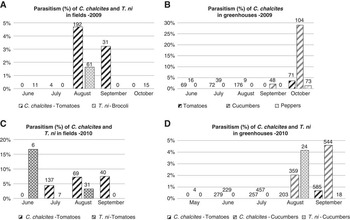
For C. chalcites, parasitised loopers were collected from tomato plants, Solanum lycopersicum Linnaeus (Solanaceae), in fields around the cities of Harrow and Leamington in the summers of 2009 and 2010 (42°05'07.25"N, 82°36'08.65"W; 42°02'11.54"N, 82°57'03.78"W; 42°02'36.45"N, 82°38'05.60"W; 42°05'00.78"N, 82°37'07.26"W; 42°02'00.82"N, 82°53'58.49"W). Parasitised C. chalcites were also collected from tomato, pepper, Capsicum annuum Linnaeus (Solanaceae), and cucumbers, Cucumis sativus Linnaeus (Cucurbitaceae), in greenhouses around Leamington and Chatham-Kent in the fall of 2009, and in the late summer and fall of 2010. For T. ni, a parasitised larva was collected from a broccoli plant in a field west of Leamington in August 2009 (42°02'36.45"N, 82°38'05.60"W), two from tomato plants in fields around Harrow and Chatham-Kent in the summer of 2010 (42°02'11.54"N, 82°57'03.78"W; 42°23'26.93"N, 82°09'27.13"W), and one from a cucumber plant in a commercial greenhouse northeast of Leamington in August 2010 (42°04'59.21"N, 82°34'10.93"W) (Fig. 1).
Parasitism (%) by Cotesia vanessae on Chrysodeixis chalcites and Trichoplusia ni collected from fields and commercial greenhouses in southwestern Ontario, Canada in 2009 and 2010. The numbers represent the total number of caterpillars collected each month on the indicated plants.

Parasitoids from these original field collections initially were reared at the Sunrite Greenhouses Biocontrol laboratory, Ontario (by H.M.), and subsequently at the Lethbridge Research Centre, Alberta (by V.A.D.H.). Colonies were maintained on T. ni purchased from the Insect Production Services of the Great Lakes Forestry Centre, Sault Ste. Marie, Ontario, which were reared on McMorran diet (McMorran Reference McMorran1965) (recipe modified by the Great Lakes Forestry Centre). Only females have been observed in our laboratory colony, reproducing by thelytokous parthenogenesis over multiple generations. From a subsample of 10 T. ni, each exposed to a single C. vanessae for 48 hours, an average of 103 adult parasitoids emerged (range: 56–165).
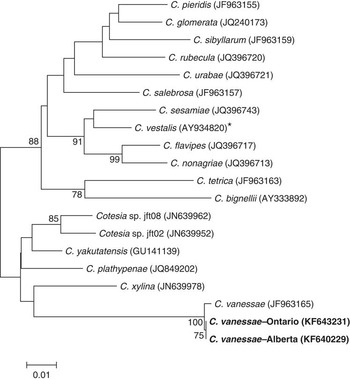
To identify the parasitoid species, we obtained CO1 sequences for specimens from the laboratory colony using primers and general methods as described in Hebert et al. (Reference Hebert, Cywinska, Ball and deWaard2003). All the sequences were identical, one of which (KF640231) was deposited in GenBank (http://www.ncbi.nlm.nih.gov/genbank/). This sequence was compared with existing sequences from GenBank, using similarity analyses that identified our specimens as C. vanessae (Fig. 2).
Neighbour-joining tree, K2P distance model for CO1 sequences for Cotesia species generated using Mega 5.2. Sequences obtained from GenBank. Bootstrap values<70 are not reported. *Although the name Cotesia plutellae (Kurdjumov) is used for this sequence in GenBank, the valid name for this species is now Cotesia vestalis (Haliday) (see Shaw Reference Shaw2003).

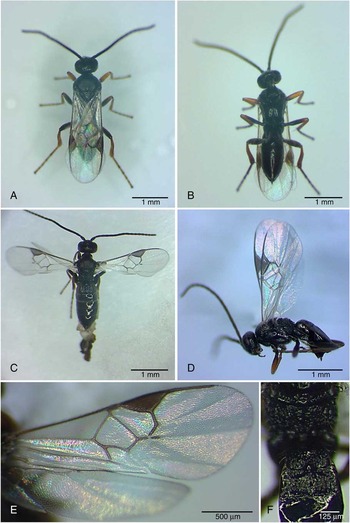
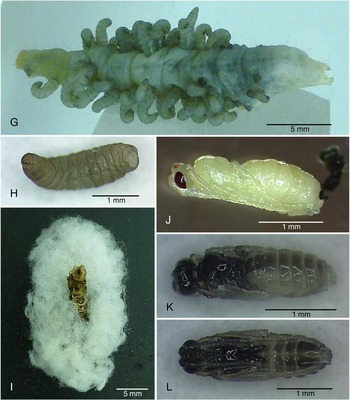
To characterise the morphology of this species, photographs of adult and immature C. vanessae are provided in Figures 3, 4. There are many similar Cotesia species, thus these pictures are not meant to be used to identify an unknown specimen. Reinhard’s descriptions of C. vanessae (Reinhard Reference Reinhard1880, Reference Reinhard1881) and Nixon’s (Reference Nixon1974) diagnosis correspond with our observations. However, the Ontario specimens tend to have lighter metafemur, metatibia, and metasoma (especially the laterotergites) compared with the specimens that we examined from northwestern Europe. Specimens from Libya and Ethiopia (perhaps really Eritrea) also have been reported to be lighter in colour than European specimens (Nixon Reference Nixon1974; Papp Reference Papp1987). Nixon (Reference Nixon1974) also drew attention to minor differences, that he considered to be of little significance, between European series reared from vanessines and noctuids – presumably merely season- and/or host-related.
Cotesia vanessae adults (all females): (A) live, dorsal side; (B) live, ventral side; (C) live, emerging from pupal exuvia, dorsal side; (D) dead, pointed, left lateral side; (E) dead, upper surface of right wings; (F) dead, dorsal side of propodeum and basal three tergites of metasoma.

Cotesia vanessae immature stages: (G) larvae (prepupae) erupting from a Trichoplusia ni larva before pupating; (H) prepupa just emerged from a Noctuidae host; (I) cocoon mass of about 80 cocoons around dead host; (J) one-day-old pupa, left lateral side; (K) three-day-old pupa, dorsolateral side; (L) five-day-old pupa, ventral side.

Collections from Alberta: A DNA sequence for C. vanessae, but not specimens, was recovered from a final instar larva of alfalfa looper, Autographa californica (Speyer) (Lepidoptera: Noctuidae), which had also produced a brood of a different species of Cotesia. The larva was one of about 30 A. californica collected for an unrelated study on 9 and 10 July 2012 from three canola fields; that is, 12 km NE of Claresholm (50°04'45"N, 113°26'21"W), 17 km NE of Claresholm (50°07'23"N, 113°26'21"W), 30 km E of Calgary (50°57'27"N, 113°31'42"W). Larvae were held indoors in a Plexiglas cage (30×30×30 cm) at 22 °C and fed canola leaves, Brassica napus Linnaeus (Brassicaceae) for three days after which an unidentified gregarious species of Cotesia emerged from most individuals. Based on morphology and CO1 sequences (KF640233), the parasitoid was not C. vanessae. However, in sequencing parasitised caterpillars to verify their identity, we obtained a CO1 sequence (KF640229) that was identical to that for C. vanessae from Ontario (Fig. 2).
We speculate that this A. californica was parasitised by both the unknown Cotesia species and by C. vanessae, but only the former emerged from the host. Cases of caterpillars being parasitised by two Cotesia species and progeny of both species successfully developing within the host have previously been documented (Ngi-Song et al. Reference Ngi-Song, Kimani-Njogu and Overholt2001).
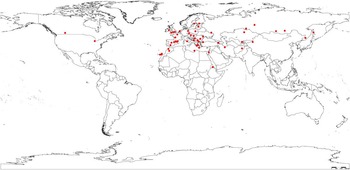
Current known range: Cotesia vanessae is widely distributed throughout the Palaearctic (Fig. 5). Nixon (Reference Nixon1974) recorded it from Eritrea (Asmara), Libya (Benghazi), Turkey, Italy, and “northwest Europe”. Stefanescu et al. (Reference Stefanescu, Askew, Corbera and Shaw2012) reported it from locations in central-western Morocco and north-east Spain. Specimens in the Natural Museum of Scotland also include records from: Israel (Negev Mountains), Bulgaria (East Rhodope Mountains), Greece (N. Peloponnese), Crete, Canary Islands (Lanzarote, Fuerteventura), Spain (Girona, Lleida, Barcelona, Córdoba, Aragon), France (Charente), Finland (Åland), and most of the counties in the southern half of England. Additional records (Fig. 5) are from Yu et al. (Reference Yu, van Achterberg and Horstmann2012).
Reported distribution of Cotesia vanessae. The North American reports are from this study. The Old World distribution includes unpublished data (specimens in the Natural Museum of Scotland). Figure generated using SimpleMappr.

We provide morphological, biological and genetic evidence that documents the first record of C. vanessae in North America. Where, when, and how this parasitoid may have been introduced to North America is unknown. We speculate that it may have been introduced into North America developing inside a host in a shipment of imported plants.
Recovery of this parasitoid from three pest species thus far (C. chalcites, T. ni, and A. californica) warrants further study of C. vanessae as a potential biological control agent against noctuid crop pest caterpillars. However, this parasitoid is also reported to parasitise nymphalid butterflies such that non-pest species are likely to be at risk. Benson et al., (Reference Benson, Driesche, Pasquale and Elkinton2003) showed that the deliberate introduction of C. rubecula (Marshall) for the biological control of pest Pieris butterflies had a negative impact on a native nonpest congener. Hence, monitoring the establishment and spread of C. vanessae in North America and its possible colonisation of native vanessines and noctuids is advised, before any deliberate manipulations in the interests of crop protection are attempted.
Acknowledgements
The authors thank Carolyn Herle, (Agriculture and Agri-Food Canada, Lethbridge, Alberta, Canada) for providing us field-collected alfalfa loopers from Alberta. They particularly thank Paul Coghlin (Agriculture and Agri-Food Canada, Lethbridge), who was instrumental in obtaining the CO1 sequences that verified the determination of C. vanessae. They also thank all the field and greenhouse growers who allowed us to take samples from their crops. Funding for this research was received from the Canola Council of Canada (Canola Agronomic Research Program Project 2012–1), Natural Sciences and Engineering Research Council of Canada, and the Alberta Conservation Association. This is Lethbridge Research Centre Publication No. 38713020.