Introduction
Opportunity to choose between hospitals is a new trend in Northern European health systems. This right was introduced in Denmark and Sweden at the beginning of the 1990s and in Norway in 2001. Currently, it is also being introduced in England. This raises important questions regarding the functionality of choice in public integrated systems and the consequences for other policy goals such as equity, democratic planning, and expenditure control.
The utilization of choice will depend upon reactions on both the supply and demand sides, i.e. the relationship between patients and the public health care system. We argue that patient behaviour is a function of multiple, intrinsic (patient-related), and exogenous institutional factors, including the regulative structure, the degree of variation in service and quality, and the availability of information. The institutional conditions for choice, therefore, strongly influence its utilization.
The right to choose can be interpreted as a gradual shift in the Scandinavian health care systems towards a more demand-driven system. This process reflects some of the elements in New Public Management (NPM) (Pollitt and Bouckaert, 2000; Ferlie, Ashburner, Fitzgerald, and Pettigrew, 1996; Kettl, 2000). From a narrow NPM perspective, one would expect patients to utilize choice to seek the best opportunities for treatment. This would send signals to the public provider organizations and would, in theory, spur the organizations to focus on service and quality for potential ‘customers’. As price competition is prohibited in the public health systems, the primary competition would revolve around reputation, service, and quality. Nevertheless, it can also be expected that organizations would develop better knowledge of their strategic position, as well as their internal cost structures, in order to consider potential strategies in response to choice. The potential benefits of choice depend upon a number of assumptions, including the willingness and ability of most patients to evaluate treatment options and act accordingly, the development of positive economic incentives for providers, and the general normative acceptance of choice as an option. Such assumptions will be investigated further below.
The Scandinavian experience presents a unique opportunity to study patient choice in integrated public health systems with universal coverage and strong roots in egalitarian welfare state ideas. Analysing patient choice in a comparative Scandinavian setting provides general insights regarding the barriers and potentials for this policy tool. Two related questions are addressed in this article: (1) How many patients in Scandinavian countries are exercising the right to choose between hospitals, and who is making use of this opportunity? (2) How can we explain the observed utilization pattern?
Framework, concepts, and questions
Answering the two questions posed above requires a discussion of the concept of choice. Tessier et al. (Reference Tessier, Contandiopolous and Dionne1985) conceptualized the differences in choice concepts, and Ringgard et al. (Reference Ringard, Rico and Hagen2005) developed this conceptualization further by introducing the concept of patient mobility. They divide patient mobility into three different types: (1) forced mobility resulting from insufficient supply at the local level; (2) physician-induced mobility resulting from GPs’ referral preferences and hospital affiliations; and (3) mobility due to patient choice. Chosen mobility is the core concept in this article, as it can be considered to be the same as patient choice. In many practical situations, however, it is difficult to distinguish physician-induced referral from chosen mobility. Patients require referrals to utilize choice, and referrals are usually given in a dialogue between patient and physician in which the degree of independent patient decision-making is variable and hardly measurable on objective grounds. This leads us to conclude that both ‘chosen mobility’ and ‘physician-induced’ mobility ought to be included in our study, as both reflect the impact of the added flexibility introduced by choice.
The analytic question ‘How can we explain the observed utilization pattern?’ requires hypotheses regarding the determinants for patient choice. We take an institutionalist starting point and argue that choice is a function of external regulatory factors (incentives, administrative procedures, rules etc.) and broader cognitive and normative institutional formations that become internalized as patient perceptions of needs, preferences, treatment options and their desirability, and quality and service dimensions (Scott, 1995; DiMaggio and Powell, 1993; Campbell, 2003). Such perceptions may in turn be influenced by patient ‘responsiveness’, modified by factors such as age, education level, employment, financial status, family status, and networks. We can thus construct a ‘model’ for patient choice entailing the following broad elements:
Patient choice = f [(patient intrinsic factors such as perceptions and preferences modified by factors such as age, education level, gender, employment, financial status, family status, and networks; ability to interact with the GP; prior experience; expectations of the need for follow-up and repeated treatment; habits and traditions) + (external institutional factors such as travel distance and costs, information regarding treatment options, waiting times and quality, GP referral patterns and advice, access to chosen departments, variation in service levels, treatment regimes and quality)].
This ‘model’ gives us reason to expect variations in choice patterns based on both intrinsic patient-related factors and external institutional factors. The comparative analysis of the three Scandinavian countries aims at illustrating some of the differences in utilization and some of the possible explanations in terms of variations, mainly in institutional factors, as many patient-intrinsic factors are assumed to be similar between the Scandinavian countries. Obviously, a very large and differentiated database would be necessary to perform rigorous tests of causal relationships in the model. We do not have access to such differentiated data, and can only indicate relationships based on available data sources and analytical interpretations of these data, as well as supplementary qualitative data sources.
It should also be noted that there may be interaction between the respective ‘independent’ variables, e.g. between education level and GP referral patterns. Also, as described above, there may be variables such as GP referral that are partially intrinsic and partially external.
We will thus investigate selected intrinsic and external institutional factors based on initial assessments of importance and data availability. This translates into the following working questions: Are patients aware of the opportunity to choose between hospitals? Are patients motivated to choose? Which factors are important to patients when choosing hospitals? Are data about the treatment regimes, service (waiting times), and quality available to them in an understandable format? What are the administrative rules for choice and the incentives for hospitals and GPs?
Method
This study is primarily based on secondary data from different studies undertaken in the three countries. The data sources used in the three countries consist of the following:
The data for Norway mainly stem from three database sources. First, the data used in the description of the use of the right to choose between hospitals were drawn from the Norwegian Patient Register (NPR) (Huseby, Reference Huseby2004a, Reference Huseby2004b; Kristiansen and Sunnevåg, Reference Kristiansen and Sunnevåg2003). This register was initiated in 1997 by the Ministry of Health and Social Services, which owns the register. Among other things, the register includes data about all hospitalizations at somatic hospitals. The second source, used in the description of waiting lists, is derived from the national database on waiting lists (www.sykehusvalg.net). The third source, describing patients’ interpretations of free choice of hospitals, is based on Christensen and Hem (Reference Christensen and Hem2004), who undertook a cross-sectional survey with a self-administrated questionnaire. Reference is also made to other survey and interview-based studies.
For Denmark, the main sources are official Ministry of Health reports on utilization (e.g. Ministry for the Interior and Health, 2005), including data from the Danish National Patient Registry (DNPR), websites with official information on waiting times and quality (www.sundhed.dk), national patient satisfaction surveys (EfB, 2001, 2003, and 2005), and various regional and national supplementary studies.
For Sweden, the data stem from a study of patient mobility conducted by the National Board of Health and Welfare (NBHW), as well as a national database covering waiting times for elective secondary care. The database is administrated by the Swedish Association of Local Authorities and Regions (formerly the Federation of County Councils) and covers waiting times for different forms of treatment and examinations. Data in the article are also collected from a thesis investigating the implementation of patient choice policies in Sweden (Winblad Spångberg, Reference Winblad Spångberg2003). Information from other research studies has also been used.
Distinguishing patient choice and other types of patient mobility from one another posed a methodological challenge in the study. In a number of instances, we have been forced to use the less-precise definition of patients who are treated at a hospital in another administrative region than the one they reside in. This broader definition includes patients travelling for specialized treatment in other counties (so-called forced mobility) as well as chosen mobility and physician-induced mobility across administrative boundaries (category 3 above) but excludes intra-county choice. The inclusion of specialized treatment, i.e. treatment in other counties due to insufficient supply at the local level, is problematic considering our focus on chosen mobility. We will therefore emphasize this problem whenever we are forced to rely on this type of data. We argue that the amount of inter-county/region referrals for specialized treatment is limited and relatively constant everywhere. This means that whenever our data indicate increases in the number of inter-county treatments over time, it is likely to be a result of chosen mobility or physician-induced mobility.
One reason for exclusively focusing on choice of hospital in other counties/regions is that we lack data on patient mobility within the administrative regions, i.e. the counties/regions. In addition to this lack of data, there are two other arguments for excluding choice within counties/regions. Firstly, there has been a strong trend towards centralizing treatment options by merging hospitals and departments into ‘function-bearing units’. This dramatically reduces the relevance of (and indeed the opportunities for) in-county choice. This also creates difficulties as regards the development of time series data for in-county choice activity over time. Secondly, intra-regional choice is less challenging for the public planning system than inter-regional choice, as financing and delivery proceeds within the same administrative structure.
Healthcare is handled by different administrative levels in the three countries. The populations of the 15 counties in Denmark differ somewhat (between 43,000 and 660,000 inhabitants. As of 1 January 2007, the 15 counties have been re-aligned to form five regions with populations ranging from 577,000 to 1,634,000 inhabitants), the 21 counties in Sweden (between 127,000 and 1,890,000 inhabitants), and the five regions in Norway (between 460,000 and 1,700,000 inhabitants).
It is evident from this discussion that there are numerous shortcomings in the available data. In general terms, this leads us to exercise caution when drawing comparisons and to focus on relative development trends rather than absolute levels.
How many patients are exercising their right to choose hospitals?
In this section, we will summarize the available evidence on the utilization of choice and those who are making use of this opportunity in Norway, Denmark, and Sweden.
Norway
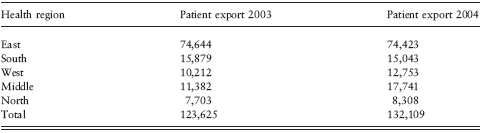
In 2004, 132,000 patient contacts (inpatient and outpatient) were conducted outside the patients’ residence areas. Approximately 10% of all patient treatments and 14% of all elective patient treatments were conducted outside the patients’ residence areas (SINTEF-Helse, 2005). Table 1 below illustrates patient export from the five regions in 2003 and 2004. It indicates that three of the five health regions increased the number of patients treated outside the patients’ residence areas.
Patient export from the five regions in 2003 and 2004
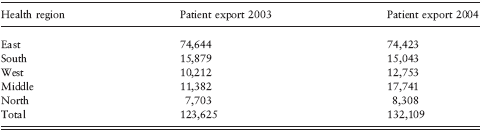
Several studies identify a trend of increasing use of treatment in other regions. A study based on cross-border patient flows from two years prior to the reform (1999–2000) to two years after the reform (2001–2002) reveals that the import of surgery patients increased from 7.7% (16,051 patients) to 13.3% (30,939 patients) (Kristiansen and Sunnevåg, Reference Kristiansen and Sunnevåg2003: 19). Finally, one survey was carried out in order to identify how many of the cross-region patients had used chosen mobility; it showed around 50% (45% for 2003 and 52% for 2004) (Christensen and Hem, Reference Christensen and Hem2004).
In addition to an increasing trend in the respective numbers of cross-border patients, this study also identified an increasing use of private providers in other regions, particularly for the urban areas (Kristiansen and Sunnevåg, Reference Kristiansen and Sunnevåg2003: 20). The number of visits to private commercial hospitals increased by 180% from 2002 to 2003 (Huseby, Reference Huseby2004a).
One explanation for the increase in cross-border patients is not directly related to free choice but instead to a realignment of the borders. A new reform was implemented in Norway in 2002 (the Health Reform), dividing the country into five regions instead of a large number of counties. Oslo, the Norwegian capital, was subsequently divided: one part of the city belonging to Health Region South and the other to Health Region East. Consequently, many patients in Oslo use the hospital closest to their residence, even if they do not belong to the region in which the hospital is located.
Regarding those exercising their opportunity to choose between hospitals, Godager, and Iversen (Reference Godager and Iversen2004) demonstrated that the most important variable is the patient’s education background. Moreover, Norwegian female patients are more likely than males to consider choosing a hospital (Godager and Iversen, Reference Godager and Iversen2004).
Denmark
A study based on data from the DNPR revealed growth in the share of non-emergency patients treated outside their home county (from 8% in 1997 to 11.3% in 2003). These figures include chosen mobility and physician-induced mobility, but largely exclude treatment at higher levels of specialization and exclude all intra-county mobility (Ministry for the Interior and Health, 2005). The share of patients treated in other counties is considerably greater in Zealand (the island including the Copenhagen metropolitan area) than in Jutland (the predominantly rural peninsula north of Germany), probably due to shorter transport distance and a concentration of treatment facilities in and around the capital city.
Regarding those who exercise their right to choose, there are Danish studies indicating that specialty, age, and social background influence patient choice (e.g. Vrangbæk, Reference Vrangbæk1999). Area of specialty influences the utilization of choice amongst patients on the grounds that the share of elective patients influences the opportunity to choose and may influence the preferences for a shorter waiting period or shorter distance to hospital. One study of three counties indicated that inpatients referred to departments of rheumatology, ophthalmology, orthopaedics, or paediatrics and outpatients referred to rheumatology, orthopaedics, or paediatrics were especially likely to choose a hospital outside their home county (Birk and Henriksen, Reference Birk and Henriksen2003). In one study, short waiting time was the most important factor for patients referred to the ophthalmology, orthopaedics, or otorhinolaryngology departments, while short distance was the most important factor for patients referred to the surgery, internal medicine, or gynaecology/obstetrics departments (EfB, 2003). Patients aged 50–54 years are especially likely to exercise their right to free choice within two months of referral (National Board of Health, 2006). GPs report that patients with a medium or long education and patients from the middle or higher social classes are those most likely to utilize choice (Vrangbaek, Reference Vrangbæk1999).
Sweden
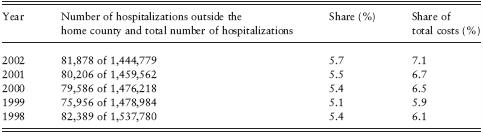
Thus far, relatively few patients have opted for care at hospitals in other parts of the country. A recent study from the National Board of Health and Welfare (NBHW) indicates that the patient flows between the county councils in Sweden increased only marginally from 1998 to 2002 (see Table 2). The care provided outside the home county makes up 5–6% of the total care (Socialstyrelsen, 2005).
Number of hospitalizations outside the home county
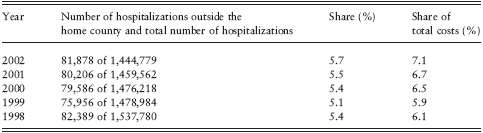
It is impossible to tell from these numbers how many of the hospitalizations in other counties represent chosen mobility. According to the authors of the report, approximately half of the hospitalizations in other counties are due to emergency cases (43%). The other half (47%) are mostly due to specialized treatment being provided in other counties because of inadequate capacity in the home county. Apparently, very few of these are actually due to patients acting on their own to choose treatment outside their home counties. Utilization varies significantly between counties. The counties of Uppsala and Västra Götaland in central Sweden receive the greatest number of patients from other counties, while Norrbotten in the North receives the smallest number of patients. To summarize the Swedish case, few patients chose a hospital in other counties and the number has increased only marginally since 1998. For some counties, however, the introduction of choice has increased costs considerably, e.g. many of the patients in Halland County in southern Sweden have sought care in nearby Gothenburg, resulting in costs of 21,800,000 Euro (200 million SEK) annually (Landstingsvärlden, 2004).
Another study conducted by the Swedish Association of Local Authorities and Regions (2006) investigated patient choice regarding knee and hip replacements and cataract care. In 2004, 8% (710 patients) of the total number of knee replacement patients chose care in other counties. The figure for hip replacement patients was 5% (950 patients) and 7% for cataract surgery (5,178 patients). It is important to note that these figures include both specialized treatment due to insufficient resources in the home county as well as ‘chosen mobility’ patients. Nevertheless, these numbers are higher than in the study presented above. One probable explanation is that patient choice is most commonly exercised in relation to orthopaedics, where the waiting lists have been quite lengthy in some counties.
To sum up, the figures differ considerably among the Scandinavian countries. The available data indicate that the number of cross-border patients in Norway was 132,109 in 2005. Of these, around 50% were chosen mobility patients. Approximately 14% of all elective patients’ treatment was provided outside the individual patient’s area of residence. Up to 11.3% of Danish elective patients were treated outside their home county. Sweden, which does not have the same type of data as Norway and Denmark, had about 82,000 (5.7%) cross-border (both elective and emergency patients) patients in 2002, indicating that the use of patient choice is still quite limited in Sweden.
Perhaps more importantly, we see that there is a slightly increasing trend in all countries. The number of elective surgery cross-border patients increased from 1999–2000 to 2001–2002 from 7.7% to 13.3% in Norway. There was a slightly lower percentage of increase in Denmark (from 8% to 10.5% between 1997 and 2002) of elective cross-border patients. For Sweden, the number of both elective and emergency cross-border patients increased from 5.4% to 5.7% between 1998 and 2000, and rose for certain specialties to 8% in 2004. Nevertheless, the utilization of free choice appears lower in Sweden compared to Norway and Denmark.
Why do so few patients choose?
In this section, we will provide tentative explanations for the observed patterns of choosing by describing and analysing the differences for each country. Initially we describe the intrinsic factors (patients-related), followed by the exogenous institutional factors.
Intrinsic factors
Are patients aware of their right to choose between hospitals?
Norway
Inpatients’ awareness of their freedom of choice is relatively high (69%) and growing (Christensen and Hem, Reference Christensen and Hem2004: 30). In the first years following the new Patient Rights Act (2001), complaints were registered in the media about the limited awareness of the opportunity to choose between hospitals. That led to comprehensive information campaigns carried out by health authority. For example, the government introduced a national website with information concerning the right to choose freely between hospitals together with a toll-free information hotline. One indicator of the results of these efforts is that there were 7,700 individuals who called the number in the first three months of 2004, and this figure is continuously increasing (www.helse-ost.no/nyheter 01.03.04–31.03.04). While the government has made extensive efforts to make information easily accessible, studies indicate that people continue to become aware of their new rights from newspapers (32%), while information provided by GPs comes second (18%) (Christensen and Hem, Reference Christensen and Hem2004: 30).
Denmark
Awareness amongst elective inpatients regarding their freedom to choose is high and growing (81% in 2000 and 87% in 2004) (EfB, 2001, 2005). This awareness varies according to specialty and is highest amongst patients referred to internal medicine, ophthalmology departments, otorhinolaryngology departments, and outpatient rheumatology or orthopaedics clinics. It is lowest amongst patients referred to geriatric departments and parents of children referred to paediatric departments (EfB, 2003).
Sweden
The Swedish Federation of County Councils (FCC) asked several thousand people four times a year up until 2004 whether they knew if they had the right to choose a hospital. Only every second person (51%) affirmed this (Landstingsförbundet, 2004). This percentage was fairly stable throughout the measurements. Patients also have the right to a second opinion if they are seriously ill. Knowledge about this was very low when measured in 2001 (Socialstyrelsen, 2001).
In summary, it appears as though the awareness of the right to choose between hospitals is highest amongst Danish patients (80%), with Norway following at 69% and Sweden at 51%. It is interesting to note that the Norwegian figure is 69%, even though choice was introduced almost a decade later than in Denmark and Sweden.
Are patients motivated to choose?
While many patients are aware of their right to choose, relatively few patients do so. It is therefore relevant to enquire whether or not patients are motivated to choose. This is evaluated by examining the limited evidence on patient preferences regarding choice and by examining variations in hospital profiles and differences in waiting times. The assumption is that patients will be more motivated to choose if there are significant (and commonly known) differences in treatment/service profiles and waiting times, i.e. if there are relevant alternatives and variations in service levels. Patients may have different preferences in terms of treatment for the same condition. The procedures for giving birth offer a good example, where frequencies for caesarean births, access to pain-reducing drugs, and access to alternative birth procedures vary internationally as well as between different hospitals, and where many women have pronounced preferences. The relevant question regarding choice is whether there are significant differences relating to treatment practices in other specialties, and patients appear to have strong preferences for particular treatments as well as access to systematic information concerning procedural variations. We can only provide limited answers to these questions and mostly as regards the availability of information. Preferences for treatment types are likely developed in interaction with GPs, but further studies are required to provide firm conclusions.
Another type of variation that possibly induces the exercise of choice concerns expected waiting times. If significant waiting time variation persists and patients have access to reliable information about it, we could expect that patients with strong preferences for short waiting times would utilize choice.
Patient preferences
Norway
No studies have been conducted regarding the extent to which patients are interested in choosing hospitals in Norway. However, there are studies indicating the amount patients are willing to pay for exercising their free choice between hospitals. In one study, those who had chosen their hospital were asked if they would have used the service if it were more expensive. If the co-payment increased from 400 NOK (50 Euro) to 600 NOK (75 Euro), then 45% stated that they would still be interested in choosing their hospital. If the co-payment increased to 800 NOK (100 Euro), the percentage would fall to 38% (Christensen and Hem, Reference Christensen and Hem2004: Figure 6).
The two most important factors for choice appear to be the reputation of the hospital, particularly the perception of the competence level (Christensen and Hem, Reference Christensen and Hem2004: Figure 6). Less important factors include quality information on the Internet and prior negative experiences with the hospital.
No systematic national data about treatment profile differences (treatment offers/types of medical technology etc.) are available for patients, but many hospitals and regions publish more or less detailed information. Hospitals also provide information to GPs concerning treatment options/profiles.
Despite the introduction of choice, waiting time differences persist. Patients apparently value other factors just as highly as the expected waiting time (see above).
Denmark
Up to 10% of non-emergency patients receive treatment in other counties. The share differs by county (Ministry of the Interior and Health, 2005). The patterns vary somewhat over time, but there is a tendency for some counties to remain net importers, while others are net exporters. Most healthy citizens assume that if they fall ill, they would choose by themselves and the choice would be determined by short waiting time and high quality; 82% of the participants in a telephone survey reported that they would be willing to travel outside of their counties to be treated at the hospital with the highest quality of care (PLS Consult, 1999). Actual (revealed) preferences of elective patients are more heterogeneous than healthy people’s hypothetical preferences, as patients facing a choice are less willing to travel (Birk and Henriksen, Reference Birk and Henriksen2006).
Choosing the hospital closest to one’s home often represents a deliberate act; inpatient studies reveal that short distance is the most important factor affecting patient choice (EfB, 2001, 2005).
Waiting time is an important factor in the choices of 22% of elective patients (EfB, 2005). Waiting time may serve as a confounder for uncertainty about the length of the waiting time; some patients are willing to wait longer if they know exactly how long they must wait (Birk and Henriksen, Reference Birk and Henriksen2006).
Patient perceptions of the service and quality at various hospitals play a major role for choice; in 2004, personal experience with one or more hospitals influenced 41% of Danish patients who chose by themselves; hospital reputation influenced 41% of the patients’ choices (EfB, 2005). The experiences of relatives and friends with various hospitals played a major role when choosing between hospitals, while the media were much less important (Birk and Henriksen, Reference Birk and Henriksen2006). Patients generalized their experience with one department to the hospital as a whole. If satisfied with the treatment they had received at a hospital, they were more likely to choose the same hospital again, even if they required an entirely different kind of procedure (Hansen, Reference Hansen1994).
Limited national data on differences in treatment profiles (treatment offers/types of medical technology etc.) are available for patients, but many hospitals and regions publish information in varying levels of detail. Hospitals also provide such information to GPs and practicing specialists.
Waiting time differences persist despite the introduction of choice. Patients would thus appear to value other factors at least as highly as the expected waiting time (see above). The government introduced a waiting time guarantee for all types of treatment in 2002, providing access to a number of private hospitals and treatment facilities abroad if the home county could not provide treatment within two months (one month as of October 2007). The utilization of this scheme reveals a slightly increasing trend, although many patients still appear to value proximity higher than quick access.
Sweden
No systematic national study of patient preference regarding choice is available. However, some studies indicate that patients want to choose the provider of care and consider this right to be important; a great majority wants to choose their own GP, and 66% considered it very important to choose their hospital. Only 5% found this right unimportant (Anell and Rosén, Reference Anell and Rosén1995). When patients were asked about their actual choice behaviour, three out of four had wanted to be referred to a specific hospital, indicating that many patients want to choose when alternatives are available (Stockholms Läns Landsting, Reference Stockholms Läns1993).
There are no national data on differences in treatment profiles (treatment offered/types of medical technology etc.) available for patients.
Waiting time differences persist in spite of the introduction of choice. Patients apparently value other factors at least as highly as the expected waiting time (see above).
Exogenous institutional factors
The introduction of policies enhancing choice in Norway, Denmark, and Sweden is a relatively recent phenomenon in the health care context, wherein elective patients traditionally were restricted to using the nearest medical facility. In comparison with other Beveridge type health systems (and even some social health insurance systems), the right to choose in the Scandinavian countries must be considered far-reaching, although some legislative and practical barriers remain in all three countries. First, the level of treatment (primary care or secondary care) is decided by the GP in both Norway and Denmark, and the patient will not be able to change treatment level. In Sweden, most counties employ a system in which patients are able to seek secondary care without contact with their GP. Second, there is a limited supply of private providers in all three countries and some restrictions in publicly funded access to private facilities (see below). Third, emergency care patients are generally not included for obvious practical reasons.
‘Free choice’ is thus a rhetorically powerful notion in all three countries (see Nordgren, Reference Nordgren2005, for a detailed discussion on the rhetoric for free choice), but the institutional implications vary somewhat. This could explain some of the observed variations in utilization. In the following, we will further examine the similarities and differences in the exogenous institutional factors for choice.
Administrative rules
Norway
In Norway, free hospital choice began with an experiment in one region. This was followed by a voluntary national arrangement, and free hospital choice was finally enacted in January 2001 (Ministry of Health and Social Affairs, Ot prp nr 12, Patient Rights Act (1998–1999);Footnote 1 Ministry of Health and Social Affairs, Innstilling, O nr. 91 (1998–1999), Lov om pasientrettigheter). In addition to the right to a second opinion and treatment, the Patient Rights Act also included rights to involvement and information, to approval of health help, access to medical records, special rights for children, and a patient representative agreement (i.e. a representative for the patient). In other words, the Patient Rights Act encompassed a broad package of rights that went far beyond merely being able to choose freely between hospitals (Vrangbæk and Østergren, Reference Vrangbæk and Østergren2006).
The implementation of the Act initially presented a number of difficulties. On 2 December 2003, the Norwegian parliament therefore made a number of amendments to the Patient Rights Act (Ministry of Health and Social Affairs, Ot.prp. 63 (2002–2003); Ministry of Health and Social Affairs, Besl.O.nr. 23 2003–2004). There were three major changes to Section 2-1 relating to the right to specialized healthcare. The first constitutes that the specialized healthcare service is to determine a time limit in line with sound medical practice, within which the necessary treatment must be provided. Second, if the regional health authority (RHA) responsible for the patient fails to provide the necessary treatment within the time limit, the patient has the right to be transferred without delay to a private healthcare provider or a healthcare provider abroad. Third, if the RHA cannot provide adequate treatment from a Norwegian facility, the patient has the right to be administered the necessary treatment abroad within the given time limit.
Elective patients are now free to choose between any public or private hospital (if they have a contract with a public hospital) in Norway, if their GP (the ‘gatekeeper’) detects grounds for referral to hospital treatment. The patient may choose amongst any of these hospitals immediately from the time of referral and is free to change his/her mind later on. The choice is extended to additional hospitals abroad if the patient is facing an expected wait of more than the limit set by the physician at the initial visit. The idea is to place additional pressure on the region to maintain short waiting times. After receiving a referral, the hospital must inform the patient about the day of admission for the beginning of treatment. There is a limit to how long the patient must wait (based on medical prioritizing) for treatment to begin; if treatment cannot begin within this limit, the patient is free to choose a hospital abroad.
The Act is also generous with regards to the amount the patient must pay. Norwegian patients do not pay for choosing between hospitals, except for a fee to the GP and a travel fee. The procedure dictates that the patient must go through his/her GP to be referred to specialist care. The co-payment for the patient for a referral is 15.6 Euros (125 NOK) during daytime and 26.3 Euros (210 NOK) in the evening. The patient must also pay 55 Euros (440 NOK) in co-payment, while travel expenses are covered by the Regional Health Authority (2005 prices).
Denmark
On 1 October 1992, the counties introduced freedom of choice throughout Denmark. On 1 January 1993, freedom of choice was introduced by law, allowing patients to choose between public hospitals at the lowest sufficient level of specialization if the receiving hospital was willing to accept them.
Fewer patients exercised their right to choose than had been expected. Assuming that this limited utilization was due to barriers, several consecutive governments have extended patient rights. Since July 2006, elective patients have been free to choose between any public Danish hospital and a few hospitals owned by patient associations in the event that their GP (the ‘gatekeeper’) finds referral to hospital treatment warranted. The patient may choose between any of these hospitals immediately from the time of referral, and he/she is free to later change his/her mind. An ‘extended free choice of hospitals’ was introduced in July 2002. This legislation implies that patients are free to choose between a number of private hospitals and hospitals abroad if the home county cannot offer treatment in a public hospital within two months, thereby placing additional pressure on the counties to secure short waiting times. Patients may currently choose from a list of 162 private providers (as of 24 July 2006) in Denmark or abroad. The national government has stated that the limit on waiting time will be reduced to one month by October 2007.
Within eight days of receiving a referral, the hospital must inform the patient about details such as the admission date, whether the hospital can receive the patient within two months, that the patient is free to choose another hospital, information about waiting times and patient volume at other hospitals, and offer to refer the patient to another hospital. Patients are prioritized solely on the basis of a medical assessment of severity. Receiving hospitals are not allowed to differentiate between local and ‘choice’ patients.
If a patient suffers from one of a number of life-threatening cancers or heart diseases, the county must offer treatment abroad if it is unable to find a public Danish hospital offering examination and treatment within a set time limit (generally two weeks, but this varies according to disease).
Danish patients do not pay for visits to a GP, hospitalization, or exercising the right to choose, except for travel costs beyond the nearest public hospital in the home county. The county will only finance the utilization of private hospitals in the event that the patient has been referred by the county.
Sweden
Several policies were introduced in Sweden in the beginning of the 1990s with the intent of enabling patients to choose. This was a new phenomenon in the Swedish context, where the patients had traditionally been restricted to using the nearest medical facility. Unlike the other Scandinavian countries, free choice was not legislated; instead, it was simply adopted by the Federation of County Councils in 1989. There was little political dispute over the issue, and all county councils, regardless of the political bent of the majority, agreed on the proposal introducing free choice as of the beginning of 1991. With some exceptions, this entitled patients to seek care throughout the entire country at primary care centres and at certain hospitals or private clinics. In 2000, the Federation of County Councils clarified and simplified the rules, updating the old recommendations and extending the policy. Many counties strongly opposed this revision. For instance, the four Northern (Social Democratic) counties found that they could not afford to pay for patients opting for care in other parts of Sweden. They also considered the policies to be unfair, since only strong, young patients used them. After heated debate, the Swedish government threatened to legislate patient choice if the counties did not accept the revision. It was not until the summer of 2003 that all of the county councils accepted the new recommendation (Winblad Spångberg, Reference Winblad Spångberg2003).
The free choice recommendation provides the patient with the right to choose between hospitals or specialists throughout the entire country, except for highly specialized care. In eight out of 21 of the counties, patients require a referral from a GP or a private physician to seek hospital care outside their home county. Patients from counties without an internal referral system only need a referral for inpatient care in other counties to prove that the care will be reimbursed by the home county.
Comparing the three countries, we see that there are few formal regulatory barriers for choosing between public hospitals and relatively extensive access to publicly funded care in private hospitals. Explanations for the limited use of choice must be found elsewhere. The GP has an important role as a gatekeeper to the system, especially in Denmark and Norway. However, GPs have incentives to please the patients; and once the referral is given, the patient has extensive rights to choose between public and some private facilities.
Incentives for hospitals
Norway
Health regions treating patients from other regions are usually compensated at 80% of average DRG rates instead of the usual 60% average DRG rates. The regions can negotiate to change the percentage. The regions are also free to choose whether the revenue for the choice patients should go directly to the local health enterprise (the hospital) or to the regional coffers.
Denmark
Counties treating patients from other counties receive full DRG payment. Danish DRG rates are based on a calculation of average cost structures. This means that counties/hospitals with below average costs will enjoy immediate economic gains from attracting out-of-county patients. Counties/hospitals/departments may also perceive choice patients as beneficial in order to maintain or expand particular activities. When freedom of choice was introduced, the compensation was smaller, intended only to reflect the hospitals’ marginal costs to prevent rising costs in the traditionally supply-driven sector (Vrangbæk and Beck, Reference Vrangbaek and Bech2004). The counties are free to choose whether the revenue for choice patients should go to the hospitals directly or via the county budget.
Sweden
The patient’s home county always pays for care chosen in another county. How much the receiving hospital receives for admitting a patient from another county varies; the receiving hospital has the right to charge for its own costs. It also varies whether the revenue goes to the hospital centrally or to the department concerned.
Comparing the three countries, Denmark and Sweden have the most developed market solution in the sense that the counties must pay 100% of all exported patients. In Norway, it is almost the same, with 80%. The counties in Denmark and Sweden therefore have greater incentives than those in Norway to restrict choice due to extra costs.
Incentives for GPs to choose freely between hospitals
Norway
The reform of the patient list system in 2001 has changed the role of GPs; it is now less that of a gatekeeper than previously was the case, as GPs have increased the incentives to satisfy patients in order to keep them on their lists. Carlsen and Norheim (Reference Carlsen and Norheim2003) demonstrate that GPs have experienced a shift in power in the physician–patient relationship in favour of the patient.
Another study conducted by SINTEF Unimed in May 2001 (the same year the reform was introduced) revealed that not every third GP wants to have anything to do with free choice of hospital (Aftenposten, 26.05.01). After this study, the Health Ministry emphasized that the role of the GP includes responsibility for informing patients about free choice.
GPs play a rather significant role in the choice process. According to ‘choice’ patients, 40% decided to use free choice of hospital together with or under the influence of the GP, and 13% decided to use free choice of hospital because of advice from a GP (Christensen and Hem, Reference Christensen and Hem2004).
Most Norwegian GPs are private. The individual GP’s income is determined by capitation fees and fees-for-service paid by the central government. The incentive for GPs to use free choice of hospital for their patients is to satisfy the patient and to keep the patient enrolled. Nevertheless, informing patients about their right to choose is time consuming.
Denmark
Danish GPs are self-employed (private). In order to receive fees from the county, a GP must have a contract with the county. The individual GP’s income is determined by capitation fees and fees-for-service paid by the county. The sole incentive for the GP to recommend a specific hospital is to satisfy the patient in order to keep the patient enrolled.
Some GPs may find it time consuming to inform patients about their right to choose and the hospitals available to choose from. Anecdotal evidence supports this impression. This may reduce the actual utilization of free choice, as some GPs may simply choose on behalf of their patients unless the patients have strong preferences for particular facilities or actively demand information about alternatives. The patients in one study reported that GPs chose on behalf of their patients in up to 50% of all referrals, while 30% of the patients in the same study reported that their choice was strongly influenced by their GP (EfB, 2005). In light of the high awareness regarding choice (see above), these results indicate that a considerable number of patients discuss possible choices with their GPs. At least 30% of all patients chose to rely on the advice from their GP after having discussed the matter. About half of the patients accepted the GP choice more or less consciously. Choice has thus entered as a potential option in the referral process and in the relationship between patients and GPs, although many referrals still tend to follow traditional patterns unless patients have particular reasons for raising the issue.
Sweden
Most Swedish GPs are publicly employed and receive a monthly salary; however, there are also many private GPs. Income for private GPs is closely connected to productivity. Still, neither the public nor private GPs have any personal economic incentives to refer patients to certain hospitals, and the GPs are never responsible for the costs of referred patients. On the other hand, informing patients about different caregivers and waiting times may be costly and time consuming for both private and public GPs. A survey of a large number of GPs has revealed that there were no direct formal limitations built into the economic incentive system preventing GPs from helping patients to choose. However, a large share of the GPs found that the policies had a negative impact on working conditions. For instance, informing patients about choice was time consuming. The study also showed that GPs who felt professionally threatened by the policies were less willing to inform patients about their right to choose (Winblad Spångberg, Reference Winblad Spångberg2003).
In summary, the GP appears to have an important role concerning hospital choice in all three countries. Swedish GPs have no direct financial incentives hindering the choice. In Norway and Denmark, however, where GPs are self-employed, incentives exist that possibly hinder the choice on the grounds that helping the patient make the choice time consuming.
Is information available and understandable?
Another possible explanation for the relatively limited use of choice in the three countries is that they differ regarding the availability of patient information for choice.
Norway
Since the introduction of free choice of hospital in Norway, several information campaigns have been launched to increase general awareness about the new rights. Both a private and a public website have been established with information regarding the right to choose freely between hospitals. The websites include waiting times and quality indicators for the various healthcare providers (http://www.sykehusvalg.net). Two years after implementing the new Act, over 400 patients visited the new public website each day. Another indicator of a large search for information is the use of patient advisers. There are five patient advisers (one in each region), and they received 22,000 questions between May and December 2003 (Dagens Medisin 29.01.04).
Waiting time information
Waiting time prognoses published monthly indicate that there are differences between hospitals. The Norwegian Patient Register (NPR) is responsible for collecting and verifying patient data submitted by somatic and psychiatric institutions. However, it is important to be aware of the fact that all of the data are self-reported, either by local health enterprises or by regional health authorities. The control function carried out by NPR is only on the registration process and not on the quality of the data.
Variations in quality
National quality indicators are used in Norway in order to identify differences in quality between the hospitals. In September 2003, national quality indicators were published which then consisted of ten indicators including the number of corridor patients, i.e. patients placed in the corridor due to capacity problems, the time for epicrisis, the preoperative bedtime after femoral neck fracture, the number of hospital infections, and patient experiences and numbers of compulsory commitments to psychiatric hospitals. Waiting lists are also an aggregated indicator of quality. These indicators have been further developed; 15 indicators existed in 2005 (nine in somatic care and six in psychiatric care).
The indicators have three aims. First, they provide a basis for internal quality development in the hospitals. Second, they provide better management information to the leaders in health services and administration. Third, they give physicians, patients and the general population information about qualitative aspects in the hospital (SAMDATA – Sykehus Rapport, 2002). Some of the indicators are difficult to understand for the patient using them to help make choices (Østergren, Reference Østergren2006).
Denmark
Hospitals are mandated by law to inform patients of their right to choose. Moreover, the government has published information available at most GP and practicing specialist offices.
Waiting time information
After the introduction of choice, the counties started sending waiting time prognoses to the GPs on a regular basis. In recent years, the prognoses on paper have been supplemented or replaced by information on the county websites and a national website (www.venteinfo.dk and www.sundhed.dk).
Official waiting time forecasts are now published on the Internet for common, elective, and surgical procedures. These figures indicate that differences in waiting times for treatment at different hospitals persist more than a decade after introducing choice. The body of expected waiting time data are based on reporting from the counties and illustrates the average expected waiting times (http://www.venteinfo.dk/ventelister/).
Variations in quality
Data pertaining to hospital volume but not surgeon volume are available for many elective interventions from a national website (www.sundhed.dk). The counties inform GPs in their own area of the interventions performed in their hospitals. Hospitals and departments have recently started describing their services in greater detail. A national website provides information about which private providers offer services for patients who cannot be assured treatment within two months (www.sygehusvalg.dk). Patients can search here for providers by county and intervention.
In October 2006, the national authorities launched a new comprehensive information system with quality information for patients. A website provides access to data for all departments and the most common treatment types under the five headings of: hygiene, physical characteristics of the hospital (e.g. number of beds per room), patient-reported safety, patient-reported satisfaction, and timeliness for diagnosis and treatment. An aggregated star rating (from 0 to 5 stars) is provided based on these five dimensions.
Some of the national and regional databases on clinical quality enable comparisons by department and specialty (e.g. The Danish Vascular Registry) or intervention (e.g. The Danish Hysterectomy Database). A national website presents results from some of the most comprehensive databases (currently covering heart failure, hip fractures, lung cancer, schizophrenia, strokes, and diabetes). The databases enable comparison at the hospital department level. The www.sundhed.dk website also presents results from national patient satisfaction surveys. A national initiative (the Danish Quality Development Program: http://www.kvalitetsinstitut.dk/) attempts to integrate the various ongoing projects (expanded clinical databases, accreditation, benchmarking etc).
Another attempt at overcoming information gaps has been the mandatory employment of independent patient advisors in all counties.
Despite these efforts, it appears as though patients and GPs primarily rely on anecdotal evidence in many treatment areas when assessing departments. Time constraints and difficulties in interpreting the available data are contributing factors.
Sweden
The government has not launched any central information campaign about the right to choose, because this right is based on a recommendation introduced by the Federation of County Councils, not legislation. Each county provides information on its website about the freedom to choose. The quality of this information varies considerably; some of the counties have direct links to basic information about the regulation accessible at the Swedish Association of Local Authorities and Regions website. However, many of the county councils have clarified and extended this basic information, e.g. by adding patient cases. The information provided gives no clinical information such as ratings of care quality and treatment outcomes, and is therefore of little help to the individual patient’s decision-making process.
Waiting time information
In 2000, the county councils and the government launched a national database and website for expected waiting times (for first examination as well as treatment) for about 23 different specialties, seven diagnostic procedures, and 23 elective care treatments. The database is administered by the Swedish Association of Local Authorities and Regions. The database covers waiting times for elective secondary care, i.e. hospital care, and almost all hospitals report to the database. The figures are updated monthly and the clinics are responsible for reporting changes (www.skl.se/vantetider). Waiting list information is published by the Swedish Association of Local Authorities and Regions. All county councils have links on their websites to this database, which provides the only standardized information on waiting lists in Sweden. None of the county councils provides any other information on waiting times on the Internet.
Variations in quality
Information about care quality can be found in 58 national quality registries administrated by the National Board of Health and Welfare. The registries are managed and maintained by doctors and contain information on diagnosis, treatment, and outcomes on every individual patient. The results of the registries are formally available to the public; however, in practice they are too technical and difficult to interpret to be useful for the individual patient without help from doctors. Most importantly, only some of the registries publish data on specific hospitals.
Summing up, we see that regularly updated information on waiting times is available in the three countries. The reliability of the data and the usefulness of expected average waiting times have been questioned (see e.g. Stoop, Berg, and Vrangbæk, 2005; Østergren, Reference Østergren2006). Nevertheless, this information does provide a rough indicator for patients choosing between hospital departments. Information on quality is more limited despite ongoing efforts in all three countries. The introduction of a comprehensive star rating scheme in Denmark in October 2006 is an example of recent developments in patient-oriented quality data. More clinically based data are also available to some extent (e.g. from clinical databases). However, such information can be very difficult to interpret for patients and even for GPs. This seems to present a potentially important barrier for choice that is not easily overcome. All three countries are currently sponsoring projects to develop more comprehensive and publishable quality data.
Interpretating free choice of hospital
The first question presented in this study related to the number of patients exercising their right to choose between hospitals. The analysis reveals clear similarities between the countries. The results indicate that a limited but slowly increasing number of patients have actually chosen to cross administrative borders for care (up to 10% outpatient and 20% inpatient treatment in Norway, up to 11% of non-emergency patients in Denmark, and the Swedish figures are smaller). Most patients continue to choose the nearest hospital or a hospital in their own region. A gradual increase over the years is noticeable, especially in the Norwegian and Danish cases. Even if the statistics are limited, we can observe variations in the types of patients likely to utilize choice. In particular, it appears as though young, well-educated persons with clearly defined elective treatment needs are most likely to choose their provider.
How can we then explain the observed patterns of utilization? Can we find the explanation in patient-intrinsic or external institutional factors? As regards intrinsic factors, we asked whether it could be explained by (i) lack of awareness of the right to choose between hospitals. The picture differs among the countries in this regard. Danish patients appear quite aware of their rights. In Norway, the patients on waiting lists are also quite aware of free choice (69%), while only every second patient in Sweden is aware. The knowledge is probably even more limited about the specific rules, e.g. whether private care is included or who pays for travel costs.
Secondly, we asked whether (ii) lack of motivation could be the reason for the low rate of use. By answering which preferences the patients have and whether there are any differences between regions concerning waiting times and hospital profiles, we have pinpointed that there are indeed motives to choose. Studies from the Scandinavian countries reveal that patients do indeed appreciate their opportunities to choose. Different studies from Norway and Denmark show that reputation appears to be an important factor when patients are asked why they have chosen a certain hospital. Nonetheless, studies from Denmark indicate that proximity is the most important factor regarding choice. Because of this, it appears as though patient choice is seen more as a safety valve for use when the closest alternative is perceived as not being good enough. This may improve hospital quality and service, but we do not have data to conclude on this. Anecdotal evidence from Denmark indicates that hospital managers are aware of the potential for ‘losing’ patients from their local area at a very general level, but there is limited detailed information on patient flows, and few counties have experimented with negative incentives for departments ‘losing’ patients to other counties. Quality is probably more driven by other factors, e.g. the evaluation of national quality indicators and ongoing hospital accreditation work.
There is limited detailed systematic information available on hospital treatment profiles, although hospitals and regional authorities provide information to GPs and on publicly available websites. In theory, such information on different treatment strategies could spur choice if patients develop clear preferences.
More importantly, differences in waiting times persist in all three countries. In theory, this ought to provide a strong impetus for choice. As indicated by one Danish study, however, patients usually prefer treatment close to home.
Exogenous factors influencing choice:
Can limitations in legislation or administrative rules explain the relatively limited utilization? Not really: in all three countries, extensive rights have been developed in order to improve the opportunities available to patients to choose between hospitals. In Norway and Denmark, the right to choose has been laid down by law. Sweden has chosen less-defined regulation in which the County Council delegates have accepted the responsibility to allow patients to choose freely. Examining the rules, we see that patients can freely choose from amongst the hospitals in their entire respective countries. Travel costs are almost free in Norway (only a patient fee) and free for low-income groups in Denmark. From a European perspective, these rights are relatively far-reaching. Few formal barriers exist that could explain the low use of choice.
Can incentives for hospitals, e.g. reimbursements rates, limit the utilization? In Norway, the reform was a combination of patient rights and extended activity-based steering. National politicians were particularly concerned about waiting lists and regarded choice as an instrument for improving capacity utilization by encouraging patients to seek the treatment facilities with the shortest waiting times and by creating economic incentives for hospitals/health enterprises to utilize excess capacity. The export of patients to other regions will therefore be a cost for the exporting region, which can represent a reason for limiting utilization. Incentives in Denmark are mainly at the county level, since they can decide whether or not to redistribute choice income to the hospitals. Most counties have used combination models in which only part of the funding goes to the hospital. At the county level, there are incentives to retain patients by developing treatment capacity within the county. This can provide a partial explanation for the limited utilization of choice in Denmark. Swedish hospitals – or in some cases the hospital departments – receive the revenue for the choice patients, providing strong incentives for the hospitals to draw patients from other counties. Many counties have recently made great attempts at decreasing their waiting lists in order to prevent patients from seeking care in other counties.
Can incentives or the role of the GP explain the limited effects of the reforms? Evidence exists that GPs play a strong role in the decision of the site of treatment. Studies from Norway and Sweden also indicate that GPs feel threatened by choice patients and consider the reforms to be quite time consuming. This could lead to less information about the details of the policies, which poses a threat for the patients on the grounds that the doctors are responsible for helping patients to choose.
Can a lack of comprehensive and understandable information explain the limited effects of the reforms? All countries have established websites about waiting lists; however, they merely indicate expected (prospective) waiting times and lack co-ordination with statistics for realized (retrospective) waiting times. Another problem, at least in Sweden, is that statistics are thus far only available for the most common diagnoses and some clinics have been reluctant for various reasons to provide information about their waiting times on the national databases. There is also some speculation that self-reported data may be biased for political reasons or as input for budgeting negotiations. Nevertheless, the databases in all three countries must be considered an ambitious attempt to provide doctors and patients with information.
Patients also require information about other outcome measures, e.g. quality of care, as a basis for their choices. This kind of information is not easily available in all three countries and appears to be a more controversial issue than waiting times. For instance, certain quality registries in Sweden have been developed for and by the medical profession. However, even if this information is available to the public, it remains very technical and is only rarely presented for each hospital. Norway also presents certain quality indicators. One problem with these is that the information is at an aggregated level, and some of the indicators are difficult to use as a basis for choosing between hospitals. Furthermore, the purpose of the quality indicators is questionable, while several of them are better to use for control and comparison between hospitals than for informing patient choice (Østergren, Reference Østergren2006).
A unique feature in the Danish situation is the development of a comprehensive national web-based information system allowing comparison between all hospital departments based on five dimensions (patient satisfaction, timeliness, hygiene, safety, and physical facilities) and at the aggregate level in terms of a star rating (0–5 stars). The system is intended to facilitate choice, but the interpretation can still be ambiguous. All told, despite numerous initiatives having been undertaken in all three countries, much more is required to create greater transparency regarding quality of care. This must otherwise be considered as a barrier for patients being able to choose between hospitals.
To sum up, few formal legislative or economic barriers seem to exist for patients’ choice between hospitals. There may be more informal barriers in terms of limited impetus and support from hospitals and GPs, but the available data do not support detailed investigation of this. Our results thus point to a combination of patient-intrinsic factors and the limited availability of readily interpretable information concerning differences in service and quality. This raises important issues as to whether it is possible to develop comprehensive, objective, and easily interpretable indicators capable of providing a platform for rational choice behaviour. All three countries are currently making extensive efforts to collect and publish waiting time prognoses and quality data. However, the complexity of the quality issue and the lack of universally accepted methodologies that can weigh patient-related, process, and clinical outcomes hamper the process.
Another issue is how to assess the success and failure of the choice reform. As indicated above, there are usually several purposes in introducing choice. The complexity of aims and aspirations for choice makes it unclear how the scheme ought to be evaluated. In order to level out waiting times, it will probably be necessary for many patients to choose a distant hospital; however, great utilization may be perceived as indication of strong dissatisfaction by some hospitals, while limited utilization may indicate high patient satisfaction. The picture that has emerged is of significant awareness of the option to choose but a rather limited level of utilization. The utilization is somewhat unevenly distributed across geographical areas and patient groups.
NPM (New Public Management) arguments for introducing choice are based on the idea that signals from users may force providers to adapt their supply, service, and quality to patient preferences. The preconditions for this are that providers are actually able to adjust their strategies, and patients (or referring doctors) have access to information and are able to interpret such information. Both preconditions can be questioned in public healthcare systems. However, it seems as though the signalling effect and the mere possibility of ‘losing’ customers might have an effect, even when conditions are less than perfect. Moreover, free choice provides the patient with extra security, even if he/she chooses not to use it and prefers treatment in his/her home region.