English employs various cleft constructions as focus-marking constructions. The prototypical clefts, such as those illustrated in (1), consist of cleft-clause (cl), copula be and focused part (foc):Footnote
1
(1)
(a)
It -cleft:
It is [
foc the inside] [
cl that matters].
(b)
Pseudo-cleft:
[
cl What matters] is [
foc the inside].
(c)
Inverted pseudo-cleft:
[
foc The inside] is [
cl what matters].
As noted by Lambrecht (Reference Lambrecht2001) and others, these prototypical clefts share identical information structure: the cleft clause introduces an open proposition with a variable x, the postcopular or precopular expression denotes a focus, and the cleft construction as a whole asserts that the focus serves as the value for the evoked variable.
(2)
(a)
Open proposition: x matters
(b)
Focus: the inside
(c)
Assertion: x = the inside
Beyond these, English also features non-prototypical constructions like those presented in (3), which are the focus in this book by Kristin Davidse, Ngum Meyuhnsi Njende and Gerard O’Grady. These non-prototypical clefts, akin to their prototypical counterparts, maintain similar information structure properties (see Kim & Michaelis Reference Kim and Michaelis2020: 303–13, Kim Reference Kim2022; and references cited therein). The key objective of the book Specificational and Presentational There-Clefts: Redefining the Field of Clefts is to offer a detailed descriptive investigation of these non-prototypical clefts from a Natural Grammar perspective.
(3)
(a)
There-clefts:
There also are [
foc Santiagos] [
cl that define a way of life for many].
(b)
Have-clefts:
I have [
foc my neighbour] [
cl who is black].
The introduction (pp. 1–21) lays out key claims for the two main types of there-clefts, namely specificational (4a) and presentational (4b).
(4)
(a)
There were one or two we’ve got on there. (p. 6, ex (6))
(b)
There was an undergraduate who did absolutely no work at all. (p. 6, ex (8))
The central suggestion is that specificational there-clefts (4a) are characterized as ‘secondary specificational’ constructions, whereas presentational there-clefts (4b) are described as ‘secondary predicational’ constructions. In this context, the identifying and existential copula be in (4a) is interpreted as a three-place predicate that selects three arguments: the subject there, the postverbal element and the relative clause. It is posited that the subject there introduces a reference point, while the copula serves as an existential matrix, expressing a matching (or identifying) operation between the two internal arguments, with the postverbal element specifying a value for the variable evoked from the relative clause. Furthermore, it is also argued that the existential be in (4b) likewise acts as a three-place predicate; however, it differs from the one in (4a) by establishing a predicative relation between the postverbal expression and the relative clause.
Departing from traditional analyses, which configurationally assign a focus value to the postverbal element (e.g. Hedberg Reference Hedberg2000; Lambrecht Reference Lambrecht2001), the authors advocate for a compositional analysis in resolving the semantics of both there-clefts and it-clefts. Traditional analyses often regard the subject it or there in clefts as expletive, and attribute no semantic contribution to the copula be. Conversely, the analysis developed by Davidse, Njende and O’Grady supports a non-expletive compositional analysis wherein each expression in the cleft contributes to the construction’s overall semantic composition. This direction aligns with Langacker’s articulation that representational semantic structures are predominantly compositional and symbolized by lexicogrammatical assemblies (Langacker Reference Langacker1987; Reference Langacker, Kodama and Koyama2021).
In parallel with the compositional view for there-clefts, the authors also identify specificational and presentational have-clefts, as illustrated in examples (5a) and (5b).
(5)
(a)
I’ve got Brian [∅ looks after machine shop polishing]. (p. 12, ex (16))
(b)
I had a sister [∅ just left]. (p. 12, ex (17))
These examples, featuring the zero relative marker (∅), exhibit behavior analogous to there-clefts. In particular, in (5a) Brian specifies the value for the variable evoked from the clause ‘x looks after machine shop polishing’, while in (5b) the postverbal NP a sister is introduced as a sibling and the cleft clause denotes new information about the sibling.
Chapter 2 (pp. 23–31) provides a concise outline of the ‘natural’ and ‘functional’ grammar which serves as the foundational basis of the proposed compositional analysis for the non-prototypical clefts. Advocating Bolinger’s (Reference Bolinger1968) heuristic principle that a difference in form spells a difference in meaning, the authors analyze non-prototypical clefts with the perspective that each grammatical form is intrinsically linked to its meaning within the construction. The authors suggest that the representational semantics encoded in cleft constructions is mirrored in their complementation and modification structures.
Chapter 3 (pp. 33–9) delineates the data and methodology used in the analysis, which involved extracting 224 relative clauses with there + be from the sound files of the London Lund Corpus of Spoken English (LLC). These data were subsequently subjected to a prosodic analysis employing both auditive and instrumental methods in order to identify the focused expressions. The authors provide a qualitative and quantitative analysis of the re-parsed data.
Chapter 4 (pp. 41–8) explores the distinctions between demonstrative there, as in (6a), and existential there, as in (6b).
(6)
(a)
there was my auntie Elsie, wasn’t she (p. 42, ex (40b))
(b)
there were three enormous fires in the room, weren’t there (p. 43, ex (43d))
The expression there in (6a), which may carry a nuclear accent, is understood as an adverb standing in semantic opposition to here, whereas in (6b) there is interpreted as a non-accented clitic pronoun with a definite reference. The expression there also functions as the subject, as evidenced from the interrogative tag in (6b) (weren’t there). Adopting Bolinger’s (Reference Bolinger1977: 93) approach, the authors take the existential there as a definite exophoric pronoun with an ambient reference to ‘what is obvious in the context or the implications of the context’ (akin to the subject it in weather sentences like It was hot, so hot, as discussed in Kaltenböck Reference Kaltenböck2003).
Chapter 5 (pp. 49–54) and chapter 6 (pp. 55–73) address the paradigms of relative markers across the four constructions and discuss the antecedent–relative clause relations. Examples like (7a)–(7d) are representative instances (brackets are my own).
(7)
(a)
existential clause with a restrictive relative:
there are [certain [arguments which work]] (p. 57, ex (63))
(b)
existential clause with a non-restrictive relative:
there was [Mr. Charles Brandon] [who was a secretary of the Transport and General Workers Union] (p. 82, ex (89))
(c)
specificational there-cleft:
there’s [the British suite] [that will be in attendance]. (p. 52, ex (56))
(d)
presentational there-cleft:
there were [three little black boys] [∅ were going along]. (p. 51, ex (55))
These two chapters distinguish between existential clauses with a restrictive relative (7a) and those with a non-restrictive relative clause (7b), respectively. As inferred from the bracket representation, the antecedent of the restrictive clause is restricted to the nominal head minus the determiner, whereas that of the non-restrictive clause is the whole NP. It is argued that this structural difference contributes to the difference in semantics. The restrictive clause narrows down the type of entity that the head noun denotes, while the non-restrictive relative clause and its full NP antecedent refer to identical sets, which is also observed by Langacker (Reference Langacker1991: 430–4).
The adopted test to differentiate these existential constructions from the there-clefts is the so-called such-test. The test is applicable in the existential clause with a restrictive clause, where the substitution by such confirms the original meaning, whereas this is not possible in cleft constructions, as illustrated by examples (8a)–(8c).
(8)
(a)
existential with a restrictive relative:
There are [many [people [who don’t think in words]]] (p. 68, ex (76))
(b)
specificational there-cleft:
There’s [a friend of mine] [that wants to do surgery now] (p. 69, ex (78))
(c)
presentational there-cleft:
there was [a particular man there] [she wanted to work with] (p. 70, ex (79))
Here (8a) can be interpreted as in (9a), but neither (8b) nor (8c) can be interpreted with such.
(9)
(a)
Yes, there are many such people.
(b)
≠ Yes, there is such a friend of mine.
(c)
≠ Yes, there is such a particular man.
In chapter 5, concerning the uses of relative markers, it is observed that specificational there-clefts predominantly utilize the th-paradigm as relative markers, while presentational there-clefts employ the wh-paradigm. The attested data also include examples with the zero subject relative marker, as illustrated in (10).
(10)
(a)
there was not one of them there ∅ could justify the disparity … (p. 51, ex (54))
(b)
there were three little black boys ∅ were going along. (p. 51, ex (55))
Chapter 7 (pp. 75–122) investigates the distinct behaviors of antecedent and relative clause in terms of structural integration and semantics within the four constructions, exemplified in (11).
(11)
(a)
existential with a restrictive relative:
there are [certain [arguments which work]] (p. 10, ex (12))
(b)
existential with a non-restrictive relative clause:
there was [Mr. Charles Brandon] [who was a secretary of the Transport and General Workers Union] (p. 82, ex (89))
(c)
specificational there-cleft:
There is [Vernon] [who is also known]. (p. 87, ex (99))
(d)
presentational there-cleft:
there were [three little black boys] [∅ were going along] (p. 51, ex (55))
As noted in chapter 6, the existential construction with a restrictive relative clause in (11a) takes a nominal head as its antecedent, while the relative clause functions as its postmodifier, narrowing down the meaning of the entity denoted by the head noun. But in (11b) the whole NP (proper noun here) forms a loose apposition with the non-restrictive clause, as suggested by Van Eynde & Kim (Reference Van Eynde and Kim2016). This structural difference also leads to a semantic difference, a point previously noted. In the two there-clefts, unlike in the existential construction, the copula be is a three-place predicate selecting the subject there, the postcopular NP as a direct complement and a relative clause as its indirect complement. This analysis, while reconceptualizing the analysis in Lambrecht (Reference Lambrecht2001), diverges in several respects. For instance, in the proposed analysis, the subject clitic there is a meaningful expression contributing to the semantic composition, the cleft clause is a secondary specification or predication relation with the matrix copula, and the clause also functions as the copula’s complement, while being in a modification relation with its antecedent (the postcopular NP).
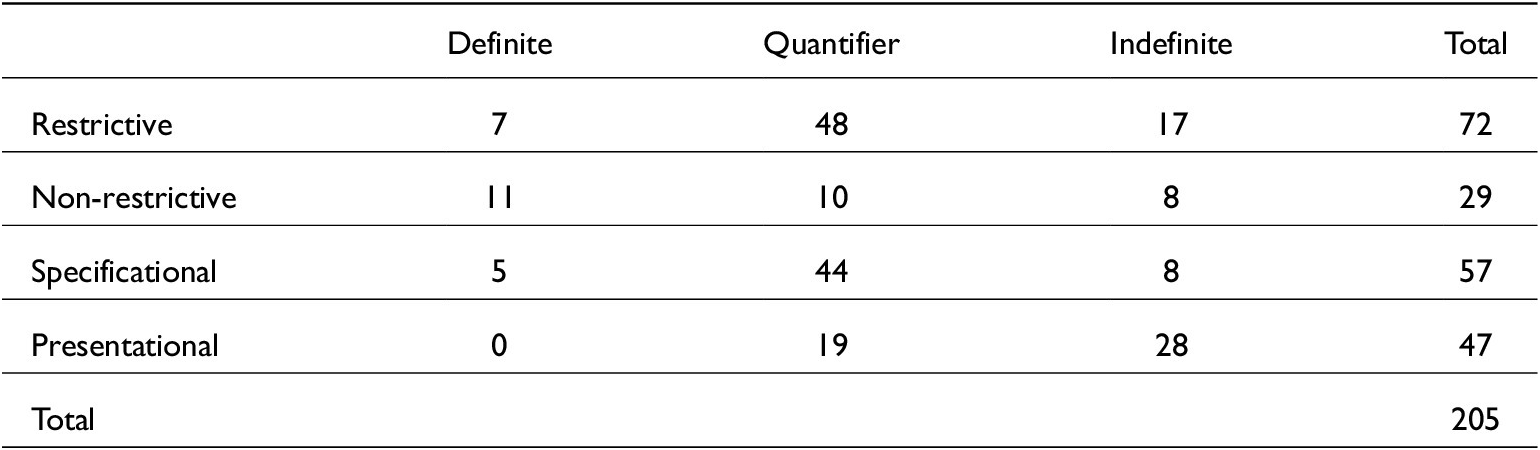
Chapter 8 (pp. 123–34) examines the way in which the meaning of the four constructions affects the possible determiner type of their postcopular NP. Through a quantitative analysis of 205 tokens, the chapter reveals distributional preferences, as summarized in table 1. It is observed that the existential construction with a restrictive relative clause avoids a pronoun or a proper name as its existential NP, favoring a quantifier (e.g. nobody) or an indefinite NP as its antecedent. In contrast, the construction with a non-restrictive clause allows both an indefinite and a definite NP as its antecedent NP. The specificational there-cleft, quantifying the instance matching the variable evoked from the relative clause, typically prefers to be a definite NP, while the presentational there-cleft favors an indefinite NP.
Antecedent NP types of the four constructions (adapted from table 8.1 on p. 128)

Table 1. Long description
The table consists of five columns and five data rows. The columns are labeled Construction Type, Definite, Quantifier, Indefinite, and Total.
* Restrictive construction: 7 Definite, 48 Quantifier, 17 Indefinite, totaling 72.
* Non-restrictive construction: 11 Definite, 10 Quantifier, 8 Indefinite, totaling 29.
* Specificational construction: 5 Definite, 44 Quantifier, 8 Indefinite, totaling 57.
* Presentational construction: 0 Definite, 19 Quantifier, 28 Indefinite, totaling 47.
* The final row indicates a grand total of 205 instances across all categories.
Chapter 9 (pp. 135–53) addresses the prosodic properties of the four constructions. It points out that only the existential with a non-restrictive relative clause shows a consistent prosodic pattern where the existential NP and the following relative clause form independent tone units. The authors also observe that the specificational and presentational there-clefts display focal prosody either at the matrix or within the relative clause.
Finally, chapter 10 (pp. 155–69) concludes with a succinct summary of each chapter, underscoring the contributions of this work to the understanding of there-clefts and related non-prototypical clefts in English.
The book Specificational and Presentational There-Clefts: Redefining the Field of Clefts is quite unique in that it provides a detailed descriptive study of spoken data for non-prototypical there-clefts. It is also distinctive in offering a compositional analysis wherein the lexicogrammatical structure and intonation patterns of there-clefts encode their grammatical meaning in a compositional way. In this context, the analysis advocated for there-clefts as well as it-clefts differs from traditional approaches, which often consider the subject pronoun and the matrix copula to be devoid of semantic significance, with the postcopular expression being structurally assigned a focus value (e.g. É Kiss Reference É Kiss1998; Hedberg Reference Hedberg2000; Lambrecht Reference Lambrecht2001). Drawing on attested examples such as (12), where the focused expression is not the entire postverbal NP but specifically the expression pop, the authors develop a compositional analysis in which each expression within the cleft contributes to the overall propositional meaning.
(12)
because there’s not the same pressure on the material it’s the pop material that counts (p. 4, ex (5))
Although the arguments for the proposed compositional analysis of there-clefts are robust, certain ambiguities remain. For instance, the distinction between there-existentials and there-clefts is not entirely clear. As illustrated in table 1, both restrictive existential and presentational there-clefts allow indefinite NPs as their antecedents. Consider the following examples in (13).
(13)
(a)
There are many people who don’t think in words but who think in abstracts (p. 68, ex (76))
(b)
there was an undergraduate who did absolutely no work at all in his history schools (LLC) (p. 68, ex (76))
The authors classify examples like (13a) as an existential with a restrictive relative clause, whereas those like (13b) are taken as a presentational there-cleft. As previously remarked in this review, the so-called such-test is used to differentiate these two constructions (e.g. there are many such people and there was such an undergraduate). However, the robustness of this test is questionable, as both could potentially be paraphrased with such in the absence of a clear context.
It is also inferred from table 1 that both the restrictive existential construction and the specificational there-cleft construction can employ a quantifier as their antecedent NP, as shown in (14).
(14)
(a)
there is nothing that they consider that they do not adjourn (p. 65, ex (71))
(b)
there’s nothing you can cut (p. 146, ex (176))
These two examples are identified as specificational there-clefts. Although the corpus search yielded no tokens with a negative quantifier NP with a restrictive relative clause (p. 130), this remark contradicts the quantitative data presented in table 1: of the total 44 tokens, 11 are negative. The discrepancy also raises the question as to whether the polarity value (positive or negative) of the determiner influences the classification of there-constructions. Notice examples like (15) which the authors categorize as there-existential.
(15)
there is no medical problem that could kill a pregnant woman … (p. 66, ex (75))
The postcopular expression with the negative determiner no is not a negative quantifier like nothing, yet it is semantically quite similar to it. It is thus questionable whether there exists a test to determine examples like (15) not as specificational clefts but as existential constructions with a restrictive relative.
Additionally, the distinction between specificational and presentational there-clefts becomes challenging when no subject relative marker is present. Both examples in (16) feature the zero subject relative marker, as indicated by the empty set. It is suggested that (16a) represents a specificational cleft, while (16b) is a presentational cleft. If the contrastive or negative meaning in (16a) categorizes this as a specificational construction, it raises the question as to whether the absence of the negator here would reclassify it as a presentational cleft. More reliable criteria are needed to differentiate there-existential from there-cleft constructions.
(16)
(a)
there was not one of them there ∅ could justify the disparity … (p. 51, ex (54))
(b)
there were three little black boys ∅ were going along (p. 51, ex (55))
There is another issue to consider further. The authors suggest that the copula in the there-clefts selects three arguments: the subject there, the postverbal NP and the relative clause (which is also in a modification relation with the antecedent NP). This view aligns with non-transformational analyses suggested by Gazdar et al. (Reference Gazdar, Klein, Pullum and Sag1985) and Pollard & Sag (Reference Pollard and Sag1994: 260–3). While the three-place predicate approach may hold significance in the context of Construction Grammar or Natural Grammar, questions persist regarding whether this copula be differs from all the other uses of the copula be in terms of syntactic or semantic arguments. The copula typically selects two syntactic arguments although each use is mapped into a different meaning (e.g. specificational, predicational, identificational and equational uses of the copula; see Mikkelsen Reference Mikkelsen, Maienborn and Portner2011). Whether predicates in English or other languages select a relative clause as a syntactic or semantic argument remains debatable. More convincing arguments, coupled with a sophisticated discussion of the syntactic and semantic aspects of the copula verb be in there-existentials and there-clefts, are necessary to support the three-place predicate approach.
For prospective readers, several stylistic enhancements could improve the text. It would be quite beneficial to have an appendix with the entire set of examples analyzed in the book, classified into one of the four constructions. In addition, numbering each subsection or subsubsection could facilitate reference. It is also atypical for a research monograph to conclude each chapter with references.
Notwithstanding some areas requiring clarification and stylistic refinement, this book makes a significant contribution to the study of non-prototypical cleft constructions in English, and will serve as an informative guide to those who are interested in the study of there-cleft constructions from a descriptive perspective. Readers can meet the complexities of there-cleft and related constructions and see how these complexities can be unraveled from a Natural Grammar and Construction Grammar viewpoint.