Implications
Most growing pigs within the EU are tail docked to prevent tail biting. We studied a farm which routinely tail docks and had a very low tail biting prevalence. For this study, tail docking was ceased in half the pigs. The results indicate that even in such a low prevalence herd, keeping pigs with undocked tails increases the tail damage prevalence significantly, particularly in 30 to 60 kg pigs, and as a consequence more hospital pens are needed for tail bitten pigs. Also, our data show that abattoir estimates of tail damage prevalence are likely to greatly underestimate on-farm prevalence.
Introduction
The majority of pigs reared worldwide are tail docked to reduce the risk of being tail bitten (EFSA, 2007). This is also the case in the EU despite animal welfare legislation banning routine tail docking (2001/93/EC amendments to directive 91/630/EEC). Despite the tail docking procedure, tail lesions still occur, variously suggested as affecting around 1% to 2% (Zonderland et al., Reference Zonderland, Bosma and Hoste2011a) to 3.1% (D’Eath et al., Reference D’Eath, Niemi, Ahmadi Vosough, Rutherford, Ison, Turner, Anker, Jensen, Busch, Jensen, Lawrence and Sandøe2016) of the pigs. If pigs within the EU are to be kept with undocked tails in existing housing systems with no change in management, it will most likely lead to a dramatic increase in tail bitten pigs (EFSA, 2014). A 50% increase in severe lesions has been suggested (Valros and Heinonen, Reference Valros, Ahlström, Rintala, Häkkinen and Saloniemi2015), and recent calculations stated 17% tail bitten pigs during growth, if pigs are to be housed with undocked tails in today’s conventional systems (D’Eath et al., Reference D’Eath, Niemi, Ahmadi Vosough, Rutherford, Ison, Turner, Anker, Jensen, Busch, Jensen, Lawrence and Sandøe2016). On the other hand, Finnish farmers, producing pigs with intact tails, reported in a survey an estimated tail lesion prevalence of 2.3% (median 1%, range 0% to 30%) on farm (Valros et al., Reference Valros, Munsterhjelm, Hänninen, Kauppinen and Heinonen2016). However, these estimates need further evidence-based confirmation. In most studies, levels of tail damage across herds are estimated based on recordings made on pigs at slaughter (Valros et al., Reference Valros and Heinonen2004; Harley et al., Reference Harley, More, O’Connell, Hanion, Teixeira and Boyle2012; Keeling et al., Reference Keeling, Wallenbeck, Larsen and Holmgren2012). However, using abattoir meat inspection recordings to determine the level of tail bitten pigs in herds will probably underestimate the number of bitten pigs (Keeling et al., Reference Keeling, Wallenbeck, Larsen and Holmgren2012).
The first step towards a general termination of tail docking is to investigate the consequences of housing undocked pigs in conventional herds with low levels of tail biting among tail docked pigs. Based on existing knowledge and risk factors related to tail biting behaviour (Taylor et al., Reference Taylor, Parker, Mendl, Edwards and Main2012), it could be assumed that tail biting behaviour will be less prevalent in such herds. Consequently, if tail biting increases significantly in herds with a low level of tail biting among tail docked pigs, it will most likely be very difficult to house pigs with undocked tails in other herds as well, without a dramatic increase in tail bitten pigs.
The aim of the present study was to quantify the level of tail lesions between pens with docked and undocked pigs housed under the same conditions in a herd with very low tail biting prevalence among tail docked pigs. No pre-emptive adjustment of current housing was carried out, because tail biting among tail docked pigs occurred very infrequently in the herd and pigs were routinely provided with manipulable materials in the form of straw and wooden boards.
Material and methods
This study was conducted in accordance with the guidelines of the Danish Ministry of Justice Act no. 382 (10 June 1987), Act no. 333 (19 May 1990), Act no. 726 (9 September 1993) and Act no. 1016 (12 December 2001) with respect to animal experimentation and care of animals under study.
The study was carried out at a commercial Danish farm (Vrå, Denmark) from March 2014 to August 2015. The farm was selected based on low prevalence abattoir tail biting remarks. Meat inspection data before the study (1 year) reported tail biting remarks of 0.37% for the tail docked pigs. In addition the farmer and his advisor reported that they very infrequently experienced tail biting in the herd. The management system was also considered low-risk as regards to tail biting due to the daily provision of straw (Taylor et al., Reference Taylor, Parker, Mendl, Edwards and Main2012).
Housing and experimental design
In total, 960 undocked and 962 docked (906 females, 948 castrated males and 68 unknown gender) Danish Duroc×(Landrace×Yorkshire) pigs from 12 batches were included in the study: 47 pens with undocked tails and 48 pens with docked tails. In all, 20 (±0.03) pigs were randomly allocated (48% gilts/pen, ±1.5%) to each experimental pen housing undocked and docked pigs separately. A period of 2 weeks after arrival, the farmer moved one or two of the smallest pigs from each pen to a buffer pen at which point these pigs were excluded from the experiment.
Piglets were born at a different location in farrowing pens with crates. Every 5th week, 10 to 18 litters were randomly allocated to one of two treatments (groups): tail docked or undocked. On the day of birth, piglets had the tip of their needle teeth removed by grinding. At 4 days of age, piglets in the ‘docked group’ were tail docked (half the tail). All piglets were given iron injections (Uniferon; Pharmacosmos, Holbæk, Denmark), and male piglets were surgically castrated and given a short-term analgesic. From 10 days of age, piglets were offered creep feed on the floor. No additional enrichment was provided for the piglets in the farrowing pen.
All pigs were ear tagged and their gender noted 1 week before weaning. Piglets were weaned on average 26 (±2.3) days after birth and moved to pens, where they were housed for 2 days before being transported to the experimental farm. Docked and undocked pigs were housed in separate pens within the same room. Within the group, pigs were allocated randomly to the pens. Pens were designed with two climate zones, with solid floor and a cover in the lying area and slats in the dunging area. Pigs had ad libitum access to a diet based on spring barley, wheat, fat and 30% concentrate (Danstart VP30; Vilomix, Mørke, Denmark).
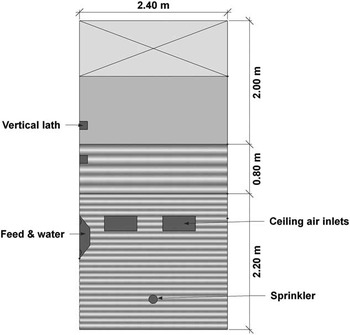
The experimental farm consisted of four identical rooms with 36 pens/room of which 6 to 13 pens/room were included in the study. Pens measured 2.4×5.0 m (12 m2) with 4.8 m2 solid floor and 7.2 m2 slatted floor (Figure 1). A 2.16 m2 cover was placed 1 m above the solid floor. Two pens shared a dry feed dispenser with a 62 cm long trough and two nipple drinkers (Figure 1).
Experimental pen design.

At the weaning accommodation and at the experimental farm, each pen was equipped with two vertically mounted wooden pine boards measuring 38×57×100 mm standing on the floor in a retainer as manipulable material.
Climate
The indoor climate at the experimental farm was regulated by a negative pressure ventilation system (SKOV A/S, Glyngøre, Denmark) supplemented with ceiling air inlets. The ceiling air inlets opened when the room temperature was 2°C above the set temperature. At arrival at the experimental farm (day 0), the set room temperature was 24°C, and the temperature was gradually decreased during the growing period to 17°C on day 112 when the study ceased. Two heating pipes placed along the wall in either side of the room were regulated by the ventilation system. In addition, thermostatically controlled floor heating in the lying area was turned on when the pigs arrived, resulting in a floor temperature of 35°C to 37°C. The floor heating was usually turned off around day 25.
Feeding
Pigs were fed with five different commercial compound diets (Table 1) formulated to fulfil the Danish recommendations for pigs of this weight and genotype (Tybirk et al., Reference Tybirk, Sloth, Kjeldsen and Shooter2016). From 7 to 9 kg (~10 days), pigs were floor fed four times a day (semi ad libitum). From ~9 kg until slaughter pigs had ad libitum access to feed in a dry feed dispenser.
Potential physiological energy, CP and lysine content in commercial diets

1 to 5Hedegaard A/S, Nørresundby, Denmark.
1 Minigris L-3.
2 Maxigris L-7.
3 Maxigris voks.
4 Svine-voks primo.
5 Svine-voks sludeal.
Management
Each day, pigs were inspected twice: at around 0900 and 1730 h. Pigs’ health condition was monitored, and pigs with clinical signs of disease were recorded by the stockperson and treated with an antibiotic. In the study period, pigs were treated for diarrhoea, tail lesions, locomotion disorders, respiratory diseases, brain/nerve disorders and other reasons (none of the above mentioned). Unthrifty pigs, pigs with locomotion disorders or serious tail lesions (more than half the tail missing for undocked pigs) were either euthanised or moved to hospital pens. The farmer recorded the reason for euthanasia/death and transfer to hospital pens.
Throughout the study period, pens were provided daily with ~230 g of chopped wheat straw on the floor. In case the solid floor got soiled due to defecation, the straw allocation stopped. This could happen, when pigs weighed around 70 kg.
Tail biting management
If tails were clinical injured, a Bite-Rite (Ikadan Systems A/S, Ikast, Denmark), consisting of four elastic plastic sticks, was suspended in the middle of the pen above the slatted floor, and the amount of chopped straw was doubled (~460 g/pen, once daily). The development in tail damages was monitored the following days. Pigs with tails with signs of infection (swollen red tissue) were treated with antibiotic, and pigs with severe tail injuries, defined as half the tail missing, were moved to a hospital pen.
Tail damage scoring
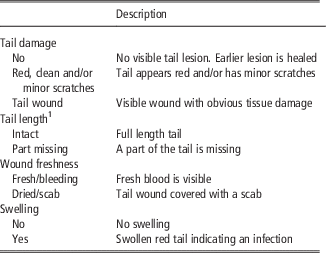
Tails were scored every 2nd week from weaning until slaughter according to the scale in Table 2 using four parameters for each tail: Tail damage, tail length (only intact tails), wound freshness and tail swelling. In order to standardise observations, tail scoring was performed by the same trained person throughout the study period. At tail scoring, the observer was walking around in the pen checking each tail.
Tail injury scoring system

Modified after Kritas and Morrison (Reference Kritas and Morrison2004) and O’Driscoll et al. (2013).
1 Tail length was only recorded for undocked pigs.
Statistical analysis
Each pig was categorised as either a tail biting victim or non-victim (binary variable). Pigs scored with a tail wound, irrespective of freshness of the wound, tail length or swelling, were categorised as victims (Table 2). Pigs were divided into three weight (age) groups: (1) weaning (7 to 30 kg, 5 to 12 weeks), (2) grower (30 to 60 kg, 13 to 17 weeks) and (3) finisher (60 to 90 kg, 18 to 21 weeks).
Statistical analyses were performed using SAS Enterprise Guide 7.1. Number of pigs moved to hospital pens, pen level prevalence of tail damage and number of antibiotic treatments were analysed with pen as the experimental unit. For the overall appearance of tail bitten pigs, each individual pig was the experimental unit, and pigs within pens within batches were included as random effects. Number of dead pigs was analysed on batch level.
The effect of weight (age) on tail damage prevalence (binary variable) was analysed using the Generalised Linear Mixed Model procedure (GLIMMIX) with weight as fixed effect and sex, batch and pen as random effects. The effect was analysed using an overall F test, and a Student’s t test for pairwise comparisons of weight groups. Differences in number of dead pigs and antibiotic treatments between docked and undocked pigs were analysed using a Student’s t test. To compare differences between number of docked and undocked pigs getting a tail biting remark at the abattoir and pens with pigs moved to a hospital pen, a χ 2 test was used. Data are presented as means±SEM and P-values lower than 0.05 were considered significant.
Results
No tail injuries were recorded among tail docked pigs. In contrast, 220 undocked pigs (23% of undocked pigs) distributed in 32 pens (68% of pens) were scored with a tail injury at least once during the study period. In all, 24 tail bitten pigs (10.9%) from 12 different pens were moved to hospital pens. Thus, 89.1% of the tail bitten pigs stayed in the home pen, and the wound healed with the use of Bite-Rite and extra straw as enrichment or removing the biter. Four biters in three different pens were removed during the trial, and three tail bitten pigs moved to a hospital pen had to be euthanized.
Of the 220 tail bitten pigs, 38 were logged twice with a tail lesion in the home pen, and four were logged three times. Injuries on pigs with two or three tail lesion recordings could either be new fresh wounds or scabbed wounds. In other words, aside from pigs moved to hospital pens, the majority of wounds healed within a 2-week period.
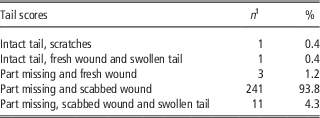
On average, 4.0 (±0.7) % of the pigs with undocked tails had a tail lesion at each inspection. These bitten pigs were distributed in 20.9 (±2.2) % of the pens. In addition, 50.0% of the tail bitten pigs were observed within 37 days (up to ~25 kg) after arrival. The recorded tail scores are listed in Table 3. By far the most frequent score (93.8%) was ‘part of the tail missing with a scabbed wound’.
Total tail damage frequency (n=257) and distribution (%) among pigs scored with clinically injured tails

1 Totally 257 clinically injured tails were recorded on 220 different pigs.
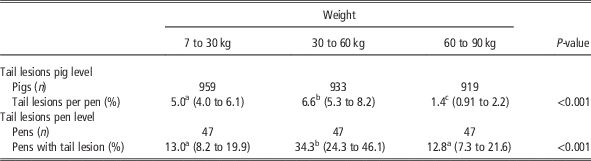
More castrated males got tail lesions (124; F=13.04, P<0.001) compared with females (82) with gender information missing for 14 of the tail bitten pigs. More pigs had tail lesions in the weight interval 30 to 60 kg than 7 to 30 kg (P=0.026) and 60 to 90 kg (P<0.001), and fewer pigs between 60 and 90 kg compared with 7 to 30 kg (P<0.001) were observed with tail lesions (Table 4). At pen level, tail lesions were more often present in pens with pigs weighing 30 to 60 kg than in pens with pigs weighing 7 to 30 kg (P<0.001) and 60 to 90 kg (P<0.001) (Table 4).
Percentage of pigs and pens with tail lesions among pigs with undocked tails in three weight intervals: 7 to 30 kg, 30 to 60 kg and 60 to 90 kg

95% confidence interval values are within parentheses.
a,bValues within a row with different superscripts differ significantly at P<0.05.
Pigs with undocked tails increased the need for hospital pens (P=0.02; Table 5). Undocked pigs (n=39) were moved due to: tail damages (61.5%), other reasons (12.8%), brain/nerve disorders (10.3%), locomotion disorders (7.7%) and diarrhoea (7.7%). In total 15 docked pigs were moved due to: brain/nerve disorders (40.0%), other reasons (26.7%), diarrhoea (13.3%), locomotion disorders (13.3%) and respiratory disease (6.7%). No difference in number of dead or euthanised pigs was observed between docked and undocked pigs, but more pigs with undocked tails were treated with antibiotics (P=0.02; Table 5).
Effect of tail docking on pigs moved to hospital pens, dead/euthanised pigs, antibiotic treatments and abattoir tail biting remarks

1 Pens with pigs moved to hospital pens, χ 2=5.04.
2 Abattoir tail biting remarks, χ 2=11.24.
Finally, meat inspection data were collected from 853 undocked pigs and 933 tail docked pigs, and more pigs with undocked tails got a tail biting remark during standard meat inspection at the abattoir (P<0.001; Table 5).
Discussion
This study was designed to compare the tail biting prevalences between docked and undocked pigs from weaning until slaughter. The farm was chosen based on very low tail lesion prevalences among tail docked pigs before the study period. In this study, none of the tail docked pigs got tail lesions, which supports the idea that tail docking can reduce damaging tail biting (Sutherland and Tucker, Reference Sutherland, Bryer, Krebs and McGlone2011). The effect of tail docking found in the current study is in agreement with most other studies. Di Martino et al. (Reference Di Martino, Scollo, Gottardo, Stefani, Schiavon, Capello, Marangon and Bonfanti2015) reported increased risk of tail lesions among undocked fattening pigs (OR=20.82) compared with tail docked, and Sutherland et al. (Reference Sutherland and Tucker2009) described more severe tail lesions among undocked pigs. In a survey of Dutch farmers, conventional farmers rearing tail docked pigs stated that tail docking is the most effective way to reduce tail biting (Bracke et al., Reference Bracke, Lauwere, Wind and Zonderland2013). This need for tail docking received less support from Finnish conventional farmers rearing pigs with undocked tails (Valros et al., Reference Valros, Munsterhjelm, Hänninen, Kauppinen and Heinonen2016), with only 21% saying they would tail dock if it was allowed. The differences in attitude towards the need to tail dock between Finnish and Dutch farmers, could be, that Finnish farmers are not allow to tail dock and have considerable experience of managing undocked pigs, and that they have practical knowledge of other solutions to tail biting.
The prevalence of bitten pigs varies greatly between studies, possibly due to different definitions of a tail wound and tail scoring method. For comparison of prevalence between studies, in the following, the definition of a tail wound is stated along each study. Di Martino et al. (Reference Di Martino, Scollo, Gottardo, Stefani, Schiavon, Capello, Marangon and Bonfanti2015) observed in average 18.6% undocked finishers with mild tail lesions (bite marks/small abrasions), and 3.6% with tail wounds (lesions bleeding and tissue loss). A Dutch study, with undocked weaners reported considerably higher levels, with 54% observed with a tail wound (clearly visible wound with blood) and 35% with bite marks (Zonderland et al., Reference Zonderland, Bosma and Hoste2011b). In another study 83.4% (barren environment – jute sack, ball on a chain, two handful of wood shavings per pen per day) and 45.3% (enriched environment – jute sack, ball on a chain, 12 kg wood shavings at start, 3 kg added daily) of the undocked pigs were reported with a tail wound (clearly visible wound) from weaning to slaughter (Ursinus et al., Reference Ursinus, Van Reenen, Kempa and Bolhuis2014). Among finishers weighing 90 to 100 kg, Cagienard et al. (Reference Cagienard, Regula and Danuser2005) observed on ‘animal friendly’ farms (straw bedding and access to outdoor facility) 2.8% pigs with a bleeding tail or a part of the tail missing due to tail biting, compared with 21.9% on traditional farms. This suggests that increasing levels of enrichment reduces the level of tail damage. In the present study, pigs were provided with straw daily, which might explain the lower level of tail bitten pigs throughout the growing period compared with some other studies. Overall, the large variation between studies is probably due to variation in any or all of the many distinct risk factors associated with tail biting (Schrøder-Petersen and Simonsen, Reference Schrøder-Petersen and Simonsen2001; D’Eath et al., Reference D’Eath, Arnott, Turner, Jensen, Lahrmann, Busch, Niemi, Lawrence and Sandoe2014).
Stocking density has been suggested as another risk factor influencing tail biting prevalence (D’Eath et al., Reference D’Eath, Arnott, Turner, Jensen, Lahrmann, Busch, Niemi, Lawrence and Sandoe2014). Two epidemiological studies concluded that increasing stocking density was associated with an increased risk of tail lesions (Moinard et al., Reference Moinard, Mendl, Nicol and Green2003; Scollo et al., Reference Scollo, Contiero and Gottardo2016). In our study, pigs were housed in the same pen from weaning to slaughter, giving a lower stocking density in the weaning period (~0.6 m2/pig) than required according to the EU Council Directive (0.3 m2 – EU Council Directive 2008/120/EC). This lower stocking density might have influenced the level of tail biting in the weaner group.
Barrows are often more likely to become tail biting victims (Wallgren and Lindahl, Reference Wallgren and Lindahl1996; Kritas and Morrison, Reference Kritas and Morrison2004; Valros et al., Reference Valros and Heinonen2004), and this is in line with the present study. However, some experiments have failed to show a correlation between gender and the risk of becoming a tail biting victim (Zonderland et al., Reference Zonderland, Bracke, Hartog, Kemp and Spoolder2010; Sinisalo et al., Reference Sinisalo, Niemi, Heinonen and Valros2012; Scollo et al., Reference Scollo, Di Martino, Bonfanti, Stefani, Schiavon, Marangon and Gottardo2013; Di Martino et al., Reference Di Martino, Scollo, Gottardo, Stefani, Schiavon, Capello, Marangon and Bonfanti2015). These inconsistencies between studies might be attributed to different grouping strategies and different settings (Sinisalo et al., Reference Sinisalo, Niemi, Heinonen and Valros2012). The reasons why barrows in some studies more often become tail biting victims are not fully understood.
We scored tail damage in every age group from weaning to slaughter, which was also done in a Dutch study (Ursinus et al., Reference Ursinus, Van Reenen, Kempa and Bolhuis2014). In the Dutch study, the percentage of bitten pigs did not decline towards the end of the finisher period in a barren environment. However, a decline in tail bitten pigs, as in our study, was observed among pigs in the end of the finisher period housed in an enriched environment. This decline in tail damages could be due to the fact that severely bitten pigs were moved to hospital pens, or perhaps pigs are reluctant to bite tails when they reach a certain age or weight. In two studies with finishers the exploratory behaviour towards straw (Lahrmann et al., Reference Lahrmann, Oxholm, Steinmetz, Nielsen and DÉath2014; Oxholm et al., Reference Oxholm, Steinmetz, Lahrmann, Nielsen, Amdi and Hansen2014) and activity level declined with age (Oxholm et al., Reference Oxholm, Steinmetz, Lahrmann, Nielsen, Amdi and Hansen2014). However, in the same studies, penmate directed behaviours did not decline with age, and increasing levels of penmate directed behaviour has been associated with tail biting (Beattie et al., Reference Beattie, Sneddon, Walker and Weatherup2001).
When tail biting occurs, the severity of tail wounds can differ between pigs within the pen. Some pigs only get a bite mark whereas others get actual wounds (Zonderland et al., Reference Zonderland, Bosma and Hoste2011b). The severity of the wound is expected to affect the healing duration. In our study, 11 pigs got a severe tail lesion with infection (swollen tail) in the home pen. This number would probably be higher if pigs in the hospital pens were tail scored as well. In comparison, 89% of the tail wounds healed successfully in the home pen between two tail inspections, and this indicates, that it is not necessary in every case to remove bitten pigs in order to stop the damaging tail biting behaviour.
Adding extra enrichment as an intervention can stop tail biting to the same extent as removing the biter (Zonderland et al., Reference Zonderland, Wolthuis-Fillerup, Reenen, Bracke, Kemp, Hartog and Spoolder2008). In the present study, biters were removed when detected and extra enrichment was added to the pen. The effect of extra enrichment probably depends on the reason why pigs instigate the damaging tail biting. Extra enrichment might be enough to stop the ‘two-stage‘ biting and ‘sudden-forceful’ biting, if the reason for biting is boredom or frustration due to lack of enrichment, whereas the obsessive biter must be removed from the pen in order to stop the tail biting (Taylor et al., Reference Taylor, Main, Mendl and Edwards2010). However, there is a need for more experimental studies looking into the effect of different intervention strategies on the healing of tail wounds, as suggested by D’Eath et al. (Reference D’Eath, Arnott, Turner, Jensen, Lahrmann, Busch, Niemi, Lawrence and Sandoe2014).
Previous studies of mortality rates ranging from 1.7% (Scollo et al., Reference Scollo, Di Martino, Bonfanti, Stefani, Schiavon, Marangon and Gottardo2013) to 5.5% (Di Martino et al., Reference Di Martino, Scollo, Gottardo, Stefani, Schiavon, Capello, Marangon and Bonfanti2015) corresponding to our findings, have failed to discover differences in overall mortality between undocked and tail docked pigs. However, the results of the present study should be interpreted with caution, as it was not statistically designed for comparing mortality.
In contrast to our findings, no differences in number of pigs moved to hospital pens between docked and undocked pigs were reported by Scollo et al. (Reference Scollo, Di Martino, Bonfanti, Stefani, Schiavon, Marangon and Gottardo2013) and Di Martino et al. (Reference Di Martino, Scollo, Gottardo, Stefani, Schiavon, Capello, Marangon and Bonfanti2015). A likely explanation for the dissimilarity between studies could be different management routines and strategies in the experiments, such as when the tail bitten pigs are moved to hospital pens and the intervention strategies in outbreak pens (moving biter, adding extra enrichment, etc.).
To our knowledge, the current study is the first to compare abattoir tail biting remarks between undocked and docked pigs originating from the same piggery. Comparing on-farm tail wound prevalence (Table 4) with abattoir prevalence (Table 5), indicates that abattoir recordings heavily underestimate the number of undocked pigs being tail bitten. The prevalence of tail lesions was highest among 30 to 60 kg pigs, and these wounds probably healed before slaughter. Healed tail lesions will usually not be recorded during meat inspection, and severely bitten pigs will often be culled in the herd (Taylor et al., Reference Taylor, Main, Mendl and Edwards2010), which to some extent explains the differences in prevalence. An adjusted scoring method at slaughter could improve the agreement between herd and abattoir prevalence of tail wounds/bites. In the current study, we observed that healed tips (round and bald) had a different appearance than intact tips (flattened and hairy). In an abattoir, where docked pigs are the norm, meat inspectors may be likely to score previously bitten and now healed tails as though they are ‘normal’ docked tails.
A Danish abattoir survey of 1 173 213 tail docked pigs reported 0.85% tail damages at meat inspection (Alban et al., Reference Alban, Petersen and Busch2015), and an Irish abattoir study with 99% tail docked pigs reported 1.03% severe tail lesions (Harley et al., Reference Harley, More, O’Connell, Hanion, Teixeira and Boyle2012). As expected, these figures are slightly higher than for the docked group in our study, because the trial herd was selected based on low abattoir tail biting remarks among tail docked pigs. Meat inspection data from a Swedish survey (15 068 pigs) with undocked pigs showed tail damage prevalences of 1.2% and 1.6% at two different slaughterhouses (Keeling et al., Reference Keeling, Wallenbeck, Larsen and Holmgren2012), which is in accordance with the level in the undocked group in the present study. In agreement with these findings, a Finnish abattoir study reported 1.3% tail damages, though some pigs may have been tail docked (Valros et al., Reference Valros and Heinonen2004). Even though no tail damage was observed among tail docked pigs during the trial period, a few tail docked pigs did get a tail biting remark at the abattoir. These tail damages could have occurred after the study ended, during transportation or in the abattoir holding pens.
In conclusion, in a conventional herd with low stocking density in the weaning period and daily provision of straw, no tail docked pigs got a tail lesion, whereas 23% of the undocked pigs got a tail lesion. At pig and pen level, tail lesions were more prevalent among 30 to 60 kg pigs than in the late finishing period (60 to 90 kg). More pigs with undocked tails compared with tail docked pigs had to be treated with antibiotics and moved to hospital pens. In particular, the results suggest that caution should be taken when recordings from abattoir routine meat inspection are used to evaluate the level of tail biting in a herd, because this likely highly underestimates the number of bitten pigs.
Acknowledgements
The authors acknowledge pig producer Jens Kristiansen for participating in the project and technician Hans Peter Thomsen for helping with data collection. The authors are grateful to statistician Mai Britt Friis Nielsen for assistance with the statistical analyses.
This work was funded by SEGES, Pig Research Centre, The Danish Pig Levy Fund and The Danish Rural Development Programme (LD-32101-U-12-00196). SRUC receives funding from the Scottish Government Rural and Environment Science and Analytical Services Division (RESAS).