Research shows that many Archaic period (ca. 8000–3000 cal BP) hunter-gatherer societies living in North America, long thought to be isolated from one another, were often tied together by broad networks of affiliation and interaction (Arnold Reference Arnold1993; Bender Reference Bender, Sheridan and Bailey1981; Sassaman Reference Sassaman2010). The impetus for establishing these social networks is not well understood. Some suggest they were means of adapting to local environmental conditions, reducing intersocietal conflict or overcoming challenges associated with increased sedentary behavior and higher population density (e.g., Bahn Reference Bahn1982; Fitzhugh et al. Reference Fitzhugh, Colby Phillips, Gjesfeld, Whallon, Lovis and Hitchcock2011; Whallon Reference Whallon2006). Social networks often involve the movement of objects, occasionally including highly valued “prestige items” (Hayden Reference Hayden1998). Copper exchange is a prominent example of long-distance movement of prestige items in North America, particularly during the Late Archaic (ca. 5000–3000 cal BP), when networks originating in the Great Lakes (Rapp et al. Reference Rapp, Allert, Vitali, Jing and Henrickon2000), Appalachians (Goad Reference Goad1978), and Canadian Maritimes (Hill et al. Reference Hill, Greenlee and Neff2016) spanned much of the Eastern Woodlands. Tracking the extent of Late Archaic period copper exchange is an important avenue of research because it is often connected to greater social hierarchy and an increase in the intensity and scale of ceremonial gatherings (Goldstein and Meyers Reference Goldstein, Meyers, Kuijt, Quinn and Cooney2014; Hill Reference Hill2012; Lattanzi Reference Lattanzi2013; Levine Reference Levine, Levine, Sassaman and Nassaney1999; Pleger Reference Pleger2000; Sanger et al. Reference Sanger, Hill, Lattanzi, Padgett, Larsen, Culleton, Kennett, Dussubieux, Napolitano, Lacombe and Thomas2018). Copper sources typically have unique chemical signatures, making it possible to trace the origin points of exchanged materials (Rapp et al. Reference Rapp, Allert, Vitali, Jing and Henrickon2000), and sourcing studies have successfully revealed Late Archaic copper trade networks spanned hundreds of kilometers and in rare cases, more than 1,000 km (Hill et al. Reference Hill, Greenlee and Neff2016). Copper exchange is only one of many networks spanning the Eastern Woodlands: beads, carved bone pins, hypertrophic stone blades, pottery, and shells all moved along separate but interconnected lines of Archaic exchange (see review in Sassaman Reference Sassaman2010).
Although archaeologists have documented exchange networks that spanned the Archaic landscape, the social nature of these connections is unclear. Some suggest the long-distance movement of objects was a slow, iterative process in which items moved through many hands (e.g., Milner Reference Milner2004), whereas others posit that relations between distant peoples were much more direct (e.g., Sassaman Reference Sassaman2010). Determining how objects moved long distances is critical given that it provides insights into the scale, intensity, and nature of interaction networks and the level to which different groups emerged in isolation or in contact with one another. Unfortunately, while sourcing studies can determine the distribution of nonlocal objects, they are typically incapable of determining the nature of exchange (Hodder Reference Hodder1978).
One means of determining that nature is to test the level to which information moved along exchange networks. Unlike objects, which are typically long lasting, the integrity of information deteriorates quickly as it moves from its source (Stein Reference Stein2002; Wobst Reference Wobst and Cleland1977). For this reason, when communities linked through exchange networks adopt another's customs, beliefs, or traditions, we assume that their connection is relatively unmediated and direct, especially when the adoption replicates minor or less visible aspects of the adopted practice (Agbe-Davies and Bauer Reference Agbe-Davies, Bauer, Bauer and Agbe-Davies2010; Knappett Reference Knappett2011; van der Leeuw Reference Van der Leeuw and Knappett2013). In contrast, when communities exchange objects but not information, we assume they are linked by a more diffuse, mediated, or indirect relationship. For example, when an object passes through many hands over long periods, it is increasingly likely to be used in fashions or contexts not intended by the producer because the information regarding its “proper” use has been lost, distorted, or is no longer embedded alongside the exchanged object.
Based on this model, we provide evidence of a relatively direct and unmediated relationship between Archaic period communities in the Great Lakes, the coastal Atlantic southeast United States, and intervening areas, perhaps including the Ohio and Tennessee River Valleys. In our prior publications (Hill et al. Reference Hill, Lattanzi, Sanger and Dussubieux2019; Sanger et al. Reference Sanger, Hill, Lattanzi, Padgett, Larsen, Culleton, Kennett, Dussubieux, Napolitano, Lacombe and Thomas2018), we demonstrated that a copper bandFootnote 1 found among cremated human remains located on an island off the southeastern U.S. Atlantic coast was fashioned from materials that originated in the Great Lakes during the Archaic period. We revisit these finds and focus on the acts, contexts, and processes used to incinerate human bodies in both locales to argue that the shared use of cremation to handle the dead, something virtually absent elsewhere in the Archaic southeastern United States (Sassaman Reference Sassaman2010:66–77), was not coincidental but rather reflects an exchange network that spanned more than 1,500 km and moved both objects and information.
We also revisit the conditions of Archaic period exchange and suggest that trade relations emerged and were maintained during large-scale ceremonial aggregations. The context of the copper band and cremated human remains strongly suggests a connection between ceremony and exchange, as they were found in a burial pit located in the center of a Late Archaic shell ring plaza. The scale, planning, and formation tempo of Late Archaic shell rings—large, arcing shell deposits surrounding broad open plazas—led others to suggest that the rings were places of ceremonial aggregations and ritual events (Russo Reference Russo, Roksandic, de Souza, Eggers, Burchell and Klokler2014; Sassaman Reference Sassaman2010; Saunders Reference Saunders, Roksandic, de Souza, Eggers, Burchell and Klokler2014; Thompson and Andrus Reference Thompson and Fred T Andrus2011). Our findings support that interpretation and suggest at least some of these gatherings included the burial of the dead and the interment of exotic objects.
Critically, our discovery of a copper band in a Late Archaic shell ring is not unique; archaeologists have recovered copper objects from Claiborne and Cedarland, two shell rings located on the Mississippi coast (Bruseth Reference Bruseth and Byrd1991:12). We suggest that the discovery of copper at multiple shell rings located hundreds of kilometers from one another is evidence that these sites were among the most distant nodes of at least one (if not multiple) exchange network that spanned half the North American continent.
Models of Long-Distance Exchange in Hunter-Gatherer Societies
Exchange is defined as the practices, obligations, and social structures created and maintained by the acts of giving and receiving (Mauss Reference Mauss1954). Exchange is a catalyst for bonding among individuals, groups, and societies and is a critical means of building broader communal identities and alliances (Sahlins Reference Sahlins1972). Hunter-gatherer exchange systems have long elicited anthropological and archaeological study, in part because nonagrarian groups often operate in a socioeconomic paradigm where property rights, trade relations, and conceptions of ownership are different from those found in societies dependent on agricultural or pastoral production (Kelly Reference Kelly2013; Sahlins Reference Sahlins1972; Testart Reference Testart1982; Woodburn Reference Woodburn1982). Research shows hunter-gatherers typically engaged in multiple networks of exchange, each differentiated by scale, intensity, and periodicity (Fitzhugh et al. Reference Fitzhugh, Colby Phillips, Gjesfeld, Whallon, Lovis and Hitchcock2011; Zvelebil Reference Zvelebil2006). Exchange between individuals living in proximity include the movement of food, utilitarian tools, and basic raw materials given with little expectation of return beyond the norm of reciprocity (Testart Reference Testart1982; Woodburn Reference Woodburn1982). Hunter-gatherers also often develop relations with neighboring groups with whom they exchange information and objects as a means of insurance when local resources drop in productivity (Bahn Reference Bahn1982; Weissner Reference Weissner, Leacock and Lee1982; Whallon Reference Whallon2006; Whallon et al. Reference Whallon, Lovis and Hitchcock2011).
Whereas local and regional social networks are important, our focus is on exchange that spanned much greater distances. When studying hunter-gatherers, it is important to delineate long-distance exchange from long-distance movement of objects. The long-distance movement of objects often occurs through direct procurement in which highly mobile hunter-gatherer groups acquire raw materials at their source and travel vast distances before depositing them (e.g., Binford Reference Binford1979). In these scenarios, hundreds of kilometers are not onerous journeys but are instead parts of everyday life. However, when groups become less mobile and the landscape populates with communities claiming more territorial control, directly acquiring materials becomes more difficult as travel is curtailed (Bettinger Reference Bettinger, Ericson and Earle1982; Kelly Reference Kelly2013). To compensate for the increased difficulty in acquiring materials, many groups establish social relations with one another through which important raw materials or finished objects could flow (e.g., Sassaman et al. Reference Sassaman, Hanson and Charles1988). This is often the point at which communities begin establishing long-distance exchange networks.
Typically, this long-distance exchange is iterative; objects and materials travel through many hands as they move across the landscape. Described as “down-the-line” exchange (Renfrew Reference Renfrew, Sabloff and Lamberg-Karlovsky1975, Reference Renfrew, Earle and Ericson1977), this system is perhaps better understood as a series of smaller networks, each connected to one another through relatively small steps. Down-the-line exchange networks are relatively common in many smaller-scale societies as they move important materials across vast distances, yet they rarely result in close ties or alliances between far-flung communities because a web of intermediaries connects these groups.
In contrast to iterative or down-the-line exchange, archaeologists rarely consider the possibility that more direct networks linked hunter-gatherer groups over long distances (however, see Zvelebil Reference Zvelebil2006). Unlike down-the-line exchange, direct exchange involves far fewer intermediaries and creates a much more immediate relationship among groups (Renfrew Reference Renfrew, Sabloff and Lamberg-Karlovsky1975, Reference Renfrew, Earle and Ericson1977). Viewed as an aspect of complex societies, long-distance, direct exchange typically entails the presence of specialized traders, emissaries, or religious pilgrims who move objects, information, and even customs and belief systems across vast distances (Wynne-Jones Reference Wynne-Jones2010). In nonindustrial groups, direct exchange rarely moves bulk or common items but instead often involves the movement of highly valued “prestige items” between elites (Hayden Reference Hayden1998). Also described as “status goods,” or “elite goods,” prestige items are often necessary for marriage or mortuary events, are used as symbols of status and identity, and can be accumulated as amassed wealth (Friedman and Rowlands Reference Friedman, Rowlands, Friedman and Rowlands1977). The distribution and movement of prestige goods are often politically important as they materialize social and economic relations between people on local, regional, and interregional scales and can be critical in forming powerful alliances (Demarrais et al. Reference Demarrais, Castillo and Earle1996). While more common goods are consumed or widely distributed, prestige goods often stay in circulation for extended periods and, when eventually deposited or destroyed, are often used as burial items or offerings during ritual events (Hayden Reference Hayden1998). Although some items attain prestige because they entail intensive labor or require complex production technologies, many are considered special because they are made from exotic materials that originate from great distances (Hayden Reference Hayden1998; Peregrine Reference Peregrine, Chase-Dunn and Hall1991); however, these qualifers are not mutually exclusive.
Whereas the long-distance exchange of prestige goods is more commonly associated with agrarian, state-level societies, its earliest emergence is occasionally found in hunter-gatherer communities, in which case it is usually seen as influencing a transition from egalitarian to trans-egalitarian societal structures (e.g., Hayden Reference Hayden1998). Typically, within trans-egalitarian groups, the long-distance acquisition of prestige goods is closely tied to ritual and ceremonial gatherings that include feasting (Hayden Reference Hayden, Dietler and Hayden2001). The connection between ritual aggregation and prestige goods has been well documented, and many argue that the political potency of prestige goods increases during large-scale gatherings because these events are venues where social roles, relations, and histories are made visible, explicit, and at times, alterable (e.g., Aldenderfer Reference Aldenderfer1993).
Archaeologists often view copper as a prestige item, especially in North America where communities began exchanging smaller items long distances during the Late Archaic. Although there are some areas, such as the mid-Atlantic, where copper exchange does not appear alongside increases in hierarchical relations, in other portions of the Archaic Eastern Woodlands the creation and movement of copper is seen as indicative of increasing power imbalances and a rising importance of interregional exchange (e.g., Pleger Reference Pleger2000).
Copper Exchange in the Archaic Woodlands
The Archaic period in the Eastern Woodlands of North America was a time of shifting ecological and environmental conditions. Beginning at the onset of the Holocene and ending with environmental conditions stabilizing near modern levels, the Archaic period began about 11,500 cal BP and continued until about 3,200 cal BP (Sassaman Reference Sassaman2010). Human population size in the Eastern Woodlands increased dramatically during the Archaic period as groups adopted increasingly specialized subsistence practices focused on locally available resources (Anderson Reference Anderson, Sassaman and Anderson1996). In tandem with rising population size, social groups increased in size and definition, and many adopted settlement strategies that required less mobility (McElrath et al. Reference McElrath, Fortier, Emerson, Emerson and McElrath2009; Sassaman Reference Sassaman2010). With decreased mobility, increased population size, and a larger “filling in” of the landscape, the acquisition of raw materials often required exchange through intermediaries (e.g., Sassaman et al. Reference Sassaman, Hanson and Charles1988). Exchange may have been further promoted as a means of finding mates and forming broader alliances that could be counted on during periods of subsistence stress and intercommunal violence (Bender Reference Bender1985). Research shows that ritual activities and large-scale ceremonial gatherings also increased in frequency and intensity through the Archaic (Claassen Reference Claassen2015), and objects and materials were likely exchanged during these events to create or strengthen alliances.
Documentation of Archaic copper exchange is facilitated by chemical sourcing that provides an accurate means of finding the origin point of objects and raw materials (Rapp et al. Reference Rapp, Allert, Vitali, Jing and Henrickon2000). Most research has focused on copper-working in the Great Lakes, a practice that began as early as about 7000 cal BP (Beukens et al. Reference Beukens, Pavlich, Hancock, Farquhar, Wilson, Julig and Ross1992). The people who worked it were known as the “Old Copper Culture,” and their earliest copper objects were heavy-socketed tools, including projectile points and axes, generally considered to be utilitarian (Binford Reference Binford1962). The Old Copper Culture spread throughout present-day Indiana, Illinois, Michigan, Wisconsin, and Ontario by the Late Archaic (after ca. 3600 cal BP), at which point archaeologists define it as the Red Ochre and Glacial Kame complexes (Sassaman Reference Sassaman2010:89–90). Red Ochre and Glacial Kame groups more commonly fashioned copper into beads, necklaces, and other objects of personal adornment, which they traded more extensively than their predecessors (Goad Reference Goad1978).
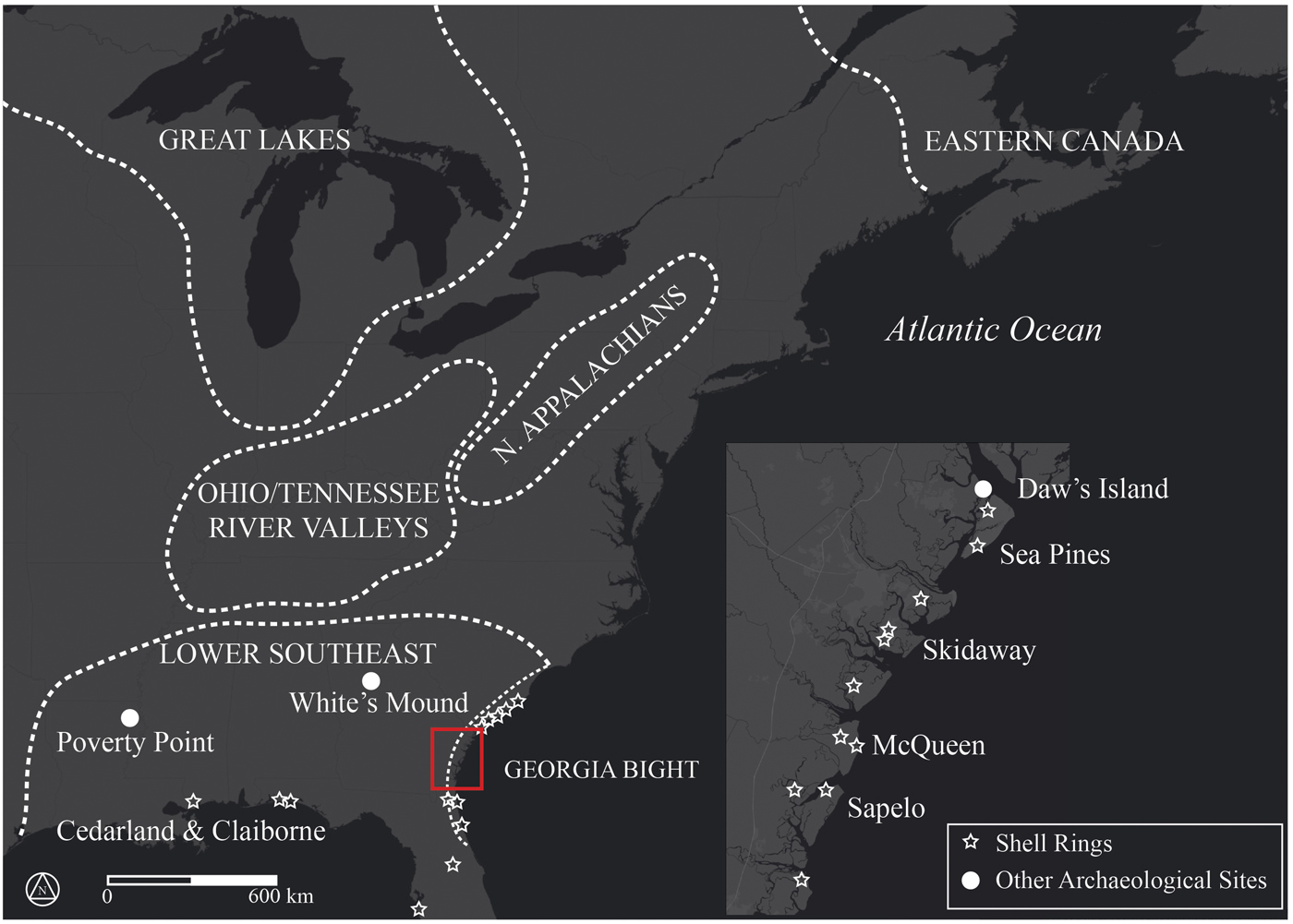
There are multiple origin points for Archaic period copper as groups in the northern Appalachians and eastern Canada are now known to have been more involved in copper production than previously assumed (Figure 1; Lattanzi Reference Lattanzi2008; Levine Reference Levine, Levine, Sassaman and Nassaney1999). Although not as well understood as their counterparts in the Great Lakes, metallurgists in these other regions also engaged in exchange networks, including groups living in the Canadian Maritimes who produced objects that eventually moved as far south as Poverty Point, a massive earthwork site in northern Louisiana (Hill et al. Reference Hill, Greenlee and Neff2016).
Location of selected copper production centers, Late Archaic shell rings, and other selected archaeological sites.

Archaeologists have long viewed Poverty Point as an aberration, in part because of its scale. Dating to the Late Archaic, Poverty Point consists of six concentric earthen ridges, at least five mounds, and a series of “woodhenges” measuring between 20 and 200 m across (Gibson Reference Gibson2007; Spivey et al. Reference Spivey, Kidder, Ortmann, Arco, Gilmore and O'Donoughue2015). The material culture recovered from Poverty Point also demonstrates its uniqueness. Excavations and pedestrian surveys have recovered dozens of copper objects, including awls, thin sheets, beads, pendants, nuggets, and at least one plummet (Bell Reference Bell1956; Webb Reference Webb1982). Copper is only one example of nonlocal materials found at Poverty Point: nonlocal stone used to make bifaces and other tools are measured in metric tons (Gibson Reference Gibson2007), and the frequency of nonlocal stone vessels at Poverty Point “eclipses all other assemblages known from the Eastern Woodlands” (Sassaman Reference Sassaman2010:62).
Material culture arrived at Poverty Point through a series of associated locales, likely including two shell rings located near the mouth of the Mississippi River (Figure 1). Cedarland and Claiborne are the westernmost manifestation of shell ring construction, a phenomenon spanning the Gulf and Atlantic coasts from Mississippi through South Carolina (Russo Reference Russo, Roksandic, de Souza, Eggers, Burchell and Klokler2014). Shell rings are defined as large (50–200 m across) circular or arcing midden deposits consisting of shellfish, vertebrate fauna, botanical remains, and material culture that encircle broad, shell-free plazas (Russo Reference Russo, Roksandic, de Souza, Eggers, Burchell and Klokler2014). Because of their scale, formality of deposition, and widespread construction, archaeologists have debated the function of shell rings, but most agree that they were used, at least occasionally, as a place for large-scale regional gatherings (Russo Reference Russo, Roksandic, de Souza, Eggers, Burchell and Klokler2014; Sanger Reference Sanger2017; Sanger and Ogden Reference Sanger and Ogden2018; Sassaman Reference Sassaman2010; Saunders Reference Saunders, Roksandic, de Souza, Eggers, Burchell and Klokler2014; Thompson and Andrus Reference Thompson and Fred T Andrus2011). At Claiborne, excavations recovered two copper bracelets and a pendant, a cache of soapstone vessels, and a piece of galena, all placed in a pit at the apex of the crescent-shaped ring (Bruseth Reference Bruseth and Byrd1991:18; Sassaman Reference Sassaman2010:62–63). The soapstone vessels date to about 3200 cal BP, roughly coincident with the abandonment of Poverty Point (Sassaman and Brookes Reference Sassaman and Brookes2017).
Poverty Point, Cedarland, and Claiborne mark the southernmost extent of Archaic copper exchange in the Eastern Woodlands and are unlike most sites in the Lower Southeast (defined as Florida, Georgia, South Carolina, Alabama, Louisiana, and Mississippi) where Archaic period copper is virtually absent (Figure 1; Goldstein and Meyers Reference Goldstein, Meyers, Kuijt, Quinn and Cooney2014; Sassaman Reference Sassaman2010). The southernmost extent of notable quantities of Archaic period copper is the lower Ohio River Valley where communities labeled as the Shell Mound Archaic may have acted as intermediaries between northern metal-producing communities and groups further to the south as they amassed copper from the Great Lakes and marine shellfish, likely from the lower southeast Atlantic coastline (Goad Reference Goad1978; Sassaman Reference Sassaman2010:46).
While Shell Mound Archaic communities likely played an important role within the broader exchange networks spanning the Eastern Woodlands, we know little about how Archaic period copper objects moved to even more distant nodes in the lower Southeast, including Poverty Point and its associated shell rings. Considering that they are long lasting and likely highly valued, an implicit assumption is that copper moved through many intermediaries, perhaps over many generations, eventually ending up in important locales such as Poverty Point, at which point they were purposefully deposited (Milner Reference Milner2004). Others argue that the relational networks spanning the Archaic, of which copper is just one, were based on much more immediate relations between far-flung communities (Sassaman Reference Sassaman2010). At Poverty Point, some researchers suggest people gathered during massive “trade fairs” where objects were exchanged (Jackson Reference Jackson and Gregg1991), whereas others argue the site was a religious aggregation point that drew people from across the Eastern Woodlands, perhaps through pilgrimages (Spivey et al. Reference Spivey, Kidder, Ortmann, Arco, Gilmore and O'Donoughue2015).
As already noted, copper was one of many materials exchanged across the Archaic Eastern Woodlands as other objects, including oversized blades, zoomorphic beads, and carved bone pins, traveled along unique yet intertwined social networks (see review in Sassaman Reference Sassaman2010:138–142). Communities deployed many of these exchanged goods during ritual gatherings and often interred them with their dead, evidence of the increasing visibility, and perhaps importance, of mortuary programs during the Archaic.
Archaic Mortuary Program
Mortuary programs became increasingly localized and circumscribed during the Archaic as communities established regional traditions across the Eastern Woodlands (Buikstra and Charles Reference Buikstra, Charles, Ashmore and Knapp1999; Charles and Buikstra Reference Charles, Buikstra, Phillips and Brown1983; Milner et al. Reference Milner, Buikstra, Wiant, Emerson and McElrath2009). Cremation was a widespread and relatively common practice in the northern portions of the Eastern Woodlands during the Archaic period, including Ontario and the upper Midwest (Converse Reference Converse1980; Donaldson and Wortner Reference Donaldson and Wortner1995), Newfoundland and Labrador (Fitzhugh Reference Fitzhugh1978; McGhee and Tuck Reference McGhee and Tuck1975; Robinson Reference Robinson1996), and in the northeastern United States (Regensburg Reference Regensburg and Stinton1983; Stanzeski Reference Stanzeski1996) and southern New England (Bolian Reference Bolian, Starbuck and Bolian1980; Dincauze Reference Dincauze1968, Reference Dincauze1975; Robinson Reference Robinson1996). Often carried out alongside other mortuary practices, including flexed and extended inhumations (Pleger Reference Pleger2000), cremation has a particularly deep history in the Great Lakes, where communities have incinerated their dead since the Paleoindian period (Mason and Irwin Reference Mason and Irwin1960).
The distribution of copper use and cremation overlaps to a large extent, as Archaic period cremations are found in low numbers as far south as the southern Ohio Valley (Webb and DeJarnette Reference Webb and DeJarnette1942) and the Tennessee River Valley (Chapman and Myster Reference Chapman, Myster and McNutt1991) with virtually none recorded in the lower Southeast (Sassaman Reference Sassaman2010:66–77). Instead, there we find a rich assortment of localized practices including pond burials, flexed interments in shell mounds, extended inhumations in sand mounds, bundle-burials, and crouched-position interments within pits (see review in Sassaman Reference Sassaman2010:66–77). The one region in the lower Southeast where mortuary data is notably absent is from the Georgia Bight, a portion of the Atlantic coast between Cape Fear, North Carolina, and Cape Canaveral, Florida, where only a few possible Archaic-age bodies have been recovered (Figure 1; Michie Reference Michie2000).
Skeletal remains recovered at Daw's Island, South Carolina, are the best understood and most firmly dated Archaic period human remains from the Georgia Bight (Figure 1). Excavations recovered three nearly complete burials while surface collections resulted in the recovery of at least five additional individuals (Michie Reference Michie2000; Rathbun et al. Reference Rathbun, Sexton and Michie1980). The intact remains were found eroding from a midden, characterized as a thin lens of dark soil, oyster shell, mammal bones, fiber-tempered pottery, antler and stone projectile points, engraved bone pins, and steatite objects. The midden dates to about 3900–3700 cal BP (Michie Reference Michie2000:43), and the remains were all in flexed positions and found either on their side or back. Other than those from Daw's Island, there are very few reported Archaic period remains from the Georgia Bight (Russo Reference Russo2006:46–47) and only a few from other shell rings.
Because of the size and layout of the shell rings, early archaeologists and antiquarians assumed they were burial sites, but excavations failed to find more than a few scattered pieces of human bones (Moore Reference Moore1897). More recent research has likewise found only a few human remains (Marrinan Reference Marrinan1975; Trinkley Reference Trinkley1980), often intermixed with the shell and vertebrate fauna that make up the arcing middens. The low occurrence of Archaic period human remains at shell rings and other coastal sites has led many archaeologists to assume coastal residents of the Georgia Bight handled their dead in a manner that makes them difficult, if not impossible, to find archaeologically, including burial at sea, open-air burials in nearby forests and marshes, or cremation (Elliott and Sassaman Reference Elliott and Sassaman1995; Marrinan Reference Marrinan1975; Trinkley Reference Trinkley1980). One of the few human cremations reported from the lower Southeast that may date to the Late Archaic was found at White's Mound in Richmond County, Georgia (Figure 1), where Phelps and Burgess (Reference Phelps and Burgess1964:200) uncovered a large pit containing fragmented and burned human bones. Although the bones were exposed to heat, there was no sign of burning within the pit (Phelps and Burgess Reference Phelps and Burgess1964:200). Based on the high levels of heat and fragmentation, Phelps and Burgess (Reference Phelps and Burgess1964:200–202) suggest the remains are evidence for either cannibalism or crematory practices (also see Trinkley Reference Trinkley1980:46). Unfortunately, the remains and their associated materials have never been directly dated. This is problematic, as there are Woodland period ceramics intermixed with the skeletal remains, which may suggest the pit and burned human remains are not Late Archaic (Phelps and Burgess Reference Phelps and Burgess1964:200).
Although it is possible that coastal peoples living in the Georgia Bight disposed of their dead in ways that make remains difficult to detect, it is also likely that archaeologists have not been looking in the right locales. Russo (Reference Russo2006:50) highlights that to this point, the vast majority of research conducted on coastal Late Archaic sites, particularly shell rings, has focused on shell middens and that despite their clear importance, the interior portions of shell rings, particularly the direct centers, have only occasionally been tested (Sanger and Ogden Reference Sanger and Ogden2018). This is surprising, given that later Woodland period circular shell middens in the lower Southeast occasionally contain burials in their centers (Bense Reference Bense1994). Although few ring centers have been investigated, when they are tested, they often contain features that archaeologists find difficult to explain. For example, Calmes (Reference Calmes1967:9–11) excavated the centers of both Skull Creek shell rings and found large circular pits, including one in the larger ring that contained a “concretion-like” material. Similar large pits have been found in the centers of Stratton Place (Trinkley Reference Trinkley1980:256), A. Brush Krick (DePratter Reference DePratter1979), and perhaps Lighthouse Point (Trinkley Reference Trinkley1980). Invariably, archaeologists describe these features as simple processing or roasting pits, paying little attention to the objects found within them, which occasionally include calcined bone (Calmes Reference Calmes1967; Trinkley Reference Trinkley1980). It is possible that some of these previously excavated pits may include remains that, as our findings document below, are difficult to recognize as human because they have been calcined and perhaps pulverized into small fragments.
Study Area
Excavations in the center of the McQueen shell ring uncovered a burial pit filled with more than 80,000 calcined bone and teeth fragments, a piece of worked copper, and other associated material culture (Figure 2; Sanger and Ogden Reference Sanger and Ogden2018; Sanger et al. Reference Sanger, Hill, Lattanzi, Padgett, Larsen, Culleton, Kennett, Dussubieux, Napolitano, Lacombe and Thomas2018). In our prior publications (Hill et al. Reference Hill, Lattanzi, Sanger and Dussubieux2019; Sanger et al. Reference Sanger, Hill, Lattanzi, Padgett, Larsen, Culleton, Kennett, Dussubieux, Napolitano, Lacombe and Thomas2018), we detailed analyses demonstrating that the copper band is made of materials that originated in the Great Lakes region. As there is no evidence of local copper working in the lower Southeast during the Archaic, we assumed the copper band was also manufactured in the Great Lakes region.
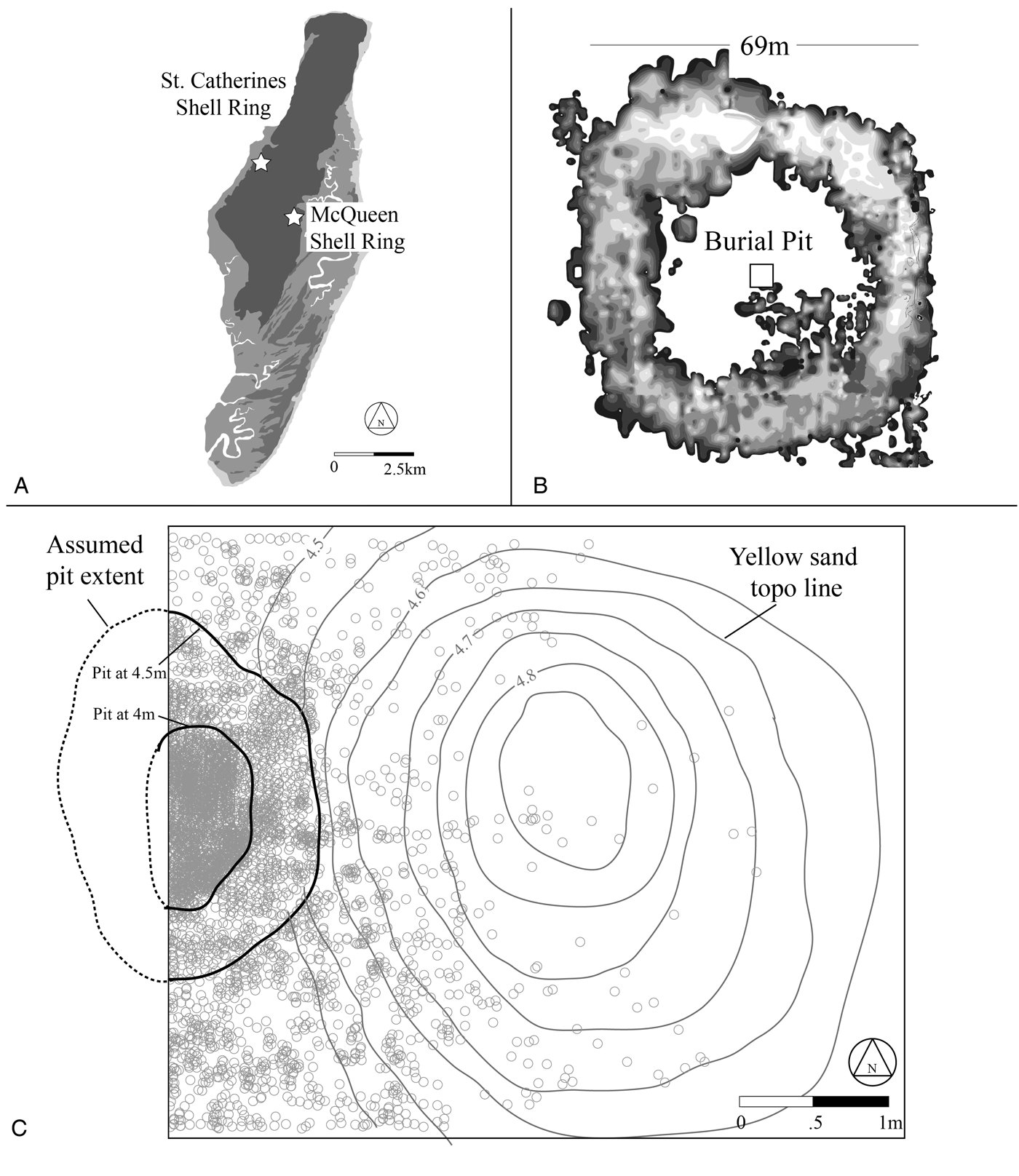
(A) Location of shell rings on St. Catherines Island, (B) Location of burial pit within the McQueen shell ring (shell arc outline based on thickness of shell deposits), (C) Plan view of burial pit marked by dark lines signifying the upper and lower extent and dotted lines showing the assumed western extent of a pit that has not been mapped, human and nonhuman bones are marked by circles, and topographic lines indicate small sand hill. Elevation of the pit extent and hill are based on arbitrary datum elevation at 5 m.

The McQueen shell ring is one of two contemporaneous shell rings on St. Catherines Island, located near the center of the Georgia Bight (Sanger and Thomas Reference Sanger, Thomas, Thomas and Sanger2010; Figure 2). Dating to about 4300–3800 cal BP (Supplemental Table 1), the McQueen and St. Catherines shell rings are among the oldest known sites on the island and were deposited shortly after sea levels stabilized near modern levels (Bishop et al. Reference Bishop, Meyer, Vance, Rich, Bishop, Rollins and Thomas2011; Sanger and Thomas Reference Sanger, Thomas, Thomas and Sanger2010). Both rings are similar in size, with middens measuring roughly 70 m across and encircling shell-free plazas spanning 30–40 m (Figure 2). Measuring only 0.2–1 m in height, the circular midden at McQueen is not as tall as the midden at the St. Catherines shell ring that measures 1–1.5 m. Both ring sites appear to have been occupied year-round, although population levels may have fluctuated throughout the year with numbers increasing during seasonal gatherings (Colaninno Reference Colaninno2012; Quitmyer et al. Reference Quitmyer, Jones, Reitz, Quitmyer and Thomas2012; Sanger et al. Reference Sanger, Quitmyer, Colaninno, Cannarozzi and Ruhl2019). Evidence suggests that shell-ring site residents engaged in relations with their inland neighbors, likely facilitated by periodic gatherings, during which materials, including stone for knapping, were exchanged (Sanger and Ogden Reference Sanger and Ogden2018; also see Gilmore et al. Reference Gilmore, Sassaman and Glascock2018).
Geophysical surveys provided the impetus for excavating in the McQueen shell ring plaza, as they revealed a unique magnetic signature in its center (Mahar Reference Mahar, Thompson and Thomas2013). Located roughly 30 cm below the surface, only the very upper edge of the burial pit was impacted by hand plowing during the eighteenth and nineteenth centuries. The pit measured almost 1.5 m across and 1 m deep and was filled with a dark sandy loam, distinguishing it from the surrounding yellow-brown sand (Figure 2). Conical in shape, the pit and surrounding soils showed no signs of thermal alteration, which typically manifests as reddish, highly consolidated sands. Excavations also revealed the presence of a buried sand hill, measuring 30 cm tall, next to the pit (Figure 2).
Pit contents included highly fragmented bones that were typically calcined and very small. We were unaware that some of these remains might be human until the assemblage was hand sorted in the laboratory and their identification was confirmed by project bioarchaeologists. Acting in accordance with requirements for all Native American remains from St. Catherines Island, David Hurst Thomas conveyed these findings to Georgia's Council on American Indian Concerns. The resulting agreement facilitated continued excavations and the analyses presented here without sharing any photographs of the human remains.
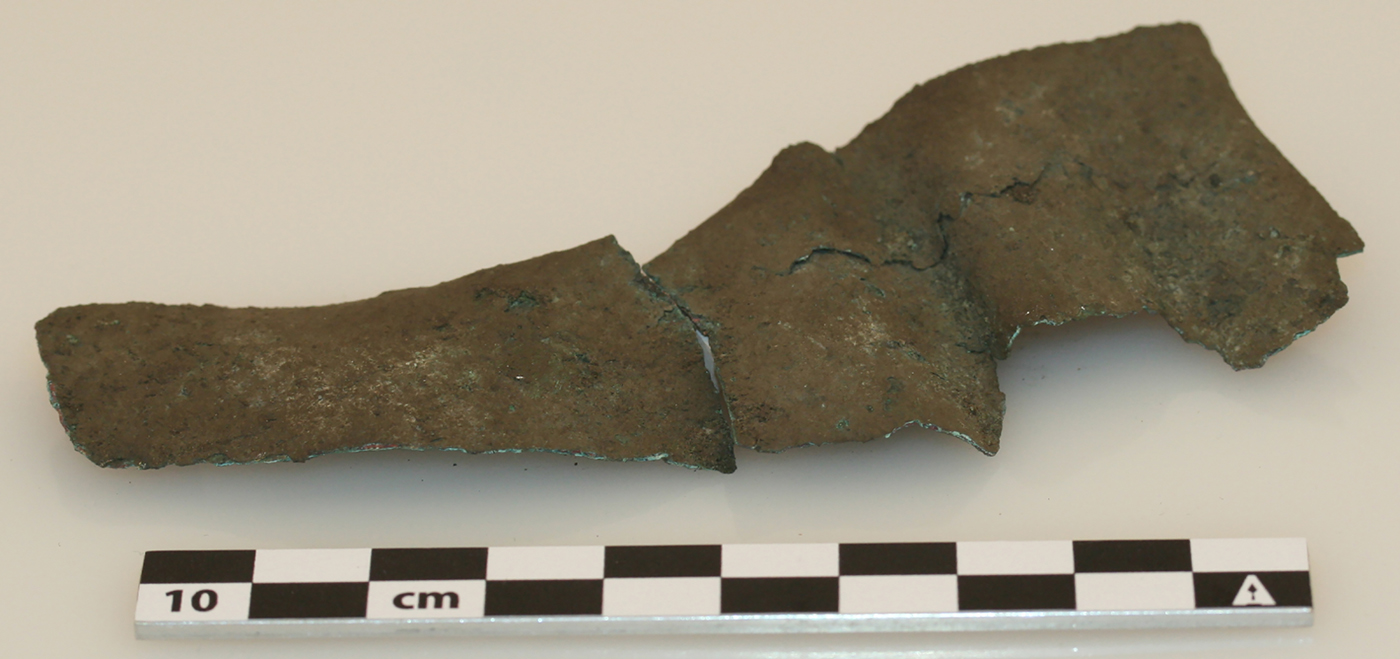
Excavators encountered several very small (1–5 cm) fragments of copper about halfway down the pit alongside a larger, nearly intact copper band. Although we do not share any photos of human remains, we include an image of the copper object recovered alongside the cremains (Figure 3). The copper band measures between 38 mm and 19 mm wide, 160 mm long, and 1 mm thick and has no engravings, impressions, incisions, or other embellishments on either face. It has not been exposed to heat and therefore was not placed in the fires alongside the cremated bones.
Photo of copper band from the McQueen shell ring. Photo by Matthew Sanger.

We ran direct accelerator mass spectrometry (AMS) radiocarbon dates on a human cranial vault fragment found 2 cm above the copper band and a femur fragment immediately adjacent to it. Both dates are statistically identical and show the cremated individuals died about 4100–3980 cal BP, contemporaneous with the formation of the shell arc (Supplemental Table 1, lab numbers OxA-32446 and UCIAMS-130901; Sanger et al. Reference Sanger, Hill, Lattanzi, Padgett, Larsen, Culleton, Kennett, Dussubieux, Napolitano, Lacombe and Thomas2018:E7674). The material culture recovered from the pit supports the radiocarbon findings, as they include fiber-tempered pottery and stemmed projectile points, which are diagnostic of the Late Archaic (e.g., Sassaman Reference Sassaman1993). At least one projectile point was fractured by high levels of heat, presumably as it was exposed to the same flames as the surrounding bones (Sanger and Ogden Reference Sanger and Ogden2018).
Methods
Our analytical goals included the following: (1) determining the profiles of the individuals interred in the center of the shell rings, (2) the means by which they were interred and handled after death, and (3) the context of their interment. To fulfill these goals, we conducted bioarchaeological analyses of the remains, including determining the level of heat alteration (Supplemental Table 2), assessing the minimum number of individuals (MNI), mapping their distribution within the burial pit, developing biological profiles, and identifying other processes relating to health status, lifestyle, and cultural events that impacted individuals in both pre- and postmortem contexts (see Supplemental Data and Supplemental Tables 3–5). We also used X-ray fluorescence (XRF) spectrometry and energy dispersive spectroscopy in conjunction with scanning electron microscopy (SEM-EDS) analyses to determine the elemental composition of several unusual small bright-red stains observed on some calcined bones to help further understand how people handled these remains after death.Footnote 2
Results
Bone, teeth, and shell remains recovered from the McQueen shell ring were highly fragmented. Very few of the osteological materials are whole, and the degree of identifiability is low. Of the 80,264 skeletal and dental fragments, only 2.4% were positively identified as human while only 8.7% of the nonhuman osteological materials were identified to class or beyond. The remaining fragments could not be confidently identified as human or nonhuman. The nonhuman remains do not appear to be exclusively food remnants. Of the 281 white-tailed deer (Odocoileus virginianus) remains represented, a large proportion, 71.2% (n = 200), are teeth, an element that has no nutritional value. The nonhuman vertebrate collection includes species rarely represented among other well-studied Late Archaic shell-ring collections, such as a small sperm whale (Kogia sp.), alligator (Alligator mississippiensis), woodpecker (Picidae), and belted kingfisher (Megaceryle alcyon; Colaninno Reference Colaninno2012; Colaninno and Compton Reference Colaninno and Matthew Compton2018). The remains of these taxa are not represented or are extremely uncommon among the studied collections from the surrounding shell midden, which otherwise contains large numbers of locally available animals, such as estuarine fishes (Colaninno and Reitz Reference Colaninno and Reitz2015; Reitz Reference Reitz2014).
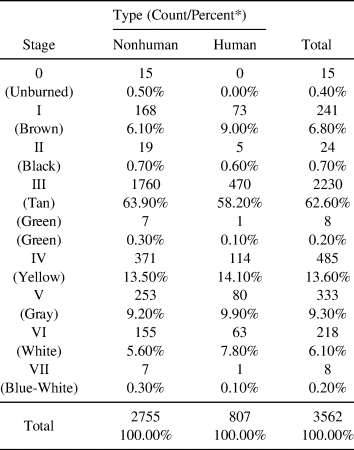
A majority of the human bone fragments were tan with structural alterations consistent with exposure to high temperatures, including reticulate, parallel curvilinear, and stepped fracture patterns, as well as warped macrostructure apparent in larger fragments (Table 1). These features are usually gray, whereas the tan color may be due to soil contact during cremation or following deposition. Most other fragments were calcined yellow or gray with fewer as white to blue white, indicating exposure to 1,100+°C. Very few fragments were the sooty black color that typically occurs from exposure to 200–400°C, and fewer still were unburned. A few fragments bore a green or teal patina, evidence of their proximity to copper. The structural alterations of the bone fragments are consistent with cremains burned in the flesh. Manual reduction through pulverization during or after firing was probably part of the process, given the uncommonly small size of the fragments.
Frequency of Identifiable Bone Fragments by Burn Stage.

* Count and percent based on a sample that clearly demonstrated burn stage.
Analysis of point-provenience data demonstrates that the pit contained at least two depositional events, including an isolated, discrete burial in the lowest deposit. The two deposits representing these events were separated by a thin layer of dark sandy loam that measured about 5 cm thick and contained few bones. Both radiocarbon dates from the pit were obtained from bones in the upper deposit, and the copper fragment was also found in the upper deposit near the transition with the lower deposit. Osteometric analysis of an intact intermediate cuneiform and visual assessment of nonmetric features indicate the cremains in the lower burial are of an adult female (Supplemental Tables 3 and 4). The upper burial contained additional adult human individuals, including at least one male and one female. We estimated the MNI for the upper burial by measuring the repetition of intermediate hand phalanges. Assuming all the adults possessed all their fingers at death and none were removed afterward, each individual should be represented by eight manual intermediate phalanges. As such, the 36 manual intermediate phalanges identified in the upper burial represent at least five adults. These five individuals and the adult in the lower burial indicate that the adult MNI is six. Age estimates from the upper burial include at least one child aged 6–7 years old, an adolescent, at least one person about 30–44 years old, and at least one person who was 45 years of age or older at the time of death. The presence of at least one child brings the total MNI to seven, as all of the manual intermediate phalanges described above were from adults.
Three cranial fragments displayed evidence of possible perimortem modifications, including two from the upper burial and one from the lower (Supplemental Table 5). The most heavily modified cranial fragment came from the upper burial. It is an otherwise nondescript cranial vault fragment, 13 mm long, with no suture edges or vascular grooves and is more likely from the frontal lobe rather than one of the parietals. The bone is marked by at least nine short subparallel cutmarks, seemingly organized in series. Some are very thin and shallow, and others are wider and deeper across the ectocranial surface. Considering that some extend beyond the edges of the fragment, it is likely that these cuts occurred before breakage. The cutmarks were made with a retouched stone tool, as many present complex profiles with multiple subparallel “ledges” (as opposed to a V-shaped profile) that are more compatible with the edge of a retouched stone tool than with a smooth, sharp blade. The endocranial surface shows signs of a modern impact, likely created during excavation, as well as much older perimortem marks caused when a thin implement penetrated the bone. The second fragment from the upper burial with perimortem marks is a frontal bone fragment exhibiting one or two shallow cuts made with a sharp stone implement near the origin of the temporal line. One cranial vault fragment from the lower burial displays a perimortem cutmark on the ectocranial surface.
Other pathologies found on skeletal fragments from the lower burial include a radius fragment exhibiting evidence of osteomyelitis (Supplemental Table 5). Another long bone fragment exhibited striated bone deposition on the surface, a characteristic reaction to a subperiosteal hematoma resulting from blunt-force trauma, although it may also be symptomatic of some pathogenic infection.
Most of the pathological conditions documented in the upper burial were mild, including evidence of a small cyst or bone spur. A few bone fragments exhibit periosteal reactions, which are usually nonspecific pathophysiological reactions to exogenously imposed insults, such as physical trauma, infection, or other systemic conditions (Supplemental Table 5). One subadult frontal bone fragment with a portion of the orbital roof exhibited evidence of cribra orbitalia. This condition is regarded as an indication of some episode of nutritional stress, perhaps associated with iron-deficiency anemia or other conditions.
Small, bright-red deposits were observed on the heat-exposed surfaces of several osteological fragments. XRF and SEM-EDS analyses indicate that the elemental composition of these stains is consistent with an iron-oxide mineral. We hesitate to refer to this material as ochre, given that the term in the archaeological literature not only refers to naturally occurring minerals but also implies intentional use of these minerals by humans. Iron-oxide minerals naturally occur on the Georgia coast in sandstone deposits. Additionally, in salt-marsh and estuarine sediments, iron-oxide mineral phases can be formed from pyrite oxidation (e.g., Luther et al. Reference Luther, Giblin, Howarth and Ryans1982). Given the overall infrequent occurrence of iron-oxide staining on the calcined bone, we cannot conclude the iron-oxide was intentionally added to the cremains; however, bone from other areas of the site lack iron-oxide staining, making it plausible that its occurrence is related to human intent.
Discussion: Movements of Ideas and Objects
The use of cremation at McQueen is unlike what is typically found in the Late Archaic lower Southeast and may even be a unique discovery, as no similar finds have been published. However, an absence of data does not prove that other cremations are not present at other Late Archaic sites in the lower Southeast. There are several ways to interpret these findings: (1) cremation is more common in the lower Southeast than previously assumed, and the discovery of cremains at McQueen is part of this broader yet underappreciated pattern; (2) residents of McQueen independently invented crematory practices; or (3) the practice of cremation originated elsewhere and was brought to McQueen. We find little evidence for the first two hypotheses. Cremation was a relatively foreign practice in the lower Southeast, and we propose that it came to McQueen alongside the copper band through direct trade lines between the Georgia Bight and further to the north, perhaps extending as far as the Great Lakes, and likely was facilitated by communities living in the Ohio and Tennessee River Valleys.
We find our first hypothesis (that cremation is a more widespread tradition) unconvincing, as there are very few instances of cremation in the region, and the few that have been documented, such as White's Mound, are problematic. Instead, the few Late Archaic period burials that have been recovered, such as those found at Daw's Island, suggest that inhumations are a means of handling the dead in the coastal lower Southeast. As already discussed, the paucity of Late Archaic period human remains from the coastal lower Southeast is notable and could be evidence of crematory practices that resulted in highly fragmented cremains that either are difficult to recover or are misidentified when recovered. In this regard, it is possible that additional cremations were performed at other shell rings but have been ignored or inaccurately identified as food remains located in roasting pits (e.g., Trinkley Reference Trinkley1980). It is difficult to determine whether cremation was a more widely held practice when this hypothesis is based on negative evidence (i.e., the lack of human remains). Further excavations and reassessment of prior finds, especially from other shell rings, are needed to determine whether additional Late Archaic period cremations are located in the lower Southeast.
Without this additional evidence, the burial pit at McQueen appears unique, perhaps reflecting an independent invention by the residents of the Georgia Bight. Containing at least seven individuals, the McQueen cremation does not hold all the individuals that would have perished over the hundred or more years in which the ring was in use. Our geophysical surveys and excavations did not encounter any similar burial pits, and we are relatively confident that the one in the center of the ring is the only one on site. As such, the dead interred in the center of McQueen may have been handled differently than other deceased individuals, perhaps because of who they were or how they died. As they were burned in the flesh and the burial pit does not appear to be excavated multiple times, the individuals buried at McQueen almost certainly represent a group of people who died at, or approximately at, the same time. The deaths of at least seven people in such a short period could reflect the presence of a relatively large population who came together to bury their recently departed. Alternatively, the co-occurrence of these deaths could reflect an anomalous event in which a group of people perished, perhaps through disease, violence, or accident. Perhaps the inauspiciousness of their deaths required handling these bodies differently, creating an impetus to invent a new tradition with few, if any, parallels in the region.
It is difficult to reject the possibility of independent invention, but there are notable parallels in how people at McQueen and the Great Lakes handled their dead that suggests a shared tradition. Making the link between the Great Lakes and the coastal lower Southeast is not altogether surprising, considering that Late Archaic Great Lakes burials occasionally contain shell artifacts thought to originate from the coast (Abel et al. Reference Abel, Stothers, Koralewski, Prufer, Pedde and Meindl2001; Del Castillo Reference Del Castillo1986; Donaldson and Wortner Reference Donaldson and Wortner1995; Stothers and Abel Reference Stothers and Abel1993). There is also some evidence to suggest that the mortuary practices of groups in the Great Lakes and Upper Midwest extended further to the south, including among Shell Mound Archaic communities in the Ohio River Valley and perhaps as far south as the Tennessee River Valley (Chapman Reference Chapman1977; Chapman and Myster Reference Chapman, Myster and McNutt1991; Goldstein and Myers Reference Goldstein, Meyers, Kuijt, Quinn and Cooney2014; Trevelyan Reference Trevelyan2004).
Within all these regions (the Great Lakes, Ohio River Valley, and Little Tennessee River Valley), we find mortuary practices that are also found at McQueen, including the cremation of the dead in places other than where they were buried and the interment of copper alongside the dead (Abel et al. Reference Abel, Stothers, Koralewski, Prufer, Pedde and Meindl2001; Donaldson and Wortner Reference Donaldson and Wortner1995; Goldstein and Myers Reference Goldstein, Meyers, Kuijt, Quinn and Cooney2014; Pfeiffer Reference Pfeiffer1977; Stothers and Abel Reference Stothers and Abel1993). In the Ohio and Tennessee River Valleys, the co-occurrence of copper and cremation is relatively uncommon during the Late Archaic, but when they do occur, interments are often placed on a nearby hilltop, a practice also found in the Great Lakes (Donaldson and Wortner Reference Donaldson and Wortner1995; Goldstein and Meyers Reference Goldstein, Meyers, Kuijt, Quinn and Cooney2014). St. Catherines Island is a relatively flat landform, yet residents of McQueen placed their burial pit next to a very small hill located in the center of the ring (Figure 2). Such hills are rare, and our excavations did not encounter any similar features anywhere else at the site. As such, this small topographic similarity could be evidence of another connection between McQueen and communities closer to the Great Lakes. However, we understand that a 30 cm tall pile of sand is of a much smaller scale than the burial contexts often used in the Great Lakes. The point of emphasis here is not necessarily any topographical similarity, but rather the ritual significance of a visually distinct feature of the land where the cremated remains were interred.
We find additional similarities in how communities in the Great Lakes and McQueen handled the dead that are not as well represented or well reported in the regions found in between, including how both groups cremated bodies while still in the flesh (Donaldson and Wortner Reference Donaldson and Wortner1995; Pfeiffer Reference Pfeiffer1977). Great Lakes groups also cremated both men and women as well as individuals of all age groups (Converse Reference Converse1980; Donaldson and Wortner Reference Donaldson and Wortner1995; Ritchie Reference Ritchie1949; Ritzenthaler and Quimby Reference Ritzenthaler and Quimby1962), similar to the demographic profile found at McQueen. The stratigraphy of the McQueen burial is also similar to those at the Great Lakes where Late Archaic burials are occasionally layered (Donaldson and Wortner Reference Donaldson and Wortner1995). Cremations conducted by Late Archaic Great Lakes communities occasionally include faunal remains (Abel et al. Reference Abel, Stothers, Koralewski, Prufer, Pedde and Meindl2001; Donaldson and Wortner Reference Donaldson and Wortner1995). While we cannot definitively state that the red stains found on the bones from McQueen were the result of people placing ocher on the cremains, this seems a plausible conclusion. The use of red ocher is a hallmark of burials in the Great Lakes (Abel et al. Reference Abel, Stothers, Koralewski, Prufer, Pedde and Meindl2001; Donaldson and Wortner Reference Donaldson and Wortner1995; Ritzenthaler and Quimby Reference Ritzenthaler and Quimby1962).
Finally, copper is typically associated with deep-water creatures and spirits known as manitous in the Great Lakes, where copper is often described as originating when a warrior dove to great depths to remove a piece of an underwater beast (Trevelyan Reference Trevelyan2004). The pygmy sperm whale vertebra found in the McQueen cremation is a unique archaeological find not replicated elsewhere on the island and reflects a purposeful deposit of a deep-water creature alongside the copper band and cremains. Whether this vertebra is meant to echo stories of the manitous is impossible to determine, but we have few other theories about why this bone was placed in the burial pit.
Conclusions
Although we can confidently state that the copper found at McQueen originated in the Great Lakes, it is more difficult to determine the origin point(s) of the various mortuary practices found at this shell ring. These mortuary practices are very similar to those found in the Great Lakes as well as with some burials found in the Ohio and Tennessee River Valleys. As such, it is currently impossible to determine whether these practices moved along relational lines connecting the Great Lakes and the coastal lower Southeast or whether these relations were partially mediated by communities living in between. In either regard, the presence of shared mortuary practices found in the Great Lakes, the coastal lower Southeast, and the intervening regions suggests a more direct level of communication among these communities than would be assumed based on the presence of the copper object alone. Likely, exchange and communication among the communities living in these different regions occurred through a range of different avenues that varied in length over time and across space. Nonetheless, even the shortest distance suggested by the present study, from the Tennessee River Valley to St. Catherines Island, spans more than 500 km, is separated by the Appalachian Mountains, and would be considered an example of long-distance exchange.
The precise means of exchange among these regions is unclear, although it is likely that periodic gatherings drew people from across the region, perhaps including very distant travelers. For example, Late Archaic communities in the Great Lakes held “trade fairs” as far south as Ohio in which goods, including shells from the Atlantic, were exchanged (Abel et al. Reference Abel, Stothers, Koralewski, Prufer, Pedde and Meindl2001; Stothers and Abel Reference Stothers and Abel1993; Stothers and Graves Reference Stothers and Graves1980). Similar points of aggregation and exchange bridge the Georgia Bight and Ohio, including the western Appalachians (Claassen Reference Claassen2010, Reference Claassen2015) and along the Savannah River (Gilmore et al. Reference Gilmore, Sassaman and Glascock2018; Sassaman et al. Reference Sassaman, Blessing and Randall2006). Connections between residents of the Savannah River and the Georgia Bight have been demonstrated by sourcing studies on pottery (Gilmore et al. Reference Gilmore, Sassaman and Glascock2018) and similarities in site layout and use of storage pits (Sanger Reference Sanger2017; Sassaman et al. Reference Sassaman, Blessing and Randall2006), and it is thought that these connections were partly faciliated during large-scale gatherings. It is possible that individuals moved vast distances to attend these various gatherings, perhaps acting as emissaries, merchants, or knowledgeable healers or playing other roles rarely accorded to hunter-gatherer communities. To this point, it is possible that some, and perhaps all, of the individuals interred in the center of McQueen were long-distance travelers.
The recovery of copper at McQueen suggests a reassessment of similar finds from shell rings in Mississippi and more broadly. The presence of copper at Cedarland and Claiborne has long been thought to reflect their connection to nearby Poverty Point (Bruseth Reference Bruseth and Byrd1991), yet given the finds at McQueen, it is possible that shell rings were more broadly imbricated into vast exchange networks. Importantly, the copper recovered from Poverty Point, and presumably from Cedarland and Claiborne, did not originate from the Great Lakes but rather from the Canadian Maritimes (Hill et al. Reference Hill, Greenlee and Neff2016). Therefore, McQueen, Claiborne, and Cedarland appear to be involved in different exchange networks or one network that included materials from a wide range of locales. The level to which other shell rings found across the southern Atlantic and Gulf coasts might also have been part of this network or networks is an exciting possibility that should drive future research.
The exchange patterns documented in this article and other publications that describe the movement of a wide range of materials across the Archaic Eastern Woodlands presage a much more robust movement of objects and ideas in later periods. Similar to what we suggest in this article, much of the later exchange revolved around ritual and ceremonial events and often included the handling of the dead (e.g., Carr and Case Reference Carr and Case2006; Wright Reference Wright2014). The exchange of copper also reached new heights during later periods, most notably during the ascendancy of Hopewellian and Mississippian groups (Trevelyan Reference Trevelyan2004).
Deployed during ritual events and eventually interred alongside the dead, copper objects likely were prestigious during the Late Archaic and in later periods, perhaps filling a ceremonial or political need. The objects may have symbolized and affirmed distant relations between groups and places, perhaps increasing the status of individuals or groups involved in their exchange, but we do not yet have any evidence of entrenched social inequality at the Late Archaic shell rings or more broadly across the Georgia Bight. Whether reflecting or contributing to emergent status differences, the discovery of long-distance exchange of prestige goods among Archaic period communities living in the U.S. Southeast challenges traditional notions of hunter-gatherers as living in relative isolation and instead suggests nonagrarian groups created and maintained vast social networks thousands of years earlier than typically assumed.
Acknowledgments
We thank the students, interns, and staff at the American Museum of Natural History who conducted fieldwork and initial laboratory processing. We are particularly grateful for the work of Lorann Pendleton, who first noted the possibility we had encountered human remains and then worked tirelessly to convince the rest of us. We are in her debt. We are also especially grateful to Anna Semon for taking part in fieldwork and facilitating research. Our gratitude is also shared with the staff of St. Catherines Island and Edward John Noble Foundations, who made fieldwork possible—particularly Royce Hayes, who provided unlimited patience during our field seasons. We also thank Laure Dussubieux of the Field Museum for her assistance in analyzing the copper band. Eric V. Formo of the University of Georgia conducted the SEM analysis of the red stains, for which we are appreciative. We are also grateful for the help provided by the staff and faculty at the University of Georgia, where the materials analyzed in this article are housed. We also thank Georgia's Council on American Indian Concerns for assistance in handling such sensitive materials. We also thank Cynthia Campos for translating our abstract into Spanish. Finally, our paper benefited greatly from the comments of three anonymous reviewers; we thank them for their efforts. We are responsible for any errors, misrepresentations, or other mistakes presented in this paper.
Data Availability Statement
All analyzed materials are housed at the University of Georgia, Athens; and all analytical tables, reports, and forms are housed at the American Museum of Natural History and Ohio State University.
Supplemental Materials
For supplementary material accompanying this paper, visit https://doi.org/10.1017/aaq.2019.59.
Supplemental Table 1. Radiometric Results
Supplemental Table 2. Stages of Thermal Alteration in Human Remains at McQueen Shell Ring
Supplemental Table 3. Bone Fragments Used for Sex Estimation
Supplemental Table 4. Age Estimates
Supplemental Table 5. Evidence of Pathology, Trauma, or Modification
Supplemental Data. Bioarchaeological Analyses and References Cited