


Law and society’s theories sometimes get stretched until they fray. Silbey’s reflection on legal consciousness shows how a once-targeted concept ballooned in usage and lost analytic sharpness, prompting calls to “recapture” its theoretical promise (Silbey Reference Silbey2005). Legitimacy required consolidation and explicit subtyping to remain useful across contexts (Suchman Reference Suchman1995; Sudda et al. Reference Suddaby, Bitektine and Haack2017). New work on legal ambiguity similarly demonstrates the value of carefully differentiating types to avoid conflation (Frost and Schaaf Reference Frost and Schaaf2024). Parallel efforts in organizational theory have tried to preempt drift by specifying architectures – fields (Fligstein and McAdam Reference Fligstein and McAdam2015) and institutional logics (Thornton et al. Reference Thornton, Ocasio and Lounsbury2012) – that bound what is and is not an instance of a concept. And the institutional career of diversity vividly illustrates how popularity can outpace precision without such guardrails (Berrey Reference Berrey2015). Portability without boundaries invites conceptual sprawl.
Neoliberalism epitomizes this pattern and is also a cornerstone explanation in sociolegal studies (Bourdieu Reference Bourdieu1994; Fernandes et al. Reference Fernandes, Cadigan, Edwards and Harris2019; Foucault Reference Foucault, Burchell and Davidson2008; Simon Reference Simon2010a; Sozzo Reference Sozzo2019; Sykes et al. Reference Sykes, Ballard, Giuffre, Goodsell, Kaiser, Mata and Sola2022; Wacquant Reference Wacquant2009). Indeed, some leading law and society scholars consider neoliberalism an existential adversary – Valverde, for instance, laments how sociolegal researchers are not engaged in the “overthrow of neoliberal capitalism” (Valverde Reference Valverde2010: 46). Such framing testifies to the concept’s ubiquity in our intellectual landscape but also hints at the blurring of analytic boundaries that this paper scrutinizes. The appeal of broadly defined neoliberalism is that it can bridge sociolegal change to macro shifts in the political economy – but I argue this elasticity is dangerous. This makes it all the more urgent to examine how we deploy “neoliberalism” as a concept.
Indeed, some scholars have questioned neoliberalism as “polyvalent” and overly elastic (Boas and Gans-Morse Reference Boas and Gans-Morse2009; Ferguson Reference Ferguson2010; Springer et al. Reference Springer, Birch and MacLeavy2016: 2), critiqued its application beyond Western contexts (Kipnis Reference Kipnis2007), or described it as conceptually murky (Sozzo Reference Sozzo2019; Venugopal Reference Venugopal2015; Xenakis and Cheliotis Reference Xenakis and Cheliotis2019). Silbey, Suchman, and Frost and Schaaf counsel that, for their respective concepts, we should specify scope conditions and mechanisms and articulate what evidence would count against the claim (Silbey Reference Silbey2005; Suchman Reference Suchman1995; Frost and Schaaf 2024). Drawing on scholars who explore the promises and pitfalls of our applications of social theory (Beck 1992 [Reference Beck1986]; Blumer Reference Blumer1954; Ermakoff Reference Ermakoff2017; Sartori Reference Sartori1970; Silbey Reference Silbey2005; Suchman Reference Suchman1995), this paper goes further by analyzing how unbounded uses hinder theory-building and by offering a concrete path to “rescue” the concept through counterfactual imagination.
In this article, I map recurrent ambiguities in the operationalization of neoliberalism – is it an era, ideology, policy bundle, or mechanism? Neoliberalism is not one thing; historically it has been (1) a set of market-driven policies, (2) an ideological project extending economic reasoning into all social domains, and in some cases (3) a political intervention implemented undemocratically (e.g., Pinochet-era Chile). Therefore, in this article, references to neoliberalism generally mean the concept (the bundle of ideas/practices it represents) and its application in scholarship, not just the word itself. By the late 20th century, scholars positioned neoliberalism as directly causing social harms, punitive laws, and mass incarceration. Part I addresses how this shift occurred by tracing neoliberalism’s conceptual journey. It begins with neoliberalism’s origins as a state-friendly capitalist doctrine in 1938 (Denord Reference Denord2001), through its consolidation as a set of market-driven policies during the Cold War (Harvey Reference Harvey2007), and its widespread adoption by law and society scholars from the 1990s onward.
Part II addresses two problems with this shift: ubiquity and a lack of counterfactuals. Ubiquity occurs when scholars cast neoliberalism as an omni-causal force: ready to provide causality for any time, place, actor, or institution. This flexible framing has a downside: scholars who invoke neoliberalism as an omni-cause (e.g., to explain mass incarceration) fail to specify counterfactuals. Without a counterfactual – a cogent story of what would happen in the absence of neoliberalism – there is no rock to lever against and so determine a cause. Without counterfactual imagination, neoliberalism may structure all outcomes of all social relations, explaining everything and, thus, nothing.
After detailing these two problems, I address several cases, with a primary focus on the punishment and society subfield of law and society (Collaborative Research Network 27 of the Law & Society Association). I focus on this case because scholars have questioned theorization in the subfield (e.g., Rubin and Shalaby Reference Rubin and Shalaby2025; Xenakis and Cheliotis Reference Xenakis and Cheliotis2019) and because, as I argue, the subfield has embraced neoliberalism as an explanatory frame.
An unbounded neoliberalism may be less useful for our empirical work (see Freese and Peterson Reference Freese and Peterson2017).Footnote 1 As Sartori (Reference Sartori1970: 1048) warned regarding conceptual stretching, when a single concept explains contradictory phenomena without meaningful distinctions, the concept loses analytical value. This critique does not imply abandoning neoliberalism – indeed, some scholars deploy it as a sociohistorical phenomenon rather than as an omnipresent cause (see the last subsection of Part II). Other scholars respond by dismissing the importance of theorization in empirical work (Besbris and Khan Reference Besbris and Khan2017). However, removing direct references to theory does not resolve the problem: neoliberalism can backfire by muddying causal claims, weakening generalizations, and obscuring the contributions of our scholarship.
In short, this article argues that scholars have misused “neoliberalism” as a catch-all for disparate sociolegal outcomes. This misuse means that neoliberalism explains everything and nothing, which impairs both the empirical and theoretical development of our field. Instead of abandoning the term, I propose we apply neoliberalism as a sociohistorical process so that it has meaningful consequents.
Part I: a brief history of neoliberalism
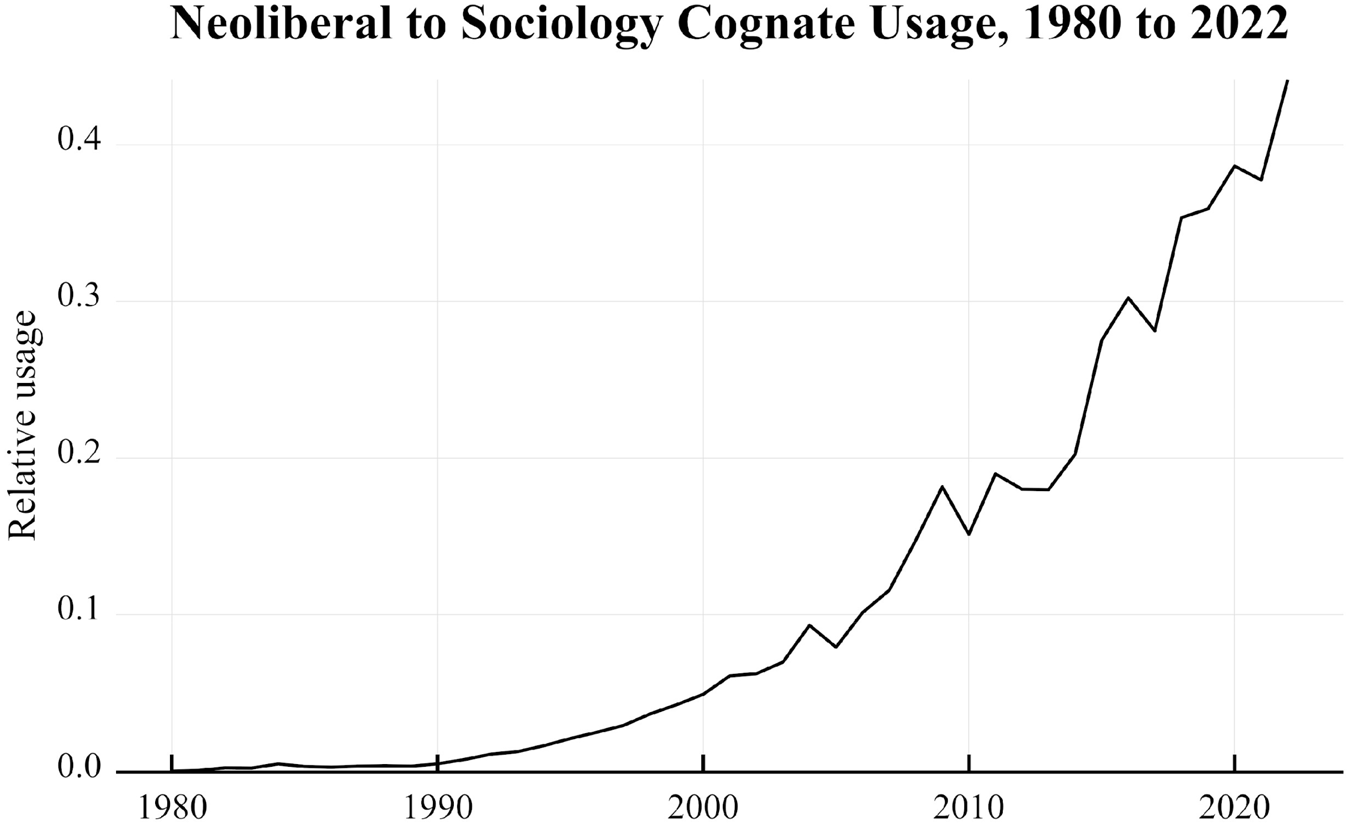
In conversation and in papers, neoliberalism abounds. Outside of academia, neoliberalism broadly refers to “deregulation, liberalization, privatization or fiscal austerity” (Rodrik Reference Rodrik2017). “Neoliberalism” and its cognates have become popular since appearing in the 1980s and now exceed two mentions for every five mentions of “sociology” and its cognates (see Figure 1). Figure 1 illustrates the rising usage of “neoliberalism” relative to “sociology,” demonstrating a surge in popularity after the 1980s.
Neoliberal cognate usage relative to sociology, Google NGram (Sparavigna and Marazzato Reference Sparavigna and Marazzato2015). Note: A relative usage of 1.0 indicates that the term “sociology” (and related words such as “sociological”) appears as frequently as “neoliberal” (and related words such as “neoliberalism”) during that year.

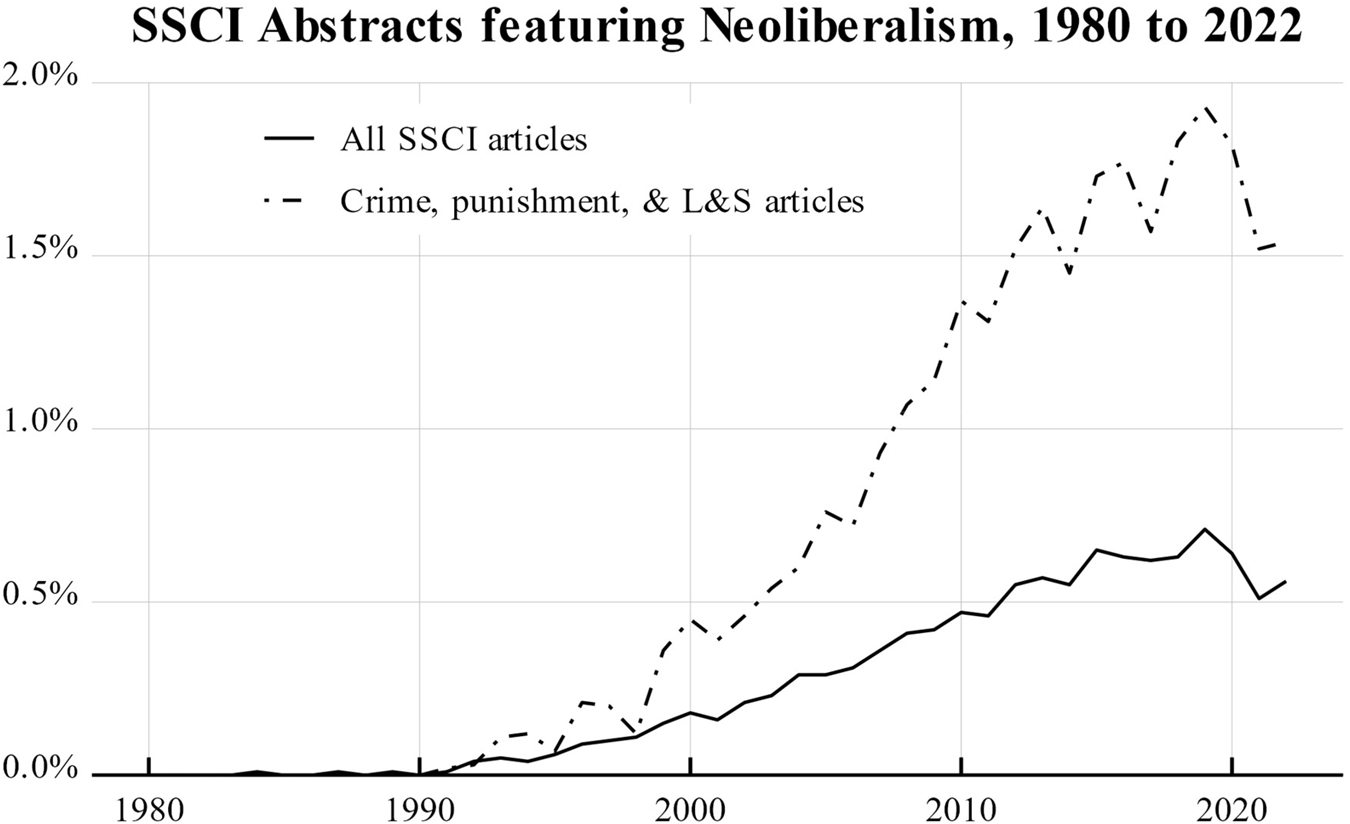
The proportion of Social Science Citation Index articles prominently featuring neoliberalism also grew rapidly during the same period. Figure 2 shows that usage of neoliberalism in scholarly articles has grown dramatically in sociolegal journals since the 1990s. Indeed, the popularity of neoliberalism in research is understated by Figure 2 for two reasons: the figure only counts papers that prominently feature neoliberalism, and many scholars engage neoliberalism’s substantive claims but avoid the term itself (e.g., Lara‐Millán Reference Lara‐Millán2021; Seim Reference Seim2020). This popularity leads scholars to “associate neoliberalism with multiple underlying concepts, including a set of policies, a development model, an ideology, and an academic paradigm” (Boas and Gans-Morse Reference Boas and Gans-Morse2009: 140). To understand this fragmentation, we must first visit the birth of neoliberalism and then assess how scholars began to incorporate theorizations of neoliberalism in their work. Be warned, however, that I cannot provide a singular, definitive definition of neoliberalism, but I will instead unearth several competing definitions.Footnote 3
Social Science Citation Index articles using neoliberalism (Clarivate 2024).Footnote 2

Development of neoliberal doctrine
Today’s formulations of neoliberalism would be unrecognizable to the first neoliberals, who created the term in 1938 to inaugurate a new economic doctrine. These formulations would also be nearly unrecognizable to the social scientists who first discussed neoliberalism in the 1960s as a policy position midway between 19th-century liberal capitalism and socialism or communism. How did the idea of neoliberalism first take form, and why did its early proponents endorse state involvement in markets?
The 1930s saw the aftermath of the Great Depression and the rejection of the classical (also known as liberal) socioeconomic policies that had enabled and then exacerbated the economic crisis. Various state, economic, and ideological schemas arose to address the myriad policy failures of liberalism. A set of leading old-world and new-world intellectuals, many of whom were disenchanted liberals, sought to create a solution (Lepage Reference Lepage1977). Inspired by Lippmann’s (Reference Lippmann1937) reimagination of liberalism (The Good Society), they organized the 1938 Walter Lippmann Colloquium in Paris to inaugurate neoliberalism as a path forward. This led to a manifesto calling for state intervention to secure competition and fund social welfare (Denord Reference Denord2001).
Breaking with past policy and theory, neoliberalism would advocate for market economies governed by strong state regulatory bodies to ensure competition and deter market failures (Mirowski and Plehwe Reference Mirowski and Plehwe2009). This move ushered in a newfound focus on the economic (rather than sociopolitical, for example) analysis of regulatory issues and market failures. Because laissez-faire policies was demonstrably inadequate, Neoliberals had to interrogate the extent to which “the formal principles of a market economy can index a general art of government” (Foucault Reference Foucault, Burchell and Davidson2008: 131). Foucault observed that in neoliberal thought, the old dichotomy between state intervention and individualism loses significance. Unlike classical liberalism, neoliberalism does not reflexively oppose the state; it even sees an active role for the government in maintaining the market order (Foucault Reference Foucault, Burchell and Davidson2008: 132–133). The first neoliberals agreed that society required state policy and oversight, rather than a market alone.
Their vision was to give the state the responsibilities of market regulation and taxation to fund welfare, defense, education, law, and scientific research (Burgin Reference Burgin2012: 76; Denord Reference Denord2001: 25). In contrast to the notion that neoliberals uniformly opposed state intervention (Harvey Reference Harvey2007: 20),Footnote 4 early neoliberals welcomed a strong state role. As Bronfenbrenner (Reference Bronfenbrenner1955: 160) noted, their thought “lacks the anti-state overtones” of classical liberalism. These early positions are distinct from the deregulation and fiscal austerity that neoliberalism often denotes today.
In the 1950s, University of Chicago economists and sociopolitical theorists such as Hayek, Mises, and Friedman spread neoliberal economic theory into Western policies, institutions, and academia (Mirowski and Plehwe Reference Mirowski and Plehwe2009). Members of the “Chicago School” debated the operation and extent of market regulatory regimes and the proper methods regulators should use to intervene (see Burgin Reference Burgin2012; Lepage Reference Lepage1977). Their meetings and policy proposals constitute the beginnings of a neoliberal school of policy in conscious opposition to socialist and communist doctrines (Boas and Gans-Morse Reference Boas and Gans-Morse2009). For example, members of the Mont Pelerin Society (founded in 1947) crafted proposals such as reducing trade barriers and reforming currency policy to combat post-war socialism (Burgin Reference Burgin2012).
Neoliberal policy and the “Chicago boys”
Keynesians of the era emphasized the state’s role in managing demand. In contrast, neoliberal theorists maintained that decentralized markets aggregate information better than central planning – an idea that eventually entered the mainstream with Hayek’s 1945 paper “The Use of Knowledge in Society.” However, disagreements arose. Whereas hardline Chicago School neoliberals opposed (most) redistribution as inefficient (Ogus Reference Ogus1989: 402–403), more moderate neoliberals – including the German Ordoliberals such as Walter Eucken and Wilhelm Röpke – favored strong social welfare policies and regulatory institutions to temper a market economy.
A hardline set of University of Chicago-educated economists, later known as the “Chicago Boys,” applied a subset of neoliberal precepts during Pinochet’s military junta rule of Chile in the 1970s. Becker praised these economists for their success in enabling high economic growth, calling “their willingness to work for a cruel dictator and start a different economic approach [one] of the best things that happened to Chile” (Becker Reference Becker1997). While these policies did spur economic growth and trade, they also increased unemployment to counteract inflation and denuded labor protections, welfare programs, and social insurance (Harvey Reference Harvey2007: 63, 65).
This early history illustrates that “neoliberalism” has taken (at least) three forms among economists: first, as a policy paradigm, with governments undertaking concrete actions to regulate and promote markets (e.g., privatization, public–private partnerships); second, as an expansion of economics into new spheres, applying market logic to social issues, thereby marginalizing other approaches; and third, as a disruptive intervention, where neoliberal reforms are imposed in an authoritarian manner.
The diffusion of neoliberalism
The Cold War era saw the integration of neoliberal economic theory and government policy, alongside the global proliferation of market economies. Influential economists in the 1970s (such as Gary Becker) expanded the purview of economics toward a “comprehensive” approach “applicable to all human behavior” (Becker Reference Becker1976: 8). Economic analysis could be applied to arenas of human behavior that had previously been considered “irrational,” including deviance and criminology. Correspondingly, neoliberalism could apply to more policy decisions, such as the rationalization of fines and fees (O’Malley Reference O’Malley2011). Though not all economists were so sanguine (see McKenzie Reference McKenzie1978), the field was emboldened.
Early discussion of neoliberalism among other academics focused on welfare-state policies and their direct impacts. The first substantive mention of neoliberalism in American Sociological Review was in 1967, in a footnote discussing the interplay of market controls and political economy in America (Wiley Reference Wiley1967: 529). In Social Research, the first substantive mention was in 1966 as part of a discussion of welfare policies, describing neoliberalism as “the welfare type of neo-capitalism and its ideology” (Maldonado-Denis Reference Maldonado-Denis1966: 608). In The Review of Politics, the first substantive mention was in 1965 as part of a review of the activities of Latin American and Colombian neoliberal policy movements (Bailey Reference Bailey1965).Footnote 5 The first usages in Law & Society Review were in Reference Teubner1983 of the role of law in fostering “social cooperation” (Teubner: 254) and in Reference Rogers1987 of “neoliberal strategies for a competitiveness-oriented industrial policy” amidst other state-led ways to address the internationalization of the economy (Rogers: 757). These initial mentions portray neoliberalism as a policy position, approximately in the middle on a spectrum ranging from unfettered liberal capitalism (and/or fascistic corporatism in Bailey Reference Bailey1965) to collectivization via socialism or communism on the left.
In the late 1970s, political theorists and sociologists (e.g., Mongardini Reference Mongardini1980) were often optimistic about neoliberalism. Their hope was that neoliberalism would, like Locke’s liberalism and the Enlightenment, reinvigorate debates about the relationships between the person, legality, and the state. Bronner (Reference Bronner1980: 17) attributed the success of social democracy to a compromise: wealth redistribution and class-based analysis within a neoliberal, rationalized governance and a market economy, yoking capitalism to the welfare. Proponents of neoliberalism argued that applying cost-benefit analysis could aid policymakers (Mirowski and Plehwe Reference Mirowski and Plehwe2009; Lepage Reference Lepage1977). In their view, this would improve governance.
However, even if neoliberal techniques might support a welfare state, they do so from a technocratic and amoral vantage. Consider that a cost-benefit analysis may (and often will) support a more generous welfare state. The reasoning involved, as Blau (1989) observes, is “cold”; the neoliberal welfare state calculus “resurrects the distinction between the worthy and unworthy but omits the moralizing. Now an unwed mother is a member of the worthy poor as long as a cost-benefit analysis shows that her work exceeds the value of an investment in daycare” (33). Even the prospect of objectivity is dubious, as “moralizing” can influence which factors merit entering the cost-benefit analysis.
As early as 1960, sociolegal scholars voiced concerns about the reach of large corporations operating “in the world arena with only the most tenuous restraints” on their activities (Miller Reference Miller1960: 1568). Political theorists began to critique how economists linked economic freedom to the development of political freedom. While this debate was about neoclassical economics and economic liberalism (not neoliberalism, yet), it presaged future neoliberal policy debates on the relative merits of outcome equity versus market efficiency (see Crowley Reference Crowley1969; Macpherson Reference Macpherson1969). This mid-20th-century debate about classical economic liberalism foreshadowed key aspects of later neoliberalism. By the late 1960s and 1970s, we see the parallel rise of neoliberal economic agendas in Western governments and the growing influence of economics departments, which happened alongside the expansion of global corporations.
Even economists questioned the application of cost-benefit analyses and other assessments to regulatory regimes and social programs, asking why “it is not capitalism or the market economy which should be put on trial today, but the State” (Lepage Reference Lepage1977: 233). The brutal outcomes in Chile of the Pinochet regime, combined with the negative impacts of some neoliberal policies at home and abroad, further soured support among social scientists (Burgin Reference Burgin2012; Harvey Reference Harvey2007; see Valdés Reference Valdés2008, in particular, on disillusionment).
Meanwhile, Western countries largely supported development according to the precepts of austerity, globalization, growth-friendly inflationary policy, and government-mandated transparent markets (Harvey Reference Harvey2007: 13). This “Washington Consensus” became the playbook for international financial institutions such as the World Bank and International Monetary Fund in the 1980s and 1990s. In practice, it meant cuts to public spending, privatization of state enterprises, and trade liberalization in dozens of countries in Latin America, Africa, and Eastern Europe. The importance of this “Washington Consensus” lies in how thoroughly it globalized one version of a neoliberal policy model, making it virtually synonymous with “market reform” worldwide. This contrasted with earlier understandings of neoliberalism as “more social engineering, more services, more paternalism and leveling, in short more statism” (Cohen Reference Cohen1983: 100). Despite popular talk of “deregulation,” sociolegal scholars argue that the neoliberal turn often entailed re-regulation through soft law, standards, and public–private coordination that expanded the amount and sites of regulation (Braithwaite Reference Braithwaite2008; Levi-Faur Reference Levi-Faur2005; Majone Reference Majone1997).Footnote 6
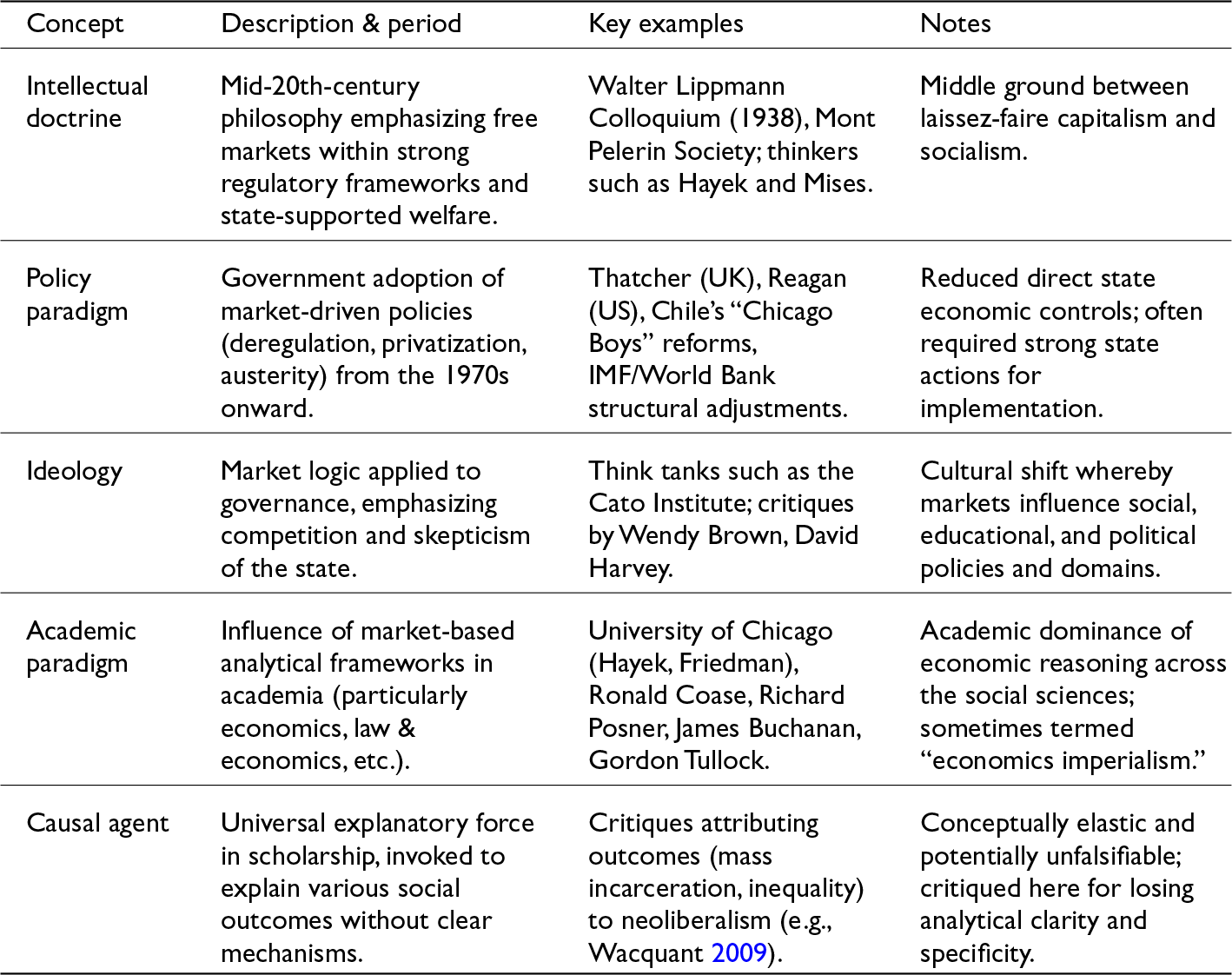
This contrast anticipated a growing distinction between two strands of academic approaches to neoliberalism. One strand was about policy: how governments could impose market reforms, provide services, and administrate (for a recent example, see Parker et al. Reference Parker, Schut and Boen2025). Within this strand neoliberalism is an intellectual doctrine or a policy paradigm. The other strand was intellectual and ideological: scholars and pundits espousing free-market ideals, minimal government, and individual responsibility (often aligning with the burgeoning US neoconservative movement). Within this strand, neoliberalism is an ideology, an academic paradigm, or an agent of undesirable sociopolitical outcomes (or a combination thereof). Table 1 provides an overview of these different conceptions of neoliberalism.
Different neoliberalisms

Table 1 Long description
Columns list Concept, Description and period, Key examples, and Notes. Intellectual doctrine is described as a mid 20th century philosophy of free markets within strong regulatory frameworks and state supported welfare, with examples including the Walter Lippmann Colloquium in 1938, the Mont Pelerin Society, and thinkers such as Hayek and Mises; notes call it a middle ground between laissez faire capitalism and socialism. Policy paradigm covers government adoption of market driven policies from the 1970s onward, including deregulation, privatization, and austerity, with examples Thatcher in the UK, Reagan in the US, Chiles Chicago Boys reforms, and IMF and World Bank structural adjustments; notes mention reduced direct state economic controls and strong state actions for implementation. Ideology is defined as market logic applied to governance, emphasizing competition and skepticism of the state, with examples including think tanks such as the Cato Institute and critiques by Wendy Brown and David Harvey; notes describe a cultural shift affecting social, educational, and political domains. Academic paradigm describes market based analytical frameworks in academia, particularly economics and law and economics, with examples including the University of Chicago, Hayek, Friedman, Ronald Coase, Richard Posner, James Buchanan, and Gordon Tullock; notes mention dominance of economic reasoning across the social sciences and the term economics imperialism. Causal agent describes neoliberalism as a universal explanatory force in scholarship without clear mechanisms, with examples including critiques attributing outcomes such as mass incarceration and inequality to neoliberalism, for example Wacquant 2009; notes describe conceptual elasticity and potential unfalsifiability and say it is critiqued here for losing analytical clarity and specificity.
Ideological theories of neoliberalism
In the 1980s, scholars began to discuss neoliberalism as a broad ideology of governance, not just as a set of policies. Ideological neoliberalism refers to a worldview that is “characterized by mistrust of government” and a preference for market solutions over democratic interventions (Woolley Reference Woolley1982: 152). Woolley traced this strain to certain Chicago School economists and more specifically to the burgeoning neoconservative political movement. A neoconservative agenda of neoliberal ideology allowed scholars to conjoin (1) the effects of specific neoliberal policy implementations, particularly austerity and debt measures that denuded worker protections and social safety nets, and (2) the integration of neoliberal policies with interventions by the United States and affiliated institutions to support the Washington Consensus. Foucault claimed that the Western conjunction of market societies and judicial institutions was no accident – it was “two faces of a single phenomenon” called neoliberalism (Foucault Reference Foucault, Burchell and Davidson2008: 149–150). Like a metonym, neoliberalism became both a component of Reagan-era US policy and a byword for an array of ideologies, policy prescriptions, and foreign interventions.
This operationalization of neoliberalism departed from earlier, moderate visions that embraced a welfare state. Instead, scholars envisaged ideological neoliberalism as a (socioeconomically) classical liberal movement. Scholars began to use this larger version of neoliberalism in their work (recall Figure 2). This ideological turn in the meaning of neoliberalism laid the groundwork for scholars to link neoliberalism to punitive policies.
In the 1990s, sociologists of law and punishment began exploring the ideological ramifications of neoliberal economic policies conjoined with the political messaging that “government is not the solution to our problems; government is the problem” (Reagan Reference Reagan1981). Garland’s Punishment and Modern Society (Garland Reference Garland1990) tracked how Reagan-era conservatives and other deterrence proponents “claim that punitive (as opposed to correctional) measures can be a proper and defensible form of reaction to crime” (Garland Reference Garland1990: 8); this laid the groundwork for future scholars to link neoliberalism to punitive excess. This insight is important: academics were linking shifts in political rhetoric (like Reagan’s), market-driven ideological transformations, and punishment practices. It foreshadows the later embrace of “neoliberalism” as an explanation for punitive turns.
Garland then introduced “responsibilization” to describe citizens’ and families’ assumption of functions previously associated with the state (Garland Reference Garland1996: 452). Citizens navigated between distinct sets of consumption decisions that mapped to demographics and beliefs, constituting “communities of choice” (Garland Reference Garland2001: 89). For example, a comparison between Prius and Hummer drivers would map to such distinct communities of choice. Thus, neoliberal responsibilization was both a cause and consequence of the devolution of state functions – such as safety, schooling, and welfare – to private citizens. This individualization, Posner observed, enables each person “to find a package of beliefs and observances that fits his economic and psychological circumstances” (Posner Reference Posner1987: 12).Footnote 7 This approach to neoliberal responsibilization, supported by Foucault’s (Foucault Reference Foucault, Burchell and Davidson2008) work, is now canonical. In essence, responsibilization means shifting duties and risks from the state to the individual: citizens are expected to self-manage welfare, security, and risk, aligning with market principles.
In Governing Through Crime (Simon Reference Simon2007), Simon extended this lens of consumer “security” culture. Specifically, Simon proposed a set of sociopolitical and legal practices that “channel responsibility for managing crime risks … into the family itself” (Simon Reference Simon2007: 200). These neoliberal practices package consumable and market-accessible “solutions” to risks that lead to a modern family “[l]ocked inside SUVs, parked in a secure garage, locked inside a ‘gated’ and privately policed subdivision” (Simon Reference Simon2007: 204). Scholars link this risk-privatization to the Reagan-era neoliberal policy agenda of deregulation and marketization of state functions (see O’Malley Reference O’Malley2009: 2). Simon directly linked the rise of suburban home ownership to the rise of the prison industrial complex as unified via neoliberal policies (2010a: 168–169; see also Wacquant Reference Wacquant2002). Under neoliberalism, capitalism and state policy march in lockstep to erect white picket fences and gray steel bars alike.
Sociolegal scholars adopt neoliberalism
Building on this ideological turn, sociolegal scholars, in both the law and society and punishment and society realms, increasingly adopted neoliberalism as a framework for explaining legal and punitive developments. The reach of the neoliberal doctrine extended into legal academia through the rise of the law and economics movement. In 1958, economist Ronald Coase founded the Journal of Law and Economics as a venue for scholarship that addressed social problems with market-based solutions dependent “on the creation of new sets of property rights” (Lepage Reference Lepage1977: 225). This exemplified how core neoliberal ideas (assigning property rights and relying on market mechanisms) directly influenced a branch of legal studies.
Early law and society scholars, in contrast, positioned themselves differently. Rather than applying a narrow economic lens, they pursued empirically grounded, sociological analyses of law’s formation and function (Lempert Reference Lempert2013). Dissatisfied with criminology’s focus on individual deviants, these sociolegal scholars examined “conditions of inequality, powerlessness, institutional violence, and so on, which lie at the bases of our tortured society” (Liazos Reference Liazos1972: 118–19). Classic works such as Selznick’s Law, Society, and Industrial Justice (Reference Selznick1969) looked at law in context, addressing the social and economic relations surrounding legal institutions. Law and society’s core focus on how law is operationalized and its social impact distinguished it from both traditional sociology and the emerging law and economics movement.
As the law and society field matured, it became more hospitable to inquiries outside its early empirical mandate of “understanding law through empirical social sciences” (Lempert Reference Lempert2013: 11). Scholars increasingly pursued “more concrete historical and empirical” analyses of law (Hunt Reference Hunt1985), although these early efforts did not fully demonstrate “the extent to which law and legal regulation are themselves constitutive of social and economic relations” (Hunt Reference Hunt1985: 34). Law and society’s focus on the formation, implementation, and impact of law set it apart from other social science disciplines, yet this separation needed to remain permeable to broader social and economic forces (Abel Reference Abel2010). Meanwhile, related domains of inquiry remained fragmented by the mid-20th century: criminologists studied individual crime and deviance, law and society scholars examined law in social context, and law and economics proponents imported market theories into legal analysis (Posner Reference Posner1987). Each subfield had different priorities and theoretical tools, which initially limited the direct application of the concept “neoliberalism.” Yet this disciplinary fragmentation also created an opening for integrative theories (such as legal pluralism) that could account for myriad social forces across these domains.
Scholars soon began to address the disconnect between law and society research and broader political-economic forces. Merry’s (Reference Merry1988) authoritative critique of traditional sociolegal studies warned that analyses narrowly focused on local or doctrinal matters might “miss the way a particular social field is gradually reshaped by a variety of ideological and political forces both within and outside it” (Merry Reference Merry1988: 891). She illustrated this with an anthropological study: the Comaroffs’ (Reference Comaroff and Comaroff1986) account of colonial missionaries, which failed to connect those on-the-ground case studies to a larger global trend of codifying property rights (for context on that global trend, see Scott Reference Scott1998: 36–44). Instead, the Comaroffs emphasized cultural reproduction – arguing that the missionaries inadvertently created an “analogue of their European parent culture” (Comaroff and Comaroff Reference Comaroff and Comaroff1986: 15) – thereby overlooking transnational forces. In retrospect, their work has been criticized as paying insufficient attention to emerging structures of globalization and neoliberalism (Berman Reference Berman2012; Holzmeyer Reference Holzmeyer2009). Innovative law and society scholars of the late 20th century were not content to stay within the specific locales of their case studies; they sought to engage with these broader transnational social theories.
However, attempting to simultaneously attend to minute social processes, prior literature, and sweeping structural forces was (and remains) highly ambitious. Such synthesis can be laudably achieved in book-length works (for a superb example, see Ballakrishnen Reference Ballakrishnen2021), but it is difficult within the space constraints of a journal article. Despite this, law and society scholars called for greater focus on political and economic factors amidst sociolegal analysis as the 21st century approached (Hillyard Reference Hillyard2007). Researchers took note of the top-down deregulatory and market-driven policy shifts underway in the United States and the UK – the two countries dominating English-language academia – and the export of Chicago School neoliberal economics to authoritarian regimes such as Pinochet’s Chile. Scholars were troubled by these developments. By the early 1990s, sociolegal researchers began to invoke neoliberalism as an explanatory framework. They shifted toward examining an “ideological” neoliberalism in ethnographic studies (see Ruggiero and Vass Reference Ruggiero and Vass1992), rather than confining themselves to sociohistorical or quantitative analyses of narrowly delimited topics. This widening lens aligns with the regulatory-governance literature’s account of a shift to governance via public–private hybridity (Talesh Reference Talesh2009; Levi-Faur Reference Levi-Faur2005; Majone Reference Majone1997).
One arena of innovative work in this vein focused on the global diffusion of business-friendly laws during an era of academic “decentering” (Morrill and Mayo Reference Morrill and Mayo2015). For example, Dezalay and Garth traced the rise of new forms of legal expertise aligned with neoliberal globalization. They studied the emergence of “moral entrepreneurship” as legal systems evolved to favor multinational business interests (Dezalay and Garth Reference Dezalay and Garth1995), and they documented how Western legal principles were exported and repurposed to serve local elite factions in developing countries (Dezalay and Garth Reference Dezalay and Garth2002). This line of research exemplified law and society scholars’ engagement on a broader transnational stage, linking on-the-ground legal phenomena to the global spread of neoliberal policy norms.
A parallel shift occurred in the study of punishment and society.Footnote 8 Early scholarship (circa 1960s–1970s) rarely mentioned neoliberalism at all. As noted, the intellectual landscape was fragmented: criminology looked at individual offenders, law and society examined institutional contexts of law, and law and economics applied market logic to legal issues. In the 1980s and 1990s, responding to critiques such as Merry’s, scholars of crime, punishment, and law likewise began situating local penal phenomena within larger political-economic forces. Neoliberalism, by then widely recognized as encompassing recent socioeconomic policy shifts, offered a convenient umbrella framework. Researchers increasingly described an ideology of neoliberalism as a causal force shaping legal and penal changes (Ruggiero and Vass Reference Ruggiero and Vass1992). By invoking neoliberalism, scholars could link a local observation (for example, a change in prison policy or a new policing strategy) to a grand narrative of market-driven reform. In short, neoliberalism provided an appealingly comprehensive explanation that could bridge micro-level research to macro-level context.
In adopting neoliberalism as a master frame, sociolegal scholars gained a unifying element of political economy that could connect macro-structural forces with micro-institutional details.Footnote 9 Neoliberalism emerged to fulfill this role as a kind of agent in scholarly narratives. Alongside the concept of globalization, it was seen as capable of producing paradoxical outcomes. For instance, Coutin (Reference Coutin2011: 299) describes how neoliberal globalization both enables “large-scale movements of persons” and erects legal barriers that leave many of those persons without state protection – in other words, neoliberal governance can simultaneously mobilize and marginalize populations. This example reflects a broader trend among scholars examining world-polity or “global culture” explanations: neoliberalism and globalization together were used to interpret a host of changes, effectively positing an increasingly homogeneous transnational order that leaves “little cross-national difference in cultural and organizational forms, including law, in light of a larger historical trend toward increasing transnational homogeneity” (Jenness Reference Jenness2004: 161). Neoliberalism is active. Often, it is an antagonist.
The shift toward framing neoliberalism as an agentic foe – responsible for punitive policies, social inequality, and welfare-state erosion – is explored below.
Neoliberalism as foe
Neoliberalism’s agency in law and society rests on claims that it coordinates the market and the judiciary (Foucault Reference Foucault, Burchell and Davidson2008) and demarcates fields of action (Bourdieu Reference Bourdieu1994). Granted this agency, it should be no surprise that neoliberalism becomes a foe: a disease infecting “political and scientific epistemologies” (Richland Reference Richland2009: 171); a force “responsible for a wide range of social, political, ecological and economic problems” (Springer et al. Reference Springer, Birch and MacLeavy2016: 2); a tool of elites that offers “a mere pittance of liberty” (Harvey Reference Harvey2007: 37) while blocking progress toward justice, leading to an ideological hegemony of market adjudication over democratic decision-making (Centeno and Cohen Reference Centeno and Cohen2012); a mechanism that conjoins the “left” and “right” hands of the state (Wacquant Reference Wacquant2009, Reference Wacquant2012a, Reference Wacquant2014) and crystallizes “communities of consumption” that desire punishment (Simon Reference Simon2007, Reference Simon2010a, Reference Simon2010b); and a driver of a racialized penal strategy culminating in a “global firestorm of law and order” (Wacquant Reference Wacquant2014). In punishment and society specifically, scholars invoke neoliberalism to explain the mass incarceration of Black communities and the disproportionate punishment of the poor (Garland Reference Garland2001; Simon Reference Simon2007; Wacquant Reference Wacquant2002).
These villainous faces of “neoliberalism” underscore how capacious the concept is – it seems to explain all our social ills. This is useful, because more ills must be addressed as the literature enters a “global” era (Morrill and Mayo Reference Morrill and Mayo2015). Theories of neoliberalism in law and society scholarship are central because scholars have come to “a widespread and growing sense … that rapid changes in late modernity, such as consumerism, globalization, or neoliberalism, pose fresh challenges” (Feenan Reference Feenan and Feenan2013: 3). For example, a recent Law & Society Review discussion urged scholars to explicitly address the “socio-political-economic environment,” as a failure to engage with this environment might exacerbate law and society’s “somewhat marginalized [status] in the broader debates within and across the social sciences” (Savelsberg et al. Reference Savelsberg, Halliday, Liu, Morrill, Seron and Silbey2016: 1031). Valverde’s call for scholars to work toward the “overthrow of neoliberal capitalism” (Reference Valverde2010: 46) is not specific to neoliberal treatises, policies, time periods, or locations. Thus, by the 2000s, neoliberalism in law and society had become a force to be found, and foe to be fought, across many research fronts.
Part II: problems with neoliberalism
Part II discusses two problems with the conceptual shift toward neoliberalism as omnipresent foe: (1) ubiquity, where neoliberalism is invoked to explain almost everything, and (2) a lack of counterfactuals, where neoliberalism’s causal role cannot be decisively tested. Treating neoliberalism as an omnipresent foe has two advantages for scholars.
First, by using neoliberalism as an agent, scholars sidestep ambiguities raised by the complex history of neoliberalism. This tradeoff may feel appropriate when the policy attributed to neoliberalism is considered horrific, such as in the case of mass incarceration. In such cases the ambiguities in research are collapsed, allowing scholars to more effectively combat neoliberalism’s pernicious effects.
Second, more subjects can shelter under the umbrella of causal neoliberalism. Specifically, theories of neoliberalism supply an interstitial causality linking disparate actors, institutions, and locales. This framing is of great use when theorizing at the epochal level because micro- and meso-mechanisms seldom fit into macro-narratives (Sozzo Reference Sozzo2019). Armed with this expansive definition, scholars are ready for new investigations. For example, Friedman and Pattillo (Reference Friedman and Pattillo2019) examine how (nominally separate) state functions – such as welfare systems’ aid disbursement and courts’ imposition of monetary sanctions – come together to surveil and manage marginal populations. This theorization of neoliberalism is concise, inspires bold research, and most importantly, invites scholars to challenge capitalism and institutions in a way that elevates law and society scholarship, as Valverde demanded (Valverde Reference Valverde2010). Consensus motivates this operationalization, as the term’s ascendant academic popularity (refer to Part I and Figures 1 and 2) has driven further adoption.
I argue that the popularity of neoliberalism is double-edged. Scholars summon a specter of neoliberalism without substantive discussion of meaning or mechanism. For example, a “neoliberal trope of personal responsibility” (Friedman and Pattillo Reference Friedman and Pattillo2019: 174) is commonly mentioned in empirical work as a causal force. This may obscure the proximal cause(s) in a research study, which may be federal and state defunding of city services and the resulting dependence on fines and fees for revenue.
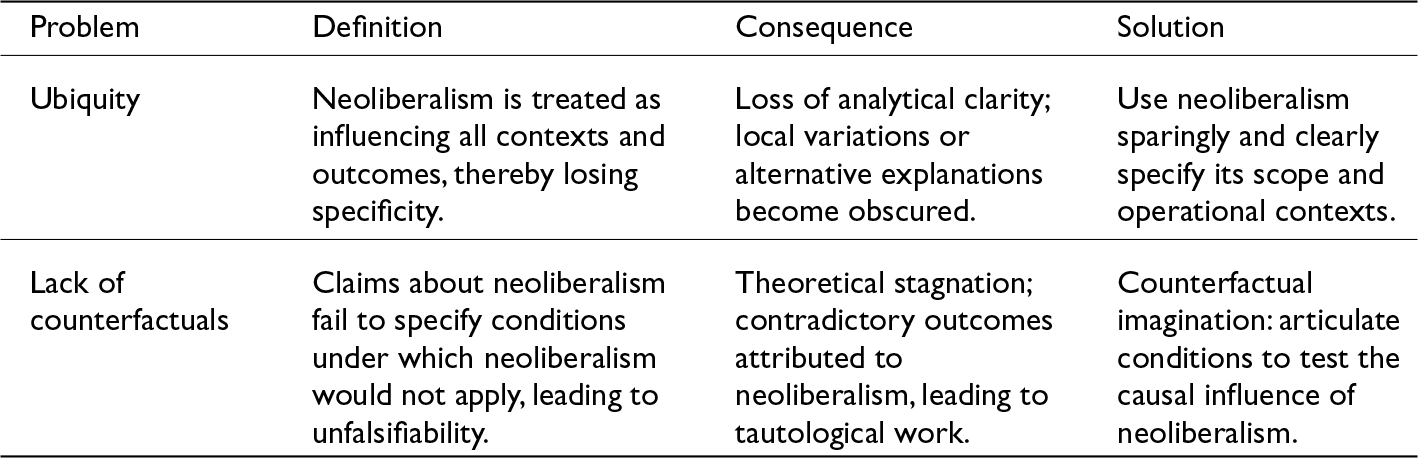
Conjuring this causally broad “neoliberalism” leads to conceptual difficulties where scholars cite neoliberalism as a cause of fines and fees but analyze data that predate neoliberalism. For example, Kirk et al. (Reference Kirk, Fernandes and Friedman2020) analyze austerity and criminal legal policies in the wake of the Great Depression (like the 1935 Public Act 253 (HB 204) prison reimbursement act). These policies often predate the 1938 inception of neoliberalism but are still declared to “reflect the neoliberal tendency” (Kirk et al. Reference Kirk, Fernandes and Friedman2020: 933). This precludes counterfactual causation, meaning that we cannot ask “what if” about the social world (see Table 2).
Ubiquity and a lack of counterfactuals

Table 2 Long description
Four columns organize content by problem, definition, consequence, and solution. Row one, problem, Ubiquity: definition says neoliberalism is treated as influencing all contexts and outcomes, thereby losing specificity; consequence is loss of analytical clarity, with local variations or alternative explanations obscured; solution is to use neoliberalism sparingly and clearly specify its scope and operational contexts. Row two, problem, Lack of counterfactuals: definition says claims about neoliberalism fail to specify conditions under which neoliberalism would not apply, leading to unfalsifiability; consequence is theoretical stagnation, with contradictory outcomes attributed to neoliberalism, leading to tautological work; solution is counterfactual imagination, articulating conditions to test the causal influence of neoliberalism.
Problem 1: ubiquity
It is difficult to discern a past, present, or future social mechanism that is not a manifestation of neoliberalism. This is ubiquity. Indeed, the 2019 Social Problems presidential address enlists scholars to fight neoliberalism, because it “reorders all social fields, rendering all human activity as seen through the market, and all interactions as though governed through the logic of a firm … leaving all aspects of social relations vulnerable” (emphasis added, Fernandez Reference Fernandez2019: 323). This universality collapses neoliberal policy, the history of neoliberalism’s application (e.g., the Washington Consensus), and derivatives such as neoliberal responsibilization. To explore this problem, I contrast two framings below: Galanter’s (Reference Galanter1974) original framing and a counterfactual neoliberal framing of the same empirical finding.
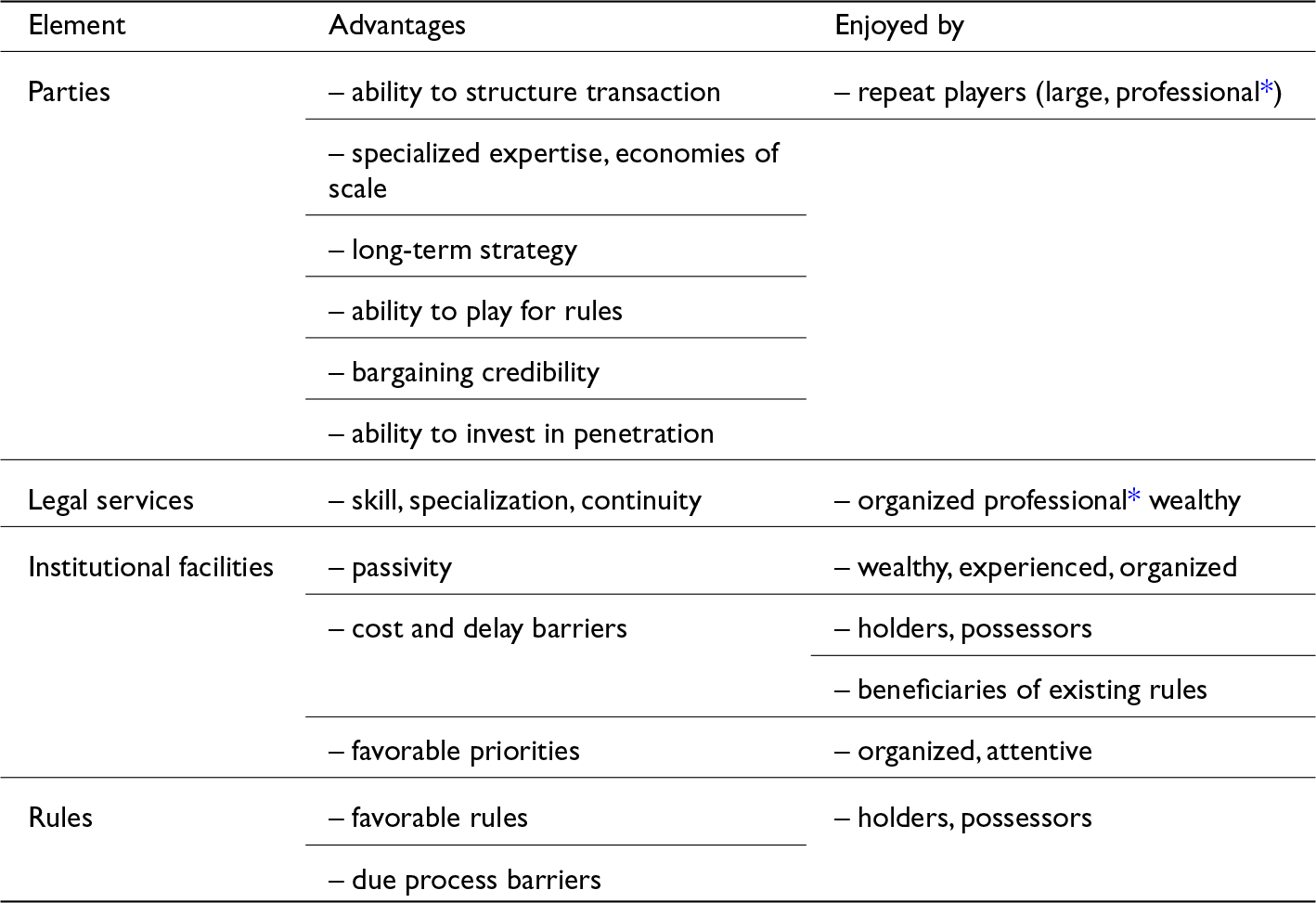
Galanter (Reference Galanter1974) analyzed how repeat players accrued advantages in the nominally neutral venue of the courts (see Table 3). Because of this accrual of advantages, Galanter described the courts as accommodating “vast concentrations of private power while upholding the supremacy of public authority; of accommodating inequality in fact while establishing equality at law” (Galanter Reference Galanter1974: 148). This mirrors the criticisms levied against modern neoliberalism, as well as characterizations of neoliberals as the beneficiaries of capital and hegemony (see Brown Reference Brown2019; Glinavos Reference Glinavos2008). Today, such an analysis could – and likely would – be framed using theories of neoliberalism precisely because of these characteristics.
Galanter’s (Reference Galanter1974: 125) characterization of the advantages that repeat players accrue

Table 3 Long description
Columns are labeled Element, Advantages, and Enjoyed by. Under Parties, advantages listed are ability to structure transaction, specialized expertise and economies of scale, long term strategy, ability to play for rules, bargaining credibility, and ability to invest in penetration; enjoyed by repeat players described as large and professional. Under Legal services, the advantage is skill, specialization, and continuity; enjoyed by organized professional wealthy. Under Institutional facilities, advantages are passivity, cost and delay barriers, and favorable priorities; enjoyed by wealthy, experienced, organized, then holders and possessors, then beneficiaries of existing rules, then organized and attentive. Under Rules, advantages are favorable rules and due process barriers; enjoyed by holders and possessors.
Note:
* (in the simple sense of “doing it for a living”).
Such a framing would enable a modern scholar to impact a broader field of neoliberal institutional theory than Galanter did. However, a neoliberal framing might also limit or obscure the contextual characteristics of Galanter’s research. Galanter’s analytical framing can be applied to different times, places, legal systems, economic systems, and political systems. For example, Galanter’s framing could enable the comparison of bankruptcy practices between established inland Chinese cities such as Beijing and newer coastal metropolises such as Shenzhen. In contrast, a neoliberal framing would bring with it those Western contexts of neoliberalism, described in Part I, that are not shared here; Deng Xiaoping was not Margaret Thatcher.
In other words, the choice to position a study as being about neoliberalism incorporates a teleology. This teleology is based on the 1980s and 1990s “basket” of ideologies, policy prescriptions, and (often deleterious) interventions. Because our research methods cannot easily construct a counterfactual world of policy unaffected by Chicago School neoliberals, nor determine exactly how different times, people, and locations were (or were not) neoliberal, we cannot easily discern what neoliberalism is doing.
This ubiquity impedes research. Social research is often idealized as scholars (1) using prevailing theories to scope their research, (2) executing research designs to discern (with various methods and logics) relevant mechanisms, estimands (Lundberg et al. Reference Lundberg, Johnson and Stewart2021), or experiences, and (3) disseminating their findings to refine the prevailing theories and enable paradigm shifts in research (see Bogen and Woodward Reference Bogen and Woodward1988; Kuhn Reference Kuhn1970). Theories that position neoliberalism as a hydra of causation – Wacquant’s “monster” (Wacquant Reference Wacquant2012a: 39) or “centaur” (Wacquant Reference Wacquant2012b) – are not specific. This is because law and society scholars risk overdetermining their subject by claiming that the past, present, and future are teleologically caused by neoliberalism:
[T]he enigmatic features of economy and society circa 2000—be they the allegorical transfiguration of the nation-state, the assertive stridency of racinated adolescence, the crisis of masculinity, the apotheosis of consumption, the fetishism of civil society, the enchantments of everyday life—are concrete, historically specific outworkings of millennial capitalism and the culture of neoliberalism. For all their apparent polysemy and disarticulation, these things are closely interrelated, all at once rooted in the past and new in the present. (Comaroff and Comaroff Reference Comaroff and Comaroff2000: 334)
There is no theoretical skin in the research game for such a neoliberalism. Note how it is everywhere and nowhere (despite “apparent” differences), past and present, and inescapable in the future.Footnote 10 Ubiquity allows scholars to simultaneously engage with “concrete, historically specific” cases while linking them to a causal force that is “all at once.” Such assertions of neoliberalism’s power float free of empirical checks. What can count against these claims?
Problem 2: lack of counterfactuals
To concentrate entirely on a master conceptual scheme for deriving all subsidiary theories is to risk producing … the large philosophical systems of the past, with all their varied suggestiveness, their architectonic splendor, and their scientific sterility. (Merton Reference Merton1968: 51)
When neoliberalism functions as an agent everywhere, its effects are unbounded. Counterfactuals that might clarify recede. Without boundaries or the possibility of being wrong (see Table 2), our work tends toward the scientific sterility Merton (Reference Merton1968) warns of.
To illuminate this dilemma, I briefly assess several cases, beginning with a critique of the neoliberal penality nexus. This theorization is weak because scholars omit counterfactuals, allowing causal claims to stretch without constraint. I share the field’s urgency about understanding – and endeavoring to change – the punitive state. But neoliberalism is invoked in this literature without discipline: comparisons are rare and scholars do not assess plausible alternative trajectories. What is missing is engagement with counterfactuals.
To engage with a “counterfactual,” scholars first must consider what about neoliberalism is a necessary and sufficient cause of their outcome. Given our prior discussion, let’s assume that scholars are interested in how neoliberalism leads to policies (e.g., racialized mass incarceration) and ideological transformations (e.g., the reorientation of gun ownership in America from sporting to self-defense). Methodologists have emphasized that researchers must imagine what evidence would disconfirm their theory (Rohlfing and Zuber Reference Rohlfing and Zuber2019). Following that advice, we should ask: what observable state of the world would contradict the claim that “neoliberalism caused X”?Footnote 11 Would this alien, counterfactual world feature meaningfully different outcomes?Footnote 12
Case 1: neoliberal penality
There are two reasons scholars have difficulty building counterfactuals for causal theories of neoliberalism. They are both encountered in scholarship on the neoliberal penality thesis – that neoliberalism drives punitive excess and, above all, racialized mass incarceration (Wacquant Reference Wacquant2002; Wilson Reference Wilson2014).
First, neoliberal economic policy does not necessitate carceral extremes and often advises fines or alternatives (e.g., better legal wage opportunities), because of neoliberal beliefs that carceral punishments are inefficient (Becker Reference Becker1968, Reference Becker1976; O’Malley Reference O’Malley2011, Reference O’Malley2014).Footnote 13 Is mass incarceration a consequence of neoliberalism, or is neoliberalism a contextual (rather than determinative) factor? Scholars encounter a similar counterfactual clarity problem when, observing seismic shifts in the leadership and policy positions of the Republican Party of the United States, they claim neoliberalism has shifted toward trade protectionism and even authoritarian nationalism (see Fraser Reference Fraser2017, Reference Fraser2019; Watkins and Seidelman Reference Watkins and Seidelman2019).Footnote 14
Second, suppose there was a strong link between US neoliberalism and racialized incarceration. As Carrington et al. (Reference Carrington, Hogg, Scott, Sozzo and Walters2019) point out, applying a US-centric neoliberalism-to-punishment link to the world at large exemplifies a kind of “Northern theorizing” – a tendency to generalize from Global North experiences to Global South contexts without sufficient adjustment. Why? A narrative of neoliberal state remasculinization leading to worldwide penality may fade when scholars demand context (Fonseca Reference Fonseca2018).
Wacquant (Reference Wacquant2012b) underscores this view by arguing that we must recognize agencies such as the police, courts, and prisons as “core political capacities” through which the neoliberal state governs and “stages sovereignty” (Wacquant Reference Wacquant2012b: 76). In Wacquant’s view, neoliberalism manipulates the penal apparatus, penetrating state functions to promulgate a sort of racialized market-driven order. Many law and society scholars, such as Friedman and Pattillo (Reference Friedman and Pattillo2019) and Sykes et al. (Reference Sykes, Ballard, Giuffre, Goodsell, Kaiser, Mata and Sola2022) on monetary sanctions, adopt this productive frame.
Wacquant relies on this omnipresent view, identifying neoliberalism as a “bureaucratic monster with a liberal head mounted on a paternalistic body” (Wacquant Reference Wacquant2012a: 39). Wacquant contends that economic growth under a neoliberal system “necessitates robust institutional contraptions to anchor and support it, among them an enlarged and energetic penal institution targeted on those who bear the social cost of the revamping of public authority” (Wacquant Reference Wacquant2012a: 40). This theory of neoliberalism deploys the state’s penal institutions as a “firestorm” (Wacquant Reference Wacquant2014) to pacify workers who might otherwise disrupt economic growth. Simon (Reference Simon2007) similarly frames neoliberal governance as creating a culture of security and control through crime, while Sozzo (Reference Sozzo2019) critiques that this nexus is influential yet often assumed rather than empirically demonstrated. Yet, recent research complicates this punitive assumption, as illustrated below.
Consider Sánchez’s 2021 book Neoliberalismo y castigo (Neoliberalism and Punishment), which analyzes the Spanish trajectory of punishment through a neoliberal penality lens and features a foreword written by Wacquant. In a 2023 Punishment & Society review, Brandariz presents this book as a test case for extending Wacquant’s neoliberal penality beyond its North Atlantic “heartlands” (Brandariz Reference Brandariz2023: 1138). Yet incarceration declined in many Global North countries since the late 2000s, and Spain specifically is “witnessing a prison downsizing of an unprecedented duration” (Brandariz 2023: 1139). This echoes Fourcade‐Gourinchas and Babb’s (Reference Fourcade‐Gourinchas and Babb2002) finding that varied local conditions, when met with neoliberalism, maintain varied outcomes.
Nonetheless, Sánchez, Wacquant, and Brandariz reaffirm the neoliberal penality thesis. As Brandariz summarizes, “[t]he book demonstrates that neoliberal policies resulted in a rise in state punitiveness in post-transitional Spain, at least until the late 2000s and early 2010s” (Brandariz 2023: 1139). At the same time, Neoliberalismo y castigo “challenges the claim that an expanding penal state may be seen as a vital, inherent component of neoliberalism” and concludes that neoliberal rationales do “not necessarily entail the expansion of the penal arm of the state” (Sánchez Reference Sánchez2021: 44–45, 187–189, 204; cited in Brandariz 2023: 1138). That perspective allows Sánchez, Wacquant, and Brandariz to maintain neoliberal penality even as the punishment it is meant to explain declines while neoliberal policies prevail. This approach turns what should be a counterexample into a confirmatory story – effectively insulating the neoliberal penality thesis from causal relevance. This approach is easier when there is a near-complete absence of counterfactuals within the literature.
Gong’s ethnography (Gong Reference Gong2019, Reference Gong2025) of mental health governance provides a compelling counterpoint to the neoliberal penality thesis. Gong uses a neoliberal governmentality lens – focusing on responsibilization and self-governance – but finds that neoliberal contexts do not uniformly lead to harsh discipline. Gong observes that marginalized poor clients are often managed through “post-disciplinary” benign neglect rather than aggressive punishment. In his study, public mental health programs aim for “tolerant containment” – simply housing and stabilizing indigent, mentally ill adults with minimal rules – premised on the view that these clients are “beyond transformation.” This nuanced stance echoes Foucauldian predictions that those who fail to self-regulate will be excluded or abandoned under neoliberalism, but Gong finds housing subsidization and minimal control.
Gong finds that the neoliberal penality thesis neglects “the post-disciplinary tolerance addressed here, such as tolerant containment in subsidized housing with minimal rules” (Reference Gong2019: 686, note 3). Gong’s later book (Gong Reference Gong2025) further underscores this class‐patterned dynamic: wealthy families pursue intensive “concerted constraint” to reform wayward relatives, but for the destitute mentally ill, success is defined negatively as part of a system of minimal intervention. Gong’s findings, along with similar nuanced accounts (e.g., Lara‐Millán Reference Lara‐Millán2021’s study of how market logics in hospitals and jails do not neatly align with a punitive framework), suggest that neoliberal governance can entail containment and tolerance of the poor – not just the active “harsh state” that Wacquant theorizes.
Returning to debates over US imprisonment, scholars note that incarceration trends do not neatly track shifts in neoliberal economic policy and warn that different operationalizations of neoliberalism muddy causal attribution (Wilson Reference Wilson2014; Xenakis and Cheliotis Reference Xenakis and Cheliotis2019). Not all scholars depend on neoliberalism to explain mass incarceration. For example, see Wilson’s (Reference Wilson2012) discussion of racial politics, deindustrialization, penal policy (e.g., the 1984 Sentencing Reform Act), and the longstanding impact of slavery followed by Jim Crow segregation leading to sustained racial wealth inequalities. Muller and Roehrkasse (Reference Muller and Roehrkasse2025) likewise show that since the late-20th-century US racial inequality in prison admissions has vastly declined while educational inequality has grown, contradicting Wacquant’s racial carceral state claims. Moreover, recent scholarship finds no significant substitution between welfare spending and correctional spending across US localities (Omori et al. Reference Omori, Shamserad and Boessen2025). These results show that the neoliberal penality thesis fails on its home front, not just in Spain or the Global South.
The indicators scholars bundle under the neoliberal penality label do not move in lockstep. Yet, as discussed, sociolegal scholars treat neoliberalism as a penumbral source of our taste for punitive excess (e.g., Simon Reference Simon2010a, Reference Simon2010b). The neoliberal penality thesis absorbs or ignores anomalies instead of letting them flower into scope conditions.
Case 2: social spending and neoliberalism
The popularity of scholarly and informal references to neoliberalism (see Figures 1 and 2) functions as a “sensitizing” concept, providing “a general sense of reference and guidance in approaching empirical instances” (Blumer Reference Blumer1954: 7). This “neoliberalism as sensitizing construct” blunts specificity, so that almost any outcome can plausibly be read as neoliberal. Heterogeneity across domains and regimes is expected, but my concern is unbounded heterogeneity: claims made without ex ante scope conditions or disconfirming cases. Consider social spending: decreases are attributed to neoliberal austerity and resource shifts from welfare to prisons – indexing the transfer from the “left” to the “right” hand of the state (Bourdieu Reference Bourdieu1994; Friedman and Pattillo Reference Friedman and Pattillo2019; Sykes et al. Reference Sykes, Ballard, Giuffre, Goodsell, Kaiser, Mata and Sola2022; Wacquant Reference Wacquant2009, Reference Wacquant2014). Yet increases and instability in hospital and welfare spending are likewise attributed to neoliberalism, via market-driven policy disruptions and administrative complexity (Duckett Reference Duckett2020; Lara‐Millán Reference Lara‐Millán2021). Even budgetary stability is attributed to neoliberal logics – for example, when businesses back local education levies while opposing broader state outlays (Anzia Reference Anzia2025). Individually plausible, even likely, these operationalizations jointly hold neoliberalism responsible for increases, decreases, instability, and stability, undermining testability.Footnote 15
This is not to say that these accounts are false, but rather not falsifiable. Opposite findings do not contend with each other, so we cannot determine the relationship of neoliberalism to social spending. Notably, Pierson (Reference Pierson1994) argued that neither Thatcher nor Reagan significantly retrenched welfare spending. Without an identifiable relationship, the research cycle stalls and theory’s empirical leverage diminishes, prompting some to question theory’s role in empirical work (Besbris and Khan Reference Besbris and Khan2017).
Case 3: when neoliberalism hides
This break is problematic because it leads scholars to disengage from theories of neoliberalism when their studies should inform and refine those same theories. For example, Seim’s (Reference Seim2020) book on public–private ambulance services contends with neoliberal welfare provision but does not mention relevant theories of neoliberalism. Similarly, Lara‐Millán’s (Reference Lara‐Millán2021) book on the distribution of substandard or fictitious medical services to the poor and incarcerated does not contend with these neoliberal theories, despite clear influence from Bourdieu, Foucault, and Wacquant.
Neoliberalism’s analytical precision has become blunted due to years of ubiquitous usage, reducing clarity and leading some authors to avoid it (e.g., Lara‐Millán Reference Lara‐Millán2021; Seim Reference Seim2020; Sozzo Reference Sozzo2019). Sozzo therefore suggests (Sozzo Reference Sozzo2019) that scholars transition from epochal change theories (i.e., theories of neoliberalism) toward “middle” theories that have more easily mappable causal mechanisms, enabling refinement in light of results. But middle theories only solve this problem if they explicitly map neoliberalism to the mechanisms; if authors draw research inspiration from theories of neoliberalism but only contribute to middle theories, then the research cycle remains broken.
Case 4: neoliberal responsibilization
As discussed earlier, neoliberal responsibilization is theorized by Garland and Simon to valorize personal productivity and consumption as incentive counterparts to individualized carceral, labor, and monetary sanction punitive schemes. For example, Carlson (Reference Carlson2014) argues that the shift in American gun culture toward self-defense is a result of neoliberal responsibilization, which valorizes individual security practices. Under this logic, citizens internalize the duty to protect themselves (rather than rely on the state), which is consistent with neoliberal ideology. Notably, scholars argue that responsibilization may coexist with re-regulation, as soft-law (e.g., professional “standards”) becomes a tool of public–private self-management (Talesh Reference Talesh2009; Levi-Faur Reference Levi-Faur2005). Yet other political regimes and socioeconomic systems – without Western neoliberalism’s sociohistorical context – can make policies similarly designed to valorize individual responsibility for security and productivity or punish perceived irresponsibility.
The top five polities ranked by civilian arms per capita are the United States, the Falkland Islands, Yemen, New Caledonia, and Serbia (Karp Reference Karp2018). It is not clear that these countries are more neoliberal than, say, Czechia (the Czech Republic) – a business-friendly country featuring liberal gun laws and a long history of gun manufacture that nevertheless ranks 64th in its civilian gun ownership rate. This calls into question the idea that neoliberalism causes armed citizenry; non-“neoliberal” contexts and causes have produced similar outcomes (e.g. the COVID-19 pandemic increased desire for guns, see Sola Reference Sola2021). Scholars who do not consider counterfactuals risk that neoliberalism may be sufficient – but not necessary – to produce neoliberal outcomes such as responsibilization. These patterns point to a need for explicit, cross-national comparisons to test whether neoliberalism is necessary for outcomes such as responsibilization. I briefly outline two research opportunities below.
The Soviet Union’s economic system relied on state-administered production quotas that were disaggregated into personal productivity benchmarks (Randall Reference Randall2000). Efforts to valorize over-production, personal responsibility, and consumption – known now as the “Stakhanovite” movement – were implemented to increase personal spending and enhance productivity (Davies and Khlevnyuk Reference Davies and Khlevnyuk2002; Hessler Reference Hessler and Fitzpatrick2000). Industry administrators were incentivized to over-produce for personal advancement, leading in part to over-fishing despite a lack of domestic demand for canned fish products (Österblom and Folke Reference Österblom and Folke2015; Solecki Reference Solecki1979: 116). State-led support for an ideology of personal consumption, personal productivity benchmarks, environmental degradation, and over-exploitation cannot be exclusive features of Western countries and the neoliberal world order.
Similarly, non-Western countries can engage in the export and implementation of legal and financial vehicles. Empirical research using fieldwork and interviews now shows that non-Western political regimes such as China also deploy financial and legal engineering, so that “despite the distinct nature of state capital, in the end, Chinese enterprises pursue and exhibit the universal logic of capitalism” (Erie Reference Erie2021: 65). Accordingly, scholars struggle when using neoliberalism to describe policies and techniques that appear with only a “polymorphous and unstable” (Collier Reference Collier2005: 2) relationship to the Washington Consensus-styled neoliberalism.Footnote 16
Case 5: tautological neoliberalism
Without clear counterfactual reasoning, neoliberalism can be used to explain any outcome. Therefore, we see scholars prefix everything with “neoliberal”: the university, state, market, elite, legal system, policy, carceral system, education, art, media, racism, sexism, logics, consciousness, past, present, future. This approach to neoliberalism is tautological; if we already know that neoliberalism is everywhere, then all observations are manifestations of it. It then ceases to tell us why one outcome occurs instead of another. The irony is that such neoliberalisms have become Wacquant’s hydra (Wacquant Reference Wacquant2012a: 39).
In one example, Darian-Smith claims that Global Studies is the “handmaiden of neoliberalism” (Darian-Smith Reference Darian-Smith2015), implying that the entire academic field serves neoliberal ends of globalization. Yet, neoliberalism is not defined and no causal pathway is described between it and globalization. A clearer theory would allow scholars to compare prior epochs of globalization, such as pre-World War I’s globalization spearheaded by mercantilist European colonial empires (James and Steger Reference James and Steger2014; Osterhammel and Petersson Reference Osterhammel and Petersson2005), with the current flux of tariffs spearheaded by the Trump administration. Such an epochal framing assumes today’s globalization is fundamentally the same as neoliberal globalization, leaving little room for a “something else is at work here” analysis.
In another example, a study of the discipline of criminology claims that a “neoliberal-carceral university … produces the workforce and legitimizing knowledge of the carceral state … [and] repurposes these productions to serve its own ends” (Mokhtari Reference Mokhtari2024: 14). Neoliberalism is not clearly defined or operationalized. Disciplines have waxed and waned for a millennium in Western universities; must we also attribute each historical academic shift, such as the transformation of the University of Paris’s Faculty of Canon Law, to “neoliberalism”?Footnote 17 Indeed, requirements that police, or other government workers, have college degrees – part of the educational credentialism treadmill observed since the early 20th century (Collins Reference Collins1979) – might explain expanding enrollment in criminology programs better than a “neoliberal-carceral university” nexus (Mokhtari Reference Mokhtari2024). Mokhtari (Reference Mokhtari2025) then explores a Canadian policy to remove such degree requirements from policing jobs, but the same “neoliberal-carceral university” persists as the actor throughout the work. Instead, authors might consider whether a Weberian analysis – of disciplines and departments struggling to secure resources, legitimacy, and an ethos (Weber Reference Weber, Gerth and Mills1946) – may frame findings better.
Scholars are inconsistent: is neoliberalism an adjective for the content of socioeconomic and policy processes (and therefore atemporal and universal) or a historically bound process that applies to specific (Western and/or capitalist) contexts? A lack of counterfactual analysis has made this delineation unclear in our scholarship. This lack of clarity weakens theoretical validity. The danger of unvalidated neoliberalism is that it becomes a default, tautological explanation for any observation, collapsing distinctions between very different processes.
Successful uses of neoliberalism
My focus is on work that lacks bounded scope. However, many scholars use delimited theories of neoliberalism in their work. These applications use neoliberalism as a sociohistorical context or process. This approach positions neoliberalism as an evolving set of policy and ideological shifts culminating in the Washington Consensus – not as an active agent or synonym for capitalism. I briefly discuss two law and society research areas that have successfully utilized such “smaller” neoliberalisms: studying elites (e.g., Riles Reference Riles2011; Ballakrishnen Reference Ballakrishnen2021) and public–private partnership dynamics (e.g., Muñiz Reference Muñiz2020; Lageson et al. Reference Lageson, Webster and Sandoval2021). These research areas tend to treat neoliberalism as an evolving context rather than a causal agent, as milieu, not mechanism.
First, the ethnographic investigation of elites – known as “studying up” (Gusterson Reference Gusterson1997; Nader Reference Nader and Hymes1972) – has grown in sophistication. This technique has allowed many qualitative scholars to explore how powerful actors undertake the policy interventions and innovations that compose neoliberalism, capitalism, and globalization. Law and society scholars are experts at empirical and theoretical research that centers “social and economic relations” (Abel Reference Abel2010).
Riles (Reference Riles2011) uses years of fieldwork and interviews to trace the spread of a financial and legal technology key to globalization: law firms specializing in collateralized financial instruments.Footnote 18 Reminiscent of Hayek (Reference Hayek1945) and Scott (Reference Scott1998), Riles argues that financial market regulation requires the mutual buy-in of the public (via the state) and regulated industries (Riles Reference Riles2011: 227). Ballakrishnen (Reference Ballakrishnen2021) uses interviews and document analysis to trace the impact of a misconception that gender equity was important to elite international law firms. Armed with this (mis)conception, the sample of burgeoning Indian law firms claimed expertise and collegiality with foreign partners and unparalleled levels of gender equity among their law partners.
Second, scholars study aspects of neoliberalism through the emergence of public–private partnerships. DHS immigration enforcement software has increasingly incorporated commercial data to ensnare people through panoptic data mining according to data acquired from Freedom of Information Requests (Muñiz Reference Muñiz2020). The promulgation of digital records has aided this trend of data individuation (Lageson et al. Reference Lageson, Webster and Sandoval2021), the mechanism by which both states and corporations assign valenced attributes (credit scores, criminal records) to individuals.
This public–private agglomeration of data evokes a new legal consciousness of corporate and state omniscience, built upon “an ever-increasing number of documents allow[ing] for a government at distance of institutions, citizens, workers, and consumers” (St‐Pierre Reference St‐Pierre2019: 332). These arrangements foreground legal intermediaries: actors who translate, certify, and operationalize rules (Abbott et al. Reference Abbott, Levi-Faur and Snidal2017; Lascoumes and Galès Reference Lascoumes and Galès2007; Talesh and Pélisse Reference Talesh, Pélisse and Sarat2019). Intermediaries rely on guidelines-based regulation to govern rather than solely through statutes, co-producing legality via verification, auditing, and standards (Abbott et al. Reference Abbott, Levi-Faur and Snidal2017; Levi Faur and Starobin Reference Levi Faur and Starobin2014; Talesh and Pélisse Reference Talesh, Pélisse and Sarat2019). By avoiding assigning causality to an overarching agentic neoliberalism, these scholars refine our understanding of neoliberalism as a sociohistorical process – which means that scholars can assess alternative political and economic contexts that feature data individuation.
Discussion
Theories of neoliberalism inspire bold research in the four fundamental topics of law and society: the sociology of law, the possibility of legal change, the process of legal action, and the organization of the legal profession (Sutton Reference Sutton2001: xiv–xv). Viewing neoliberalism as part of a broader capitalist logic can highlight connections between economic policy and social control. That perspective is not inherently unscientific – it becomes an issue only when it posits a neoliberalism immune to disconfirmation.
As political historian Daniel Rodgers observes, “neoliberalism is the linguistic omnivore of our times” (Rodgers Reference Rodgers2018: 79). Part I described how neoliberalism has come to devour countless meanings, while Part II analyzed why some of these meanings obscure more than they illuminate. As Table 1 highlights, there are many conceptions to contend with. And Rodgers’ colorful metaphor echoes my critique of some causal conceptualizations of neoliberalism: as Tables 2 and 3 highlight, without addressing ubiquity and counterfactuals, we risk a theory so broad that it narrows to nothing.
This means that neoliberal histories, policies, and ideologies may not be sufficient (or necessary) causes of the many outcomes attributed to them. Scholars find, for example, that neoliberalism characterizes China’s globalization (Erie Reference Erie2021) and domestic policies (Duckett Reference Duckett2020) as well as the Soviet Union’s encouragement of consumerism and personal responsibility for productivity (Davies and Khlevnyuk Reference Davies and Khlevnyuk2002; Hessler Reference Hessler and Fitzpatrick2000), straining the credulity of theory.
Rubin and Shalaby (Reference Rubin and Shalaby2025) argue that law and society has a theory problem as scholars pile on cases without building new frameworks. Neoliberalism’s unbounded use exemplifies this trend. The issue is not that these diverse works are insufficiently empirical or descriptive (for a diverging opinion, see Besbris and Khan Reference Besbris and Khan2017). Indeed, heterogeneity is expected across domains and regimes. While I agree that there is a theory problem, my claim is narrower. Without comparison – enabled by ex ante scope conditions, specified mechanisms, and disconfirming cases – any outcome can be narrated as “neoliberal,” and counterfactuals recede. Then, scholars’ results do not constrain or falsify the generative theory. A disjuncture crystallizes: theories of neoliberalism are incredibly useful and yet claims about what neoliberalism causes are increasingly incredible.
This leads to a lack of consensus on whether neoliberalism is a contingent sociohistorical product, or whether neoliberalism can coordinate actions across cultures, economies, polities, and times. Instead, the current scholarly consensus on neoliberalism resembles the common improv trope, “yes, and ___.” Neoliberalism is left without the clarifying possibility of “no.” Responding to a similar theory problem, Rubin (Reference Rubin2025) contends that normativity and activism pervade our work and have blunted theory. My analysis finds that danger arises when scholars embrace ubiquity and omit counterfactuals. Normativity in academic work – our value-driven engagement or affect – may not need to undermine empirics and theorization. Indeed, the disciplining process depends on harnessing passion toward activism for science (Schmidt Reference Schmidt2001). Would a paroxysm of passion for counterfactual imagination be so bad?
To understand the social world, we must account for its (mal)functions. To revise our understanding of these malfunctions, we must be able to complete the research cycle. This means we must delineate a mechanism. Indeed, Silbey asks us to allow our “audience [to] assess for empirical validity and reliability. Thus, all our diverse ways of making knowledge must be made more transparent” (Savelsberg et al. Reference Savelsberg, Halliday, Liu, Morrill, Seron and Silbey2016: 1027). Unfortunately, I have shown how our theorizations of neoliberalism often fail to achieve this goal. Failed theorizations mystify the link between a study and the world. We misunderstand the (mal)functions of the social world we research. We do not learn.
Scholars have two ways to address this dilemma: comparative research and careful operationalization. Comparative research (e.g., Gong Reference Gong2025) enriches research with contrasts, resulting in more context and less direct causation (cf. Kipnis Reference Kipnis2007 on mismatches when Western “neoliberal” models are applied to China). Comparison also disciplines the concept itself: it forces us to specify scope conditions and confront the risk of concept-stretching (Sartori Reference Sartori1970; Silbey Reference Silbey2005; Suchman Reference Suchman1995). Even when causal identification is not the goal, well-chosen contrasts highlight features that have explanatory potential – and those which are merely riding along (Ermakoff Reference Ermakoff2017). Notably, comparative analysis has long been recommended to guard against concept overreach in theory-building (Blumer Reference Blumer1954). By examining how ostensibly “neoliberal” effects vary across different contexts, scholars can identify where neoliberalism truly operates versus where other forces are at work. The payoff is modest but real: more bounded claims, sharper mechanisms, and counterfactuals that are at least thinkable.
Careful operationalization (Schoon Reference Schoon2022) will allow specific elucidations of neoliberalism. For example, if scholars can agree on a set of features that characterize ideological neoliberalism, they can empirically test the relationship of this ideology to theorized (but untested) confederates such as gun ownership (see Carlson Reference Carlson2014). This makes our work more transparent and credible to sociolegal studies as a whole (Silbey in Savelsberg et al. Reference Savelsberg, Halliday, Liu, Morrill, Seron and Silbey2016: 1027) and addresses our need to produce sociolegal work that is both empirically grounded and theoretically engaging (Heyer et al. Reference Heyer, Rubin and Talesh2025). Rather than an omnipotent hydra, a carefully operationalized neoliberalism will be sociohistorically bound (for example, the late-20th-century context of the Washington Consensus). This echoes Ferguson’s (Reference Ferguson2010) call to distinguish specific neoliberal techniques from an amorphous neoliberal ideology.
Law and society scholars should both compare and carefully operationalize when using neoliberalism. Or, avoid the term and instead interpret their findings’ substantive connection to the literature. It is time that we begin to elucidate and test neoliberalism, because it is both too useful and too broad to live only in our literature reviews and discussion sections. Then we can take neoliberalism seriously: not as a hydra, nor a centaur, nor a ubiquitous foe, but as a theory with consequents.
Acknowledgements
I would like to thank Ashley Rubin, Katharina Heyer, and Shauhin Talesh as LSR editors, LSR reviewers, Tania Jenkins, Megan Kang, Swethaa Ballakrishnen, Juan Sandoval, Joshua Seim, Bryan Sykes, Scott Duxbury, Sora Han, Francesca Polletta, Christopher Seeds, Charis Kubrin, Justin Pickett, Ekaterina Moiseeva, Maurizio Recordati, Thomas Davidson, the UCI Socio-Legal Studies workshop, the Law and Society Association, the Society for the Study of Social Problems, and the American Sociological Association for their generosity, feedback, and encouragement during this manuscript’s development. It was invaluable, and I am in your debt.
Funding statement
No funding to report.
Conflicts of interest
The author declares no conflicts of interest.