INTRODUCTION
The term ‘phylogeography’ was coined by Avise and colleagues in 1987 (Avise et al. Reference Avise, Arnold, Ball, Bermingham, Lamb, Neigel, Reeb and Saunders1987). Originally, phylogeography was introduced to bridge the gap between population genetics and systematics in eukaryotic organisms. Molecular markers were used to explore microevolutionary processes and the phylogenetic relationship in populations to explain the evolution of species. Initial studies in phylogeography relied on mitochondrial DNA (mtDNA) due to its fast evolution, no or limited recombination and haploidy which makes these loci suitable for phylogenetic inferences. The properties of mtDNA in animals yielded observations around geographic structuring of genetic lineages. This correspondence between genealogy and geographic origin, in turn, allows for inferences related to population history and demography. Since the introduction of phylogeography as a discipline much progress has been made in terms of (1) development of a statistical framework in which phylogeographic hypothesis can be contrasted (e.g. Knowles and Maddison, Reference Knowles and Maddison2002; Garrick et al. Reference Garrick, Caccone and Sunnucks2010); (2) the amount of genetic information used (multilocus analyses, sequencing technology and single nucleotide polymorphism [SNPs]) (e.g. Aanensen and Spratt, Reference Aanensen and Spratt2005; Chan, Reference Chan2005; Hall, Reference Hall2007) and (3) the incorporation of geographic elements through geographic information systems (e.g. Kidd and Ritchie, Reference Kidd and Ritchie2006).
Due to similarities in genome characteristics (haploidy and fast mutation rates) between mitochondria and bacterial species, there has been a clear application of the phylogeographic techniques developed for animals using mtDNA to bacterial taxa, including pathogenic bacteria. However, the use of phylogenetics to infer the very recent past is generally limited by the type or number of loci used. While it was initially suggested that homoplasy in fast evolving loci may limit phylogenetic inferences to the very recent past such as single hosptial outbreaks (Spratt, Reference Spratt1999), a more recent view is that the use of such loci is hampered by processes like horizontal gene transfer or gene loss. This complicates their use for applications such as tracing the source of hospital outbreaks because these loci very likely do not reflect the phylogenetic relationships between the strains considered. On the other hand, genes that are highly conserved, such as 16S RNA, are usually not able to provide a resolved picture of intra-species bacterial lineages. The same is true for genes under balancing selection, because these loci might reflect the evolutionary history of the locus rather than that of the population or species. Slowly evolving loci (such as housekeeping genes) can be useful for medically important bacteria for explaining long-term historic patterns of emergence or co-evolution with hosts, but their limited genetic variation may make it difficult to estimate processes over shorter time-spans when only few loci are used. Until recently, power was limited for investigating finer scale landscape ecological processes that have shaped contemporary populations, partially as a result of complex demographic processes such as sequential population bottlenecks, population expansions, founder effects, hybridization or gene flow.
A more recent introduction for microevolutionary studies, i.e. at the population level in a spatial context, is landscape genetics. As it combines landscape ecology with molecular population genetics, landscape genetics aims to explain local adaptation and gene flow or barriers to it, providing a powerful approach for determining populations or their substructure and for quantifying their connectivity. An advantage of landscape genetics over conventional population genetics is that populations and their boundaries do not need to be defined a priori. It has been developed to investigate genetic variation under consideration of landscape heterogeneity potentially at finer spatial and temporal scales than phylogeography (Manel et al. Reference Manel, Schwartz, Luikart and Raberlet2003; Storfer et al. Reference Storfer, Murphy, Evans, Goldberg, Robinson, Spear, Dezzani, Delmelle, Vierling and Waits2007; Reisen, Reference Reisen2010). It has been predicted that an increase in the number of genetic markers used, including the use of genome-wide SNPs, will allow the optimal choice of genetic marker for the study in question, and this will greatly enhance the power to identify the underlying processes of population heterogeneity. Indeed, as shown by recent studies on bacterial pathogens, interrogation of genome-wide SNPs and their phylogenetic inferences can inform about bacterial relationships at ultra-fine temporal and spatial scales, i.e. they might bridge the gap between phylogeography and landscape genetics for these systems.
Phylogeography aims to untangle microevolutionary processes that lead to diversification and ultimately speciation. However, multilocus analyses and the availability of fully sequenced bacterial genomes have revealed that horizontal gene transfer between and within bacterial species may be more common than previously thought, which raised questions about the nature of bacterial species and whether bacterial species do exist (Lan and Reeves, Reference Lan and Reeves2001; Cohan, Reference Cohan2002; Konstantinidis and Tiedje, Reference Konstantinidis and Tiedje2005; Achtman and Wagner, Reference Achtman and Wagner2008). Although a theory-based prokaryotic species concept has not been agreed on, it has been suggested repeatedly that cohesive forces cause genetic clustering of bacterial populations (Rossello-Mora and Amann, Reference Rossello-Mora and Amann2001; Cohan, Reference Cohan2002; Gevers et al. Reference Gevers, Dawyndt, Vandamme, Willems, Vancanneyt, Swings and De Vos2006; Konstantinidis et al. Reference Konstantinidis, Ramette and Tiedje2006) and that such clusters may have quintessential properties to be classified as species. As a pragmatic approach most bacteriologists define bacterial species through genetic or phenotypic cut-offs (Goris et al. Reference Goris, Konstantinidis, Klappenbach, Coenye, Vandamme and Tiedje2007), and multilocus sequence analysis (MLSA) has been suggested as a convenient tool for bacterial species assignment (Gevers et al. Reference Gevers, Cohan, Lawrence, Spratt, Coenye, Feil, Stackebrandt, Van De Peer, Vandamme, Thompson and Swings2005; Bishop et al. Reference Bishop, Aanensen, Jordan, Kilian, Hanage and Spratt2009). It has been shown for several bacteria that sequence clusters are remarkably congruent with bacterial ecotypes (Koeppel et al. Reference Koeppel, Perry, Sikorski, Krizanc, Warner, Ward, Rooney, Brambilla, Connor, Ratcliff, Nevo and Cohan2008; Margos et al. Reference Margos, Vollmer, Cornet, Garnier, Fingerle, Wilske, Bormane, Vitorino, Collares-Pereira, Drancourt and Kurtenbach2009) lending support to such an approach.
The availability of many fully sequenced genomes has led to the concept that bacterial genomes consist of a conserved ‘core’ genome which basically codes for housekeeping functions, and an ‘accessory’ genome which is susceptible to horizontal gene transfer and gene loss and where more mobile genetic elements (plasmids, phage, transposons, etc.) are located. While the core genome may be used to ascertain the evolutionary relationship among bacteria and to generate species trees, horizontal gene transfer of genetic elements may occasionally occur between (un)related prokaryotes and can lead to ‘evolutionary jumps’ (e.g. resistance to antibiotics or host switches). Such events may enable new strains to emerge and to occupy a different ecological niche. These ecotypic changes may not be observed immediately at the level of core genes (by means of MLST) as suggested for Yersinia pestis (Achtman et al. Reference Achtman, Zurth, Morelli, Torrea, Guiyoule and Carniel1999; Kotetishvili et al. Reference Kotetishvili, Kreger, Wauters, Morris, Sulakvelidze and Stine2005), Bacillus anthracis (Keim et al. Reference Keim, Van Ert, Pearson, Vogler, Huynh and Wagner2004) or other so-called monomorphic bacterial pathogens (Achtman and Wagner, Reference Achtman and Wagner2008; Pearson et al. Reference Pearson, Okinaka, Foster and Keim2009). Regardless of such concerns, it appears that bacterial lineages do exist which differ considerably in their geno- and phenotypes, at least in some instances even if this cannot be applied to all bacterial taxa (Hanage et al. Reference Hanage, Fraser and Spratt2005; Corander et al. Reference Corander, Connor, O'dwyer, Kroll and Hanage2011).
BACTERIAL TYPING TOOLS
Multilocus sequence typing (MLST) and multilocus sequence analysis (MLSA)
For many bacterial genera, multilocus sequence typing (MLST) or multilocus sequence analyses (MLSA) have considerably advanced the knowledge of intraspecies bacterial relationships (see mlst.net or pubmlst.org). These techniques utilize slowly evolving loci, such as enzyme encoding genes that are under purifying selection, which have usually only few mutational changes that may not give sufficient phylogenetic resolution to distinguish closely related bacteria strains when studied individually. Therefore, to increase the phylogenetic signal and to understand the longer term relationship of bacteria, multiple loci are included for population genetic analyses (Maiden et al. Reference Maiden, Bygraves, Feil, Morelli, Russell, Urwin, Zhang, Zhou, Zurth, Caugant, Feavers, Achtman and Spratt1998; Maiden, Reference Maiden2006). Compelling reasons for this choice of marker type were the assumption of nearly neutral variation, ability to detect or buffer against recombination, and high discriminatory power (reviewed by Maiden, Reference Maiden2006). However, the phylogenetic signal obtained, even from several loci, may be limited for the inference of very short-term or deep evolutionary relationships in ‘monomorphic’ species such as Yersinia pestis or Bacillus anthracis (reviewed by Achtman and Wagner, Reference Achtman and Wagner2008) or in species with elevated levels of homologous recombination (Pearson et al. Reference Pearson, Okinaka, Foster and Keim2009).
Genome-wide single nucleotide polymorphisms (SNPs)
SNPs have been shown to be a powerful instrument for understanding bacterial evolution (even for genetically monomorphic microbes) (Van Ert et al. Reference Van Ert, Easterday, Simonson, U'ren, Pearson, Kenefic, Busch, Huynh, Dukerich, Trim, Beaudry, Welty-Bernard, Read, Fraser, Ravel and Keim2007; Achtman and Wagner, Reference Achtman and Wagner2008; Holt et al. Reference Holt, Parkhill, Mazzoni, Roumagnac, Weill, Goodhead, Rance, Baker, Maskell, Wain, Dolecek, Achtman and Dougan2008; Harris et al. Reference Harris, Feil, Holden, Quail, Nickerson, Chantratita, Gardete, Tavares, Day, Lindsay, Edgeworth, Lencastre, Parkhill, Paecock and Bentley2010). The introduction of massive parallel sequencing and improvements such as increased read length and depth, or reduced error rates have made genome re-sequencing using next generation platforms more economical for investigations of microbial organisms (Hall, Reference Hall2007). The large number of SNPs that can be found in genomes of many prokaryotes offers unprecedented power to infer bacterial relationships at temporal scales that cover deep and very fine evolutionary relationships. SNPs can be filtered according to whether they are from coding or non-coding regions, from core or accessory genome, permitting enormous scope for evolutionary inferences.
The large number of software tools which are available to analyse MLSA and SNP data facilitate such approaches (Excoffier and Heckel, Reference Excoffier and Heckel2006). Such data will not only permit much more precise insights into the history of species, they will reveal complications such as incomplete lineage sorting, branch length heterogeneity or recombination.
Here, we review phylogeographic data for two different types of bacterial pathogens: one vector-borne pathogen, Borrelia burgdorferi sensu lato, also known as Lyme borreliosis (LB)-group spirochetes and one directly transmitted human pathogen, methicillin-resistant Staphylococcus aureus (MRSA). While members of the LB-group spirochetes are tick-transmitted zoonotic bacteria that have many hosts and differ in their degree of host specialism, MRSA was initially thought to occur only in humans, but now it has been found in horses, dogs, cast, cattle and pigs. MRSA is transmitted by direct contact with an infected or colonized person or animal, and also by contact with MRSA-contaminated objects. In both cases, pathogen dispersal is host dependent. In the case of LB-group spirochetes, MLSA data proved to be very useful in ecotype and species determination (Richter et al. Reference Richter, Postic, Sertour, Livey, Matuschka and Baranton2006; Postic et al. Reference Postic, Garnier and Baranton2007; Chu et al. Reference Chu, Liu, Jiang, Wang, Jiang, Zhao, Zhang, Wang, Tang, Yang and Cao2008; Margos et al. Reference Margos, Vollmer, Cornet, Garnier, Fingerle, Wilske, Bormane, Vitorino, Collares-Pereira, Drancourt and Kurtenbach2009, Reference Margos, Hojgaard, Lane, Cornet, Fingerle, Rudenko, Ogden, Aanensen, Fish and Piesman2010; Rudenko et al. Reference Rudenko, Golovchenko, Grubhoffer and Oliver2009a,Reference Rudenko, Golovchenko, Lin, Gao, Grubhoffer and Oliverb; Crowder et al. Reference Crowder, Matthews, Schutzer, Rounds, Luft, Nolte, Campbell, Phillipson, Li, Sampath, Ecker and Eshoo2010) and to distinguish between long-term and more recent demographic and evolutionary processes (Margos et al. unpublished). In S. aureus MLST was used to study the global population structure as well as the dispersal of particular clonal complexes (Enright et al. Reference Enright, Day, Davies, Peacock and Spratt2000). In MLST analyses, clonal complexes are defined by using a model of clonal expansion and divergence. The eBURST algorithm was developed to provide a convenient method to establish relationships of bacterial populations via allelic multilocus sequence profiles. It clusters STs as disjointed tree collections and uses a set of hierarchical rules to determine single locus (SLV) and double locus variants (DLV) and founder stains of complexes that consist of SLV and DLVs. Furthermore, very recently genome-wide SNP data have been used to study the very short-term evolution of two important MRSA lineages, ST239 and ST225, which is described in detail below.
EXAMPLES OF BACTERIAL PHYLOGEOGRAPHIC STUDIES
LB-group spirochetes: a vector-transmitted bacterial species complex
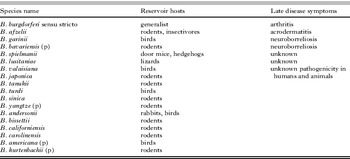
The LB-group spirochetes form a species complex which now comprises 18 named species (Table 1) (Margos et al. Reference Margos, Vollmer, Ogden and Fish2011) but more species are likely to be described in the near future as highly diverse LB strains have been found in environmental samples (e.g. Scott et al. Reference Scott, Lee, Fernando, Durden, Jorgensen, Mak and Morshed2010, Lane personal communication).
Lyme borreliosis group spirochetes

p = proposed species.
LB-group spirochetes are transmitted by ticks belonging to the Ixodes ricinus-persulcatus species complex. Vector competence has been demonstrated for a number of Ixodes species (reviewed by Eisen and Lane, Reference Eisen, Lane, Gray, Kahl, Lane and Stanek2002) but the extent to which vector competence for LB-group spirochete species varies is by no means fully understood. The main vector species transmitting LB-group spirochetes to humans are I. pacificus in Western North America, I. scapularis in Central and Eastern North America, I. ricinus in Europe and I. persulcatus in Eastern Europe and Asia (Ogden et al. Reference Ogden, Artsob, Margos, Tsao, Sonenshine and Roe2011a).
A hallmark of LB-group spirochetes is the pronounced host associations of some of its members, which means that these hosts support completion of the whole transmission cycle, i.e. tick to host and host to tick (Kurtenbach et al. Reference Kurtenbach, Peacey, Rijpkema, Hoodless, Nuttall and Randolph1998a, Reference Kurtenbach, De Michelis, Etti, Schafer, Sewell, Brade and Kraiczy2002; Humair and Gern, Reference Humair and Gern2000). These host specialisations match the ability of spirochete species to deflect complement-mediated lysis of the respective host species (Kurtenbach et al. Reference Kurtenbach, Peacey, Rijpkema, Hoodless, Nuttall and Randolph1998a, Reference Kurtenbach, De Michelis, Etti, Schafer, Sewell, Brade and Kraiczy2002). Furthermore, they have been shown to play an important role in the geographic distribution and spread of LB-group spirochetes (Vollmer et al. Reference Vollmer, Margos, Donaghy, Bormane, Drancourt, Garnier, Cornet and Kurtenbach2011).
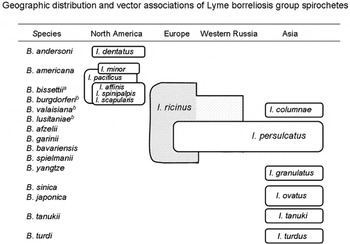
Although less well studied, the compatibility of LB-group spirochetes and vector associations may also impact the distribution range of LB-group spirochetes (Fig. 1) and both host and vector associations contribute to niche formation which may lead to speciation of LB-group spirochetes (reviewed by Randolph, Reference Randolph2004; Tsao, Reference Tsao2009; Kurtenbach et al. Reference Kurtenbach, Hoen, Bent, Vollmer, Ogden, Margos, Robinson, Falush and Feil2010; Margos et al. Reference Margos, Vollmer, Ogden and Fish2011).
Geographic distribution and vector associations of Lyme borreliosis group spirochetes. The figure shows combinations of main ixodid vectors and Lyme borreliosis group spirochetes they transmit. While for many Lyme borreliosis group spirochetes vector associations have been established, this is not the case for all species, e.g. B. calforniensis, B. carolinensis, B. kurtenbachii in North America.
aFor B. bissettii the vector in Europe is uncertain.
bB. burgdorferi, B. valaisiana and B. lusitaniae are transmitted by I. ricinus in Eastern Europe but their prevalence is low. These species do not appear to be transmitted by I. persulcatus. Reproduced with modifications and with permission from the author.

Members of the LB-group spirochetes are distributed across the northern temperate zones of the globe but the species and strains are not evenly distributed globally, across continents or regions (Kurtenbach et al. Reference Kurtenbach, Hanincova, Tsao, Margos, Fish and Ogden2006; Margos et al. Reference Margos, Vollmer, Ogden and Fish2011). This is due to complex multifactorial processes that govern the ecology and evolution of LB-group spirochetes including host and vector associations, climate and landscape features and long-term evolutionary and demographic processes (Randolph, Reference Randolph2000, Reference Randolph2004; Kurtenbach et al. Reference Kurtenbach, Hoen, Bent, Vollmer, Ogden, Margos, Robinson, Falush and Feil2010). LB-group spirochetes reside either in their hosts or in their vector ticks. It is conceivable that the strong impact that Pleistocene climate variations had on vertebrate and invertebrate species and their present day geographic ranges (Waters, Reference Waters1963; Hewitt, Reference Hewitt1999) will also have impacted the distribution of LB spirochete species and sequence types. Therefore, the post-glacial recolonization by vertebrate and vector hosts of northern regions in Europe and North America might be reflected in the sequence type and species distribution of LB-group spirochetes (Reference Vollmer, Margos, Donaghy, Bormane, Drancourt, Garnier, Cornet and KurtenbachVollmer et al. unpublished).
Of the 18 species recognized in the LB group of spirochetes to date, seven occur in North America, eight in Europe and eight in Asia. There is some overlap between the regions in that three species, B. burgdorferi sensu stricto, B. bissettii, and possibly B. kurtenbachii, occur in Europe and North America (Picken et al. Reference Picken, Cheng, Han, Nelson, Reddy, Hayden, Picken, Strle, Bouseman and Trenholme1995, Reference Picken, Cheng, Strle and Picken1996, Reference Picken, Strle, Ruzic-Sabljic, Maraspin, Lotric-Furlan, Cimperman, Cheng and Picken1997; Picken and Picken Reference Picken and Picken2000) and three species, B. afzelii, B. garinii, and B. bavariensis, occur in Europe and Asia but remarkably no overlap of species from North America and Asia has been described so far (Masuzawa, Reference Masuzawa2004; Margos et al. Reference Margos, Hojgaard, Lane, Cornet, Fingerle, Rudenko, Ogden, Aanensen, Fish and Piesman2010). This is interesting in view of the origin of LB-group spirochetes, their spread and the global colonisation of this group of spirochetes.
North America
The picture of LB-group spirochetes in North America has recently become more complex. As far as LB-group spirochetes and their vectors are concerned, there are several distinctly different regions on the North American continent: coastal regions west of the Rocky Mountains (California, Oregon, Washington, British Columbia), the southeastern States (Florida, Georgia, South Carolina, North Carolina, Virginia, Maryland), northeastern States (Pennsylvania, New Jersey, New York, Connecticut, Massachusetts, New Hampshire, Maine, Vermont) and midwestern states (Wisconsin, Minnesota, Missouri, Illinois). The main vector species maintaining the bacterial species in natural transmission cycles in these regions are I. pacificus and I. spinipalpis in the west, I. affinis and I. minor in the southeast and Ixodes scapularis in northeast and midwest (Brown and Lane, Reference Brown and Lane1992; Maupin et al. Reference Maupin, Gage, Piesman, Montenieri, Sviat, Vanderzanden, Happ, Dolan and Johnson1994; Lin et al. Reference Lin, Oliver and Gao2004; Brown et al. Reference Brown, Peot and Lane2006; Diuk-Wasser et al. Reference Diuk-Wasser, Gatewood, Cortinas, Yaremych-Hamer, Tsao, Kitron, Hickling, Brownstein, Walker, Piesman and Fish2006, Reference Diuk-Wasser, Vourc'h, Cislo, Hoen, Melton, Hamer, Rowland, Cortinas, Hickling, Tsao, Barbour, Kitron, Piesman and Fish2010; Hamer et al. Reference Hamer, Tsao, Walker and Hickling2010; Maggi et al. Reference Maggi, Reichelt, Toliver and Engber2010).
The distribution of species and genotypes suggests a turbulent evolutionary history of LB spirochetes in North America with long-term (millions of years ago) and short-term (500 years ago until present) demographic events (Hoen et al. Reference Hoen, Margos, Bent, Kurtenbach and Fish2009; Margos et al. unpublished). The long-term events may have led to separation of strains, isolation and speciation. It has been suggested that the present day distribution of the species may be the result of southward migration during glacial periods and northward migration during interglacials (Humphrey et al. Reference Humphrey, Caporale and Brisson2010; Margos et al. Reference Margos, Hojgaard, Lane, Cornet, Fingerle, Rudenko, Ogden, Aanensen, Fish and Piesman2010). But so far, this is speculative as there are no data to estimate mutation rates or speciation events for LB spirochetes and not all Borrelia species that are likely to reside on this continent are currently known (Scott et al. Reference Scott, Lee, Fernando, Durden, Jorgensen, Mak and Morshed2010) and can be included into phylogenetic analysis.
B. americana, B. bissettii and B. burgdorferi appear in eastern and western coastal regions (Rudenko et al. Reference Rudenko, Golovchenko, Lin, Gao, Grubhoffer and Oliver2009b; Margos et al. Reference Margos, Hojgaard, Lane, Cornet, Fingerle, Rudenko, Ogden, Aanensen, Fish and Piesman2010) while species such as B. californiensis or B. carolinensis seem to have limited distribution ranges and were described from the west or southeast, respectively (Postic et al. Reference Postic, Garnier and Baranton2007; Rudenko et al. Reference Rudenko, Golovchenko, Grubhoffer and Oliver2009a). B. andersonii seems to be distributed through the eastern range of LB spirochete occurrence (Lin et al. Reference Lin, Oliver and Gao2004; Hamer et al. Reference Hamer, Tsao, Walker and Hickling2010). The distribution range of B. kurtenbachii needs to be investigated further as it was previously subsumed in B. bissettii and only recently proposed as a separate species (Margos et al. Reference Margos, Hojgaard, Lane, Cornet, Fingerle, Rudenko, Ogden, Aanensen, Fish and Piesman2010). Several samples previously described as B. bissettii in the various regions need to be re-evaluated as they showed RFLP pattern similar to B. kurtenbachii (Lin et al. Reference Lin, Oliver, Gao, Kollars and Clark2001, Reference Lin, Gao, Seyfang and Oliver2005; Oliver et al. Reference Oliver, Lin, Gao, Clark, Banks, Durden, James and Chandler2003). While B. bissettii was associated with I. spinipalpis and I. pacificus and the woodrats Neotoma mexicana or Neotoma fuscipes in Colorado and California, respectively, B. kurtenbachii were isolated from the vole Microtus pennsylvanicus in Illinois (Picken and Picken, Reference Picken and Picken2000) and the vector is unknown. Other B. kurtenbachii strains were isolated from host-attached I. scapularis, which raised the possibility that B. kurtenbachii transmission cycles differ ecologically from that of B. bissettii. These data underpin the importance of using appropriate typing tools in order to understand the evolutionary history of this species complex. This needs to be particularly emphasized as a relatively new species, B. miyamotoi, which represents a relapsing-fever spirochete that occurs sympatrically with LB-group spirochetes (Barbour et al. Reference Barbour, Bunikis, Travinsky, Hoen, Diuk-Wasser, Fish and Tsao2010).
B. burgdorferi and B. bissettii are without doubt the species with the widest distributions as both occur not only in most regions of the USA where LB-group spirochetes are found but also in Europe. Based on analyses of the genetic diversity of the outer surface protein C (ospC) it has been suggested that B. burgdorferi originated in North America (Marti Ras et al. Reference Marti Ras, Postic, Foretz and Baranton1997), and that migration between Europe and North America occurred in the past 200 years (Qiu et al. Reference Qiu, Bruno, Mccaig, Xu, Livey, Schriefer and Luft2008). In contrast, data based on MLST of housekeeping genes suggested that B. burgdorferi originated in Europe (Margos et al. Reference Margos, Gatewood, Aanensen, Hanincova, Terekhova, Vollmer, Cornet, Piesman, Donaghy, Bormane, Hurn, Feil, Fish, Casjens, Wormser, Schwartz and Kurtenbach2008). Analysis of the pairwise mismatch distribution of variation of B. burgdorferi samples from northeastern and midwestern USA suggested a population expansions that took place thousands or million of years ago (Hoen et al. Reference Hoen, Margos, Bent, Kurtenbach and Fish2009). This time estimate makes the presence of B. burgdorferi in North America likely during the glacial-interglacial periods of the Pleistocene (2·5 million to about 10,000 years ago).
Evidence for more recent demographic processes of B. burgdorferi populations comes from the analysis of allele frequencies in the various regions. B. burgdorferi was isolated and the participation of ticks as transmission vectors was demonstrated in the early 1980s (Burgdorfer et al. Reference Burgdorfer, Barbour, Hayes, Benach, Grunwaldt and Davis1982). However, museum specimens of Peromyscus from Massachusetts collected in 1894 were PCR positive for B. burgdorferi DNA (Marshall et al. Reference Marshall, Telford, Rys, Rutledge, Mathiesen, Malawista, Spielman and Persing1994). In addition, reports suggesting LB cases (and presence of B. burgdorferi) were from Cape Cod in 1962 and Wisconsin in 1969 (Scrimenti, Reference Scrimenti1970; Steere et al. Reference Steere, Bartenhagen, Craft, Hutchinson, Newman, Pachner, Rahn, Sigal, Taylor and Malawista1986) suggesting that the bacterium was widely distributed in North America.
The epidemic increase of human LB in parts of the USA in the past 40–50 years has been attributed to range expansions of vector and pathogen and this has been linked to reforestation and the exponential increase in numbers of white tail deer (Odocoileus virginianus Zimmermann) since 1900 (Barbour and Fish, Reference Barbour and Fish1993; Falco et al. Reference Falco, Daniels and Fish1995; McCabe and McCabe, Reference Mccabe, Mccabe, McShea, Underwood and Rappole1997). Before 1500, white-tailed deer populations covered a large area, probably ranging from Florida to New England in the east to British Columbia in the west of North America. The distribution of deer does not necessarily match the distribution range of Ixodes spp. tick vectors because other factors such as climate play an important role. It is, however, highly likely that Ixodes spp. populations were also widely distributed (Brownstein et al. Reference Brownstein, Holford and Fish2003). Due to over-hunting, woodland clearance and land-use changes, by 1900 O. virginianus had been driven to almost extinction (Christensen, Reference Christensen1959; Cronon, Reference Cronon1983; Halls, Reference Halls1984; McCabe and McCabe, Reference Mccabe, Mccabe, McShea, Underwood and Rappole1997). The lack of the main hosts of adult ticks most certainly led to a decline of Ixodes spp. populations (Wilson et al. Reference Wilson, Adler and Spielman1985) which in the 1920s were only known to occur on some islands off the coast of Massachusetts, on Long Island and Wisconsin (Jackson and DeFoliart, Reference Jackson and Defoliart1970; Spielman, Reference Spielman1994). It would be expected that a decline in Ixodes spp. produced a severe bottleneck for B. burgdorferi populations. Presently, in the northeast USA B. burgdorferi appears to be the only LB species transmitted by I. scapularis.
MLST was used to analyse geo-referenced samples from the Northeast (New England and southern Canada), the upper midwest, southern Canada) (Hoen et al. Reference Hoen, Margos, Bent, Kurtenbach and Fish2009; Ogden et al. Reference Ogden, Bouchard, Kurtenbach, Margos, Lindsay, Trudel, Nguon and Milord2010, Reference Ogden, Bouchard, Lindsay, Margos, Kurtenbach, Trudel, Nguon and Milord2011b) and California (Margos et al. unpublished) and to investigate potential population subdivisions in a spatial context. These analyses suggest that the contemporary populations of B. burgdorferi are geographically separated with no or only limited gene flow between the regions. The determination of boundaries between sub-populations strongly supported suggestions of local expansions of regional B. burgdorferi populations since the middle of the last century and was consistent with hypotheses of bottlenecks occurring in the recent evolutionary history (Margos et al. unpublished). Phylogenetic and other analyses indicated that the populations from all three regions are genetically closely related and revealed signatures of admixture, particularly between STs found in northeast and midwest. It was hypothesized that these signals reflect an ancestral population structure before the recent population bottleneck. Interestingly, some strains from California showed levels of divergence that suggest longer-term separation from STs clustering in neighbouring phylogenetic clades. These data revealed genetic signatures of contemporary and ancestral population structure of B. burgdorferi in North America and these were in agreement with current knowledge of the recent historical events of major ecological components impacting the transmission cycle of this parasitic microorganism.
These studies also suggested that gene-flow occurred in an east-to-west direction as most founders of clonal complexes were located in the northeast (Hoen et al. Reference Hoen, Margos, Bent, Kurtenbach and Fish2009; Ogden et al. Reference Ogden, Bouchard, Lindsay, Margos, Kurtenbach, Trudel, Nguon and Milord2011b). Whilst this is consistent with suggestions that B. burgdorferi originated in Europe (Margos et al. Reference Margos, Gatewood, Aanensen, Hanincova, Terekhova, Vollmer, Cornet, Piesman, Donaghy, Bormane, Hurn, Feil, Fish, Casjens, Wormser, Schwartz and Kurtenbach2008) and absent in Asia (Masuzawa, Reference Masuzawa2004) (therefore, not colonising North America from the west), bootstrap support of clonal complex founders was not particularly strong and more samples need to be analysed to confirm these hypotheses. Furthermore, genetic analyses of the present day sub-populations would benefit from use of tools providing higher resolution. As exemplified by the S. aureus data, genome-wide SNP analyses may provide the discriminatory power required for such an enterprise.
Europe and Asia
In Europe, eight LB spirochete species occur (B. afzelii, B. garinii, B. bavariensis, B. lusitaniae, B. spielmanii, B. valaisiana, B. burgdorferi, and B. bissettii) of which three, namely B. afzelii, B. garinii, and B. bavariensis (or B. bavariensis-like strains), also occur in Asia. Whether or not B. kurtenbachii occurs in Europe needs to be evaluated (Picken et al. Reference Picken, Cheng, Strle and Picken1996 It is interesting to note that some species have been described as occuring more regionally in Asia and Europe. These include B. japonica, B. turdi, B. tanukii, which have only been described from Japan while B sinica and B. yangtze were found in southeastern China. Several of these species are transmitted by specialised vectors (B. turdi by I. turdus; B. tanukii by I. tanuki; B. sinica and B. japonica by I. ovatus), which may limit the geographic distribution range of these species. The notion that vector associations may determine the geographic range that a species can occupy is supported by the following observations: (1) B. valaisiana is widely distributed in Europe in the distribution range of I. ricinus but whether it occurs in Asia is uncertain. It is not commonly reported in I. persulcatus-dominated habitats and a single report in I. columnae exists from Japan (Korenberg et al. Reference Korenberg, Gorelova, Kovalevskii, Gray, Kahl, Lane and Stanek2002; Bormane et al. Reference Bormane, Lucenko, Duks, Mavtchoutko, Ranka, Salmina and Baumanis2004; Masuzawa, Reference Masuzawa2004). Phylogenetically the most closely related species is the rodent-associated species B. yangtze (previously known as B. valaisiana-like strains) which is transmitted by I. granulatus in China and I. nipponensis in Korea but not by I. persulcatus (Masuzawa, Reference Masuzawa2004; Chu et al. Reference Chu, Liu, Jiang, Wang, Jiang, Zhao, Zhang, Wang, Tang, Yang and Cao2008). (2) Similarly, B. burgdorferi has not been reported from Asia. (3) B. garinii is the most widespread species in Eurasia and the Arctic and Antarctic Circles where I. ricinus, I. persulcatus and I. urea serve as vectors, respectively. It has also been reported to be present in sea bird colonies at the east coast of the American continent (Smith et al. Reference Smith, Muzaffar, Lavers, Lacombe, Cahill, Lubelczyk, Kinsler, Mathers and Rand2006) but it has not (yet) spread inland of the American continent which may have to do with vector incompetence of local Ixodes or reservoir incompetence of vertebrate hosts.
Rodent-adapted variants of B. garinii were described from Europe where they were named OspA serotype 4 and in Asia where they were designated NT29. In western Europe these strains have a focal distribution and are highly invasive for humans (Wilske et al. Reference Wilske, Busch, Eiffert, Fingerle, Pfister, Rossler and Preac-Mursic1996; Fingerle et al. Reference Fingerle, Rauser, Hammer, Kahl, Heimerl, Schulte-Spechtel, Gern and Wilske2002). NT29 strains (also known as ribotype IV or Asian-type B. garinii (Nakao et al. Reference Nakao, Miyamoto and Fukunaga1994)), were known to occur in Russia and Asia. MLSA revealed that OspA serotype 4 and NT29 are genetically closely related but are distinct from bird-associated B. garinii and a new species, B. bavariensis, has been proposed (Margos et al. Reference Margos, Vollmer, Cornet, Garnier, Fingerle, Wilske, Bormane, Vitorino, Collares-Pereira, Drancourt and Kurtenbach2009). MLSA revealed that the majority of human cases in Japan was caused by strains closely related to B. bavariensis (Takano et al. Reference Takano, Nakao, Masuzawa, Takada, Yano, Ishiguro, Fujita, Ito, Ma, Oikawa, Kawamori, Kumagai, Mikami, Hanaoka, Ando, Honda, Taylor, Tsubota, Konnai, Watanabe, Ohnishi and Kawabata2011). Strains from Asia show much more genetic heterogeneity suggesting that the species likely originated in Asia. However, it has been reported that NT29 strains are only transmitted by I. persulcatus while OspA serotype 4 strains are transmitted by I. ricinus. This and the genetic homogeneity of B. bavariensis in Europe suggest that B. bavariensis made its way into a new vector and it is possible that this currently leads to speciation. This hypothesis requires testing by transmission assays.
In Europe all of the known LB species (B. burgdorferi, B. garinii, B. afzelii, B. bavariensis, B. spielmanii, B. lusitaniae, and B. valaisiana) are transmitted by the generalist vector I. ricinus with the exception of perhaps B. bissettii. This tick species feeds on birds as well as on reptiles or small-to-medium sized mammals. It renders the tick an ideal place for mixing different strains and species and, therefore, the host associations described in Europe are not driven by adaptation to an endophilic tick with a narrow host preference but are truly host driven (Kurtenbach et al. Reference Kurtenbach, Sewell, Ogden, Randolph and Nuttall1998b). The host associations described for LB-group species in Europe have provided an ideal system to compare and contrast the impact of hosts on the population structure, dispersal or spread of the different species. The phylogeography of several LB species has been analysed using MLST/MLSA.
The first species to be analysed was B. lusitaniae using samples collected in two ecologically different locations north (Mafra) and south (Grandola) of Lisbon (Vitorino et al. Reference Vitorino, Margos, Feil, Collares-Pereira, Ze-Ze and Kurtenbach2008). While Mafra resembles a European deciduous forest habitat and harbours several Borrelia species, Grandola is much drier and hotter, and B. lusitaniae is the sole Borrelia species described from here. Lizards of the family Lacertidae are one of the main hosts for I. ricinus and adult ticks can be found to have very high infection prevalences (up to 70%) (De Michelis et al. Reference De Michelis, Sewell, Collares-Pereira, Santos-Reis, Schouls, Benes, Holmes and Kurtenbach2000). MLST on samples of this Borrelia species revealed a pronounced fine-scale geographic structure of populations from Mafra and Grandola suggesting limited migration between the two localities. It was further suggested that the population structure displayed by the Borrelia populations reflected the highly parapatric population structure of their lizard hosts underpinning the importance of host associations in the geographic dispersal of parasitic microorganisms. In view of several other studies on LB spirochetes which show strong spatial structuring but appear polyphyletic in phylogenies (such as B. afzelii) the (almost) monophyletic clustering of the two regional B. lusitaniae populations warrants further investigations (Vitorino et al. Reference Vitorino, Margos, Feil, Collares-Pereira, Ze-Ze and Kurtenbach2008).
Of the eight LB species occurring in Europe, B. afzelii, B. garinii and B. valaisiana are the most common. Vollmer et al. (Reference Vollmer, Margos, Donaghy, Bormane, Drancourt, Garnier, Cornet and Kurtenbach2011) used an MLSA system to compare the population structure of the species B. valaisiana and B. garinii which are associated with highly mobile hosts (passerine birds) (Hanincova et al. Reference Hanincova, Taragelova, Koci, Schafer, Hails, Ullmann, Piesman, Labuda and Kurtenbach2003b; Taragel'ova et al. Reference Taragel'ova, Koci, Hanincova, Kurtenbach, Derdakova, Ogden, Literak, Kocianova and Labuda2008; Dubska et al. Reference Dubska, Literak, Kocianova, Taragelova and Sychra2009), and the rodent-associated species B. afzelii (Gern et al. Reference Gern, Estrada-Pena, Frandsen, Gray, Jaenson, Jongejan, Kahl, Korenberg, Mehl and Nuttall1998; Hanincova et al. Reference Hanincova, Schafer, Etti, Sewell, Taragelova, Ziak, Labuda and Kurtenbach2003a; Skuballa et al. Reference Skuballa, Oehme, Hartelt, Petney, Bucher, Kimmig and Taraschewski2007). As predicted, on a European scale, the two bird-associated species showed spatial mixing (although this was more pronounced in B. garinii) while B. afzelii showed spatial structuring. However, when bird associated B. garinii strains from Asia were included into the analyses, the majority of European strains clustered independently from Asian strains indicating spatial structuring at this continental scale even for this highly mobile species.
Spatial structuring of B. garinii was also reported when samples from marine and terrestrial transmission cycles were compared. Gomez and colleagues (Gomez-Diaz et al. Reference Gomez-Diaz, Boulinier, Sertour, Cornet, Ferquel and Mccoy2011) investigated the population structure of B. garinii maintained in the different transmission cycles using MLSA of chromosomally located loci and two plasmid-encoded genes (ospA and ospC). The samples included in the study consisted of strains from the terrestrial transmission cycle and two distinct marine transmission cycles, Pacific and Atlantic. Analyses of strains from the Pacific, Atlantic and terrestrial B. garinii populations using only the chromosomal loci suggested population structuring although clades containing strains from the various regions appeared polyphyletic. Population structuring between the two marine cycles and the terrestrial cycles was highly significant but no evidence of host associated genetic structure was observed. This is interesting in view of the described host races of I. uriae which suggested some form of adaptation between vector and host (McCoy et al. Reference Mccoy, Boulinier, Tirard and Michalakis2003, Reference Mccoy, Chapuis, Tirard, Boulinier, Michalakis, Bohec, Maho and Gauthier-Clerc2005). Interestingly, the B. garinii type strain 20047 clustered separately from the other terrestrial strains seemingly closer related to Borrelia strains detected in Atlantic seabirds. Although the plasmid-encoded loci showed higher genetic variation and evidence for recombination (particularly when both marine and terrestrial strains were considered) they did not reveal population structure. Based on their results, the authors suggested that contact zones exist where exchange between the different transmission cycles occurs.
B. afzelii populations showed pronounced structuring at the European scale (Vollmer et al. Reference Vollmer, Margos, Donaghy, Bormane, Drancourt, Garnier, Cornet and Kurtenbach2011). When Asian B. afzelii were included into the analyses, the majority of these samples formed a distinct cluster in phylogenetic trees and isolation-by-distance between European and Asian STs was significant at the continental scale but not at a European scale (Vollmer et al. unpublished). Interestingly, the European STs formed two phylogenetic clades, one consisting mostly of STs found in eastern Europe (Latvia) while the other one carried mostly STs found in western Europe such as England and France. Strains from Germany were scattered inside and outside these clades. This clustering of STs evoked some extent of similarity to geographic structuring of mammalian species due to post-glacial recolonisation of northern Europe (Hewitt, Reference Hewitt1999). The last of the Pleistocene glacial maxima is dated to about 18,000 years before present (BP) although there might be continental differences of temporal advance and retreat of the ice sheets. In Europe, ice sheets started to retreat from 16,000 BP and by 13,000 BP Britain had been colonised by some Mediterranean species (Atkinson et al. Reference Atkinson, Briffa and Coope1987) before the re-formation of the English Channel (Coles, Reference Coles1998). In Europe, the formation of three refuge populations for many vertebrate and invertebrate species including host species of LB spirochetes (e.g. voles, hedgehogs, shrews) has been proposed: a western refuge on the Iberian peninsula, an eastern refuge in the Baltics, and a potential refuge on the Italian peninsula. It was also suggested that the migration of these species may have led to a pattern of hybrid zones in the region of France, Germany or Czech Republik (Hewitt, Reference Hewitt1999). It would be interesting to investigate additional samples from the Iberian Peninsula and Baltic states to confirm this hypothesis.
Methicillin-resistant S. aureus (MRSA) clones
S. aureus colonises the skin and is also found in the anterior nares in around 30% of healthy people (Wertheim et al. Reference Wertheim, Melles, Vos, Van Leeuwen, Van Belkum, Verbrugh and Nouwen2005). However, S. aureus can cause infections that vary from minor skin infections to pneumonia all over the world (Grundmann et al. Reference Grundmann, Aires-De-Sousa, Boyce and Tiemersma2006). From an epidemiological perspective, there has been great interest in monitoring the geographical distribution and the spread of S. aureus in general and MRSA in particular. For this purpose, several typing methods have been developed and used, including MLST, genomic DNA fingerprinting by pulse-field electrophoresis, sequence analysis of the ‘X-region’ in the staphylococcal protein A that has a highly polymorphic succession of short and variable tandem repeats (spa typing), multilocus variable tandem repeat analysis (VNTR) and, most recently, genome-wide SNP data (Nubel et al. Reference Nubel, Roumagnac, Feldkamp, Song, Ko, Huang, Coombs, Ip, Westh, Skov, Struelens, Goering, Strommenger, Weller, Witte and Achtman2008, Reference Nubel, Strommenger, Layer and Witte2011). Since the turn of the century, the most widely used typing method for S. aureus was MLST. Using this approach, the S. aureus global population structure has been classified into some major and many minor clonal complexes (Feil et al. Reference Feil, Cooper, Grundmann, Robinson, Enright, Berendt, Peacock, Smith, Murphy, Spratt, Moore and Day2003). Many of these clonal complexes consist of particular type of strains, the so-called MRSA, which are resistant to many classes of antibiotics. Being a very common cause of hospital-acquired infections, MRSA is a considerable burden to hospitals all over the world. The methicillin-resistant phenotype is encoded by the mecA gene that is located on the staphylococcal cassette chromosome (SCCmec), which can integrate into the genome of S. aureus at a particular site near the origin of replication (Kuroda et al. Reference Kuroda, Ohta, Uchiyama, Baba, Yuzawa, Kobayashi, Cui, Oguchi, Aoki and Nagai2001). It has been shown that MRSA strains do not form a monophyletic group suggesting that this phenotype has evolved many times by acquisition of SCCmec elements by diverse lineages of S. aureus (Robinson and Enright, Reference Robinson and Enright2003). In what follows we will consider two very recently emerged MRSA clones, namely ST239 and ST225. These two MLST sequence types have been shown to be restricted to hospital settings and for these STs genome-wide SNP data sets, generated either by a second-generation sequencing platform (Harris et al. Reference Harris, Feil, Holden, Quail, Nickerson, Chantratita, Gardete, Tavares, Day, Lindsay, Edgeworth, Lencastre, Parkhill, Paecock and Bentley2010) or a dHPLC mutation discovery approach (Nubel et al. Reference Nubel, Dordel, Kurt, Strommenger, Westh, Shukla, Zemlickova, Leblois, Wirth, Jombart and Al2010), have been used to study their evolutionary history considering very confined spatial and very recent temporal scales.
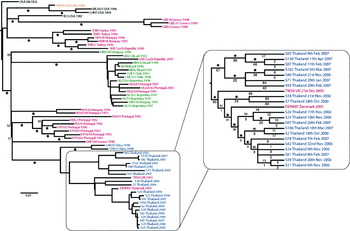
The pandemic ST239 shows resistance against multiple antibiotics and has been found in hospitals in Asia, central and eastern Europe, South America and Australia. In a recent study, Harris and collegeagues have unveiled the global geographic structure and the intercontinental spread of this clone over four decades (Harris et al. Reference Harris, Feil, Holden, Quail, Nickerson, Chantratita, Gardete, Tavares, Day, Lindsay, Edgeworth, Lencastre, Parkhill, Paecock and Bentley2010). The authors first mapped reads for 62 globally collected isolates against a reference genome and identified 6714 high-quality SNPs. After removing all SNPs found in the non-core genome they generated a maximum likelihood phylogeny based on 4310 SNPs mapping to the core genome. The rationale behind this strategy was to disregard the genomic regions that might have been affected by recombination. The authors found that the phylogenetic clustering presented a remarkable consistency with the geographic origin of the samples (Fig. 2). Three groups were observed corresponding to three geographic areas, i.e., Asia, Europe, and South America (blue, red and green name labels, respectively, in Fig. 2). While the South American and the Asian groups were monophyletic the European clade was not. They also noted some exceptions to this geographical pattern and these clearly allude to intercontinental transmissions. For example, Portuguese strains and even a strain from the Czech Republic were found within the South American clade. Remarkably, the study was able to resolve fully the phylogenetic relationship of a subset of 20 isolates, all of which were obtained from patients from a single hospital in northeast Thailand over a period of 7 months (see the higher resolution panel in Fig. 2). This clearly demonstrates the resolving power of SNP interrogation as the authors were able to resolve very confined geographical (one hospital) and temporal scales. Additionally, having the date of isolation of each strain, the authors were not only able to estimate the mutation rate but also to date the origin of this clone. It has been dated between the mid and late 1960s, which, interestingly, is few years after the introduction of methicillin in 1960.
Maximum likelihood phylogeny using core genome SNPs to analyze the intercontinental transmission of MRSA ST239 isolates. The label colours reflect the continental origin for each isolate: Asia, blue; Australia, yellow; Europe, red; North America, black; South America, green. Bootstrap values are shown below the branches, stars represent a bootstrap value of 100%. The scale bar represents the number of substitutions per SNP. The inset shows the subset from Thailand, here the bootstrap values are above the branches and, below the branch, the number of distinguishing SNPs for each isolate. Original Fig. from Harris et al. Reference Harris, Feil, Holden, Quail, Nickerson, Chantratita, Gardete, Tavares, Day, Lindsay, Edgeworth, Lencastre, Parkhill, Paecock and Bentley2010, Science 327 (5964). Reprinted with permission from AAAS.

Nubel and colleagues, in a slightly more recent study analysed the MLST ST225, which is a highly prevalent ST in Central European Hospitals (Nubel et al. Reference Nubel, Dordel, Kurt, Strommenger, Westh, Shukla, Zemlickova, Leblois, Wirth, Jombart and Al2010). The study considered 269 loci using an international collection of 73 isolates (including samples from Europe and the USA). The observation of very low diversity in European isolates suggested that a recent population bottleneck preceded the expansion of this ST in Europe. The authors suggested that isolates collected in the USA comprised an ancestral population, being more divergent than the European population. As the sampling dates were known, the authors were able to estimate the emergence of this ST. Using Bayesian approaches, they established that ST225 had diverged since ∼1990 and that the expansion of the European clade began in ∼1995. Through a demographic analysis, the authors inferred a drastic increase of population size in Europe from 2001 to 2004 and this is consistent with the known prevalence of this ST in European countries. Furthermore, a pattern of frequent transmission of ST225 between hospitals within central Europe was suggested by a spatio-temporal dynamics analysis. This study exemplifies how the recent demographic history of a particular ST can be studied in great detail by means of genome-wide SNPs in combination with biologically appropriate statistical techniques.
Notably, a similar phylogeographic pattern was identified in both studies. Both STs, 239 and 225, appear to be relatively low-dispersal lineages where very closely related isolates are geographically proximate, forming tight groups, while basal long branches distinguish these groups. This makes sense when the ecology of these STs is taken into account. Importantly, MRSA mainly colonize humans in hospital settings and these particular settings can be regarded as ‘islands’ on which these lineages thrive. These STs seem to be dispersing among hospitals within the same geographical regions. Nonetheless, the intercontinental transmission events detected in the first study are clear exceptions to this pattern. Only by utilizing genome-wide SNP data sets were these studies able to explore the short-term evolution of these STs at an ultra-fine scale. Actually, the common motivation of both studies was the lack of power of MLST to grasp microevolutionary processes within individual clonal complexes. It is important to emphasize that these studies explored either 40 or 20 years in time and, remarkably, in the first study no two isolates had the same haplotype. Hence, these data provide such high resolution that each individual strain can be distinguished from other strains. The unprecedented resolving power of this genome-wide SNP approaches is exemplified in the study by Harris and colleagues (2010), which has estimated that a mutation event occurs every six weeks. From an epidemiological point of view, this total discrimination between isolates is quite remarkable and offers the possibility of tracking the spread of individual clones over very short periods of time.
COMPARING AND CONTRASTING THE SYSTEMS REVIEWED
In this review we intended to give a comprehensive overview of the phylogeography for the LB-group spirochetes. The idea of including the discussion about two very recently evolved MRSA clones was not to give a full account of the MRSA clones but to exemplify how the use of genome-wide SNPs can be of tremendous use in uncovering very recent phylogeographic patterns for pathogenic bacteria with very restrictive niches. Nonetheless, there are similarities between the systems discussed here, LB-group spirochetes and MRSA, that we wish to highlight. First, the phylogeography of both bacteria is dependent on host species and, in the case of LB-group spirochetes, on the vector as well. While the LB-group spirochetes can infect either their hosts or their tick vectors, the two MRSA clones have been found only in humans and specifically only in hospitalized patients. This has major implications - for example, recurrent population bottlenecks may affect these two groups of bacteria whenever they are transmitted from one host to another. Due to this consistent reduction in population size, these bacteria would be predicted to show considerable levels of genetic drift. Indeed, a recent study reanalyzing ST239 data has shown increased levels of drift on the core genomes of this clone (Castillo-Ramirez et al. Reference Castillo-Ramirez, Harris, Holden, He, Parkhill, Bentley and Feil2011). As a consequence of the smaller populations of these bacteria, one would expect that more slightly deleterious mutations would go to fixation by drift and thus these bacteria might have faster substitution rates than their close relatives with larger population sizes. It remains to be seen whether LB-group spirochetes also show high levels of genetic drift and corroborate the idea that these bacteria will have faster substitution rates than free-living relatives, which should have larger population sizes. Because the complete transmission cycle of LB-group spirochetes involves two passages (from tick to host and from host to tick), the levels of genetic drift could be more pronounced for this group.
Another issue of host dependence is that the mobility of hosts will inevitably influence the spread of these bacteria and the bacterial populations will be considerably affected by the demographic process shaping the populations of their host. A major difference between these systems is that MRSA is directly transmitted from human to human (or via contaminated equipment) while LB-group spirochetes represent a zoonotic pathogen with a highly complex life cycle. This difference is clearly reflected in their distribution range. Although both pathogens may utilise highly mobile hosts (humans and birds, respectively), the spread of LB-group spirochetes was likely limited by availability and abundance of vector species and populations and the environmental factors that act upon them underpinning the complexity of such systems (Kurtenbach et al. Reference Kurtenbach, Hanincova, Tsao, Margos, Fish and Ogden2006; Margos et al. Reference Margos, Vollmer, Ogden and Fish2011).
Finally, in spite of being initially described as rather clonal species, strains from both of these groups undergo recombination. Actually, very recent studies using whole genome sequences have found considerable amounts of recombination in S. aureus strains (Chan et al. Reference Chan, Beiko, Darling and Ragan2009; Takuno et al. Reference Takuno, Kado, Sugino, Nakhleh and Innan2012). For instance, Chan and colleagues noted that ∼ 27% of the genes within the Staphylococcus genus have been affected by recombination and also found elevated rates of recombination, particularly in S. aureus genomes (Chan et al. Reference Chan, Beiko and Ragan2011). Interestingly, we found compelling evidence that recombinations have also affected B. burgdorferi sensu stricto, one of the emblematic species of the LB-group (Margos et al. unpublished). However, more systematic studies are required to assay the impact of recombination on the various species of the LB-group spirochetes quantitatively. This implies that caution should be exercised when dealing with even supposedly clonal species and the presence of recombination should be tested in the loci under consideration before inferring phylogenetic relationships. On the other hand, moderate levels of recombination have the advantage of breaking the linkage between genes and in this regard different realisations of the history of the species would be available as the genes may be unlinked. Statistical methods are now at hand for this to be taken into consideration when inferring species trees (Brito and Edwards, Reference Brito and Edwards2009).
OUTLOOK
In the foreseeable future, approaches using genome-wide SNP data will be very useful for conducting more informed surveillance over very short periods of time (weeks), at local and global scales, for a variety of bacterial pathogens. Furthermore, these genome-wide SNP data sets could not only be used to study the phylogeography of these microorganisms but also the evolutionary forces that have been shaping the genetic variation in these clones. For example, by reanalyzing the data set generated by Harris and colleagues (2010), it was possible to determine the effect of recombination on recently emerged clones and to show that the non-core regions of ST239 had been enriched in synonymous changes through recombination (Castillo-Ramirez et al. Reference Castillo-Ramirez, Harris, Holden, He, Parkhill, Bentley and Feil2011).
Additionally, SNP data are likely to provide a sufficient signal to investigate deeper evolutionary relationships such as speciation events and to infer population genetic parameters such as mutation rates or effective population sizes. Furthermore, these data may also allow disentangling locus-specific effects (mutation, recombination) from genome-wide effects owing to demographic processes and, in this regard, both demographic processes and single loci could be studied in great detail. The ever decreasing costs of genome sequencing suggest that eventually such studies will be carried out routinely for many bacterial pathogens and this would allow a much better understanding not only about the spread and population structure of any given bacterium but also about the evolutionary forces that impact such bacteria.
However, for many of bacteria ad hoc MLST/MLSA have proved to be very revealing in terms of population structure and evolutionary relationship. Major advantages of these approaches are the employment of targeted PCR, which confers high specificity and permits the analysis of field collected samples without the need to culture the species/strains of interest (particularly appealing to species that are difficult to culture). In addition, the accumulative nature of database, their accessibility, the link to Google Maps (permitting generation of global distribution maps for STs) and the potential to use EpiCollect (Aanensen et al. Reference Aanensen, Huntley, Feil, Al-Own and Spratt2009) makes this a convenient system for epidemiologists, ecologists and/or clinicians (Aanensen and Spratt, Reference Aanensen and Spratt2005). Another virtue of MLSA is its usefulness for taxonomic purposes (Gevers et al. Reference Gevers, Cohan, Lawrence, Spratt, Coenye, Feil, Stackebrandt, Van De Peer, Vandamme, Thompson and Swings2005; Bishop et al. Reference Bishop, Aanensen, Jordan, Kilian, Hanage and Spratt2009).
The enormous speed of scientific advance using sequencing methods in the last few years and additional technological and methodological developments that are likely to be made in the near future will most certainly accelerate progress in this exciting field of research.
ACKNOWLEDGEMENTS
The authors acknowledge Klaus Kurtenbach (who passed away in March 2009) for his many contributions to Lyme borreliosis research, his enthusiasm and the initiation of phylogeographic studies on Borrelia and S.A. Vollmer for sharing unpublished data. SCR is funded by the TROCAR consortium (EU FP7-HEALTH #223031).