INTRODUCTION
Multiple sclerosis (MS) is an autoimmune, demyelinating disease of the central nervous system. MS patients experience numerous physical symptoms such as loss of function or feeling in the extremities, incontinence, pain, fatigue, and dysarthria. Visual anomalies are some of the most common physical symptoms (Warner & Lessell, 1994). In fact, as many as 50% of MS patients present with vision loss as an initial symptom (Sorensen et al., 1999). Optic neuritis is the most common cause of vision loss in MS with up to 90% of MS patients suffering from optic neuritis during the course of their disease (Jacobs & Galetta, 2004). Other visual problems commonly observed in MS include internuclear opthalmoplegia, diplopia, and nystagmus.
In addition to the salient physical disabilities experienced by MS patients, cognitive deficits are common (Diaz-Olavarrieta et al., 1999). Cognitive difficulties typically involve memory, information processing speed, and executive functioning (Benedict et al., 2001). Attentional abilities are also commonly affected. In fact, over 50% of MS patients demonstrate deficits on tests of complex attention (Rao et al., 1991). Many of these tests of complex attention require patients to rapidly process visual information.
The interpretation of neuropsychological test results can be confounded by a number of factors, one of which is visual impairment. Typically, neuropsychologists screen patients for severe visual acuity disturbances and attempt to tailor test batteries so that the need for intact vision is minimized. However, little is known about how mild visual acuity disturbances may influence MS patients' neuropsychological test performance. In a landmark consensus article, MS experts recommended that “measures of visual/sensory/motor defects and fatigue be employed when indicated” (Benedict et al., 2002). They reasoned that even brief, standardized measures of sensory capabilities could be of great value in the interpretation of neuropsychological test results. Consequently, they recommended that near vision acuity charts be employed and that visual acuity disturbances greater than the 20/50–70 threshold should be considered when administering and interpreting neuropsychological tests (Benedict et al., 2002). However, this recommendation was largely anecdotal and, to date, no study has been published that directly examines the effects of visual acuity on visually-based tests of attention. The purpose of the present study was to examine the extent to which mild visual acuity disturbances influence performance on two common visually-based tests of complex attention.
METHOD
Participants and Procedure
Patients with mostly clinically definite (2 clinically probable, 8 laboratory-supported definite) relapsing-remitting or secondary progressive MS were recruited from an advertisement placed in a newsletter distributed to individuals with MS in western Pennsylvania (PA), MS support groups in central PA, and flyers distributed in the State College, PA community. Diagnoses and MS course types were assigned by board-certified neurologists based on established guidelines for research protocols in MS (Lublin & Reingold, 1996; Poser et al., 1983). None of the patients included in the current study were experiencing a clinical exacerbation at the time of the evaluation. Participants were not included in the study if they had a history of: (a) neurological disease other than MS; (b) drug or alcohol abuse; (c) learning disability; or (d) motor impairments that would significantly alter test administration procedures. In addition, participants were excluded if they reported visual problems that prevented them from reading standard newsprint. Three MS patients were not included in the study. One had a history of electro-convulsive therapy; one reported a history of stroke after testing was completed, and one was administered the vision screen incorrectly. After establishing informed consent, graduate students trained by a licensed clinical neuropsychologist (P.A.) administered a variety of measures assessing physical, cognitive, and emotional functioning. In return for their participation, MS patients were given 75 dollars and a brief neuropsychological report. Normal controls were recruited by asking MS patients to recruit interested friends and by distributing flyers in central PA. Controls were included if they had no major neurological or physical illnesses that would impact their testing. They were given 75 dollars for their participation and a brief neuropsycho-logical report upon request. Two controls were excluded from the present study due to errors in test administration. All procedures were approved by an institutional review board at the Penn State University.
Measures
Neuropsychological Measures
Visual attention was measured using the 90-second oral version of the Symbol Digit Modalities Test (SDMT) (Smith, 1982) and time per switch on the VE subtest from the Test of Everyday Attention (Robertson et al., 1994). For the SDMT, participants employ an answer key to rapidly say numbers that correspond to matching symbols. On the VE, examinees are shown a series of elevators on a stimulus sheet. Interspersed among the elevators, an occasional arrow points up or down to indicate the direction in which the elevator is traveling. Participants are asked to quickly count the elevators to indicate which floor they are on; when they come upon a “down” arrow they must reverse count and when the come upon an “up” arrow they must count forward consecutively. There are 40 total switches of directions across 10 trials. Intellectual functioning was estimated from the Shipley Institute of Living Scale (Zachary, 1986).
Vision Testing
Visual acuity was measured using a reduced Snellen near vision eye chart. The chart was placed onto a stand and a measuring tape was used to ensure that the chart was 14 inches away from the participants' eyes. Participants were asked to read the letters on the chart without moving their heads starting with the largest letter. They used both eyes and wore corrective lenses, if needed. The total number of correct letter identifications on the seven-line stimulus card was used as the dependent variable for continuous analyses. For categorical analyses, patients were given the visual acuity measurement that corresponded to the line prior to their first letter misidentification.
Expanded Disability Status Scale
The Expanded Disability Status Scale (EDSS) is a measure of MS disease progression and neurological impairment (Kurtzke, 1983). It is commonly used in both clinical practice and MS research. Participants were asked to rate their functional abilities in a number of different physical domains, and then EDSS ratings were determined by a clinical neuropsychologist experienced in MS (P.A.). Scores on the EDSS range from 0 (no neurological impairment) to 10 (death from MS).
RESULTS
Preliminary Analyses
Ninety-one MS patients (73 relapsing-remitting and 18 secondary progressive) and 25 controls met inclusion criteria for the study (see Table 1). Seventy-five of the MS patients (82%) and 20 of the controls (80%) were female. The MS and control groups did not differ on measures of age, estimated intelligence, or gender. The controls were significantly more highly educated than MS patients [t (114) = 2.02, p < .05]. However, this was not problematic as none of the dependent or independent variables were significantly correlated with education. Kolmogorov-Smirnov testing revealed that VE was not normally distributed (p < .05); a log transform corrected for this violation.
Descriptive statistics for MS patients and controls

Analyses with MS Patients
Poorer visual acuity was associated with poorer performance on visual attention measures. Pearson product moment correlations revealed a significant relationship between visual acuity and performance on the SDMT (r = .37, p < .001) and VE (r = −.33, p < .01). Worse visual acuity was also associated with older age (r = −.35, p < .01), longer symptom duration (−.23, p < .05), and more physical disability (r = −.25, p < .05). Forward stepwise regression analyses (entrance = .05, exit = .10) were conducted with age, symptom duration, EDSS, and visual acuity predicting performance on measures of visual attention. Age was entered as a covariate in the first block and symptom duration, EDSS, and visual acuity were entered stepwise in the second block. Visual acuity was the sole remaining variable associated with performance on the VE (R2 change = .10, F change = 10.24, p <.01). EDSS (R2 change = .13, F change = 14.56, p < .001) and visual acuity (R2 change = .04, F change = 5.18, p < .05) both predicted unique variance associated with performance on the SDMT.
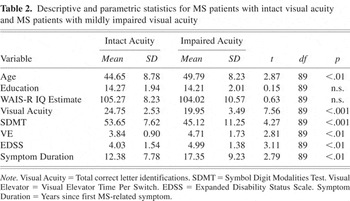
Ten MS patients had 20/20 vision or better, 38 had 20/30 vision, 42 had 20/40 vision, and one had 20/60 vision. MS patients with 20/20 vision did not differ from patients with 20/30 vision on any neuropsychological or demographic measures. Consequently, participants were split into groups with visual acuity worse than 20/30 and visual acuity better than or equal to 20/30 (see Table 2). Analysis of covariance (ANCOVA) controlling for age, symptom duration, and physical disability status revealed that patients with poorer visual acuity performed worse on the SDMT [F(1,86) = 7.03, eta2 =.08, p < .01] and VE [F(1,86) = 4.07, eta2 = .05, p < .05].
Descriptive and parametric statistics for MS patients with intact visual acuity and MS patients with mildly impaired visual acuity

Analyses with MS Patients and Controls
Among controls, visual acuity was not significantly correlated with performance on the SDMT (r = .35, p = .09) or VE (r = −.28, p = n.s.), though the magnitude of the correlations was comparable to the correlations within the MS group. This suggests that the null findings in the control group may have been a function of reduced statistical power. No significant difference was found between MS patients and controls for total visual acuity. However, MS patients performed worse than controls on the SDMT [t(114) = 4.81, p < .01]. MS patients also performed worse than controls on the SDMT when controlling for visual acuity [F(1,113) = 14.20, p < .001]. Visual acuity was a significant covariate accounting for 13% of the between groups variance in SDMT performance [F(1,113) = 17.20, p < .001]. On the VE, MS patients performed worse than controls [t(114) = 2.03, p < .05]. However, MS patients and controls did not differ significantly on the VE when controlling for visual acuity. Visual acuity was a significant covariate accounting for 10% of the between groups variance in VE performance [F(1,113) = 12.95, p < .001].
DISCUSSION
In this study, we examined how mild vision problems among MS patients are associated with neuropsychological test performance on two tests of complex attention. Findings indicated that even MS patients who report adequate vision can exhibit mild visual acuity disturbances that are significantly correlated with common tests of visual attention. Results of stepwise regression analyses revealed that visual acuity disturbances account for unique variance in neuropsychological performance, even when age and physical disability status are considered. Moreover, mild visual acuity disturbances accounted for as much as 13% of the variance between MS patients and control groups on measures of visual attention. These results suggest that mild visual impairment may be an important consideration for accurate neuropsychological test interpretation in MS.
This study supports previous recommendations to include visual acuity screens as part of neuropsychological test batteries in MS (Benedict et al., 2002). Previous expert recommendations suggested a near vision threshold of 20/50–70 for the neuropsychological assessment of MS patients. Our findings suggest that an even more conservative threshold may be necessary. Specifically, MS patients with normal visual acuity performed significantly better than patients with visual acuity disturbances greater than or equal to 20/40. Results suggest that clinicians and researchers should take special care when interpreting performance on tests of visual attention when MS patients have visual acuity disturbances greater than or equal to 20/40.
An associated finding of the study was that MS patients with more physical disability have significantly poorer visual acuity. Some previous studies have found strong relationships between physical disability status and cognitive deficits in MS (Thorton & Raz, 1997); others have not (Rao et al., 1991). Mild visual acuity differences may partially account for some of these discrepancies. Future studies are encouraged to report and control for visual acuity disturbances in MS, because they may have a significant impact on test performance.
The primary limitation of this study is the correlational nature of the findings. Although it may be tempting to conclude that visual acuity disturbances influence performance of speeded tests of visual attention, it should be noted that other equally plausible explanations for the findings exist (see Baltes & Lindenberger, 1997). For example, it may be that a third factor such as lesion load influences both visual acuity and speeded visual attention in MS. Future studies should employ neuroimaging to more thoroughly examine this relationship. Similarly, future studies should employ visual and non-visual tests of attention. A strong association between visual acuity and non-visual tests of attention would bolster support for the argument that central nervous system damage accounts for the relationships observed in this study. It would also be illuminating to include non-speeded measures of visual attention to evaluate whether visual acuity is associated with these types of tasks also. Because both of the complex visual tasks employed in the current study were speeded, it was not possible to test whether our findings would generalize to non-speeded visual attention tasks. In addition, experimental studies that employ vision impairing lenses may help us better understand how visual acuity disturbances impact performance on tests of visual attention independent of the MS disease process. Another limitation of the present study was our use of a very brief vision screen. Future research should consider including visual acuity screens, visual field screens, self-report measures of visual disturbance, and measures of contrast sensitivity. Such instruments are typically brief to administer, and therefore would not add a significant amount of time to test batteries.
This is the first study that has examined the association between mild visual acuity impairment and neuropsychological test performance in MS patients. Results highlighted that mild visual acuity disturbances are associated with performance on tests of visual attention. In the future, neuropsychologists conducting assessments with MS patients should be aware of even mild visual acuity limitations to ensure accurate test interpretation.
ACKNOWLEDGMENTS
There are no financial or other relationships that involve a conflict of interest in relation to this manuscript including the manufacturer(s) of any commercial products(s) and/or provider(s) of commercial services. Additionally, no commercial support was provided for the research reported in this manuscript. Special thanks to the many neurologists in Pennsylvania, particularly Dr. Brian Ahlstrom, who contributed their time to verifying MS diagnoses and ratings of course for the MS participants in the project. We thank Dawn Polen, Lauren Strober, Megan Smith, Fiona Barwick, Stephanie Pantalone (Marshall), Molly Riley, Luciano Tristan, Martin Pankiewicz, Jess Clark, Karisa Cortellini, Kate Caddick, Lisa Martin, Alfred Bagamasbad, Jennifer Leer (Cromer), Kristin King, La Riena Ralph, Maya Ramirez, Elizabeth Ranft, Hannah Roggenkamp, Megan Wagner, Pinar Miski, Michelle Olson, Erin Stover, and Andrae Laws for their help with various aspects of the project. This work was presented (in part) at the 34th annual meeting of the International Neuropsychological Society Neuropsychology in Boston, Massachusetts, and the research was supported, in part, by a Pilot Grant from the National Multiple Sclerosis Society (PP0978).