


Introduction
On November 8, 2019, the International Court of Justice (ICJ) delivered a highly anticipated judgment on the preliminary objections raised by the Russian Federation with respect to the lack of the Court's jurisdiction over the claims brought by Ukraine under the Convention on the Elimination of All Forms of Racial Discrimination (CERD) and the International Convention for the Suppression of the Financing of Terrorism (ICSFT).Footnote 1 The Court overwhelmingly rejected all of Russia's preliminary objections under both Conventions and confirmed the admissibility of Ukraine's claims under the CERD.Footnote 2 Therefore, Ukraine's case will be heard on the merits in its entirety.
Background
The lawsuit results from a bitter standoff between the two neighboring states that have been at loggerheads with each other since early 2014 over the annexation/occupation of Crimea and Russia's military involvement in the conflict in eastern Ukraine.Footnote 3 Ukraine and Russia disagree over the factual circumstances surrounding the situation in Crimea and eastern Ukraine. Backed by the international community, Ukraine asserts its sovereign rights over Crimea, whereas Russia maintains that Crimea was lawfully incorporated into its territory through the exercise of the right of the “Crimean people” to self-determination, and that they were entitled to unilaterally secede from the parent state when faced with the heightened risk of an armed assault from the Ukrainian authorities in Kyiv.Footnote 4 As for the conflict in eastern Ukraine, Ukraine submits that the fighting has been enabled by Russia's exercise of its effective control over the separatist groups in Donbas, while Russia strongly denies its military involvement and any form of assistance rendered for such groups.Footnote 5 The pending case at the ICJ does not touch upon the fundamental issues underlying the dispute in question—that is, the right to self-determination, unilateral secession, and the use of force, given Russia's non-acceptance of the compulsory jurisdiction of the Court. The scope of the Court's judicial inquiry is narrowly limited to Ukraine's claims under the CERD with respect to the allegations of racial discrimination directed against the opponents of the Russian regime in Crimea, as well as Ukraine's claims with respect to Russia's alleged backing of the pro-Russian separatist groups and its failure to take measures and cooperate in the prevention and suppression of alleged terrorism financing offences. To put it differently, the dispute is not about the legal status of Crimea or the legal qualification of the armed conflict in eastern Ukraine; rather, it falls squarely within the examination of the allegations of racial discrimination under the CERD and the allegations of terrorism financing under the ICSFT.Footnote 6
Judgment
ICSFT
As for the existence of jurisdiction ratione materiae under Article 24(1) of the ICSFT, the Court found that the examination of the plausibility of claims, which was a bone of contention in the parties' submissions, was not warranted at the preliminary objections stage.Footnote 7 The Court clarified the scope of States Parties' obligations under the ICSFT, having ruled that state financing of terrorism fell outside the scope of the Convention.Footnote 8 Here, the Court departs from its reasoning in the Bosnian Genocide case, in which it inferred the prohibition of the commission of genocide by a state from its duty to prevent genocide.Footnote 9 Having grounded its findings in the travaux preparatoires of the Convention, the Court nevertheless stated that the exclusion of state financed terrorism from the scope of the ICSFT did not make it lawful under international law.Footnote 10 This finding refutes Ukraine's arguments advanced at the provisional measures stage that state financing of terrorism fell within the scope of the Convention.Footnote 11 At the preliminary objections stage, Ukraine's argument somewhat shifted from a broader reading of the obligation to prevent under the ICSFT to the scope of the concept of perpetrators of terrorism financing offences, which in its opinion encompassed both state agents and persons acting in a private capacity.Footnote 12 Although the Court agreed that the provision covered both categories of persons, it emphasized that the commission of a terrorism financing offence by a state official did not in itself engage the responsibility of the state under the ICSFT.Footnote 13 In other words, state responsibility was only engaged when a terrorism financing offence committed by whichever person resulted in the breach of an obligation to take appropriate measures and to cooperate in the prevention and suppression of the financing terrorism offences.Footnote 14 As for the most contested aspect of the case, which concerned the existence of the necessary mens rea in relation to terrorism financing offences and its underlying terrorism offences, the Court considered the question to be largely of a factual nature, thus constituting a matter for the merits.Footnote 15
When assessing the fulfilment of the procedural preconditions under Article 24 of the ICSFT, the Court held that the prolonged negotiations concerning the organization of the arbitration had failed.Footnote 16 In its examination, the Court did not address whether Ukraine's insistence on referring the dispute to an ad hoc chamber of the Court was sufficient to satisfy the procedural preconditions in the given compromissory clause. The wording of the judgment suggests that Ukraine's proposal was one of the few options put forward by Ukraine, but the Court made it clear that the ad hoc chamber mode of dispute settlement could not be equated with arbitration.Footnote 17
CERD
The part of the judgment on the CERD is rather brief, as it is largely a summary of States Parties' points of disagreement. The Court found that in order to determine whether it had jurisdiction ratione materiae under the CERD, it neither had to satisfy itself of the measures that Ukraine complained actually constituted racial discrimination within the meaning of the CERD, nor to establish the extent to which such alleged acts were covered by the respective provisions of the Convention.Footnote 18 In the Court's view, both matters were to be appropriately dealt with at the merits.Footnote 19 Having ruled that both Crimean Tatars and ethnic Ukrainians in Crimea constitute ethnic groups within the meaning of the CERD, and having taken into account the broadly formulated rights and obligations provided for in the Convention, the Court found that the measures of which Ukraine complained were “capable of having an adverse effect on the enjoyment of certain rights protected under CERD,” thus falling within the provisions of the CERD.Footnote 20 When examining the fulfilment of the procedural preconditions under Article 22 of the CERD, the Court addressed in depth a previously unsettled issue in Georgia v. Russia as to whether the procedural preconditions—that is, negotiations and the settlement of a dispute by resorting to the CERD committee procedure—were alternative or cumulative. The Court held that it would be unreasonable to require States Parties, which had already failed at negotiations, to engage in an additional set of negotiations in accordance with the CERD committee procedure.Footnote 21 Further, the Court recognized that the cumulative character of the procedural preconditions would go against the object and purpose of the CERD, which requires States Parties to eliminate racial discrimination “without delay.”Footnote 22 When addressing the fulfilment of the negotiation precondition by Ukraine, the Court found that Ukraine had genuinely attempted to negotiate with Russia through its engagement in both diplomatic correspondence and face-to-face meetings; however, negotiations between the parties had become futile or deadlocked by the time Ukraine had filed its lawsuit.Footnote 23 In light of its earlier finding on the alternative character of the procedural preconditions, the fulfilment of the negotiation requirement on the part of Ukraine was sufficient in itself to satisfy jurisdictional prerequisites under Article 22 of the CERD.Footnote 24
Concluding Remarks
The case demonstrates that the strategy of “defensive lawfare” pursued by Ukraine against Russia in various international courts, including inter-state arbitration proceedings, is starting to bear fruit.Footnote 25 The ICJ ruling on jurisdiction is the biggest defeat for Russia thus far, as Russia did not manage to replicate its earlier success in Georgia v. Russia to have the case dismissed on jurisdictional grounds by the Court. Ukraine's case will be heard on the merits in its entirety; this is the first time in the history of the Court that it will adjudge claims under the CERD and the ICSFT. The case has the potential to deliver credible fact-finding at the backdrop of the parties' alternative accounts of events in Crimea and eastern Ukraine. Moreover, the case may contribute to advancing international law more generally by clarifying the scope of States Parties' obligations under the CERD and the ICSFT.Footnote 26 A number of important questions are yet to be answered by the Court, in relation to the content of broadly formulated rights and obligations in the CERD and the relationship between international humanitarian law and the suppression of the terrorism framework more broadly. It is highly probable that the Court will satisfy at least some of Ukraine's claims under the CERD; however, Ukraine has less chance of succeeding with its claims under the ICSFT. It will be enormously challenging to prove the existence of the requisite mens rea in relation to alleged terrorism financing offences and underlying terrorism offences, which is a necessary prerequisite for assessing whether States Parties' obligations under the ICSFT have been breached. Apart from the question of mens rea, the Court may face other challenges in the interpretation of the ICSFT, as pointed out by dissenting Judge Xue, who disagreed with the Court's assessment on the existence of its jurisdiction under the ICSFT.Footnote 27 Judge Xue argued that the allegations of terrorism financing were inseparable from defining the nature of the conflict in eastern Ukraine, which was beyond the scope of the Court's jurisdiction.Footnote 28 Further, she maintained that every act of terrorism financing alleged by Ukraine pointed at the responsibility of Russia, which is not a matter for the ICJ to adjudge due to the exclusion of state-financed terrorism from the scope of the ICSFT.Footnote 29 To sum up, this case needs to be watched closely for important international law developments.
8 NOVEMBRE 2019
ARRÊT
APPLICATION DE LA CONVENTION INTERNATIONALE POUR LA RÉPRESSION DU FINANCEMENT DU TERRORISME ET DE LA CONVENTION INTERNATIONALE SUR L'ÉLIMINATION DE TOUTES LES FORMES DE DISCRIMINATION RACIALE
(UKRAINE c. FÉDÉRATION DE RUSSIE)
APPLICATION OF THE INTERNATIONAL CONVENTION FOR THE SUPPRESSION OF THE FINANCING OF TERRORISM AND OF THE INTERNATIONAL CONVENTION ON THE ELIMINATION OF ALL FORMS OF RACIAL DISCRIMINATION
(UKRAINEv. RUSSIAN FEDERATION)
8 NOVEMBER 2019
JUDGMENT
Table of Contents
…………………………………………………………Paragraphs
Chronology of the Procedure…………[ILM Page 348]
I. INTRODUCTION…………[ILM Page 357]
A. Subject-matter of the dispute…………[ILM Page 357]
B. Bases of jurisdiction invoked by Ukraine…………[ILM Page 359]
II. THE INTERNATIONAL CONVENTION FOR THE SUPPRESSION OF THE FINANCING OF TERRORISM…………[ILM Page 359]
A. Jurisdiction ratione materiae under the ICSFT…………[ILM Page 359]
B. Procedural preconditions under Article 24 of the ICSFT…………[ILM Page 364]
1. Whether the dispute between the Parties could not be settled through negotiation…………[ILM Page 364]
2. Whether the Parties were unable to agree on the organization of an arbitration…………[ILM Page 365]
III. THE INTERNATIONAL CONVENTION ON THE ELIMINATION OF ALL FORMS OF RACIAL DISCRIMINATION…………[ILM Page 366]
A. Jurisdiction ratione materiae under CERD…………[ILM Page 366]
B. Procedural preconditions under Article 22 of CERD…………[ILM Page 369]
1. The alternative or cumulative character of the preconditions procedural…………[ILM Page 369]
2. Whether the Parties attempted to negotiate a settlement to their dispute under CERD…………[ILM Page 372]
C. Admissibility…………[ILM Page 374]
Operative Clause…………[ILM Page xx]
INTERNATIONAL COURT OF JUSTICE
YEAR 2019
2019 8 November General List No. 166
8 November 2019
APPLICATION OF THE INTERNATIONAL CONVENTION FOR THE SUPPRESSION OF THE FINANCING OF TERRORISM AND OF THE INTERNATIONAL CONVENTION ON THE ELIMINATION OF ALL FORMS OF RACIAL DISCRIMINATION
(UKRAINE v. RUSSIAN FEDERATION)
PRELIMINARY OBJECTIONS
Subject-matter of the dispute — Proceedings instituted by Ukraine under the ICSFT and CERD — Two aspects of the dispute — Alleged breaches by the Russian Federation of its obligations under the ICSFT and CERD.
Bases of jurisdiction invoked by Ukraine — Article 24, paragraph 1, of the ICSFT and Article 22 of CERD.
* *
Whether the Court has jurisdiction ratione materiae under the ICSFT.
Whether acts of which Applicant complains fall within provisions of the ICSFT — Interpretation of the ICSFT according to rules contained in Vienna Convention on Law of Treaties — Scope of obligations under the ICSFT — The ICSFT addresses offences committed by individuals — Financing by a State of acts of terrorism outside scope of the ICSFT — Ordinary meaning of term “any person” in Article 2 of the ICSFT — Term applies both to persons acting in private capacity and to those who are State agents — All States parties to the ICSFT under obligation to take appropriate measures and to co-operate in prevention and suppression of offences of financing acts of terrorism — Definition of “funds” in Article 1 need not be addressed at present stage of proceedings — Whether specific act falls within meaning of Article 2, paragraph 1 (a) or (b), of the ICSFT is matter for the merits — Questions concerning existence of requisite mental elements not relevant to the Court's jurisdiction ratione materiae — Objection to the Court's jurisdiction ratione materiae under the ICSFT cannot be upheld.
*
Whether the procedural preconditions under Article 24, paragraph 1, of the ICSFT have been met.
First precondition, namely, whether dispute between the Parties could not be settled through negotiation — Precondition requires genuine attempt to settle dispute through negotiation — Little progress made by the Parties during negotiations — Dispute could not be settled through negotiation within reasonable time — First precondition met — Second precondition, namely, whether the Parties were unable to agree on organization of arbitration — Failure to reach agreement during requisite period despite negotiations — Second precondition fulfilled.
*
The Court has jurisdiction to entertain Ukraine's claims under the ICSFT.
* *
Whether the Court has jurisdiction ratione materiae under CERD.
Whether measures of which Ukraine complains fall within provisions of CERD — Parties agree that Crimean Tatars and ethnic Ukrainians in Crimea constitute ethnic groups protected under CERD — Rights and obligations contained in CERD broadly formulated — Measures of which Ukraine complains are capable of having adverse effect on enjoyment of certain rights protected under CERD — These measures fall within provisions of CERD — Claims of Ukraine fall within scope of CERD.
*
Whether the procedural preconditions under Article 22 of CERD have been met.
Whether two preconditions alternative or cumulative — Application of rules of customary international law on treaty interpretation — Meaning of conjunction “or” in phrase “not settled by negotiation or by the procedures expressly provided for in [CERD]” — Term “or” may have either disjunctive or conjunctive meaning — Article 22 must be interpreted in its context — Negotiation and CERD Committee procedure two means to achieve same objective — Context of Article 22 does not support a reading that preconditions cumulative in nature — Article 22 must also be interpreted in light of object and purpose of CERD — Aim of States parties to eradicate racial discrimination effectively and promptly — Achievement of such aims more difficult if procedural preconditions under Article 22 cumulative — No need to examine travaux préparatoires of CERD — Article 22 imposes alternative preconditions to the Court's jurisdiction.
Whether the Parties attempted to negotiate settlement to their dispute — Notion of “negotiation” — Precondition of negotiation met when there has been a failure of negotiations, or when negotiations have become futile or deadlocked — Genuine attempt at negotiation made by Ukraine — Negotiations between the Parties futile or deadlocked by time Ukraine filed Application — Procedural preconditions satisfied.
*
The Court has jurisdiction to entertain Ukraine's claims under CERD.
* *
Objection by the Russian Federation to admissibility of Ukraine's Application with regard to claims under CERD — Contention that Application inadmissible because local remedies not exhausted before dispute referred to the Court — When a State brings claim on behalf of its nationals customary international law requires previous exhaustion of local remedies — Ukraine challenges alleged pattern of conduct of the Russian Federation with regard to treatment of Crimean Tatar and Ukrainian communities in Crimea — Rule of exhaustion of local remedies not applicable in circumstances of present case — Objection to admissibility of Ukraine's Application with regard to CERD rejected.
* *
The Court has jurisdiction to entertain the claims made by Ukraine under CERD and Ukraine's Application with regard to those claims is admissible.
JUDGMENT
Present: President Yusuf; Vice-President Xue; Judges Tomka, Abraham, Bennouna, Cançado Trindade, Donoghue, Gaja, Sebutinde, Bhandari, Robinson, Crawford, Salam, Iwasawa; Judges ad hoc Pocar, Skotnikov; Registrar Gautier.
In the case concerning the application of the International Convention for the Suppression of the Financing of Terrorism and of the International Convention on the Elimination of All Forms of Racial Discrimination,
between
Ukraine,
represented by
H.E. Ms Olena Zerkal, Deputy Minister for Foreign Affairs of Ukraine, as Agent;
H.E. Mr. Vsevolod Chentsov, Ambassador Extraordinary and Plenipotentiary of Ukraine to the Kingdom of the Netherlands,
as Co-Agent;
Mr. Harold Hongju Koh, Sterling Professor of International Law at Yale Law School, member of the Bars of New York and the District of Columbia,
Mr. Jean-Marc Thouvenin, Professor at the University Paris Nanterre, Secretary-General of the Hague Academy of International Law,
Ms Marney L. Cheek, Covington & Burling LLP, member of the Bar of the District of Columbia,
Mr. Jonathan Gimblett, Covington & Burling LLP, member of the Bars of the District of Columbia and Virginia,
Mr. David M. Zionts, Covington & Burling LLP, member of the Bars of the Supreme Court of the United States and the District of Columbia,
as Counsel and Advocates;
Ms Oksana Zolotaryova, Acting Director, International Law Department, Ministry of Foreign Affairs of Ukraine,
Ms Clovis Trevino, Covington & Burling LLP, member of the Bars of the District of Columbia, Florida and New York,
Mr. Volodymyr Shkilevych, Covington & Burling LLP, member of the Bars of Ukraine and New York,
Mr. George M. Mackie, Covington & Burling LLP, member of the Bars of the District of Columbia and Virginia,
Ms Megan O'Neill, Covington & Burling LLP, member of the Bars of the District of Columbia and Texas,
as Counsel;
Mr. Taras Kachka, Adviser to the Minister for Foreign Affairs of Ukraine,
Mr. Roman Andarak, Deputy Head of the Mission of Ukraine to the European Union,
Mr. Refat Chubarov, Head of the Mejlis of the Crimean Tatar People, People's Deputy of Ukraine,
Mr. Bohdan Tyvodar, Deputy Head of Division, Security Service of Ukraine,
Mr. Ihor Yanovskyi, Head of Unit, Security Service of Ukraine,
Mr. Mykola Govorukha, Deputy Head of Unit, Prosecutor General's Office of Ukraine,
Ms Myroslava Krasnoborova, Liaison Prosecutor for Eurojust,
as Advisers;
Ms Katerina Gipenko, Ministry of Foreign Affairs of Ukraine,
Ms Valeriya Budakova, Ministry of Foreign Affairs of Ukraine,
Ms Olena Vashchenko, Consulate General of Ukraine in Istanbul,
Ms Sofia Shovikova, Embassy of Ukraine in the Kingdom of the Netherlands,
Ms Olga Bondarenko, Embassy of Ukraine in the Kingdom of the Netherlands,
Mr. Vitalii Stanzhytskyi, Ministry of Interior of Ukraine,
Ms Angela Gasca, Covington & Burling LLP,
Ms Rebecca Mooney, Covington & Burling LLP,
as Assistants,
and
the Russian Federation,
represented by
H.E. Mr. Dmitry Lobach, Ambassador-at-large, Ministry of Foreign Affairs of the Russian Federation,
Mr. Ilya Rogachev, Director, Department of New Challenges and Threats, Ministry of Foreign Affairs of the Russian Federation,
Mr. Grigory Lukiyantsev, PhD, Special Representative of the Ministry of Foreign Affairs of the Russian Federation for Human Rights, Democracy and the Rule of Law, Deputy Director, Department for Humanitarian Co-operation and Human Rights, Ministry of Foreign Affairs of the Russian Federation,
as Agents;
Mr. Mathias Forteau, Professor at the University Paris Nanterre,
Mr. Alain Pellet, Emeritus Professor at the University Paris Nanterre, former chairperson of the International Law Commission, member of the Institut de droit international,
Mr. Samuel Wordsworth, QC, member of the Bar of England and Wales, member of the Paris Bar, Essex Court Chambers,
Mr. Andreas Zimmermann, LLM (Harvard University), Professor of International Law at the University of Potsdam, Director of the Potsdam Centre of Human Rights, member of the Permanent Court of Arbitration and of the Human Rights Committee,
as Counsel and Advocates;
Mr. Sean Aughey, member of the Bar of England and Wales, 11KBW Chambers,
Ms Tessa Barsac, consultant in international law, Master (University Paris Nanterre), LLM (Leiden University),
Mr. Jean-Baptiste Merlin, doctorate in law (University Paris Nanterre), consultant in public international law,
Mr. Michael Swainston, QC, member of the Bar of England and Wales, Brick Court Chambers,
Mr. Vasily Torkanovskiy, member of the Saint Petersburg Bar, Ivanyan & Partners,
Mr. Sergey Usoskin, member of the Saint Petersburg Bar,
as Counsel;
Mr. Ayder Ablyatipov, Deputy Minister of Education, Science and Youth of the Republic of Crimea,
Mr. Andrey Anokhin, expert, Investigative Committee of the Russian Federation,
Mr. Mikhail Averyanov, Second Secretary, Permanent Mission of the Russian Federation to the Organization for Security and Co-operation in Europe,
Ms Héloïse Bajer-Pellet, member of the Paris Bar,
Ms Maria Barsukova, Third Secretary, Department for Humanitarian Co-operation and Human Rights, Ministry of Foreign Affairs of the Russian Federation,
Ms Olga Chekrizova, Second Secretary, Department for Humanitarian Co-operation and Human Rights, Ministry of Foreign Affairs of the Russian Federation,
Ms Ksenia Galkina, Third Secretary, Legal Department, Ministry of Foreign Affairs of the Russian Federation,
Mr. Alexander Girin, expert, Ministry of Defence of the Russian Federation,
Ms Daria Golubkova, administrative assistant, Legal Department, Ministry of Foreign Affairs of the Russian Federation,
Ms Victoria Goncharova, Third Secretary, Embassy of the Russian Federation in the Kingdom of the Netherlands,
Ms Anastasia Gorlanova, Attaché, Legal Department, Ministry of Foreign Affairs of the Russian Federation,
Ms Valeria Grishchenko, interpreter, Investigative Committee of the Russian Federation,
Mr. Denis Grunis, expert, Prosecutor General's Office of the Russian Federation,
Mr. Ruslan Kantur, Attaché, Department of New Challenges and Threats, Ministry of Foreign Affairs of the Russian Federation,
Ms Svetlana Khomutova, expert, Federal Financial Monitoring Service of the Russian Federation,
Mr. Konstantin Kosorukov, Head of Division, Legal Department, Ministry of Foreign Affairs of the Russian Federation,
Ms Maria Kuzmina, Acting Head of Division, Second CIS Department, Ministry of Foreign Affairs of the Russian Federation,
Mr. Petr Litvishko, expert, Prosecutor General's Office of the Russian Federation,
Mr. Timur Makhmudov, Attaché, Legal Department, Ministry of Foreign Affairs of the Russian Federation,
Mr. Konstantin Pestchanenko, expert, Ministry of Defence of the Russian Federation,
Mr. Grigory Prozukin, expert, Investigative Committee of the Russian Federation,
Ms Sofia Sarenkova, Senior Associate, Ivanyan & Partners,
Ms Elena Semykina, paralegal, Ivanyan & Partners,
Ms Svetlana Shatalova, First Secretary, Legal Department, Ministry of Foreign Affairs of the Russian Federation,
Ms Angelina Shchukina, Junior Associate, Ivanyan & Partners,
Ms Kseniia Soloveva, Associate, Ivanyan & Partners,
Ms Maria Zabolotskaya, Head of Division, Legal Department, Ministry of Foreign Affairs of the Russian Federation,
Ms Olga Zinchenko, Attaché, Department for Humanitarian Co-operation and Human Rights, Ministry of Foreign Affairs of the Russian Federation,
as Advisers,
The Court,
composed as above,
after deliberation,
delivers the following Judgment:
1. On 16 January 2017, the Government of Ukraine filed in the Registry of the Court an Application instituting proceedings against the Russian Federation with regard to alleged violations by the latter of its obligations under the International Convention for the Suppression of the Financing of Terrorism of 9 December 1999 (hereinafter the “ICSFT”) and the International Convention on the Elimination of All Forms of Racial Discrimination of 21 December 1965 (hereinafter “CERD”).
2. In its Application, Ukraine seeks to found the Court's jurisdiction on Article 24, paragraph 1, of the ICSFT and on Article 22 of CERD, on the basis of Article 36, paragraph 1, of the Statute of the Court.
3. On 16 January 2017, Ukraine also submitted a Request for the indication of provisional measures, referring to Article 41 of the Statute and to Articles 73, 74 and 75 of the Rules of Court.
4. The Registrar immediately communicated the Application and the Request for the indication of provisional measures to the Government of the Russian Federation, in accordance with Article 40, paragraph 2, of the Statute and Article 73, paragraph 2, of the Rules of Court, respectively. He also notified the Secretary-General of the United Nations of the filing of the Application and the Request for the indication of provisional measures by Ukraine.
5. In addition, by a letter dated 17 January 2017, the Registrar informed all Member States of the United Nations of the filing of the above-mentioned Application and Request for the indication of provisional measures.
6. Pursuant to Article 40, paragraph 3, of the Statute, the Registrar notified the Member States of the United Nations, through the Secretary-General, of the filing of the Application, by transmission of the printed bilingual text of that document.
7. By letters dated 20 January 2017, the Registrar informed both Parties that, referring to Article 24, paragraph 1, of the Statute, the Member of the Court of Russian nationality informed the President of the Court that he considered that he should not take part in the decision of the case. Pursuant to Article 31 of the Statute and Article 37, paragraph 1, of the Rules of Court, the Russian Federation chose Mr. Leonid Skotnikov to sit as judge ad hoc in the case.
8. Since the Court included upon the Bench no judge of Ukrainian nationality, Ukraine proceeded to exercise the right conferred upon it by Article 31 of the Statute to choose a judge ad hoc to sit in the case; it chose Mr. Fausto Pocar.
9. By an Order of 19 April 2017, the Court, having heard the Parties, indicated the following provisional measures:
“(1) With regard to the situation in Crimea, the Russian Federation must, in accordance with its obligations under the International Convention on the Elimination of All Forms of Racial Discrimination,
(a) Refrain from maintaining or imposing limitations on the ability of the Crimean Tatar community to conserve its representative institutions, including the Mejlis;
(b) Ensure the availability of education in the Ukrainian language;
(2) Both Parties shall refrain from any action which might aggravate or extend the dispute before the Court or make it more difficult to resolve.” (I.C.J. Reports 2017, pp. 140–141, para. 106.)
10. In a letter dated 19 April 2018, Ukraine drew the Court's attention to the Russian Federation's alleged non-compliance with point (1) (a) of operative paragraph 106 of the Court's Order on the indication of provisional measures. Ukraine stated that this lack of compliance stems from the Russian Federation's interpretation of the provision in question, which is contrary to its proper meaning. Consequently, in light of the “different and conflicting interpretations” ascribed to point (1) (a) by the Parties, Ukraine requested that the Court “exercise its authority to interpret its Order of 19 April 2017”.
11. Following this communication, on 17 May 2018 the Court requested the Russian Federation to provide, by 7 June 2018 at the latest, information on measures that had been taken by it to implement point (1) (a) of operative paragraph 106 of the Court's Order of 19 April 2017, and Ukraine to furnish, by the same date, any information it might have in that regard. This information was duly provided on 7 June 2018. Each Party having been given until 21 June 2018 to provide comments on the information submitted by the other, the Court received comments from Ukraine on 12 June 2018 and from the Russian Federation on 21 June 2018. On 18 July 2018, having considered the information and comments submitted to it by the Parties, the Court again requested the Russian Federation to provide, by 18 January 2019, information regarding measures taken by it to implement point (1) (a) of operative paragraph 106 of the Court's Order of 19 April 2017, and Ukraine to furnish, by the same date, any information it might have in that regard. This information having been transmitted to the Court, each Party was invited to communicate its comments on the information received from the other, by 19 March 2019 at the latest. Both Parties provided their comments on that date. By letters dated 29 March 2019, the Parties were informed that the Court had considered and taken due note of the various communications submitted by them. It was further indicated in this respect that the issues raised in these communications may need to be addressed by the Court at a later juncture, should the case proceed to the merits. Under such circumstances, the Parties would be at liberty to raise any issues of concern to them relating to the provisional measures indicated by the Court.
12. Pursuant to Article 43, paragraph 1, of the Rules of Court, the Registrar addressed to States parties to the ICSFT and to States parties to CERD the notifications provided for in Article 63, paragraph 1, of the Statute. In addition, with regard to both of these instruments, in accordance with Article 69, paragraph 3, of the Rules of Court, the Registrar addressed to the United Nations, through its Secretary-General, the notifications provided for in Article 34, paragraph 3, of the Statute.
13. By an Order dated 12 May 2017, the President of the Court fixed 12 June 2018 and 12 July 2019 as the respective time-limits for the filing of a Memorial by Ukraine and a Counter-Memorial by the Russian Federation. The Memorial of Ukraine was filed within the time-limit thus fixed.
14. On 12 September 2018, within the time-limit prescribed by Article 79, paragraph 1, of the Rules of Court of 14 April 1978 as amended on 1 February 2001, the Russian Federation raised preliminary objections to the jurisdiction of the Court and the admissibility of the Application. Consequently, by an Order of 17 September 2018, having noted that, by virtue of Article 79, paragraph 5, of the Rules of Court of 14 April 1978 as amended on 1 February 2001, the proceedings on the merits were suspended, the President of the Court fixed 14 January 2019 as the time-limit within which Ukraine could present a written statement of its observations and submissions on the preliminary objections raised by the Russian Federation. Ukraine filed such a statement within the time-limit so prescribed and the case thus became ready for hearing in respect of the preliminary objections.
15. Referring to Article 53, paragraph 1, of the Rules of Court, the Government of the State of Qatar asked to be furnished with copies of the Memorial of Ukraine and the preliminary objections of the Russian Federation filed in the case, as well as any documents annexed thereto. Having ascertained the views of the Parties in accordance with the same provision, the Court decided, taking into account the objection raised by one Party, that it would not be appropriate to grant that request. The Registrar duly communicated that decision to the Government of the State of Qatar and to the Parties.
16. Pursuant to Article 53, paragraph 2, of its Rules, after ascertaining the views of the Parties, the Court decided that copies of the written pleadings and documents annexed thereto, with the exception of the annexes to the Memorial, would be made accessible to the public on the opening of the oral proceedings.
17. Public hearings on the preliminary objections raised by the Russian Federation were held from 3 to 7 June 2019, during which the Court heard the oral arguments and replies of:
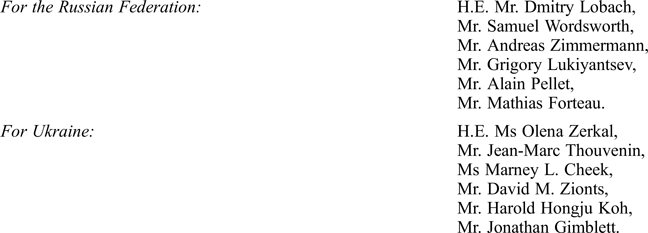
*
18. In the Application, the following claims were made by Ukraine:
With regard to the ICSFT:
“134. Ukraine respectfully requests the Court to adjudge and declare that the Russian Federation, through its State organs, State agents, and other persons and entities exercising governmental authority, and through other agents acting on its instructions or under its direction and control, has violated its obligations under the Terrorism Financing Convention by:
(a) supplying funds, including in-kind contributions of weapons and training, to illegal armed groups that engage in acts of terrorism in Ukraine, including the DPR, the LPR, the Kharkiv Partisans, and associated groups and individuals, in violation of Article 18;
(b) failing to take appropriate measures to detect, freeze, and seize funds used to assist illegal armed groups that engage in acts of terrorism in Ukraine, including the DPR, the LPR, the Kharkiv Partisans, and associated groups and individuals, in violation of Articles 8 and 18;
(c) failing to investigate, prosecute, or extradite perpetrators of the financing of terrorism found within its territory, in violation of Articles 9, 10, 11, and 18;
(d) failing to provide Ukraine with the greatest measure of assistance in connection with criminal investigations of the financing of terrorism, in violation of Articles 12 and 18; and
(e) failing to take all practicable measures to prevent and counter acts of financing of terrorism committed by Russian public and private actors, in violation of Article 18.
135. Ukraine respectfully requests the Court to adjudge and declare that the Russian Federation bears international responsibility, by virtue of its sponsorship of terrorism and failure to prevent the financing of terrorism under the Convention, for the acts of terrorism committed by its proxies in Ukraine, including:
(a) the shoot-down of Malaysia Airlines Flight MH17;
(b) the shelling of civilians, including in Volnovakha, Mariupol, and Kramatorsk; and
(c) the bombing of civilians, including in Kharkiv.
136. Ukraine respectfully requests the Court to order the Russian Federation to comply with its obligations under the Terrorism Financing Convention, including that the Russian Federation:
(a) immediately and unconditionally cease and desist from all support, including the provision of money, weapons, and training, to illegal armed groups that engage in acts of terrorism in Ukraine, including the DPR, the LPR, the Kharkiv Partisans, and associated groups and individuals;
(b) immediately make all efforts to ensure that all weaponry provided to such armed groups is withdrawn from Ukraine;
(c) immediately exercise appropriate control over its border to prevent further acts of financing of terrorism, including the supply of weapons, from the territory of the Russian Federation to the territory of Ukraine;
(d) immediately stop the movement of money, weapons, and all other assets from the territory of the Russian Federation and occupied Crimea to illegal armed groups that engage in acts of terrorism in Ukraine, including the DPR, the LPR, the Kharkiv Partisans, and associated groups and individuals, including by freezing all bank accounts used to support such groups;
(e) immediately prevent all Russian officials from financing terrorism in Ukraine, including Sergei Shoigu, Minister of Defence of the Russian Federation; Vladimir Zhirinovsky, Vice-Chairman of the State Duma; Sergei Mironov, member of the State Duma; and Gennadiy Zyuganov, member of the State Duma, and initiate prosecution against these and other actors responsible for financing terrorism;
(f) immediately provide full co-operation to Ukraine in all pending and future requests for assistance in the investigation and interdiction of the financing of terrorism relating to illegal armed groups that engage in acts of terrorism in Ukraine, including the DPR, the LPR, the Kharkiv Partisans, and associated groups and individuals;
(g) make full reparation for the shoot-down of Malaysia Airlines Flight MH17;
(h) make full reparation for the shelling of civilians in Volnovakha;
(i) make full reparation for the shelling of civilians in Mariupol;
(j) make full reparation for the shelling of civilians in Kramatorsk;
(k) make full reparation for the bombing of civilians in Kharkiv; and
(l) make full reparation for all other acts of terrorism the Russian Federation has caused, facilitated, or supported through its financing of terrorism, and failure to prevent and investigate the financing of terrorism.”
With regard to CERD:
“137. Ukraine respectfully requests the Court to adjudge and declare that the Russian Federation, through its State organs, State agents, and other persons and entities exercising governmental authority, including the de factoauthorities administering the illegal Russian occupation of Crimea, and through other agents acting on its instructions or under its direction and control, has violated its obligations under the CERD by:
(a) systematically discriminating against and mistreating the Crimean Tatar and ethnic Ukrainian communities in Crimea, in furtherance of a State policy of cultural erasure of disfavoured groups perceived to be opponents of the occupation régime;
(b) holding an illegal referendum in an atmosphere of violence and intimidation against non-Russian ethnic groups, without any effort to seek a consensual and inclusive solution protecting those groups, and as an initial step toward depriving these communities of the protection of Ukrainian law and subjecting them to a régime of Russian dominance;
(c) suppressing the political and cultural expression of Crimean Tatar identity, including through the persecution of Crimean Tatar leaders and the ban on the Mejlis of the Crimean Tatar People;
(d) preventing Crimean Tatars from gathering to celebrate and commemorate important cultural events;
(e) perpetrating and tolerating a campaign of disappearances and murders of Crimean Tatars;
(f) harassing the Crimean Tatar community with an arbitrary régime of searches and detention;
(g) silencing Crimean Tatar media;
(h) suppressing Crimean Tatar language education and the community's educational institutions;
(i) suppressing Ukrainian language education relied on by ethnic Ukrainians;
(j) preventing ethnic Ukrainians from gathering to celebrate and commemorate important cultural events; and
(k) silencing ethnic Ukrainian media.
138. Ukraine respectfully requests the Court to order the Russian Federation to comply with its obligations under the CERD, including:
(a) immediately cease and desist from the policy of cultural erasure and take all necessary and appropriate measures to guarantee the full and equal protection of the law to all groups in Russian-occupied Crimea, including Crimean Tatars and ethnic Ukrainians;
(b) immediately restore the rights of the Mejlis of the Crimean Tatar People and of Crimean Tatar leaders in Russian-occupied Crimea;
(c) immediately restore the rights of the Crimean Tatar People in Russian-occupied Crimea to engage in cultural gatherings, including the annual commemoration of the Sürgün;
(d) immediately take all necessary and appropriate measures to end the disappearance and murder of Crimean Tatars in Russian-occupied Crimea, and to fully and adequately investigate the disappearances of Reshat Ametov, Timur Shaimardanov, Ervin Ibragimov, and all other victims;
(e) immediately take all necessary and appropriate measures to end unjustified and disproportionate searches and detentions of Crimean Tatars in Russian-occupied Crimea;
(f) immediately restore licenses and take all other necessary and appropriate measures to permit Crimean Tatar media outlets to resume operations in Russian-occupied Crimea;
(g) immediately cease interference with Crimean Tatar education and take all necessary and appropriate measures to restore education in the Crimean Tatar language in Russian-occupied Crimea;
(h) immediately cease interference with ethnic Ukrainian education and take all necessary and appropriate measures to restore education in the Ukrainian language in Russian-occupied Crimea;
(i) immediately restore the rights of ethnic Ukrainians to engage in cultural gatherings in Russian-occupied Crimea;
(j) immediately take all necessary and appropriate measures to permit the free operation of ethnic Ukrainian media in Russian-occupied Crimea; and
(k) make full reparation for all victims of the Russian Federation's policy and pattern of cultural erasure through discrimination in Russian-occupied Crimea.”
19. In the written proceedings on the merits, the following submissions were presented on behalf of the Government of Ukraine in its Memorial:
“653. For the reasons set out in this Memorial, Ukraine respectfully requests the Court to adjudge and declare that:
ICSFT
(a) The Russian Federation is responsible for violations of Article 18 of the ICSFT by failing to cooperate in the prevention of the terrorism financing offenses set forth in Article 2 by taking all practicable measures to prevent and counter preparations in its territory for the commission of those offenses within or outside its territory. Specifically, the Russian Federation has violated Article 18 by failing to take the practicable measures of: (i) preventing Russian state officials and agents from financing terrorism in Ukraine; (ii) discouraging public and private actors and other non-governmental third parties from financing terrorism in Ukraine; (iii) policing its border with Ukraine to stop the financing of terrorism; and (iv) monitoring and suspending banking activity and other fundraising activities undertaken by private and public actors on its territory to finance of terrorism in Ukraine.
(b) The Russian Federation is responsible for violations of Article 8 of the ICSFT by failing to identify and detect funds used or allocated for the purposes of financing terrorism in Ukraine, and by failing to freeze or seize funds used or allocated for the purpose of financing terrorism in Ukraine.
(c) The Russian Federation has violated Articles 9 and 10 of the ICSFT by failing to investigate the facts concerning persons who have committed or are alleged to have committed terrorism financing in Ukraine, and to extradite or prosecute alleged offenders.
(d) The Russian Federation has violated Article 12 of the ICSFT by failing to provide Ukraine the greatest measure of assistance in connection with criminal investigations in respect of terrorism financing offenses.
(e) As a consequence of the Russian Federation's violations of the ICSFT, its proxies in Ukraine have been provided with funds that enabled them to commit numerous acts of terrorism, including the downing of Flight MH17, the shelling of Volnovakha, Mariupol, Kramatorsk, and Avdiivka, the bombings of the Kharkiv unity march and Stena Rock Club, the attempted assassination of a Ukrainian member of Parliament, and others.
CERD
(f) The Russian Federation has violated CERD Article 2 by engaging in numerous and pervasive acts of racial discrimination against the Crimean Tatar and Ukrainian communities in Crimea and by engaging in a policy and practice of racial discrimination against those communities.
(g) The Russian Federation has further violated CERD Article 2 by sponsoring, defending or supporting racial discrimination by other persons or organizations against the Crimean Tatar and Ukrainian communities in Crimea.
(h) The Russian Federation has violated CERD Article 4 by promoting and inciting racial discrimination against the Crimean Tatar and Ukrainian communities in Crimea.
(i) The Russian Federation has violated CERD Article 5 by failing to guarantee the right of members of the Crimean Tatar and Ukrainian communities to equality before the law, notably in their enjoyment of (i) the right to equal treatment before the tribunals and all other organs administering justice; (ii) the right to security of person and protection by the State against violence or bodily harm, whether inflicted by government officials or by any individual group or institution; (iii) political rights; (iv) other civil rights; and (v) economic, social and cultural rights.
(j) The Russian Federation has violated CERD Article 6 by failing to assure the Crimean Tatar and Ukrainian communities in Crimea effective protection and remedies against acts of racial discrimination.
(k) The Russian Federation has violated CERD Article 7 by failing to adopt immediate and effective measures in the fields of teaching, education, culture and information, with a view to combating prejudices which lead to racial discrimination against the Crimean Tatar and Ukrainian communities in Crimea.
654. The aforementioned acts constitute violations of the ICSFT and CERD, and are therefore internationally wrongful acts for which the Russian Federation bears international responsibility. The Russian Federation is therefore required to:
ICSFT
(a) Cease immediately each of the above violations of ICSFT Articles 8, 9, 10, 12, and 18 and provide Ukraine with appropriate guarantees and public assurances that it will refrain from such actions in the future.
(b) Take all practicable measures to prevent the commission of terrorism financing offences, including (i) ensuring that Russian state officials or any other person under its jurisdiction do not provide weapons or other funds to groups engaged in terrorism in Ukraine, including without limitation the DPR, LPR, Kharkiv Partisans, and other illegal armed groups; (ii) cease encouraging public and private actors and other non-governmental third parties to finance terrorism in Ukraine; (iii) police Russia's border with Ukraine to stop any supply of weapons into Ukraine; and (iv) monitor and prohibit private and public transactions originating in Russian territory, or initiated by Russian nationals, that finance terrorism in Ukraine, including by enforcing banking restrictions to block transactions for the benefit of groups engaged in terrorism in Ukraine, including without limitation the DPR, LPR, the Kharkiv Partisans, and other illegal armed groups.
(c) Freeze or seize assets of persons suspected of supplying funds to groups engaged in terrorism in Ukraine, including without limitation illegal armed groups associated with the DPR, LPR, and Kharkiv Partisans, and cause the forfeiture of assets of persons found to have supplied funds to such groups.
(d) Provide the greatest measure of assistance to Ukraine in connection with criminal investigations of suspected financers of terrorism.
(e) Pay Ukraine financial compensation, in its own right and as parens patriae for its citizens, for the harm Ukraine has suffered as a result of Russia's violations of the ICSFT, including the harm suffered by its nationals injured by acts of terrorism that occurred as a consequence of the Russian Federation's ICSFT violations, with such compensation to be quantified in a separate phase of these proceedings.
(f) Pay moral damages to Ukraine in an amount deemed appropriate by the Court, reflecting the seriousness of the Russian Federation's violations of the ICSFT, the quantum of which is to be determined in a separate phase of these proceedings.
CERD
(g) Immediately comply with the provisional measures ordered by the Court on 19 April 2017, in particular by lifting its ban on the activities of the Mejlis of the Crimean Tatar People and by ensuring the availability of education in the Ukrainian language.
(h) Cease immediately each of the above violations of CERD Articles 2, 4, 5, 6, and 7, and provide Ukraine with appropriate guarantees and public assurances that it will refrain from such actions in the future.
(i) Guarantee the right of members of the Crimean Tatar and Ukrainian communities to equality before the law, notably in the enjoyment of the human rights and fundamental freedoms protected by the Convention.
(j) Assure to all residents of Crimea within its jurisdiction effective protection and remedies against acts of racial discrimination.
(k) Adopt immediate and effective measures in the fields of teaching, education, culture and information, with a view to combating prejudices which lead to racial discrimination against the Crimean Tatar and Ukrainian communities in Crimea.
(l) Pay Ukraine financial compensation, in its own right and as parens patriae for its citizens, for the harm Ukraine has suffered as a result of Russia's violations of the CERD, including the harm suffered by victims as a result of the Russian Federation's violations of CERD Articles 2, 4, 5, 6 and 7, with such compensation to be quantified in a separate phase of these proceedings.”
20. In the Preliminary Objections, the following submissions were presented on behalf of the Government of the Russian Federation:
“In view of the foregoing, the Russian Federation requests the Court to adjudge and declare that it lacks jurisdiction over the claims brought against the Russian Federation by Ukraine by its Application of 16 January 2017 and/or that Ukraine's claims are inadmissible.”
21. In the Written Statement of its Observations and Submissions on the Preliminary Objections, the following submissions were presented on behalf of the Government of Ukraine:
“For the reasons set out in this Written Statement, Ukraine respectfully requests that the Court:
(a) Dismiss the Preliminary Objections submitted by the Russian Federation in its submission dated 12 September 2018;
(b) Adjudge and declare that it has jurisdiction to hear the claims in the Application submitted by Ukraine, dated 16 January 2017 and that such claims are admissible; and
(c) Proceed to hear those claims on the merits.”
22. At the oral proceedings on the preliminary objections, the following submissions were presented by the Parties:
On behalf of the Government of the Russian Federation,
at the hearing of 6 June 2019:
“Having regard to the arguments set out in the Preliminary Objections of the Russian Federation and during the oral proceedings, the Russian Federation requests the Court to adjudge and declare that it lacks jurisdiction over the claims brought against the Russian Federation by Ukraine by its Application of 16 January 2017 and/or that Ukraine's claims are inadmissible.”
On behalf of the Government of Ukraine,
at the hearing of 7 June 2019:
“Ukraine respectfully requests that the Court:
(a) Dismiss the Preliminary Objections submitted by the Russian Federation in its submission dated 12 September 2018;
(b) Adjudge and declare that it has jurisdiction to hear the claims in the Application submitted by Ukraine, dated 16 January 2017, that such claims are admissible, and proceed to hear those claims on the merits; or
(c) In the alternative, to adjudge and declare, in accordance with the provisions of Article 79, paragraph 9, of the Rules of Court that the objections submitted by the Russian Federation do not have an exclusively preliminary character.”
*
* *
I. Introduction
A. Subject-matter of the dispute
23. The present proceedings were instituted by Ukraine following the events which occurred in eastern Ukraine and in Crimea from the spring of 2014, on which the Parties have different views. However, the case before the Court is limited in scope. With regard to the events in eastern Ukraine, the Applicant has brought proceedings only under the ICSFT. With regard to the situation in Crimea, Ukraine's claims are based solely upon CERD.
24. Article 40, paragraph 1, of the Statute and Article 38, paragraph 1, of the Rules of Court require an applicant to indicate the “subject of the dispute” in its application. Furthermore, the Rules require that the application “specify the precise nature of the claim, together with a succinct statement of the facts and grounds on which the claim is based” (Article 38, paragraph 2, of the Rules) and that the memorial include a statement of the “relevant facts” (Article 49, paragraph 1, of the Rules). However, it is for the Court itself to determine on an objective basis the subject-matter of the dispute between the parties, by isolating the real issue in the case and identifying the object of the claim. In doing so, the Court examines the application as well as the written and oral pleadings of the parties, while giving particular attention to the formulation of the dispute chosen by the applicant. It takes account of the facts that the applicant presents as the basis for its claim. The matter is one of substance, not of form (Immunities and Criminal Proceedings (Equatorial Guinea v. France), Preliminary Objections, Judgment, I.C.J. Reports 2018 (I), pp. 308–309, para. 48).
25. The Court observes that the Parties have expressed divergent views as to the subject-matter of the dispute brought by Ukraine before it.
* *
26. According to the Applicant, its claims under the ICSFT concern the alleged violations by the Russian Federation of its obligations to take measures and to co-operate under Articles 8, 9, 10, 12 and 18 of the ICSFT in the prevention and suppression of terrorism financing offences, as defined in Article 2 of the Convention. In this regard, Ukraine contends that the Russian Federation has failed to take all practicable measures to prevent and counter preparations in its territory for the commission of terrorism financing offences in the context of the events which occurred in eastern Ukraine starting from the spring of 2014 and to repress them. In its Application, Ukraine also claimed that the Respondent supplied funds to groups that engage in acts of terrorism, but has not put forward the same claim either in its Memorial or in the proceedings on preliminary objections. The Applicant indeed stated that “[its] claim is not that Russia has violated Article 2 of the ICSFT”, but rather “that Russia has violated ICSFT Article 18 and other related cooperation obligations”.
The Applicant submits that its claims on the basis of CERD concern alleged violations by the Russian Federation of its obligations under Articles 2, 4, 5, 6 and 7 of CERD. In this regard, Ukraine maintains that the Russian Federation engaged in a campaign directed at depriving the Crimean Tatars and ethnic Ukrainians in Crimea of their political, civil, economic, social and cultural rights and pursued a policy and practice of racial discrimination against those communities.
27. For its part, the Russian Federation considers that the dispute submitted by Ukraine to the Court in fact concerns matters which are unconnected to the two conventions relied on by the Applicant. It asserts that the Parties' rights and obligations under the ICSFT cannot be invoked by Ukraine, since the acts referred to by the Applicant do not constitute offences within the meaning of Article 2 of the Convention. The Russian Federation further asserts that the facts relied on and evidence submitted by the Applicant do not substantiate its claim that funds were provided or collected by various actors in the Russian Federation with the intention or knowledge that they were to be used to carry out acts of terrorism in eastern Ukraine. The Respondent also contends that the dispute does not concern its obligations under CERD and contests allegations that it is subjecting Crimean Tatar and Ukrainian communities in Crimea to a systematic campaign of racial discrimination. The Russian Federation argues that, under cover of allegations relating to violations of the ICSFT and CERD, Ukraine is seeking to bring before the Court disputes concerning alleged violations of “different rules of international law”. In particular, the Respondent contends that Ukraine is seeking to seise the Court of disputes over the Russian Federation's alleged “overt aggression” in eastern Ukraine and over the status of Crimea.
* *
28. As the Court has observed, applications that are submitted to it often present a particular dispute that arises in the context of a broader disagreement between the parties (Certain Iranian Assets (Islamic Republic of Iran v. United States of America), Preliminary Objections, Judgment of 13 February 2019, para. 36; Obligation to Negotiate Access to the Pacific Ocean (Bolivia v. Chile), Preliminary Objection, Judgment, I.C.J. Reports 2015 (II), p. 604, para. 32). The fact that a dispute before the Court forms part of a complex situation that includes various matters, however important, over which the States concerned hold opposite views, cannot lead the Court to decline to resolve that dispute, provided that the parties have recognized its jurisdiction to do so and the conditions for the exercise of its jurisdiction are otherwise met.
29. In the present case, the Court notes that Ukraine is not requesting that it rule on issues concerning the Russian Federation's purported “aggression” or its alleged “unlawful occupation” of Ukrainian territory. Nor is the Applicant seeking a pronouncement from the Court on the status of Crimea or on any violations of rules of international law other than those contained in the ICSFT and CERD. These matters therefore do not constitute the subject-matter of the dispute before the Court.
30. The Court observes that Ukraine requests the Court to adjudge and declare that the Russian Federation has violated a number of provisions of the ICSFT and CERD, that it bears international responsibility for those violations, and that it is required to cease such violations and make reparation for the consequences thereof.
31. The Court considers that it follows from the opposing views expressed by the Parties in the present case that the dispute consists of two aspects. First, the Parties differ as to whether any rights and obligations of the Parties under the ICSFT with regard to the prevention and suppression of the financing of terrorism were engaged in the context of events which occurred in eastern Ukraine starting in the spring of 2014, and whether terrorism financing offences, within the meaning of Article 2, paragraph 1, of the ICSFT, were committed. As a result of these differences of views, the Parties draw opposite conclusions as to the alleged breaches by the Russian Federation of its obligations under Articles 8, 9, 10, 12 and 18 of the ICSFT and as to its ensuing international responsibility. Secondly, the Parties disagree as to whether the decisions or measures allegedly taken by the Russian Federation against the Crimean Tatar and Ukrainian communities in Crimea constitute acts of racial discrimination and whether the Russian Federation bears responsibility in that regard for the violation of its obligations under Articles 2, 4, 5, 6 and 7 of CERD.
32. In view of the foregoing, the Court concludes that the subject-matter of the dispute, in so far as its first aspect is concerned, is whether the Russian Federation had the obligation, under the ICSFT, to take measures and to co-operate in the prevention and suppression of the alleged financing of terrorism in the context of events in eastern Ukraine and, if so, whether the Russian Federation breached such an obligation. The subject-matter of the dispute, in so far as its second aspect is concerned, is whether the Russian Federation breached its obligations under CERD through discriminatory measures allegedly taken against the Crimean Tatar and Ukrainian communities in Crimea.
B. Bases of jurisdiction invoked by Ukraine
33. The Court recalls that its jurisdiction is based on the consent of the parties and is confined to the extent accepted by them (Immunities and Criminal Proceedings (Equatorial Guinea v. France), Preliminary Objections, Judgment, I.C.J. Reports 2018 (I), p. 307, para. 42).
34. To establish the Court's jurisdiction in the present case, Ukraine invokes Article 24, paragraph 1, of the ICSFT and Article 22 of CERD (see paragraph 2 above). The first of these provisions reads as follows:
“Any dispute between two or more States Parties concerning the interpretation or application of this Convention which cannot be settled through negotiation within a reasonable time shall, at the request of one of them, be submitted to arbitration. If, within six months from the date of the request for arbitration, the parties are unable to agree on the organization of the arbitration, any one of those parties may refer the dispute to the International Court of Justice, by application, in conformity with the Statute of the Court.”
Article 22 of CERD provides that:
“Any dispute between two or more States Parties with respect to the interpretation or application of this Convention, which is not settled by negotiation or by the procedures expressly provided for in this Convention, shall, at the request of any of the parties to the dispute, be referred to the International Court of Justice for decision, unless the disputants agree to another mode of settlement.”
35. Ukraine and the Russian Federation are parties to the ICSFT, which entered into force for them on 5 January 2003 and 27 December 2002 respectively. Neither of them entered any reservations to the ICSFT.
Ukraine and the Russian Federation are also parties to CERD. The Convention entered into force for Ukraine on 6 April 1969. The instrument of ratification, deposited by Ukraine, on 7 March 1969, contained a reservation to Article 22 of the Convention; on 20 April 1989, the depositary received notification that this reservation had been withdrawn. The Russian Federation is a party to the Convention as the State continuing the international legal personality of the Union of Soviet Socialist Republics, for which CERD entered into force on 6 March 1969. The instrument of ratification, deposited by the Union of Soviet Socialist Republics on 4 February 1969, contained a reservation to Article 22 of the Convention; on 8 March 1989, the depositary received notification that this reservation had been withdrawn.
36. The Russian Federation contests the Court's jurisdiction to entertain the dispute on the basis of each of the two instruments invoked by Ukraine. In this regard, it argues that the dispute is not one which the Court has jurisdiction ratione materiae to entertain, either under Article 24, paragraph 1, of the ICSFT or under Article 22 of CERD, and that the procedural preconditions set out in these provisions were not met by Ukraine before it seised the Court. The Respondent further contends that Ukraine's claims under CERD are inadmissible, since, in its view, available local remedies had not been exhausted before Ukraine filed its Application with the Court.
37. The Court will address the preliminary objection raised by the Russian Federation to its jurisdiction on the basis of the ICSFT in Part II of the Judgment. It will then address, in Part III, the preliminary objections to its jurisdiction on the basis of CERD and to the admissibility of the Application in so far as it concerns the claims made by Ukraine under CERD.
II. The International Convention for the Suppression of the Financing of Terrorism
38. The Court will now consider whether it has jurisdiction ratione materiae under Article 24, paragraph 1, of the ICSFT and whether the procedural preconditions set forth in that provision have been met.
A. Jurisdiction ratione materiae under the ICSFT
39. The Court recalls that its jurisdiction ratione materiae over the dispute under Article 24, paragraph 1, of the ICSFT covers “[a]ny dispute between two or more States Parties concerning the interpretation or application of this Convention”.
* *
40. The Russian Federation contests the Court's jurisdiction ratione materiae with regard to all aspects of the dispute submitted by Ukraine to the Court under the ICSFT. In the Russian Federation's opinion, the fact that the Parties entertain different views on the interpretation of a treaty containing a compromissory clause is not sufficient to establish the Court's jurisdiction ratione materiae. According to the Respondent, the Court must interpret the key provisions of the relevant treaty and “[s]atisfy itself that the facts pleaded and the evidence relied on by the applicant State plausibly support the asserted characterisation of its claims” as claims under that treaty. The Russian Federation does not request from the Court a complete analysis of the facts at the stage of a decision on preliminary objections, but contends that some consideration must be given to the facts.
41. The Russian Federation recalls that, in its Order of 19 April 2017 on the Request for the indication of provisional measures in the present case, the Court affirmed that Ukraine's claimed rights under the ICSFT were not plausible (I.C.J. Reports 2017, pp. 131–132, para. 75). In considering the plausibility of Ukraine's case at the present stage, the Russian Federation maintains that the Court must rely on its earlier assessment. According to the Respondent, Ukraine has not put forward any new evidence related to elements of intention, knowledge and purpose concerning the funding of acts of terrorism which would allow the Court to depart from the findings made at the stage of its decision on provisional measures.
42. More specifically, the Respondent maintains that no material evidence has been presented by Ukraine demonstrating that the Russian Federation provided weaponry to any entity “with the requisite specific intent or knowledge” under Article 2, paragraph 1, of the ICSFT that such weaponry would be used to shoot down flight MH17. With regard to four specific incidents of alleged indiscriminate shelling, the Russian Federation submits that no new evidence has been presented by Ukraine since the stage of provisional measures. In the Respondent's view, Ukraine fails to present any credible evidence that the perpetrators of the shelling acted with “the requisite specific intent to kill or seriously harm civilians” and that the locations were shelled “for the requisite specific purpose of intimidating the population or to compel a government to do or to abstain from doing any act”. Moreover, even if a plausible case of terrorism could be demonstrated with regard to those incidents, the Russian Federation argues that Ukraine would also be implicated in the commission of indiscriminate shelling during the same conflict. Concerning the further allegation of bombing that took place in Kharkiv, the Respondent maintains that no reliable evidence was submitted to show that the incident was perpetrated with the Russian Federation's support. The Russian Federation also maintains that, in diplomatic correspondence, it confirmed its interest in receiving from Ukraine “the concrete materials containing evidential data” relating to that incident, which Ukraine failed to provide. Furthermore, with regard to other alleged acts of extrajudicial killing, torture and ill-treatment of civilians, the Respondent contends that the evidence does not demonstrate that they were “plausible ‘terrorist’ acts within the meaning of Article 2 (1) (b) of the ICSFT”. According to the Russian Federation, such acts have in any case been committed by all parties to the armed conflict.
43. The Russian Federation is of the view that the ICSFT is a “law enforcement instrument” which does not cover issues of State responsibility for financing acts of terrorism. It bases its interpretation on a textual analysis of the Convention, as well as on considerations pertaining to the structure of the ICSFT, the preparatory work related to the drafting of specific articles, provisions of other conventions concerned with terrorism and subsequent State practice. The Russian Federation asserts that multiple attempts were made by delegations during the drafting of the ICSFT to bring public officials and State financing within the scope of the Convention, but all attempts failed.
44. The Russian Federation maintains that the Court must at this stage fully interpret the relevant provisions of the ICSFT, especially Article 2, paragraph 1. The Russian Federation submits that the term “any person” in Article 2, paragraph 1, has to be interpreted as meaning “private persons only” and does not cover State officials. It points out that Ukraine is asking the Court to find that the Russian Federation has not prevented its own officials from financing terrorism. In the Respondent's view, while State responsibility is excluded from the scope of the ICSFT, a finding that State officials are also covered would mean declaring that the Russian Federation is directly responsible for financing terrorism in accordance with Article 4 of the Articles on Responsibility of States for Internationally Wrongful Acts adopted by the International Law Commission.
45. The Russian Federation further argues that, in order to determine the scope of the ICSFT, the mental elements of the offence of terrorism financing must be defined. The terms “intention” and “knowledge” in Article 2, paragraph 1, of the ICSFT must therefore be interpreted. The Russian Federation maintains that these two terms are not synonymous. It is of the view that “intention” must be understood as “a specific intent requirement”. Following the interpretation given by the Respondent, “knowledge” refers to actual knowledge that the funds will be used to commit acts of terrorism, and not merely that they may be used to do so. According to the Russian Federation, recklessness is insufficient to establish knowledge. The Russian Federation accepts that the requirement of knowledge can be satisfied by the financing of groups that are notorious terrorist organizations. However, the Respondent argues that it is not sufficient for Ukraine to so characterize any entity unilaterally, particularly in the absence of any indication to that effect by an international organization.
46. The Russian Federation notes that an act constitutes an offence within the meaning of Article 2, paragraph 1 (a), of the ICSFT when it is “an offence within the scope of and as defined in one of the treaties listed in the annex” to the Convention. In this regard, the Respondent submits that in order to constitute an offence defined in Article 1, paragraph 1 (b), of the Convention for the Suppression of Unlawful Acts against the Safety of Civil Aviation, done in Montreal on 23 September 1971 (hereinafter the “Montreal Convention”), relied on by Ukraine with regard to the downing of flight MH17, there must be an intent to destroy or cause damage to a civilian aircraft in service. The Russian Federation also provides an interpretation of Article 2, paragraph 1 (b), of the ICSFT, under which acts of terrorism need to be performed with a specific intention and with the purpose of intimidating a population or compelling a government. According to the Respondent, intention under the same subparagraph refers to a “subjective aim, desire or plan” and “implicitly exclud[es] knowledge-based standards”.
*
47. Ukraine contends that the Russian Federation's preliminary objections “improperly ask the Court to address the merits of the Parties' dispute”. In the Applicant's view, the Court should not provide a definitive interpretation of Article 2 of the ICSFT at the present stage of the proceedings, nor should it determine the plausibility of the alleged facts before it, but must only decide whether the dispute is one that concerns the interpretation or application of the ICSFT. Ukraine considers that the Russian Federation's contention that the Court should examine the plausibility of the case is based “on a flawed analogy between preliminary objections and provisional measures”. It argues that the Court, in determining whether it has jurisdiction, must provisionally assume that the facts alleged by Ukraine are true; it must therefore accept them pro tempore.
48. Despite its view that facts should not be assessed in terms of plausibility at the present stage of the proceedings, Ukraine contends that it has “more than plausibly” demonstrated that acts of terrorism within the meaning of the ICSFT have been committed by the Russian Federation's “proxies” on Ukrainian territory. The Applicant argues that its Memorial contains an “extraordinary level of evidence”.
49. Ukraine maintains that a number of events documented by the evidence presented by it establish offences covered by Article 2, paragraph 1, of the ICSFT. It asserts that Russian officials supplied the missile launching system that was used to shoot down flight MH17. Ukraine argues that this launching system was “knowingly provided” to a terrorist organization, and that the requirement of knowledge under Article 2, paragraph 1, was amply met. Ukraine contends that the shooting down of the aircraft constituted a violation of the Montreal Convention and that the supply of the launching system was an offence under Article 2, paragraph 1 (a), of the ICSFT. Moreover, Ukraine argues that its Memorial shows that bombing attacks by the Russian Federation's “proxies” constituted offences under the International Convention for the Suppression of Terrorist Bombings and that the alleged knowledge of financing the attacks, including through the supply of bombs, was covered by Article 2, paragraph 1 (a), of the ICSFT.
50. With regard to other incidents, Ukraine argues that the evidence presented demonstrates that certain events of indiscriminate shelling such as those that occurred in Volnovakha and Mariupol constituted acts of terrorism under Article 2, paragraph 1 (b), of the ICSFT because these acts were performed by the Russian Federation's “proxies” with the intent to kill civilians and for the purpose of intimidating a population or compelling a government. Concerning further allegations of acts of torture and killings, Ukraine submits that those acts were performed with the objective of terrorizing a civilian population.
51. Ukraine contends that the Russian Federation's arguments with regard to the interpretation of the different elements of Article 2 of the ICSFT belong to the merits, and that they do not have an impact on the Court's jurisdiction. The Applicant argues that, if the Court were now to proceed to such interpretation, it would “prematurely determine some elements of this dispute on the merits”. Ukraine submits that such issues of interpretation are “inseparable from the factual questions” and in any event do not possess an exclusively preliminary character.
52. If however the Court were to find it necessary to give an interpretation of Article 2 of the ICSFT at the present stage of the proceedings, Ukraine argues that the Russian Federation's restrictive reading should be dismissed. The Applicant submits that Article 2, paragraph 1 (a) and (b), of the ICSFT gives a broad and comprehensive definition of acts of terrorism. It also maintains that the notion of “‘funds’ under Article 1 of the ICSFT is a broad term covering all property, including weapons”.
53. In Ukraine's view, the term “any person” in Article 2, paragraph 1, includes both private individuals and public or government officials. Relying on a textual interpretation of the treaty provisions, read in their context, Ukraine contends that Article 18 imposes on States an obligation to prevent terrorism financing offences and that, according to Article 2, such offences may be committed by “‘any person’, without qualification”. It maintains that concluding otherwise would be “paradoxical” as the ICSFT would bind a State to prevent the financing of acts of terrorism, but would not prohibit financing by officials of the same State. Ukraine also argues that the Russian Federation's interpretation undermines the object and purpose of the ICSFT and that its own interpretation is, on the contrary, supported by the preamble, the context and the preparatory work of the Convention. The Applicant argues that the Russian Federation is conflating the States' duty under Article 18 of the ICSFT to prevent terrorism financing with the notion of State responsibility for committing terrorism financing.
54. Ukraine is of the view that providing funds to groups with the knowledge that such groups carry out acts of terrorism is sufficient to fulfil the requirement of knowledge under Article 2, paragraph 1, of the ICSFT, and that certainty that the funds will be used to commit specific acts is not required. Ukraine contends that the groups in question do not need to be designated as terrorist by, for instance, the Security Council, a competent organization or a considerable number of States, for a financing entity to have knowledge of the terrorist groups' activities.
55. Ukraine also addresses the terrorism offences referred to in Article 2, paragraph 1, of the ICSFT. As to the offence defined in Article 1, paragraph 1 (b), of the Montreal Convention, it holds that “the civilian or military status of the aircraft is a jurisdictional element of the offence, not subject to an intent requirement”. The Applicant also maintains that the phrase “act intended to cause death or serious bodily injury” in Article 2, paragraph 1 (b), of the ICSFT, does not refer to a specific mental element; it is “an objective statement, referring to the ordinary consequences of an act”. It points out that this provision further refers to the purpose of an act of terrorism to intimidate a population or compel a government. Ukraine states that in many cases the specific agenda of the perpetrators of acts of terrorism will be unknown, but that in such cases the requisite purpose can be inferred, as the provision suggests, from the “nature or context” of the act.
* *
56. The Court will now determine whether the dispute between the Parties is one that concerns the interpretation or the application of the ICSFT and, therefore, whether it has jurisdiction ratione materiae under Article 24, paragraph 1, of this Convention.
57. As the Court stated in the case concerning Oil Platforms (Islamic Republic of Iran v. United States of America) (Preliminary Objection, Judgment, I.C.J. Reports 1996 (II), pp. 809–810, para. 16) and, more recently, in the case concerning Certain Iranian Assets (Islamic Republic of Iran v. United States of America) (Preliminary Objections, Judgment of 13 February 2019, para. 36), in order to determine the Court's jurisdiction ratione materiae under a compromissory clause concerning disputes relating to the interpretation or application of a treaty, it is necessary to ascertain whether the acts of which the applicant complains “fall within the provisions” of the treaty containing the clause. This may require the interpretation of the provisions that define the scope of the treaty. In the present case, the ICSFT has to be interpreted according to the rules contained in Articles 31 to 33 of the Vienna Convention on the Law of Treaties of 23 May 1969 (hereinafter the “Vienna Convention”), to which both Ukraine and the Russian Federation are parties as of 1986.
58. At the present stage of the proceedings, an examination by the Court of the alleged wrongful acts or of the plausibility of the claims is not generally warranted. The Court's task, as reflected in Article 79 of the Rules of Court of 14 April 1978 as amended on 1 February 2001, is to consider the questions of law and fact that are relevant to the objection to its jurisdiction.
59. The ICSFT imposes obligations on States parties with respect to offences committed by a person when “that person by any means, directly or indirectly, unlawfully and wilfully, provides or collects funds with the intention that they should be used or in the knowledge that they are to be used, in full or in part, in order to carry out” acts of terrorism as described in Article 2, paragraph 1 (a) and (b). As stated in the preamble, the purpose of the Convention is to adopt “effective measures for the prevention of the financing of terrorism, as well as for its suppression through the prosecution and punishment of its perpetrators”. The ICSFT addresses offences committed by individuals. In particular, Article 4 requires each State party to the Convention to establish the offences set forth in Article 2 as criminal offences under its domestic law and to make those offences punishable by appropriate penalties. The financing by a State of acts of terrorism is not addressed by the ICSFT. It lies outside the scope of the Convention. This is confirmed by the preparatory work of the Convention, which indicates that proposals to include financing by States of acts of terrorism were put forward but were not adopted (United Nations, docs. A/C.6/54/SR.32–35 and 37). As was recalled in the report of the Ad Hoc Committee established by the General Assembly which contributed to the drafting of the ICSFT, some delegations even proposed to exclude all matters of State responsibility from the scope of the Convention (United Nations, doc. A/54/37). However, it has never been contested that if a State commits a breach of its obligations under the ICSFT, its responsibility would be engaged.
60. The conclusion that the financing by a State of acts of terrorism lies outside the scope of the ICSFT does not mean that it is lawful under international law. The Court recalls that, in resolution 1373 (2001), the United Nations Security Council, acting under Chapter VII of the Charter, decided that all States shall “[r]efrain from providing any form of support, active or passive, to entities or persons involved in terrorist acts”.
61. When defining the perpetrators of offences of financing acts of terrorism, Article 2 of the ICSFT refers to “any person”. According to its ordinary meaning, this term covers individuals comprehensively. The Convention contains no exclusion of any category of persons. It applies both to persons who are acting in a private capacity and to those who are State agents. As the Court noted (see paragraph 59 above), State financing of acts of terrorism is outside the scope of the ICSFT; therefore, the commission by a State official of an offence described in Article 2 does not in itself engage the responsibility of the State concerned under the Convention. However, all States parties to the ICSFT are under an obligation to take appropriate measures and to co-operate in the prevention and suppression of offences of financing acts of terrorism committed by whichever person. Should a State breach such an obligation, its responsibility under the Convention would arise.
62. As the title of the ICSFT indicates, the Convention specifically concerns the support given to acts of terrorism by financing them. Article 2, paragraph 1, refers to the provision or collection of “funds”. This term is defined in Article 1, paragraph 1, as meaning:
“assets of every kind, whether tangible or intangible, movable or immovable, however acquired, and legal documents or instruments in any form, including electronic or digital, evidencing title to, or interest in, such assets, including, but not limited to, bank credits, travellers cheques, bank cheques, money orders, shares, securities, bonds, drafts, letters of credit”.
This definition covers many kinds of financial instruments and includes also other assets. Since no specific objection to the Court's jurisdiction was made by the Russian Federation with regard to the scope of the term “funds” and in particular to the reference in Ukraine's submissions to the provision of weapons, this issue relating to the scope of the ICSFT need not be addressed at the present stage of the proceedings. However, the interpretation of the definition of “funds” could be relevant, as appropriate, at the stage of an examination of the merits.
63. An element of an offence under Article 2, paragraph 1, of the ICSFT is that the person concerned has provided funds “with the intention that they should be used or in the knowledge that they are to be used” to commit an act of terrorism. The existence of the requisite intention or knowledge raises complex issues of law and especially of fact that divide the Parties and are properly a matter for the merits. The same may be said of the question whether a specific act falls within the meaning of Article 2, paragraph 1 (a) or (b). This question is largely of a factual nature and is properly a matter for the merits of the case. Within the framework of the ICSFT, questions concerning the existence of the requisite mental elements do not affect the scope of the Convention and therefore are not relevant to the Court's jurisdiction ratione materiae. Should the case proceed to the examination of the merits, those questions will be decided at that stage.
64. In light of the above, the Court concludes that the objection raised by the Russian Federation to its jurisdiction ratione materiae under the ICSFT cannot be upheld.
B. Procedural preconditions under Article 24 of the ICSFT
65. The Court needs now to examine whether the procedural preconditions set forth in Article 24, paragraph 1, of the ICSFT (see paragraph 34 above) have been fulfilled. In this context, the Court will consider whether the dispute between the Parties could not be settled through negotiation within a reasonable time and, if so, whether the Parties were unable to agree on the organization of an arbitration within six months from the date of the request for arbitration.
1. Whether the dispute between the Parties could not be settled through negotiation
66. The Russian Federation notes that, under Article 24, paragraph 1, of the ICSFT, the Parties must pursue negotiations over their dispute and that, in the event of failure, they shall try to agree on a settlement by way of arbitration. It argues that the Court may be seised only if genuine attempts to pursue these procedures have been made and both failed.
67. The Russian Federation is of the view that it is not sufficient for the Parties simply to enter into negotiations; these must be meaningful and pursued “as far as possible”. The Respondent argues that “mere protests and disputations” are not sufficient to fulfil the precondition relating to negotiation. It maintains that Ukraine did not attempt to negotiate in good faith. The Russian Federation considers that Ukraine only engaged in negotiations “with a view to bring this dispute before this Court” and not with the objective of settling the matters in contention between the Parties. It states that during the negotiations Ukraine did not take into account the Russian Federation's interests. According to the Respondent, Ukraine also did not contemplate any modification to its position and refused to substantiate some of its allegations, notwithstanding requests to do so made by the Russian Federation. The Respondent points out that negotiations took place in Minsk at its suggestion and that it showed its willingness “to contemplate modifications of its own position”. Furthermore, the Russian Federation contends that, in its Notes Verbales, the Applicant mainly did not address the ICSFT, but rather raised allegations of acts of aggression and of intervention in the internal affairs of Ukraine.
*
68. Ukraine points out that the Parties negotiated extensively for two years, even though the dispute ultimately could not be resolved by negotiations. It mentions that it sent more than twenty Notes Verbales to the Russian Federation and that the Parties met in four rounds of in-person negotiations. Ukraine maintains that it has genuinely attempted to negotiate with the Russian Federation and to discuss in good faith all the issues separating them under the ICSFT. Ukraine specifies that the negotiations did not concern acts of aggression and intervention. In the Applicant's opinion, there was no genuine attempt by the Russian Federation to settle the dispute as it did not meaningfully engage with the claims raised by Ukraine and refused to take account of the latter's positions. The Applicant is of the view that, when negotiations have been conducted “as far as possible with a view to settling the dispute” but have failed, become futile or reached a deadlock, the precondition of holding negotiations is fulfilled. Ukraine submits that Article 24, paragraph 1, of the ICSFT only requires negotiations to be conducted for a “reasonable time” and not to the point of futility. Ukraine contends that it would not have been reasonable to require further negotiations between the Parties for an extended period of time.
* *
69. The Court considers that Article 24, paragraph 1, of the ICSFT requires, as a first procedural precondition to the Court's jurisdiction, that a State makes a genuine attempt to settle through negotiation the dispute in question with the other State concerned. According to the same provision, the precondition of negotiation is met when the dispute “cannot be settled through negotiation within a reasonable time”. As was observed in the case concerning the Application of the International Convention on the Elimination of All Forms of Racial Discrimination (Georgia v. Russian Federation), “the subject-matter of the negotiations must relate to the subject-matter of the dispute which, in turn, must concern the substantive obligations contained in the treaty in question” (Preliminary Objections, Judgment, I.C.J. Reports 2011 (I), p. 133, para. 161).
70. The Court recalls that, on 28 July 2014, Ukraine wrote a Note Verbale to the Russian Federation, stating that
“under the provisions of the 1999 International Convention for the Suppression of the Financing of Terrorism, the Russian Party is under an obligation to take such measures, which may be necessary under its domestic law to investigate the facts contained in the information submitted by the Ukrainian Party, as well as to prosecute persons involved in financing of terrorism”,
and proposing “to conduct negotiations on the issue of interpretation and application of the [ICSFT]”. On 15 August 2014, the Russian Federation informed Ukraine of its “readiness to conduct negotiations on the issue of interpretation and application of the [ICSFT]”. While exchanges of Notes and meetings between the Parties did not always focus on the interpretation or application of the ICSFT, negotiations over Ukraine's claims relating to this Convention were a substantial part. In particular, in a Note Verbale of 24 September 2014 Ukraine contended that
“the Russian Side illegally, directly and indirectly, intentionally transfers military equipment, provides the funds for terrorists training on its territory, gives them material support and send[s] them to the territory of Ukraine for participation in the terrorist activities of the DPR and the LPR etc.”.
On 24 November 2014, the Russian Federation contested that the acts alleged by Ukraine could constitute violations of the ICSFT, but accepted that the agenda for bilateral consultations include the “international legal basis for suppression of financing of terrorism as applicable to the Russian-Ukrainian relations”. After that Note, several others followed; moreover, four meetings were held in Minsk, the last one on 17 March 2016. Little progress was made by the Parties during their negotiations. The Court therefore concludes that the dispute could not be settled through negotiation in what has to be regarded as a reasonable time and that the first precondition is accordingly met.
2. Whether the Parties were unable to agree on the organization of an arbitration
71. The Russian Federation contends that Ukraine has also not satisfied the precondition to submit the Parties' dispute to arbitration. It argues that Ukraine did not properly engage in negotiations with a view to organize an arbitration. It points out that Ukraine insisted that an ad hoc chamber of the Court should be constituted as the forum for arbitration, and in the Russian Federation's view, this suggestion was not apposite because referral of the dispute to a chamber of the Court cannot be regarded as a form of submission to arbitration.
72. The Russian Federation also points out that, according to Article 24, paragraph 1, of the ICSFT, a claim may be brought before the Court only if the Parties have been unable to agree on the organization of an arbitration within six months from the date of the request by one of them for arbitration. It considers that it is not sufficient “as a matter of fact” that the six-month period has elapsed without reaching any agreement on the organization of the arbitration. What is required, the Respondent maintains, is a “genuine attempt” to reach an agreement. In the Russian Federation's view, Ukraine — by insisting on some core principles that would govern the arbitration and by not submitting any concrete suggestions for the text of an arbitration agreement while refusing the Russian Federation's proposals — did not genuinely attempt to organize the arbitration pursuant to Article 24 of the ICSFT.
73. The Russian Federation maintains that Article 24, paragraph 1, of the ICSFT requires the Parties to negotiate with a view to “agree on the organization of the arbitration” and that accordingly they must decide on the composition of the tribunal, the law applicable, as well as on administrative matters. The Respondent argues that the Parties were in agreement with regard to most issues concerning the organization of the arbitration. It asserts that negotiations with regard to the arbitration had not reached a deadlock. In the Russian Federation's view, the procedural precondition to submit the Parties' dispute to arbitration set forth in Article 24 of the ICSFT has not been fulfilled.
*
74. Ukraine points out that it submitted to the Russian Federation a Note Verbale dated 19 April 2016 which contained a direct request to have recourse to arbitration with a view to settling their dispute. Contrary to the Russian Federation's argument, Ukraine maintains that its later suggestion to constitute an ad hoc chamber of the Court was only an alternative option on which it did not insist.
75. Ukraine argues that the Parties were unable to agree on the organization of the arbitration within the six-month period referred to in Article 24, paragraph 1, of the ICSFT. It notes that the Russian Federation responded to its request for arbitration more than two months after receiving it and only offered to meet to discuss the organization of the arbitration a further month later. Ukraine maintains moreover that at the first meeting the Russian Federation did not address Ukraine's views on the organization of the arbitration. The Applicant asserts that, when negotiations with respect to the organization of the arbitration were discontinued, the Parties had only agreed to discuss the details of the arbitration further and to consider each other's positions, and had not reached any agreement on the actual organization of the arbitration. Ukraine submits that it genuinely attempted to reach an agreement on the organization of the arbitration within the requisite period.
* *
76. The Court recalls that, nearly two years after the start of negotiations between the Parties over the dispute, Ukraine sent on 19 April 2016 a Note Verbale in which it stated that those negotiations had “failed” and that, “pursuant to Article 24, paragraph 1 of the Financing Terrorism Convention, [it] request[ed] the Russian Federation to submit the dispute to arbitration under terms to be agreed by mutual consent”. Negotiations concerning the organization of the arbitration were subsequently held until a period of six months expired. During these negotiations, Ukraine also suggested to refer the dispute to a procedure other than arbitration, namely the submission of the dispute to a chamber of the Court. In any event, the Parties were unable to agree on the organization of the arbitration during the requisite period. The second precondition stated in Article 24, paragraph 1, of the ICSFT must thus be regarded as fulfilled.
77. The Court therefore considers that the procedural preconditions set forth in Article 24, paragraph 1, of the ICSFT were met. The Court thus has jurisdiction to entertain the claims made pursuant to that provision.
III. The International Convention on the Elimination of All Forms of Racial Discrimination
78. The Court will now examine the Russian Federation's preliminary objections to the Court's jurisdiction and the admissibility of Ukraine's claims under CERD. As stated above (see paragraph 36), the Russian Federation argues that the Court lacks jurisdiction ratione materiae under CERD, and that the procedural preconditions to the Court's jurisdiction set out in Article 22 of the Convention are not met; it also argues that Ukraine's Application with regard to claims under CERD is inadmissible because local remedies had not been exhausted before the dispute was referred to the Court. The Court will deal with each objection in turn.
A. Jurisdiction ratione materiae under CERD
79. It is the Russian Federation's position that the real issue in dispute between the Parties does not concern racial discrimination but the status of Crimea. The Russian Federation contends that the measures which Ukraine characterizes as racial discrimination are not in breach of CERD, since they are not based on any of the grounds set out in Article 1, paragraph 1, of CERD. According to the Respondent, Ukraine's claims of racial discrimination consist in asserting that measures allegedly taken by the Russian Federation in respect of members of certain ethnic communities were motivated by the opposition of these communities to the “purported annexation” of Crimea.
80. According to the Russian Federation, Ukraine's attempt to define “ethnic groups” within the meaning of CERD on the basis of political self-identification and opinions is misconceived. The Russian Federation argues that Ukraine's definition of “ethnicity” is not in consonance either with the ordinary meaning of CERD, or with the intention of its drafters, and is also unsupported both by State practice, and by the decisions of the Committee on the Elimination of Racial Discrimination (hereinafter the “CERD Committee”). The Russian Federation does not contest, in any event, that Crimean Tatars and ethnic Ukrainians in Crimea constitute distinct ethnic groups protected by CERD.
81. The Respondent argues that the claims that it discriminated between citizens and non-citizens are beyond the scope of CERD, in so far as they are incompatible with Article 1, paragraphs 2 and 3, of the Convention, which expressly excludes from its scope “distinctions, exclusions, restrictions or preferences made by a State Party to this Convention between citizens and non-citizens”, and does not affect “in any way the legal provisions of States Parties concerning nationality, citizenship or naturalization”.
82. The Russian Federation further contends that a number of rights invoked by Ukraine are not protected under CERD. According to the Respondent, Ukraine's argument that Article 5 of CERD includes a right “to return to one's country”, allegedly breached by Russian citizenship laws, was only made to circumvent Article 1 of the Convention, since such a right is not protected under CERD unless the person concerned is subject to racial discrimination within the meaning of the Convention. On this basis, the Russian Federation argues that the alleged imposition of Russian citizenship in Crimea could not be a breach of CERD.
83. In relation to the ban on the Mejlis of the Crimean Tatar People, the Russian Federation contends that the political right of the Crimean Tatars to retain their representative institutions is not protected under Article 5, paragraphs (c) and (e), of CERD, as those provisions protect only individual and not collective, political rights.
84. The Respondent also states that the right to education and training, to which Article 5, paragraph (e) (v), of CERD refers, does not guarantee an absolute right to be educated in one's native language, since this provision only aims to ensure the right of everyone to have access to a national educational system, irrespective of ethnic origin.
85. The Russian Federation contends that by claiming that Crimean Tatars have been discriminated against because of their Muslim faith, Ukraine misconstrues the scope of CERD, which does not include discrimination based on religious grounds.
86. According to the Russian Federation, a considerable part of the alleged violations of CERD to which Ukraine refers is based on the assumption that the application of Russian laws in Crimea amounts to a breach of certain rules of international humanitarian law, which, following Ukraine's logic, would in turn entail a breach of CERD. The Russian Federation contends that Ukraine is seeking to challenge the application of Russian laws in Crimea, purportedly on the basis of CERD, but actually by reference to certain rules of international humanitarian law.
*
87. Ukraine argues that, while it is obliged to refer to the Russian Federation's “intervention” in Crimea in describing the alleged campaign of racial discrimination against the Crimean Tatar and Ukrainian communities in Crimea, neither the substance of Ukraine's claims, nor the relief requested, concern the status of Crimea.
88. According to Ukraine, its claims under CERD fall squarely within the definition of “racial discrimination” under Article 1, paragraph 1, of the Convention. Ukraine alleges that the Russian Federation has implemented a “policy of discrimination in political and civil affairs” and a “campaign of cultural erasure” against Crimean Tatars and ethnic Ukrainians in Crimea. The Applicant claims that the Russian Federation has impaired the civil and political rights of the Crimean Tatar and Ukrainian communities in Crimea by a series of targeted murders and acts of torture; forced disappearances and abductions; arbitrary searches and detentions; the imposition of Russian citizenship on the residents of Crimea; and the ban on the Mejlis. The Applicant also claims that the Russian Federation has impaired the economic, social and cultural rights of these communities, by imposing restrictions on Crimean Tatar and Ukrainian media outlets; the degradation of their cultural heritage; the suppression of culturally significant gatherings of these communities; and the suppression of minority rights relating to education, and in particular restrictions placed on education in the Crimean Tatar and Ukrainian languages. It is the Applicant's position that these measures were principally aimed against the ethnic groups of Crimean Tatar and Ukrainian communities in Crimea and had the “purpose and/or effect” of disproportionately affecting these communities less favourably than other ethnic groups in Crimea. Accordingly, Ukraine maintains that these measures amount to racial discrimination within the meaning of Article 1, paragraph 1, of CERD.
89. Ukraine argues that its Memorial shows, “on an article-by-article basis”, that the Russian Federation's conduct has resulted in nullifying or limiting the rights and freedoms of the Crimean Tatar and Ukrainian communities protected under Articles 2, paragraph (1) (a) and (b), 4, 5 (a) to (e), 6 and 7, of CERD. Ukraine thus asserts that its claims relate to an aspect of the dispute which concerns the interpretation or application of CERD.
90. Moreover, Ukraine argues that freedom from deportation from one's country by an “occupying State” is a human right or fundamental freedom, the denial of which on a racial or ethnic basis constitutes a breach of CERD. Ukraine further argues that the denial of the right to return to one's country either by the territorial sovereign or by an “occupying State” also constitutes a breach of CERD. Ukraine also emphasizes that, considering Article 1, paragraph 3, of CERD, citizenship laws passed by States parties to the Convention may constitute a breach of CERD if they “discriminate against any particular nationality”. In this regard, Ukraine maintains that the law granting Russian citizenship to citizens of Ukraine and to stateless persons resident in Crimea, together with the Russian Federation's enforcement of this law, disproportionately and adversely affects Crimean Tatars and ethnic Ukrainians in Crimea. Ukraine disputes the Russian Federation's assertion that these measures fall outside of CERD by virtue of paragraphs 2 and 3 of Article 1.
91. Ukraine also submits that the protections provided by CERD do not exist solely with respect to those rights listed in the Convention, but extend to human rights and fundamental freedoms in other fields of public life. It is Ukraine's position that the Russian Federation's arguments on the interpretation of certain provisions of CERD confirm that the dispute between the Parties also concerns the interpretation of that Convention. According to Ukraine, the issues in dispute between the Parties concern the respect of the right of indigenous peoples to maintain their representative institutions, the right of minorities to be educated in their native language, the consideration of Article 49 of the Fourth Geneva Convention as a rule relevant to the interpretation of Article 5, paragraph (d) (ii), of CERD, and the relevance of Article 1, paragraphs 2 and 3, to claims relating to the imposition of Russian citizenship in Crimea. Ukraine submits that it is appropriate for the Court to decide these disputed issues at the merits stage of the proceedings.
92. In the alternative, Ukraine argues that, should the Court decide to address such issues at the preliminary objections stage, it should decide them in Ukraine's favour. The Applicant maintains that targeting the Mejlis constitutes an ethnicity-based distinction having the purpose or effect of impairing the human rights and fundamental freedoms of the Crimean Tatar people. Ukraine further states that Article 5 (e) (v) of CERD provides for a broad right to education and training, which also covers the right to be educated in one's own native language. Ukraine also clarifies that it is not requesting the Court to make any finding or grant any relief in respect of breaches of CERD resulting from discrimination on religious grounds. The Applicant further maintains that it is not asking the Court to decide claims of discrimination on the basis of political opinion.
93. According to Ukraine, the Russian Federation's claim that the extension of its laws in Crimea is equated by Ukraine to a violation of CERD is inaccurate; the Applicant argues that, in its Memorial, it referred to the introduction of such laws to describe the means by which the Respondent has pursued a campaign of discrimination in Crimea. Using as an example the breach of freedom of peaceful assembly, Ukraine submits that the alleged violations of CERD do not result from breaches of international humanitarian law, but from the discriminatory application by the Russian Federation of its domestic legislation as a means of repressing the Crimean Tatar and Ukrainian communities in Crimea.
* *
94. In order to determine whether it has jurisdiction ratione materiae under CERD, the Court does not need to satisfy itself that the measures of which Ukraine complains actually constitute “racial discrimination” within the meaning of Article 1, paragraph 1, of CERD. Nor does the Court need to establish whether, and, if so, to what extent, certain acts may be covered by Article 1, paragraphs 2 and 3, of CERD. Both determinations concern issues of fact, largely depending on evidence regarding the purpose or effect of the measures alleged by Ukraine, and are thus properly a matter for the merits, should the case proceed to that stage.
95. At the current stage of the proceedings, the Court only needs to ascertain whether the measures of which Ukraine complains fall within the provisions of the Convention (see paragraph 57 above). In this respect, the Court notes that both Parties agree that Crimean Tatars and ethnic Ukrainians in Crimea constitute ethnic groups protected under CERD. Moreover, Articles 2, 4, 5, 6 and 7 of the Convention set out specific obligations in relation to the treatment of individuals on the basis of “race, colour, descent, or national or ethnic origin”. Article 2, paragraph 1, of CERD contains a general obligation to pursue by all appropriate means a policy of eliminating racial discrimination, and an obligation to engage in no act or practice of racial discrimination against persons, groups of persons or institutions. Article 5 imposes an obligation to prohibit and eliminate racial discrimination, and to guarantee the right of everyone to equality before the law, notably in the enjoyment of rights mentioned therein, including political, civil, economic, social and cultural rights.
96. The Court, taking into account the broadly formulated rights and obligations contained in the Convention, including the obligations under Article 2, paragraph 1, and the non-exhaustive list of rights in Article 5, considers that the measures of which Ukraine complains (see paragraph 88 above) are capable of having an adverse effect on the enjoyment of certain rights protected under CERD. These measures thus fall within the provisions of the Convention.
97. Consequently, the Court concludes that the claims of Ukraine fall within the provisions of CERD.
B. Procedural preconditions under Article 22 of CERD
98. Having established that the claims of Ukraine fall within the scope of CERD, the Court now turns to the examination of the procedural preconditions under Article 22 of the Convention.
1. The alternative or cumulative character of the procedural preconditions
99. The Russian Federation argues that Article 22 imposes preconditions to the seisin of the Court, and that the Court has jurisdiction only if both preconditions are satisfied. According to the Russian Federation, the conjunction “or” may have an alternative meaning, a cumulative meaning or both; the Respondent further maintains that, in Article 22, the word “or” indicates cumulative, not alternative, preconditions. The Russian Federation also argues that interpreting Article 22 to provide for alternative procedural preconditions would deprive the provision of effet utile, as it would be meaningless if no legal consequences were to be drawn from the reference to two distinct preconditions. The Russian Federation adds that conciliation under the auspices of the CERD Committee cannot be regarded as a kind of negotiation, since, unlike negotiation, it entails third-party intervention, and that reading Article 22 in its context and in light of the object and purpose of CERD confirms that the two procedural preconditions are cumulative.
100. The Respondent contends that its interpretation of Article 22 of CERD is supported by the drafting history of the Convention. The Russian Federation argues that the earliest version of what subsequently became Article 22, proposed by the representative of the Philippines to the Sub-Commission on Prevention of Discrimination and Protection of Minorities, envisaged that the Court could only be seised of a dispute if the CERD Committee had already failed to effect conciliation. According to the Russian Federation, a new proposal for the compromissory clause, prepared by the officers of the Third Committee of the United Nations General Assembly, mentioned only negotiation as a procedural precondition; thereafter, an amendment by Ghana, Mauritania and the Philippines (hereinafter “the Three-Power amendment”), which proposed introducing the words “or by the procedures expressly provided for in this Convention” into Article 22, was adopted unanimously. The Russian Federation infers from this addition that the drafters of CERD intended that resort to those procedures would be compulsory before referral of a dispute to the Court.
101. The Russian Federation also infers the cumulative character of the procedural preconditions under Article 22 of CERD by comparing the compromissory clauses of other human rights treaties, namely the Convention against Torture and Other Cruel, Inhuman or Degrading Treatment or Punishment, the International Convention on the Protection of the Rights of All Migrant Workers and Members of their Families, the International Convention for the Protection of All Persons from Enforced Disappearance and the Convention on the Elimination of All Forms of Discrimination against Women. According to the Respondent, the compromissory clauses in these treaties set out a three-step procedure to settle disputes on their interpretation or application, envisaging negotiation as the first step, efforts to set up an arbitration over a certain period of time as the second step, and resort to the Court once that period of time has elapsed as the third step. The Russian Federation states that the dispute settlement system under Article 22 of CERD is similar to, and should be interpreted consistently with, the three-step procedure for which these treaties provide.
*
102. Ukraine states that the correct interpretation of Article 22 of CERD is that it contains no preconditions to the Court's jurisdiction. The Applicant argues that should the Court interpret Article 22 as establishing preconditions, the “most natural reading” of Article 22 is that “or” conveys that “negotiation” and the “procedures expressly provided for in this Convention” are two alternative options for resolving a dispute before the seisin of the Court. Ukraine also contends that, in Article 22, the word “or” appears three times, always with disjunctive meaning.
103. Ukraine submits that, if the CERD Committee procedure were to be considered as mandatory, the Convention would have said so explicitly. According to the Applicant, it would not make sense if Article 22 required disputing States first to negotiate within an unspecified period of time only to renegotiate for six more months in accordance with the CERD Committee procedure. Ukraine adds that the CERD Committee only hears complaints by a State party “that another State Party is not giving effect to the provisions of this Convention”, which entails that, if Article 22 required exhaustion of the CERD Committee procedure, a dispute limited to the interpretation of CERD would never satisfy the preconditions for States to seise the Court. Ukraine considers that the placement of Article 22 within Part III of CERD, while the CERD Committee procedures are governed by Part II, indicates that Article 22 was not intended to make the procedures before the CERD Committee a necessary precondition for seising the Court. According to the Applicant, as the preamble indicates that CERD was intended to be an effective instrument to eliminate racial discrimination promptly, it would be inconsistent with the object and purpose of CERD if Article 22 delayed the settlement of disputes by imposing cumulative procedural preconditions.
104. Although Ukraine expresses the view that recourse to supplementary means of interpretation is not necessary, it argues that, should recourse be had to the drafting history of CERD, it would not assist the Russian Federation's case. According to Ukraine, the late addition, by the Three-Power amendment, of a reference to “the procedures expressly provided for in this Convention” to the compromissory clause of CERD merely aimed to clarify that the CERD Committee procedure was one of the options available before States referred their disputes to the Court. Ukraine also supports this view by reference to the statement that Ghana made as a sponsor of the Three-Power amendment, according to which the amendment was “self-explanatory” and contained a “simple refer[ence] to the procedures provided for in the Convention”.
105. Ukraine further maintains that the Russian Federation's reliance on the compromissory clauses in other human rights treaties (see paragraph 101 above) is misplaced, as such treaties contain compromissory clauses which are different from Article 22 of CERD.
* *
106. Pursuant to Article 22 of CERD, the Court has jurisdiction to decide a dispute brought under the Convention provided that such a dispute is “not settled by negotiation or by the procedures expressly provided for in this Convention”. In the case concerning Application of the International Convention on the Elimination of All Forms of Racial Discrimination (Georgia v. Russian Federation), the Court found that
“in their ordinary meaning, the terms of Article 22 of CERD, namely ‘[a]ny dispute . . . which is not settled by negotiation or by the procedures expressly provided for in this Convention’, establish preconditions to be fulfilled before the seisin of the Court” (Preliminary Objections, Judgment, I.C.J. Reports 2011 (I), p. 128, para. 141; see also ibid., pp. 129–130, para. 147).
In that case, the Court did not determine whether the preconditions set out in Article 22 of CERD are alternative or cumulative. In order to make this determination, the Court will apply the rules of customary international law on treaty interpretation as reflected in Articles 31 to 33 of the Vienna Convention (Question of the Delimitation of the Continental Shelf between Nicaragua and Colombia beyond 200 Nautical Miles from the Nicaraguan Coast (Nicaragua v. Colombia), Preliminary Objections, Judgment, I.C.J. Reports 2016 (I), p. 116, para. 33).
107. Concerning the text of Article 22 of CERD, the Parties expressed divergent views on the meaning of the word “or” in the phrase “not settled by negotiation or by the procedures expressly provided for in this Convention”. The Court notes that the conjunction “or” appearing between “negotiation” and the “procedures expressly provided for in this Convention” is part of a clause which is introduced by the word “not”, and thus formulated in the negative. While the conjunction “or” should generally be interpreted disjunctively if it appears as part of an affirmative clause, the same view cannot necessarily be taken when the same conjunction is part of a negative clause. Article 22 is an example of the latter. It follows that, in the relevant part of Article 22 of CERD, the conjunction “or” may have either disjunctive or conjunctive meaning. The Court therefore is of the view that while the word “or” may be interpreted disjunctively and envisage alternative procedural preconditions, this is not the only possible interpretation based on the text of Article 22.
108. Article 22 of CERD must be interpreted in its context. Article 22 refers to two preconditions, namely negotiation and the procedure before the CERD Committee governed by Articles 11 to 13 of the Convention. Article 11, paragraph 1, of CERD envisages that, if a State party considers that another State party “is not giving effect to the provisions of [the] Convention, it may bring the matter to the attention of the [CERD] Committee”; the CERD Committee “shall then transmit the communication to the State Party concerned”, which, within three months, “shall submit to the Committee written explanations or statements clarifying the matter and the remedy, if any, that may have been taken”. Under Article 11, paragraph 2, a State has the right to refer the matter back to the CERD Committee through a second communication “[i]f the matter is not adjusted to the satisfaction of both parties, either by bilateral negotiations or by any other procedure open to them, within six months after the receipt by the receiving State of the initial communication”.
109. Pursuant to Article 12, paragraph 1 (a), of CERD, after the CERD Committee has obtained the necessary information, its chairperson shall appoint an ad hocConciliation Commission, the good offices of which shall be made available to the States concerned “with a view to an amicable solution of the matter”. Article 13, paragraph 1, provides that, when the Commission has fully considered the matter, it shall submit to the chairperson of the CERD Committee a report containing “such recommendations as it may think proper for the amicable solution of the dispute”. Pursuant to Article 13, paragraph 2, the States concerned, within three months of receiving such recommendations from the chairperson of the Committee, shall inform the chairperson as to “whether or not they accept the recommendations contained in the report of the Commission”. The references to the “amicable solution” of the dispute and to the States' communication of acceptance of the Conciliation Commission's recommendations indicate, in the Court's view, that the objective of the CERD Committee procedure is for the States concerned to reach an agreed settlement of their dispute.
110. The Court therefore considers that “negotiation” and the “procedures expressly provided for in [the] Convention” are two means to achieve the same objective, namely to settle a dispute by agreement. Both negotiation and the CERD Committee procedure rest on the States parties' willingness to seek an agreed settlement of their dispute. It follows that should negotiation and the CERD Committee procedure be considered cumulative, States would have to try to negotiate an agreed solution to their dispute and, after negotiation has not been successful, take the matter before the CERD Committee for further negotiation, again in order to reach an agreed solution. The Court considers that the context of Article 22 of CERD does not support this interpretation. In the view of the Court, the context of Article 22 rather indicates that it would not be reasonable to require States parties which have already failed to reach an agreed settlement through negotiations to engage in an additional set of negotiations in accordance with the modalities set out in Articles 11 to 13 of CERD.
111. The Court considers that Article 22 of CERD must also be interpreted in light of the object and purpose of the Convention. Article 2, paragraph 1, of CERD provides that States parties to CERD undertake to eliminate racial discrimination “without delay”. Articles 4 and 7 provide that States parties undertake to eradicate incitement to racial discrimination and to combat prejudices leading to racial discrimination by adopting “immediate and positive measures” and “immediate and effective measures” respectively. The preamble to CERD further emphasizes the States' resolve to adopt all measures for eliminating racial discrimination “speedily”. The Court considers that these provisions show the States parties' aim to eradicate all forms of racial discrimination effectively and promptly. In the Court's view, the achievement of such aims could be rendered more difficult if the procedural preconditions under Article 22 were cumulative.
112. The Court notes that both Parties rely on the travaux préparatoires of CERD in support of their respective arguments concerning the alternative or cumulative character of the procedural preconditions under Article 22 of the Convention. Since the alternative character of the procedural preconditions is sufficiently clear from an interpretation of the ordinary meaning of the terms of Article 22 in their context, and in light of the object and purpose of the Convention, the Court is of the view that there is no need for it to examine the travaux préparatoires of CERD.
113. The Court concludes that Article 22 of CERD imposes alternative preconditions to the Court's jurisdiction. Since the dispute between the Parties was not referred to the CERD Committee, the Court will only examine whether the Parties attempted to negotiate a settlement to their dispute.
2. Whether the Parties attempted to negotiate a settlement to their dispute under CERD
114. The Russian Federation argues that, although the Parties made reciprocal accusations and replies to each other, Ukraine did not negotiate in good faith within the meaning of Article 22 of CERD. According to the Russian Federation, Ukraine's Notes Verbales were replete with accusations, including of occupation and aggression, which resulted in escalating tensions between the Parties. The Respondent expresses the view that Ukraine had never aimed at solving the dispute between the Parties, but that its only aim was to hold the Russian Federation responsible by bringing the matter before the Court. The Russian Federation also refers to the diplomatic exchanges between the Parties in 2014, emphasizing that Ukraine set very short deadlines for the Parties to organize face-to-face meetings, and that it wrongly accused the Russian Federation of not replying positively to negotiation proposals. The Russian Federation acknowledges that the Parties finally held face-to-face negotiations, but states that Ukraine did not behave in good faith during such negotiations, as it insisted on its positions, refusing to devote the necessary time to examining the positions and allegations of both Parties. The Russian Federation also submits that face-to-face negotiations were carried out within an unduly short time frame owing to choices made by Ukraine, which resulted in little progress being made.
*
115. Ukraine states that it engaged in good-faith negotiations by sending multiple Notes Verbales to the Russian Federation, making concrete proposals for the organization of the negotiations and detailing the acts of racial discrimination allegedly being committed against the Crimean Tatar and Ukrainian communities of Crimea. Ukraine maintains that its attempts to negotiate directly with the Russian Federation were not met with substantive responses, since there was no reply to any of the Notes Verbales concerning the Russian Federation's alleged conduct in violation of CERD sent by Ukraine before the filing of the Application. Nonetheless, Ukraine contends that it persisted in its efforts to engage with the Russian Federation, which included three face-to-face meetings in Minsk. The Applicant maintains that it has meticulously put the Russian Federation on notice with respect to the facts which allegedly constitute breaches of CERD and has given the Russian Federation ample opportunity to respond over a two-year period. Ukraine submits that it only filed its Application with the Court when it had become clear that further negotiations would have been fruitless, considering that no progress had been made and that there had been no change in the Parties' respective positions. The Applicant also rejects the Respondent's attempts to show that it acted in bad faith while conducting negotiations with respect to CERD.
* *
116. The Court has already had the opportunity to examine the notion of “negotiation” under Article 22 of CERD. In the case concerning Application of the International Convention on the Elimination of All Forms of Racial Discrimination (Georgia v. Russian Federation), the Court stated that
“negotiations are distinct from mere protests or disputations. Negotiations entail more than the plain opposition of legal views or interests between two parties, or the existence of a series of accusations and rebuttals, or even the exchange of claims and directly opposed counter-claims. As such, the concept of ‘negotiations’ differs from the concept of ‘dispute’, and requires — at the very least — a genuine attempt by one of the disputing parties to engage in discussions with the other disputing party, with a view to resolving the dispute.” (Preliminary Objections, Judgment, I.C.J. Reports 2011 (I), p. 132, para. 157; see also Pulp Mills on the River Uruguay (Argentina v. Uruguay), Judgment, I.C.J. Reports 2010 (I), p. 68, para. 150; North Sea Continental Shelf (Federal Republic of Germany/Denmark; Federal Republic of Germany/Netherlands), Judgment, I.C.J. Reports 1969, pp. 47–48, para. 87; Railway Traffic between Lithuania and Poland, Advisory Opinion, 1931, P.C.I.J., Series A/B, No. 42, p. 116.)
The Court also stated that “evidence of such an attempt to negotiate — or of the conduct of negotiations — does not require the reaching of an actual agreement between the disputing parties” (I.C.J. Reports 2011 (I), p. 132, para. 158), and that “to meet the precondition of negotiation in the compromissory clause of a treaty, these negotiations must relate to the subject-matter of the treaty containing the compromissory clause” (ibid., p. 133, para. 161).
117. The Court further held that “the precondition of negotiation is met only when there has been a failure of negotiations, or when negotiations have become futile or deadlocked” (ibid., p. 133, para. 159). This statement was confirmed in the case concerning Questions relating to the Obligation to Prosecute or Extradite (Belgium v. Senegal), in which, despite the fact that Belgium had sent Senegal four Notes Verbales and engaged in negotiations with Senegal, such steps did not lead to a settlement of their dispute (Judgment, I.C.J. Reports 2012 (II), p. 446, paras. 58–59).
118. The Court notes that Ukraine sent its first Note Verbale to the Russian Federation concerning alleged violations of CERD on 23 September 2014. In that Note, Ukraine listed a number of measures which, in its view, the Russian Federation was implementing in violation of the Convention, and the rights which such acts were allegedly violating, and went on to state that “the Ukrainian Side offers to the Russian Side to negotiate the use of [CERD], in particular, the implementation of international legal liability in accordance with international law”. On 16 October 2014, the Russian Federation communicated to Ukraine its willingness to hold negotiations on the interpretation and application of CERD. On 29 October 2014, the Applicant sent a second Note Verbale to the Respondent, asking for face-to-face negotiations which it proposed to hold on 21 November 2014. The Russian Federation replied to this Note on 27 November 2014, after Ukraine's proposed date for the meeting had passed. Ukraine sent a third Note Verbale on 15 December 2014, proposing negotiations on 23 January 2015. The Russian Federation replied to this Note on 11 March 2015, after the date proposed by Ukraine for the negotiations had passed. Eventually, the Parties held three rounds of negotiation in Minsk between April 2015 and December 2016.
119. There are specific references to CERD in the Notes Verbales exchanged between the Parties, which also refer to the rights and obligations arising under that Convention. In those Notes, Ukraine set out its views concerning the alleged violations of the Convention, and the Russian Federation accordingly had a full opportunity to reply to such allegations. The Court is satisfied that the subject-matter of such diplomatic exchanges related to the subject-matter of the dispute currently before the Court, as defined in paragraphs 31–32 of this Judgment.
120. The Court observes that the negotiations between the Parties lasted for approximately two years and included both diplomatic correspondence and face-to-face meetings, which, in the Court's view, and despite the lack of success in reaching a negotiated solution, indicates that a genuine attempt at negotiation was made by Ukraine. Furthermore, the Court is of the opinion that, during their diplomatic exchanges, the Parties' respective positions remained substantially the same. The Court thus concludes that the negotiations between the Parties had become futile or deadlocked by the time Ukraine filed its Application under Article 22 of CERD.
121. Accordingly, the Court concludes that the procedural preconditions for it to have jurisdiction under Article 22 of CERD are satisfied in the circumstances of the present case. As a result, the Court has jurisdiction to consider the claims of Ukraine under CERD.
C. Admissibility
122. The Court will now turn to the objection raised by the Russian Federation to the admissibility of Ukraine's Application with regard to claims under CERD on the ground that Ukraine did not establish that local remedies had been exhausted before it seised the Court.
* *
123. The Russian Federation contends that the rule of exhaustion of local remedies is well established in international law, and that it also applies to inter-State claims under CERD. The Russian Federation submits that the rule of exhaustion of local remedies requires claims relating to alleged violations of individual rights to be, in essence, the same as those previously submitted to domestic courts. It follows, the Respondent maintains, that the allegations in Ukraine's Application should have been submitted to domestic courts as claims of racial discrimination. The Russian Federation further submits that, in its Written Statement, Ukraine formulated its claims differently from its Application and Memorial in order to overcome the objection based on the rule of exhaustion of local remedies.
124. According to the Respondent, Articles 11, paragraph 3, and 14, paragraph 7 (a), of CERD make it clear that the rule of exhaustion of local remedies applies to claims under the Convention. The Respondent further submits that the application of the rule of exhaustion of local remedies is consistent with Article 6 of CERD, which imposes an obligation on States parties to provide “effective protection and remedies, through the competent national tribunals and other State institutions”, to everyone within their jurisdiction. The Russian Federation also contends that the application of the rule of exhaustion of local remedies is consistent with the approach of other human rights treaties and is confirmed by the Articles on Responsibility of States for Internationally Wrongful Acts adopted by the International Law Commission.
125. The Russian Federation further relies on the approach of the CERD Committee that local remedies must be exhausted even if there are doubts as to their effectiveness. The Respondent argues that Ukraine has not established that local remedies were exhausted, or that cases were submitted before domestic courts, prior to it instituting proceedings under Article 22 of CERD. Moreover, according to the Russian Federation, the claims before domestic courts on which Ukraine relies did not concern allegations of racial discrimination.
*
126. Ukraine argues that local remedies must be exhausted only when a State brings a claim on behalf of one or more of its nationals. According to the Applicant, the rule of exhaustion of local remedies has no application in the present case since Ukraine's claims relate to an alleged pattern of conduct of the Russian Federation, and Ukraine is invoking the rights it holds as a State under CERD. Ukraine contends that the Russian Federation's objection is not persuasive because Ukraine did not bring the present case to vindicate individual rights. On the contrary, Ukraine seeks an end to the Russian Federation's alleged “systematic campaign of racial discrimination” in violation of CERD.
127. Ukraine states that both the structure of CERD and the plain language of its provisions contradict the Russian Federation's argument. Ukraine emphasizes that references to the rule of exhaustion of local remedies are contained in Part II of CERD concerning the procedure before the CERD Committee, whereas Article 22 is located in Part III of the Convention, which makes no reference to the rule of exhaustion of local remedies. On this basis, Ukraine infers that the rule of exhaustion of local remedies applies only in the context of the CERD Committee procedure. Ukraine further submits that, in any event, Article 11, paragraph 3, and Article 14, paragraph 7 (a), of CERD have no relevance in the present case: first, as a sovereign State, Ukraine cannot be expected to submit itself to the domestic courts of another sovereign State; secondly, bringing a dispute before the courts of the Russian Federation would be futile, as Ukraine could not expect a fair hearing of its claims.
128. Ukraine states that the cases heard by human rights courts on which the Russian Federation relies all concern claims by individuals or non-governmental organizations acting on their behalf. Ukraine relies on the jurisprudence of the European Court of Human Rights and of the African Commission on Human and Peoples' Rights, which, in its view, supports its position that the rule of exhaustion of local remedies does not apply in the present case. In particular, Ukraine refers to a decision in which the European Court of Human Rights held that the rule of exhaustion of local remedies “does not apply where the applicant State complains of a practice as such . . . but does not ask the Court to give a decision on each of the cases put forward as proof or illustrations of that practice” (Georgia v. Russia (II), Application No. 38263/08, Decision on Admissibility of 13 December 2011, para. 85). Ukraine concludes that the rule of exhaustion of local remedies does not apply in the present case and that its Application is consequently admissible.
* *
129. The Court recalls that local remedies must be previously exhausted as a matter of customary international law in cases in which a State brings a claim on behalf of one or more of its nationals (Interhandel (Switzerland v. United States of America), Preliminary Objections, Judgment, I.C.J. Reports 1959, p. 27; Elettronica Sicula S.p.A. (ELSI) (United States of America v. Italy), Judgment, I.C.J. Reports 1989, p. 42, para. 50; Ahmadou Sadio Diallo (Republic of Guinea v. Democratic Republic of the Congo), Preliminary Objections, Judgment, I.C.J. Reports 2007 (II), p. 599, para. 42; see also Draft Articles on Responsibility of States for Internationally Wrongful Acts with Commentaries, Report of the International Law Commission on the work of its fifty-third session, Yearbook of the International Law Commission, 2001, Vol. II, Part Two, pp. 120–121; Draft Articles on Diplomatic Protection with Commentaries, Report of the International Law Commission on the work of its fifty-eighth session, Yearbook of the International Law Commission, 2006, Vol. II, Part Two, p. 44).
130. The Court notes that, according to Ukraine, the Russian Federation has engaged in a sustained campaign of racial discrimination, carried out through acts repeated over an appreciable period of time starting in 2014, against the Crimean Tatar and Ukrainian communities in Crimea. The Court also notes that the individual instances to which Ukraine refers in its submissions emerge as illustrations of the acts by which the Russian Federation has allegedly engaged in a campaign of racial discrimination. It follows, in the view of the Court, that, in filing its Application under Article 22 of CERD, Ukraine does not adopt the cause of one or more of its nationals, but challenges, on the basis of CERD, the alleged pattern of conduct of the Russian Federation with regard to the treatment of the Crimean Tatar and Ukrainian communities in Crimea. In view of the above, the Court concludes that the rule of exhaustion of local remedies does not apply in the circumstances of the present case.
131. This conclusion by the Court is without prejudice to the question of whether the Russian Federation has actually engaged in the campaign of racial discrimination alleged by Ukraine, thus breaching its obligations under CERD. This is a question which the Court will address at the merits stage of the proceedings.
132. The Court finds that the Russian Federation's objection to the admissibility of Ukraine's Application with regard to CERD must be rejected.
*
133. It follows from the findings made above that the Russian Federation's objections to the jurisdiction of the Court under Article 22 of CERD and to the admissibility of Ukraine's Application with regard to CERD must be rejected. Accordingly, the Court concludes that it has jurisdiction to entertain the claims made by Ukraine under CERD and that Ukraine's Application with regard to those claims is admissible.
*
* *
134. For these reasons,
The Court,
(1) By thirteen votes to three,
Rejects the preliminary objection raised by the Russian Federation that the Court lacks jurisdiction on the basis of Article 24, paragraph 1, of the International Convention for the Suppression of the Financing of Terrorism;
In Favour: President Yusuf; Judges Abraham, Bennouna, Cançado Trindade, Donoghue, Gaja, Sebutinde, Bhandari, Robinson, Crawford, Salam, Iwasawa; Judge ad hoc Pocar;
Against: Vice-President Xue; Judge Tomka; Judge ad hoc Skotnikov;
(2) By thirteen votes to three,
Finds that it has jurisdiction on the basis of Article 24, paragraph 1, of the International Convention for the Suppression of the Financing of Terrorism, to entertain the claims made by Ukraine under this Convention;
In Favour: President Yusuf; Judges Abraham, Bennouna, Cançado Trindade, Donoghue, Gaja, Sebutinde, Bhandari, Robinson, Crawford, Salam, Iwasawa; Judge ad hoc Pocar;
Against: Vice-President Xue; Judge Tomka; Judge ad hoc Skotnikov;
(3) By fifteen votes to one,
Rejects the preliminary objection raised by the Russian Federation that the Court lacks jurisdiction on the basis of Article 22 of the International Convention on the Elimination of All Forms of Racial Discrimination;
In Favour: President Yusuf; Vice-President Xue; JudgesTomka, Abraham, Bennouna, Cançado Trindade, Donoghue, Gaja, Sebutinde, Bhandari, Robinson, Crawford, Salam, Iwasawa; Judge ad hoc Pocar;
Against: Judge ad hoc Skotnikov;
(4) Unanimously,
Rejects the preliminary objection raised by the Russian Federation to the admissibility of the Application of Ukraine in relation to the claims under the International Convention on the Elimination of All Forms of Racial Discrimination;
(5) By fifteen votes to one,
Finds that it has jurisdiction, on the basis of Article 22 of the International Convention on the Elimination of All Forms of Racial Discrimination, to entertain the claims made by Ukraine under this Convention, and that the Application in relation to those claims is admissible.
In Favour: President Yusuf; Vice-President Xue; JudgesTomka, Abraham, Bennouna, Cançado Trindade, Donoghue, Gaja, Sebutinde, Bhandari, Robinson, Crawford, Salam, Iwasawa; Judge ad hoc Pocar;
Against: Judge ad hoc Skotnikov.
Done in French and in English, the French text being authoritative, at the Peace Palace, The Hague, this eighth day of November two thousand and nineteen, in three copies, one of which will be placed in the archives of the Court and the others transmitted to the Government of Ukraine and the Government of the Russian Federation, respectively.
(Signed) Abdulqawi Ahmed Yusuf,President.
(Signed) Philippe Gautier,Registrar.
Vice-President Xue appends a dissenting opinion to the Judgment of the Court; Judges Tomka and Cançado Trindade append separate opinions to the Judgment of the Court; Judges Donoghue and Robinson append declarations to the Judgment of the Court; Judge ad hoc POCAR appends a separate opinion to the Judgment of the Court; Judge ad hoc SKOTNIKOV appends a dissenting opinion to the Judgment of the Court.
(Initialled) A.A.Y.
(Initialled) Ph.G.
--------
Dissenting Opinion of Vice-President Xue
1. With much regret, I departed from the majority and voted against the decision on the jurisdiction of the Court with regard to the International Convention for the Suppression of the Financing of Terrorism (hereinafter the “ICSFT”). I firmly believe that the Court does not have jurisdiction under Article 24, paragraph 1, of the ICSFT in this case.
2. Ukraine's claim as presented in its Application and Memorial, in my opinion, concerns more the alleged military and financial support by the Russian Federation to the armed groups in the course of armed conflict in eastern Ukraine, where violations of international humanitarian law may have occurred, than the Russian Federation's failure in preventing and suppressing the financing of terrorism. The materials submitted by Ukraine do not present a plausible case that falls within the scope of the ICSFT.
3. Identification of the subject-matter of the dispute is essential for the Court to determine its jurisdiction ratione materiae. More often than not, a dispute arises from a complicated political context, where the legal question brought before the Court is mixed with various political aspects. That fact alone does not preclude the Court from founding its jurisdiction. As the Court pointed out in the case concerning United States Diplomatic and Consular Staff in Tehran, “legal disputes between sovereign States by their very nature are likely to occur in political contexts, and often form only one element in a wider and long-standing political dispute between the States concerned” (Judgment, I.C.J. Reports 1980, p. 20, para. 37). Moreover, “never has the view been put forward before that, because a legal dispute submitted to the Court is only one aspect of a political dispute, the Court should decline to resolve for the parties the legal questions at issue between them” (ibid.). What the Court had to take into account when determining the question of jurisdiction was whether there was connection, legal or factual, between the “overall problem” in the context and the particular events that gave rise to the dispute, which precluded the separate examination of the applicant's claims by the Court.
4. The essential element in this criterion is the separability of the claim from the overall problem. In determining the question of jurisdiction ratione materiae, either proprio motu, or at the request of a party, the Court has to ascertain whether the dispute can be detached or separated from the overall political context and presented as a self-standing issue, either in law or fact, capable of judicial settlement by the Court. When the dispute constitutes an inseparable part of the overall problem and any legal pronouncement by the Court on that particular dispute would necessarily step into the area beyond its jurisdiction, judicial prudence and self-restraint is required. In international judicial settlement of disputes between States, the question of jurisdiction is just as important as merits. This policy is designed and reflected in each and every aspect of the jurisdictional system of the Court.
5. The dispute between Ukraine and the Russian Federation arose from the internal armed conflict in eastern Ukraine. Acts alleged by Ukraine all took place during this period. Apparently, attacks that targeted civilians with the intention to create “terror” in the event of an armed conflict are serious violations of international humanitarian law and human rights law. To draw a clear legal distinction between such violations and the acts of terrorism alleged by Ukraine in the present context, however, is likely difficult, if not impossible. To characterize military and financial support from Russia's side, by whomever possible, as terrorism financing, would inevitably bear the legal implication of defining the nature of the armed conflict in eastern Ukraine, which, in my view, extends well beyond the limit of the Court's jurisdiction under the ICSFT. In other words, Ukraine's allegations against the Russian Federation under the ICSFT bear an inseparable connection with the overall situation of the ongoing armed conflict in eastern Ukraine. Factually, documents before the Court do not demonstrate that the alleged terrorism financing can be discretely examined without passing a judgment on the overall situation of the armed conflict in the area; Ukraine's claim under the ICSFT forms an integral part of the whole issue in eastern Ukraine. Judicially, the Court is not in a position to resolve the dispute as presented by Ukraine.
6. My second reason for upholding the Russian Federation's objection to the jurisdiction of the Court under Article 24, paragraph 1, of the ICSFT relates to the scope of the Convention. The term “any person” in Article 2, paragraph 1, of the ICSFT must be interpreted within the framework of the Convention to which States parties agreed to accept. Under Articles 3 and 7 of the ICSFT, State parties undertake to establish in their domestic law territorial, national and universal criminal jurisdiction over offences defined in Article 2, paragraph 1, thereof. As the Court recalls in the Judgment, the drafting history of the Convention demonstrates that the Convention only addresses offences committed by individuals and does not cover the financing by a State of acts of terrorism, which lies outside the scope of the Convention (Judgment, paragraph 59). During the proceedings this point was not contested between the Parties. This interpretation, however, becomes blurred when the meaning of the term “any person” in Article 2, paragraph 1, is given. According to the majority's view,
“[t]he Convention contains no exclusion of any category of persons. It applies both to persons who are acting in a private capacity and to those who are State agents. As the Court noted . . . State financing of acts of terrorism is outside the scope of the ICSFT; therefore, the commission by a State official of an offence described in Article 2 does not in itself engage the responsibility of the State concerned under the Convention. However, all States parties to the ICSFT are under an obligation to take appropriate measures to co-operate in the prevention and suppression of offences of financing acts of terrorism committed by whichever person. Should a State breach such an obligation, its responsibility under the Convention would arise.” (Judgment, paragraph 61.)
This seemingly straightforward statement unfortunately cannot be sustained by the rules of State responsibility.
7. I agree that the term “any person” does not preclude State officials and there is no question about jurisdictional immunity. There are possible cases where a State official's act may invoke the application of the Convention. For example, when a State official of State A has allegedly committed an offence of terrorism financing to a group located in State B for conducting terrorist acts, State A, as a party to the ICSFT, is obliged to provide legal assistance to another State party, State B, and take measures to suppress the crime. If such State official is found in the territory of State C, State C has to take measures to bring him to criminal justice and provide legal assistance to State B, if the latter so requests. In either situation, no State act is alleged.
8. The situation in the present case is an entirely different one; every act of terrorism financing alleged by Ukraine points at the Russian Federation itself. In its Application, Ukraine requests the Court to adjudge and declare that
“the Russian Federation, through its State organs, State agents, and other persons and entities exercising governmental authority, and through other agents acting on its instructions or under its direction and control, has violated its obligations under the Terrorism Financing Convention by:
(a) supplying funds, including in-kind contributions of weapons and training, to illegal armed groups that engage in acts of terrorism in Ukraine, including the DPR, the LPR, the Kharkiv Partisans, and associated groups and individuals, in violation of Article 18” (emphasis added).
Although Ukraine subsequently deleted this submission in the Memorial, instead, accusing the Russian Federation of allowing and encouraging its own officials to finance terrorism, the substance of its claim under the ICSFT remains unchanged. Factually, Ukraine does not draw any distinction between its initial allegation of terrorism financing under the Russian Federation's instruction and direction, and its subsequent claim based on the Russian Federation's permission and encouragement. It is evident that what Ukraine has in mind is primarily the State responsibility of the Russian Federation for the acts done by its officials or agencies, or acts allegedly instructed or directed by the Russian Federation. This intention can be observed from Ukraine's Memorial, where it states that “[w]hen a State allows or encourages its own officials to finance terrorism, it necessarily fails to take all ‘practicable measures’ to prevent the financing of terrorism” (emphasis added). Apparently, this is a case concerning the allegations of the financing by a State of terrorist acts, which, as the Court stated in the Judgment, is explicitly precluded from the scope of the ICSFT.
9. By virtue of the rules of attribution for the invocation of State responsibility, acts done by State officials in the exercise of their functions and acts instructed or directed by the State are regarded as acts of the State in international law. In case the acts alleged by Ukraine were proven, it would be the Russian Federation as the State that should be held responsible for such acts under international law, regardless of individual criminal responsibility under domestic law. The Court should not simply, by relying on Ukraine's amendment of its submissions, come to the conclusion that this case is not about State's financing of terrorist acts without examining the relevant elements of the scope of the Convention, such as the term “funds”, and the nature of the alleged acts in light of Article 2, paragraph 1, of the Convention. By narrowly focusing on the obligations in preventing and suppressing terrorism financing, the Court not just unduly expands the scope of its jurisdiction ratione materiae, but also creates confusion and uncertainty in the law of State responsibility.
10. Moreover, in the present case, the question whether or not the Russian Federation allowed or encouraged military and financial support to the armed groups in eastern Ukraine is not a matter for the Court to consider, as it falls outside the scope of its jurisdiction under the ICSFT. Should the case proceed to the merits phase, however, the Court may find itself in a position where it has to pronounce on the above question, which, in my view, may raise the issue of judicial propriety.
11. Judicial policy requires the Court to avoid unnecessary prolongation of the legal process if the case does not present itself as plausible. Proper identification of the subject-matter of the dispute that falls within the scope of the jurisdiction ratione materiae of the Court is essential for the purposes of good administration of justice and judicial economy. Loose expansion of the scope of the Court's jurisdiction will not be conducive to the peaceful settlement of international disputes, when judicial restraint is clearly called for under the circumstances. To allow this case to proceed to the merits phase, in my view, would neither serve the object and purpose of the ICSFT, nor contribute to the peace process in the region.
(Signed) XUE Hanqin.
Jurisdiction ratione materiae of Court under ICSFT — Criminal law nature of ICSFT — Ukraine's claims related to support in internal armed conflict — Rights Ukraine seeks to protect implausible at provisional measures stage — Court should have analysed whether Ukraine's claims within scope of ICSFT — Supply of arms outside scope of “funds” — Ukraine's claims outside Court's jurisdiction.
Jurisdiction ratione materiae of Court under the CERD — Court should have analysed Ukraine's claims in detail — No absolute right under CERD to native-language education — Alleged discrimination in equality before law within scope of CERD — Some but not all of Ukraine's claims within scope of Court's jurisdiction under CERD — Court has jurisdiction over those claims.
Procedural preconditions to jurisdiction under CERD — Recourse to negotiation and CERD procedures not overly burdensome relative to Court — Logical reading of text of Article 22 requires preconditions to be cumulative — Precondition to engage CERD procedures supported by context — Departure from practice not to considertravaux préparatoires — Travaux confirm preconditions are cumulative — Requiring recourse to Committee procedures however excessively formalistic in circumstances of present case.
State responsibility — Requirement of breach of internationalobligation for State responsibility.
1. The way in which the Court has dealt with the preliminary objections of the Russian Federation as regards its jurisdiction ratione materiae and determined that it has jurisdiction under both of the Conventions relied on by Ukraine calls for some comments. I will start with the International Convention for the Suppression of the Financing of Terrorism (hereinafter the “ICSFT”).
I. The International Convention for the Suppression of the Financing of Terrorism
2. The ICSFT is a typical criminal law convention. It precisely defines, in Article 2, the offence of the financing of terrorism by describing both its objective element (the act itself or actus reus) and its subjective element (mens rea). States parties to the Convention have the obligation — as is typical for criminal law conventions — to establish as criminal offences under their domestic law the offences defined in Article 2 and to provide for appropriate penalties which take into account the grave nature of the offences. States parties have the obligation — again typical for criminal law conventions — to establish as may be necessary their jurisdiction over the offences defined in the Convention. The Convention also creates an obligation for the States parties to co-operate in the prevention of the offences. That obligation of co-operation is further specified in the Convention (Article 18). The object of the Convention is clearly spelled out in its preamble, which provides that States have agreed on this Convention,
“[b]eing convinced of the urgent need to enhance international cooperation among States in devising and adopting effective measures for the prevention of the financing of terrorism, as well as for its suppression through the prosecution and punishment of its perpetrators”.
The Convention has to be viewed and interpreted in light of its object and purpose, taking into account its nature as a criminal law convention.
3. According to Ukraine this Convention is applicable to acts involving the use of arms and armed force in the eastern part of Ukraine, which have occurred in what can be characterized as an internal armed conflict. The Memorial of Ukraine refers in particular to actions by the so-called Donetsk People's Republic (“DPR”) and Luhansk People's Republic (“LPR”) opposing the efforts of the Government of Ukraine, also involving the use of force, to reinstate its full control over the region.
4. It is to be recalled that, in its Order on provisional measures of 19 April 2017, the Court declined the request of Ukraine based on the ICSFT. The Court did not consider that the rights for which Ukraine sought protection were at least plausible, not having been convinced that there were “sufficient reasons for considering that the other elements set out in Article 2, paragraph 1, such as the elements of intention or knowledge . . . [were] present” (Application of the International Convention for the Suppression of the Financing of Terrorism and of the International Convention on the Elimination of All Forms of Racial Discrimination (Ukraine v. Russian Federation), Provisional Measures, Order of 19 April 2017, I.C.J. Reports 2017, pp. 131–132, para. 75). As the Court noted, “[a]t th[at] stage of the proceedings, Ukraine ha[d] not put before the Court evidence which affords a sufficient basis to find it plausible that these elements [specified in Article 2] [were] present” (ibid.).
5. This conclusion of the Court has led Ukraine to “repackage” its original claims, as presented in its Application instituting proceedings (Judgment, paragraph 18) into a new version as formulated in its Memorial (Judgment, paragraph 19), while in substance they remain more or less the same. It is apparent from the Memorial of Ukraine that it continues to charge the Russian Federation of committing acts which, in its view, are contrary to the ICSFT. Chapter 2, consisting of some forty pages, of that written pleading is entitled “Russian Financing of Terrorism in Ukraine”. Its purpose is to describe “the myriad ways in which the Russian Federation, acting through numerous state officials, not only tolerated but fostered and supported the funding of illegal armed groups in Ukraine, including by providing weapons used for the acts of terrorism recounted in Chapter 1” (Memorial of Ukraine, p. 80, para. 132). Ukraine submits that “Russian financing of terrorism in Ukraine” consisted of “massive” supply of weapons and ammunition to “illegal armed groups in Ukraine” (ibid., pp. 81–85, paras. 133–136), the supply or “transfer” of the Russian Buk anti-aircraft missile used to destroy flight MH17 (ibid., pp. 86–98, paras. 137–154), the supply of multiple launch rocket systems, which were used to shell Ukrainian civilians, to the DPR and LPR (ibid., pp. 98–104, paras. 155–161), the provision of explosives used to bomb Ukrainian cities (ibid., pp. 104–108, paras. 162–168), “comprehensive training on Russian territory” of the DPR, LPR and other armed groups (ibid., pp. 109–113, paras. 169–173) and Russian fundraising for illegal armed groups in Ukraine (ibid., pp. 113–119, paras. 174–180).
6. On the one hand, the Court recalls that, as it stated in its Judgment on the preliminary objection in Oil Platforms (Islamic Republic of Iran v. United States of America)(I.C.J. Reports 1996 (II), pp. 809–810),
“in order to determine the Court's jurisdiction ratione materiaeunder a compromissory clause concerning disputes relating to the interpretation or application of a treaty, it is necessary to ascertain whether the acts of which the applicant complains ‘fall within the provisions’ of the treaty containing the clause” (Judgment, paragraph 57).
On the other hand, the Court ultimately fails to ascertain whether the above-mentioned acts, described in Chapter 2 of Ukraine's Memorial, fall within the provisions of the ICSFT. Instead, the Court focuses its attention on the definition of perpetrators of offences of financing acts of terrorism. Not surprisingly, the ICSFT, as a criminal law convention, uses in Article 2 the expression “any person”. This is typical language used in many criminal codes and statutes to describe a perpetrator. The Court leaves the other element of the offences (mens rea), specifically either the intention of a perpetrator that the funds should be used or his knowledge that they are to be used to commit an act of terrorism, for the merits stage of the proceedings (Judgment, paragraph 63).
7. The Court has also refrained from determining the scope of the term “funds” used in the Convention, in particular whether it includes the provisions of weapons by a State, despite the fact that it is determining its jurisdiction ratione materiae (Judgment, paragraph 56). As the Court acknowledges “[t]his may require the interpretation of the provisions that define the scope of the treaty” (Judgment, paragraph 57). One such provision is Article 1, paragraph 1, of the ICSFT, which defines the term “funds” for the purposes of that Convention. The Court accepts that the scope of this term “relate[s] to the scope of the ICSFT” (Judgment, paragraph 62) but rather surprisingly takes the view that it “need not be addressed at the present stage of the proceedings” (ibid.). According to the Court, the interpretation of the definition of “funds” “could be relevant as appropriate at the stage of an examination of the merits” (ibid.).
8. I am not convinced that this is the right approach. The ascertainment of the scope of the term “funds” is a distinctly legal issue which is a matter of interpretation of the Convention. The scope of that term “relate[s] to the scope of the ICSFT” (ibid.) and thus has a direct bearing on the scope of the Court's jurisdiction ratione materiae. Determining the scope of jurisdiction ratione materiae more precisely at this jurisdictional stage of the proceedings would have assisted in clarifying which of the claims presented by Ukraine, if any, fall within the Court's jurisdiction and could be further argued at the merits stage. This issue has been left open despite the fact that the legal definition of the term “funds” for the purposes of the ICSFT is not closely intertwined with the merits. Thus, the principal task of the jurisdictional stage of the proceedings has not been fully realized. Moreover, it is useful to recall the past jurisprudence of the Court. In 1972, the Court stated that it “must . . . always be satisfied that it has jurisdiction, and must if necessary go into that matter proprio motu” (Appeal Relating to the Jurisdiction of the ICAO Council (India v. Pakistan), Judgment, I.C.J. Reports 1972, p. 52, para. 13). Although this statement was made by the Court in response to India's argument that Pakistan could not challenge the Court's jurisdiction as it did not raise it as a “preliminary” objection, the Court resorted to that jurisprudence some thirty-five years later when it asserted that its 1996 Judgment on jurisdiction and admissibility in the Genocide case dealt implicitly with an issue that neither party raised before it in 1996 during the jurisdictional phase of the proceedings, but which was relevant for the Court's jurisdiction (Application of the Convention on the Prevention and Punishment of the Crime of Genocide (Bosnia and Herzegovina v. Serbia and Montenegro), Judgment, I.C.J. Reports 2007 (I), p. 91, para. 118).
9. On the basis of the extremely cursory treatment of the Russian Federation's objection, without really applying the Oil Platforms test and without considering whether various acts of the Russian Federation of which the Applicant complains in Chapter 2 of the Memorial fall within the provisions of Articles 8, 9, 10, 12 and 18 identified by Ukraine as relevant for its claims in its submissions (Memorial of Ukraine, pp. 362–363, para. 653), the Court “concludes that the objection raised by the Russian Federation to its jurisdiction ratione materiae under the ICSFT cannot be upheld” (Judgment, paragraph 64).
10. Despite the above comments on the treatment by the Court of the preliminary objections raised by the Russian Federation against the Court's jurisdiction on the basis of Article 24 of the ICSFT, I agree with the Court's view that “[t]he financing by a State of acts of terrorism is not addressed by the ICSFT” and that such activity “lies outside the scope of the Convention” (Judgment, paragraphs 59, 60 and 61). The Court's conclusion on its jurisdiction under the ICSFT should be read in light of this view, which is expressed repeatedly in its Judgment.
11. The acts of which Ukraine complains of in Chapter 2 of its Memorial (pp. 80–119), describing them as “Russian Financing of Terrorism in Ukraine”, referred to already in paragraph 5 of this opinion, are the acts of the Russian Federation, to a great extent consisting of providing weapons to the DPR and the LPR. Even if proven, they, in my view, do not fall within the scope of the ICSFT. This has led me to respectfully disagree with the conclusion of the majority.
II. The International Convention on the Elimination of All Forms of Racial Discrimination
12. This brings me to the Court's treatment of the jurisdictional objections of the Russian Federation as to Ukraine's claims under the International Convention on the Elimination of All Forms of Racial Discrimination (hereinafter “the CERD”).
13. The Court's determination of its jurisdiction ratione materiae under the CERD is not much more detailed. In fact it consists of just three paragraphs. In the first one (Judgment, paragraph 94), the Court says what it does not need to do at this stage of the proceedings. In the next paragraph (Judgment, paragraph 95), the Court recalls that at the jurisdictional stage of the proceedings it “only needs to ascertain whether the measures of which Ukraine complains fall within the provisions of the Convention”. And in the final paragraph of its “analysis”, the Court simply considers that “taking into account the broadly formulated rights and obligations contained in the Convention . . . and the non-exhaustive list of rights in Article 5, . . . the measures of which Ukraine complains . . . are capable of having an adverse effect on the enjoyment of certain rights protected under CERD” (Judgment, paragraph 96). It concludes that “[t]hese measures thus fall within the provisions of the Convention” (ibid.). The Court simply asserts this conclusion without reasonably and sufficiently demonstrating it.
14. Again, there is no specific analysis of the preliminary objections of the Russian Federation, presented on almost forty pages (Preliminary Objections submitted by the Russian Federation, Vol. I, pp. 139–182, paras. 294–359). By way of example, the Respondent argues that “Article 5 (e) (v) of CERD does not include, as Ukraine alleges, an absolute right to education ‘in native language’” (ibid., p. 158, para. 329). The Court provides no answer to this argument, which concerns the scope of the CERD, rather leaving the issue open for the merits.
15. However, certain of the claims of Ukraine, like the claim that the Respondent “fail[s] to guarantee the right of members of the Crimean Tatar and Ukrainian communities to equality before the law, notably in the enjoyment of . . . the right to equal treatment before the tribunals and all other organs administering justice” (Memorial of Ukraine, p. 363, para. 653 (i)), fall within the scope of the CERD. Whether the Respondent has failed to comply with this obligation still remains to be proven by the Applicant, while the Respondent will have full opportunity to rebut these allegations. This, however, is a matter properly for the merits. Since at least some of the claims of Ukraine fall within the scope of the CERD, although I am not satisfied that the Court refrained to specify which ones, I have in the end voted with the majority.
16. Moreover, I am not convinced by the Court's treatment of the question of the procedural preconditions for seising it contained in Article 22 of the CERD. When interpreting the nature of these preconditions, the Court concludes that they are alternative. Accordingly, prior to seising the Court with a dispute under the CERD, either, at least, a good-faith attempt of negotiations on the issues falling within the subject-matter of the Convention must have been made, or the dispute must have been referred to the Committee on the Elimination of the Racial Discrimination (hereinafter “the Committee”) without that dispute having been settled.
17. The main basis for this conclusion by the Court is its view that
“should negotiation and the CERD Committee procedure be considered cumulative, States would have to try to negotiate an agreed solution to their dispute and, after negotiation has not been successful, take the matter before the Committee for further negotiation, again in order to reach an agreed solution” (Judgment, paragraph 110).
According to the Court “the context of Article 22 of CERD does not support this interpretation” (ibid.).
18. However, the relevant provisions for the procedure before the Committee are contained in Articles 11 to 13 of the Convention. Nowhere is the condition of prior negotiations before referring the matter to the Committee stipulated in those three Articles. Under Article 11, paragraph 1, of the Convention “[i]f a State Party considers that another State Party is not giving effect to the provisions of this Convention, it may bring the matter to the attention of the Committee”. The Committee then transfers the communication to the State party concerned. Under paragraph 2 of the same Article, if the matter is not adjusted within six months, either by bilateral negotiations or by any other procedure, either State shall have the right to refer the matter again to the Committee. As is clear from the provisions of Article 11, negotiations are an element of the process instituted before the Committee, not a precondition for seising it of the matter.
19. It follows from the above that, once a State brings a matter to the attention of the Committee under Article 11, it demonstrates its willingness to enter into negotiations with the other State party within the context of the procedures in the Committee. If that negotiation or the continuation of the procedures do not lead to the settlement of a dispute, either party may bring it to the Court, as both negotiations and conciliation procedures under Articles 11–13 of the CERD will have been tried to no result.
20. The Court believes that such expressions as “without delay” (Article 2, paragraph 1) or “speedily” (preamble) support its interpretation as these provisions “show the States parties' aim to eradicate all forms of racial discrimination effectively and promptly” (Judgment, paragraph 111). And the Court adds that “the achievement of such aims could be rendered more difficult if the procedural preconditions under Article 22 were cumulative”.
21. This view can underestimate the usefulness of other means of peaceful settlement of disputes and the role of other bodies and, on the other hand, unrealistically estimate that the Court can resolve a dispute “speedily”. The present dispute was brought before the Court on 16 January 2017 and, taking into account the current docket of the Court, the Court's Judgment on the merits most likely will not be rendered earlier than sometime in 2023.
22. In my view, Article 22 should be interpreted to the effect that the conditions provided therein are cumulative. Under Article 22, a dispute which is to be referred to the Court must be one that “is not settled by negotiation or by the procedures expressly provided for in this Convention”. Ukraine focuses heavily on the ordinary meaning of the word “or” to support its position that the preconditions are alternative. However, it is not the ordinary meaning of “or” which the Court must determine; it is the ordinary meaning of the phrase “which is not settled by negotiation or by the procedures . . .”. This phrase admits two meanings. First, it could refer to a dispute which is not settled by negotiation and which is not settled by the procedures, as the Russian Federation argues. Second, it could refer to a dispute which is not settled by negotiation or is not settled by the procedures before the Committee, as Ukraine maintains. Which of these interpretations is correct depends on the reading to be given to “not” and “or” together in this phrase.
23. A logical reading of the text of Article 22 favours the interpretation that the conditions are cumulative. The words “not” and “or” are logical connectors, so it is reasonable to apply propositional logic to the interpretation of the phrase in which they are used. According to the first De Morgan Law of formal propositional logic “the negation of a disjunction is equal to the conjunction of the negation of the alternates — that is not (p or q) equals not p and not q, or symbolically ~(p˅q) ≡ ~p·~q”Footnote 1. This is consistent with the semantic context of Article 22. A dispute can be settled either by direct negotiation between the parties or by the procedures referred to in Articles 11–13 of the CERD, but not by both simultaneously. Accordingly, with respect to a dispute that is outside the jurisdiction of the Court, the “or” must be disjunctive. The negation of this disjunction should accordingly be read to refer to disputes settled neither by negotiation nor by the CERD procedure. Only when negotiation and the procedures have not led to the resolution of a dispute, is the condition met in accordance with the ordinary meaning of the terms of Article 22.
24. When the context is taken into account, a cumulative reading that requires recourse to the inter-State dispute settlement procedures of the Committee should also be preferred in order to preserve the effectiveness of Articles 11 to 13 of the CERD and the Conciliation Commissions foreseen thereunder. According to the rule codified in Article 31, paragraph 2, of the Vienna Convention on the Law of Treaties, the context to be considered comprises the full text of the CERD, including its preamble. The particular context for the interpretation of Article 22 of the CERD includes the Conciliation Commission process established in Articles 12 to 13.
25. It would undermine the procedures in the Committee to interpret recourse to them as optional before seisin of the Court. The principle of effectiveness “has an important role in the law of treaties and in the jurisprudence of this Court” (Fisheries Jurisdiction (Spain v. Canada), Jurisdiction of the Court, Judgment, I.C.J. Reports 1998, p. 455, para. 52). The necessity of a cumulative reading to preserve the effectiveness of Articles 11 to 13 of the CERD is reflected in the difference between the procedures in the Committee and the Court. From the perspective of a claiming State, there are several reasons to prefer the Court. First, the procedures in the Committee produce a report containing findings of fact and recommendations (Article 13, para. 1), while a judgment of the Court has binding effect in accordance with Article 94, paragraph 1, of the Charter of the United Nations and Article 59 of the Statute. Additionally, there is no possibility for interim relief during the procedures in the Committee, while the Court has the power to indicate binding provisional measures under Article 41 of its Statute.
26. This preference is borne out in the practice of States. States do not resort to the inter-State procedures before the Committee unless there is no access to the Court. The only exception is the case between Qatar and the United Arab Emirates, Application of the International Convention on the Elimination of All Forms of Racial Discrimination, which is also pending before the Court. In view of the above, the context strongly favours the interpretation of the procedural preconditions of Article 22 of the CERD as cumulative. To hold otherwise is tantamount to holding that States anticipated Articles 11 to 13 of the CERD to serve as a residual mechanism against States which make reservations to Article 22, thus not accepting the jurisdiction of the Court. However, nothing suggests that this was the intention of States when they negotiated the text of the future Convention.
27. Indeed, the travaux préparatoires of the CERD indicate the opposite, and confirm the interpretation that the preconditions are cumulative. The Court, in a departure from its recent practice — even in paragraph 59 of the Judgment as regards the ICSFT — declines to look at the CERD travaux. Although “[t]he Court notes that both Parties rely on the travaux préparatoires of CERD in support of their respective arguments”, in its view “there is no need for [the Court] to examine the travaux préparatoires” (Judgment, paragraph 112). This is rather a “spectacular” turn-around, as just eight years ago, when the Court interpreted the same provision, Article 22 of the CERD, the travaux were not ignored. There, also after noting that “both Parties have made extensive arguments relating to the travaux préparatoires, citing them in support of their respective interpretations” of Article 22 and after mentioning by example four other cases when it resorted to the travaux préparatoires, the Court came to the conclusion that “in this case . . . an examination of the travaux préparatoires is warranted” (Application of the International Convention on the Elimination of All Forms of Racial Discrimination (Georgia v. Russian Federation), Preliminary Objections, Judgment, I.C.J. Reports 2011 (I), p. 128, para. 142; emphasis added). As consistency is a virtue in judicial approach and reasoning, I see no reason for the Court to change its approach.
28. The draft of the Convention submitted by the Economic and Social Council to the General Assembly on the basis of the report of the Commission on Human Rights contained neither institutional provisions establishing the Committee nor a provision on dispute resolution (Draft International Convention on the Elimination of All Forms of Racial Discrimination, E/RES/1015 B (XXXVII)). Instead, these provisions were added to the text during negotiations in the Third Committee (Report of the Third Committee: Draft International Convention on the Elimination of All Forms of Racial Discrimination, United Nations, doc. A/6181). In addition to the draft text, the Council submitted to the Assembly a working paper prepared by the Secretary-General containing draft final clauses, including a dispute resolution clause (UN doc. E/CN.4/L.679; see also doc. A/6181, para. 4 (d)). In that paper, the Secretary-General provided four examples of compromissory clauses based on previous multilateral treaties (UN doc. E/CN.4/L.679, pp. 15–16). The Third Committee discussed the question of a compromissory clause at its 1367th Meeting on 7 December 1965 (see UN doc. A/C.3/SR.1367). As a basis for discussion, the officers of the Committee suggested a similar text:
“Any dispute between two or more Contracting States over the interpretation or application of this Convention, which is not settled by negotiation, shall at the request of any of the parties to the dispute be referred to the International Court of Justice for decision, unless the disputants agree to another mode of settlement.” (UN doc. A/C.3/L.1237, p. 4; see also doc. A/6181, para. 197.)
29. The addition of words “or by the procedures expressly provided for in this Convention” after “negotiation” was jointly proposed as an amendment by Ghana, Mauritania and the Philippines (UN doc. A/C.3/L.1313; see also doc. A/6181, para. 199). This proposed amendment was adopted unanimously by the Third Committee (UN doc. A/C.3/SR.1367, para. 41). During the discussion, only Ghana provided views on the amendment. Its delegate
“said that [it] was self-explanatory. Provision had been made in the draft Convention for machinery which should be used in the settlement of disputes before recourse was had to the International Court of Justice. The amendment simply referred to the procedures provided for in the Convention.” (UN doc. A/C.3/SR.1367, para. 29; emphasis added.)
The amendment was not further discussed prior to the adoption of the Convention by the plenary of the General Assembly at its 1406th Meeting on 21 December 1965 (UN doc. A/PV.1406).
30. I admit that in the case at hand, in view of the very strenuous relationship between the two Parties in the period from 2014 to 2017, there was no chance of settling their dispute even if it had been referred to the Committee. It would have been a futile exercise. For that reason, while maintaining my interpretation of Article 22 of the Convention, I did not vote against the Court's jurisdiction under the CERD. To insist, in the circumstances of the present case, on the prior referral of the dispute to the Committee would have been an exercise in excessive formalism. Even if the Application was premature, this defect could have been remedied by the Applicant and it would make no sense to require Ukraine to institute fresh proceedings (cf. Certain German Interests in Polish Upper Silesia, Jurisdiction, Judgment No. 6, 1925, P.C.I.J., Series A, No. 6, p. 14; Mavrommatis Palestine Concessions, Judgment No. 2, 1924, P.C.I.J., Series A, No. 2, p. 34; Military and Paramilitary Activities in and against Nicaragua (Nicaragua v. United States of America), Jurisdiction and Admissibility, Judgment, I.C.J. Reports 1984, pp. 428–429, para. 83).
III. Breaches of an “international obligation”
31. A final point on precision in drafting merits mention. The Court occasionally refers to “breaches of the Convention”, “breaches of Articles” or “violat[ions] of a number of provisions of the ICSFT and CERD” (e.g. Judgment, paragraphs 30, 79, 90 and 93). It is rather regrettable that the principal judicial organ of the United Nations does not pay sufficient attention to the precision of the language it uses. Under international law, for an act of a State to be wrongful, such act, consisting of an action or omission, must both be attributable to the State and constitute a breach of an international obligationof the State (Article 3 of ARSIWA). The International Law Commission intentionally chose this language because it is “long established” (Yearbook of the International Law Commission (YILC), 2001, Vol. II, Part Two, p. 35, Commentary to Article 2, para. 7). As the Commission correctly stated in its Commentary to then Article 3 of the Draft Articles adopted in the first reading, it is “more appropriate to refer . . . to ‘breach of an international obligation’ rather than ‘breach of a rule’ or of a ‘norm of international law’” (YILC, 1973, Vol. II, p. 184, Commentary to Article 3, para. 15; emphasis in the original). As the Commission explained, that expression is
“the most accurate. A rule is the objective expression of the law; an obligation is a subjective legal phenomenon and it is by reference to that phenomenon that the conduct of a subject of international law is judged, whether it is in compliance with the obligation or whether it is in breach of it.” (Ibid.)
And as the Commission observed, the phrase “breach of an international obligation” corresponds to the language of Article 36, paragraph 2 (c), of the Statute of the International Court of Justice (YILC, 2001, Vol. II, Part Two, p. 35, Commentary to Article 2, para. 7). The Court could have been inspired by the language of its own basic instrument.
(Signed) Peter TOMKA.
Table of Contents
…………………………………………………………Paragraphs
I. PROLEGOMENA…………[ILM Page 388]
II. BASIS OF JURISDICTION: ITS IMPORTANCE FOR THE PROTECTION OF THE VULNERABLE UNDER U.N. HUMAN RIGHTS CONVENTIONS…………[ILM Page 389]
III. THE RATIONALE OF THE COMPROMISSORY CLAUSE OF THE CERD CONVENTION (ARTICLE 22)…………[ILM Page 390]
1. Compromissory Clause and the Justiciables' Right of Access to Justice…………[ILM Page 390]
2. Compromissory Clause Within a Victim-Oriented Human Rights Convention…………[ILM Page 392]
IV. RATIONALE OF THE LOCAL REMEDIES RULE IN INTERNATIONAL HUMAN RIGHTS PROTECTION: PROTECTION AND REDRESS, RATHER THAN EXHAUSTION…………[ILM Page 393]
1. Undue Invocation of the Rule, in the Case of Application of the CERD Convention, Opposing Qatar to UAE…………[ILM Page 393]
2. Undue Invocation of the Rule, in the Case of Application of the CERD Convention, Opposing Ukraine to Russian Federation…………[ILM Page 394]
3. The Overriding Importance of Redress…………[ILM Page 395]
V. THE RELEVANCE OF JURISDICTION IN FACE OF THE NEED TO SECURE PROTECTION TO THOSE IN SITUATIONS OF VULNERABILITY…………[ILM Page 396]
1. Protection in Face of Vulnerability…………[ILM Page 396]
2. Protection against Arbitrariness…………[ILM Page 397]
VI. CONCLUDING CONSIDERATIONS.…………[ILM Page 397]
VII. EPILOGUE: A RECAPITULATION…………[ILM Page 399]
I. Prolegomena
1. I have concurred, with my vote, for the adoption today, 08 November 2019, of the present Judgment of the International Court of Justice (ICJ), wherein it dismisses the preliminary objections raised before it in the present case of Application of the Convention for the Suppression of the Financing of Terrorism and of the Convention on the Elimination of All Forms of Racial Discrimination (Ukraine versus Russian Federation). In an earlier case (of 2011) concerning also the Application of the Convention on the Elimination of All Forms of Racial Discrimination (CERD | Georgia versus Russian Federation), as the ICJ decided to uphold one of the four preliminary objections (the second) raised by the Respondent, thus finding itself without jurisdiction, I appended a lengthy Dissenting Opinion to the Judgment (of 01.04.2011), in support of the ICJ's jurisdiction for the reasons which I carefully examined.
2. Eight years later, I find that some of the reflections that I developed therein remain relevant for the consideration of the present case as well. I proceed thus to recall them, in relation to the cas d'espèce as well, singling out some points. I find it necessary to do so in the present Separate Opinion, as I reach the same decision of the ICJ to dismiss all preliminary objections in the present case, on the basis of a distinct reasoning in respect of the selected points, which, in my perception, require further attention on the part of the Court.
3. I shall focus on the following points: a) basis of jurisdiction: its importance for the protection of the vulnerable under U.N. human rights Conventions; b) the rationaleof the compromissory clause of the CERD Convention (Article 22); c) the rationale of the local remedies rule in the international safeguard of human rights: protection and redress, rather than exhaustion; d) the relevance of jurisdiction in face of the need to secure protection to those in situations of vulnerability; e) concluding considerations. After examination of the whole matter at issue, the way will then be paved for the presentation, in an epilogue, of a recapitulation of all the points that I sustain in the present Separate Opinion.
II. Basis of Jurisdiction: Its Importance for the Protection of the Vulnerable under U.N. Human Rights Conventions
4. In the decision the ICJ has just taken today, in the case concerning the Application of the CERD Convention (Ukraine versus Russian Federation), the Court moved a step forward in relation to its earlier decision in the case of Application of the CERD Convention (Georgia versus Russian Federation, 2011); yet, it has not succeeded in freeing itself from the outdated and unfounded view of ascribing utmost importance to State consent in relation to its own jurisdiction. Once again, the ICJ, keeping in mind Article 22 of the CERD ConventionFootnote 1 (cf. infra), stated that “its jurisdiction is based on the consent of the parties and is confined to the extent accepted by them” (para. 33).
5. This being so, I deem it necessary to recall here that, contrary to the Court's majority and in my firm support of the ICJ's jurisdiction in the earlier case of Application of the CERD Convention (Georgia versus Russian Federation, 2011), I warned in my Dissenting Opinion that the rationale of human rights Conventions cannot be overlooked by the ICJ's “mechanical and reiterated search for State consent”, continued in time and placed above the “fundamental values” underlying those Conventions (paras. 140 and 202). In my understanding, human rights and values stand well above a State's “will” or “interests” (paras. 139 and 194), and access to justice is not conditioned by any requirement of “prior negotiations” (para. 138).
6. I further held, in my Dissenting Opinion, that one cannot keep on approaching the Court's jurisdiction as from an outdated voluntarist outlook privileging State consent, as done almost one century ago (para. 44). In our times, human rights Conventions go beyond the strict inter-State dimension, so as to ensure the safeguard of the rights of the human person, in light of the principle pro persona humana, pro victima (para. 72). There is need to endeavours, | I proceeded, | to secure the progressive development of international law (para. 45), attentive to the relevance of compulsory jurisdiction for the realization of justice (paras. 60, 65, 68 and 141).
7. Moreover, I drew attention to the importance of keeping in mind the vulnerability or defencelessness of the members of the victimized segments of the population (para. 146), as shown in that case by the human tragedy surrounding the victims and their need for justice (paras. 163–165 and 208). Those in situations of vulnerability or adversity stood in need of a higher standard of protection, not conditioned by State “consent” (para. 162).
8. These pitiless situations, | and not the old notions of State's “will” or “interests”, | required far more attention (paras. 196 and 199). After all, | I concluded on this issue, | the realization of justice under a human rights Convention like CERD can only be achieved taking due account and properly valuing the sufferings and needs of protection of the members of the victimized segments of the population (paras. 194 and 209).
9. May I here add that attention to the need to preserve human beings from their own violence and propensity to destruction has been constant in human history and thinking,Footnote 2 until current times,Footnote 3 at times focusing attention on certain historical occurrences.Footnote 4 Already in antiquity, there were endeavours in search of the recta ratio Footnote 5 (as in the writings of Cicero, and in the Letters to Lucilius of Seneca), as the search of the perfection of reason. The exponents of the school of thinking of stoicism (Seneca, Epictetus, Marco Aurelio) always valued the use of reason, seeking the correct attitude in face of the fragility of human life, dedicating particular attention to the ethical questions.
10. In face of the presence of evil, there have been advices given which have maintained their perennial value along the centuries. For example, the words of Seneca's On Anger, dated from the year 49 A.D., seem to have been written nowadays:
“There is nothing more dangerous than animosity: it is anger that breeds this. Nothing is more deadly than war (…); it repudiates human nature, (…) while it incites hatred (…) to do harm. (…) [O]ne may learn (…): how much evil is inherent in anger when it has at its service all the power of extremely powerful men (…).
(…) [O]ne should take into account the boundaries of our human condition, if we are to be fair judges of all that happens (…). Let us grant to our soul that peace which will be provided by constant study of beneficial instruction, by noble actions, and a mind fixed on desire only for what is honourable.
(…) The benefits of life are not to be squandered (…). (…) Fate stands above our heads and numbers our days as they go by, drawing nearer and nearer to us (…). Let us rather spend the brief span we have left in rest and peace (…). [L]et us behave as men should; let us not be a cause of fear or danger to anyone (…)”Footnote 6.
III. The Rationale Of The Compromissory Clause Of The Cerd Convention (Article 22)
11. Keeping in mind the importance of the basis of jurisdiction for the protection of vulnerable persons under U.N. human rights Conventions, I shall now turn to my considerations on the rationale of the compromissory clause of the CERD Convention (Article 22), as related to the justiciables' right of access to justice. This is a key point that I have been addressing within the ICJ along this last decade. Once again, in the present Separate Opinion, I shall stress the need and relevance of a proper understanding of the compromissory clause within a victim-oriented human rights Convention, like CERD.
1. Compromissory Clause and the Justiciables' Right of Access to Justice
12. In effect, along the years, the ICJ has unfortunately been experiencing an unnecessary difficulty in understanding the rationale of a compromissory clause within a human rights Convention. May I recall that, in the aforementioned earlier case of the Application of the CERD Convention(Georgia versusRussian Federation, Judgment of 01.04.2011), I found it necessary to present my strong and extensive Dissenting Opinion furthermore sustaining that the ICJ's strict interpretation of its compromissory clause (Article 22) of the CERD Convention was mistaken: in my understanding | I explained | compromissory clauses such as that of Article 22 of the CERD Convention are directly linked to the justiciables' right of access to justice itself, under human rights treaties (para. 207).
13. In that case, the ICJ should, in my understanding, have dismissed the preliminary objections, by means of the interpretation of the compromissory clause in the light of the CERD Convention as a whole, keeping in mind its legal nature, its material content, and its object and purpose (paras. 64–78), mainly to protect the justiciables in situation of particular vulnerability (para. 185). Only in this way it would secure the CERD Convention's proper effects, to the benefit of human beings in need of protection (para. 78).
14. In that decision of 2011, the ICJ, in declaring itself without competence to proceed to the examination of the claim as to the merits, in my understanding failed to value, from the correct humanist perspective, the sufferings and needs of protection of the victimized population (summum jus, summa injuria) (paras. 145–166). Human rights Conventions are essentially victim-oriented, and can only be properly interpreted and applied from a humanist outlook, and not at all from a State-centric and voluntarist one.
15. In my aforementioned Dissenting Opinion I further sustained that the compromissory clause (Article 22) of the CERD Convention ought to be interpreted bearing in mind the nature and material content of that Convention, besides its object and purpose, as a human rights treaty (paras. 64–118), and I underlined the pressing need of the realization of justice on the basis of that compromissory clause; I thus disagreed with the voluntarist and restrictive posture assumed by the Court's majority in the cas d'espèce (paras. 1–214).
16. In the present case of Ukraine versus Russian Federation (2019), the ICJ once again reiterated its finding in the case of Georgia versus Russian Federation (2011) that the phrase any dispute which is “not settled by negotiation or by the procedures expressly provided for in this Convention” sets up procedural “preconditions” to be fulfilled by the Parties for the Court to be validly seized (para. 106).
17. On my part, just as I explained in my Dissenting Opinion attached to the ICJ Judgment of eight years ago in the aforementioned case opposing Georgia to the Russian Federation (2011), I keep on sustaining that Article 22 of the CERD Convention does not provide that “preconditions” should be fulfilled for seizing the ICJ (para. 92). As I then stressed, Article 22 of the CERD Convention, taking into account the object and purpose of the Convention, “a victim-oriented human rights treaty”, should have led the ICJ to interpret it as not setting forth any procedural “precondition” (paras. 92–96).
18. As to the present Judgment of the ICJ in the case of Ukraine versus Russian Federation (2019), I can live | not entirely pleased | with its finding that the “preconditions” set forth in Article 22 are not “cumulative”, as such characterization would not be reasonable in respect of the relevant CERD provisions; the “cumulative” approach creates an unnecessary obstacle to access to justice, and the ICJ itself ponders that this would not be reasonable (para. 110). Although I do not agree with the view that Article 22 of the CERD Convention sets out “preconditions” (supra), as the Court's majority here interprets rather distinctly that “preconditions” are alternative (not at all cumulative), I can then live with that, to the extent that it preserves the ICJ's jurisdiction.
19. In the present case of Application of the ICSFT and the CERD Conventions, the ICJ, in addressing what it considers the “preconditions” under Article 22 of the CERD Convention, rightly concluded that Article 22 “must also be interpreted in light of the object and purpose of the Convention” (para. 111, and cf. also para. 112). In this respect, I go further than the ICJ. The due attention to the object and purpose of a human rights Convention like CERD also calls, in my understanding, for a proper understanding of the relevance of the basis of jurisdiction under human rights Conventions (Article 22 of CERD), as I have already pointed out, with fundamental human rights and values standing well above a misguided search for State “consent” (paras. 4–10, supra).
20. After all, the approach (of alternatives) adopted by the ICJ in the cas d'espèce is confirmed by the nature and substance of the CERD Convention, a victim-oriented human rights treaty. To attempt to consider that the “preconditions” would be “cumulative” would be contrary to the object and purpose of the CERD Convention, as I warned in my Dissenting Opinion (para. 96) in the previous ICJ decision in the case of Georgia versus Russian Federation (2011). And as I further stated in my Dissenting Opinion in that earlier case of Application of the CERD Convention (Georgia versus Russian Federation),
“with regard to the question whether the previous engagement in negotiations and recourse to the procedures expressly provided for in the CERD Convention (referred to in Article 22) are cumulative or alternative, the conjunction ‘or’ indicates that the draftsmen of the CERD Convention clearly considered ‘negotiation’ or ‘the procedures expressly provided for in this Convention’ as alternatives. The Court could well | and should | have discarded any doubts that could persist on this point; instead, it deliberately preferred to abstain from pronouncing (para. 183) on this aspect of the controversy raised before it. Instead of clarifying the point, of saying what the law is (juris dictio), it felt there was ‘no need’ to do so” (para. 116).
21. In the present case of Ukraine versus Russian Federation (2019), once again, throughout the arguments of the parties on preliminary objections submitted to the ICJ, attention has been concentrated on Article 22 of the CERD Convention,Footnote 7 from two distinct approaches. Thus, in the Preliminary Objections it submitted, the Russian Federation presents its view that the requirements contained in Article 22 are cumulative, requiring Ukraine to have exhausted negotiations and to have attempted to resolve the dispute using the special procedures provided for in the CERD Convention itself (paras. 373–410).Footnote 8 Russia further refers to four other human rights Conventions,Footnote 9 arguing that the compromissory clauses found in them are similar to that in the CERD Convention, and that the cumulative requirements are to be complied with by the applicant State before seizing the ICJ (paras. 404–410).
22. For its part, Ukraine, in its Written Statement, firmly contests this view, holding that Article 22 of the CERD Convention does not contain preconditions, there being a misconstruction in reading Article 22 as requiring a dispute to be referred to the CERD Committee after negotiations have failed and before seizing the ICJ. Ukraine relies on the ordinary meaning of the disjunctive word ‘or’ in interpreting Article 22 of the CERD Convention, indicating alternatives (para. 314). To Ukraine, this is the most natural reading and the ordinary meaning of Article 22 (para. 315).
23. Ukraine contends that the CERD Committee procedures referred to in Article 22 are voluntary and not mandatory, and the respondent State's interpretation of it would deprive the compromissory clause of effect; moreover, Article 11 concerns only the application of the Convention. Ukraine adds that if the draftsmen of the CERD Convention had intended the ICJ's jurisdiction to be contingent upon the use of the CERD Committee procedures, they would have addressed such conditions in Part II and not in Part III of the Convention (paras. 316–323).
24. According to Ukraine, the drafting history of Article 22, and the object and purpose of the CERD Convention (the prompt elimination of racial discrimination), support the conclusion that Article 22 does not require recourse to the CERD Convention inter-State complaints procedure (paras. 324–327). In considering the ICJ's treatment of Article 22 of the CERD Convention in the earlier case of Georgia versus Russian Federation (paras. 341–348), Ukraine submits that the better interpretation of Article 22 (para. 346) is to read it as creating no “precondition” to the ICJ's jurisdiction to hear disputes concerning the interpretation or application of the CERD Convention.
2. Compromissory Clause Within a Victim-Oriented Human Rights Convention
25. On my part, may I recall that, in my Dissenting Opinion in the earlier Judgment of the ICJ (of 01.04.2011) in the case of Georgia versus Russian Federation, I sustained the understanding that Article 22 of the CERD Convention does not set up “preconditions” for the ICJ to be seized (para. 92); this is in conformity with the object and purpose of the Convention, “a victim-oriented” human rights treaty (para. 96). As I clearly explained in my Dissenting Opinion of eight years ago,
“In effect, Article 22 is located in Part III of the CERD Convention, dealing with the settlement of disputes concerning the interpretation and application of the Convention as a whole. Article 11, located in Part II of the CERD Convention, establishes a special complaints procedure, which is not mandatory. The location of Article 22 in a part of the Convention distinct from that which governs the functioning of the Committee (Part II) is thus not without relevance, and should not pass unnoticed. A brief analysis of the special complaints procedure contained in Article 11 of the CERD Convention indicates that Article 22 of the CERD Convention is not to be read as requiring prior ‘exhaustion’ of the procedures set forth in Articles 11 and 12 of the CERD Convention, as an alleged ‘precondition’ to the Court's jurisdiction.
It may be recalled that Article 11(1) of the CERD Convention establishes a distinct procedure that allows a State party to bring to the attention of the CERD Committee its concerns as to acts or omissions of another State party. The language provides that a State party ‘may’ (not ‘shall’) invoke this procedure if it wishes to do so; this makes it clear that it is not required to refer to this procedure for any further purpose. The language is clearly not mandatory, and this is not the only indication to this effect.
It is noteworthy, moreover, that Article 11(2) of the CERD Convention, which deals with the right to return to the CERD Committee ‘if the matter is not adjusted’, is subject to two procedural conditions, namely: (a) the right must be exercised within six months from the receipt by the receiving State of the initial communication to the Committee; and (b) the Committee must have determined that the matter has not been adjusted to the satisfaction of both Parties, either by bilateral negotiations or by any other procedure open to them. In case these two conditions were not met, the State concerned could not go back to the CERD Committee.
This confirms that, when the draftsmen of the CERD Convention considered it necessary to establish a procedural condition, they clearly did so, leaving no margin or room for further interpretation or doubts. If no such condition was clearly set forth, it could not at all be simply inferred, as that would not be in conformity with the nature and substance of the CERD Convention, a victim-oriented human rights treaty, and would clearly militate against the fulfilment of its object and purpose. This discloses the ordinary meaning of Article 22 of the CERD Convention” (paras. 93–96).Footnote 10
26. Moreover, from the standpoint of the justiciables, a compromissory clause such as that of Article 22 of the CERD Convention is directly related to their access to justice; the realization of justice thereunder can hardly be attained from a strict State-centered voluntarist perspective, and a recurring search for State “consent”. As I further sustained in that Dissenting Opinion,
“In my understanding, consent is not ‘fundamental’, it is not even a ‘principle’. What is ‘fundamental’, i.e., what lays in the foundations of this Court, since its creation, is the imperative of the realization of justice, by means of compulsory jurisdiction. State consent is but a rule to be observed in the exercise of compulsory jurisdiction for the realization of justice. It is a means, not an end, it is a procedural requirement, not an element of treaty interpretation; it surely does not belong to the domain of the prima principia. (…)
Fundamental principles are those of pacta sunt servanda, of equality and non-discrimination (at substantive law level), of equality of arms (égalité des armes — at procedural law level). Fundamental principle is, furthermore, that of humanity (permeating the whole corpus juris of International Human Rights Law, International Humanitarian Law, and International Refugee Law). Fundamental principle is, moreover, that of the dignity of the human person (laying a foundation of International Human Rights Law). (…)
These are some of the true prima principia, which confer to the international legal order its ineluctable axiological dimension. These are some of the true prima principia, which reveal the values which inspire the corpus juris of the international legal order, and which, ultimately, provide its foundations themselves” (paras. 211–213).
27. In sum, in my aforementioned Dissenting Opinion of 2011, I firmly disagreed with the Court's majority in the cas d'espèce, and I stressed that Article 22 of the CERD Convention does not establish “preconditions” to the Court's jurisdiction; neither the ordinary meaning of Article 22, nor its drafting history, would support any such formal “preconditions” to the ICJ's jurisdiction. Article 22 refers only to “alternatives”, pursuant to a teleological approach, ensuring and rendering effective human rights protection under the CERD Convention (para. 116). Article 22 must therefore be interpreted in a manner that is conducive to ensuring human rights protection. To this effect, the ICJ is to construe the options contained in Article 22 as alternatives, and not at all as “preconditions”.
28. As I have already pointed out, in its present Judgment in the case of Ukraine versus Russian Federation (2019), the ICJ does not reiterate the strict outlook that it adopted in the earlier case of Georgia versus Russian Federation (2011), also under the CERD Convention, and does not sustain any of the corresponding preliminary objections; it correctly dismisses them. Yet, I find it necessary to reiterate my dissenting reflections of 2011 at this end of the present decade (2019), so as to keep on contributing to achieve a proper understanding of the rationale of the compromissory clause of the CERD Convention (Article 22) as well as of other U.N. human rights Conventions.
IV. Rationale of the Local Remedies Rule in International Human Rights Protection: Protection and Redress, Rather than Exhaustion
29. May I turn to the next selected point to consider, namely, that of the rationale of the local remedies rule under human rights Conventions. Once again, the point is raised in respect of the CERD Convention. I shall first review the undue invocation of the rule in the recent case of Application of the CERD Convention (Qatar versus UAE, 2018). Then, I shall proceed to consider the undue invocation of the rule in the present case of Application of the CERD Convention, opposing Ukraine to the Russian Federation. I shall then examine the overriding importance of redress.
1. Undue Invocation of the Rule, in the Case of Application of the CERD Convention, Opposing Qatar to UAE
30. Moving now to the other point, this is not the first time that I deem it necessary to warn against the inadequacy of the invocation of the local remedies rule in an inter-State case before the ICJ pertaining to the Application of the CERD Convention. In a recent case of the kind, opposing Qatar to UAE, for example, I appended a Separate Opinion to the ICJ's Order of 23.07.2018, where I began by finding entirely inadequate and regrettable the invocation of the rule of exhaustion of local remedies at the early stage of a request for provisional measures of protection, and not on admissibility (para. 48).
31. And I added that the incidence of the local remedies rule in human rights protection is certainly distinct from its application in the practice of diplomatic protection of nationals abroad, there being nothing to hinder the application of that rule with greater or lesser rigour in such different domains (para. 49). And I then pondered that
“Its rationale is quite distinct in the two contexts. In the domain of the safeguard of the rights of the human person, attention is focused on the need to secure the faithful realization of the object and purpose of human rights treaties, and on the need of effectiveness of local remedies; attention is focused, in sum, on the needs of protection. The rationale of the local remedies rule in the context of diplomatic protection is entirely distinct, focusing on the process of exhaustion of such remedies.
Local remedies, in turn, form an integral part of the very system of international human rights protection, the emphasis falling on the element of redress rather than on the process of exhaustion. The local remedies rule bears witness of the interaction between international law and domestic law in the present context of protectionFootnote 11. We are here before a droit de protection, with a specificity of its own, fundamentally victim-oriented, concerned with the rights of individual human beings rather than of States. Such rights are accompanied by obligations of States.
Generally recognized rules of international law (which the formulation of the local remedies rule in human rights treaties refers to), besides following an evolution of their own in the distinct contexts in which they apply, necessarily undergo, when inserted in human rights treaties, a certain degree of adjustment or adaptation, dictated by the special character of the object and purpose of those treaties and by the widely recognized specificity of the international protection of human rights” (paras. 50–52).
32. In my same Separate Opinion in the case of Application of the CERD Convention (Qatar versusUAE), I further pointed out that, in its handling of successive cases under the CERD Convention, for example, the Committee on the Elimination of Racial Discrimination (CERD Committee) has deemed it necessary to single out that petitioners are only required to exhaust local remedies which are effective in the circumstances of the cas d'espèce (paras. 53–54). And I concluded, on this point, that
“The local remedies rule has a rationale of its own under human rights treaties; this cannot be distorted by the invocation of the handling of inter-State cases in the exercise of diplomatic protection, where the local remedies rule has an entirely distinct rationale. The former stresses redress, the latter outlines exhaustion. One cannot deprive a human rights Convention of its effet utile by using the distinct rationale of the rule in diplomatic protection.
Contemporary international tribunals share the common mission of realization of justice. There is here a fundamental unity of conception and mission. International human rights tribunals, created by Conventions at regional levels, operate within the conceptual framework of the universality of human rights. International human rights tribunals have been faithful to the rationale of effectiveness of local remedies and redress.Footnote 12 There is in this respect a complementarity in outlook between mechanisms of dispute-settlement at U.N. and regional levels, all operating under the conceptualized universality of the rights inherent to the human person” (paras. 55–56).
2. Undue Invocation of the Rule, in the Case of Application of the CERD Convention,Footnote 13 Opposing Ukraine to Russian Federation
33. In its Judgment in the present case opposing Ukraine to the Russian Federation, the ICJ, in the part of it relating to the CERD Convention, rightly dismissed the preliminary objection of alleged non-exhaustion of local remedies. In its submission, the Russian Federation intended to widen its scope (p. 223, para. 447) so as to cover any claim under the CERD Convention, | in the light of its Articles 11(3) and 14(7)(a), | including inter-State claims (p. 224, paras. 448–449).
34. Ukraine, for its part, contested the applicability of the local remedies rule in this context, and held that this rule applied only in claims by a State on behalf of specific individuals or entities; in the present case, however, | Ukraine added, | its claims under the CERD Convention related to “a broad pattern of conduct” by the respondent State resulting in breaches of its obligations under the CERD Convention (p. 199, para. 373).
35. As to my own position on the matter at issue, it is clear from the wording of Article 11(3) of the CERD Convention that the local remedies rule only applies to procedures before the CERD Committee. More specifically, it is only when the dispute is brought before the CERD Committee for the second time, because the matter is not adjusted to the satisfaction of both parties, that the Committee will ascertain that local remedies have been exhausted in the case at issue.
36. This is in contrast with the respondent State's argument of drawing the relevance of the wording in Articles 11(3) and 14(7)(a) of the CERD Convention, which cannot be sustained.Footnote 14 On the contrary, Article 22 of the CERD Convention, as the compromissory clause on the basis of which the ICJ is seized, makes no mention of a requirement to exhaust local remedies prior to seizing the Court. In effect, Article 22 is to interpreted in a way conducive to ensuring human rights protection, and thus provides alternative (not cumulative) options.
37. In the present case, Ukraine, instead of protecting nationals, complains of an alleged internationally wrongful act of the respondent State against it, in breach of the CERD Convention. As such, it cannot be litigated in domestic courts of another State, and the local remedies rule does not apply. Ukraine is thus correct in pointing to the impossibility of bringing such a case in the respondent State's domestic courts.
38. It is clear that individual rights are here also at stake, and human rights treaties such as the CERD Convention protect them to the benefit of the human persons concerned. But a breach of the CERD Convention also entails the commission of an internationally wrongful act by a State, and here the Convention's enforcement does not require the application of the rule of exhaustion of local remedies. In the cas d'espèce, Ukraine points out that it does bring its claim on behalf of the individuals concerned, but rather in its own right; as a result, the respondent State's preliminary objection of alleged non-exhaustion of local remedies does not stand, and has been rightly dismissed by the ICJ.
3. The Overriding Importance of Redress
39. In any case, the ultimate beneficiaries of the application of the CERD Convention, among other human rights treaties, are the human beings protected by them, even in an inter-State claim thereunder, as the present one. It is necessary to keep in mind that the fundamental rights of human beings stand well above the States, which were historically created to secure those rights. After all, States exist for human beings, and not vice-versa.
40. The prevalence of human beings over States marked presence in the writings of the “founding fathers” of the law of nations, already attentive to the need of redress for the harm done to the human person. This concern marks presence in the writings of the “founding fathers” of the XVIth. century, namely: Francisco de Vitoria (Second Relectio- De Indis, 1538–1539);Footnote 15 Juan de la Peña (De Bello contra Insulanos, 1545); Bartolomé de Las Casas (De Regia Potestate, 1571); Juan Roa Dávila (De Regnorum Justitia, 1591); and Alberico Gentili (De Jure Belli, 1598).
41. Attention to the need of redress is likewise present in the writings of the “founding fathers” of the following XVIIth. century, namely: Juan Zapata y Sandoval (De Justitia Distributiva et Acceptione Personarum ei Opposita Disceptatio, 1609); Francisco Suárez (De Legibus ac Deo Legislatore, 1612); Hugo Grotius (De Jure Belli ac Pacis, 1625, book II, ch. 17); and Samuel Pufendorf (Elementorum Jurisprudentiae Universalis — Libri Duo, 1672; and On the Duty of Man and Citizen According to Natural Law, 1673); and is also present in the writings of other thinkers of the XVIIIth. century. This is to be kept in mind.
42. The rationale of the local remedies rule in human rights protection discloses the overriding importance of the element of redress, the provision of which being a matter of ordre public; what ultimately matters is the redress obtained for the wrongs complained of, and not the mechanical exhaustion of local remedies. The incidence of the local remedies rule in human rights protection is certainly distinct from its application in diplomatic protection; as those two contexts are also distinct, there is nothing to hinder the application of that rule with lesser or greater rigour in such different situations.Footnote 16
43. This law of protection of the rights of the human person, within the framework of which international and domestic law appear in constant interaction, is inspired by common superior values: this goes pari passu with an increasing emphasis on the State's duty to provide effective local remedies. In sum, as I have been pointing out along the years,
“local remedies form an integral part of the very system of international human rights protection, the emphasis falling on the element of redress rather than on the process of exhaustion. The local remedies rule bears witness to the interaction between international law and domestic law in the present domain of protection, applying only when those remedies are indeed effective and capable to provide redress. We are here before a droit de protection, with a specificity of its own, fundamentally victim-oriented, concerned with the rights of individual human beings rather than of States. Generally recognized rules of international law (which the formulation of the local remedies rule in human rights treaties refers to), besides following an evolution of their own in the distinct contexts in which they apply, necessarily undergo, when inserted in human rights treaties, a certain degree of adjustment or adaptation, dictated by the special character of the object and purpose of those treaties and by the widely recognized specificity of the international protection of human rights”Footnote 17.
V. The Relevance of Jurisdiction in Face of the Need to Secure Protection to Those in Situations of Vulnerability
44. My considerations in the present Separate Opinion leave it clear that there are aggravating circumstances which increase the need to secure protection to those directly affected by them. This is another point which cannot pass here unnoticed. The factual context of the present case of Application of the ICSFT and the CERD Conventions discloses that those who seek protection find themselves in utmost vulnerability, if not defenselessness, and, in addition, in need to safeguard themselves against arbitrariness. The ICJ cannot, and does not, make abstraction of such increased need of protection.
1. Protection in Face of Vulnerability
45. In effect, even in an earlier stage of the handling of the cas d'espèce, I have appended a Separate Opinion to the ICJ's Order (of 19.04.2017) on Provisional Measures of Protection, wherein I have dwelt upon the importance of such measures in face of the aggravated human vulnerability and defencelessness of the segments of the population affected (paras. 21–29). As shown in the course of the proceedings, indiscriminate shelling against civilians (in eastern Ukraine) struck and damaged residential buildings, hospitals, schools, kindergartens, ambulances (paras. 30–31), causing physical injuries and imposing limitations on freedom of movement (paras. 32–35).
46. Hence the importance | I proceeded | of due consideration of the test of human vulnerability, insufficiently considered by the ICJ at that stage (paras. 36 and 41–44). I then deemed it fit to recall that
“the CERD Convention is a core U.N. human rights Convention intended to protect rights of the human person at intra-State level. Accordingly, concern for the protection of vulnerable segments of the population must inform the Court's finding that the test of human vulnerability here applies, requiring provisional measures of protection” (para. 48).
47. In effect, this is a consideration to be kept in mind in all stages of the handling of the present case, including the present one on preliminary objections, here duly dismissed. I then stressed that “the vulnerability of victims, with its implications, are (…) clearly acknowledged in contemporary international case-law, of distinct international tribunals” (para. 53). I recalled, e.g., that the European Court of Human Rights (ECtHR), has likewise been seized, since 2015, of two cases of Ukraine versus Russian Federation (paras. 60–61), | the matter remaining pending with itFootnote 18 to date (November 2019).
48. I then pointed out that the handling of the present case of the Application of the ICSFT Convention and of the CERD Convention requires “a humanist outlook”, going beyond the strict inter-State dimension, given the great need of protection of those in situations of great vulnerability or even defencelessness (paras. 84 and 86). I added that here “[t]he principle of humanity comes to the fore”; it “permeates the whole corpus juris of contemporary international law” with “a clear incidence on the protection of persons in situations of great vulnerability. The raison d'humanité prevails here over the raison d'État. Human beings stand in need, ultimately, of protection against evil, which lies within themselves” (paras. 90–91).
2. Protection against Arbitrariness
49. In cases of extreme violence like the present one, human beings stand in need of protection against arbitrariness on the part not only of State authorities, but also of other (unidentified) individuals. In a wider horizon, human beings need protection ultimately against themselves.Footnote 19 Human rights Conventions, like CERD, enable the exercise of protection against arbitrariness, in any circumstances. There is an absolute prohibition of arbitrariness in the rationale of those Conventions, in support of the imperative of access to justice lato sensu, the right to the Law (le droit au Droit, el derecho al Derecho), to secure the realization of justice even in situations of utmost human vulnerability.Footnote 20
50. Fundamental principles of law reveal the right to the Law of which are titulaires all human beings in need of protection. Those principles do not depend on the State's “will” or “consent”, and the inalienable rights under human rights Conventions, like CERD, rest on the foundations of jus gentium itself.Footnote 21 Human beings in situations of great vulnerability or adversity stand in need of a higher standard of protection under human rights Conventions, like CERD. The Court cannot remain hostage of State “consent” to the point of losing sight of the imperative of realization of justice, also in these situations.
51. After all, the safeguard and prevalence of dignity of the human person, | even amidst utmost vulnerability and facing arbitrariness, | are identified with the end itself of Law. General principles of law conform the substratum of the legal order itself, guaranteeing its unity, integrity and cohesion. Such indispensable principles, consubstantial to the international legal order itself, form the jus necessarium (not a jus voluntarium), prior and superior to the State's “will”, and expressing an idea of objective justice, in the line of jusnaturalist thinking.
VI. Concluding Considerations
52. In effect, U.N. human rights Conventions, like CERD, attribute a central place to the human person in the domain of protection of rights inherent to her, setting limits to State voluntarism, and thus safeguarding their integrity and the primacy of considerations of ordre public over the “will” of individual States. May I recall that, in the ICJ Judgment in the case of Jurisdictional Immunities of the State (Germany versus Italy, with Greece intervening, merits, of 03.02.2012), where the Court upheld the sovereign immunities of Germany in the cas d'espèce (originated historically in the crimes of the Third Reich in the II world war, in 1943–1945), I presented my extensive Dissenting Opinion (paras. 1–316), strongly opposing the ICJ's voluntarist-positivist approach, based on the “will” of the States; I further singled out that situations of injustice are unsustainable.
53. There have unfortunately been other recent examples to the same effect, wherein I have appended other lengthy Dissenting Opinions.Footnote 22 The central place, | may I here reiterate, | as clearly indicated by cases concerning human rights, is that of the human person, and the basic posture is principiste, without making undue concessions to State voluntarism. The assertion of an objective law, beyond the “will” of individual States, is, in my perception, a revival of jusnaturalist thinking.
54. After all, the basic foundations of international law, the law of nations (droit des gens), emanate ultimately from the human conscience, from the universal juridical conscience, and not from the “will” of individual States. Human rights Conventions, like CERD, are people-centered and victim-oriented (rather than State-centric), focusing on the protection of human beings, in particular in situations of vulnerability or defenselessness. They acknowledge the need, in the adjudication of cases, to go beyond the strict inter-State outlook, with due attention on the persons concerned in need of protection, in pursuance of a humanist outlook, in the light of the principle of humanity.Footnote 23
55. In the course of the recent public hearings before the ICJ (of June 2019) on preliminary objections in the present case of Application of the ICSFT and the CERD Conventions, the contending parties, in addition to their arguments on specific legal points, also addressed the factual context of the cas d'espèce. In doing so, occurrences of extreme violence were referred to by UkraineFootnote 24 and the Russian FederationFootnote 25 (for example, the indiscriminate shelling victimizing civilians in Eastern Ukraine—Mariupol, Volnovakha, Kramatorsk and Avdiivka). This shows that, in a case like the present one, in my perception, one cannot make abstraction of events of extreme violence in the examination of preliminary objections themselves.
56. The decision of the ICJ, in the present case opposing Ukraine to the Russian Federation, to dismiss the preliminary objections, is in conformity with the rationale of human rights Conventions, like CERD, but its reasoning could also have been likewise, if the Court had not once again relied mechanically upon the relevance it is used to attribute to State “consent” (cf. supra). Conscience stands above the “will”. Human beings, even in the most adverse conditions, stand as subjects of international law, endowed under human rights Conventions with juridical personality together with procedural capacity.
57. This is the position that I have been sustaining for a long time. For example, almost two decades ago I pondered, in another international jurisdiction,Footnote 26 that
“The considerable scientific-technological advances of our times has much increased the capacity of the human being to do all that is both good and evil. As to this latter, one cannot deny nowadays the importance and pressing need to devote greater attention to victimization, human suffering, and rehabilitation of the victims, | keeping in mind the current diversification of the sources of violations of human rights. The systematic violations of human rights and the growth of violence (in its multiple forms) in our days and everywhere disclose that, regrettably, the much praised material progress (enjoyed, in reality, by very few) has simply not been accompanied pari pasu of concomitant advances at spiritual level”.Footnote 27
58. Attention is to remain turned to the victimized persons, rather than to inter-State susceptibilities. In my perception, legal positivism has always been subservient to the established power (irrespective of the orientation of this latter), paving the way for decisions that do not realize justice. This cannot be overlooked, in particular in cases under human rights Conventions; law cannot prescind from justice, they come ineluctably together.
59. Cases under U.N. human rights Conventions, like the cas d'espèce, call for a reasoning beyond the strict inter-State outlook, and transcending the “will” of States. The voluntarist outlook is unsustainable. Nowadays, more than ever, human beings stand in need of protection from themselves. The basic foundations and the evolution of contemporary jus gentium emanates from human conscience, the universal juridical conscience, rather than the inscrutable “will” of States.
60. I have already made the point that the jus gentium of our times finds its historical roots in the conception and the ideals of the “founding fathers” of the law of nations along the XVIth. and XVIIth. centuries (cf. paras. 40–41, supra). Theirs was, in my own perception, a universalist perspective (the civitas maxima gentium),
“outrepassant les relations purement inter-étatiques. Ses fondements sont indépendants de la ‘volonté’ de ses sujets de droit (États ou autres). Il est en définitive le fruit de la conscience humaine, et s'appuie sur des principes éthiques qui intègrent des valeurs fondamentales partagées par la communauté internationale dans son ensemble et par l'humanité”Footnote 28.
61. It may be argued that the world wherein the “founding fathers” lived in the XVIth. and XVIIth. centuries is quite distinct from the world of our times; yet, the ideals and aspirations are recurring for the realization of justice (also at international level). I have considered this point in an address that I delivered in Athens half a decade ago, wherein I pondered that
“Bien que le scénario international contemporain soit entièrement distinct de celui de l'époque des célèbres ‘pères fondateurs’ du droit international (personne ne peut le nier) qui ont avancé une civitas maxima régie par le droit des gens, il y a une aspiration humaine récurrente, transmise de génération en génération au cours des siècles, menant à la construction d'un ordre juridique international applicable à la fois aux États (et organisations internationales) et aux individus, conformément à certains standards universels de justice. Cela explique l'importance, dans ce nouveau corpus juris de protection, que la personnalité juridique internationale de l'individu a assumé, étant à la fois sujet de droit interne et de droit international”.Footnote 29
62. States have humane ends, emanating from recta ratio, human conscience, resting on the foundations of jus gentium, as propounded by the jusnaturalist vision. The rights inherent to the human person are anterior and superior to the States, thus deauthorizing the archaic positivist dogma which intended to reduce such rights to those “granted” by the States. The State is not an end in itself, it was created for human beings, and conceived to be law-abiding (état de Droit), so as to achieve its humane ends.
63. Over nine decades ago, Nicolas Politis had warned that the State is subjected to Law, which has always the same end, namely, “il vise partout l'homme, et rien que l'homme. Cela est tellement évident, qu'il serait inutile d'y insister si les brumes de la souveraineté n'avaient pas obscurci les vérités les plus élémentaires”.Footnote 30 Human societies, | he added, | “n'existent que pour assurer à l'homme la possibilité de vivre et de se développer”.Footnote 31 There are other related points that can here be added, in the light of the evolution of contemporary international law.
64. Thus, the principle of humanity, with its wide dimension, gives expression to the raison d'humanité imposing limits to the raison d'État. It identifies itself, in my perception, with the aim of the international legal order, in acknowledging the [relevance of the] rights inherent to the human person. As I have been pointing out within the ICJ,Footnote 32 the principle of humanity permeates the whole corpus juris gentium, enhancing the international protection of the rights of the human person.
65. Furthermore, the principle of humanity extends itself, in my perception, to conventional and customary international law, having an incidence on all and any circumstances, in particular when persons seeking protection are in situations of great vulnerability or defencelessness. The principle of humanity counts on judicial recognition in a corpus juris gentium oriented towards the victims, in the line | as I have already pointed out | of jusnaturalist thinking. Human rights Conventions have enriched this corpus juris, conforming a true law of protection (droit de protection), well beyond the outdated and strict inter-State dimension.
66. Such conception has thus paved the way to the evolution of the law of nations itself. The imperative of the realization of justice acknowledges that conscience (recta ratio), the universal juridical conscience, necessarily stands well above the “will” of States. It is in this understanding that the realization of justice at international level has been assuming a much wider dimension. There is nowadays a vast corpus juris communis on matters of concern to the international community as a whole (e.g., those dealt with by U.N. human rights Conventions), overcoming the traditional inter-State paradigm of the international legal order.
67. In effect, the inter-State mechanism of the contentieux before the ICJ cannot be invoked in justification for a strictly inter-State reasoning in cases concerning the safeguard of vulnerable or defenseless human beings. The nature and substance of a case of the kind before the ICJ, on the basis of a human rights Convention like CERD, thus calls for a reasoning going well beyond that strict inter-State dimension, with attention focused on victimized human beings, in pursuance of a humanist outlook.
68. In sum, the law of nations is endowed with universality, with human conscience (recta ratio) prevailing over the “will” of States, of all legal subjects. Moreover, the concomitant expansion of international jurisdiction, responsibility, personality and capacity, rescues and enhances the position of the human person as subject of international law. As I have been firmly sustaining along the years, the evolution of contemporary jus gentium does not emanate from the inscrutable “will” of the States, but rather from human conscience (recta ratio), | the universal juridical conscience as the ultimate material source of the law of nations.
VII. Epilogue: A Recapitulation
69. I deem it fit, at this final stage of my present Separate Opinion in the cas d'espèce, to recapitulate briefly, in this epilogue, the points of my own reasoning developed herein, for the sake of clarity, and in order to stress their interrelatedness. Primus: The rationale of U.N. human rights Conventions, like CERD, cannot be overlooked by a misguided search for State “consent”. Secundus: Attention is to focus on the relevance of the basis of jurisdiction for the protection of the vulnerable under human rights Conventions.
70. Tertius: Human rights Conventions, like CERD, go beyond the outdated inter-State outlook, ascribing a central position to the individual victims, rather than to their States. Quartus: In doing so, human rights Conventions, like CERD, are turned to securing the effective protection of the rights of the human person, in light of the principle pro persona humana, pro victima. Quintus: Had the inter-State dimension not been surmounted, not much development would have taken place in the present domain.
71. Sextus: Careful account is to be taken of the needs of protection of persons in situations of vulnerability or defencelessness. Septimus: The realization of justice, with the judicial recognition of the sufferings of the victims, is an imperative. Octavus: The compromissory clause of a victim-oriented human rights Convention, like CERD (Article 22), is related to the justiciables' right of access to justice. Nonus: This requires a necessary humanist outlook, and not at all a State-centric and voluntarist one.
72. Decimus: In the consideration of utmost vulnerability or defencelessness of the human person, the principle of humanity comes to the fore. Undecimus: The principle of humanity assumes a clear incidence in the protection of human beings, in particular in situations of vulnerability or defencelessness of those victimized. Duodecimus: The principle of humanity, which has met with judicial recognition, permeates human rights Conventions, and the whole corpus juris of protection of human beings.
73. Tertius decimus: The principle of humanity is in line with the longstanding jusnaturalist thinking (recta ratio), — permeating likewise the Law of the United Nations. Quartus decimus: General principles of law enshrine common and superior values, shared by the international community as a whole. Quintus decimus: Article 22 of the CERD Convention does not set forth “preconditions”; in any case, the ICJ's jurisdiction is rightly preserved in the cas d'espèce, with due attention to be given to the object and purpose of the Convention, as a victim-oriented human rights treaty.
74. Sextus decimus: We are here before a law of protection (droit de protection), where the local remedies rule has a rationale entirely distinct from the one in diplomatic protection: the former stresses redress, the latter outlines exhaustion. Septimus decimus: The prevalence of human beings over States marked presence in the writings of the “founding fathers” of the law of nations (XVIth.–XVIIth. centuries), already attentive to the need of redress for the harm done to the human person.
75. Duodevicesimus: Human beings stand in need of protection against evil, they need protection ultimately against themselves. Undevicesimus: Furthermore, they stand in need of protection against arbitrariness, hence the importance of the imperative of access to justice lato sensu, the right to the Law (le droit au Droit, el derecho al Derecho), to secure the realization of justice also in situations of utmost human vulnerability. Vicesimus: Fundamental principles of law conform the substratum of the jus necessarium (not a jus voluntarium) in protection of human beings, expressing an idea of objective justice, in the line of jusnaturalist thinking.
76. Vicesimus primus: The basic foundations of the law of nations emanate ultimately from the universal juridical conscience. Vicesimus secundus: Human beings are subjects of the law of nations, and attention is to remain turned to the victimized persons, rather than to inter-State susceptibilities. Vicesimus tertius: Overcoming the limitations of legal positivism, attention is to focus on the humane ends of States, emanating from recta ratio, as propounded by the jusnaturalist vision. Vicesimus quartus: Rights inherent to the human person are anterior and superior to the States.
77. Vicesimus quintus: The principle of humanity counts on judicial recognition in a corpus juris gentium oriented towards the victims, in the line of jusnaturalist thinking. Vicesimus sextus: The universal juridical conscience (recta ratio) necessarily prevails over the “will” of States. Vicesimus septimus: A decision under human rights Conventions, like CERD, calls for a reasoning going well beyond the strict inter-State dimension, with attention turned to victimized human beings, in pursuance of a humanist outlook.
78. Vicesimus octavus: The concomitant expansion of international jurisdiction, responsibility, personality and capacity, rescues and enhances the position of the human person as subject of international law. Vicesimus nonus: The law of nations is endowed with universality, with human conscience (recta ratio) prevailing over the “will” (of any of the subjects of law), as its ultimate material source. Trigesimus: The prevalence of the universal juridical conscience as the ultimate material source of the law of nations points to securing the realization of justice in any circumstances.
(Signed)Antônio Augusto Cançado Trindade.
1. In this declaration, I offer some observations with respect to the Court's decision to reject the Respondent's preliminary objections to the Court's jurisdiction ratione materiae, with which I agree.
2. When an applicant seeks to base the jurisdiction of the Court on a treaty, a respondent that makes a preliminary objection to the Court's jurisdiction ratione materiae can be expected to ground its objection not only on jurisdictional provisions, but also on substantive provisions of the treaty at issue, such as definitions and provisions setting out the rights and obligations of parties. Substantive provisions are, of course, also interpreted when the Court considers the merits. In the context of a preliminary objection, the distinction between a question of jurisdiction and a question of the merits has important consequences. Upon the filing of a preliminary objection, the proceedings on the merits are suspended (Article 79, paragraph 5, of the Rules of Court of 14 April 1978 as amended on 1 February 2001). The Court may decide a jurisdictional question but not a question on the merits.
3. Despite the importance of the distinction between questions of treaty interpretation that determine the scope of the Court's jurisdiction ratione materiae and those that instead are part of the merits, I am aware of no single phrase that neatly describes the boundary between the two. The distinction is drawn by the Court, informed by the positions of the parties, based on the particulars of each case.
4. If the Court finds that a preliminary objection is premised on a question of treaty interpretation that is part of the merits, it must reject the objection, leaving the question to be decided on the merits.
5. If, on the other hand, the Court finds that a preliminary objection presents a question of its jurisdiction ratione materiae, it has the options of rejecting the objection, upholding it, or deferring the question of jurisdiction to be considered during the merits phase, on the basis that the objection does not possess, in the circumstances of the case, an exclusively preliminary character (Article 79, paragraph 9, of the Rules of Court of 14 April 1978 as amended on 1 February 2001). Parties often invoke this third option as an intermediate fallback to their primary positions on a preliminary objection. However, for the reasons set out by two Members of the Court in a recent separate opinion, the Court should normally uphold or reject a preliminary objection and should only choose this third option when there are clear reasons to do so. (See Certain Iranian Assets (Islamic Republic of Iran v. United States of America), Preliminary Objections, Judgment of 13 February 2019, joint separate opinion of Judges Tomka and Crawford.) The Court has followed this approach today.
6. The Court has used various formulations to frame the test that it follows in order to decide whether to uphold or reject an objection to its jurisdiction ratione materiae. In 1996, when presented with the question whether a bilateral treaty gave the Court jurisdiction to decide the applicant's claims, the Court stated that it
“cannot limit itself to noting that one of the Parties maintains that . . . a dispute exists, and the other denies it. It must ascertain whether the violations of the Treaty . . . pleaded by [the Applicant] do or do not fall within the provisions of the Treaty and whether, as a consequence, the dispute is one which the Court has jurisdiction ratione materiae to entertain” (Oil Platforms (Islamic Republic of Iran v. United States of America), Preliminary Objection, Judgment, I.C.J. Reports 1996 (II), p. 810, para. 16; emphasis added).
7. The Court recalled this formulation in Immunities and Criminal Proceedings (Equatorial Guinea v. France), Preliminary Objections, Judgment, I.C.J. Reports 2018 (I), p. 308, para. 46, in which it stated that it
“must ascertain whether the violations [alleged] . . . do or do not fall within the provisions of the Treaty and whether, as a consequence, the dispute is one which the Court has jurisdiction ratione materiae to entertain (Oil Platforms (Islamic Republic of Iran v. United States of America), Preliminary Objection, Judgment, I.C.J. Reports 1996 (II), p. 810, para. 16)”.
8. In Immunities and Criminal Proceedings (Equatorial Guinea v. France), the Court went on to use other formulations to frame its inquiry into its jurisdiction ratione materiae. It stated, for example, that it would decide whether the two “aspect[s] of the dispute” between the parties in that case were “capable of falling within the provisions” of the two treaties invoked by the applicant (ibid., paras. 69 and 70; emphasis added) and whether the “actions by [the Respondent] of which [the Applicant] complain[ed] [were] capable of falling within the provisions of” the treaty at issue (ibid., para. 85; emphasis added).
9. The Court's most recent statement of the test that it uses to determine its jurisdiction ratione materiae appears in Certain Iranian Assets (Islamic Republic of Iran v. United States of America), Preliminary Objections, Judgment of 13 February 2019, para. 36, where the Court stated that it
“must ascertain whether the acts of which [the Applicant] complains fall within the provisions of the Treaty . . . and whether, as a consequence, the dispute is one which the Court has jurisdiction ratione materiae to entertain (Oil Platforms (Islamic Republic of Iran v. United States of America), Preliminary Objection, Judgment, I.C.J. Reports 1996 (II), pp. 809–810, para. 16)” (emphasis added).
The Court has used this formulation again today (Judgment, paragraph 57).
10. I do not understand each of these various formulations to suggest inconsistencies in the criteria that the Court applies to decide on an objection to its jurisdiction ratione materiae. Under the approach first articulated in Oil Platforms, once the Court finds that there is a dispute between the parties, it must examine the acts of which the applicant complains (in other words, the facts that it alleges) in relation to the rights and obligations contained in the treaty. The Court does not need to determine whether there is proof of the facts alleged by the applicant, or even whether the alleged facts are plausible, in order to decide a question of its jurisdiction ratione materiae. The weighing of evidence is left for the merits. On the other hand, the Court must form a view as to the scope of treaty provisions in relation to the acts alleged by the applicant in order to uphold or reject an objection to its jurisdiction ratione materiae. The way that it expresses its conclusions about the interpretation of the treaty will inevitably vary depending on the particulars of the case.
11. The recent Judgment in Immunities and Criminal Proceedings (Equatorial Guinea v. France) illustrates a situation in which the Court upheld one of the respondent's preliminary objections to its jurisdiction ratione materiae. The Court reached this decision in relation to claims said to arise under the United Nations Convention against Transnational Organized Crime after analysing the parties' respective interpretations of that convention (Immunities and Criminal Proceedings (Equatorial Guinea v. France), Preliminary Objections, Judgment, I.C.J. Reports 2018 (I), p. 323, para. 102 and p. 328, paras. 117–118). In such a situation, it can be said that the acts of which the applicant complains are not capable of falling within the provisions of the treaty, even assuming that the facts alleged by the applicant could be proven. The Court gives a definitive answer to a disputed question of treaty interpretation, which cannot be reopened in the case.
12. The situation is more complicated and more delicate when an objection to jurisdiction ratione materiae is rejected, such that the claims at issue proceed to the merits. This is the case today. The Court has rejected each of three grounds on which the Respondent objected to jurisdiction ratione materiae. I offer observations below on the two grounds of objection related to the International Convention for the Suppression of the Financing of Terrorism (hereinafter “the ICSFT”) — the required “mental elements” and the meaning of the phrase “any person”. I then address the objection to jurisdiction ratione materiae under the International Convention on the Elimination of All Forms of Racial Discrimination (hereinafter “CERD”).
13. As the Court explains in paragraph 63 of the Judgment, it has rejected the aspect of the first preliminary objection based on the Respondent's proposed interpretation of the provisions of Article 2, paragraph 1, of the ICSFT that address intention, knowledge and purpose (which the Court describes as “mental elements”). It has decided that the Parties' differing interpretations of these aspects of Article 2, paragraph 1, are not relevant to the Court's jurisdiction ratione materiae but are matters to be addressed as part of the merits of the case. Such issues have a character similar to the interpretation of the elements of intent that are necessary to a finding of genocide under the Convention on the Prevention and Punishment of the Crime of Genocide, which the Court addressed as an aspect of the merits, not as a question of jurisdiction ratione materiae (Application of the Convention on the Prevention and Punishment of the Crime of Genocide (Bosnia and Herzegovina v. Serbia and Montenegro), Judgment, I.C.J. Reports 2007 (I), p. 121, paras. 186–187; Application of the Convention on the Prevention and Punishment of the Crime of Genocide (Croatia v. Serbia), Judgment, I.C.J. Reports 2015 (I), p. 62, para. 132). Today's Judgment on preliminary objections does not set out the Court's interpretation of the “mental elements” provisions of Article 2, paragraph 1.
14. The Court has also rejected the aspect of the first preliminary objection that is based on the Respondent's interpretation of the phrase “any person” in Article 2, paragraph 1, of the ICSFT.
15. In the Respondent's view, the phrase “any person” must be interpreted to exclude State officials. On this reading of the ICSFT, alleged violations of the ICSFT predicated on the alleged financing by State officials would be excluded from the Court's jurisdiction ratione materiae.
16. The Applicant maintains that the interpretation of this phrase is a matter for the merits. Even if the Respondent's objection concerns jurisdiction, the Applicant argues that the objection lacks an exclusively preliminary character and, in any event, that the Respondent's interpretation of “any person” is incorrect. According to the Applicant, the phrase “any person” encompasses anyone, whether private individuals or State officials.
17. The Court has properly treated the interpretation of the phrase “any person” as a question that informs the scope of its jurisdiction ratione materiae, not as a question to be decided on the merits. Its decision as to this aspect of the Respondent's first preliminary objection has enormous significance for the scope of the case that proceeds to the merits. Much of the conduct that the Applicant characterizes as the financing of terrorism appears to have been undertaken by individuals who (according to the Applicant) were officials of the respondent State. Had the Court upheld the Respondent's first objection to jurisdiction on the basis of the Respondent's interpretation of the phrase “any person”, a much more limited case would have advanced to the merits. The interpretation of the phrase “any person” is purely a question of law. It has been fully briefed by the Parties. There is no basis to conclude that the jurisdictional objection lacks an exclusively preliminary character. It is therefore appropriate for the Court to decide today whether to uphold or reject this element of the Respondent's preliminary objections.
18. I agree with the Court's decision today that the term “any person”, as used in Article 2, paragraph 1, of the ICSFT, does not exclude State officials.
19. As the Respondent stresses, the ICSFT contains no prohibition on State financing of terrorism. However, a State can only act through individuals. If officials whose conduct is attributable to a State fall within the scope of the phrase “any person”, a State party has an obligation to punish and to prevent certain conduct in which its own officials engage in the course of their duties. It follows that, even though negotiating States refrained from including a prohibition on State financing of terrorism in the Convention, they nonetheless adopted a text that has substantively similar consequences for States parties to the ICSFT. As the Respondent points out, this is an odd result.
20. Nonetheless, the phrase “any person”, in its ordinary meaning, admits of no limitation. The Respondent asks the Court to imply an exception that cannot be found in the text. When the plain language of a treaty provision is unambiguous, as is the case here, an exception to that provision could only be implied if the rules of treaty interpretation pointed convincingly to such an exception. Having studied the detailed presentations made by the Respondent on the interpretation of “any person”, I see no basis to imply an exception that is at odds with the ordinary meaning of the phrase.
21. In today's Judgment, the Court rejects the Respondent's interpretation of the phrase “any person” and accepts the interpretation advanced by the Applicant. It has decided for purposes of the present case this question of treaty interpretation.
22. The Court has also rejected the Respondent's objection to the Court's jurisdiction ratione materiae under CERD. However, the basis for the Court's decision as to CERD differs from the basis on which the Court rejected the Respondent's “any person” objection in relation to the ICSFT. This difference in reasoning leads to different implications for future proceedings in this case.
23. The Application presents wide-ranging claims that are said to arise under CERD, as summarized in the Judgment (paragraphs 88–90). In the main, the Applicant does not complain of de jurediscrimination against protected groups. It instead alleges “discrimination manifested through the disparate impact or effect of facially neutral laws or regulations” (Memorial of Ukraine, para. 566), contending that the Respondent has implemented measures “the purpose or effect of which is to generate racial discrimination” (ibid., para. 587). The Court has correctly observed that the rights and obligations under CERD that are invoked by the Applicant are broadly formulated and that the list of rights in Article 5 is not exhaustive. The Court cites the breadth of these CERD provisions, together with the need to assess evidence regarding the purpose and effect of the measures about which the Applicant complains, as reasons to reject the Respondent's objection to jurisdiction ratione materiae under CERD (Judgment, paragraphs 94–96). It concludes that the measures of which the Applicant complains are “capable of having an adverse effect on the enjoyment of certain rights protected under CERD” (Judgment, paragraph 96).
24. I agree with the Court that these aspects of the Applicant's pleaded case contribute to the reasons why the preliminary objection as to jurisdiction ratione materiae under CERD should be rejected. An additional consideration is the manner in which the Respondent chose to frame its objection in relation to CERD. The Respondent maintains as a general matter that the Applicant invokes rights and obligations that are not rights and obligations under CERD (Preliminary Objections submitted by the Russian Federation, Chap. VIII, Sect. II). It states that “a number of rights invoked by Ukraine” are not protected by CERD (ibid., para. 327). For example, the Respondent addresses Article 5, paragraph (e) (v), of CERD, which refers to the “right to education and training”. The Respondent states that this provision “does not include, as Ukraine alleges, an absolute right to education ‘in native language’”. According to the Respondent, the main goal of this provision is instead to ensure the right regardless of ethnic origin to have access to a national educational system without discrimination (ibid., para. 329). However, the Respondent does not review the particular education-related measures of which the Applicant complains in order to support the proposition that those acts do not fall within the scope of the provision, as interpreted by the Respondent.
25. When the education-related measures of which the Applicant complains are examined in light of the Parties' respective observations about the scope of Article 5, paragraph (e) (v), it can be said that those measures are “capable” of falling within the provisions of the treaty (or, in the words of the Court today, to be “capable of having an adverse effect on the enjoyment of certain rights protected under CERD”) (Judgment, paragraph 96). I reach a similar conclusion in respect of the other measures about which the Applicant complains, taking into account the way that each Party interprets the relevant CERD provisions. Accordingly, I conclude that the acts of which the Applicant complains fall within the provisions of CERD.
26. Today's Judgment does not set out the Court's interpretation of the provisions of CERD on which the Applicant relies. The rejection of the preliminary objection in relation to CERD does not mean that the Court has accepted the interpretations of that treaty advanced by the Applicant. The question whether the acts of which the Applicant complains give rise to violations of CERD will depend on interpretations of CERD to be made when the Court addresses the merits, as well as the Court's conclusions on the evidence.
27. Having considered the Respondent's objection to jurisdiction ratione materiae in relation to CERD, the Court has rejected it. This Judgment settles for purposes of this case the question of the Court's jurisdiction ratione materiae under CERD.
(Signed) Joan E. Donoghue.
--------
Declaration of Judge Robinson
1. Although I have voted in favour of the operative paragraphs of the Judgment, I wish to comment on two aspects of the decision.
State responsibility
2. The first seven sentences of paragraph 59 of the Judgment read as follows:
“The ICSFT imposes obligations on States parties with respect to offences committed by a person when “that person by any means, directly or indirectly, unlawfully and wilfully, provides or collects funds with the intention that they should be used or in the knowledge that they are to be used, in full or in part, in order to carry out” acts of terrorism as described in Article 2, paragraph 1 (a) and (b). As stated in the preamble, the purpose of the Convention is to adopt “effective measures for the prevention of the financing of terrorism, as well as for its suppression through the prosecution and punishment of its perpetrators”. The ICSFT addresses offences committed by individuals. In particular, Article 4 requires each State party to the Convention to establish the offences set forth in Article 2 as criminal offences under its domestic law and to make those offences punishable by appropriate penalties. The financing by a State of acts of terrorism is not addressed by the ICSFT. It lies outside the scope of the Convention. This is confirmed by the preparatory work of the Convention”.
3. There is nothing in the first four sentences to support the conclusion that “the financing by a State of acts of terrorism is not addressed by the ICSFT”. The first sentence simply reiterates that the offence is committed by a person, without undertaking any analysis of the meaning of the term “person”. The second sentence simply states that the preamble identifies the purpose of the Convention as the suppression of the financing of terrorism through the prosecution and punishment of the perpetrators of the offence; notably, it does this without indicating whether the term “perpetrators” includes public officials as well as private persons. The third sentence indicates that the Convention is devoted to offences committed by individuals. Since this conclusion is drawn from the first two sentences it reflects the failure to examine the meaning of the term “any person” in Article 2, paragraph 1, of the Convention. The fourth sentence simply refers to the obligation imposed by the Convention on States parties to establish the offences as criminal offences under their domestic law. It is clear that States could establish offences committed by public officials, in which event it is at least arguable that the question of the responsibility of their States for their acts could arise.
4. Consequently there is nothing in these sentences to support the conclusion that State financing of terrorism is outside the scope of the Convention. The result is that when the Judgment goes on in the seventh sentence to cite the preparatory work of the Convention as confirming its earlier conclusion, it is in reality seeking to confirm a finding that has no basis in an analysis of the text of the Convention. Preparatory work may be used to confirm the meaning of a term that results from the application of the general rule of interpretation set out in Article 31 of the Vienna Convention on the Law of Treaties (hereinafter the “VCLT”). Since the relevant area of enquiry is the meaning of the term “any person” — and the Court had not at this stage of its reasoning established the meaning of that term in accordance with the general rule of interpretation in Article 31 of the VCLT — there is no basis for recourse to the preparatory work to confirm the Court's conclusion that State financing of acts of terrorism is outside the scope of the Convention.
5. Thus in arriving at the finding that State financing of acts of terrorism is outside the scope of the Convention the Court has not grappled with the real issue in the case, that is, the meaning of the term “any person”, and the impact, if any, that the resolution of this question has on the general rule of attribution to States of responsibility for the acts of their agents. One consequence of the Court's approach is that it renders questionable the finding in paragraph 61 of the Judgment that “the commission by a State official of an offence described in Article 2 does not in itself engage the responsibility of the State concerned under the Convention”.
6. In adopting this line of reasoning the Court appears to have put the proverbial cart before the horse, given that — at this stage of its reasoning — it had not yet considered the meaning of the term “any person” in Article 2. When the Court does in fact analyse the meaning of that term, it correctly concludes that it covers both private individuals and State agents. Here the Court has interpreted the term “any person” in accordance with its ordinary meaning in its context and in light of the object and purpose of the Convention. But by that time it had already concluded that State financing was outside the scope of the Convention. By this approach the Court foreclosed itself from considering the impact that its conclusion — that State agents are covered by the term “any person” — has on its analysis of the question whether or not States are also covered by the Convention. In other words the determination that State financing was outside the scope of the Convention should not have been made without the Court profiting from an analysis of the meaning of the term “any person”.
7. In any event the preparatory work of the Convention is far from being unequivocal in supporting the conclusion that State financing is outside the scope of the Convention. While the Judgment cites the preparatory work to support its conclusion that the Convention does not cover State financing, it is noteworthy that there are aspects of that work that support the contrary view. Thus, the Libyan Arab Jamahiriya stated that it
“welcomed the conclusion of the negotiations on the draft international convention for the suppression of the financing of terrorism, but wished to emphasize the responsibility of the States which financed terrorism and which protected terrorists and gave sanctuary to their leaders and their organizations. Those criminal acts should be condemned.” (United Nations, doc. A/C.6/54/SR.34, p. 3, para. 10.)
This statement is to be found in the same document cited in paragraph 59 of the Judgment and its existence points to the need for caution in relying on the preparatory work of a treaty, particularly when justification for recourse to such work has not been clearly established. In that regard there is a need to heed the admonition of Sir Humphrey Waldock (Special Rapporteur) in the “Third Report on the Law of Treaties”Footnote 1. He stressed that travaux preparatoires were only a subsidiary means of interpretation, caution was needed in using them and that “their cogency depends on the extent to which they furnish proof of the common understanding of the parties as to the meaning attached to the terms of the treaty” (emphasis in original). In the circumstances of this case the conflicting statements in the preparatory work as to the application of the Convention to State financing of the acts constituting the offence under Article 2 cast doubt as to whether there was any common understanding of the Parties in relation to the question whether State financing is within the scope of the Convention. Consequently the preparatory work does not appear to shed any clear light on this question.
Conclusion
8. In conclusion, the Court has had recourse to the preparatory work of the Convention in circumstances not permitted by the customary rules of interpretation reflected in Articles 31 and 32 of the VCLT. Moreover the Court has adopted a line of reasoning that does not establish that the financing by a State of acts constituting the offence under Article 2 is outside the scope of the Convention.
References to acts of terrorism in the Judgment
9. The history of multilateral efforts to combat terrorism is marked by the failure to adopt any global treaty on the question (a failure principally explained by the difficulty in reaching agreement on a definition of terrorism), the consequential piecemeal approach reflected in the many suppression of crime treaties adopted since 1970,Footnote 2 and a spate of resolutions on the topic adopted by the United Nations General Assembly since 1972.
10. The only global treaty on terrorism to have been adopted is the League of Nations Convention on the Prevention of Terrorism (1937), which received one ratification and never entered into force.
11. In 1972 the General Assembly adopted resolution 3034 (XXVII) which was devoted not only to measures to eliminate international terrorism but also to a study of its underlying causesFootnote 3. The question of the balance between measures to control terrorism on the one hand and its causes and political motivations on the other is the most significant aspect of the modern history of efforts to combat international terrorism. In the debate at the United Nations in the 1970s and 1980s there were differing views as to whether a study of the underlying causes of international terrorism should be a precondition for taking effective action against terrorism; there was also the concern of many countries that in the absence of a definition of the phenomenon of terrorism, the struggle of peoples for national liberation and independence might be characterized as terrorism.
12. In 1991 the reference to the underlying causes of international terrorism, which up to that time had appeared in the title of all the General Assembly resolutions on terrorism, was removed and not inserted in subsequent resolutions. With the change in title came a change in focus: the resolutions concentrated almost exclusively on the identification of effective measures to eliminate international terrorism.
13. The failure to adopt a multilateral treaty on international terrorism is mainly due to the difficulties that are encountered in defining that phenomenon. On the one hand there are States whose approach is to concentrate only on the heinous nature of the acts which an international convention would proscribe. On the other hand there are those countries which want to ensure that the underlying causes of terrorism would not be ignored in the adoption of any international instrument. In the view of these countries a definition of terrorism should exclude from its ambit measures adopted by peoples in the struggle for national liberation, self-determination and independence. In the preparatory work of the ICSFT there are very revealing statements by the delegates of Bahrain and Libya. They both emphasized the need to distinguish between the legitimate struggle of peoples for self-determination and terrorism. (United Nations, doc. A/C.6/54/SR.33, p. 10, para. 58 and doc. A/C.6/54/SR.34, p. 2, para. 7.)
14. In light of the failure to adopt a multilateral treaty that defines international terrorism States have concluded a large number of treaties at the global level,Footnote 4 which take the simpler and less problematic approach of creating offences by identifying certain acts which are characterized as offences. All of these treaties carefully avoid using the term “terrorism” in defining the acts constituting the offences they create. An examination of the nine treaties in the Annex referred to in Article 2 (1) (a) of the Convention shows that none of them describes the acts constituting the offence under the relevant treaty as terrorism.Footnote 5 Rather, they, like the ICSFT, only prohibit specific acts. Significantly even though the preamble of two of these conventions contains references to terrorism, there is absent from their articles, including the article creating the offence, any reference to terrorism.Footnote 6 In that respect the ICSFT is similar to those conventions in that there is a reference to terrorism in the preamble but no such reference in the article creating the offence or in any other article. All the treaties in the Annex were concluded in the shadow cast by the failure of the international community to agree on a definition of international terrorism. As such, they isolate acts to be criminalized as offences. However in view of the failure to reach agreement on the definition of international terrorism, they avoid characterizing these acts as terrorism. For example, the Convention for the Suppression of Unlawful Seizure of Aircraft (1970) criminalizes the act of seizing an aircraft (commonly called hijacking) but does not characterize the unlawful seizure as terrorism, even though in ordinary parlance it would be so described. In the same vein the (1979) Convention against the Taking of Hostages only criminalizes the act of taking hostages and does not characterize that act as terrorism, although in colloquial parlance it would be so described.
15. Moreover in the suppression of crime treatiesFootnote 7 adopted after the ICSFT a similar approach has been employed: the prohibited act is not described as terrorism; the conventions describe an offence that takes place when certain acts are carried out. Significantly, although the International Convention for the Suppression of Acts of Nuclear Terrorism (2005) has, like the ICSFT, a reference to terrorism in its title and in its preamble, there is no such reference in the article creating the offence.
16. What this legal history shows is that it is no mere happenstance that the ICSFT does not describe the offence in Article 2 as terrorism, even though its title and preamble refer to the phenomenon of terrorism. If during the negotiations Article 2 had been formulated to read “any person commits the offence of terrorism within the meaning of this Convention”, rather than “[a]ny person commits an offence within the meaning of this Convention”, the draft Convention would more than likely have met with serious objections from several countries which would have wanted to carve out an exception in respect of peoples struggling for liberation, self-determination and independence. It is for this reason that the Court's finding in paragraph 63 of the Judgment is problematic. In that paragraph the Court finds that “[a]n element of an offence under Article 2, paragraph 1, of the ICSFT is that the person concerned has provided funds ‘with the intention that they should be used or in the knowledge that they are to be used’ to commit an act of terrorism”. It is problematic because nowhere in any of the articles of the ICSFT — and in particular, nowhere in Article 2 which creates the offence — is there any reference to “an act of terrorism”. Of course it would be unobjectionable if the Judgment did not use terrorism as a term of art referring to the offence under Article 2. But here the reference to an “element of the offence” — that is, “the intention” (the mens rea) that is required by Article 2, paragraph 1, to establish the offence — makes it abundantly clear that by “an act of terrorism” what is meant is the offence established by the Convention. The Court should have followed the approach it took in the same paragraph when it referred to “an act fall[ing] within the meaning of Article 2, paragraph 1 (a)or (b)”. This comment applies to other parts of the Judgment where “terrorism” is used as a term of art referring to the offence under Article 2. In any event if the phrase “act of terrorism” were to be retained in paragraph 63, the more appropriate formulation would be an act of financing terrorism.
17. The Court's reference to acts of terrorism in describing the offence under Article 2 may lead some States to question how the acts in Article 2 could be said to constitute terrorism without any exception being carved out when those acts are committed by peoples struggling for liberation, self-determination and independence. Notably, on acceding to the ICSFT, Kuwait made a declaration that distinguished between terrorism and the “legitimate national struggle against occupation”.
(Signed) Patrick L. Robinson.
Separate Opinion of Judge ad hoc Pocar
Jurisdiction ratione materiae of the Court on the basis of the ICSFT | Interpretation of Article 2 of the ICSFT | State responsibility under the ICSFT for not having taken appropriate measures to prevent and suppress the offence described in Article 2 | Agreement with the interpretation of the term “any person” of Article 2 | Inclusive interpretation of the term “any person” supported by the object and purpose of the ICSFT and the international practice in the conclusion of similar treaties | Different reasoning to conclude that the interpretation of the definition of “funds” of Article 1 should be left to the merits | Definition of assets is closely related to the facts and is therefore a matter for the merits.
1. I concur with the Judgment of the Court and with its decision to reject the preliminary objections of the Russian Federation in this case. Therefore, I would only briefly clarify my position on a couple of issues, which have been largely debated between the Parties, concerning the jurisdiction ratione materiae of the Court.
2. Following its jurisprudence, the Court has recalled that“in order to determine the Court's jurisdiction ratione materiaeunder a compromissory clause concerning disputes relating to the interpretation or application of a treaty, it is necessary to ascertain whether the acts of which the applicant complains ‘fall within the provisions’ of the treaty containing the clause. This may require the interpretation of the provisions that define the scope of the treaty” (Judgment, paragraph 57).
Consequently, the Court has proceeded to give an interpretation of some of the provisions that define the scope of the International Convention for the Suppression of the Financing of Terrorism (hereinafter “ICSFT”), with a view to establishing, in particular, (I) whether the financing by a State of an act prohibited under paragraph 1 (a) and (b) of Article 2 may constitute an offence under Article 2, paragraph 1, and (II) whether Article 2 covers the perpetration of the offence of financing terrorism as described in Article 2, paragraph 1, by a private individual or also by a State official. By contrast, on another issue (III) | the interpretation of the definition of the term “funds” under Article 1, paragraph 1, of the ICSFT | the Court observed that “this issue relating to the scope of the ICSFT [did not] need [to] be addressed at the present stage of the proceedings” (Judgment, paragraph 62).
I. State financing and the ICSFT
3. On the first question the Court concludes that, since the ICSFT addresses offences committed by individuals, and Article 4 requires each State party to establish the offence set forth in Article 2 as a criminal offence under its domestic law and to make that offence punishable by appropriate penalties, the financing by a State of such an offence “is not addressed by the ICSFT”, and “[i]t lies outside the scope of the Convention” (Judgment, paragraph 59). I agree with this conclusion. A convention imposing on States parties the obligation to criminalize in their legislation a specific individual conduct, and to prevent and suppress it, inevitably presupposes that the States accepting the convention would not engage themselves in that conduct. Thus, imposing on them a corresponding obligation under the convention could appear superfluous.
4. However, should a State directly commit the offence described in Article 2, its responsibility would nevertheless be engaged under the Convention, not for the commission of the offence as such, but for not having taken appropriate measures for preventing and suppressing it. In any event, even if the conduct of a State lies outside the scope of the ICSFT, that State may still be responsible under customary international law for the commission of the offence. Furthermore, any other competent jurisdiction could rely, as the case may be, on the findings made by the Court as evidence for adjudicating a claim based on State responsibility under international law.
II. Financing of acts of terrorism by State officials
5. On the second question mentioned above, whether the perpetration by a State official of the offence of financing terrorism as described in Article 2, paragraph 1, of the ICSFT is covered by the said provision, the Court concludes that the expression “any person” “covers individuals comprehensively”, and that “the Convention contains no exclusion of any category of persons”, notably not of State agents (Judgment, paragraph 61). Therefore, “all States parties to the ICSFT are under an obligation to take appropriate measures and to co-operate in the prevention and suppression of offences of financing acts of terrorism committed by whichever person”. Although this matter has been the subject of an intense and articulated discussion between the Parties, I find that the Court's conclusion is obvious and compelling.
6. To reach that conclusion, the Court explicitly relies on the ordinary meaning of the expression “any person” referred to in Article 2, paragraph 1, of the ICSFT. While this reference is certainly sufficient, I am of the view that the Court's conclusion is also strongly supported by an analysis of the object and purpose of the ICSFT, in accordance with the general rule of interpretation set forth in Article 31 of the Vienna Convention on the Law of Treaties, as well as by international practice in the conclusion of similar treaties.
7. Firstly, the object and purpose of the ICSFT is to prevent and suppress the financing of terrorism through the criminalization by State parties of the conduct of any person who provides or collects funds with the intention that they should be used, or in the knowledge that they are to be used, in full or in part, in order to carry out: (a) acts which constitute offences within the scope of and as defined in a list of other treaties, and (b) certain other acts against civilians or persons not taking part in the hostilities in a situation of armed conflict, which constitute violations of international humanitarian law. In light of this object and purpose of the Convention, it would be inherently contradictory to impose on States parties the obligation to take appropriate measures and to co-operate to prevent and suppress the commission of the offence of financing terrorism as described in Article 2, paragraph 1, and at the same time to exclude that obligation by letting States parties free not to do so when their State officials are involved. It has to be recalled in this regard that, since any prevention or suppression activity will have to be carried out by State officials, a legal recognition of their impunity would inevitably and definitely hamper a successful implementation of the purpose of the Convention. Thus, an exclusion of State officials from the scope of the expression “any person” would plainly contradict not only the text of Article 2, paragraph 1, but also the object and purpose of the ICSFT.
8. Secondly, this reading of Article 2 of the ICSFT is confirmed by international practice in the conclusion of similar treaties providing for the criminalization of unlawful conduct by individuals.
9. This is certainly the case for treaties that impose on States parties to criminalize acts that are commonly qualified as being terrorist acts, like the conventions and protocols referred to in Article 2, paragraph 1 (a), and listed in the Annex to the ICSFT. Most of them use the same expression “any person” or, in a couple of cases (Nos. 3 and 5 of the Annex), the expression “offender” without any further qualification, and without any exclusion of State officials. Thus, the provision for criminal jurisdiction also over crimes committed by public officials is by no means inconsistent with international practice. Rather, that practice even shows that, when a restriction is made, it goes the other way around and excludes private individuals from the scope of the criminal rule, by limiting the establishment of individual criminal responsibility to public officials. In this respect, e.g. the Convention against Torture and other Cruel, Inhuman or Degrading Treatment or Punishment, concluded on 10 December 1984, defines the crime of torture as being punishable, for the purposes of the Convention, “when . . . pain or suffering is inflicted by or at the instigation of or with the consent or acquiescence of a public official or other person acting in an official capacity” (Article 1, paragraph 1).
10. An unrestricted approach as to the qualification of the perpetrators has also been adopted by the conventions that impose on States parties the obligation to criminalize violations of international humanitarian law, as are the acts referred to in Article 2, paragraph 1 (b), of the ICSFT. In this respect, the relevant provisions of each of the four Geneva Conventions of 12 April 1949 and of Additional Protocol I of 8 June 1977, which institute the régime of the so-called “grave breaches”, provide that the State parties thereto “undertake to enact any legislation necessary to provide effective penal sanctions for persons committing, or ordering to be committed, any of the grave breaches of the present Convention defined in the following Article” (Article 146, first paragraph of Geneva Convention IV. An identical provision is enshrined in the other three Conventions: Article 49 of GC I, Article 50 of GC II; Article 129 of GC III). No restriction is made as to the qualifications of those persons. However, as the Conventions and Additional Protocol I only refer to violations committed in international armed conflicts, the perpetrators will normally be State officials rather than private individuals. Again, if a restriction is made, it concerns the criminalization of act(s) committed by private persons, not by State officials.
11. Finally, it has to be recalled that a conclusion restricting the criminal responsibility of State officials as compared with that of private individuals would also go against domestic State practice in enacting criminal legislation. Domestic criminal laws of a democratic State do not make any distinction as to the qualification of perpetrators and, when they do, it is to provide that the qualification of public official is to be regarded as an aggravating circumstance for the purposes of the punishment of the author of the criminal activity at issue.
12. I conclude that both the ordinary meaning of the text and the object and purpose of the Convention, as well as the international practice of States in drafting similar treaties, show unequivocally that the expression “any person” contained in Article 2, paragraph 1, of the ICSFT must be understood as comprising private individuals and State officials.
III. Interpretation of the definition of “funds” is for the merits
13. Coming now to the third issue mentioned above, i.e. the interpretation of the definition of “funds” under Article 1, paragraph 1, of the ICSFT, the Court recalls that this term is defined in the said provision as meaning
“assets of every kind, whether tangible or intangible, movable or immovable, however acquired, and legal documents or instruments in any form, including electronic or digital, evidencing title to, or interest in, such assets, including, but not limited to, bank credits, travellers cheques, bank cheques, money orders, shares, securities, bonds, drafts, letters of credit”.
14. The Court addresses the issue of the interpretation of this definition by stating in its Judgment:
“This definition covers many kinds of financial instruments and includes also other assets. Since no specific objection to the Court's jurisdiction was made by the Russian Federation with regard to the scope of the term ‘funds’ and in particular to the reference in Ukraine's submissions to the provision of weapons, this issue relating to the scope of the ICSFT need not be addressed at the present stage of the proceedings. However, the interpretation of the definition of ‘funds’ could be relevant, as appropriate, at the stage of an examination of the merits.” (Judgment, paragraph 62.)
15. I agree with the conclusion of the Court that the interpretation of the definition of “funds” is to be left to the stage of an examination of the merits. However, it seems to me that the reasons for reaching that conclusion should have been different. In paragraph 62 of the Judgment, the Court seems to infer that the question of the interpretation of the term “funds” is an issue that could have been the object of a preliminary objection if it had been raised by the Russian Federation, as relating to the scope of the ICSFT and thus possibly affecting the jurisdiction of the Court ratione materiae. I do not believe this is the case. First, it may be misleading to state succinctly that the definition of “funds” contained in Article 1, paragraph 1, of the ICSFT “covers many kinds of financial instruments and includes also other assets” (emphasis added). This provision, actually, refers principally to “assets of every kind, whether tangible or intangible, movable or immovable, however acquired” and refers to legal documents and instruments only as they may evidence title to such assets; these documents may also include, but are not to be limited to financial instruments. Thus, the provision puts the accent on assets, not on financial instruments, which may come into consideration only as evidence of the entitlement to assets. Considering further that the list of financial instruments is unlimited, in no case these legal documents and financial instruments may play a role in circumscribing the scope of the Convention.
16. As to the assets, the definition provided in paragraph 1 of Article 1 is also unlimited, as the provision refers to “assets of every kind”. In other terms, the issue is not to establish what kind of assets are included in the definition, but whether the ones used in a concrete situation are suitable to be used for committing the acts described in Article 2, paragraph 1 (a) and (b), of the ICSFT. The issue is therefore to establish which assets were actually provided or collected with the intention or the knowledge that they were to be used for unlawful purposes as described in Article 2, paragraph 1 (a) and (b). With regard to the existence of the requisite intention of the perpetrator, this issue raises problems of law but especially of fact that are properly a matter for the merits of the case.
17. I note, with respect to questions concerning the existence of the requisite mental elements, that the Court concludes that they “do not affect the scope of the Convention and therefore are not relevant to the Court's jurisdiction ratione materiae” (Judgment, paragraph 63). In my opinion, the Court should have adopted a similar reasoning as far as the interpretation of the notion of “funds” is concerned.
18. In conclusion, correctly, in my view, the Russian Federation did not raise the issue of the definition of “funds” to object to the jurisdiction of the Court. Had it done so such objection should have been rejected for the reasons expressed above.
(Signed) Fausto Pocar.
--------
Dissenting Opinion of Judge ad hoc Skotnikov
Regrettably, I cannot support the Court's decision that it has jurisdiction to adjudicate the present case.
1. The Court, in its Order of 19 April 2017 on provisional measures, came to the conclusion that the rights Ukraine sought to protect under the ICSFT were not plausible. Since rights, as such, as provided in a given treaty are alwaysplausible, the Court's task was to examine, on a prima facie basis, the acts alleged by Ukraine in support of its claims. In paragraphs 74 and 75 of that Order, the Court stated:
“74. . . . [I]n the context of a request for the indication of provisional measures, a State party to the Convention may rely on Article 18 to require another State party to co-operate with it in the prevention of certain types of acts only if it is plausible that such acts constitute offences under Article 2 of the ICSFT.
75. In the present case, the acts to which Ukraine refers . . . have given rise to the death and injury of a large number of civilians. However, in order to determine whether the rights for which Ukraine seeks protection are at least plausible, it is necessary to ascertain whether there are sufficient reasons for considering that the other elements set out in Article 2, paragraph 1, such as the elements of intention or knowledge noted above . . . and the element of purpose specified in Article 2, paragraph 1 (b), are present. At this stage of the proceedings, Ukraine has not put before the Court evidence which affords a sufficient basis to find it plausible that these elements are present.” (Application of the International Convention for the Suppression of the Financing of Terrorism and of the International Convention on the Elimination of All Forms of Racial Discrimination (Ukraine v. Russian Federation), Provisional Measures, Order of 19 April 2017, I.C.J. Reports 2017, pp. 131–132, paras. 74–75; emphasis added.)
Consequently, without addressing the issues of urgency or irreparable harm to the rights claimed, the Court decided that “the conditions required for the indication of provisional measures in respect of the rights alleged by Ukraine on the basis of the ICSFT are not met” (ibid., p. 132, para. 76). The conclusion that these rights are not plausible still stands.
2. In the present Judgment, the Court concludes that “[a]t the present stage of the proceedings, an examination by the Court of the alleged wrongful acts or the plausibility of the claims is not generally warranted” (Judgment, paragraph 58). This statement implies that plausibility of facts is not relevant to an objection to the Court's jurisdiction and that even implausible claims could be entertained by it. In the same paragraph, the Court states that its “task, as reflected in Article 79 of the Rules of Court . . . is to consider the questions of law and fact that are relevant to the objection to its jurisdiction” (ibid.). It is difficult to see how these two statements, appearing directly next to each other, are compatible. In any event, the Court did not consider the questions of factual evidence, in the case of either the ICSFT or CERD.
3. As the Court has noted, “[t]he existence of jurisdiction of the Court in a given case is . . . not a question of fact, but a question of law to be resolved in the light of the relevant facts. The determination of the facts may raise questions of proof.” (Border and Transborder Armed Actions (Nicaragua v. Honduras), Jurisdiction and Admissibility, Judgment, I.C.J. Reports 1988, p. 76, para. 16.) The Rules of Court relating to preliminary objections repeatedly refer to the need to examine both questions of law and fact. Of course, the alleged facts need to be ascertained to the extent which is appropriate in a given case. Where the Court needs to assess all the facts pertaining to the merits in order to decide whether or not it has jurisdiction ratione materiae, it declares that the objection in question does not possess an exclusively preliminary character.
4. In the present circumstances, where the Court's finding of 2017, referenced above, remains in force, a decision as to whether the claims, which are based on the very same alleged facts, “do or do not fall within the provisions” (Oil Platforms (Islamic Republic of Iran v. United States of America), Preliminary Objection, Judgment, I.C.J. Reports 1996 (II), p. 809, para. 13) of the ICSFT required particular caution, which unfortunately has not been exercised. Had the Court exercised such caution, it would not have come to the conclusion that Ukraine's case meets the Oil Platforms test and that it has jurisdiction ratione materiae in the present case.
5. As to the questions of law, it is the Court's task at the preliminary objections stage to resolve the issues relating to the scope of the treaty in question and thereby determine the limits of its jurisdiction ratione materiae. This imperative is well established in the jurisprudence of the Court, according to which “the Court ‘must . . . always be satisfied that it has jurisdiction, and must if necessary go into the matter proprio motu’” (Jurisdictional Immunities of the State (Germany v. Italy: Greece intervening), Judgment, I.C.J. Reports 2012 (I), p. 118, para. 40).
6. Unfortunately, the Court does not follow this well-established jurisprudence when it states that the issue relating to the scope of the term “funds” “need not be addressed at the present stage of the proceedings” (Judgment, paragraph 62). In the next sentence, the Court concludes that “the interpretation of the definition of ‘funds’ could be relevant, as appropriate, at the stage of an examination of the merits” (ibid.). Thus this preliminary issue relating to the scope of the ICSFT is being transformed, without any justification, into an issue for the merits.
7. In paragraph 59 of the Judgment, the Court correctly states that the financing by a State of acts of terrorism is not addressed by the ICSFT and lies outside the scope of that Convention. In paragraph 61, the Court concludes that the commission by a State official of an offence under Article 2 does not engage the responsibility of the State concerned under the ICSFT. Since a State is an abstract entity, which acts through its officials, the above conclusions do not sit well with the Court's finding in the same paragraph that the Convention applies both to persons who are acting in a private capacity and those who are State agents. This finding also runs counter to the logic of the Articles on Responsibility of States for Internationally Wrongful Acts adopted by the International Law Commission (Report of the International Law Commission, Fifty-third Session: United Nations, Official Records of the General Assembly, Fifty-sixth Session, Supplement No. 10, doc. A/56/10).
8. In its Order of 19 April 2017, the Court stated that “a State party to CERD may avail itself of the rights under Articles 2 and 5 only if it is plausible that the acts complained of constitute acts of racial discrimination under the Convention” (Application of the International Convention for the Suppression of the Financing of Terrorism and of the International Convention on the Elimination of All Forms of Racial Discrimination (Ukraine v. Russian Federation), Provisional Measures, Order of 19 April 2017, I.C.J. Reports 2017, p. 135, para. 82; emphasis added). The Court concluded that
“[i]n the present case, on the basis of the evidence presented before the Court by the Parties, it appears that some of the acts complained of by Ukraine fulfil this condition of plausibility. This is the case with respect to the banning of the Mejlis and the alleged restrictions on the educational rights of ethnic Ukrainians.” (Ibid., para. 83; emphasis added.)
It is worth noting that, apart from these two issues, the Court in 2017 did not consider the rest of Ukraine's claims to be plausible. This is pertinent as to how the Court should examine the factual evidence which may be relevant to the issue of its jurisdiction. That is to say, some additional scrutiny is required. However, the Judgment, for example, does not even mention the fact that acts alleged by Ukraine, according to its own writings, occurred before the referendum on the question of the status of Crimea or shortly thereafter, and that the measures Ukraine alleges concerned activists who were opposed to the referendum. This, of course, raises an issue of jurisdiction ratione temporis. Further, it undermines Ukraine's own argument that those actions are covered by CERD. Had the Court engaged in a proper examination of relevant factual evidence, it probably would have reached different conclusions. However, the Court decided not to do so (see Judgment, paragraph 94). After simply summarizing the arguments of the Parties on the questions of law and fact, the Court comes to a sweeping conclusion that, “taking into account the broadly formulated rights and obligations contained in the Convention, including the obligations under Article 2, paragraph 1, and the non-exhaustive list of rights in Article 5, . . . the measures of which Ukraine complains . . . fall within the provisions of the Convention” (Judgment, paragraph 96). This conclusion, summarily reached, is hardly satisfying.
9. Earlier in the Judgment, the Court recalled that the application of the Oil Platforms test “may require the interpretation of the provisions that define the scope of the treaty” (Judgment, paragraph 57). It is regrettable that the Court failed to consider questions relating to the scope of CERD.
10. I agree that the list of rights enumerated in Article 5 of the CERD is not exhaustive. However, at all times it must be shown that an alleged violation answers all the criteria in Article 1, paragraph 1, which reads as follows:
“In this Convention, the term ‘racial discrimination’ shall mean any distinction, exclusion, restriction or preference based on race, colour, descent, or national or ethnic origin which has the purpose or effect of nullifying or impairing the recognition, enjoyment or exercise, on an equal footing, of human rights and fundamental freedoms in the political, economic, social, cultural or any other field of public life.” (Emphasis added.)
This means that CERD could come into play only in the case of a discriminatory treatment of one group of the population in relation to another group or groups. Accordingly, I think that the issue of whether the Crimean Tatar community has a right to maintain its distinct representative institutions is not covered by Article 1, paragraph 1. The Court should have pronounced on this issue, which clearly relates to the scope of the Convention.
11. Similarly, the Court should have addressed as a preliminary issue the question as to whether the right to education in one's native language is covered by CERD. In this connection, I would observe that the States parties can create rights which are not expressly listed in CERD and yet bring those rights within the scope of its application. However, a State party's responsibility can be engaged only if the overarching principle of non-discrimination on the grounds mentioned in Article 1, paragraph 1, is breached.
12. It is obvious that no right to receive education in one's native language is mentioned in Article 5, paragraph (e) (v), of CERD. However, if such a right derives from the constitutional or other legal arrangements existing in a given country, or a part of its territory (and the Ukrainian language is one of the three State languages in Crimea), a denial of this right to a particular group in relation to another group or groups could fall within the scope of CERD. However, this treatment, in order to fall under CERD, mustbe manifest, for example, taking the form of legislative or administrative action, which is clearly not the case. Possible fluctuations in student or school numbers (such as those invoked by Ukraine in the present case) are not relevant, as such fluctuations may result from factors other than discrimination on the grounds specified in CERD. Particular caution is required on the part of the Court, since no right to education in one's own language is established as such by CERD.
13. Finally, I am not convinced by the Court's reasoning as regards whether the preconditions contained in Article 22 of CERD are cumulative or alternative, since the Court conflates negotiation and conciliation, which are distinct modes of dispute settlement. This is reflected in paragraph 133 of its Judgment on preliminary objections in Application of the International Convention on the Elimination of All Forms of Racial Discrimination (Georgia v. Russian Federation) (I.C.J. Reports 2011 (I), p. 125) interpreting Article 22. Additionally, despite the appearance of the word “speedily” in the preamble of CERD, there is no indication from the context of Article 22 that the States parties intended dispute resolution under CERD, rather than the performance of the primary obligation to eliminate racism, to be as quick as possible. The Court's application in the present Judgment of the word “speedily” to Article 22 is at odds with its conclusion in Georgia v. Russian Federation that Article 22 imposes preconditions at all (ibid., p. 141). The Court's surprising refusal to consider the travaux préparatoires of Article 22 departs from the approach taken in paragraph 142 of the Judgment in Georgia v. Russian Federation, where the Court examined the travaux of the same provision in view of the parties' extensive discussion of them (ibid., p. 128). This incongruity is best explained by the fact that recourse to the travaux would, in this instance, serve to undermine rather than to confirm the Court's conclusion.
14. The present Judgment comes very close to implying that it is enough for an applicant to argue the existence of a connection, no matter how remote or artificial, between its factual allegations and the treaty it invokes, in order for the Court to be satisfied that it has jurisdiction ratione materiae under that treaty to entertain the case. This departure from the Court's case law is not, in my view, a welcome development.
(Signed) Leonid Skotnikov.
--------


