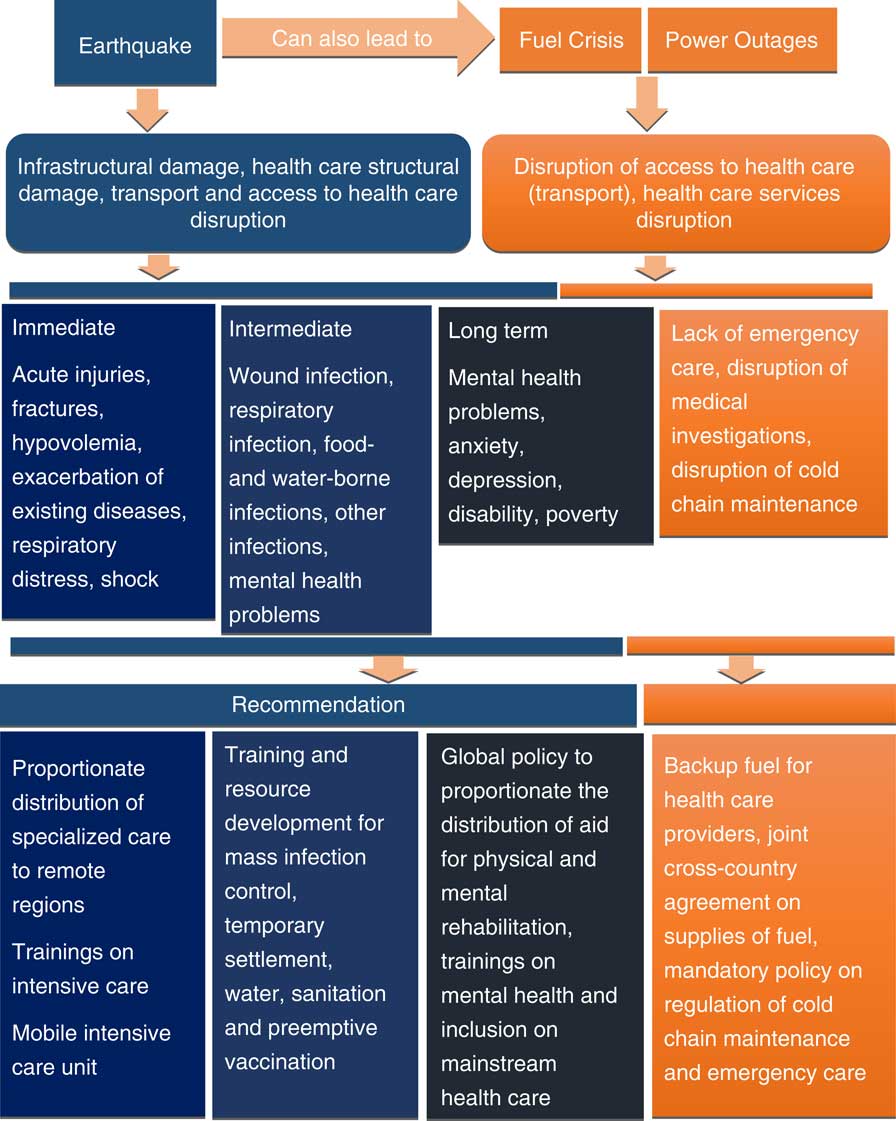
Earthquakes are a major natural disaster that result in pervasive impacts on the population affected, ranging from acute injuries and infectious diseases to disability and effects on mental health (Figure 1).Reference Lock, Rubin and Murray 1 The earthquake also disrupts the socioeconomic and ecological aspects of human civilization, including the destruction of physical infrastructure and historical places.Reference Briggs 2 Similarly, fuel crises and power outages can occur as aftermaths of earthquakes. However, in developing countries such as Nepal, fuel shortages and power cuts have been occurring as man-made disasters. These natural and man-made disasters can cause intangible human suffering and often leave lifelong scars of psychosocial damage.Reference Klinger, Landeg and Murray 3 The main objective of this study was to review the effects of mega earthquakes, fuel crises, and power outages on health services in Nepal and to formulate recommendations for the future.
Impacts of Various Disasters and Ways to Mitigate Them.

THE EARTHQUAKE AND ITS IMMEDIATE HEALTH IMPACT
Each year, Nepal experiences on average 300 natural disasters such as lightning strikes, floods, earthquakes, and landslides. Between 1971 and 2012, there were over 28,000 casualties from these natural disasters. 4 Until the formulation of the Disaster Relief Act in 1982 and after, the Ministry of Home Affairs was entirely responsible for disaster management in Nepal. The National Strategy for Disaster Risk Management, which was formulated in 2009 under the Ministry of Home Affairs, provides calculated guidance on disaster management from the central to the local level. 5 However, apart from the network of existing health infrastructures around the country, public health preparedness during a disaster, particularly in peripheral regions of Nepal, is largely neglected. Despite the fact that various international nongovernmental organizations such as the Red Cross Society have been active in public health preparedness for disaster, the development of local capacity at the village level through health education, training, and preparedness drills is lacking. 6 , Reference Adhikari and Mishra 7 In addition, inadequate steps have been taken to develop the community’s capacity for future preparedness; novel approaches such as community engagement have been inadequately prioritized.
Nepal lies in a major fault line between 2 tectonic plates and future earthquakes with potential for a much greater impact on Kathmandu are predicted.Reference Elliott, Jolivet and Gonzalez 8 On April 25, 2015, an earthquake measuring 7.8 on the Richter scale ravaged Nepal and affected 31 out of 75 districts in Nepal.Reference Aryal, Acharya and Shrestha 9 , Reference Basnyat, Tabin and Nutt 10 Another subsequent earthquake on May 12 damaged Nepal further. These 2 earthquakes claimed 9000 lives, left more than 23,000 injured, and displaced about 2 million people. Similarly, more than 500,000 houses and 1000 health facilities were destroyed.Reference Adhikari and Mishra 7 , 11
While Kathmandu had access to all kinds of health care institutions, remote and neighboring districts in Nepal lacked adequate health care services. Health posts constitute the only health structures in remote villages. There are about 3813 health structures at the village level, which are unable to provide specialized care. 12 During the 2015 earthquakes, 446 public health facilities including 5 hospitals and 16 private hospitals were completely destroyed, and 765 health facilities were partially damaged; 84% of the complete damage occurred in the 14 most affected districts. 6
Immediately after the earthquake, it was those in the poorest and remotest regions of Nepal requiring immediate resuscitation and intensive care who lost their lives. Despite Kathmandu being a capital city and having the majority of the tertiary care centers, disorganized urbanization and crowded households similarly oversaw a high degree of damage and mortality. As a consequence, the magnitude of chaos in Kathmandu was higher because of higher population density (a population of >1 million). 13 On the contrary, neighboring districts with lower population densities were bound to follow the worst prognosis because of a lack of adequate health care facilities and almost nonexistent specialized care centers.Reference Aryal, Acharya and Shrestha 9 , Reference Adhikari and Mishra 14
While these villages in remote districts are ordinarily deprived of adequate health care, during the 2015 earthquakes, outreach by aid agencies was hindered by their inaccessibility.Reference Adhikari and Mishra 7 Thus, acute care to this population was severely limited, which resulted in a high mortality rate.Reference Aryal, Acharya and Shrestha 9 While injuries are tangible consequences on the population affected by the earthquakes, consequences due to destruction of housing were even more severe. More than 2 million people were immediately left exposed in the open and could not enter their houses because of fear of aftershocks. 6 The management of the large population forced to live in temporary makeshift shelters was another challenge in terms of providing clean water, sanitation, and food.Reference Nepal 15 , Reference Fuse, Igarashi and Tanaka 16 Many experts and scientists predicted possible disease outbreaks, citing Nepal’s looming annual monsoon seasonReference Basnyat, Dalton and Kamar 17 ; however, the rationale of vaccinating the large population varied between experts.Reference Adhikari and Mishra 7 , Reference Cousins 18 Fortunately, food- and water-borne diseases did not affect a large majority of the population; nevertheless, preparedness for food- and water-borne diseases was strongly recommended.Reference Basnyat, Tabin and Nutt 10
Under the Ministry of Health and Population, 4118 health facilities ranging from central-level specialized hospitals to health posts were the major networks treating the earthquake victims during the earthquake. As a part of preparedness for the disaster in Nepal, a Health Emergency Operation Center was established in 2013. Prepositioning of medical logistics was done mostly within tertiary care centers in Kathmandu. Similarly, capacity building of staff on mass casualty management and hospital preparedness training for emergencies was conducted mainly within the capital. 6 At the local level, however, capacity and public health preparedness are severely lacking.Reference Adhikari and Mishra 14
Recommendation
An earthquake has a wide spectrum of impacts on health. Traumatic injuries generally lead to consequences for first 3 to 4 days and are often followed by post-traumatic wounds and delayed and entrapped injuries. During the acute phase of the earthquake, provision of intensive care is vital, and often the lack of intensive care or the failure to reach hospitals in the first few hours is the major cause of mortality in a country with geographically inaccessible regions.Reference Aryal, Acharya and Shrestha 9 In Nepal, 70% of specialized health care facilities are provided by the private health sector and the majority of them are located in urban regions. Impoverished, inaccessible, and remote areas have always remained deprived of specialized health care.Reference Adhikari and Mishra 14
In the future, it will be mandatory to proportionately distribute private health care institutions with specialized care to reach affected populations. Mobile critical care units based in primary health care centers need to be developed to provide health care in time. Intensive care training for all peripheral health workers is essential for rural health care and even more so for unprecedented disaster situations such as earthquakes. In terms of effective disaster management, a robust policy with a strong coordination between disaster management agencies is currently lacking in Nepal, which were identified in recent research as barriers to disaster mitigation in Nepal.Reference Lee 19 , Reference Mishra 20 Additionally, recent reports have attributed impunity and intricacies in health policy to be the cause of health problems.Reference Lee 19 , Reference Adhikari 21 Therefore, this warrants an urgent need for a robust policy on disaster management with clear devolvement of roles and responsibilities.
FUEL CRISIS AND HEALTH CARE
Nepal has stood stoic in various natural disasters mainly because it has been the way of life and there have rarely been alternatives for the problems faced by the population. Soon after the 2015 earthquakes that killed thousands and left many injured and health care facilities destroyed, Nepal was once again tested with a critical deadlock due to political tensions concerning promulgation of the constitution.Reference Khanal, Mishra and DeYoung 22
The southern plains of Nepal, which are the main economic gateways with India, were blocked as the result of a series of strikes against the constitution. Nepal faced yet another challenge due to this economic blockade, which gave rise to a fuel shortage that invariably affected the everyday lives of the people. 23 While the earthquakes gained substantial attention because of its natural impact on health care, the economic blockade did not get media attention initially because it was tied up in political tension between Nepal and India.Reference Sheppard and Landry 24 However, the consequences arising from the economic blockade were considered by some to be worse than those of the earthquake.
The lack of fuel for vehicles and scarcity of cooking essentials and food items in the marketplace affected all facets of life. People had to stand in lengthy queues for gasoline, essential food items, and cooking gas. Consequently, the fuel crisis compelled the government to supply wood for cooking, and the long-term environmental impacts of this are beyond measurement. 23 The blockade was politically presumed to be temporary and many thought that it would be resolved in a few weeks. However, it lasted for 4.5 months, and once again the Nepalese had to tolerate severe scarcity and compromised health care.Reference Nielsen, Ferguson and Joshi 25 The impacts on health care facilities were devastating. Most hospitals and health care facilities ran out of essential medicines, and health care was invariably affected throughout the country. 23 , Reference Nielsen, Ferguson and Joshi 25
Recommendation
While fuel crises and power outages are seen as emergency situations when occurring during a natural disaster in the Western world, these are quite frequent incidents in Nepal regardless of the presence of a natural disaster. The impact of the fuel crisis on health was beyond estimation and did not get attention from scientific forums. The fuel crisis severely hampered all facets of life in Nepal, jeopardizing access to health care. Nationwide, the shortages of essential medicines and limitations in public transport resulted in the death of many health care seekers.Reference Nielsen, Ferguson and Joshi 25
The health indicators that had been achieved in Nepal were susceptible to reversal as a result of the fuel crisis.Reference Khanal, Mishra and DeYoung 22 This has resulted in a need for the government of Nepal to formulate a backup plan such as “health diplomacy” to operate in these frequent yet unprecedented situations with a high focus on health care services.Reference Mishra, Sharma and Khanal 26 Storage and reservation of fuel for the most essential institutions such as health care services needs to be prioritized. A cross-country agreement on the provision of fuel for health care institutions despite political turmoil is mandatory.
POWER OUTAGES AND HEALTH CARE
Power cuts commonly recognized as load shedding are a major problem in Nepal. While a systematic review on power outage accounted for it as a consequent effect of extreme events such as flooding and earthquakes,Reference Klinger, Landeg and Murray 3 in Nepal, power outages have been a way of life. Power outages have a wide spectrum of impact on the population: disruption in supply of clean water, medication storage, operation of life support devices, use of medical technologies, transport, communication, and sewage disposal and consequent increase in mental health problems.Reference Klinger, Landeg and Murray 3
So far, there has not yet been any scientific estimation of impacts on health care facilities due to power outages in Nepal; however, a high number of health facilities are considered affected by the power supply schedule. In Kathmandu itself, power outages of up to 18 hours per day have been a dreaded experience.Reference Conwright 27 , Reference Poudel 28 Most of the health facilities that run on backup power such as diesel generators also experience hindrances in providing services to patients.Reference Conwright 27 More than 70% of the health care institutes in Kathmandu are private; a lack of power therefore affects a huge proportion of health care facilities. Power outages are prolonged (up to 18 hours) during winter seasons. During February 2016, a rough estimate of about 3 million children under 5 years were considered to be at risk of death due to severe shortages of fuel, food, medicines, and vaccines.Reference Conwright 27 Hospitals provide their services by complying with the power supply schedules and patients are often obliged to wait for many hours for simple investigations such as x-rays and ultrasonography and for most medical and surgical procedures.Reference Gautam 29
Recommendation
In Western health care facilities, power outages are often the consequences of disaster situations and the measures taken to mitigate the hazards are expeditious. In Nepal, however, power outages are a regular phenomenon. Thus, hindrances on health care services are inevitable. An alternative backup power plan could be a radical solution. Realistically, however, this may not be feasible in the current situation. An efficient means of alternative power supplies such as generators and sustainable (recyclable) batteries could be a solution in current conditions. Alternative power sources such as solar power could be a sustainable solution. In order to provide quality health care, the government of Nepal urgently needs to formulate a clear policy for private health care institutions to have a backup power plan to maintain the cold chain for essential medicines including vaccines and to have preparedness for life-saving procedures.
INTERMEDIATE HEALTH EFFECTS (MENTAL HEALTH, RESPIRATORY INFECTIONS, HOMELESSNESS, INFECTIONS)
The health impacts of disaster situations are permanent. Physical injuries such as broken bones leave a large proportion of the population with disabilities and consequent poor quality of life. The impacts on economy, quality of life, and mental health are often more debilitating than the traumatic injuries during the disaster situation itself.Reference Sheppard and Landry 24 , Reference Hu and Su 30
Infections arising from debris, dust inhalation, and wound infections are the major consequences.Reference Phalkey, Reinhardt and Marx 31 Respiratory problems have been frequent findings in post-earthquake clinics. Similarly, infectious disease outbreaks are always a possibility that could arise from the broken water and sanitation system.Reference Basnyat, Dalton and Kamar 17 The cholera outbreak in Haiti, 10 months after the earthquake in a broken and fragile public health system (physical and functional infrastructure), is an example of such a disease outbreak.Reference Walton and Ivers 32 Among various diseases, respiratory problems are reported as one of the major diseases associated with an earthquake. After the Sichuan earthquake in China, the second most frequent disease reported was respiratory problems.Reference Hung, Lam and Chan 33 Similarly, in Japan, pneumonia and exacerbation of chronic respiratory disease among the elderly were reported after the Great East Japan Earthquake.Reference Yamanda, Hanagama and Kobayashi 34 A comparative review on common disease outbreaks showed respiratory infections as the most common occurrence in various countries including Iran, Haiti, Peru, China, and Pakistan.Reference Kalantar Motamedi, Sagafinia and Ebrahimi 35
Mental health and homelessness are a huge price people have to pay after an earthquake. The loss of loved ones and the development of post-traumatic stress disorders are common consequences of disaster situations. Post-traumatic stress disorders and depression are chronic conditions and can be lifelong. A longitudinal study conducted in Armenia found that about one-quarter of participants were still suffering from depression 21 years after the earthquake.Reference Khachadourian, Armenian and Demirchyan 36 Similarly, physical conditions (both acute and chronic) were found to increase by more than 4 times in the same time period.Reference Khachadourian, Armenian and Demirchyan 36 In Nepal, post-earthquake mental health problems have not yet been estimated and integration of mental health care into the health system has been suggested.
Recommendation
Intermediate health care in addition to intensive health care resources needs to include infection control, wound care, and rehabilitation (physical and psychosocial). Wound care and infection control are always a challenge. Nepal is endemic for antibiotics overuse (antibiotics are available over the counter), and during the earthquake, this was even more accentuated.Reference Aryal, Acharya and Shrestha 9 Future planning needs to concentrate on primary wound management and infection control. This could be strengthened by training and resource development at all levels.Reference Adhikari and Mishra 7
In the context of the Nepalese earthquake, makeshift accommodations for the displaced population were not only inadequate but the unpreparedness and disproportionate distribution of donated tents resulted in havoc. The lack of proper sanitation and water supplies were major constraints. In the midst of scientists’ claims over the possible outbreak of diseases such as cholera and other diarrheal diseases, Nepal successfully survived the monsoon season.Reference Basnyat, Tabin and Nutt 10 , Reference Marahatta 37 However, the mere escape from these infectious diseases cannot be taken for granted as Nepal had outbreaks of food- and water-borne diseases even during times when there was no earthquake. A robust backup plan for large mass vaccination and temporary shelters with proper alternatives to water and sanitation needs to be preemptively considered.
PERMANENT HEALTH EFFECTS (MENTAL HEALTH, DISABILITY, POVERTY)
About half a million of those injured are estimated to have adverse mental health effects, such as depression, post-traumatic stress disorder, and anxiety.Reference Khachadourian, Armenian and Demirchyan 36 , Reference Shigemura, Harada and Yoshino 38 After the South Napa Earthquake in California, the majority of households (50-75%) reported that one or more household members had experienced anxiety, fear, or distraction during or since the earthquake. Similarly, about 30% of the population suffered from post-traumatic stress disorder.Reference Attfield, Dobson and Henn 39 In China, a study of schoolchildren reported that about 40% of the students had post-traumatic stress disorder.Reference Zhang, Zhang and Zhu 40 In Haiti, post-traumatic stress disorder prevalence in school-aged children was 50%.Reference Blanc, Bui and Mouchenik 41 Similarly, a study conducted on an adult Haitian population living in Miami showed 19% with PTSD, 36% with anxiety, and 45% with depression.Reference Messiah, Acuna and Castro 42
Many earthquake-affected victims are thought to have these mental disorders and they apparently continue to bear such effects permanently. Virtually all people with or without direct effects of an earthquake are likely to have mental health effects. In fact, the mental health effects of disasters such as earthquakes are more pervasive than the physical effects.Reference Fukunaga and Kumakawa 43 Currently, there are no mental health care facilities in peripheral health services. While recent earthquakes were only a sample of the natural disasters that affect mental health, for sustainable care of this population, mental health care must be integrated into all peripheral health care services in Nepal. Training on mental health care for all levels of health care services is necessary to effectively manage these cases. An attitudinal- and stigma-free strategy toward mental health sufferers in post-disaster situations can only promise a healthier community.
Injuries such as broken limbs and bones and the resultant complications and disabilities have devastating effects on the quality of life of the affected person. In the 2015 Nepal earthquakes, approximately 18,500 people were injured, of whom approximately 6% suffered spinal cord injuries, 2% had amputations, 4% sustained traumatic brain injuries, and the vast majority (70%) sustained bone fractures.Reference Sheppard and Landry 24 , 44 Development of disability can lead to a lower quality of life and invariably results in economic loss.
In Haiti after the earthquake, 4.1% of the population was reported to have developed disabilities.Reference Danquah, Polack and Brus 45 In Japan, 3 years after the Great East Japan Earthquake, the prevalence of disability (affected area=14.7%; non-affected area=6.2%) in affected areas was higher than in unaffected areas and was reported higher than in later years.Reference Tomata, Suzuki and Kawado 46 In Nepal, a provisional report on injuries among the victims of the earthquakes showed that almost 12% had developed a disability (8% spinal cord injuries and 4% amputation).Reference Paudel, Dariang and Keeling 47 However, baseline disability rates in Nepal are difficult to report. Disabilities are often underreported or concealed by family members owing to the attached stigma.Reference Adhikari, Kaehler and Chapman 48 The national census itself was criticized for not being able to provide the true prevalence of disability, mostly because it failed to account for concealed cases.Reference Paudel, Dariang and Keeling 47
There could be a higher proportion of the population who are living with disabilities and much more in remote and inaccessible regions of Nepal, where outreach by health facilities often is not possible. Of the total 1100 current number of physiotherapists in Nepal, 99.98% of them work in the private sector because there are no places for physiotherapy in current national health services.Reference Paudel, Dariang and Keeling 47 Many of the humanitarian aid agencies including temporary makeshift hospitals treating injured patients with surgical procedures raised concerns about sustainable care such as rehabilitation and occupational therapy.Reference Jeffay 49
The government of Nepal did not have a proper strategy to focus on the disability-affected population until after the 2015 earthquake. Even after the earthquake, the initiation of the disability and rehabilitation unit itself may only be a mere response to growing demand and might take a long time for execution. The lack of trained human resources such as physiotherapists and the previously nonexistent rehabilitation program in government health services are the major constraints. 44
It is estimated that the damages and losses due to the earthquake totalled US $7 billion. Among the most affected sectors was the social sector, in which 86% of the loss was from the destruction of housing. The earthquakes have pushed an additional 3.5% of Nepalese into poverty, which roughly equals an additional 700,000 poor, and 70% to 80% of this population are from the rural regions of Nepal. 6 While poverty can give rise to many diseases,Reference Eisenstein 50 disease can result in poverty as well, thus creating a vicious cycle of poverty to disease and disease to poverty.
The earthquakes damaged about 500,000 houses and 2 million people were displaced and obliged to stay in makeshift housing. 11 , Reference Khanal, Mishra and DeYoung 22 Living in temporary housing and the uncertainty of permanent settlement are a huge psychosocial burden and can result in depression in the long run.Reference Nakaya, Nakamura and Tsuchiya 51 The damaged sanitation, water supply, and hygiene in temporary housing with or without disaster situations globally are a huge threat to infectious disease outbreaks.Reference Basnyat, Dalton and Kamar 17 , Reference Eisenstein 50 It was estimated that about 1.1 million people lost access to protected water supplies and toilets during this earthquake. 11
Recommendation
An urgent priority is to initiate programs such as community-based rehabilitation, inclusion of rehabilitation programs in all government health services, and an increase in training of physiotherapists and rehabilitation experts. Global policies are required to distribute aid proportionally to those who are permanently disabled and need psychosocial rehabilitation. Partial to complete lack of health services for those who acquire mental health problems and disabilities can often contribute to further burden on health. A paradoxical complacency achieved by observing the numbers of people who receive immediate care often masks the development of prolonged health effects due to disaster events. Training health workers on mental health and disability management is crucial to sustain health care after disasters.
The earthquakes affected the poorest and most impoverished districts where health care services were already scarce and specialized care services were almost nonexistent. In order to effectively deal with further impoverished communities due to recent earthquakes, a priority by the government for the distribution of sustainable development agencies needs to be clearly formulated. In addition, at the global level, donors and aid agencies need to proportionate their aid not just to temporary, immediate health care but also to sustainable care. The huge economic disproportion brought by the earthquake can only be dealt with through the equitable distribution of aid and sustainable development programs.
CONCLUSION
Nepal is vulnerable to a wide spectrum of disasters, political instabilities (turmoil, riots, strikes, and transport bans), power outages, and resultant humanitarian crises. While the earthquakes and natural disasters are unprecedented incidents, economic blockade, fuel crisis, and political instabilities invariably affect health care in Nepal. The earthquakes were dealt with by various aid agencies in partnership with the Nepalese government; however, the ongoing health crises due to non-natural-disaster conditions such as power outages, fuel crisis, and political instabilities are often overlooked. In the current context of Nepal, a brisk alternative plan to smoothly run health care institutes is necessary.
Post-earthquake health care should prioritize rehabilitation and continuous support for mental health. While an acute surge in post-earthquake aid and resultant health care were beneficial in providing immediate support to Nepal, the complacency of providing acute care can mask the need for continuous and sustainable health care in Nepal. The homeless and even the unaffected population are also vulnerable to mental health problems and disabilities. Health care resources and aid need a constant presence in Nepal to rehabilitate the injured and provide much needed psychological support to the affected ones.
Acknowledgment
We sincerely express our gratitude to Mr. Gordon Tambellini for providing constructive feedback during manuscript writing.