Much previous research on sentence comprehension in aphasia has shown that agrammatic individuals with aphasia have difficulty understanding sentences with movement. In particular, they have difficulty understanding sentences in which arguments do not appear in their canonical order, as in the unaccusative structure in (1):
(1) The ice-cream i melted i
The unaccusativity hypothesis claims that there is a trace in the syntactic representation of the sentence, occupying the postverbal position, which is ultimately co-indexed with the “ice-cream,” thus leading to a noncanonical interpretation of the sentence (i.e., the theme moves to a syntactic subject position typically occupied by an agent; Perlmutter, Reference Perlmutter, Jaeger, Woodbury, Ackerman, Chiarello, Gensler and Kingston1978). In comprehending unaccusative sentences, it is the language processor's task to identify the gap or trace associated with the moved object and resolve the movement relationship, which is also called filler-gap dependency (Burzio, Reference Burzio1986; Friedmann, Taranto, Shapiro, & Swinney, Reference Friedmann, Taranto, Shapiro and Swinney2008; Perlmutter, Reference Perlmutter, Jaeger, Woodbury, Ackerman, Chiarello, Gensler and Kingston1978).
The sentence processing experiments have typically used different sentence types as a means to examine underlying operations in agrammatic processing (Grodzinsky, Reference Grodzinsky1990; Grodzinsky, Reference Grodzinsky1995; Grodzinsky, Piñango, Zurif, & Drai, Reference Grodzinsky, Piñango, Zurif and Drai1999; Hagiwara, Reference Hagiwara1993; Swinney, Zurif, Prather, & Love, Reference Swinney, Zurif, Prather and Love1996; Zurif, Swinney, Prather, Solomon, & Bushell, Reference Zurif, Swinney, Prather, Solomon and Bushell1993). The common goal has been to illuminate processes underlying language-unimpaired comprehension and how these go awry in aphasia. The outcome of the overwhelming majority of these studies was that their subjects with Broca aphasia do not reliably understand sentences with displaced determiner phrases (DPs), or perhaps more generally, sentences that require the computation of (especially, long-distance) dependencies.
Even though the effect of filler-gap dependencies on on-line sentence interpretation has attracted a growing amount of interest within the aphasiological community over recent years, there have been relatively a few studies which have specifically examined the real-time operations relevant to the gap-filling process in aphasia (Blumstein et al., Reference Blumstein, Byma, Kurowski, Hourihan, Brown and Hutchison1998; Burkhardt, Piñango, & Wong, Reference Burkhardt, Piñango and Wong2003; Love, Swinney, & Zurif, Reference Love, Swinney and Zurif2001; Swinney et al., Reference Swinney, Zurif, Prather and Love1996; Zurif et al., Reference Zurif, Swinney, Prather, Solomon and Bushell1993). Up to now, one of the methods which have been extensively used to examine the real-time processing of sentences with movement in aphasia is lexical priming. In the cross-modal lexical priming (CMLP) task, subjects listen to a sentence and make a lexical decision about a word presented visually at a position in the ongoing sentence. The CMLP technique is based on the idea that the speed of access to a word during sentence processing is affected by semantic priming; an item, or crucially a reactivated item at the position of its trace, primes a semantically related word, such that the reaction times (RTs) to a visually presented word that is related to a word in the sentence will be shorter relative to a visually presented word that is unrelated to the words of the sentence. There have been a number of experimental investigations with unimpaired populations that have come to support the view that the linkage between an antecedent filler and a gap is one that is made immediately upon discovery of the “gap” site (e.g., Love & Swinney, Reference Love and Swinney1996; Nagel, Shapiro, & Nawy, Reference Nagel, Shapiro and Nawy1994; Swinney, Ford, Frauenfelder, & Bresnan, Reference Swinney, Ford, Frauenfelder and Bresnan1987).
The studies which have examined the on-line processing of sentences with movement in aphasia by employing the CMLP technique yielded interesting but conflicting results. In their study, Zurif et al. (Reference Zurif, Swinney, Prather, Solomon and Bushell1993) have investigated Broca and Wernicke patients' ability to form in real-time intrasentential dependency relations in subject-relative clauses by testing for priming for the relative pronoun at the position of the trace (i.e., after the pronoun) and at a position before the trace (pregap site). According to the findings, the neurologically intact and the Wernicke aphasic subjects showed priming (i.e., relative facilitation in lexical decision for words related to the antecedents) at gap sites but not at pregap sites. By contrast, the Broca patients did not show priming at either position. Swinney and colleagues (Reference Swinney, Ford, Frauenfelder and Bresnan1987; following up similar results from Zurif et al., Reference Zurif, Swinney, Prather, Solomon and Bushell1993) had examined Broca and Wernicke aphasic individuals' performance in a CMLP priming task with object relative clauses. For participants with Wernicke aphasia, Swinney et al. (Reference Swinney, Zurif, Prather and Love1996) found evidence of reactivation at the trace site, such that there was reliable priming of words related to the head DP after the verb but not before. In contrast, they found that participants with Broca aphasia showed no reliable priming in either position. Both studies' similar findings were accounted for in terms of an overall slowed processing account of aphasic comprehension preventing the Broca patients either from locating the antecedent in time or from accessing momentarily all of the possible argument structure configurations within a verb's lexical entry.
A later study from Blumstein and colleagues (Reference Blumstein, Byma, Kurowski, Hourihan, Brown and Hutchison1998) essentially contradicted the Swinney–Zurif (Swinney et al., Reference Swinney, Zurif, Prather and Love1996; Zurif et al., Reference Zurif, Swinney, Prather, Solomon and Bushell1993) results. Blumstein and colleagues repeated the Swinney et al. (Reference Swinney, Zurif, Prather and Love1996) study using purely auditory materials (i.e., the target word was presented in the voice of a speaker of the opposite sex from the speaker of the sentence). An additional difference from the Swinney–Zurif studies is that probe words were presented at only one position (the site where the gap was licensed) and both relative clauses and wh-questions were used. Blumstein et al. found priming for words semantically related to the antecedent of a trace for Broca aphasic and elderly groups, but no priming for words separated from a prime by an equal number of syllables in control sentences without traces. Moreover, there was no evidence in favor of a priming effect at the trace site for Wernicke aphasic participants with any sentence type, also the opposite result from that reported by Swinney and colleagues (Reference Swinney, Zurif, Prather and Love1996).
The inconsistency of the results of the aforementioned studies has been mainly attributed to the distinct methodological designs used in each of them. Balogh et al. (Reference Balogh, Zurif, Prather, Swinney and Finkel1998) argued that the priming effect observed at the single probe position available in Blumstein et al.'s (Reference Blumstein, Byma, Kurowski, Hourihan, Brown and Hutchison1998) study may reflect end of sentence “wrap up” reactivation of previously presented lexical items, not syntactically based co-indexation of traces due to structural factors. In addition, the materials used by Swinney and colleagues (Reference Swinney, Zurif, Prather and Love1996) are subject to another concern raised by McKoon and Ratcliff (Reference McKoon and Ratcliff1994). They argue that the priming effects found with these materials may be due to a better pragmatic fit of the related rather than the unrelated words to the pragmatic context at the point of the trace, not to the co-indexation of the trace per se. Finally, Zurif et al.'s (Reference Zurif, Swinney, Prather, Solomon and Bushell1993) results must be tempered by the consideration that their Broca aphasic participants did not show evidence in favor of a priming effect at the pregap site. Such findings may reflect slowed lexical access processes, further implicating the possibility that Broca patients would have shown priming of the moved element had they been tested far enough downstream from the trace site (Love et al., Reference Love, Swinney and Zurif2001; Swinney et al., Reference Swinney, Zurif, Prather and Love1996). The CMLP technique then requires a design that would be sensitive to the temporal evanescence of aurally presented sentences, in case antecedent reactivation takes place at a point later than its syntactic licensing.
The latter possibility was successfully integrated in the CMLP design of Burkhardt, Pinango, and Wong's (Reference Burkhardt, Piñango and Wong2003) study that has investigated the on-line processing of unergative and unaccusative verbs with two English-speaking agrammatic patients and a control group. According to the analyses of the subjects' response times in the unaccusative verbs, the aphasic patients failed to reactivate the antecedent at the point of the trace; yet, their parser did show priming for the antecedent on average 150 ms later than the language unimpaired subjects who provided evidence of antecedent reactivation not immediately at the postverbal trace position but at a significantly later point in time (650 ms after the unaccusative verb). The researchers have attributed such pattern of performance to the slow syntax hypothesis according to which Broca patients' syntactic knowledge and ability to establish the dependency relation between the antecedent and its trace in unaccusative verbs is spared, yet delayed syntactic structure formation caused by the anterior lesions to the patients' left hemisphere prevented them from responding on time. In contrast, no antecedent reactivation pattern was observed for the unergative verb class for the two patients. Two further points worth mentioning from Burkhardt et al.'s (Reference Burkhardt, Piñango and Wong2003) study is that (a) no clear pattern of priming effect for the antecedent was shown by Broca patients when tested on unaccusatives lacking a causative counterpartFootnote 1 in contrast to the control subjects who showed the same reactivation pattern across all unaccusative sentences, and (b) the neurologically intact control subjects have shown a statistically significant priming effect immediately after the verb in the unergative verb class. The specific finding was accounted for by the authors in terms of the verb phrase (VP)-internal subject hypothesis (Koopman & Sportiche, Reference Koopman and Sportiche1991, among others), which claims that the subject DP originates in a VP-internal position (more specifically, the [Spec, VP]), from which it raises into [Spec, inflection phrase] in English leaving behind a trace. Burkhardt et al. hold the postverbal subject trace responsible for the priming effect registered within the short time window of 100 ms after the unergative verb has been heard.
Although there is little consensus among the studies regarding the modeling of the CMLP technique so that it would best capture aphasic comprehension of sentences involving movement, they appear to be similar in claiming that some operation relevant to the gap-filling process in Broca patients is greatly slowed and error prone. The specific processing approach suggests that syntactic operations are time sensitive and temporally unforgiving; computing a dependency relation must occur at the right time in the processing stream or else comprehension will suffer. Either the slow processing account takes the form of a delay in syntactic structure formation in Broca aphasia (Burkhardt et al., Reference Burkhardt, Piñango and Wong2003; Haarmann & Kolk, Reference Haarmann and Kolk1991) or the form of protracted lexical access capacities limiting the patients' ability to fill the gap at the point where it is properly licensed in the syntax (Love et al., Reference Love, Swinney, Walenski and Zurif2008; Swinney et al., Reference Swinney, Zurif, Prather and Love1996), the processing outcome for individuals with Broca aphasia will be the same: slowed processing routines will create problems for locating and successfully reactivating an antecedent for a trace in a filler-gap dependency. Delayed application of the processing routines implicated in the resolution of filler-gap dependencies in Broca aphasia has also been shown with a cross-modal lexical decision task testing reflexive-antecedent dependencies (Burkhardt, Avrutin, Piñango, & Ruigendijk, Reference Burkhardt, Avrutin, Piñango and Ruigendijk2008), as well as an anomaly detection task testing filler-gap dependencies in object relative clauses (Dickey & Thompson, Reference Dickey and Thompson2004). Likewise, Love et al. (Reference Love, Swinney, Walenski and Zurif2008) report evidence suggesting that for complex object-relative clauses, aphasic participants showed evidence of significantly delayed gap filling in a CMLP paradigm.
The overall slowed processing account of aphasic comprehension contrasts with other accounts of aphasic performance in that it postulates no deficits in aphasic syntactic representations (see trace deletion hypothesis in Grodzinsky, Reference Grodzinsky1990, Reference Grodzinsky1995, Reference Grodzinsky2000) or in the processes responsible for mapping those representations onto an interpretation (see Linebarger, Schwartz, & Saffran, Reference Linebarger, Schwarz and Saffran1983; Schwartz, Linebarger, Saffran, & Pate, Reference Schwartz, Linebarger, Saffran and Pate1987). Rather, it claims that agrammatic individuals try to comprehend sentences with movement more or less as healthy subjects do, but are slower and less efficient in their processing. Under the slow processing model, aphasic individuals' difficulties in understanding sentences with movement are not particularly delayed compared to other comprehension processes: all processing is slowed and inefficient.
CURRENT STUDY
With this brief background in mind we now present our investigation of the processing of unaccusative sentences in a population of Greek-speaking aphasic patients. As described above, Burkhardt et al.'s (Reference Burkhardt, Piñango and Wong2003) CMLP study has offered evidence supporting the distinct processing of the two verb classes (i.e., unergatives and unaccusatives) by two Broca patients, whereas their data spoke in favor of an overall slowing down of “the syntactic structure building (i.e., Merge) operations” (Burkhardt et al., Reference Burkhardt, Piñango and Wong2003, p. 20) through which the dependency relation between the derived DP subject and the postverbal trace is instantiated in unaccusative verbs.
In the present study, we also applied the CMLP technique, albeit with some modifications in the experimental population and the experimental stimuli. First, we ran the experiment with a group of eight Greek-speaking agrammatic patients in the hope of gaining robust and reliable data on the on-line processing of unaccusative (vs. unergative) verbs by Broca patients. Second, the morphological realization of unaccusativity in Greek was also fully manipulated; as will be described analytically in the linguistic framework of the study, the rich morphological paradigm of unaccusative verbs in Greek is an excellent candidate to tease apart morphological factors that may interfere to influence antecedent reactivation in unaccusative sentence processing from pure syntactic operations, like the reconstruction of the antecedent in postverbal position. The realization of some Greek unaccusative verbs with nonactive (NACT) voice morphology, as well as the optional marking of some active (ACT) unaccusative verbs with NACT voice morphology proves a fruitful area to compare the priming effect elicited by morphologically marked (i.e., NACT) verbs with that elicited by morphologically less complex (i.e., ACT) verbal predicates.
In individuals with aphasia, processing disadvantages for morphologically complex words including inflected verbs have been reported (Friederici et al., Reference Friederici, Wessels, Emmorey and Bellugi1992; Marslen-Wilson & Tyler, Reference Marslen-Wilson and Tyler1997; Miceli & Caramazza, Reference Miceli and Caramazza1988). Aphasic individuals' inflectional errors appear to support a decompositional view of morphological processing, whereby not only are there distinct neurocognitive mechanisms for the retrieval of verbs and inflections from long-term memory, but there are also specialized neurocognitive mechanisms for combining stems and inflections to yield grammatical forms. A dual system approach has been proposed whereby patient groups with posterior damage were predicted to have an impairment in declarative memory based representations; thus, they were assumed to have difficulty with the computation of irregular but not regular past tense forms for real and novel words, whereas dysfunction of basal ganglia and frontal lobe circuits (as in Broca aphasia) were predicted to affect the procedural brain memory system and, in particular, grammatical rules (Ullman et al., Reference Ullman, Corkin, Coppola, Hickok, Growdon and Koroshetz1997). The regular–irregular dissociation hypothesis has been extensively examined by studies focusing on the computation of past tense forms by aphasic agrammatic patients of various language backgrounds (Balaguer et al., Reference Balaguer, Costa, Sebastian-Galles, Juncadella and Caramazza2004; Bird et al., Reference Bird, Lambon Ralph, Seidenberg, McClelland and Patterson2003; Penke, Janssen, & Krause, Reference Penke, Janssen and Krause1999; Tsapkini, Jarema, & Kehaya, Reference Tsapkini, Jarema and Kehaya2002). Yet, the dual mechanism theory has not been clearly confirmed by neuropsychological data, because aphasic errors have not been restricted to morphology but to semantics and/or phonology as well.
A second potential locus of verb inflection errors in aphasia is syntactic encoding, and more specifically, the complexity of the verb's argument structure. Specifically, unergative verbs were found to be inflected correctly more easily than both two-place and three-place transitive verbs in a picture-naming task (Luzzatti et al., Reference Luzzatti, Raggi, Zonca, Pistarini, Contardi and Pinna2002; Thompson, Reference Thompson2003). Unaccusative verbs are rarely produced since they are considered to be syntactically complex, in that their grammatical subjects originate in the postverbal complement position and then move in the subject position. A theoretical account of these results is the argument structure complexity hypothesis (Thompson, Reference Thompson2003), which states that verbs with complex argument structure, both in terms of number of arguments and/or of movement, are impaired in agrammatic production.
Although the bulk of studies to date have focused on aphasic individuals' pronounced production difficulty with morphologically synthetic (inflected) verb forms, including unaccusatives, the present study seeks to investigate whether we should also anticipate such difficulty in comprehension as reflecting the processing of morphologically marked, that is, NACT (vs. morphologically unmarked, i.e., ACT) unaccusative verbs; more specifically, whether NACT voice morphology marking on unaccusative verbs will affect aphasic patients' inclination to anticipate (or not) a postverbal trace as the sentence unfolds.
Finally, we have investigated the effect of the [±animacy] of the syntactic subject of the verbs on the aphasic subjects' ability to disambiguate the meaning of both ACT and NACT unaccusative verbs during on-line sentence processing. We will elaborate on this, and other possibilities offered by the current study, in the Predictions section after the linguistic framework of the study.
THE LINGUISTIC FRAMEWORK OF THE STUDY
In the present research, we focus on unergative and unaccusative verbs covered by the global term “intransitivity,” which is defined in terms of the lack of accusative case licensing by the verb. It is crucial that the distinction between unergatives and unaccusatives relates to the distinct ways in which the syntactic subject of these verbs is derived in syntax. This issue is closely linked to the lexicosemantic structure of intransitive verbs and the way it feeds into the syntactic component in terms of the arguments projected onto the syntactic structure. Fine distinctions related to the semantics of the intransitive verbs depending on whether they include an agent are critical in their syntactic derivation. The defenders of the unaccusativity hypothesis assume that the subject of unergative verbs is merged in its spell-out position and attracts the external theta feature of the Voice° head. In contrast, the external argument of unaccusative verbs is unavailable in syntax but present at the level of the conceptual structure of the verbs (Hale & Keyser, Reference Hale, Keyser, Hale and Keyser1993; Levin & Rappaport-Hovav, Reference Levin and Rappaport-Hovav1995). The subjects of unaccusative verbs are base generated as internal arguments and subsequently move to [Spec, tense phrase] position to satisfy the extended projection principle.
As mentioned above, an interesting property of unaccusative verbs in Greek is the way in which the suppression of the external theta feature is realized in the morphological component. More specifically, according to the categorization proposed by Alexiadou and Anagnostopoulou (Reference Alexiadou, Anagnostopoulou, Alexiadou, Anagnostopoulou and Everaert2004, pp. 123–127), there are four classes of unaccusatives in Greek:
In the first class, the unaccusative verbs have NACT morphology, while in their unmarked (i.e., ACT voice form, they are transitive):
(2) O jiatros jiatrepse to Jiani. (causative/transitive)
The-NOM doctor-NOM heal-PERF-ACTIVE.3s the-ACC Jiani-ACC
“The doctor healed John”
(3) O Jianis jiatreftike (apo thavma). (unaccusative)
The-NOM Jianis-NOM heal-PERF-NON-ACTIVE.3s (by miracle-ACC)
“John healed (by a miracle)”
The second class consists of unaccusatives that have NACT morphology. Active voice morphology is used with transitive verbs, but there is also a limited number of verbs that are unergatives with ACT morphology:
(4) O Jianis ekapse ti supa. (causative/transitive)
The-NOM Jianis-NOM burn-PERF-ACTIVE.3s the-ACC soup-ACC
“John burnt the soup”
(5) I supa kaike. (unaccusative)
The-NOM soup-NOM burn-PERF-NON-ACTIVE.3s
“The soup burnt”
(6) I fotia kei/*kejete. (intransitive/unergative)
The-NOM fire-NOM burn-IMPERF-ACTIVE.3s/burn-IMPERF-NON-ACTIVE.3s
“The fire burns”
The verbs in this class are de-adjectival verbs. The unaccusatives have ACT morphology and can only take an inanimate subject. Active morphology is present in transitive variants as well:
(7) O Jianis adiase ti sakula. (causative/transitive)
The-NOM Jianis-NOM empty-PERF-ACTIVE.3s the-ACC bag-ACC
“John emptied the bag”
(8) I sakula adiase. (unaccusative)
The-NOM bag-NOM empty-PERF-ACTIVE.3s
“The bag emptied”
In this class, all of the transitive verbs appear with ACT voice morphology. Unaccusatives optionally appear either with ACT or NACT morphology without the voice change affecting the availability of the unaccusative reading. Such verbs are labeled as “alternating” verbs and they are referred to in Greek as verbs “ditipias”Footnote 2 (literally of two forms, Theophanopoulou-Kontou, Reference Theophanopoulou-Kontou, Pavlidou and Tzitzilis2000). Henceforth, these verbs will be referred to as “voice-alternating” verbs.
In case the voice-alternating verb in Greek has NACT morphology, its subject may either be animate or inanimate; when the subject is animate the verb's meaning is ambiguous between an unaccusative, a reflexive, and a passive reading:
(9) O Jianis lerose to trapezomadilo. (transitive)
The-NOM Jianis-NOM dirty-PERF-ACTIVE.3s the-ACC tablecloth-ACC
“John dirtied the tablecloth”
(10) To trapezomadilo lerose/lerothike (apo to krasi). (unaccusative)
The-NOM tablecloth-NOM dirty-PERF-ACTIVE.3s/dirty-PERF-NON-ACTIVE.3s (by the-ACC wine-ACC)
“The tablecloth got dirty (from the wine)”
(11) I Maria lerothike (apo tis laspes/moni tis/apo ton Kosta). (unaccusative/reflexive/passive)
The-NOM Mary-NOM dirty-PERF-NON-ACTIVE.3s (from the-ACC mud-ACC/by herself-NOM/by Kostas-ACC)
“Mary got dirty (from the mud/by herself/by Kostas)”
According to Tsimpli's account of unaccusativity (Reference Tsimpli, Unshworth, Parodi, Sorace and Young–Scholten2006), the realization of ACT or NACT voice morphology on unaccusative verbs in Greek is related to the absence/presence of Voice° projection, thus supporting a grammatical interpretation of the phenomenon. In ACT unaccusatives the Voice projection is missing and the transitive alternation is attributed to “a transitivity or agentive feature borne by light v, independently of Voice” (Tsimpli, Reference Tsimpli, Unshworth, Parodi, Sorace and Young–Scholten2006, p. 26). More specifically, the causative/unaccusative alternation applies to a specific class of externally caused change of state verbs, like spao/“break,” klino/“close,” and anijo/“open.” Change of state verbs with internal cause do not appear to have a causative alternant (e.g., to luluδi anthise/“the flower blossomed-ACT”) *o ilios anthise to luluδi/“*the sun blossomed-ACT the flower” (Levin & Rappaport-Hovav, Reference Levin and Rappaport-Hovav1995; Theophanopoulou-Kontou, Reference Theophanopoulou-Kontou2001). In the latter verbal set, the internal argument is the only argument that is syntactically active and it either moves to [Spec, tense phrase] position to satisfy the extended projection principle or it is directly merged in its spell-out position and attracts the internal theta feature on the Voice° head (Manzini & Roussou, Reference Manzini and Roussou2000).
With respect to the unaccusative verbs marked with NACT morphology, Tsimpli (Reference Tsimpli, Unshworth, Parodi, Sorace and Young–Scholten2006) argues that the morphological marking is the reflex of the Voice° projection. The latter attracts the verb's external theta feature that is left underspecified with regards to its interpretation. The verb's internal feature is attracted by the internal argument that subsequently moves to subject position. Failure of the Voice° head to lexicalize the attracted agentive feature forces its interpretation at the LF level where the verb receives its unaccusative reading “depending on the semantics of the verbal predicate (change of state, situation type), and pragmatic information, (i.e., the naturalness, frequency and transparency of the relation between the subject and the event described by the verb”; Tsimpli, Reference Tsimpli, Unshworth, Parodi, Sorace and Young–Scholten2006, p. 27). This derivation applies to all verbal structures marked with NACT morphology in Greek, including passives and middles,Footnote 3 whereas reflexive structures differ in that the subject DP is an agent and both external and internal thematic features are interpreted within the verbal domain. Besides this grammatical distinction characterizing the derivation of the syntactic subject in reflexives and NACT unaccusative verbs, individual lexical preferences and real world knowledge also appear to play a crucial role in the disambiguation between the two verbal structures, especially when the NACT unaccusative verb takes an [+animate] entity in subject position. As can be seen in (12) and (13) below, in the absence of any disambiguating cues provided by the continuation of the clause, the NACT verb reaches a final reading on the basis of individual lexical preferences.
(12) O adras zestathike.
The-NOM man-NOM warm up-PERF-NON-ACTIVE.3s
“The man warmed up” (preferred reading: unaccusative)
(13) O adras kriftike.
The-NOM man-NOM hide-PERF-NON-ACTIVE-3s
“The man hid” (preferred reading: reflexive)
Overall, on the basis of Tsimpli's (Reference Tsimpli, Unshworth, Parodi, Sorace and Young–Scholten2006) account, the disambiguation of NACT verbs between an unaccusative and a reflexive reading seems to be nonfixed as it is dependent on pragmatic factors as well as on the [±animacy] of the syntactic subject of the verb, while the classification of ACT verbs as unaccusatives is strictly lexically constrained. Animacy appears to be relevant in the processing of ACT unaccusative verbs as well. Several event-related potential studies (Hoeks Stowe, & Doedens, Reference Hoeks, Stowe and Doedens2004; Kuperberg, Reference Kuperberg2007) have found that the co-occurrence of an inanimate subject with a transitive verb results in P600 effect, despite the sentence being syntactically well formed. Such findings evince that animacy and verb types modulate structural choices, with animate entities being preferentially mapped onto subjects/agents and inanimate entities onto objects/themes.
PREDICTIONS OF THE STUDY
The main prediction of the study pertains to the patients' retained or nonretained sensitivity to the argument structure distinction between unergatives and unaccusatives during on-line sentence processing. If antecedent reactivation is observed on-line only in unaccusatives (and not in unergatives) and at the right point, in the immediate temporal vicinity where it is licensed (i.e., at the gap position), then this pattern would be evidence that the individuals with Broca aphasia comprehend unaccusative constructions normally. If we observe late-occurring effects (i.e., some time after the trace is encountered), then this would suggest that filler-gap dependencies are affected in Broca aphasia, since such protracted effects have already been observed with unaccusatives (e.g., Burkhardt et al., Reference Burkhardt, Piñango and Wong2003), as well as other sentence types (e.g., Love et al., Reference Love, Swinney, Walenski and Zurif2008). Partial support for the aphasic individuals' preserved sensitivity to the silent, postverbal placeholder in unaccusatives receiving its reference from the preverbal subject DP is also the participants' RTs for the trials with a semantically unrelated word at a postverbal position; we expected RTs for the unrelated probes (in unaccusatives only) to be considerably higher relative to the unergative verbs on the assumption that “reaction times for the unrelated probes may be treated as an indication for processing load due to gap-filling” (Friedman et al. Reference Friedmann, Taranto, Shapiro and Swinney2008, p. 15) implicated in unaccusative verbs.
The second prediction made for the aphasic performance in unaccusatives relates to the facilitatory role played by the NACT morphological marking on unaccusative verbs during on-line sentence processing. As already mentioned, besides the ACT-NACT unaccusative verb distinction manipulated in the present study, special status was also assigned to the voice-alternating properties of some Greek unaccusative verbs which can surface with either ACT or NACT voice morphology. We expect that the NACT unaccusative verbs, as well as the ACT unaccusatives that have a marked morphological alternant (i.e., the same verb appearing in NACT voice morphology) will be stronger in their expression of transitivity than the ACT nonvoice-alternating unaccusatives.Footnote 4 The assumption is that whenever a mediopassive suffix is involved (see the Linguistic framework of the study: verb classes [b] and [d] where the Voice° projection is fixed and optional, respectively), the aphasic subjects will be able to capture the transitivity alternation more readily by trying to establish a dependency relation between the postverbal gap and the derived subject; this would mean that the relevant structures will be more susceptible to a priming effect (i.e., to postverbal antecedent reactivation) relative to the morphologically unmarked structures (i.e., the ACT nonvoice-alternating unaccusatives). Furthermore, we expect that the postverbal argument will be faster reactivated for NACT unaccusatives (assumingly, immediately after the verb where the gap is licensed) relative to the ACT voice-alternating verbs where we expect delayed antecedent reactivation due to the patients' protracted access to the verbs' voice-alternation property.Footnote 5
Conversely, tracking and resolving the filler-gap dependency in ACT nonvoice-alternating unaccusative verbs might be more computationally intensive, thus more difficult for the aphasic parser. Perhaps, the latter verb class requires both syntactic reconstruction of the displaced DP, as well as considerations of lexicon-filtered information, and these combine to overwhelm the processing system in aphasia. If this assumption is true, then ACT nonvoice-alternating unaccusatives should yield no antecedent reactivation at a postverbal position at all.
If these predictions on the aphasic performance are verified, then this pattern would be evidence that processing difficulty increases when the aphasic parser is forced to proceed to a morphologically nontransparent action (i.e., parsing the ACT nonvoice-alternating verbs). It would also be partial support for our initial stipulation that unaccusative verbs in Greek (at least) should be further subdivided on the basis of their [± voice-alternation] properties. A necessary condition on these assumptions, however, is the aphasic individuals' increased sensitivity to the morphology of the verbs, which further implicates that the patients should have normal access to the verbs' conceptual representations and could syntactically compute and maintain the NACT alternant along with the ACT one during the on-line processing of ACT voice-alternating unaccusatives.
Finally, the third prediction of the study relates to the [±animacy] of the subject and the way it affects the resolution of both ACT and NACT unaccusative predicates during the processing of the sentences by the patients. As already mentioned, inanimate subjects of NACT verbs may only be encountered in derived structures (i.e., unaccusatives, passives and middles). As such, the postverbal reactivation of the antecedent for the inanimate trials for the aphasic group is anticipated to take place regardless of whether the patients have disambiguated the unaccusative meaning of the NACT verb. On the contrary, NACT verbs with an animate subject in Greek can be interpreted either as unaccusatives or reflexives, the two of them being distinguished on the basis of the derived versus nonderived status of their syntactic subject, respectively. The concurrent computation of both a reflexive and an unaccusative derivation is expected to bring about an overall disruption in the patients' on-line processing operations, reflected in a more prominent priming/antecedent reactivation effect (i.e., considerably shorter RTs elicited for the related probes relative to the semantically unrelated probes) for the trials with an inanimate entity relative to the trials with an animate entity in subject position. We anticipate this interpretive ambiguity to be resolved once the reflexive reading is ruled out at a relatively late point in time on the basis of the aphasic individuals' lexical preferences or the disambiguating cues provided by the continuation of the clause.
With respect to ACT unaccusatives, we predict that these verbs with an animate entity in subject position are at high risk of being misinterpreted as unergatives (or as transitives with a null object) by our aphasic population. More specifically, we expect that occasional nonstandard filtering of the syntactic output by the patients' lexicon will distort the idiosyncratic theta grid of the specific verbal set, thus impeding the reconstruction of the displaced DP as originating from the internal object position. The treatment of the preverbal subject DP as an external argument will thus block the postverbal reactivation of the antecedent. If such hypothesis holds true, we expect that the aphasic postverbal priming effect for the ACT unaccusatives with an animate subject will be similar to the priming effect observed for the unergative verbs (also with an animate subject). In other words, we expect no antecedent reactivation to take place postverbally for neither ACT unaccusatives with an animate subject nor unergatives. We return to this, and other implications, in our Discussion to follow our experiment.
METHOD
Subjects
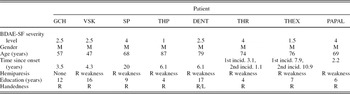
Aphasic subjects. A group of eight Greek-speaking agrammatic aphasic subjects (all males, mean age = 69.6 years, mean years of education = 9.3) participated in the study. The patients were recruited from a Treatment Medical Centre in the Greek province. All subjects were right-handed, with the exception of a single patient who was bimanual. None of the subjects had a history of prior neurological disease, drug or alcohol abuse, psychiatric disorders, developmental speech/language disorders, or learning disabilities. Computed tomography scans, which were available for seven of the patients, revealed that they had suffered from a left hemisphere, ischaemic stroke leaving a deep lesion in the Broca area; one of the patients suffered from an extensive hemorrhage of the left basal ganglia, while two of the patients with an ischaemic stroke have also suffered from a second incident at the same brain area a few years after the first stroke. All subjects were between 1 and 21 years poststroke at the time of the study, while none had received language treatment in the past (see Table 1 for more details on the patients' biographical profile and Appendix A for information on each patient's exact lesion site).
Demographic Information of the participants in the Broca group

Note: BDAE-SF, Boston Diagnostic Aphasia Examination, Third Edition—Short Form; R, right; L, left.
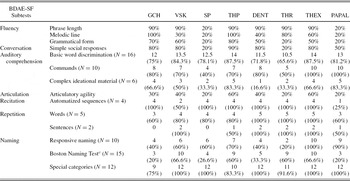
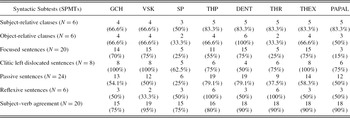
Language testing. The diagnosis of aphasia was based on administration of the Boston Diagnostic Aphasia Examination Third Edition—Short Form (BDAE-SF; Goodglass, Kaplan, & Barresi, Reference Goodglass, Kaplan and Barresi2001) standardized in Greek by Tsapkini, Emmanuel, Passalidou, and Nassiopoulou (Reference Tsapkini, Emmanuel, Passalidou and Nassiopoulou2007), as well as a series of sentence-picture matching tasks (Peristeri, Reference Peristeri, Agathopoulou, Dimitrakopoulou and Papadopoulou2005) that looked at various syntactic structures, including focused and clitic left dislocated sentences, passives, subject and object relative clauses, and reflexives. Leaving aside the individual differences in the aphasia quotients derived from both tests, auditory verbal comprehension, while impaired, was found to be superior to verbal expressive ability. Moreover, results from the sentence-picture matching tasks revealed that comprehension of object relatives, passives and focused sentences was more disrupted than comprehension of reflexives, clitic left dislocated, and subject relative clauses. Furthermore, most of the patients have exhibited low performance in repetition tasks measured at the word and the sentence level. A summary of these results is reported in Table 2Footnote 6 and Table 3.
The eight aphasic patients' individual performances on the BDAE-SF battery

Note: BDAE-SF, Boston Diagnostic Aphasia Examination, Third Edition—Short Form.
a Second Edition, Short Form (Kaplan, Goodglass, & Weintraub, Reference Kaplan, Goodglass and Weintraub2001).
The eight aphasic patients' accuracy scores in the syntactic comprehension SPMTs (raw data and percentages)

Note: SPMTs, sentence picture matching tasks.
Control subjects. Fifteen language-unimpaired native speakers of Greek (all males) also participated in the study to provide a baseline of healthy performance. Control subjects (mean age = 69.2 years, mean years of education = 9) were carefully selected to match most closely the mean age and educational level of the aphasic experimental group in order to ensure that any deviation observed between the performance of the controls and the aphasic patients would not be biased by factors such as age and educational level. None of the controls had a history of neurological, psychiatric, or developmental speech, language, or hearing problems.
Materials
Each participant heard 92 aurally presented sentences consisting of 46 experimental sentences and 46 fillers. The fillers involved diverse syntactic structures consisting of a main clause followed by a causal or a temporal subordinate sentence. The 46 experimental sentences included 16 ACT unaccusative verbs (half [+voice-alternating], and half [-voice-alternating]), 14 unaccusative verbs bearing NACT voice morphologyFootnote 7 (half [+voice-alternating], and half [-voice-alternating])Footnote 8 and, finally, 16 unergative verbs (see Appendix B for the full list of the testing sentences). The verbs from all three verb classes were balanced in frequency of occurrence (mean frequency per thousand based on the Institute for Language and Speech Processing Corpus in Greek): unergative 1.43, ACT unacc. 5.6, NACT unacc. 2.1, which did not differ significantly F (2, 43) = 1.216, p = .307; frequency ranges = 0.1–6.80, 0.1–49.0, and 0.1–16.70, and SDs = 0.189, 1.312, and 4.35, respectively. All of the antecedents were full DPs and included 15 inanimate and 31 animate nouns. More specifically, all syntactic subjects in the unergative sentences were [+animate], seven syntactic subjects in the NACT verb condition were [+animate] and seven were [-animate], and eight syntactic subjects in the ACT unaccusative verb condition were [+animate] and eight were [-animate]. The letter sequences for lexical decision (i.e., the visually presented probes) included 92 words and 46 nonwords.
The nonword probes conformed to Greek orthographic and phonological rules, and appeared with the filler sentences. For the word-probes we created 46 pairs of words; in each pair, one word was related to the head of the subject DP and the other was unrelated. Related probes were close semantic associates of the subject DP, while each unrelated probe was chosen to be matched in number of syllables with the corresponding related probe. Both related and unrelated probe words were balanced in frequency of occurrence (mean frequency per thousand based on the Institute for Language and Speech Processing Corpus in Greek): related = 36.1, unrelated = 25.4, which did not differ significantly, F (1, 136) = 1.801, p = .182; frequency ranges = 0–206.9, 0–193.7, and SDs = 5.23 and 3.91, respectively. It is of the most importance that both the related and the unrelated probes were always matched with the [±animacy] feature of the syntactic subject. Each head of subject DP and each probe appeared only once per participant during the entire sentence list.
All of the stimuli were recorded (and digitized at a 48-kHz sampling rate) by a female native speaker of Greek at a normal speaking rate. The stimuli were afterwards broken into three blocks using SoundEdit and entered into E-Prime psychological software to create the CMLP experiment. The experimental and filler sentences were pseudo randomly assigned to positions in a script, such that no more than two of either verb type appeared successively.
As can be seen in (14) to (16) below, the visual targets appeared at three probe positions in each sentence. The location of the first two probe positions was determined on the basis of structural criteria: Probe Position 1 was immediately at the offset of the head of the subject (pregap/base position) and Probe Position 2 immediately at the offset of the verb (i.e., at the point where the trace is licensed). Sentential material was added to the subject DP so that enough time would elapse between the antecedent and the trace to allow for decay in activation from the initial appearance of the subject DP. In light of previous research (e.g., Love & Swinney, Reference Love and Swinney1996; Onifer & Swinney, Reference Onifer and Swinney1981; Swinney, Reference Swinney1979) claiming that at least three syllables (or reading time equal to 1.5 s) are typically required to detect antecedent decay in priming, and in accordance to Friedmann et al.'s (Reference Friedmann, Taranto, Shapiro and Swinney2008) experimental design, the syntactic subject in the experimental stimuli of the present study was always followed by a prepositional phrase modifying the noun and a modal adverb, together adding up to five to six words. The number of intervening words between the subject head and the trace in the present experiment was smaller than the number of the intervening words in Friedmann et al.'s experimental design (mean N = 8), but the difference was compensated for by Greek words usually comprising a considerably greater number of syllables than English words. Special attention was given to the sentences so that semantic relatedness of noun phrases across neighboring sentences (i.e., two sentences presented one after the other) was avoided to prevent indirect priming effects. Finally, Probe Position 3 (postgap position) allowed for an at least four word spill-over region after the main verb across all three verb type conditions:
(14) unergative verb condition
O δolofonos # me to ageliko prosopo ksafnika δrapetefse # otan o astinomikos kimithike stin karekla tu tmimatos # ekso apo to keli
The-NOM murderer-NOM with the-ACC angelical-ACC face-ACC suddenly escape-PERF-ACTIVE.3s when the-NOM policeman-NOM fall-PERF-NONACTIVE-3s. (asleep) on the-ACC chair-ACC of the-ACC police station-ACC out of the-ACC cell-ACC
“The murderer with the angelical face suddenly escaped when the policeman fell asleep on the chair of the police station right out of the cell”
Related probe: eglimatias (criminal)
Unrelated probe: poδosferistis (footballer)
Nonword probe: kepasi
(15) NACT unaccusative verb condition
a. [+animate] subject – [-voice-alternating] condition
O arostos # me tis lijes meres zois ksafnika jiatreftike # otan episkeftike ena monastiri prin lijes meres # ke ekane tama
The-NOM ill man-NOM with the-ACC few-ACC days-ACC life-GEN suddenly heal-PERF-NONACTIVE.3s when visit-PERF-ACTIVE.3s a-ACC monastery-ACC ago few-ACC days-ACC and make-PERF-ACTIVE.3s offering-ACC
“The ill man with the few days of life suddenly healed when he visited a monastery a few days ago and he made an offering”
Related probe: jiatros (doctor)
Unrelated probe: jata (cat)
Nonword probe: poftokasi
b. [+animate] subject – [+voice-alternating] condition
I nosokoma # apo ta epijoda ksafnika lerothike # otan patise se laspes # se mia lakuva
The-NOM nurse-NOM from the-ACC emergency-ACC suddenly spill-PERF-NONACTIVE.3s when step-PERF-ACTIVE.3s in mud-ACC in a-ACC pit-ACC
“The nurse from the emergency department suddenly spilled herself when she stepped in the mud of a pit”
Related probe: jiatros (doctor)
Unrelated probe: kota (hen)
Nonword probe: prohi
c. [-animate] subject – [-voice-alternating] condition
Ta luluδia # stin akri tu δromu δistihos marathikan # otan o kipuros arostise poli varia # ke δe δulepse δeka mines
The-NOM flowers-NOM in the-ACC corner-ACC the-GEN street-GEN unfortunately wither-PERF-NONACTIVE.3pl when the-NOM gardener-NOM fall-PERF-ACTIVE.3sg (sick) heavily and not work-PERF-ACTIVE.3sg ten-ACC months-ACC
“The flowers in the corner of the street unfortunately withered when the gardener fell heavily sick and did not go to work for ten months”
Related probe: kipos (garden)
Unrelated probe: plio (ship)
Nonword probe: krenati
d. [-animate] subject – [+voice-alternating] condition
To harti # me tis simiosis ksafnika tsalakothike # otan epese kata lathos kato # ke to patisame me ta poδia
The-NOM paper-NOM with the-ACC notes-ACC suddenly crumple-PERF-NONACTIVE.3sg when fall-PERF-ACTIVE.3sg by mistake down and it-CL-ACC step-PERF-ACTIVE.1pl with the-ACC feet-ACC
“The paper with the notes suddenly crumpled when it fell down by mistake and we stepped on it”
Related probe: tertraδio (notebook)
Unrelated probe: okeanos (ocean)
Nonword probe: flidaria
(16) ACT unaccusative verb condition
a. [+animate] subject – [-voice-alternating] condition
O trajuδistis # me tis poles epitihies ksafnika kriose # otan vjike horis palto # sto δromo pu hionize
The-NOM singer-NOM with the-ACC many-ACC hits-ACC suddenly get-PERF-ACTIVE.3sg (cold) when go-PERF-ACTIVE.3sg (out) without coat-ACC at the-ACC street-ACC where snow-IMPERF-ACTIVE-3sg
“The singer with the many hits suddenly got cold when he went out on the street without a coat while it was snowing”
Related probe: musikos (musician)
Unrelated probe: vasilias (king)
Nonword probe: movivi
b. [+animate] subject – [+voice-alternating] condition
To ajori # me ta mavra malia ksafnika δiplose # sto eδafos apo aforitus ponus # ke fonaze ti mama tu
The-NOM boy-NOM with the-ACC black hair-ACC suddenly fold-PERF-ACTIVE.3sg on the-ACC ground-ACC from unbearable-ACC pains-ACC and scream-IMPERF-ACTIVE-3sg the-ACC mother-ACC the-CL-GEN
“The boy with the black hair suddenly folded on the ground with unbearable pains and he was screaming for his mother”
Related probe: koritsi (girl)
Unrelated probe: arahni (spider)
Nonword probe: keruli
c. [-animate] subject – [-voice-alternating] condition
To δedro # sto kedro tu kipu ksafnika anthise # otan o keros ejine kaliteros # ke anevike i thermokrasia
The-NOM tree-NOM in the-ACC centre-ACC the-GEN garden-GEN suddenly blossom-PERF-ACTIVE.3sg when the-NOM weather-NOM become-PERF-ACTIVE.3sg better-NOM and rise-PERF-NONACTIVE.3sg the-NOM temperature-NOM
“The tree in the centre of the garden suddenly blossomed when the weather improved and the temperature rose”
Related probe: fila (leaves)
Unrelated probe: stoma (mouth)
Nonword probe: plogera
d. [-animate] subject – [+voice-alternating] condition
To forema # me ta pola hromata sinehia tsalakoni # lojo tis kakis piotitas tu # opu ki an kathiso
The-NOM dress-NOM with the-ACC many-ACC colours-ACC all the time crinkle-IMPERF-ACTIVE.3sg. due the-GEN bad-GEN quality-GEN it-CL-GEN wherever and if sit-PERF-ACTIVE.1sg.
“The dress with the many colours crinkles all the time due to its bad quality wherever I may sit”
Related probe: ifasma (fabric)
Unrelated probe: molivi (pencil)
Nonword probe: sihani
Design and procedure
In order that no sentence would be heard more than once by the same participant, six scripts comprising the same experimental and filler sentences were created. The three probe positions and the two probe types (related vs. unrelated) for each experimental sentence were then equally distributed across the six scripts. Each participant heard each sentence only once with one of the combinations of probe position and probe type; more specifically, within a single script participants heard 92 sentences (46 experimental sentences, 46 fillers) containing a verb paired with a probe in each of the three probe positions, and for half of each of these the probe was either related to the antecedent DP or unrelated.
All subjects were tested using an Acer laptop computer which was set up on the table at which the subject and the experimenter were seated. The materials were delivered under computer control using the E-Prime experimental package. A computer played a digitized version of the stimuli over loudspeakers at a comfortable listening level. After an initial practice block consisting of 10 filler sentence constructions, the word “READY” appeared on the screen. Using their (poststroke) dominant hand, the aphasic participants pressed the space bar to indicate that they were ready to begin the trial, and the first experimental item was run. During the temporal unfolding of each sentence, a visually presented probe appeared centrally on the screen for an infinite period of time. At that point, subjects were required to make a lexical decision on whether the letter string on the screen was a real word . They were asked to make the decision as quickly and accurately as possible by pressing one of two keys (“0” for a nonword, “1” for a Greek native wordFootnote 9).
RTs for the lexical decisions were recorded by E-Prime software and the accuracy of the responses was noted down by the examiner. Shorter RTs on related probes relative to unrelated probes indicate a facilitatory or priming effect. A priming effect is interpreted as resulting from the activation of the head of the subject DP at a specific point in time and it is quantified by subtracting the RT elicited by the semantically related probe from the RT elicited by the semantically unrelated probe per each probe position and per each verb type. Once the lexical decision was made, the subject went through the rest of the aurally presented sentence via the moving time window paradigm. The last word of each sentence was always succeeded by a question mark appearing at the center of the computer screen. At that point (and in 20% of the experimental trials) the subjects were asked a yes/no comprehension question about the sentence that they had just heard, in order to encourage participants to pay close attention to the meaning of the sentence materials. All six scripts were presented to each participant with a one-week interval between two consecutive scripts.
RESULTS
Prior to statistical analyses, it was observed that performance was virtually flawless for all of the subjects on those trials (20%) that required indicating understanding of the sentence. Thus, the participants were indeed listening to the sentences for meaning. Likewise, all CMLP probes were responded to correctly by all of the participants (i.e., they always pressed “1” for the real words and “0” for the nonwords), such that no responses were removed from further consideration. Finally, RTs in the CMLP task that exceeded a cut-off point of three standard deviations above or below the mean for each verb type (i.e., unergatives, ACT unaccusatives, NACT unaccusatives) and probe position (Position 1, Position 2, Position 3) were treated as outliers and were replaced by the grand mean for the appropriate condition and for each participant as a conservative measure. Outliers encompassed only 1.63% of the data for the aphasic group and 4.8% of the RT data for the controls.
For the sake of clarity of presentation, the findings are presented in four different subsections determined on the basis of the main issue under investigation each time we conducted a statistical analysis of the data: (a) priming effect for the control and the Broca group as a function of probe position and verb class, (b) priming effect for the control and the Broca group as a function of the unaccusative verbs' [±voice-alternation] property, (c) analysis of RTs for the unrelated probe as indication of processing load, and (d) priming effect for the control and the Broca group as a function of the [±animacy] of the syntactic subject.
Priming effect for the control and the Broca group as a function of probe position and verb class
With the data in the form described above, our first main concern was to look for a priming effect immediately after the subject DP (Probe Position 1), such that the priming effect that would be examined for antecedent reactivation at a postverbal position (Probe Positions 2 & 3) would not be biased by a possible lexical access or/and integration deficit frequently reported for agrammatic subjects in the aphasiological literature (Blumstein, & Dworetzky, 1987; Hagoort, Reference Hagoort1997; Love et al., Reference Love, Swinney, Walenski and Zurif2008; Milberg, Blumstein, & Dworetsky, Reference Milberg, Blumstein and Dworetzky1987; Thompson & Choy, Reference Thompson and Choy2009). A one-way analysis of variance (ANOVA) performed for each subject group with RTs at Probe Position 1 as the dependent factor yielded a significant main effect of probe type across both groups; related probes (1367.3 ms for the controls, 2879.1 ms for the patients) tended to yield significantly shorter RTs than the unrelated probes (1596.6 ms for the controls, 3833.5 ms for the patients), F1 (1, 89) = 10.616, p < .005 for the controls, F1 (1, 47) = 4.396, p < .05 for the patients. The analysis of the data with items (sentences) as the random variable (F2) yielded a significant main effect of probe type for both groups as well; related probes (1373.8 ms for the controls, 2879.6 ms for the patients) yielded significantly shorter RTs than the unrelated probes (1567.6 ms for the controls, 3878.4 ms for the patients), F2 (1, 90) = 10.911, p < .001 for the controls, F2 (1, 90) = 8.494, p < .005 for the patients. A between-group analysis of the participants' RT data at Probe Position 1 for each verb category (unergatives, ACT alternating unaccusatives, ACT nonvoice-alternating unaccusatives, NACT alternating unaccusatives, and NACT nonvoice-alternating unaccusatives) revealed significant differences between the aphasic group and the language-unimpaired subjects for almost all verb categories, F1 (1, 21) = 6.652, p < .05 for the unergatives, F1 (1, 21) = 6.704, p < .05 for the ACT nonvoice-alternating unaccusatives, F1 (1, 21) = 25.294, p < .000 for the NACT alternating unaccusatives, and F1 (1, 21) = 8.688, p < .01 for the NACT nonvoice-alternating unaccusatives. This group effect was anticipated since the Broca group exhibited, in general, slower response times relative to the language-unimpaired group.
The statistical analyses of the data consisted of an overall mixed design ANOVA followed by a series of repeated measures ANOVAs aiming at further exploring the significant interaction effects that would result for the various experimental variables of the task. More specifically, the mixed design ANOVA was designed to examine the distinction between the two groups' priming effects at the pregap, gap, and postgap position for each of the verb classes manipulated in the study. Following Friedmann et al.'s (Reference Friedmann, Taranto, Shapiro and Swinney2008) method of data analysis, we then conducted repeated measures ANOVAs focusing on each experimental group separately; what we were mainly interested in the repeated measures ANOVA outputs were the trend analyses for linear and quadratic contrasts that are specifically designed to assess change of the priming effect and the type of the priming effect's change over time for the different verb classes. More specifically, a linear (straight-line) curve would mean that there is a continuous decrease or increase in priming effect from Probe Position 1 to Probe Position 2 and Probe Position 3; this would mean that there is priming for the subject DP and then the antecedent reactivation effect progressively decays or increases as a function of the postverbal domain (Probe Positions 2 & 3) of the sentence. In contrast, a quadratic trend indicates that a group's priming effect increases at Probe Position 2 and then decays at Probe Position 3 (inverted U-shaped pattern) or decays at Probe Position 2 and then increases at Probe Position 3 (U-shaped pattern). Such curves would translate either into a priming effect immediately after the subject DP and an even stronger antecedent reactivation effect (i.e., an even greater difference between the RTs elicited by the related and the unrelated probes) for the position immediately after the critical verb, or a priming effect at Probe Position 1, decay in activation at the gap position and reactivation of the antecedent at a later point in time (i.e., at Probe Position 3). Preplanned trend analyses were also conducted to examine each group's priming effect trajectories for the animate and the inanimate trials during on-line unaccusative sentence processing.
The mixed-design ANOVA was conducted with group (Broca, controls) as a between-subjects factor, and probe position (pregap, gap, postgap), probe type (related, unrelated), and verb type (unergative, ACT unaccusative, NACT unaccusative) as within-subjects factors. An effect of probe type and verb type were observed, F1 (1, 378) = 6.443, p < .01, and F1 (2, 378) = 15.726, p < .000, respectively, as well as three significant two-way interactions between position and probe, F1 (2, 378) = 3.164, p < .04, probe and group, F1 (1, 378) = 3.125, p < .05), and verb and group, F1 (2, 378) = 13.358, p < .000.
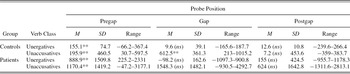
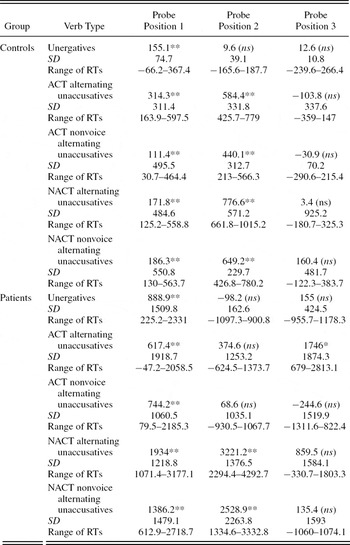
We next conducted separate repeated measures ANOVAs with mean priming effect (lexical decision times to unrelated minus related probes) as within subject factor per each group, per each probe position, per each verb class, as well as per each sentence, per each probe point to search for the source of the aforementioned interactions. The overall mean priming effect for each group, each verb class (unergatives, unaccusatives) and probe position (pregap, gap, postgap) calculated across all data is presented in Table 4. These are reported here for the subject (F1) analysis, collapsing over items; the analysis (F2) collapsing across subjects reveals nearly identical results.
Mean, standard deviation, and range of priming effects (lexical decision time to unrelated minus related probes) for the controls and the Broca group as a function of verb class (unergatives, unaccusatives) and probe position (subject based; F1 analysis)

Note: The statistical significance of priming effects (i.e., significant evidence of antecedent reactivation) is indicated by **p < .05 (significant), *.05 < p < .07 (marginally significant), or nonsignificant.
The preplanned trend analyses for the control group with unergative and unaccusative items (sentences) as the random variable, yielded a significant linear trend for the unergative verbs, suggesting that the antecedent was activated at Position 1, it then decayed and it was not reactivated at a later point in time (F2 (1, 15) = 63.420, p < .000), and a quadratic trend for the unaccusative verbs, meaning that the antecedent reactivation effect grew stronger at Position 2 and decayed at Position 3 (F2 (1, 29) = 31.002, p < .000). With respect to the aphasic group, the trend analysis of their data across the three probe positions yielded a significant linear trend for both the unergativeFootnote 10 and the unaccusative verbs (F2 (1, 15) = 14.499, p < .005, and F2 (1, 29) = 4.438, p < .05, respectively).
Priming effect for the control and the Broca group as a function of the unaccusative verbs' [±voice-alternation] property
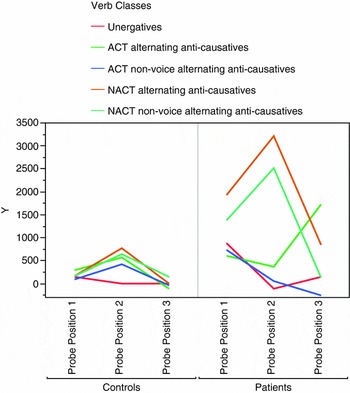
Further within-group trend analyses with alternating and nonvoice-alternating unaccusatives as the between-subject factor revealed an effect of the [±voice-alternation] dimension on unaccusative sentence processing. More specifically, the analyses for the control group yielded significant quadratic trends for the ACT alternating and NACT nonvoice-alternating unaccusatives, while the quadratic trends for the ACT nonvoice-alternating and NACT alternating unaccusatives were found to be marginally significant, F2 (1, 7) = 42.699, p < .000 for ACT alternating unaccusatives, F2 (1, 7) = 5.098, p = .059 for ACT nonvoice-alternating unaccusatives, F2 (1, 6) = 5.110, p = .06 for NACT alternating unaccusatives, and F2 (1, 6) = 16.625, p < .01 for NACT nonvoice-alternating unaccusatives. In contrast, the ACT nonvoice-alternating unaccusatives for the aphasic group showed a linear trend, F2 (1, 7) = 10.039, p < .02, whereas the NACT unaccusative verb categories yielded marginally significant quadratic trends, indicating a stronger (than Position 1) priming effect at Position 2 and antecedent decay at Probe Position 3, F2 (1, 6) = 5.196, p = .063 for NACT alternating unaccusatives, and F2 (1, 6) = 4.898, p = .069 for NACT nonvoice-alternating unaccusatives. Of the most interest, the analysis for the ACT alternating unaccusatives also yielded a near-significant quadratic trend, F2 (1, 7) = 5.042, p = .06, which was characterized by a U-shaped activation pattern, thus implying that there is priming for the subject DP at Position 1, then decay in activation at the gap position, and then reactivation of the antecedent at Probe Position 3.
An analysis of the RT data with subjects as the random variable (F1) yielded comparable results. More specifically, repeated measures analyses for the control group, for each of the verb categories yielded a linear trend for the unergatives, F1 (1, 14) = 55.782, p < .000, and a quadratic trend for the rest of the verbal sets, F1 (1, 14) = 93.834, p < .000 for the ACT alternating unaccusatives, F1 (1, 14) = 9.802, p < .01 for the ACT nonvoice-alternating unaccusatives, F1 (1, 14) = 13.007, p < .01 for NACT alternating unaccusatives, and F1 (1, 14) = 38.547, p < .000 for NACT nonvoice-alternating unaccusatives. In contrast, the analysis for the Broca group yielded a linear trend for the unergatives and the ACT nonvoice-alternating unaccusatives, F1 (1, 7) = 6.915, p < .04, and F1 (1, 7) = 10.039, p < .02, respectively, and a quadratic trend for the ACT alternating unaccusatives (near-significant p value), the NACT alternating and nonvoice-alternating unaccusatives, F1 (1, 7) = 5.042, p = .06 for the ACT alternating unaccusatives, F1 (1, 7) = 7.928, p < .03 for the NACT alternating unaccusatives, and F1 (1, 7) = 5.819, p < .05 for the NACT nonvoice-alternating unaccusatives. The overall mean priming effect for each group, each verb type (ACT alternating unaccusatives, ACT nonvoice-alternating unaccusatives, NACT alternating unaccusatives, and NACT nonvoice-alternating unaccusatives) and probe position (pregap, gap, postgap) calculated across all data is presented in Table 5. These are reported here for the subject (F1) analysis, collapsing over items (see also Figure 1 for each group's priming trajectories).
The priming effect (lexical decision time to unrelated minus related probes) for both groups as a function of probe position (pregap, gap, postgap) and verb type (unergatives, active [ACT]-alternating unaccusatives, ACT-nonalternating unaccusatives, nonactive [NACT]-alternating unaccusatives, and NACT-nonalternating unaccusatives).

Mean priming effect (lexical decision time to unrelated minus related probes) and standard deviations for the controls and the Broca group as a function of probe position (pregap, gap, postgap) and the unaccusative verbs' [± voice alternation] property (subject based; F1 analysis)

Note: The statistical significance of priming effects (i.e., significant evidence of antecedent reactivation) is indicated by **p < .05 (significant), *.05 < p < .07 (marginally significant), or nonsignificant.
A comparison between the verb types at each position for each group, which was done by one-way ANOVAs for each probe position with verb type as the repeated measure yielded different results for the controls and the aphasic group. More specifically, with respect to the controls, the analysis revealed no difference between the verb types for Probe Position 1 (p = .54) or for Probe Position 3 (p = .81), but yielded a significant effect of verb type for Probe Position 2, F2 (4, 41) = 11.407, p < .000. Further posthoc tests revealed that such effect at Probe Position 2 was derived from significant differences between the unergatives and the rest of the verb types, namely, ACT alternating unaccusatives, t (7) = 4.991, p < .001, ACT nonvoice-alternating unaccusatives, t (7) = 3.678, p < .005, NACT alternating unaccusatives, t (6) = 3.625, p < .005, and NACT nonvoice-alternating unaccusatives, t (6) = 6.107, p < .0005 (one-tailed, item-based data; collapsing across subjects). This supports the pattern of antecedent activation for the five verb types which was found by the trend analyses. In contrast, the analysis for the Broca group revealed no difference between the verb types for Probe Position 1 (p = .40), but yielded a significant effect of verb type for both Probe Positions 2 and 3, F2 (4, 41) = 12.498, p < .000, and F2 (4, 41) = 2.720, p < .05, respectively. More specifically, the verb type effect at Position 2 was mainly derived by the significant differences between the NACT unaccusatives (both alternating and nonvoice alternating) and the rest of the verb categories, namely, unergatives and ACT alternating and nonvoice-alternating unaccusatives, t (6) = 5.768, p < .0005 for the difference between unergatives and NACT alternating unaccusatives, t (6) = 2.848, p < .02 for the difference between unergatives and NACT nonvoice-alternating unaccusatives, t (6) = 4.163, p < .005 for the difference between ACT alternating unaccusatives and NACT alternating unaccusatives, t (6) = 1.768, p < .05 for the difference between ACT alternating unaccusatives and NACT nonvoice-alternating unaccusatives, t (6) = 3.932, p < .005 for the difference between ACT nonvoice-alternating unaccusatives and NACT alternating unaccusatives, and t (6) = 2.061, p < .04 for the difference between ACT nonvoice-alternating unaccusatives and NACT nonvoice-alternating unaccusatives. In contrast, the verb type effect at Probe Position 3 stemmed from significant differences between ACT alternating and nonvoice-alternating unaccusatives, t (7) = 3.069, p < .02.
Analysis of RTs for the unrelated probe as indication of processing load
The controls' and the aphasic participants' RT data lent themselves to an additional type of analysis, namely, the measurement of a possible increase in the RTs for the unrelated probes during the priming trajectory from Probe Position 1 to Probe Positions 2, and then to Probe Position 3. To this end, we ran one-way ANOVA analyses for the RTs elicited by the unrelated probe words only, and for each probe position with verb type (unergatives, ACT unaccusatives, NACT unaccusatives) as the repeated measure. With respect to the controls, the analysis revealed no difference between the verb classes for Probe Position 1, but yielded a significant effect of verb class for both Probe Positions 2 and 3, F1 (2, 42) = 5.365, p < .01, and, F1 (2, 42) = 8.525, p < .001, respectively. More specifically, the verb type effect at Position 2 was mainly derived by the significant RT difference, t (14) = 3.925, p < .001 (one-tailed, subject-based data; collapsing across items) detected between the unergatives and the ACT unaccusatives which have yielded the highest RT (for the unrelated probes) among the three verb classes (ACT unaccusatives = 1502.2 ms > NACT unaccusatives = 1424.1 ms > unergatives = 1319.2 ms). The same pattern of performance was registered for Probe Position 3, whereby the RT difference between the unergatives and the ACT unaccusatives was found to be statistically significant, t (14) = 5.252, p < .000, with the highest RTs for the unrelated probes being once more elicited by the ACT unaccusative verb class (ACT unaccusatives = 1579.8 ms > NACT unaccusatives = 1514 ms > unergatives = 1447.8 ms). In contrast, the analysis of the aphasic data for the unrelated probes across the three probe positions has not revealed a significant verb type effect for any of the positions. Yet, it is worth mentioning that the NACT unaccusative verb class tended to systematically yield the highest RTs for the unrelated probes relative to the unergatives and the ACT unaccusatives, with the specific difference becoming more pronounced at Probe Position 2 (NACT unaccusatives = 4717.7 ms > ACT unaccusatives = 3229 ms > unergatives = 3049.9 ms) and Probe Position 3 (NACT unaccusatives = 4595.5 ms > ACT unaccusatives = 3396.1 ms > unergatives = 3315.3 ms). Based on the specific data, there was an increase in RTs for the unrelated probes at Probe Position 3 compared to Probe Position 2 for both unergatives and ACT unaccusatives across both the control (increase of 128.6 ms for unergatives, and 77.6 ms for ACT unaccusatives) and the aphasic group (increase of 265.4 ms for unergatives, and 167.1 for ACT unaccusatives). On the contrary, while the controls have exhibited an increase of 89.9 ms at Probe Position 3 for NACT unaccusatives, the patients have exhibited a decrease of 122.2 ms for the same verb category. These differences among the three verb classes were not found to be significant on either item (F2) or subject analysis (F1).
Priming effect for the control and the Broca group as a function of the [±animacy] of the syntactic subject
Finally, the manipulation of the [±animacy] feature of the syntactic subject of the verbs across both ACT and NACT unaccusatives in the CMLP task allowed us to evaluate our initial hypothesis that animacy drives syntactic predictions during the processing of the two verb categories. To this end, we ran (a) a comparison between the priming effect elicited by the unergatives (RTs for unrelated probes minus RTs for related probes) and the priming effect elicited by the ACT unaccusatives in the animate trials only (RTs for unrelated, animate probes minus RTs for related, animate probes) at each probe position for each group, which was done by one-way ANOVAs for each probe position with verb type as the repeated measure, and (b) a comparison between the priming effect elicited by the animate trials (RTs for unrelated, animate probes minus RTs for related, animate probes) and that elicited by the inanimate trials (RTs for unrelated, inanimate probes minus RTs for related, inanimate probes) of the NACT unaccusative verb class for each probe position, for each group, which was done by one-way ANOVAs for each probe position with [±animacy] of the subject as the repeated measure.
With respect to the control group, the results from the comparison between the unergatives and the ACT unaccusatives revealed a significant effect of verb type at Probe Position 2: the priming effect for ACT unaccusatives was reliably stronger relative to the unergatives, F1 (1, 28) = 3.983, p < .05, which probably implies that the unaccusative verb subcategorization drove syntactic expectations about argument realization as early as immediately after the verb, thus disregarding animacy violations. In fact, the trend analysis for the animate trials in the ACT unaccusative verb condition, with subjects as the random variable, yielded a significant quadratic trend, F1 (1, 14) = 7.604, p < .02, suggesting that there is priming for the syntactic subject DP, then reactivation of the antecedent at Probe Position 2, and there is no reactivation of the antecedent at a later temporal point. With respect to the aphasic patients, the same analysis yielded no significant difference between the two verb types for neither position; the trend analysis for the animate trials in the ACT unaccusative verb condition has yielded a nonsignificant linear trend (p = .14).
In contrast, the analysis comparing the priming effect between animate and inanimate trials in NACT unaccusatives revealed a significant effect of animacy at Probe Position 2 for both groups; the priming effect for the inanimate trials was found to be considerably stronger relative to the animate trials, F1 (1, 28) = 5.219, p < .03 for the controls, F1 (1, 14) = 8.769, p < .01 for the Broca group. More specifically, the trend analyses have yielded significant quadratic effects for the inanimate trials, F1 (1, 14) = 11.419, p < .005 for the controls, F1 (1, 7) = 6.535, p < .04 for the patients, indicating reactivation of the antecedent at the gap position and then decay of the priming effect. On the contrary, the trend analyses for the animate trials in the NACT unaccusative verb condition yielded significant for the controls but nonsignificant for the patients U-shaped trends, F1 (1, 14) = 16.139, p < .01 for the controls, F1 (1, 7) = 4.021, p = .08 for the patients, thus suggesting decay in activation at Probe Position 2, and then reactivation of the antecedent at Probe Position 3.
DISCUSSION
In this study we have investigated the processing of unaccusativity in a group of patients with Broca aphasia and a group of language-unimpaired control participants by using the CMLP technique. To review, we auditorily presented unergative and unaccusative sentences, the latter appearing with either ACT or NACT voice morphology and with animate or inanimate entities in the syntactic subject position. We presented visual probes either semantically related to the subject-antecedent DP or unrelated probes, and these probes were presented at one of three probe positions: pregap, gap, and postgap sites. With this task, shorter RTs to probes which were semantically related to the derived subject DP, relative to the RTs for the unrelated probes, would indicate activation/priming of the antecedent.
The results indicate distinct priming patterns for the Broca group relative to the language-unimpaired control group, as evinced by significant interactions involving the group variable. The aphasic group evinced no priming at either gap or postgap position for the ACT nonvoice-alternating unaccusative verbs, while late antecedent reactivation (at Probe Position 3) was reported for the patients for the ACT voice-alternating unaccusative verb class. Language-unimpaired controls, in contrast, evinced reactivation of the antecedent immediately at the gap position regardless of the unaccusative verbs' morphological marking (ACT/NACT) or their [± voice-alternation] property. The pattern of aphasic performance suggests that the processing deficit underlying Broca aphasia percolates to their lexicon-filtered system which is responsible for the valuation of some intransitive verbs as unaccusatives in the absence of an overt (NACT) morphological marking on their stem. The late priming effect registered at the postgap position (i.e., at Probe Position 3) for the ACT voice-alternating unaccusatives implies that the possibility of these verbs to appear with NACT voice morphology enhanced the reactivation of the antecedent even in a protracted manner.
A possible explanation for this pattern of performance is that the additional underlying layer of mediopassive morphology in ACT voice-alternating unaccusatives functions as a marker of transitivity and thus facilitates antecedent reactivation, par consequence, grammatical encoding for the specific verb type. The finding that the patients have eventually reactivated the displaced argument at a later temporal window (after the gap site) is probably related to the Broca group's delayed access to the critical verb's underlying NACT morphology. If syntactic structure for ACT unaccusatives must be built at the gap site requiring parallel access to the verb's conceptual representation and lexicon-filtered information, perhaps there was just not enough time for our Broca patients to gain timely access to the verb's voice-alternating property. Probably, the coordination of multiple types of information (i.e., syntactic output, voice morphology, lexicon) in overlapping time spans overwhelms the processing system in Broca aphasia, thus postponing the reconstruction of the missed constituent till a later temporal window once voice morphology cues are fully accessed. This possibility is directly related to accounts that speak in favor of an overall slowing down of formal syntactic operations, including the Voice○ projection, in Broca aphasia (Burkhardt et al., Reference Burkhardt, Piñango and Wong2003, Reference Burkhardt, Avrutin, Piñango and Ruigendijk2008).
Furthermore, a rather interesting caveat is derived from the patients' antecedent reactivation pattern of performance in ACT voice-alternating unaccusatives. Some of the language comprehension models claiming for a disruption of some process crucial to the comprehension of movement-derived sentences in Broca patients rest on evidence of a reduced verbal working memory capacity. These models (e.g., Martin, Reference Martin2003; Rogalsky, Matchin, & Hickok, Reference Rogalsky, Matchin and Hickok2008) posit that verbal working memory functions are associated with activation in the Broca area, such that a trauma to the specific brain region may reduce the efficiency of retrieval mechanisms necessary for restoring information into active memory, thus increasing language difficulties for the aphasic patients. Following the same line of reasoning, voice-alternating verbs implicating an additional morphological layer should increase the amount of items that either need to be held in memory or be retrieved during integration processes. The findings of the present study provide evidence in favor of the patients' spared (yet, delayed) access to the NACT morphological alternant of ACT voice-alternating unaccusatives; such morphophonological cue may be held responsible for the presence of a priming effect in the ACT voice-alternating, but not in the ACT nonvoice-alternating unaccusatives.
One possibility for such pattern of performance is that the [+voice-alternation] property of unaccusative verbs is relevant in a separate morphological interface, which computes the morphophonologically distinct voice forms of a single voice-alternating verbal root, while a different mechanism computes hierarchical syntactic relations. The idea of a presyntactic morphology interface responsible for the morphological realization of categories retrieved from the lexicon was first introduced by Froud (Reference Froud2001) to account for her aphasic patient's morphological representations of functional categories. Froud conceived of such an interface as an isolable module in the language faculty that feeds into syntax. It is crucial that the morphology interface is not available to top-down interference, thus it is not subject to the memory-based constraints modeling linguistic production and comprehension. We may thus account for the Broca group's ability to gain access to the NACT morphological alternant of ACT voice-alternating unaccusatives in terms of a relatively intact morphological processing stream that is assumingly independent from memory-based limitations. This explanation is also consistent with Caplan and Waters' (Reference Caplan and Waters1996, Reference Caplan and Waters1999), and Waters and Caplan's (Reference Waters and Caplan2004) theory of working memory as a set of resources that each support different language comprehension functions.
In contrast, the aphasic group's antecedent reactivation pattern in NACT (both alternating & nonalternating) unaccusative verbs was striking in its similarity to the language-unimpaired subjects; a priming effect was observed immediately after the critical NACT verb at the gap site. Partial support for the distinctive priming behaviour of the NACT unaccusative verb class (relative to the ACT unnacusatives) in the Broca group is also offered by the verb class effect that has emerged at Probe Position 2 and has set apart NACT from ACT unaccusatives in terms of the strength of the two sets' priming effect. The patients' timely establishment of a link between the postverbal trace and its antecedent in real time for NACT unaccusatives validates our previous finding that the NACT suffix serves as a substantial morphosyntactic cue to the on-line derivation of the argument structure of the unaccusative verbs. The specific assumption requires that the patients are sensitive to the verbs' morphology, and this sensitivity is probably contingent on the strong interpretability of the NACT morpheme; the morphological marking of the verb after the suppression of the external theta feature indicates a thematic structure/transitivity change. In this sense, the specific finding conflicts with the impaired interpretable features hypothesis which proposes that “functional categories that carry interpretable features cause more difficulties to nonfluent aphasic subjects” (Varlokosta et al., Reference Varlokosta, Valeonti, Kakavoulia, Lazaridou, Economou and Protopapas2006, p. 742) and that for these patients “the morphophonological realisation of interpretable features [is] not functioning” (Nanousi et al., Reference Nanousi, Masterson, Druks and Atkinson2006, p. 235).Footnote 11 The facilitatory role of the unaccusative verb's morphological marking on the on-line dependency formation between the postverbal trace and the derived subject position does not appear to emerge in production where morphophonological complexity of inflected verb forms predicts retrieval difficulties for aphasic patients (e.g., Miceli & Caramazza, Reference Miceli and Caramazza1988).
The patients' processing of unergative verbs, in contrast, offers evidence in favor of the aphasic individuals' sensitivity to the subcategorization information encoded in the specific verb class. Such sensitivity was manifested in the lack of a significant priming effect at either gap or postgap position. Nevertheless, the weak upwards shift of the priming trajectory at Probe Position 3 for the unergatives implies a replanning of the sentence-initial planning window for the patients, and can (carefully) be interpreted as a weak antecedent reactivation effect at the postgap site. Of the most interest, this pattern of performance was encountered in Burkhardt et al.'s (Reference Burkhardt, Piñango and Wong2003) study wherein the unergatives registered a statistically significant priming effect 100 ms after the verb for the neurologically intact control subjects. As already mentioned, this effect was accounted for in terms of the VP-internal subject hypothesis (Koopman & Sportiche, Reference Koopman and Sportiche1991).
According to the present study, this finding for the Broca group could be accounted for by different possibilities. One first account may be that the patients' syntactic deficit impeded on their full access and utilization of the subcategorization information of the verbs that were ultimately interpreted by the patients as transitives. Yet, this explanation does not fully account for the priming effect emerging at Probe Position 3 and not immediately after the verb at the gap site. According to the second possibility, the specific pattern could reflect the systematic grammaticalization of transitivity reported for an increasing number of verbs of semitransparent intransitivity in the Greek language (Roussou & Tsimpli, Reference Roussou, Tsimpli and Alexiadou2007). There is empirical evidence from Modern Greek showing that lexical transitivization takes place in a specific subclass of unergative/intransitive V-roots (mainly manner of motion and bodily function verbs; some of them are used in the present task, see unergatives in the Appendix B) in which the correlation between unergativity and intransitivity is not absolute. This semitransparency allows for the verbs' causativization, with the ultimate aim of shifting the attentional focus from the causee to the cause of the event portrayed by the verb (e.g., Ta pola eksoδa jonatisan ton patera tu Adrea/(literal translation): “The many expenses kneeled Adreas' father,” O δimosiojrafos δierefse tin iδisi oti epikite anashimatismos tis kivernisis/“The journalist leaked the news that a Cabinet shuffle is underway,” Me afta pu foras pos na se kikloforiso/“How I am supposed to go you out with the clothes that you are wearing?,” I Maria etrekse to projrama/“Maria ran the programme”). If this transitivization procedure is underway in the Greek language, we may reason that the priming effect at the postgap site is not due to a disruption of information encoded in the subcategorization restrictions of the unergative verbs in question, but rather to a causativization procedure triggered by discourse-based reasons that raised the patients' expectancy levels for a postverbal object.Footnote 12
Partial insights into the language processing capacities of the Broca group are also gained by its RTs for the unrelated probes across both the unergative and the unaccusative verbs. More specifically, the specific data were treated as an indication of gap filling (Friedman et al., Reference Friedmann, Taranto, Shapiro and Swinney2008; Shapiro, Gordon, Hack, & Killackey, Reference Shapiro, Gordon, Hack and Killakey1993; Shapiro, Nagel, & Levine, Reference Shapiro, Nagel and Levine1993; Shapiro, Zurif, & Grimshaw, Reference Shapiro, Zurif and Grimshaw1987; Reference Shapiro, Zurif and Grimshaw1989) such that unmet expectations of an unrelated probe at the gap position (needed to be filled with the antecedent) would result in considerably increased RTs for the relevant trials. The first point to be noted relates to the unexpected finding that the greatest postverbal increase in RTs for the unrelated probes was registered for the unergative verbs at Probe Position 3 across both experimental groups. Although this result was not found to be significant it may carefully be interpreted as evidence in favor of a transitivization effect. More specifically, one viable possibility is that the increase in RTs (for the unrelated probes) reflects the participants' unmet expectations for a postverbal object, like in transitive sentences.
Another point worth mentioning pertains to the finding that the patients' RTs for the unrelated probes were not significantly different across the various verb classes, except maybe from their tendency to slow down their lexical responses for the unrelated probe trials especially in the NACT unaccusative verb condition at both Positions 2 and 3. On the contrary, RTs for the ACT unaccusative verbs for the control group were significantly contrasted with the RTs for the unergatives, with the latter eliciting the shortest RTs during on-line sentence processing. The lack of a parallel effect in the Broca group offers support for our assumption that unergatives and ACT unaccusatives were treated in the same way by the patients. Perhaps, the individuals with aphasia did not exert more effort as the complexity of the linguistic materials increased, as is the case with ACT unaccusatives which require a combinatorial stream of information from both the lexicon and the syntactic output for their resolution. This is consonant with the experimental literature demonstrating that individuals with aphasia have difficulty monitoring their own performance, appropriately evaluating task demands, and thus allocating a sufficient amount of resources for the successful processing of the sentences (Murray, Holland, & Beeson, Reference Murray, Holland and Beeson1997; Tseng, McNeil, & Milenkovic, Reference Tseng, McNeil and Milenkovic1993). In contrast, the overall slowing down of the patients' lexical responses for the NACT unaccusatives at the postverbal region may be attributed to the morphophonological complexity of the mediopassive morpheme; the decomposition of a NACT verb produces more “activity” than the processing of a morphologically less complex form (Tsimpli, Reference Tsimpli, Unshworth, Parodi, Sorace and Young–Scholten2006). Following this reasoning, a second viable account for the patients' lack of a significant RT difference across the different verb types at the postverbal region is that the processing resources of the individuals with aphasia were taxed to the maximum by the NACT unaccusative sentences to begin with, such that, increasing complexity of the ACT unaccusative sentences did not further impact RTs for the unrelated probes.
We end by elaborating on the evidence highlighting the crucial role played by the [±animacy] of the subject in the modulation of the patients' parsing choices for the unaccusative sentences. The lack of a significant postverbal difference between the priming effect elicited by unergatives and ACT unaccusatives with an animate subject in the Broca group evinces that both structures were parsed in a similar manner; there was no reactivation of the antecedent for ACT unaccusatives with an animate entity in subject position. The most plausible explanation for this pattern of performance relates to a heuristic-based strategy of thematic role assignment whereby an animate entity in subject position is a prototypical actor/agent, as such, it best qualifies for an unergative or a transitive parsing scenario. Following the specific heuristics, we hypothesize that the animacy of the subject argument in ACT unaccusatives might have led the aphasic parser to assume an unergative (or a transitive with a null object) interpretation, thus blocking antecedent reactivation postverbally. On the contrary, the controls appeared not to be influenced by the animacy of the subject during the processing of ACT unaccusatives; the difference in the priming effect between the two verb classes (i.e., unergatives vs. ACT unaccusatives) was found to be significant, thus suggesting that a syntactically and lexically determined interpretation construing the subject as originating from an internal argument position in ACT unaccusatives tended to overcome any animacy bias.
The comparison between the priming effects elicited by animate and inanimate subjects in NACT unaccusatives points towards the same interpretive direction, that is, the crucial interference of animacy heuristics during on-line agrammatic sentence processing. More specifically, the postverbal priming effect for the inanimate trials was found to be considerably stronger relative to the animate trials, which have exhibited weak signs of antecedent reactivation at the postgap position. We believe that the U-shaped trajectory of the priming effect in NACT unaccusatives with an animate subject is attributed to a garden-path effect caused by the early interference of the reflexive reading during on-line sentence processing. The reader is reminded that NACT verbs with an animate subject are also prone to a reflexive interpretation (along with the unaccusative one) whereby the single syntactic argument is the verb's true, nonderived agent. The lack of an antecedent reactivation effect at Position 2 for NACT unaccusatives with an animate subject may thus be attributed to the dominance of the reflexive reading, which is a relatively cost-free parsing option relative to the “copy–paste” procedure (that is, the reconstruction of the DP subject at a postverbal position) implicated in unaccusatives. The temporal span available to the patients after the gap has probably allowed them some time to access the verbs' lexical information, yet, it was not enough to attain at significant antecedent reactivation for the relevant verb class at Probe Position 3.
It is crucial that the dissociation between the priming effects elicited by the animate and the inanimate trials in NACT unaccusatives for the Broca group was most pronounced for Probe Position 2 (i.e., the gap site). Such finding implies that the patients gained access to the [±animacy] of the verb's subject immediately after the verb. On the contrary, the reader is reminded that the patients' access to the underlying NACT voice morphology for the ACT voice-alternating unaccusative verbs was achieved at a later point during the temporal unfolding of the sentence (i.e., at Probe Position 3). Such pattern of performance is consistent with the observation that Broca patients primarily rely on semantic information in assigning thematic roles to syntactic arguments in general (Saffran, Schwartz, & Linebarger, Reference Saffran, Schwartz and Linebarger1998).
It is of the most interest that the control group has exhibited similar to the Broca group's patterns of performance across both the animate and the inanimate trials in NACT unaccusatives: a significant priming effect was registered for the inanimate subject trials immediately after the verb, while controls' more robust (relative to the patients) lexical preferences secured a significant priming effect for the animate subject trials as well, yet, in a protracted manner (at Probe Position 3). The particular evidence suggests that the use of heuristics (in other words, a model of parsing that assumes a minimal effort principle for initial parsing) reflects both Broca patients' and language-unimpaired subjects' linguistic system. Such assumption appears to be in line with a number of linguistic and psycholinguistic studies with control populations (e.g., Chang, Bock, & Goldberg, Reference Chang, Bock and Goldberg2003; Pappert, Zeiske, & Pechmann, Reference Pappert, Zeiske and Pechmann2009) showing how animacy heuristics are extensively employed during thematic role assignment (especially in morphologically rich languages) in the parsing of noncanonical constructions, as well as in the resolution of syntactic ambiguities. Unfortunately, the use of animacy heuristics has been rarely explored in Broca aphasia; yet, we believe that further and deeper work on the specific issue may eventually lead to a better understanding of language processing in both healthy and impaired populations.
CONCLUSION
The present study has focused upon investigating Broca patients' sensitivity to the unaccusativity features of intransitive verbs in Greek by using the CMLP technique. Of the most importance, the analyses were also directed to assess which representational type of verb, if any, determined unaccusative verb processing complexity for the patients by manipulating the [±voice-alternation] property of unaccusative verbs in the Greek language. The data from the left-hemisphere damaged subjects show that lexical specification of unaccusativity alone can not account for the patients' processing performance; the patients did not show reactivation of the antecedent for the ACT nonvoice-alternating verbs, while they showed delayed antecedent reactivation for the ACT voice-alternating unaccusatives, thus revealing a protracted reconstruction effect for the latter. This result is in line with previous work suggesting a slow-rise time of syntactically relevant processing routines in agrammatic aphasia, further elucidating Broca patients' difficulty with gaining timely access to the verbs' underlying morphology. In contrast, the NACT verbs were found to be normally reconstructed by the Broca group at the elided position and no later than that. Such evidence suggests that the patients consistently take into account the verbs' (marked) voice morphology during on-line sentence processing. Unlike the patients, the controls did not show the asymmetric pattern of NACT > ACT morphology in their priming trajectories, which has been linked to their direct access to the verbs' lexical specifications at the lexicon-syntax interface. It is crucial that the analyses suggest that not only voice morphology cues but also information on the animacy features of the derived subject in unaccusatives is systematically related to the patients' parsing options during on-line unaccusative sentence processing. These data show how together morphological and semantic information facilitates (or hinders) the on-line interpretation of unaccusatives. Experimental materials drawn from languages other than English, thus supplement existing evidence on unaccusativity processing by Broca patients by providing a means of examining the nature of morphology and animacy influences on agrammatic comprehension, and thereby helping to refine accounts of antecedent reactivation patterns in unaccusatives.
Lesion information of each participant in the Broca group

APPENDIX B: TESTING SENTENCES
Unergatives
1. O jiatros # me ti lefki poδia ksafnika hamojelase # otan i omorfi nosokoma # perase apo to δiaδromo
“The doctor with the white apron suddenly smiled when the beautiful nurse walked down the corridor”
2. To moro # apo tin proti mu ksaδerfi ksafnika δipsase # otan iδe ti thia mu # na pini nero
“My first cousin's baby suddenly got thirsty when he saw my aunt drinking water”
3. O thios # me ti mejali kilia sinehia rohalize # otan pijene sto krevati # ke ton eperne o ipnos
“The uncle with the big belly was always snoring when he was going to bed and dozed off”
4. O iδravlikos # me tin kokini forma ksafnika lipothimise # otan i zesti mesa sto δomatio itan foveri # kai kanena parathiro δen itan anihto
“The plumper with the red uniform suddenly fainted when the heat in the room was unbearable and no window was open”
5. O psaras # me to majazi sti jonia ksafnika pinase # otan iδe enan psilo kirio # na troi mia tiropita
“The fisherman with the shop in the corner suddenly got hungry when he saw a tall man eating a cheese-pie”
6. I δaskala # me ta mavra malia sinehia aperjuse # otan i kivernisi athetise tis iposhesis tis # ke δen eδose tis afksisis
“The teacher with the black hair was continuously on strike when the government didn't keep its promises and didn't grant the raises”
7. O arheolojos # me to mejalo kapelo ksafnika evikse # otan i skoni apo ton aera itan poli # ke bike sto stoma tu
“The archaeologist with the big hat suddenly coughed when the dust from the air got into his mouth”
8. O mastoras # me ta siδerenia erjalia ksafnika δakrise # otan espase to poδi tu # ke o jiatros tu apajorepse na ksanaδulepsi
“The craftsman with the iron tools suddenly wept when he broke his leg and the doctor forbade him to work again”
9. O athlitis # me to htipimeno poδi ksafnika ponese # otan pije na kani jimnastiki # sto jimnastirio tis jitonias tu
“The athlete with the hurt leg suddenly felt a pain when he tried to exercise at the gym of his neighborhood”
10. O δikastis # me to mavro hartofilaka ksafnika etrekse # otan o katijorumenos gia to fono # evjale krifa tis hiropeδes tu
“The judge with the black suitcase suddenly ran when the man who was accused for murder has secretly put out his handcuffs”
11. I nikokira # me tis poles sakules sta heria vaδize # otan o listis me ti mavri kukula # tis arpakse me via tin tsada
“The housewife with the many shopping bags on her hands was walking when the thief with the black hood has violently grabbed her bag away”
12. O δolofonos # me to ageliko prosopo ksafnika δrapetefse # otan o astinomikos kimithike stin karekla tu tmimatos # ekso apo to keli
“The murderer with the angelical face suddenly escaped when the policeman fell asleep on the chair of the police station right out of the cell”
13. I nifi # me to makri nifiko sinehia horeve # otan teliose to fajito tis δeksiosis # ke ta klarina arhisan
“The bride with the long gown was dancing all the time when the dinner of the reception has finished and the clarinets began to play music”
14. I ipiretria # me ti lefki poδia ksafnika fovithike # otan iδe to listi me ti mavri kukula # na beni sto spiti apo to parathiro
“The maid with the white apron suddenly got scared when she saw the thief with the black hood getting into the house through the window”
15. O enikiastis # tu δiamerismatos sto δeftero orofo ksafnika efije # otan pire metathesi stin Athina # ke anagastike na metakomisi
“The tenant of the apartment on the second floor suddenly left when he got transferred to Athens and he was forced to leave”
16. I mathitria # tu tritu thraniu ksafnika jelase # mesa sti mesi tu mathimatos tis istorias # otan o δiplanos tis ipe ena anekδoto
“The student sitting at the third desk suddenly laughed in the middle of the history class when the student next to her cracked a joke”
ACT unaccusatives
1. O trajuδistis # me tis poles epitihies ksafnika kriose # otan vjike horis palto # sto δromo pu hionize
“The singer with the many hits suddenly got cold when he went out on the street without a coat while it was snowing”
2. O epihirimatias # me ta tria erjostasia ksafnika lijise # otan i trapeza δen tu eδose to δanio # ke hreokopise
“The businessman with the three factories suddenly bent when the bank didn't grant him the loan and he went bankrupt”
3. I mitera # me to varia arosto peδi sinehia elione # kathos etrehe sinehia sta nosokomia # horis to peδi tis na ginete kala
“The mother with the ill child was wasting way since she kept going to hospitals without her child being healed”
4. O hrimatistis # me tis poles metohes ksafnika espase # otan meta apo mia perioδo ikonomikis krisis # emathe oti ehase ola ta kerδi tu
“The broker with the many stokes suddenly broke when after a period of financial crisis he learnt that he has lost all of his profits”
5. To ajori # me ta mavra malia ksafnika δiplose # sto eδafos apo aforitus ponus # ke fonaze ti mama tu
“The boy with the black hair suddenly folded on the ground with unbearable pains and he was screaming for his mother”
6. To koritsi # me to roz forema ksafnika htipise # otan epeze kinijito stin peδiki hara # ke jlistrise
“The girl with the pink dress suddenly hit when she was playing tag at the playground and she slipped”
7. To moro # me ta ble matia ksafnika lerose # mia ora meta to fajito # otan ekane emeto
“The baby with the blue eyes suddenly spilled himself one hour after lunch when he vomited”
8. To prosopo # tis ilikιomenis kirias ksafnika tedose # meta tin triti plastiki epemvasi # pu ekane to kalokeri
“The face of the old lady suddenly stretched after the third plastic surgery that she had in the summer”
9. To δedro # sto kedro tu kipu ksafnika anthise # otan o keros ejine kaliteros # ke anevike i thermokrasia
“The tree in the centre of the garden suddenly blossomed when the weather improved and the temperature rose”
10. I varka # me ti mejali tripa ksafnika vuliakse # apo ena megalo kima sti thalasa # ke pije katefthian ston pato
“The boat with the big hole suddenly sank by a big wave in the sea and it went straight to the bottom”
11. Ta malia mu # meta ti vafi ksafnika epesan # otan hrisimopiisa to kenurio proion # pu iha feri apo Ameriki
“My hair after the tint suddenly fell when I used the new product that I had brought from America”
12. To δedro # me ta pola portokalia ksafnika maragiase # meta to δinato halazi to apogevma # ke ola ta fila epesan kato
“The tree with the many oranges suddenly drooped after the strong hail of the afternoon and all its leaves fell down”
13. I simea # stin avli tu sholiu ksafnika eskise # otan fisikse apotoma poli δinatos aeras # ke to kodari epese kato
“The flag in the school-yard suddenly tore when a very strong wind blew all of a sudden and the bargepole fell down”
14. To forema # me ta pola hromata sinehia tsalakoni # logo tis kakis piotitas tu # opu ki an kathiso
“The dress with the many colours crinkles all the time due to its bad quality wherever I may sit”
15. To δomatio # sto vorio tmima tu spitiu eftihos zestane # otan o keros ejine kaliteros # ke anevike i thermokrasia
“The room at the northern part of the house fortunately heated when the weather improved and the temperature rose”
16. To lastiho # tu akrivu aftokinitu ksafnika tripise # otan o oδijos perase apo ena δromo # me spasmena jialia
“The tire of the expensive car suddenly pricked when the driver drove on a road with broken glasses”
NACT unaccusatives
1. I jineka # me ta makria malia ksafnika zestathike # otan kathise se ena pagaki tu parku # ke δen ihe katholu skia
“The woman with the long hair suddenly heated when she sat on a bench at the park where there was no shadow”
2. To provato # sti mesi tu dromu ksafnika komatiastike # otan kapia stijmi htes to apojevma # perase ena fortijo apo pano tu
“The sheep in the middle of the road was suddenly cut up when some moment yesterday afternoon a truck ran over it”
3. O arostos # me tis lijes meres zois ksafnika jiatreftike # otan episkeftike ena monastiri prin lijes meres # ke ekane tama
“The ill man with the few days of life suddenly healed when he visited a monastery a few days ago and he made an offering”
4. I nosokoma # apo ta epijoda ksafnika lerothike # otan patise se laspes # se mia lakuva
“The nurse from the emergency department suddenly spilled herself when she stepped in the mud of a pit”
5. I frura # tis δiasimis trajuδistrias Madonna ksafnika tripithike # otan enas kodos mesilikas adras # katafere na plisiasi tin trajuδistria
“The guard of the popular singer Madonna suddenly pricked when a short middle-aged man managed to approach the singer”
6. O poδosferistis # me to akrivo simvoleo ksafnika δiplothike # sto tetarto lepto tu agona me tin Aglia # otan o astrajalos tu jirise
“The football player with the well-paid contract suddenly folded during the fourth minute of the match with England when his ankle twisted”
7. I ethelodes # jia ton erano eftihos sigedrothikan # otan ta δimosia ke ta iδiotika kanalia # ton δiafimisan me sihna spot
“The volunteers for the fund-raising fortunately assembled when both the public and the private TV channels promoted it with frequent spots”
8. O ilios # jiro sto apojevma ksafnika kriftike # otan ta sinefa apo tin katejiδa # plisiasan ke epiase vrohi
“The sun in the afternoon suddenly hid when the clouds from the storm approached and it started to rain”
9. To ptoma # apo tin ksanthia jineka ksafnika vithistike # otan to erikse sti thalasa # o satanikos δolofonos
“The corpse of the blonde woman suddenly sank in the water when the evil murderer threw it into the sea”
10. Ta luluδia # stin akri tu δromu δistihos marathikan # otan o kipuros arostise poli varia # ke δe δulepse δeka mines
“The flowers in the corner of the street unfortunately withered when the gardener fell heavily sick and did not go to work for ten months”
11. To harti # me tis simiosis ksafnika tsalakothike # otan epese kata lathos kato # ke to patisame me ta poδia
“The paper with the notes suddenly crumpled when it fell down by mistake and we stepped on it”
12. To nisi # sta notia tis Elaδas ksafnika htipithike # apo ena mejalo sismo jiro sta mesanihta # ke ta spitia gremistikan
“The island in the south of Greece was suddenly stricken by a huge earthquake around midnight and the houses collapsed”
13. To lastiho # tis horeftrias ksafnika tedothike # para poli kata ti δiarkia tis parastasis # ke ejine hilia komatia
“The hose of the dancer suddenly stretched too much during the performance and it tore into pieces”
14. I zesti # apo tin Afriki eftihos miothike # meta apo mia poli δinati katejiδa # pu kratise tris ores
“The heat from Africa fortunately faded after a very strong storm that has lasted three hours”
ACKNOWLEDGMENTS
Many special thanks go to the eight aphasic patients for their contribution to the specific paper, the neurologist Tasos Papapostolou for his valuable help, and the two anonymous reviewers for valuable comments and helpful suggestions.