Hospital-onset methicillin resistant Staphylococcus aureus bacteremia (HO-MRSAB) rates expressed as the standardized infection ratio (SIR) are reported annually for each US state as a quality indicator of hospital infection control practice. 1 Risk factors for HO-MRSAB have been well studied at the individual patient level (including African-American race, diabetes, age >65 years, and male gender), but little is known about the extent to which these factors determine variations in HO-MRSAB rates among populations.Reference Tong, Davis, Eichenberger, Holland and Fowler 2 – Reference Kallen, Mu and Bulens 6 While it is generally assumed that variations among states can be explained by differences in the quality of infection control practice, demographic and socioeconomic differences may also play a role.Reference Tong, Davis, Eichenberger, Holland and Fowler 2 , Reference Tong, van Hal, Einsiedel, Currie and Turnidge 7 Better understanding the demographic and socioeconomic determinants of HO-MRSAB would allow more informed interpretation of rate comparisons among states and might also identify population-level risk factors that are, at least in principle, modifiable. We therefore sought to examine the correlation between several putative demographic and socioeconomic determinants and the standardized infection ratio of HO-MRSAB (SIR-HO-MRSAB) using data points for each of the 50 US states plus Washington, DC.
METHODS
State-level SIR-HO-MRSAB data for the year 2013 were obtained from the Centers for Disease Control and Prevention (CDC) website. The SIR is defined as the ratio of each state’s current HO-MRSAB rate to the national rate in 2011. 1 State-level data for demographic and socioeconomic variables were obtained from either US census data or yearly American Community Surveys. 8 , 9 Age-adjusted diabetes rates for each state were obtained from the CDC Diabetes Atlas. 10 The following demographic and socioeconomic state-level variables were examined for potential association with HO-MRSAB rate: median income, percent of the population that self-identify as African American, percent of the population that self-identify as Hispanic or Latino, percent of the population aged ≥65 years, male-to-female gender ratio, percent of the population with diabetes, the Gini coefficient (a standard measure of income inequality between 0 [complete equality] and 1 [complete inequality]), and poverty rate (poverty was defined in absolute terms according to the standard definition used by the US Census Bureau). 8
The Pearson correlation coefficient (R) and 2-tailed P values were obtained using the Pearson test (online calculator at http://www.socscistatistics.com/pvalues/pearsondistribution.aspx). Statistical significance was defined as P<.05. Corresponding data were examined for 2014 to determine whether correlations were observed consistently. Where no data were available for 2014, 2013 data were used (ie, for gender ratio and percent ≥ 65 years). Multiple linear regression was performed using Multiple Regression version 1.0.38 Free Statistics Software version 1.1.23-r7 (Office for Research Development and Education, University of Leuven, Belgium, http://www.wessa.net/rwasp_multipleregression.wasp/) to model the relative predictive power of variables significantly correlated with SIR-HO-MRSAB on univariate analysis.
RESULTS
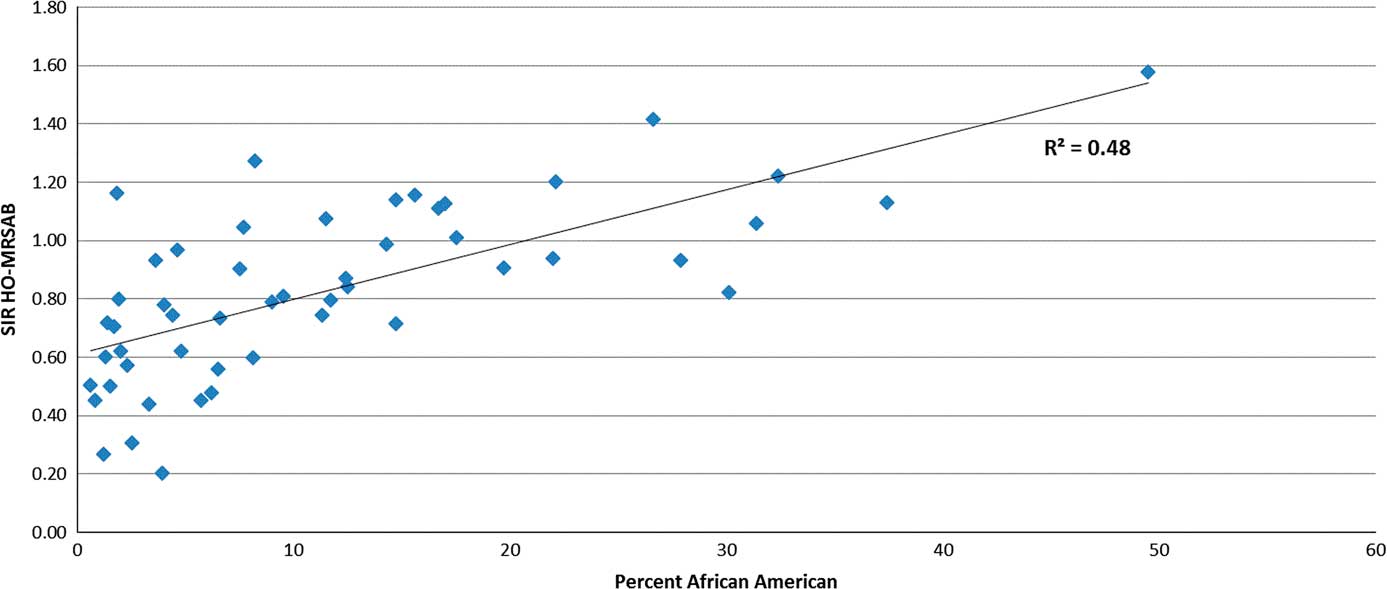
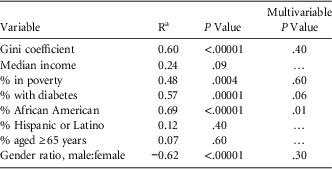
Univariate analyses demonstrated significant positive correlations between SIR-HO-MRSAB and poverty rates, income inequality, percent of the population with diabetes, and percent of the population that self-identify as African American (Table 1; Figure 1). No correlation was observed with median income, percent of the population aged ≥65 years, or percent of the population that self-identify as Hispanic or Latino. An unexpected significant negative correlation was observed with increasing male-to-female gender ratios.
Percent African American by state versus standardized infection ratio of hospital-onset methicillin-resistant Staphylococcus aureus bacteremia by US state, 2013.

Correlation Coefficients and P Values for the 2013 Standardized Infection Ratio of Hospital-Onset Methicillin-Resistant Staphylococcus aureus Bacteremia

a The correlation coefficient, R measures the strength and direction of a linear relationship between 2 variables on a scatterplot. The value of R is always between +1 and –1. A perfect straight line with a positive slope would have an R value of 1 whereas a perfect straight line with a negative slope would have an R value of −1.
Multiple linear regression was performed on variables found to be statistically significant on univariate analysis. The only variable that retained significance in the multivariable model was percent of the population that self-identify as African American. Univariate analyses of 2014 data were similar except that no significant correlation was seen with diabetes rates (data not shown). Multiple linear regression analysis of 2014 data included variables found to be statistically significant on univariate analysis (ie, gender ratio, Gini, poverty rate, and percent African American). This analysis also found that percent African American was the only variable that retained statistical significance in the multivariable model (data not shown).
DISCUSSION
Our findings suggest that interstate differences in HO-MRSAB are not driven solely by variation in hospital infection control practice. Sociodemographic factors such as percent African-American race, income inequality, diabetes, and poverty may also play a role. This finding has practical significance because identifying population-level risk factors for HO-MRSAB is the first step toward developing risk-adjustment tools. Risk adjustment for sociodemographic factors would allow more meaningful comparisons among states and allow the contribution of infection control practice to be more accurately estimated.
Our findings also raise questions about how and why certain sociodemographic factors are correlated with HO-MRSAB rates. The strongest correlation we observed, and the only variable remaining statistically significant on multivariable analysis, was percent of the population of African-American ethnicity. To our knowledge, this finding has not been previously reported at the population level, but it is consistent with previous studies examining risk factors at the individual patient level. In 2011, for example, it was estimated that 34% of all HO-MRSAB nationally were in African American, despite this group comprising only 13% of the total population.Reference Laupland, Lyytikainen and Sogaard 3 It is plausible, therefore, that the positive correlation is a direct result of the disproportionately high incidence of HO-MRSAB in the African-American population. The socioeconomic and biological pathways driving this disparity are poorly understood, although recent whole-genome sequencing work from 2 centers in Chicago found that most strains causing HO-MRSAB were acquired prior to hospitalization and that African-American patients tend to acquire MRSA via shared transmission pathways in the community.Reference Popovich, Snitkin and Hota 11 Further work is needed to determine whether this phenomenon applies more generally to other US states and to elucidate community transmission pathways. Further work is also required to determine whether African Americans colonized with MRSA on admission are more likely to progress to HO-MRSAB than other racial groups.
The correlations we observed with poverty and income inequality also warrant further investigation, although the lack of a significant association after multivariable analysis suggests these variables may have simply been confounded by African-American race. The negative correlation with increasing male-to-female ratio is surprising because male gender has previously been shown to be a risk factor for HO-MRSAB. The explanation for this is uncertain, although measured or unmeasured confounders are possible.
The lack of correlation we observed between SIR-HO-MRSAB and age ≥65 years may be explained by the relatively low variability in the prevalence of this risk factor among states compared to the variability in the percent African American (9%–19% versus 1%–50%, respectively). Another possibility is that the expected increase in HO-MRSAB incidence associated with older populations was overwhelmed by unmeasured and, as yet, uncharacterized effects that operate at the population level.
This ecological study has several limitations. First, correlation does not prove causality. As suggested, our findings require further investigation and validation. Second, not all hospitals in any given state submit HO-MRSAB rates, and it is uncertain how this may have biased the findings. Third, some of the sociodemographic variables for each state were derived from American Community Surveys rather than population-based census data, which may have introduced bias. Finally, we were unable to evaluate the relative contribution of hospital infection control due to lack of an independent quality marker of infection control practice.
Nonetheless, the strength of the correlations we observed, the high level of statistical significance, and the consistency of our findings with previous epidemiological studies should prompt further research in this area, both to develop a practical risk-adjustment tool and to better understand and address sociodemographic determinants of HO-MRSAB.
ACKNOWLEDGMENTS
Financial support: No financial support was provided relevant to this article.
Potential conflicts of interest: All authors report no conflicts of interest relevant to this article.