Introduction
The challenge of dementia
Dementia presents a tremendous challenge to people living with the condition, their social partners, the care and medical sectors, and to societies in general. As life expectancy grows, the societal challenge can only increase worldwide. Alzheimer's Disease International (2009) characterises the situation as a growing epidemic, and states that the number of people with dementia worldwide will increase from a best current estimate of 35.6 million, to 65.7 million in 2030, and to 115.4 million in 2050. Much of the increase will occur in low- and middle-income countries. Using the United Kingdom (UK) as a typical example of the situation facing relatively prosperous, post-industrial nations, there are currently over 750,000 people living with dementia (PLWD) in a population of around 62 million. Projections indicate that by 2025 there will be over a million. About 64 per cent of the residents of care homes for older people in the UK have dementia, although about 66 per cent of PLWD still live in the community (Alzheimer's Society 2010b). Dementia and dementia care currently cost the UK around £20 billion (approximately US $30 billion) annually, at a time when the parlous state of public finances ensures that pressure to find cost-effective means of care is ever more imperative (National Audit Office 2007). At an individual level, people living with dementia typically face an inevitable and progressive (although rarely linear) loss of cognitive functionality. They may face social stigmatisation (e.g. Kontos Reference Kontos2004). Depression and anxiety can also accompany the condition, particularly in the early stages. Communication becomes increasingly more difficult for PLWD and for those around them at a time when the need for effective and sustaining communication is greater than ever (Young, Manthorp and Howells Reference Young, Manthorp and Howells2010).
The role of communication in care
Key recent policy initiatives have highlighted quality of life (Department of Health and Medical Research Council 2009) and communication (Commission for Social Care Inspection (CSCI) 2008) as target areas for improvement in dementia care. These initiatives confirmed a recognition that is current in much of the research literature. The prevailing situation both in terms of support for PLWD and their family members in their homes, and in terms of the quality of formal care currently provided in care homes, is considerably less than optimal, with poor communication practices the norm and appropriate, evidence-based carer communication training highly unusual (e.g. CSCI 2008; Gibson Reference Gibson1999; Goldsmith Reference Goldsmith1996; Koury and Lubinski Reference Koury, Lubinski and Lubinski1995; National Institute for Health and Clinical Excellence (NICE) and Social Care Institute for Excellence (SCIE) 2006) . The still prevalent socially-constructed ‘othering’ of PLWD in society (Young and Manthorp Reference Young and Manthorp2009), also characterised as a malignant social psychology (Kitwood Reference Kitwood1993, Reference Kitwood1997), tends to promote poor communicative practices, social isolation and a lower quality of life than is necessary given the effects of the condition (CSCI 2008; Goldsmith Reference Goldsmith1996; Lubinski Reference Lubinski and Lubinski1995; Ward et al. Reference Ward, Vass, Aggarwal, Garfield and Cybyk2008). Poor communication practices are commonly a response to the behaviours of PLWD, and they support old-age and cognitive-deficiency stereotypes. This in turn stimulates old-age and cognitive-deficiency behaviours in PLWD and so contributes to a downward communicative spiral by which supposed deficits are reinforced and real abilities and potentialities unacknowledged and unsupported (Lubinski Reference Lubinski and Lubinski1995).
A growing literature on dementia suggests that effective, appropriate communication can improve the lives of all groups touched by the condition. A person-centred approach emphasises the crucial importance of communication (Kitwood Reference Kitwood1997), and is fundamental in many recent attempts to delineate how the lives of PLWD might be improved (Crisp Reference Crisp, Adams and Clarke1999; Gibson Reference Gibson1999; Hairon Reference Hairon2008; Whitehouse and George Reference Whitehouse and George2009). Person-centredness, while vaguely conceptualised (Davis Reference Davis2004; Gibson Reference Gibson1999), at core is an attempt to move away from a strictly biomedical approach to dementia care and treatment, which it has been frequently argued addresses the disease but not the person (e.g. Kitwood Reference Kitwood1993; Young and Manthorp Reference Young and Manthorp2009). A person-centred approach to care attempts to incorporate knowledge and recognition of an individual's personhood – their life-history, beliefs, values and individual wants, needs and preferences – into interaction. Such an approach encourages a mutual empowerment of both PLWD and their social partners, significant aspects of which can only be realised through efficacious and appropriate communicative practices. Communication influenced by this approach recognises and supports an individual's sense of self and their agency. The aim is to initiate and perpetuate a virtuous circle, whereby the recognition of and support for the PLWD's individuality and agency by carers increases both individuals' sense of self and competence, positively changing the nature of the social interaction for all parties. Such an approach recognises that selfhood persists even with severe dementia (Kontos Reference Kontos2004).
The relatively little research evidence about communication and dementia suggests that improving communication may have positive effects on PLWD, on informal (usually family) carers, and on people working in care environments such as psychogeriatric wards and long-term care institutions. For example, some evidence has indicated that PLWD themselves have benefited from interventions designed to improve residential care home staff communicative practices, and those of people working with PLWD in medical contexts (Peterson et al. Reference Peterson, Berg-Weger, McGillick and Schwartz2002; Savundranayagam, Ryan and Hummert Reference Savundranayagam, Ryan, Hummert, Weatherall, Watson and Gallois2007; Savundranayagam et al. Reference Savundranayagam, Ryan, Anas and Orange2007; Schrinjnmaekers et al. Reference Schrinjnmaekers, van Rossum, Candel, Frederiks, Derix, Sielhorst and van den Brandt2003; Worral and Hickson Reference Worral and Hickson2003). There are also strong suggestions that effective communication with PLWD may improve the quality of life and reduce the stress experienced by family carers (Orange Reference Orange and Lubinski1995; Small et al. Reference Small, Gutman, Makela and Hillhouse2003), and that effective therapeutic communication may also improve staff morale and job satisfaction and reduce high turnover rates among care home workers (Koury and Lubinski Reference Koury, Lubinski and Lubinski1995; Savundranayagam, Ryan and Hummert Reference Savundranayagam, Ryan, Hummert, Weatherall, Watson and Gallois2007; Savundranayagam et al. Reference Savundranayagam, Ryan, Anas and Orange2007; Schrinjnmaekers et al. Reference Schrinjnmaekers, van Rossum, Candel, Frederiks, Derix, Sielhorst and van den Brandt2003).
Currently available communication interventions
Numerous specific interventions and strategies are suggested in this literature. Levy-Storms (Reference Levy-Storms2008) reviewed interventions focused on long-term care institutions, and several other publications have examined interventions in other care contexts (Done and Thomas Reference Done and Thomas2001; Fritsch et al. Reference Fritsch, Kwak, Grant, Lang, Montgomery and Basting2009; Magai, Cohen and Gomberg Reference Magai, Cohen and Gomberg2002; Ripich, Wykle and Niles Reference Ripich, Wykle and Niles1995; Ripich et al. Reference Ripich, Ziol, Fritsch and Durand2000), but very little of this work makes any explicit association with theories of communicative or interactional effectiveness and related empirical evidence. Kohler (Reference Kohler2004) exceptionally linked concrete and specific behavioural skills to strategies that aim to reach a higher goal. This higher goal was limited, however, to making an emotional connection to PLWD in residential homes, and no reference was made to any underpinning communications theory, or to a broader idea of supporting agency, individuality and personhood in general.
Both the Communicative Predicament of Aging Model (CPAM) (Hummert et al. Reference Hummert, Shaner, Garstka and Henry1998; Ryan et al. Reference Ryan, Giles, Bartolucci and Henwood1986), and the Communication Enhancement Model (CEM) (Ryan et al. Reference Ryan, Meredith, MacLean and Orange1995) are cited as influences in some empirical work (Kemper and Harden Reference Kemper and Harden1999; Savundranayagam, Ryan and Hummert Reference Savundranayagam, Ryan, Hummert, Weatherall, Watson and Gallois2007; Small et al. Reference Small, Gutman, Makela and Hillhouse2003; Watson and Gallois Reference Watson, Gallois, Ng, Candlin and Chu2004). Both the CPAM and the CEM are based conceptually on Communication Accommodation Theory (CAT) (e.g. Giles and Ogay Reference Giles, Ogay, Whaley and Samter2006), which addresses issues of appropriate and inappropriate accommodation from a social psychological perspective. The CPAM delineates the communicative problems experienced by older people, particularly those with cognitive impairments such as dementia. These are characterised as communicative practices that exhibit over-accommodation towards a stereotypical view of older people, often in the form of ‘elderspeak’ by carers and other social partners. This might include exaggerated pitch and intonation and the inappropriate use of diminutives, as well as oversimplified grammar, non-listening, inadequate attention to speech and a tendency to be non-engaged. Over time, exposure to this type of communication contributes to a downward communicative spiral, through which the actual needs and abilities of older people in general, and PLWD in particular, are not sufficiently acknowledged, leading progressively to disengagement by PLWD and their concomitant disempowerment (Hummert et al. Reference Hummert, Shaner, Garstka and Henry1998; see also Ward et al. Reference Ward, Vass, Aggarwal, Garfield and Cybyk2008). As a counter, the CEM and some research that draws on it have indicated how personhood can be appropriately acknowledged in communication between PLWD and social partners, to the benefit of all parties. Appropriate and efficacious modifications to communicative behaviours by social partners highlighted by the work influenced by the CEM include seeking the attention of a PLWD; using a calm tone; the use of ‘yes/no’ questions; the appropriate use of touch; repetition, rephrasing and repairing in conversation; environmental reinforcement; and the central importance of listening and interpretation.
The vast majority of advice and most of the communication tools or training programmes currently available make no explicit link to any theoretical framework. Most of the tools also tend not to refer directly to the empirical work done in the field beyond field notes compiled by the authors, or an objective, observational rating, such as dementia care mapping, a system for examining and recording components of quality of care and quality of life of PLWD in congregate care settings (e.g. Sloane et al. Reference Sloane, Brooker, Cohen, Douglass, Edelman, Fulton, Jarrot, Kasayka, Kuhn, Preisser, Williams and Zimmermann2007). Rather they tend to lay out specific, pragmatic and probably helpful communications advice to different users groups such as long-term care assistants, health professionals such as nursing staff, and family members of PLWD (e.g. Adams and Gardiner Reference Adams and Gardiner2005; Alzheimer's Society 2010 a; Bayles and Kaszniak Reference Bayles and Kaszniak1987; Crisp Reference Crisp, Adams and Clarke1999; Dodd, Worral and Hickson Reference Dodd, Worral and Hickson1990; Enderby Reference Enderby, Stokes and Goudie1990; Goldsmith Reference Goldsmith1996; Kohler Reference Kohler2004; Mace and Rabins Reference Mace and Rabins1999; Rau Reference Rau and Lubinski1995; Santo Pietro and Ostuni Reference Santo Pietro and Ostuni2003; Sherman Reference Sherman2000).
There is a tendency, however, for these programmes not to be cross-referenced to other work. They are also overwhelmingly ‘western’ in their cultural orientations and presuppositions about ageing, disability and care, and so may not be easily applicable beyond these contexts where there is a growing need for relevant advice (Alzheimer's Disease International 2009). They also may not be readily applicable by the large numbers of carers who work in North America or Europe but do not share this culturally-informed outlook or background (although Santo Pietro and Ostuni Reference Santo Pietro and Ostuni2003 addressed multicultural issues in nursing homes in North America). Their content rarely if ever incorporates the specific views of all stakeholders, especially PLWD, about their take on the nature of effective and appropriate communication derived from their own experiences and perspectives, tending instead to have a top-down, writer/trainer perspective. They also tend to refer to the importance of individualised care, but not to show how this might be operationalised by people following the offered advice. The efficacy of the approaches suggested in these programmes also remains largely untested. Where tested at all, on the evidence of reviews conducted over the past decade, studies have tended to exhibit weak research designs and to find limited evidence of changes in behaviour among carers or PLWD (Kruijver et al. Reference Kruijver, Kerkstra, Francke, Bensing and van de Wiel2000; Levy-Storms Reference Levy-Storms2008). There is no suggestion in any consulted publication that the findings have been disseminated effectively to stakeholder groups. All of these factors may contribute to the lack of uptake of communications programmes, and to the dearth of carer training and guidance (CSCI 2008; Department of Health and the Medical Research Council 2009), and to poor carer communicative practices which tend not to go beyond the completion of practical everyday tasks (see Ward et al. Reference Ward, Vass, Aggarwal, Garfield and Cybyk2008 for a detailed discussion).
Aims and methods
Demographic trends and the acknowledged poor quality of life for PLWD mean there is an extreme, growing and imperatively urgent need for effective care and improved quality of life for everyone touched by dementia. Given this need, the lack of user-informed, empirically-supported and evaluated communications advice, readily accessible to users, is surprising. It was to address this perceived need that the authors determined to develop a new communications intervention. Specifically, this project aimed to establish a theoretically-grounded, practically-orientated communications tool and benchmark that can be freely available to and used by all relevant stakeholders. This would also aspire to be internationally and inter-culturally adaptable and applicable over time, and adaptable to the needs of individual users whatever their circumstances.
The research design was iterative, with cycles of simultaneous data collection and analysis, and with the results of ongoing analysis informing subsequent data collection (Lingard and Kennedy Reference Lingard and Kennedy2007). In the first instance, this involved pilot work conducted by three of the co-authors during 2008 and early 2009 in both residential care and psychogeriatric hospital settings. This involved observation of interactions between care staff and PLWD, and informal interviews with care staff. This pilot work confirmed that formal carers in these environments perceived a lack of practically applicable guidance on optimal communications practices. Such perceptions were current across different formal carer groups, including residential home managers and workers, nurses (both general and specialist dementia care) and geriatricians. This was despite the fact that many of the informants shared a view that much clearly efficacious communicative practice was ‘out there’ in the actions of good carers. This practice, however, was generally not based on any specific training and was not usually shared even within the specific settings, and it was not effectively disseminated to other contexts.
During the pilot stage, the views of PLWD and their family carers were also sought from self-help, carer education and support groups, all loosely affiliated to the UK Alzheimer's Society, which is the main non-governmental support and advocacy organisation for PLWD and their carers, and linked to an international network of affiliates through Alzheimer's Disease International. If anything, the views of these individuals were even more emphatic. Bad practice, especially among medical professionals, seemed to be the perceived norm and had been consistently witnessed. There were many cited instances of people with dementia being subjected to patronising speech, and a lack of clarity in information sharing, or consideration and a lack of listening to their concerns. Key communicative episodes had been handled badly by professionals, with the point of diagnosis of dementia being a frequently remarked example of perceived bad practice – many PLWD informants told us that they were unsure after the consultation whether they actually had been given such a diagnosis. Almost all PLWD and family carers participating in this initial stage of the study reported a perception of how vitally and increasingly important communication was in their lives. It featured both as a means of reaching out for contact and help, and in reinforcing a sense of self and social connectedness. Advice on communication currently offered to family carers was felt to be minimal, or too general to be of practical help. All the informants at this stage of the study reported that they had not felt able to make use of communications guidance and advice, and their perception that this was true of most members of the self-help groups in which they participated. A large majority of the PLWD and informal carers consulted agreed that there was an urgent need for help and advice, for themselves and for medical and care staff.
In response to these findings, a more formal and larger project was instigated. We opted for an inclusive, process-based approach to develop the toolkit, with the aim of increasing its validity and relevance to its intended user groups. The sampling was therefore ‘purposeful’ in that we sought data from sources that would be able to confirm, challenge or expand emerging theory as they related it to their actual lived experiences (Lingard and Kennedy Reference Lingard and Kennedy2007). Such an approach and sampling strategy has been successful in fostering innovation and bringing together best practice in various contexts: for example in drawing up and implementing new training programmes and curricula in higher education (Knight Reference Knight2001), and in increasing professionals' and service users' involvement in decision making and change within organisations (Sutcliffe Reference Sutcliffe1992 exemplifies a rare example of how members of different professional groups can be involved in innovation in health education). Such an approach, involving seeking to index the views of a spectrum of lay and professional stakeholders, remains unusual in a residential care or health context.
The consultation project had several stages: a literature review and review of current best practice in care homes and psychogeriatric wards by two of the authors; drawing up a consultation document based on this; consultation with target user groups; refinement of the instrument; dissemination of findings and then of an agreed version of the instrument. In the initial stage, the authors drew up an outline ‘Code of Practice for Communicating with People Living with Dementing Illnesses’ (CoP) (Young and Manthorp Reference Young and Manthorp2009) which served as a consultation and discussion document.
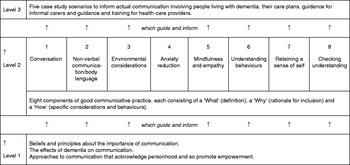
The CoP had three levels. Level 1 was intended as a clear and agreed statement by UK-based stakeholders of their beliefs about dementia, the effects of dementia on communication, and empowering approaches to communication involving PLWD, which fully acknowledge their personhood. The purpose of Level 1 was to link the intervention clearly to relevant theory and a body of related empirical literature, so as to aid adaptation in different national and sociocultural contexts where, for example, attitudes to age, ageing and disability might be different from those in the UK. Also emerging from the study was the fact that having such a clear but adaptable foundation level to inform the actual advice made this kind of instrument adaptable for the needs of different disability groups. For example, informants at this stage of the study suggested its possible applicability to communication with people living with Parkinson's disease, learning disabilities and neurological disabilities.
Level 1 has a summary of the instrument's conceptual foundations and of the negative communicative practices in the theoretical and empirical literature relating to the Communicative Predicament of Ageing Model, and it emphasised the importance of supporting the potentialities of people living with dementia outlined in the theoretical and empirical literature on communication and dementia relating to the Communication Empowerment Model. Level 1 also emphasised, as a guiding philosophy, the importance of a commitment to supporting personhood, and of communicative practices that aimed to help PLWD to ‘own’ a clear idea of themselves as situated individuals, and so supporting the quality of life of PLWD and their social partners. This foundational level of the instrument also discusses and gives examples of the communicative impairments that can occur at different stages of living with dementia. Examples of these, relating to early and mid stages of the condition in particular, include a tendency to distraction; a tendency to talk off message; attempting to convey meaning in ways that may be discontinuous and apparently lacking a normal structure but which express underlying meanings metaphorically; and susceptibility to environmental, situational or sociocultural ‘noise’.
Level 2, rooted in the principles spelled out in Level 1, consisted of ten specific components of good communicative practice. Each component consisted of a ‘what’, a ‘why’ and a series of ‘hows’, i.e. a brief definition (what we mean by ‘non-verbal communication’, for example), a rationale for including this component in the CoP (e.g. the possible impacts of non-verbal communication on the lives of PLWD and their social partners) and a list of implications for, and specific guidance on effective communication practices related to this component. The ten components of Level 2 were: environmental considerations, non-verbal communication, listening skills, speaking skills, conversation management, anxiety reduction, mindfulness and empathy, decoding unhelpful behaviours, identity reinforcement and concept checking. For instance, an example related to non-verbal communication details the efficacy of appropriate gentle touch, particularly in later-stage dementia; the importance of speaking face-to-face if possible, and of establishing eye contact; and the use of consistent gestures to convey and reinforce meanings.
Level 3 of the CoP consisted of practical guidance about individualising care. This related the principles laid out in Level 1 and the advice detailed in Level 2, to the life and needs of an individual PLWD. Level 3 could, it was proposed, be the basis for a communicative element for care plans, and could form the basis for using the CoP in training programmes for care staff.
Data collection took place in mid-2009, and consisted of asking stakeholders to reflect in detail on their own experiences of communication and living with dementia, and then to examine a version of the CoP which included a full draft statement of Level 1, a list of Level 2 components, and two draft ‘complete’ Level 2 specifications of advice. We also asked for suggestions as to how Level 3 might be fleshed out and made user-friendly and appropriate to individualised care. We sought the input of PLWD and family members independent of any direct influence by professionals or other paid carers – to ensure that the voices of ‘lay’ stakeholders could be heard, and so that the finished instrument would fully and appropriately reflect these views of voices previously under-represented in drawing up communications packages. We also felt that an intervention with a strong ‘bottom up’ input would be more credible to and more specifically related to the needs of lay users, and so would be more readily taken up by PLWD and their carers. Consultation with PLWD was done either face-to-face or by telephone, individually with a PLWD or with PLWD and a family carer – whichever the PLWD preferred. Six such individual or pair interviews, involving ten people in total (six PLWD and four family members) were held, mainly involving people based in the North East of England. Facilitated by the Alzheimer's Society, a day-long consultation conference was also held in London. Here members of self-help groups of PLWD in its early to mid stages (25 people) and family and volunteer carers (15 people) were brought together to reflect on their own experiences of communication and dementia, relate this to our proposal, and to amend and fully populate all three levels of the CoP as they felt was appropriate. The conference was facilitated by professionals and volunteers with experience of working with PLWD, but these facilitators had no direct input at this point. Views of family members and of PLWD were paramount in this activity, and every effort was made to ensure that these views could be voiced and that they shaped a final version.
For the professional care and health communities, a series of presentations and workshops relating to the CoP as a work in progress were held (at the UK Dementia Congresses in 2008 and 2009 and at the International Conference on Language and Social Psychology, Tuscon, 2008) where the input of delegates was sought. This consultation process culminated when another, separate conference was held to follow that held for ‘lay’ stakeholders. Invitation to participate was sent out to a spectrum of professionals through contact lists supplied by the Alzheimer's Society. Invitees were given the same background information as participants in the ‘lay’ conference, and a detailed précis of the outcomes of the ‘lay’ conference. They were also asked to reflect on and share their own experiences of communication and living with dementia, to relate this to our proposed CoP, to comment on and agree on amendments to Levels 1 and 2, and to populate Level 2 with appropriate advice and considerations. We also asked for input on ways that the CoP might be presented so that it could be tailored to individuals (rather than a set of monolithic ‘rules’), and disseminated and tested for efficacy.
Twenty-nine professionals attended. Of these, six were dementia care specialist nurses; five were academics and researchers working in the fields of care and care training, general health and more specifically geriatric communication; four were managers of long-term general and dementia care specialist homes; four were senior administrators for long-terms care providers (housing associations and local authorities); four were from the Alzheimer's Society (care and communications specialists); two were general psychogeriatric nurses; two were professional care specialists from non-dementia organisations (working to improve care for people with brain and spine injuries and resultant neurological damage, and for care for people with Parkinson's Disease, respectively); and two were speech and language therapists.
Findings
The need for an intervention
Both lay and professional participants reinforced the findings of the pilot work by impressing on us the need for a new communications intervention. The lay participants confirmed a lack of suitable, indexed web-based or published advice to guide their communicative practices – when advice had been sought it had been inaccessible, or when found it was felt to be too technical or inadequate to be of real benefit. The professionals reported knowledge of a small amount of communications advice and guidance for carers – published, web-based and in the form of training for care staff. The professionals also reported a lack of uptake, and suggested four reasons for this:
1. Advice, particularly that based on discourse and conversational analysis of the speech of PLWD, was couched too technically to be of use to anyone except specialist speech and language therapists.
2. The plethora of general ‘dementia communication’ packages available confused the target audience.
3. Available advice lacked credibility as it did not make any clear reference to empirically-supported theory from research about communication and living with dementia.
4. Advice aimed at care staff seemed to be patronising in tone, and to consist largely of statements of the obvious.
5. Advice seemed to be ‘one size fits all’. Little, if any, attempt was made in available communications advice to explain how guidance was relevant to care and interaction at different stages of dementia, or how it could be operationalised with different individual PLWD. It also failed to be person-centred, tending to suggest the overarching importance of concrete rules.
6. Much of it was written for a North American audience, and participants felt it would need to be adapted heavily before it would be suitable for other contexts.
The language of the proposed CoP
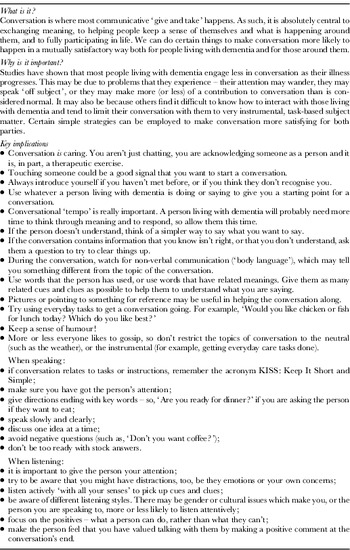
It was felt by the majority of lay participants and almost all the professionals that ‘Code of Practice’ as a title for the intervention was too prescriptive, and might be off-putting to intended users. Both groups agreed that a ‘toolkit’ was a more attractive and appropriate title, and that it captured the idea that what was offered was advisory and for consideration by users, rather than compulsory. Some PLWD suggested ‘Dementia Toolkit for Effective Communication’ (DEMTEC) as a better title, which we were happy to adopt. The (perhaps slightly clumsy) formulation ‘person/people living with dementia’ was urged upon us by both groups of participants, most especially by PLWD themselves. This was felt to more accurately capture their experience of the condition, and to be more positive, person-centred and life-affirming than the alternatives ‘people with dementia’ (which they felt over-emphasised the condition at the expense of their individuality), and ‘people with dementing illnesses’ (which did the same, to an even greater extent, sounding in the words of one PLWD ‘cold and medical’). The language of the proposed toolkit was felt to be appropriate for a general lay and professional audience (see Table 1 for an example). Participants also felt that there was a further need for variations on this ‘core’ toolkit which would include the same information and advice but which were couched in much simpler language. The reason for this is that many formal carers (in the UK, Western Europe and North America, especially) have English as a second or other language. The availability of simpler versions of the core toolkit would also make its information and guidance more readily accessible to some PLWD.
Conversation: a complete example of DEMTEC Level 2

The overall structure of the toolkit
The overall structure of the toolkit was characterised by both groups as accessible and fit for purpose. The professional group also felt it was based on appropriate theoretical foundations, although a minority of this group felt that its basis on social psychological theory rather than discourse or conversational analytical theory, might tend to position PLWD as ‘recipients’ of the communications advice, rather than partners in its realisation. PLWD and family members did not make this point, stressing instead their perception of suitability of the Communicative Predicament of Ageing Model as a description of the problems faced, and the Communicative Enhancement Model as a description of a way out of a negative, unhelpful and inappropriate negative communications cycle. For this reason we retained these models as our primary explanatory frameworks, and so retained references to and glosses of these models in our core Level One, while stressing that communication is interactional.
In the process of populating the ‘how’ advice in Level 2, a number of changes to the components list were agreed, reducing it from ten components to eight in the process. Speaking and listening skills, and conversation management were subsumed into a single ‘Conversation’ component. ‘Decoding unhelpful behaviours’ was re-titled ‘Understanding behaviour’, ‘Identity reinforcement’ became ‘Retaining a sense of self’ and ‘Concept checking’ became ‘Checking understanding’. These changes tended to reduce any overlaps in actual communicative suggestions that were in different component areas of the original CoP. In the view of our participants, they also appropriately slightly simplified the language. Most crucially, they served to make communication advice less about doing things for or to PLWD, and more about making the goals and needs of PLWD central. See Figure 1 for the overall structure and content of the agreed core DEMTEC.
Overview of the Dementia Toolkit for Effective Communication (DEMTEC).

Level 1 of the toolkit
There was unanimity in both groups that Level 1 was a necessary foundational statement of clear and appropriate beliefs about living with dementia, the central importance of communication in supporting agency and quality of life for PLWD and their social partners, and of the effects on communication of dementia. Personhood was also acknowledged as central to effective care. Care home managers especially stressed how difficult it was to effectively provide care for people whose background, life history and personal preferences were not known, in instances where no such information could be gleaned from a PLWD due to communication difficulties and a lack of input from family members. The broad scope of Level 1, and its links to Level 2, were acknowledged by all participants as necessary features of a toolkit to improve communication that was to have credibility and relevance. Many PLWD and informal carer participants were unfamiliar with the term ‘personhood’, but they acknowledged that it captured an appropriate and achievable general aspiration for care and social relationships in living with dementia. Most professional participants were familiar with the term, but felt that it had tended to be vaguely defined and commended its use and links to communicative behaviour as outlined in Level 1.
Level 2 of the toolkit
As a result of the consultations, a number of amendments were made to the outline list of Level 2 components, as noted above. The eight remaining components of the new DEMTEC were also completed with agreed definitions and statements of why the component was relevant and important. Each was populated with its ‘how’ element – specific advice, guidance and considerations agreed by each group. Each component had between 17 elements (in ‘Conversation’) and four elements (in ‘Anxiety Reduction’), all expressed as short, simple sentences. Table 1 presents an example of a Level 2 component of DEMTEC.
Level 3 of the toolkit
Our aim with Level 3 of the toolkit was to link the general position on dementia, personhood and communication in Level 1, and the advice in Level 2, with their individualised operationalisation in actual communication. Our participants agreed that case studies of individuals living with dementia would be an appropriate format to show how this might be done (see alsoCarpiac-Claver and Levy-Storms Reference Carpiac-Claver and Levy-Storms2007). They felt that the scenarios in the case studies should describe the effects of dementia on people and those around them, with a particular emphasis on how dementia affected communication and interaction, and a focus on real-life examples of PLWD which would bring authenticity and realism, and thus credibility. Each case study should include specific information about the individual, their life histories, preferences, needs and likely wants, and should show how that individual's personhood and agency might be supported and enhanced by the people around them. It was also felt, particularly by the professional participants, that the scenarios should reflect the likely effects of dementia on communication at different stages of the condition. While anxious to dispel ideas that there are ‘typical’ experiences of dementia, participants also felt that there were enough communicative common features involved in living with dementia in its broadly early, mid and later stages to warrant advice of greater relevance to each stage. It was also felt that it would be useful to show how different social partners might operate the advice – spouses, other family members, friends, colleagues and former colleagues, workers in short-term and long-term care environments, social workers, nurses and physicians.
In response to these opinions, five case studies were produced to complete a core DEMTEC. Space does not permit a detailed consideration of these here, but see Young, Manthorp and Howells (Reference Young, Manthorp and Howells2010) for a detailed discussion of the complete versions. Briefly, each case study gives a sketch of a PLWD, their lives past and present, and outlines the challenges they are facing in living their lives as they wish and in their relations to other people. The case studies show individuals living with a broadly different stage of dementia (early, pre-diagnosis; early to mid, mid, mid-to-late; and late). Each case study relates the challenges to communication with social partners experienced by the PLWD in this stage of the condition, and shows how communication might be made more effective by incorporating advice in the DEMTEC. It is intended that these case studies could form the basis for carer training, and serve as illustrations of how communication can be made effective for PLWD and for family members.
Discussion and conclusions
The aim of the project described here was to triangulate the views and experiences of PLWD with those of key groups of health and care professionals, and with the theoretical and empirical literature to frame and populate a communications advice package which is intended to be accessible and free to all users. The resulting toolkit is a user-informed, empirically-supported and accessible communications package designed to help to support the personhood and quality of life of PLWD and their social partners. The project also aimed to highlight advice and considerations that would be adaptable and relevant to the care of individuals, and to produce an intervention that would be applicable in different care, and ultimately in different sociocultural, contexts. We believe that its structure linking a clear statement of beliefs, knowledge and principles to actual advice, and to examples of the lived experiences of individuals, both increases the likelihood of its uptake, and promotes localised and individualised discussion of good communicative practice. The agreed core of the current version of DEMTEC extends the range of advice offered by previous interventions. So, for example, the Level 2 components ‘environmental considerations’ and ‘anxiety reduction’ are not among those identified in Levy-Storms' (Reference Levy-Storms2008) review of therapeutic communications training in long-term care institutions. The total specific advice offered in the eight Level 2 components adds considerably to that given in other recent care advice interventions (e.g. Kohler Reference Kohler2004; Santo Pietro and Ostuni Reference Santo Pietro and Ostuni2003; Williams et al. Reference Williams, Hyer, Kelly, Leger-Krall and Trappen2005).
The next stage of the project will be to produce tailored versions of the core toolkit. These will retain the same overall three-level structure of the core toolkit, and the same range of advice, but be couched in language intended to be accessible and related closely to the personal or professional circumstances of different users and user groups. We anticipate that for a UK audience four variations on the core toolkit will be necessary – one for PLWD (acknowledging that its primary use will be for people in early-to-mid stages), one for workers in long-term care establishments, one for family members and friends of PLWD, and one for health and care professionals whose primary experience is not concerned with working with PLWD. To insist upon separate toolkit versions for these groups risks clumsiness, but the fact is that their experience and practical needs are different. The aim is to produce versions that complement each other as their core components remain stable and delineate concepts that can be discussed between those using the different versions. The users can therefore be assisted in having discussion about communication, personhood, quality of life and dementia that transcend personal or professional boundaries.
Once finalised, each of these versions will be made available free of charge through web-based platforms. They will also form the basis for training packages, as a number of organisations have expressed interest in the practical exposition of the best practice the toolkit sets out to embody, a self-evidently reasonable approach. However, just as the authors wish to insist that the toolkit itself be free to all users they wish equally to insist that no organisation can or should have the exclusive right to training in (or devising and offering qualifications based on) the toolkit. The intention is that the toolkit should and must remain a flexible instrument which will be adapted to suit different circumstances.
Despite the recent development of a number of packages which aimed to improve communications involving PLWD and carers, there is very little evidence of their uptake, or of their efficacy. Dissemination and evaluation are vital if a real difference is to be made. Evaluation of training based on the different versions of the DEMTEC will consist, in the first instance, of field testing in the UK. We intend, on a pre- and post-intervention basis, to test the toolkit's efficacy in two day-care centres and in at least two long-term dementia care specialist residential homes. Testing for efficacy will involve the evaluation of multidimensional outcomes of health-related quality of life of people living at various stages of dementia, using the Dementia-specific Quality of Life psychometric instruments (DEMQOL and DEMQOL-proxy; Banerjee et al. Reference Banerjee, Smith, Lamping, Harwood, Foley, Smith, Murray, Prince, Levin, Mann and Knapp2006; Smith et al. Reference Smith, Murray, Banerjee, Foley, Cook, Lamping, Prince, Harwood, Levin and Mann2005, Reference Smith, Lamping, Banerjee, Harwood, Foley, Smith, Cook, Murray, Prince, Levin, Mann and Knapp2007). Five domains will be tested: daily activities and self-care; general health and wellbeing; cognitive functioning; social relationships; and self-concept. Formal and informal carers will be closely involved. Semi-structured interviews will also be conducted with PLWD and family carers to obtain qualitative quality of life data for triangulation. We also intend to survey the views of staff through specific evaluation of the training packages in terms of their improvement of staff knowledge and attitudes towards PLWD, their job satisfaction and their self-reported behaviour. Feedback from user groups will contribute to a continuous cycle of feedback and adaptation to all three levels of the DEMTEC.
We aim for national and international free-to-users dissemination of the DEMTEC, utilising the multiprofessional and stakeholder contacts networks we have established during the production of a core toolkit. The toolkit's structure encourages adaptation to local circumstances and needs, and will, we anticipate, help to open up a transnational, intercultural dialogue into the nature of dementia and communication, the social construction of PLWD, and into wider issues of health, ageing, disability and communicative practice. Outcomes from the production and dissemination of the DEMTEC will include:
1. The uptake and actual application of the intervention in a variety of settings, making available a cost-effective, evaluated instrument which will enhance and support the quality of life of PLWD, their social partners and formal carers.
2. The establishment of a comprehensive national and international benchmark for effective communication in the lives of people with dementia which may be adaptable for and applicable to other groups living with disability.
3. A benchmark and methodological and conceptual framework for future multi-stakeholder involvement in developing communications-based interventions aimed at improving the lives of patients and the recipients of care.
4. The encouragement of ongoing empirical testing of the efficacy of an intervention centred on the support for and realisation in communication of personhood, linked to negative and positive models of communications patterns in the lives of older people in general, and of people living with cognitive deficit in particular. Such testing of both a person-centred approach, and of an approach linked clearly to extant models of communicative behaviour are extremely unusual in the fields of health and care, and so should make a contribution to advancing the research agenda across a range of health and care communicative contexts.
In developing this toolkit, our work with the spectrum of stakeholders has reinforced in us a sense that, despite damaged cognitive functionality, PLWD can take control of their lives, shaping the communicative help they sometimes require in partnership with formal and informal carers. Whilst real and often tragic constraints are the reality of living with dementia, the withdrawal of agentive status that was (and still is, in some contexts) the norm at the point of diagnosis should no longer be acceptable. Effective communication should lead to positive social validation and support for a sense of self and of individual and social identity for PLWD. It should also lie at the heart of resistance to the stigmatisation and ‘othering’ of PLWD. Such support and validation are realised in simple, effective communication linked to clear but flexible principles. The DEMTEC described here is a distillation of real-life experience, best theory and best practice into a free, powerful and international tool to help redefine boundaries in interpersonal interactions, and so empower PLWD and their carers.