




No CrossRef data available.
Article contents
Prevalence of arrhythmias and conduction disturbances in large population-based samples of children
Published online by Cambridge University Press: 20 January 2005
Abstract
The aim of our study is to provide data on the prevalence of disturbances of rhythm in the general population of children. Accurate estimates of true prevalence of such disturbances of rhythm from large samples are mandatory if we are to interpret properly electrocardiographic abnormalities. We analysed prevalence of disturbances of rhythm in a population of 152,322, comprised of 71,855 elementary school students, 36,692 males and 35,163 females, aged from 5 to 6 years, and 80,467 students of junior high school, 41,842 males and 38,625 females, aged from 12 to 13 years. We analysed the prevalence of premature atrial and ventricular contractions, first, second and third degree atrioventricular block, incomplete and complete right bundle branch block, Wolff-Parkinson-White syndrome, and prolongation of the QT interval. The prevalence of disturbances of rhythm in total rose with age, being found in 1.25% of elementary school students and 2.32% of junior high school students, and was higher in males than females, at 2.00% as opposed to 1.38%, both values being statistically significant at a level of less than 0.0001. Prevalences of all types of rhythmic disturbances were higher in junior high school students than elementary school students (p < 0.0001). Premature atrial and ventricular contractions and prolongation of the QT interval were higher in female than male students, at percentages of 0.089, 0.497, and 0.02 for males, and 0.123, 0.534 and 0.027 in females (p < 0.0001). In contrast, incomplete and complete right bundle branch blocks were higher in males than females, at 0.983% and 0.083% in males versus 0.410% and 0.161% in females (p < 0.0001). Disturbances of rhythm increased with age, and conduction disturbances were higher in male students than female, although premature atrial and ventricular contractions and prolongation of the QT interval were more frequent in female. These data may be useful for future comparative studies of disturbance of rhythm in children.
Keywords
Information
- Type
- Original Article
- Information
- Copyright
- © 2004 Cambridge University Press
Disturbances of rhythm may present as primary disturbance in otherwise healthy people, or may occur along with cardiac diseases. Accurate estimates of the true prevalence of arrhythmias and conduction disturbances from large samples are mandatory if we are to interpret properly these electrocardiographic abnormalities.1, 2 Several epidemiological studies have concentrated on estimating the prevalence of electrocardiographic findings in a standardized way.3–5 Most of these previous reports from large cohorts of studies, however, were usually based on highly selective population samples of men, such as air force personnel.1 Other reports focused on adults, including women.2, 6 There are few reports containing data on disturbances of rhythm from large cohorts containing both sexes and children.7, 8 The aim of our study, therefore, was to establish the prevalence of disturbances of rhythm by analysing a large cohort of normal children by cardiac screening, and establishing the effect of development and gender on the prevalence of these electrocardiographic abnormalities.
Materials and methods
Population
We analysed 12-lead electrocardiograms performed as part of a cardiac screening test in Chiba City, Chiba, Japan during 1996 to 2001 in a total population of 152,322 children, comprising 71,855 elementary school students with a mean age of 6.4 years, 36,692 being male and 35,163 female, and 80,467 junior high school students, with a mean age of 12.4 years, 41,842 being male and 38,625 female (Tables 1 and 2) The electrocardiograms were recorded at the first grade of both elementary and junior high school. When a follow-up examination was performed, we analysed only the initial result.
Table 1. Prevalence of disturbances of rhythm in different age group.

Table 2. Prevalence of disturbances of rhythm in males and females.

Cardiac screening test
The regular governmental cardiac screening test, including a 12-lead electrocardiogram, is mandatory for elementary and junior high school students in Chiba City. A questionnaire regarding past medical history was filled out by each examinee before the examination for evaluating the existence of organic cardiac disease, and was analysed by the Committee of the Medical Association in Chiba City. The electrocardiogram was recorded with the subjects in the supine position in accordance with classical recommendation, and was analysed by computer analysing program (Fukuda Electric Co. Japan). The Committee of the Medical Association in Chiba City, comprising 4 board certified cardiologists and 3 pediatric cardiologists, reviewed the electrocardiograms themselves, and the diagnoses of rhythmic disturbances as judged by the computer. The diagnostic criterions for electrocardiographic abnormalities were based on the Guidelines of the School Cardiac Screening Test established by the Committee on Electrocardiography of the Japanese Society of Pediatric Cardiology and Cardiac Surgery.9 Screening for prolongation of the QT interval was based on the heart rate dependent criterions already described.10, 11 Electrocardiograms judged as abnormal by the Committee members were later reviewed by the two experienced observers (KN, pediatric cardiologist and YS, board certified adult cardiologist). The final diagnosis was derived after establishing consensus between the two.
Rhythmic disturbances
From this database, we analysed the prevalence of premature atrial and ventricular contraction, first, second, or third degree atrioventricular block, incomplete or complete right bundle branch block, Wolff- Parkinson-White syndrome, and prolongation of the QT interval. Supraventricular arrhythmias, such as atrial flutter, fibrillation and paroxysmal supraventricular tachycardia, and ventricular tachycardia were also analysed. Abnormal electrocardiographic findings associated with organic cardiac disease, such as congenital cardiac disease, were excluded.
Statistical analyses
We analysed the available data using StatView J-5.0 PPC (SAS Institute Inc., Chicago). When the p < 0.05, the data were considered statistically significant. Descriptive data for continuous variables are presented as mean ± S.D. Pairwise comparisons were performed using the two-sample t-test, or the Wilcoxon rank-sum test, wherever appropriate. Discrete variables were analysed by Chi-square tests.
Results
Paroxysmal supraventricular tachycardia was observed in one junior high school female student, but no atrial flutter or fibrillation was observed in either group. Ventricular tachycardia was observed in one male junior high school student. Third degree atrioventricular block was observed in three individuals, two being elementary male students, and the other a male junior high school student.
Age-related prevalence of disturbances of rhythm (Table 1 and Figs 1 & 2)
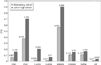
The prevalence rose with age, afflicting 896 of 71,855 (1.247%) elementary school students, and 1868 of 80,467 (2.321%) junior high school students (p < 0.0001). The prevalence of each disturbance was significantly higher in junior high school students than those at elementary school (p < 0.0001 for each abnormal rhythm).

Figure 1. Prevalence of total disturbances of rhythm in elementary and junior high school students, with difference noted for gender.

Figure 2. Prevalence of disturbances of rhythm in elementary and junior high school students. PAC: premature atrial contraction; PVC: premature ventricular contraction; 1-AVB: first-degree atrioventricular block; 2-AVB: second-degree atrioventricular block; IRBBB: incomplete right bundle branch block; CRBBB: complete right bundle branch block; WPW: Wolff-Parkinson-White syndrome; QT: QT prolongation.
Gender differences in prevalence of disturbances of rhythm (Table 2 and Fig. 3)
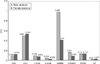
Total disturbances of rhythm were higher in males, at 2.003%, than in females, at 1.383% (p < 0.0001 each). Premature atrial and ventricular contractions, and prolongation of the QT interval, however, occurred more frequently in female students, at 0.089%, 0.497% and 0.020% respectively, than in males, where the values were 0.123%, 0.534% and 0.027%, respectively (p < 0.0001). In contrast, incomplete and complete right bundle branch blocks, and first and second degree atrioventricular block were higher in males, at 0.983%, 0.083%, 0.096% and 0.048%, than in females, where the values were 0.410%, 0.161%, 0.076% and 0.025% respectively (p < 0.0001).

Figure 3. Prevalence of disturbances of rhythm in male and female students. PAC: premature atrial contraction; PVC: premature ventricular contraction; 1-AVB: first-degree atrioventricular block; 2-AVB: second-degree atrioventricular block; IRBBB: incomplete right bundle branch block; CRBBB: complete right bundle branch block; WPW: Wolff-Parkinson-White; QT: QT prolongation.
Discussion
The possibility to examine a large sample of children has permitted us to provide a precise description of the prevalence of disturbances of rhythm both genders of the childhood population. Disturbances of rhythm increased exponentially with age, and conduction disturbances were higher in male students than females. Premature atrial and ventricular contractions, and prolongation of the QT interval, in contrast, were more prevalent in females. These data may be useful for future comparative studies of childhood disturbances of rhythm.
Difference of disturbances of rhythm with age
Nagashima and colleagues12 reported a rising incidence of arrhythmias with advancing age from infants to adolescents except in the neonatal period by ambulatory electrocardiographic analysis. In our study, we found a similar increase in all types of arrhythmias as students progressed from elementary school to junior high school.
Gender differences in disturbances of rhythm
We found that the total of disturbances was higher in male students than females. Conduction disturbances such as atrioventricular block and right bundle branch block also occurred more frequently in males, albeit that premature atrial and ventricular contractions and prolongation of the QT interval occurred more frequently in females. Right bundle branch block has previously been reported to be 3.5 times higher in men than women.2 Bundle branch block is reported to occur in 1.6% of men, as opposed to 0.8% in women. The differences we noted in gender, therefore, are entirely attributable to the sex-related difference in the incidence of right bundle branch block.2, 13
Supraventricular arrhythmias and premature atrial contraction
Based on analysis of 320,000 cardiac screening tests performed in children, Tsuda and associates reported that the prevalence of premature atrial contraction in elementary school, junior high school, high school and university students was 0.12%, 0.13%, 0.17% and 0.16%, respectively, with no differences noted for gender.7 The prevalence in elementary school students in our study was lower than their report. We also found that the prevalence increased along with age in both sexes, and that the incidence was higher in female students in both groups. The incidence of supraventricular tachyarrhythmias or ventricular tachycardia in our children was very low, probably because our analysis is based on the school cardiac screening test for healthy individuals without symptoms.
Premature ventricular contractions
A two-fold increase in prevalence of asymptomatic complex or frequent ventricular beats has been reported for the male gender.14 In our study, premature ventricular contractions were more prevalent in females, albeit that the cause of this higher prevalence in female is unknown.
Premature ventricular contractions as seen on the resting electrocardiogram have been said to increase from 2% to 15% along with increasing age in male adults.15 Tsuda and colleagues reported the prevalence of premature ventricular contractions in elementary school, junior high school, high school and university students to be 0.16%, 0.26%, 0.31% and 0.45% respectively, and there were no differences noted for gender.7 In our children, premature ventricular contractions occurred twice more frequently than in their study, being more prevalent in students at junior high school than elementary school.
Atrioventricular block
The long-term prognosis of atrioventricular block as seen on the resting electrocardiogram in the absence of organic heart disease has not been clearly defined.2, 16, 17 In a large sample of over 100,000 male aircrew aged from 16 through 50 years, atrioventricular block was observed in 0.6% of the total.1 In another study, a lower prevalence was found, 0.2% in men and 0.1% in women, with no increase with age.2 We found fewer children with atrioventricular block, but the disturbance was more prevalent in males. First-degree atrioventricular block is said to increase continuously after the age of 40, approaching 1.13 per 1000 person-years.17 We found first degree atrioventricular block to be more prevalent in high school than in elementary school students. Tsuda and colleagues reported that third degree atrioventricular block was observed in two of 133,567 elementary school students, and 3 of 149,542 junior high school students. Others have reported the prevalence of third degree atrioventricular block to be one over 15,000 to one over 25,000 live births.18 These prevalences are compatible with our own findings.
Bundle branch block
Right bundle branch block is reported to increase in prevalence with age.19, 20 In our study, prevalence of both complete and incomplete right bundle branch block was higher in junior high school than elementary school. Among most of epidemiological studies based on a large sample of men, the prevalence of bundle branch block has been estimated at between 1.2% and 2.7%.1, 2 This prevalence is higher than we have found in children. A male predominance for right bundle branch block has also been observed.2, 13, 20 The ratio of right bundle branch block in males to females in the Framingham study was 3.0.21 Males had a higher prevalence of right branch block than females even during childhood,19 and this male preponderance was similarly found in our study.
Wolff-Parkinson-White syndrome
The overall prevalence of Wolff-Parkinson-White syndrome has been reported to be from 0.15% to 0.4%.1, 2, 22, 23 It is also known that the delta wave may intermittently disappear during the natural course of this syndrome.1, 2, 22–24 The exact prevalence of the syndrome, therefore, is somewhat hard to determine. Its prevalence as reported in high school students in Japan (0.174%) was significantly higher than found in elementary and junior high school students (0.073% and 0.070%, respectively).25 These prevalences for elementary and junior high school students, however, were lower than our findings of 0.107% and 0.162%. The higher prevalence in adults compared with children might be attributable to a reported higher incidence of left free wall accessory pathways in adults.26 Intermittent Wolff-Parkinson-White syndrome is observed more frequently in patients with left-sided accessory pathway,27 with the pathway manifesting itself in response to changes in autonomic nervous tone and atrioventricular nodal conductivity that occur during growth.19, 25
The male to female ratio in prevalence of the syndrome is reported to be 2 to 1.1, 2, 22, 23 We found a higher incidence of males at junior high school, albeit that the incidence was lower in male students at elementary school.
Prolongation of the QT interval
The exact prevalence of long QT syndrome in the general population is not known as based on examination of a large cohort, and it is speculated to be approximately 1 in 10,000.28 From the recent data based on the screening program, the prevalence of non-familiar long QT syndrome was found to be one in 1164 students at junior high school, with no example found in elementary school students.29 These investigators speculated that abnormal electrocardiographical phenotypes in children with non-familiar long QT syndrome may appear during the time spent at elementary school. Other reports based on the cardiac screening test, however, found 13 children, 6 in first-grade and 7 in seventh grade, with an abnormally prolonged QT interval.30 Tsuda and colleagues found long QT syndrome in 2 of 133,567 elementary school students, and one of 149,542 junior high school students.7 We found QT prolongation in 0.011% of our elementary school students, and 0.035% of our junior high school students. It is reported that there is no significant influence of gender on QT interval up to the age of 14 years.31, 32 Women are reported to have longer heart rate adjusted QT intervals than men, with lengthening of the QT intervals in female subjects beginning at the elementary school.29 We found a higher prevalence of QT prolongation in female students at the junior high school.
Limitations
Our study was based on the results of cross-sectional cardiac screening test, and it was not carried out in longitudinal fashion. There is a possibility, therefore, that the prevalence of arrhythmias does not reflect the true difference seen with growth of the individual. Further prospective and longitudinal follow-up studies are needed to evaluate the influence of growth on the prevalence of rhythm disturbances. There are no regular governmental cardiac screening tests for children under the age of 5 years, nor for high school students, in Chiba City. The electrocardiographic data for these age groups, therefore, are lacking in our study. Seven different cardiologists and pediatric cardiologists reviewed the electrocardiograms and diagnoses as judged by the computer program. It has a possibility that this constitutes a positive bias in diagnosis. The data set of this study is based on school cardiac screening test, not Holter monitoring, and so it is possible that most paroxysmal types of tachyarrhythmia, such as atrial flutter or fibrillation, or paroxysmal supraventricular tachycardia or ventricular tachycardia with symptoms, could be overlooked. The concealed variant of the Wolff-Parkinson-White syndrome cannot be diagnosed from the regular electrocardiogram, and so we were unable to assess the true prevalence of this syndrome in the age groups examined.
Conclusions
Our large sample has permitted us to provide a precise description of the age and sex related prevalence of rhythm disturbance in children. The disturbances increased with age, and conduction disturbances were higher in male students than females. Premature atrial and ventricular contractions and QT prolongation, however, were more frequent in females. These data may be useful for future comparative studies of disturbance of rhythm in children.
Acknowledgements
We gratefully acknowledge the assistance of Atsuko Niwa in the preparation of this report.
References
Hiss RG, Lamb LE. Electrocardiographic findings in 122,043 individuals. Circulation 1962; 25: 947–961.Google Scholar
De Bacquer D, De Backer G, Kornitzer M. Prevalences of ECG findings in large population based samples of men and women. Heart 2000; 84: 625–633.Google Scholar
Blackburn H. Electrocardiographic classification for population comparisons. The Minnesota code. J Electrocardiol 1969; 2: 5–9.Google Scholar
Blackburn H, Keys A, Simonson E, Rautaharju P, Punsar S. The electrocardiogram in population studies. A classification system. Circulation 1960; 21: 1160–1175.Google Scholar
De Bacquer D, De Backer G, Kornitzer M, Blackburn H. Prognostic value of ECG findings for total, cardiovascular disease, and coronary heart disease death in men and women. Heart 1998; 80: 570–577.Google Scholar
Ostrander LD, Brandt RL, Kjelsberg MO, Epstein FH. Electrocardiographic findings among the adult population of a total natural community. Tecumseh, Michigan. Circulation 1965; 31: 888–898.Google Scholar
Tsuda J, Niimura I, Matsuo M. Statistics of arrhythmias in school age. Health guidance of heart disease in childhood (in Japanese). Nihon-Ijishinpo 1982; 3035; 43–48.Google Scholar
Tasaki H, Hamasaki Y, Ichimaru T. Mass screening for heart disease of school children in Saga city: 7-year follow-up study. Jpn Circ J 1987; 51: 1415–1420.Google Scholar
Ookuni M, Harada K, Kitada M, et al. School cardiac screening test. Guideline for selection of second step screening. Pediatr Cardiol Cardiac Surg (in Japanese). 1996; 12: 725–730.Google Scholar
Schwarz PJ, Moss AJ, Vincent GM, Crampton RS. Diagnostic criteria for the long QT syndrome. An update. Circulation 1993; 88: 782–784.Google Scholar
Yoshinaga M, Tomari T, Aihoshi S, et al. Exponential correction of QT interval to minimize the effect of the heart rate in children. Jpn Circ J 1993; 57: 102–108.Google Scholar
Nagashima M, Matsushima M, Ogawa A, et al. Cardiac arrhythmias in healthy children revealed by 24-hour ambulatory ECG monitoring. Pediatr Cardiol 1987; 8: 103–108.Google Scholar
Thrainsdottir IS, Hardarson T, Thorgeirsson G, Sigvaldason H, Sigfusson N. The epidemiology of right bundle branch and its association with cardiovascular morbidity – the Reykjavik Study. Euro Heart J 1993; 14: 1590–1596.Google Scholar
Bikkina M, Larson MG, Levy D. Prognostic implications of asymptomatic ventricular arrhythmias: the Framingham heart study. Ann Intern Med 1992; 117: 990–996.Google Scholar
Fisher FD, Tyroler HA. Relationship between premature contractions on routine electrocardiogram and subsequent sudden death from coronary heart disease. Circulation 1973; 47: 712–719.Google Scholar
Young D, Eisenberg R, Fish B, Fisher JD. Wenchebach atrioventricular block (Mobitz type I) in children and adolescents. Am J Cardiol 1977; 40: 393–399.Google Scholar
Mymin D, Mathewson FAL, Tate RB, Manfreda J. The natural history of primary first-degree atrioventricular heart block. New Engl J Med 1986; 315: 1183–1187.Google Scholar
Ross BA, Pinsky WW, Driscoll DJ. Complete atrioventricular block. In: Gillette PC, Garson A (eds). . Philadelphia, W.B. Saunders, 1990, pp 306–316.
Ashley EA, Raxwal VK, Froelicher VF. The prevalence and prognostic significance of electrocardiographic abnormalities. Curr Probl Cardiol 2000; 25: 1–72.Google Scholar
Rotman M, Triebwasser JH. A clinical and follow-up study of right and left bundle branch block. Circulation 1975; 51: 477–484.Google Scholar
Schneider JF, Thomas HE, Kreger BE, McNamara PM, Sorlie P, Kannel WB. Newly acquired right branch block: the Framingham study. Ann Intern Med 1980; 92: 37–44.Google Scholar
Munger TM, Packer DL, Hammill SC, et al. A population study of the natural history of Wolff-Parkinson-White syndrome in Olmstedt Country, Minnesota, 1953–1989. Circulation 1993; 87: 866–873.Google Scholar
Perry JC, Garson A Jr. Supraventricular tachycardia due to Wolff-Parkinson-White syndrome in children: early disappearance and late recurrence. J Am Coll Cardiol 1990; 16: 1215–1220.Google Scholar
Vignati G, Balla E, Mauri L, Lunati M, Figini A. Clinical and electrophysiologic evolution of the Wolff-Parkinson-White syndrome in children: impact on approaches to management. Cardiol Young 2000; 10: 367–375.Google Scholar
Sano S, Komori S, Amano T, et al. Prevalence of ventricular preexcitation in Japanese school children. Heart 1998; 79: 374–378.Google Scholar
Gillette PC. Concealed anomalous cardiac conduction pathways: a frequent cause of supraventricular tachycardia. Am J Cardiol 1977; 40: 848–852.Google Scholar
Klein GJ, Hackel DB, Gallagher JJ. Anatomic substrate of impaired antegrade conduction over an accessory atrioventriucular pathway in the Wolff-Parkinson-White syndrome. Circulation 1980; 61: 1249–1256.Google Scholar
Fukushige T, Yoshinaga M, Shinago A, et al. Effect of age and overweight on the QT interval and the prevalence of long QT syndrome in children. Am J Cardiol 2002; 89: 395–398.Google Scholar
Aihoshi S, Yoshinaga M, Nakamura M, Oku S, Haraguchi T, Nishibatake M. Screening for QT prolongation using a new exponential formula. Jpn Circ J 1995; 59: 185–189.Google Scholar
Eberle T, Hessling G, Ulmer HE, Brockmeier K. Prediction of normal QT intervals in children. J Electrocardiol 1998; 31: 121–125.Google Scholar
Pearl W. Effects of gender, age, and heart rate on QT intervals in children. Pediatr Cardiol 1996; 17: 135–136.Google Scholar
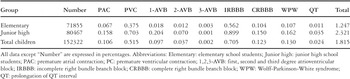
Table 1.
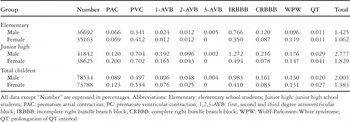
Table 2.

Prevalence of total disturbances of rhythm in elementary and junior high school students, with difference noted for gender.
Prevalence of disturbances of rhythm in elementary and junior high school students. PAC: premature atrial contraction; PVC: premature ventricular contraction; 1-AVB: first-degree atrioventricular block; 2-AVB: second-degree atrioventricular block; IRBBB: incomplete right bundle branch block; CRBBB: complete right bundle branch block; WPW: Wolff-Parkinson-White syndrome; QT: QT prolongation.
Prevalence of disturbances of rhythm in male and female students. PAC: premature atrial contraction; PVC: premature ventricular contraction; 1-AVB: first-degree atrioventricular block; 2-AVB: second-degree atrioventricular block; IRBBB: incomplete right bundle branch block; CRBBB: complete right bundle branch block; WPW: Wolff-Parkinson-White; QT: QT prolongation.
 You have
Access
- 47
- Cited by