Media and scholarly attention to polarization has surged recently. The New York Times has featured articles with headlines such as “Polarization Is Dividing American Society, Not Just Politics,”Footnote 1 “Why America’s Political Divisions Will Only Get Worse,”Footnote 2 and “America Has Split, and Now in ‘Very Dangerous Territory.’”Footnote 3 Scholars have explored the institutional consequences of polarization showing that legislative gridlock increases during periods of high polarization (Jones Reference Jones2001), that economic inequality has increased as a result of polarization (McCarty, Poole and Rosenthal Reference McCarty, Poole and Rosenthal2005), and that the rhetorical strategies of political elites have changed with the increase in polarization (Rhodes Reference Rhodes2014; Ballard et al. Reference Ballard, DeTamble, Dorsey, Heseltine and Johnson2023).
While much of the research on the consequences of polarization focuses on its effects on the public, Congress, or the executive branch, polarization in the federal judiciary, and especially the lower courts, has received less scholarly attention (Hasen Reference Hasen2019). This is despite considerable media attention given to judicial polarization. For example, The New York Times published an editorial claiming that polarized Circuit Courts are out of sync and engaged in result-oriented jurisprudence.Footnote 4 Commentary has blamed the increase in venue shopping on the increased polarization of the federal judiciary.Footnote 5 Additionally, in public remarks, Fifth Circuit Court Judge Jerry E. Smith remarked that polarization in the judiciary had increased and that increased polarization has caused judges to engage in more strategic behavior.Footnote 6
One potential explanation for the lack of scholarly focus on judicial polarization is the difficulty in measuring polarization within the context of the judiciary. For example, polarization in legislatures is measured by taking the absolute difference between the party medians (Shor and McCarty Reference Shor and McCarty2011; McCarty, Poole and Rosenthal Reference McCarty, Poole and Rosenthal2016). Unlike legislators, judges do not endorse partisan labels.Footnote 7 So grouping the judges into distinct parties and measuring the distance between them is not as straightforward as it is with legislators. Further, there are times when an entire court may have been appointed by one party making the conventional measures of polarization not suitable for these courts. One-party dominance of a particular Circuit Court of Appeals does not foreclose the opportunity for ideological polarization.
Other measures such as relying on the variance or kurtosis of ideal points (DiMaggio, Evans and Bryson Reference DiMaggio, Evans and Bryson1996) are not suitable in the context of the judiciary where there are relatively few judges per court. In response to these problems, Clark (Reference Clark2009) recommends using an Esteban and Ray (Reference Esteban and Ray1994) model to estimate polarization in the context of courts. However, Clark (Reference Clark2009) only estimates polarization statistics for the Supreme Court. Currently, there are no measures of polarization for the individual Circuit Courts of Appeals. The lack of a polarization measure across individual Circuit Courts of Appeals has limited scholars’ ability to speak to trends of polarization on these courts and how polarization may influence the decision-making on these courts.
This article builds off Clark (Reference Clark2009) by estimating yearly polarization statistics for each of the twelve circuits in the Courts of Appeals from 1953 to 2022. I show that polarization on the Circuit Court of Appeals has steadily increased and – in the most recent decade – polarization has been at its apex. Yet, polarization on the Courts of Appeals is not something entirely new. The Circuit Courts of Appeals have had considerable polarization since the mid-1980s. The results also indicate considerable heterogeneity in polarization across circuits. Some circuits have high polarization, while others have remained relatively unpolarized. I attribute this to presidential strategy in filling judicial vacancies. Finally, I investigate the consequences of polarization on decision-making. I find that polarized circuits take longer to dispose of cases, are less likely to hold full hearings with oral arguments, and are less likely to publish signed, reasoned opinions.
Polarization in the federal judiciary
Considering the centrality of polarization to American politics in the last few decades, there have been relatively few research studies focusing on polarization in the judiciary (Hasen Reference Hasen2019). This contrasts with polarization in other contexts. For example, there are well-established measures of polarization in Congress (Poole and Rosenthal Reference Poole and Rosenthal1984) and state legislatures (Shor and McCarty Reference Shor and McCarty2011). However, most of the research on polarization and the judiciary tends to focus on the effect polarization in other institutions has on the judiciary. For example, Hasen (Reference Hasen2012) shows that as Congress becomes more polarized, they are less likely to attempt to overturn the Supreme Court’s statutory decisions. Thus, as polarization in Congress increases, this can grant the Supreme Court more authority (Lee Reference Lee2015). Other studies examine how Senate polarization influences judicial nominations (Binder Reference Binder2008; Binder and Maltzman Reference Binder and Maltzman2009; Cottrill and Peretti Reference Cottrill and Peretti2013). The general conclusion of this research is that increased polarization in the Senate has led to a more contentious confirmation process, which leads to fewer nominees being confirmed.
Few studies on polarization and the judiciary are focused specifically on measuring polarization and understanding its consequences on judicial decision-making. One exception is Clark (Reference Clark2009), which develops a measure of polarization for the Supreme Court. Using this measure, Clark (Reference Clark2009) shows that higher polarization is associated with a greater share of dissenting opinions. Gooch (Reference Gooch2015) uses the Supreme Court polarization statistics to show that Supreme Court polarization is driven by polarization within Congress and the executive. However, outside of the Supreme Court, there are no measures of polarization for the Courts of Appeals, the trial courts, or state judiciaries. This limits the potential to draw inferences about the nature of polarization on these courts and how polarization influences decision-making on these courts.
While several studies focus on polarization and decision-making in the Circuit Courts of Appeals, much of this research conflates polarization and partisan sorting. Polarization refers to the ideological distance between groups, such as the ideological distance between Democrats and Republicans (McCarty, Poole and Rosenthal Reference McCarty, Poole and Rosenthal2005) or the overall ideological variation among actors within an institution (Esteban and Ray Reference Esteban and Ray1994; Clark Reference Clark2009). However, sorting refers to the extent to which individuals are members of groups that match their ideological preferences – for example, Democrats adopting liberal preferences or Republicans adopting conservative preferences (Levendusky Reference Levendusky2009).
Numerous studies within the context of the Circuit Courts of Appeals demonstrate partisan sorting. Sennewald, Manning and Carp (Reference Sennewald, Manning and Carp2017) show that over time, judges appointed by Democratic presidents have become more liberal, while judges appointed by Republican presidents have become more conservative. In another study, Keck (Reference Keck2014) finds a difference in how judges appointed by Democratic presidents and Republican-appointed judges decide high-stakes, salient issues such as abortion, affirmative action, gay rights, and gun rights. In the context of the First Amendment’s Establishment Clause and Free Exercise Clause, Sisk and Heise (Reference Sisk and Heise2011) find increased sorting among Democratic- and Republican-appointed judges.
While these studies effectively illustrate how judges appointed by Democratic and Republican presidents have increasingly aligned with their respective ideologies over time, they do not measure ideological polarization itself. Conflating partisan sorting with ideological polarization can lead to misunderstandings about the ideological dynamics within the judiciary (Levendusky Reference Levendusky2009). As a result, the field currently lacks a reliable, cardinal measure of polarization across individuals circuits in the Courts of Appeals. By not having a valid measure of ideological polarization, scholars’ ability to track polarization trends over time and to speak to how ideological polarization influences judicial decision-making is limited.
All the extant research on ideological polarization in the Court of Appeals treats the unit of analysis as the Court of Appeals as a whole. This is true in each of the studies cited above. Each study compares judges appointed by Democratic presidents to judges appointed by Republican presidents without regard for potential variation in polarization between circuits or districts (Sisk and Heise Reference Sisk and Heise2011; Keck Reference Keck2014; Sennewald, Manning and Carp Reference Sennewald, Manning and Carp2017). In another example, Bonica and Sen (Reference Bonica and Sen2021) estimate a polarization measure for the Court of Appeals and District Courts. Bonica and Sen (Reference Bonica and Sen2021) do this by using the standard approach used in legislative studies, taking the difference in Democratic and Republican ideal points. They show that polarization in these courts has steadily increased since the late 1980s. While this approach does produce a measure of polarization for the Courts of Appeals, there are potential limitations to this approach. Specifically, Bonica and Sen (Reference Bonica and Sen2021) estimate a single polarization statistic for the entire Courts of Appeals. However, the Courts of Appeals consist of twelve independently operating circuits. There may be variation between the circuits in the extent to which they are polarized. A single measure of polarization for the entire Courts of Appeals ignores this potential variation in circuit polarization. Circuit-specific measures of polarization would allow for comparison of polarization across circuits and better allow for testing of theories of how polarization influences judicial behavior within circuits. For example, if researchers want to understand how polarization influences a judge’s decision-making, it would be most appropriate to measure polarization in that judge’s circuit rather than using a measure that is estimated from all judges across all circuits.
Measuring polarization
As Clark (Reference Clark2009) notes, there are unique difficulties in measuring polarization in the context of the judiciary. Common measures of polarization make assumptions that are not true in the judicial context. For example, the common approach for measuring polarization in Congress calculates the absolute distance between the median Democrat and median Republican’s DW-NOMINATE score (McCarty, Poole and Rosenthal Reference McCarty, Poole and Rosenthal2005). Such an approach does not apply to the judiciary because judges do not adopt partisan identifiers. While it is true that judges’ votes tend to correlate with the partisanship of the president who appointed them (Zorn and Bowie Reference Zorn and Bowie2010; Baum and Devins Reference Baum and Devins2019), this is not always the case, and making that assumption may underestimate polarization. This is especially true in the context of the lower courts, where presidents occasionally advance opposition-party nominees out of compromise, judges are more constrained, and the correlation between nominating president’s party and judicial votes is much weaker than at the level of the Supreme Court (Klein and Hume Reference Klein and Hume2003; Zorn and Bowie Reference Zorn and Bowie2010). Beyond the fact that judges do not adopt partisan identifiers, relying on the party of the appointing president is problematic for other reasons. Historically, some Circuit Courts of Appeals are composed of judges nominated by a single party. This does not exclude the potential for polarization to exist on these courts. There are frequently distinct ideological factions within political parties (Clarke Reference Clarke2020). For example, judges appointed by President Trump are significantly more conservative than judges appointed by President Bush, and judges appointed by President Obama are significantly more liberal than judges appointed by President Clinton (Manning, Carp and Holmes Reference Manning, Carp and Holmes2020). Thus, even if a court is dominated by a single party, there may still very well be ideological polarization on the court. Ignoring these within-party differences in ideological belief potentially underestimates the extent to which courts have ideological polarization.
As a solution to these problems, Clark (Reference Clark2009) recommends the Esteban and Ray (Reference Esteban and Ray1994) model, which posits three characteristics that define polarization: homogeneity within groups, homogeneity between groups, and the number of distinct groups (Esteban and Ray Reference Esteban and Ray1994). Thus, the two key factors to the Esteban and Ray (Reference Esteban and Ray1994) model are intragroup alignment and intergroup difference. Polarization will be less when there are members of a group who have similar ideal points, and polarization will be greater when members of different groups have differences between their ideal points. This makes the measure more nuanced than other common approaches to measuring polarization since they are primarily concerned with estimating intergroup differences and are less concerned with intragroup alignment. The third characteristic states that polarization will be higher when there are more groups. Like Clark (Reference Clark2009), I define each individual ideal point as a distinct group. Judges who share an ideal point are considered a group. The polarization statistic estimated by the Esteban and Ray (Reference Esteban and Ray1994) model is a linear representation of the distance between all individuals, weighted by the number of individuals in each group.
To measure the ideology of circuit court judges, I rely on their Giles, Hettinger, and Pepper’s (GHP) ideology scores (Giles, Hettinger and Peppers Reference Giles, Hettinger and Peppers2001, Reference Giles, Hettinger and Peppers2002; Epstein et al. Reference Epstein, Martin, Segal and Westerland2007). GHP ideology scores are imputed from key actors in the nomination and confirmation process. If a judge is appointed in a state where the president and at least one Senator from that state are of the same party, the judge is assigned the NOMINATE score of the Senator. If both senators belong to the president’s party, the judge is given the average of the Senators’ NOMINATE scores. If neither senator belongs to the president’s party, the judge is assigned the president’s NOMINATE score. The GHP scores are a reliable measure of judge ideology and have been shown to have a strong correlation with judicial decision-making (Giles, Hettinger and Peppers Reference Giles, Hettinger and Peppers2001, Reference Giles, Hettinger and Peppers2002).Footnote 8
Using the GHP scores, I estimate polarization statistics for each circuit court for every year between 1953 and 2022. The estimates include only regular service judges and exclude judges who have taken senior status. The rationale for excluding senior-status judges is that senior-status judges do not participate in the creation of circuit procedures and rules, and because of this senior status, judges are less active in creating the norms and culture of a particular circuit. So their overall contribution to a polarized environment is likely less than that of a full-time active judge. Senior-status judges also participate in only a small percentage of the total cases heard by the circuit courts. Yoon (Reference Yoon2005) suggests that senior-status judges sit in on roughly 17 percent of cases heard in the circuit courts and that there is considerable variation in the number of cases heard by each senior-status judge.Footnote 9
The polarization statistic for each circuit between 1953 and 2022 is presented in Figure 1.Footnote 10 The average polarization statistic across the period is .361, and the standard deviation is .103. Figure 1 shows that there is considerable variation in the polarization of the Court of Appeals both across circuits and across time. Polarization reached its apex in the Court of Appeals on the DC Circuit Court in 1986 where the polarization statistic was .58. Indeed, the DC Circuit Court of Appeals has the top twenty-five highest polarized scores. Polarization reached its lowest point on the Fourth Circuit Court of Appeals in 1959 and 1960 where the polarization statistic was .003. The First Circuit Court of Appeals has the highest variance in polarization across time, and the Eleventh Circuit Court of Appeals displays the least variance across time.
Polarization Statistic by Circuit and Year.

Polarization: Where and when?
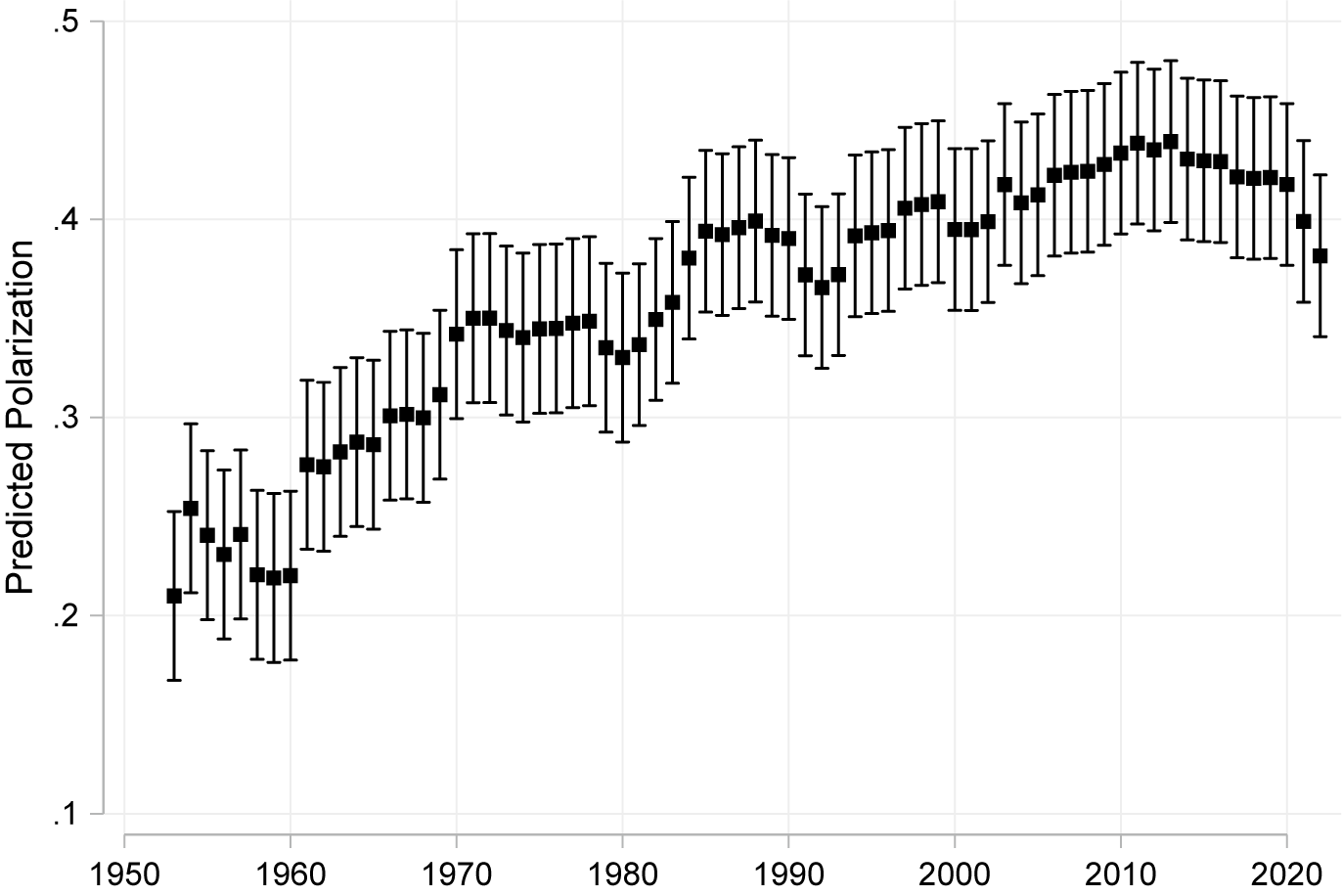
With polarization statistics now estimated, it can now be used to describe polarization across circuits and time. To do this, I estimate a linear model predicting the polarization statistic by circuit and year. Figure 2 presents the predicted polarization statistic by year. Figure 2 confirms commentary of increasing polarization in the judiciary. The highest polarization scores are in the era of 2000–2022, with the highest polarization happening in 2013. However, at the same time, polarization in the judiciary is nothing new. The predicted values reveal relatively high levels of polarization since the mid-1980s. The lowest levels of polarization are observed in the earliest periods in the time studied: the mid-1950s and early-1960s.
Polarization Statistic by Year.

Figure 3 presents the predicted polarization statistic by Circuit. Figure 3 shows considerable heterogeneity in polarization between circuits. The DC Circuit Court has the highest level of polarization. For the DC Circuit, there is no home state Senator who needs to approve of the president’s nominee through the blue slip procedure. This leaves the president less constrained in selecting a nominee that better reflects their ideology. The 6th, 7th, 9th, and 10th Circuits also display relatively high polarization, while the remaining circuits largely have similar levels of polarization.
Polarization Statistic by Circuit.

These patterns could be due to presidential strategy when making judicial nominations. Presidents often face multiple judicial vacancies at any given time and must act strategically when deciding which vacancy to fill. Research by King and Ostrander (Reference King and Ostrander2020) finds that presidents fill judicial vacancies when they are likely to have support from the home state Senators. Home state Senators play an important role in the nomination process because of the Senate’s blue slip process. The blue slip process essentially gives home state Senators a veto over potential nominees (Binder Reference Binder2007). If there is a vacancy and the home state Senator is unlikely to return a blue slip on the president’s potential nominee, the president will instead decide to fill a vacancy where the home state Senator will approve of the nomination (King and Ostrander Reference King and Ostrander2020). As a result of this strategy, it may be the case that circuit courts with unified Senate delegations tend to be less polarized than circuits that have divided Senate delegations. Unified Senate delegations mean that presidents from only one party may be able to make nominations in that circuit. While this may lead to an increasingly partisan circuit, overall polarization would decrease because the ideological distance between the judges would be smaller. Alternatively, when a Senate delegation is divided, it allows opportunities for presidents of both parties to fill vacancies because each party can anticipate some level of support from the home state Senate delegation.
To test whether there are differences in polarization between circuits with unified and divided Senate delegations, I created a yearly measure of whether the circuit’s Senate delegation was unified or divided. I used this measure to estimate a linear regression model predicting polarization. The model includes a control for whether the circuit is the DC Circuit or not. This is because the DC Circuit has no Senate delegation, and therefore, the president is always unconstrained by a potential blue slip when making nominations to this court. The model also includes errors clustered at the year level. The results are presented in Table 1 and Figure 4. The results support the idea that circuits with a unified Senate delegation are less polarized and circuits with a divided Senate delegation are more polarized. The difference in polarization between a unified Senate delegation and a circuit with a divided Senate delegation is .066, which represents roughly 64 percent of a standard deviation on the polarization statistic.Footnote 11
Regression Model: Predicting Polarization

* p < 0.05;
** p < 0.01;
*** p < 0.001.
Standard errors in parentheses. Clustered by the year level. Two-tailed test.
Divided Senate Delegation Predicts Increased Polarization.

Polarization: Consequences
One way to demonstrate that the polarization statistics estimated here are valid is to demonstrate that they predict relevant theoretically motivated outcomes. There are many ways in which polarization should influence decision-making on the Courts of Appeals. Collegiality is an important norm in the context of judicial decision-making (Maltzman, Spriggs and Wahlbeck Reference Maltzman, Spriggs and Wahlbeck2000; Hettinger, Lindquist and Martinek Reference Hettinger, Lindquist and Martinek2006; Hazelton, Hinkle and Nelson Reference Hazelton, Hinkle and Nelson2023). One important aspect of collegiality is the suppression of disagreement and an attempt to strive for unanimity (Hazelton, Hinkle and Nelson Reference Hazelton, Hinkle and Nelson2023). On the Courts of Appeals, suppression of dissents and an attempt for unanimity are commonplace (Songer Reference Songer1982; Bowie, Songer and Szmer Reference Bowie, Songer and Szmer2014). The vast majority of cases are decided unanimously, and often when judges disagree with a potential outcome, they choose not to author a dissenting opinion and instead go along with the majority’s preferences (Atkins and Green Reference Atkins and Green1976; Hettinger, Lindquist and Martinek Reference Hettinger, Lindquist and Martinek2006).
However, high polarization may create stress on collegiality and endanger the norm consensus that collegiality creates. This argument has been advanced by judges sitting on the Courts of Appeals. Judge Jerry. E. Smith, who sits on the Fifth Circuit, believes polarization in the circuits potentially can disrupt the patterns of consensus.Footnote 12 To avoid this, Judge Smith argues that judges in polarized environments engage in strategic behavior to minimize potential breakdowns in unanimity.
There are many ways in which judges can engage in strategic behavior to ensure unanimity and avoid dissensus. To this end, I anticipate more polarized courts will engage in these three actions. One such way is to engage in long deliberation periods. Research demonstrates that heterogenous groups – groups with greater polarization – take longer to come to decisions than homogeneous groups – groups with lesser polarization (Schulz-Hardt et al. Reference Schulz-Hardt, Frey, Lüthgens and Moscovici2000). This longer deliberation period allows the heterogeneous group to work out their differences and come to a unified decision after hearing each individual’s point of view. Based on this, it would be expected that polarized circuits in the Courts of Appeals will take longer to make decisions after the case has been docketed. This will allow the judges to discuss their own individual points of view and come to a decision that is acceptable to each party and allows them to hold up the norm of consensus. Courts that are less polarized do not need longer deliberation periods because these judges are initially likely to agree with each other and do not need to engage in additional deliberation.
Beyond longer deliberation periods, another way in which judges on the Courts of Appeals can ensure consensus and minimize dissensus is through procedural maneuvering. The Circuit Courts of Appeals have discretion in how they perform their duties. In the Court of Appeals, not all cases receive a full hearing. Some cases are decided after the briefs have been filed and do not receive oral arguments. I anticipate that polarized courts will be less likely to hold oral arguments on cases and will instead dispose of them after the briefs have been filed. Polarized courts will be less likely to hold oral arguments because oral arguments open up an environment where disagreements between individual judges are likely brought to the surface. Research shows that individuals who engage in argumentation with each other are more likely to experience attitude polarization and less likely to come to a consensus with each other (Burnstein and Vinokur Reference Burnstein and Vinokur1977), and this is especially true in situations similar to oral arguments where individuals repeatedly express various arguments (Brauer, Judd and Gliner Reference Brauer, Judd and Gliner1995). To avoid the potential airing of disagreements, polarized courts will be less likely to grant oral arguments. Instead, polarized courts will be more likely to make decisions without the benefit of an oral argument.
Judges on the Court of Appeals have discretion in publishing their decisions in individual cases. Not all cases on the Courts of Appeals receive a published, signed opinion that justifies the court’s decision. Most decisions are either unpublished, not signed by the judges, or do not provide a full rationale for the court’s decision (Songer Reference Songer1989; Merritt and Brudney Reference Merritt and Brudney2001). Only 20 to 30 percent of cases receive a published opinion (Merritt and Brudney Reference Merritt and Brudney2001). Polarized courts will be less likely to publish signed, fully justified opinions. On a polarized court, there is more potential for disagreement. By going through the process of writing an opinion, these disagreements may come to the forefront of discussions. In situations when judges understand that the opinion-writing process will lead to potential disagreement being expressed, this would result in a situation in which the judges would have to form some kind of compromise to avoid dissenting or concurring opinions being circulated (Hettinger, Lindquist and Martinek Reference Hettinger, Lindquist and Martinek2006). An alternative to compromise is to simply come to a judgment without providing a rationale that each judge approves of and one in which the judges do not need to sign their name. These expectations are also held by sitting judges. Judge Jerry Smith of the Fifth Circuit Court of Appeals has argued that polarization will increase the extent to which judges engage in using unpublished opinions.Footnote 13
To evaluate my expectations, I rely on data from the Federal Judiciary Center’s Integrated Database (IDB). The IDB has data on cases in the Court of Appeals between 1971 and the present. During this period, the IDB has information on over two million cases. The IDB includes information on the date the case was docketed and the date the case received judgment, whether the case received a full hearing with argument or whether it was disposed of before an argument, and it includes information on the type of opinion the case received. Using this information, I created three variables. The first is a count of the number of days it takes the court to reach a judgment. The second is a binary indicator that takes the value of 1 if the case received a full hearing with oral argument and 0 otherwise. The third is a binary indicator that takes the value 1 if the case received a published, signed, opinion with a rationale and 0 if it did not.
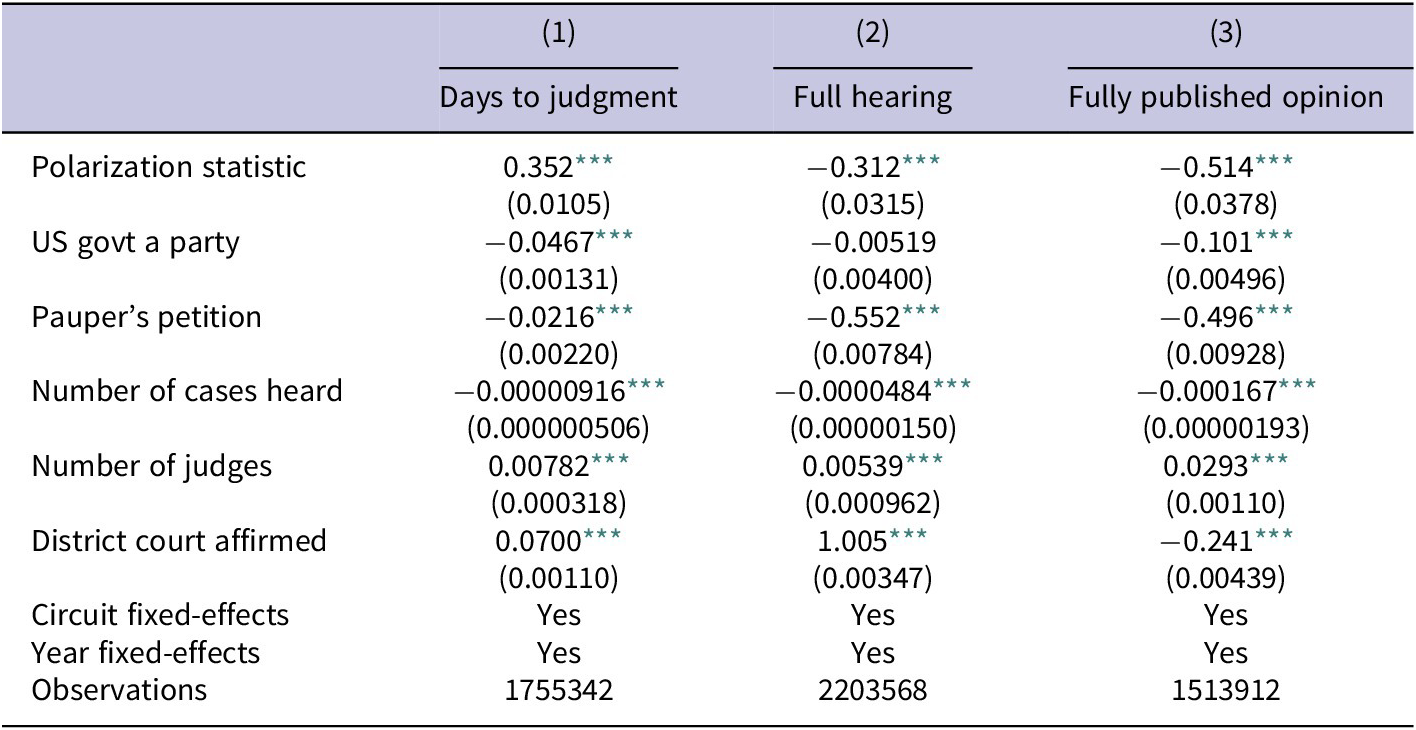
I estimate three models predicting each dependent variable as a function of the polarization statistic. Days to judgment is modeled using a negative binomial regression since the outcome is a count. Receiving a full hearing and receiving a published, signed, justified opinion are each modeled using logistic regression. Aside from the measure of polarization, the models control for variables that may be associated with the dependent variables. The models control for whether the United States is a party to the ligation, whether the petition was filed in forma pauperis, the number of cases decided by the circuit court in the year, the number of judges on the circuit court, and whether the district court’s opinion was ultimately affirmed. The models also include fixed-effects for circuit and year to account for unobserved heterogeneity between units.Footnote 14 For example, some circuits may have a norm toward procedures that facilitate faster decisions than others, and certain years may have larger caseloads, which might influence the time it takes to decide and the deliberative effort in any given case. The results are presented in Table 2.
Regression Models: Consequences of Polarization

*** p < 0.001 two-tailed test.
Standard errors in parentheses. Model 1 is a negative binomial regression. Models 2 and 3 are logistic regressions.
The results support the expectation that polarized courts will engage in more strategic behavior to limit the expression of dissensus. Polarized courts take greater care to minimize dissensus. The predicted values for each variable across the range of the polarization statistic are presented in Figure 5. In terms of days to decision, moving from the minimum level of polarization to the maximum level of polarization is associated with an additional 194 days to be released, which represents a 19 percent increase in days. The probability of issuing a published, signed decision with a rationale decreases by .045 which represents a 19 percent decrease. The probability of a case receiving a full hearing decreased by .03 which represents a 12 percent decrease. These results help validate the polarization statistics estimated here, as these results demonstrate that the polarization statistics predict relevant theoretically motivated outcomes.
Substantive Results from Table 1. The left panel presents predicted days to judgment. The center panel presents the predicted probability of full opinion. The right panel presents the predicted probability of full hearing. The histogram represents the distribution of polarization.

Conclusions and implications
Despite recent scholarly attention to ideological polarization in the United States, the judiciary has received relatively less attention from scholars than institutions such as Congress or the executive (Hasen Reference Hasen2019). This lack of scholarly attention is especially notable in a context in which media and judges serving in the federal judiciary themselves are commenting on the ideological polarization of the judiciary and explaining how ideological polarization may influence how courts within the federal judiciary come to their decisions. To validate or refute these claims, social scientists need measures of polarization in these courts. This article fills this void in scholarly attention to ideological polarization in the federal judiciary by estimating ideological polarization statistics for each Circuit Court of Appeal between 1953 and 2022. It does so by relying on the Esteban and Ray (Reference Esteban and Ray1994) model of polarization, which has been previously used to measure ideological polarization on the Supreme Court (Clark Reference Clark2009).
Descriptively, I find that polarization has steadily increased since the 1960s and 1970s. Yet, polarization is not something completely new to the federal judiciary; substantively, the federal judiciary has seen high levels of polarization since the mid-1980s. This shows that narratives that posit that ideological polarization is just now reaching the federal judiciary are mistaken. I also find that there is considerable variation in ideological polarization across circuits. Some circuits – such as the DC Circuit – are high in ideological polarization, whereas other circuits – such as the Second Circuit – have relatively low levels of ideological polarization. I posit that the variation in ideological polarization may be due to presidential strategy in filling vacancies. King and Ostrander (Reference King and Ostrander2020) show that presidents are more likely to fill vacancies when they anticipate a home state Senator will feature a favorable blue slip. Thus, due to this strategy, ideologically homogeneous Circuits – such as the Second Circuit – do not polarize because a single party’s president is making the most of the nominations. Meanwhile, the DC Circuit, which has no Senators, or politically heterogeneous circuits such as the Sixth or Seventh Circuit become more polarized because there is greater opportunity for presidents of both parties to make successful nominations in these circuits. Future research can continue to study the dynamics of polarization on the Court of Appeals and try to further understand why some circuits have become very polarized while others have remained relatively less polarized.
Moving from the descriptive, I investigate how ideological polarization might influence decision-making behavior. Drawing from the literature on the norm of consensus in the Court of Appeals and commentary from sitting judges, I proposed that increased ideological polarization would cause courts longer to make decisions and be less likely to engage in deliberation. Polarized courts will take longer to make decisions because there is a strong norm of consensus on the Court of Appeals (Songer, Sheehan and Haire Reference Songer, Sheehan and Haire2000; Hettinger, Lindquist and Martinek Reference Hettinger, Lindquist and Martinek2006); in a polarized context, achieving consensus may take longer as judges sort out their ideological differences. Polarized courts will engage in behaviors that minimize the chances of dissent being expressed. In this manuscript, I argued this would mean that polarized courts would be less likely to hold oral arguments and that polarized courts would be less likely to publish fully reasoned and signed opinions. Judges on polarized courts want to avoid these situations because these situations make it more likely that potential dissenting views will be brought to the forefront. I find support for each expectation by analyzing decision-making on the Circuit Court of Appeals between 1971 and 2022.
Polarized courts do take longer to render decisions. Thus, polarization decreases the efficiency of courts. The Court of Appeals receives between 40,000 and 50,000 cases per year.Footnote 15 This results in an extremely high workload for judges serving on these courts. To manage this workload, judges engage in behaviors that maximize efficiency (Hettinger, Lindquist and Martinek Reference Hettinger, Lindquist and Martinek2006). Yet, even with these behaviors, polarization limits the efficiency of courts by requiring additional time before a decision is released.
Polarized courts engage in less deliberation. In this manuscript, I demonstrate this in two contexts. First, polarized courts are less likely to give cases full hearings. Instead, polarized courts will render judgment without the benefit of oral arguments. Second, polarized courts are less likely to produce a published, justified, and signed decision. Thus, polarization decreases the efficacy of potential decisions. With less opportunity to gather information about cases through oral argument, judges may come to potentially different decisions (Martineau Reference Martineau1986; Johnson, Wahlbeck and Spriggs Reference Johnson, Wahlbeck and Spriggs2006). This decreases efficacy because, in a counterfactual context in which oral arguments were held, the judges may have come to a more informed decision. Efficacy is also diminished for the parties involved in the case. Lind and Tyler (Reference Lind Lind and Tyler1988) and Tyler (Reference Tyler1991) demonstrate the critical role of procedural fairness in the perceived legitimacy of outcomes. For the parties involved in the case, not receiving an opinion justifying that decision may cause them to be more likely to question the outcome. From this point of view, polarization could diminish the efficacy of the decision for those involved in the case.
Polarization leads to the Court of Appeals abdicating its authority. While research in the context of legislatures has demonstrated polarization has led to less productive and less powerful legislatures (Jones Reference Jones2001; Binder Reference Binder2004; Schreckhise et al. Reference Hazelton, Hinkle and Nelson2023), it is less clear if a similar phenomenon is happening with the judiciary. Unpublished decisions do not carry the weight of precedent (McAlister Reference McAlister2019). Thus, polarized appeals courts build up less authoritative holdings within their circuit. Further, polarized courts take longer to produce decisions and likely dispose of fewer cases per year. The combined lack of establishing precedent and taking longer to decide cases potentially leads to District Court judges being granted more discretion as the signal of expectations from the circuit is less clear. This could be why Hübert and Copus (Reference Hübert and Copus2022) find that ideological voting in the District Courts has increased over time. During the period of their study, polarization increased in the Court of Appeals and, if this leads to decreased signals of circuit court preferences, it potentially facilitates greater ideological voting by District Court judges.
Supplementary material
The supplementary material for this article can be found at http://doi.org/10.1017/jlc.2024.16.