Palliative Care is a holistic approach to patient care that aims to improve the quality of life for patients, and their families, living with an incurable life-threatening chronic condition (WHO, 2002). Modern Palliative Care developed from the pioneering work of Dame Cicely Saunders and the Hospice Movement and is now recognized as a model of care that is applicable across a range of chronic life-limiting conditions such as cancer, cardiovascular, respiratory, and neurological disease (Connor, Reference Connor2018). This position has been strengthened by a recent resolution from the World Health Organization that recommends equitable access to Palliative Care for all patients with a chronic life-limiting illness (WHO, 2014).
Access to Palliative Care is increasingly recognized as an International Human Right (Brennan, Reference Brennan2007); a position supported by the principles of a “right to health,” as cited in the “International Covenant on Economic, Social and Cultural Rights” where every world citizen should be able to experience the “Highest attainable standard” of physical and mental health. However, an ageing population and an increasing prevalence of patients with neurological conditions, disabilities, and multiple chronic comorbidities present a challenge to existing healthcare systems (O'Brien, Reference O'Brien2013; Reville and Foxwell, Reference Reville and Foxwell2014). The 2017 Lancet Commission report “Alleviating the access abyss in palliative care and pain relief — an imperative of universal health coverage” estimated 25.5 million of the deaths that occurred in 2015 involved serious health-related suffering; equating to 6 billion hours of avoidable distress (Knaul et al., Reference Knaul, Farmer and Krakauer2018).
The UN Special Rapporteur on torture identifies that it is “degrading and inhuman” to deny access to pain relief, particularly where therapeutic approaches are well understood (Health and Human Rights Resource Guide, 2017). However, unless changes are made, the levels of suffering and distress reported by the Lancet Commission report are likely to increase.
Palliative Care is an effective approach to ameliorate the pain and symptomatic distress at the end of life. However, according to the WHO “Global Atlas of Palliative Care at the End of Life,” the main barrier to increased access to Palliative Care is a lack of trained healthcare professionals (WHO, 2014). Expanding provision of Palliative Care and increasing access simply require the integration of the core principles and practice of Palliative Care in all undergraduate education and formative training program. However, evidence from the Atlas on Palliative Care, from the ATLANTES Project in Pamplona, illustrate that in many nursing and medical schools Palliative Care is not a mandatory subject, and where training is provided, content and delivery is variable (Arias-Casais et al., Reference Arias-Casais, Garralda and Rhee2019).
As a result, key challenges for modern healthcare systems and economies are how to initiate and integrate Palliative Care training, to ensure there is sufficient resource to meet the needs of patients, as outlined in the Lancet Commission report. To address this challenge, the WHO proposed that:
… basic training and continuing education on Palliative Care should be integrated as a routine element of all undergraduate medical and nursing professional education, and as part of in-service training of caregivers at the primary care level … (WHO, 2014)
Accordingly, it is imperative that every student doctor understands and is both competent and confident in applying the principles of Palliative Care; changing global demographics and patterns of chronic illness mean that every current and future clinician will be required to care for patients with Palliative Care needs. Although Palliative and End-of-Life Care are increasingly recognized within national health policy frameworks, there is a lack of policy guidance on the provision of training to meet this health care challenge.
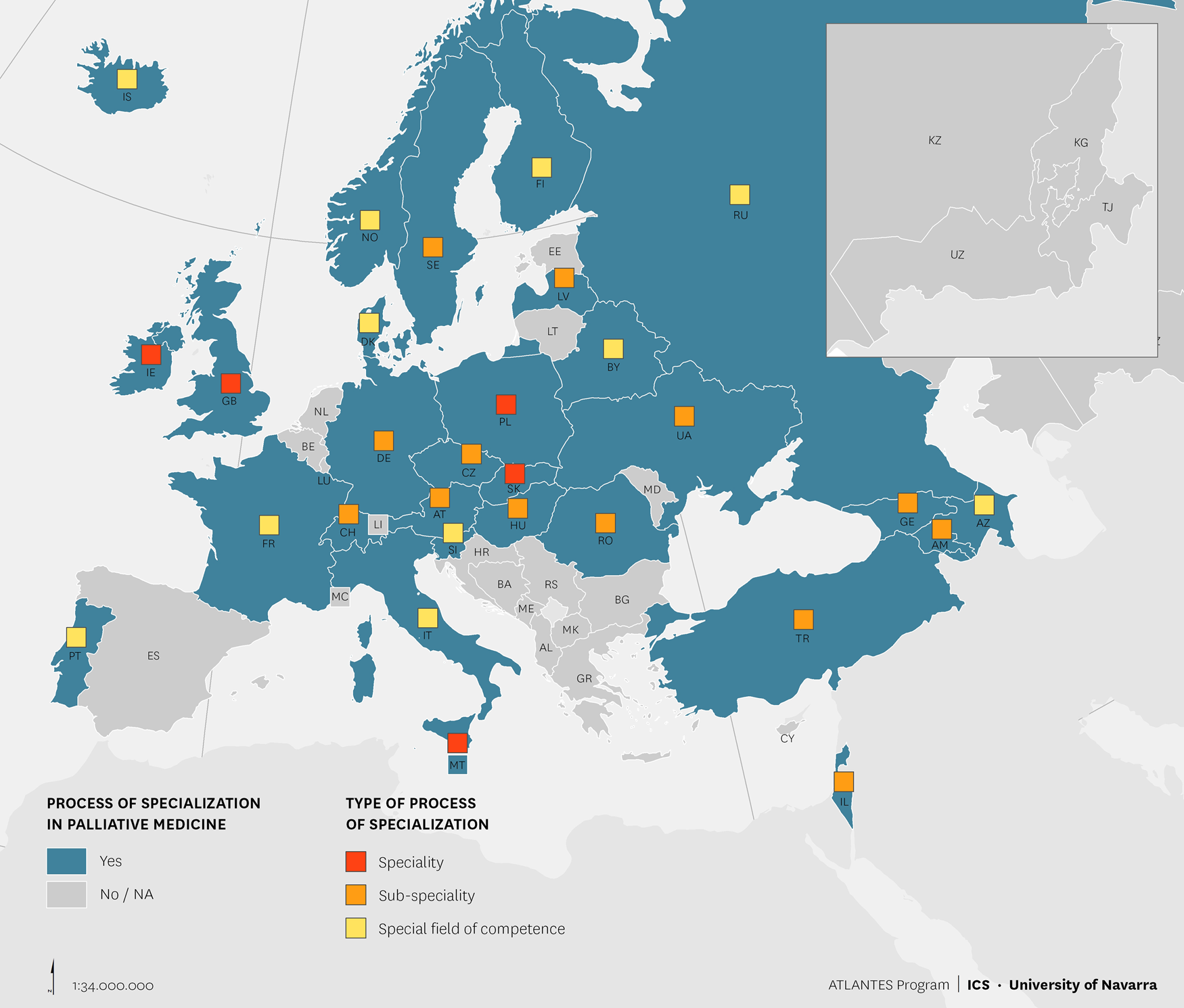
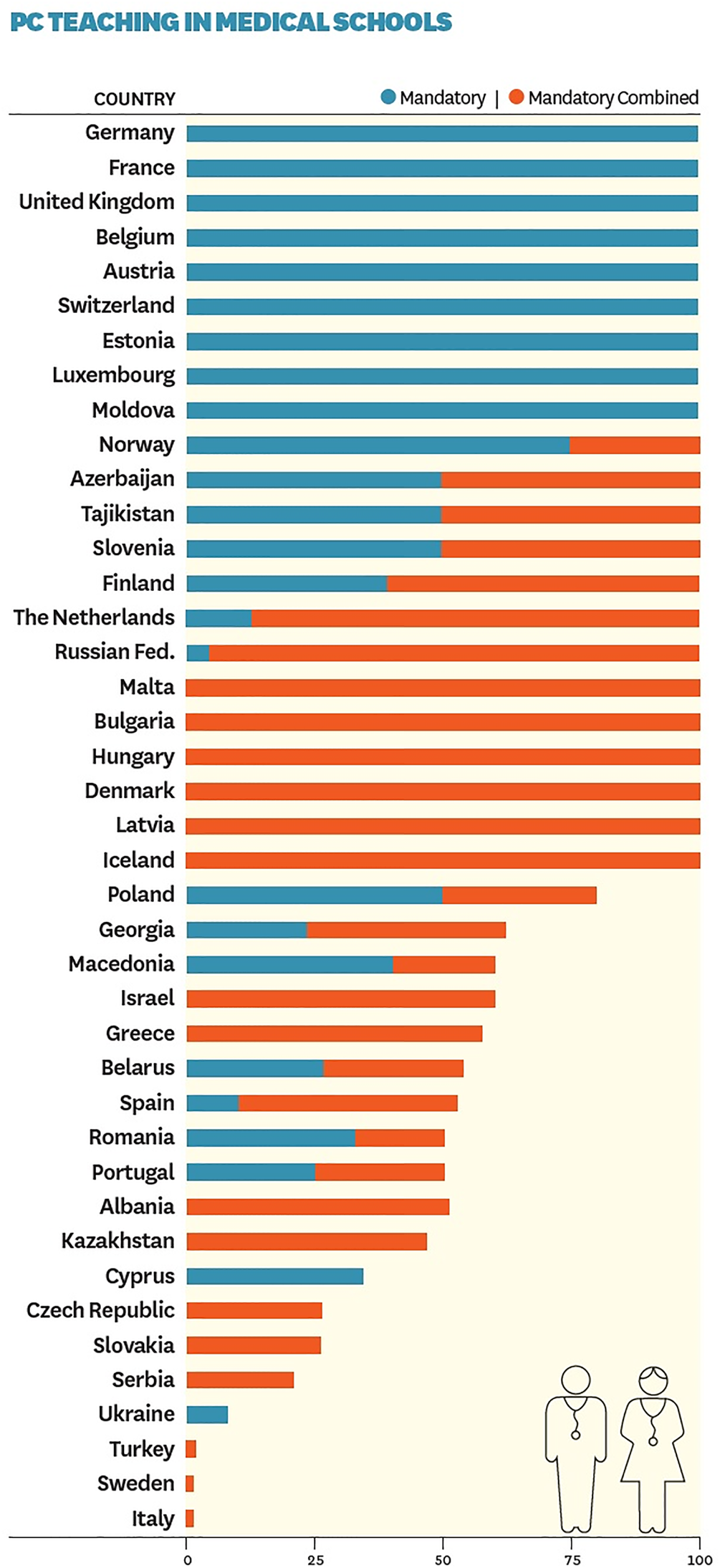
Globally, there is a notable lack of parity in the opportunities for students to learn how to practice Palliative Care. For example, in Europe, the 2019 Atlas of Palliative Care identified that access to any type of formal training for medical students was not available in 32% of the countries surveyed (Figures 1 and 2; Arias-Casais et al., Reference Arias-Casais, Garralda and Rhee2019).
EAPC Atlas of Palliative Care–Palliative Care Education.

Palliative Care Teaching in Medical Schools.

Recently, a small number of policy initiatives have developed across Europe to redress this imbalance and increase the access to training in Palliative Care (Harden et al., Reference Harden, Davis and Crosby1997; Rhodes-Kropf et al., Reference Rhodes-Kropf, Carmody and Seltzer2005; Radwany et al., Reference Radwany, Stovsky and Frate2011; Eyigor, Reference Eyigor2013; Schiessl et al., Reference Schiessl, Walshe and Wildfeuer2013; Horowitz et al., Reference Horowitz, Gramling and Quill2014; Sweeney et al., Reference Sweeney, Lynch and Khashan2014; Carrasco et al., Reference Carrasco, Lynch and Garralda2015; Crawford and Zambrano, Reference Crawford and Zambrano2015; DeCoste-Lopez et al., Reference DeCoste-Lopez, Madhok and Harman2015; Eychmüller et al., Reference Eychmüller, Forster and Gudat2015; Ilse et al., Reference Ilse, Alt-Epping and Kiesewetter2015; Centeno et al., Reference Centeno, Ballesteros and Carrasco2014; General Medical Council, 2018; White et al., Reference White, Oostendorp and Minton2019). For example, Ilse et al. (Reference Ilse, Alt-Epping and Kiesewetter2015) report on the effects of the 2009 legislation in Germany that resulted in undergraduate education in Palliative Care being compulsory across all medical schools. Whereas White et al. (Reference White, Oostendorp and Minton2019) report from the UK that training in Palliative Care is inconsistent across courses and professions and the course organizers express frustration at the lack of resources, funding and time to include more training.
In Africa, there is a significant lack of training opportunities for both doctors and nurses. The 2017 APCA Atlas of Palliative Care in Africa found that in the 49 countries surveyed, only six medical schools reported that learning the practice of Palliative Care is a mandatory subject in medical school (IAHPC, 2017). The patterns illustrated in Europe and Africa are also evident in North/South America and Asia; for example, fewer than 15% of physicians in South America are thought to receive training in palliative medicine (ICCP, 2012).
With the variable provision and a lack of standardized Palliative Care education across the globe, many countries would welcome a model curriculum and structured guidance on developing undergraduate training programs, and national policy guidance to provide impetus to establish training programs. Training in Palliative Care is crucial in both the personal and professional development of healthcare practitioners. Palliative Care is not solely about terminal care but engages multidisciplinary approaches and wider social determinants of health, such as psychological, social and spiritual aspects of care.
Funded through the Erasmus+ “Cooperation for innovation and the exchange of good practices” action, the EDUPALL project has produced a complete program for undergraduate medical student education in Palliative Care, including a universally applicable curriculum that can be adopted and implemented (and adapted) where required; exemplar lesson plans employing blended learning, e-learning, and “bed-side” teaching; resources for faculty development; and a structured evaluation program. The purpose of the detail in the developed curriculum is to support a rapid transition and implementation of undergraduate training in Palliative Care within existing undergraduate medical curricula.
EDUPALL (https://edupall.eu/) may be one part of the solution to this international health care challenge, but without guiding policy at the national/international level on the integration of training, Palliative Care may not develop sufficiently quickly to meet the growing needs of patients.