




No CrossRef data available.
Article contents
- Abstract
- METHODS
- Model Structure
- Derivation of Model Parameters of Clinical Effectiveness
- Derivation of Model Health Utility Values
- Derivation of Model Costs
- Cost-Effectiveness Reporting and Sensitivity Analyses
- RESULTS
- 2-Year Analysis
- Life-Time Analysis
- DISCUSSION
- Study Limitations
- CONCLUSIONS
- POLICY IMPLICATIONS
- CONTACT INFORMATION
- References
Spinal cord stimulation for failed back surgery syndrome: A decision-analytic model and cost-effectiveness analysis
Published online by Cambridge University Press: 04 August 2005
Article contents
- Abstract
- METHODS
- Model Structure
- Derivation of Model Parameters of Clinical Effectiveness
- Derivation of Model Health Utility Values
- Derivation of Model Costs
- Cost-Effectiveness Reporting and Sensitivity Analyses
- RESULTS
- 2-Year Analysis
- Life-Time Analysis
- DISCUSSION
- Study Limitations
- CONCLUSIONS
- POLICY IMPLICATIONS
- CONTACT INFORMATION
- References
Abstract
Objectives: The aim of this study was to develop a decision-analytic model to assess the cost-effectiveness of spinal cord stimulation (SCS), relative to nonsurgical conventional medical management (CMM), for patients with failed back surgery syndrome (FBSS).
Methods: A decision tree and Markov model were developed to synthesize evidence on both health-care costs and outcomes for patients with FBSS. Outcome data of SCS and CMM were sourced from 2-year follow-up data of two randomized controlled trials (RCTs). Treatment effects were measured as levels of pain relief. Short- and long-term health-care costs were obtained from a detailed Canadian costing study in FBSS patients. Results are presented as incremental cost per quality adjusted life year (QALY) and expressed in 2003 Euros. Costs were discounted at 6 percent and outcomes at 1.5 percent.
Results: Over the lifetime of the patient, SCS was dominant (i.e., SCS is cost-saving and gives more health gain relative to CMM); a finding that was robust across sensitivity analyses. At a 2-year time horizon, SCS gave more health gain but at an increased cost relative to CMM. Given the uncertainty in effectiveness and cost parameters, the 2-year cost-effectiveness of SCS ranged from €30,370 in the base case to €63,511 in the worst-case scenario.
Conclusions: SCS was found to be both more effective and less costly than CMM, over the lifetime of a patient. In the short-term, although SCS is potentially cost-effective, the model results are highly sensitive to the choice of input parameters. Further empirical data are required to improve the precision in the estimation of short-term cost-effectiveness.
Information
- Type
- GENERAL ESSAYS
- Information
- International Journal of Technology Assessment in Health Care , Volume 21 , Issue 3 , July 2005 , pp. 351 - 358
- Copyright
- © 2005 Cambridge University Press
Failed back surgery syndrome (FBSS) is defined as chronic back and leg pain after technically and anatomically adequate lumbosacral surgery (14). FBSS is common throughout the developed world, but especially in the United States, where more lumbosacral surgery is done per capita than any other country (26).
There is randomized controlled trial evidence that spinal cord stimulation (SCS) is an effective method for the management of chronic pain management in FBSS patients in comparison to re-operation (18;19;21) However, reimbursement of health-care technologies in many countries now also requires evidence of acceptable cost-effectiveness (6).
A recent systematic review identified several studies that have assessed the costs of SCS in patients with FBSS (24). These studies consistently show that the initial health-care acquisition costs of SCS implantation are offset in the long run by a reduction in postimplant health-care resource demand and costs. A formal economic evaluation focusing on whether or not the additional health benefit of SCS, in FBSS patients, is worth its additional cost in the short-term has not been addressed to date. Such an economic evaluation should be based upon comparing SCS to accepted current medical management for FBSS, that is, nonsurgical conventional medical management that includes analgesic drugs and physical therapy (13). This study describes a decision-analytic model designed to compare SCS with conventional medical management (CMM) in FBSS patients and reports the preliminary model cost-effectiveness results based on current best evidence.
METHODS
Our model took a health-care perspective and assessed the cost-effectiveness of SCS compared CMM in FBSS, as an incremental cost per quality cost per quality-adjusted life year (QALY). It was assumed that the probability of survival was equivalent for CMM and SCS-treated patients. Therefore, the incremental cost per QALY of SCS, compared with CMM, was driven by differences in health-care costs and utility (quality of life) gain.
Model Structure
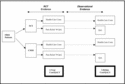
The conceptual basis of the cost-effectiveness model is summarized in Figure 1 and can be summarized as (i) quantification of pain relief associated with SCS and CMM from randomized controlled trial (RCT) evidence, (ii) imputation of utility (quality of life) associated with this level of pain relief, (iii) short-term combination (2-year) of utility and costs, and (iv) extrapolation and combination of utility and costs over the lifetime of the patient using observational evidence.

Schematic summary of spinal cord stimulation (SCS) cost-effectiveness analysis. RCT, randomized control trial; FBSS, failed back surgery syndrome; CMM, conventional medical management; QoL, quality of life; QALY, quality-adjusted life year.
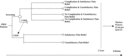
A decision tree was developed to examine the costs and outcomes of SCS and CMM at 2 years. A Markov extension to this decision tree enabled costs and outcomes to be determined over the lifetime of the patient (Figure 2). The structure of this model was developed from a previously published disease model framework for FBSS patients used in the assessment of the costs of intrathecal morphine therapy (5). The model was developed using decision-analytic software (DATA-PRO Release 2, TreeAge Software, Inc., Williamstown, MA).

Summary of spinal cord stimulation (SCS) cost-effective model structure. FBSS, failed back surgery syndrome; CMM, conventional medical management; QALY, quality-adjusted life year.
Patients undergoing SCS could experience four possible health states: (i) satisfactory pain relief with no complications; (ii) satisfactory pain relief with complications; (iii) unsatisfactory pain relief with no complications; and (iv) unsatisfactory pain relief with complication. Investigators have conventionally chosen an improvement of 50 percent, or more, to indicate a satisfactory level of pain relief (22). This analysis follows this convention. The model structure is summarized in Figure 2.
It was assumed that CMM patients do not experience either short- or long-term complications (see derivation of clinical effectiveness parameters) and, therefore, could undergo only two possible health states: (i) satisfactory pain relief and (ii) unsatisfactory pain relief.
On entering the decision tree, FBSS patients could undergo either SCS screening (i.e., a short test period to assess if SCS would be effective or not) or CMM. Those patients who achieved satisfactory pain relief with testing underwent SCS implantation, and patients who failed underwent CMM. All patients then achieved satisfactory pain relief, or unsatisfactory pain relief over a 2-year period of follow-up. During this period, SCS patients could either experience a complication in this period or “fail” (i.e., undergo a stimulator explant and then switch to CMM).
After this initial 2-year period, patients then enter a Markov process for the period of their lifetime. The structure of the model, to the right of each Markov node (triangles in Figure 2), consists of 4-year cycles that depend on the node at which a patient enters. For example, a patient undergoing SCS who has experienced satisfactory pain with no short-term complications will accrue the relevant costs and utility at year 2. On entering the Markov process, this patient will progress to year 3 and either (i) continue to experience satisfactory pain relief with no long-term complications, (ii) continue to experience satisfactory pain relief with a complication, or (iii) experience failure and move to a strategy for CMM for remainder of their lifetime. Each of these states results in the patient accruing a different (transitional) cost and utility for that cycle. The number of yearly cycles experienced by a patient, after an SCS implant, was determined by the stimulator battery life. This process continues over the life expectancy of the patient. According to their 2-year outcome, CMM patients remained in either satisfactory or unsatisfactory pain over the duration of their lifetime.
Derivation of Model Parameters of Clinical Effectiveness
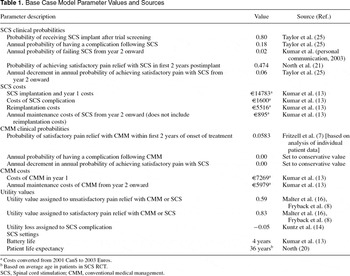
To minimize bias, clinical effectiveness estimates were derived from an RCT, or systematic review evidence. The one RCT of SCS to date to randomize FBSS patients to either SCS or re-operation had a mean follow-up of 2.5 years (18;19;21). To compare SCS with CMM, the method of indirect comparisons was used (2). The indirect method is based on comparing the results of two or more studies where there is a common comparator (in this case re-operation). An RCT of CMM versus re-operation in patients with chronic leg and back pain (CLBP) was identified with 2-year follow-up data (7). Using this indirect approach, it was estimated that the proportions of patients who achieved satisfactory pain relief were 47.4 percent and 5.8 percent for SCS and CMM, respectively.
The proportion of FBSS patient undergoing implantation after SCS testing was estimated to be 80 percent (25). It was estimated that there was a 6 percent absolute reduction in the proportion of patients reporting satisfactory levels of pain relief each year after SCS implantation (25). Based on an overall rate of 43 percent of patients experiencing one or more complication over an average period of 28-months across studies, an annual rate of 18 percent rate of complications with SCS per year was assumed (25).
We failed to find any studies that reported the long-term rate of complications and changes in pain relief associated with the use of CMM in FBSS patients. However, one RCT reported no complications with CMM in patients with CLBP over a 2-year follow-up period (7). Therefore, for the purposes of this study, the rate of complications and the loss in pain relief with CMM were both set to zero. These values were chosen to underestimate the cost-effectiveness of SCS relative to CMM. The importance of these assumptions was assessed by several sensitivity analyses.
Derivation of Model Health Utility Values
Health-related quality of life was not collected in the two RCTs used to estimate the magnitude of pain relief with SCS versus CMM. A detailed literature search, therefore, was conducted to identify utility estimates in patients with FBSS. Although several studies in back pain exist, none considered FBSS patients specifically (3;8–10;12). The utility values reported from the Beaver Dam study were selected for the purposes of this report, as this study focused on patients who reported “an episode of severe back pain” in the past 12-months and, therefore, were deemed to be the closest to FBSS (8).
Estimates of the patient utility associated with satisfactory and unsatisfactory pain outcome were imputed based on a method adapted from Malter et al. (16). Utility values of 0.83 and 0.59 were estimated to be associated with satisfactory and unsatisfactory pain relief, respectively.
Given the fundamental basis of the imputation of utilities to the results of this decision-analytic model, we sought to validate these utility values. Individual patient data was obtained from the principal author of an RCT of SCS in type I complex regional pain syndrome (CRPS) patients (11). Analysis of the utility and pain relief data from the Kemler trial supported the above imputed utility values. The utility loss associated with an SCS-related complication was taken as −0.05 utility units (16).
Derivation of Model Costs
From a systematic review of SCS cost studies (24), one particular study was identified to have undertaken a comprehensive examination of the costs associated with SCS and CMM in patients with FBSS (13). This study was conducted in a single Canadian center.
To assess the issue of European applicability, a Clinical Reference Panel, composed of a group of clinicians working with SCS across Europe, was asked to judge if the level of key health-care resource utilization identified for SCS and CMM in this study was reflective of their own clinical setting. With few exceptions, the group judged the Canadian pattern of resource utilization, for both SCS and CMM, to be similar to their own. Therefore, the pattern of health-care resource and costing from the Canadian study were directly used in this study. Health-care costs were converted from Canadian dollars (at 2000 prices) to Euros (at 2003 prices), based on both purchasing parity power and European (EU-15) health-care price inflation rates.
Cost-Effectiveness Reporting and Sensitivity Analyses
The model results are calculated and reported as incremental cost per QALY ratios. Several univariate and multivariate sensitivity analyses were undertaken across the plausible range of key parameter values that reflected uncertainties in the data sources, extrapolation, and analytic methods (1). Costs were discounted at 6 percent and outcomes at 1.5 percent, in accordance with current guidance (17).
RESULTS
The values of the effectiveness, utility, and cost parameters used in the model base case are summarized in Table 1. The incremental cost-effectiveness ratios for SCS compared with CMM at 2 years and over the duration of the patient lifetime are described below.

2-Year Analysis
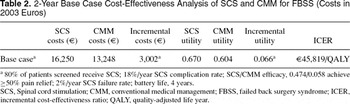
Table 2 shows the base case costs and utilities for SCS and CMM at 2 years. SCS was associated with higher cost (+€3,002) and a higher utility gain (+0.066), with an incremental cost-effectiveness ratio for SCS of €45,819 per QALY.

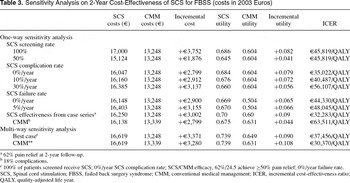
In a one-way sensitivity analysis, the cost-effectiveness of SCS appeared to be highly sensitive to changes, in both the level of SCS effectiveness and SCS annual complication rate (Table 3). The incremental cost-effectiveness ratio was insensitive to changes in the proportion of patients being implanted with SCS after screening. In the “best case” multivariate analysis, with a complication rate of 18 percent for CMM patients, the incremental cost-effectiveness ratio was estimated to be €30,370 per QALY.

Life-Time Analysis
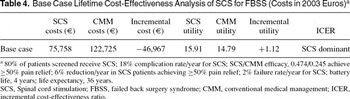
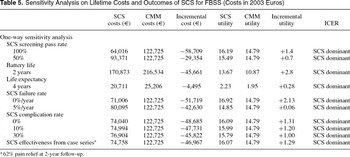
Table 4 shows the base case costs and utilities for SCS and CMM over the lifetime of an average 36-year-old FBSS patient. In this analysis, SCS was dominant, that is, both reduced costs (−€46,967 per patient) and improved utility (+1.12 QALYs per patient), relative to CMM. This finding was robust to all one-way sensitivity analyses (Table 5).


DISCUSSION
In this study, a decision-analytic model was developed to assess the cost-effectiveness SCS for patients with FBSS. We believe this report to be the first study to have combined the outcomes and costs of SCS for FBSS within a formal economic evaluation.
Over the lifetime of the patient, compared with conventional medical management, SCS was found to be both cost-saving to the health-care system and more effective, a findings that was robust to the plausible range of model parameter values and assumptions. This finding supports the previous studies that have examined the costs of SCS alone (24). In a short-term, 2-year analysis, the effectiveness of SCS was found to be superior and health-care costs to be higher relative to CMM. Given the uncertainty in model effectiveness and cost parameters, the short-term cost incremental cost-effectiveness of SCS could range from €30,370, in the best case scenario, to €63,511, in the worst case scenario.
Study Limitations
As with any decision-analytic model, the results and conclusions of this study are dependent on the quality of data upon which the model is based. In this study, there are four potential data limitations: assessment of SCS efficacy, quantification of utility values, long-term disease process, and derivation of costs. These limitations are discussed below.
To date, no RCT has directly compared SCS and CMM in FBSS patients. The treatment effect, therefore, was estimated from an indirect comparison of RCTs. Indirect comparison has been shown to be a valid method for estimating efficacy, when no head-to-head evidence exists (23). However, a particular difficulty in the indirect comparison performed in this study was that of the difference in population of the two RCTs that were used: CLBP in the RCT of re-operation versus CMM (7) and FBSS in the RCT of re-operation versus SCS (19;21). However, as the primary indication for treatment in both RCTs was back and leg pain, an indirect comparison was deemed reasonable.
Despite a comprehensive literature review, no studies reporting utility values in FBSS patients were identified. Therefore, in this study, utility values were imputed from the level of pain relief. As this method failed to take into account other patient outcomes, such as improvements in functionality, it could be argued that the true utility gain associated with SCS was underestimated. However, two factors support the approach taken here. First, in view of the fact that the principle indication for SCS in FBSS is pain, it was considered reasonable to assume that a key driver of the utility change in FBSS patients will be the magnitude of pain relief. Second, when the imputation method was applied to individual patient utility values reported by direct assessment, the results were very similar.
To quantify the long-term costs and outcomes of SCS and CMM, extrapolation was required from the 2-year RCT results. Several long-term (i.e., up to 8 years) observational studies have reported outcomes (efficacy and complications) associated with SCS in patients with FBSS (25). In the absence of such evidence for CMM, it was assumed that there was both no decrement in pain relief over time and no complications with CMM. Although recognized to be highly conservative, these assumptions were made so that they underestimate (rather than overestimate) the cost-effectiveness of SCS compared with CMM.
Costs in this study were from the previous literature rather than, and in particular, from the only detailed cost analysis (13). Although costs from this study were converted to 2003 Euros, it is possible that the pattern of health-care resource utilization reported by the study based in a single Canadian center might be unrepresentative of that incurred in a European setting. However, the pattern of Canadian health-care utilization was judged to be similar to European levels by a clinical expert panel.
CONCLUSIONS
SCS was found to be both more effective and less costly than CMM over the lifetime of a patient. In short-term, although SCS is potentially cost-effective, the model results are highly sensitive to the choice of input parameters. Further empirical data are required to improve the precision in the estimation of short-term cost-effectiveness.
POLICY IMPLICATIONS
In view of its lower health-care costs and superior effectiveness, SCS is clearly highly attractive for health-care policy-makers as a long-term therapy for the management of FBSS patients. At the moment, the policy decision in the short-term is less clear: currently, there is uncertainty in model effectiveness and costs inputs. Indeed, the incremental cost-effectiveness of spinal cord stimulation in this study was found to vary widely: the incremental costs per QALY of SCS spans a range that include values above and below what is currently deemed to represent good value for money in the United Kingdom, that is, less than €50,000 (22). To improve the precision in estimation of the cost-effectiveness of SCS, the collection of further empirical data is required. Collection of utility values in FBSS patients, and assessment of how these values change with SCS, compared with CMM, is required in future research studies. In addition, studies are required to quantify the potential variation in health-care costs of SCS and CMM across centers, and countries. An ongoing, multicentered, randomized controlled trial (PROCESS) is an example of one such study that should address many of these issues (4).
CONTACT INFORMATION
Rebecca J. Taylor, MSc (Health Economics), MSc (Health Psychology), Senior Associate (r.j.taylor@bham.ac.uk), Health Economics Facility, Rod S. Taylor, PhD, Reader (r.s.taylor@bham.ac.uk), Department of Public Health and Epidemiology, University of Birmingham, Edgbaston, Birmingham B15 2TT, UK
We thank Drs. Richard North, Peter Fritzell, and Marius Kemler for access to data from their respective trials. In addition, we acknowledge the advice and peer review of the Clinical Reference Panel members (Drs. Eric Buchser, Jean-Pierre Van Buyten, Paolo Marchettini, Andrew Parrent, Francisco Robaina, Simon Thompson, and John Raphael) and comments on the decision-analytic model by Professor Mark Sculpher, Centre for Health Economics, University of York, United Kingdom. The project was funded by Medtronic, Europe. The planning, conduct, and conclusions of this report have been made independently from the company.
References
Briggs A,
Sculpher M.
1995
Sensivity analysis in economic evaluation of health care technologies: The role of senstivity analysis.
Health Econ.
4:
355–
371.Google Scholar
Bucher H,
Guyatt G,
Griffith L, et al.
1997
The results of direct and indirect treatment comparisons in the meta-analysis of randomized controlled trials.
J Clin Epidemiol.
50:
683–
691.Google Scholar
Burstrom K,
Johannesson M,
Diderichsen F.
2001
Swedish population health-related quality of life results using EQ-5D.
Qual Life Res.
10:
621–
635.Google Scholar
Controlled Trials Register.
A prospective, randomised, controlled, multicentre study to evaluate the effectiveness and cost-effectiveness of spinal cord stimulation using the Synergy System in reducing pain in patients with failed back surgery syndrome compared to conventional medical management (PROCESS study).
ISRCTN77527324 Available at: http://www.controlled-trials.com/isrctn/. Accessed 5 September 2004.
De Lissovoy G,
Brown Re,
Halpern M, et al.
1997
Cost-effectiveness of long-term intrathecal morphine therapy for pain associated with failed back surgery syndrome.
Clin Ther.
19:
96–
112.Google Scholar
Drummond M,
Brown R,
Fendrick MA, et al.
2003
Use of pharmacoeconomics information report of the ISPOR task force on use of pharmacoeconomic/health economic information in health-care decision making.
Value Health.
6:
407–
416.Google Scholar
Fritzell P,
Hagg O,
Wessberg P, et al.
2001
Lumbar fusion versus nonsurgical treatment for chronic low back pain.
Spine.
26:
2521–
2534.Google Scholar
Fryback DG,
Dasback EJ,
Klein R, et al.
1993
The Beaver Dam health outcomes study: Initial catalog of health-state quality factors.
Med Decis Making.
13:
89–
102.Google Scholar
Garratt AM,
Klaber MOFFET J, et al.
2001
Responsiveness of generic and specific measures of health outcome in low back pain.
Spine.
26:
71–
77.Google Scholar
Hollingworth W,
Dyo RA,
Sullivan SD, et al.
2002
The practicality and validity of directly elicited and SF-36 derived health state preferences in patients with low back pain.
Health Econ.
11:
71–
85.Google Scholar
Kemler MA,
Barendse GA,
van KLEEF M, et al.
2000
Spinal cord stimulation in patients with chronic reflex sympathetic dystrophy.
N Engl J Med.
343:
618–
624.Google Scholar
Kendrick D,
Fielding K,
Bentley E, et al.
2001
The role of radiography in primary care patients with low back pain of at least 6 weeks duration: A randomised controlled (unblinded) trial.
Health Technol Assess.
5:
1–
69.Google Scholar
Kumar K,
Malik S,
Deneria D.
2002
Treatment of chronic pain with spinal cord stimulation versus alternative therapies: Cost-effectiveness analysis.
Neurosurgery.
51:
106–
116.Google Scholar
Kuntz KM,
Snider RK,
Weinstein JN, et al.
2000
Cost-effectiveness of fusion with and without instrumentation for patients with degenerative spondylolisthesis and spinal stenosis.
Spine.
25:
1132–
1139.Google Scholar
Kupers RC,
Van DEN Oever R,
Van HOUDENHOVE H, et al.
1994
Spinal cord stimulation in Belgium: A nation-wide survey on the incidence, indications and therapeutic efficacy by the health insurer.
Pain.
56:
211–
216.Google Scholar
Malter A,
Larson EB,
Urban N,
Deyo TA.
1996
Cost-effectiveness of lumbar discectomy for the treatment of herniated intervertebral disc.
Spine.
21:
1048–
1055.Google Scholar
National Institute for Clinical Excellence.
2001
Guidance for manufacturers and sponsors.
London:
NICE; June.
North RB,
Kidd DH,
Lee MS.
1994
A prospective, randomized study of spinal cord stimulation versus reoperation for failed back surgery syndrome: Initial results.
Stereotact Funct Neurosurg.
62:
267–
272.Google Scholar
North RB,
Kidd DH,
Lee MS.
1995
Spinal cord stimulation versus operation for failed back surgery syndrome: A prospective, randomized controlled trial.
Acta Neurochir Suppl.
64:
106–
108.Google Scholar
North RB.
2000
Reoperation versus neuromodulation for failed back surgery.
International Neuromodulation Society San Francisco,
California, July 15,.
North RB,
Kidd DH,
Farrokhi F,
Piantadosi SA.
2005
Spinal cord stimulation versus repeated lumbosacral operation for chronic pain: A randomized controlled trial.
Spine.
64:
98–
107.Google Scholar
Raftery J.
2001
NICE: Faster access to modern treatments? Analysis of guidance on health technologies.
BMJ.
323:
1300–
1303.Google Scholar
Song F,
Altman DG,
Glenny A-M,
Deeks JJ.
2003
Validity of indirect comparison of competing interventions: Empirical evidence from published meta-analysis.
BMJ.
326:
472.Google Scholar
Taylor RS,
Taylor RJ,
Van Buyten JP,
Buchser E,
North R,
Bayliss S.
2004
The cost effectiveness of spinal cord stimulation in the treatment of pain: A systematic review of the literature.
J Pain Symptom Manage.
27:
370–
378.Google Scholar
Taylor RS,
Van Buyten J-P,
Buchser E.
2005
Effectiveness of spinal cord stimulation in the management of failed back surgery syndrome: Systematic reviews and assessment of prognostic factors.
Spine.
30:
152–
160.Google Scholar
Turner JA,
Loeser JD,
Deyo RA,
Sanders SB.
2004
Spinal cord stimulation for patients with failed back surgery syndrome or complex regional pain syndrome: A systematic review of effectiveness and complications.
Pain.
108:
137–
147.Google Scholar
Schematic summary of spinal cord stimulation (SCS) cost-effectiveness analysis. RCT, randomized control trial; FBSS, failed back surgery syndrome; CMM, conventional medical management; QoL, quality of life; QALY, quality-adjusted life year.
Summary of spinal cord stimulation (SCS) cost-effective model structure. FBSS, failed back surgery syndrome; CMM, conventional medical management; QALY, quality-adjusted life year.
Base Case Model Parameter Values and Sources
2-Year Base Case Cost-Effectiveness Analysis of SCS and CMM for FBSS (Costs in 2003 Euros)
Sensitivity Analysis on 2-Year Cost-Effectiveness of SCS for FBSS (costs in 2003 Euros)
Base Case Lifetime Cost-Effectiveness Analysis of SCS for FBSS (Costs in 2003 Euros)a
Sensitivity Analysis on Lifetime Costs and Outcomes of SCS for FBSS (Costs in 2003 Euros)
 You have
Access
- 74
- Cited by