INTRODUCTION
The grey seal (Halichoerus grypus Fabricius, Reference Fabricius1791) inhabits Atlantic boreal waters. Three populations are identified: north-west and north-east Atlantic populations are considered to represent the Atlantic subspecies H. g. grypus, and the Baltic population is made up by the genetically isolated Baltic subspecies H. g. macrorhynchus (Vishnevskaya et al., Reference Vishnevskaya, Bychkov, Kondakov and Mishin1990; Rice, Reference Rice1998). Seals from the north-west Atlantic and Baltic populations are considered to be ice-breeding, and the north-east Atlantic population, land-breeding (Krushinskaya & Lisitsyna, Reference Krushinskaya and Lisitsyna1983). Body size of grey seals shows geographical variation. The largest seals were recorded in the north-west Atlantic: asymptotic length is 242 cm for males and 201 cm for females (Murie & Lavigne, Reference Murie and Lavigne1992). In the north-east Atlantic, mature males are 195–260 cm long, and females are 165–210 cm long (Geptner et al., Reference Geptner, Chapskii, Arsenyev and Sokolov1976; Beck et al., Reference Beck, Bowen, McMillan and Iverson2003). Body size of animals from the Baltic Sea is much smaller: at the age of 12–34 years old, males are 182–202 cm long and females are 166–176 cm long (Lundstedt-Enkel et al., Reference Lundstedt-Enkel, Roos, Nylud and Asplund2008). No data are available on grey seal introductions in other regions.
Grey seals have been never recorded in the Black Sea. The only extant aboriginal pinniped in the Black Sea, the Mediterranean monk seal Monachus monachus Hermann, Reference Hermann1779, inhabited the region up to the end of the 20th Century; now it is extinct in the Black Sea.
The aim of this work is description of the case of long-term survival of a grey seal introduced into the Black Sea with its ecological characteristics and the discussion of present-day pinniped occurrence and survival in the Black Sea.
MATERIALS AND METHODS
Data collection
Search surveys and coastal observations at the coast of Crimea were conducted by the authors occasionally in 2001–2011, from February to November. In summer 2011, in the course of ‘Ukrainian Marine Caves 2011' expedition, submerged and semi-submerged caves of the south Kerch Peninsula were examined. The cave where the seal was observed was assigned number PK-395 for the Ukrainian Caves Cadaster. The observations were recorded with photographs and video. Underwater video records in caves were made using a 3CCD video camera (Sony TRV900) with a blimp and self-power lighting. In addition, we collected data about the seal identified as the observed one from the coast of eastern Crimea and the Kerch Strait: using oral communications and photographs by researchers from the South Scientific Research Institute of Marine Fisheries and Oceanography, Opuk and Karadag natural reserves, Taurida National University, other research institutions, by local residents, and tourists. Data on external appearance and behaviour of the seal and, when available, on the weather conditions, were recorded. Photographs taken in various localities were analysed. The criteria for identifying the observed animal as a grey seal were: large body size; greyish spotted coloration; long ‘Danish dog-like' snout; absence of observable auricles; and difference from eared seals familiar to the respondents.
Species and individual identification
Acceptable quality photographs and snapshots showing lateral views of the seal's head were used for species and individual identification. Each individual seal has a unique black and white pelage pattern with the spots at the head and neck, especially distinct in adult females (Hiby et al., Reference Hiby, Lundberg, Karlsson, Watkins, Jüssi, Jüssi and Helander2007). We compared two series of images taken in 2009 (photographs by Marina Dovgopolaya) and in 2011 (snapshots from a video by Oleg Kovtun).
RESULTS
Time frames
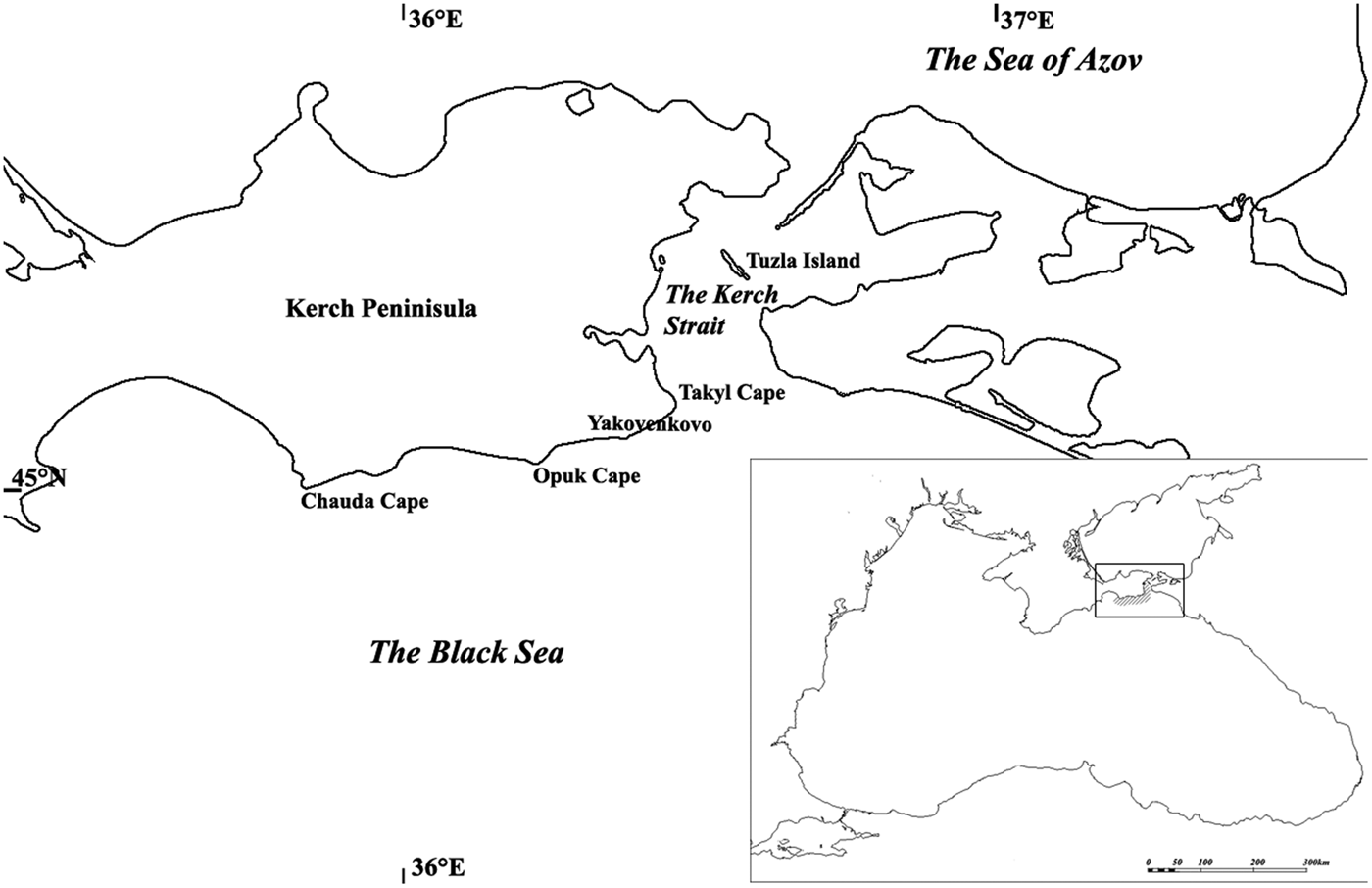
The first anecdotal records of an animal similar to a grey seal near the Crimean coast are dated as early as 1982–1983: a seal of spotted coloration was seen on ice in the Bulganak Bay, the Sea of Azov. Then a seal was recorded in 1995–2000 in the Kerch Strait (in the Taman Gulf and near Tuzla Island). The reports were controversial: although some respondents reported having seen ‘a fur seal', the descriptions (‘long hind limbs and short forelimbs' and ‘head without observable auricles') suggested a phocid seal. Since at least 2001 (or even 2000) the animal identified as a grey seal has been regularly seen near the south coast of the Kerch Peninsula at the Black Sea, between the capes of Chauda and Takyl (Figure 1). A few anecdotal reports of two (‘old and young') animals in 2001, 2005 and 2011 were validated and proven to be erroneous; at present we have no testimony of any two seals being observed at the same time.
Geographical range of sightings of the grey seal Halichoerus grypus at the Black Sea coast (marked by shaded area).

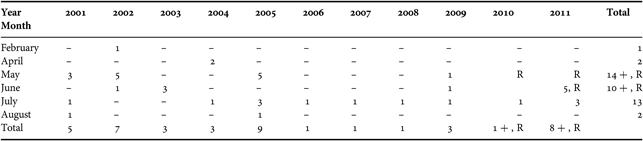
During 11 years of observation, the seal has been observed in February and from April to August (Table 1). In terms of seasonal dynamics, more than 33% random observations fell in May; in May 2010 and 2011, there were regular observations as well. Throughout all those years the seal has never been seen within the periods of 10–20 July or 29 July–24 August.
Seal records near the southern coast of the Kerch Peninsula in 2001–2011 (the number of records is indicated; R, regularly).

Results of field studies
During our field studies we have seen one animal identified as a sexually mature, although not old, female grey seal. It has a long snout, shorter and more gracile than in males, without fleshy bulge. The dorsal side is dark-grey, and the ventral one, light-grey, with numerous white blotches of various size and shape at the belly, sides and neck. This type of female coloration is usual for grey seal colonies in Scotland and at the Baltic coasts; it is rarely seen in the Barents Sea colonies (Geptner et al., Reference Geptner, Chapskii, Arsenyev and Sokolov1976; Anderson, Reference Anderson1988). Body length of the seal living near the Crimean coast is estimated as 160–170 cm.
The analysis of pelage pattern on the head from photographs taken in 2009 and from above-water and underwater video in 2011 demonstrates that this is one and the same individual (Figure 2). This can be seen from the shape and location of a large white patch near the right ear and three small spots behind the mouth on the right side of the head. The main elements of the pattern used for individual identification are marked with red boxes on the photographs. Bright pelage indicates recent moulting. The coloration is black and white, without the reddish hue that appears in northern grey seals in the next few months after moulting.
Photographs of the grey seal Halichoerus grypus at the Black Sea coast: (A) photograph by M. Dovgopolaya, 2009; (B) photograph by O. Kovtun, Reference Kovtun2011. Elements of pelage patterns are compared.

The most successful observations from a close distance were made in July 2011.
Behaviour
Most frequently the seal was observed while feeding. It was repeatedly seen foraging in the waters near the coast of the Kerch Peninsula, hunting so-iuy mullet Liza haematocheilus. These observations mostly fall in May, the season of migration of so-iuy. Depredation from fishing gears was recorded: the seal took flathead grey mullet (Mugil cephalus) and so-iuy mullet (Liza haematocheilus). The seal often visited a facility for artisanal fisheries near Yakovenkovo. When fishermen lifted the net, the seal took the fish dropping out of the net. Sometimes it would enter the area encircled by the net; the fishermen let the seal go out.
The seal was seen in an underwater cave on 26 July 2011 (E.G., personal observations). It was lying on a stone with its head under water (Figure 3), sometimes lifting its head up and watching the researchers. After 30 minutes, it dived into an underwater passage. During the next observation in the cave on 27 and 28 July 2011 (Kovtun, Reference Kovtun2011), the operator with the camera met the seal in an underwater tunnel. Moving past the operator, the seal bit the objective of the camera and hit the camera with its foreflipper. Next day the seal was found lying on the above-water stone in the remote part of the east cave. As before, the seal watched the diver for a long time, and then it went to the water. After this record, the cave observations were stopped to avoid further disturbance. Thus, the seal did not tend to leave the cave after meeting a human, but stayed inside the cave.
The grey seal Halichoerus grypus in the underwater cave: (A) lying on a stone (photograph by D. Smirnov); (B) under water (photograph by O. Kovtun).

Shelter
The examined cave is probably the shelter regularly used by the seal (Figure 4). There are traces of the seal's activity: faeces, prey remains and specific smell. We suppose it to be the seal's haul-out for the moulting period. The cave is a complex of passages produced by abrasion. Total length of the cave is 111.7 m; area is 429.2 m2; volume is 1269.8 m3. The cave has two entrances. Extensions and niches up to 1.5 m high are seen in underwater portions. The cave floor is mostly submerged, it lifts gradually from the entrance to terminations; height gradient is about 3 m. Depth is 2 m at the west entrance and 1.5 m at the east entrance. Maximum height of the cave is 11 m at the west entrance; minimum height is 1 m in the small passage. Maximum breadth, 8.5 m, is at the west entrance. The cave floor is covered by boulders and pebbles. The seal's haul-out is located at the pebble beach in the east portion of the cave.
Scheme of the cave ‘Tyuleniy’ (presumed haul-out is marked by the asterisk).

DISCUSSION
Origin
The nearest to the Black Sea natural habitats of grey seals are the Baltic Sea and the coasts of France, Great Britain and Ireland; vagrant individuals were recorded in the waters of Portugal (Rice, Reference Rice1998). West European seals prefer remote coastlands at rocky archipelagos, uninhabited islands, isolated beaches and underwater caves (Lockley, Reference Lockley1966; Kiely & Myers, Reference Kiely and Myers1998); at the Faroe Islands, grey seals moult and even breed in caves (Mikkelsen, Reference Mikkelsen2007). A similar landscape is typical of the grey seal's habitat at the Black Sea.
The most probable way of a grey seal's penetration into the Black Sea is escape from captivity. Grey seals from the Barents and Baltic Seas have been held in oceanaria and zoos of Russia; a young male grey seal was transported in April 1988 from the Barents Sea to an oceanarium at the Black Sea (Mishin & Matishov, Reference Mishin and Matishov2000).
Atlantic grey seals, including animals from the Barents Sea, are larger than the Baltic seals. So the fully-grown female about 170 cm long is more likely a Baltic grey seal. Living in an alien environment and malnutrition could cause stress and decline in growth rate. However, no data support inadequate nutrition or emaciation of the studied individual. Pelage coloration in late July 2011 indicated a recent moulting. Moulting seasonality differs for Atlantic and Baltic grey seals. Moulting occurs from January to March in Britain, from March to May in the Barents Sea and from May to early July in the Baltic Sea (Kondakov, Reference Kondakov1999; McConnell et al., Reference McConnell, Fedak, Lovell and Hammond1999; Sjoberg et al., Reference Sjoberg, McConnell and Fedak1999). Individual activity is low during the moulting. In captivity, duration of individual moulting extends and its time significantly varies. According to our data, records of the seal at sea are either rare or missing starting with the end of June. This period falls within the moulting season known for Baltic grey seals.
Lifestyle and behaviour
No uniform migration pattern is characteristic for grey seals. Some individuals can migrate 100 km or even more (McConnell et al., Reference McConnell, Fedak, Lovell and Hammond1999; Vincent et al., Reference Vincent, Fedak, McConnel, Meynier, Saint-Jean and Ridoux2005). In the Black Sea we have data of seal records within the 80-km long coastal stretch (Figure 1).
The coast of Kerch Peninsula is remarkable for its small population, lack of human activity, and almost inaccessible areas with cliffs and underwater caves. These conditions are favourable as a seal habitat—that was probably the main reason why the seal chose this area. Conflicts with fisheries affect grey seals in some regions due to depredation and net damage by seals (Königson et al., Reference Königson, Lunneryd, Stridh and Sundqvist2009). The seal living in the Black Sea interacts with fishing gears, too. However, a single animal cannot cause much damage to fisheries, so fishermen are tolerant of it.
In the Baltic Sea, the surface water temperature varies within +2–8°С during cold season and +10–17°С in summer. The north-eastern Black Sea is much warmer: in summer, water in the coastal area warms up at least to +23–25°С. Many fishes, e.g. mullets and turbot, migrate to depths with cooler water, and it can account for the rare summer seal records at sea. During the periods of water cooling the seal is more frequently recorded in June, like in 2011, when the June water temperature was below +17–18°С. Also June/July is the probable moulting season; hence, the summer decline in activity is in line with the moulting period. Attractive for a cool-loving grey seal is the shelter cave with a cool-water pool, which is indirectly connected to the sea.
Baltic grey seals mainly haul out on ice during the breeding season, although in warm winters they breed and moult ashore (Harding et al., Reference Harding, Härkönen, Helander and Karlsson2007). On the contrary, Atlantic seals tend to moult at coastal haul-outs only. So the animal preferring open sea and ice in natural habitats (if it is a Baltic seal) has adapted to the Black Sea coast and changed its ecological strategy, while the edge of stable winter ice in the Sea of Azov is just 20–30 km from its present habitat. However, the seal remains within the limits of the species ecology: its lifestyle fits in with what we know about that of north-east Atlantic seals near the Faroese, British and French coasts.
Grey seal and monk seal
The Mediterranean monk seal is now extinct in the Black Sea; its latest records in the 1990s came from the southern and south-western coasts (Öztürk, Reference Öztürk and Öztürk1996; Spasov & Avramov, Reference Spasov and Avramov2011). In Crimea, monk seals were recorded near the south Crimean coast in the early 20th Century (Zernov, Reference Zernov1913; Kleinenberg, Reference Kleinenberg1956). Monk seals probably were extinct in Crimea by the 1930s (Puzanov, 1929) and in the north-western Black Sea by the 1950s (Krotov, Reference Krotov1952; Sal'nikov, Reference Sal'nikov1959).
Subsequently pinnipeds were numerously recorded in the northern Black Sea: they escaped from local oceanaria (Birkun, Reference Birkun2006), where seals have been held since the 1970s; yet individual survivals in nature are supposed to be short-term. Especially important is the report by Evgeny Kondaurov who observed a seal near the cape of Chauda in 1974 (Krasnaya Kniga RSFSR, Reference Krasnaya Kniga1983). It is not known if it was an extralimital record of a monk seal or the first record of a seal that had escaped from captivity.
In recent years, scientific and popular publications reported sightings of monk seals in the north-east Black Sea. In light of our data, all these records should be referred to the grey seal, the records of monk seals being erroneous. The source of confusion is the ecological similarity: tendency to uninhabited areas and using underwater caves as shelters. It indicates that under certain conditions (e.g. presence of cool-water habitats or currents) dispersing or introduced grey seals can mimic the monk seal in subtropical regions. So far this has not been evident, because the present-day natural ranges of these species do not overlap; however, the similarity of their ecology has revealed itself with the introduction of the grey seal into the Black Sea.
For the past 50 years distribution and abundance of monk seals in the eastern Mediterranean declined to critically small values by the 2000s (Güçlüsoy et al., Reference Güçlüsoy, Kiraç, Veryer and Savas2004). However, in recent years monk seals have been showing a tendency toward dispersal: previously unknown colonies have been found (Güçü et al., Reference Güçü, Güçü and Orek2004); sightings in the waters of Croatia and Israel have been reported (Gomerčić et al., Reference Gomerčić, Huber, Gomerčić and Gomerčić2011; Scheinin et al., Reference Scheinin, Goffman, Elasar, Perelberg and Kerem2011). In the past, long-distance migrations were recorded in the Black Sea (Sal'nikov, Reference Sal'nikov1959; Dobrovolov & Yoneva, Reference Dobrovolov, Yoneva and Öztürk1996). Individual movements in the Aegean Sea, at the north-eastern edge of the present-day range, can amount to 280 km within three months and 40 km per day (Adamantopoulou et al., Reference Adamantopoulou, Androukaki, Dendrinos, Kotomatas, Paravas, Psaradellis, Tounta and Karamanlidis2011). In addition, some Aegean monk seals habituate to humans (Adamantopoulou et al., Reference Adamantopoulou, Androukaki, Dendrinos, Kotomatas, Paravas, Psaradellis, Tounta and Karamanlidis2011). Given these trends and the presence of habitats suitable for monk seals (Bychkov, Reference Bychkov1976), we can expect reappearance of monk seals in the Black Sea, the case of successful survival of the grey seal at the Black Sea coast demonstrating the possibility of re-colonization of this region by monk seals.
ACKNOWLEDGEMENTS
The authors thank Tatyana Vasilchenko, Igor Barmin, Dmitry Smirnov, Dmitry Startsev and Lena Godlevskaya for their help in field research; Vladimir Pletyuk, Igor Sikorsky and Vera Gasymova for their help in organization of studies; Valentin Kassin, Marina Dovgopolaya, Vasily Mazepa, Viktor Gromenko, Ekaterina Lukyanenko, Nikolay Kononov, Valentina Kobechinskaya, Dmitry Georgiev, Aleksandr Fedetsov, Maxim Svolynsky, Evgeny Suslov, Vladimir Dikiy, Sergey Ivanov, Lena Godlevskaya, Roman Zimnukhov, Dmitry Kalentsov, Vitaly Giragosov, Valentin Serbin, Evgeny Gol'din, Andrey Tsemenko, Tatyana Vishnevskaya and Viacheslav Bychkov for interviews and discussions; and two anonymous referees for comments on the earlier draft of the manuscript. Special thanks to Marina Kosareva for her inspiration and support at all steps of our study.