INTRODUCTION
On 26 May 1925, several years after Belgium had consolidated its League of Nations Mandate over Ruanda-Urundi, a Belgian administrator of Rukira territory in eastern Ruanda notified his superior that his subjects had begun moving out of his administrative area, seeking what appeared to be seasonal employment in neighbouring British territory. About a fifth of the adult men in the area were involved in such trips. This sudden mobility was not confined to a small area: the Rukira report was part of a broader inquiry, and fellow administrators throughout Ruanda conveyed similar messages about an unexpected onset of uncontrolled migration to the British territories to the north and east.Footnote 1
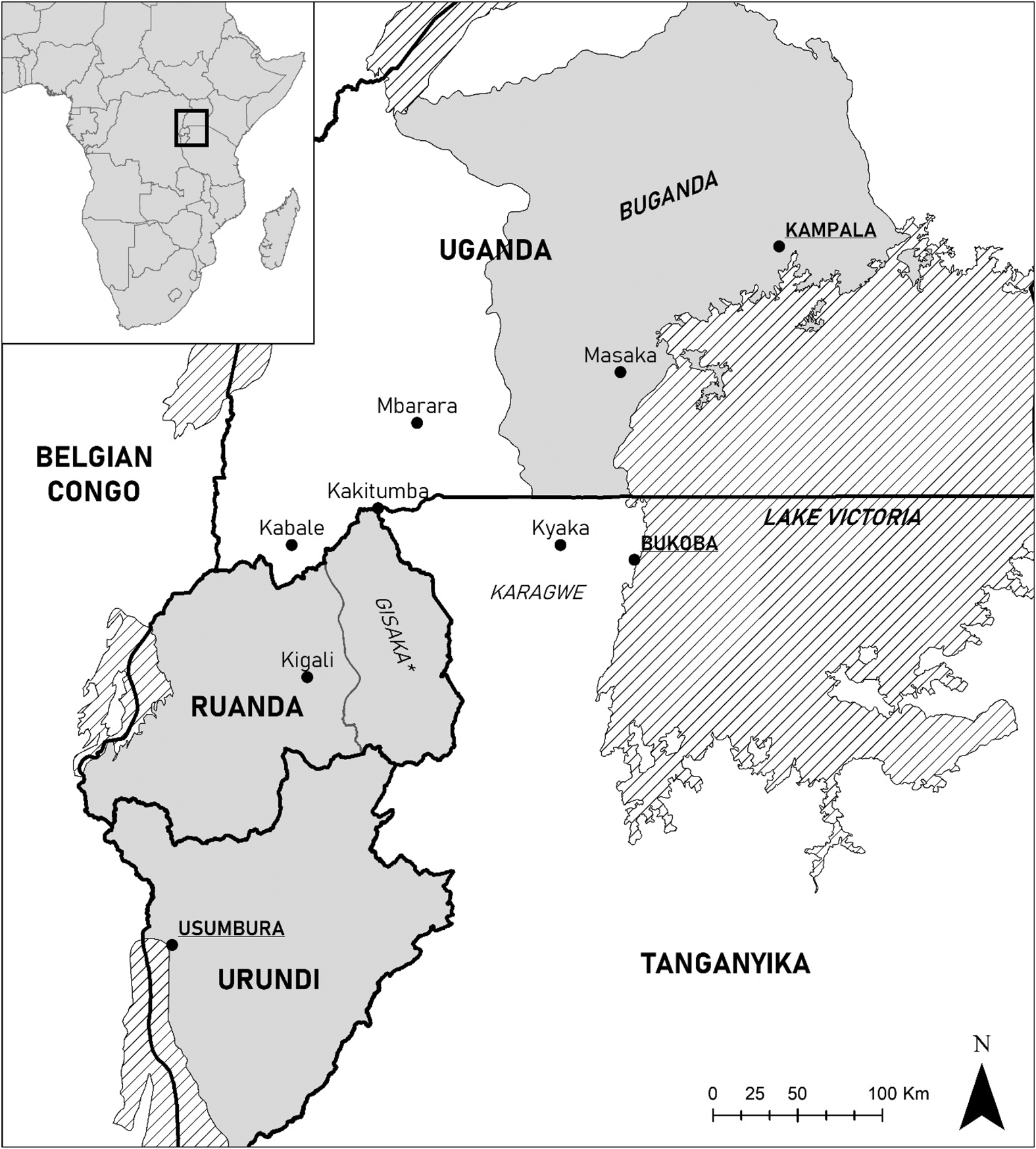
Although dwarfed in size by the Belgian Congo (Fig. 1), Ruanda-Urundi harboured over a third the number of inhabitants of its giant neighbour, constituting – by far – colonial Africa's most densely populated territorial unit. Thanks to its fertile soils, elevated topography, and strong but inward-looking political institutions, the area had been able to sustain a dense population and had remained comparatively shielded from the nineteenth-century demographic shocks related to the slave trades and the spread of communicable human and animal diseases. Despite the abundance of people, the German and – initially – the Belgian colonizers had refrained from tapping Ruanda-Urundi as a labour reservoir, believing that the native population, used to relatively cool and disease-free mountainous conditions, would not tolerate other climates. Additionally, as the Belgian administration argued as late as 1923, the indigenous people were ‘too attached to their country to envisage the possibility of taking them out of their environment’.Footnote 2
Map of the migration area.

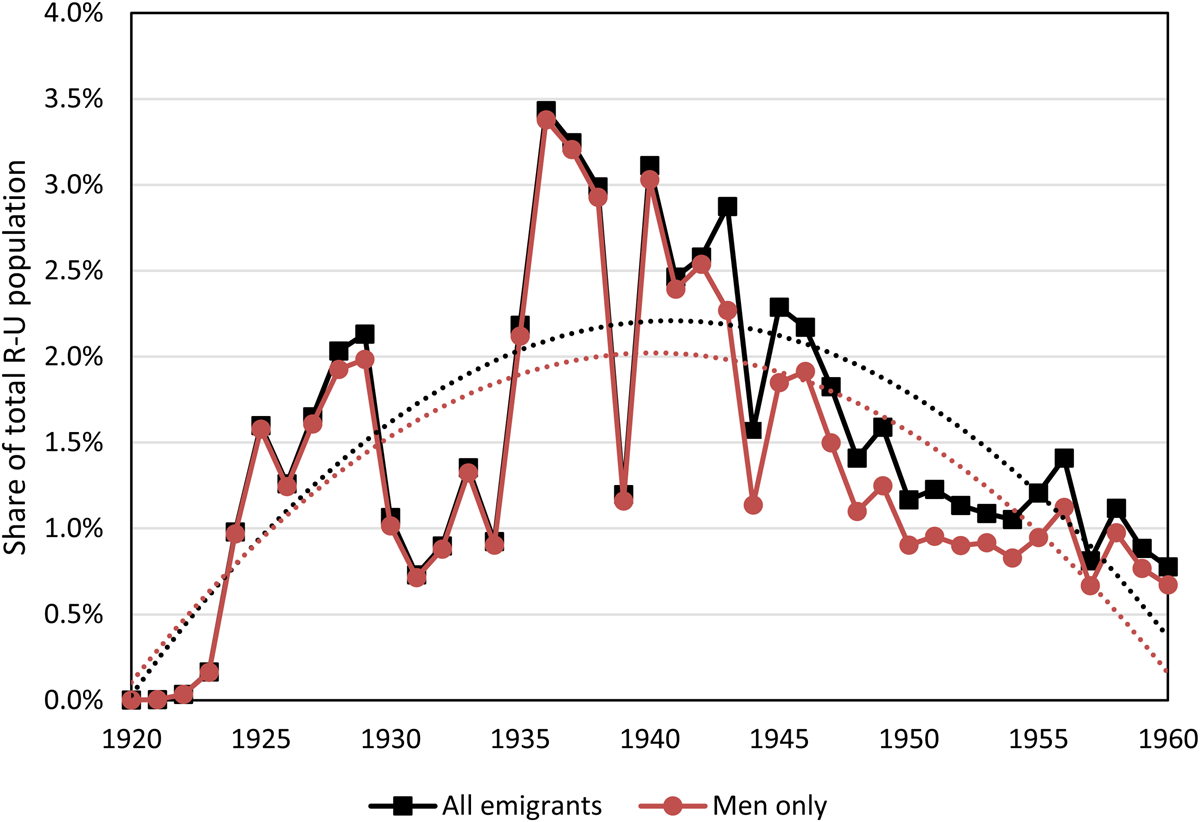
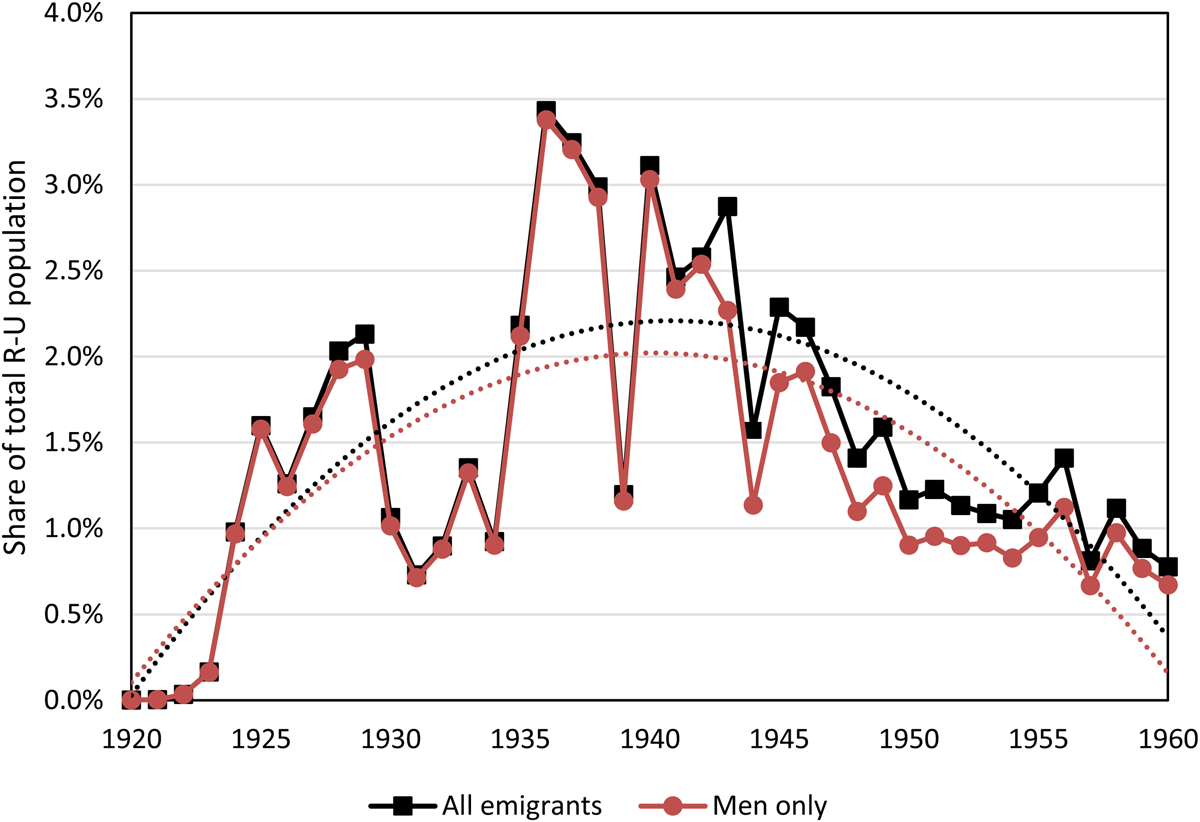
Now that labour had proven substantially more mobile than previously supposed, the Belgians began to re-evaluate the potential of their newly acquired territory as a labour reservoir.Footnote 3 Like several other colleagues, the Rukira administrator reassured his superior that he was engaged in ‘constant exhortation’ to stop the unexpected and uncontrolled exodus of working-age men, and argued that labour should be diverted towards Belgian enterprises in the Congo, such as the Katanga and Kilo-Moto mines and Kivu settler farms, or at least be put to local productive use. A plethora of initiatives to limit or divert the flow, however, proved of little avail. Typically 50,000 to 100,000 migrants were to circulate annually between Ruanda-Urundi and Uganda with little colonial supervision for the remainder of the colonial period, translating to between 1 and 4 percent of Ruanda-Urundi's entire population (Fig. 2) and a much higher share of working-age male adults, particularly in the territory's eastern regions. Peaking in the late 1920s, and again from the mid-1930s to the mid-1940s, the overall flow subsequently abated until 1959, when political turmoil caused a renewed outpouring of migrants, this time primarily seeking safety and refuge.Footnote 4 In 1950, while the total population of Ruanda-Urundi was just under 5 million, the Belgian authorities estimated that approximately 675,000 Rwanda and Rundi resided in Uganda, Tanzania, and Kenya, the great majority of whom were recent migrants.Footnote 5
Estimated annual rates of outmigration from Ruanda-Urundi to Buganda, 1920–60 (with quadratic fitted trendlines).
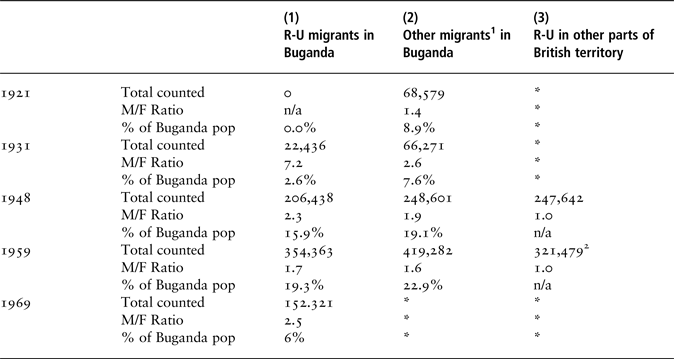
While migrants branched out in many directions, by far their most important destination was Buganda, the commercially and politically dominant kingdom within the pre-colonial Great Lakes region, and subsequently the administrative and economic core of the Uganda Protectorate (Fig. 1). From the 1920s onwards, Buganda's labour supply and economic expansion came to rely heavily on the inflow of migrants, most of whom originated from places with which it had no historical migration ties. As indicated by Table 1 below, by the end of the colonial period, about half of Buganda's (overwhelmingly rural) population of 1.8 million consisted of recent immigrants and their descendants. While Buganda's migrants came from many regions, Ruanda-Urundi was by far the most important source. In particular, its migrants were absorbed into the rural economy and found employment with indigenous farmers, contributing substantially to the production of cotton and coffee, the crops which made Uganda one of the more significant agricultural exporters in colonial Africa.Footnote 6
Rwanda and Rundi enumerated in Buganda

Notes: (1) ‘Other migrants’ include all people present in Buganda but not identifying as Ganda, except Nyoro in Mubende District, and ‘Basese’ and ‘Bavuma’ in the 1921 census. A small number of Rwanda and Rundi who worked in Kenya are not accounted for in column 3. (2) The 1959 figures for Tanganyika in column 3 are in fact from 1957.
Sources: Uganda, Census Returns 1921 (Entebbe, 1921); Uganda, Census Returns 1931 (Entebbe, 1931); Uganda, Uganda Census 1959; East African Statistical Department, African Population of Uganda Protectorate, 1948: Geographical and Tribal Studies (Nairobi, 1950).; East African Statistical Department, African Population of Tanganyika Territory: Geographical and Tribal Studies (Nairobi, 1950); East African Statistical Department, General African Census [Tanganyika], August 1957, Tribal Analysis, Part I (Nairobi, 1957).
Uncontrolled mass mobility was the aggregate outcome of the choices of large numbers of ordinary people defying imperial borders and colonial labour recruitment efforts. Such migratory choices crucially shaped the direction of economic, as well as political, cultural, and social change, not only in the Great Lakes region, but in much of the African continent, which during the colonial era saw rapid and tumultuous processes of labour market formation, rural commercialization, and regional economic integration. On a scale comparable to Buganda, migrants crossed colonial and imperial borders to cultivate groundnuts in Senegal and the Gambia, and to grow and harvest cocoa in the forest zones of the Gold Coast.Footnote 7 In contrast to migration in Southern Africa, which has been rather dominant in the historiography on colonial labour migration, much of this mobility was ‘uncontrolled’, and initiated by migrants themselves rather than by colonial governments.Footnote 8
Despite the importance of uncontrolled mass migration throughout the African continent during the colonial era, its treatment in the historiography has remained rather fragmented.Footnote 9 One strand of scholarship, which we can trace back to late colonial anthropology and economics, associates large-scale migratory movements in Africa with progress, focusing on changing material and non-material aspirations of migrants as an explanation for shifting migration outcomes.Footnote 10 Another strand takes a more pessimistic view on migration, associating it with exploitative colonial structures, designed to extract labour for capitalist enterprise.Footnote 11 Neither view, however, allows for a comprehensive explanation of the dynamics of migration from Ruanda-Urundi to Buganda. If we just consider the onset in the early 1920s, as described above, it is unlikely that the aspirations of migrants changed radically enough in a matter of years to explain mobility on such a scale. At the same time, the migrants' movement beyond imperial borders did not result from an organized or official recruitment effort, and took colonial officials by surprise.
Using insights from comparative economic history and migration theory, this study seeks to extend our understanding of the dynamics of nondirected mobility beyond the dichotomy of migrant agency versus colonial exploitation. The central argument is that migrants’ dynamic choices about when to move, for how long, and with whom, arose from contrasting and shifting land and labour availability, colonial policies, currency fluctuations, and the emergence of export agriculture. In more general terms, migrants responded promptly and pragmatically to processes of economic change in the sending and receiving regions, processes that were largely beyond their control and that of their colonizers. However, large-scale mobility was not just an outcome of uneven spatial opportunity structures. Migrants’ choices had unintended consequences, affecting economic opportunities at both the sending and receiving ends, and eventually eroding the benefits of migration. Individually, then, migrants were responding to changing spatial opportunity structures, while collectively, they also crucially shaped the evolution of such structures.
The argument and narrative of this study are based on qualitative and quantitative materials from Belgian, British, and Ugandan archives and published colonial reports, as well as a reading of the Anglo- and Francophone historiographies. Migrants, and especially those who found employment in the indigenous rural economy, are typically difficult to trace in administrative records.Footnote 12 Labour migration from Ruanda-Urundi to Buganda, however, became widespread after colonial administrative apparatuses on both sides of the border had been sufficiently well-established to address its occurrence in administrative correspondence and to attempt the collection of somewhat crude statistics. Moreover, the fact that migrants crossed an imperial border and that Ruanda-Urundi was subject to League of Nations and later United Nations scrutiny provided an incentive for record-keeping. The Belgian and British administrations also documented helpful, albeit incomplete, price and wage data in their annual statistical yearbooks, providing the empirical foundation for temporal and spatial comparisons of economic opportunities in the sending and receiving regions.
DEBATES AND CONTRIBUTIONS
Various scholars have already analysed the nexus of colonial policy, economic change, and migration in Buganda and Ruanda-Urundi. However, the extant literature is characterized by two distinct limitations. First, study of the Great Lakes region is hampered by what Jean-Pierre Chrétien has referred to as an ‘absurd obstacle’ of linguistic division which follows the colonial partition and has led strands of research to ‘ignor[e] each other, as if they concerned distant regions without mutual relationships, even though they treated the same region, the same peoples, and the same cultures.’Footnote 13 Due to its inter-imperial nature, the analysis of this migration is particularly affected by such an obstacle. Indeed, while various economic and labour histories have acknowledged the importance of labour migration across imperial borders, even such enquiries have to a large extent remained limited to the confines of one colonial territory or empire.Footnote 14 Notably, Audrey Richards’ Economic Development and Tribal Change, which discusses Ruanda-Urundi migrants in Buganda and is widely recognized for its careful treatment of their aspirations and integration into the host society, hardly engages with Francophone sources and developments across the Anglo-Belgian border.Footnote 15 More recent studies, notwithstanding their rich and nuanced arguments, still rely heavily on either Francophone or Anglophone archival material and literature.Footnote 16
Second, and partly as a result of the first limitation, studies that focus on migration in the Great Lakes region pay only peripheral attention to its crucial and complex linkages with economic change in the sending and receiving areas, let alone employ the wealth of available quantitative material on migration and living standards in both sending and receiving ends to substantiate their arguments. Richards, for example, observed the situation in Buganda in the 1950s but did not attempt to explain profound shifts in the migration pattern, such as the sharp increase of women and children in the migration flow after the Second World War. Philip Powesland and Simon Rutabajuuka did provide historical analysis of Uganda's colonial labour market, but both were primarily interested in explaining colonial policies and their effects, and paid little attention to events and trends that shifted opportunity structures faced by prospective migrants in the sending regions.Footnote 17 More recent studies have moved away altogether from analysing migration in relation to labour market formation and economic change, instead addressing mobility in the context of debates on public health, migrant assimilation, or the later refugee crisis.Footnote 18 As a result, we still lack a comprehensive and empirically-founded understanding of the temporal dynamics in which migration was both a driver and an outcome of regional economic change in the Great Lakes region during the colonial era.
To situate this case in the broader context of emerging mass mobility under colonial rule, I engage with a ‘factor endowments’ perspective developed by economic historians of Africa. In their understanding, the key factor that explains the way in which labour markets were formed in the early colonial era was the continent's particularly large endowment, or availability, of land relative to labour. As a result of land abundance, the argument goes, prospective workers had independent access to fertile farmland which provided a viable alternative to wage labour and pushed up the minimum wage required for someone to offer their labour voluntarily (their ‘reservation wage’). Situations with such easy access to land are typically referred to as ‘Nieboer-Domar conditions’.Footnote 19 In the pre-colonial era, Nieboer-Domar conditions prevented the emergence of free labour markets and facilitated the widespread use of slave labour. The early colonial abolition of slavery allowed people to cultivate their own (commercial) crops or gravitate towards commercially dynamic areas to seek wage labour. Prospective employers, then, could alleviate labour scarcity only through new forms of direct coercion (forced labour), comprehensive efforts to push people onto the labour market and force down the reservation wage (such as land alienation or direct taxation), or adequate compensation, i.e. providing attractive wages.
Recent work on urban real wages demonstrates that the issue of labour shortage was resolved along very different lines in British West and East Africa during the colonial era. The more commercialized economies of West Africa embarked on a path of compensation and comparatively high wages, while Eastern Africa was subjected to a much higher degree of colonial intervention in labour markets (direct taxation, labour laws, land alienation), reducing the bargaining power of African workers and serving the interests of planters, settlers, mineowners, and public works departments.Footnote 20 The case of labour market formation in Buganda in the wake of the abolition of slavery is paradoxical. Like the commercial centres of West Africa, Buganda received large uncontrolled flows of migrant labourers, who could participate in lucrative cash crop cultivation. Nevertheless, and unlike in West Africa, labour was poorly compensated, with wages remaining close to basic survival level until the 1950s, expressed in terms of a basic bundle of subsistence goods required to sustain a family.Footnote 21 Taking account of the fact that Buganda's labour supply arose largely from an exceptionally labour-abundant territory proves crucial to explaining this paradox.
For a comprehensive understanding of the salient aspects of the migration flow and its temporal dynamics, such as the timing of the onset of migration, the expansion and subsequent contraction of the flow, and the shift from circular mobility to permanent resettlement, we must also take stock of a wider set of contextual factors and internal migration dynamics. Particularly helpful in that respect is the work of migration theorist Hein de Haas, who provides a framework to clarify the interactions between shifting spatial opportunity structures and migration dynamics.Footnote 22 As de Haas points out, migration flows initially emerge out of ‘exogenous spatial opportunity gaps’ between sending and receiving regions. Such exogenous gaps may change over time, causing migration to swell, dwindle, or divert. But migration is not only an outcome of opportunity gaps, it also causes them through what de Haas refers to as contextual feedback effects, which he defines as the ways in which migration ‘impacts on the sending and receiving contexts, changing the initial conditions under which migration [takes] place’.Footnote 23 At first, contextual feedback effects of migration tend to generate self-sustaining dynamics, stimulating further migration through a variety of mechanisms. In the context of Ruanda-Urundi, for example, the elevated purchasing power of returning bachelor migrants pushed up bridewealth, making it more imperative for other prospective grooms to follow suit. Over time, however, contextual feedback effects tend to generate migration-undermining dynamics. A shift of labour of the scale observed in Ruanda-Urundi and Buganda, for example, tends to increase wages on the sending end (due to increased labour scarcity) and reduce wages on the receiving end (due to increased labour abundance). The temporal pattern of rise and decline that results from these dynamics, clearly visible in Figure 2, may be referred to as a migration transition.
INITIAL CONDITIONS
Before discussing the events and processes that triggered and sustained migration from the 1920s onwards, it is important to appreciate the nature and extent of the initial opportunity gaps between the sending and receiving regions. When Audrey Richards interviewed migrants in the early 1950s, some of them explained to her that ‘the peasant of Buganda is not like a peasant but he is like a sort of little chief’ and ‘the Ganda peasant is the same as a rich man in Ruanda-Urundi’.Footnote 24 It is unlikely that such perceived contrasts had arisen only recently.Footnote 25 Rather, the migrants conveyed their understanding of a deeply rooted opportunity gap in terms of subsistence levels, labour regimes, and social inequality that had pre-colonial and early colonial roots, and arose directly and indirectly from contrasting land:labour ratios in the sending and receiving areas.
In the broader African context, Rwanda's land:labour ratio was an aberration, and hardly consistent with the general presupposition that African labour markets were formed in a labour scarce and land abundant context. Even by the mid-twentieth century, after two major famines and decades of outmigration, Ruanda-Urundi was about 2.5 times more densely populated than Nigeria, Africa's second-most crowded territory, and almost twenty times more than neighbouring Congo.Footnote 26 By 1959, even after decades of population equalization through migration, Ruanda-Urundi still had double the population density of Buganda.Footnote 27 For centuries, Rwandans had been able to avoid the poverty and social stratification associated with land scarcity by moving to the peripheries of the kingdom, but in the decades leading up to the onset of large-scale migration, such options were increasingly cut off. In particular, under the rule of Rwabugiri (c. 1867–95), the kingdom saw substantial territorial expansion and consolidation of centralized power, but no equivalent expansion of trade and non-agricultural economic activity. Rwanda's limited engagement with the Indian Ocean slave trade, which was peripheral and only took place towards the very end in the late nineteenth century testifies to its isolation.Footnote 28 Equally revealing is the fact that Europeans did not set foot in the kingdom until the 1890s.Footnote 29
Already under Rwabugiri's rule, high population densities may have had a direct effect on the per capita availability of subsistence goods in the central regions of Rwanda. By the turn of the century, a class of landless poor had emerged in the centre of the kingdom, who, in the words of Jan Vansina, hired themselves out as ‘genuine proletarian day laborers’, to ‘whomever would pay them in foodstuffs’.Footnote 30 Many others struggled to eke out a living on small plots of land. But even if the direct effect of physical land scarcity on subsistence crisis in Rwanda is disputed, it certainly shaped social relations and political institutions.Footnote 31 While ordinary peasants might have been nominally free, their struggle to access land also meant that they had dwindling bargaining power over the remuneration and conditions of their labour. By the late nineteenth century, according to Jan Vansina, access to farmland in central Rwanda had become so scarce that landlords could extract hefty corvée and ‘crushing tributes’ in foodstuffs and manufactured goods from their clients, who, fearing to lose their access to land, had few options but to comply with these onerous demands.Footnote 32 As put succinctly by John Iliffe, observing the link between land scarcity and poverty and the contrast with the broader African pattern of land abundance, ‘Rwanda and Burundi were among the worst parts of Africa in which to be poor’.Footnote 33
The German colonial intrusion hardly generated exit options for impoverished and oppressed sections of the population. The few German administrators stationed in the territory acquiesced with the indigenous court elite's desire to monopolize trade, and Catholic missionaries developed a general hostility towards commercialization and trade due to a fear of Islamization and Protestant competition.Footnote 34 After an episode where some local elites pillaged and killed a band of roving foreign traders, the German administrators restricted the latter's access to the territory.Footnote 35 A plan to introduce smallholder coffee cultivation was thwarted by the royal court, which feared that broad-based access to cash income would undermine its power.Footnote 36 The administration's plan to extend the coastal railway to Rwanda never came to fruition. Although Ruanda-Urundi was seen as a potential future labour reservoir, the German policy was to restrict recruitment of labour from the area, partly because of a fear that fragile and undernourished Rwandans would not thrive or even survive on the coastal plantations of German East Africa.Footnote 37
In 1916, when Belgian troops ousted the Germans from Rwanda, ordinary peasants still had very limited economic opportunities, and their fragile subsistence position came under intense pressure as a result of famine conditions during the First World War.Footnote 38 Rwanda's limited commercial expansion under German and early Belgian rule is underscored by the fact that by 1921 only 112 Europeans and 55 Asians were resident in Ruanda, compared to 802 Europeans and 2297 Asians in Buganda.Footnote 39 Statements in Belgian colonial reports that ‘there is no labour problem in Ruanda-Urundi’Footnote 40 and ‘non-specialized labour is abundant and cheap’ testify to high levels of underemployment and poor wages in the early 1920s.Footnote 41
With respect to its land endowments and external orientation, Buganda contrasted sharply with Rwanda. By the mid-nineteenth century, Buganda was arguably the most outward-looking among the Great Lakes polities, welcoming first Arab and then European missionaries, explorers, and traders beginning in the 1840s (that is half a century before Rwanda), and engaging in extensive trading with and raiding of its neighbours.Footnote 42 Its expansive activities required a sizeable body of soldiers, traders, and administrators – and an agricultural surplus to sustain such specialists. However, in a context of abundant fertile land and open internal land frontiers, labour was hard to procure. Consistent with ‘Domar-Nieboer conditions’, large numbers of non-free labourers were brought in to supplement the agricultural and domestic labour force. The majority were women, acquired during raids and on slave markets, and ‘held in domestic servitude as cultivators, wives, and concubines.’Footnote 43 At the same time, land abundance benefited free peasants. As emphasized by Holly Hanson, Buganda's social relations operated on the basis of reciprocal obligations, as ‘a chief had to treat his followers reasonably well’, because farmers, having access to ample fertile land, were able to seek better conditions elsewhere.Footnote 44 According to Richard Reid, in late nineteenth-century Buganda it was not uncommon for peasants to own slaves.Footnote 45
In the late nineteenth century, Buganda's shortage of labour became particularly pressing. Expanding external contact pushed up the demand for labour. It also – indirectly – suppressed labour supply, as the kingdom's violent ‘religious wars’, in combination with the recurrent outbreaks of various diseases associated with long-distance trade and the dislocations of the civil war, increased mortality, reduced fertility, and triggered emigration.Footnote 46 Moreover, at a critical time when opportunities for export-based commercialization expanded with the completion of the Uganda railway in 1901, the rapid diffusion of Christian ideology and abolitionist colonial policies undermined the supply of non-free (female) labour.Footnote 47
One reason why the high demand for menial labour did not induce large-scale immigration at this earlier juncture was probably that, as in many other parts of colonial Africa and despite anti-slavery rhetoric, the early colonial response to Buganda's labour shortage was coercive. The power of a segment of Buganda's elites was bolstered by their collaboration with British missionaries and colonizers and their acquisition of formal ownership over most of the kingdom's fertile lands. Working with these elites, the colonial government imposed unprecedented labour demands upon Ganda peasants to make up for the loss of (female) labour.Footnote 48 They were called up for one month of meagrely paid and laborious work on colonial infrastructural and building projects, as well as a month of unpaid ‘communal’ labour. Peasants also had to pay rent and tithe to their landlords and a poll tax to the colonial state. Such labour demands posed the heaviest burden on women and the poor, but they also pushed down market wages, despite the expanding cash crop economy.Footnote 49
1923–7: MIGRANTS TAKE THE INITIATIVE
Word about the rising demand for labour on the shores of Lake Victoria was spread by military expeditions, traders, catechists, and colonial agents who all straddled the region's porous imperial borders. People who inhabited the northern and eastern fringes of colonial Ruanda had become directly familiar with different systems of colonial rule in general, and Ganda agents in particular, during the First World War and the protracted colonial contestation over their home regions.Footnote 50 Porters, who had been going on trading missions to Bukoba, south of Buganda, from at least the early 1910s, came to constitute the first generation of Rwandan migrant labourers in British territory.Footnote 51 Connections between sending and receiving regions had thus been firmly established before the 1920s. However, it was not until 1923 that large numbers of migrants from Rwanda and Burundi were observed by colonial administrators in Buganda.Footnote 52 After this year, the annual flow of migrants swelled swiftly, to an average of roughly 50,000 in the second half of the 1920s.Footnote 53 To understand the timing and rapid expansion of migration, we have to consider some key events in both the sending and receiving areas.
The formal establishment of a Belgian mandate over Ruanda-Urundi in 1923 signified the first serious attempt to integrate Rwanda into the wider region's colonial economy. The Belgian administration embarked on an ambitious road construction program in western Rwanda, seeking to connect the newly acquired territory to its Congolese possessions.Footnote 54 To obtain the labour and monetary taxes required to fulfil such ambitions, elites were sent from the core of the kingdom to outlying regions.Footnote 55 As elsewhere in colonial Africa, and in line with peasants’ long-standing response to encroaching centralization, some Rwandans responded to the increased colonial demands by voting with their feet.Footnote 56 This response was not only restricted to poorer peasants; wealthier cattle owners also made their way to British territory.Footnote 57 The assertion that migration equalled protest or flight, however, is inconsistent with the fact that the great majority of migrants, at this stage, did not leave permanently. Leaving their families behind in Belgian territory, migrants sent remittances home during their absence, and duly paid their taxes (and gifts to their chiefs) upon return.Footnote 58 Economic incentives to migrate, throughout this early period, were very strong. Between 1919 and 1927, the Belgian franc had depreciated rapidly relative to the pound sterling.Footnote 59 Striving to turn Ruanda-Urundi into a source of cheap food and labour to benefit European investors, wages and producer prices were not adjusted in response to this depreciation.Footnote 60 Since wages and food prices both declined, labourers’ basic living standards were not much affected, but items imported from outside the franc currency zone, such as hoes and textiles, became increasingly unaffordable, and acquisition of foreign currency became increasingly important.Footnote 61
In Buganda, meanwhile, heavy labour demands and coercive labour conditions had put a massive strain on a society that had previously relied on the forcible acquisition of outsiders to take care of most of the menial work.Footnote 62 Such unpopular demands also eroded the authority and legitimacy of the newly-empowered elites. The parliament of the Kingdom of Buganda increasingly put pressure on the colonial government to abolish its forced labour system, to which the latter yielded in 1921–2.Footnote 63 In the context of a booming cotton economy, the abolition of forced labour significantly boosted labour remunerations, as reflected in the stark increase of wage rates in the early 1920s. This upward movement of wages was further compounded by recalibration of the rupee-shilling exchange rate, which resulted in a windfall increase of purchasing power in terms of imported goods.Footnote 64 The time needed to obtain a fixed amount of cloth by working an unskilled construction job in Kampala dropped by a factor of five between 1919 and 1925.Footnote 65 Farmers also benefited from Buganda's burgeoning economy. After a brief collapse in 1921, cotton producer prices recovered and stabilized. The acreage planted with cotton by African smallholders in Buganda rose fivefold between 1921 and 1925.Footnote 66
Migrants, who began to arrive in Buganda in substantial numbers from numerous directions, could profit from these developments in several ways. Some found waged jobs with expatriate employers, in construction, in cotton ginning, or with expatriate plantations, in particular two large sugar plantations run by South Asians.Footnote 67 Most migrants, however, and especially those from Ruanda-Urundi, found their way into the indigenous rural economy. They offered themselves as day labourers, servants, herdsmen, sharecroppers, or seasonal tenants for Ganda farmers, who, building on a history of incorporating foreigners to take care of household and agricultural work, were willing and able to absorb large numbers of migrant labourers.Footnote 68 As early as 1924, Uganda's governor noted that ‘Baganda land-holders employ large numbers of immigrant labour on the cultivation of cotton, under conditions and inducements with which the private employers cannot compete’.Footnote 69 In that same year, it was estimated that migrants cultivated more than half of the cotton grown in Buganda.Footnote 70
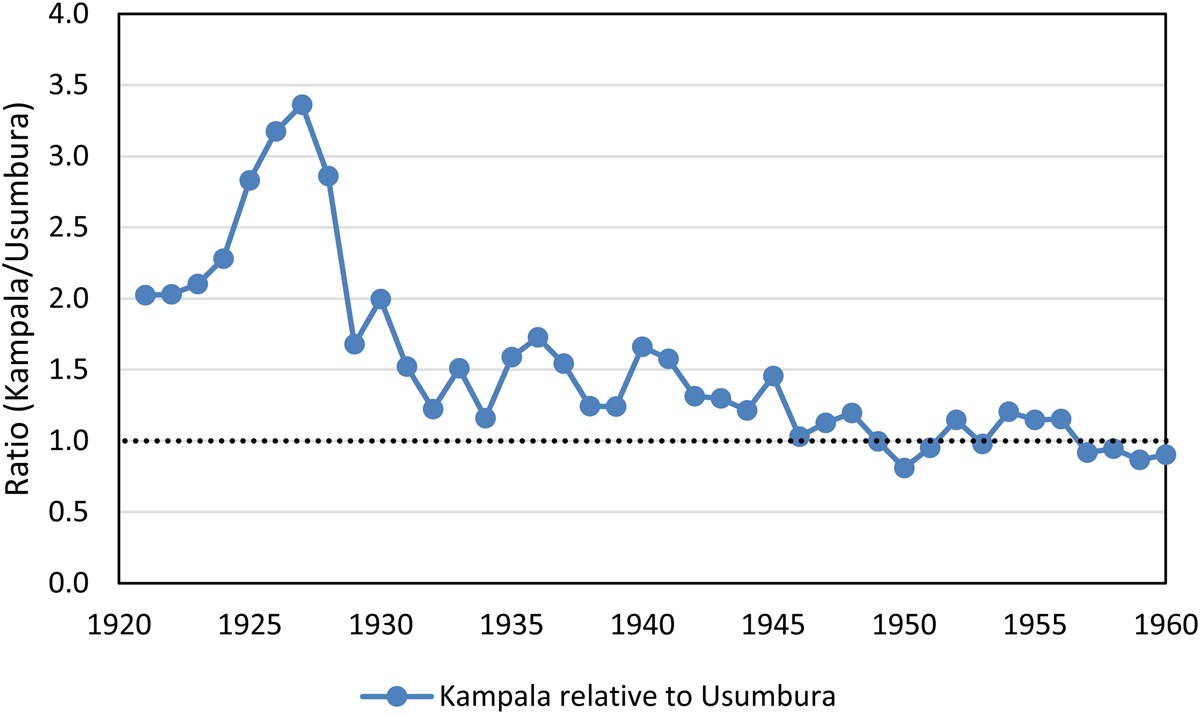
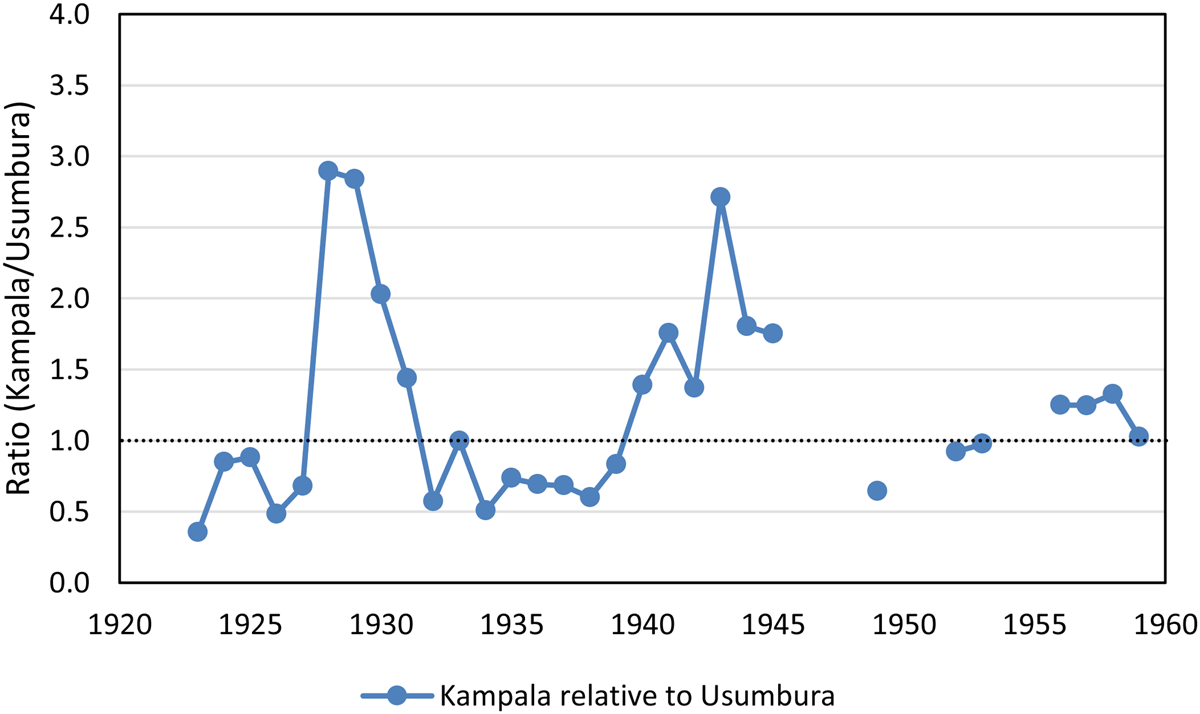
A crucial aspect of migratory dynamics in this period was the strong incentive for workers from Ruanda-Urundi to bring their savings home after spending some time working in Buganda. As a result of the depreciation of the franc and Belgian colonial policies to fix local prices, the purchasing power of the shillings and imported goods that returning migrants brought with them was very high – notably in terms of livestock. Fig. 3 expresses nominal wages in Kampala relative to Usumbura. In 1927, assuming that the exchange rate on the ground followed the official exchange rate, and that transaction costs were limited, wages from three months of unskilled construction labour in Kampala would suffice to buy a cow in Usumbura (and considerably less in rural Ruanda-Urundi), compared to ten months of similar labour in Usumbura itself.Footnote 71
Nominal unskilled wages in Kampala relative to Usumbura (=1.0), 1920–60.

The colonial sources amply testify to opportunities for ‘price arbitrage’, or the exploitation of exchange rate fluctuation and imbalances in the value of assets in different markets, and the extent to which such opportunities were pursued. The Rukira administrator cited in the introduction held that the sudden onset of migration was not the result of ‘propaganda’ from the British side, but rather of the migrants’ own ‘fascination for textiles, beads and shillings’, amplified by the opportunity to reap quick returns because of the depreciation of the franc.Footnote 72 Another administrator observed, with disapproval, that after a few months in Uganda, migrants returned ‘almost rich’, loaded with textiles.Footnote 73 Because items necessary for bridewealth, such as livestock, could be obtained easily with shillings and imported goods, trips to Uganda were particularly popular among prospective grooms.Footnote 74 One returned migrant, interviewed by Joseph Gahama in 1979, stated that he ‘fled’ to Uganda as soon as he had to buy his first clothes, in order to ‘seek shillings, clothes and bride wealth’. Because he had moved without permission from his chief, his uncle's cows were confiscated, but he was able to buy new cows and a large piece of land upon return with the clothes he brought back, even though some of them were impounded.Footnote 75 Other ways to engage in price arbitrage were to move cattle and food into Uganda, exchange currency at the border, or import cloth into Rwanda. Unsurprisingly, in the early 1920s, the colonial administration observed ‘intense trafficking’ across the border, involving Rwandan, various East African, and South Asian traders and cattle owners, as well as enterprising peasants.Footnote 76
The substantial wage and price gaps between the sending and receiving areas not only explain why most migrants engaged in circular rather than permanent migration, but also help to understand why the first generations of migrants typically returned after only several months, did not bring their families, preferred to work for rural rather than urban employers, and were willing to work very long hours. Between 1923 and 1927, the price of beans, a key staple food in Ruanda-Urundi, was over five times higher in Kampala than in Usumbura, a gap that was even greater than the difference in nominal wages. As a result, despite much lower nominal wages, the local purchasing power of Usumbura wages in terms of beans was higher than that of Kampala wages, in most years (Fig. 4). In other words: life in Buganda was expensive. By taking on multiple jobs per day, by working for food as well as money in rural areas where calories were cheap and abundantly available, and by moving without their families, migrants managed to save substantially on living costs.Footnote 77 It is unsurprising that migrants explained that they went to Buganda to ‘buy money’.Footnote 78
Real unskilled ‘bean wages’ in Kampala relative to Usumbura (=1.0), 1920–60.

1928–44: RACE TO THE BOTTOM
The British administration in Uganda was quick to realize the advantages of immigration, given the labour scarcity which followed the abolition of its forced labour arrangements and in the context of a cash crop boom. Its own recruitment efforts were concentrated on north- and southwestern Uganda, but the zealous efforts and propaganda of African recruiters, who were paid on a piecework basis, quickly brought in numerous people from across the nearby and porous Anglo-Belgian borders.Footnote 79 Initially, there were some concerns about the labour quality and health of the ‘Banyaruanda’, as migrants from Ruanda-Urundi came to be generically labelled, but no active attempts were made to prevent them from entering.Footnote 80 The Belgian authorities were much less pleased with the uncontrolled outflow of their subjects. Migrants began to travel clandestinely, as Belgian administrators made attempts to stop ‘defectors’ and ‘fugitives’ and to punish returnees with fines and imprisonment (only to realize that this stimulated permanent departures).Footnote 81 Administrators, surprised that so many people suddenly offered their labour in the British territories, also saw an opportunity to divert migrants to the mines and plantations in the Congo. In 1925, Ruanda-Urundi was administratively amalgamated with the Congo, which eased recruitment from the former to the latter.Footnote 82 Soon, the Katangese Union Minière started to recruit labour throughout Ruanda-Urundi, aided by local chiefs and administrators.Footnote 83 In 1927, the Governor-General of Ruanda-Urundi boasted to a British counterpart that Belgium controlled ‘the finest reservoir of labour in central Africa’.Footnote 84 By 1930, indeed, approximately a quarter of the labour force of the Union Minière du Haute Katanga originated from Ruanda-Urundi.Footnote 85 Labourers were also recruited by settlers in Kivu, and whole families were resettled in a sparsely populated area in that region.Footnote 86
Not long after, however, in the early 1930s, large-scale recruitment efforts for the Congo were aborted. An important reason for this abrupt cessation was a major political backlash provoked by labour recruitment.Footnote 87 During the years 1927 to 1931 a serious famine, the effect of which on prices in Usumbura is clearly visible in Fig. 4, struck Ruanda-Urundi.Footnote 88 In Rwanda alone, the famine killed at least 35,000 people. In Gisaka, on the eastern border, over one third of the population died or fled.Footnote 89 International observers had reported unfavourably on the Belgian response to the famine, describing the mandated territories as a ‘land of living and dead skeletons’. Aggressive labour recruitment was considered one of the key factors contributing to the crisis.Footnote 90 The famine put an end to the Belgian plans to transform their newly acquired mandated territory into a convenient supplier of cheap labour. While migration to British territories swelled to new heights during the 1930s, the government's reluctant policy became ‘neither to prevent nor to increase’ it.Footnote 91 In 1938, the governor of Ruanda-Urundi summarized the situation as it had emerged in the preceding decade:
Politically our hands are tied: our British neighbours have a great need for labour, and if we try to restrain it, we will be accused of trying to monopolize the labour for the profit of the Belgian Congo, which goes against our Mandatory powers.Footnote 92
While the famine reduced the capacity of the Belgian administration to redirect migrant labour to the Congo, it also amplified incentives to migrate to British territory. The famine had an immediate adverse impact on living conditions in Ruanda-Urundi, in particular in the eastern regions, pushing many people across the border into western Uganda, a large share of whom ultimately made their way to Buganda.Footnote 93
The famine also had more complex and sustained negative effects on living conditions in Ruanda-Urundi and, as a result, on migration. The Belgian administration shifted the blame for the famine onto structural poverty and local elites, whom it accused of neglecting their subjects.Footnote 94 To mediate both perceived problems, the colonial government took various measures. To rein in the power of the traditional elites, the administration appointed selected Tutsi chiefs to rule newly created, ‘rationalized’ administrative units.Footnote 95 To prevent future famines, a wide range of famine-prevention measures were instituted. Hoping to generate much-desired cash flow and export revenues, the administration embarked on a program of forced smallholder Arabica coffee cultivation, which was at least partly inspired by the success of smallholder cotton cultivation in Uganda.Footnote 96 To generate revenues to expand government capacity, direct taxes were ramped up significantly. For example, taxpayers in the Nyanza district in central Rwanda saw their real tax burden increase from an equivalent of 3.9 days of unskilled labour per year in Usumbura in 1929 to 10.3 days in 1931.Footnote 97 Direct taxes also allowed the Belgian government to generate some income from labour migration, as earlier attempts to place duties on imported goods were evaded on a massive scale.Footnote 98
Such policies hardly provided quick new sources of personal income to relieve the impoverished state of the population. Coffee required substantial weeding and mulching efforts in the first years after planting, and it only bore fruit after an initial investment of several years. Similarly, anti-famine and anti-erosion measures, such as terracing and marsh drainage, required massive upfront efforts before yielding benefits in terms of food and income. Moreover, placing newly appointed chiefs in charge of tax collection and labour requisition gave them unprecedented extractive powers, which they used both for colonial projects and private gain, a system that, in the words of Catherine Newbury, was ‘not designed to limit abuses’.Footnote 99
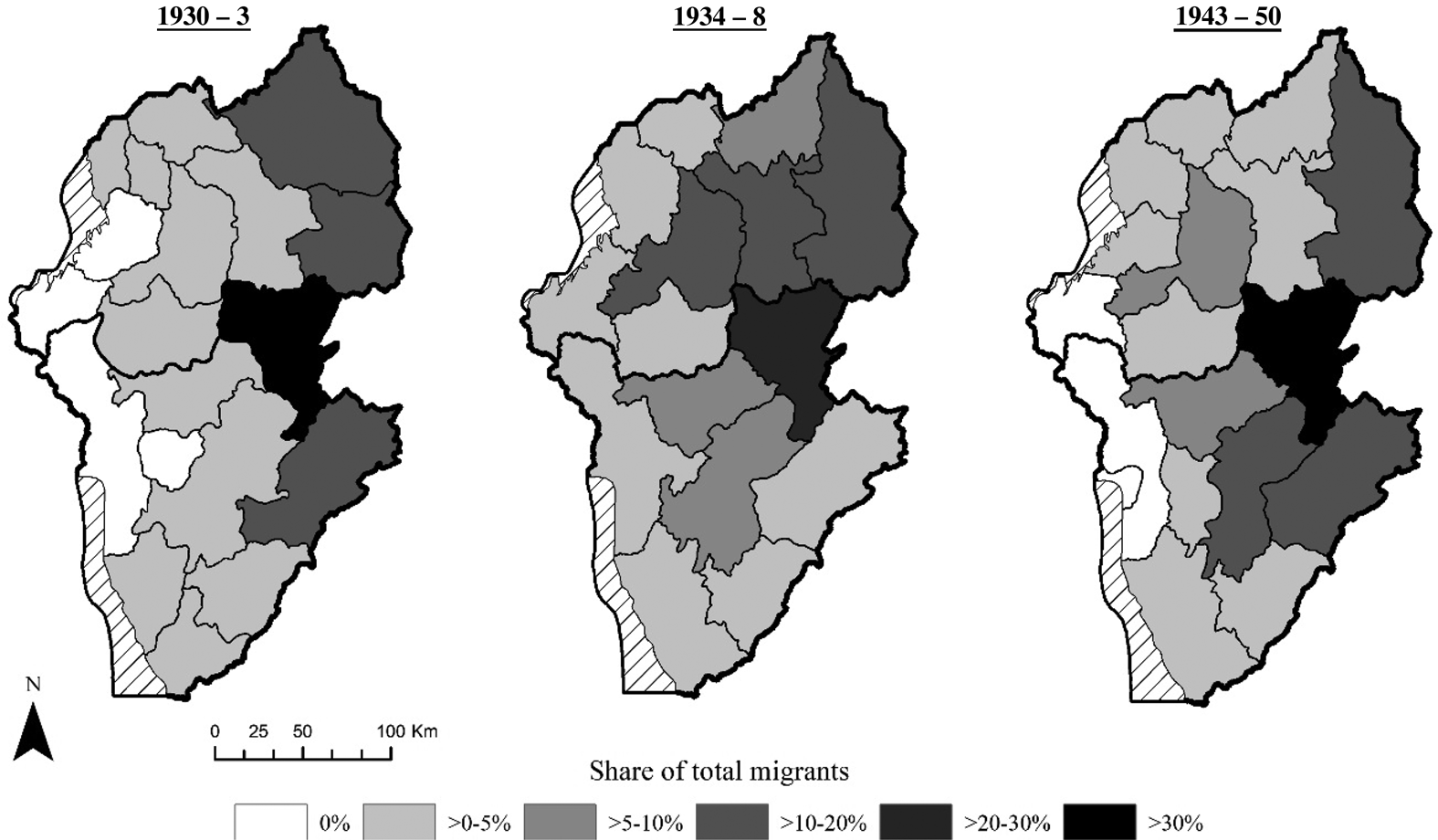
In the context of declining socio-economic opportunities for a large section of the population, migrants, still mostly men, swelled in number and were less likely to possess the entrepreneurial streak that characterized the early movers of the mid-1920s. In 1937, a Catholic missionary pointed out in a confidential circular that migrants were ‘increasingly poor and defenceless, rather than entrepreneurial’.Footnote 100 He also maintained that ‘all Christian fathers in Ruanda-Urundi know that migration to Uganda can be led back to a single motive: Kuruhuka, to rest from corvée labour and from exploitation by minor chiefs’.Footnote 101 The geographical origin of migration also expanded. Fig. 5 shows that in the early 1930s, just after the famine, the great majority of Rwandans recorded as absent and in British territory by the Belgian authorities came from the northern and eastern regions of Ruanda-Urundi, which were closest to Uganda and also hit hardest by the recent famine.Footnote 102 From 1934 to 1938, a much greater share of migrants came from the densely populated central areas of Rwanda and from eastern Burundi, which during the mid-1930s saw increased Belgian political interference and underwent a divisive administrative reorganization.Footnote 103
Regional origin of migrants recorded as absent and in British territory.

By the late 1930s, the annual circular flow of male migrants from Belgian territories into Buganda had swollen to over 100,000, while some migrants began to bring families and resettle permanently in Buganda.Footnote 104 Aside from the famine, migration itself also affected opportunities in the sending and receiving regions in ways that made it both more necessary for people to engage in migration, and, tragically, also harder to reap benefits from mobility. One obvious feedback mechanism was that the more people left, the more pressing labour demands became for the remaining population, among whom women, children, and the old were overrepresented.Footnote 105 Other feedback mechanisms were less direct but nonetheless had major consequences.
On the Rwandan side, the enhanced purchasing power of returning migrants and the circulation of shillings and imported textiles not only enabled the Belgian authorities to increase direct taxes, but also pushed up the price of livestock. The number of days of unskilled work in Kampala required to buy a cow in Usumbura increased from approximately 50 in the mid-1920s to well over 150 in the mid-1940s.Footnote 106 On the Ugandan side, the abundant supply of migrant labour pushed down wages.Footnote 107 Work in Buganda, however, continued to offer much higher returns than in Ruanda-Urundi, as suggested by a complaint from Catholic missionaries in 1933 that the ‘thirst for beautiful fabrics drew the poor out of their homes’, to leave for ‘the English’.Footnote 108 But as Fig. 3 shows, while opportunities for price arbitrage continued to exist, the nominal wage gap (and thereby the gap in terms of purchasing power of imported goods) had shrunk considerably.
The increased inflow of cheap migrant labour was a major boon for Buganda's rural economy and export production. Having faced poor conditions at home and an exhausting and dangerous journey of several weeks on foot, migrants from Ruanda-Urundi tended to arrive in Buganda in a weak condition, had low labour productivity and high mortality rates, and were sometimes even so enfeebled that they were initially unable to work.Footnote 109 Still, food was plentiful in the Ganda countryside, and most migrants were able to regain strength quickly. They contributed vitally to Buganda's cotton output in the 1930s, which almost tripled between the 1930–31 and 1937–38 seasons.Footnote 110 In 1934, as in 1924, migrants – many of them from Ruanda-Urundi – accounted for over half of Buganda's expanding cotton production, which made up approximately 25 percent of the Protectorate's entire cotton export.Footnote 111 While employing migrants to cultivate cotton and bring in quick returns, Ganda farmers themselves increasingly invested in coffee, benefiting from increased tenure security resulting from laws passed in the late 1920s.Footnote 112
The poor conditions in the sending regions of most migrants meant that the British colonial authorities did not have to ensure high wages, nor resort to coercive measures to sustain a labour supply in Buganda. Indeed, they basically ignored the migrants on their way to and at the place of work, leading one official to note the ‘remarkable … ignorance in Uganda of these strangers in their midst’.Footnote 113 Such a policy of neglect was rationalized by arguing that, if anyone, Ganda employers should bear the cost of servicing the migrants en route and at their place of work, but since they already bore ‘a considerable export tax’ on cash crops, imposing additional taxes would be politically inexpedient.Footnote 114 Instead of support, migrants were offered small perks, such as the ability to stay in Uganda for several years without paying any taxes, to the frustration of Belgian officials who instructed Rwandan chiefs to impress upon their people that ‘the British also levy taxes’.Footnote 115
Eventually, the colonial policy of neglect backfired, as the health condition of immigrants worsened considerably during the Second World War, which coincided with a deadly famine in Ruanda-Urundi that killed close to 300,000 people in 1943–44.Footnote 116 An advisory committee tasked in June 1942 with an investigation of the conditions under which Banyaruanda migrants travelled, noted in its report (which was published the following year) that numerous migrants, in an ‘emaciated condition and half-starving’, were seeking medical aid at dispensaries in Buganda, and even made mention of a hastily buried corpse found along a dry stretch of the migration route near Mbarara.Footnote 117 In September 1942, the British authorities intercepted a private letter, written by a doctor temporarily stationed in East Africa, who noted that migrants were ‘brought in off the road to us when they can no longer move – being nothing but skin and bone. We can do nothing except dig graves for them. I have written letters, talked and begged the great men, but nothing is ever attempted’.Footnote 118 External experts were called in to investigate the situation, ‘if only to silence criticism’.Footnote 119 By early 1943, however, the outrage had risen to the ranks of the British parliament.Footnote 120 Towards the end of 1943, at a time when the cotton economy was notably depressed due to war conditions, the Uganda government temporarily closed the border with Ruanda-Urundi – ‘with great reluctance’ – to diminish the inflow of ‘unfit’ migrants, particularly women and children.Footnote 121
1945–58: FAMILY MIGRATION AND RESETTLEMENT
The migration crisis of the early 1940s was the culmination of a voluntary circular migration dynamic that was predicated on deteriorating conditions in the sending regions, large price and nominal wage gaps between sending and receiving regions, and continued demand for cheap labour on the receiving end. Several circumstances, partly exogenous, and partly driven by contextual feedback of migration, changed its subsequent development. The most important change was that the gap in economic opportunities between sending and receiving areas shrank considerably, due to changes on both sides of the border.
In Ruanda-Urundi, completed ridging and swamp reclamation projects began to pay off, relieving land pressures and food scarcity.Footnote 122 Simultaneously, coffee planted during the campaigns of the 1930s began to yield amply, while world coffee prices rose precipitously during the first post-war decade.Footnote 123 Indeed, the value of exports from Ruanda-Urundi per capita converged with Uganda's, rising from a mere tenth during the 1920s and a fifth during the 1930s to over half by the first post-war decade and three quarters by the late 1950s.Footnote 124 With new sources of revenues secured, and under intensified United Nations monitoring, the Belgian authorities expanded public investment, increased wages, abolished corvée duties in 1949, and dismantled some of the extractive powers of chiefs.Footnote 125 Moreover, partly in response to the devaluation of the franc in previous decades which had made textile imports from other currency zones expensive, combined with the fact that African colonies were of limited importance as a market for the metropolitan textile industry, several textile factories had been set up in the Congo since the 1930s. These factories now produced coarse cloth for the internal market that was cheaper than imported cloth and made a trip to British territory to obtain fabrics redundant.Footnote 126
This convergence of opportunities was also driven by a gradual deterioration of real wages and producer prices for cash crops in Buganda, which reached their lowest point in the years after the Second World War and resulted in widespread protest and strikes.Footnote 127 Such low remuneration for labour was, at least to some extent, a contextual feedback effect of migration. As expressed by C.C. Wrigley in the late 1950s, ‘real wages […] have shown little if any increase, because the greatly expanded demand for labour has been satisfied, so far, by a continuing influx of migrants […] above all from Rwanda and Burundi.’Footnote 128
Available statistics on the migrant flow suggests that annual migration was large in the years immediately after the war and then gradually declined to rates that were substantial, but below those prevalent in the late 1930s and early 1940s (Fig. 2). However, during that time the composition of the migrant flow had changed substantially. During the period 1935–42, only 1.4 percent of the migrants crossing into Uganda via the border at Kakitumba bridge had been women, and 0.9 percent children. In 1943, during the famine, the share of women and children rose drastically, but interestingly it remained at this higher level. Between 1943 and 1955, the share of women and children migrants was on average 14.3 and 9.6 percent respectively.Footnote 129 The average length of trips also had increased, from about half a year before the war to a just under a year after.Footnote 130 The longer trips and the greater movement of women and children indicates that migrants, probably after several earlier tours to Buganda, were increasingly aiming for resettlement. This is confirmed by Richards, who found that 92 percent of the female migrants she interviewed at the border intended to settle in Buganda.Footnote 131 A shift towards settlement is also indicated by the fact that the numbers of Rwanda and Rundi resident in Buganda now far exceeded the annual flow.Footnote 132
This move towards family migration and settlement is consistent with shifting Belgian and British policy priorities. The wartime migration crisis, as well as recurrent and increasingly widespread strikes on plantations and in urban areas exposed the downsides of the Uganda Protectorate government's policy of non-interference in, and transient nature of, the labour market. Already during the war, British administrators perceived intervention in the migrant labour system as urgent, ‘both on economic and humanitarian grounds’.Footnote 133 The Belgian authorities, in their turn, realized that a shift from circular male towards more permanent family migration could restore the precarious balance between working-age males and their dependents and contribute to relieving demographic pressures.Footnote 134 In the wake of the border closure, both colonizers began to plan efforts to control migration. Closer coordination between the Belgian and British authorities was initiated to formalize the exchange of labour.Footnote 135 New labour camps were constructed, and agencies were established to formalize recruitment.
More than by policy, however, the shift towards family migration was likely driven by shifting incentives that resulted from a convergence of wages and prices on the sending and receiving ends. With the cost of living converging, leaving other household members at home was no longer an effective strategy to accumulate savings. Moreover, the convergence of the purchasing power of wages in terms of imported goods meant that returning migrants could no longer engage in lucrative price arbitrage.Footnote 136 The amount of work in Buganda required to obtain a cow or pay the tax in Ruanda-Urundi had tripled in the years after the war compared to before. Rather than a place to obtain valuable goods and savings, migrants began to look at Buganda increasingly as an attractive place to live. Through past trips, they had become increasingly ‘at home’ in Buganda, through familiarity with Ganda language, customs, and rules, as well as the legal rights of tenant farmers.Footnote 137
From the perspective of Ganda employers, who had long welcomed migrants as labourers, sharecroppers, and tenants, this move towards permanent settlement had a clear downside. Migrants, now having access to their own plots and growing their own cash crops, could not as easily be recruited anymore for subsistence wages. With Buganda's land still ample enough to accommodate new foreigners, the reservation wage of migrant labourers was increasingly set in the Ganda, rather than Ruanda-Urundi, countryside. Indeed, Richards found that the issue of immigrant labour shortage was a key concern among Ganda employers, noting that they were ‘clearly aware that the greatest single cause of labour scarcity is the high rate of settlement of the immigrants on holdings of their own’.Footnote 138 The issue of migrant settlement was central in many local council meetings she visited. Not only were migrants pitted against Ganda employers, but smaller Ganda farmers – who reported that wages were rising and that ‘now only a rich man can have porters’ – also condemned Ganda landlords, who, despite lamenting the labour shortage, continued to give out plots to migrants who were willing to put waste land under cultivation and pay hefty entrance fees.Footnote 139
Circular migration still continued, but it was now primarily the prerogative of people in the poorer, eastern regions of Ruanda-Urundi (Fig. 4), who did not have access to land suitable for coffee cultivation but still had to fulfil monetary social and tax obligations.Footnote 140 For them, despite the convergence of real wages and the disappearance of windfall returns, seasonal employment in Buganda continued to make sense. It was closer and easier to reach than the centres of employment in the Congo and even western parts of Ruanda-Urundi, especially with the introduction of regular and affordable buses and lorries operated by recruiters.Footnote 141 As previously, migrants continued to prefer Ganda employers, by this time growing coffee rather than cotton, over expatriate employers, thus alleviating some of the (re)emerging rural labour scarcities discussed above.Footnote 142
Uganda's population census of 1969 recorded 152,321 Rwanda and Rundi to be present in Buganda, less than half the number recorded in 1959 (Table 1), while the reduction of women had been even faster, suggesting not only that fewer circular migrants had come to Buganda, but also that many of the families who had earlier settled in Buganda had left.Footnote 143 Such dwindling numbers testify to the closing of opportunity gaps between sending and receiving regions. Migrants were no longer as poor and desperate, nor were they able to reap windfall returns from their mobility. Their reservation wages had gone up, and they increasingly expected to participate in Buganda's cash crop economy on equal terms, as tenants. As migrants increasingly chose to settle down as independent cultivators, Ganda attitudes towards migrants became more apprehensive.Footnote 144 Buganda still offered opportunities, but such opportunities were increasingly imagined rather than real.
CONCLUSION
In a period of merely forty years, large-scale migration from Ruanda-Urundi to Buganda had emerged, expanded, and declined, meanwhile profoundly shaping the demographic makeup, labour markets, and economic structures of the sending and receiving regions. Neither migrants nor colonial governments proved to have much control over these structural shifts. Rather, this migration dynamic was predicated on deeply rooted and contrasting factor endowments in the sending and receiving areas and the unintended and unanticipated consequences of colonial interventions. In a wider African context, Ruanda-Urundi stood out for its labour abundance and struggle with an endemic subsistence crisis, resulting in meagre remuneration and poor labour conditions. Buganda, to the contrary, was economically dynamic and labour scarce, which created scope for both repression and compensation of labour.
In light of this structural opportunity gap, currency movements and the formation of markets for wage labour ignited a rapid migration take-off during the 1920s and 1930s, which took colonial authorities on both ends by surprise. Initially, migration was circular and involved mostly men, which is consistent with the existence of large price gaps between sending and receiving regions, opening up scope for inter-imperial price arbitrage. Over time, however, prices converged, and increased numbers of migrants settled in Buganda, bringing their families. Meanwhile, conditions in Ruanda-Urundi improved substantially, while Ganda attitudes towards migrants become more apprehensive, so that, during the 1960s, the frequency of settlement declined as well. The extent to which such temporal migration dynamics were unique or unfolded in similar ways in different parts of colonial Africa without a stark contrast in factor endowments remains to be studied. As in this case, such analysis would require a consideration of conditions in both sending and receiving regions, which were often under different colonizers whose archival records need to be matched and harmonized.
A central tenet of the evolving argument has been that migrants’ choices were largely informed by rapidly shifting conditions in the sending and receiving regions, and closely reflected spatial opportunity structures. Throughout the migration transition that unfolded from the early 1920s until the early post-colonial period, ordinary rural inhabitants of both Rwanda and Burundi proved highly responsive to, and able to navigate, fluctuations in colonial currencies, wage differentials, and differences in labour regimes, subsistence conditions, and access to (imported) commodities. On the receiving end, Ganda cultivators were equally responsive to shifts in the supply of labour, pragmatically incorporating migrants as long as they provided their labour cheaply, replacing enslaved labour, and helping to overcome a system of local recruitment of forced labour in place during the early colonial era. While migrants’ choices cannot be separated from the colonial context in which they took place, it is important to note that colonial authorities were unable to pre-empt or reverse migration. Only as their smallholder coffee campaign began to yield returns and famine measures took effect were the Belgians able to contain migration to British territories. Whether these limits to colonial control are generalizable to other contexts of uncontrolled migration, or whether they arose from particular contextual factors, such as the status of Ruanda-Urundi as a mandated territory and the vital role of immigrants within Uganda's indigenous cash crop sector, remains an issue worthy of further comparative study.
Supplementary material
To view supplementary material for this article, please visit https://doi.org/10.1017/S0021853719001038.