Introduction
Atrophic rhinitis is a chronic, debilitating, recalcitrant disease characterised by progressive nasal mucosal changes and turbinate atrophy associated with greenish crusts and foetor. This condition is noted to reverse after decreasing the size of the roomy nasal cavities, thereby reducing air current turbulence and preventing mucosal drying and crusting. Young described complete, unilateral closure of the nostril to promote regeneration of normal nasal mucosa.Reference Young1 Sinha modified the procedure by leaving a small, 3 mm opening within the skin membrane, which could be done bilaterally and simultaneously. This procedure is popular due to its effectiveness, simplicity and high degree of patient acceptance. Periodic endoscopic evaluation is useful to assess resolution of the diseased nasal mucosa to a normal state, and to time recanalisation procedures.
Young stated that ‘the aperture that is created by excision of the membrane tends to close, and more than one operation may have to be done before the opening is satisfactory’.Reference Young1 Gadre et al. described a three flap technique of recanalisation, followed by the use of silicone tube stents for six weeks.Reference Gadre, Savant, Gadre, Bhargava and Juvekar2 Various other stents have been tried for iatrogenic and congenital nasal vestibular stenosis; however, there are few descriptions of stents which effectively relieve nasal obstruction while maintaining an acceptable cosmetic appearance and minimising discomfort.
In this study, we compared three different methods of stenting for maintaining nasal patency after recanalisation of a modified Young's procedure.
Materials and methods
This was a prospective study undertaken from 2005 to 2007 and involving 16 patients (32 nostrils) who had undergone a modified Young's procedure in the ENT – head and neck surgery department of a tertiary centre. Patients were evaluated pre-operatively and considered disease-free, based on relief of symptoms and assessment of the nasal cavity using a 2.7 mm nasal endoscope. In all cases, recanalisation was performed under local anaesthesia, using the three flap technique described by Gadre et al. Reference Gadre, Savant, Gadre, Bhargava and Juvekar2
Following the recanalisation procedure, three different stent types were used.
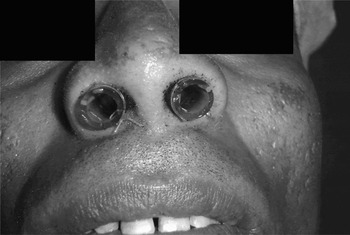
The first stent type was a silicone suction tube tip (tube size equivalent to a size six endotracheal tube), cut to a length of 2 cm and smoothed around the edges using a diamond burr (Figure 1). This was secured to the floor of the recanalised nostril and left in situ for two weeks.
Silicone suction tube tip stent in situ.

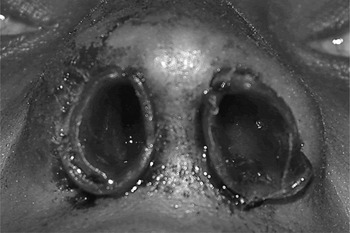
The second type of stent was made from a dental wax plate, formed into a prism or inverted V shape, with the apex intended to maintain the nasal valve angle (Figure 2). These patients were reviewed every week.
Dental wax plate stent in situ.

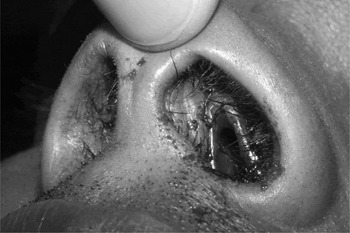
The third stent type was a specially designed acrylic nasal stent (Figure 3). These were made from clear, heat-treated acrylic. Stents were individually made in our hospital's prosthodontics department, based on the patient's nasal aperture measurements. An impression was taken of the patient's nasal cavity in the region of the nasal valve, using dental wax. This impression was used to make a mould in dental stone. Acrylic paste was then poured into this mould and heat-cured for two hours. The prosthesis was removed by breaking the mould. It was then cleaned and polished. Each facet of the triangular stent had a small aperture through which a suture could be passed to secure the stent in position.
Customised acrylic stent in situ.

Suction tube tips were used in seven patients (14 nostrils) and dental wax plates in three (six nostrils). These stents were kept in situ for a period of two weeks. Patients were reviewed once a week to check the stent position.
The customised acrylic stents were used in six patients (12 nostrils). This included one patient who developed synechiae following the use of dental wax plate stents.
Following stent removal, all patients were followed up for a minimum of six months (range, six months to two years).
Results
Patients treated with silicone suction tube tip stenting obtained relief from nasal obstruction, and there were no cases of restenosis or recurrence of atrophic changes. However, these patients developed a circular nasal aperture with superior blunting of the nasal valve area.
The three patients receiving dental wax plate stenting had a tendency to restenosis, and subsequently required further surgical sittings to place other stenting materials. In one patient, the wax plate migrated posteriorly and the recanalisation region partially restenosed. Removal of the wax plates was difficult: they had to be cut into small pieces and removed piecemeal. In the second patient, the initial result was good, but the patient subsequently developed superior synechiae (seen at one month's follow up) requiring release in the out-patient department and placement of dental wax plates. The third patient had extensive restenosis of the recanalised nostrils, requiring a second surgical procedure and placement of acrylic stents.
As their initial results were poor, dental wax plate stents were not used for any further cases.
All the patients receiving the customised acrylic stents showed good improvement in nasal function. These patients found the acrylic stents more acceptable, as they were not visible. The customised acrylic stents had superior results as regards recanalisation and preservation of the nasal valve anatomy and function, compared with the other stent types.
Discussion
The modified Young's procedure is a standard operation performed for atrophic rhinitis, and is simple and effective. Recanalisation can be performed once the nasal mucosa returns to normal. Although the obturator membrane is easily excised, it is notorious for restenosis, as the raw edges of the nasal mucosa are in close proximity.Reference Young1 Stenting provides a simple and reliable solution to this problem, by keeping the raw edges separated until re-epithelialisation occurs. Long term stenting is used to resist the contractile forces during wound healing and remodelling. An ideal stent would not only prevent restenosis and give good functional results, but also restore good cosmetic appearance to the nostril.
Long term packing is an alternative to stenting, using gauze impregnated with petroleum jelly or bismuth iodoform paraffin paste.Reference Gadre, Savant, Gadre, Bhargava and Juvekar2 However, this entails repeated packing, a long hospital stay, and prolonged mouth-breathing leading to considerable discomfort for the patient. This can be avoided by the use of hollow stents for a period of four to six weeks. Another option is to use internal nasal dilator stents, which direct outward force onto the internal nasal valve, thus increasing the cross-sectional area of the valve.Reference Brandt, Moore and Doyle3 Mitomycin C, an antibiotic, antineoplastic alkylating agent, may prevent narrowing by reducing fibrosis and post-operative scarring.Reference Salvado and Wang4
In our patients, we compared three types of stenting material (Table I). Silicone suction tubing has commonly been used as a stent following modified Young's procedure recanalisation. It has also been used in cases of vestibular stenosis. A dimethylpolysiloxane obturator, used for secondary atrophic rhinitis, can also be modified to create a stent with an opening for nasal respiration. Silicone stents have the advantage of being easily available, cost-effective and sterilisable prior to use. Our silicone suction tube stents had good functional results; however, healing around the tube resulted in a circular aperture with superior blunting in the nasal valve region. Patients also reported minor discomfort and an unacceptable facial appearance with the stent in situ (it gave their nose a snout-like appearance). In addition, there may be a tendency to recurrence of atrophic changes, as the newly regenerated mucosa may be unable to endure the mechanical insult of the tube.Reference Gadre, Savant, Gadre, Bhargava and Juvekar2
Stent results

Results are subjective, based on patient feedback and treating doctor's opinion. Pt = patients; −= poor results; += average results; ++ = good results; ++ + = very good results
Dental wax plates are an effective supportive material following septal surgery, and prevent post-operative synechiae.Reference Nayak, Murthy and Balakrishnan5 However, our dental wax plate stents gave disappointing results, with all three patients (six nostrils) showing a tendency to restenose at follow up. We have discontinued the use of dental wax plates as a stenting material following recanalisation of modified Young's procedure. However, we still use dental wax plates following septal surgery and after the release of synechiae posterior to the nasal valve region.
Our acrylic nasal stents were specially designed and custom-made to fit the patient's nasal aperture. These stents are similar to the obturator described by Lobo et al. in the treatment of atrophic rhinitis.Reference Lobo, Hartley and Farrington6 However, they differ in having three holes on three of the faces to facilitate securing the stent with sutures at the site of recanalisation.
• Modified Young's procedure is the standard surgery for atrophic rhinitis
• When recanalisation is planned, the obturator membrane is easily excised; however, restenosis is common
• Long term stenting is an option in such cases
• Silicone suction tube stents give good functional results but poor post-operative cosmesis
• Customised acrylic stents offer good functional and cosmetic results, and also minimise patient discomfort
Our customised acrylic stents gave good functional results, as did our silicone suction tip stents. A good nasal airway was maintained, with no tendency to restenosis. Due to the customised fit, patient discomfort was minimal, and hence patients's acceptance of treatment was better. The customised fit also ensured that these stents were inconspicuous in situ and caused no alteration in facial appearance. Thus, the results for customised acrylic stents were superior in regard to cosmesis and maintenance of nasal valve integrity. Clear, heat-treated acrylic stents were also superior to silicone stents as they did not absorb mucous or other secretions.Reference McKinstry and Johnson7 However, silicone suction tubing is easily available for stent creation, whereas acrylic stents must be individually designed and fashioned to fit the widened nostril obtained after recanalisation.
Conclusion
Restenosis is common following recanalisation of the modified Young's procedure. Stenting is necessary to prevent restenosis. In our study, the customized acrylic stents due to their distinct advantages of shape, comfort, acceptable cosmesis and effectiveness as a stent in maintaining the patency and shape, were a superior alternative to other forms of stenting methods such as dental wax plate stents, silicone suction tube stents and repeated packing.