As in many other countries across the world, China is entering a ‘graying’ era: the number of people aged sixty years and above in China has risen to 160 million, or more than 12 per cent of the total population; the number is likely to increase until it reaches about 240 million, 17 per cent of the population in 2020, when the country will have about 30 million people over the age of eighty (Mu, Reference Mu2011). Due to reduced family size after the implementation of the one-child policy and the migration of adult children for better career and life opportunities, adequate home care for elderly parents has become extremely hard to achieve (Giles and Mu, Reference Giles and Mu2007). Studies of institutional eldercare in China, although remaining sporadic, have aroused some academic attention in recent years (Chen, Reference Chen1996). It is estimated that 6 to 8 per cent of China's elders will need to receive institutional care (China National Committee on Ageing, 2012), and some observers believe that institutions such as elder homes are likely to become one of the major options for ageing parents in China (Zhan et al., Reference Zhan, Liu, Guan and Bai2006).
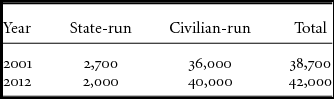
During the 1990s, the welfare reforms highlighting budget cuts, decentralisation and compatibility with the growing market economy subjected welfare institutions in China to dramatic changes. State welfare homes encountered significant financial difficulties as the reduced government funding failed to keep up with inflation and rising living costs (Shang, Reference Shang2001). They had to generate new sources of income to become financially self-reliant, as was now required by the state. Meanwhile, as opportunities for entrepreneurship have opened up in the service sector in the last few decades, non-governmental and private elder homes have mushroomed (Zhan et al., Reference Zhan, Feng and Luo2008). As shown in Table 1, civilian-run old-age homes tremendously outnumbered state-run institutions by the end of 2001 and the trend was further reinforced during the first decade of the twenty-first century.
Institutional eldercare has become an option for all families in contemporary China, but elders in the category of ‘Three Nos’ (no children, no income and no relatives) remain the only group eligible for state subsidies. They live either in public state-sponsored elder homes together with self-funding customers who pay for the services or they secure a bed in private and non-governmental institutions with financial support from the local government. With the post-socialist reforms having placed welfare recipients and customers face-to-face in the same institutions, the marginalised elders now find that they constantly encounter distinction between welfare dependents and privileged service consumers, in a social environment that increasingly cherishes economic attainment and market competency. As the meaning of public institutional eldercare changes in the reform era, the processes of identity construction, status negotiation, stigmatization and resistance to labels that take place at the elder homes in China, where state-sponsored and private clients share the same space, demonstrate important mechanisms of boundary configuration, maintenance and dispute during social changes (Lamont and Molnar, Reference Lamont and Molnar2002). With ethnographic data collected at four such mixed elder homes, where both public and private clients are served, this article investigates how boundary work and welfare stigma are constructed and practiced in the changing social contexts of China after the welfare reforms. Some scholars may hail the welfare reforms as being successful attempts to expand and diversify social services (e.g., Shang, Reference Shang2001); however, a discussion of social distinctions at the mixed elder institutions reveals class stratification, inequality and exclusion, and it stimulates reflection on the human costs of the reforms.
Boundary work and welfare stigma
In recent years, the concept of boundaries has been at the centre of many academic discussions across the different disciplines of social sciences. The definition of boundary has been extended far beyond physical separation, although segregation in public and residential space remains of key interest to the scholarship of inequality (Jackson, Reference Jackson2001). One important line of the literature pays particular attention to the construction of social boundaries, or the process of ‘boundary work’ in social life, during which strategies, principles and practices are used to ‘create, maintain, and modify social categories’ (Nipper-Eng, Reference Nipper-Eng1995). Boundary is also believed to be a cultural mechanism that designates hierarchical meaning and values to social groups. Boundary work, as cultural sociologists claimed, takes place in contexts which are particularly shaped by the cultural repertoires, traditions and narratives to which individuals have access (Swidler, Reference Swidler2001). A relational definition of territory, social position and identity that differentiates ‘us’ and ‘them’/‘others’ often appears at the interface between dominant and dominated groups in the production of boundaries. Hence boundary work – physical, social or cultural – is not only a process of constituting the self, but also an intrinsic mechanism of creating, maintaining and contesting social privilege and inequality (Lan, Reference Lan2003).
In public and academic discussions of social welfare, scholars, policy-makers and the mass media have paid tremendous attention to the stigma attached to the recipients of public welfare, resulting from a highly visible boundary between independent citizens and welfare dependants (Hancock, Reference Hancock2004). Many empirical studies have demonstrated that the boundary is carefully produced and preserved by the non-recipients of welfare, and simultaneously perceived and understood by the recipients. Kefelas (Reference Kefelas2002) argued that white working-class people in major American cities make great efforts to manage their property and neighborhood to define and defend their communities against the black welfare users. Lamont (Reference Lamont2000), through in-depth interviews with the workers, discovered their use of working ethics and moralities as a strategy to distinguish themselves from the lazy welfare people. For welfare recipients, shame and stigma are usually aroused when they claim welfare benefits and practice the otherness (DeParle, Reference DeParle2004). In a survey of families in Oregon who experienced welfare, the respondents repeatedly admit to their shame when using Medicaid services in hospitals (Seccombe and Hoffman, Reference Seccombe and Hoffman2007). Although the welfare recipients adopt discursive and behavioural tactics to resist the discrimination, they often feel powerless to challenge the physical, social and cultural boundaries (Seccombe, Reference Seccombe2011).
The boundary work between the paying customers and the recipients of public eldercare in the newly reformed elder homes in China, although it may echo some of the similar processes uncovered in the previous studies, is particularly interesting in two dimensions. First, the two groups are put under the same roof, in the same category of service users, and experience everyday interactions with one another. The welfare recipients are no longer the imagined others or people the paying clients accidentally encounter; instead, they are members of the same institution with no explicitly announced distinctions. The ‘threat of mixing’ (Ozyegin, Reference Ozyegin2001: 11) does not undermine the social division in the elder homes, but only triggers enhanced efforts to differentiate and segregate through boundary work. Secondly, these mixed elder homes were established during the welfare reforms in China, during a transition from state socialism which legitimised social care for the disadvantaged to a market economy which hails individualistic competence. The elders, both the welfare recipients and the paying service users, have lived under the socialist and the post-socialist regimes. The construction, disputes and resistance in boundary work at the institutions mobilise contesting ideologies of entitlement and discourses of justice of the two distinct social systems. The intriguing boundary work not only evinces the fundamental social change that China experienced during the past few decades, but also sheds light on important mechanisms associated with the negotiation, transformation and transposition of boundaries – an emphasised field of inquiry in the study of social distinction and inequality (Lamont and Molnar, Reference Lamont and Molnar2002).
State-sponsored eldercare in China: (re)-stigmatisation
Although the socialist state in China formerly aimed to provide a cradle-to-grave system of social security for its citizens, care for the elderly was excluded from the ambitious blueprint of welfare. Adopting the discourses of filial piety and family responsibility, adult children were required by law to take care of the elders – financially, physically and emotionally. The elderly with no children, no income and no relatives (‘Three Nos’) were placed by the government in local welfare homes and the government paid the costs. Despite there being limited data and documentation available concerning the public response to the state-sponsored eldercare in socialist China, some research has produced interesting findings. Although the childless elders seemed abnormal and strange to some people, they were generally regarded as pitiful individuals deserving sympathy and charity, in a society where meagre income and material scarcity were common life experiences (Chang, Reference Chang2003). Under the official ideology of egalitarianism and collectivism, many, including some interviewees in the study (e.g., Interview 15: 28 July 2011), perceived the public eldercare as a glorification of socialist ‘justice’ (Croll, Reference Croll1999).
During the dramatic market reforms in China, the meaning of social welfare changed from universal protection to public assistance to selective needy individuals. The core contents of the welfare reform in the 1990s included budget cuts, decentralisation and marketisation. Although the central state determined to shift the responsibilities of provision to local governments and grassroots organisations, it failed to supply them with sufficient funds (Gustafsson and Zhong, Reference Gustafsson and Zhong2000). State-owned welfare institutions, in order to generate revenues, opened their doors to self-financing clients, who are elders not in the category of the ‘Three Nos’ (Shang and Wu, Reference Shang and Wu2004). Seeing family needs and business opportunities in eldercare, private parties established non-governmental elder homes with diverse service objectives and models (Dai, forthcoming). Institutional eldercare in contemporary China is no longer characterised by government monopoly, and neither is it exclusively for the truly deprived. However, state sponsorship and public assistance of institutional care is available only for the ‘Three Nos’ elders. The local government either covers all of their costs at public welfare homes or gets them admitted to non-governmental elder centres and then pays for the services in full when the district's public institutions are closed in an effort to strategise public spending.
The popular residual model of public welfare, which is adopted in the organisation of institutional eldercare in China, tends to engender negative labelling effects and stigmatisation of welfare recipients (Myles and Quadagno, Reference Myles and Quadagno2002). When the market economy swept through the Chinese society with values of efficiency, competition and self-sufficiency, the ideation of public assistance was also reconstructed. In his research on the recipients of the Minimum Living Standard Scheme, for instance, Saich (Reference Saich2008) discovered that although the public may question their ‘abnormal’ life styles (e.g., being single or having multiple children), the major concern is about their inability to survive in the booming market and their economic dependency on the government. Among the ageing population, because receiving home care from one's spouse or adult children is no longer regarded as the only or ideal option, it is now acceptable, and sometimes even considered to be an indicator of economic achievement and status, to be able to afford high-quality institutional care with one's own pension or with monetary support from one's children (Li et al., Reference Li, Long, Essex, Sui and Gao2012). If financial competence confers honour on the paying customers at elder homes, ‘no income’ and the resulting economic dependency stigmatise the ‘Three Nos’ elders on public welfare. ‘No children’ and ‘no relatives’ may consistently make them seem strange in the transition from state socialism to a market economy; however, ‘no income’ and a lack of self-sufficiency, which are incompatible with the values of the market economy, now constitute the major stigma attaching to them and stimulate antagonistic boundary work and social differentiation at the elder homes. With empirical data from mixed elder homes in Taizhou, Zhejiang Province, this study explores how differentiation among elder clients and the welfare stigma of economic dependency are deliberated and contested in the practice of institutional eldercare in post-reform China.
Research on public and non-governmental elder homes in Zhejiang Province
The data for this article come from a larger study on the organisation of institutional eldercare in the Taizhou area of south Zhejiang Province. Taizhou is a mid-size prefecture-level city that is located in an area well-known for its private entrepreneurship and prosperous market economy. During the three decades of post-socialist reforms, Zhejiang Province, particularly south Zhejiang, has established a unique model of economic growth emphasising private or village-based collective ownership of enterprises, open market competition and limited state interventions; this distinguishes the area even from Shanghai and Jiangsu Province, which are adjacent to it (Huang, Reference Huang2008).
It is then not surprising that Taizhou fully embraced the ideas of decentralisation and state withdrawal during the welfare reforms in the 1990s and pioneered the introduction of the market and non-governmental organisations in the provision of social services. The state-owned welfare homes were encouraged to recruit self-financing customers to balance their budgets and gain independence from governmental assistance. When non-governmental elder homes mushroomed to meet the needs of the ageing population, many small-sized and financially incompetent welfare homes were closed and the ‘Three Nos’ elders, together with orphans and disabled clients,Footnote 1 were sent to the elder homes with state subsidies. Reliable local statistics are scarce to track the increase in non-governmental elder homes and the closures of smaller public homes, but the national statistics presented in Table 1 demonstrate this general trend.
The record kept by the Department of Civil Affairs of Taizhou shows that the total number of elder institutions reached 358 (twenty-seven state-run and 331 non-governmental) in the city by the end of September 2013, providing 35,999 beds. Among the twenty-three elder service organisations that the research team visited in 2011 and 2012, fourteen (five state-owned and nine non-governmental) are mixed with both paying customers and those who receive state subsidies. That covers the dominant majority (five out of six) of the state-owned welfare homes and about half (nine out of sixteen) of the non-governmental elder homes. Some owners of non-governmental elder homes claimed that they are willing to take the public clients, but it requires established connections with local officials to get them. ‘That is free money – who does not want them? I wish I knew people in the government!’, one of them said during a casual conversation. In accordance with the national statistics that ‘Three Nos’ elders constituted 4.2 per cent of the ageing population in 2010 (National Bureau of Statistics of China, 2010), public clients at the mixed elder homes in the sample are usually the minority: the rate ranges from 2 per cent to 32 per cent. The only exception is a public welfare home of forty-seven clients, which was recently opened to self-financing clients and has succeeded in recruiting merely two of them. In order to generate a good understanding of the interactions of the two groups at mixed institutions, four elder homes (two public and two non-governmental), where ‘Three Nos’ elders are relatively visible yet still remain as the minority, were selected for this study.
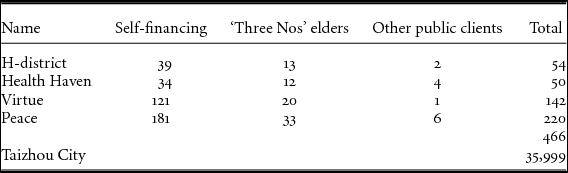
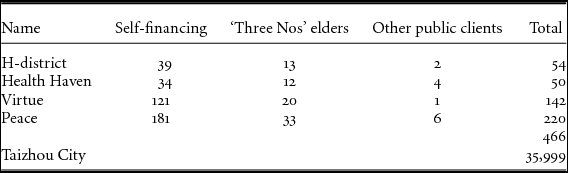
The two public elder homes are located in affluent districts, and they survived the reform because the better living conditions there attracted enough paying customers. H-District Welfare HomeFootnote 2 has fifty-four residents, thirty-nine of whom pay for their stays; thirty-four of the fifty elders at Health Haven Elder Home are self-financing. The two non-governmental elder homes in the study were established in 2001 and 2003 and are large in scale. During their decade-long history of care provision, they have gained a reputation of delivering high-quality services and received recognition from the governments not only in different districts of the city but also other cities nearby. The ‘Three Nos’ elders, as well as orphans and the disabled, were sent by the local governments to the non-governmental elder homes with the benefit of full state subsidies. Virtue Elder Home serves twenty-one recipients of state welfare and 121 paying customers; among the 220 clients at Peace Elder Home, thirty-nine are subsidised by the government. The distribution of different types of clients at the four mixed elder homes is summarised in Table 2. With qualitative data from the non-representative sample, I have no intention of arguing that the findings of the study can be generalised to institutional eldercare in Zhejiang Province or in China, but the research hopes to demonstrate the processes and mechanisms of social differentiation and stigmatisation that have occurred in reformed elder homes, and explore their implications for policies and service practices in the field of eldercare, as well as research on social inequality in post-socialist China.
Summary of clients at the four elder homes
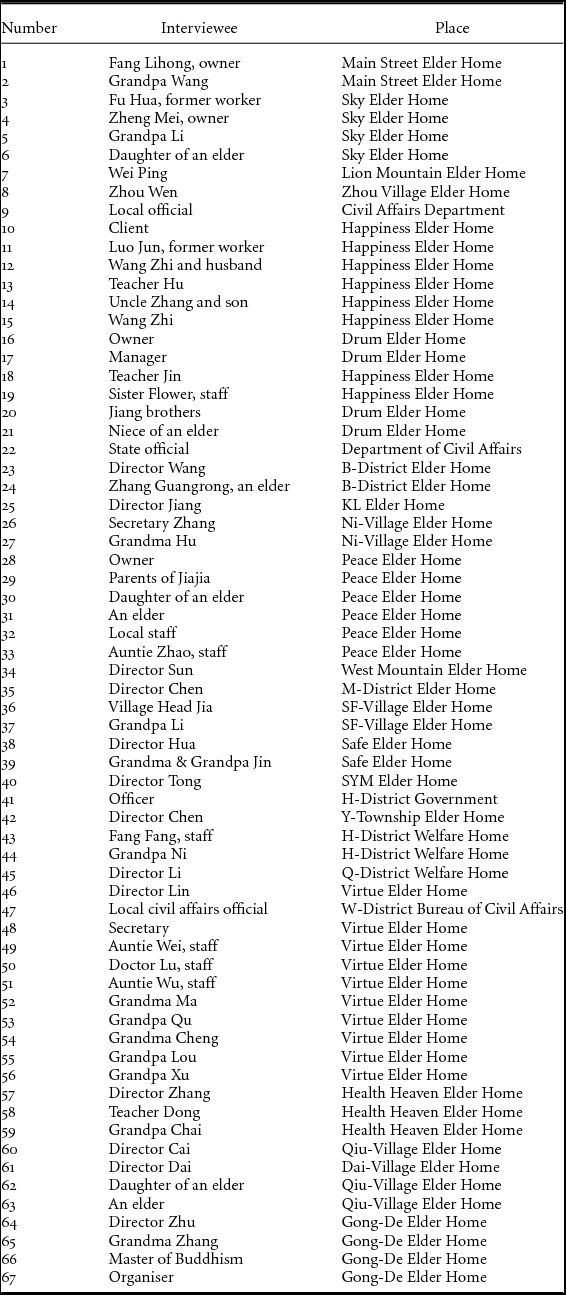
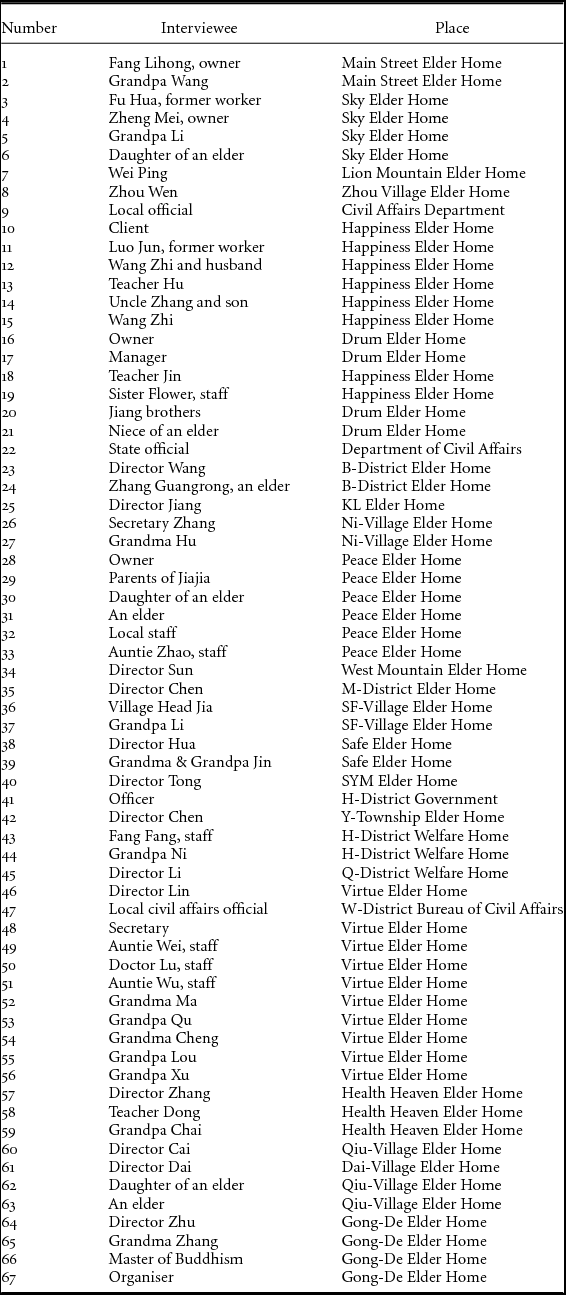
Ethnographic data for the study were collected in Taizhou during the summers of 2011 and 2012 in three different ways. First, ten weeks of participant observation was carried out at twenty-three public and non-governmental elder homes. When the stigma attaching to welfare recipients at the mixed elder homes was consistently recognised in the field observation, three weeks of intensive fieldwork in 2012 were devoted to the four elder homes selected for the study to inquire into the processes of boundary work and social construction of distinction. Secondly, sixty-seven in-depth interviews (detailed information can be found in Table 3) each ranging from one to two hours were completed during the fieldwork in the area. Out of the sixty-seven interviews, twenty-one were carried out at the four mixed elder homes, which were used as a major source of data for this study. Interviews at other elder homes and with local officials were also used in data analysis. Lastly, I studied local archives of news coverage, state documents, gazetteers and meeting minutes at the elder homes to understand the local contexts of these institutions. Data from the different sources were put together, coded and analysed to reveal the construction, negotiation, reinforcement and resistance of boundaries between welfare recipients and paying customers in their everyday face-to-face interactions at the elder homes, and the discourses embedded in their articulation of the boundary work. Through a dialogue with the existing literature and theories of social and cultural boundaries and welfare stigma, I intend to form theoretically meaningful ‘extended case studies’ (Burawoy, Reference Burawoy1998) with the qualitative data.
Sixty-seven in-depth interviews in Taizhou, Zhejiang Province
‘We belong to different worlds’
Grandpa Ni, eighty-three, is a ‘Three Nos’ elder sharing a double room with a paralysed ‘Three Nos’ elder at H-District Welfare Home. The room is dark with only one dim lamp and the aged furniture smells strange. As a bachelor from a farming village in the district, he has been struggling with poverty for the whole of his life. He was sent to the welfare home at the age of seventy-nine, when independent living and farm work became beyond his abilities. He is grateful for the cleaning and hygiene services, the meals at the canteen and the staff who regularly assist him to use the bathroom at the end of the hallway, but he feels completely out of place at the institution. He often spends his day simply sitting in his room, and tries his best to avoid using the bathroom because ‘that would bother the service worker’. He told me that he was gradually losing his appetite and mobility, and was waiting for ‘that day to come’ (Interview 44: 1 August 2012).
Grandpa Xu, also eighty-three, lives alone at Virtue Elder Home. He has a large single room with wooden floors, furniture as in a modern hotel, a flat TV and a clear view of mountains and green fields. He retired as the principal of a local primary school and enjoys pensions and state health care. Since his wife's early death, he has been a childless widower for more than fifty years, but that does not seem to deprive him of a good life as an elder. As a pensioner, he can easily afford the room and care services at the non-governmental elder home. He was practicing Peking opera with two elder friends at the institution when I visited him, and was looking forward to a scheduled foot massage and pedicure that afternoon. When I asked him about the ‘Three Nos’ elders at the same elder home, he shook his head slightly and said, ‘We just belong to different worlds’ (Interview 56: 3 August 2012).
The distinction between the ‘Three Nos’ and the self-financing elders at the mixed elder homes is conspicuous in their living arrangements. Health Haven Elder Home was established in 1967 as a state welfare home and the original architectural structure, which consists of small and dark single rooms with tiny windows, was retained during the renovation in 2002, shortly before self-financing clients were admitted. Two floors of large, bright and comfortable rooms and suites, equipped with modern home electronics, were built on top of the old structure. The ‘Three Nos’ elders at the institution were assigned to the rooms on the ground floor, in the original part of the welfare home, usually in the corner or near the public bathrooms. They have shabby metal beds, shaky desks or lockers, few personal belongings and there is a strong musty smell in the rooms. The paying customers, on the other hand, can choose the rooms at different prices, and arrange the furniture settings according to their own tastes. Some live on the top floor in one- or two-bedroom apartments with two balconies; some prefer the large rooms with individual bathrooms on the second floor; some, because of their immobility, have to stay on the ground floor, yet they can get two adjacent rooms, remove the wall in-between, and create a friendly living environment of a decent size.
These living arrangements create physical boundaries between the elders receiving state benefits and the paying customers; yet, more importantly, the more affluent self-financing elders draw definitive social lines to be differentiated, and carefully maintain the boundary work that divides the clients at the elder homes into two different worlds. The canteens at the elder homes serve three regular meals a day to the elders and provide clean tableware for them to use. Once the meal service starts, the ‘Three Nos’ elders go to the canteens separately, sit down at the tables near the entrance and silently eat their food with the canteen tableware. They always arrive early for meals because they are not occupied with group activities or entertainments. Assured that the canteen service would wait for them, the self-financing elders choose their meal times at their convenience. They go to the canteen in groups, chatting loudly with one another, and freely sit at the tables that suit their group size, but never the tables designated to the ‘Three Nos’ elders. They often bring their own meals, delivered by a restaurant nearby, purchased at the market during the day, or prepared by their adult children or personal nannies at the apartment kitchens, and share them with their friends. None of them ever uses the tableware provided by the canteen as they find it horrifying to share such intimacy with people that ‘they do not know well’ (Interview 52: 3 August 2012). They insist on bringing their own bowls, plates, chopsticks and spoons to the canteen for every meal.
When a social line between the welfare recipients and the paying customers is apparent at the elder homes, cultural construction and articulation of the distinction also take place in the boundary work. The self-financing elders legitimise the exclusion of the ‘Three Nos’ elders from their circles and the social segregation at the elder homes by characterising the welfare recipients as incompetent in making life choices or taking actions, and therefore of low quality in their personalities. The self-financing elders are extremely familiar with the ideologies of state socialism: many of them worked as cadres and are now benefiting from the socialist pension system. However, in their cultural boundary work, they embrace the discourses of the capitalist market highlighting individual responsibility, competitiveness and independence, and remain critical of the inefficiency and unfairness of an all-inclusive state welfare system.
Incompetent, irresponsible and dependent
Teacher Dong lives in a spacious one-bedroom apartment on the top floor of Health Haven Elder Home. A retired school teacher and a pensioner at the age of ninety, she keeps herself updated with the world through reading newspapers and talks in a clear tone and at an amazing speed. She chose the public elder home over the non-governmental ones because, as she mentioned during the interview, for her generation the word ‘public’ is always associated with ‘a fair price, a safe environment and honest management’ (Interview 58: 4 August 2012). But her sentimental feeling of the ‘public’ does not translate into appreciation of public assistance or its recipients.
I don't understand why some people would have no income in this prosperous area, and I am not afraid to say that … If one is serious in keeping a job or starting some business, he should be fine later in life. It is really about careful and responsible planning and saving … I think the government should be nice to the elders, but not to be too generous. That will draw us back to the chaotic socialism, when people did not work their best and depended on the state for everything. (Interview 58: 4 August 2012)
Self-financing elders at the mixed elder homes, supported by their pensions, life savings or adult children, agree with Teacher Dong in their perception of the ‘Three Nos’ elders who receive state subsidies. All of them in the interview sample described negative impressions of the other group, with words such as ‘incompetent’, ‘irresponsible’ and ‘dependent’. These prevalent discourses, through everyday occurrence in the field notes at the four institutions, were also remarkably evident in the observation data. The paying elders feel entitled to the better living conditions at the elder homes because of their earlier contributions to the nation, achievement of financial security and responsibility to their family and the society. One day after lunch, I chatted with a group of paying elders in the activity room of Peace Elder Home. Grandma Yang, whose son is a renowned physician and supports her stay at the institution, shared her story of raising her child. ‘That is a big contribution to the society, raising a physician.’ A retired state official admired her efforts and said, ‘In my opinion, everybody should do this – make a plan, steadily contribute either to the work place or the family, and then later in life he can be at ease and enjoy the world.’ ‘Exactly. Just like the building and renovation of this elder home. They could finance the project because we paid our fees and made our contributions. Then we can stay here and it is very fair’, a retired worker continued with the topic. ‘But the people on state welfare – they did not contribute a cent yet still moved with us to this new place. That is free riding and they depend on others for this nicer environment. Not very fair, right? That is why I do not like them’ (Field notes: 26 July 2012). As the ideology of market competence and individual achievement permeates the Chinese view of justice in resource distribution and allocation in the post-reform era (e.g., Whyte, Reference Whyte2010), the self-financing clients at the elder home, who in fact lived through state socialism, blatantly hailed differential treatment based on personal responsibility and condemned universal access to welfare.
During the interviews, I sometimes mentioned that the ‘Three Nos’ elders have no offspring and therefore need public assistance, but the paying elders refused to accept it as a cause for sympathy. Together with their childless acquaintances, they often brought up a local businessman that they read about in the news, who never married, has no children, but has had tremendous success in the plastics industry. At the age of seventy-five, he lives a good life in his single-family house, receiving care from private doctors, nurses and nannies, and plans to donate all his wealth to society, particularly to elder homes, after his death. ‘That is what I would call a hardworking life and having social responsibilities’, Teacher Dong at Health Haven Elder Home said. ‘These days, it is no longer that weird to be a loner or not to want to have kids, right? … After all, in the new era, it is highly possible that we are not really supported by our children when getting old, but by the money and wealth we have carefully accumulated previously’ (Interview 58: 4 August 2012).
Either supported by their capable adult children or by their own savings, the self-financing elders attribute their financial security to a responsible and contributing life. Compared with ‘No Children’ and ‘No Relatives’, the ‘No Income’ status of the welfare recipients, resulting from their lack of family/social responsibility and market incompetence, is their major problem. When the self-financing elders depict the welfare recipients, who stay at their institutions for free, as incompetent, irresponsible and dependent, they categorise them as an inferior group in the status hierarchy and refer to them as of ‘low quality’.
Low quality
During the conversations with the paying elders, I tried to probe the possibility that even though they do not like the ‘Three Nos’ elders, they can still have some communications with them. The immediate response I received was that the welfare recipients are of such ‘low quality’ that there are no common topics for discussion. As a socially disadvantaged group, the ‘Three Nos’ elders generally did not receive adequate education and thus lack the cultural capital that their more affluent counterparts possess. However, education alone cannot explain the construction of ‘low quality’ at the mixed elder homes, because many of the paying elders had also been deprived of educational opportunities due to family poverty or political turmoil. At the lunch table of some self-financing elders at Peace Elder Home, the association of education and ‘low quality’ was fiercely contested. Grandpa and Grandma Zhou, from a small village nearby, never received any formal education, yet managed to turn their family tailor shop into a decent garment business, which their sons have inherited. They admitted that they could not correctly write the names of their own children and asked the elders at the table whether they are of ‘low quality’. ‘Of course, not!’, Grandma Wang, a retired school teacher, said. ‘You two are very interesting people, more interesting than many of my former colleagues. I see that you are daring, creative and capable, and I love your stories of developing the business, such high risks, and so many dramas’. ‘You are really optimistic people, you know, especially when you talk about how you deal with the officials and the government. Those are some funny stories. You also raised your kids well – see how successful they are now. Wish we could get to know each other earlier, my friend.’ A retired state official also expressed these sentiments (Field notes: 24 July 2012). After three decades of miraculous economic prosperity, in the affluent city of Taizhou, the cultural inferiority of ‘low quality’ is not about educational level per se. Instead, the good qualities of an individual need to include the courage and upbeat spirit to embrace, be adventurous and succeed in the new market economy, the fulfillment of responsibilities towards family and society, and the maintenance of independence and autonomy. The ‘Three Nos’ elders have no exciting stories compatible with the bold and striving social atmosphere of the area, exert no influence on the younger generation or the wider society and depend on state welfare to survive. That places them in the cultural category of individuals of low quality.
Resistance of the ‘Three Nos’: discourse and action
At the mixed elder homes, the ‘Three Nos’ elders, or the public clients, are segregated in remote corners, having little contact with the outside world. They are aware of the differential treatment they receive at the institutions and understand their staying at the elder homes as dependency on the public resources. In contrast to the perceptions of the self-financing elders, they never find it a fortunate option to be a ‘free-rider’ in the system, like many welfare recipients elsewhere in the world (Seccombe, Reference Seccombe2011). Therefore, they make every effort to delay their admission, usually until independent living becomes out of the question.
In addition to their disadvantage in socio-economic status, the ‘Three Nos’ elders at the elder homes are usually older than the paying customers and in much worse health because of their unwillingness to get admitted earlier. Many of them are completely paralysed or with little mobility, losing their sight, hearing or voice, and slow in speaking and social reaction. It is difficult for them to negotiate with the management, or with their self-financing counterparts, about the residential arrangements, or to overtly protest about the segregation in daily routines and social activities. However, they are not entirely submissive to the boundary work of distinction at the institutions and contest in particular the cultural meaning of the difference between them and the paying customers.
Unlike the self-financing elders, the recipients of public welfare often engage in reminiscence about state socialism, although they were rather marginalised even back then. Grandpa Chai, aged eighty-two, at Health Haven Elder Home, is one of the few ‘Three Nos’ elders articulate enough for a formal interview in the study. As an urban resident, he was a temporary worker at a state-owned factory under state socialism and never managed to obtain a permanent contract for various personal reasons that he refused to elaborate upon. His wife left him during the Cultural Revolution and he does not have children. After his factory went bankrupt in the 1990s, he lost his major source of income and has been on public assistance since then. Despite his life full of frustration, he still believes that socialism treated all the elders with equal respect and provided decent care to the ageing population.
The factory used to organise the workers to volunteer at welfare homes. We were instructed to respect them during the volunteer activities. One of my colleagues even made a joke – he wished he would be eligible for welfare homes because life was just the same, or even better, with the professional care. I felt quite relaxed, thinking the government would take good care of me, even though I have no kids … But now, you see, everything is about money. I can feel that those people (the paying elders) despise me. I don't understand why they feel that they are better … Is this still a socialist nation? Then as long as you are part of the “people”, you were born equal and should die equal, right? (Interview 59: 4 August 2012)
The ‘Three Nos’ elders, in their often inconsistent life accounts and intermittent dialogues with me, rejected the stigma of being irresponsible and lazy losers and attributed their situations to uncontrollable life misfortunes. They emphasised mutual respect and mutual support among different generations and among the ageing population. They firmly believed that they have contributed to society through their previous work and social participation and deserve some good care from society at their age. It was also mentioned that an elder home is a small society, in which every member should contribute if he can and receive care if he needs it. ‘That is how a good society is built. We were educated about this every day back in the 60s and 70s’, Grandma Lai, a ‘Three Nos’ elder at Virtue Elder Home, said (Field notes: 13 August 2012).
No matter how hard they try to stick to the socialist nostalgia as resistance to the differentiation at the elder homes, the ‘Three Nos’ elders are fully conscious of the discrimination and stigmatisation against them and often feel frustrated, powerless and marginalised. ‘I even hate the way they (the paying customers) look at us. Full of contempt. They think I don't know, but I do. Sometimes, I wish I had dementia or even lost my consciousness. Then I will not care’, Grandpa Ni at H-District Welfare Home raised his voice with frustration and anger during the interview (Interview 44: 1 August 2012). The final escape that they seek is further isolation in a purely public institution, and I heard them many times mention Safe Elder Home. Located in a remote and poor area of Taizhou, the elder home fails to attract self-financing customers and remains a tiny institution for clients who are supported by public welfare. Safe Elder Home hires only one part-time staff as a supervisor and the elders survive on mutual help. The healthier ones carry out the duties of cleaning and care-giving while the female elders take turns to cook in the kitchen. The poor housing and hygiene conditions of the institution are notorious in the local area, and in our conversations the welfare officials admitted incidents of death caused by negligence. But the ‘Three Nos’ elders at the mixed elder homes referred to it as a paradise where they can find respect, peace and harmony. Grandpa Chai was applying for a transfer, but the welfare officials in his home district insisted that he could receive better care at the current institution (Interview 47: 2 August 2012). ‘They just don't understand, don't understand … How can one be happy in such an environment? I just want some respect and to be happier…’, he almost murmured (Interview 59: 4 August 2012).
With a shared yearning for equality and justice, the ‘Three Nos’ elders recall memories of collectivism and fantasise about isolation from the world that stigmatises them. Their resistance to the boundary work is not only weak, but extremely incompatible with the market prosperity and the popular ideology of competition and achievement in the region. It is therefore often ignored at the mixed elder homes. The public clients continue to bear the label of being dependent and inferior individuals, lacking competence, responsibility and quality, and they live in a world which is segregated from the self-financing elders.
Conclusion and discussion
It is true that the welfare reforms in the 1990s in China, ceasing state monopoly and introducing market mechanisms, diversified funding sources and service models at elder homes and made the option of institutional care accessible to a larger part of the population. The mixture of public and private clients seems a sound policy approach to ameliorate the conditions of elder homes and increase social support among the ageing; however, the self-financing customers construct and maintain physical, social and cultural boundary work against the recipients of public welfare, which are explicit, persistent and loaded with the values of the capitalist market economy. The ‘Three Nos’ (no children, no income and no relatives) elders on state subsidies are discriminated against, marginalised and depressed at the elder homes, in spite of their nostalgic efforts to recall and revive the discourses and practices under state socialism as resistance. Neither the paying nor the ‘Three Nos’ elders get to socialise with the other group at the mixed elder homes, and the self-financing customers legitimise their entitlement to service at the institutions via the boundary work that stigmatises the ‘Three Nos’ elders on public welfare.
The content and antagonism of the cultural boundary work between the two groups is particularly worthy of scholarly attention because it demonstrates the conflicts of the legacy of state socialism and the current dominance of market competition in the area. Public care for the needy elders was transformed from a legitimate state mandate to a representation of individual failure and welfare dependency during the dramatic social change in China, and the ‘Three Nos’ elders at the mixed institutions have become the trapped victims of the re-stigmatisation. The pervasive discrimination deprives them of respect and dignity during their old age while causing deterioration in their physical and mental health. The ‘purely’ public institution, which they regard as a form of escape, is far from providing adequate care and service because of the extreme lack of policy support and financial resources.
As with governments elsewhere in the world, the current Chinese regime in its public policies is quite determined to join the global trend of retrenching the welfare state and to follow the path of residual and austere welfare spending: the central state keeps shifting the responsibility of provision to local governments, grassroots communities and non-profit organisations while continuously cutting its budget in welfare (Hebel, Reference Hebel2003). From 1979 to 1997, the government budget for social welfare services and social relief shrank from 0.58 per cent of GDP to 0.19 per cent, despite accelerated economic growth during this period (Shang, Reference Shang2001). Faced with increasing welfare obligations yet limited budgets, it is then an economical and strategic model for local governments, in their welfare management, to mix the ‘Three Nos’ elders with paying customers at public and private institutions. In a reform aimed at welfare efficiency, the eligibility for state-subsidised eldercare remains highly selective, as only for the truly deprived in the market economy, which reinforces the recipients’ stigmatic association with personal incompetence and taking advantage of limited public resources. The welfare reform, compatible with the social change towards capitalism in China, neglects to address social inequality and marginalises disadvantaged groups such as the ‘Three Nos’ elders, as evinced in the boundary work at the mixed elder homes. Meanwhile, as the market reforms in China, instead of tackling poverty, only accelerate social stratification, the number of ‘Three Nos’ elders is unlikely to shrink. They will be joined by the elders who have lost their only child, according to a new policy initiative of the Ministry of Civil Affairs, and reach the number of 10 million in the near future (China Broadcasting Network, 2013). It is at least worrying to place this vulnerable group, with accumulative disadvantages from their previous life experiences, at these mixed institutions, where discriminative boundaries and stigmatisation are highlighted.
Safe Elder Home, the only purely public institution we visited in the area, presents an alternative model to organising eldercare in the general policy context of welfare decline. Building on cooperation and mutual help of the marginalised ‘Three Nos’ elders, it can be run as a low-cost home only for welfare recipients. But inadequate staffing and lack of financial resources severely limit its potential and jeopardise its long-term survival. Still, it is a policy initiative that is worthy of pursuing for the local governments, who may increase their support to the model and enable the ‘Three Nos’ elders to enjoy respect, happiness and decent living conditions. At the mixed elder homes, social service programmes, such as support or sharing groups, can aim at reducing the segregation and discrimination against welfare recipients. Intervention of trained social service professionals, as well as financial and policy support from the local governments, is required to establish and develop these programmes. To truly tackle the problem of discrimination, it is also important for changes to take place in the general society: more understanding of the situations of the ‘Three Nos’ elders, less hostility towards welfare recipients in the changing social values and more critical reflection on wealth redistribution and stratification in the post-socialist society. The unchallenged pro-market atmosphere in Chinese capitalism, as discussed in many studies (e.g., Davis and Wang, 2009), stigmatises welfare use. It prevents the ‘Three Nos’ elders from choosing institutional care even when it seems necessary, and discourages them to express their needs, participate in social life or protest against exclusion once they are at the institutions. If integration stays as the goal of mixed elder homes, macro changes in social structure and social values are thus crucial to fulfil it.
The mechanisms of social distinction, the dynamics of boundary work and the voices and struggles of the ‘Three Nos’ elders at the mixed elder homes should not only draw the attention of academic inquiries, but also policy-makers and service professionals concerned with the social welfare system in contemporary China. Apart from praising the economic miracles that the Chinese post-socialist reform has attained, it may also be a good time to interrogate and reflect on the class hierarchy, social inequality and human costs that it has created and reinforced.