Introduction
Geopolitical manoeuvring during the 19th century provided an impetus for many journeys of exploration through Central Asia (Hopkirk, Reference Hopkirk1990). One such was the Forsyth political mission to Yarkand in 1870. This involved travel from British India to Yarkand, in what was then termed East Turkistan (now Xinjiang Province of China), via Kashmir; and back again. The British members of the mission were the leader T. D. (later Sir Douglas) Forsyth; Robert Barkley Shaw, who had been in Yarkand the previous year; and, as Medical and Scientific Officer, George Henderson. A considerable entourage of assistants and servants from various parts of the subcontinent and further afield made up the bulk of the party.
Henderson travelled from Lahore, leaving on 15 May 1870, to join the expedition, hence the title of the book that includes Henderson's account of the expedition. The purpose of the visit was to curry favour with the local leader, Yakub Beg, who was considered to be open to promoting British interests in the area. To this end, the mission was fruitless, because Yakub Beg was away from Yarkand when they arrived on 23 August 1870. However, Henderson made ample use of the opportunity in collecting natural history specimens, particularly plants and birds. Allan Octavian Hume helped write up the ornithological account of the expedition, including the description of a number of new species. Henderson worked on the botanical part but sought assistance from George Bentham and Joseph Hooker with describing the new species. Five of these were included in the book: two composites, a grass, a tamarisk and a dogbane. Henderson deposited specimens from the expedition in the Kew herbarium (Jackson, Reference Jackson1901: 31). Except for a single specimen in Edinburgh distributed from Kew, I am not aware of plant specimens collected on the Yarkand mission in any other herbarium.
The purpose of this short paper is to review these plant names and their typification. The work stems from attempts to establish priority between the Henderson and Hume book and Bentham and Hooker's Genera Plantarum, because the name Iphiona radiata is published in both works. When it was found that the original material for this name was not in a type cover in the Kew herbarium, I decided to check the other names published in Lahore to Yārkand. The text (p. vii and the individual species accounts) makes it clear that the names and descriptions of the new species are attributed to either Bentham or Hooker.
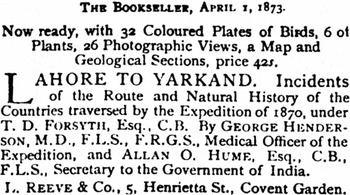
The publication of both Lahore to Yārkand and volume 2 part 1 of Genera Plantarum occurred in April 1873. Stearn (Reference Stearn1956) narrowed the date of publication for the relevant part of Genera Plantarum to 7–9 April. Both The Bookseller (Fig. 1) and The Publishers’ Circular of 1 April carried advertisements stating that Lahore to Yārkand was now ready. Therefore, I take 1 April 1873 as the publication date of Lahore to Yārkand, and so I consider that ‘Henderson and Hume’ have priority over ‘Bentham and Hooker’ by about 1 week in this case.
Advertisement for Lahore to Yārkand that appeared in The Bookseller of 1 April 1873.

New Plant Species
Apocynum hendersonii Hook.f. in Henderson & Hume, Lahore Yārkand: 327–328, unnumbered plate (1 April 1873). – Type: China, Xinjiang, Yarkand, G. Henderson 491, 23 August 1870 (lecto K (2 sheets), designated here (or possibly holo)).
= Apocynum pictum Schrenk, Bull. Cl. Phys.-Math. Acad. Imp. Sci. Saint-Pétersbourg 2: 115 (1844).
There are two sheets from Yarkand in the Kew herbarium. They are both labelled ‘bis’, which was Kew herbarium practice to indicate that material from the same collection was mounted on more than one sheet, so the two sheets are considered to represent one specimen. Because Hooker did not make a type designation or cite any specimen explicitly, a lectotype designation is made here.
Deyeuxia anthoxanthoides Munro ex Hook.f. in Henderson & Hume, Lahore Yārkand: 339–340, unnumbered plate (1 April 1873). – Type: China, Xinjiang, Sanju Pass, Yarkand, 15–16,000 feet, G. Henderson s.n., 9 August 1870 (lecto K (K000838303), designated here; isolecto K (K000838302)).
≡ Calamagrostis anthoxanthoides (Munro ex Hook.f.) Regel, Trudy Imp. S.-Peterburgsk. Bot. Sada 7: 640 (1880).
In this case, there are two sheets representing the original material of the species, but there is no indication that they make up the same specimen. Therefore a lectotype is designated. There is little to choose between the specimens, but the lectotype sheet selected has a more extensive label.
Hololachna shawiana Hook.f. in Henderson & Hume, Lahore Yārkand 313–314, unnumbered plate (1 April 1873), as Hololachne. – Type: China, Xinjiang, Yarkand, common along Karakash and Sanju rivers, G. Henderson s.n., August 1870 (lecto K (K000641967), designated here (or possibly holo)).
= Reaumuria songarica (Pallas) Maxim., Fl. Tangut. 1: 97 (1889), as R. soongorica.
Presumably, Hooker commemorated expedition member Robert Shaw with the epithet of this species. Because Hooker did not make a type designation or cite any specimen explicitly, a lectotype designation is made here.
Iphiona radiata Benth. in Henderson & Hume, Lahore Yārkand: 323–324, unnumbered plate (1 April 1873); Bentham & Hooker, Gen. Pl. 2(1): 333 (7–9 April 1873). – Type: [China, Xinjiang, Yarkand], G. Henderson 512, 23 August 1879 (lecto K, designated here).
= Inula salsoloides (Turcz.) Ostenf. in Hedin, S. Tibet 6(3): 39 (1922).
There are four specimens mounted on one sheet in the Kew herbarium. Each specimen has a ticket with Henderson's field number and a date. From these four syntypes, one specimen, marginally better than the rest, is selected as lectotype.
Saussurea ovata Benth. in Henderson & Hume, Lahore Yārkand: 325–326, unnumbered plate (1 April 1873). – Type: China, Xinjiang, Yarkand, 12,000 ft, G. Henderson 356, 10 August 1870 (lecto K (K000035727), designated here (or possibly holo)).
Because Bentham did not make a type designation or cite any specimen explicitly, a lectotype designation is made here.
Acknowledgements
Comments from two anonymous reviewers helped to improve the paper.