Regulating the conduct of transnational actors has long posed a challenge for states. Global economic integration, however, has given questions of regulatory convergence and divergence new scope and urgency. Governance problems arise because states' legal rules generally operate only within their respective territories, whereas a single transnational act can, by definition, have consequences in several states. Segmenting cross-border conduct into location-specific components for regulatory purposes is often impossible. While governments can sometimes agree on the desirability of regulatory harmonization, achieving it on a practical level is difficult.Footnote 1 One approach to regulating transnational conduct that has become increasingly common in recent decades involves courts and other domestic-level institutions claiming direct authority over entire transactions, including those elements outside the territorial boundaries of the regulating state. This practice is known in international law as “extraterritoriality.”
International regulatory competition encompasses efforts by governments to induce, or coerce, other governments into adopting their preferred laws and policies. An important facet of such competition concerns the varying ability of governments to impose rules and policy preferences on private actors, both inside their territory—and beyond. The United States has been by far the most assertive state with respect to giving its domestic rules extraterritorial effect, with U.S. courts playing a key role. Since 1945, U.S. courts have considered a growing number of new claims involving extraterritorial conduct (see Figure 1). This upward trend, however, conceals considerable variation in U.S. court willingness to find and exercise jurisdiction extraterritorially over time and across issues.Footnote 2 U.S. courts have, for example, enforced domestic statutes extraterritorially against international trading cartels; to compensate victims of torture ordered by foreign military officials; to restrict re-exports of sensitive materials and technologies; to protect U.S. trademarks; and to safeguard migratory species. Conversely, U.S. courts have generally declined to exercise extraterritorial jurisdiction over product liability claims; to punish alleged patent violations; to secure compensation for U.S. citizens killed in foreign plane crashes; or to require compliance with U.S. labor and antipollution standards. In most instances the text of the underlying law offers no justification for this variation. Nor can this variation be elucidated by reference to legal issue area, as indicated by opposing empirical trends in different types of intellectual property law, environmental law, and human rights claims, or to the presence or absence of international treaties and institutions.
New extraterritorial jurisdictional claims

The primary empirical question this study engages is why U.S. courts decide to exercise jurisdiction over some regulatory disputes with an extraterritorial dimension, but not others. The answer matters for at least two reasons. First, such decisions are an important component in tracing the outer limits of how the United States as a transnational regulatory actor can be expected to behave. This holds both where courts are directly involved in enforcement claims, and where the prospect of court involvement affects how expansively other agencies and officials interpret their regulatory authority in the transnational realm. Second, court decisions regarding questions of extraterritorial jurisdiction influence the strategic behavior of private actors as well as foreign governments. Court decisions do so by clarifying the scope and reach of U.S. rules for a wide audience of actors engaged in, or contemplating, regulated conduct involving U.S. territory or citizens.
National courts are quintessentially “domestic” institutions. Consequently, they rarely feature in international relations theories. Nevertheless, U.S. courts and those in other powerful liberal democracies can and do influence outcomes and processes at the international level. When U.S. courts exercise authority over legal claims with an extraterritorial dimension, they function as international-level actors in a direct sense. Indirectly as well, the activities of domestic courts matter to international political processes. Whether vindicating, extending, or nullifying public policies and privately held rights and entitlements, court decisions have distributional consequences. To the extent that the preferences and strategies of foreign policy officials are conditioned on domestic interests, who wins and who loses in domestic regulatory battles impacts international affairs.Footnote 3 Under globalization, furthermore, the lines between “domestic” and “transnational” private conduct have blurred considerably. On issues as diverse as trade, finance and investment, banking, labor policy, intellectual property, human rights, public health, and natural resource policy, it is increasingly difficult to posit where “domestic” policy ends, and “international” policy begins.Footnote 4
U.S. extraterritoriality is often equated with unilateral exercises of “economic statecraft,” such as the Cuban Liberty and Democratic Solidarity Act (also known as the Helms-Burton Act), together with sanctions against other states, such as Nicaragua, Libya, and Iran, and broad restrictions on trading with Soviet-aligned states during the Cold War.Footnote 5 Under these policies, the U.S. government has threatened to penalize U.S. corporations, their foreign subsidiaries, and even foreign corporate entities for activities outside U.S. territory deemed contrary to U.S. policy objectives—much to the aggravation of U.S. allies and trading partners. Although undeniably “extraterritorial,” such activities are also in many respects extraordinary. First, sanctions are typically directed against specific states. Most regulatory law, by contrast, embodies rules of general application. Second, sanctions involve strategic leveraging of access to U.S. markets and technologies for foreign policy ends, often at the expense of broader regulatory objectives. Unilateral sanctions imposed for foreign policy purposes by definition involve heightened restrictions on regulated interactions among states and their nationals in an effort to make the foreign target's adherence to particular policies more costly.Footnote 6 Thus, the absence of sanctions need not suggest the absence of U.S. extraterritoriality. Instead, it implies only a return to “standard” modes of regulatory behavior.
Recent studies of transnational governance emphasize the role of substate actors, quasi-governmental bodies, and private entities in producing regulatory structure: corporations and interest groups lobby to shape the policies and preferences of legislators and state agencies.Footnote 7 Firms and industry associations create institutions for “self-regulation” and to promote “corporate social responsibility,” in part to pre-empt more direct forms of state regulation.Footnote 8 Government agencies delegate the development of standards to quasi-governmental or private bodies ex ante (for example, for international accounting practices, or product specifications), or adopt privately formulated standards ex post.Footnote 9 In each of these areas private sector inputs are distinguishable from public acts. Extraterritorial regulation in the civil realm is, by contrast, a paradigmatically “hybrid” mechanism of rulemaking and enforcement: it is both “of the state” and in important respects decoupled from it.
Public and private actors share in the direct initiation of civil regulatory claims handled by courts—including those with an extraterritorial dimension.Footnote 10 Whether undertaken for enforcement purposes, or to challenge the validity or interpretation of a particular rule, most involve private actors in pursuit of private ends. Others are brought by nongovernmental organizations seeking to shape public policy. Still others are initiated by government agencies on behalf of parties too weak or diffuse to protect their interests, or where the rules do not allow private parties to initiate claims directly. The U.S. legal system gives plaintiffs of all types considerable choice regarding the scope, timing, and forum for their claims.Footnote 11 Plaintiffs also generally control termination of valid legal disputes in advance of a final court decision.Footnote 12 The substantive rules and standards U.S. courts apply are those of the United States, or foreign laws held to be compatible with U.S. law. As such, judicial assertions of extraterritorial jurisdiction actively project U.S. rules and policy preferences into the transnational realm. Importantly, this transports U.S. law to locations and situations where U.S. officials may not otherwise be expected to act. At the same time, the enforcement power of U.S. courts is firmly embedded in traditional features of territorial sovereignty: the ability to control persons, property, and assets inside the state's territory, to exclude unwanted entities, and to control flows across external borders.Footnote 13
The mix of actors and interests involved in extraterritorial regulation suggests several possible explanations for why, and under what circumstances, U.S. courts choose to act when faced with disputes involving extraterritorial conduct. I argue that U.S. courts opt to regulate extraterritorially when necessary to maintain the domestic efficacy of regulatory rules and policies, or to ensure the respect of what I call “basic rights”—and rarely otherwise. This argument is premised upon a notion of a “disaggregated,” pluralistic state in which governmental branches and agencies jockey for influence over policy, and where opportunistic inputs from private actors can influence outcomes. Empirical patterns of U.S. judicial extraterritoriality are, in this view, an artifact of institutional pragmatism grounded solidly in domestic-level rules and processes—not a strategy of institutional aggrandizement, or of promoting U.S. interests abroad.
In the next section I present my account of variation in the propensity of U.S. courts to resolve disputes involving extraterritorial conduct and contrast it with two competing accounts of judicial behavior in the transnational realm. The second section describes the contents of an original dataset of U.S. federal court decisions handed down between 1945 and 2003 and discusses strategies for managing selection issues. The third section summarizes and discusses the results of the statistical tests. The fourth section explores the implications of my findings to theories of transnational governance and international regulatory competition. The final section concludes.
Toward a Theory of Extraterritorial Regulation
Before the mid-twentieth century, U.S. courts had little practice in using U.S. statutes extraterritorially to resolve civil claims, having done so in only a handful of cases involving conduct partially inside U.S. territory, or in locations outside the sovereignty of any state (for example, the high seas).Footnote 14 In 1945, a U.S. federal court for the first time applied a U.S. statutory provision to a dispute involving wholly extraterritorial conduct. The claim alleged the Aluminum Company of America (ALCOA) had engaged in monopolistic activities in Europe with the objective, and the effect, of distorting the international market for aluminum ingot. Because the market effects of ALCOA's actions harmed U.S. producers and consumers, the court held that they violated section 2 of the Sherman Antitrust Act, despite having taken place outside U.S. territory.Footnote 15 Other exercises of extraterritorial regulation followed this landmark decision, albeit haltingly, and often at a considerable time lag. Nevertheless, by the beginning of the twenty-first century U.S. courts had applied dozens of statutory and constitutional provisions extraterritorially to resolve a wide range of disputes, and new challenges to the territorial limitations of U.S. laws continue to arise.
This study examines disputes among private actors, or between private actors and government officials, where the extraterritorial reach of U.S. law, and therefore also the jurisdiction of U.S. courts, is directly under contention.Footnote 16 I argue that U.S. courts can be expected to interpret U.S. rules as reaching extraterritorial conduct in two types of situations. The first is where extraterritorial conduct threatens to undercut the domestic operation of a regulatory rule or regime. Such situations arise when private actors are able to capture domestic benefits of conduct prohibited under U.S. law (for example, forming a cartel, passing information for insider trading) simply by undertaking all or part of a prohibited transaction outside U.S. territory. Where this type of expected private gain outweighs the expected costs of undertaking extraterritorial conduct, it creates predictable incentives for others to follow suit. The foreseeable consequence in the absence of intervention is for rational behavior on the part of private actors to undercut both the rule in question, and the public policy it is meant to serve. Where extraterritorial conduct does not create such incentives, a court may forego regulation without risking harm to the domestic regulatory order—even where it results in some demonstrable costs to U.S.-based entities.
U.S. courts are also likely to find extraterritorial regulation appropriate where conduct is alleged to violate a short list of “basic” rights at the core of U.S. political and legal identity. Rights considered “basic” for these purposes are those receiving strict scrutiny in U.S. constitutional review, and those considered jus cogens under international law. This includes rights not to be deprived of life, liberty, or property without due process of law, rights to free speech, and freedom from discrimination on the basis of national origin or membership in a traditionally disadvantaged group, and also the right not to be subjected to torture or other “crimes against humanity,”Footnote 17 The rationale behind this type of extraterritoriality differs in important respects from the first. Here the regulatory objective involves re-enforcing core norms of the political community. As such, membership in the polity, through citizenship or other forms of close association with the United States, is an especially critical dimension. In addition, the need to demonstrate actual harmful effects from extraterritorial conduct is weaker, as every violation of a core norm by a member of the community is considered harmful per se.Footnote 18
In formulating expectations for judicial behavior, I look to courts' institutional responsibilities and capacities within the U.S. government, together with constraints on their actions imposed by the international environment. U.S. courts' primary task is to resolve disputes “arising under” the constitution and laws of the United States by providing authoritative interpretations regarding their scope, content, and consequences.Footnote 19 Judges in this account are rule-bound, strategic actors.Footnote 20 Their behavior is regulated from within the judiciary by the threat of higher court review, together with formal rules and norms of conduct whose observance is required for professional advancement.Footnote 21 At the same time, courts operate in a political environment populated by other actors and institutions with preferences over regulatory outcomes, and mechanisms for signaling the nature and strength of those preferences. The U.S. Congress can override court decisions in the statutory realm by legislative amendment, while the president can attempt to clip the wings of unwelcome judicial decisions using executive orders and treaty making powers.Footnote 22 Less directly, dissatisfaction with judicial behavior can also be expressed through the politics of budgets and appointments.Footnote 23
The separation-of-powers structure of the U.S. government creates incentives for each branch to exercise restraint in dealing with the others. The “shadow” of prospective judicial review spurs Congress to observe constitutional limits when making law, and likewise the executive branch when carrying it out. It also encourages judges to base decisions on plausible theories of legislative intent, and, where possible, to decide claims on procedural or statutory (not constitutional) grounds.Footnote 24 In addition, when approaching claims in which the extraterritorial applicability of a U.S. law is at issue, the politics of interbranch restraint oblige courts to consider the foreign affairs implications of possible outcomes. Although courts are largely insulated from protests and other actions of foreign governments concerning assertions of U.S. extraterritorial jurisdiction, their impact may be felt indirectly through executive pressure to exercise, or refrain from exercising, jurisdiction in particular cases.Footnote 25
At the same time, the underlying issues in the set of extraterritorial claims examined here generally differ little from those found in purely domestic suits—from price-fixing and conspiracies to defraud, to violations of environmental protection statutes, to attempts to secure compensation for injury or death in the workplace. What makes these disputes unusual is the question of whether all or part of the claim should be considered beyond the reach of U.S. law because some portion of the conduct at issue occurred outside U.S. territory.
Jurisdiction: What It Is, and Why It Matters
For courts “jurisdiction” is the legal authority to hear and resolve disputes. Under the U.S. system, before a court may formally consider any dispute it must confirm that the underlying law grants it authority over both the actions (‘subject matter jurisdiction’), and the actors (‘personal jurisdiction’) involved.Footnote 26 If the court finds its authority lacking on either dimension, it must dismiss the claim.Footnote 27 Both types of jurisdiction hinge on whether the statutory or constitutional law on which the claim is based was meant to prescribe behavior outside U.S. borders. Few federal statutes, however, mention extraterritoriality, or are otherwise clear regarding their intended prescriptive reach. Indeed, the number is far fewer than that found by U.S. courts to have at least some measure of extraterritorial applicability.Footnote 28 One reason is that legal rules are drafted for general application. As a result, they rarely enumerate the full range of conduct they may be read to embrace, either at the time of drafting, or looking forward as circumstances change. When deciding questions of prescriptive jurisdiction over extraterritorial claims, therefore, federal courts are defining the extent—in literal, spatial terms—of their own and other domestic actors' power to regulate persons and conduct outside U.S. boundaries.Footnote 29
The standard judicial approach to resolving extraterritorial jurisdictional questions involves inquiring into the intent behind the rule at issue. In so doing, judges look to the law's text, its legislative history, and any prior record of application to form hypotheses (of sorts) regarding its scope and purpose. The National Labor Relations Act (NLRA), for example, can be understood as having been passed to promote collective bargaining by safeguarding U.S. workers' rights to organize. Whether this goal requires U.S. companies to respect NLRA provisions when negotiating with U.S. (or foreign) employees based outside the United States is the type of question on which prescriptive jurisdiction turns. As with domestic legal claims, congressional action in important respects conditions the degree of federal court involvement in extraterritorial regulatory matters. There are, in addition, a handful of statutes for which legislative intent to provide a basis for extraterritorial jurisdiction is obvious at a general level. Examples include the Foreign Trade Antitrust Improvements Act (FTAIA) and the Foreign Corrupt Practices Act (FCPA).Footnote 30 Extraterritorial claims based on statutes of this type get a “free pass” on the most basic prescriptive hurdle. However, courts must still ensure the law plausibly encompasses the specific facts alleged in the claim.Footnote 31 Under the FCPA, for example, courts must decide whether the conduct at issue is “foreign,” and whether it reasonably relates to the statute's definition of “corrupt practices.”Footnote 32 Courts use this mode of analysis, in addition, when considering novel jurisdictional claims based on legal rules previously found to have extraterritorial reach. Consequently, in the analysis below I consider each of these types.
A separate inquiry under constitutional due process is also required to verify court jurisdiction over the “persons” of prospective defendants.Footnote 33 In this inquiry, the key question is whether a defendant's conduct should be held to U.S. legal standards—whatever those standards may be. This, in turn, entails asking whether the defendant(s) fall within the class of actors Congress intended to regulate.Footnote 34 Outcomes here turn on the type and frequency of U.S. ties.Footnote 35 Degrees of association range from U.S. citizenship to thin and episodic contacts with U.S. territory or citizens. In deciding the break point between “sufficient” and “insufficient” contacts for personal jurisdiction, judges must likewise square broad principles of due process with the regulatory objectives of particular rules. Strategic actors frequently attempt to insulate themselves from the reach of U.S. regulators by creating subsidiaries in foreign countries, or by attempting to contract out of practices that are questionable under U.S. law. Such defensive actions have a role in generating the types of litigation examined here: suits that challenge the territorial limitation of regulatory rules, to whom or what they apply, and even what constitutes an “actor” under particular regulatory statutes.
The Production of New Disputes
How, as a general matter, do extraterritorial legal disputes arise? Legal rules embody legislated and constitutional rights and entitlements. Legal claims arise when one party believes another has caused it harm through behavior inconsistent with a legal rule. Actors at all levels in social and political systems continuously engage in the interpretation and application of legal rules when calibrating their conduct, and in formulating expectations regarding others' likely behavior. Because all actors operate with imperfect information, strategic behavior may result in poor estimation of, or decisions to test, others' beliefs, preferences, or resolve regarding their legal rights. Where opposing parties disagree about a rule's scope or application, they may ask courts to adjudicate. Disagreements are especially likely in three types of circumstances: when existing conduct is undertaken on a larger scale, when new actors or forms of conduct arise, and when new rules are announced. Each of these instances creates opportunities for formally reassessing how conduct maps onto settled rules.Footnote 36
Uncertainty and flux in what legal rules mean can result from both large- and small-scale changes in the political, institutional, and technological status quo. Where change in the regulatory environment makes it easier for private actors to engage in transnational activities, to the extent that those activities negatively impact the vested rights and interests of at least some domestic actors, claims that challenge territorial limitations on regulatory rules are likely.Footnote 37 In the 1940s, for example, U.S. involvement in international political and economic affairs increased dramatically over prior levels.Footnote 38 This expansion created both new opportunities and new vulnerabilities for American entrepreneurs at home and abroad. Where the extraterritorial activities of entities with U.S. ties resulted in particularized harm to domestically guaranteed rights and legal expectations, those suffering harm frequently turned to courts for vindication.Footnote 39 Change of this type helps to explain important aspects of the production of legal disputes with an extraterritorial dimension and, in the account presented here, the growing willingness among U.S. courts to decide some proportion of those disputes.
Technological innovation can likewise give rise to new and unforeseen types of conduct. It can also enable existing activities to be carried out on a larger scale, thereby involving increased numbers of direct and indirect participants in regulated activities. Although innovation can place some actors in an advantageous position, it may disadvantage others locked into older technical or organizational methods. Entities harmed by technological change may attempt to use court rulings to block new approaches by arguing their incompatibility with existing rules, whereas those who benefit can be expected to defend their consistency. For example, the development of increasingly sophisticated financial and accounting tools for large and small investors, such as markets for derivatives, futures, and hedges, effectively transformed the universe of international investment and dramatically increased the global supply of credit. Such innovations, however, have also undermined the market for “traditional” approaches to investment, and created new opportunities to engage in manipulation and fraud.
Finally, legislative, executive, and judicial modifications to regulatory rules can also trigger new claims as plaintiffs seek to probe the limits of observed changes. As a consequence, even statutes with an extensive history of extraterritorial application (for example, the Sherman Antitrust Act) continue to undergo reinterpretation as circumstances change and innovations are introduced. In the legislative realm, for example, the 1964 Civil Rights Act and related statutes codified earlier judicial rulings, declaring many domestic practices involving racial discrimination unconstitutional. Where, subsequently, U.S.-based actors have engaged in discriminatory practices in their foreign operations, plaintiffs have (predictably) sought with some success to have these laws applied extraterritorially. In another example, Congress in the 1980s amended the U.S. Patent Act specifically to allow for its application in situations where acts inside U.S. territory facilitate unauthorized extraterritorial use of U.S.-patented technologies. In subsequent efforts to test the bounds of this change using litigation, federal courts have consistently interpreted the provisions narrowly, allowing their use only where clear intent to circumvent the rights in question is evident. As a consequence, the record of reported cases contains relatively few claims seeking to expand the amended provisions in jurisdictional terms.Footnote 40
How Others Explain Patterns of Judicial Extraterritoriality
Extraterritorial regulation has received almost no consideration from international relations scholars, although it has long been of theoretical and practical interest to international lawyers. The legal literature on this topic is largely focused on tracing developments in legal doctrine for specific areas of practice. A few scholars, however, have sought broader explanations for what drives courts to exercise, or refrain from exercising, jurisdiction over civil disputes with an extraterritorial dimension. I focus here on two of the more compelling accounts.
First, Turley attributes patterns of decision making on extraterritorial jurisdictional questions to a judicial desire to promote and enhance U.S. economic competitiveness.Footnote 41 He draws a distinction between economic (or commercial) disputes, such as antitrust and securities claims, and social policy (or noncommercial) disputes—for example, those involving human rights, the environment, and labor regulation. Turley's analysis focuses on the different “tests” judges have devised to determine the appropriateness of extraterritorial regulation.Footnote 42 In deciding whether to exercise jurisdiction over “market” disputes, Turley observes that U.S. judges generally use “easy” tests that require little more than demonstrating some “effect” or “conduct” inside U.S. territory. In “nonmarket” claims, by contrast, he finds judges often require additional evidence of congressional intent for the statute in question to apply extraterritorially. It follows that Turley anticipates that U.S. courts will exercise jurisdiction far more readily over extraterritorial commercial claims.
A second set of testable propositions regarding the conditions under which U.S. judges can be expected to exercise jurisdiction extraterritorially is suggested by Slaughter's work on judicial globalization. As part of a broader account of emerging trends in international judicial cooperation, Slaughter describes a growing tendency among judges to engage in assessing alternative forums when deciding whether to resolve, or dismiss, transnational claims.Footnote 43 Specifically, Slaughter argues that where alternative judicial forums share basic similarities (or “affinities”), judges are less likely to dismiss claims in deference to foreign sovereign interests.Footnote 44 This is because courts in this category presumptively share a common set of values and an interest in resolving disputes in an orderly manner. Under these conditions, resolving transnational claims according to “local” rules and procedures is unlikely to produce serious friction among the courts or governments concerned, and may, moreover, result in productive forms of conflict over variation in underlying rules.Footnote 45 She illustrates this point with several examples of claims involving the United States and other economically advanced countries. Slaughter also expects U.S. courts to retain control over transnational claims involving states experiencing serious political instability or civil war, or in cases where alternative forums are considered systematically biased or corrupt.Footnote 46 By contrast, where alternative forums do not share basic affinities with the U.S. system but have a prima facie interest in resolving the claim, Slaughter's argument anticipates that U.S. judges will be more likely to defer to foreign courts on the basis of traditional notions of domestic sovereignty and international comity.Footnote 47 Under these conditions, judges should give greater weight to factors such as the citizenship of parties and the location of the disputed conduct.Footnote 48 If this argument is correct, U.S. courts should be more likely, after controlling for cases in which there is no ex ante expectation of procedural justice, to find exercising extraterritorial jurisdiction appropriate in transnational disputes implicating other states that share a baseline understanding of procedural fairness.
To summarize, I hypothesize that U.S. courts are more likely to find and exercise jurisdiction over transnational disputes when failing to do so would create incentives for systematic frustration of the rule inside U.S. territory, or where a dispute alleges a violation of a “basic right” owed to a U.S. national by another party with close U.S. ties. In addition, the empirical pattern of U.S. extraterritorial regulation cannot be explained primarily by whether the dispute involves a commercial or social policy issue, or by reference to judicial-procedural affinities attributed to other states implicated in the dispute.
Data and Analysis
In this section I use multivariate logistic regression to test the hypotheses about the conditions under which U.S. courts are expected to exercise jurisdiction over extraterritorial claims specified in the prior section. The data is from an original sample of 438 civil cases decided in U.S. federal courts between 1945 and 2003 in which the question of the court's extraterritorial jurisdiction was a factor.Footnote 49 Substantively, it encompasses disputes involving roughly 120 countries on issues that include antitrust, securities regulation, tax, intellectual property rights, contracts, environment and species protection, labor rights, personal injury, aviation regulation, as well as racial and gender discrimination, torture, forced labor and other egregious violations of human rights.Footnote 50
The dependent variable is whether a U.S. federal court finds and exercises jurisdiction extraterritorially. Three different outcomes are possible in civil disputes. First, a court may determine jurisdiction is present and decide to exercise it. Second, the court may find it has no jurisdiction to decide the dispute. Third, when a U.S. court finds jurisdiction, the judge may nevertheless decline to hear the dispute by invoking a so-called “discretionary doctrine.”Footnote 51 Because the latter two options generate the same outcome in behavioral terms—effective termination of the case in U.S. courts—I treat the dependent variable as dichotomous.Footnote 52 As indicated in Figure 1, U.S. federal courts decide in favor of exercising jurisdiction in roughly half of the new extraterritorial claims that reach them.
Selection Issues
Disputes in which the extraterritorial jurisdiction of U.S. courts is explicitly under contention constitute a subset of transnational regulatory problems, albeit an important one. In this section I identify three ways in which this approach selects for particular types of disputes, and briefly discuss the implications for inferences that can be drawn from this analysis. The first two selection effects follow from incentives that lead public and private actors to turn to courts to resolve disputes. They are uncertainty about the scope, content, or consequences of legal rules, and concerns related to the postjudgment enforceability of successful claims. A third involves observational biases tied to how judicial opinions are reported and archived.
The primary selection mechanism follows from what is essentially a problem of incomplete information. In a classic article, Priest and Klein argue that uncertainty regarding how legal rules apply is what drives parties to litigate: where parties can agree in advance on the probable outcome of litigation, they resolve the dispute out of court.Footnote 53 As an empirical matter, few disputes are litigated. Even among civil claims that reach the formal filing stage, only a small percentage ever reach trial; the rest are settled or simply dropped. Sampling for uncertainty regarding U.S. court jurisdiction, therefore, generally excludes extraterritorial claims involving uncertainty about nonjurisdictional aspects of the rules in question. It also excludes legal disputes that never result in formal claims due to consensus among the parties regarding likely outcomes of U.S. court jurisdiction (in favor or against).
A second selection effect arises from limitations on the enforceability of U.S. judicial decisions outside U.S. territory. Rational plaintiffs initiate claims only where some expectation of positive utility exists. Examples include compensation for past harms, benefits from enjoining or compelling the conduct of other actors, or affirming a right to engage in disputed forms of conduct. In situations where defendants have substantial ties to, or assets in, U.S. territory, enforcement issues differ little from purely domestic claims. Where, by contrast, a prospective defendant has no (or few) direct ties to the United States, U.S. courts must rely on foreign governments to assist in enforcing judgments. When such assistance appears ex ante unlikely to materialize, this affects the likelihood that public and private actors will turn to courts to achieve their objectives.Footnote 54
Domestic courts are, of course, not the only institutions capable of upholding existing or emerging rights, clarifying regulatory rules, or providing compensation. Where available, state-to-state mechanisms such as World Trade Organization (WTO) complaints, sanctions, and other modes of agency enforcement perform similar functions. For a lawsuit to be attractive to parties seeking redress for particularized harms, it need only offer an equal probability of achieving the desired end at equal cost—either alone or in conjunction with other tactics. Interestingly, the same technological innovations that have increased the capacity for private actors to interfere with the domestic operation of regulatory rules have, in many instances, also increased enforcement opportunities for courts and other domestic regulatory actors. This is because the more points of contact an extraterritorial actor has with the United States, and the more diverse its operations, the greater the leverage a U.S. court has to seize or attach assets to satisfy an extraterritorial damage award, or to raise the costs of noncompliance with injunctive orders.
Finally, using federal judicial opinions as data entails an embedded form of selection related to the observability of outcomes on claims involving extraterritorial jurisdiction. Only a subset of litigated cases result in formal written opinions. Moreover, judges are encouraged to report opinions for publication only when they “rule on an issue of first impression, modify a previously announced rule, reverse a published decision of an agency or district court, or create a conflict with another circuit.”Footnote 55 Consequently, the disputes analyzed here, like those drawn from any pool of reported cases, are not routine examples of judicial decision making. Rather, fully argued and reported opinions generally follow from disputes involving legal rules that are genuinely in flux, and where outcomes turn on novel interpretations of rules or doctrine, or the exercise of discretionary powers.
The pool of cases from which the data is drawn is thus atypical in several respects. The cases are a nonrandom sample of legal disputes characterized by high uncertainty about the reach of U.S. rules and the extraterritorial jurisdiction of U.S. courts. By selecting out disputes with relatively low stakes for plaintiffs, and those in which the court's jurisdiction either is not challenged, or where such challenges lack merit under “settled” law, it systematically understates the incidence of legal disputes involving extraterritorial conduct. Accordingly, this approach is poorly suited to observing overall patterns of regulatory enforcement. These factors, however, combine to make this approach well suited to observing areas of regulatory flux, and to testing the hypotheses at issue here regarding the conditions under which U.S. courts are likely to consider, and in some cases modify, the extraterritorial reach of U.S. rules.
Independent Variables
The independent variables track the two sets of conditions in which I claim courts should be expected to find and exercise jurisdiction extraterritorially. Also included are variables to test for effects anticipated by the alternative accounts, and several controls. I briefly describe each and how they are coded.
Ensuring domestic rule integrity
To be coded as a threat to a domestic regulatory rule, extraterritorial conduct must, first, produce an actual or anticipated “cost,” broadly defined, inside the United States, or to the foreign property or interests of U.S. citizens. Second, the extraterritorial conduct must allow an actor to capture private benefits that would not be allowed if the conduct occurred wholly within U.S. territory. Where anticipated benefits are expected to outweigh the operational costs of circumventing the rule, this creates incentives for other private actors to follow suit, thereby threatening to undermine the future domestic operation of the rule. The function described is a “back-of-the-envelope”-type calculation of the costs of circumvention (generally speaking) weighed against the potential benefits (again, generally speaking). In other words, it is the type of calculation one can imagine a “reasonable judge” making given a short time horizon and few external resources.
Where these conditions appear to apply to the case as summarized in the court's written decision, the domestic regulatory threat variable was coded as 1.Footnote 56 Where private incentives to engage in allegedly harmful behavior are already weighted in favor of domestic regulatory compliance, no comparable threat to U.S. rules exists, and the variable is coded as 0.Footnote 57 In claims involving mixed incentives for private actors, consideration of broader transaction costs is necessary to decide whether the behavior in question is expected to increase in the absence of extraterritorial regulation.Footnote 58
Protecting “basic rights.”
To code for “basic rights,” I use an independent indicator—whether the underlying legal issue falls into a category that receives heightened scrutiny in federal judicial review. This list of rights is discrete, readily ascertainable, and subject to change over time. At present, it includes claimed violations of rights to life, liberty, privacy, assembly, and free speech. In addition, U.S. federal courts also strictly review allegations of discrimination based on race, national origin, alien status, or membership in a “discrete and insular” minority.Footnote 59 Analogues to these rights are codified in international human rights instruments relating to core civil and political rights and recognized under jus cogens. These include slavery, extra-judicial killings, and torture. Where any of these issues arises in a dispute, the “basic rights” threat is coded as a 1 and otherwise as 0.
Additional variables and controls
Testing the influence of the general type of dispute and the “fitness” of alternative forums on U.S. court decisions to regulate extraterritorially requires specification of additional variables.
• Involvement of an OECD member state. Two variables test the plausibility of liberal claims that U.S. courts should be more likely to regulate extraterritorially when disputes involve foreign countries with highly similar standards of justice. As a proxy, I track two types of involvement—whether any portion of the disputed conduct occurred in an Organization for Economic Cooperation and Development (OECD) member state (locoecd), and whether any citizen of an OECD member state is a defendant (defoecd). Where the answer to either query is positive (coded as 1), the logic of the judicial globalization argument anticipates an increased likelihood that a U.S. court will exercise jurisdiction.Footnote 60
• Subject matter. Whether a dispute concerns an economic or commercial matter (coded as 0) or a social policy issue (coded as 1) is tracked with this variable. Conceptually, I distinguish between disputes where the crux involves a business transaction or private compensation, and distributive questions involving public burdens or benefits, or processes by which such determinations are made.Footnote 61 The expectation is that U.S. courts should be more likely to regulate extraterritorially in commercial disputes than for those involving social policy.
A further set of variables is added to each regression to control for factors considered important in legal “folk theories.” These variables are expected to perform roughly similarly across explanatory accounts.
• Year suit commenced. The expectation is that this variable will generate positive coefficients, reflecting growing ease in initiating new extraterritorial claims.
• Conduct wholly/partially extraterritorial. This variable indicates whether any conduct occurred in U.S. territory. Conduct inside the United States (coded as 1) should increase the probability that U.S. courts will regulate the extraterritorial elements of a transaction.
• U.S. citizenship. Two variables attempt to capture the effects of citizenship on the dependent variable. The first controls for whether any plaintiff is a U.S. citizen, and the second for the same among defendants. U.S. courts are expected to be more likely to find and exercise jurisdiction when U.S. citizens are directly involved in litigation than when they are not.
• U.S. government preferences. Two dummy variables test the effect of U.S. government preferences for, or against, regulation. Preferences may be “expressed,” as occurs when an executive agency intervenes as a third-party (amicus curiae), or “structural”—that is, when the government is a party to litigation.Footnote 62 The expectation is that known government preferences will increase the likelihood of the preferred outcome.Footnote 63
• Judicial ideology. This variable uses a judicial “liberalness” score ranging from 0 to 1 based on the political party of the appointing president for the highest decision in each case. Republican presidents are coded 0 and Democratic presidents are coded 1. At the district level, single judges decide claims. Appellate review typically involves three-judge panels, but may have greater numbers where senior judges in a circuit decide to rehear a case en banc. Supreme Court review normally entails nine justices, but may involve fewer where recusals are appropriate. The score is calculated by dividing the total over the number of judges. The expectation is that the more “liberal” the deciding judge(s), the greater the likelihood of supporting extraterritorial jurisdiction in close cases.
Cross tabulations of the dependent variable and the primary explanatory variables indicate that they correctly predict 61 percent of the outcomes, even before controlling for other factors.
Regression Results
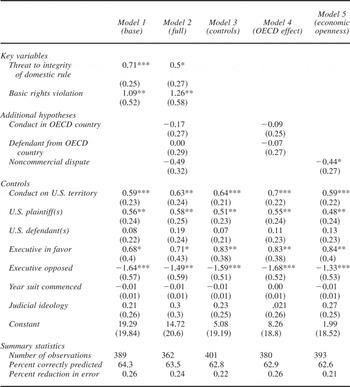
To examine the effects of specific explanatory variables on the dependent variable I tested several versions of the logistic regression model summarized in Table 1. In the base model or model (1), which tests my hypothesized account, both the “domestic rule integrity” coefficient and the “basic rights” coefficient have substantive weight, with statistical significance at the 95 percent level. The likely robustness of the latter coefficient, however, should be treated with skepticism given the thinness of its underlying data.Footnote 64 I also tested a two-stage Heckman selection model (with finding jurisdiction as the first-stage dependent variable, and exercising it as the second), supplemented by Sartori's selection estimator for when identical sets of independent variables are used in both models.Footnote 65 Except for the time variable, which in the first stage model has a coefficient of −0.019 (0.009) and is significant at 90 percent, the results of the more complicated model do not differ substantively from those in the simpler approach.
Probability that U.S. federal court exercises extraterritorial jurisdiction over a novel claim

Notes: Standard errors in parentheses. *** significance at 99% confidence level; ** significance at 95% confidence level; * significance at 90% confidence level in two-tailed t-tests.
The models testing alternative explanations for U.S. court behavior generated less promising results. The coefficients tracking whether any disputed conduct occurred in an OECD member state involved an OECD-based defendant are quite small with large standard errors both in the full model and when tested on their own. In the latter instance, furthermore, the sign is negative. This is contrary to what Slaughter's argument predicts, although the results are not statistically distinguishable from zero.Footnote 66 The “noncommercial dispute” coefficient has the expected sign in both the full and the standalone model. In the full model the coefficient falls short of significance at the 90 percent level using a two-tailed t-test, and just reaches it in model (5).
The results for the control variables are largely as anticipated. First, conduct partially inside U.S. territory is positively related to court decisions to regulate extraterritorially with at least a 95 percent level of confidence. Second, having a U.S. citizen as a plaintiff also matters substantively, with 95 percent confidence. Having a U.S. defendant, however, does not. Third, an expressed U.S. government preference in favor of extraterritorial jurisdiction appears to have a substantial impact on the outcome, with at least a 90 percent level of confidence. An even greater substantive effect is evident, generally at the 99 percent level, when the U.S. government expresses a preference against an exercise of exterritorial jurisdiction. Finally “year suit commenced” has no effect. These results are consistent across all iterations of the models, which indicates that neither the coefficients, nor their standard errors, are strongly correlated with other variables tested.
To aid in interpreting the quantities of interest in the base model, I performed a set of post-estimation parameter simulations using Clarify.Footnote 67 Holding all other variables to their means, I estimated the effect of a change in key variables from 0 to 1 (“first difference”). The results indicate that the likelihood that a U.S. court will regulate extraterritorially increases by 0.17 (standard error 0.06) when the disputed conduct poses a threat to domestic regulatory rules. With other variables at their means, when the domestic rule integrity variable is 1, a U.S. court has a 0.54 probability of exercising jurisdiction, but only a 0.37 probability when 0. For the “basic rights” variable, the “first difference” is 0.25 (standard error 0.11), with a 0.46 probability that a U.S. court will exercise jurisdiction when there is no threat to basic rights, and a 0.71 probability when such a threat is alleged.
Discussion
The results of these exercises indicate that the featured explanatory variables account for a substantial measure of unexplained variation in the propensity for U.S. courts to regulate extraterritorially. Where conduct outside U.S. territory threatens the integrity of domestic regulatory rules, the likelihood that a U.S. court will exercise jurisdiction over resulting disputes is considerably greater than when it does not. In addition, where actors with close U.S. ties are alleged to have violated basic rights owed to others, the evidence suggests, albeit less strongly, that U.S. courts are more likely to regulate extraterritoriality. These results are robust across all variations of the model, and post-estimation simulations confirm that the identified effects are nontrivial.
At the same time, the results offer less support to either alternative account as a standalone explanation. Beginning with the liberal internationalist argument, the variable tracking of whether any portion of the conduct occurred in an OECD member state resulted in extremely small or negative coefficients coupled with high standard errors. To the extent that these coefficients suggest anything, it is that conduct in an OECD country reduces the likelihood a U.S. court will exercise jurisdiction, and having a defendant from an OECD country has no effect. Nor do the results unequivocally support the “economic openness” hypothesis. Although U.S. courts do appear somewhat more willing to expand the reach of statutes regulating commercial as compared to noncommercial matters, the underlying evidence is both substantively and statistically weaker. The results of the base model, however, suggest that controlling for the commercial nature of disputes could account for some variation not captured by the domestic rule integrity variable.Footnote 68
The results for several of the controls are also noteworthy. First, the variables tracking U.S. government preferences are both substantively and statistically significant. They are, nevertheless, inadequate as a general explanation for court behavior. First, cases in which executive preferences are made explicit are relatively rare, and not necessarily determinative of court action.Footnote 69 Of the 438 observations on the dependent variable, the executive expressed no preference in 341, or 78 percent. Where government preferences are explicit, court decisions with respect to jurisdiction were consistent with government preferences only 76 percent of the time. Second, the coefficients and standard errors for U.S. government preferences change only slightly across models. This indicates noncolinearity between the featured variables and those tracking government preferences, which, in turn, suggests they are complementary.Footnote 70
The results for U.S. citizenship and judicial ideology are likewise interesting. Regarding plaintiffs, one implication could be that U.S. courts are systematically biased in favor of hearing complaints brought by U.S. plaintiffs. Alternatively, U.S. plaintiffs could be better at identifying new claims likely to be successful—or some combination of these factors. If, however, systematic bias is involved, it should be also reflected in the coefficient for U.S. defendants, which it is not. The purported “liberal” bias of deciding judges appears to have no effect on the dependent variable for the sample as a whole, or for the subsample of district court cases. When analyzing only the 173 appellate cases in the sample, however, the coefficient for judicial ideology is 0.94 (0.57), which just misses significance at the 90 percent level.Footnote 71 This suggests ideology may have some role in especially close calls for these types of claims.
The results for the time variable also merit discussion. The coefficient for time, which is miniscule across all iterations of the model, is at first surprising due to the increase in situations where U.S. courts have been asked to consider extraterritorial regulation. The arguments underlying the selection of disputes for litigation, however, render this result intuitive. Because litigated cases are those with a high degree of uncertainty among parties regarding the outcome, one should expect that the rate of plaintiff success should tend toward 0.5. This probability does not change with the number or character of the underlying questions courts are asked to decide, and it is this stability that is reflected in the time coefficients.
Finally, how should one evaluate the explanatory power of these models in substantive terms? Or, alternatively, what is not being captured? In answering this question it is helpful to recall that, when deciding close jurisdictional questions, judges are often exercising a degree of discretion. Where multiple courts potentially have jurisdiction over a transnational dispute, forum selection may be determined by prior contracting, or by the convenience (proximity) of the parties, which is substantially weighted in favor of the plaintiff's preference. In just under 20 percent of the cases in the base model, a U.S. court exercised jurisdiction where the featured variables predict it would not. These cases generally fit the profile just described. In another 16 percent of cases, the model predicts an exercise of jurisdiction where none occurred. This class of cases is more interesting. One explanation for this gap involves measurement error, or “noise” in the data. A more intriguing possibility is that other factors of a more political character systematically negate exercises of jurisdiction in circumstances where we would otherwise expect them. Testing specific hypotheses about the conditions under which judges use discretionary doctrines—for example, international comity, forum non conveniens, stays on proceedings—to avoid particular claims where jurisdiction is supportable is, therefore, a needed step in elaborating a more fully specified theory of U.S. regulatory behavior in the transnational realm.Footnote 72
Extraterritoriality and Transnational Governance
Extraterritorial regulation takes place at the interface of domestic law and international relations.Footnote 73 Its usage by the United States, and less frequently by other global and regional powers, has important implications for how we understand the dynamics of international regulatory competition. The analysis above demonstrates a solid relationship between extraterritorial conduct with potential to negatively affect the domestic operation of U.S. regulatory policy, and a judicial propensity to interpret U.S. law as having extraterritorial reach. It also offers weaker evidence of a trend toward U.S. courts deciding claims in which plaintiffs with U.S. ties allege extraterritorial violations of core individual rights. The remainder of this article relates these findings to what I argue are two undertheorized elements in accounts of the origins and operation of formal and informal rules structuring transnational conduct. The first concerns the extraterritorial regulatory capacity of states and its effects on the strategic behavior of private entities. The second examines how this capacity influences state preferences and strategies in the context of international bargaining over regulatory rules.
Standard international relations theories concerning the origins and operation of transnational regulatory rules focus almost exclusively on intergovernmental bargaining outcomes.Footnote 74 Order in the transnational realm, however, also has sources in the strategic behavior of states and private entities. To the extent that domestic courts are able to enforce domestic laws against transnational actors with physical, financial, or citizenship ties to their respective state territories, those laws feed into the formation and operation of transnational regulatory structure.Footnote 75 This, in turn, has implications for the range of regulatory policies and strategies available to other governments both domestically and internationally. The reason is that government preferences concerning the incidence, scope, and timing of bargaining for purposes of regulatory coordination (or coercion) are in important respects endogenous to states' internal and external regulatory capabilities and vulnerabilities. With respect to the U.S. extraterritoriality, observed patterns of regulatory enforcement feed into the evaluations of private actors and foreign governments alike regarding the relevance of U.S. rules—both as constraints on their decision making, and in anticipating the behavior of others.
Domestic Sovereignty and Extraterritorial Capacity
The globalization (or internationalization) of many private activities has enhanced the potential for outside actors to affect the domestic environment of virtually every state in the international system. The logic of domestic sovereignty suggests where states have the capacity to prevent outside entities from undermining domestic policies they should be expected to use it.Footnote 76 I argue above that preservation of domestic sovereignty is a core concern of U.S. courts on constitutional grounds—which in part differentiates courts from other governmental actors with a hand in foreign affairs. But what does capacity mean in this context? Extraterritorial regulatory capacity derives from the relative density of ties a state has within the universe of actors (citizens and noncitizens) engaged in a regulated issue area.Footnote 77 Where this density is high, a state can elicit compliance with its regulatory preferences by exerting leverage over individuals and assets inside its territory, or by threatening to exclude noncomplying entities from future transactions within its reach.Footnote 78
State capacity to enforce domestic laws extraterritorially varies widely. Regulators in Canada, the United Kingdom, Australia, France, Germany, Japan, South Korea, and increasingly also the European Union (EU) have demonstrated some capacity and willingness to regulate extraterritorially.Footnote 79 The size of the U.S. economy and its high (in absolute terms) level of integration into global markets, however, give its courts unparalleled enforcement power across numerous issues. The United States is, moreover, an outlier with respect to its extensive reliance on privately initiated civil claims to generate desired levels of regulatory enforcement, and the relative openness of U.S. courts to foreign plaintiffs.Footnote 80
Private entities in the transnational realm are nominally subject to multiple states' rules simultaneously. Overlapping rules and enforcement patterns generate operational uncertainties—but also opportunities for regulatory arbitrage. A key question for governance, therefore, involves which rules various actors use when calibrating behavior within and across national jurisdictions.Footnote 81 Because strategic behavior involves anticipating the costs of complying with various rules, and also the likelihood and magnitude of punishment for noncompliance, the parameters of private risk analysis are set in part by patterns of observed enforcement. Consequently, even a small number of decisions altering, (or clarifying) the reach of U.S. law, and concomitantly the jurisdiction of courts to decide related claims, can influence the character of transnational conduct in the issue area concerned.Footnote 82
Court decisions on the extraterritorial enforceability of U.S. rules interact with other formal and informal elements of transnational structure to shape decision environments for private actors—whether actors are seeking to comply with, or circumvent, those rules, or to clarify the compliance obligations of others. U.S. courts, for instance, have taken an expansive approach to interpreting the extraterritorial applicability of the antifraud provisions of federal securities laws.Footnote 83 Informed transnational actors with actual or anticipated U.S. ties will, therefore, rationally take note of, for example, U.S. definitions of “fraudulent conduct,” when dealing with U.S. exchanges and investors—however marginally. A contrasting record with respect to U.S. patent protections is also informative.Footnote 84 Here the observable disinclination of U.S. courts to interpret U.S. law as reaching claims involving unauthorized foreign production or sale of U.S.-patented materials gives transnational actors wider latitude in the transnational realm—and also alerts U.S. patent holders to look elsewhere to secure foreign rights.
In both situations, jurisdictional thresholds for U.S. extraterritorial legal enforcement, whether initiated by other private actors or by government agents, actively shape the decision environments of transnational actors. Whether an extraterritorial regulator is enforcing its state's domestic rules, or its interpretation of international treaty obligation, the rule as applied becomes part of a set of background conditions against which transnational actors operate. Decisions about whether to exercise jurisdiction over extraterritorial claims affect the immediate parties to the claim, and simultaneously inform wider audiences about the importance the United States attaches to resolving the problem in accordance with its rules. Such decisions also reveal information about the state's capacity to regulate extraterritorially (and its limits) under different configurations of issues and actors.
As noted above, courts are only one mechanism for projecting U.S. power extraterritorially. Where U.S. federal courts decide a direct exercise of extraterritorial jurisdiction is not legally justifiable, those affected may still attempt to bring political pressure to bear against foreign entities by asking the U.S. Trade Representative office, State Department, or other appropriate agency to pressure foreign governments to alter rules or enforcement patterns. Such actions, however, also take place within the “shadow” of judicial review—meaning they must fall within the scope of the acting agency's discretion or face challenge from negatively affected parties. In sum, how U.S. courts respond to actual extraterritorial claims, and are anticipated by public regulators and private actors to respond to prospective claims is an important dimension of how the United States as an extraterritorial regulator behaves. These collectively shared expectations, in turn, help to structure the broader regulatory environment in which transnational interactions occur.
Extraterritoriality and International Regulatory Competition
U.S. extraterritoriality on regulatory questions can likewise influence the dynamics of international regulatory competition. This is reflected in the incentives and strategies available to foreign governments in attempting to respond to other states' extraterritorial regulation. Extraterritorial regulatory capacity from this perspective is not simply a mechanism for protecting the domestic sovereignty of the enforcing state. It also generates leverage in international regulatory competition and coordination efforts. This is particularly so where an enforcing state's preferences are more constraining than, or otherwise incompatible with, those of other states or groups of states.
A state's domestic rules and practices can facilitate, by default or design, private conduct that generates negative externalities in other states—for example, when one state allows (or requires) conduct that another prohibits. States in this position may face direct pressure from foreign governments to make internal regulatory adjustments. Another possibility is that public and private actors within the state may become the target of extraterritorial regulation. Governments seeking to counter assertions of extraterritorial regulatory authority have a limited set of options. They can, for example, formally or informally protest extraterritorial regulation through diplomatic channels. On the domestic front, governments can adopt legislation specifically to block domestic compliance with extraterritorially imposed rules (thereby forcing private actors to choose between violating one or another set of rules), or permit their domestic courts to undertake parallel proceedings.Footnote 85 Governments may opt to accede to outside pressure and bring domestic regulations into line with that of a more powerful state or regional grouping.Footnote 86 Or they may attempt to coordinate support among other governments for a preferred general rule or set of international regulatory guidelines.
A government's responsiveness to outside pressure to change its domestic rules can be expected to depend in part on factors already highlighted in the literature on regulatory convergence. These include the balance of relative power among the states concerned, the presence or absence of a focal rule or norm, the degree of adjustment required, and anticipated domestic costs to adjustment.Footnote 87 An additional factor that may influence a state's choices about whether, and on what terms, to engage in intergovernmental bargaining is its capacity to unilaterally secure compliance with its domestic rules and policies—and, conversely, to resist others' efforts to do the same within its borders. This capacity is an important aspect of relative power, albeit one that is often overlooked, perhaps due to a general tendency in international relations theory to discount the role of self-interested private actors. Several implications follow for explaining the behavior of the United States in actual and prospective bargaining situations.
Where a state's capacity to induce private actors to follow its regulatory preferences is large relative to other concerned entities, the government can be expected certis paribus to be less inclined to enter into negotiations that would require substantial change or compromise regarding regulatory rules or patterns of enforcement. Similarly, where bargaining occurs, states in this position may be less likely to compromise on strongly held preferences in order to reach agreement with other states. This resolve can be expected to increase as anticipated short-term domestic adjustment costs rise, or where trends in underlying behavior are in the direction of the more capable government's regulatory ideal point.Footnote 88 Courts, I argue above, are most likely to interpret legal rules to support extraterritorial expansions of jurisdiction where failure to make such adjustments is expected to interfere with the prevailing domestic regulatory or constitutional order. Where capacity to enforce domestic rules extraterritorially is also high, U.S. negotiators (and those in similarly situated governments) can adopt a hard line in bargaining over international regulatory coordination, both inside and outside of formal bargaining settings.
In the realm of international antitrust, substantive policy differences among powerful states have effectively precluded successful large-scale efforts at regulatory coordination. Extraterritoriality in this context allows states, or legally and politically mobilized private actors inside them, to “muddle through” by targeting enforcement against particularly damaging transactions or patterns of private conduct. U.S. antitrust rules are generally less permissive than European rules with respect to, for example, territorial division of markets, coordinated pricing, and other “competition-limiting” behavior.Footnote 89 This suggests that, all else equal, rational private actors should adopt the more permissive (European) rules where the transactions in question are not specifically directed at U.S. territory or markets. Extraterritorial enforcement, however, effectively narrows the field of activity that can be considered safely outside the range of U.S. regulation. This is because private actors not able to circumvent the more stringent U.S. rules due to their position within the reach of U.S. regulators have strong incentives to police violations among competitors, and, where feasible, to attempt to broaden the reach of U.S. rules to competitors.Footnote 90 Consequently, private entities that have, or anticipate having, ties to U.S. markets or territories may reasonably choose to forgo types of market coordination permitted under European rules, where such behavior may result in claims under U.S. antitrust statutes. Private enforcement of U.S. antitrust rules in the transnational realm, realized directly and indirectly through U.S. courts, therefore, gives practical effect to U.S. competition rules far beyond U.S. territorial boundaries. This effect has persisted even given substantially increased levels of coordination among European states in the realm of competition law and policy.
A second case in point concerns the negotiation of the Madrid Protocol for trademark rights. Recognizing the high transaction and enforcement costs associated with maintaining a regime of country-specific trademarks, a group of economically advanced states came together in the late 1980's under the auspices of the World Intellectual Property Organization. The objective was to provide a mechanism for reciprocal recognition of trademark rights based on valid registration in any member state. U.S. negotiators were formally only observers to the process. Nevertheless, they were able to secure the inclusion of several features tailored specifically to ensuring compatibility with U.S. rules. The protocol came into force in 1996. The U.S. government, however, did not accede until 2002 due to a dispute with the EU over voting rights, which was ultimately resolved with EU assurances that it would not exercise its rights in ways the United States sought to avoid.Footnote 91 In the intervening period, U.S. trademark holders continued to rely on a record of extraterritorial assertiveness on trademark issues stretching back to the early 1950s to deter conduct incompatible with U.S. rules (although likely at a level below what could be expected under the new regime). U.S. negotiators were able to tailor important aspects of the emerging regime to U.S. preferences in part because the reach of its domestic rules provided public and private actors alike an alternative enforcement mechanism that allowed the United States to credibly withhold accession.
By opening the door selectively to extraterritorial enforcement of U.S. legal rules, courts create incentives among private actors with current or prospective U.S. ties to view those rules as benchmarks for transnational conduct. In this way extraterritorial enforcement of domestic laws, though undertaken primarily for parochial purposes, follows from, and also contributes to, the division of regulatory authority among states in the international system.
Conclusion
Taking ideas about disaggregated sovereignty seriously entails recognizing that actions and decisions relevant to foreign relations can originate at multiple sites within states and governments. The research presented here seeks to explain the conditions under which U.S. courts have opted to exercise jurisdiction to resolve novel regulatory disputes with an extraterritorial center of gravity, and when they have not. It also suggests how attention to the strategic interactions of private actors and state institutions on regulatory terrain can enrich accounts of international rulemaking and enforcement more generally. The empirical results support the contention that U.S. courts are significantly more likely to interpret rules to apply beyond U.S. borders in situations where extraterritorial conduct creates opportunities and incentives for circumventing domestic regulatory rules. More tentatively, the analysis suggests where extraterritorial violations of core individual rights are alleged against parties with close U.S. ties, courts are also increasingly likely to find exercising jurisdiction appropriate. To the extent that these processes condition the strategic behavior of governmental and private entities, they have important implications for theories concerning the origins and operation of broader forms of transnational regulatory structure.
As the volume and diversity of economic, social, and cultural ties among countries grows, so will opportunities for new types of regulatory disputes. At the same time, the internationalization of many forms of public and private conduct is making it more difficult to distinguish between “domestic” and “international” processes and outcomes. Such trends have contributed to uncertainty regarding both the regulatory competence of public entities and the obligations of private actors in the transnational realm. Decisions regarding the availability (or not) of the U.S. judicial system as a forum for bringing direct extraterritorial regulatory claims are, therefore, likely to be increasingly important in influencing how much weight private transnational actors give to U.S. rules and preferences in calibrating their behavior, and in forming expectations about the behavior of others. Finally, this article also suggests how choices among private actors about which states' rules to use as regulatory benchmarks may also matter for governments and their decisions about whether, and on what terms, states choose to engage in international bargaining over regulatory issues.