


I. INTRODUCTION
It is a commonplace that standards adopted by organizations such as the International Organization for Standardization (‘ISO’) and the Codex Alimentarius Commission (‘Codex Commission’) have undergone a regime shift, after having been absorbed into the regulatory frameworks of the Technical Barriers to Trade Agreement (‘TBT’)Footnote 1 and the Sanitary and Phyto-Sanitary Agreement (‘SPS’),Footnote 2 two of the new-generation WTO treaties. This shift has attracted scholars' attention, particularly because many have seen in this interaction between the WTO and the standards bodies an instance of regulatory delegation.Footnote 3 This has given rise to a diffuse trend of questioning the origin, nature, legitimacy and accountability of the standards, based on the assumption that international standards, once incorporated into WTO rules, need to meet more stringent requirements, by virtue of their enhanced strength, reach and compulsory force.Footnote 4
The main concern of this article is to examine this migration of standards onto the binding side of international trade law, and to ascertain whether in this process the standards stay the same, or their transplant into the regime of international trade entails a distortion of their normative nature. In other words, this article questions the commonly-held view that international standards endorsed by WTO norms acquire a (quasi) binding nature, by virtue of a process of ‘hardening.’
Assuming that standards are adopted for a purpose, it is possible to talk about hardening only if these rules, besides enjoying a strengthened legal force, are also intended to serve the same purpose for which they were originally adopted. This analysis requires identifying the original purpose of the standards as well as their role in the WTO system, and a comparison between the two will clarify whether it is real hardening or something else. The identification of the purpose of international legal texts typically starts with a reading of the preambles of the relevant sources, but it does not always go much further.Footnote 5 This exercise is often inconclusive; preambles both clarify the real purpose and pay lip-service to the non-sought ones.
This article aims at highlighting the real purpose of the standards by running a step-by-step analysis of the life of a rule, from conception to enforcement; arguably the description of the players and the stakes involved at each phase is more revealing than the declarations of intent. The analysis will be run twice: once upon voluntary standards in and of themselves, and once on their WTO avatars. The comparison will show that standards serve such a different purpose in the two regimes that talking of hardening is at least misleading. The article focuses on the ISO and Codex regulatory regimes since these two frameworks are by far the largest regulatory external ‘tank’ from which the WTO system draws its technical and phytosanitary standards and thus represent the optimal and most comprehensive subject for this research.
Part II thus offers an overview of the ISO and Codex regimes, accompanied by a breakdown of the respective roles of relevant stakeholders in the various phases of the regulating process. Part III considers the doctrine of the ‘hardening’ of voluntary standards due to the WTO renvoi, one that has gained authoritativeness over time but has arguably failed to prove convincing. In particular, the contention here is that even if a stretched interpretation of the relevant TBT and SPS provisions could justify the strengthening of standards through WTO endorsement, it is virtually impossible that an episode of violation in peius of the standards would actually be litigated before the DSB. In principle, the use of the standards as a ceiling for national regulations is at odds with the typical function of standards originated outside the trade arena, which is the setting of minimum levels of protection.
In Part IV the implications of WTO endorsement of international standards described in Part II are revisited, with some reflections on other elements revealing the nature of this regime shiftFootnote 6 (the role of third party beneficiaries or affected third parties, the concept of due diligence defence). A few general remarks will conclude (Part V).
II. AN APPRAISAL OF THE STANDARDIZATION REGIMES
Before discussing the consequences arising from WTO endorsement, it is first necessary to provide a brief description of the ISO and Codex regimes, explaining their historical origin, their nature (in terms of the public–private divide), their purpose and their structure (section A). Then, using the ANIME method developed by Abbott and Snidal for the analysis of regulatory processes, the various actors involved at each step of the Codex and ISO regulatory processes are identified (section B).
A. Regime Description
1. Codex Alimentarius
The Codex Commission (‘CC’)Footnote 7 was established in the early 1960s as an intergovernmental body within the UN system,Footnote 8 and its competence covers all matters pertaining to the implementation of the Joint FAO/WHO Food Standards Programme, consisting mainly in the coordination of existing food standards and the drafting, circulation, adoption and publication of new ones. Its general purpose, which should be reflected in its standard-setting activity, is that of ‘protecting the health of the consumers and ensuring fair practices in the food trade’.Footnote 9 Membership of the Commission is open to all States that are members of either the FAO or the WHO,Footnote 10 and its internal structure reflects that of a typical international intergovernmental organization articulated under an associational model.Footnote 11
The standard-setting activityFootnote 12 is run mainly by the CC, and is triggered by proposals coming from national governments or subsidiary committees. The Commission has a pivotal role and decides the priority according to which proposals for standards are to be implemented, and which subsidiary committees must draft the standards. The draft standards are then circulated among members for comment, and submitted to the CC for approval, before being published and included in the Codex Alimentarius.Footnote 13
Codex standards are not binding on Member States,Footnote 14 who are nevertheless encouraged, as a general practice, to accept them voluntarily and to enact domestic rules incorporating them. The General Principles of the CodexFootnote 15 provide for three kinds of acceptance—full acceptance, acceptance with specific deviations, and free distribution—graduated according to the degree of force accorded to the standards in the domestic market.Footnote 16 This voluntary nature of the standards is very important for the present analysis, because it assimilates Codex standards to other forms of private regulation and represents the necessary precondition for the ‘hardening rhetoric’ recalled above. It also justifies the choice of the Codex as an object of this study, despite the public aspects reflected in its membership and structure.Footnote 17
2. ISO
The International Standard Organization, in turn, is a prima facie hybrid actor. It is a federation of national standard-setting bodies, which can differ markedly in terms of structure; whereas some among them are governmental agencies (for instance the French Association Française de Normalisation ‘AFNOR’), others are private bodies (such as the British Standard Association, or the US American National Standards Institute, a private organization composed of private members and officials of federal agencies).Footnote 18 ISO was established in 1947 under the form of an association governed by Swiss corporate law. ISO's primary stakeholder is the industry sector, which provides expertise both to governmental and private domestic bodies.Footnote 19
The purpose of the ISO is to adopt global technical standards in all fields except for electronic engineering and telecommunication. ISO's jurisdiction is expanding, and over time it has adopted standards relating to environmental protection (the ISO 14000 series) and corporate social responsibility (the ISO 26000 series, launched in 2010).Footnote 20 Only ISO members are involved in decision making and participate in every phase of the norm-setting procedure (receiving drafts, providing comments, voting for the adoption); non-governmental organizations (NGOs), in contrast, can only serve as liaison organizations,Footnote 21 a status that allows them to observe and comment upon the work of the Committees. The restrictive nature of the procedure continues after the adoption of the standards, which are not freely accessible to the general public, but are available to purchase.Footnote 22
The ISO standard-setting process is generally less open and transparent than that of the Codex, and whereas Codex standards are primarily intended to serve at least as a model for national binding regulation, ISO's primary mission is the adoption of voluntary standards and it is for the Member States to decide how to implement them domestically. However, the certification method (see below) makes ISO standards effective and appealing to private firms regardless of specific national implementation or incorporation into State law.
B. ANIME
In order to understand a regulatory regime more fully, it is useful to divide the regulatory process into phases, and to identify the subjects that are involved in, or responsible for, each phase. In this section we adopt the ‘ANIME’ method, which is a step-by-step analysis of the regulatory process. based on the following phases: Agenda-setting, Negotiation and adoption, Implementation, Monitoring and Enforcement.Footnote 23 This ANIME method is employed here to illuminate the role of different actors in the Codex and ISO standardization processes.
1. Codex Alimentarius
a) Agenda-Setting
The Rules of Procedure are clear in endowing any member of the Commission, along with the Directors-General of the FAO and WHO, with the power to propose the inclusion of an item in the agenda for a session of the Commission.Footnote 24 The proposed agenda is then voted by the Commission.Footnote 25
b) Negotiation and Adoption
The process of drafting and adoption is almost entirely internal to the Commission and the members. The FAO and WHO can provide guidelines on certain particular mattersFootnote 26 and, in the limited case of dairy products, the International Dairy Federation (made up of representatives of the national dairy industries) can issue recommendations to the drafters.
An intense session of comments from members and interested international organizations precedes the final adoption by the Commission. International non-governmental organizations are allowed to take part in every stage of the drafting procedure, except for the adoption one.Footnote 27
c) Implementation
It is important to specify which substantial purpose the Codex standards pursue, in order to examine the implementation phase, but it is not an easy task. Several aims are listed among those belonging to the Commission, and each of them would correspond to a different implementation stage, and a different responsible actor. For instance, if the very purpose of the standards were the harmonization of international food standards, implementation would occur through the adoption of national norms incorporating them, the implementing subjects being the domestic rule-makers. Instead, if the prevailing interest were the fairness of international trade in foods, the implementation task would perhaps be carried out by trade authorities granting equal market access to food abiding by the same standards. Although the second hypothesis will be explored below, Part II will take a more traditional position as regards implementation for the purpose of the ANIME breakdown; implementation is typically reflected in compliance with the standards, and is therefore carried out by the subjects producing, processing, distributing and selling the food, that is, the companies.Footnote 28
d) Monitoring
Several actors can be expected to play a monitoring role in connection with Codex standards, reacting to cases of non-compliance. Consumers are the most obvious candidates, as they are the direct beneficiaries of standards compliance and, conversely, the most affected in case of non-compliance. Retailers and distributors may adopt policies requiring compliance by Codex standards, hence bearing an interest to monitor the actual respect thereof along the supply chain. The Codex Commission does not perform directly certification activities, but encourages Member States to set up a system of certification run by official bodies or officially recognized bodies.Footnote 29
e) Enforcing
Non-compliance issues raised through monitoring can be considered and enforced in different venues. Courts may adjudicate disputes arising from consumers' claims alleging the violation of standards (either under tort or contract law).Footnote 30 Retailers and distributors can terminate their business relationship with producers and suppliers for non-compliance with the standards. Third-party certifiers may threaten the withdrawal of, or deny the award of, certification. State authorities are empowered to regulate (and deny) market access to food that is produced or processed in violation of standards (that is, they are not bound to apply the ‘safe haven’ provisions of the international trade regime, a concept that shall be considered infra). Independent authorities active in the field of food safety can assess non-complying companies where the standards have been incorporated into applicable domestic regulations.
2. ISO
a) Agenda-Setting
The impulse triggering a standard-drafting session comes from the industry sector, which communicates its needs to the respective member(s). After consideration, and assessment of the potential interests of other industry sectors and stakeholders, a member submits the proposal to the relevant ISO organ, to initiate the drafting process.Footnote 31 Technical Committees and Sub-Committees examine the proposal, expertise-based Working Groups define technical specifications, and then a consensus (or at least a two-thirds majority) is required among members to pass to the next phase.
b) Negotiation and Adoption
The process is run by the members, grouped into Technical Committees, and supported by professional experts. Members are free to decide their structure and internal membership, therefore there is not a common model accounting for the identification of the actors taking part in the drafting phase. However, it is fair to say that national standard bodies are dominated by government members and industry representatives,Footnote 32 with consumers' organizations having relatively little voice, despite all the calls for inclusiveness that the ISO itself has made.Footnote 33 Experts are also involved throughout, although it would be difficult to state clearly whose interests they are supposed or seek to represent within the process. Overall, consumers are under-represented, and the industry community (which can even submit self-prepared technical standards to obtain ISO recognitionFootnote 34) is leading the decision-making process, either directly or through the government representatives.Footnote 35
c) Implementation
The same caveat made for the Codex applies here.Footnote 36 However, we adhere to a traditional approach, and acknowledge that the companies (the industry sector) are the subjects complying with the standards, and implementing them (after having bought them from ISO). We also assume that standards are not incorporated in national regulations, which would make them binding, and would alter profoundly the following monitoring and enforcement phases.
d) Monitoring
ISO standards have a prominent market-related function. They work as a signal of quality for consumers and retailers (who are relatively uninterested in their trade-facilitating function). Certification, like compliance, is a matter of voluntariness; companies can self-assess ISO performances, or resort to third party certifiers, to improve their credibility record.Footnote 37 ISO does not carry out any conformity assessment activity, nor does it perform certification duties;Footnote 38 national standardization bodies are responsible for certifying compliance directly or by accrediting other certification bodies.
e) Enforcement
First, customers and retailers have the power to sanction deviation from standards simply by refusing to purchase products or services from the producer/provider, or even by terminating existing business relationships. Domestic courts are likely to give considerable weight to non-compliance with standards in tort cases related to product liability (but also in contract cases, particularly when products come with a warranty).Footnote 39 Refusal of certification by certification companies is another powerful means of sanctioning (and signaling to the market) the violation of standards, especially when their spread diffusion induces expectation of compliance.
III. THE WTO ENDORSEMENT
Notoriously, ISO and Codex standards have obtained direct relevance in the WTO regime as a consequence of the reference to ‘relevant international standards’ in the TBT and SPS Agreements. Many authors considered this link between the WTO and the standards as an element that adds binding force to the latter, despite their original voluntary nature.Footnote 40 This view is arguably less the outcome of a reasoned analysis than of a plausible intuition: the Dispute Settlement System of the WTO stands out among other international dispute resolution fora for its high level of effectiveness, both in terms of compulsory and exclusive jurisdiction and of losers' compliance with the terms of the judgment; accordingly, the so-called ‘incorporation’Footnote 41 of the standards into the set of applicable law enforced by panels and Appellate Body cannot but add to the standards’ overall strength.
However, it is posited that this position is the by-product of a significant legal and factual simplification, which is ultimately misleading. This section will first explore the exact design of the TBT and SPS renvois and their actual construction and application by the Dispute Settlement Body (section A), and then reflect on the systemic position of this reference in light of the overall scope of the WTO regime (section B). Finally, the hardening narrative and its validity will be reviewed more closely (section C).
A. The Normative Framework
1. TBT
The purpose of the TBT Agreement is to ensure that technical regulations and standards do not result in ‘unnecessary obstacles to international trade’.Footnote 42 Article 2(4) of the Agreement requires members to use ‘relevant international standards’ ‘as a basis’ for their technical regulations.Footnote 43 This provision must be read in conjunction with article 2(5),Footnote 44 and it means that if national technical regulationsFootnote 45 that entail a restriction on the imports are challenged before a panel or the Appellate Body (‘AB’), they will enjoy a rebuttable presumption of WTO compliance if the defendant State shows that it adopted them ‘in accordance with’ international standards. Furthermore, if a State considers that the relevant international standards are ineffective or inappropriate to pursue some legitimate objective,Footnote 46 it can deviate from them when adopting TBT measures (and choose the appropriate levels of protectionFootnote 47). However, challenge to such deviation will be successful if a claimant State is able to show that the standards disregarded by the defendant were in fact effective and appropriate.Footnote 48 All TBT regulations must also comply with the basic principles of non-discriminationFootnote 49 and least-restrictiveness.Footnote 50
The wording of article 2(4), in fact, is not entirely clear. Two concepts in particular seem to be defined too vaguely: that of ‘relevant international standards’ and that of ‘use as a basis’. The expression ‘use as a basis’ could imply either coincidence or just careful inspiration between the standards and the national measure, and the distinction between this expression and the intuitively more stringent requirement of article 2(5) (‘in accordance with’) is even more difficult to draw.Footnote 51
The Agreement provides a definition of ‘standard’ hinging upon the quality of the standard-setter (a standard is a ‘document approved by a recognized body’Footnote 52), but falls short of providing guidance on how to identify recognized bodies.Footnote 53 Further guidance as to the choice of the ‘relevant’ standards under the TBT may be found in a Decision of the TBT Committee,Footnote 54 which provides some procedural conditions that standards must meet, and also lays down other requirements aimed at favouring the relevance of standards promoting free trade and de-regulation.Footnote 55
An Annex to the AgreementFootnote 56 provides a set of Good Practices for standard-setting bodies, in which it repeats the principles already spelled out in the TBT. This is to ensure that all standardizing bodies—even those that do not qualify for the requirements of article 2(4) TBT—share the same principles followed by WTO Members adopting technical regulations: non-discrimination, national treatment, most favoured nation, and reliance on available international standards.Footnote 57 This Annex entrusts the ISO/IEC Information Centre with the task of collecting all the notifications from standardization bodies that have accepted the Guidelines. WTO Members have an obligation, codified in article 4(1) TBT, to adopt ‘reasonable measures’ to ensure that non-governmental standard-setting bodies on their territory abide by the Good Practices of Annex 3 (which otherwise have no direct effect on them).
In the whole TBT Agreement, there are no explicit references to how bodies must be regarded as ‘relevant’ organizations. However, ISO (along with IEC and ITU) and Codex are—in the respective fields—the most likely candidates to meet the conditions set in article 2(4) TBT, for different reasons.Footnote 58 With respect firstly to ISO, it is not an intergovernmental body and, unlike those of the Codex, its standards are not primarily designed to be incorporated in domestic regulations. In this light, and in the absence of further indications in the TBT, the prominent position of ISO standards as the most obvious ‘relevant international standards’ is little more than mere historical fact. ISO has risen in authority and credibility over the decades, and by the time of the adoption of the TBT its first-mover advantage had already resulted in three significant privileges: a position of virtual monopoly in several areas of technical standardization,Footnote 59 widespread membership and a quasi-universal competence over almost all conceivable technical issues.Footnote 60
Moreover, there is an evident synergy between the TBT and ISO's activity.Footnote 61 First of all, as mentioned above, ISO standards are adopted, inter alia, with the purpose of facilitating international trade, rather than exclusively to improve quality through the implementation of uniform standards. This overlap in the purpose of the two organizations plays a significant role, and proves revealing in assessing the real role of ISO standards (see next section). Furthermore, ISO enjoys observer status before the TBT CommitteeFootnote 62 and serves as the central accreditation body for the compliance of non-governmental standard-setters with the Code of Good Practices.Footnote 63
With respect to Codex, the CCFootnote 64 was identified as the ‘recognized organization’ in the Sardines case, where the AB confirmed that the European Community (‘EC’) regulationFootnote 65 restricting the imports of certain sardines was in violation of the TBT, since it was not based on the relevant international standard of the Codex.Footnote 66 The AB also lays down some benchmarks regarding the features of ‘relevant standards’ that could be helpful, namely, that such standards need not be adopted by consensus,Footnote 67 and must bear some connection with national regulations.
To date, there are no further judgments that could help to elaborate on the concept of relevant standards and international recognized bodies.Footnote 68 It is unclear, therefore, whether bodies other than the ISO, the Codex and the IEC will meet the requirements of article 2(4) TBT. Likewise, given the universal reach of ISO standards, it is not clear whether alternative non-governmental standards—if used as a basis for national regulations—will be able challenge the position of the ISO standards, and obtain DSB clearance (on the different issue of private standards, see below).
2. SPS
The SPS Agreement, in turn, aims to reconcile the tension arising between free trade and the proliferating regimes of food safety. In the Preamble to the Agreement, the members make clear that the purpose of the SPS is both ‘to improve the human health, animal health and phytosanitary situation in all Members’ and to establish ‘a multilateral framework of rules and disciplines to guide the development, adoption and enforcement of sanitary and phytosanitary measures in order to minimize their negative effects on trade’. This double purpose might cause difficulties in the interpretation of the SPS provisions, insomuch as any attempt to relay on a purposive interpretation would have to take into account these two aspirations, which are often in a relationship of tension.
SPS provisions are intended, on the one hand, to facilitate mutual recognition of good faith standards designed to ensure health protection and, on the other hand, to expose all those standards that are, in fact, market restrictions disguised as safety regulations dictated by national policies. Since the distinction between good-faith and bad-faith regulations is in the mind of the national regulator and is typically hard to appreciate, the SPS Agreement introduces what is contended to be the most objective benchmark reasonably available to assess the appropriateness of domestic food safety regulations—the ‘scientific foundation’.Footnote 69 Any SPS measure must satisfy other requirements besides the scientific justification (accompanied by the relative risk-assessment criterion) and the non-discrimination mantra;Footnote 70 it must be the least trade-restrictive available among those that ensure the same level of protectionFootnote 71 (the one every State is entitled to choose freely)Footnote 72, and if it reflects a level of protection that is not comparable to that adopted by the State with respect to similar risks or threats, the measure will be subject to additional scrutiny.Footnote 73
Like the TBT, the SPS (article 3(1)) requires Member States to base national regulations on available international standards.Footnote 74 Unlike in the TBT, however, the SPS itself clarifies what those standards are, and appoints the Codex Commission (along with the International Office of Epizootics and the International Plant Protection Convention) as the body empowered to adopt ‘relevant standards’ on food safety under the SPS.Footnote 75
The role of article 3(2) SPS is similar to that of article 2(5) TBT, as it provides a presumption of WTO-compliance for national regulations conforming to international standards.Footnote 76 Article 3(3) SPS,Footnote 77 in turn, specifies the conditions that a national regulation which is more stringent than required by international standards must meet not to result in a violation of the SPS and the obligations applicable to the GATT. Namely, if the complainant discharges the burden to make a prima facie case of violation, defending States must be able to provide a scientific justificationFootnote 78 when they diverge from international standards and pass more stringent (read: more trade-restrictive) regulations. Substantiating this scientific basis, importantly, is not a means to rebut a presumption of the measure's illegality (that is to say, a justification for a prima facie violation of the SPS), but a positive obligation, in discharging which a defendant can demonstrate it has satisfied the conditions necessary to enjoy its primary right not to base its measures on international standards.Footnote 79
Importantly, the rules of article 3(3) SPS and 2(4) TBT set the conditions for States to depart from standards without violating their WTO obligations. However, the analysis of these provisions is intentionally limited because, as will come clear below, they are arguably (and sometimes literally, as in article 3(3) SPS, first part) designed specifically to regulate national measures that tighten up the protection granted by international standards, not those that detract from such level of protection.
B. Liberalization Versus Positive Harmonization
It is well established that the 1947 GATT system was very much focused on trade liberalization, through the control of trade barriers at borders (tariffs, quotas and the like) and internally (regulations). After 1995, with the entry into force of the whole Doha treaty package, the focus of the new WTO has shifted more to the control of ‘behind-the-border’ measures, that is, regulatory measures.Footnote 80 In particular, in the fields of food safety, health matters and environmental protection the shift has been apparent, and the paradigm of ‘embedded liberalism’Footnote 81 has mutated into a system where the need to ensure non-discrimination and to eradicate trade obstacles has started to interfere with national policies in a direct way.Footnote 82
International standards are not formally incorporated in the WTO legal regime, which continues to profess its liberalization agenda based on de-regulation.Footnote 83 However, compliance with the standards entitles States to some presumption of WTO-compliance, and this—at least indirectly—cannot but bring about a certain degree of harmonization of national technical regulations, which converge towards the safe haven granted by the ‘use’ of standards.
It is necessary to clarify the nature of this harmonization process. The WTO has been hailed as the archetypical regime of negative harmonization, or (better) negative integration.Footnote 84 Standards, in turn, are among the typical tools to promote regulatory harmonization. It is clear, just by referring to these simplistic definitions, that both the WTO and international standards regimes favour harmonization but, in fact, they promote different kinds of harmonization (respectively, negative integration and regulatory harmonization).Footnote 85 We anticipate a concept that will be explored in more detail in part C below; whereas standardization purports to encourage harmonization by setting minimum protection benchmarks which ought not be lessened by national regulators (eg a certain vegetable cannot contain more than X milligrams of pesticide residues → national regulators can adopt different residue standards, but should not increase the X value), the WTO regime aims at discouraging measures that, by imposing additional burdens on producers and exporters, restrict market access (in the same example, WTO provisions discourage national regulators from decreasing the X value).Footnote 86
The harmonization effect of TBT and SPS is not embodied in the deference to standards that they proclaim, but in the whole set of procedural requirements (in terms of non-discrimination, least distortion, scientific or reasonable motivations) that encourage a progressive rapprochement of the modalities by which regulations are adopted, rather than of their content. The main innovation with respect to the GATT model, indeed, is that under the SPS and TBT national measures can be challenged and struck down even if they are not discriminatory; it is no longer true that States can regulate freely insofar as they do not discriminate. In fact, under the SPS and TBT unnecessary, ineffective, non-substantiated regulatory schemes are subject to review, inasmuch as they result in an unjustified burden for trade, regardless of their discriminatory nature.
Bearing these points in mind, it is useful to pause to consider the role of domestic technical regulations within the international trade regime. States often enact trade policies designed to pursue economically questionable results such as protection of domestic producers from the competition of foreign products, and/or the improvement of their ‘terms-of-trade,’Footnote 87 when their market power as importers is such that their buying policies affect significantly the world price.Footnote 88 Both protectionism and terms of trade manipulation are typically achieved by imposing tariffs on imports (it strengthens the competitive position of domestic producers, and forces foreign ones to lower the price of their products). Since tariff increases are outlawed in the WTO system (and so are tariff-comparable measures, like quotas and consumption taxes), another option available is the adoption of technical regulations targeting foreign products; by imposing additional standards on foreign producers a State can shift abroad the increase in cost of a certain product (caused by the partial closure of the internal market) and at the same time improve its terms-of-trade.Footnote 89 To avoid States using these manipulative strategies that result in trade externalities and overall inefficiency, the GATT and the WTO endorsed the non-discrimination principles of MFN and NT, under which regulatory measures shall be applied uniformly to foreign and domestic producers.
Despite the imposition of such non-discrimination requirements on national regulations, States nevertheless have the incentive to raise regulatory standards, in order to make foreign suppliers bear at least part of the cost of ensuring a better terms-of-trade ratio,Footnote 90 in the form of regulatory compliance cost,Footnote 91 or more simply to raise a protection for the domestic industry. This called for the enactment of a new generation of post-discriminatory rules;Footnote 92 the TBT and SPS Agreements were adopted precisely to counter the rise of regulatory measures that, although being non-discriminatory on their face, entailed de facto discriminatory effects, or simply constituted an unnecessary trade restriction.Footnote 93
In fact, WTO endorsement of international standards is little more than an authoritative instruction moulding Member States' litigation strategies and a yardstick designed to simplify judicial review by panels and AB.Footnote 94 The rationale behind the presumptions described above is one of economic efficiency; regulations based upon widely agreed standards are less likely to cover a State policy aimed at externalizing the cost of compliance by shifting it onto foreign players; therefore, they are presumed not to distort free trade. To put it differently, international standards are presumed to comply with all or some of the requirements that, in their absence, national regulatory measures are in turn required to meet to pass the SPS and TBT test.Footnote 95
With these factors in mind, the rhetoric of ‘delegation of regulatory powers’Footnote 96 appears perhaps too far-reaching; the following section considers the ‘hardening’ theory, based on the suggestion that standards in the WTO mutate and assume a trade-driven function.
C. No Hardening
1. Reverse Hardening (Standards are used as a Protection Ceiling)
As observed above, several scholars link the quasi-judicial functions of DSB bodies with the effectiveness of ISO and Codex standards, and consider that the latter have undergone a process of hardening, as they are enforced in the WTO system within a framework of compulsory jurisdiction. For example, Pereira states that: ‘If one considers that the Appellate Body has been interpreting the relevant provisions of the SPS Agreement in a way that strips national regulators' discretion to deviate from international standards and that members may eventually face sanctions if noncompliance persists, Codex standards might be undergoing a hardening process.’Footnote 97 This may be misleading, in that it reinforces the impression that deviation from Codex standards triggers violation of WTO obligations, as if compliance with (or violation of) standards and compliance with (or violation of) WTO rules go hand in hand. The hardening reference, indeed, suggests that forced compliance with WTO rules results, indirectly, in higher compliance with standards.This is incorrect, because by definition compliance with standards and compliance with trade obligations mutually exclude one another,Footnote 98 save for the ‘fortunate’ situations governed by articles 2(5) TBT and 3(2) SPS.Footnote 99
Note that the quotation above is from Pereira's comment on EC—Hormones, a case in which the EC was found to violate relevant trade obligationsFootnote 100 for adopting domestic food safety regulations that were more stringent than those required by relevant international standards, and for being unable to justify them based on scientific evidence (risk assessment).Footnote 101 That means that the violation of WTO rules was not caused by a violation of the standards, but by the imposition of higher (but ultimately unjustified) standards.Footnote 102 If the EC had violated the Codex standards by adopting weaker requirements than those incorporated therein (eg, by permitting the distribution of meat containing a food additive beyond the maximum use level established in the Codex), no claim would be triggered under the WTO.
In other words, the above equivalence should be re-phrased: deviation from standards entails noncompliance with WTO obligations only in the sense that over-compliance with standards entails noncompliance with WTO obligations. Violation of standards (that is, regulatory measures less restrictive than required by international standards), in effect, would raise no issue of compliance with WTO rules, at least before the DSB.Footnote 103 We briefly explore below the abstract possibility of WTO violation through below-standard measures (see Part (B) infra).
This becomes even clearer if we think that the presumption of WTO-compliance is accorded as far as the international standard is not exceeded; standards mark the maximum level of protection that domestic policies can pursue without needing further justification; they play a ‘ceiling’ function in the trade regime.Footnote 104 To the contrary, harmonized standards are traditionally conceived as minimum standards by which all countries must abide, yet being able, severally, to choose more stringent protection policies and objectives.Footnote 105 Standards drafted and adopted with the purpose of implementing and developing food safety or product quality end up being used in the WTO regime as a protection cap, whose role is to discourage States that want to adopt stricter policies. This calls into question the original purpose of the ISO and Codex standardization activities, besides undermining the ‘hardening rhetoric’.Footnote 106
As simple as this reading is, it appears well-suited to explain the actual dynamics between standards and trade rules. Among the alternative arguments supporting the hardening rhetoric, there is the textual interpretation of the TBT and SPS. Indeed, at least literally, articles 2(4) TBT and 3(1) SPS use the language of obligation (members ‘shall’ use standards as a basis for their measures), which in itself might be construed as requiring States not to deviate from standards in any circumstance, not even leveling them downwards. This construction is so literal that it appears somewhat stretched, and one cannot disregard what the whole agreement makes clear, even if it is not spelled out in single provisions. That is, a fair interpretation of the terms of the treaty ‘in their context and in the light of its object and purpose’Footnote 107 definitely leads the interpreter to acknowledge the trade-concerned nature of such ‘obligation’: deviations are regulated and discouraged only insofar as they affect trade. As Howse rightly notes, concerning the TBT regime: ‘The presumption in Article 2(5) suggests that Article 2(4) is intended to serve a similar function to Article 2(5), ie, to limit trade-restrictiveness in domestic regulations, not to impose the normativity of international standards as such.’Footnote 108
With the SPS Agreement, the teleological aspect is even more immediate; article 1(1) specifies that the whole agreement only applies to national regulations affecting trade, and the AB ingenuously provides a soft rendition of the ‘obligation’ of article 3(1) (‘[u]nder Art. 3(1) … a member may choose to establish an SPS measure that is based on the existing relevant international standard.’)Footnote 109
A final aspect of the use of standards in the TBT must be considered, for the sake of completeness. A complaining State could allege that the defendant's measure, although adopted on the basis of an international standard, still creates an unnecessary restriction of trade under article 2(2) TBT,Footnote 110 and is therefore illegitimate. In other words, there could be the case where international standards are more trade restrictive than necessary to fulfill the ‘legitimate objectives’ pursued by the State. This follows from the concededly rebuttable nature of the presumption set forth in article 2(5) TBT. If this is the case, the complainant has the additional burden of showing that complying with standards (as pursuant to article 2(4) TBT) did not lead the defendant to choose the actually least-restrictive viable option (as required by article 2(2) TBT).Footnote 111
A similar scenario may occur also in the SPS regime. However, since the requirement of least-restrictiveness of article 5(6) explicitly spares article 3(2) measures, it is difficult to hypothesize how these latter could be demonstrated to violate other relevant SPS provisions.Footnote 112
The fact that the TBT discourages (by means of an aggravated burden of proof) trade-concerned claims aimed at challenging the application of the standards could seem to support the argument that the WTO mechanism favours harmonization and the implementation of international standards even when they are not efficient, to the detriment of free trade.Footnote 113 However, while this argument may be convincing in stressing the force of the presumption granted by standards, it has little to do with our ceiling argument based on the level of protection; by definition, the least-restrictive test is premised on a fixed level of protection. Moreover, if trade-inefficient standards are somehow in need of justification under the TBT, it follows that the general rule is that least restrictive measures are generally legal, be they based on standards or not. If anything, this tells us that not even the safe haven provided by standards is that safe, and certain claims meeting precise proof requirements could carry the day and win against measures based on (inefficient) standards, invalidating the presumption.Footnote 114
The intuition that SPS and TBT use standards only to draft a black-list of more stringent measures to hit, which in principle ensure higher protection, is supported by the nature of the disputes brought so far before the panels and the AB (invariably relating to regulations more stringent than required by relevant standards),Footnote 115 but also by the nature of the disputes that were settled or resolved before getting to the adjudication phase. Observing the breakdown of the ‘trade concerns’ (a revealing formula indicating complaints raised by members against other members' regulations) raised before the SPS or TBT Committee, it emerges that they systematically target new stringent regulations, often adopted by more developed members.Footnote 116 This means that SPS and TBT do not regard themselves as having jurisdiction over lower-than-standards technical regulations, or at least that no member is concerned about them.Footnote 117
2. Professor Scott's Rebuttal of the upwards Harmonization Hypothesis
This finding (standards are used as a ceiling, and States are free to adopt less stringent measures), concededly, is not reflected in an explicit text of WTO law, nor has it been clearly endorsed by a panel or the AB. Moreover, scholars appear not to have examined this aspect rigorously.Footnote 118 This relative disinterest of the regulator, the adjudicator and the commentators would have, if any, the effect of strengthening the premise of the present analysis; State measures that are less stringent than required by international standards are WTO-irrelevant, and this is why they understandably raise little interest.
However, this very issue (in the SPS system) was discussed at some length by Professor Joanne Scott, hence it is appropriate to give an account of her views.Footnote 119 Scott's analysis aimed at discussing the possibility that international standards be used to ratchet-up States' level of protection, a hypothesis premised on the literal reading of article 3(3), first part of the SPS (which only regulates how to deal with stricter-than-standards measures), whereby ‘upwards derogation would be permitted … but downwards derogation would be entirely precluded’.Footnote 120 This is the antithesis of the claim advanced in this article, and if correct, it would imply that standards are used to build a minimum protection floor, rather than a ceiling.
Scott notes that the purpose of the WTO regime (promoting trade) is not sufficient to discard the floor-hypothesis altogether, as the purpose of the SPS is spurious (see above) and a sporadic health-friendly use of the agreement is not unthinkable.Footnote 121 Nevertheless, the floor-hypothesis can be rebutted with other objections. First, the AB referred to the principle in dubio mitius to reject the idea that voluntary standards might bestow international obligations on WTO members;Footnote 122 secondly, the recurring emphasis on members' freedom to choose their own level of protection cannot be assumed to operate only upwards; thirdly, the possibility that standards themselves are challenged (for inefficiency, see previous section, or for inadequate scientific basis) suggests that they do not impose a mandatory minimum level of protection.Footnote 123 A last consideration should defuse the floor-hypothesis, based on a reading of the whole SPS Agreement. Interpreting articles 3(1) and 3(3) SPS so as to prohibit lower-than-standard measures would virtually nullify the effect of those provisions (such as articles 3(4) and 5(6) SPS) that allow developing countries to base their trade choices also on their limited economic resources.Footnote 124
These considerations, as well as those analyzed above in this section, point to one direction. International standards are not binding in the WTO, not only because more stringent measures are acceptable, subject to certain requirements, but also because less stringent measures are permitted, and standards are not able to trigger a ratchet-up effect on domestic policies, at least de jure.
D. A Counterfactual
Is it possible that lower-than-standard national measures may in fact be successfully challenged under the TBT and SPS? Albeit residual, this hypothesis cannot be categorically excluded, and the very limited case-law available allows for no absolute certainty on this issue.
As seen above, regulations lessening the protection provided by relevant international standards might be deemed to violate articles 2(4) TBT and 3(1) SPS. This would hold true assuming that these regulations have some detrimental effect on trade, both to meet the letter of article 1(1) TBT and, more generally, to hypothesize a reasonable litigation scenario under the terms of article XXIII GATT, providing that the launch of a settlement mechanism follows the alleged nullification or impairment of some trade benefits.
First, it seems that the requirement that regulations ‘be based on’ relevant standards is more elastic downwards than upwards. As seen above, regulations ‘based on’ standards (articles 3(1) SPS and 2(4) TBT) do not require their complete incorporation,Footnote 125 unlike measures ‘conforming to’ or ‘in accordance with’ them (articles 3(2) SPS and 2(5) TBT). Although the case-law has not yet clarified the scope and quality of such a divide, it has made clear that when compliance with the international standard can result in a violation of the domestic regulation, this latter cannot be deemed to be adopted ‘on the basis’ of the former.Footnote 126
In the case of looser standards, in fact, it seems that such one-sense contradiction would not arise.Footnote 127 Let us rehearse the Sardines example. The Codex standard allowed the species Sardina sagax to be marketed as ‘Peruvian sardines’ whereas the EC measure prohibited using any ‘sardines’ denomination for fish other than the Sardina pilchardus. The contradiction is clear that, using the denomination ‘Peruvian sardines’ in keeping with the Codex, results in a violation of the EC norm.
If the EC norm, on the contrary, allowed the use of the unqualified ‘sardines’ denomination not only for the pilchardus species, but also for the sagax one, we would have the opposite scenario, and in the EC market, naming and labelling standards would be less stringent than required by the Codex. In this case, no contradiction in the above sense would arise, as compliance with the Codex would never result in the violation of the EC measure.Footnote 128 Arguably, this would be precisely the case in which incomplete incorporation of the standards would not prevent the national regulations from being deemed ‘based on’ them, under article 2(4) TBT.
Moreover, it would be difficult to understand who would be worse off; at most, the disparate effect of a similar measure would be detrimental to Sardina pilchardus producers, who would lose the relative advantage given by the Codex standard, but this does not seem a compelling argument. In addition, the latest records of ongoing complaints and requests of consultations clearly show how States' concerns invariably relate to restrictive State practices, rather than instances of distorting liberalization lessening relevant standards.Footnote 129
In light of this purported trade-inoffensiveness of international standards, then, it comes as no surprise that the majority of standard-related trade concerns, in fact, arise in connection with the proliferation of private standards (voluntarily set and applied by importers and retailers, and not reflected in State measures), that at once pierce the protection ceiling constituted by international standards, and escape the application of SPS and TBT disciplines, not being attributable to a Member State.Footnote 130
It is not necessary here to investigate extreme cases where the protection accorded domestically was lowered to a reckless threshold (eg any fish meat can be marketed with the denomination ‘sardines’; or no threshold whatsoever of growth hormone administration is established with respect to beef meat). Similar national measures would increase trade flows overall (possibly affecting the sales of products complying with higher standards), but their questionability would be less a matter of trade law than of responsible governmental policies and public order.Footnote 131
IV. THE REGIME SHIFT
In the previous part of this article, it was indicated that the purpose of ISO and Codex standard-setting systems is conceptually confused, which may serve to explain the apparent schizophrenia of the standards hypothesized above. With respect to the Codex, it seems clear that in the WTO regime the prevailing purpose of the standards is ‘to guide and promote the elaboration and establishment of definitions and requirements for foods to assist in their harmonization and in doing so to facilitate international trade’.Footnote 132 The same holds true with ISO standards; among the various purposes of the standard-setting activity, the only relevant one in the WTO appears to be that of granting to ‘businesses using International Standards’ market access to ‘many more markets around the world’.Footnote 133
Consider how the focus of the WTO differs from the UN endorsement of standards, contained in General Assembly Resolution 39/284:
39. Food. When formulating national policies and plans with regard to food, Governments should take into account the need of all consumers for food security and should support and, as far as possible, adopt standards from the Food and Agriculture Organization of the United Nations and the World Health Organization Codex Alimentarius or, in their absence, other generally accepted international food standards.Footnote 134
The quality or health-related function of national policies, instead, is treated with relative indifference in WTO texts;Footnote 135 it is not questioned when it is incorporated into recognized standards, and it is suspected to shield protectionist practices when standards are exceeded.Footnote 136
International standards are not upgraded into WTO rules, if that is what is currently referred to by the ‘hardening’ rhetoric. They are simply used as a benchmark to discourage stringent national policies. The technical instructions that standards contain are extracted and used as a yardstick, as a fact whose only purpose is to flag the threshold over which WTO scrutiny becomes more severe: whatever soft normative effect standards had originally, it is not hardened, it is gone.Footnote 137
The shift in function, supported by a shift in purpose, requires a re-run of the ANIME analysis provided above (A), and a tentative comparison with other standard regimes, as regards the due diligence defence (B) and the identification of third party beneficiaries or affected subjects (C).
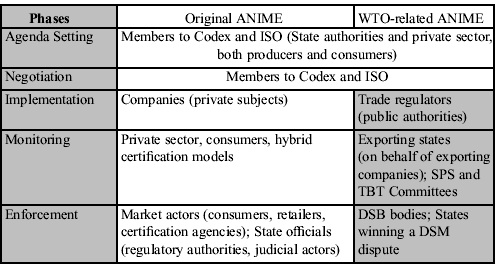
A. New ANIME
Since this new ANIME review is intended to account for the shift of purpose mentioned above, it is appropriate to examine in particular the phases from Implementation to Enforcement. Indeed, it is at the implementation phase that the purpose plays a material function, and affects the further course of the regulatory process. This does not mean that the WTO endorsement does not entail some changes in earlier phasesFootnote 138 (for instance, it is clear that States might have changed their approach when getting to choose among standard proposals,Footnote 139 and that they have a different and stronger incentive to participate and shape the outcome of the process)Footnote 140. However, these changes would mainly affect the content of the standards adopted, an aspect that is relatively unimportant for this study. Moreover, at the risk of lapsing into over-simplistic statements, we shall treat Codex and ISO standards jointly, in light of the ‘conceptual similarity’Footnote 141 of the WTO provisions that, respectively, regulate their function in the DSM.
a) Implementation
The shift in purposeFootnote 142 that we have described requires a re-thinking of the implementation phase. Trade-related and harmonization concerns are satisfied by national authorities and regulators better than by single firms; indeed, the monitoring and enforcement phases in the WTO do not generally target firms' deviation from standards, but rather State failure to ensure a fair market treatment to foreign producers complying with standards. Implementation can be intuitively identified referring to the subsequent phases; a given activity certainly ranks as ‘implementation’ when the failure to perform it properly is subject to monitoring and potentially founds a claim. Since States (and State authorities) are the only subjects covered by SPS and TBT provisions, this re-allocation of the Implementing phase to State officials seems appropriate.
b) Monitoring
Monitoring of member countries' compliance seems to depend largely on the possibility of setting up trade disputes.Footnote 143 Therefore, actors monitoring compliance with standards are export firms and exporting States, that is to say trade-affected parties. The SPS Committee has adopted a monitoring procedure on compliance with international standards, as required by article 12 SPS. However, it is pretty evident that the real object of the monitoring activity is the potential occurrence of trade effects connected with the standards.Footnote 144
c) Enforcement
Enforcement is provided by the Dispute Settlement Mechanism of the WTO, triggered following the failure of amicable negotiations and the submission of a claim by a State. In case of violation, the panel or the AB orders the losing State to bring the challenged measures into compliance; in our case, this means that the State must amend the regulatory measure challenged, either to make it consistent with the ISO or Codex standards, or in a way that allows the State to meet the further conditions of article 3(3) SPS or 2(5) TBT. In cases of continuous non-compliance, and subject to further judicial authorization and instructions,Footnote 145the winning State can proceed to private enforcement, that is, it can suspend trade concessions agreed under the WTO Agreements vis-à-vis the counterparty. This typically results in the raising of tariffs against goods imported from the losing party, and States can be authorized to apply it to market segments different from that in which the defendant adopted (and keeps in force) the discriminatory regulation.
B. The Due Diligence Defence, and the Identification of Beneficiaries
From the outset, the inclusion of standards in the WTO framework simply amounts to a codified due diligence defence. States basing their technical regulations on international standards will come before the WTO quasi-judicial bodies with clean hands. This presumption of good faith provided by the TBT and SPS, however, has nothing to do with the due diligence devices that are typically related to voluntary standards in the context of court litigation.
By means of a simple comparison it may be demonstrated how the shift in purpose is also reflected in the actual ‘adjudicability’ of standards (their function in litigation); notwithstanding all the ‘hardening’ claims, ISO and Codex standards are voluntary, both as such and in the WTO system. Therefore, the way in which judges apply them to resolve a dispute is a very telling benchmark of their inner telos; when courts take them into account they do not do so under precise rules of liability, but they abstract from the standards a combination of elements (an evidence of good faith, a model of the duty of care that may be exacted, the objective of protecting public interest values) that may inform the application of general principles of liability.
In general, voluntary standards are not directly enforceable, that is, a violation does not automatically entail an actionable claim by the affected party. However, courts are likely to take into account voluntary standards and give them weight in two senses: compliance with standards can support a successful due diligence defence (especially if they are commonly agreed upon), and non-compliance with voluntary standards may support the determination of a breach of the duty of care.Footnote 146
For instance, in the product safety framework, compliance with voluntary standards frees producers from the burden of proving that their products are safe, whereas in case of non compliance they will have to discharge the relative burden of proof.Footnote 147 This is the typical design of the due diligence defence; it does not entail an automatic equivalence between non-compliance and liability (and vice versa), but displaces the burden of the proof away from the defendant who has adopted more public-interest concerned measures (more precisely, it does so by increasing the burden on the plaintiff, who is called on to provide the more difficult evidence of producer's negligence despite compliance with the standards).
In contrast, compliance with the standards in WTO disputes, as noted above, is mainly a defence against the claim of trade-restrictiveness. In other words, it is a litigation mechanism conceived to induce importing States not to select autonomously the least trade-restrictive technical measures, but rather to use standards as guidance, and enjoy the safe haven granted thereby. This incentive is clearly beneficial to exporters' interests, because it aims at preventing States from adopting de facto discriminatory trade measures.
This distinction gives rise to a particular phenomenon of unintended (even perverse) consequences; whereas the obvious beneficiaries of Codex and ISO standards are the consumers (who would benefit from enhanced quality and safety of the purchased goods)Footnote 148 the very same standards, when used in the WTO litigation setting, are used to protect exporting companies' interests.Footnote 149 To put it differently, even conceding that international standards reach the status of hard law in the WTO framework, they would do so solely in connection with the protection of free trade, and have no increased effectiveness as regards their original purpose (the protection of consumers).Footnote 150
In keeping with the remarks above, it is relevant to consider how the lack of a direct effect of WTO law influences the identification of the regulated subjects and of the beneficiaries in the Codex and the ISO regimes. As anticipated, this yields counterintuitive results; the incorporation into the WTO framework results in a shift of (third-party) benefits from the consumer to the manufacturers/producers (the exporting sector), and makes it harder to compare the regimes with other analogous consumer/workers/environment protection schemes. Consumers are arguably worse off, because WTO rules set a disincentive to adopt overly stringent standards;Footnote 151 however, private regulation can make good the deficiencies, using an enhanced quality standard as a mechanism to enhance market share. Besides a certain threshold, in other words, the segmentation of supply according to quality standards is becoming privatized; producers and providers use compliance with higher stringent standards (and the publicity thereof, eg through labelling) as leverage to meet consumers' preferences.
It is not clear whether, in the end, consumers are definitely worse off; private standards might very well serve the purpose. Nevertheless, some issues are likely to arise in the largely uncharted scenario of private standards; the costs of compliance with higher voluntary standards is often transferred onto customers/consumers, and could be high enough to discourage them from paying the additional cost, or the producers from imposing it in the first place. In other words, where neither public policy nor market feasibility seems to back the application of higher protection standards, they will simply be disregarded. In any event, it appears that (as reflected in the genuine concerns expressed by the States in the TBT and SPS Committee sessions) if any standards are actually used to raise the level of protection to the detriment of market flows, these are private standards, not international ones.
V. CONCLUSION
It is important to recall the central purpose of this article, by clarifying what is not argued here. First of all, this contribution does not claim that international standardization regimes are ineffective in providing better protection of the public goodFootnote 152 and regulatory harmonization, or that voluntary standards do not get incorporated in hard law instruments (for instance, in national binding standardsFootnote 153). Nor does it claim that the WTO system necessarily triggers a trend of downward harmonization,Footnote 154 though it is fair to note that the stricter requirements that the TBT and SPS impose on national regulators to justify higher protection measures has resulted in the WTO DSB striking down some SPS and TBT measures exceeding international standards, and that the requirement to promote an overall alignment of national regulations, especially in the SPS area, might down-level the field rather than the opposite.Footnote 155
This article's main purpose was to scrutinize the commonplace view of the hardening of standards through WTO endorsement, and show that the system of presumptions established in the TBT and SPS uses international standards more as a ceiling than as a floor benchmark of protection, as a codified and agreed yardstick for least trade-restrictive measures.Footnote 156 It follows that the nature of standards—so far as their limited role in the WTO regime is concerned—is distorted, as they are relevant in the international trade legal system as a fact, not as norms contributing to the improvement of food-safety or product-quality protection.
Whereas this conclusion is the result of an analysis that focused prevalently on the WTO side of this regime interaction, we have followed in parallel the evolution of the standardization regime. A static breakdown of the regulatory process of international standardization allowed us to isolate which phases and which actors are affected by WTO absorption, and most importantly to describe with reasonable approximation the purpose shift that standards go through by virtue of their use by DSM bodies. The only junction point between the standards as such and their WTO double is their function of minimum compromise; the stress is on their minimum protection in the standardization field,Footnote 157 while it is on their minimum distortion (least trade-restrictiveness) in the WTO area.Footnote 158 In combining the two, standards survive the migration between the regimes, because they correspond to the area of overlap between the two epistemic orders, they represent the greatest common factor between trade values and those interests that originally triggered their adoption. The existence of this common core, at least, demonstrates that even in the WTO regime trade and non-trade interests are not relatively prime to each other, as they share a substantive (albeit mimimal) content.


