Introduction
Emergency Medical Services (EMS) provide emergency medical care to critically ill patients in difficult physical environments with limited resources. Reference Mackenzie1 These systems play a critical role in health services, as they have been shown to improve the survival of critically ill patients. Reference Meizoso, Valle and Allen2,Reference Rea, Kudenchuk, Sayre, Doll and Eisenberg3 The use of EMS is widely implemented in Western health services: in 2021, more than 48 million activations were generated in the United States, with more than 19 million patients treated and transported. Reference Lerner, Browne and Studnek4
Protocols for early identification improved the management of time-dependent pathologies, allowing prompt responses to patients with little chance of survival (polytrauma, heart attacks, strokes, and sepsis). Reference Martín-Rodríguez, Sanz-García and Medina-Lozano5 But it is also important to identify individual characteristics of patients at risk of deterioration, for example, older patients with a higher burden of comorbidities and from nursing homes. Reference Martín-Rodríguez, Sanz-García and Medina-Lozano5,Reference Elbaz-Greener, Carasso and Maor6 It has also been shown that the values of blood pressure, temperature, oxygen needs, and respiratory and heart rate ratios that these patients present at the time of first EMS care predict risk of adverse events in the following 28 days. Reference Mitsunaga, Hasegawa and Uzura7 Even alterations in biochemical parameters measured at the point-of-care testing (POCT) based on blood gas and cardiac biomarkers show promising results in helping to identify such patients. Reference Claret, Bobbia, Roger, Sebbane and de La Coussaye8,Reference Ter Avest, Griggs, Wijesuriya, Russell and Lyon9
All these studies were aimed at looking for the risk of early deterioration but have not proved to be useful in identifying the risk of patients with late deterioration. The critical patient treated in EMS has an added burden of excess mortality that is maintained over the years. This risk of late mortality appears to be associated with age, previous comorbidities, and type of critical illness. For example, patients transported for losing consciousness, cardiac arrest, dyspnea, or neurological symptoms are at a higher risk of mortality in the following years. Reference Bøtker, Terkelsen and Sørensen10–Reference Atramont, Lindecker-Cournil and Rudant12 Moreover, probably due to differences in EMS across countries, this type of long-term mortality has not been studied further.
Studying how bed-side physiological, biochemical POCT, demographic, and reasons for transfer variables affect survival at one year in patients attended by EMS may improve patient care, allowing to plan different health care strategies. In this way, patients with the highest risk of mortality over the year following the EMS intervention would not be overlooked, opening an opportunity to improve care and follow-up in the health care system.
This study, therefore, aims to analyze mortality in the first year in patients who required transfer by EMS and to determine the associated factors in terms of demographic, physiological, or analytical variables.
Methods
Design and Setting Study
This was a multicenter, prospective, observational, controlled, ambulance-based study of patients transferred by ambulance to emergency departments (EDs) from October 2019 through July 2021 for any cause.
The study was hosted by six Advanced Life Support (ALS) and 38 Basic Life Support (BLS) unit stations, and five hospitals —four tertiary university hospitals and one small general district hospital— of four Spanish provinces (Burgos, Salamanca, Segovia, and Valladolid) with a reference population of 1,364,952 inhabitants. The BLS team consists of two emergency medical technicians (EMTs), and the ALS team includes two EMTs, one emergency registered nurse (ERN), and one physician. Their response is based on clinical practice guidelines according to pre-established protocols. The patients requested medical attention by dialing the emergency telephone number 1-1-2— answered first by an operator who collects location and affiliation data— and were assessed by a coordinating doctor who asked them key questions and selected the most appropriate care resource. The present work fulfills the Strengthening the Reporting of Observational Studies in Epidemiology (STROBE) Statement (Supplementary Data; available online only).
Participants
All patients transported by BLS or ALS to the ED of their referral hospital, who required a venous line due to their clinical situation, were included. Without exception, every patient was evaluated primarily by ALS; following the physician’s evaluation, it was decided if evacuation to the ED was necessary and the type of ambulance. Patients under 18 years of age, pregnant women, terminally ill patients (documented with a specialist doctor’s report), patients with cardiorespiratory arrest, patients who were discharged on site after the ALS physician evaluation or those who were evacuated by other means, and all cases in which it was not possible to obtain informed consent from the patients were excluded.
Outcome
The primary outcome was the one-year mortality rate (all-cause mortality).
Collection of the Parameters and Data Abstraction
The respiratory rate was calculated by listening to the respiratory cycles for 30 seconds, and for one minute in case of doubt or irregular rhythm. Oxygen saturation, systolic, diastolic, and mean blood pressure, as well as heart rate were measured with the LifePAK 15 monitor-defibrillator (Physio-Control, Inc.; Redmond, Washington USA). The temperature was measured with the ThermoScan PRO 6000 thermometer (Welch Allyn, Inc.; Skaneateles Falls, New York USA). The EMS providers calculated Glasgow Coma Scale (GCS). After that, an intravenous line was placed and 1.5ml of venous blood was taken using the Epoc Blood Analysis System (Siemens Healthcare GmbH; Erlangen, Germany), obtaining: hematocrit, hemoglobin, creatinine, lactate, glucose, carbon dioxide tension (pCO2), acidity (pH), calculate oxyhemoglobin saturation (cSO2), calculate serum bicarbonate (cHCO3), calculate percentage of hemoglobin saturated with oxygen (cSO2), total CO2 concentration (TCO2), serum sodium concentration (Na+), serum potassium concentration (K+), serum calcium concentration (Ca++), serum chlorine concentration (Cl-), base excess in blood, extracellular base excess, blood urea nitrogen (BUN), and serum urea concentration. Patients’ ventilatory needs or external electrical cardioversion or defibrillation treatments during transfer were recorded. After the follow-up period, the following hospital variables were recorded: Charlson comorbidity index, resident of a nursing home, hospital/intensive care unit (ICU) in-patient, two-day mortality, three- to 30-day mortality, 31-day to 365-day mortality, and one-year mortality (including all-cause mortality). The EMS medical records that were unable to be linked were excluded (details on the exact patients’ matching is available in the Supplementary Data).
Data Analysis
Percentages were used to represent categorical variables, and the mean and standard deviation (SD) were used for continuous variables. The univariate comparison between each independent variable and the outcome was assessed by Log-Rank. Survival was obtained using the Kaplan-Meier method (KM) according to different variables selected based on their association to mortality in previous works.
To construct the predictive model, a sequential procedure was performed. First, using the results derived from the Log-Rank test, those variables that presented statistically significant differences (P <.001) were selected —this value was selected to avoid Type I error, due to the considerable number of variables and therefore comparisons. Second, a predictive model was fitted by using Cox regression (multivariate analysis).
Data were analyzed using codes and basic functions in R, version 4.0.3 (R Foundation for Statistical Computing; Vienna, Austria).
Information regarding data collection, missing values, and sample size can be found in the Supplementary Data.
Ethics Approval and Consent to Participate
The study was approved by each clinical hospital ethics committee with reference Ref.: 22-PI149, and adopted the Code of Good Scientific Practice Human Resources Strategy for Researchers HR STRATEGY (HRS4R), the Declaration of Helsinki, and the current legal framework (without prejudice to international standards and treaties). All participants in the study could read and sign the informed consent.
The ERN oversaw obtaining the consent. If the patient presented an adequate level of consciousness, they signed the consent valid for the entire duration of the study. If the patient could not sign the consent, a relative or legal guardian signed the document. In cases where it was impossible to obtain written consent at the scene, permission was obtained by the hospital research coordinator, either through the patient or through a family member or legal guardian of the patient. Where it was not possible to obtain informed consent, the patient was excluded from the study.
Results
The clinical-epidemiological characteristics of the patients and the differences between survivors and one-year non-survivors are shown in Table 1; there were statistically significant differences for all the variables except for sex and systolic blood pressure. The total cohort included 1,406 patients (Figure 1). The median age was 70 years (interquartile ratio [IQR], 52-81 years); a total of 587 (51.4%) were females, and 13% were nursing home residents. The one-year mortality rate (any cause) was 21.6% (n = 304). Mortality within the first two days reached 5.2% of all the patients; between Day 2 and Day 30, reached 5.3%; and between Day 31 and Day 365, reached 11.1%. The most frequent diagnoses were circulatory disease (38.6%) and neurological disease (18.2%) with an overall mortality rate of 31.2% and 18.1%, respectively. However, long-term mortality was higher among the respiratory, infectious, and endocrine problem groups, with death in 45.6%, 42.6%, and 53.4% of the cases, whereas the lowest mortality was regarding trauma and poison diseases (14.9% and 10.3%, respectively). The characteristics of non-survivors were the following: they were of higher median age, had a higher score of age-Charlson comorbidity index (aCCI), and 17.1% of them lived in a nursing home. Their prehospital physiological ratios showed higher temperature, higher respiratory and heart rate, and lower arterial tension, oxygen saturation, and points of GCS. Their analytical parameters were compatible with states of metabolic acidosis, with worsened kidney function, and their hemoglobin rate was lower.
Patient Characteristics at Baseline (Prehospital Evaluation) According to One-Year Mortality

Abbreviations: NA, not applicable; RR, respiratory rate; SpO2, oxygen saturation; FiO2, fraction of inspired oxygen; SAFI, SpO2/FiO2; SBP, systolic blood pressure; DBP, diastolic blood pressure; MBP, mean blood pressure; HR, heart rate; GCS, Glasgow Coma Scale; aCCI, age - Charlson comorbidity index; ICU, intensive care unit; pCO2, carbon dioxide tension; pH, acidity; cSO2, calculate oxyhemoglobin saturation; cHCO3, calculate serum bicarbonate; TCO2, total CO2 concentration; Na+, serum sodium concentration; K+, serum potassium concentration; Ca++, serum calcium concentration; Cl, serum chlorine concentration; Base (B), base excess in blood; Base (ecf), extracellular base excess; BUN, blood urea nitrogen; Urea, serum urea concentration; A Gap K+, anion gap with K+; A Gap U, anion gap with urea; INR, International Normalized Ratio; PVC, packed cell volume.
a Values expressed as total number (fraction) and medians [25 percentile;75 percentile] or mean (standard deviation), as appropriate. Percentages of categorial variables are row percentages (ie, they represent the distribution of each particular variable in the non-survivors’ and survivors’ groups).
b Hazard ratio derived from the log-rank comparison of non-survivors vs survivors.
c P value derived from the log-rank comparison of non-survivors vs survivors.
Flowchart of the Participants in the Study.

Prehospital care and the need for admission to the hospital ward or ICU are listed in Table 2. A total of 58.9% of patients were admitted to the hospital and 11.1% to the ICU. Ventilatory needs, external electrical treatments, and hospital and ICU admissions were significantly higher among non-survivors than in the group of survivors.
Primary Analysis and Other Determinants and Outcomes According to One-Year Mortality

Abbreviations: FiO2, fraction of inspired oxygen; NIV, non-invasive mechanical ventilation; IMV, invasive mechanical ventilation; ICU, intensive care unit.
a Hazard ratio derived from the log-rank comparison of non-survivors vs survivors.
b P value derived from the log-rank comparison of non-survivors vs survivors.
The multivariate model (Table 3) showed statistically significant factors associated with mortality (the whole list of results for all factors included can be found in the Supplementary Data). Low GCS values, elevated lactate levels, elevated BUN, and circulatory diseases (all P <.001) were risk factors, as well as low oxygen saturation, previous neurological disease (P <.01), high respiratory rate, and advanced age (P <.05).
Cox Regression for One-Year Mortality

Abbreviations: RR, respiratory rate; SpO2, oxygen saturation; DBP, diastolic blood pressure; GCS, Glasgow Coma Scale; BUN, blood urea nitrogen.
a Hazard ratio derived from the Cox Regression for survival at one year.
b P value derived from the Cox Regression for survival at one year.
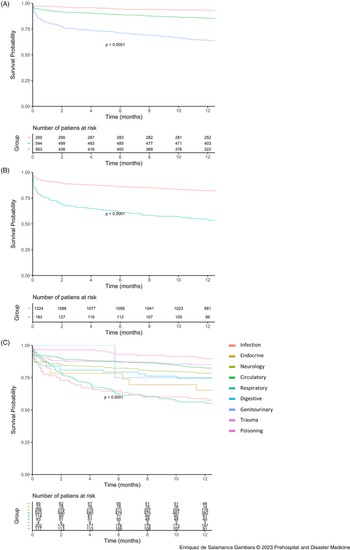
In order to determine the differences between critical factors for mortality, a KM was used; Figure 2A showed that older patients (>75) presented a higher mortality throughout the following period. Similarly, the patients in nursing homes (Figure 2B) presented a higher mortality. However, this was not statistically significant. Finally, when assessing mortality according to pathology (Figure 2C), those patients with sepsis or heart arrest presented the highest mortality.
Kaplan-Meier Survival Curve According to: (A) Age; (B) Nursing Home; and (C) Pathology.
Note: For Figure 2A, the red line corresponds to patients <49 years, the green line 50-74 years, and the blue line to >75 years. For Figure 2B, the red lines are for patients not in nursing homes, and the blue line for those in nursing homes.

Discussion
This is the first prospective study on a cohort of patients referred by ambulance that analyses long-term mortality using prehospital epidemiological, physiological, and analytical variables. The present results suggest that the risk of late deterioration depended not only on expected variables such as age or the type of disease, but also the initial physiological symptoms and the prehospital analytical parameters were related with long-term mortality.
The overall mortality at one year was higher as compared to other works that have also aimed to assess this outcome. Reference Elbaz-Greener, Carasso and Maor6,Reference Bøtker, Terkelsen and Sørensen10 This direct comparison is always risky since the severity of the patients of each study is different. For instance, the mortality described in a Danish study is around 11%, lower than this study’s results. This could be explained because they included all calls to EMS regardless of the priority of care required for each patient and whether the patient was transported to a hospital. Reference Bøtker, Terkelsen and Sørensen10 The present study only included patients previously assessed by an ALS-physician and who required transport to hospital in ambulances with high-priority and were likely to be more severe patients. However, if the one-year mortality rate of the current study is compared with a study carried out in Finland in patients that required helicopter transport, the mortality rate reported here was lower. Reference Björkman, Laukkanen-Nevala, Olkinuora, Pulkkinen and Nurmi11 A possible reason for that is the fact that the use of helicopter transport is more expensive and is reserved only for the most severely ill patients. Furthermore, out-of-hospital cardiac arrests (OHCAs) were not included in the present study; OHCAs account for 87% mortality in the first 30 days, with the mortality rate increasing over time and depending on the age and comorbidity of the patients. Reference Hirlekar, Jonsson, Karlsson, Hollenberg, Albertsson and Herlitz13,Reference Amacher, Bohren and Blatter14
It is important to highlight that the rate of mortality was 11% from Day 31 to Day 365, which is different from other studies in which the highest rate of excess mortality occurred in the first few days. Reference Elbaz-Greener, Carasso and Maor6,Reference Bøtker, Terkelsen and Sørensen10,Reference Björkman, Laukkanen-Nevala, Olkinuora, Pulkkinen and Nurmi11 This may be due to the fact that within the group of patients who died between Day 31 and Day 365, there could be older patients with a high premorbid burden. These factors appear to be determinant in the current study and others alike. Reference Gayat, Cariou and Deye15 Therefore, it is suggested that despite resolving the acute pathology, they probably had a worse independent pre-test prognosis. Reference Gayat, Cariou and Deye15,Reference Atramont, Lindecker-Cournil and Rudant16 To find out more, a time-subgroup analysis of survival was performed and analyzed the differences according to age groups, comorbidities, and place of residence —this is nursing homes. All of them showed significant differences between groups. Particularly interesting is the nursing home case, since it was statistically significant in the KM but not in the multivariate analysis, probably due to an initial increase in mortality that was not observed throughout the follow-up time.
Although the diagnostic groups most frequently seen in the EMS in the present study were affected by neurological and circulatory problems, those with the highest excess mortality after one year according to KM were the respiratory, infectious, and endocrinological pathology groups. In a study carried out to determine prehospital clinical prognostic factors in Israel, at the time of EMS care, dyspnea was strongly correlated with short- and long-term mortality. Reference Elbaz-Greener, Carasso and Maor6 This could be explained by the fact that the patients who most frequently present with dyspnea are patients with heart disease or chronic lung disease whose long-term survival is also conditioned. Reference Pesola and Ahsan17 These findings are consistent with the present study, in which patients with higher respiratory rate ratios seem to have a worse prognosis. In addition, many of the respiratory decompensations may be due to an underlying infectious problem. This seems logical, as infectious problems are also diseases with the highest mortality rate in the study, and in their most severe forms can develop into septic processes, which have very high short- and long-term mortality rates. Reference Vincent, Jones, David, Olariu and Cadwell18 It should also be noted that the small group of patients transported for endocrinological problems had higher mortality rates compared to the other diseases. This may be explained by the fact that peak glucose concentrations during critical illness are associated with higher mortality in ICU patients, but there are no studies that analyze this association in the long term. Reference Olariu, Pooley, Danel, Miret and Preiser19,Reference Plummer, Bellomo and Cousins20 Therefore, to suspect a respiratory, infectious, or endocrine disease could be seen as a warning tag in the EMS.
On the other hand, the association between long-term outcome and physiological variables has already been demonstrated by in-hospital emergency series and are frequently used for triage of such patients, Reference Nickel, Kellett and Nieves Ortega21,Reference Ustaalioğlu, Ak, Öztürk, Koçak and Onur22 but this is the first study to demonstrate their association to prehospital ones. Systolic blood pressure has already been studied in isolation for long-term mortality in prehospital settings, but not in conjunction with the other physiological variables. Reference Elbaz-Greener, Carasso and Maor6 Physiological variables are easily measurable by physicians and paramedics when assessing the patient on site (eg, a study of 1,075 patients in an ICU in the Netherlands has already demonstrated similar prognostic abilities compared with the SAPS-II and APACHE-IV, and out-performed the Sequential Organ Failure Assessment [SOFA] score). Reference Hiemstra, Eck and Wiersema23 Scores based on physiological variables such as National Early Warning Score (NEWS) have been shown to have good predictive ability for short- and medium-term mortality in hospital emergency settings. Reference Ustaalioğlu, Ak, Öztürk, Koçak and Onur22–Reference Loisa, Kallonen, Hoppu and Tirkkonen24
According to the results reported here, lactate was a critical factor for long-term mortality. In ICU settings, metabolic acidosis is the most common cause of acidosis and seems to be correlated with short- and long-term mortality. Sepsis, cardiogenic shock, and metabolic ketoacidosis are some examples of causes of metabolic acidosis. Reference Jentzer, Schrage and Patel25,Reference Azevedo, Choi, Simmonds, Davidow and Bagshaw26 Severe acidemia can lead to cardiovascular collapse because of hydrogen ion binding to cellular proteins, impairing their functions, and it may be associated with mortality. Reference Martín-Rodríguez, López-Izquierdo and Medina-Lozano27 Moreover, the findings on the strong correlation of elevated lactate levels and long-term mortality are consistent with other studies. Serum lactate level rises with both accelerated glycolysis and tissue hypoxia and is known to be a predictor of mortality in sepsis, polytrauma, OHCA, and neurological problems. Reference Ter Avest, Griggs, Wijesuriya, Russell and Lyon28
The POCT allowed the evaluation of patient’s renal function and hemoglobin. It has been demonstrated that low hemoglobin levels or acute renal function deterioration are associated with a higher risk of all-cause mortality, Reference James, Bhatt, Pannu and Tonelli29 which could explain their relationship with long-term mortality in the present case. In this sense, the combination of physiological variables and biomarkers to stratify risk in critically ill patients has resulted in the development of risk scores, such as the NEWS-L, which has shown satisfactory results in prehospital and hospital triage for predicting short- and medium-term mortality. Reference Jo, Yoon, Lee, Jin, Jeong and Park30
Limitations
The study is not without limitations. This study aimed to relate variables obtained at first patient contact with long-term outcomes, which means that the analyses obtained are associations and not necessarily causal events. In addition, part of the data collection was carried out during the SARS-CoV-2/COVID-19 pandemic, and this may have changed the profile of the patient transported by the EMS due to the saturation of the health care systems during the health crisis. The present study excluded patients with OHCA due to the difficulty of data collection in this type of pathology. The sample was taken from among those patients transferred by the EMS, not assessing cases of patients coming to hospital by their own means. The present study does not describe short- and long-term quality of life after prehospital critical care.
Conclusion
Predictors of long-term all-cause mortality risk in a large cohort of patients during transport by EMS have been found. Long-term mortality rates are significant and cannot be overlooked in adjusting the care provided by health services. Not only expected variables are related to the risk of late deterioration, but also analytical variables proved risk factors. Taking all these parameters into consideration in the prehospital scenario could improve patient care and optimize the resource management by following-up those patients at risk of long-term worsening.
Conflicts of interest/funding
All signing authors meet the requirements of authorship and have declared the non-existence of potential conflicts of interest. Rodrigo Enriquez de Salamanca Gambara, Ancor Sanz-García, José L. Martín-Conty, Begoña Polonio-López, Carlos del Pozo Vegas, Francisco Martín-Rodríguez, and Raúl López-Izquierdo report no conflicts of interest. The authors have no disclosures to make. This work was supported by the Gerencia Regional de Salud, Public Health System of Castilla y León (Spain) [grant number GRS 1903/A/19 and GRS 2131/A/20], CIBER de Enfermedades Respiratorias, CB22/06/00035, Instituto de Salud Carlos III, Madrid, Spain.
Author Contributions
Rodrigo Enriquez de Salamanca Gambara and Francisco Martín-Rodríguez conceptualized the project, managed, and coordinated the project, assisted with design of methodology, analyzed data, and prepared the initial and final drafts of the manuscript. Ancor Sanz-García takes responsibility for the data and analysis. José L. Martín-Conty, Begoña Polonio-López, and Carlos del Pozo Vegas assisted with management and coordination of the project, assisted with design of methodology, and helped review the manuscript. Raúl López-Izquierdo conceptualized the project and helped review and commented on the initial and final drafts of the manuscript. All authors performed a critical review and approval of the final manuscript for interpretation of the data and important intellectual input.
Supplementary Material
To view supplementary material for this article, please visit https://doi.org/10.1017/S1049023X23005800