As the demographic profile of North American society shifts, with life expectancy increasing and the number of older adults doubling by 2036 (Statistics Canada, 2010), an increasing number of older Canadians are expected to engage in end-of-life planning. Planning for care at the end of life can be an arduous process, both for the older adult and for the family. Advance care planning has been suggested to mitigate some of the difficulties experienced when trying to make decisions about care, particularly in situations where a person is unable to make decisions for him/herself (Teno, Nelson, & Lynn, Reference Teno, Nelson and Lynn1994).
Advance care planning allows an individual to exercise his/her right to self-determination in deciding care at the end of life (Teno et al., Reference Teno, Nelson and Lynn1994). If one becomes unable to make decisions, having end-of-life preferences clearly laid out (i.e., decided while a person is still competent) can help maintain some degree of an individual’s autonomy while vulnerable. Advance care planning is often considered a multi-component process, rather than a single event occurring at one point in time. Bomba (Reference Bomba2005) identified five components of this process: (1) becoming educated about ACP; (2) exploring and documenting one’s beliefs, values, and goals; (3) understanding how to choose the best surrogate decision-maker; (4) gaining an understanding about life-sustaining treatments; and (5) understanding practical issues related to advance care documents. In this study, we used the term advance care plan (ACP) to delineate two aspects of the advance care planning process: (1) discussing end-of-life preferences with others and/or choosing a substitute decision-maker to make decisions, and (2) creating legal documents for end-of-life care. Among the most common legal documents are advance directives, which outline a person’s health care and end-of-life preferences.
Several studies have examined the factors that influence whether an individual will engage in ACPs. Among cognitively intact older adults, the most consistent predictors of ACPs include being female, being of an older age, and having more years of education (Alano et al., Reference Alano, Pekmezaris, Tai, Hussain, Jeune and Louis2010; Garrett, Tuokko, Stajduhar, Lindsay, & Buehler, Reference Garrett, Tuokko, Stajduhar, Lindsay and Buehler2008). Additional factors that influence a person’s likelihood of engaging in ACPs include receiving education about ACPs, being asked to complete an advance directive by a medical professional, and personal factors such as wanting to feel a sense of control and wanting to help his/her family (Alano et al., Reference Alano, Pekmezaris, Tai, Hussain, Jeune and Louis2010; Levi, Dellasega, Whitehead, & Green, Reference Levi, Dellasega, Whitehead and Green2010).
Engaging in the ACP process may be particularly important in improving the quality of end-of-life care in persons with cognitive impairment, especially those with dementia (Alzheimer Europe, 2006). The nature of neurodegenerative disorders is such that the person will become progressively more cognitively impaired over time, and this will affect their capability to make decisions. Ideally, the process of ACPs begins before the person experiences a high degree of cognitive impairment (Hirschman, Kapo, & Karlawish, Reference Hirschman, Kapo and Karlawish2006), although recent evidence suggests that persons with mild to moderate dementia may be able to provide meaningful and consistent information regarding their values and preferences for medical treatment (Karel, Moye, Bank, & Azar, Reference Karel, Moye, Bank and Azar2007). Unfortunately, these desires may not be carried out, especially if there is no legal document in place. This lack may contribute to findings that many cognitively impaired older adults die in medical facilities despite a desire to die at home (McCarthy, Addington-Hall, & Altmann, Reference McCarthy, Addington-Hall and Altmann1997).
While practical reasons surely contribute to relocation (i.e., safety, falls), inadequate or nonexistent ACPs regarding residence preferences may also play a role. To our knowledge, only one study has examined the relationship between ACPs and location of death among cognitively impaired older adults: a survey of nursing homes in Flanders, Belgium (Vandervoort et al., Reference Vandervoort, van den Block, van der Steen, Stichele, Bilsen and Deliens2012). Among nursing home residents in the Vandervoort et al. study, those with documented general practitioner’s orders (instructions regarding specific end-of-life treatments) were much less likely to be transferred to, and die in, hospital (OR = 0.38). The authors suggested that such orders, often including “do-not-hospitalize” instructions, may decrease the number of hospital-based deaths among those who wish to die in place (e.g., in the nursing home).
The burden of making decisions for an adult with cognitive impairment can leave caregivers highly distressed (Givens, Lopez, Mazor, & Mitchell, Reference Givens, Lopez, Mazor and Mitchell2012), especially if the person’s wishes have not been discussed (Dening, Jones, & Sampson, Reference Dening, Jones and Sampson2011). It has been suggested that end-of-life preferences for persons with dementia may differ from those of medically compromised or cognitively intact persons, with an emphasis on symptom relief and anticipation of death (Haydar, Lowe, Kahveci, Weatherford, & Finucane, Reference Haydar, Lowe, Kahveci, Weatherford and Finucane2004). There appears to be little agreement between spouses’ predictions of psychogeriatric patients’ end-of-life-preferences and the patients’ actual desires (Ayalon, Bachner, Dwolatzky, & Heinik, Reference Ayalon, Bachner, Dwolatzky and Heinik2012; Shalowitz, Garrett-Mayer, & Wendler, Reference Shalowitz, Garrett-Mayer and Wendler2006). In fact, Stajduhar, Allan, Cohen, and Keyland (Reference Stajduhar, Allan, Cohen and Keyland2008) found that only half of seriously ill hospital patients and their caregivers agreed on the patients’ preferred location of death. It appears that this issue may not be adequately addressed within the family, potentially leading to later conflict and dissatisfaction with end-of-life care. This may be exacerbated by health care professionals’ concerns about implementing ACPs in this population due to uncertainty about their value, lack of information about legal aspects of ACPs, and difficulties implementing ACPs within the health care system (Robinson et al., Reference Robinson, Dickinson, Bamford, Clark, Hughes and Exley2012a; Rurup, Onwuteaka-Philipsen, Pasman, Ribbe, & van der Wal, Reference Rurup, Onwuteaka-Philipsen, Pasman, Ribbe and van der Wal2006).
Despite these challenges, some studies have suggested that persons with cognitive impairment may be more likely than cognitively intact older adults to create advance directives (McAuley & Travis, Reference McAuley and Travis2003). However, others have found that persons with moderate cognitive impairment were less likely to have a living will relative to cognitively intact participants (Dobalian, Reference Dobalian2006). Further, the content of advance directives for persons with advanced dementia may be quite non-specific and may not address issues important to this population, such as hospitalization or treatment of acute illness (Triplett et al., Reference Triplett, Black, Phillips, Fahrendorf, Schwartz and Angelino2008). Such discrepancies within the literature may be due, in part, to methodological differences (e.g., prospective versus retrospective studies); thus, further research is needed to determine the reasons for these differences across studies.
Dening et al. (Reference Dening, Jones and Sampson2011) examined catalysts for ACPs among persons with dementia, and their results suggest that Caucasian and highly educated persons were more likely to engage in this process, similar to results found in the general population. However, unlike cognitively intact older adults, younger participants were more likely to engage in ACPs upon diagnosis of mild cognitive impairment or dementia, possibly in response to facing their own mortality (Garand, Dew, Lingler, & DeKosky, Reference Garand, Dew, Lingler and DeKosky2011). Further research is needed to replicate this finding, and to understand the nature of this relationship.
A recent systematic review of four studies in which ACPs were implemented in nursing homes with cognitively impaired participants provides preliminary evidence for their effectiveness in reducing inappropriate hospital admissions and decreasing health care costs (Robinson et al., Reference Robinson, Dickinson, Rousseau, Beyer, Clark and Hughes2012b). Increased health care proxies’ satisfaction with end-of-life care appears to be associated with more time spent planning advance directives with a physician, even for as little as 15 minutes (Engel, Kiely, & Mitchell, Reference Engel, Kiely and Mitchell2006). However, there remains a dearth of research investigating the components of ACPs for cognitively impaired persons, particularly regarding the relationship with quality of life and whether the person’s wishes were respected.
Objectives
The purpose of the current study is to examine the relations between several demographic variables and ACPs. Demographic variables include age at time of death, sex, years of education, as well as cognitive status (cognitively impaired versus cognitively intact). The focus of the study is to determine whether cognitively impaired persons differ from cognitively intact participants in the following aspects of ACPs: (1a) making arrangements for surrogate decision-making prior to death; (1b) formalizing those arrangements in legal documents; (2a) discussing preferences about end-of-life care with someone; and (2b) formalizing those preference in legal documents. Further, we sought to determine whether differences based on aforementioned demographic variables as well as the presence of some form of ACP affected participant outcomes, including location of death and whether the respondent felt the decedent’s final wishes were respected.
Methods
Participants
Data for this study were collected in the Canadian Study of Health and Aging (CSHA), a multi-centre longitudinal study of cognitive function and health in older adults across Canada. Participants were tested three times, with five years between each wave. General procedures utilized in data collection and analysis in CSHA are described elsewhere (see McDowell, Xi, Lindsay, & Tuokko, Reference McDowell, Xi, Lindsay and Tuokko2004). A total of 10,263 participants aged 65 or older were recruited, evenly distributed among the five geographic regions in Canada (British Columbia, the Prairies, Ontario, Quebec, and the Atlantic provinces) in both urban and rural locations. The oldest adults were oversampled, with those aged 75–84 sampled twice as often as those aged 65–74, and a sampling ratio of 2.5 (relative to the youngest group) was used for those aged 85 and older. Data from the third wave of testing were utilized in this study, specifically for participants who had died between the second and third points of data collection (n = 1,654 participants). Information regarding the decedent’s cognitive functioning, health, and end-of-life experience was obtained through completion of the decedent questionnaire by an informant who had been close with the decedent. Only those cases in which a decedent questionnaire was completed were included in this study, yielding a sample of 1,454 participants.
The majority of the interviews (1,423, 98.9%) were conducted by telephone, with the remaining 31 interviews conducted in-person in the respondent’s home, the respondent’s workplace, or in a public location. Most of the interviews were conducted in English (1,208 or 82.9%) while 249 (17.1%) were conducted in French. The majority of respondents (n = 858) were sons or daughters (including in-laws) of the decedents. An additional 299 respondents were the spouse of the decedent, of which 255 were wives. The remaining 297 respondents were siblings, other family members, or institutional staff who had a close relationship with the deceased.
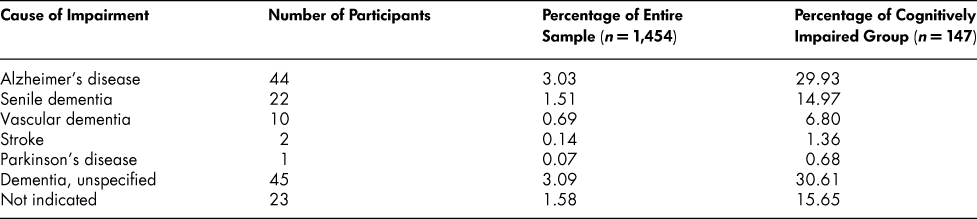
Cognitive status previous to time of death was determined based on responses to the question “Was [the deceased] ever diagnosed with memory problems: for example, Alzheimer’s disease, senile dementia?” Cognitive status was coded as either cognitively impaired (n = 147) or not impaired cognitively (NIC; n = 1,307). The proportion of cognitively impaired persons in the sample (10.1%) is similar to previous prevalence rates of cognitive impairment in CSHA (13.3%; Graham et al., Reference Graham, Rockwood, Beattie, Eastwood, Gauthier and Tuokko1997) and several international studies (c.f. Hilal et al., Reference Hilal, Ikram, Tan, Catindig, Dong and Lim2013; Gavrilla et al., Reference Gavrilla, Antunez, Tormo, Carles, Garcia Santos and Parrilla2009; DiCarlo et al., Reference DiCarlo, Baldereschi, Amaducci, Maggi, Grigoletto and Scarlato2000). Table 1 reports the causes of cognitive dysfunction for participants coded as impaired. Of note, participants with identified mild cognitive impairment or cognitive impairment no dementia (CIND) were likely included in the cognitively impaired group (in the category “Other”) as respondents may have considered this a diagnostic entity. Study coordinators verified the information provided regarding date, place, and cause of death with each Canadian region’s Provincial Registry of Vital Statistics. This was not possible for 380 participants due to difficulties acquiring records. Time since death was calculated as the number of months between the date of death and the date of the respondent interview, rounded to the nearest month.
Cause of cognitive dysfunction in participants coded as cognitively impaired

Measures
The questionnaire, created specifically for the CSHA, included items regarding the time, location, and cause of the decedent’s death, as well as questions regarding his/her cognitive abilities, behaviours, and functioning prior to death. Several questions addressed end-of-life planning and care. Six of these questions formed the dependent variables used in this study: (1a) “Had [the deceased] and the family made arrangements to have someone make health care decisions in case he/she was unable to do this for him/herself?”; (1b) “Had [the deceased] formalized [the arrangements] in a legal document (e.g., Power of Attorney for Health Care)”; (2a) “Had [the deceased] discussed his/her preferences regarding end-of-life car with anyone?”; (2b) “Had he/she formalized [his or her preferences] in a legal document (e.g., a living will)?”; (3) “Where did his/her death take place?”; and (4) “Do you feel that [the decedent’s] final wishes regarding treatment at the end of life were carried out?”
The four dependent variables regarding end-of-life planning (arrangements, discussions, and two questions about legal documents) were coded as either “yes” or “no”. The questions regarding creation of legal documents were asked only of respondents who indicated that they had made arrangements or discussed end-of-life preferences with others, as it is unlikely that legal documents would have been created without discussion with others. For research questions which addressed outcomes of ACPs, participants were coded as either engaging in some form of ACPs (i.e., answering yes to questions 1a, 1b, 2a, or 2b above) or as not engaging in any form of ACPs. The decedent’s location of death was classified into one of three categories: (1) medical institution (hospital, in-patient hospice, or palliative care unit), (2) nursing home or seniors’ home, and (3) private residence (decedent’s own home or another private home). The respondents rated their view on whether the decedent’s end-of life wishes were respected on a 5-item scale, from “not at all” to “completely”.
Statistical Procedures
All statistical analyses were completed using PASW Statistics for Windows, version 18 (SPSS Inc., Chicago, US, 2009). For all analyses, a p value < .05 was considered significant. Six separate logistic regression analyses were carried out to correspond to the research questions. For research questions 1a, 1b, 2a, and 2b, regression models with 2-level categorical outcome variables for the end-of-life planning questions were used. Independent variables included in each of these models were cognitive status, age, sex, and years of education. The demographic variables included were based on previous work indicating their strong predictive power in identifying those who will engage in ACPs (Alano et al., Reference Alano, Pekmezaris, Tai, Hussain, Jeune and Louis2010). For research question three, the regression model included a three-level categorical outcome for location of death. Private residence was chosen as the referent in these analyses given that dying in a medical facility or nursing/seniors’ home typically occurs after relocation from a private residence. The regression model for question four included a five-level categorical outcome for respondent perception of whether the decedent’s wishes were respected with respect to end-of-life care. Independent variables included in the models for research questions three and four were cognitive status, age, sex, years of education, and engagement in some form of ACP. Procedures used for the evaluation of the moderating effect of time since death were based on those proposed by Baron and Kenny (Reference Baron and Kenny1986).
Results
Participant Characteristics
The sample consisted of 1,445 participants (778 women, 667 men). Participant age at death was calculated as the number of years between date of birth and date of death, with a range from 71 to 106 years (M = 85.71, SD = 6.68). Overall, participants had an average of 10.16 years of education (SD = 3.86). The average time since death in the entire sample was 26.21 months (SD = 16.93). Demographic information for participants classified as cognitively impaired and those classified as NIC was examined to determine if group differences were present (see Table 2). The proportion of females and males in each group did not differ significantly (p = .200), and no group differences were observed for years of education (p = .758). One-way analysis of variance (ANOVA) revealed that the cognitively impaired group was significantly older than the NIC group at time of death, p = .009. Also, there was a significantly longer time between death and completion of the interview for NIC participants than for cognitively impaired participants, p = .001.
Summary of participant characteristics
NIC = not impaired cognitively
SD = standard deviation
* p < .05.
Time since Death as Moderator in Regression Analyses
The relations between time since death and the outcome variables (aspects of ACPs and outcomes of ACPs) were evaluated by entering time since death, age, sex, years of education, and cognitive status in the first block of the regression model. The second block consisted of the interactions between time since death and the four other factors entered in a stepwise procedure using an inclusion criteria of p = .05. These analyses revealed no significant main effect of time since death in any of the analyses, as well as no significant interaction effects. This indicates that time since death was not a moderator of the relationship between age, sex, years of education, and cognitive status and any of the dependent variables. The regression analyses were then run without the inclusion of this variable.
Questions 1a and 1b: Made Arrangements to have Someone Make Decisions and Formalized Arrangements in a Legal Document
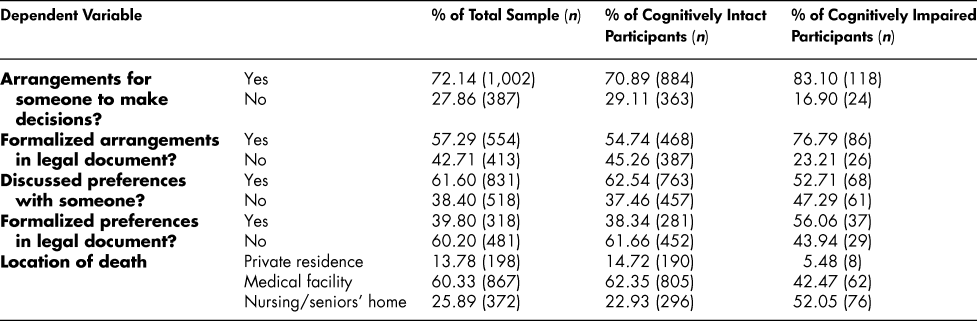
Within the overall sample, the majority of participants (72.1%) had made arrangements to have someone make health care decisions in case they were unable to do so (n = 1,002). Proportions of participants responding to each dependent measure are shown in Table 3. Within the subgroup of cognitively impaired participants, 83.1 per cent made arrangements for surrogate decision-making (n = 118) while only 70.9 per cent of cognitively intact participants had done so (n = 884). Among all participants who had made arrangements regarding end-of-life decisions, approximately half (57.3%) had formalized these arrangements in a legal document. Further, 76.8 per cent of cognitively impaired participants who made arrangements for a substitute decision-maker also formalized this in a legal document while only 54.7 per cent of NIC participants had done so.
Proportions of participants responding to each dependent measure
NIC = not impaired cognitively
SD = standard deviation
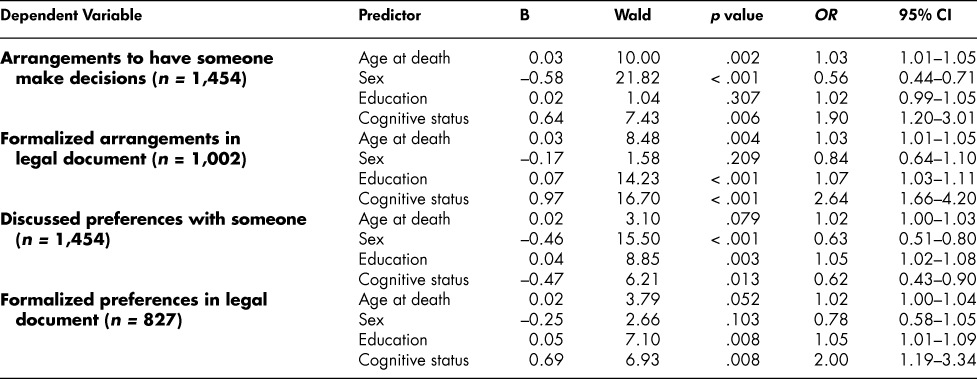
Table 4 summarizes logistic regression analyses for the end-of-life planning dependent variables. Higher age at death was significantly predictive of whether participants had made arrangements for a substitute decision-maker (OR = 1.03). Males were less likely than females to have made arrangements for a substitute decision-maker (OR = 0.56). Cognitively impaired participants were 1.90 times as likely to have made arrangements for a future substitute decision-maker as NIC participants.
Summary of logistic regression models for end-of-life planning
CI = confidence interval; OR = odds ratio; Reference category for sex = female; Reference category for cognitive status = NIC.
A second logistic regression analysis was run using the subsample of participants who had made arrangements for future health care decision-making to determine which variables predicted creation of legal documents following arrangements for end-of-life decision-making. The strongest predictor of having formalized arrangements for a substitute decision-maker into a legal document was cognitive status: cognitively impaired older adults were 2.64 times more likely to have created legal documents than NIC participants. Older age at death and higher education were also predictive of having formalized the arrangements in a legal document (OR = 1.03 and OR = 1.07, respectively).
Questions 2a and 2b: Discussed Preferences with Anyone and Formalized Preferences in a Legal Document
Among the full sample, 61.6 per cent of participants had discussed their preferences regarding end-of-life care with another person (see Table 3), with 52.7 per cent of cognitively impaired participants having had these discussions compared to 62.5 per cent of NIC participants. Among the participants who had discussed their preferences for end-of-life care with another person, 39.8 per cent had formalized these plans in a legal document, with 56.1 per cent of cognitively impaired participants and 38.3 per cent of NIC participants having had formalized their discussions in a legal document.
In the regression model (see Table 4), higher years of education was predictive of increased likelihood of having discussed preferences for end-of-life care (OR = 1.05). Males were less likely than females to have discussed their end-of-life preferences (OR = 0.63). Further, cognitively impaired participants were less likely than NIC participants to have had these discussions (OR = 0.62).
The second regression model indicated that cognitively impaired participants were twice as likely to formalize their preferences in a legal document as NIC participants. Higher years of education was predictive of increased likelihood of formalizing preferences in a legal document (OR = 1.05) whereas higher age approached significance as a predictor (OR = 1.02).
Question 3: Location of Death
In the overall sample, 867 (60.3%) participants died in a medical facility: 846 died in hospital and 21 died in palliative care. Many participants (n = 372, 25.9% of the entire sample) died in a seniors’ home or nursing home (37 in a seniors’ residence and 335 in a nursing home). An additional 198 participants (13.8% of the overall sample) died in a private residence, with 182 dying in their own home and 16 dying in a private home that was not their own. Just over half of cognitively impaired participants (52.1%) died in a nursing or seniors’ home, while 42.5 per cent died in a medical facility, and 5.5 per cent died in a private residence. Among NIC participants, the majority died in a medical facility (62.4%), with an additional 22.9 per cent dying in a nursing or seniors’ home, and 14.7 per cent dying in a private residence.
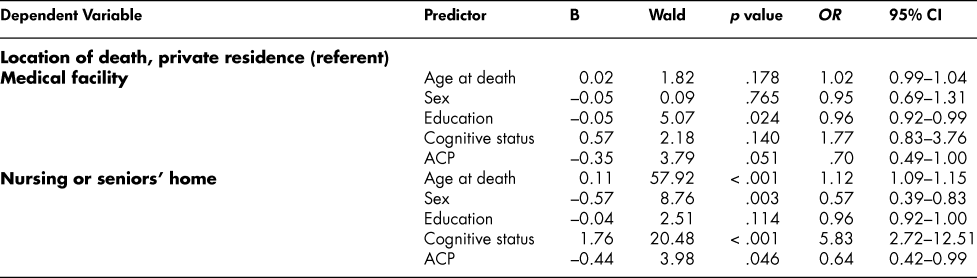
The results of the logistic regression analyses with the 3-level dependent variable of location of death are summarized in Table 5. Participants with higher education were less likely to die in a medical facility compared to a private residence (OR = 0.96). Males were less likely than females to die in a nursing or seniors’ home than in a private residence (OR = 0.57). Older age at death was significantly predictive of dying in a nursing or seniors’ home compared to dying in a private residence (OR = 1.12). Cognitively impaired older adults were 5.83 times more likely than NIC older adults to die in a nursing or seniors’ home than in a private residence. The association of engagement in some form of ACP and the likelihood of dying in a medical facility was not significant (p = .051), with a trend towards participants who did not engage in ACPs being less likely to die in medical facilities than in private residences. Furthermore, those who did not engage in ACPs were less likely to die in nursing homes than in private residences (OR = 0.46).
Summary of logistic regression model for location of death
CI = confidence interval; OR = odds ratio; Reference category for sex = female; Reference category for cognitive status = NIC; Reference category for ACP = no engagement in any ACP.
Question 4: Dying According to Wishes
The majority of respondents (69.3%) indicated that they believed the decedent’s wishes about end-of-life care were completely respected, with an additional 18.2 per cent indicating that they were quite well respected. Very few respondents indicated that the decedent’s wishes were respected very little (1.0%) or not at all (1.4%). Given the extreme skew in the dependent variable, and the small variability in this measure, results of the regression model were not valid and not interpretable.
Two zero-order correlations were run to evaluate the relationship between making arrangements for end-of-life care and discussing preferences for end-of-life care with respondent perception of respect for end-of-life desires. The relation between making arrangements for end-of-life care and respect for end-of-life wishes was not significant,χ 2 (4, n = 1,314) = 7.872, p = .096. In contrast, families in which discussion of end-of-life care occurred also had a higher rating for respect for end-of-life preferences, χ2 (4, n = 1,282) = 17.016, p = .002. However, the causality within this relationship could not be evaluated in the current study.
Discussion
The purpose of this study was to determine if cognitively impaired older adults differed from NIC older adults on issues relevant to ACPs. Overall, the majority of participants, both cognitively impaired and intact, had engaged in some form of ACP, either by making arrangements for a substitute decision-maker or by discussing their preferences for end-of-life care. Furthermore, a large majority of respondents indicated that they felt the decedent’s final wishes for end-of-life care were respected. Relative to cognitively intact participants, those with cognitive impairment were more likely to die in a nursing home or seniors’ home (relative to a private residence) and were more likely to have arranged for a substitute decision-maker but were less likely to have discussed their preferences for end-of-life care with others. Participants who did not engage in any form of ACP were less likely to die in medical facilities or nursing homes compared to private residences, although this association was not as strong as other findings in our study. Time since death did not moderate any of these relations.
The high proportion of participants who discussed their end-of-life preferences is similar to a previous study also using CSHA wave 3 data with living participants (Garrett et al., Reference Garrett, Tuokko, Stajduhar, Lindsay and Buehler2008). However, the proportion of individuals who made arrangements for a substitute decision-maker is somewhat lower in our study (72.1%) compared to 83.2 per cent in Garrett et al.’s study. This difference may reflect the assumed better health of participants in Garrett et al.’s study, given their survival during the five-year interval between data collection waves.
The proportions of cognitively impaired and intact participants who engaged in ACPs are also similar to previous studies in comparable populations (Lingler et al., Reference Lingler, Hirschman, Garand, Dew, Becker and Schulz2008; Triplett et al., Reference Triplett, Black, Phillips, Fahrendorf, Schwartz and Angelino2008). Persons with dementia may be more likely to create advance directives and have informal discussions regarding end-of-life preferences to provide guidance for their future surrogate decision-makers and to decrease the burden of decision-making (Black et al., Reference Black, Fogarty, Phillips, Finucane, Loreck and Baker2009). Black et al. further proposed that end-of-life planning may be initiated in response to a major health change, such as diagnosis of dementia. Participants in our study who received a diagnosis of cognitive impairment may have been more open to discussing end-of-life care during their interactions with the health care system.
Unexpectedly, cognitively impaired older adults were less likely than NIC participants to have discussed their preferences for end-of-life care with someone. We can hypothesize several possible reasons for this finding. First, while 83.1 per cent of cognitively impaired participants made arrangements for a substitute decision-maker, only 52.7 per cent had discussions with others about end-of-life preferences (these findings are not mutually exclusive). People may feel more comfortable and less stigmatized naming a substitute decision-maker than planning specific aspects of their desired end-of-life care. Naming a surrogate decision-maker may also be easier as it places more of the burden of decision-making on the surrogate. This finding may be akin to difficulties experienced in a U.K. exploratory randomized controlled study in which researchers implemented an ACP-related intervention with caregivers of advanced dementia patients (Sampson et al., Reference Sampson, Jones, Thune-Boyle, Kukkastenvehmas, King and Leurent2011). Only seven of 22 carers who received the intervention created ACPs, often due to conflicting family dynamics and unwillingness to take on the burden of decision-making. It is possible that these same factors influence the likelihood of the older adult engaging in ACPs themselves.
Interestingly, this finding is consistent with Garrett et al.’s (Reference Garrett, Tuokko, Stajduhar, Lindsay and Buehler2008) results among living participants in the CSHA, suggesting that this relationship may be sample-specific. For example, Garand, Dew, Lingler, and DeKosky (Reference Garand, Dew, Lingler and DeKosky2011) found that younger (below age 65) cognitively impaired participants were more likely to create end-of-life legal documents than older cognitively impaired participants. They suggested that younger persons may be more motivated to create legal documents following diagnosis as this would likely be the first time they have been confronted with their own mortality. This theory could be applied to other aspects of ACPs, including discussions with others. In the current study, all participants were over the age of 70, which may explain the lack of effect of age on likelihood of discussions. Following from this, the lack of association between cognitive status and having discussions may be related to the moderating effect of age.
In comparing these results with those of a large-scale multinational European study, considerable differences arose (Houttekier et al., Reference Houttekier, Cohen, Bilsen, Addington-Hall, Onwuteaka-Philipsen and Deliens2010). Among four (the Netherlands, England, Wales, and Scotland) of the five countries studied, very few older adults with dementia died at home (ranging from 3.2% in Wales to 5.0% in Scotland), similar to our results. However, a much higher proportion, 11.4 per cent, died at home in Belgium, which the authors speculate may be related to the small number of nursing home beds available in that country. Furthermore, in a study of location of death of demented older adults in Germany, Pinzon et al. (Reference Pinzon, Claus, Perrar, Zepf, Letzel and Weber2013) found that 42.4 per cent of this group died at home, which is much higher than findings in other studies. Overall, the proportion of older adults dying in a medical facility was comparable between the current study and Houttekier et al.’s study, except for the Netherlands, where only 2.8 per cent of older adults with dementia died in hospital. The proportion of older adults with dementia dying in palliative care is fairly similar, and uniformly low, among our study and the European countries examined. Although rates of death in nursing homes were similar in our study and those conducted in England, Wales, and Scotland, there was a much higher proportion in Belgium (65.9%) and an astounding 92.3 per cent in the Netherlands. This particularly high rate in the Netherlands may reflect the high number of nursing homes beds available and the sophistication of geriatric services provided in these settings.
It is of interest to note that participants with higher years of education were less likely to die in a medical facility relative to a private residence. It is possible that participants with higher years of education, and likely higher socioeconomic status (SES), may have had greater access to private health care services, such as home nursing care, enabling them to remain in private residences at end-of-life relative to those who were less able to afford these services. Further, if their family members were also highly educated and of higher SES, they may have been more able to help care for the dying person due to fewer financial restrictions.
The final outcome measure explored in our current study was respondents’ views on whether the deceased’s wishes for end-of-life care were respected. This is one of the least-explored aspects of ACPs in the literature, despite the suggestion that this is an area of great importance in evaluating quality of end-of-life care (Casarett, Teno, & Higginson, Reference Casarett, Teno and Higginson2006). Within the full sample, the large majority of respondents indicated that their wishes were highly respected as care received was in line with the person’s desires. However, the manner in which the question was asked (i.e., “Do you feel that the decedent’s final wishes regarding treatment at the end of life were carried out?”) may have led to a response bias (over-reporting positive aspects) due to social desirability. This may be particularly relevant in this study as the process of death can be very emotional and difficult to accept, and this may lead to a bias towards responding favorably to this question.
There was some evidence that discussing preferences for end-of-life care was associated with higher ratings of respect for final wishes. This is consistent with previous studies that indicated that increased time spent discussing advance directives is associated with greater health care proxy satisfaction with end-of-life care (Engel et al., Reference Engel, Kiely and Mitchell2006). Time spent discussing preferences for end-of-life care may be a marker for communication within a family and/or between a family and health care providers. Quality of communication may also play a role in the relationship in the current study, although further investigation is needed.
Overall, the results of our study contribute to and expand on the body of research in this burgeoning area, in part due to the strengths in the methodology. We made use of a large nation-wide data set in our study, in which rich information regarding participant cause of death was collected through respondent interview and death certificate review. We were then able to define a cognitively impaired group based on multiple sources of information. Of particular note, we included questions that addressed multiple aspects of ACPs and their outcomes, rather than simply inquiring about the creation of advance directives, as has been common practice in many studies. In doing so, we are able to evaluate group differences in several aspects of ACPs, which can elucidate differences that would otherwise be obfuscated when examining ACPs as a single entity.
As with any study, there are also limitations that must be noted. The primary weakness of this study is reliance on informant reports. Although commonly used when studying persons with cognitive impairments (cf. Engel et al., Reference Engel, Kiely and Mitchell2006; Hirschman, Kapo, & Karlawish, Reference Hirschman, Kapo and Karlawish2008), the responses may be prone to reporting bias. It is possible that respondents may have been unaware of some aspects of participants’ ACPs or may have under- or over-reported symptoms of cognitive impairment.
Future Directions
While many of the findings in our study are in accordance with previously published research, there remains a great diversity of results in the literature. It would be of benefit to replicate this study with another large data set, particularly to determine if the finding of decreased likelihood of discussing end-of-life preferences among cognitively impaired individuals is further substantiated. It would also be of interest to replicate this study using different criteria for identifying cognitively impaired participants as it is possible that the discrepancies in the literature are caused, in part, by methodological differences in determination of cognitive status and severity of cognitive impairment.
There may also be differences in likelihood of engaging in ACPs based on etiology of the cognitive impairment. It would be of interest to determine whether persons who experience slower, more insidious causes of impairment, such as Alzheimer’s disease, are more likely to engage in ACPs than those who experience cognitive impairment following an acute event (e.g., a stroke).
Further, the results of this study could be enriched by information gleaned in a qualitative study with surrogate decision-makers of deceased older adults. Future work could utilize the same outcome measures and gather rich, detailed qualitative information about each component of the ACPs and gain an understanding of the timeline of this process. Given the relationship between cognitive status and aspects of ACPs, it would be of great use to understand more deeply why a person may engage in certain aspects of ACPs and not engage in other aspects. These reasons may be different for cognitively impaired older adults compared to those who died without cognitive impairment. Further, such a study could delve more deeply into the issue of family satisfaction with ACPs and with end-of-life care, particularly determining the factors affecting whether people with dementia are, in fact, dying in their desired locations.
Conclusion
This study provides evidence of differences in ACPs among older adults with and without cognitive impairment. In particular, cognitively impaired older adults were more likely (compared to cognitively intact participants) to make arrangements for a substitute decision-maker, to create a legal document indicating their choice for this proxy, and to create a legal document outlining their preferences for end-of-life care. However, relative to NIC participants, those with cognitive impairment were less likely to discuss their preferences for end-of-life care with someone. These group differences suggest that the process of ACPs may be quite different for persons with diagnosed cognitive impairment as compared to those who are cognitively intact. Currently, there is a very small literature investigating ACPs in persons with cognitive impairment, and more work in this area is needed. With increased understanding of the nuances and intricacies of ACPs in this population, effective strategies to further enhance the quality of end-of-life care in this group can be devised.