Introduction
Sparganosis, an important foodborne parasitic zoonosis, is caused by the plerocercoid larvae of genus Spirometra. Humans become infected with spargana mainly by eating raw or inadequately cooked frog and snake meat, or by using raw frog and snake meat as poultice on open wounds (Li et al., Reference Li, Song, Li, Lin, Xie, Lin and Zhu2011). Human sparganosis has been reported in many countries, but most of the cases occur in eastern and south-eastern Asian countries (Kim et al., Reference Kim, Ahn, Sohn, Nawa and Kong2018). Infection with spargana can cause serious illnesses, including blindness, paralysis and even death (Liu et al., Reference Liu, Li, Wang, Zhao and Zhu2015).
Thus far, more than 1350 cases of human sparganosis have been reported in China, and most of them were documented in Guangdong and Hunan provinces (Lu et al., Reference Lu, Shi, Lu, Wu, Li, Rao and Yin2014). Before 2010, only approximately 40 cases have been reported in Hunan province. However, more than 100 cases have emerged since 2010 in Hunan province, which may be correlated with the local customs. In recent years, eating frog and snake meat has become increasingly popular as they are both delicious and nutritious. Furthermore, swallowing raw snake gall bladder was very common as some people believe they possess therapeutic effects for many diseases (Su & Li, Reference Su and Li2004). Such customs in this province may facilitate human infection with spargana (Wang et al., Reference Wang, Zhou, Gong, Deng, Zou, Wu, Liu and Hou2011; Tan et al., Reference Tan, Chen and Ding2015; Yang et al., Reference Yang, Wang, Gong, Li, Wei, Ge and Xiao2015). The second intermediate hosts of Spirometra spp. are mainly frogs and snakes, which play an important epidemiological role (Mo et al., Reference Mo, Li, Lei and Xie2013; Liu et al., Reference Liu, Li, Wang, Zhao and Zhu2015). In our previous work, we showed a high prevalence (20.2%) of spargana in wild frogs from Hunan province (Liu et al., Reference Liu, Zhao, Tan, Zeng, Wang, Yuan, Lin, Zhu and Liu2010). To evaluate the risks of human infected with sparganosis in Hunan province and to strengthen public safety awareness, we investigated the prevalence of spargana infection in wild snakes in Hunan province.
For all these reasons, the objective of the target work was to determine the risk of plerocercoid infection in snakes from Hunan province. Sequence analysis of a portion of the cytochrome c oxidase subunit 1 (cox1) gene was performed to identify the specific identity of collected plerocercoids. Based on cox1 sequences, phylogenetic relationships among Diphyllobothrium tapeworms were also reconstructed.
Materials and methods
Sample collection
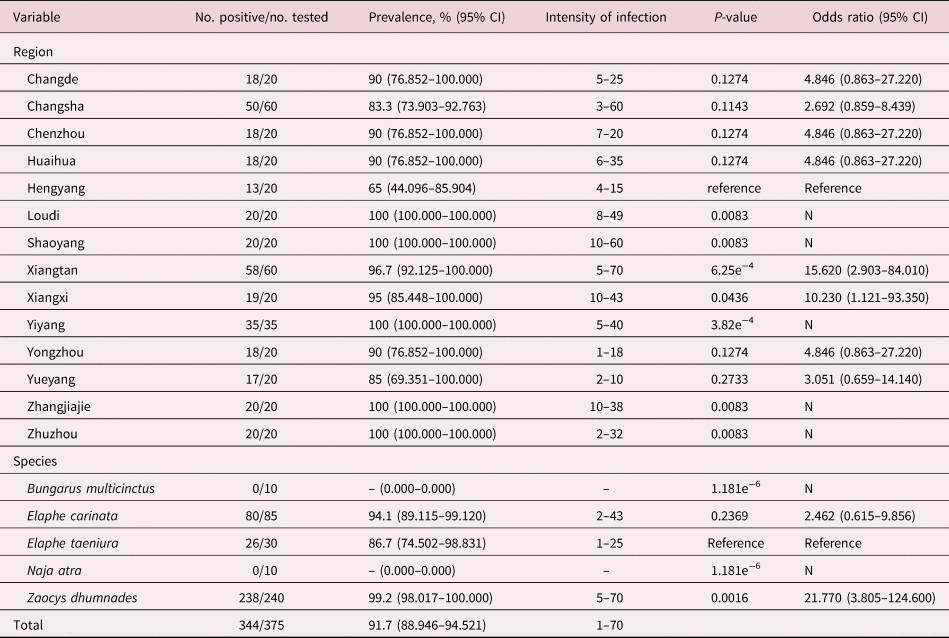
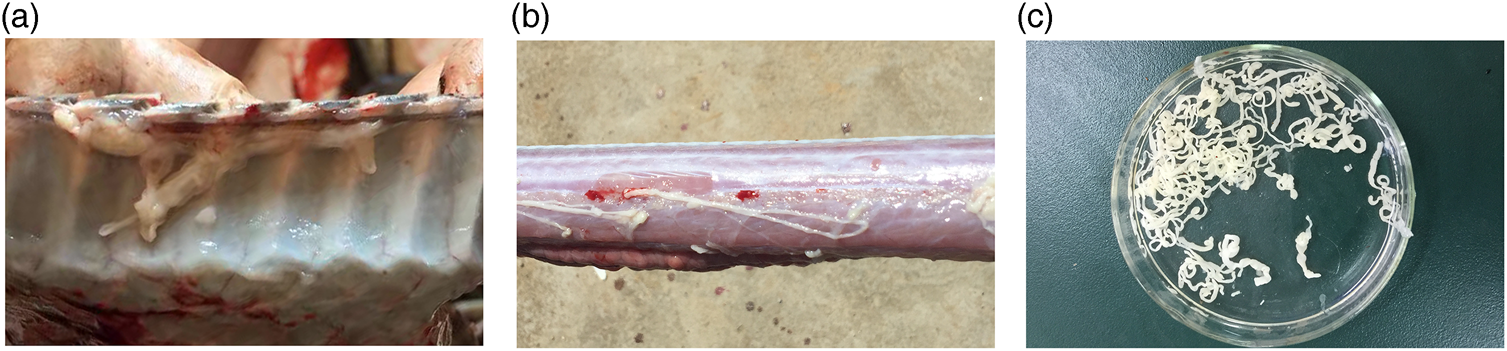
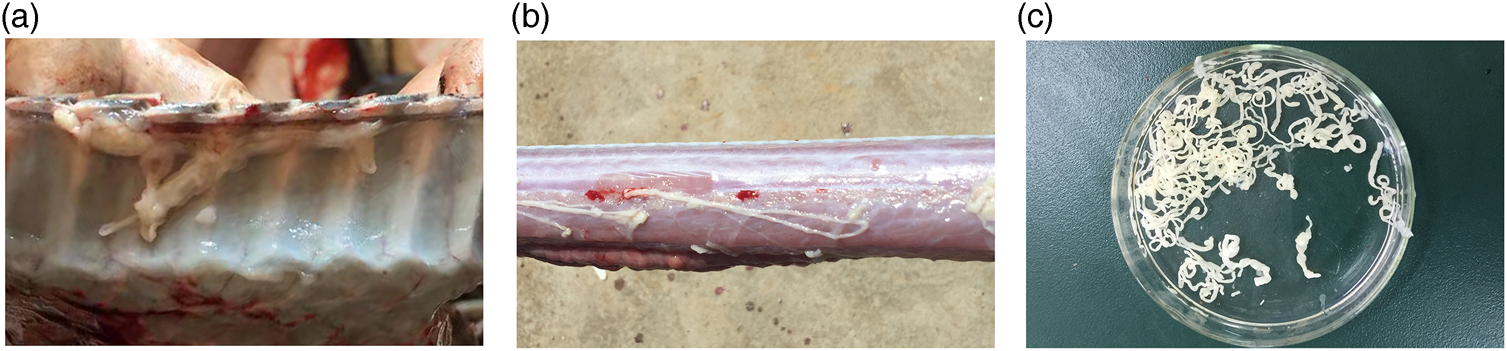
Wild snakes were obtained from food markets in 14 administrative regions covering the whole Hunan province between April and September 2018 (table 1). Snakes were sacrificed after anesthetizing with ethyl ether and skinned. The muscular, subcutaneous tissue and coelomic cavity were carefully observed for the presence of spargana parasites (fig. 1). The number of spargana plerocercoids was recorded to estimate the intensity and locations of infection. All obtained spargana parasites were washed in physiological saline, and identified preliminarily based on morphological characters and predilection sites (Daly, Reference Daly1982).
Prevalence of spargana in snakes in Hunan province, China.

N = No significant
Morphological photographs of spargana in snakes: (a) spargana in subcutaneous tissue of the snake; (b) spargana in muscular tissue of the snake; (c) spargana isolated from snakes.
DNA extraction and polymerase chain reaction (PCR) amplification
Samples preserved with 70% ethanol were repeatedly washed with double-distilled water. Genomic DNA of individual spargana plerocercoids was extracted using the Wizard® SV Genomic DNA Purification System (Promega, Madison, Wisconsin, USA) according to the manufacturer's recommendations.
A region of the cox1 gene was amplified with universal primers JB3 and JB4.5 (Bowles et al., Reference Bowles, Blair and McManus1992; Zhu et al., Reference Zhu, Beveridge, Berger, Barton and Gasser2002; Li et al., Reference Li, Yu, Zhu, Wang, Zhai and Zhao2008). Each reaction mix contained 12.5 µl of Ex-Taq polymerase (TaKaRa, Beijing, China), 0.5 µl of each primer (50 µmol/l) and 2 µ of DNA template. Deionized H2O was added to a final volume of 25 µl. The PCR reaction was performed in a thermocycler (Biometra, Jena, Germany) under the following conditions: initial denaturation at 94°C for 5 min, then 35 cycles of denaturation at 94°C for 30 s, annealing at 55°C for 30 s and extension at 72°C for 30 s, followed by a final extension at 72°C for 7 min. Each PCR series included no-DNA controls and host-DNA controls, where no amplicons were detected (not shown). PCR products were identified after agarose gel electrophoresis, and target amplicons were recovered, purified and sequenced.
Sequence analysis and reconstruction of phylogenetic relationships
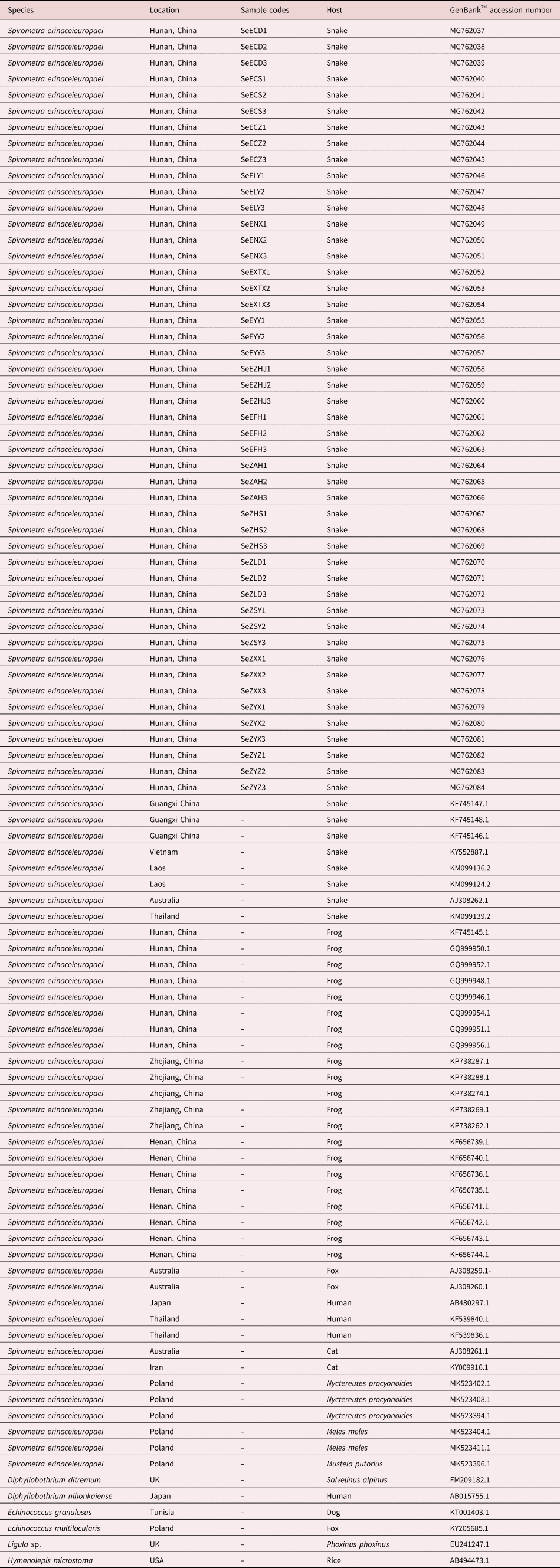
The partial cox1 sequences were submitted to GenBank™ databases with accession numbers (Appendix 1) that were aligned with reference sequences using Clustal X 2.0 (Thompson et al., Reference Thompson, Gibson, Plewniak, Jeanmougin and Higgins1997). Neighbour-joining (NJ) and minimum-evolution methods (ME) were used for phylogenetic reconstructions. The consensus tree was set up after bootstrap analysis, with 1000 replications. To reveal the genetic relationships in Diphyllobothrium tapeworms, other parasites of the Diphyllobothriidae family (Appendix 1) were taken into consideration in the experiment, with Taenia solium (GenBank™ accession number AB271234) as outgroup. Phylograms were completed with the Tree View program version 1.65 (Page, Reference Page1996).
Statistical analyses
All statistical analyses were performed using Statistical Analysis System Version 9.1 (SAS, North Carolina, USA); 95% confidence intervals (CI) are given; and P < 0.05 was considered statistically significant.
Results and discussion
The overall prevalence of spargana parasites in the examined wild snakes was 91.7% (344/375) (table 1) in Hunan province, which was almost twofold higher than the average prevalence observed in its neighbouring province (Guangdong: 29.8%, 37/124 and 55%, 251/456) (Wang et al., Reference Wang, Zhou, Gong, Deng, Zou, Wu, Liu and Hou2011, Reference Wang, Li, Hua, Gong, Xiao, Hou, Ge and Yang2014). The detection rate of spargana in wild snakes ranged from 65% to 100% (table 1). The difference of positive rates in wild snakes from different geographical locations was not significant, except for Loudi, Shaoyang, Xiangxi, Xiangtan, Yiyang, Zhangjiajie and Zhuzhou (P > 0.05). Logistic regression analysis showed that Xiangtan and Xiangxi had 15 (odds ratio (OR) = 15. 620, 95% CI = 2.903–84.010, P = 6.25e−4) and ten (OR = 10.230, 95% CI = 1.121–93.350, P = 0.0436) times higher risks of being positive compared to Hengyang. In the present study, Zaocys dhumnades (99.1%) had the highest spargana infection prevalence, followed by Elaphe carinata (94.1%) and Elaphe taeniura (86.7%) (table 1), consistent with previous results (Wang et al., Reference Wang, Zhou, Gong, Deng, Zou, Wu, Liu and Hou2011, Reference Wang, Li, Hua, Gong, Xiao, Hou, Ge and Yang2014). Logistic regression analysis showed that Z. dhumnades had 21 (OR = 21.770, 95% CI = 3.805–124.600, P = 0.0016) times higher risk of being positive compared to E. taeniura. Spargana plerocercoids were identified in the muscular tissue (50.0%), subcutaneous tissue (32.1%) and coelomic cavity (17.9%); these differences in the distribution density were significant (P < 0.05). Interestingly, spargana infection in some snakes, such as Bungarus multicinctus and Naja atra, in which spargana infection had been reported previously in Guangdong province (Wang et al., Reference Wang, Li, Hua, Gong, Xiao, Hou, Ge and Yang2014) was not found in the present investigation.
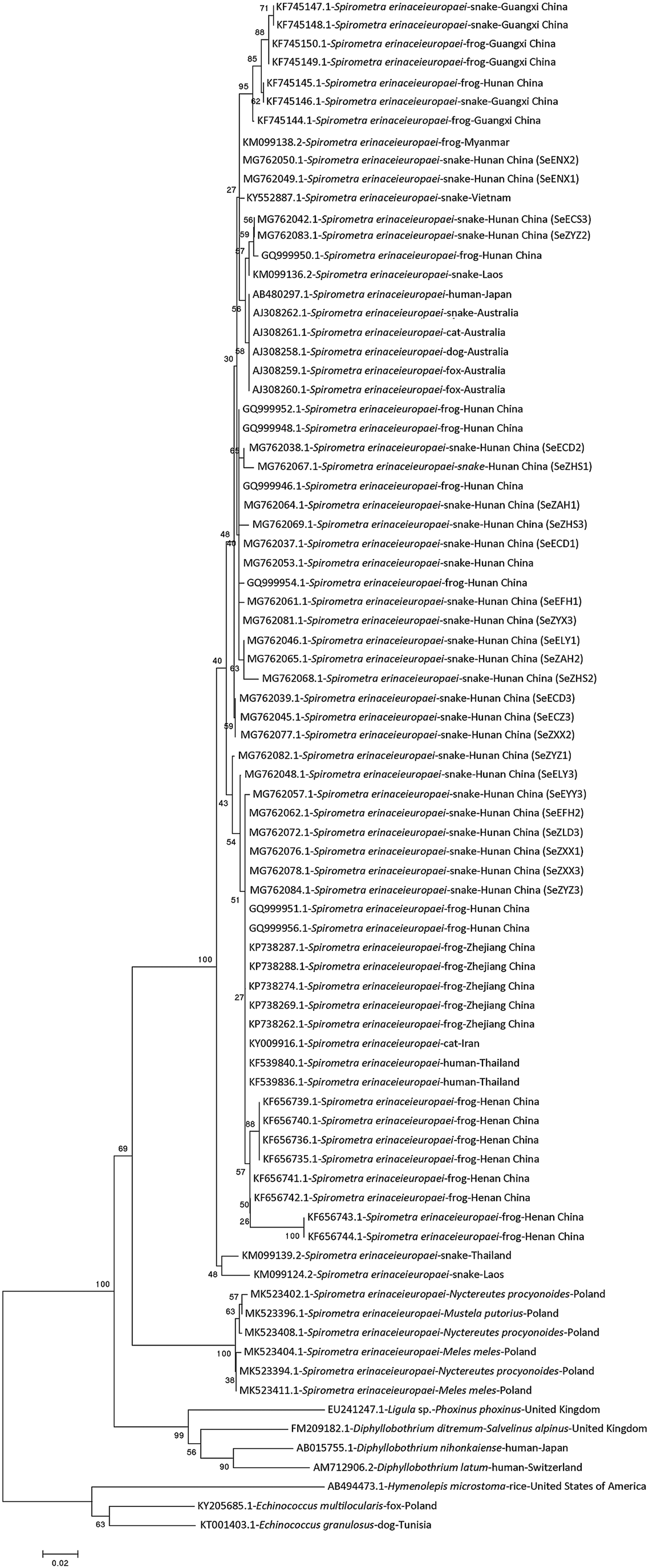
Sequence variations of the cox1 gene fragment from 48 spargana isolates ranged between 0 and 2.9%, and 21 variable sites were detected (4.71%, 21/446). These sequences were deposited in GenBank (accession numbers MG762037–MG762084). The sequence of cox1 was 446 bp, and the A + T contents of the sequence was 62.56–63.45%. While the interspecific sequence differences among members of Diphyllobothrium were significantly higher than the intraspecific sequence variations among different populations of spargana isolates, being 15.0–27.4% and were 0–12.8%. In addition, the sequence variations of spargana isolates obtained here and others in China were 0.0–3.8%; that of spargana isolates obtained here and others from different species in other Asian countries (including in Laos, Japan and Thailand) and Australia ranged from 0.0 to 4.5%, but the sequence differences among spargana isolates obtained here and others in Poland were more obvious, being 11.7–12.8%. In addition, based on this molecular marker, 26 representative spargana isolates gained in the present study and others available in the GenBank database were employed to reconstruct the phylogenetic tree using the NJ method. Results showed that all isolates obtained from Hunan Province in the present study grouped with Spirometra erinaceieuropaei isolates available in the GenBank database, and they formed two separate branches. The upper branch was composed of several sister clades, and the isolates obtained here and gained from other hosts/regions in Asian countries and Australia were randomly distributed in this branch, and the lower branch consisted of S. erinaceieuropaei isolates from different species in Poland (fig. 2), which was in line with that of recent research (Kołodziej-Sobocińska et al., Reference Kołodziej-Sobocińska, Stojak, Kondzior, Ruczyńska and Wójcik2019). Moreover, the phylogenetic tree based on sequences of the cox1 region successfully discriminates Diphyllobothrium and Spirometra species, and allowed identification of spargana isolates as belonging to S. erinaceieuropaei, confirming that cox1 is an appropriate marker for molecular epidemiology (Yamasaki & Kuramochi, Reference Yamasaki and Kuramochi2009; Wicht et al., Reference Wicht, Ruggeri-Bernardi, Yanagida, Nakao, Peduzzi and Ito2010; Zhang et al., Reference Zhang, Wang, Cui, Jiang, Fu, Zhong, Zhang and Wang2015; Jeon et al., Reference Jeon, Park and Lee2018; Kołodziej-Sobocińska et al., Reference Kołodziej-Sobocińska, Stojak, Kondzior, Ruczyńska and Wójcik2019).
Phylogenetic relationships among members of the family Diphyllobothriidae inferred by neighbour-joining analysis and minimum-evolution analysis using the partial sequence of the cox1 gene, with Taenia solium as outgroup. The scale bar (0.02) indicates the genetic distance.

Wild snakes have been extensively traded at food markets in some regions of Hunan province; eating the rare-cooked meat of wild snakes is still popular in some remote or poor areas in this province, contributing to the high risk of those people contracting sparganosis. The present results showed that risks of wild snake infections with spargana reached 91.8% in Hunan province, posing significant public health threats. Another study (Wu et al., Reference Wu, Chen, Qiu and Jiang2007) has indicated that high sparganosis cases rates (53.9%) closely correlated with patients that had consumed uncooked frogs and snakes. To ensure public safety, the major risk behaviour and harms of sparganosis should be publicized and popularized; in addition, the illegal trade of wild snakes should be effectively controlled and punished.
Conclusions
The present study indicated that the infection of snakes with S. erinaceieuropaei was severe in Hunan Province, China, which might contribute to huge threats to public health. The results obtained from the present study provide baseline data for the implementation of effective measures and strategies to control and prevent snake and human infection with spargana.
Financial support
This work was supported, in part, by the Department of Education, Hunan Province (17B126); the Bureau of Animal Husbandry and Fisheries, Hunan Province (2130199); the Department of Science and Technology, Hunan Province (2016NK2014); and the Youth Department of Science and Technology, Orient Science and Technology College of Hunan Agricultural University (17QNZ04).
Conflicts of interest
None.
Ethical standards
The authors assert that all procedures contributing to this work comply with the Guidelines and Recommendations for the Care and Use of Animals of the Ministry of Health of the People' s Republic of China. The protocols of the animal experiments reported herein were approved by The Life Science Ethics Committee of Hunan Agricultural University. All efforts were made to minimize animal suffering during the course of these studies.
Author contributions
W. Liu and L. Tan contributed equally to this article.
Appendix
Sequence information for diphyllobothroid tapeworms used in the present study.