
Lipid residue analysis and pottery function
The analysis of absorbed lipid residues is a well-established technique for determining the types of products processed in ceramic vessels. Research has focused largely on the identification of animal fats, with analysis of plant residues targeting those that have higher lipid content, such as waxy plants (Roffet-Salque et al. Reference Roffet-Salque, Dunne, Altoft, Casanova, Cramp, Smyth, Whelton and Evershed2017). Usually a lipid concentration of >5μg g−1 is considered sufficient, with lower concentrations deemed insufficient for reliable interpretation of vessel use.
It is recognised that some products detected in the analysis of ceramic vessels, beeswax for example, may have had multiple uses—such as in lighting or as a sealant (Roffet-Salque et al. Reference Roffet-Salque, Dunne, Altoft, Casanova, Cramp, Smyth, Whelton and Evershed2017). A combination of beeswax and tallow has been identified as an illuminant in medieval contexts (Frith et al. Reference Frith, Appleby, Stacey and Heron2004); and Mottram et al. (Reference Mottram, Dudd, Lawrence, Stott and Evershed1999) have identified pig ‘tallow’ in medieval ‘dripping dishes’, which acted as a receptacle for fat collection during spit roasting. The rendering of fat into tallow occurs when the fat is boiled or steamed in water—a process separates it from other components, such as bone and protein. The fat is then skimmed from the surface; or in a dry process, where the fat is heated in a vessel without water. Tallow extracted from cattle and sheep is hard, while pig fat produces a softer ‘grease’ product (lard). Traditional uses of tallow include the making of soaps, candles and skincare products, and in leather conditioning and industrial lubricants (Moore Reference Moore1879; Routh et al. Reference Routh, Bhowmik, Parish and Witkowski1996). In prehistoric contexts, the Lascaux stone lamp has been suggested to have been used for fat burning, and a Mesolithic ‘blubber’ lamp has been identified from Northern Europe (de Beaune Reference de Beaune1987; Heron et al. Reference Heron, Steele, Andersen, Fischer, Glykou, Hartz, Saul and Craig2013). In these two particular examples, the vessel forms unambiguously indicate that these were not cooking vessels; generally, however, the identification of the residues of ‘edible’ products are assumed to relate to human food and consumption.
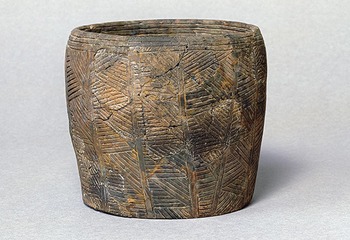
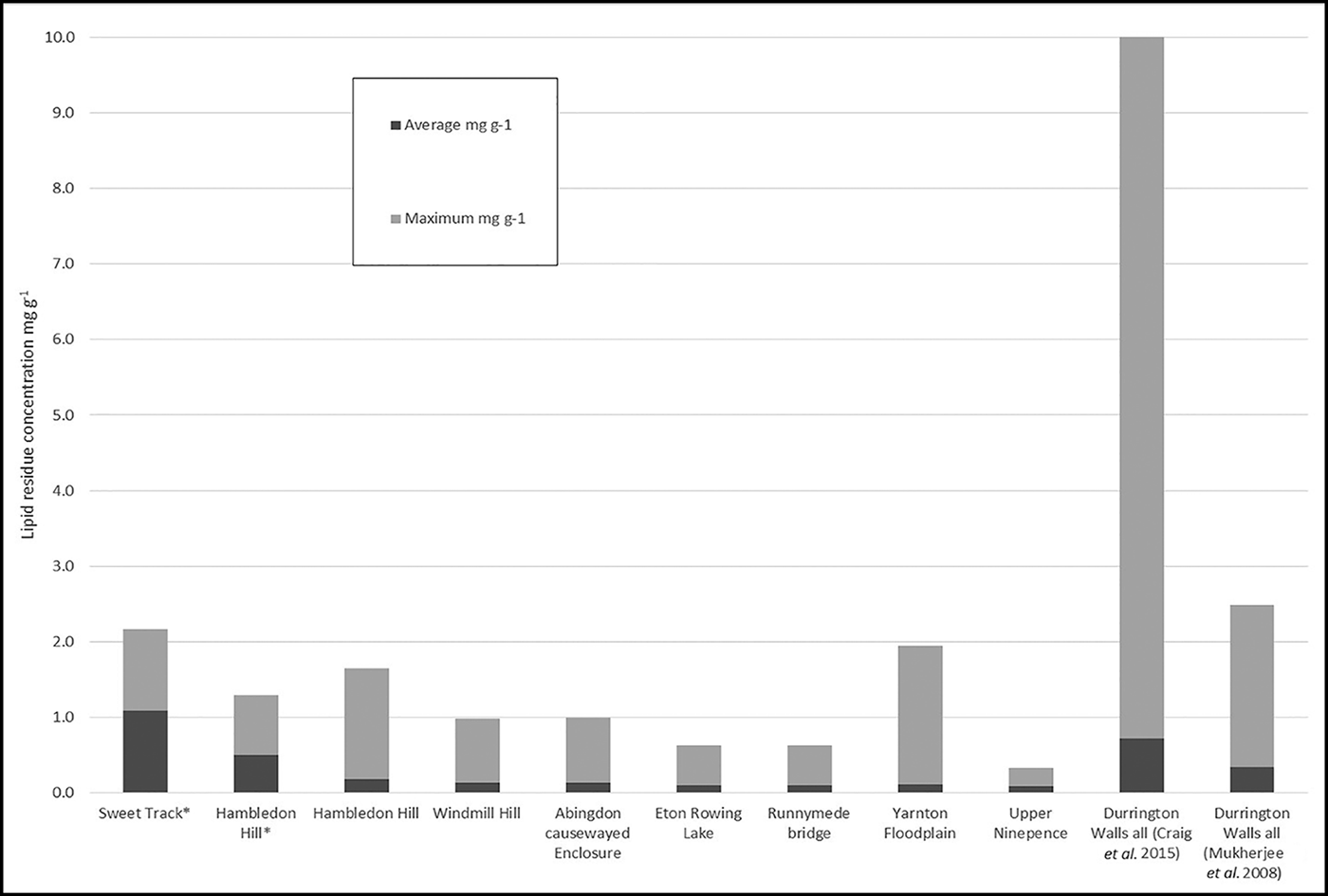
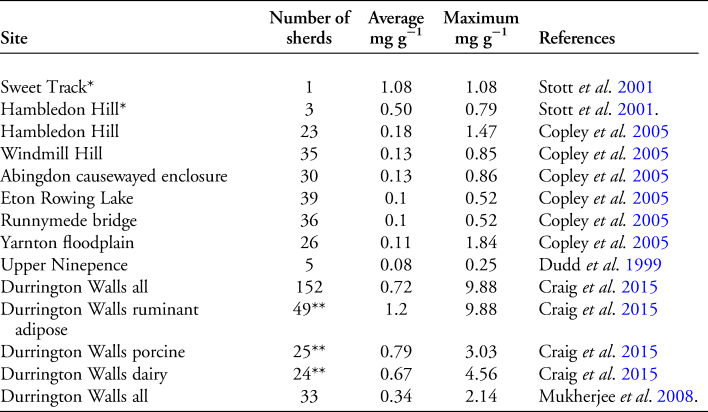
As part of the ‘Feeding Stonehenge’ project (Parker Pearson et al. Reference Parker Pearson, Pollard, Richards, Thomas, Welham, Albarella, Chan, Marshall, Viner, Aranda Jiménez, Montón-Subías and Sánchez Romero2011), over 300 sherds of Grooved Ware pottery were analysed from Durrington Walls, a village associated with the construction of the monument (Figure 1). The aims of the project were to understand the material resources and social organisation required to build Stonehenge. This research concluded that pottery was more frequently used in the processing of cattle carcasses, with pig and dairy fats being found in much lower quantities (Craig et al. Reference Craig, Shillito, Albarella, Viner-Daniels, Chan, Cleal, Ixer, Jay, Marshall, Simmons, Wright and Pearson2015). Furthermore, the lipid concentrations identified were extremely high, averaging 0.69mg g−1, with a maximum of 9.88mg g−1 (Figure 2 & Table 1). The average concentration of lipids preserved in archaeological pottery is usually around 0.1mg g−1 (Evershed Reference Evershed2008). Comparably high concentrations have been found in Egyptian lamps, where 17.8mg g−1 are attested, and in a Neolithic vessel from Slovenia, containing birch bark tar at 3.06mg g−1 (Copley et al. Reference Copley, Berstan, Dudd, Mukherjee, Straker, Payne and Evershed2005; Šoberl et al. Reference Šoberl, Horvat, Gašparič, Sraka, Evershed and Budja2014). Exceptionally good preservation is also documented in vessels from the Libyan Sahara, with one sherd containing 17mg g−1 (Dunne et al. Reference Dunne, Evershed, Salque, Cramp, Bruni, Ryan, Biagetti and di Lernia2012). Modern experimental analyses of pots used to cook lamb have produced maximum values, in rim sherds, of 21.8mg g−1, and ethnographic pots used to cook pork for over 40 years have recorded a maximum rim sherd value of 5.4mg g−1 (Evershed Reference Evershed2008).
Intact Grooved Ware vessel from Durrington Walls (reproduced with kind permission of Salisbury Museum CC).

Average and maximum mg g−1 of absorbed lipid residue extracted from Neolithic Grooved Ware in Britain (samples with concentrations > 5μg g−1). Data from references in Table 1 (figure by the author).

Numbers of Grooved Ware sherds analysed for lipid residues in published literature, showing average and maximum mg g−1 values for samples where recovery >5μg g−1.

* Early Neolithic, unclear if these samples are Grooved Ware.
** Only includes samples where isotope result available.
The dominance of bovine lipid residues from Durrington Walls is particularly interesting when compared to the faunal assemblage, which shows the opposite pattern—an overwhelming dominance of pig bones, with smaller quantities of cattle bone. The faunal data are also critical in that they reveal different methods of carcass preparation. The burnt extremities on pig bones, for example, suggest the spit roasting of whole pigs, the carcasses of which were often then deposited in articulation. Zooarchaeological analysis of pig bones from Durrington Walls has also identified butchery patterns associated with marrow extraction. Generally, this process at Durrington is more commonly associated with cattle bones (Albarella & Serjeanston Reference Albarella, Serjeantson, Miracle and Milner2002), which were chopped into portions that would fit into pots. This may explain why ruminant residues dominate within the pottery at Durrington Walls.
On the basis of zooarchaeological evidence, the roasting of whole animal carcasses in the Neolithic in general is considered an infrequent cooking method. If we assume that the pig fat identified in the Durrington Walls pottery is the result of food-processing, then there is an apparent contradiction with the evidence for spit roasting suggested by the faunal assemblage. Alternately, two different processes could be in evidence here: initially, the spit roasting of whole pig carcasses and, secondly, the collection of carcass fat in large vessels. Such collection of fat and its rendering into tallow also makes it more storable. Ethnographic studies have shown that rendered fat may be stored in pits for extended periods without refrigeration (Albright Reference Albright1982: 186).
The construction of Stonehenge
The construction of Stonehenge remains an ongoing question of considerable academic and public interest (Harris Reference Harris2016). The monument consists of large sarsen triathlons, each up to 8m in height and 30 tonnes in weight, and smaller bluestones, up to 3m high and weighing 1–2 tonnes. It is generally accepted that the megaliths were moved by human effort, rather than natural processes, with the sarsens originating in the Marlborough Downs, approximately 30km to the north, and the bluestones from Craig-Rhos-y-felin and Carn Goedog, over 140km away (Bevins & Ixer Reference Bevins and Ixer2018; Parker Pearson et al. Reference Parker Pearson, Pollard, Richards, Welham, Casswell, French, Schlee, Shaw, Simmons, Stanford, Bevins and Ixer2019). It is clear from research at Durrington Walls that the people who constructed Stonehenge were well organised, with large numbers of individuals coming from across the British Isles—and beyond—to take part in the building process (Viner et al. Reference Viner, Evans, Albarella and Pearson2010; Mays et al. Reference Mays, Roberts, Marshall, Pike, van Heekeren, Bronk Ramsey, Dunbar, Reimer, Linscott, Radini, Lowe, Dowle, Speller, Vallender and Bedford.2018). The question of how the stones were transported and erected is often perceived with incredulity, given the lack of modern technology available to the builders. There are, however, many examples of similar logistical and construction feats around the world from the third millennium BC, and there is ample ethnographic and experimental evidence to demonstrate how megaliths can be moved with ‘pre-industrial’ technology (e.g. Adams Reference Adams and Scarre2009; Harris Reference Harris2016).
The labour input required for the construction of Stonehenge was considerable, but not excessively so. There have been numerous attempts to recreate the process of lifting a bluestone, although few of these have been systematic or fully published. The most recent experiments indicate that 10 individuals could move a one-tonne stone at a pace of around 1.6km per hour using a sledge system; hence, 20 individuals could easily have moved Stonehenge's smallest stone. This system involves placing logs on the ground as sleepers and pulling the stone, mounted on a sled, over the top of them (Harris Reference Harris2016). Ethnographic examples of a similar technology can be found in West Sumba, Indonesia, where there is an ongoing practice of megalithic tomb construction (Adams Reference Adams and Scarre2009). The traditional method for transporting stones is to haul them on wooden sledges, with teams of 100–1000 individuals required to move the largest stones. The process can take from one day to one month; each day during the long journey, pigs and sometimes water buffalo are slaughtered to feed the labourers and spectators who view the process. These feasts can require over 100 pigs and 10 water buffalo (Adams Reference Adams and Scarre2009).
A sledge system would be more efficient with lubrication to reduce the friction between the sled and the sleepers. In Mesopotamia and Egypt, depictions of construction scenes suggest that liquid lubricants were used for the movement of large stone blocks on sledges. A famous painting from El Bersheh, for example, depicts the transport, using a sledge, of a colossus, with a person pouring liquid from a jar at the front of the sledge. This liquid was suggested by Sir Austen Henry Layard (Reference Layard1853: 115) to be grease, although others have suggested that water was used (Nosonovsky Reference Nosonovsky2007). The use of tallow or lard for lubrication (and lighting) is well documented ethno-historically. In an earlier piece of research, a team of engineers and stonemasons worked with archaeologists to conduct a series of practical experiments relating to the construction of Stonehenge, using tools and methods thought to be available to the Neolithic builders. The most successful of their experiments involved a timber sledge used to haul a stone block along a greased timber slipway. A proprietary grease—chosen due to its similarity to tallow—was used (Richards & Whitby Reference Richards and Whitby1997). These experiments provide strong support for the viability of this method in relation to the movement of megaliths in prehistory.
Multiple functions and multi-proxy methods
The British Neolithic is a very well-researched period in terms of lipid residue analysis (Figure 2). Several studies have suggested that Grooved Ware in southern Britain correlates with pig feasting and ceremonial sites, such as henges and timber circles. This contrasts with contemporaneous non-Grooved Ware vessels and Scottish Grooved Ware (Mukherjee et al. Reference Mukherjee, Berstan, Copley, Gibson and Evershed2007, Reference Mukherjee, Gibson and Evershed2008), which are not typically found at such sites. Mukherjee et al. (Reference Mukherjee, Gibson and Evershed2008) note that pig fat is observed in much lower quantities in domestic Grooved Ware contexts (3 per cent) compared to ceremonial sites (40 per cent). The prevalence of pig bones at these latter sites also lends support to this interpretation. The association between pig bones and Grooved Ware is a well-known phenomenon in Late Neolithic southern Britain (e.g. Edwards & Horne Reference Edwards, Horne and Whittle1997; Hey et al. Reference Hey, Mulville, Robinson and Pearson2003), with pig bones comprising more than 40 per cent of assemblages. This compares with Early to mid Neolithic sites, where pig bones typically comprise less than 30 per cent of the overall faunal assemblage. This Late Neolithic prevalence of pig has been interpreted either as representing an overall shift in the economy, or as a reflection of the specific ceremonial functions of the sites investigated (Albarella & Serjeanston Reference Albarella, Serjeantson, Miracle and Milner2002).
Craig et al.’s (Reference Craig, Shillito, Albarella, Viner-Daniels, Chan, Cleal, Ixer, Jay, Marshall, Simmons, Wright and Pearson2015) detailed intra-site study of lipid residues at Durrington Walls suggests that while ruminant products were more prevalent overall in the vessels, there was also mixing of different products, and that vessels used for pig products were more likely to be deposited in pit contexts (Craig et al. Reference Craig, Shillito, Albarella, Viner-Daniels, Chan, Cleal, Ixer, Jay, Marshall, Simmons, Wright and Pearson2015). Recent work by Fernandes et al. (Reference Fernandes, Eley, Brabec, Lucquin, Millard and Craig2018) at Durrington Walls examines the potential mixing of different products in further detail, and suggests that two-thirds of the vessels having dairy or ruminant fat as the principal source of lipids, with 35 per cent of sherds having large contributions (at least 50 per cent) from porcine fat.
The disparity between faunal and lipid data deserves further scrutiny: why do we see pig lipids in pots, when faunal data indicate a different form of processing? Could the unusual faunal assemblage at Durrington Walls be related to the non-food use of ceramics and animal fat—tallow production as a means of lubrication, for example? Whether or not this hypothesis is correct, it highlights that the value of recognising material culture—including that typically assumed to be ‘food’ vessels—may have had multiple functions and meanings (Oras et al. Reference Oras, Higham, Cramp and Bull2017). The production of tallow for lubrication need not exclude feasting on pigs and, indeed, might form part of the same picture—a multi-function product and a multi-purpose activity, comprising both food and non-food uses.
While this reconsideration of the lipid residues at Durrington Walls supports the ‘greased sled’ theory as an explanation for the movement of the Stonehenge megaliths (Harris Reference Harris2018), there are still many questions that need to be addressed. The most obvious concerns the impact of differential preservation on the quantities of lipids recovered from archaeological ceramics. At the site level, there is the possibility that context type plays a role in lipid preservation. One aim of the ‘Feeding Stonehenge’ project was to explore variation in vessel use by context, and the dataset from the site is unique in this regard. Most ceramic residue studies in the UK focus on broader inter-site comparisons, rather than detailed intra-site variation. It is only by analysing such large assemblages from a single site that we can begin to examine such variation.
Unfortunately, due to sampling limitations, the spread of samples across different contexts was very uneven. Most of the analysed assemblage came from a single midden context, with smaller numbers taken from various pits and house floors. While there is a statistically significant correlation between context type and ceramic residues, the grouping of samples is problematic. All pits, for example, are grouped as one context type. Dudd et al. (Reference Dudd, Evershed and Gibson1999) also suggest a correlation between residue and context type in Grooved Ware from the Upper Ninepence barrow site in Wiltshire; sherds from pit 133 contained lipid concentrations of more than 100μg g−1 compared to the absence of detectable absorbed residues in sherds from pit 198. Pit 133 was also noted to contain lithics in pristine condition, suggesting that they were discarded into the pit immediately following production (Donahue & Burroni Reference Donahue, Burroni, Walker, Wenban-Smith and Healy2004)—a tantalising hint, perhaps, of the possible ‘special’ nature of pit deposition in the Neolithic and curation of particular artefacts, in this case perhaps the storage of items for future use.
The form of the ceramic vessel is important in the interpretation of food vs non-food residues. Non-food uses of pottery are generally interpreted from vessel form, with residue analysis relying on pottery specialists to advise on the probable function. The production of tallow would certainly fit with the size of the ‘bucket’-like Grooved Ware vessels at Durrington Walls, some of which have rim diameters in excess of 0.4m. This hypothesis could be tested by a more detailed examination of vessel characteristics, such as the relationship between residue, vessel size and sooting patterns, to advance understanding of how the vessels were heated.
Dunne et al. (Reference Dunne, Grillo, Casanova, Whelton and Evershed2018) acknowledge that, despite decades of methodological advances, there has been little critical reflection on how we interpret pottery lipid residue data, particularly with regard to how residues relate to actual dietary practices and subsistence strategies. Their analysis of pottery from modern pastoralist communities in Kenya indicates intensive processing of ruminant carcasses, even though the community does not have a meat-based subsistence. Thus, they clearly demonstrate that archaeological interpretations of pottery residues are often overly simplistic. Despite being considered a very ‘processual’ branch of archaeological science, the interpretation of lipid residues is very much influenced by the assumptions of the analyst. This highlights the necessity of ‘multi-proxy’ approaches to archaeological questions (Shillito Reference Shillito2017), and the importance of reflecting on our assumptions during the interpretation of scientific data.