Introduction
Cognitive deficits are considered a core feature of schizophrenia by researchers and clinicians. Indeed, patients typically perform one standard deviation below healthy comparison groups on numerous measures of cognitive performance (Heinrichs, Reference Heinrichs2005). Domains including verbal learning and memory, working memory, reasoning skills and processing speed tend to be impaired (Dickinson et al., Reference Dickinson, Ramsey and Gold2007; Heinrichs & Zakzanis, Reference Heinrichs and Zakzanis1998). Nonetheless, despite this evidence of widespread cognitive impairment, reports of subgroups of patients with preserved (Kremen, Seidman, Faraone, Toomey, & Tsuang, Reference Kremen, Seidman, Faraone, Toomey and Tsuang2000; Palmer et al., Reference Palmer, Keaton, Paulsen, Kuck, Braff, Harris and Jeste1997; Weickert et al., Reference Weickert, Goldberg, Gold, Bigelow, Egan and Weinberger2000) and even above-average (Heinrichs et al., Reference Heinrichs, Miles, Smith, Zargarian, McDermid Vaz, Goldberg and Ammari2008; MacCabe et al., Reference MacCabe, Brebion, Reichenberg, Ganguly, McKenna, Murray and David2012) cognitive ability have also appeared in the literature.
While preserved or relatively proficient cognitive performance has implications for understanding pathophysiology and disease processes in psychotic disorders, it also has implications for understanding functional outcome and adjustment (Shamsi et al., Reference Shamsi, Lau, Lencz, Burdick, DeRosse, Brenner and Malhotra2011). As much as 50% of functional outcome variance can be explained by cognitive ability (Velligan et al., Reference Velligan, Mahurin, Diamond, Hazelton, Eckert and Miller1997), although recent estimates derived from meta-analysis reveal more modest relationships (Fett et al., Reference Fett, Viechtbauer, Dominguez, Penn, van Os and Krabbendam2011). However, little is known about the benefits of normal-range cognition in schizophrenia and the extent to which real world adjustment is enhanced relative to the more typical picture of dependency and disability associated with cognitive impairment.
Leung, Bowie, and Harvey (Reference Leung, Bowie and Harvey2008) found that middle-aged and older cognitively normal-range patients demonstrated higher functional and social competence relative to impaired patients, but still showed disability in several aspects of real-world outcome. Heinrichs and colleagues (Reference Heinrichs, Miles, Smith, Zargarian, McDermid Vaz, Goldberg and Ammari2008) reported that verbally superior-range patients showed better community adjustment than patients with more typical cognitive profiles. However, even these “superior” patients were functionally disadvantaged when compared to healthy controls. This pattern of findings was also reported for patients with normal-range IQ and verbal learning performance relative to patients with global impairment (Ammari, Heinrichs, & Miles, Reference Ammari, Heinrichs and Miles2010). Together, the small number of available studies suggests that patients with normal-range or better cognitive performance are significantly advantaged in terms of community outcome relative to patients with impaired cognition, but remain disadvantaged compared to healthy controls.
A complicating consideration in the study of patients with atypically proficient cognitive abilities is the nature of normality criteria. Normal-range cognition is recognized in a significant minority of patients, but definitions of performance normality are inconsistent and controversial. Numerous methods and psychometric indices have been used for gauging normality, including norm-referenced measures such as IQ tests (e.g., Kremen, Seidman, Faraone, & Tsuang, Reference Kremen, Seidman, Faraone and Tsuang2001) and neuropsychological batteries (e.g., Kremen et al., Reference Kremen, Seidman, Faraone, Toomey and Tsuang2000), comparisons of patients and healthy controls (e.g., MacCabe et al., Reference MacCabe, Brebion, Reichenberg, Ganguly, McKenna, Murray and David2012), and use of expert raters (e.g., Palmer et al., Reference Palmer, Keaton, Paulsen, Kuck, Braff, Harris and Jeste1997). No single method has achieved consensus agreement as a preferred approach in this evolving field. For example, Leung et al. (Reference Leung, Bowie and Harvey2008) and Ammari et al. (Reference Ammari, Heinrichs and Miles2010) used different measures and psychometric criteria to identify normal range patients for outcome analysis and only Ammari et al. (Reference Ammari, Heinrichs and Miles2010) included healthy comparison controls. Recently, the Measurement and Treatment Research to Improve Cognition in Schizophrenia (MATRICS) Consensus Cognitive Battery (MCCB; Nuechterlein et al., Reference Nuechterlein, Green, Kern, Baade, Barch, Cohen and Marder2008) was developed to provide a set of “gold standard” co-normed cognitive measures for schizophrenia treatment research (McKibbin, Brekke, Sires, Jeste, & Thomas, Reference McKibbin, Brekke, Sires, Jeste and Thomas2004). However, it is not known whether MCCB-defined normal-range subgroups exist in the schizophrenia population or the degree to which such subgroups demonstrate benefits in community outcome.
Therefore, the present study was designed to answer the following questions: (1) Does normal cognition, as defined by the MCCB, exist in the schizophrenia population? (2) If so, what magnitude of benefit do patients with average cognitive ability demonstrate on measures of community independence relative to patients with impaired cognition?
METHODS
Participants
Patients with schizophrenia were recruited from three outpatient clinics in Hamilton, Ontario, Canada: the Cleghorn Early Intervention in Psychosis Program, the Hamilton Program for Schizophrenia, and the Community Schizophrenia Service. The clinical sample was recruited through referrals by clinicians at the settings and posted advertisements. To participate in the study, patients had to meet several inclusionary criteria including: (1) a diagnosis of schizophrenia or schizoaffective disorder confirmed by the Structured Clinical Interview for DSM-IV Axis I Disorders (SCID-I; First, Spitzer, Gibbon, & Williams, Reference First, Spitzer, Gibbon and Williams1996) with no concurrent diagnosis of substance use disorder; (2) no history of developmental or learning disability; (3) no history of neurological or endocrine disorder; and (4) age 18–65. These criteria yielded a pool of 100 patients (78% male). Healthy control participants were recruited through local newspaper and online classified advertisements for paid research participation. Interested individuals were screened for psychiatric illnesses and substance use disorders. Eighty-one non-psychiatric participants (67% male) were recruited for potential participation in the study. All participants provided written informed consent on a form approved by the institutional review board.
Measures
The MATRICS Consensus Cognitive Battery (MCCB; Nuechterlein et al., Reference Nuechterlein, Green, Kern, Baade, Barch, Cohen and Marder2008) was administered to all participants. Composite and domain T scores (Processing Speed, Working Memory, Visual Learning and Memory, Verbal Learning and Memory, Reasoning and Problem Solving, Attention/Vigilance, Social Cognition) were calculated for each participant. These domains were assessed through Category Fluency: Animal Naming, Trail Making Test and Brief Assessment of Cognition in Schizophrenia: Symbol Coding (Processing Speed), Wechsler Memory Scale-III: Spatial Span, Letter-Number Span (Working Memory), Hopkins Verbal Learning Test Revised (Verbal Learning), Brief Visuospatial Memory Test Revised (Visual Learning), Neuropsychological Assessment Battery: Mazes (Reasoning and Problem Solving), Continuous Performance Test – Identical Pairs (Attention), and the Mayer-Salovey-Caruso Emotional Intelligence Test – Managing Emotions (Social Cognition). Adjunct cognitive tests included the Vocabulary and Matrix Reasoning subtests of the Wechsler Abbreviated Scale of Intelligence (WASI; Psychological Corporation, 1999), to provide an estimate of IQ, and the Reading subtest of the Wide Range Achievement Test (WRAT-4; Wilkinson & Robertson, Reference Wilkinson and Robertson2006), to estimate premorbid intellectual ability. Parental education was also included as an estimate of premorbid cognitive ability. Functional competence or practical cognition was indexed with the University of California San Diego (UCSD) Performance-Based Skills Assessment (UPSA; Patterson, Goldman, McKibbin, Hughs, & Jeste, Reference Patterson, Goldman, McKibbin, Hughs and Jeste2001). The UPSA is a performance-based measure of capacity to perform everyday activities in five areas: household chores, communication, money and finances, public transportation, and recreational activity. Participants role-play tasks that are thought to be comparable to situations that individuals with schizophrenia are likely to encounter, such as determining the route and cost of a bus trip, planning a recreational activity, handling cash and making household payments using a check. Subscale scores are summed to provide a summary score out of 100. The Positive and Negative Syndrome Scale (PANSS; Opler, Kay, Lindenmayer, & Fiszbein, Reference Opler, Kay, Lindenmayer and Fiszbein1999) was used to gauge the severity of symptoms in the patient sample. Finally, the Multidimensional Scale of Independent Functioning (MSIF; Jaeger, Berns, & Czobor, Reference Jaeger, Berns and Czobor2003), a measure of community adjustment and independence, was administered. The MSIF comprises a structured interview and self-report measure, with verification of information provided by history, chart and document review, proxy reports and informant interviews. Assessments are made of an individual’s expected role responsibility, support received for that role and quality of productive activities (performance) across work, education and residential settings. Ratings for each dimension in three settings (occupational, education, and residential) are made along a 7-point Likert scale. A score of 1 indicates normal functioning, a score of 4 represents moderate disability, and a score of 7 signifies complete disability and dependence on supports. Finally, a global indicator of outcome is calculated, which reflects functioning across settings while adjusting for the degree of role responsibility, supports received, and achieved performance level. Thus, individuals working in similar environments but with varying supports and performance levels receive different ratings. Detailed anchors are provided to aid in ratings and to reduce subjective scoring (Jaeger et al., Reference Jaeger, Berns and Czobor2003).
Data Analysis
The MCCB data were used to create groups based on performance normality criteria and these groups were then compared on clinical, cognitive, and community outcome indicators. One-way analyses of variance (ANOVAs) were conducted to determine whether differences existed between groups on age, education, MCCB domain scores, WASI IQ, WRAT-4 Reading scores and the UPSA total score. Differences between the 2 patient groups on PANSS scores were assessed through an independent groups t test. To examine whether normal-range cognition conferred a functional advantage, a multivariate analysis of variance (MANOVA) corrected for multiple comparisons was performed for the MSIF global domain score which, relative to ANOVA, allowed for greater statistical power.
RESULTS
Group Assignment and Composition
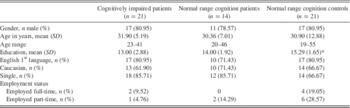
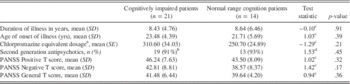
Group assignment was based on MCCB composite scores, with a T score of 50±10 representing normative mean performance in the community standardization sample (Kern et al., Reference Kern, Nuechterlein, Green, Baade, Fenton, Gold and Marder2008, Reference Kern, Gold, Dickinson, Green, Nuechterlein, Baade and Marder2011). Accordingly, the criterion for assignment to cognitively normal groups was a minimum T score of 40. Application of this performance criterion to the pool of 100 patients yielded 14 normal-range cognitive ability patients (MCCB T≥40). Next, normal-range cognitive ability controls meeting the criterion (MCCB T≥40) and cognitively impaired patients falling below the criterion (T≤39) were selected. To ensure demographic equivalence with cognitively normal patients, age, sex, first language and Canadian birth were used as matching criteria in assigning 21 controls and 21 cognitively impaired patients to their respective groups. Table 1 provides descriptive information for each group. Patient and control groups were demographically equivalent on all variables except educational achievement (Table 1). The patient groups were equivalent in terms of PANSS positive and negative syndrome and general psychopathology scores (Table 2). Furthermore, there were no medication differences in terms of Chlorpromazine equivalent dose or proportion of patients receiving second generation antipsychotic medication between the two patient groups.
Demographic characteristics of schizophrenia patients and healthy participants

Note. *Indicates a significant difference from Cognitively Impaired Patient group at p<.005.
Clinical characteristics of schizophrenia patients and healthy participants

Note: a=based on Andreasen, Pressler, Nopoulos, Miller, & Ho (2010); b=includes 2 patients taking a combination of first and second generation antipsychotics; c=t statistic, t(33); d=chi-Square statistic, comparing frequencies of first generation, second generation and combination medication; PANSS=Positive and Negative Syndrome Scale. PANSS=Positive and Negative Syndrome Scale.
Cognitive and Functional Capacity Measures
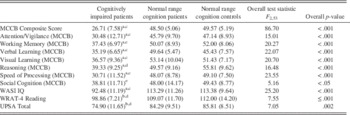
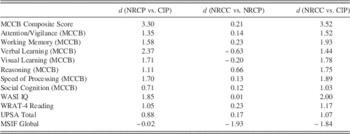
Group comparisons on cognitive measures (Table 3) revealed significant differences between cognitively impaired patients and the two average-range groups on the MCCB composite score and on six of the seven domains. In terms of the Social Cognition domain, there were significant differences between cognitively impaired patients and normal-range controls, but not between cognitively impaired patients and normal-range patients. Differences between cognitively impaired and normal-range patients on Social Cognition approached (p=.075) but did not reach significance. Normal-range controls and normal-range patients were equivalent on the composite score and on all MCCB domains. A significant group main effect was found in terms of IQ (Table 3: F(2,53)=25.20; p<.001). Post hoc comparisons revealed that the cognitively impaired patients (M=92.48; SD=11.19) had lower IQ scores than both the normal-range patients (M=113.29; SD=11.26) and normal-range controls (M=113.38; SD=9.64). These differences were significant at the p<.001 level. Normal-range controls and normal-range patients had statistically equivalent IQ scores. In addition, in terms of WRAT-4 Reading standard scores, cognitively impaired patients (M=98.86; SD=7.21) differed significantly from both normal-range patients (M=109.07; SD=11.70) and normal-range controls (M=112.00; SD=14.20) at p<.05. The normal-range control and patient groups did not differ from one another in terms of oral reading. Additionally, a one-way ANOVA was carried out on the overall UPSA performance score. This analysis revealed significant between-group differences (see Table 3). Cognitively impaired patients performed significantly lower than normal-range patients and below normal-range controls, but the two normal cognition groups were equivalent. Effect sizes for these differences are presented in Table 4.
Cognitive and functional results for schizophrenia and healthy participant groups

Note. a=significant pairwise comparison at p<.001 with average controls; b=significant post-hoc differences at p<.01 with average controls; c=significant pairwise differences at p<.001 with average patients; d=significant post-hoc differences with average patients at p<.05; e=significant post-hoc differences with average controls at p<.05; MCCB=Measurement and Treatment Research to Improve Cognition in Schizophrenia (MATRICS) Consensus Cognitive Battery; UPSA=University of California San Diego (UCSD) Performance-Based Skills Assessment; WASI=Wechsler Abbreviated Scale of Intelligence; WRAT=Wide Range Achievement Test.
Effect sizes (Cohen’s d) for cognitive and functional measures

Note. CIP=Cognitively Impaired Patients; NRCC=Normal Range Cognition Controls; NRCP=Normal Range Cognition Patients; MCCB=Measurement and Treatment Research to Improve Cognition in Schizophrenia (MATRICS) Consensus Cognitive Battery; MSIF=Multidimensional Scale of Independent Functioning; UPSA=University of California San Diego (UCSD) Performance-Based Skills Assessment; WASI=Wechsler Abbreviated Scale of Intelligence; WRAT=Wide Range Achievement Test.
Community Outcome
Finally, to assess group differences in community independence, a multivariate analysis of variance (MANOVA) corrected for multiple comparisons was conducted on the global MSIF indicator. This analysis indicated that there was a significant main effect of group, F(2,53)=21.21; p<.011. Scheffé post hoc analysis showed that there were significant differences between cognitively impaired patients and normal-range controls, and between normal-range controls and normal-range patients. Both differences comprised large effect sizes (see Table 4). However, the two patient groups demonstrated equivalent MSIF performance and obtained MSIF global scores (cognitively impaired patients: M=3.95, SD=1.24; normal-range cognition patients: M=3.93, SD=1.14) consistent with “moderate” disability. This score corresponds to significant difficulty in mainstream community environments in the absence of supports or “some” difficulty despite regular supports (Jaeger et al., Reference Jaeger, Berns and Czobor2003). Normal-range controls obtained a mean value (M=2.00; SD=0.83) consistent with the lower end of normal independence.
DISCUSSION
The present study confirmed for the first time the existence of a subset of schizophrenia patients with normal-range abilities averaged across seven ability factors on the MCCB, a widely used neurocognitive test battery. We also examined the magnitude of functional outcome advantage associated with normal-range performance in this subpopulation. Patients with normal-range cognition and healthy control participants demonstrated equivalent performance on all MCCB domains, on estimated premorbid ability, current IQ, and on a summary index of simulated functional ability. Nevertheless, these high-performing patients were indistinguishable from more typically impaired patients in terms of community outcome and remained dependent and functionally impaired relative to healthy controls. Thus, normal-range cognitive performance, as defined by the MCCB, may confer no real-life adjustment advantage in schizophrenia.
There is an extensive literature supporting cognition as a predictor and possible mediator of functional outcome in schizophrenia (Bowie & Harvey, Reference Bowie and Harvey2006; Fett et al., Reference Fett, Viechtbauer, Dominguez, Penn, van Os and Krabbendam2011). At the same time, a substantial number of studies demonstrate near-normal, normal or even above normal cognitive performance in minorities of the patient population (Heinrichs et al., Reference Heinrichs, Miles, Smith, Zargarian, McDermid Vaz, Goldberg and Ammari2008; Kremen et al., Reference Kremen, Seidman, Faraone, Toomey and Tsuang2000; MacCabe et al., Reference MacCabe, Brebion, Reichenberg, Ganguly, McKenna, Murray and David2012; Palmer et al., Reference Palmer, Keaton, Paulsen, Kuck, Braff, Harris and Jeste1997; Weickert et al., Reference Weickert, Goldberg, Gold, Bigelow, Egan and Weinberger2000). Yet few studies have examined or reported community outcomes for cognitively exceptional subgroups and none have used the MCCB as a normality criterion to identify subgroups. Correlations in the cognitively unselected schizophrenia population suggest that the MCCB-community outcome relationship may be inconsistent and vary with the measures used and with clinical settings. For example, Shamsi et al. (Reference Shamsi, Lau, Lencz, Burdick, DeRosse, Brenner and Malhotra2011) found no significant relationships between generalized cognitive deficit as measured by the MCCB and community independence (MSIF). Against this, other studies have shown that the MCCB composite score correlates with employment (August, Kiwanuka, McMahon, & Gold, Reference August, Kiwanuka, McMahon and Gold2012) and naturalistic community performance indicators (Bromley, Mikesell, Mates, Smith, & Brekke, Reference Bromley, Mikesell, Mates, Smith and Brekke2012). Another group reported mixed results with regards to correlations between the MCCB and a measure of functional competence (UPSA). At one site, Silverstein, All, and Jaeger (Reference Silverstein, All and Jaeger2011) reported lower-than-previously found correlations between scores on the UPSA and scores on cognitive batteries, and at other sites, they reported correlations close to or within the range found in previous studies. It is also noteworthy that cognitive performance as measured by a variety of widely used neurocognitive tasks captures a relatively small percentage of community performance variance (Fett et al., Reference Fett, Viechtbauer, Dominguez, Penn, van Os and Krabbendam2011).
Hence it may be that our data reflect the inherent weakness of any simple cognition-functional outcome relationship rather than weak functional validity specifically attributable to the MCCB as a normality criterion. Indeed, recent work shows that the cognition-outcome relationship is complex and potentially mediated by additional variables. It has been suggested, for example, that more practical and functionally relevant aspects of cognition mediate the cognition-community outcome relationship (Bowie, Reichenberg, Patterson, Heaton, & Harvey, Reference Bowie, Reichenberg, Patterson, Heaton and Harvey2006; Green et al., Reference Green, Kern, Braff and Mintz2000; Harvey, Keefe, Patterson, Heaton, & Bowie, Reference Harvey, Keefe, Patterson, Heaton and Bowie2009). This view is partly contradicted by our data showing enhanced functional role simulation, but not real-life independence, in cognitively normal patients. Nonetheless, community outcome may depend in part on skill acquisition and the performance of specific competencies (Green et al., Reference Green, Kern, Braff and Mintz2000). From this perspective, cognitive remediation may improve neuropsychological test performance without necessarily translating into changes in daily living skills (Dickinson et al., Reference Dickinson, Tenhula, Morris, Brown, Peer, Spencer and Bellack2010). Failure to acquire such skills may be due to several variables including limited opportunities to learn, practice, and use behaviors adaptive for daily living. Inclusion of supplemental and practical skills training in cognitive remediation can enhance real world functioning (Bowie, McGurk, Mausbach, Patterson, & Harvey, Reference Bowie, McGurk, Mausbach, Patterson and Harvey2012). In addition, although patients with normal range cognitive performance may have the potential for adequate community adjustment, psychotic illness disrupts and restricts the acquisition of life skills and prevents the realization of this potential (Albert et al., Reference Albert, Bertelsen, Thorup, Petersen, Jeppesen, Le Quack and Nordentoft2011). Moreover, prolonged psychotic disorder may have a functionally leveling effect across patients with impaired and near-normal cognitive profiles.
Another noteworthy relationship is that of social cognition and outcome. Substantial correlations have been reported between aspects of social cognition and community outcome (Fett et al., Reference Fett, Viechtbauer, Dominguez, Penn, van Os and Krabbendam2011). In particular, emotion perception and social knowledge, significantly mediate the relationship between cognition and outcome (Schmidt, Mueller, Roder, & Reference Schmidt, Mueller and Roder2011). However, in the present study cognitively impaired and normal range cognition patients did not differ in terms of the MCCB index of social cognition. This index has been criticized for its restricted sampling of a complex construct and lack of convergence with well-established behavioral measures of social cognition (Eack et al., Reference Eack, Greeno, Pogue-Geile, Newhill, Hogarty and Keshavan2010). Thus, while the role of social cognition in community outcome continues to be an important area for study, it requires further investigation in cognitively normal patient populations with measures that assess the multiple aspects of the construct.
Limitations of the present study include reliance on self-report data to assess community independence (MSIF) in study participants. Although proxy-reports were used and attempts were made to verify information with mental health practitioners and patient charts, such verification was not feasible for all participants. Therefore, it is not known whether functional outcome ratings based on clinician evaluations rather than on patient self-report yield differences between normal-range and cognitively impaired patients (Bowie et al., Reference Bowie, Twamley, Anderson, Halpern, Patterson and Harvey2007). In addition, our relatively small sample sizes may have made the detection of small and moderate-size group differences difficult. Given the low prevalence of normal-range MCCB performance in the schizophrenia patient population it is a challenge to obtain large numbers of demographically equivalent research participants. However, MSIF effect sizes for the normal-range and impaired patient group contrasts were extremely small and this suggests that statistical power alone is an unlikely explanation for non-significance.
In summary, the present study supports the growing literature suggesting that normal-range cognitive performance exists in a subset of schizophrenia patients, even when indexed by measures specifically selected for their sensitivity to the disorder. Although these high-performing patients demonstrate a variety of cognitive assets across a range of basic and functionally relevant abilities, these assets do not associate with enhanced community functioning.
ACKNOWLEDGMENTS
This research was financially supported by the Ontario Mental Health Foundation. No grant number is associated with the funding. There are no conflicts of interest. My coauthors and I do not have any interests that might be interpreted as influencing the research. We thank Joel Goldberg and the clinical staff at participating sites for their assistance and support.