We know from existing research that institutional change can open up space for shifts in the gender order (Celis, Mackay, and Meier Reference Celis, Mackay and Meier2013; Chappell Reference Chappell2015; Mackay Reference Mackay2014; Waylen Reference Waylen2014). But the dynamics of this relationship are not well understood. Is the main driver the arrival of new institutional actors? Or does it lie in the crafting of new institutional rules, which shape behavior over and above the contribution of individuals? This article investigates the interface between new actors and new rules at moments of institutional disruption. Moving beyond classic studies of women's policy machinery (e.g., McBride and Mazur Reference McBride and Mazur2010), the research demonstrates how non-gender-specific rules can embed gender policy change, but only in the hands of motivated, knowledgeable, and reflexive actors.
Conceptually, the article argues for a focus on the micro-foundations of institutional change. We understand micro-foundations as the “rules-in-use” that characterize institutional arrangements. This formulation, inspired by the work of Elinor Ostrom, captures rules and their enactment in combination. Rules-in-use can be defined as the mix of formal rules and informal conventions that guide the way “things are done around here” in different settings (Ostrom Reference Ostrom and Sabatier1999). Rules in and of themselves cannot achieve change; rather, it is how actors work with rules that matters, with rules shaping behavior but also being shaped by actors’ interpretation and enactment. A micro-foundational approach can be contrasted with the meso-level (or policy system) approaches associated with historical institutionalism, which have been particularly influential in feminist scholarship (see, e.g., Waylen Reference Waylen, Krook and Mackay2011 for comparative research on democratization, or Staab Reference Staab2017 on health, pension, and maternity leave reform in Chile).
To investigate these issues, we use a case study of institutional change in England, where in 2012, 41 police and crime commissioners (PCCs) were elected to replace appointed police authorities. We study the effect that these new institutional arrangements had on gender policy prioritization, specifically measures to address violence against women and girls (VAWG). Introduced to improve public accountability in police governance, PCCs are directly elected executive actors with high levels of public visibility. The policy was inspired by the example of U.S. cities, where a single elected official has responsibility for police governance, but differed by making this a police-specific role (rather than responsibility lying with an elected mayor, who then appoints a police commissioner) (Newburn Reference Newburn2012).Footnote 1 The case is valuable for our research because it involves an institutional change that is both entirely novel and highly disruptive. With respect to VAWG, the case allows us to examine the role of elected executive actors (rather than legislators, who are more commonly studied) and the contribution of non-gender-specific institutional changes (rather than women's policy machinery, which is better researched).
Our research follows a mixed methods sequential research design. An earlier quantitative phase of research found that policy prioritization was linked to PCCs’ gender, with female PCCs being twice as likely to prioritize VAWG. However, it also confirmed the importance of rules, finding that PCCs who adopted a more expansive interpretation of their gender equality duties were 2.4 times more likely to prioritize VAWG in their annual policy plan (Gains and Lowndes Reference Gains and Lowndes2014, Reference Gains and Lowndes2018). What the quantitative research could not establish, however, was why these determinants made a difference and how the new executive actors worked with new institutional rules (formal and informal) to secure gender policy change. To interrogate the dynamic and iterative relationship between actors and rules, this article presents data from a second qualitative phase of our research, based on 20 interviews in five case study areas with PCCs and other elite actors on their staff.
The article uncovers seven sets of rules that have shaped policy prioritization in favor of VAWG: the right to make key appointments; the requirement to set policy priorities; the obligation to utilize equalities duties; the power to commit resources; the expectation of partnership working with other agencies; the commitment to hold operational police officers to account; and the maintenance of diverse channels of contact with victims of crime and the wider public. These rules were positioned along a continuum from formal (based on statute and guidance) to informal (operating through conventions). All seven had the status of rules-in-use because they provided regular, predictable, and enforceable guides to action. The rules were associated specifically with the introduction of the PCC governance arrangements, and they were clearly recognized by the actors involved. The research shows how these institutional rules, while not specifically about VAWG, shaped gender policy change in important ways. But it also makes clear that the rules don't “do the work” themselves. The link to gender policy change depended upon the way actors interpreted and enacted the new rules. Thus, our research aims to make a broader conceptual contribution to understanding the determinants of gender policy change and the significance of moments of institutional transformation.
The article is organized in the following way: The first section reviews key concepts from the literature on institutional change and gender equality and argues for a focus on micro-foundations. The second section explains the case study, while the third section sets out the research design and methodology. Sections four, five, and six present the research findings, followed by the discussion and conclusion.
NEW INSTITUTIONS AND GENDER POLICY CHANGE: WHAT IS THE ROLE OF NEW ACTORS AND NEW RULES?
In this article, we interpret gender policy change in terms of issue attention or policy prioritization. Drawing on the agenda-setting literature, Annesley, Engeli, and Gains (Reference Claire, Engeli and Gains2015) have investigated the conditions under which national governments “pay serious attention” to gender equality issues (Baumgartner, Green-Pedersen, and Jones Reference Baumgartner, Green-Pedersen and Jones2006; Kingdon Reference Kingdon1995). Mazur (Reference Mazur2002) points, however, to the heterogeneity of gender equality policies, and Htun and Weldon (Reference Htun and Weldon2010) distinguish between “class-based” and “status-based” polices (the former aim to support women in the workplace, while the latter address women's bodily integrity). Research in five countries has highlighted the importance of executive actors in securing status-based policies, which include VAWG, in contrast to the significance of party affiliation for class-based policies (Annesley, Engeli, and Gains Reference Claire, Engeli and Gains2015). In this article, we seek to better understand the relationship between executive actors and institutional rules in securing gender policy change (in relation to VAWG), focusing on the opportunities provided at a moment of institutional transformation (the creation of the PCC office). This speaks to a broader issue of significance for feminist reformers, who ask whether progressive policies can be “locked in” at a time when structures and underpinning values are being negotiated (Celis, Mackay, and Meier Reference Celis, Mackay and Meier2013, 46).
We argue that the best way to approach these questions is through a focus on the micro-foundations of institutional change—that is, the interactions between specific institutional rules and the actors who interpret and enact them. While aggregate effects are, of course, important, a focus on micro-foundations helps us unearth those institutional rules that distribute power along gendered lines—to drag them out of complex and embedded institutional networks and subject them to scrutiny. As Dunleavy (Reference Dunleavy2019, 39) argues, “micro-institutions may switch on or off the effects of macro-institutions or modify them in fundamental ways.” From a feminist institutionalist viewpoint, a focus on micro-foundations is important for two reasons. First, it may help us explain why equality policies often fail to gain traction—perhaps they are being “switched off” at the micro level? Second, such a focus may enable us to identify what kinds of institutional rules can enable gender policy change, by “switching on” higher-level commitments.
We understand institutions not as “brass nameplate” organizations but as “shared prescriptions about what actions are required, prohibited or permitted” (Ostrom Reference Ostrom2011, 7). A micro-foundational approach focuses on the specific “rules-in-use” that express these prescriptions. We use Ostrom's concept of rules-in-use to capture rules and their enactment in combination. Our argument is that rules in and of themselves cannot achieve change; rather, it is how actors work with rules that matters, with rules shaping behavior but also being shaped by actors’ interpretation and enactment. Institutions constrain behavior but, at the same time, are human constructions. This is evident most clearly in grand foundational moments (designing constitutions, international agreements, or new legislative structures) and in acts of major institutional reform. However, on a daily basis, actors are faced with the challenge of fitting cases to rules and interpreting those rules in the context of changing environments. As Lowndes (Reference Lowndes2020, 557) argues, “Rules-in-use are only ‘in-use’ because actors use them . . . Both institutional change and institutional stability emerge out of the dynamic encounter between institutional actors and institutional rules.” It is through actors’ own interpretations and enactments that institutions are reproduced but also adapted and even resisted. Understanding how gender policy change happens requires an appreciation of the creative and contingent interaction between actors and rules.
From a feminist institutionalist viewpoint, we are interested particularly in the operation of “rules about gender”—that is, prescriptions that differentially allocate roles, actions, or benefits to women and men (Lowndes Reference Lowndes2020). These may be “positive,” as in the case of the equalities duties imposed upon all public bodies under the United Kingdom's 2010 Equality Act, or “negative,” as in historical exclusions of women from the franchise or certain roles in the armed services. However, we also need also to be concerned with identifying “rules with gendered effects,” that is, prescriptions that are apparently gender-neutral but impact differentially upon women and men (Gains and Lowndes Reference Gains and Lowndes2014, Reference Gains and Lowndes2018). These may also be “negative” as in, for example, criteria for cabinet selection that build in gendered assumptions about what constitutes “merit” (Annesley, Beckwith, and Franceschet Reference Annesley, Beckwith and Franceschet2019), or “positive,” as in rules against harassment or bullying that benefit women more than men because women are more likely to be victims (presuming such rules are properly enforced, of course). As Fiona Mackay (Reference Mackay, Krook and Mackay2011, 181, 193) puts it, “apparently gender-neutral political institutions have differential effects on women and men.” For both “rules about gender” and “rules with gendered effects,” institutional prescriptions may take the shape of formal, written-down rules or informal conventions. The latter may be particularly pernicious in terms of undermining formal commitments to gender equality, but they can also have positive effects for women.
Indeed, a key insight of new institutionalism has been the recognition of the role of informal conventions in structuring political life. However, the informal is frequently neglected in institutionalist scholarship on the grounds that formal rules are both more important in modern political economies and more susceptible to research (see, e.g., Streeck and Thelen Reference Streeck and Thelen2005, 10). Helmke and Levitsky (Reference Helmke and Levitsky2004, 727) define informal institutions as “socially shared rules, usually unwritten, that are created, communicated, and enforced outside of officially sanctioned channels.” Feminists have argued that the formal/informal relationship is especially significant in the gendering of political institutions (Chappell Reference Chappell2006; Waylen Reference Waylen2014), as it is in racializing them (Hawksworth Reference Hawkesworth2003; Smooth Reference Smooth2011). Research on gender quotas, for example, shows how informal rules may actually play a role in securing gender policy change. Bjarnegård and Kenny (Reference Bjarnegård and Kenny2015, 751) argue that “informal rules may reinforce change, ensuring that formal procedures are actually complied with,” noting that the effective implementation of legal quotas (for example) is more likely among “parties that have had informal arrangements for alternating male and female names on candidate lists.” However, they also point to “informal practices of quota subversion, ranging from running women in ‘no hope’ seats . . . to practices of local patronage.” Informal rules can be just as tenacious as formal rules, with sanctions for rule breaking including public disapproval and social isolation (or even intimidation and violence) and “positive” enforcement relying on social approval and a sense of belonging (Lowndes and Roberts Reference Lowndes and Roberts2013, 52–53).
Bjarnegård and Kenny's quota research indicates that it is important not to view formal and informal institutions as separate entities, but rather to analyze their dynamic interrelationship. Ostrom's concept of rules-in-use is helpful because it assumes that any set of institutional arrangements is likely to include both formal and informal elements. Rules-in-use are best described as the distinctive ensemble of “dos and don'ts that one learns on the ground” (Ostrom Reference Ostrom and Sabatier1999, 38). They are the mix of formal and informal rules and conventions that guide the “way things are done around here” (Ostrom Reference Ostrom and Sabatier1999). We need to consider how the interaction between formal and informal rules operates to facilitate or obstruct gender policy change.
The literature has established the potential of institutional change to promote gender equality goals, but there are areas in which analysis remains underdeveloped. We know that both actors and rules are important. More specifically, we know that executive actors have a key role to play in promoting status-based policies and that both formal and informal institutional rules are significant in shaping political action. However, we need to understand more about the interaction between new actors and new rules, the role of informal rules, and how they relate to formal prescriptions. Using a qualitative case study methodology, this article addresses these puzzles through a micro-foundational approach, based on Ostrom's concept of rules-in-use.
POLICE AND CRIME COMMISSIONERS IN ENGLAND: A CASE STUDY
Considering an institution in formation allows us to investigate the proposition in the literature that institutional change opens up opportunities for gender policy change (Celis, Mackay, and Meier Reference Celis, Mackay and Meier2013; Chappell Reference Chappell2015; Mackay Reference Mackay2014; Waylen Reference Waylen2014). This opportunity arose with the establishment of directly elected police and crime commissioners in the 41 police authority areas of England and Wales in 2012 to oversee the governance of policing.Footnote 2 The introduction of PCCs represented the first nationwide cadre of directly elected politicians in a country with no tradition of direct presidential or mayoral elections. The model was inspired by arrangements in some U.S. cities, where a directly elected mayor takes personal responsibility for police governance, but differed by giving responsibility to a police-specific elected official (Newburn Reference Newburn2012). The aim of establishing PCCs was to introduce more visible and strategic executive actors, accountable to local communities (and victims of crime in particular) for the governance of policing. The new arrangements no longer relied on accountability to “distant politicians” and were intended to reduce bureaucracy and a reliance on “insular policing expertise” (McDaniel Reference McDaniel2018, 25).
PCCs replaced police authorities, which were made up of councilors nominated by the elected municipal governments within each police area. Police authority members, and the chair of the authority, were thus indirectly, rather than directly, elected, and their engagement in police governance was just one among many local responsibilities. Police authorities did not have the same agenda-setting or resource allocation powers as the new PCCs, nor the political authority and legitimacy that flows from a personal electoral mandate. Some of the first PCCs came from a background in national politics (including former government ministers), some from policing and the military, while others came from business backgrounds or caring professions such as social work. Contrasting with the heavily party-oriented character of established local government, 11 of the 41 new PCCs were nonparty “independents,” reflecting the policy's focus on personalized and individualistic leadership (although this fell to just 3 in the 2016 election). Of the 2012 cohort, just 6 were women, rising to 8 in 2016.Footnote 3
PCCs are charged with setting local police and crime priorities, appointing the chief constable (head of operational policing), and disbursing financial support to local organizations working on community safety (crime prevention and victim support). PCCs have to produce a police and crime plan setting out their priorities and an annual report on progress against the plan. PCCs are empowered to make just one political appointment, a deputy PCC (but not all have chosen to do so), and employ a small staff comprising a chief executive (who is head of paid service and has a legal oversight role) and various administrative, marketing, and research roles and—in some cases—a dedicated equalities officer.
The new institutional arrangements also included the establishment in each area of a police and crime panel, made up of local stakeholders, which was intended to hold the PCC to account on a regular basis. However, given that police budgets are allocated by the Home Office (U.K. central government), accountability is complex in practice (Raine and Keasey Reference Raine and Keasey2012). PCCs are accountable to the public through direct election, to the local police and crime panel through regular meetings, and to the Home Office through financial monitoring and inspections of police performance. Indeed, the Police Reform and Social Responsibility Act 2011 sets out the Home Office's continuing responsibility for overall policing policy and national police funding, along with the power to set the strategic direction in areas of national policing.
Policing is a highly male-dominated environment in the United Kingdom as elsewhere, especially in the higher echelons (Westmarland 2002). Indeed, of the 41 PCCs elected in 2012, only 6 were women. At the same time, there are well-reported and long-standing gender differences in rates of criminal engagement, victimhood, and arrest (reflecting the international picture reported by UN Women 2011). At the time PCCs were first elected, the Home Office (Reference Office2013) reported that “1.2 million women suffered domestic abuse, over 400,000 women were sexually assaulted, 70,000 women were raped and thousands more were stalked.” A national strategy was in place at the time to reduce violence against women and girls, requiring a nationally coordinated operational response (Home Office Reference Office2012).
RESEARCH DESIGN
For our research, the value of the PCC case lies in the novel and disruptive character of the institutional change involved, given that England lacks any tradition of presidential or mayoral elections. At the same time, it provides an opportunity to respond to the wider literature on gender policy change, which—as we have seen—identifies the importance of executive actors (rather than legislators) in promoting “status policies” (Annesley, Engeli, and Gains Reference Claire, Engeli and Gains2015). In relation to VAWG specifically, the case responds to Weldon's (Reference Weldon2002, 5, 20) call to “focus more attention on variation in the structure of public administration,” and specifically the role of local governance. By investigating how non-gender-specific institutional change facilitates or obstructs the prioritization of VAWG, our case study complements the well-established literature on the role played by women's policy agencies (McBride and Mazur Reference McBride and Mazur2010; Weldon Reference Weldon2002).
Given our theoretical interest in uncovering the micro-foundations of gender policy change at moments of institutional transformation, we used in-depth qualitative interviewing, targeting 20 elite actors in five PCC areas. These interviews constituted the second phase of a larger research program (Gains and Lowndes Reference Gains and Lowndes2014, Reference Gains and Lowndes2018) based on a sequential mixed methods design (Teddlie and Tashakkori Reference Teddlie and Tashakkori2009, 27, 153, 276). Mixed methods designs challenge the convention that quantitative methods are confirmatory (of theoretical propositions) and qualitative methods are exploratory (aimed at generating empirical knowledge and theory generation). As Teddlie and Tashakkori (Reference Teddlie and Tashakkori2009, 33) argue, “a major advantage of mixed methods is that it enables the researcher to simultaneously ask confirmatory and exploratory questions and therefore verify and generate theory in the same study.” Hence, mixed methods allow the researcher to establish relationships between variables and explore how and why these relationships pertain. In a sequential mixed methods design, there is no assumption that exploratory phases necessarily precede confirmatory stages (Teddlie and Tashakkori Reference Teddlie and Tashakkori2009, 153, 276–77). Our research started with a quantitative confirmatory phase (see Gains and Lowndes Reference Gains and Lowndes2014, Reference Gains and Lowndes2018), followed by a second qualitative exploratory phase, which is analyzed in the present article.
The initial quantitative phase tested expectations regarding the link between VAWG policy prioritization, as the dependent variable, and the independent variables of gender of actor, adoption of equalities rules, and party affiliation. We coded data from all 41 PCC areas drawn from PCCs’ police and crime plans and annual reports over a three-year period, involving 123 observations. We identified that VAWG was prioritized by just half of PCCs in 60 out of 123 plans (49%). We wanted to examine institutional rules relevant to gender policy change, so we looked at whether PCCs had a minimal or an expansive interpretation of their equality duty (a legislative requirement of all public bodies in the United Kingdom).Footnote 4 We found that while all PCCs have formally to fulfill their equality duty, PCCs with a strong interpretation of these duties were more likely to prioritize VAWG in their police and crime plans. We also looked at rules that were not about gender per se but might have “gendered effects” (Lowndes Reference Lowndes2020), in the sense of making VAWG prioritization more likely. We found that traditional party candidates were more likely to prioritize VAWG than independent (non-party) candidates. Finally, we established that female PCCs were more likely to give priority to VAWG in their police and crime plans than male PCCs.Footnote 5
Our quantitative research could not, however, establish why these determinants made a difference and how the new executive actors worked with new institutional rules (formal and informal) to secure gender policy change. Heeding Yin's (Reference Yin2009, 2) advice that “how” and “why” questions are best addressed using case study analysis, we embarked upon a second qualitative phase of research. Our aim was to investigate the interaction between new actors and new rules and to understand more about the role of informal rules, which are notoriously difficult to research using quantitative methods. As Yin (Reference Yin2009, 63) argues, a mixed methods approach enables researchers to “address more complicated research questions and collect a richer and stronger array of evidence than can be accomplished by any single method alone.” To understand how actors work with rules–informal as well as formal—it is necessary to ask people “how are things done around here” and “why is X done, but not Y.” As Ostrom (Reference Ostrom and Sabatier1999, 53) explains, “Obtaining information about rules-in-use requires spending time at a site and learning how to ask non-threatening, context-specific questions about rule configurations.” That is exactly what we set out to do through our qualitative case studies. We sought to analyze the interpretation and enactment of rules by actors on a daily basis, aiming to identify both the formal and informal rules that were shaping gender policy change.
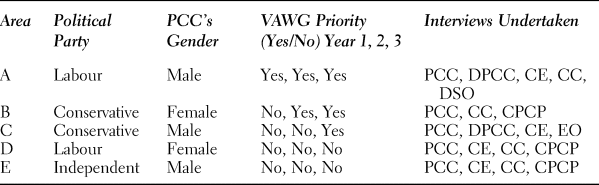
In identifying suitable case study sites, we used our quantitative data and sampled PCCs in relation to the following variables: whether the PCC was male or female; whether the PCC was a political party candidate or independent (nonparty); and whether the PCC prioritized VAWG as a policy outcome over the three-year period of annual priority setting from 2013 to 2016 (see Table 1). The sampled PCCs are units of analysis within what Yin (Reference Yin2009, 50) calls an “embedded case study,” in which subunits are investigated to add depth to the case study. We conducted 20 interviews in five contrasting subunits in England (Wales was not included because of differences in the wider governance landscape in which PCCs operated). Our aim was to investigate, in a detailed and contextualized manner, findings arising from quantitative research covering all 41 PCCs. Our research design enabled a focus on the enactment of rules by actors, including informal as well as formal rules. Case study sites and interviewees were anonymized. Interviewees included PCCs, deputies (DPCC), democratic services officers (DSO) and equalities advisers (EA) (where they existed), chief executives (CE), chairs of police and crime panels (CPCP), and chief constables (CC) (heads of operational policing). Our aim in interviewing the key actors around the PCC was to learn more about the stance of the PCC and gauge the extent to which his or her ways of working were understood, and shared, by those in the small staff team. Interviews were transcribed, anonymized, and double coded manually in relation to the key concepts. Quotations and extracts were selected to illustrate key concepts and were attributed (anonymously) to the roles listed earlier.
Selection of case study areas by key variables

Table 1 shows the key characteristics of each case study area: gender of the PCC, political control, whether the quantitative research identified VAWG prioritization in each of the three years of data collection, and the interviews that we undertook in each area. The table is presented in descending order of the extent to which we identified a prioritization of VAWG policy over the three-year period of quantitative data collection and analysis.
Our sampling strategy was limited because of the small number of female PCCs after the 2012 election (just 6 of 41), which reduced the opportunity to select among female PCCs according to the other variables and led to access difficulties (the possibility of substituting new units of analysis when refusals were received from initial choices). We were not seeking a structured or representative sample of PCCs, but a purposive sample that showed some level of variation, or at least contrast, in relation to the variables we had used in the quantitative work. The purpose was not to undertake a systematic comparison of the five units within the embedded case study, but rather to generate detailed and contextualized data from a range of contrasting settings. Because of sampling limitations and the size of the study, the qualitative findings cannot be considered as representative or generalizable to any population (or subpopulation) of PCCs. However, in the manner explained by Yin (Reference Yin2009), they do allow us to make analytical generalizations regarding the way in which actors work with rules-in-use to steer gender policy prioritization and the significance of moments of institutional transformation for gender policy change.
We present our research findings in three sections. The first section summarizes findings by case study area; the second section focuses on the new actors and their stance toward prioritizing VAWG; and the third section identifies the relevant institutional rules (formal and informal) that actors worked with to promote responses to VAWG.
SUMMARY OF RESEARCH FINDINGS BY CASE STUDY AREA
Here we provide vignettes of the five case study areas to demonstrate the contrasting approaches taken by PCCs on whether to prioritize VAWG and the different ways in which PCCs enacted and interpreted the institutional rules associated with their new office. The vignettes situate the subsequent discussion that seeks to identify the specific rules-in-use that are relevant in explaining how actors operated to prioritize VAWG policy and why the rules made a difference.
Area A was led by a male PCC whose previous political career included a period as a Labour minister in central government; he also had a professional background as a social worker. This PCC had a clear prioritization of VAWG across the three consecutive police and crime plans and annual reports that we analyzed. All our interviews confirmed this policy prioritization in practice. The PCC used the formal rules of his office to appoint a female deputy (DPCC), choosing someone with a long experience in the nongovernmental sector addressing the VAWG agenda. Both the PCC and DPCC used informal conventions associated with the status of the office (described by the DPCC as “clout”) to ensure a sustained policy focus on VAWG. They sought to build their evidence base on VAWG, requiring greater information from police officers on incidence and response while also establishing partnerships with local nongovernmental organizations (NGOs) working with survivors.
Area B was led by a female Conservative PCC who had previously worked in both the NGO and private sectors, where she had some experience of working with young female victims of crime. She drew on this experience once elected and was able to make VAWG a priority in Years 2 and 3. All interviewees confirmed this commitment and prioritization in practice. The PCC held regular drop-in sessions for members of the public, at which she was often directly approached by female victims of abuse. She also used formal powers under the United Kingdom's equalities legislation to commission research on VAWG, and she committed resources to NGOs providing services for victims of domestic violence under commissioning powers specific to the PCC office. This PCC exploited informal party channels of communication with elite actors inside central government to lobby for more resources to deal with sexual abuse.
Area C was led by a male Conservative PCC with no previous experience of VAWG or gender issues. The interviews show that his understanding of VAWG grew during his period of office, and he made it a priority in his third year in office. This PCC held drop-in sessions for the public in collaboration with the NGO Victim Support and sought a variety of ways of meeting voters to better understand their policing priorities. He used his commissioning powers to fund domestic and sexual violence services, and also used his media visibility to challenge municipal governments on their VAWG services, leading to an increase in resourcing. As in Area B, this PCC directly lobbied the secretary of state for health (central government), using Conservative party connections, to seek support for a specialist referral center for abused children. An equalities officer was appointed late in his term of office (shared with another public agency), further developing capacity for equalities assessment related to VAWG.
Area D was led by a female Labour PCC with significant previous political experience, including as a Labour government minster. While our quantitative analysis of formal documents had not identified VAWG prioritization in the area, the qualitative research indicated that addressing VAWG was actually a key goal, which was embedded in the PCC's prioritization of victim support (in practice having a highly gendered orientation). This was confirmed by all our interviewees and was clearly a shared understanding among relevant actors. The policy process in this PCC area was informed by the PCC's prior political experience of using evidence-based policy processes and, specifically, equalities duties and assessments. This use of data and evidence-based commissioning led to the delivery of new therapeutic services for VAWG survivors.
Area E, which was led by a male independent (nonparty) PCC, showed no prioritization of VAWG through our quantitative analysis and this was confirmed by our interviews. The male PCC came from a commercial public relations background and had no prior experience or knowledge of the VAWG agenda. The single, unchanging priority over the three-year period under study was the protection of the number of police posts in the area. Attention to VAWG in this area was driven by the operational police leadership (and junior police officers) rather than by the PCC.
In the next two sections, we draw on our qualitative research to analyze how new actors worked with new rules to secure VAWG as a policy priority. We start by presenting findings on the actors specifically and their experience and disposition in relation to VAWG. Next, we discuss the specific rules that were important in shaping action to prioritize VAWG, identifying the role of both formal and informal elements.
The New Actors: Implications for VAWG Policy Prioritization
The single biggest institutional change associated with the new office of the PCC was that of direct election, with PCCs replacing appointed police authorities. Our interviews highlighted the ways in which this gave PCCs personal authority and legitimacy to act. It was clear from our interviews that the different motivations and prior experience of each PCC influenced the extent to which this power was used to prioritize VAWG. The male PCC in Area A described his commitment to VAWG policy as being based upon his experience as a social worker, adding that he was “proud of that work.” This was confirmed by the chief constable in the same area: “From day one he put VAWG and sexual violence as being amongst his highest priorities.” A female PCC who prioritized VAWG in her second year in office explained that the role “combined my political interests with my interests in improving outcomes for people” (PCC Area B). These interests linked directly to VAWG, as she had acted as a trustee in an organization working with young female sex workers, having found that elsewhere “there was nobody championing the needs of these people.” A third PCC, who developed a prioritization of the needs of young victims of sexual abuse toward the end of his period in office, described his growing awareness of the problem of VAWG in personal and paternalistic terms: “I had two children [i.e., of his own], then in this job I had 2,000” (PCC Area C).
The female PCC in Area D did not show a prioritization of VAWG in our quantitative analysis (which relied on formal documents), yet our interviews revealed that she did have a focus on victims, which in practice was highly gendered. This PCC stated that she had found herself prioritizing support to survivors of VAWG, because this was where the gaps in provision lay. She noted, pragmatically, that she increased “support [to] victims of crime predominantly who are women because the gaps in support were in areas of domestic violence” (PCC Area D). This de facto prioritization of VAWG was confirmed in our interviews with other actors in the PCC office, including the chief constable, who remarked that “dealing with domestic abuse, violence against women, it's a priority for the PCC” (CC Area D). The chair of the police and crime panel in Area D concurred that “domestic violence is her major priority.” In contrast, in Area E, the PCC had not at any time seen VAWG as a priority; indeed his police and crime plan, unusually, had not changed over the three-year period of office. This PCC described his main priority as protecting police jobs. Reflecting the fact that the PCC came from a commercial background and had no prior experience with VAWG or gender issues, it was noted by the chief constable in Area E that “addressing sexual violence has not been a passion or drive or a core area of business.” The chair of the police and crime panel in that area confirmed that “gender issues do not appear at all on our business plan.”
Our interviews revealed that the institutional change associated with the introduction of PCCs brought new actors into police governance, with varying preexisting levels of commitment to, and knowledge of, VAWG. Where that commitment was present, they were able to “hit the ground running,” exploiting the fact of their direct election and personal mandate to prioritize VAWG in their police and crime plans. Where a preexisting awareness of VAWG was absent, however, we found that some PCCs came to prioritize VAWG one or two years into their term of office, as their knowledge of the issues grew. The interviews also showed that quantitative research can misrepresent patterns of policy prioritization, given its reliance on using formal documents and web sources. The qualitative work revealed that one PCC did not formally prioritize PCC but did so through informal means (as part of a wider focus on victims). It was clear also that depending upon PCCs’ personal commitments and prior experience, the way in which they framed their approach to VAWG varied, whether through a focus on victims, a paternalistic narrative, or a feminist statement of intent. These findings show that at times of institutional transformation, the potential for gender policy change is shaped by the arrival of motivated, knowledgeable, and reflexive actors.
The New Rules-in-Use: How Actors Work with Rules to Prioritize VAWG
In this section, we look at how these new actors, and their close staff, exploited the new rules-in-use of police governance to achieve prioritization of VAWG (in four out of the five cases) and how they shaped the development of these rules through their varied interpretations and enactments. Seven sets of rules are identified: the right to make key appointments; the requirement to set policy priorities; the obligation to utilize equalities duties; the power to commit resources; the expectation of partnership working with other agencies; the commitment to hold operational police officers to account; and the maintenance of diverse channels of contact with victims of crime and the wider public. We start by looking at the formal rules, underpinned by legislation and guidance that influenced VAWG policy prioritization. We then tease out the other informal rules that also shaped VAWG-related action.
The legislation governing the role and remit of PCCs gave these new directly elected actors the power to appoint a deputy. In Area A, the PCC appointed a deputy with specific expertise in tackling domestic abuse. Moreover, this DPCC came from a community-based NGO that supported survivors of VAWG and had worked closely with the police from a victim's perspective. The PCC delegated authority to her on the VAWG agenda, and she reported that her new institutional role “gave me clout—if the deputy PC invites you to a meeting, people come and participate” (DPCC Area A). The DPCC drew on her prior experience to insist upon the establishment of reporting systems on the incidence of VAWG and on police responses. A second PCC appointed a deputy from the same Conservative party background as himself (an elected local government councilor) (PCC Area C). This PCC also appointed an officer with a focus on equalities, shared with another local agency, in the latter part of his first term of office. The PCC in Area B did not appoint a deputy but her chief of staff shared a Conservative party background. The PCC in Area D also declined to appoint a deputy, but her chief executive officer had worked for her when she was a minister in a previous Labour government, thus having considerable political acumen and a strong personal relationship with the PCC. This individual also had particular experience of working with equalities legislation and evidence-led service commissioning, which fed into Area D's focus on the gendered aspects of victimhood. The PCC in Area E did not use the powers of appointment allowed by the new formal rules.Footnote 6
It was also clear, and in line with our earlier quantitative findings, that where PCCs used an expansive version of their formal equalities duties, this was associated with the prioritization of VAWG. The PCCs in Areas A, B, C, and D all linked these duties to the establishment of new systems for recording the incidence of VAWG and police responses. Such systems were developing the status of rule-in-use, shaping expectations about both the collection of evidence and its use in VAWG service planning. In three areas (A, B, and D), an expectation had also developed that wider research would be commissioned to support the PCC's understanding of VAWG trends. The chief executive in Area D argued that evidence-based commissioning “makes gender differences visible” within crime and policing data.
The new institutional rules associated with the office of the PCC enabled the commitment of funds to support VAWG policy prioritization—either through commissioning services to fill gaps or ensuring the protection of funding for existing services. There was evidence across the cases of the development of a “partnership rule,” which shaped action in favor of establishing VAWG-related partnerships with relevant agencies outside the police and with community-based NGOs. In Area A, the PCC had used partnership working to support women's refuges in the area and to develop a strategy of co-commissioning with local government in order to ensure VAWG services were maintained and delivered through legally binding contracts. In Area E, where the PCC had not prioritized VAWG, the chief constable explained that VAWG initiatives were led by the police, with general support from the PCC: “the PCC has supported Victim Support and the Force's initiative around domestic abuse.” The chief constable was critical of the weak implementation of new conventions around partnership working, describing them as simply “box ticking.” Experience in Area E suggested a link between a low commitment to the partnership rule and low VAWG prioritization.
In Area B, the PCC reported that she had utilized powers to commit resources under the new institutional arrangements to secure a significant rise in support for VAWG services (up 140% since coming into office) and funding for a new online service for reporting child sexual abuse. In Area C, the PCC used the new powers to ensure the geographical coverage of sexual assault referral centers within his area, and to invest in VAWG advisers (while lobbying local government to do the same). In Area D, the evidence on VAWG commissioned by the PCC showed a gap in therapeutic services, leading to the development of new provision.
Interviews also revealed the emergence of informal rules that enabled PCCs to use “soft power” to challenge, lobby, and pressure for change with respect to established VAWG policies and services. New formal rules requiring PCCs to establish policy priorities were accompanied by new informal conventions that shaped action to challenge existing practice within the police and other relevant agencies with respect to VAWG. A “challenge rule” was mentioned, with no prompting, by several PCCs. The DPCC in Area A described the importance of challenging traditional policing practices on VAWG in her area. She described the police as a “long established organization who are used to working in a particular way,” which led to defensiveness in the face of proposals for change, especially below the senior ranks (DPCC Area A). In response, she set up a specific domestic violence policy for police employees, as a way of highlighting the widespread prevalence of VAWG among all social groups. In Area B, the PCC utilized the new challenge rule to enable a major increase in VAWG funding, commenting that this achieved “a complete reversal of what the [police] force was planning.” Despite being informal, this emerging rule-in-use enabled PCCs to challenge their own police forces and other key partners and had a direct impact on the direction of the VAWG agenda in their areas.
In Area E, however, we were told that the PCC deferred to the chief constable, especially on “tricky issues,” and was reluctant to hold the police chief to account. The police and crime panel chair admitted to “embarrassing the PCC in public” by insisting that he, rather than the chief constable, answer questions at the panel. As the chair put it, “We were happy to have him get the chief constable to elaborate but we wanted the answers from him.” The chair acted to “make it clear that the chief constable has no right of audience in our proceedings” but could attend only by invitation of the panel. Thus, the existence of the challenge rule was made clear by the sanctions used to enforce it, which took the form of social disapproval and the effective removal of the chief constable from the forum.
In Area B, the PCC described a key part of her role as scrutinizing police action and associated services, arguing that “we're really thorns in the their sides, trying to get the best service for our local victims.” In Area C, the PCC challenged both police management structures and local government provision, justifying this in terms of the need to secure consistency of VAWG policing across the area. As the PCC explained, “If you were raped in one town as opposed to another, the way you were dealt with, the resources available, would vary” (PCC Area C). This PCC also leveraged a commitment from the NGO Victim Support to recruit more local volunteers in return for additional funding and the opportunity to scrutinize police services in greater depth. The PCC described clearly the way in which soft power, sanctioned by informal institutional rules, could be brought to bear: “I have the ability to challenge and the most powerful thing I've got is my connection with the media and to place things in the court of public opinion” (PCC Area C). Informal rules are enforced by informal means (and no less powerful as a result), with the enforcement mechanism here being “the court of public opinion.”
PCCs in all our case study areas appeared to observe an informal rule creating a de facto duty to challenge police and other relevant partners on behalf of victims. Sometimes this was done overtly through public forums, but we also observed more private forms of lobbying that were shaped by the same expectation. In Areas B and C, the PCCs reported that they lobbied government ministers, facilitated by their personal party connections linking them to the Conservative government. In Area B, the PCC lobbied both the secretary of state for health and the Home Office to seek support for a new sexual assault referral center as part of wider community health provision (rather than located such services in police stations). The chair of the police and crime panel in Area B reported that, following this intervention, “the matter was sorted within weeks.” The PCC in Area C also contacted the secretary of state for health to lobby for a new sexual assault referral center in the area.
We have documented the role of formal rules (linked to equalities duties) in shaping data analysis for evidence-based commissioning and equalities monitoring on the incidence of crime and victimhood. However, interviews also showed that formal rules were accompanied by an informal expectation that information should be gathered directly from the public and the police. The Deputy PCC in Area A chaired a victims’ group and, through this group, developed a “victims’ code” that she felt was becoming institutionalized, arguing that it would be “difficult to stop doing,” even after she left her role.Footnote 7 We also found that PCCs were engaging directly with street-level police officers, rather than relying on the senior leadership of the police force. The DPCC in Area A argued that police officers “loved having someone to talk to about their everyday work” and that the information she gleaned from this new approach had led her to develop a domestic violence policy for the police force. This informal “consultation rule” was also evident in the PCCs’ establishment of drop-in sessions for members of the public, providing opportunities for the PCC to speak directly with victims. The PCC in Area B noted that drop-ins proved to be a venue in which domestic abuse that had not previously been reported came to light. The PCC in Area B felt that being accessible through drop-ins provided a particularly important opportunity as it enabled VAWG survivors to “access the police at a senior level.” She also argued that women's access was enhanced “because I am a female PCC.” The PCC in Area C also held drop-ins for the public, organizing them in the offices of the community organization Victim Support.
DISCUSSION
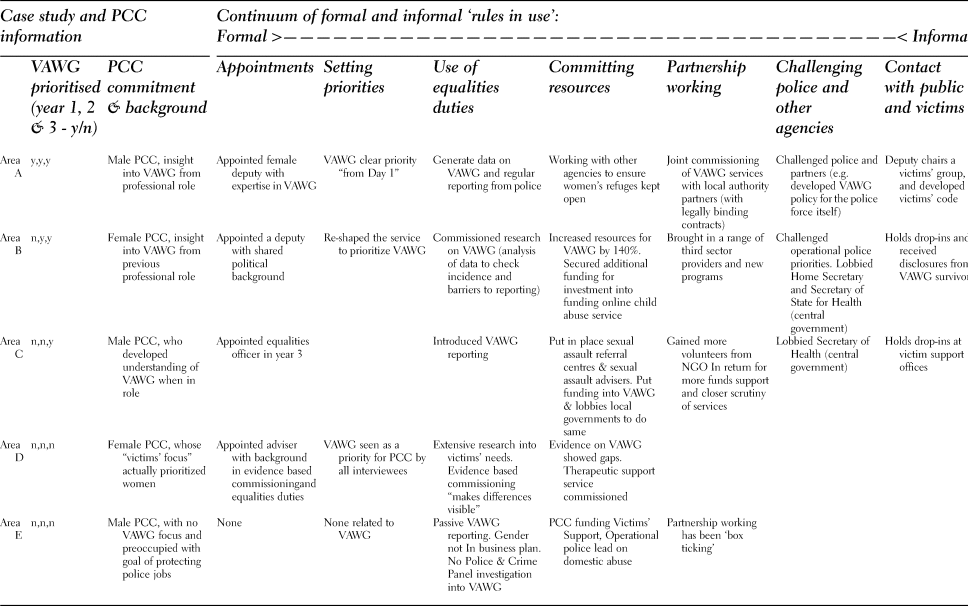
Table 2 summarizes our findings on actors and rules-in-use for the five case study areas. The table shows the characteristics of the individual PCC (including whether and when the PCC prioritized VAWG) alongside the seven sets of rules identified in the fieldwork. The cells explain how actors worked with these rules (or not) in each of the five case study areas.
- Summary of findings in five case studies

As Table 2 shows, four out of five of the case study PCCs prioritized VAWG, but in only one case was this from the start of Year 1. Our quantitative analysis (using formal documents) identified that in three cases, prioritization emerged only in Year 2 or 3 of PCCs’ term of office. The qualitative research explored what lay behind this dynamic. The case studies showed that it took time for PCCs to understand fully the extent of VAWG challenges on the ground and to recognize the potential of their new formal powers and responsibilities. PCCs also developed over time a new set of informal conventions that supported VAWG policies; it was expected that they would challenge operational police chiefs, lobby central government for resources, convene local partnerships, and proactively engage with victims and the wider public. In one area, where our quantitative research (relying on formal documents) had not established VAWG as an official priority, the qualitative research revealed that, in practice, it was. The PCC's focus on victims precipitated a focus on VAWG, as gender-disaggregated data revealed the prevalence of gendered crime.
Methodologically, these findings demonstrate the value of qualitative methods for uncovering how rules are interpreted and enacted on the ground and exploring how such processes develop over time. Theoretically, the research demonstrates that the relevant rules-in-use may be formal or informal and may be specifically “about gender” (as in the equalities duty) or may be rules that have “gendered effects” (as in priority setting in favor of victims). For feminist institutionalists, this points to the importance of scrutinizing all institutional elements at time of change, not just those that target women, to establish their gendered effects.
Our quantitative work showed that women PCCs were more likely to prioritize VAWG than men, but the qualitative research enabled us to study the ways in which both male and female PCCs acted to prioritize VAWG (although the male PCC in the fifth case did not prioritize VAWG). While these five cases cannot be seen as representative of all PCCs, the research points to the significance of PCCs’ background, knowledge, and commitment with respect to VAWG and their capacity to learn and make sense of evidence. These individual-level factors, alongside the personal autonomy associated with a directly elected executive role, shaped how different actors interpreted their mandate, powers, and responsibilities and made decisions on resource allocation to address VAWG. Thus, our findings throw light on the wider literature about the significance of elected executive actors (vis-à-vis legislators) in securing gender policy with respect to “status policies” (that affect women's bodily integrity). Theoretically, our work underscores the utility of a micro-foundational approach for understanding what happens at times of institutional change. Rules do not “do the work” themselves; rather, their effects depend upon how they are interpreted and enacted by embodied, knowledgeable, and reflexive actors—who may or may not be women. The rules-in-use concept captures rules and their enactment in combination.
The research demonstrates that rules-in-use are typically an amalgam of formal and informal rules. We argue that such formal and informal elements are better positioned along a continuum than on either sides of a clear binary. Levels of formalization are likely to vary over time and between cases. Some rules sat at the most formal end of the continuum (e.g., the power to make appointments); others sat in the middle (e.g., formal partnership mechanisms bolstered by informal conventions around convening); and still others were positioned at the most informal end (e.g., liaison with the public and victims) but were becoming more formalized over time (as fixed drop-in times and venues were established). We have shown how the rules-in-use concept can grasp the coexistence of, and dynamic relationship between, formal and informal rules. While differing in their level of formality, all the rules met the same theoretical threshold. All took the form of institutionalized expectations about appropriate behavior. While the rules were more or less embedded in different cases, we found high levels of recognition across all interviewees. Moreover, such rules were subject to sanction, formally through recourse to the law (and audit) and informally via social disapproval (e.g., embarrassing a noncompliant PCC in public). As one PCC put it, reflecting on his own experience: “You can be a maverick but it doesn't work” (Area E).
Methodologically, the value of the rules-in-use concept lies in its capacity to uncover all relevant institutional elements in a given empirical setting, making no prior assumptions about the dominance of either formal or informal rules. Our research shows that it is possible to distinguish informal rules from personal habits or social practices more generally. Like formal rules, they meet threshold conditions of regularity, recognition, and enforcement, even if their specific modalities are different. Theoretically, the concept allows feminist institutionalists to rebut those critics who argue that the inclusion of informal rules amounts to conceptual stretching, with attendant risks of nonfalsifiability (e.g., Peters Reference Peters1999, 144–42, 216). Routes for studying the informal have immense significance for feminists, given our knowledge (and experience) of how informal conventions can undermine formal commitments to gender equality, while also providing channels for building new gender-friendly institutions “below the radar.”
Empirically, the research has contributed to the gender policy change literature, and VAWG studies in particular, by exploring the role of directly elected executive actors with high levels of public visibility and individual accountability. It confirms their capacity to act in favor of VAWG policy but points to the significance of personal factors (for both women and men) such as motivation, knowledge, and learning capacity. The research responds to calls in the VAWG literature to focus upon the less well-researched areas of local governance and public administration. It reveals the potential of institutional factors to support VAWG prioritization, drawing attention to the role of non-gender-specific rules and conventions (e.g., direct election, executive accountability, partnership working and openness to citizens), thus shifting the debate beyond the familiar (but important) territory of women's policy machinery. In the face of widespread gender backlash, it may be particularly important for feminist reformers to understand the potential of such elements to sustain gender equality commitments.
CONCLUSION
The new institutional rules associated with the 2012 English PCC reform have shaped VAWG policy in significant ways. Positioned along a formal-informal continuum, they have assumed the status of rules-in-use because they provide regular, relatively stable, and enforceable guides to action. Such rules are recognized by PCCs themselves and their close staff (to different degrees across the five areas) and are impacting relationships with the police force, other local and national bodies, victims of crime, and the wider public. They have become, in Ostrom's (Reference Ostrom and Sabatier1999) words, “the way things are done around here.”
The combined and cumulative effect of these rules-in-use is potentially profound for policy to combat VAWG. Taken together, they are serving to turn the old expectations of police governance on their head (at least in the best cases). The new rules-in-use recast the governance of policing from a victim's rather than a police force perspective. The new rules express new value commitments—that the elected PCC works for the public (and victims especially) and is not there to support uncritically the chief constable or to protect the interests of the police force (as was alleged to be the case under the previous arrangements). These changes are important for the simple reason that women are disproportionately the victims of crime. PCCs’ more gender-sensitive evidence bases are also revealing more about women's experience of crime and where gaps lie in police responses and victim services. We have seen how more visible and accountable elected executive actors are working with a range of new institutional rules to secure gender policy change. Further research is needed to test our conclusions in a larger range of PCC areas and to apply the same conceptual and methodological tools to other instances of institutional change.
Through a focus on micro-foundations, the research has made a broader conceptual contribution to understanding the determinants of gender policy change and the significance of moments of institutional transformation. Our mixed methods approach has allowed us, over sequential phases of research, to analyze how executive actors are working with more and less formal institutional rules to secure VAWG prioritization. With the exception of the equalities duties falling on all U.K. public service bodies—which played an important role in surfacing the incidence of VAWG and gaps in service provision—the rules we identified were not “rules about gender” but rather “rules with gendered effects.” Such rules often have negative impacts for women because of the way they interact with wider conventions about gender roles. However, our research contributes to the feminist institutionalist literature by showing how supposedly gender-neutral rules can support gender policy change at times of institutional disruption, where they are interpreted and enacted by motivated, knowledgeable, and reflexive actors.