At the 32nd Bethesda Conference in 2000, it was estimated that there would be ~2800 adults with CHD per one million in the general population, with >50% having moderate-to-highly complex defects.Reference Warnes 1 , Reference Williams and Webb 2 This places the absolute estimate at greater than one million adults with CHD. As a result of decreasing mortality and increasing survival in all forms of CHD, the median age of patients continues to increase, and adults now comprise greater than two-thirds of all patients with CHD.Reference Mazor Dray and Marelli 3 , Reference Webb 4 This incremental adult CHD growth over the last few decades has also resulted in an increasing number of pregnant women.
CHD now supersedes other forms of cardiac disease such as ischaemic, dilated, or valvular heart disease in women during their childbearing years. The majority of women appear to tolerate pregnancy well without major cardiovascular complications despite their underlying cardiac conditions.Reference Wacker-Gussmann, Thriemer, Yigitbasi, Berger and Nagdyman 5 In spite of improved care, however, it has been shown that pregnant women with CHD experienced more maternal and neonatal complications than those without as well as those with other forms of cardiac diseases.Reference Wacker-Gussmann, Thriemer, Yigitbasi, Berger and Nagdyman 5 – Reference Khairy, Ouyang, Fernandes, Lee-Parritz and Economy 7 Pre-pregnancy counselling must be provided by cardiologists who have expertise in both CHD and pregnancy with a detailed clinical assessment of the patient and the current haemodynamic situation. In each case, the approach must be individualised with consideration of the risks in each case.Reference Warnes 6
This study was performed to investigate the perceived knowledge and perceptions of women with CHD as it relates to pregnancy. Enquiry regarding management during pregnancy, preference in cardiology training for potential providers, such as adult CHD, adult, and paediatric training, contraception counselling, need for fetal echocardiography, parturition planning, and involvement of maternal–fetal medicine specialists as it relates to individual CHD lesion was undertaken.
Methods
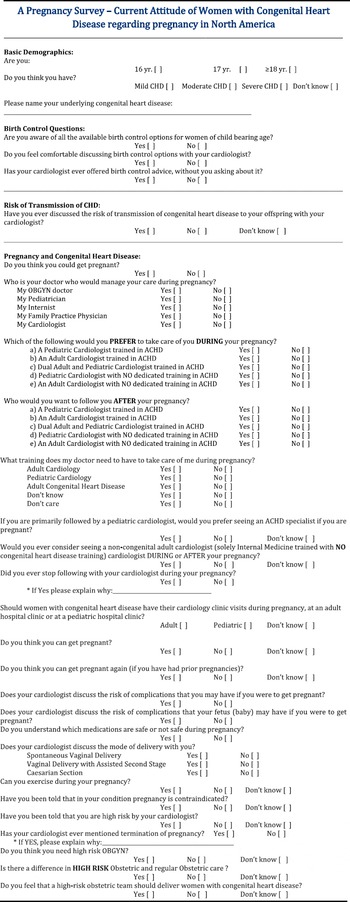
Participants were surveyed at a national adult CHD conference in 2014. This was a single-site, cross-sectional, anonymous voluntary survey. All participants completed a 50-question survey (Table 1). Each surveyor was fully de-identified. Inclusion criteria were all women with any form of CHD aged ⩾18 years, who had been pregnant at least once. Incomplete surveys and patients with developmental delay were excluded from the final analysis.
Questionnaire.

Results
Complexity of CHD
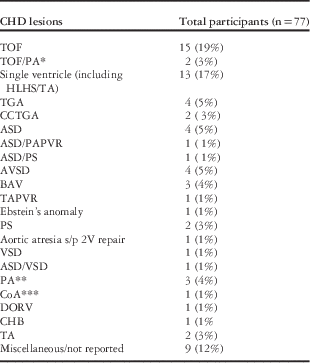
A total of 77 women completed the survey. On the basis of their own assessment, 29 had severely complex CHD, 39 moderately complex, and five had mild CHD (Table 2); two surveyors were unsure, and two omitted this question. Among the 13 women with single-ventricle physiology, seven reported severely complex CHD, five moderately complex CHD, and one did not know the underlying complexity. Among the 17 women self-identified as having tetralogy of Fallot, six reported severely complex CHD, 10 moderately complex CHD, and one mild CHD.
Self-reported incidence of CHD lesions by the participants.

1V=1 ventricle; 2V=2ventricle; ASD=atrial septal defects; AVSD=atrioventricular septal defects; BAV=bicuspid aortic valve; CCTGA=congenitally corrected transposition of great vessels; CHB=complete heart block; CoA=coarctation of aorta; DORV=double-outlet right ventricle; HLHS=hypoplastic left heart syndrome; PA=pulmonary atresia; PAPVR=partial anomalous pulmonary venous return; PS=pulmonary stenosis; SV=single ventricle; TA=tricuspid atresia; TA=truncus arteriosus; TAPVR=total anomalous pulmonary venous return; TGA=transposition of the great arteries; TOF=tetralogy of Fallot; TOF PA=tetralogy of Fallot with pulmonary atresia; VSD=ventricular septal defects
* Included a patient with Eisenmenger’s syndrome
** Unclear 1V or 2V status
*** Includes one patient with BAV
Pre-conception cardiovascular risk assessment
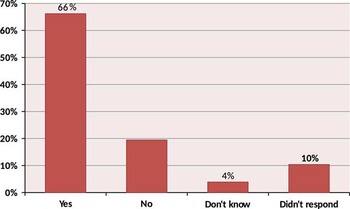
Among the respondents, two-thirds of them (66%, n=50) were told they were at high risk for adverse cardiovascular events, whereas 20% (n=15) reported that their cardiovascular risk during pregnancy was not discussed with them (Fig 1). The predominant groups among those women who were told they were at high risk for adverse cardiovascular events were those with single-ventricle physiology (n=10) and tetralogy of Fallot (n=9), including two women with concomitant pulmonary atresia.
Pre-conception cardiovascular risk assessment.

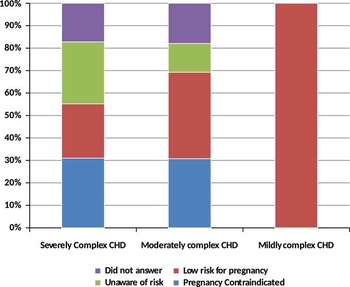
Owing to their underlying cardiac condition, 30% (n=23) of women were told that pregnancy was contraindicated. Out of the 29 women who thought they had severely complex CHD, nine were told that pregnancy was contraindicated, seven were advised that they were at low risk, eight women did not know their risk assessment, and five did not answer the question. In the moderately complex group (n=39), 12 were told that pregnancy was contraindicated, 15 were deemed to be at low risk, five women did not know their risk assessment, and seven did not answer the questions. None of the women with mildly complex CHD were told that pregnancy was contraindicated. Out of the 13 women with single-ventricle physiology, seven were told that pregnancy was contraindicated, three women did not know their risk assessment, two did not answer the question, whereas one woman thought that risk for adverse events was negligible.
The risk of cardiac complications during pregnancy was reportedly reviewed by their cardiologist in only 66% (n=51) of the respondents. More than half of the respondents (52%, n=40) thought they could get pregnant regardless of their condition, whereas 11% (n=9) were not sure despite having sought regular cardiology care.
Out of all the women (n=29) with conotruncal abnormalities – including d-transposition of the great arteries, congenitally corrected transposition of the great arteries, double-outlet right ventricle, tetralogy of Fallot, and truncus arteriosus – only 16 women had discussions regarding recurrence risk in their offspring. In women with congenital aortic stenosis/bicuspid valve (n=6), only four had discussed recurrence risk with their cardiology providers.
Involvement of high-risk maternal–fetal medicine/modes of delivery
In all, 72% (n=56) of women – two with mild CHD, two with unknown complexity of their CHD, 19 with moderate CHD, and 22 with severe CHD – felt that they needed high-risk obstetrics/maternal–fetal medicine to be involved with their pregnancy and delivery. Only eight women (10%) women with moderate-to-severe complex CHD felt that they did not need high-risk obstetrics/maternal–fetal medicine involved in their care, whereas 4% (n=3) did not know about their situation. Alternatively, out of the 11 women who did not think they needed high-risk maternal–fetal medicine care, there were four who perceived their CHD complexity to be severe, one mild CHD, and six moderate CHD; this included four women with tetralogy of Fallot, two with single ventricles, and one woman with transposition of the great arteries. The different modes of delivery were reportedly discussed by their healthcare providers in only 35% (n=27) of the respondents.
Contraception
The majority of women (88%, n=83) knew about contraceptive options and a similar number (84%) reported that their cardiologist discussed contraceptive measures with them before getting pregnant. Out of the 13 women with single-ventricle physiology, 10 women had discussed contraception with their providers.
Physician preference
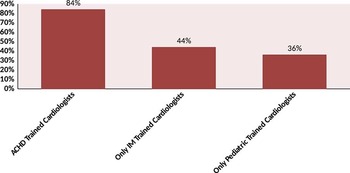
During pregnancy, 84% (n=65) of the respondents preferred their cardiologist to be specifically adult CHD trained, 44% (n=34) were satisfied with adult internal medicine-trained cardiologists, and 36% (n=28) with paediatric cardiologists, without dedicated adult CHD training in each case (Fig 2). Regarding trained adult CHD providers, 70% (n=54) respondents preferred the adult CHD provider to have an internal medicine and adult cardiology background, rather than being paediatric cardiology trained.
Cardiologist preference during pregnancy based on cardiology training. ACHD=adult congenital heart disease; IM=internal medicine.

Self-perceived pregnancy risk assessment by women based on underlying complexity of CHD.

Facility preference during prenatal care
In all, 77% (n=54) of women favoured having their prenatal cardiology visits at an adult facility, whereas 14% did not have a preference between adult versus paediatric facilities. Only 9% of women preferred their prenatal visits at a paediatric facility.
Fetal echocardiography
The need for fetal echocardiography was reported by only 48% (n=37) of the respondents, despite all women having underlying CHD. Despite all women having CHD, only 62% reported having discussed fetal risks with their cardiologists.
Discussion
As socio-economic strata and female literacy improve and as maternal age advances, women are delaying their plans of childbirth well into their fourth decade of life. This in turn coupled with adult co-morbidities of obesity, hypertension, coronary artery disease, diabetes mellitus, and hyperlipidaemia, which usually manifest around the same time, increases the relative cardiovascular risk regardless of their CHD.Reference Warnes 6 Although maternal deaths in pregnant women with CHD are rarely reported, maternal cardiac and neonatal complications are considerable.Reference Khairy, Ouyang, Fernandes, Lee-Parritz and Economy 7
During childhood, many young women with varying severity of CHD are advised against pregnancy. As our understanding of the unique issues facing adults with CHD has increased, we now recognise that many of those limitations need not be as stringent as previously assumed. Although some patients with CHD may not tolerate the haemodynamic changes of pregnancy, several women have sufficient cardiac reserve to carry a pregnancy to term.Reference Stout 8
Many patients are not appropriately transitioned into adult care,Reference Warnes 1 , Reference Webb 4 and it is known that poor transition and follow-up of young patients with CHD can impact the quality and duration of their lives. Women with CHD who have not been transitioned to adult CHD specialists are either followed-up primarily by paediatric cardiologists, sporadically by adult internal medicine cardiologists, or are lost to care. Patients with CHD need education, especially throughout adolescence about the implications of their condition, the differences between paediatric and adult services, and self-care management.Reference Heery, Sheehan, While, Coyne and Landzberg 9
The risks associated with pregnancy in women with CHD include adverse maternal and fetal outcomes. Pregnancy results in significant haemodynamic changes that may or may not be well tolerated in women with CHD. Determining which women are at increased risk of adverse outcomes and providing advice about pregnancy are optimally carried out before conception as part of a full cardiac evaluation, so that patients understand the risk that they may have during the pregnancy and the peri-partum period.Reference Wacker-Gussmann, Thriemer, Yigitbasi, Berger and Nagdyman 5 – Reference Khairy, Ouyang, Fernandes, Lee-Parritz and Economy 7
On the basis of this survey results, women were unclear about the nature of their CHD and/or the degree of complexity despite having complex CHD (Fig 3). This included women with single-ventricle physiology or repaired tetralogy of Fallot who felt they had CHD of only mild complexity, reflecting their lack of understanding of their underlying lesion and its sequelae. Our results also suggest that the role of clinicians, both obstetricians and cardiologists, is pivotal in the care of such patients, in educating them about their underlying lesion and its implications during pregnancy, and the risk it may carry for their offspring. As most women with CHD of childbearing age are presumed to be sexually active, these results further support the discussion that education for patients with adult CHD with regard to their underlying CHD, cardiovascular risk assessment during pregnancies, family planning, and contraception should begin in adolescence, both to prevent accidental and possibly dangerous pregnancies and to allow patients to plan their lives accordingly.Reference Lindley, Madden, Cahill, Ludbrrok and Billadello 10 – Reference Kovacs, Harrison, Colman, Sermer, Siu and Silversides 12
Women with CHD should undergo risk stratification and should clearly understand their underlying risk based upon the physiological changes during pregnancy with data supported by existing knowledge of specific heart diseases, especially those that carry high risk for mortality. Risk assessment should be discussed in detail with each woman who is pregnant.Reference Warnes 6 Management of pregnancy, delivery, and post-partum care needs to be discussed and optimised for each pregnant woman with CHD. Although two-thirds of women with CHD appear to tolerate pregnancy fairly well, complex CHD has been associated with more adverse cardiovascular events than simple CHD (odds ratio 2.0, 95% confidence interval 1.4–3.0), and death occurred in CHD versus non-CHD (multivariate odds ratio 6.7, 95% confidence interval 2.9–15.4).Reference Kafka, Johnson and Gatzoulis 13 In addition, maternal CHD is associated with a marked increased risk for cardiovascular events and death during pregnancy; risks continue into the peri-partum period as well.Reference Opotowsky, Siddiqi, D'Souza, Webb, Fernandes and Landzberg 14 Despite these statistics, only a third of women had discussed the different modes of delivery with their healthcare provider. This reflects the lack of knowledge not only on the part of the patients but also on the part of their providers.
The location of prenatal care, peri-partum care, and immediate post-partum care has to be established for this complex cohort of patients. A previous study has suggested that caring for an anticipated ageing adult congenital population with increasingly numerous coexisting medical problems and risk factors is best managed in an adult hospital facility.Reference Kogon 15 In our survey, the majority of women preferred to be seen at an adult facility/hospital for their prenatal care.
Preference of cardiologist during and after pregnancy was of prime importance to the surveyed women. During pregnancy, an overwhelming majority of woman (84%) preferred to be seen by an adult CHD physician to seek care during pregnancy. When women were not seen by adult CHD physicians, it appeared to be fairly equally split between their preference of paediatric versus adult cardiology. In addition, 70% of women preferred purely adult CHD-trained physicians to be their primary long-term cardiac caregivers after delivery; however, this may represent a bias towards adult CHD providers as the survey was performed at a large national adult CHD conference.
Women with any type of CHD should be advised of the risk that their offspring may also be affected, and fetal echocardiography is recommended; however, about half of the surveyed women were unaware that fetal echocardiograms should have been performed, again reflecting the lack of awareness and education about their underlying cardiac condition.Reference Ngu, Hay and Menahem 16 , Reference Ngu, Hay and Menahem 17 This emphasises the need for clinicians and patients to have adequate and detailed knowledge of the cardiac abnormality and its implications in pregnancy.Reference Ngu, Hay and Menahem 17
Limitations
Our study has several important limitations. This was a single-site, cross-sectional survey held at a national adult CHD conference in the United States of America. The populations surveyed were women from around the country with the likelihood of a higher literacy background, representative of a more motivated group, and possibly a higher socio-economic background. Our small sample size was skewed towards low risk of having an infant with CHD. Although the questionnaire developed was not psychometrically validated as a scale, it was specifically constructed to gather qualitative data pertinent to the study, drawing on relevant published literature. Future studies may wish to explore the perceptions of women with CHD who were advised against a pregnancy because of the severity of their cardiac status, who had unsuccessful pregnancies, or who got pregnant and were advised to terminate.
Conclusion
The long-term issues surrounding this growing population of patients will only increase in importance as more women with CHD reach childbearing age. This study suggests that women with CHD were undereducated and were not utilising resources that would potentially benefit them. Care specific to the CHD lesion as it relates to pregnancy should be available and known to patients and providers alike. Despite seeking medical care, pregnant women with CHD did not have a full understanding of their underlying CHD, risk for adverse cardiovascular events during pregnancy, need for fetal echocardiography, and the involvement of physicians trained in CHD and high-risk maternal–fetal medicine. Careful, individualised, pre-pregnancy risk assessment and counselling, including assessment of risks in the mother and offspring, will enable informed decision making by both patients and providers. Further efforts are needed to improve the knowledge, attitudes, and perceptions of women with CHD in relation to their cardiac and obstetric management during pregnancy.
Acknowledgements
Adult Congenital Heart Association – for allowing us to conduct the survey.
Financial Support
This research received no specific grant from any funding agency or from commercial or not-for-profit sectors.
Conflicts of Interest
None.