Implication
The environmental implications of incorporating feed-use amino acid (AA) in pig and poultry diets were evaluated using Life Cycle Assessment of feed production. Regardless of the base ingredients, the incorporation of AA decreased potential eutrophication, terrestrial ecotoxicity and cumulative energy demand impacts of both pig and broiler feed, whereas its effect on climate change impact depended on the source of protein-rich ingredients. Feeds formulated to minimize greenhouse gas emissions also had the lowest values for cumulative energy demand, but not for other impacts.
Introduction
Livestock production has major impacts on the environment, affecting air, water and soil quality because of its emissions (Steinfeld et al., Reference Steinfeld, Gerber, Wassenaar, Castel, Rosales and de Haan2006). In intensive pig or broiler production, animals are most often fed with high-protein and -energy feedstuffs imported from outside the farm, the production of which involves crop products and industrial processes. Therefore, the production of complete feed contributes greatly to the environmental impacts of the pork (Blonk et al., Reference Blonk, Lafleur and van Zeijts1997; Carlsson-Kanyama, Reference Carlsson-Kanyama1998; Basset-Mens and van der Werf, Reference Basset-Mens and van der Werf2005; Nguyen et al., Reference Nguyen, Hermansen and Mogensen2010; de Vries and de Boer, Reference Vries and Boer2010) and chicken (Katajajuuri et al., Reference Katajajuuri, Grönroos and Usva2008) meat supply chain.
The amount and composition of feed proteins influence the growth and carcass quality of animals. Indeed, some amino acids (AAs, the protein constituents) are essential, that is, they cannot be synthesized by animals and need to be supplied by feed. In pig and poultry, lysine, methionine and threonine are the most limiting AAs for muscle deposition and are available as industrial products. The incorporation of feed-use (FU) AA in diets results in a reduced use of protein-rich ingredients such as soybean meal. Several studies have shown that the soybean meal used in Western Europe contributes to environmental impacts such as climate change and reduction in biodiversity as it is mainly produced in North and South America and sometimes associated with recent deforestation (Mattsson et al., Reference Mattsson, Cederberg and Blix2000; Eriksson et al., Reference Eriksson, Elmquist, Stern and Nybrant2005; Dalgaard et al., Reference Dalgaard, Schmidt, Halberg, Christensen, Thrane and Pengue2008). FU AAs are now commonly used in pig and poultry feed formulation, but to a different extent among countries, depending on local economic and environmental constraints. However, the environmental impacts of such strategies have been evaluated in a limited number of studies, often concerning a limited number of impacts (Lammers et al., Reference Lammers, Kenealy, Kliebenstein, Harmon, Helmers and Honeyman2010). The use of locally produced protein-rich feed ingredients, such as peas or rapeseed meal, is also important to consider, especially in Europe, which depends on overseas imports of soybean meal for animal feeding. Moreover, the type of protein source might affect the environmental impact of incorporation of FU AA.
Life Cycle Assessment (LCA) is a method generally accepted to evaluate the environmental impact of a product, including the resources consumed and the emissions to the environment involved during its entire life (Guinée et al., Reference Guinée, Gorrée, Heijungs, Huppes, Kleijn, de Koning, van Oers, Wegener Sleeswijk, Suh, Udo de Haes, de Bruijn, van Duin and Huijbregts2002). The objective of this study was to assess the environmental implications of incorporating l-lysine, l-threonine and FU-methionine in pig and broiler complete feeds using LCA.
Material and methods
LCA
Evaluation methodology
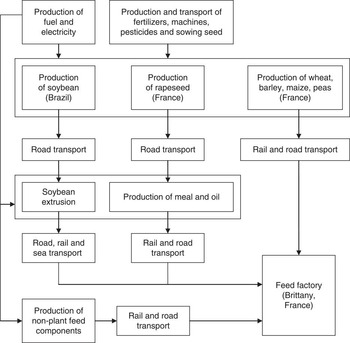
The present study deals with the production and transport of feed ingredients, including their delivery at the feed factory assumed to be located in Brittany (i.e. in northwestern France, Figure 1). Environmental impact results were expressed per kg of feed ingredient delivered to the feed production factory and per kg of feed at the exit gate of the feed production factory.
Flow diagram for the production and delivery of feed ingredients to the feed factory in Brittany (France).

Data with regard to resource use and emissions associated with the production and delivery of several inputs for crop production (fertilizers, pesticides, tractor fuel and agricultural machinery) came from the ecoinvent database, version 2.0 (Nemecek and Kägi, Reference Nemecek and Kägi2007). The production of seed for sowing was taken into account: we assumed that inputs required for seed production were similar to those required for the corresponding crop. We considered that crop products and feed ingredients produced in France were mainly transported by train to Brittany, whereas products imported to France were mainly transported from overseas.
Crop production
We assumed that soybean was produced in Brazil, as 60% of soybean meal imported in France comes from Brazil (Information Science, Technology and Applications (ISTA), 2009). We distinguished two soybean meals: one from the Centre West of Brazil, which is associated with recent deforestation (within 30 years), and one from the South of Brazil, which is not associated with deforestation (Prudêncio da Silva et al., Reference Prudêncio da Silva, van der Werf, Spies and Soares2010). Fertilization was mainly chemical, and inputs used were based on data from the Brazilian Agricultural Research Corporation (Embrapa). Soybean yields were averages for 2005 to 2008 (Embrapa). For other crops, inputs used were based on French government statistics (AGRESTE (La statistique, l’évaluation et la prospective agricole), 2006). Except for maize, crop production data used were French national averages based on data from the main production regions of production for the crop considered; yield levels were averages for 2004 to 2007. With regard to maize production, we distinguished maize from Brittany, which is not irrigated and mainly fertilized with pig slurry and maize, from Aquitaine (southwestern France), which is irrigated and mainly fertilized with mineral fertilizer.
Feed-ingredient production
For the processes of transformation of crop products into feed ingredients, data were based on Nemecek and Kägi (Reference Nemecek and Kägi2007) for maize drying and Nemecek and Kägi (Reference Nemecek and Kägi2007), and Jungbluth et al. (Reference Jungbluth, Chudacoff, Dauriat, Dinkel, Doka, Faist Emmenegger, Gnansounou, Kljun, Schleiss, Spielmann, Stettler and Sutter2007) for the production of soybean meal, rapeseed meal and rapeseed oil. Data were also obtained for phytase (Nielsen and Wenzel, Reference Nielsen and Wenzel2007), salt (Althaus et al., Reference Althaus, Chudacoff, Hischier, Jungbluth, Osses and Primas2007), monocalcium phosphate (LCA Food database, 2007) and calcium carbonate (Nemecek and Kägi, Reference Nemecek and Kägi2007). The premix was assumed to be mainly based on and to have the same impacts as calcium carbonate.
With regard to AA, published information on current industrial production is limited and we only distinguished products obtained by fermentation (i.e. l-lysine.HCl and l-threonine) from products obtained by chemical synthesis (i.e. dl-methionine and hydroxy-analogue hydroxy-4-methylthio butanoic acid (HMTBa), named FU-methionine in the rest of the text). Information on AA production was supplied by a working group on FU AA of FEFANA (EU Association of Specialty Feed Ingredients and their Mixtures, personal communication, 2010). It was assumed that the production of 1 kg of l-lysine.HCl or l-threonine required 1 kg of sugar, 0.5 kg of maize starch, 0.5 kg of wheat starch, 0.3 kg of liquid ammonia and 36 MJ of process energy at the plant, supplied as electricity (50%) and natural gas (50%). It was assumed that the production of 1 kg of dl-methionine required 0.43 kg of propylene, 0.27 kg of hydrogen sulfide, 0.39 kg of methanol, 0.21 kg of hydrogen cyanide and 7.4 MJ of process energy at the plant, supplied as electricity (50%) and natural gas (50%); these figures were used for FU-methionine in this study.
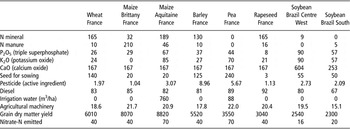
Many feed ingredients are co-products (e.g. soybean meal, rapeseed oil) resulting from processes yielding more than one product. For these ingredients, resource use and emissions were allocated according to the economic value of the co-products, which was calculated using extraction rates (the percentage of processed product obtained from the parent product) and costs. Extraction rates were taken from Food and Agriculture Organization (FAO; 2002) and costs were 2004 to 2007 means from ISTA (2009). Table 1 summarizes main production characteristics of the crops.
Main inputs used, dry matter yield and nitrate-N emitted (all in kg/ha except irrigation) for the main crops used as feed ingredients (rapeseed and soybean after transformation)

Calculation of emissions
Emissions to air were estimated for NH3, N2O and NOx. Emission factors for NH3 volatilization following application of mineral fertilizer were based on Nemecek and Kägi (Reference Nemecek and Kägi2007). For pig slurry application (for maize in Brittany), we considered that 70% of nitrogen was ammonia, 20% of which volatilized (Basset-Mens et al., Reference Basset-Mens, van der Werf, Robin, Morvan, Hassouna, Paillat and Vertès2007). For bovine manure application (crops in addition to maize from Brittany), we considered that 10% of nitrogen was ammonia, 76% of which volatilized (Payraudeau et al., Reference Payraudeau, van der Werf and Vertès2007). Emission factors for N2O were based on Intergovernmental Panel on Climate Change (IPCC, 2006), and emissions of NOx were estimated according to Nemecek and Kägi (Reference Nemecek and Kägi2007) at 21% of emissions of N2O. Losses of NO3 to groundwater were based on Basset-Mens et al. (Reference Basset-Mens, van der Werf, Robin, Morvan, Hassouna, Paillat and Vertès2007), considering the nature of the previous crop and the duration of the period without the presence of a crop. Phosphate emissions to water were estimated according to Nemecek and Kägi (Reference Nemecek and Kägi2007) considering leaching to groundwater and run-off to surface water for soluble phosphate, as well as erosion of soil particles containing phosphorus. Emissions of Cd, Cr, Cu, Ni, Pb and Zn to the soil were calculated according to a mass-balance approach considering input by synthetic and organic fertilizers and output via harvested produce. Heavy-metal content of fertilizers was based on Nemecek and Kägi (Reference Nemecek and Kägi2007).
Characterization factors
The following impact categories were considered: climate change (corresponding to greenhouse gas emissions, g CO2-eq.), eutrophication (g PO4-eq.), acidification (g SO2-eq.), terrestrial ecotoxicity (g 1,4-DCB-eq.), cumulative energy demand (MJ) and land occupation (m2 year). The indicator result for each impact category was determined by multiplying the aggregated resources used and the aggregated emissions of each individual substance with a characterization factor for each impact category to which it may potentially contribute.
Climate change, acidification, eutrophication, terrestrial ecotoxicity and land occupation were calculated using the CML2 ‘baseline’ and ‘all categories’ 2001 characterization methods as implemented in the ecoinvent v2.0 database. Cumulative energy demand (CED) was calculated according to its version 1.05 as implemented in the ecoinvent v2.0 database. For climate change, we updated values of characterization factors (per Forster et al., Reference Forster, Ramaswamy, Artaxo, Berntsen, Betts, Fahey, Haywood, Lean, Lowe, Myhre, Nganga, Prinn, Raga, Schulz and van Dorland2007) for biogenic methane (new value 25 kg CO2-eq.) and nitrous oxide (new value 298 kg CO2-eq.). A description of the CML 2001 and CED methods can be found in Frischknecht et al. (Reference Frischknecht, Jungbluth, Althaus, Bauer, Doka, Dones, Hischier, Hellweg, Humbert, Köllner, Loerincik, Margni and Nemecek2007).
Feed formulation
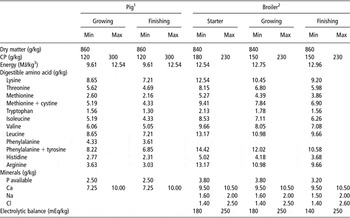
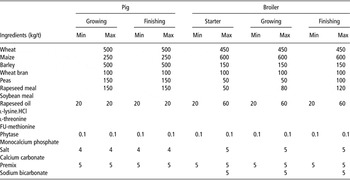
After calculating environmental impacts of feed ingredients, feeds were formulated using the linear solver function of Microsoft Excel® according to nutritional requirements (Table 2). We considered the main raw materials used in the production of pig and broiler feeds (Table 3), assuming that other crop products and by-products from industry could be included. For both pig and broiler feeds, calculations were made first using only cereals and soybean meal as main ingredients and then using cereals and several protein-rich ingredients (soybean meal, rapeseed meal and peas). Costs of ingredients were 2009 means for western France (Institut du Porc (IFIP), 2009). Cost of feed was calculated as the sum of the cost of feed ingredients.
Minimum and maximum limits for nutritional parameters imposed for feed formulation

1Growing and finishing feeds represent 40% and 60% of the total amount of feed ingested, respectively.
2Starter, growing and finishing feeds represent 5%, 25% and 70% of the total amount of feed ingested, respectively.
3Net energy for pig feeds v. metabolizable energy for broiler feeds.
Minimum and maximum limits for ingredient incorporation imposed for feed formulation

Pig feeds
In this study, we dealt with the growing period of pigs until slaughter (i.e. from 70 to 180 days of age). First, four situations minimizing the cost of the feed were compared: (1) a single feed without AA incorporation during the growing period (1F-noAA); (2) a growing and a finishing feed, both without AA incorporation (2F-noAA); (3) a growing and a finishing feed containing 16.5% and 15.0% CP, respectively, and with l-lysine.HCl, FU-methionine and l-threonine incorporation (2F-LowCP); and (4) two feeds without restriction in CP and with incorporation of the three AAs (2F-Min€). Two additional formulations were performed to maximize the incorporation of the three AAs (2F-MaxAA, with AA costs as low as the cost of soybean meal) and to minimize greenhouse gas emissions associated with feed production (2F-MinGHG). For each situation, two calculations were performed using the two types of soybean meal (associated or not with deforestation). Maize was considered to be produced in the same region as the pigs, in Brittany. It was assumed that the growing and finishing feeds represented 40% and 60% of the total mass of feed ingested during the period studied, respectively.
Broiler feeds
We studied the feeding program for broilers with three different diets from birth to slaughter (i.e. at 45 days of age). At a minimum, incorporation of the three AAs studied was necessary in the starter feed, and incorporation of FU-methionine was necessary in growing and finishing feeds. Therefore, three situations minimizing feed cost were compared, each including a starter feed with the three AAs and growing and finishing feeds incorporating (1) FU-methionine alone (Min€-M); (2) FU-methionine and l-lysine.HCl (Min€-ML); or (3) all three AAs (Min€-MLT). Two additional formulations were performed to maximize incorporation of the three AAs (MaxAA, with AA cost as low as cost of soybean meal) and to minimize greenhouse gas emission associated with feed production (MinGHG). For each situation, two calculations were performed using the two types of soybean meal (associated or not with deforestation) and the two types of maize (from Brittany or Aquitaine). It was assumed that the starter, growing and finishing feeds represented 5%, 25% and 70% of the total amount of feed ingested during the period studied, respectively.
A sensitivity analysis was performed on all diets containing FU AA, to evaluate the effect of increasing or decreasing by 50% the environmental impacts of these AAs.
Results
Impacts of feed ingredients
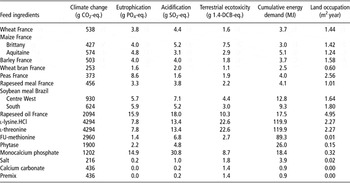
Table 4 summarizes impacts of the ingredients used for feed formulations. Salt, wheat bran and peas had the lowest values for climate change, whereas AA, rapeseed oil, phytase and monocalcium phosphate had the highest values for this impact. For eutrophication, the highest values were observed for rapeseed oil, monocalcium phosphate, peas and the AA obtained from fermentation. The highest values for acidification and terrestrial ecotoxicity were obtained for AA, rapeseed oil, monocalcium phosphate and soybean meal. For CED, the highest values were observed for AA, phytase, monocalcium phosphate, rapeseed oil and soybean meal. The highest values for land occupation were obtained for rapeseed oil, peas and AA produced by fermentation.
Potential environmental impacts due to the production and delivery at the feed production factory of 1 kg of each feed ingredient

Climate change impact was 50% larger for soybean meal associated with deforestation (Centre West Brazil) than for soybean meal not associated with deforestation (South Brazil). Moreover, the Centre West soybean meal had larger acidification, terrestrial ecotoxicity and CED than the South soybean meal. For maize from Aquitaine, climate change was 26% larger than for maize from Brittany. Eutrophication and CED were also larger for Aquitaine maize than for Brittany maize. In contrast, Aquitaine maize had lower values for acidification, terrestrial ecotoxicity and land occupation than Brittany maize.
Impacts of pig feeds
Pig feeds formulated to minimize cost
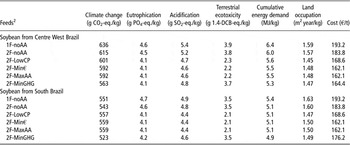
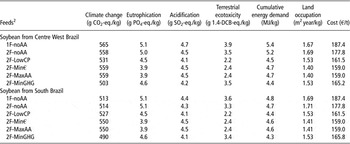
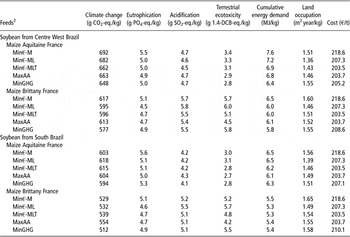
For feeds based on cereals and soybean meal associated with deforestation (Centre West Brazil), AA incorporation reduced climate-change values (Table 5). This effect was not observed for feeds based on cereals and soybean meal not associated with deforestation (South Brazil, Table 5) or when rapeseed meal and peas were incorporated into the diet (Table 6). The utilization of AA decreased acidification in feeds based on cereals and soybean meal but not in feeds based on cereals, soybean meal, rapeseed meal and peas. Regardless of the base ingredients, the incorporation of AA reduced eutrophication, terrestrial ecotoxicity and CED of feeds. In addition, the cost of feeds formulated with AA was lower than those of feeds formulated without AA.
Potential environmental impacts and costs at the gate of the feed factory of pig feeds based on cereals and soybean mealFootnote 1
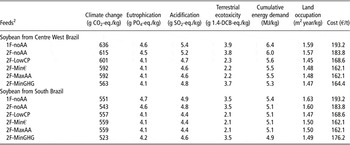
AA = amino acid.
1 Soybean from Centre West (with deforestation) v. from South Brazil (without deforestation).
2 1F-noAA (a single feed for the growing period without AA incorporation), 2F-noAA (a growing and a finishing feed, both without AA incorporation), 2F-LowCP (a growing and a finishing feed with 16.5% and 15.0% CP, respectively, and with l-lysine.HCl, l-threonine and FU-methionine incorporation) and 2F-Min€ (two feeds without restriction in CP and with incorporation of the three AAs) were formulated to minimize the cost of the feed. 2F-MaxAA was formulated to maximize AA incorporation; 2F-MinCP and 2F-MinGHG were formulated to minimize the CP content and the emission of greenhouse gases, respectively.
Potential environmental impacts and costs at the gate of the feed factory of pig feeds based on cereals, soybean meal, rapeseed meal and peasFootnote 1

AA = amino acid.
1 Soybean from Centre West (with deforestation) v. from South Brazil (without deforestation).
2 1F-noAA (a single feed for the growing period without AA incorporation), 2F-noAA (a growing and a finishing feed, both without AA incorporation), 2F-LowCP (a growing and a finishing feed containing 16.5% and 15.0% CP, respectively, and with l-lysine.HCl, l-threonine and FU-methionine incorporation) and 2F-Min€ (two feeds without restriction in CP and with incorporation of the three AAs) were formulated to minimize the cost of the feed. 2F-MaxAA was formulated to maximize the AAs incorporation; 2F-MinCP and 2F-MinGHG were formulated to minimize the CP content and the emission of greenhouse gas, respectively.
Pig feeds formulated to maximize AA and minimize greenhouse gases
The 2F-MaxAA and 2F-Min€ feeds contained similar ingredients in similar quantities (data not shown). Therefore, they had nearly identical impacts regardless of the base ingredients (Tables 5 and 6). The 2F-MinGHG feeds had the lowest values for climate change and CED but not for other impacts. On average, the cost of the 2F-MinGHG feeds was 4.5% higher than that of the 2F-Min€ feeds.
Impacts of broiler feeds
Broiler feeds formulated to minimize cost
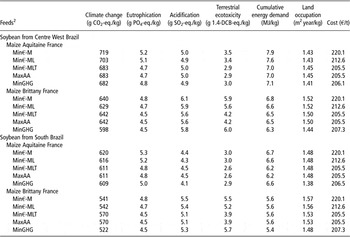
The incorporation of AA barely affected climate-change values. Only for feeds containing soybean meal with deforestation (Centre West Brazil) did the incorporation of AA clearly decrease climate-change values (Tables 7 and 8), except for feeds based on cereals and soybean meal with deforestation in combination with Brittany maize (Table 7). The utilization of AA reduced acidification values for feeds based on cereals and soybean meal in combination with Brittany maize. This effect was not observed when Aquitaine maize, rapeseed meal and peas were incorporated in the diet. Regardless of the base ingredients, the incorporation of AA decreased the values for eutrophication, terrestrial ecotoxicity and CED of feeds, as well as their cost.
Potential environmental impacts and costs of broiler feeds based on cereals and soybean mealFootnote 1

AA = amino acid.
1 Soybean from Centre West (with deforestation) v. from South Brazil (without deforestation) and maize from Aquitaine (irrigated and mainly fertilized with inorganic fertilizer) v. from Brittany in France (not irrigated and mainly fertilized with pig slurry).
2 Min€-M (a starter feed with the FU-Methionine, l-lysine.HCl and l-threonine incorporation, a growing and a finishing feed with incorporation of FU-methionine), Min€-ML (a starter feed with the three AAs, a growing and a finishing feed with incorporation of FU-methionine and l-lysine.HCl) and Min€-MLT (a starter, a growing and a finishing feed with incorporation of the three AAs) were formulated to minimize the cost of the feed. MaxAA was formulated to maximize the AAs incorporation; MinCP and MinGHG were formulated to minimize the CP content and the emission of greenhouse gas, respectively.
Potential environmental impacts and costs of broiler feeds based on cereals, soybean meal, rapeseed meal and peasFootnote 1

1 Soybean from Centre West (with deforestation) v. from South Brazil (without deforestation) and maize from Aquitaine (irrigated and mainly fertilized with inorganic fertilizer) v. from Brittany in France (not irrigated and mainly fertilized with pig slurry).
2 Min€-M (a starter feed with the FU-methionine, l-lysine.HCl and l-threonine incorporation, a growing and a finishing feed with incorporation of FU-methionine), Min€-ML (a starter feed with the three AAs, a growing and a finishing feed with incorporation of FU-methionine and l-lysine.HCl) and Min€-MLT (a starter, a growing and a finishing feed with incorporation of the three AAs) were formulated to minimize the cost of the feed. MaxAA was formulated to maximize the AAs incorporation; MinCP and MinGHG were formulated to minimize the CP content and the emission of greenhouse gas, respectively.
Broiler feeds formulated to maximize AA and minimize GHG
As for pig feeds, impacts were almost always similar for MaxAA and Min€-MLT feeds (Tables 7 and 8). The MinGHG feeds had the lowest values for climate change but not for other impacts. On average, the cost of the MinGHG feeds was 1.4% higher than that of the Min€-MLT feeds.
Climate change and feed ingredients
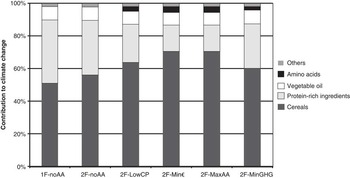
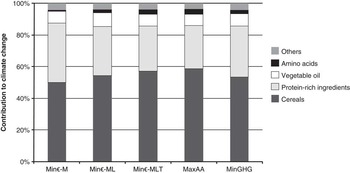
Despite the high-impact values associated with the production of AA, their contribution to climate change ranged from 0% to 3.8% for pig feeds (Figure 2) and from 1.0% to 3.4% for broiler feeds (Figure 3) as a result of their low rate of incorporation in feeds (no more than 0.5% by mass, data not shown). For pig feeds, AA incorporation was associated with a decrease in the contribution of protein-rich ingredients and an increase in the contribution of cereals to climate change. The same effect was found in broiler feeds with the incorporation of l-lysine.HCl and then l-threonine in addition to FU-methionine. The relative contribution of the feed components to climate change was similar for the 2F-MinGHG and 2F-LowCP pig feeds and the MinGHG and Min€-ML broiler feeds due to the similar compositions of these feeds (data not shown).
Contributions of feed ingredients to the values of climate change for pig feeds. Feeds 1F-noAA (a single feed without feed-use amino acids (AAs)), the 2F-noAA (growing and finishing feeds both without AA), 2F-LowCP (growing and finishing feeds containing 16.5% and 15.0% CP, respectively, and with l-lysine.HCl, l-threonine and FU-methionine incorporation) and 2F-Min€ (growing and finishing feed with AA) were formulated to minimize feed cost. Feed 2F-MaxAA was formulated to maximize AA incorporation while 2F-MinGHG was formulated to minimize greenhouse-gas emissions.

Contributions of feed ingredients to the values of climate change for broiler feeds. Feeds Min€-M (starter feed with the FU-methionine, l-lysine.HCl and l-threonine incorporation, growing and finishing feeds with incorporation of FU-methionine), Min€-ML (starter feed with the three amino acids (AAs), growing and finishing feeds with incorporation of FU-methionine and l-lysine.HCl) and Min€-MLT (starter, growing and finishing feeds with incorporation of the three AAs) were formulated to minimize feed cost. Feed MaxAA was formulated to maximize AA incorporation while MinGHG was formulated to minimize greenhouse gas emissions.

Sensitivity analysis
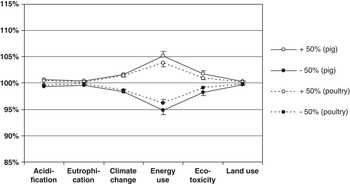
Increasing or decreasing the environmental impacts of FU AA by 50% had limited effects on feed impacts for acidification, eutrophication and land use (less than 1%; Figure 4). The effect was larger for climate change and ecotoxicity (1% to 2%) and largest for CED (4% to 5%). Moreover, sensitivity of environmental impacts tended to be higher for pig than for poultry diets.
Sensitivity of environmental impacts of pig and poultry feed to 50% increase or decrease of environmental impacts of feed-use amino acids.

Discussion
Impacts of feed ingredients
Similar to results of Eriksson et al. (Reference Eriksson, Elmquist, Stern and Nybrant2005) and Lammers et al. (Reference Lammers, Kenealy, Kliebenstein, Harmon, Helmers and Honeyman2010), who investigated the environmental implications of feed choice in pig production, our results showed that the environmental impacts associated with the production of FU AA were high compared with those of other feed ingredients when expressed per kg of product. However, our values for the impacts of AA generally were higher than those previously published, especially for the AA obtained by fermentation. For example, with regard to climate change, our values obtained for l-lysine.HCl and l-threonine were 19% and 170% greater than those of Eriksson et al. (Reference Eriksson, Elmquist, Stern and Nybrant2005) and Lammers et al. (Reference Lammers, Kenealy, Kliebenstein, Harmon, Helmers and Honeyman2010), respectively. In contrast our value for FU-methionine was 47% lower than that given by Lammers et al. (Reference Lammers, Kenealy, Kliebenstein, Harmon, Helmers and Honeyman2010). These observations underline an important discrepancy between the few published results. This may well be due to the fact that information on the processes currently used for AA production is considered confidential and therefore has been difficult to obtain. Indeed, both Eriksson et al. (Reference Eriksson, Elmquist, Stern and Nybrant2005) and Lammers et al. (Reference Lammers, Kenealy, Kliebenstein, Harmon, Helmers and Honeyman2010) based the calculations of the impacts of AA produced by fermentation on an LCA report on chemically synthesized methionine (Binder, Reference Binder2003). As pointed out by these authors, the uncertainty in the environmental impacts of AA based on these data was high. In the present study, we distinguished between the processes involved in the production of AA obtained from fermentation (l-lysine.HCl and l-threonine) and those obtained from chemical synthesis (dl-methionine and hydroxy-analogue HMTBa). Similar to AA impacts, the impacts of other feed ingredients in the present study generally were greater than in previous studies (Eriksson et al., Reference Eriksson, Elmquist, Stern and Nybrant2005; van der Werf et al., Reference van der Werf, Petit and Sanders2005; Flysjö et al., Reference Flysjö, Cederberg and Strïd2008; Lammers et al., Reference Lammers, Kenealy, Kliebenstein, Harmon, Helmers and Honeyman2010) mostly because of variations in methodology. For example, Lammers et al. (Reference Lammers, Kenealy, Kliebenstein, Harmon, Helmers and Honeyman2010) did not consider the impacts of cultivation and storage of grains on the evaluation of the climate-change potential associated with crop ingredients. Moreover, it must be noted that the availability of detailed information on the processes involved in the production of feed ingredients (e.g. inputs used, crop yields, transportation) has improved over recent years; this may help to explain differences compared with previous studies (van der Werf et al., Reference van der Werf, Petit and Sanders2005).
Industrial processes involved in the production of feed ingredients contribute to their environmental impacts (van der Werf et al., Reference van der Werf, Petit and Sanders2005). This explained the greater impacts of processed ingredients such as AA, rapeseed oil and soybean meal than unprocessed ingredients such as cereals. Crop production practices were also a major determinant of the environmental impacts of feed ingredients, as shown by differences observed for soybean from the Centre West v. the South of Brazil and for maize from Aquitaine (with mineral fertilization and irrigation) v. from Brittany (with manure fertilization and without irrigation) in France. Differences in soybean-meal impacts were related to differences in soybean-grain production, as shown by comparing the inputs used in Centre West v. South Brazil. Soybean production from the Centre West involved greater inputs of N, phosphate, potassium and calcium than that of soybean from the South Brazil (Prudêncio da Silva et al., Reference Prudêncio da Silva, van der Werf, Spies and Soares2010). Moreover, soybean production from the Centre West was associated with more recent (within 30 years) deforestation. The lower values for acidification and terrestrial ecotoxicity of Aquitaine v. Brittany maize were due to fertilization with pig slurry, a major source of volatilized ammonia from the latter (van der Werf et al., Reference van der Werf, Petit and Sanders2005). These results showed that environmental impacts of feed ingredients can differ according to crop-production practices and ultimately influence feed impacts (as discussed below), in particular when the crop considered constitutes a high proportion of the feed.
Impacts of pig and broiler feeds
The incorporation of AA decreased eutrophication, terrestrial ecotoxicity, CED and costs for both pig and broiler feeds. Climate change and acidification were decreased by AA incorporation only when feeds were based on cereals and soybean meal associated with deforestation. Thus, the replacement of protein-rich ingredients by AA, generally in association with more cereals, reduced climate change and acidification only when the impact of these protein-rich ingredients was high in comparison with the impact of cereals and AA. Nevertheless, AAs were incorporated in the feed that minimized GHG emissions, which suggested that the balance between the incorporation of AA and protein-rich ingredients was influential in obtaining a feed with the best compromise between cost and GHG emissions. It can be supposed that the incorporation of additional AAs such as tryptophan and valine, which are also available as industrial products, would allow a further reduction in the use of protein-rich ingredients and might thus reduce the environmental impacts of feeds that minimize the CP content. Indeed, our results showed similar composition and thus environmental impacts between feeds that minimized the cost (2F-Min€ for pigs and Min€-MLT for broiler) and those that maximized the AA incorporation (2F-MaxAA for pigs and MaxAA for broiler). However, for a lower price of soybean meal relative to FU AA, the two scenarios might have differed. This also indicates that the cost of AA was not the limiting factor for their incorporation, as the use of protein-rich ingredients might be necessary to meet the requirement for other essential AAs such as tryptophan and valine. Moreover, it is important to emphasize that the reduced CP content resulting from the reduced incorporation of protein-rich ingredients will reduce N excretion by animals and consequently subsequent emissions of ammonia and nitrous oxide from manure. Indeed, several studies have shown that reducing CP in diets decreases N excretion by pigs (Dourmad et al., Reference Dourmad, Sève, Latimier, Boisen, Fernandez, van de Peet-Schwering and Jongbloed1999) and ammonia emission from manure (van der Peet-Schwering et al., Reference van der Peet-Schwering, Aarnink, Rom and Dourmad1999). This means that the reduction in environmental impact of feeds observed for most impact categories when AA were incorporated would be increased (especially for acidification and eutrophication) when the whole production system is considered, because of the associated reduction in ammonia and nitrate losses associated with the use of pig manure. The same can be expected for broiler feeds.
The feeds formulated to minimize GHG emissions had the lowest values for climate change and CED but not for other impact categories. These results confirm that the choice of feed ingredients depends on the objective of formulation. However, it is not possible to minimize all criteria simultaneously (i.e. lowest cost, impacts and CP content). A simultaneous optimization would require defining an economic cost for these impacts. Nevertheless, the costs of the feeds that minimized GHG emissions were relatively close to those of feeds minimizing the cost, especially for broiler feeds. This might favor the development of industrial strategies to minimize the environmental impacts of feeds while maintaining economically competitive products. As reported in previous studies (Eriksson et al., Reference Eriksson, Elmquist, Stern and Nybrant2005; van der Werf et al., Reference van der Werf, Petit and Sanders2005; Cederberg and Sonesson, Reference Cederberg and Sonesson2006), our results showed that the replacement of soybean meal by peas and rapeseed meal decreased the environmental impacts of feeds. This was related to the lower impacts of rapeseed meal and peas than soybean meal. However, increasing the number of protein-rich ingredients masked the positive effect of the l-lysine.HCl, l-threonine and FU-methionine incorporation on GHG emissions. It can be supposed that incorporating additional FU AA could decrease feed impacts further in case several protein-rich ingredients are used.
The results from the sensitivity analyses indicated that increasing or decreasing the environmental impacts of FU AA by 50% had only limited effects on the environmental impacts of feeds (less than 1% for acidification, eutrophication and land use, 1% to 2% for climate change and ecotoxicity and 4% to 5% for energy use). This indicates that for most impacts the differences obtained between the different feeding strategies are little affected by impact values for FU AA. However, the effect is larger for CED, and to some extent for climate change and ecotoxicity, suggesting that the processes of AA production should be priorities for improvement.
In the present study, the environmental impacts of feeds were calculated according to an attributional LCA approach. However, changing feed composition, for example replacing soybean meal by FU AA, may also affect land use. To evaluate these changes, a consequential LCA would be more appropriate. For instance, total removal of FU AA would increase soybean meal incorporation by 30% and 100% in poultry and pig diets, respectively, increasing demand for soybean meal production, with possible consequences on deforestation.
Conclusion and perspectives
The incorporation of AA in pig and broiler feeds varied according to the objective of the formulation (minimizing cost, GHG emissions, etc.) and the nature of the feed ingredients used. Utilization of AA reduced the quantity of protein-rich ingredients incorporated and the cost of the feeds, leading to the formulation of products that could compete with those without AA or with only one or two AA. In most cases, incorporation of AA associated with a decrease in CP content reduced environmental impacts of the feed. However, the effect of AA incorporation on GHG emissions depended on the feed ingredients used, the decrease due to AA incorporation being greater when combined with ingredients having high impacts, such as soybean meal associated with deforestation.
Acknowledgements
Authors gratefully acknowledge Joël Aubin and Vamilson Prudêncio da Silva Júnior for providing life cycle inventory data and Isabelle Bouvarel for providing the nutritional requirements of broilers. This study was financially supported by FEFANA (EU Association of Specialty Feed Ingredients and their Mixtures).