The way that the pronunciation of a variable differs across speakers of the same language is, at the global level, the product of sociohistorical processes of linguistic change, acquisition, and contact (Labov, Reference Labov1994, Reference Labov2001a, Reference Labov2001b; Trudgill, Reference Trudgill2004), and, at the local level, an interactive, creative, and creating response to such products (Eckert, Reference Eckert2000; Zhang, Reference Zhang2005). Eckert (Reference Eckert2008:467) argued that these differences across communities are not only visible in speech production, but are both the causes and products of differences in “the understanding of what that form means and ultimately in the ideologies that underlie language use.” In other words, the social perception of language is a crucial site of meaning-making and therefore pattern-making in sociolinguistic variation. Recent work (e.g., Campbell-Kibler, Reference Campbell-Kibler2011; Pharao et al., Reference Pharao, Maegaard, Spindler Møller and Kristiansen2014) has suggested that listeners are able to contextualize individual variables within larger styles, altering their meaning. In this paper, we compare how listeners who are known to differ in their use of a sociolinguistic variable attribute social meanings to the variable and explore whether the way they do so takes the dialect of the speaker into account.
There is a solid history of research in linguistics showing that listeners will assign social attributes to speakers based on the speakers' dialect (see Giles & Billings, Reference Giles, Billings, Davies and Elder2004, for an overview), often responding with packaged stereotypes (Lambert, Hodgson, Gardner, & Fillenbaum, Reference Lambert, Hodgson, Gardner and Fillenbaum1960). Much of this research pits standard dialects against nonstandard dialects, frequently finding that speakers of standard varieties are evaluated more highly than are nonstandard speakers along dimensions of status, and that often, though not always, the converse is true along dimensions of solidarity (e.g., Gal, Reference Gal1995; Preston, Reference Preston2002). Other researchers have investigated how the demographics attributed to speakers match the demographic patterns found in production studies (Carahaly, Reference Carahaly2000; Fridland, Bartlett, & Kreuz, Reference Fridland, Bartlett and Kreuz2004; Labov, Reference Labov1966).
More recently, experimental work has shown that manipulating a single phonetic variable can significantly alter listeners' perceptions of speakers (Drager, Reference Drager2010: Fridland et al., Reference Fridland, Bartlett and Kreuz2004; Plichta & Preston, Reference Plichta and Preston2005; Szakay, Reference Szakay2008; Walker, Reference Walker, Trouvain and Barry2007), showing how a single variable can carry indexical meaning. This experimental work on perception joins production work from a “third wave” variation perspective (Eckert, Reference Eckert2005). While early variation work typically thought of language variation as “consequences of the abstract demographic categories that structure survey research—socio-economic class, gender, and ethnicity" (Eckert, Reference Eckert2008:455), more recent work has documented the ways in which social categories may in turn be consequences of social practice, including language variation. In so doing, this tradition has shown that the social associations with a single variable can be extraordinarily complex and can depend on a range of contextual factors. One such factor is the information available to the listener about the speaker, whether gained from the speech signal itself or through an external source. Campbell-Kibler (Reference Campbell-Kibler2007) showed that having (ING) realized with the alveolar nasal made a southern speaker sound more accented, but did not make a northern speaker sound accented or southern. Similarly, Pharao et al. (Reference Pharao, Maegaard, Spindler Møller and Kristiansen2014) found that a fronted /s/ signaled the speaker was gay if the speaker sounded like a white Dane, but not if they sounded like a nonwhite immigrant to Denmark.
This variability in meaning led Eckert (Reference Eckert2008), building on Silverstein (Reference Silverstein2003), to suggest the idea of indexical fields of meaning for variables. In this model, a variable or variant connects to a field of related qualities and stances (e.g., articulate, angry, careful, educated, confident, fake). Whereas a variant might index a particular quality in the speech of one group, it might be used to index an semantically related but different quality in the speech of another group. For example, a released final /t/ might index education, precision, or nerdiness to someone listening to Buchholtz's (Reference Bucholtz, Warner, Ahlers, Bilmes, Oliver, Wertheim and Chen1998) Nerd Girls, but might index prissiness to someone listening to Podesva's (Reference Podesva2006) gay diva. To understand sociolinguistic variables, listeners must consider the broader social context within which they appear.
Listener variation forms another part of the perception puzzle. A listener's sex (Ball, Reference Ball1983; Gordon, Reference Gordon1997) and regional background (Paltridge & Giles, Reference Paltridge and Giles1984) may influence how they socially evaluate linguistic variation. The dialectal experience of the listener has been shown to matter in their tendency to (correctly) associate given variables with given categories of speakers (Clopper & Pisoni, Reference Clopper and Pisoni2004; Szakay, Reference Szakay2008). Other work has shown an in-group preference such that speakers will rate their own variety (or speech closer to theirs) more positively (Aune & Kikuchi, Reference Aune and Kikuchi1993; Preston, Reference Preston and Schneider1996; Street, Brady, & Putman, Reference Street, Brady and Putnam1983), though this is not true in cases of linguistic insecurity (Labov, Reference Labov1972).
More interestingly, even speakers who appear to come from the same speech community can interpret the social meaning of a variable differently: Campbell-Kibler (Reference Campbell-Kibler2008) showed that listeners' overall (and idiosyncratic) impression of a speaker affects how they interpret the variant of (ING) in that person's speech. Invoking indexical fields, she said that the “differences of opinion relate not to disagreements about (ING) alone, but to a difference in how the listeners incorporate their understanding of the variable into their image of the speaker” (Campbell-Kibler, Reference Campbell-Kibler2008:638). That is, within the indexical field of meanings associated with (ING), the listener has flexibility in interpretation, which can entrench assessments they have already made about the speaker: a person you like using -in is being compassionate, a person you do not like is being condescending.
In this paper we look at how two variants of the same variable carry meanings depending on the variety of the listener and of the speaker. We choose a well-studied variable in Spanish—word-internal preconsonantal /s/—and examine whether the difference in the variable's status in two different dialects leads to different social interpretations. Specifically, we compare how the social meanings attributed to /s/ differ between listeners of Puerto Rican and Mexican Spanish and when the listeners are rating Puerto Rican or Mexican speakers. We show that for measures of status, the dialect of the speaker matters in /s/ interpretation, but for measures of heteronormativity, it is the dialect and gender of the listener that matters. However, the ways in which the ratings differ still seem to be consistent with a single indexical field of meaning for /s/, aspects of which are invoked differently, or to different degrees, based on listener and speaker context.
SYLLABLE-FINAL /S/ IN AMERICAN SPANISH
Syllable-final /s/ weakening (also called debuccalization) is one of the most studied linguistic features in Hispanic linguistics, “además de ser uno de los fenómenos más comentados al nivel del público no especialista” (“besides being one of the phenomena most likely to be commented on by nonspecialists”) (Lipski, Reference Lipski1983:242). The variable is a key shibboleth differentiating dialects (i.e., Lipski, Reference Lipski1994a), with an estimated 50% of Spanish-speaking varieties being categorized as /s/-weakening varieties (Hammond, Reference Hammond2001). In this process of lenition, the /s/ loses the lingual gesture (i.e., becoming [h]) (O'Brien, Reference O'Brien2012) and, in some cases, deletes entirely, resulting in three primary variants of the variable: strong [s], weakened [h],Footnote 1 and deleted /s/ (a phonetic zero) (Cedergren, Reference Cedergren, Bailey and Shuy1973; Guitart, Reference Guitart1976; Lipski, Reference Lipski1985). Some acoustic and perceptual work suggests that, at least in word-internal positions in some varieties, weakening/deletion may be accompanied by compensatory vowel lengthening (Figueroa, Reference Figueroa, Campos, Herburger, Morales-Front and Walsh2000; Gerfen, Reference Gerfen2002; Hammond, Reference Hammond and López Morales1978) and voice onset time lengthening in the following consonant (Torreira, Reference Torreira, Sagarra and Toribio2006).
As well as being produced differently across dialects, there is evidence that speakers of different varieties will phonologically categorize weakened variants of /s/ differently. Schmidt (Reference Schmidt, Carvalho and Beaudrie2013) found that speakers from an aspirating dialect (Argentinean Spanish) were much more likely to hear [h] in coda position as /s/ in nonsense words than were speakers of a nonaspirating dialect (Highland Colombian Spanish), and within each group of speakers, individual contact with aspirating dialects increased the tendency to categorize [h] as /s/.
Like most variables, /s/ weakening is linguistically conditioned. It is more common preconsonantly than prevocalically (Alba, Reference Alba2000; Poplack, Reference Poplack1979, Reference Poplack1980; Terrell, Reference Terrell1978) or prepausally (Alba, Reference Alba2000; Lipski, Reference Lipski1985; though see Brown & Torres Cacoullos, Reference Brown, Torres Cacoullos, Núñez-Cedeño, López and Cameron2003), and it is more common when preceding fricatives > nasals > stops > laterals (File-Muriel, Reference File-Muriel2007:131). All three variants are also documented in syllable-initial position, though the weakened variants are much rarer (Brown, Reference Brown2005; Lipski, Reference Lipski1984). /s/ is more likely to be weakened word internally than at word boundaries (Hammond, Reference Hammond and Scavnicky1980; Samper Padilla, Reference Samper Padilla1990; Terrell, Reference Terrell1978Footnote 2). Additionally, /s/ is more likely to be weakened in unstressed environments (Brown & Torres Cacoullos, Reference Brown, Torres Cacoullos, Núñez-Cedeño, López and Cameron2003; Poplack, Reference Poplack and Labov1981; Terrell, Reference Terrell1978), and as speech rate increases (File-Muriel & Brown, Reference File-Muriel and Brown2011). Consistent with frequency effects on reduction well established in the phonetic literature (Bybee, Reference Bybee2001; Phillips, Reference Phillips1984), higher frequency words are more likely to show weakening than are low frequency words (Brown, Reference Brown2009; File-Muriel, Reference File-Muriel2009), and File-Muriel (Reference File-Muriel2007) argued that other effects (such as lexical stress) disappear in a model that includes lexical frequency. Studies investigating the role of grammatical function (i.e., /s/ marks the plural) on weakening have shown conflicting results (see Mack, Reference Mack2009, for a review).
While the ratio of sibilant to aspirated to deleted forms differs markedly across dialects of Spanish, “all who have written on aspiration and deletion in various parts of the Spanish-speaking world have noted that . . . the use of the aspirated phones or the deletion of the phonemes is not obligatory” (Terrell, Reference Terrell1979:599), so that no dialect shows categorical use of one variant over another. Rather, which variant is used varies stylistically and socially across speakers, with the [s] variant “generally recognized as the prestige variant” (Mack, Reference Mack2009:27), and the deleted variant the most stigmatized variant (Lafford, Reference Lafford, Núñez Cedeño, Páez Urdaneta and Guitart1986). The [h] variant, like the deleted variant, is used less commonly in formal speech styles (Lafford, Reference Lafford, Núñez Cedeño, Páez Urdaneta and Guitart1986), less by speakers of higher social class (Calles & Bentivoglio, Reference Calles, Bentivoglio and Moreno de Alba1986), and less by women (Terrell, Reference Terrell, Sankoff and Cedergren1981).Footnote 3
The two varieties of Spanish included in this study are noncoastal Mexican Spanish and Puerto Rican Spanish. These two dialects were selected because they differ in a number of linguistic features and are easily distinguished by speakers of Spanish (Boomershine, Reference Boomershine and Face2006:60). Most important for the current study, they differ in the predominant realization of /s/.Footnote 4 In Puerto Rican Spanish, /s/ is primarily aspirated (López Morales, Reference López Morales, Fernández-Sevilla, López Morales, Molina, Quilis and Salvador1983, reports 81% aspiration in word-internal, preconsonantal positions), whereas in noncoastal Mexican Spanish, /s/ is primarily sibilant (Lipski, Reference Lipski1994a). The social stratification of the variants in both countries are similar, however. In Mexico, speakers most likely to aspirate are poorer, or come from the poorer coastal regions (Lipski, Reference Lipski1994a, Reference Lipski1994b). In Puerto Rico, the alveolar variant is used more often in formal situations, by more highly educated speakers, and by female speakers (Cameron, Reference Cameron2005; Lipski, Reference Lipski1983; López Morales, Reference López Morales, Fernández-Sevilla, López Morales, Molina, Quilis and Salvador1983), and despite the dominance of the aspirated variant in Puerto Rico, the sibilant variant is still taught as prescriptively correct (Lipski, Reference Lipski1983:243).
Our study looking at the social meaning of /s/ in Puerto Rican Spanish is preceded by Mack's dissertation (Reference Mack2009), which specifically investigated the stereotypes about gay speech in Puerto Rican Spanish. Through interviews, she found that listeners considered gay speech to sound more feminine, and some explicitly mentioned sibilant [s] usage as being a feature of gay speech (in Puerto Rican Spanish at least). Using an implicit measures voice recognition task, where listeners' speed at recognizing gay- or straight-sounding speakers from excerpts that include either a sibilant or glottal /s/ is interpreted as an implicit association between the speakers' perceived sexuality and the variant, she found weak evidence that listeners also implicitly associated alveolar [s] in syllable-final position with a (Puerto Rican) speaker being gay.
Because our study involves cross-dialectal ratings, it is also worth considering the relative status of the two dialects. Predominantly /s/-weakening Caribbean Spanish is generally considered less standard and often stigmatized than are other varieties of Spanish (Lipski, Reference Lipski1994a; López Morales, Reference López Morales1992; Navarro Tomás, Reference Navarro Tomás1948). However, Büdenbender (Reference Büdenbender2012) had Puerto Rican speakers rate 20 different dialects of Spanish for correctness and pleasantness, and she found no evidence of linguistic insecurity in these speakers: for correctness, Puerto Rican Spanish was second only to Peninsular Spanish, and for pleasantness, it was second only to Colombian Spanish. Though downgraded relative to Puerto Rican speech itself, Mexican Spanish fared moderately well with Puerto Rican listeners, rated fifth for correctness and seventh for pleasantness. While no similar study has been done, to our knowledge, with Mexican listeners, the Puerto Rican results suggest no great linguistic enmity between the two varieties.
To summarize, /s/ weakening is present to some extent in all varieties of Latin American Spanish, but the degree of /s/ weakening differs largely by region: noncoastal Mexican Spanish is by and large a nonweakening variety, whereas Puerto Rican Spanish is a weakening variety. Across Latin America, however, it appears the alveolar variant is prescriptively correct and used more often in formal situations and by more conservative speaker groups (female, higher class). Previous perception work in Puerto Rico suggests that there is also an association between the alveolar /s/ and gay speech.
In our study, we investigate how listeners from these two different linguistic communities, Puerto Rico and Mexico, apply social meaning to the /s/ variable cross-dialectally. We focus on word-internal preconsonantal /s/ as an environment that favors weakening and is not subject to morphological factors.
METHOD
Stimuli
We recorded four Puerto Rican and three Mexican menFootnote 5 (regional backgrounds and stimulus transcripts given in the Appendix), between 19 and 35 years of age, who have lived in the mainland United States for one to nine years, but who all still use Spanish predominantly.Footnote 6 These speakers were given a simple map and asked to give directions in Spanish in response to questions designed to elicit /s/ in word-internal, preconsonantal environments (i.e., escuela ‘school’, hospital ‘hospital’, esquina ‘corner’, restaurante ‘restaurant’). This approach was chosen to prompt unrehearsed speech while keeping content relatively constant. After the map task, participants reproduced target words with a glottal and alveolar variant, imitating the production of the second author, with explicit prompting regarding the desired variation, with which they were generally familiar.Footnote 7 The Puerto Rican speakers had no issues producing glottal and alveolar variants because both are used in their daily speech. Two of the Mexican speakers were also extremely successful at producing each variant, whereas speaker MEX2 had some issues producing the glottal variant. However, his best token of the glottal variant was used, and subsequent testing determined that it was heard as [h].
From these recordings, we extracted two clauses containing at least two tokens of word-internal preconsonatal /s/ and no other /s/ tokens: one giving directions to the hospital ‘hospital’, one to a esquina ‘corner’ of the streets Avenida de la República and Colón. For each clause, we made two versions: one with spliced glottal [h] for all /s/ tokens, and one with spliced alveolar [s] in all tokens. All spliced material was taken from the citation forms recorded after the map task. Although we did not need to adjust the amplitude of the spliced variants, we did need to reduce the duration of the spliced fricative for /s/ in some instances where the syllable was unstressed in the utterance. The files were then concatenated onto another clause by that speaker that contained no other /s/ (prevocalic or otherwise), the purpose of which was to give listeners more exposure to the speakers' dialect before the variants were introduced (Appendix). For example, the target clause (with two /s/ variants) for speaker PR3's hospital sentence is eh, queda entre la escuela y el hospital ‘um, it's between the school and the hospital’, but participants heard two connected clauses: Eh, vira a la derecha en la calle Bolívar, eh, queda entre la escuela y el hospital ‘Um, turn right at the street Bolivar, um, it's between the school and the hospital’.
The resulting stimuli were checked by three non-native trained linguists, one naïve native Spanish speaker, one trained linguist who is a native Spanish speaker, and the fourth author, who is a native speaker of Spanish. All agreed that the stimuli would be interpreted as the desired variant (alveolar or glottal) and would sound natural to naïve participants. Readers may access these sound files at www.ling.osu.edu/~ajwalker/Walker_etal_LVC2014_stimuli/.
Experiment design
Two versions of an online study were set up and hosted at The Ohio State University: one targeting Puerto Rican listeners, and one targeting Mexican listeners. Apart from introductory material, the experiments were identical. The decision to collect data online was primarily practical. From our physical base in Ohio, we could collect data from a large number of listeners in both Puerto Rico and Mexico. However, to maximize participation and critically, completion, the experiment needed to be simple and brief. For this reason, we only asked basic demographic information about participants: their regional background, age, gender, and whether they used headphones or speakers to listen to stimuli.
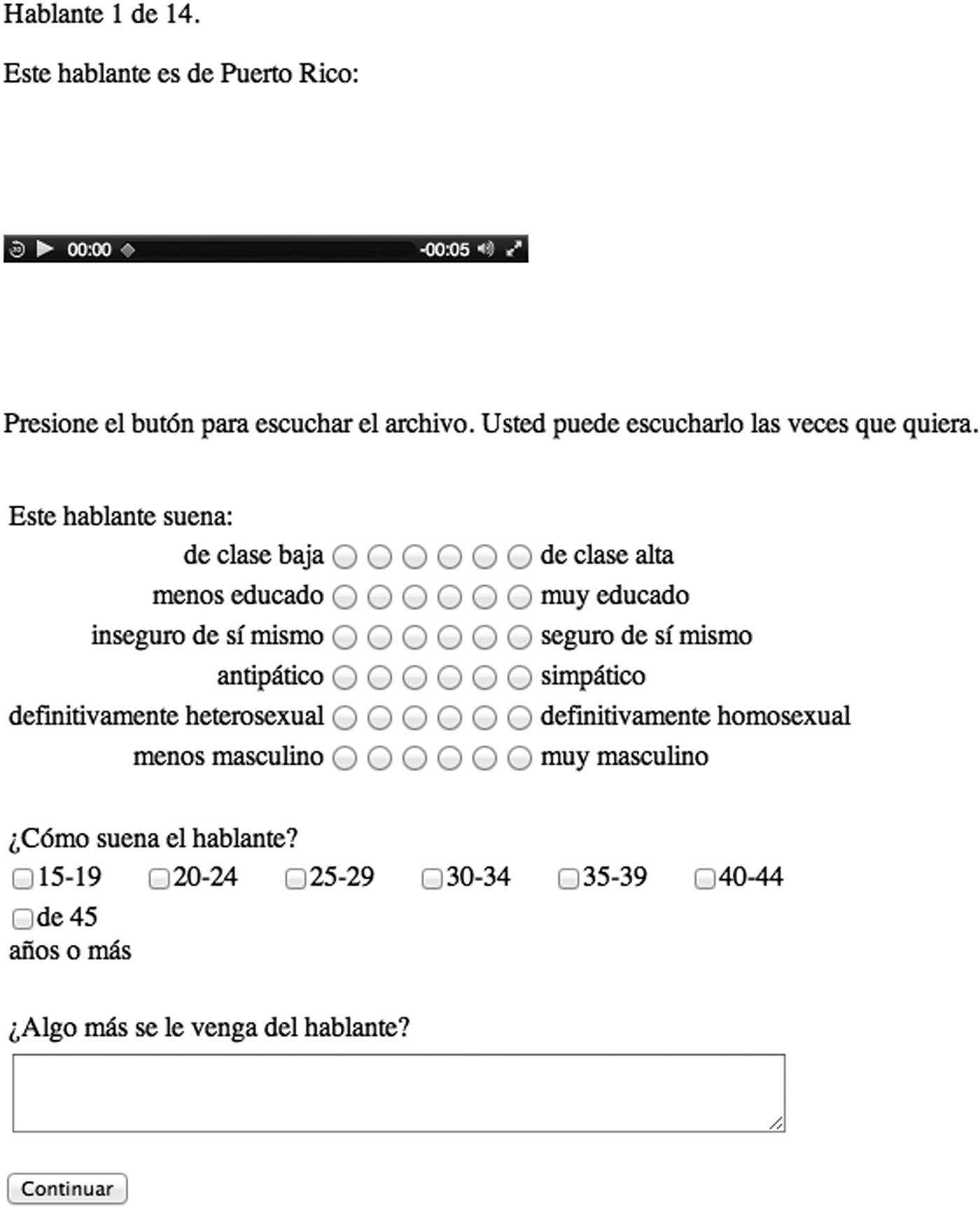
The actual experiment also needed to be brief, and to this end, two short experimental lists were created (see Appendix). For each list, there were multiple pseudorandomly organized versions so that the order of speakers and the variant in the sentences varied across lists. Each recording was presented on its own web page (see Figure 1), with a sound file participants could play as many times as they wanted.
Screen shot of the online experiment.

Each list had both glottal and alveolar versions of each of the 7 sentences (one per speaker), so that participants listened to 14 sentences total. The first seven recordings always contained a single sentence from each speaker, to ensure a rating from every speaker prior to the listener hearing the second member of a pair. The second half consisted of the matched pairs in the same order, but with the alternate variants: if a given speaker had an [s] in the first half, they had an [h] in the second half and vice versa. This arrangement allowed us to assess the existence and/or effect of listener awareness of the purpose of the study and to allow for a partial “naïve listener” dataset in the event of a detrimental effect. Our intention, however, was to use the entire set if possible, allowing for direct comparison of paired ratings, as in Lambert et al. (Reference Lambert, Hodgson, Gardner and Fillenbaum1960). This strategy was reinforced by telling participants that they would listen to 14 speakers.
The results suggested that for the most part recognition of a previously encountered speaker was not a large factor is how listeners rated speakers. Twenty out of 167 participants commented on noticing some repetition. However, it is unlikely that participants remembered specific scores. Some participants commented as much: No recuerdo mis respuestas anteriores y esta es mi nueva percepción ‘I don't remember my previous responses and this is my new perception’; Sin embargo, no recuerdo muy bien si en la escala de medición, seleccioné las mismas . . . ‘However, I don't remember very well if in the measuring scale I selected the same . . .’. No participants commented explicitly on noticing that the /s/ production had been manipulated. Additionally, statistical analysis showed no effect of this awareness in the treatment of /s/. Accordingly, the whole dataset is used in the analyses herein.
In each rating task, participants were told where the speaker was from (Puerto Rico or Mexico), but no other information. Participants were told explicitly where each speaker is from in order to reduce variability, by ensuring that the listeners interpreted each speaker as Puerto Rican/Mexican. Due to the vast dialectal differences between these two varieties, it is likely that participants could have correctly identified the speakers' origin. However, given that their ability to make this identification was not the goal of the study, we chose to ensure all participants were approaching the task with similar background information regarding the speakers. Listeners were asked to evaluate the speaker rating on the terms menos masculino/muy masculino (‘less masculine/very masculine’), definitivamente heterosexual/homosexual (‘definitely straight/gay’), antipático/simpático (roughly ‘unpleasant/pleasant’), inseguro/seguro de sí mismo (‘unsure/sure of himself’), menos educado/muy educado (‘less educated/very educated’), and de clase baja/alta (‘of low/high class’) on a six-point scale, and age on a seven-point scale. These attributes were selected based on a pilot study administered to seven Puerto Rican informants, which asked for open responses to [s] and [h] guises. A text box allowed participants to type any other comments they had about the speaker. After completing the page, participants would continue to the next speaker, until they had heard all 14 speakers. On the final page, they were able to leave additional comments about the experiment.
Participants
An e-mail targeting Puerto Rican listeners and an e-mail targeting Mexican listeners were sent to friends, colleagues, and associates, who were asked to forward it where appropriate. The e-mails specified that we were interested in Puerto Rican/Mexican listeners who were over 18 years old, had lived in Puerto Rico/Mexico at least since they were 6 years old, and had not lived outside of Puerto Rico/Mexico for more than six years. Any participant that had lived outside of Puerto Rico/Mexico for more than six years or did not meet the age requirements was excluded. Participants were not directly compensated, but were entered into a drawing for vouchers.
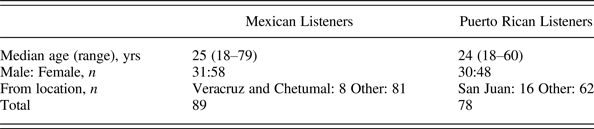
A total of 167 participants who met this criteria participated in the study. The basic demographics of the participants are in Table 1. As mentioned earlier, we collected minimal information from participants to maximize participation and completion, but the limitation of this is that we lack information on our participants' linguistic networks, and specifically, their individual-level cross-dialect contact. Additionally, the result of recruiting through personal contacts is that the majority of participants are undergraduate students (but with little or no linguistic training).
Listener demographics
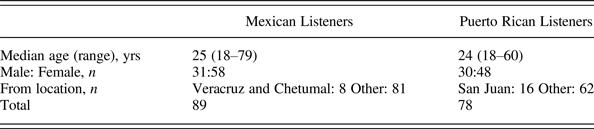
While most of the Mexican listeners are from nonweakening dialects of Mexican Spanish, some participants did come from regions of Mexico considered to have /s/-weakening dialects, specifically Veracruz and Chetumal (Lipski, Reference Lipski1994a; Lope Blanch, Reference Lope Blanch1990).Footnote 8 Of the 89 Mexican listeners, only 6 are currently living outside of Mexico. While all Puerto Rican listeners came from /s/-weakening regions, it is worth noting that some came from the capital city San Juan, the dialect of which is highly regarded and seen as the origin of /s/ elision (Lipski, Reference Lipski1994a), whereas other participants came from a variety of municipalities, most notably Mayagüez and Aguadilla. Eleven of the 78 Puerto Rican listeners are not currently residing in Puerto Rico; however, per requirement, none have lived outside of Puerto Rico for more than six years.
Although specific information regarding experience with each dialect was not elicited, it is likely that most Puerto Rican listeners are familiar with Mexican Spanish, and vice versa. Before choosing these two dialects, we consulted with Puerto Rican informants, who told us that Mexican Spanish is well known due to its presence in Spanish-speaking media and, crucially, is known for conserving the alveolar variant. Because Puerto Rican Spanish is in general less present in the media, the Mexican listeners may have been slightly less familiar with Puerto Rican Spanish, although our Mexican informants stated that the broader variety of Caribbean Spanish is extremely well known and associated with the glottal variant.
RESULTS
For data analysis, responses on the scales were transformed to numerical values, starting at 1 and going to 6 for masculinity, sexuality, simpatía (roughly ‘pleasantness’), confidence, education, and class ratings (higher values = more masculine, more gay-sounding, more simpático, more confident, more educated, higher social class) and going to 7 for age ratings (higher = older). For age ratings where participants chose two adjacent box choices, the response was given a number in between the two values. For example, if a listener selected both the 15–19 age box (1) and the 20–24 age box (2), the response was entered as 1.5.
Because it seemed likely that some of our seven different attributes were correlated, reflecting a smaller subset of latent variables, we performed a factor analysis using the Kaiser rule and parallel analysis (Bandalos & Boehm-Kaufman, Reference Bandalos, Boehm-Kaufman, Lance and Vandenberg2008; Weatherholtz, Campbell-Kibler, & Jaeger, unpublished). This analysis motivated two combined factors: a “status” factor (loading for class, education, and confidence) and a “heteronormativity” factor (loading for sexuality and masculinity). The third factor in the best factor model consisted of age alone, whereas simpatía did not load onto any factor. Accordingly, these two factors (age and simpatía) were analyzed independently, and their results should be treated with caution.
The two combined factors and the two lone items were each modeled using mixed-effects linear regression. Each model included maximal design-driven random effects (Barr, Levy, Scheepers, & Tily, Reference Barr, Levy, Scheepers and Tily2013) for participant and speaker.Footnote 9 The categorical predictors were coded as treatment contrasts, with reference levels as indicated in parentheses. These included speaker nationality (reference level = Mexican), listener nationality (reference level = Mexican), listener gender (reference level = female), and /s/ variant (reference level = [h]) as fixed effects (and in interactions with each other).Footnote 10 Items and interactions were included based on model comparison using R's analysis of variance function (R Core Team, 2013), retaining those which significantly (α = .05) improved the model as a whole. P values within models were calculated from t values, assuming normal distributions.
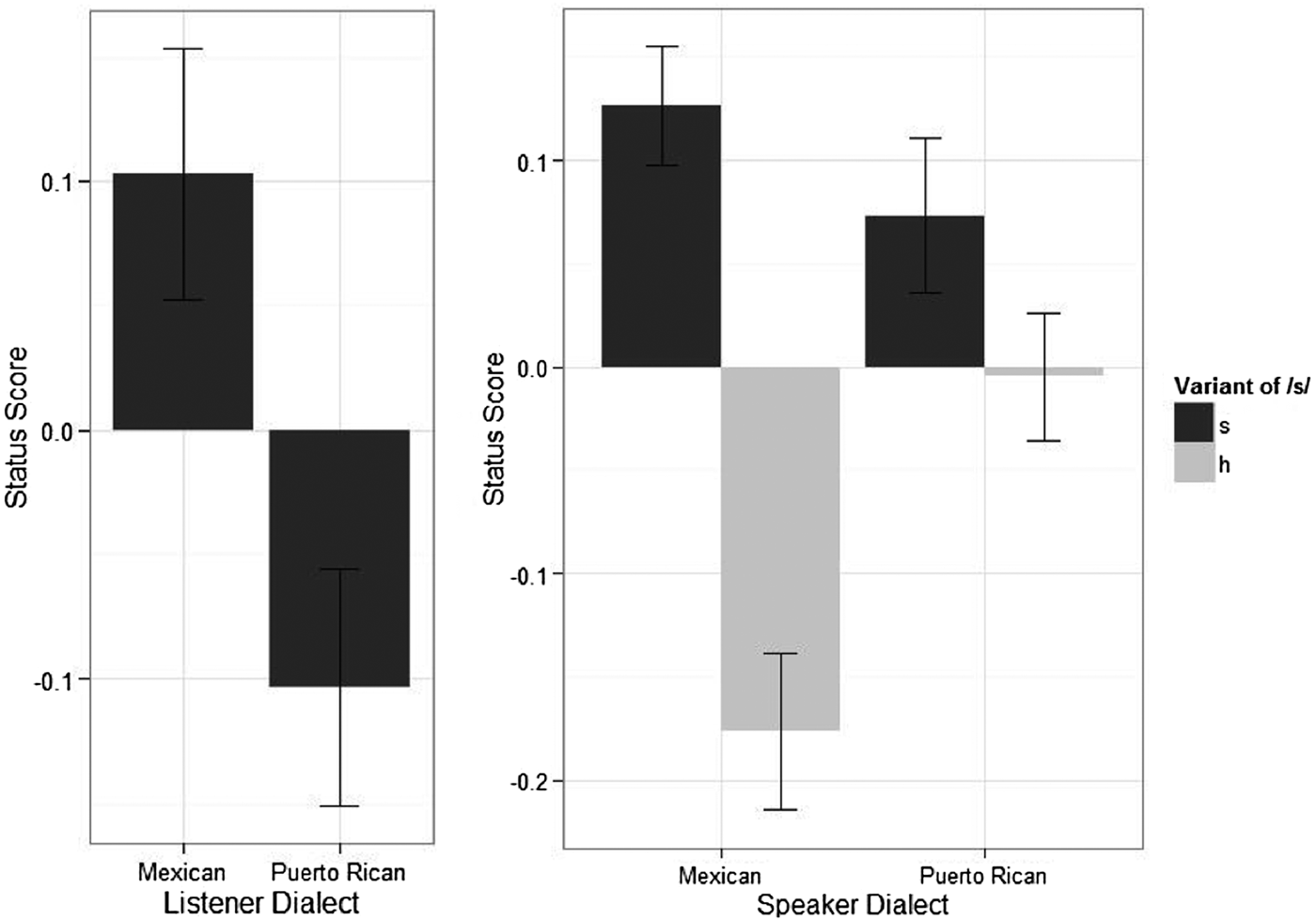
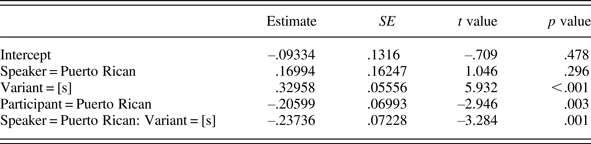
The final model for status ratings, given in Table 2, showed a main effect for listener nationality, in that Puerto Rican listeners gave lower status scores overall compared with scores assigned by Mexican listeners (Figure 2, left). There was also a significant interaction of variant and speaker nationality: for both sets of speakers, a sibilant /s/ resulted in higher ratings of status compared with those of the aspirated /s/, but this effect was significantly larger for Mexican speakers, independent of the nationality of the listener (Figure 2, right).
Aggregate status scores by speaker dialect and /s/ realization (right), and by participant nationality (left). Scores are centred on the global average (0). A higher value denotes ratings of higher status, a lower value denotes lower status. Error bars denote standard error.
Summary of best mixed-effects model for status factor (N = 2,200)
Note: Random effects = (1 + speaker nationality * variant | participant) + (1 + variant | speaker).
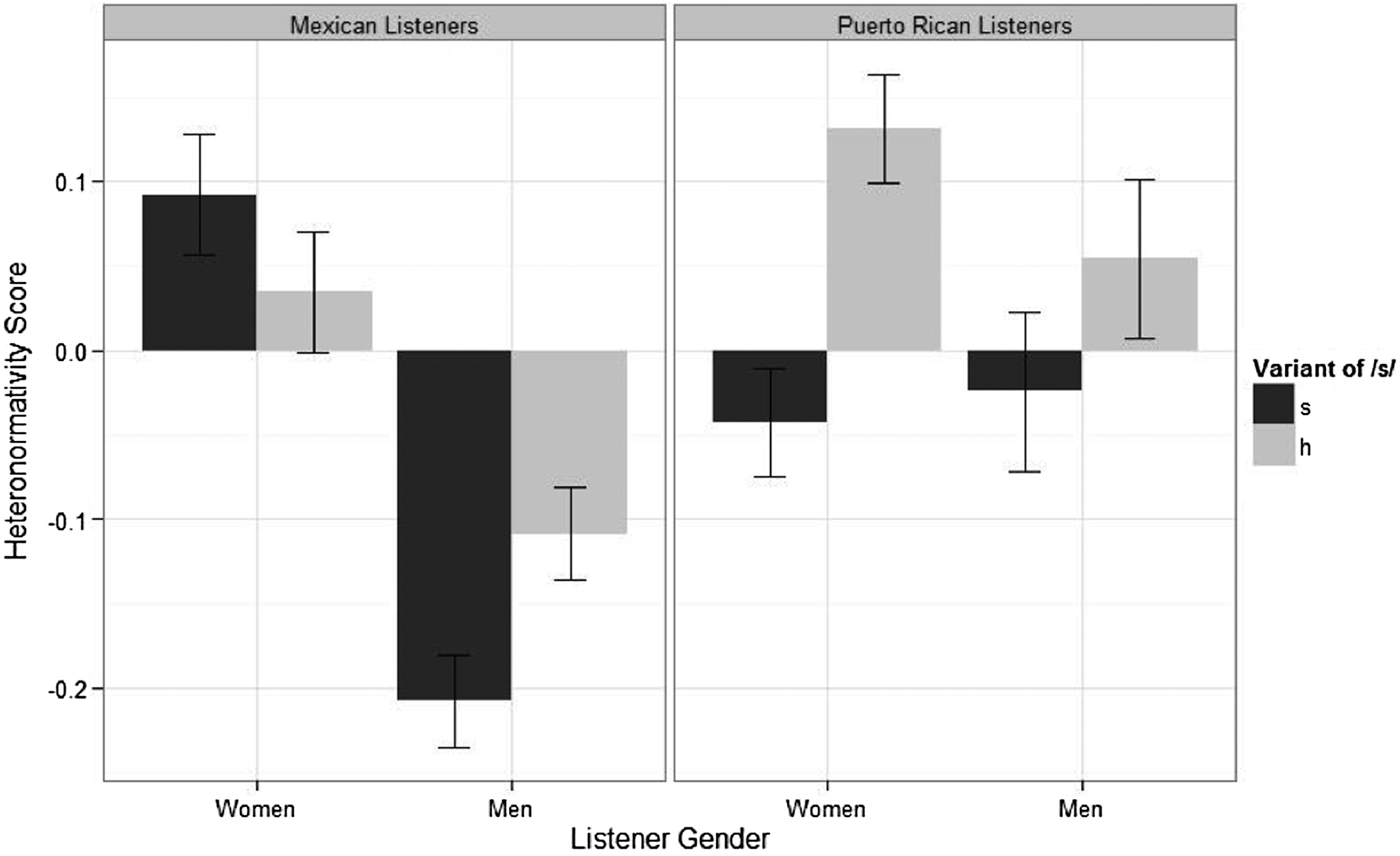
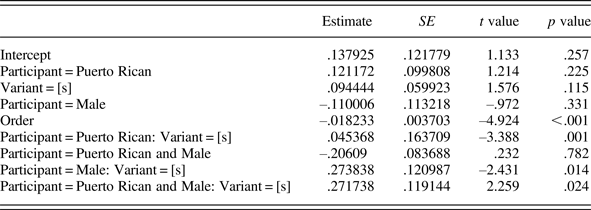
The best model for the heteronormativity factor (where a more positive score reflects a more masculine and more straight sounding rating) included a main effect of trial order and a three-way interaction between variant, participant nationality, and participant gender (Table 3). Trial order affected the results such that as the experiment progressed, listeners rated speakers as sounding less heteronormative, independent of any other factors. Figure 3 illustrates the three-way interaction. Whereas Puerto Ricans and Mexican men rate the sibilant variant as significantly less heteronormative, the Mexican women show no significant difference in their ratings of heteronormativity based on /s/ and, in fact, trend in the opposite direction, such that they find the sibilant variant more heteronormative.
Aggregate heteronormativity scores by listener dialect, listener gender, and /s/ realization. Scores are centered on the global average (0). A higher value denotes higher ratings of hetereonormativity. Error bars denote standard error.
Summary of best mixed effects model for heteronormativity factor (N = 2,200)
Note: Random effects = (1 + variant | participant) + (1 + variant | speaker).
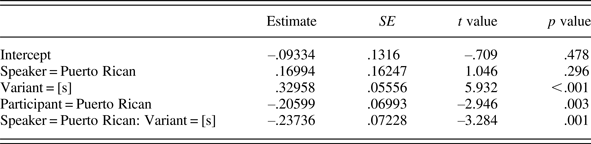
The final simpatía model (Table 4) includes order and variant. Participants rate speakers as less simpático as the experiment progresses, and if the variant is [s], they rate speakers as more simpático, with no interaction of speaker nationality or listener nationality.
Summary of best mixed-effects model for simpatía ratings (N = 2,200)
Note: Random effects = (1 + variant | participant) + (1 + variant | speaker).
Finally, the final model of age rating found no effect of variant, but included trial order (β = .04, t = 7.782, p < .001) and an interaction between speaker nationality and listener nationality (β = –.51, t = 5.445, p < .001). As the experiment progressed, participants rated the speakers as older, and Mexican listeners rated Puerto Rican speakers as older than Mexican speakers and older than the Puerto Rican listeners did.
DISCUSSION
Our manipulation of /s/ significantly affected the way our speakers were rated for all of the social attributes tested, except age. However, the patterns across the speaker dialects and listener dialects depended on the attribute in question (cf. Campbell-Kibler, Reference Campbell-Kibler2011). The sibilant variant increased status scores for both dialect groups, but significantly more so for Mexican speakers. The sibilant variant was rated as less heteronormative sounding for both sets of speakers by the Puerto Rican listeners, and by Mexican male listeners, but not by Mexican female listeners. Finally, the sibilant [s] increased how simpático a speaker sounded, independent of listener or speaker nationality.
Alveolar [s] is the predominant realization in noncoastal (and more economically powerful) varieties of Mexican Spanish, whereas the glottal variant [h] is predominant across Puerto Rico. Although we received no comments suggesting that participants were aware we had spliced in variants, we did receive in-group comments suggesting that Puerto Rican listeners did not expect [s] for Puerto Rican speakers, and Mexican listeners assumed Mexicans who used [h] were from coastal regions (we did not have comments regarding /s/ cross-dialectally):
Puerto Rican Listeners (on [s] in the Puerto Rican Speakers)
El hablante puertorriqueño sonaba un poco extranjero en ciertas palabras en ciertos items; no muy natural. Entonces, el hablante de clase alta o pobre tienen similitudes aun por ejemplo, las eses, erres no se pronuncian exageradamente. Pienso que muchas veces las eses pueden significar que eres de clase alta o media o que eres un actor de teatro. Las eses suenan un poco forzadas y eso no es normal en nuestra cotidianidad.
‘The Puerto Rican speaker sounded a bit foreign in certain words in certain items; not very natural. So, the high class speaker or low class speaker have similarities still, for example, the s’s, r's aren't pronounced exaggeratedly. I think that the s's can mean that you are from high or middle class or you are a theater actor. The s's sound a bit forced and that is not normal for our everyday life.'
A mi me parece como extranjero por las eses; suenan forzadas.
‘He seems like a foreigner to me because of the s’s; they sound forced.'
Mexican Listeners (on [h] in the Mexican Speakers)
Es de alguna zona de la costa.
‘He's from some part of the coast.’
Tiene un acento caribeño.
‘He has a Caribbean accent.’
No es de la capital.
‘He is not from the Capital.’
Creo que es alguien que vive en la costa.
‘I think it's someone who lives on the coast.’
The fact that listeners from both dialects attributed more status to the sibilant variant for Mexican speakers shows a sensitivity to this dialectal variation when attributing a status value to the [s], and that the ratings reflect speakers' awareness of the variant patterning in real life. This means that listeners are selectively attributing strength of meaning to a variant depending on the speakers' context (Campbell-Kibler, Reference Campbell-Kibler2007), and critically, that listeners will not simply apply their own symbolic usage to other speakers: Mexican listeners dampened their dialect's association of [s] with status for Puerto Rican speakers, and Puerto Rican listeners applied this social meaning more strongly when rating speakers outside their system.
It is worth stressing, however, that the Puerto Rican speakers still received significantly higher status scores when using the [s] than the [h], just to a lesser degree, suggesting that the association between [s] and status is fairly global (and institutionally supported in Puerto Rico), but also that social meanings can be gradiently invoked.
Given the association of [s] with status and power, it is unsurprising that we see that there is a predominantly negative relationship between [s] and ratings of heteronormativity. Trudgill (Reference Trudgill1972) showed that forms associated with the working class may hold cachet for male speakers. Likewise, Kiesling (Reference Kiesling2004:282) argued that the indexed effortlessness of nonstandard variants allows men to express stances of “cool solidarity,” which is “especially valuable for young men as they navigate cultural discourses of young masculinity, which simultaneously demand masculine solidarity, strict heterosexuality, and nonconformity.” The converse effect would associate standardness with effort, which in the extreme may be seen as prissiness (Eckert, Reference Eckert2008; Podesva, Reference Podesva2004). And indeed, Mack's (Reference Mack2009) work showed that Puerto Ricans explicitly (and maybe implicitly) associate the [s] variant with gay speech.
What is more surprising is that female Mexican listeners did not appear to have this association, and they exhibit a trend in the opposite direction. They hear [s] as more heteronormative than [h]. While it is difficult to explain this result based on our data here alone, one consideration is simply that for Mexican women, this variable does not index masculinity. In fact, whereas Mexican women are not significantly different from the other three groups in their reactions to /s/ for status and simpatía, when considered on their own, they show little evidence of an effect of /s/ for these factors also. Therefore it is possible that Mexican women simply do not have social associations with this variable at all, but the evidence is at present inconclusive.
Another possibility for the significant heteronormative interaction is that the Mexican women interpreted the question of masculinity differently.Footnote 11 Connell (Reference Connell1995) made a dichotomy of physical masculinity and technical masculinity, associated with the working and middle classes, respectively, but in our study we made no reference to which sort of masculinity we were interested in. If the indexical field for [s]—similar to Eckert's (Reference Eckert2008) proposed indexical field for released /t/—includes educated, confident, aggressive, rich but also prissy, effortful, emotional, we could see how [s] could index a technical masculinity to some listeners while indexing physical emasculation to other listeners. The reason why only Mexican women would invoke this alternative meaning, or have no association between the variable and sexuality, is still unclear and would be worth pursuing in future research.
The overall association of [s] with simpatía is consistent with findings that standard varieties are often rated as more pleasant (Trudgill, Reference Trudgill1972) and historically considered more polite (Watts, Reference Watts, Watts and Trudgill2002).Footnote 12
Although we find flexibility in the interpretation of /s/, the interpretations are still consistent with a single indexical field of meaning for both Puerto Rican and Mexican listeners, where contextual factors influence which particular attributes in the meaning are invoked. The context in this study is the regional dialect of the speaker, with the status value of [s] being more significant in Mexican speech. However, despite the consensus that [s] is economically powerful, it is nonetheless still heard as emasculating for most listeners. The fact that Mexican females behave differently than the other groups is more evidence that different sets of listeners will interpret context differently.
It would be interesting to consider what would happen if the /s/ were in a more marked environment; we intentionally chose the most likely environment for debuccalization, but it is possible that the social meaning of the variants could be quantitatively if not qualitatively different if it appeared in more marked positions (i.e., word-finally, or prevocalically). This is what Bender (Reference Bender2001) found in her investigation of social evaluations of morphosyntactic features of African American English.
We interpret the order effects as reflecting the instincts of our participants to use the whole scale despite an initial bias to rate speakers as young, simpático, and heteronormative. This initial bias could be based on a default assumption that speakers are young, simpático, and heteronormative; the fact that our sample of speakers were young, simpático, and heteronormative; or hesitation to attribute unfavorable attributes to speakers (see Gordon, Reference Gordon1997).Footnote 13 Whatever the specific reason, this shows how tasks like this can be subject to behavioral noise, but by controlling for this factor in our design (different participants heard speakers and variants in different orders), and in our statistics, this noise does not appear to have any bearing on the effect of the /s/ variant.
CONCLUSIONS
The results of this study shows that listeners take context—here, the speaker's regional dialect—into account when attributing social meaning to a variant, complementing findings by Campbell-Kibler (Reference Campbell-Kibler2007) and Pharao et al. (Reference Pharao, Maegaard, Spindler Møller and Kristiansen2014). Our listener groups are mostly consistent in where and when they apply meaning, suggesting global interpretations of the dialectal contexts, though we also have evidence that a subset of female listeners interpret the heteronormativity of /s/ differently than other listeners. Additionally, while there is flexibility in the social meanings associated with the variable, the meanings appear to be semantically cohesive, suggesting that /s/ realization has a similar indexical field of meaning (Eckert, Reference Eckert2008) across Puerto Rican and Mexican Spanish.
APPENDIX
Speakers and stimuli
The speakers are ordered here in the order they appeared in one version of the experiment.