The tomb at Huitzilapa presents clear evidence of social inequality in the Jaliscan altiplano during the first century a.d. (Ramos de la Vega and López Mestas 1996). Three bodies were interred in each of the two chambers of the shaft tomb; all of these bodies were laid to rest with their feet pointing away from the tomb entrance. Ceramic vessels containing organic offerings were interred along the west and south walls of the north chamber and along the south wall of the south chamber. Hollow anthropomorphic figurines were placed at the feet of the dead in both chambers. Of the three individuals laid out in each chamber, there were two males and one female in the north chamber and one male and two females in the south chamber (see López Mestas et al. 1998). Although organic grave offerings accompany the dead in both tombs, the two chambers differ considerably in quantity and quality of the sumptuous durable offerings. The north chamber's interments are accompanied by a greater number of ceramic offerings (75 vessels) and nonceramic sumptuary offerings than the south chamber. Offerings present in the north chamber included complex shell noserings and simple ear plugs, pendants and pectorals, bracelets and beads, marine shell trumpets, shell atlatl hooks inlaid with mother-of-pearl, jade figurines, beads, disks, earplugs and atlatl hooks and slate discs and plates. The south chambers inhumations are accompanied by fewer ceramic vessels (35 vessels), and ceramic ocarinas, shell beads, atlatl hooks, simple shell noserings and earrings, pendants and a trumpet, metates, as well as a slate disk and jade beads (Ramos de la Vega and López Mestas 1996). Based on the durable offerings alone, there can be little doubt that the principal individual or individuals buried in the north chamber of this tomb were of higher social status than those in the south chamber (Lopez and Ramos 1998).
The objective of the present work is to examine the social inequality represented by the organic offerings contained in the ceramic vessels and that served as accoutrements or burial wrappings. In the case that the nondurable burial offerings follow a pattern similar to the ceramic, shell, and lithic offerings, we hope to document the significance of the materials' ritual association to infer the status and role of the interred individuals. If the social difference evident from the durable offerings accurately reflects the relations of individuals in the north and south chambers, we hypothesize that the organic offerings in the north chamber should be more diverse and present in greater quantity and that the constituents in each organic offering are also more abundant than in the south chamber.
METHODS AND MATERIALS
The organic materials of vegetal origin encountered in the Huitzilapa shaft tomb are of two major types. Offerings left in the ceramic vessels, presumably food provided to nourish the dead on their journey to the afterworld, consists of small, largely unstructured, crumbly fragments of processed and unprocessed plant and animal tissues. The second class of materials includes those found in direct association with the interments and represent the woven, knotted, or pressed cloth, fabrics, and burial wrappings present on the bodies at the time of interment. Associated materials recovered in direct association with the inhumations are probably tools and/or weapons. In the course of examining the specimens taken when the interments and offerings were removed from the tomb chambers, additional material appeared that apparently was inadvertently interred with the offerings and burial coverings. Some of this material has been analyzed as well (Gatson et al. 2006) and has led to the description of a novel species of bacteria.
The tomb chambers at Huitzilapa contained an abundance of organic material. Cordage, nets, baskets, matting, as well as textiles and staffs or tools of office were probably buried with the dead. Cordage, textiles, and fragmentary fibers found on the floor, on the skeleton, or immersed in the matrix of decomposed organic materials surrounding the skeleton were collected directly into small padded vials or aluminum foil pouches. Materials found on or in the ceramic vessels in both tombs were collected after the vessel was transported to the laboratory. All vessels transported from the field were covered with aluminum foil and placed into a sealed plastic bag to prevent contamination. The material in each vessel was removed by lightly scraping the vessel surface with a clean plastic spoon to remove material adhering to the vessel surface, and these scrapings were placed directly into aluminum foil pouches, which were sealed and stored in plastic bags until their contents could be analyzed. Analysis of the constituents took place in a closed interior room and were performed with sterile techniques (all volumetric glassware, screens forceps and Petri dishes used to estimate volume and evaluate sample contents were sterilized prior to use with each sample).
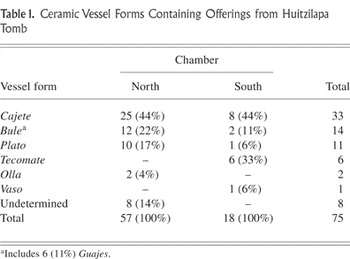
The contents of all cajete (bowls) and bules (tall neckless jars) were analyzed (Table 1). Cajetes and bules were present in both chambers, and nearly all of both vessel types contained organic material. Organic material from 24 cajetes and six bules from the north chamber was studied, and that from seven cajetes and two bules from the south chamber was examined. Samples from cajetes and bules were selected for study because they represent the most common shared vessel forms between chambers.
Ceramic Vessel Forms Containing Offerings from Huitzilapa Tomb

Ceramic vessel contents range in size from large consolidated pieces greater than 2 cm in diameter to fine dust less than 0.01 mm. The material ranges in color from white, to yellow, to reddish-brown. Most of the organic samples from these vessels pass through a screen with 1-mm openings. All samples were screened first to separate larger-sized sediments that had fallen into the vessels from the roof of the chambers. Pieces of consolidated matrix were examined for large identifiable plant or animal remains. The <1 mm fraction of all samples was the focus of analysis, which was conducted using a modification of the scanning methodology recommended by Toll (1988) in which the entire contents of each sample were examined under low power (8×) for 10 min and under high power (32×) for 5 min.
The presence or absence of 10 classes of material was recorded for each sample. The ten material types were distinguished on the basis of micromorphological features, which in some cases permit distinction of plant and animal-derived materials. A short description of each material type follows: (1) The most common material resembles a calcified fungal filament. These white fragments are small-diameter hollow cylinders that are often branched. (2) Small sections of white cellular lamina are common throughout the samples. The fragments appear to be one cell thick and are comprised of two cell types, rectangular long cells and disk-shaped cells. These fragments are reminiscent of the epidermis of grass family leaves, although they lack the characteristic trichomes and phytoliths. (3) Charred fragments of organic material are uncommon in these samples but are noticeably more frequent in samples from the south tomb. It is not clear whether these fragments are of plant or animal origin. (4 & 5) Two types of fibrous tissue are present in these organic offerings; both are aggregates of individual fibers. One (4) is straight, often with adherent ground tissue or epidermis, and the second (5) is curved, undulate, bent, or twisted and usually is stripped of associated tissues. Both types appear to be of plant origin. Both are common in the north tomb offerings while they are relatively rare (straight) and absent (woven) in the south tomb. (6) Plant epidermis fragments are relatively common in the offerings from both chambers. This material type is characterized by trichomes and hairs that adhere to the underlying tissue or cell types. (7) This material type is probably animal flesh. The tissue appears as ribbon-like sheets of red to translucent aggregations of fibers and amorphously shaped masses of white, yellow, or dark reddish-brown roughly spherical clusters of cells. These aggregated cell masses usually consist of one cell type but may co-occur with other aggregations. (8) Conglomerates, which refer to small aggregates of more than one cell or tissue type or cell masses that include reddish-brown spherical objects. (9) Bone. All examples are small and may be from fish, small birds, or mammals. (10) Insect parts. This category includes fragments of adult Hymenoptera or Coleoptera, as well as pupae and larva of unknown taxonomic category, and insect excrement. Insect parts are common in these offerings.
Four additional observations were also made on each sample: The volume of each sample was recorded to the nearest milliliter. The relative degree of consolidation of each sample's organic components was recorded as well, because we believe that highly consolidated specimens reflect either a significant initial aqueous component or highly processed material. The degree of oxidation on the aluminum foil pouch was noted and taken to indicate that the sample contains a significant amount of organic acid. The presence of roof-fall sediments was also recorded to provide some indication of the environment to which each vessel's contents were exposed.
Study of the fibers proceeded in a stepwise fashion, beginning with consultation of the ethnographic sources from western Mexico and Mesoamerica to determine what types of textile, netting, basketry, or other fiber-based offerings and accoutrements have been recorded. Comparative plant material was obtained of species whose use in the manufacture of the aforementioned items was indicated by ethnographic sources. This plant material was obtained from existing populations and from herbarium specimens in Mexican and American herbaria (permission was obtained from herbarium curators and specimens were annotated!). The penultimate step was to chemically treat the comparative materials to obtain specimens that potentially reflect the tissues and cell types present in the tomb offerings. All comparative samples were macerated in a 2:1 mixture of 30% hydrogen peroxide and glacial acetic acid. Samples were heated slowly until the specimens turned white. They were then rinsed in distilled water and stored in 70% ethanol. Samples of leaves, petioles, and stems of hard fiber-producing plants including agave or maguey leaves (Agave maximiliana and A. angustifolia); bamboo or otate (Otatea acuminatum); carrizo (Arundo donax), palm, or palma real (Brahea dulcis) were examined. Cotton fibers from plants grown in house gardens in the community of Zenzontla (Municipio of Tuxcacuesco) in southern Jalisco were also used as comparative specimens. Amate paper obtained in Tepoztlán, Morelos, was also studied for comparison with archaeological samples.
Samples of fibers from the Huitzilapa tomb were examined with various kinds of microscopes. Characterization of tissues and cell types relied on the compound microscope and the scanning electron microscope. Examination of the archaeological specimens has been hindered by their delicate and fragmentary nature that makes it difficult to mount and sputter coat the specimens, as well as to photograph them. Their fragmentary nature causes them to disintegrate under the electron beam.
Archaeological fibers samples were collected in large numbers. Many samples were taken from locations near the cranium and shoulders because we suspected that textiles and cordage for necklaces and pectorals were interred with the individuals. Samples were also obtained from alongside and between individuals, where fibrous material was detected during removal of the interments. Nine fiber samples from the south chamber have been examined in detail. Four of the specimens are associated with burial 1 (the high-status adult male), one is associated with interment 2 (an adult female), and four specimens have been examined from contexts associated with individual 3 (a young adult female). Seven samples from the north chamber have been examined. Four of these samples are associated with burial number 1, the adult male with the highest status; two are associated with interment number 2, an adult male; and one is associated with burial number 3 (a mature adult female). The location of the specimens identified to date is given later in Table 5.
We focused first on the results of the visual inspection of the vessel contents in an attempt to characterize status differences that may have existed among the individuals in the two chambers. We began by examining the average quantity of what is presumed to be food offered in the two types of vessels. Our hypothesis was that the average amount of material found in these two vessel types would be greater in the north chamber, where individuals of higher status were interred. Next we examined the hypothesized status differential by comparing the number of material types present in the vessels in each tomb. We hypothesized that a greater number of material types might be associated with and might have conferred, or could have reinforced, the status acquired by the individuals in the north chamber. The last test examined the hypothesis that high status in the north chamber will also be exhibited by a greater diversity of material types in all vessels than in the south chamber. Assuming that the high-status individuals had accumulated wealth and prestige through differential access to resources obtained through kinship, descent, and social contracts, we expected that tomb vessel offerings would reflect this by containing a combination of material types and a greater relative abundance (i.e., dominance) of certain material types, as well as a greater diversity of material types. Because of the straightforward calculation and interpretation of the Shannon-Wiener diversity index, it was used to calculate this comparison, although the samples were unequal in size and were of finite size, features that violate the assumption of the test (Magurran 1992).
In an additional test of the hypothesis concerning different social status of the individuals interred in the two chambers, organic material from the cajetes and bules was scanned for the presence or absence of the aforementioned material types. Presence/absence was tabulated, and the two chambers were compared based upon average sample volume, overall sample diversity, and the relative abundance of material classes. The sample contents between tombs were also compared by examining the similarity of vessel contents and the distribution of material types between chambers and vessel types using the matching coefficient as a measure of similarity and metric multidimensional scaling for visual display of sample similarity.
RESULTS
Ceramic Vessel Offerings
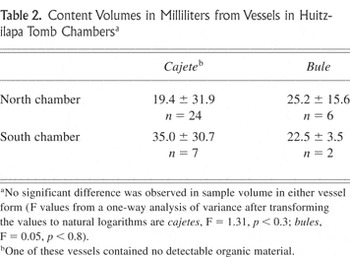
The initial impression that a greater quantity of organic material offering is present in the vessels of the north chamber, as might be expected from the greater number of vessels, is not supported (Table 2). The average volume of material occurring in the two vessel types between chambers is not significantly different, although sample volume varies considerably across vessels from each tomb. Thus the initial test of our hypothesis relating different status to different average volume of material offered is negated; that is, average offering volume per vessel is not different between chambers.
Content Volumes in Milliliters from Vessels in Huitzilapa Tomb Chambersa

Mean sample volume per chamber is only one method of comparison. If we consider vessel numbers in the equation of quantity, however, at least twice as much organic offering material was interred with the individuals in the north chamber as in the south chamber. This difference in aggregate quantity might invalidate the comparison of average sample volume between chambers if one cannot justify averaging sample volumes in each chamber. Such might be the case, for example, where organic offerings are so diverse in their composition that averaging is not logically justifiable because in doing so one combines sample volumes of liquids—alcoholic beverages, for example (tesguino or pulque are likely candidates)—and solids—e.g., masa from corn or beans. We address this point in greater detail below.
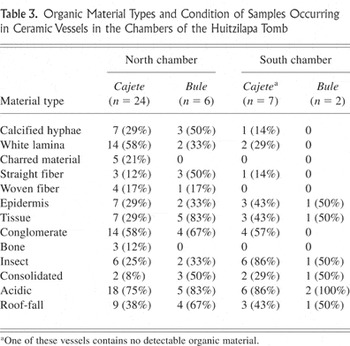
The most common material types encountered in the vessels from the north tomb are the white laminar fragments and the conglomerates in the cajetes, and tissue, conglomerates, white calcified filaments, and straight fibers in the bules (Table 3). Insect parts are the most frequent material type occurring in the cajetes of the south chamber, followed by conglomerates, tissue, and epidermis material types. The bules from the south chamber appear to have considerably fewer material types than the cajetes, but they are similar in having more common material types than the cajetes. Three material types are conspicuous in their absence from the cajete samples from the south chamber. The lack of charred material, woven fiber, and bone appears significant; however, comparison indicates that there is no difference in the frequency of material types in the cajetes in the two chambers (χ2 = 10.5, p < 0.4). The general lack of materials from the bules in the south chamber might be due to an error in sampling, because only two vessels were present. Thus the second test of our hypothesis is also negative: the number of material types in the cajete offerings in the north chamber is not significantly greater than that in the south chamber.
Organic Material Types and Condition of Samples Occurring in Ceramic Vessels in the Chambers of the Huitzilapa Tomb

Attempts to discover associations among material types and sample conditions (using average linkage cluster analysis and multidimensional scaling based on matching coefficients [not shown]) revealed two large clusters of material classes: (1) woven fiber, bone, consolidated matrix, and charred material; and (2) epidermis, straight fibers, and tissue. The significance of the relationship between material types suggests that some of the offerings consist of prepared substances, the first perhaps meat-based, and the second consists of relatively unprepared (raw?) plant and animal products. This analysis sheds light on what might be misconstrued from examination of Table 3 by itself; that is, the material types occurring only in the north chamber offerings are among the most rare. The high measures of association observed among them are based on common absence across samples in both chambers, not only on the infrequent or unique occurrences. Support for our hypothesis thus comes from the addition of rare material types. The strength of this support depends on the relative value of these rare material types.
The last test of our hypothesis comes from comparing the relative diversity of materials occurring across all vessels from each chamber. The greater the number of material types in the tomb and the more abundant each is (the frequency with which each material type occurs in the vessels of each chamber), the more diverse the assemblage in one or the other chamber. Examined in this way, the diversity of material types in the tomb chambers is not significantly different (K-S nonparametric test Z = 0.61, p < 0.86). Hence the test of this hypothesis is also negative: the diversity of organic materials occurring across all vessels from the north chamber is not significantly different from that occurring across all vessels from the south chamber.
Fibers, Textiles, and Accoutrements
Hard leaf and stem fibers, soft bast fibers, as well as seed fibers, were all used by the inhabitants of Huitzilapa. Leaf fiber bundles from the agave, cotton seed fibers, and fibers surrounded by or embedded in associated stem tissue from stems of carrizo have been identified in the samples studied. Bark fibers were also apparently used to make amate paper. Three additional fiber types were examined but cannot yet be identified.
Cotton fibers are outgrowths of the seed coat of Gossypium hirsutum. They are composed largely of cellulose and are not lignified. Cotton fibers are recognized by their lenticular or biconvex cross-sectional shape and their twisted, folded, or kinked form. Cotton fibers can be spun because fibers interlock when they are folded and twisted. The cotton fibers found in the north tomb exhibit a slightly eroded condition, with part of the cell wall removed to expose the inner lumen as though the individual fibers had been hydrolyzed when subjected to weak acids. Organic acids would be expected to be present in the tomb chambers as the bodies decomposed. The characteristic twisted and folded shape is still evident where interior fibers of textiles are exposed.
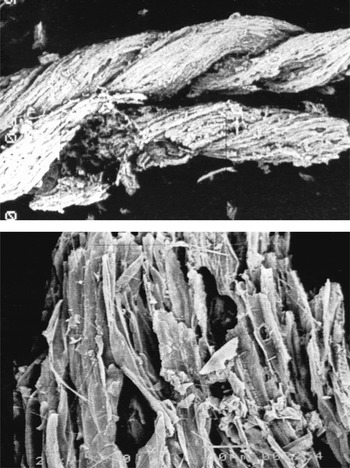
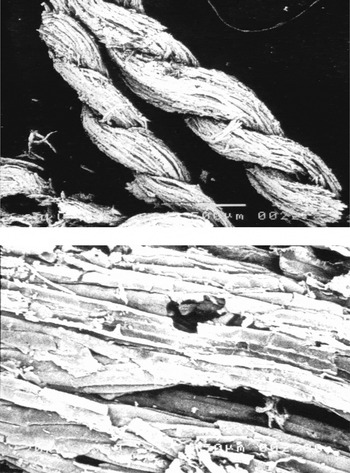
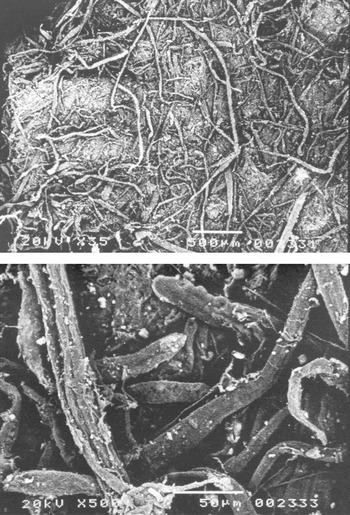
Cotton fiber in all four of the specimens from the tomb is twisted into two-ply S-twist threads (Figures 1, 2, & 3). All threads are approximately 0.5–1 mm thick. The specimens are fragmentary and only rarely exceed 6 mm in length; they have been identified as fragmentary samples of cordage (Figures 1 and 3) and textiles (Figure 2). A few specimens show evidence of having been woven, but fragments of this size might not be expected to provide such evidence. Threads of this thickness would be expected to produce a fine cloth. All cotton comes from the north chamber. The distribution of cotton in this chamber suggests that cotton thread was used to hang adornments such as necklaces and was woven into clothing or perhaps a burial shroud.

Cotton thread from the north chamber of the Huitzilapa tomb (Sample 85). (above) Two-ply S-twist cordage from chamber floor adjacent to the left side of the cranium of interment 1, the high-status individual (magnification 35×; fragment of cordage measures 2.5 mm, each ply measures about 0.5 mm thick). (below) Close up (magnification 350×; scale bar measures 50 μm) of same cordage illustrating characteristic flat hollow cotton fibers with kinks. Note the eroded state of fibers making the lumen visible.

Fragment of cotton textile from north chamber of the Huitzilapa tomb (Sample 24; magnification 35×; scale bar measures 0.5 mm). This fragment was recovered from between the femurs of interment 2. This mass of fibers is encrusted with the remnants of body decomposition, making it difficult to discern the weave. The two-ply S-twist cord the textile is composed of is apparent in the upper right of the photo. The two-ply S-twist cord in the upper right appears to coil around another fiber bundle that has decomposed.

(above) Fragments of two-ply S-twist cotton cord from the north chamber of the Huitzilapa tomb (Sample 5; 35× magnification; scale bar measures 0.5 mm). These fragments were recovered from an area on the floor to the right of the cranium of interment 3. (below) Close up of fibers that compose one of the two strands. Erosion of outer wall of individual cellulose fiber exposing the lumen is probably due to organic acids associated with decomposition of the interment (350× magnification; scale bar measures 50 μm).
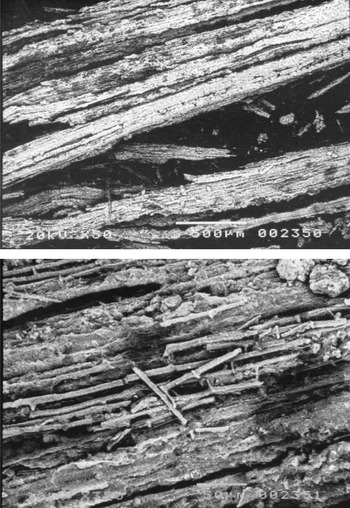
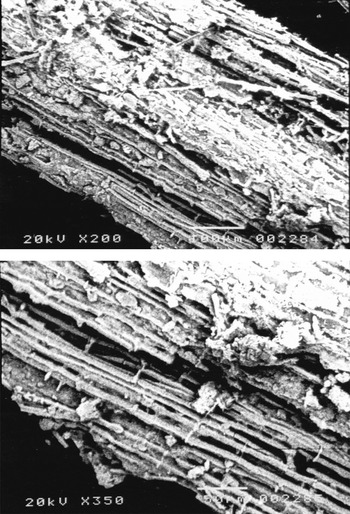
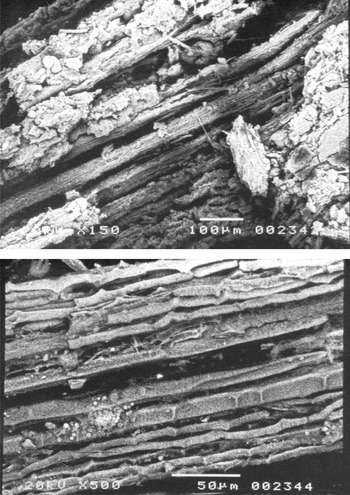
Agave fiber was very important in pre-Hispanic Mexico (Parsons and Parsons 1990). Agave fibers provide the structural support of the plant's fleshy leaf. The hard fibers from agave leaves are actually bundles of individual sclerenchyma fibers that are usually associated with vascular bundles of the leaf. They are composed of many individual sclerenchyma fibers, each of which has primary cell walls of cellulose and hemicellulose and secondary cell walls that are heavily lignified. Many of the agave fibers from the tomb chambers are intact fiber bundles (strands according to Esau 1967:217; see Figures 4a and 5a). The outer sheath of parenchyma cells and slightly lignified bundle sheath cells are frequently intact (Figures 4b and 5b). In some of the less-well-preserved specimens the bundle sheath cells are mostly absent and only the bundle fibers remain (cf. Esau 1967; see Figure 6). The condition of some specimens suggests that the retting process used typically to process agave leaves for fiber extraction (Parsons and Parsons 1990) continued after the cordage or textiles had been woven, viz., many fibers bundles have decomposed to the point that only individual fibers remain intact. The retting process attacks the pectic substances in the intercellular spaces, first outside of the vascular and fiber bundles; it later attacks the lignified intercellular spaces between fibers within the bundles until only the individual fibers remain (Figure 6b).

Agave fibers recovered from the north chamber of the Huitzilapa tomb (Sample 112), representing loose fiber bundles found alongside the right femur of burial 1. (above) Agave fiber bundles in state of disaggregation (50× magnification; scale bar measures 0.5 mm). (below) Close up of associated mesophyll and bundle sheath cells (350× magnification; scale bar measures 50 μm).

Agave fibers recovered from near the cranium of interment 1 of the north chamber of the Huitzilapa tomb (Sample 49). (above) Loose fiber bundles (magnification 200×; scale bar measures 100 μm). (below) Close up of associated bundle sheath cells (magnification 350×; scale bar measures 50 μm).

Agave fibers recovered from at right of the proximal tibia of interment 3 in the south chamber of the Huitzilapa tomb (Sample 35). (above) Agave fiber bundles are shown embedded in leaf mesophyll (?) (tissue magnification 150×; scale bar measures 100 μm). (below) Close up of disaggregated fiber bundle showing taped sclerenchyma fibers (magnification 500×; scale bar measures 50 μm).
Agave is the most common fiber occurring in both chambers. However, we cannot yet argue convincingly that agave fiber is more common than cotton in the north chamber, because all fiber specimens from the tomb's chambers have not yet been examined. The agave fiber from the tomb has been identified from a variety of characteristics: First, the tissues surrounding the bundle and bundle sheath cells show interconnections with adjacent cells that may act to join cells surrounding the bundle as well as connect adjacent bundles; second, individual fibers within the bundle are narrow, with a wider median part and two slender, oftentimes tapered, ends; third, the fibers may exhibit bends, the development of a lumen or “quasi-compartments,” and they frequently have oblique transverse ridges, which correspond to the points where adjacent fibers had ceased to elongate through intrusive growth (see Esau 1967; Lenz 1948; see Figure 6a and b). Agave fibers are also identifiable by the association of raphids, which are characteristically found in the mesophyll tissue of agaves and other related plants.
The agave fibers we have identified to date appear to have been extracted using a variety of processing techniques. Some of the agave fibers, or fiber strands, have associated mesophyll tissue that remained intact (Figures 4a, 5a), whereas other strands have neither leaf mesophyll nor bundle sheath cells surrounding the fiber strand (Figure 6a). It is still not clear whether the range of treatments agave fibers would have received would consistently produce the variation exhibited by these specimens. It seems likely that young leaves would produce narrower strands with more elastic fibers that could be woven in finer garments (cf. Parsons and Parsons 1990:176ff), whereas older leaves would produce longer but coarser strands in greater abundance. We have not yet attempted to address this question in our examination of the Huitzilapa fibers.
One fiber specimen collected from the south chamber had decomposed to the point of disintegration. The specimen is derived from material located along the right side of the male individual in the south chamber—from shoulder to knee. Fibers and parenchyma cells are associated, but individual cells are nearly all disarticulated. Parenchyma cells from the tissue associated with the fiber bundles are polyhedral but mostly rectangular to isodiametric in plane view, and they show many pit membrane connections. The loose parenchymal cells are scattered throughout the fiber bundles and loose fibers, and they probably represent the mesophyll of intact stems. These fibers do not appear to be arranged in small isolated bundles but are assumed to be a significant volume of the stem; they are uniform in length, shape, and taper. These fibers have been tentatively identified as belonging to Carrizo (cf. Arundo donax), a plant commonly used in modern times for staffs, fruit harvesting poles, the interior roof construction of houses, and a variety of other domestic implements. It is also possible that Carrizo was used as shafts for lances and arrows. The presence of Carrizo alongside this individual and not other individuals suggests that the male in the south chamber was interred with an implement demarcating office, age, or physical condition.
The single crumpled piece of bark paper was discovered along the left side of the cranium of individual 1 in the south chamber. This specimen has not been unfolded; a very small sample was taken to identify the material, which is composed of bast fibers of indeterminate length (≥1.5 mm) that had been flattened or pressed into a mold. The manufacturing process did not completely align the fibers. Fibers bend back on themselves and are folded into the inner layers of the paper. Fibers of this archaeological specimen resemble those of a specimen purchased in 1988 in the state of Morelos that the vendors claimed was manufactured and painted in the state of Guerrero. According to Peters et al. (1987), all present-day amate paper is likely manufactured from the bark of Trema micrantha (Ulmaceae). The fibers in the archaeological specimen from Huitzilapa do not, however, resemble the stiff and narrow fibers obtained from this tree, but they do resemble those depicted in the photograph (Peters et al. 1987:fig 3a; i.e., Ficus spp.) of bark fibers obtained from Ficus tecolutensis. Confirmation of the identity of the tree species from which the bark fiber paper was manufactured unfortunately is not possible from the photographs of the archaeological specimen. There are no published photographs of bark paper made from various species other than those of Peters and colleagues. Detailed anatomical descriptions based on microscopic examination are provided only in the work of Lenz (1948). Identification of the species that might have provided the raw materials for paper manufacture will be addressed in the future using molecular techniques.
Considerable interest exists concerning the use and antiquity of bark paper in Mesoamerica. Lenz (1948) argued that the use of bark paper in the Central Highlands dates at least to the fifth century a.d. based on finds of stone batidoras found in stratigraphic soundings made in the Valley of Mexico. Finds of stone batidoras found on the surface of sites in central Puebla suggest they are associated with Late Formative deposits that may date to at least the second century b.c. (P. Plunkett and G. Uruñuela, personal communication 2000) Peters et al. (1987) reiterate Lenz's argument for the antiquity of amate paper and attempt to clarify the plant source for the amate paper sold today in Mexico. The occurrence of a small piece of bark paper in the south chamber at Huitzilapa pushes back the antiquity of bark paper making to at least the first century a.d. Lenz describes the use of amate paper as an integral part of pan-Mesoamerican rituals that used it to adorn the idols of most of the Aztec pantheon, Zapotec and Mixtec deities, and many Mayan religious figures. In addition, because of its importance as a religious item, the presence of amate paper in association with the high-status male in the south chamber has particular significance. Lenz (1948) refers to the role of community papermaker as a scribe, and as the official responsible for interment of individuals that wield power and for making codices. In this context, the presence of this crumpled paper in the south chamber makes its occurrence particularly interesting. It seem likely that its association with the higher-status male in the south chamber identifies him as scribe.
SUMMARY
The preliminary examination of the contents of ceramic vessel offerings in the tomb at Huitzilapa suggests that status differentiation might be indicated in ways other than by the quantity offered in individual vessels, the number of material types, or the diversity (variety and relative abundance) of material included in the offerings. Status differentiation and individual roles may be more easily identified based on the identification of a small number of samples of fibers associated directly with the interments.
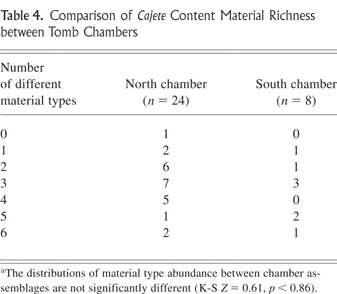
Reserving judgment until the analysis of the organic offerings is complete, it appears significant that no difference exists between the north and south tomb chambers with respect to the average quantity of material per vessel, material type richness (excepting a few rare items), or diversity of organic offering components (Table 4). One possible exception is the sole occurrence of bone in cajetes and of woven fibers found only in the vessels from the north chamber. Except for these two instances, it would appear that the organic material does not serve to distinguish the two chambers.
Comparison of Cajete Content Material Richness between Tomb Chambers

Having said this, we will now briefly discuss the evidence and restate the hypothesis. The durable offerings contained in this tomb provide a notable contrast to the apparent lack of distinction between chambers based on organic materials. Ceramic vessels are two to three times more numerous in the north chamber than in the south, and there are more than three times as many ceramic figurines in the north chamber as in the south chamber. Similar observations can be made for the shell offerings. Although the shell offerings from the north chamber are qualitatively more sumptuous than those from the south chamber (in quantity, in species diversity, and in artistic treatment), the organic material offerings in the two chambers do not appear to be qualitatively different. With this in mind, we offer an alternative explanation for the organic offerings contained in the ceramic vessels. Perhaps the organic offerings assign social inequalities in the same manner as the ceramic vessels in which they are contained. If sumptuous goods confer differences in status principally by their presence and secondarily by their quantities, utilitarian goods such as food cannot demarcate social inequality by their presence; they must do so by their abundance. Hence the average volume of organic material per vessel is not significantly different between chambers, but the aggregate volume of organic material as offering between chambers might be significant, much like the aggregate number of ceramic vessels. Additional tests of this hypothesis will come from an analysis of the vessels themselves and a more detailed examination of the constituents of the organic offerings as well. The greater status inferred for the individuals interred in the north chamber is only suggested from this analysis of the organic offerings. Additional detailed study of these unique archaeological materials is clearly warranted.
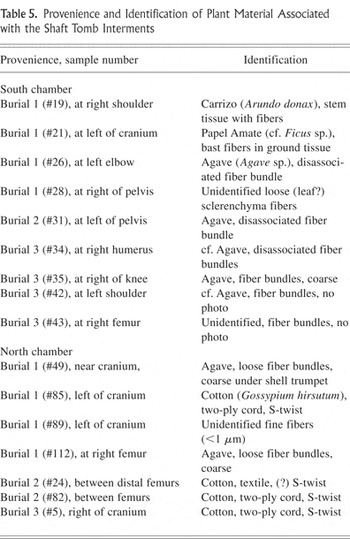
Thirteen archaeological fiber specimens from the Huitzilapa shaft tomb have been identified to date (Table 5). Three specimens from the south chamber could not be identified based on the comparative materials studied. One of these may be human hair. Thus far, agave fiber is the most common type of fiber found in association with the interments at Huitzilapa. This finding agrees with those investigators who refer to agave as the principal source of fiber for textiles as well as cordage. Agave fiber appears principally as aggregates of unwoven bundles of sclerified fibers that occur in various states of decomposition, either purposeful or post-mortem. Some of the fiber bundles identified in both the north and south chambers are suggestive—narrow bundles, relatively short fibers—of fiber obtained from young leaves used in the manufacture of the finely woven ayates still produced in the Mesquital region of Hidalgo (Parsons and Parsons 1990).
Provenience and Identification of Plant Material Associated with the Shaft Tomb Interments

The second most common fiber type occurring in these tombs is cotton. The cotton fibers examined thus far are in an eroded state that appears to have occurred as a result of being subjected to the organic acids associated with decomposition of the interments. All cotton appears in two-ply S-twist threads that are 0.5–1.0 mm in diameter. Thus far, cotton fiber occurs only in association with the interments in the north chamber. The hypothesized textiles of woven cotton apparently covered the heads and torsos of all three individuals. Agave fiber strands are also associated with the high-status male's head and the torso of the second male, suggesting perhaps that cotton fabric was placed over all individuals in the north chamber. The cotton textile appears to be in addition to and overlaying the agave fiber textiles and adornments that covered the interments.
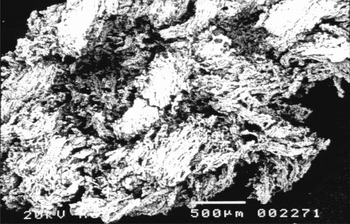
The appearance of amate paper in the Huitzilapa tomb is the earliest direct organic evidence for paper making in Mesoamerica, although there is some unpublished evidence that paper making was a well-established industry in Central Mexico at least 300 years earlier. The sole amate paper specimen (Figure 7) recovered from the tomb occurs in association with the single male interment in the south chamber. We suspect the paper has been manufactured from the bark of fig (genus Ficus) trees, not from other genera (Morus in the Moraceae or Trema in the Ulmaceae) that are used today as a result of overuse of the bark of fig trees. Anatomical and molecular study of the specimen will provide opportunity to test this hypothesis. Amate paper was commonly used to adorn the dead upon burial (Lenz 1948), so its appearance in Huitzilapa is not surprising. It is not obvious why the paper is found in association with an individual of apparently lower social status and not the highest-ranking individual. Perhaps it was left as an offering to the individual whose role was associated with paper making or as a designation of the individual who had acquired the status of a scribe. Final judgment on the relevance of amate paper will have to await completion of the analysis of all fiber samples from the Huitzilapa tomb.

Amate paper from the south chamber of the Huitzilapa tomb (Sample 21). Specimen found on floor adjacent to shoulder of interment 1. (above) Fragment showing aggregated bast fibers, some measuring 1.5 mm long. Fibers were aggregated by flattening. Ridges apparent along left margin of photo suggest the paper was flattened by beating using a comb-like instrument like a batidora (magnification 35×; scale bar measures 0.5 mm). (below) Close up of closely packed fibers composing paper. Individual fibers have different cell walls; some are more heavily impregnated by lignin (magnification 500×; scale bar measures 50 μm).
POSTSCRIPT
The discovery of a previously undescribed bacterium within the tomb (Gatson et al. 2006) creates an interesting opportunity to understand the ecology of burial ritual in western Mexico. Little is known of microbial ecology in western Mexico, complicating inferences about deposition and burial practices at Huitzilapa that might be drawn from the discovery and description of Bacillus tequilensis from the north chamber of this shaft tomb. Soil-inhabiting, spore-forming bacteria are expected denizens of ancient habitats. Although we draw no conclusions about the antiquity of the species in the Huitzilapa tomb, we are cognizant of the possibility that its presence might add useful information about human habitation, mortuary practices, and agriculture in the Tequila valley. On the other hand, much has been written about the importance of Bacillus species in agricultural environments (McSpadden Gardener 2004). Bacillus thuringiensis, also discovered in the tomb, is the source of Bt toxins used in the creation of transgenic cultigens and is well known for its pathogenicity to agricultural invertebrates. But Bacillus species are also implicated in human health maintenance and reduced crop production losses to fungi and insect pests. We believe that further study of the recently described B. tequilensis, as well as additional sampling of the Huitzilapa organics for this and other microorganisms, will assist in our understanding of pre-Hispanic interment practices in the Tequila valley.
RESUMEN
Materiales orgánicos de la tumba de tiro de Huitzilapa (ca. 74 d.C. calibrado) fueron examinados en búsqueda de indicaciones para identificar el contenido de las ofrendas de comidas u otro tipo de ofrenda para determinar el contenido de acoutremientos de entierros sobre y en asociación con los difuntos enterrados en las dos camaras. Estos materiales fueron examinados con microscopio de luz y microscopio electrónico de barrido. Las ofrendas son difíciles de identificar dado su condición avanzada de descomposición. Solo se ha podido identificar los materiales a nivel de clase (pez, insecto) o a nivel de reino (planta, animal). Sin embargo, tanto la diversidad del contenido de las ofrendas y la cantidad ofrendada ofrecen pistas sobre el estatus social de los individuos enterrados.
Las fibras asociadas con los difuntos se han prestado más a su identificación. Fibras de algodón y agave y al menos dos tipos más están asociadas a los enterrados y representan ropa, mantas de entierro o vestimientos personales o de oficio. La presencia de algodón dentro de la cámara norte también sugiere que el algodón es producto de estatus elevado que tenía disponibilidad limitada sobre el altiplano de Jalisco con acceso restringido a individuos con estatus social adquirido. La predominancia de fibras de agave en asociación con cinco entierros suguiere la importancia del maguey como fibra de uso común en el Occidente de México durante el Formativo. Un pedazo de papel amate se asocia con el hombre de estatus mayor en la cámara sur. Este papel representa la evidencia orgánica más antigua de este industria en Mesoamerica.Aunado a las diferencias entre cámaras, la asociación entre el papel y un hombre de la camara sur suguiere que los habitantes de Huitzilapa observaban una diferencial de clase, de estatus adquirido y de especialización industrial. Aunado a los restos orgánicos, presuntas ofrendas de alimentos, las fibras y textiles, una nueva especie de bacteria fue descubierto—Bacillus tequilensis—dentro de los tejidos descompuestos de los difuntos.
ACKNOWLEDGMENTS
We thank the Consejo de Arqueologia del Instituto Nacional de Anthropología e Historia for loan of the material for study. Ingieneros Civiles Associados, S. A. de C. V., supported the rescue archaeology and analysis of the materials.