Introduction
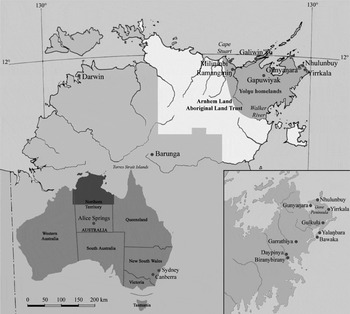
Yothu Yindi is one of Australia's most celebrated popular bands. Its innovative blend of rock and Yolŋu performance traditions from northeast Arnhem Land (see Figure 1) has spawned six original albums (1989, 1991, 1993, 1996, 1999, 2000b) and thirteen music videos (1992a, 2000a).Footnote 2 The band's philanthropic arm, the Yothu Yindi Foundation (YYF), has also produced six albums of traditional music from Arnhem Land (YYF 2001–2003), the motion picture Yolŋu Boy (Johnson [dir.] Reference Johnson2000) and the annual Garma Festival at Gulkula (YYF 2006).
Locations within the Yolŋu homelands, Arnhem Land and Australia.

Formed in Darwin in 1986, Yothu Yindi was founded by three Yolŋu men from Yirrkala on the Gove Peninsula. Singer/guitarist Mandawuy Yunupiŋu, born 1956, became the band's primary songwriter. Witiyana Marika was then a purely traditional performer who sang and played bilma (‘paired sticks’), while the late Milkayŋu Munuŋgurr was a traditional player of yidaki (‘didjeridu’).Footnote 3 Mandawuy had also forged strong friendships with a second trio of rock musicians known in Darwin as the Swamp Jockeys, bassist Stu Kellaway, guitarist Cal Williams and drummer Andy Beletty, who completed Yothu Yindi's original complement. The sounds they created together were built on an unprecedented syncretism of Yolŋu performance traditions and global popular styles. Mandawuy's older brother, Galarrwuy Yunupiŋu, also contributed his skills as a traditional singer to the band's studio recordings, and created traditional artwork for each of its albums. Other significant members of Yothu Yindi have since included Indigenous singer Jodie Cockatoo, Yolŋu multi-instrumentalist Gurrumul Yunupiŋu, Papuan drummer Ben Hakalitz, Papuan keyboardist Buruka Tau-Matagu, keyboardist Matthew Cunliffe, and Yolŋu yidaki players Gapanbulu Yunupiŋu and Yomunu Yunupiŋu. At the peak of its popularity in the early 1990s, Yothu Yindi's chart success was unprecedented by any other band with indigenous Australian roots. In 1991, ‘Treaty’ (1991, tr. 2) became the first song with lyrics in any Australian language to chart anywhere. Worldwide multi-platinum sales ensued, as did a swathe of awards from MTV, the Australian Record Industry Association (ARIA), the Australasian Performing Right Association (APRA) and Australia's Human Rights and Equal Opportunity Commission (HREOC). ‘Djäpana: Sunset Dreaming’ (1991, tr. 3), a second song with lyrics in Yolŋu-Matha, also charted well. With the announcement of Mandawuy Yunupiŋu as the 1992 Australian of the Year, the band's place in Australian history was sealed. Further recognition for Mandawuy came with an honorary doctorate in education from the Queensland University of Technology in 1998, and the Jimmy Little Deadly Award for Lifetime Achievement in Aboriginal and Torres Strait Islander Music in 2004.
Initial scholarship into Yothu Yindi focused on the roles of the entertainment and media industries in obscuring the politics behind ‘Treaty’. The popularity of this song had initially been stimulated by an unauthorised dance remix (1992b, tr. 15) which stripped away all but three lines of its original English lyrics (Hayward [ed.] Reference Hayward1992, pp. 169–70; Hayward Reference Hayward1993; Mitchell Reference Mitchell1992, Reference Mitchell1993a, Reference Mitchell and Nicol1993b; Nicol Reference Nicol1993). Following studies aptly located the band's indigenous roots in Yolŋu culture, and identified ganma (‘converging currents’) and yothu–yindi (‘child–mother’) as significant traditional themes both in its creative work and in Mandawuy's parallel career as a Yolŋu educator (Neuenfeldt Reference Neuenfeldt1993; Stubington and Dunbar-Hall Reference Stubington and Dunbar-Hall1994; Magowan Reference Magowan1996, pp. 147–52; Dunbar-Hall Reference Dunbar-Hall1997, pp. 39–42; Dunbar-Hall and Gibson Reference Dunbar-Hall and Gibson2004, pp. 198–208).
While Mandawuy offered his own thoughts on these themes in the 1993 Boyer Lecture (Yunupiŋu Reference Yunupiŋu1994), there nonetheless remained many unanswered questions about Yothu Yindi's role as an intermediary of Yolŋu cultural life and indigenous political aspirations. It was unknown why Mandawuy started composing original rock songs with materials drawn from Yolŋu tradition, or what he had hoped this innovation would achieve. Amid the sketchy inaccuracies of the band's album notes, it was also uncertain which specific traditional song repertoires had been worked into the band's music, or how their incorporation was aligned with Yolŋu traditions for managing such hereditary properties. That the immediate family of the band's Yolŋu founders had been engaged in a protracted struggle against the mining of their homelands on the Gove Peninsula since 1963 was another crucial factor that was absent from discussion of its creativity.
This article addresses these concerns by drawing on my keynote address with Mandawuy Yunupiŋu to the Annual Conference of the Musicological Society of Australia at the University of Sydney in 2005, which charted the traditional values, family history and compositional intent behind Yothu Yindi's music (Yunupiŋu and Corn Reference Yunupiŋu and Corn2005). The article is also grounded in my close collaborations with the band to chronicle its history and repertoire, and to determine how its creative approaches both reflect and extend traditional expressions of Yolŋu sovereignty and culture (Corn with Yunupiŋu Reference Corn and Yunupiŋu2001, Reference Corn and Yunupiŋu2005; Corn with Yunupiŋu, Kellaway and Marika Reference Corn, Yunupiŋu, Kellaway and Marika2005; Corn with Yunupiŋu and Marika Reference Corn, Yunupiŋu and Marika2005). It is further contextualised within an extensive body of contemporary ethnographic research into Yolŋu culture and music (Williams Reference Williams1986; Morphy Reference Morphy1991, Reference Morphy2008; Knopoff Reference Knopoff1992; Keen Reference Keen1994, Reference Keen2000; McIntosh Reference McIntosh1994, Reference McIntosh1996, Reference McIntosh1997, Reference McIntosh2000; Magowan Reference Magowan and Stokes1994, Reference Magowan2007; Dunlop [dir.] Reference Dunlop1970–1996; Cooke [ed.] Reference Cooke1996; Neuenfeldt [ed.] Reference Neuenfeldt1997, pp. 39–88; Tamisari Reference Tamisari1998, Reference Tamisari2000; Toner Reference Toner2000; Corn with Gumbula Reference Corn and Gumbula2003, Reference Corn, Gumbula, Ward and Muckle2005; Corn Reference Corn2003, Reference Corn2005, Reference Corn and Jarman-Ivens2007; Corn and Gumbula Reference Corn, Gumbula and Langton2004, Reference Corn, Gumbula and Russell2006, Reference Corn and Gumbula2007; Magowan and Neuenfeldt [eds] Reference Magowan and Neuenfeldt2005, pp. 29–45, 57–95; Deger Reference Deger2006; Stubington Reference Stubington2007).
Through intercultural ethnographic dialogues with Yolŋu musicians, my approach has been to delve beyond the popular notions of ‘dreamings’, ‘solo didjeridus’, ‘corroborees’ and ‘songlines’ that have been internationalised as icons of indigenous Australia (Williams Reference Williams1986, p. 25; Corn Reference Corn2003). My goal in the article is to identify ethnocentric meanings in the music of Yothu Yindi that are readily apparent to local Yolŋu audiences but obscure to others, and in doing so, to generate new understanding of Mandawuy Yunupiŋu's agency as a leading intermediary of contemporary Yolŋu culture and political aspirations.
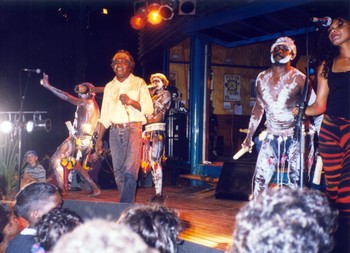
Yothu Yindi performs to open the Yirrŋa Music Development Centre on the Gumatj homeland of Gunyaŋara (Aaron Corn, 1999).

Singing children of the earth
The Yolŋu (literally ‘person’, ‘human’) are the indigenous occupants and hereditary owners of northeast Arnhem Land in Australia's Northern Territory (NT). There are approximately 7000 Yolŋu Australians whose remote homelands extend from the Gove Peninsula in the far northeast, west to Cape Stuart and southwest to Walker River. Four of the seven towns in this region, Miliŋinbi, Yirrkala, Galiwin'ku and Ramanginiŋ, were founded by the Methodist Overseas Mission between 1922 and 1973. Yothu Yindi's home town on the Gove Peninsula, Yirrkala, was founded as the second of these in 1934 (Horton [ed.] Reference Horton1994, pp. 1,292–3; Corn and Gumbula Reference Corn, Gumbula and Russell2006, p. 173). Gapuwiyak and Gunyaŋara were established by Yolŋu families as respective satellites of Galiwin'ku and Yirrkala in the 1980s, while the mining town of Nhulunbuy was developed against Yolŋu wishes near Yirrkala by the NABALCO corporation in 1967.
Yolŋu society is an expansive network of some sixty patrifilial groups (literally, ‘groups’) (Zorc Reference Zorc1996; Bagshaw Reference Bagshaw, Peterson and Rigsby1998, pp. 155–73). Membership in each mala is agnatic with hereditary ownership of each Yolŋu group's country and other property passing from father to child in perpetuity. Mandawuy Yunupiŋu was born into the Gumatj mala, while Witiyana Marika and Milkayŋu Munuŋgurr were respectively born into the Rirratjiŋu mala and the Djapu' mala.
The Yolŋu collectively speak a cluster of seven Australian languages known as Yolŋu-Matha (literally ‘human speech’). However, beyond everyday usage, each group possesses a discrete lexicon of esoteric yäku (‘names’) which, in formal usage, differentiates the matha (‘speech’) of one mala from another. Standing as constitutional evidence of this ownership, these lexicons of esoteric yäku are the most valuable traditional asset any mala can possess other than country itself. Each mala owns at least one wäŋa (‘country’, ‘homeland’) incorporating all lands, waters and natural resources therein, and an incumbent canon of hereditary yäku (‘names’), manikay (‘songs’), buŋgul (‘dances’) and miny'tji (‘designs’). ‘So axiomatic’ is this relationship for Yolŋu ‘that people without land are people without identity’ (Williams Reference Williams1986, p. 232).
Yolŋu have inhabited northeast Arnhem Land for countless millennia, and maintain hereditary knowledge of maritime sites known to have been above sea level some 10,000 years ago (Yunupiŋu and Dhamarrandji Reference Yunupiŋu, Dhamarrandji and Yunupiŋu1997; Buku-Larrŋgay Mulka Centre 1999; Horton [ed.] Reference Horton1994, p. 201). They trace their ultimate descent from metaphysical waŋarr (‘ancestral progenitors’) who originally shaped, named and populated the Yolŋu homelands, and are believed to remain sentient and ever-present therein (Williams Reference Williams1986, pp. 42–3; Gondarra Reference Gondarra2001, pp. 15–20; Corn and Gumbula Reference Corn, Gumbula and Langton2004, pp. 101–16). It is by virtue of this birthright, passed from father to child through each generation of each mala, that all Yolŋu see themselves as both wäŋa-wataŋu (‘country-holders’) and rom-wataŋu (‘law-holders’).
The hereditary canons of names, songs, dances and designs bestowed by waŋarr with the homelands are central to Yolŋu identity and spirituality. They provide a highly durable ceremonial framework for practising Yolŋu rom (‘law’, ‘culture’, ‘correct practice’, ‘the way’), and also constitute an esoteric body of Yolŋu knowledge known as madayin. Madayin describes the ‘beauty’ of all creation and the ‘nature’ of everything in it (Williams Reference Williams1986, p. 29; Keen Reference Keen1994, pp. 137–40; Gondarra Reference Gondarra2001, p. 19). Its descriptions are both qualitative and exquisitely cryptic as is evident in traditional manikay series where yäku are used as a non-narrative lyrical resource (Williams Reference Williams1986, p. 42; Keen Reference Keen1994, p. 239; Corn and Gumbula Reference Corn and Gumbula2007, pp. 120–2).
Only madayin of the garma (‘open’) and dhuni' (‘sheltered’) classes are performed in public contexts, while the deepest esoterica of the ŋärra' (‘restricted’) class is conventionally revealed only to initiated men in seclusion (Keen Reference Keen1994, p. 143).Footnote 4 The garma madayin owned by each mala are organised in distinct strings of subjects that recount the species and ecologies observed by waŋarr as they founded the Yolŋu homelands. An individual subject can be shared by multiple mala. But for each individual subject, there still exists a string of several sacred names that is unique to each mala (Williams Reference Williams1986, pp. 40–5). Canons of garma madayin always refer obliquely to details of ancestral characteristics and deeds recorded in the deeper dhuni' and ŋärra' classes. Yolŋu liken this relationship between the public and the restricted to a tree and its subterranean roots. Though unseen, a tree's roots are embedded in the same earth as the waŋarr themselves (Keen Reference Keen1994, p. 169).
Access to use and understanding of a group's hereditary names, songs, dances and designs is regulated by qualified ceremonial leaders who are known as the liya-ŋärra'mirr(i) (‘learned’, ‘wise’).Footnote 5 The process of becoming liya-ŋärra'mirr(i) is said to be a long and arduous one of attaining a demonstrable knowledge of all requisite madayin, and through this observance of ancestral law, accruing sufficient märr (‘inner strength’, ‘ancestral power’, ‘spiritual health’) (Keen Reference Keen1994, pp. 94–5). Yolŋu believe that the waŋarr who remain sentient and ever-present in country can sense the märr of their living kin. They will render their homelands safe and abundant for those who can be recognised as gurrutu (‘kin’, ‘family’), and similarly work to repel and poison intruders (Williams Reference Williams1986, pp. 85; Tamisari Reference Tamisari1998, pp. 256–67). Following ancestral precedent through the observance of one's hereditary madayin is therefore considered a high virtue among Yolŋu (Keen Reference Keen1994, p. 149).
Despite the intercultural syncretism of Yothu Yindi's music, this classical Yolŋu worldview is seeded throughout its repertoire. The song ‘Baywara’ (1993, tr. 4), for example, clearly addresses the intimate relationships between country, ancestors and law in Yolŋu epistemology. Its verses and bridge describe the progenitorial journey of Baywara, the waŋarr ‘Olive Python’, to Ŋaypinya. This homeland is owned by the Gälpu mala to which Mandawuy's late mother was born. The lyrics ‘She walked with the law in her hands, singing children of the earth’ (verse 1) describe how Baywara sang the Gälpu mala into being at Ŋaypinya as she embedded her law and her sentience deep into the earth there. In the chorus, Mandawuy identifies her as ‘Maker of the Land, Maker of the Song, Maker of the Constitution’.
Land, song and constitution are all integral; all one. You can't isolate one from the other. It's all interwoven very tightly and you can't separate them. That is written in the bark paintings; in the scrolls of the log coffins; in the songs. No matter what their language in Arnhem Land, everyone practises that. Even down in central Australia where they practise the boomerang, they talk about the same thing. It's the constitution. It's the law. It's the basis of where we come from. If you've ever been exposed to those big ceremonies, you see people dancing whether they're Shark people or Stingray people; whether they're Bäru [‘Saltwater Crocodile’], the Maralitja [‘Saltwater Crocodile’] man. Maralitja discovered fire in the beginning, so when you're dancing Bäru, you become transformed into Maralitja. And that's when you say ‘I'm the Maralitja. I own the land. I own that philosophy. I own that knowledge. I have a right to that land and you can't take that away from me’. Other groups are the same. When people dance Shark, they're transformed into the Shark ancestor, or the Stingray or whatever it may be. That's how one becomes transformed into something they want to show; they want to tell in that most classical way. The classical way of making their point known is by doing it in unity and strength with one's own mala and, of course, the yothu–yindi [‘child–mother’] balance between mala is always there in that strength and unity. We are still doing this regardless of our laws having been rejected and trivialised. We don't care. We keep going because it's important to pass on this law to the next generation so it strengthens our identity as a first-nations people of this country. (Yunupiŋu from Yunupiŋu and Corn Reference Yunupiŋu and Corn2005)
The music video for ‘Tribal Voice’ (1992a, tr. 6), a song from Yothu Yindi's second album (1991, tr. 7), exemplifies the intensity with which Yolŋu realise ancestral identities through ceremonial performance. It features a genuine dhapi ceremony for male initiation by ‘circumcision’. Mandawuy dances Gapirri (‘Stingray’) over the three boy initiates, while his older brother, Galarrwuy, sings manikay and paints deeply sacred designs on their bodies. As he dances, Mandawuy fixes a piercing forward gaze and clutches a deeply sacred Gumatj bathi (‘basket’) between his teeth. Baskets of this kind are dhuni', and stand as the most sacred emblems of waŋarr authority that can be displayed in any public context. The bathi bears a pair of long orange-feathered tassels and an elongated diamond motif representing the Gumatj waŋarr Maralitja (‘Saltwater Crocodile’). Such ceremonial gakal (‘displays’) of ancestral power are also dhuni'. They mirror the fierce power of the waŋarr and the gravity of ceremonial acts undertaken in their name (Morphy Reference Morphy1991, p. 263). As the ‘Tribal Voice’ clip ends, the boy initiates stand ready with the Gumatj elder Djaŋa Yunupiŋu. Sacred tassles of orange parrot feathers adorn their heads, arms and waists, with painted heads and torsos completing their otherworldly appearance.
The boy standing camera left, Yomunu Yunupiŋu, would come to play yidaki for Yothu Yindi in the mid-1990s. But here in ceremony, the metaphysical nature of being in all Yolŋu is made plain. Not only are the Yolŋu the direct descendants of the original waŋarr, they are also mirrored physical consubstantiations of the original waŋarr presences that remain eternal and sentient in country (Williams Reference Williams1986, pp. 23–4).
‘Tribal Voice’ stands as Yothu Yindi's response to the lingering influence of Christianity in Yolŋu lifestyles following decades of local administration under state-sanctioned missions. The early Methodist missionaries in northeast Arnhem Land had abandoned their failing attempts to quell Yolŋu traditions in 1926, and instead established an enduring spiritual and cultural dialogue that respected both Yolŋu and Christian perspectives. Yet the withdrawal of the Methodists Overseas Mission from local government in the 1970s left room for a new brand of Christianity to sweep across Arnhem Land in the decade that followed. Owing much to US evangelism, it insisted on the abandonment of Yolŋu traditions in favour of an exclusive Christian practice. Mandawuy was deeply concerned.
People here were strongly into the church. The whole place was saturated and there seemed no way out. It was like every second man and his dog was into it. My way of rejecting this was to challenge them by saying, ‘Hey, our tribal voice is going to be here forever. How about coming down to earth and thinking about where your feet are entrenched; where your reality lies?’ ‘Tribal Voice’ is about that struggle for recognition of our religious freedom and, of course, our freedom of speech. Don't throw it away and go for something else. (Yunupiŋu from Yunupiŋu and Corn Reference Yunupiŋu and Corn2005)
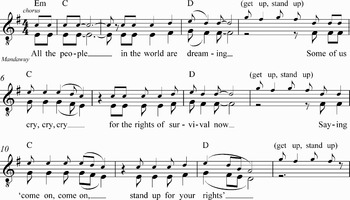
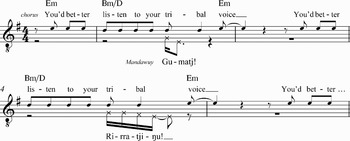
‘Tribal Voice’ was therefore conceived as a stirring rock anthem for Yolŋu religious freedom and cultural survival. The song's chorus alludes to the global diversity of human religions, and echoes the activist expression of ‘Get Up, Stand Up’ by the Wailers (1973, tr. 1) (see Example 1). Mandawuy urges audiences to listen to their ‘tribal voice’, and later in the song's coda, he levels this appeal directly at the Yolŋu mala who own homelands on the Gove Peninsula: Gumatj, Rirratjiŋu, Wangurri, Djapu', Dhalwaŋu, Dätiwuy, Maŋgalili and Gälpu (Dunbar-Hall Reference Dunbar-Hall1997, p. 46). As backing singers repeat the hook ‘You'd better listen to your tribal voice’, Mandawuy shouts each of their names in turn over the word ‘tribal’ (see Example 2). With the lyrics ‘Come now the sprits of my ancestors who have just gone before into the future of another day’ in verse 3, Mandawuy evokes a central Yolŋu belief: the cyclical passage of birrimbirr (‘souls’) through the physical and metaphysical planes of reality, from birth to death to rebirth, in an endless loop (Berndt and Berndt Reference Berndt and Berndt1988, p. 213). In the spoken lyrics of the song's bridge, ‘Yaka menguŋa nhuŋuway rom; dhuwala buŋgul gakal likan’, he also refers to the Stingray gakal he dances in the music video. While this statement has no direct English equivalent, it can be loosely translated from Yolŋu-Matha as ‘Do not forget your law; this ceremonial display of ancestral power’.Footnote 6
Opening of the chorus of ‘Tribal Voice’ (Yothu Yindi Reference Yindi1991, tr. 7).

The first two Yolŋu mala names shouted by Mandawuy Yunupiŋu in the coda of ‘Tribal Voice’ (Yothu Yindi Reference Yindi1991, tr. 7).

To a homeland far away
Before Yothu Yindi's ascent, never had sounds, images and ideas so sacred to the Yolŋu been presented through an idiom so seemingly profane as rock. The band's rise to fame in the early 1990s was unarguably buoyed by its exotic appeal amid the growing global market for World Music. Commercial success was nonetheless far from the local and personal concerns that inspired Mandawuy's songwriting. His intrepid synthesis of rock and traditional Yolŋu manikay developed in response to the entrenchment of Anglo-colonial influences in 1980s Arnhem Land. While the Methodist Overseas Mission had long been committed to working with Yolŋu in both English and Yolŋu-Matha, English was the only official language of the NT government agencies that, in the 1970s, had assumed their administrative and service roles. It was rapidly becoming impossible in Arnhem Land to buy groceries, book travel, access public services, find medical treatment or have a bank account without a working knowledge of English. English was also the only formal language of instruction in local schools, and now found even greater exposure among local youths amid the introduction to Arnhem Land of televisions, video players and portable stereos.
Yolŋu of Mandawuy's generation had come through the mission era with their traditional knowledge largely intact. But now, it fell to them to ensure that these old ways were not swept away in a torrent of the new. As a senior Yolŋu educator in an Arnhem Land school, Mandawuy knew that something radical needed to be done. His songwriting became his vehicle for shaping and theorising his ideas about new ways of schooling Yolŋu children bi-culturally.
It was with his very first original song of 1983, ‘Djäpana: Sunset Dreaming’ (Yothu Yindi Reference Yindi1989, tr. 5), that Mandawuy began to explore the potential of blending manikay and rock. With most of its lyrics in English, this initial arrangement of ‘Djäpana: Sunset Dreaming’ sounded like a fairly conventional rock song. However, in drawing on themes and lyrics from the hereditary Gumatj manikay of Mandawuy's own mala, it was an unprecedented step nonetheless. Mandawuy wanted the song to express his warwu (‘sorrow’, ‘homesickness’, ‘worry’) for the young family he had left behind in Yirrkala while he worked in Galiwin'ku as the Assistant Principal of Shepherdson College. To capture this emotion, he turned to the subject of djäpana (‘coral sunset’) from the manikay series for the Gumatj homeland of Bawaka which recounts the ancestral trespasses of foreign marauders known only as the Bayini (Mountford Reference Mountford1956, pp. 333–8). In the hull of their boat, the Bayini had captured a beautiful woman called Djotarra, and when they finally sailed from Bawaka into the beautiful coral sunset, their vessel struck a rock in the shallow coastal waters drowning all aboard. In their traditional manikay setting, the lyrics selected by Mandawuy for the Chorus of ‘Djäpana: Sunset Dreaming’ express warwu for Djotarra's loss: ‘Wo djäpana, wo warwu, wo rrämani, wo galaŋgarri’ which can be translated as ‘Oh coral sunset, oh sorrow, oh coral sunset clouds, oh coral sunset’. It is no coincidence that the song's third verse also mentions the Balanda (‘Euro-Australians’), who in the twentieth century, intruded on Gumatj lands not to maraud, but to mine.
One evening after work, I was sitting with a friend of mine. I had a guitar and I was feeling sad for my family. My family didn't come with me at that time. They came afterwards; maybe two months after I was there on my own. I was sitting. I was thinking. I was worrying about my family and it was sundown. I was thinking about the lines in djäpana. I was thinking ‘warwu’. I was thinking ‘djäpana, rräma, rrämani, dhurulaŋala [‘fading’], galaŋgarri’. I was thinking about all those names that make one sad and thinking about the family, because djäpana is about thinking back to your family. So I grabbed the guitar … Djäpana ends a manikay series. It might take all day, and then at the end of the day, djäpana basically says goodbye. Goodbye to the day, to the people, and to friends, relatives and visitors from wherever they come. (Yunupiŋu from Yunupiŋu and Corn Reference Yunupiŋu and Corn2005)
‘Djäpana: Sunset Dreaming’ marked a new radical departure from Soft Sands' country and gospel idioms. It demonstrated how the rock idiom could be harnessed, as a wakinŋu (‘kinless’) resource that existed outside the strict protocols of Yolŋu ownership, to incorporate themes and materials drawn directly from hereditary manikay as a means of conveying and contemporising durable ideas grounded in Yolŋu tradition. It also followed and extended the Yolŋu practice of composing non-canonical yuta (‘new’) manikay items in which traditional subjects are related to contemporary events, such as funerals and family separations, which evoke warwu as an emotional response (Knopoff Reference Knopoff1992, pp. 144–50; Toner Reference Toner2000, pp. 35–7). Though certainly unconventional, Mandawuy's approach nonetheless sought to satisfy the Yolŋu ideals of following and honouring ancestral precedent.
Also at that time, there was a big movement in that most of the Yolŋu in the bands were into gospel songs. There was a big gospel movement happening and my objective was to say, ‘Now listen guys, there are other avenues to think about your culture’. My struggle was to preserve my culture and the way that I wanted to do that was to write a song with all those Western elements so I came up with the lines and the lyrics as a modern way of describing what I thought about in the traditional way. On the day after composing it, I went to the band Soft Sands and asked them if they could play this song using their equipment. I was able to feel it with the drums as well as the bass guitar, the lead guitar and rhythm guitar. I then worked out the chorus lines for it as time went on. We gave it a contemporary rock ’n’ roll feel but still maintained that Yolŋu side to it. (Yunupiŋu from Yunupiŋu and Corn Reference Yunupiŋu and Corn2005)
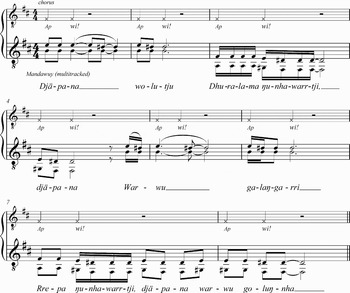
‘Djäpana: Sunset Dreaming’ became a template for how many Yothu Yindi songs would be composed. The band's songs would typically express Mandawuy's responses to topical issues through lyrical references to garma manikay subjects that alluded to their themes. As the Yothu Yindi style developed, direct musical quotations from manikay, in addition to lyrical ones, became its hallmark. For example, later recordings of ‘Djäpana: Sunset Dreaming’ (1991, tr. 3) augmented the song's traditional manikay content by quoting two entire stanzas, or gumurr (literally ‘chests’), of the original djäpana over the band's throbbing four-beat (see Example 3).
Vocal parts of the first manikay section played in ‘Djäpana: Sunset Dreaming’ (Yothu Yindi Reference Yindi1991, tr. 3).

This organic relationship between traditional manikay settings and the rock songs that they inspired is made even more apparent in the recording of ‘Djäpana: Sunset Dreaming’ on One Blood (Yothu Yindi Reference Yindi1999, tr. 8). On this fifth album, the song is preceded by an entirely traditional performance of ‘Rräma (Coral Sunset Clouds)’ (tr. 7) that is sung by Galarrwuy Yunupiŋu with bilma (‘paired sticks’) and yidaki (‘didjeridu’) accompaniment. Aural coherence between the traditional ‘Rräma’ and the rock song ‘Djäpana: Sunset Dreaming’ is established with the spoken vocables, ‘Ap wi’. They are performed at the end of each stanza of ‘Rräma’ and are the first sounds of ‘Djäpana: Sunset Dreaming’ heard in the following track.
Three other original songs on One Blood are similarly introduced by traditional manikay items from different manikay series. While Yothu Yindi's earlier albums are abundant with traditional manikay items, this particular configuration is most prevalent on One Blood. ‘Laykarrambu (Male Red Kangaroo)’ (tr. 1) precedes the titular ‘One Blood’ (tr. 2). Its distinctive bilma pattern (see Example 4) is heard again in the manikay bridges of ‘One Blood’ in which Mandawuy sings of the male red kangaroo's demise on the Gumatj homeland of Gulkula at the hands of the ancestral mokuy (‘ghost’) hunter, Ganbulapula. Both ‘Laykarrambu’ and the bridges of ‘One Blood’ share the terminal phrase, ‘Wo duwitj, wo duwutj, wo duwitj’, which describes the bloodied ‘twitching’ felled animal's carcass. ‘Tears for Law: Garrathiya Run’ (tr. 13) references the ancestral preparation of bread from the cycad palm and is introduced by ‘Miŋamiŋa (Cycad Nut Bread)’ (tr. 12). Its melody uses the same pitch set as those found in the traditional melodic structure, or dämbu (literally ‘head’), of ‘Miŋamiŋa’ (see Example 5). Finally, the manikay lyrics of ‘Nyiŋanyiŋa (Anchovy)’ (tr. 16) are again heard in the manikay bridge of the following rock song, ‘Our Land’ (tr. 17).
The bilma pattern played throughout ‘Laykarrambu’ (Yothu Yindi Reference Yindi1999, tr. 1) and heard again in the manikay bridges of ‘One Blood’ (tr. 2).

The dämbu of ‘Miŋamiŋa’ (Yothu Yindi Reference Yindi1999, tr. 12).

These are the only instances on Yothu Yindi's albums in which the organic relationships between traditional manikay settings and the rock songs they inspired are made so clear. Nonetheless, any original song incorporating thematic, lyrical or musical materials sourced from a traditional manikay item could potentially be introduced in this way. As Yolŋu logic dictates, though the deep roots of a tree are buried and unseen, they are there nonetheless.
The traditional materials presented on Yothu Yindi's albums are largely drawn from manikay series inherited by Mandawuy and Galarrwuy through their Gumatj patrilineage or yarrata (literally ‘string’). They include derivative original songs such as ‘Maralitja: Crocodile Man’ (1991, tr. 5), ‘Tears for Law: Garrathiya Run’ (1996, tr. 1), ‘Yirrmala (Hull)’ (1996, tr. 12), ‘One Blood’ (1999, tr. 2) and ‘Fire’ (2000B, tr. 2). ‘Yolŋu Woman’ (1989, tr. 2) recounts a funeral ceremony that ended with ‘the usual songs’ (verse 3) on the Gumatj manikay subjects of dirrmala (‘northeasterly wind’), gärr’ (‘morning mist spider’) and wärraŋ (‘dingo’). Brief performances of Gumatj manikay items in their traditional settings also feature on the band's albums. Sung by Galarrwuy, they include ‘Gany'tjurr (White-Faced Heron)’ (1993, tr. 15), ‘Bäpaŋ (Driftwood)’ (1996, tr. 5), ‘Lorrpu (Sulphur-Crested Cockatoo)’ (1996, tr. 10), ‘Laykarrambu (Male Red Kangaroo)’ (1999, tr. 1), ‘Miŋamiŋa (Cycad Nut Bread)’ (1999, tr. 12) and ‘Bäru (Saltwater Crocodile)’ (1999, tr. 14).
Early Yothu Yindi albums also feature Witiyana Marika singing traditional Rirratjiŋu manikay items on the subjects of ‘Gudurrku (Brolga)’ (1989, tr. 8), ‘Dhum'thum (Agile Wallaby)’ (1991, tr. 6), ‘Yinydjapana (Dolphin)’ (1991, tr. 10) and ‘Milika (Diamond Fish)’ (1993, tr. 9). However, ‘Timeless Land’ (1993, tr. 1) is the band's only original song to incorporate direct quotations from Rirratjiŋu manikay. In the two manikay bridges of ‘Timeless Land’, Witiyana sings of the mulpiya’ (‘agile wallabies’) who inhabit the rocky escarpment on the Rirratjiŋu homeland of Yalaŋbara. Later in the song's coda, he juxtaposes this against one of his mother's traditional manikay on the Gumatj subject of mambulmambul (‘rare kangaroo flesh’), thereby evoking the yothu–yindi (‘child–mother’) balance among the band's members.
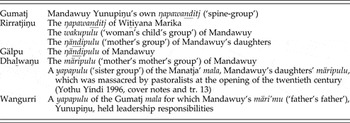
There are also several original Yothu Yindi that collectively cite Mandawuy's lineage from his Gälpu ŋändipulu (‘mother's group’), and his Dhalwaŋu märipulu (‘mother's mother's group’) (see Table). Mandawuy's continuing relationship with his late parents is celebrated in ‘Gapirri (Stingray)’ (1991, tr. 13), which personifies his father as the Gumatj Stingray ancestor and his mother as the Gälpu waŋarr, Baywara (‘Olive Python’). Mandawuy's mother is also remembered in ‘Dots on the Shells’ (1993, tr. 13), yet ‘Baywara’ (1993, tr. 4) remains the only original Yothu Yindi song to quote Gälpu manikay. Its traditional manikay bridge cites the bonbarr (‘lightening’) spoken by Baywara as she founded the Gälpu homeland of Ŋaypinya. The manikay of Mandawuy's Dhalwaŋu märipulu are similarly quoted in ‘Honey: Birrkuda (Bee)’ (1996, tr. 13) and ‘Macassan Crew’ (2000b, tr. 1).
Yolŋu mala referenced in Yothu Yindi's repertoire.

An oblique reference to Mandawuy's late father's father, the prolific Gumatj leader known as Yunupiŋu, is found in ‘Our Land’ (1999, tr. 17) with its quotation of the traditional manikay ‘Nyiŋanyiŋa (Anchovy)’ (1999, tr. 16). Yunupiŋu was renowned for having held leadership responsibilities for both the Gumatj mala and the Wangurri mala, and as a madayin subject held by both, nyiŋanyiŋa represents this historical union (Williams Reference Williams1986, p. 190). The barely perceptible rapidity with which these tiny fish dart about symbolises the deftness of Gumatj leaders as political negotiators.
Living in the mainstream
Mandawuy first set forth a response to the prevailing Anglocentrism of public schooling in Arnhem Land in 1986 in his third original song, ‘Mainstream’ (1989, tr. 1). By this time, he was in his final year of study towards a Bachelor of Arts in Education from Deakin University. The curriculum was dominated by a colonialist assumption that indigenous children were best served by a mainstream education with formal instruction in English, and this prompted Mandawuy to reconsider his own experiences of schooling under the Methodists.
Looking back now, I can see that the teachers probably saw things differently to me. Many of their demands were quite incomprehensible. They weren't just teaching me ‘useful things’. They had a theory, an ideology. I see now that it was a curriculum driven by the ideology of assimilation. I marvel at the ways we knew how to resist it. I see now that a lot of what motivated those white teachers was the view that it was only when Yolŋu stopped being Yolŋu that we could be Australians. (Yunupiŋu Reference Yunupiŋu1994, p. 116)
Albeit predominantly in English, Mandawuy launched his counter-argument in a typically Yolŋu fashion. He wrote a song about it. When asked to write an assignment on educational outcomes for indigenous school students, Mandawuy instead composed ‘Mainstream’ and submitted it for assessment. It was awarded a high distinction.
Again, on first hearing, ‘Mainstream’ sounds like an innocuous rock ballad. It nonetheless set forth the central tenant of Mandawuy's revolutionary ideas on bilingual and bicultural education in indigenous schools. ‘Mainstream’ asserted that Yolŋu children should be entitled to learn all the necessary skills for participating in broader Australian society without having to relinquish their own traditions, and it sought to turn entrenched Anglocentric notions of what constituted a mainstream education upside down. The song's chorus contends that ancestral law forms the only ‘mainstream’ of thought in which Yolŋu have been raised and educated for countless millennia, and its only Yolŋu-Matha word, ‘go’ (‘come’), beckons Yolŋu to continue in this tradition. The passage of Mandawuy's own Gumatj traditions from father to child in perpetuity – from the original waŋarr to his own children – is referenced in the first verse of ‘Mainstream’. Here, gapu (‘water’) is evoked as the liminal medium through which souls migrate between the physical and metaphysical planes of reality (Berndt and Berndt Reference Berndt and Berndt1988, p. 213). Thus, as Mandawuy sees his own daughters reflected ‘in the water’, he simultaneously hears the ‘voices’ of ancestral ‘Yolŋu heroes’ (Yothu Yindi Reference Yindi1989, tr. 1, verse 1).
‘Mainstream’ was my first challenge to mainstream education. Here I was, for the first time, sitting equally with third year students in the university system. So for me, as I was one of only five indigenous students there, this was my way of saying, ‘Listen, I can come in. I can sit. I can learn. But still, I have my own traditions which are equal to yours’. So this song is not about assimilation. It's about my law being as equal as yours. (Yunupiŋu from Yunupiŋu and Corn Reference Yunupiŋu and Corn2005)
Grounded in ideals of equality, balance, respect and dialogue between different peoples, Mandawuy's vision was for a school curriculum that incorporated formal instruction in both Yolŋu-Matha and English through which Yolŋu students would learn to be bicultural. To capture these ideals in ‘Mainstream’, he drew on traditional models for balance and cooperation between different mala which stem from the systemic diconstitutionality of Yolŋu society (Corn and Gumbula Reference Corn, Gumbula and Russell2006).
All Yolŋu mala are organised under two discrete yet interdependent constitutions of rom known as Dhuwa and Yirritja. Each mala is constituted as either Dhuwa or Yirritja, and this arrangement forms the primary balance of powers in Yolŋu political life (Gondarra Reference Gondarra2001, p. 19). The mala named in the coda of ‘Tribal Voice’ (Yothu Yindi Reference Yindi1991, tr. 7) are listed in an alternating order. Gumatj, Wangurri, Dhalwaŋu and Maŋgalili are Yirritja, while Rirratjiŋu, Djapu’, Dätiwuy and Gälpu are Dhuwa.
Alignment with a constitution, like membership of a mala, is patrilineal, and Yolŋu are only permitted to marry someone born into a mala of the opposite constitution. Therefore, while Mandawuy's daughters share his own Gumatj lineage under the Yirritja constitution, their mother is Rirratjiŋu under the Dhuwa constitution. Similarly, a mala can only ever succeed ownership in the hereditary property of another under the same constitution. The cross-constitutional relationship between waku (‘woman's child’) and ŋändi (‘mother’) is nonetheless fundamental to maintaining balance and order within Yolŋu society. It is the duty of waku to support their ŋändipulu (‘mother's group’) by scrutinising all of their ceremonies and political dealings to ensure their legality (Morphy Reference Morphy1991, pp. 66–7).
Two distinct traditional models for balance and cooperation between different mala are referenced in ‘Mainstream’ to convey Mandawuy's ideal of biculturalism. The first, ganma (‘converging currents’), is intra-constitutional, while the other, yothu–yindi (‘child–mother’), is cross-constitutional (Neuenfeldt Reference Neuenfeldt1993; Yunupiŋu Reference Yunupiŋu1994; Stubington and Dunbar-Hall Reference Stubington and Dunbar-Hall1994; Magowan Reference Magowan and Stokes1994).
Firstly, ganma symbolises the relationship between yapapulu (‘sister groups’) of equal social standing under the Yirritja constitution. This is a diplomatic relationship of respectful distance and recognition of each other's political independence (Morphy Reference Morphy1991, p. 70). Cooperation between yapapulu in mounting shared Yirritja ceremonies is likened to the meeting of independent currents, whether salt or fresh, in an estuary. The estuarine ganma site on the coastal Gumatj homeland of Biranybirany was a key inspiration for Mandawuy's ideas on biculturalism. Here, freshwater flows from the inland out into the sea. The point where it meets saltwater is marked by the production of djikungun (‘yellow foam’) on the estuary's surface, hence the reference to ‘yellow foam floating down the river’ in the first verse of ‘Mainstream’. In this ganma model, independent currents can never assimilate each other, yet will always be productive in their interactions. The ganma site at Biranybirany is also significant to the Gumatj for its sacred association with gurtha (‘fire’), and its symbolism of their historical accord with the Wangurri.
Ganma is a place where, when the water runs out, it's empty. There's no water and that ganma point is where fire is represented by the seaweed growing. It's considered a symbol of fire where the dugong eats and rolls on it. Ganma also connects us with the Wangurri mala, my yapapulu or ‘sister group’. Our father's father, Yunupiŋu, had responsibilities for Gumatj and responsibilities for Wangurri. It's drawn from the very depth of our knowledge and practices that we consider as ritual between the mala. (Yunupiŋu from Yunupiŋu and Corn Reference Yunupiŋu and Corn2005)
Mandawuy's thinking on biculturalism was also inspired by the yothu–yindi relationship which promotes close familial cooperation between mala of different constitutions. In ‘Mainstream’, the lifelong bond between child and mother is therefore represented in the contrasting lyrical themes of the first and second verses. Mandawuy's description of his daughters and their Gumatj patrilineage in verse 1 is juxtaposed against the second verse's imagery of thunder rolling which is associated with their Rirratjiŋu ŋändipulu.
So important was the yothu–yindi relationship to Mandawuy's thinking in 1986, that it became his band's name. After all, his two of his co-founders were his own sisters' children: his Rirratjiŋu waku, Witiyana Marika, and his Djapu’ waku, Milkayŋu Munuŋgurr. Their relationships with Mandawuy came as consequences of the yothu–yindi bridge between Dhuwa and Yirritja. The band also reflected in microcosm the ethos of biculturalism that Mandawuy sought to introduce into Yolŋu school curriculum. From the beginning, its membership included both Yolŋu and Balanda (‘Anglo-Australian’) musicians, and its music incorporated both Yolŋu performance traditions and globalised popular styles. Like the graduates that Mandawuy hoped a bicultural education would produce, Yothu Yindi demonstrated how Yolŋu could engage with the broader world, while simultaneously remaining true to core ancestral values. This was the goal of a bicultural education, and this is what Yothu Yindi hoped to inspire.
The ideas set forth in ‘Mainstream’ were highly influential and swiftly inspired new bicultural approaches to curriculum development in Yolŋu schools (Yirrkala Community School Action Group 1988; Christie Reference Christie1989; Marika, Ŋurruwutthun and White Reference Marika, Ŋurruwutthun and White1989; Harris Reference Harris1990). Mandawuy became the first Yolŋu Principal of the Yirrkala Community School in 1990, and continued to theorise ganma as a collaborative space where new dialogues between Yolŋu and Balanda intellectual traditions could legitimately exist and generate new understandings. The hope of new understanding between Yolŋu and Balanda is the final theme presented in the third verse and coda of ‘Mainstream’. Here, Mandawuy envisions ‘reflections in the water’ of a nation in which ‘black and white’ Australians live, share and learn together.
A similar theme of unity between different peoples is presented in ‘One Blood’ (Yothu Yindi Reference Yindi1999, tr. 2) which Mandawuy composed in anticipation of the 2000 Olympic Games in Sydney. Here, a traditional Gumatj setting laykarrambu (‘male red kangaroo’) is quoted in the song's two manikay bridges. The swiftness of this animal symbolises the peak physical condition of Olympic athletes, while the blood shed from its speared carcass represents the ‘one blood’ that beats in the hearts of all humanity. The lyrics, ‘one blood’, are heard at the end terminal of each formal section. In the chorus, they are preceded by the Yolŋu-Matha lyrics, ‘Mittji mäypa, miny'tji gulku, bata'yunmirri, ganydjarr-ŋupan’, can be translated as ‘Different peoples, many colours, racing each other, racing’. ‘Timeless Land’ (Yothu Yindi Reference Yindi1993, tr. 1) reveals the traditional roots of Mandawuy's allusion to the blood of laykarrambu as the blood of all humanity. Its traditional manikay coda describes how the Gumatj will share the mambulmambul (‘rare kangaroo flesh’) that they hunt with the peoples of all mala. The coda of ‘One Blood’ (Yothu Yindi Reference Yindi1999, tr. 2) also refers to the pursuit of precious ancestral knowledge, which the Yolŋu traditionally characterise as guku (‘honey’). Here, Ganbulapula, the ancestral mokuy who hunts laykarrambu on the Gumatj homeland of Gulkula, searches for guku in the forest canopy above.
Written on a bark
Yothu Yindi's quest to encourage better understanding between different peoples in Australia is grounded in the grave legacy of mining on the Gove Peninsula, and its devastating effect on Mandawuy, Witiyana and Milkayŋu's family. The Australian government's refusal to recognise Yolŋu sovereignty over this issue is referenced throughout the band's repertoire, and inspired the composition of its most famous song, ‘Treaty’ (1991, tr. 2).
In 1963, the Australian government granted a bauxite lease over the lands surrounding Yirrkala to the mining company Pechiney. Hereditary Yolŋu owners were locked out of all negotiations. Mandawuy's father, Mangurrawuy Yunupiŋu, was then a senior Gumatj elder at Yirrkala, and had recently finished collaborating with fifteen other elders to paint the ‘Yirrkala Church Panels’ (Marika et al. Reference Marika1962–1963). Spanning two giant bark panels representing the Dhuwa and Yirritja constitutions, this extraordinary document was created as a symbol of contemporary Yolŋu solidarity. The two panels respectively incorporated the most sacred hereditary designs of six Dhuwa mala and three Yirritja mala. They were initially hung on either side of the crucifix inside the Yirrkala Church to demonstrate the equality of the Christian and Yolŋu faiths (Mundine Reference Mundine1999, pp. 24–5). Mandawuy was a young boy at the time of the panels’ production, and Mangurrawuy cut fine hair from his head to make brushes for painting its Gumatj designs.
My father was kind in accepting the non-Aboriginal who people came to him. He also wanted to bring into the church his law, and I think I inherit that sense of balance from him. He wanted to give non-Aboriginal people, even the missionaries, a sense of ‘Hey listen, we've been here a long time and this is what we know. This is our way of telling you that we go deeper, and our layers of knowledge go deeper than you thought’. His paintings on the right panel are of the saltwater crocodile, the Maralitja man, and the yellow ochre man, Wirrili, from Biranybirany, the same land where the saltwater crocodile discovered fire. He used my hair for that painting, so it's very significant and historic for me. (Yunupiŋu from Yunupiŋu and Corn Reference Yunupiŋu and Corn2005)
The newfound solidarity of the Yolŋu elders at Yirrkala was soon tested when the lands to be mined were summarily excised from the Arnhem Land Aboriginal Reserve, and they acted swiftly to register an official protest in the form of the ‘Yirrkala Petition to the House of Representatives’ (Marika et al. Reference Marika1963). Again spread across two painted bark panels representing the Dhuwa and Yirritja constitutions, this second document incorporated a statement in Yolŋu-Matha and English that beseeched the Australian government to spare their lands. Known colloquially at the ‘Yirrkala Bark Petition’, it is now on permanent public display in Parliament House in Canberra, yet it did nothing to change the immediate fate of the Yirrkala community.
When NABALCO obtained the Pechiney bauxite lease in 1967, the nearby Rirratjiŋu homeland of Nhulunbuy was instantly bulldozed to make way for a residential mining town. The mine itself went into production in the following year. Heartbroken, the Yirrkala elders issued a writ through the Supreme Court of the NT in an attempt to halt all mining activities (Mundine Reference Mundine1999, p. 22). Their case, Milirrpum v. Nabalco (Australia 1968), was heard by Justice Blackburn. It probed the restricted depths of Yolŋu rom and its provisions for property management among seven local mala.
I remember that time when my father gathered all the elders and they went out bush. They prepared for weeks before flying to Darwin, all the things one would want to think about in terms of law. These elders were there. They were serious about talking to the judge because they knew that they had to convince the Australian high courts. So they spent maybe two weeks in the bush doing what elders would do to initiate young men. In this case, they were preparing restricted things to show Blackburn. They took those things to court. And what did Blackburn do? (Yunupiŋu from Yunupiŋu and Corn Reference Yunupiŋu and Corn2005)
Mandawuy's father, Mangurrawuy Yunupiŋu, and Witiyana's father, Dadayŋa Marika, both gave evidence on the plaintiffs' behalf. Mandawuy's older brother, Galarrwuy, was also present throughout the proceedings as a court interpreter, and he witnessed the plaintiffs' eventual defeat in Canberra on 27 April 1971, when Justice Blackburn ruled that hereditary Yolŋu land ownership had ‘never formed any part of the law of any part of Australia’ (Australia 1971, pp. 244–5). Further insult to Yolŋu dignity came when Blackburn determined that the plaintiffs had not proven their descent from the indigenous people who had inhabited the Gove Peninsula when Captain Arthur Phillip claimed the Australian continent for the British Crown on 26 January 1788 (Australia 1971, p. 198).
That was the biggest disappointment. My father was devastated when we lost that court case, and I saw most of the elders, along with my father, saddened. We'll never forget that those aspects of our law, our strength and our unity were not seen as part of Australian culture, and the Australian way of life in the Yolŋu way. (Yunupiŋu from Yunupiŋu and Corn Reference Yunupiŋu and Corn2005)
Blackburn's judgment (Australia 1971) is scathingly satirised by Galarrwuy in ‘Luku-Wäŋawuy Manikay (Sovereignty Song) 1788’ (Yothu Yindi Reference Yindi1989, tr. 15). Composed to coincide with Australia's 1988 bicentenary, the song parodies a federal parliament sitting. Its first three verses relate the strange tale of the Balanda, who claim to have owned the Yolŋu homelands ever since 1788, when Captain Phillip planted a Union Jack at Sydney Cove in the name of George III. That this singular act of succession took place some 2,500 kilometres away from the Yolŋu homelands, and 135 years before the first missionaries landed there was apparently of no consequence. In the four verses that follow, Galarrwuy asserts the continuation of Yolŋu sovereignty under rom, and retorts that Phillip would have been hastily repelled had he landed at Yirrkala. The humour of ‘Luku-Wäŋawuy Manikay 1788’ is further underscored by an offbeat acoustic guitar accompaniment that is reminiscent of Anglo-Australian revivalist folksongs.
By 1988, Galarrwuy was in his third term as Chair of the Northern Land Council (NLC), which had been founded alongside the Central Land Council (CLC) in 1976 to represent indigenous land interests in the Northern Territory. Australia's bicentennial celebrations presented the NLC and CLC an opportunity to revisit Blackburn's judgement against the Yirrkala elders, and to reaffirm the collective sovereignty of indigenous Australians. Prime Minister Robert Hawke's visit to the Barunga Festival that year provided the setting. There, Hawke was presented a new document called the ‘Barunga Statement’ (Yunupiŋu et al. Reference Yunupiŋu1988), which called on the federal government to enter into a formal Treaty with indigenous Australians in recognition of the prior ownership, continuing occupation and sovereignty of their homelands, and as an affirmation of their human rights and freedoms. To demonstrate the solidarity of indigenous Northern Territorians in this request, the ‘Barunga Statement’ took the form a single typescript around which was painted Yolŋu and central Australian designs.
Hawke's initial response to the ‘Barunga Statement’ was surprisingly positive, and he promised that its call for a Treaty would be fulfilled within the lifetime of his parliament (Aboriginal and Torres Strait Islander Commission 2001). However, this was not to be. By 1990, when Hawke's promise of a Treaty had all but faded from public consciousness, Yothu Yindi intervened. The band worked with Peter Garrett of Midnight Oil, the iconic Australian balladeer Paul Kelly, and indigenous reggae veteran Bart Willoughby to create a song that would recapture the public's imagination.Footnote 7 Willoughby and Garrett in particular had been among the first musicians to sing out against the systemic injustices faced by indigenous Australians (No Fixed Address 1982; Midnight Oil 1986). The result of their collaboration was ‘Treaty’ (1991, tr. 2), and its Chorus was incisive: ‘Treaty yeah, Treaty now’.
1988 was when Prime Minister Hawke came to Barunga and, at that Barunga Festival, he made a statement. He said there shall be a Treaty between Aboriginal Australia and white Australia. Everyone was really excited about it. ‘Ah yeah, finally there'll be a Treaty.’ Further down the track – 1988, 1989, 1990 – that's when I started to get suspicious about this Treaty. There was no action being taken. So I teamed up with Paul Kelly, Peter Garret and Bart Willoughby, a few Australian musicians, and we wrote the song ‘Treaty’. It's a reflection on the Australian government at that time, and the Australian people for that matter. When is the Treaty? What is the Treaty? How is it going to take form, and in what shape will a Treaty come into being in Australia? We wrote that song ‘Treaty’ as a reminder to us all. (Yunupiŋu from Yunupiŋu and Corn Reference Yunupiŋu and Corn2005)
The first verse of this song recounts how Hawke's promise of a Treaty in 1988 was broadcast worldwide, but then disappeared ‘just like writing in the sand’. The song's music video (1992a, tr. 1) presents corroborating evidence. It shows the completion of the ‘Barunga Statement’ at the Barunga Festival, news footage of Hawke's visit there, and the ravages of bauxite mining on the Gove Peninsula. The song's second verse contrasts Hawke's unfulfilled promise against the permanence of Yolŋu rom. It asserts that the Yolŋu never sold or ceded their ‘priceless’ homelands to the British Crown, and echoing ‘Luku-Wäŋawuy Manikay 1788’ (1989, tr. 15), declares that ‘the planting of the Union Jack never changed our [Yolŋu] law at all’. There is also a reference to ganma in this verse. Here, the unity that a Treaty would engender between indigenous and other Australians is described as ‘two rivers’ becoming ‘one’. The traditional song quoted in the bridges of ‘Treaty’ is not of the manikay tradition, but of a style known as djatpaŋarri that dominated as a popular musical form at Yirrkala from the 1930s to the 1970s (Knopoff Reference Knopoff and Bebbington1997, p. 603). Composed by the Gumatj singer Rrikin Burarrwaŋa in the 1950s, its presence here evokes nostalgia for Mandawuy's childhood years before the ravages of mining on the Gove Peninsula. The dämbu (‘head’) of this djatpaŋarri is repeated in the opening phrase of each verse in ‘Treaty’ (see Example 6) (Stubington and Dunbar-Hall Reference Stubington and Dunbar-Hall1994, pp. 252–3).
The dämbu of the djatpaŋarri by Rrikin Burarrwaŋa quoted in ‘Treaty’ (Yothu Yindi Reference Yindi1991, tr. 2).

Many other Yothu Yindi songs also cite the legacy of mining on the Gove Peninsula. The opening lyrics of ‘Our Generation’ (1993, tr. 14) – ‘someone in the city gets a piece of paper; someone in the bush holds the law in their hands’ – address the ontological schism between Balanda law and Yolŋu rom that coloured Blackburn's judgment. ‘Baywara’ (1993, tr. 4) and ‘Gunitpirr Man’ (1993, tr. 11) were both composed in memory of Witiyana's father, Dadayŋa Marika, who had given evidence for the plaintiffs. Mandawuy explains how the events surrounding his passing are referenced through the manikay quotation of bonbarr (‘lightning’) in ‘Baywara’.
‘Baywara’ is a special song because, in 1991, my uncle, who is considered to be the father of land rights, passed away. We were recording our second album, Tribal Voice, at that time and, when he passed away, we were at a mobile studio at Gunyaŋara. We were sitting outside that evening, and there was lightning in the sea and in the freshwater talking. Two snakes were talking to each other in the freshwater and the saltwater. That inspired me to write this song about Baywara as my uncle was a master of that philosophy. He taught much of how Yolŋu are initiated with the Baywara philosophy so this song was specially written when he passed away. (Yunupiŋu from Yunupiŋu and Corn Reference Yunupiŋu and Corn2005)
‘Homeland Movement’ (1989, tr. 3) recounts how, after decades of mission life, Yolŋu worked to establish outstations on their homelands in the aftermath of Blackburn's judgment (Australia 1971), while ‘Mabo’ (1993, tr. 8) celebrates the High Court's eventual recognition of native title in Australia (Australia 1992). ‘Lonely Tree’ (2000b, tr. 11) commemorates the last Gumatj banyan vine left standing in the vicinity of the Gove Peninsula bauxite plant, and in ‘Gone is the Land’ (2000b, tr. 12), Mandawuy reminisces about his early childhood, when his mother taught him to hunt the lands that were later lost to the mine. The fate of the ‘Yirrkala Bark Petition’, displayed behind glass in Australia's Parliament House, is lamented in ‘Written on a Bark’ (1999, tr. 9). Its opening lyrics evoke the heavy weight of Yolŋu suffering in Australia's recent history: ‘A long time ago, they stood proud and strong. Singing the land; touched the ground, signed the deed that was taken away in the name of a king. Can you heal the pain?’ (verse 1).
Hope for the future
Music is integral to Yolŋu life in Arnhem Land, and when Yolŋu are born, they carry that special gift in their blood. They are automatically exposed to it. I grew up in a situation where there were only a handful of missionaries, so my exposure to song and dance was immense at Yirrkala. When I wasn't going to school there, my father and mother would take me out hunting, following the seasons. There was that balance to my education. My exposure to the Western way in the classroom, learning Western musics and adjusting to the meanings behind them made me want to switch them around. Using my Yolŋu thinking, I combined the Western way with that of the Yolŋu to make it possible for others to understand. (Yunupiŋu from Yunupiŋu and Corn Reference Yunupiŋu and Corn2005)
This article has explored expressions of classical Yolŋu culture and values the music of Yothu Yindi, and Mandawuy Yunupiŋu's compositional intent in drawing on hereditary Yolŋu performance traditions to assert the continuation of ancestral Yolŋu agencies in the contemporary world. It has revealed the roots of Mandawuy's theories of biculturalism in his upbringing at Yirrkala and his work as a Yolŋu educator, and how Yothu Yindi, with its bicultural blend of Yolŋu and Balanda musicians and styles, reflected the balance and mutual respect between indigenous and new Australians that the band sought to engender in the world.
While ‘Treaty’ (Yothu Yindi Reference Yindi1991, tr. 2) became an influential anthem for the Aboriginal Reconciliation movement in Australia (Aboriginal and Torres Strait Islander Commission 2001), few who today see the ‘Yirrkala Bark Petition’ or the ‘Barunga Statement’ on display at Parliament House in Canberra will know of the tragedy suffered by Mandawuy's family as their legal struggle against the Gove Peninsula mine was ultimately defeated, with their most sacred rom trivialised and rejected by the Australian judiciary in the process. Yothu Yindi's music nonetheless asserts that Yolŋu must continue to follow in the paths of their ancestors, and to keep on singing and dancing their rom regardless. This affirmation in the chorus of ‘Hope’ (1991, tr. 12) – ‘And we will sing and dance under the honey sun, forever and ever, day and day’ – is not a statement of desire, but one of duty. It remains the sacred responsibility of contemporary Yolŋu to carry all that countless generations of their ancestors have provided ‘into the future of another day’ (Yothu Yindi Reference Yindi1991, tr. 7, verse 3).
Through its frequent references to traditional themes and materials, Yothu Yindi's music continually points local audiences ‘back to culture’ (1993, tr. 6); back to the ancestral values and practices that underpin Yolŋu society. Its resetting of these themes and materials in the rock idiom demonstrated how durable traditional ideas could be contemporised for younger Yolŋu audiences, and successfully draw their attention away from competing Anglophonic entertainments. This compositional approach has since become the accepted standard among many newer bands in Arnhem Land (Corn Reference Corn2002) such as the highly successful Saltwater (1998, 2004; Yunupiŋu Reference Yunupiŋu2008), Nabarlek (1999, 2001, 2005, 2007) and Yilila (2005, 2006).
Finally, Yothu Yindi's music also demonstrated how the rock idiom could be commandeered to communicate durable traditional Yolŋu ideas across cultures, and to encourage audiences worldwide to dream of a future Australia in which ‘the waters will be one’ (1991, tr. 2, verse 2). Like the ‘Yirrkala Church Panels’, the ‘Yirrkala Bark Petition’ and the ‘Barunga Statement’, Yothu Yindi is a deliberate step in an intergenerational continuum of Yolŋu diplomacy across cultures. To echo Mandawuy's own words (Yunupiŋu from Yunupiŋu and Corn Reference Yunupiŋu and Corn2005), the continuing aim of this diplomatic effort is to ‘make it possible for others to understand’ why the Yolŋu continue to struggle for formal recognition of their sovereignty in Australia, and why this is crucial both to their very cultural survival and to building a more equitable Australia for all.