Introduction
Over the last decade, we have seen an increase in survival rates from critical care stays. However, critical care survivors are at increased risk for long-term physical, psychological, and cognitive impairments (Needham et al., Reference Needham2012). This constellation of symptoms is collectively known as post-intensive care syndrome (PICS; Needham et al., Reference Needham2012). The Society of Critical Care Medicine has identified PICS as an area in need of further research to improve the outcomes of critical care survivors (Needham et al., Reference Needham2012). While many researchers have studied how premorbid medical and demographic factors influence adverse long-term outcomes, relatively few have examined how preexisting psychiatric illnesses such as depression may influence intensive care unit (ICU) course and post-ICU outcomes.
Delirium is a key negative prognostic indicator of poor post-ICU course. It is a clinical syndrome characterized by acute fluctuations in attention and cognition with a prevalence ranging from 60 to 87% in the ICU (Ely et al., Reference Ely2001; Sakuramoto et al., Reference Sakuramoto, Subrina, Unoki, Mizutani and Komatsu2015). Individuals who develop delirium in the hospital have an increased risk for complications, longer length of stay, and increased likelihood for discharge to a nursing facility (Gleason et al., Reference Gleason2015). Multiple premorbid chronic conditions increase the risk for delirium, most notably dementia and frailty. Depression prior to coronary artery bypass graft surgery has been identified as a risk factor as well (Greaves et al., Reference Greaves2020; Oldham et al., Reference Oldham2019).
Delirium in the ICU is also associated with negative long-term postdischarge outcomes including worsening of cognitive performance, emergence of mental health disorders, and disability. Delirium is a risk factor for cognitive impairment and can also accelerate cognitive decline (Davis et al., Reference Davis2012; Goldberg et al., Reference Goldberg2020). Longer delirium duration is also associated with greater disability in the following year (Brummel et al., Reference Brummel2014). Along with changes in cognitive performance, the most frequent psychological sequela found in ICU survivors is depression. Depression affects approximately one-third of adults in the ICU and increases the risk of mortality in the 2 years after discharge (Davydow et al., Reference Davydow, Gifford, Desai, Bienvenu and Needham2009; Hatch et al., Reference Hatch, Young, Barber, Griffiths, Harrison and Watkinson2018; Rabiee et al., Reference Rabiee2016; Wang et al., Reference Wang, Allen, Kheir, Campbell and Khan2018).
It is unclear how depression and cognitive performance deficits may interact in PICS. In adult and geriatric populations, depression is itself a risk factor for cognitive impairment (Barnes et al., Reference Barnes, Alexopoulos, Lopez, Williamson and Yaffe2006). The Framingham heart study that followed patients over 17 years found that depressed participants had more than a 50% increased risk for dementia (Pandharipande et al., Reference Pandharipande2014; Saczynski et al., Reference Saczynski2010). A meta-analysis of 23 studies found that late-life depression was associated with a significant risk for vascular and Alzheimer’s dementia (Diniz et al., Reference Diniz, Butters, Albert, Dew and Reynolds2013). Cognitive deficits in attention, memory, and executive function are frequently observed in both depressed patients and ICU survivors who suffered delirium (Murrough et al., Reference Murrough, Iacoviello, Neumeister, Charney and Iosifescu2011; Pandharipande et al., Reference Pandharipande2014).
The purpose of the study was to examine whether a preadmission history of depression is associated with acute and long-term critical care outcomes. We hypothesized that a preadmission history of depression would be associated with a more complicated ICU course, quantified as days of delirium or coma. We also hypothesized that preadmission history of depression would be associated with greater levels of cognitive impairment and greater depression severity in the year following ICU discharge.
Methods
Study population and setting
Adults admitted between March 2007 and May 2010 with respiratory failure, cardiogenic shock, or septic shock to the medical/surgical ICU services at Vanderbilt University Medical Center and Saint Thomas Hospital in Nashville, Tennessee, were eligible for enrollment in the BRAIN-ICU longitudinal cohort study. We excluded patients with significant recent ICU exposure, defined as anyone who: (a) had mechanical ventilation at any point 2 months before the current ICU admission; (b) spent 5 days or more in an ICU during the month before the current admission; or (c) spent 72 h or more with organ dysfunction in the current ICU admission. We also excluded individuals for cardiac surgery within the past 3 months, suspected anoxic brain injury, blindness or deafness, non-English speakers, current substance use or psychosis, patients for whom follow-up would be difficult (homelessness, residence > 200 miles from Nashville), patients unlikely to survive 24 h, and those for whom informed consent could not be obtained. Participants were also excluded due to significant preexisting cognitive impairment, either by a prior neurodegenerative disease diagnosis or due to cognitive impairment identified by an informant, using the Short Informant Questionnaire on Cognitive Decline in the Elderly (IQCODE) and the Clinical Dementia Rating (CDR) Scale. Individuals with a score of 3.3 or more on the IQCODE (scale from 1.0 to 5.0 where 5.0 indicates severe cognitive impairment) were assessed by certified evaluators with the CDR scale (scores range from 0 to 3.0, higher scores indicating more severe dementia). Patients with a CDR score of 2.0 or higher (moderate dementia) were excluded.
Informed consent was initially obtained by proxy and later by the patient if the patient regained capacity to consent. All study procedures were reviewed and approved by the local Institutional Review Boards. Details of the BRAIN-ICU study have been reported previously (Pandharipande et al., Reference Pandharipande2013).
Outcomes and covariates
We determined a preadmission history of depression from the health proxy inquiring if the patient had ever been formally diagnosed with depression or other psychiatric conditions by a healthcare professional. Other baseline characteristics included age, education, illness severity using the Acute Physiology Score of Acute Physiology and Chronic Health Evaluation (APACHE APS) score, comorbidities using the Charlson Comorbidity Index, and admission diagnoses. Information on possible prehospitalization cognitive impairment using the IQCODE was also obtained from the health proxy.
Patients were evaluated for delirium in the hospital for up to 30 days twice daily in the ICU and daily in the wards. We assessed for delirium using the Confusion Assessment Method for the ICU (CAM-ICU) and level of consciousness using the Richmond Agitation-Sedation Scale (RASS). Patients were positive for delirium if CAM-ICU positive and not comatose (RASS score greater than −3). Throughout the study, data were collected on severe sepsis, vital signs, and ongoing organ dysfunction using the Sequential Organ Failure Assessment Score (SOFA).
Patients were assessed after hospital discharge at 3 and 12 months (±1 month) by a neuropsychologist or a masters level professional. At these visits, depression was assessed using the Beck Depression Inventory-II (BDI-II). Patients were also assessed for PTSD; those results are presented elsewhere (Jackson et al., Reference Jackson2014).
Statistical analysis
In all long-term models, we included patients who had any assessment data available at a given time point (even if the outcome of interest is missing). Missing outcome and covariate data were handled using model-based imputation. All continuous covariates were allowed to have a nonlinear relationship with all the outcomes in all the models using restricted cubic splines, except for IQCODE which had too little variability to allow splines. All analyses were done in R (https://www.R-project.org/) and Stata version 15 (https://www.stata.com/).
Primary models examined the effect of preadmission history of depression on: (a) ICU course, measured as delirium/coma-free (DCF) days; (b) postdischarge cognitive performance, measured by the Repeatable Battery for the Assessment of Neuropsychological Status (RBANS) global score; and (c) postdischarge depression symptom severity, measured by the BDI-II. To examine the effect of depression history on DCF days, we used a proportional odds logistic regression model.
To examine the association of preadmission history of depression with long-term cognition, we used linear regression with history of depression as our primary exposure of interest and RBANS global cognition scores as outcomes. To examine the association of preadmission history of depression with depression severity, we used logistic regression with history of depression as our primary exposure of interest and BDI-II depression scores as outcomes. We created separate models to examine these outcome measures at 3 and 12 months after hospital discharge. All models were adjusted for age, gender, Charlson Score, Framingham Stroke Risk Profile, IQCODE, and years of education. Models examining the effect of depression history on DCF days were also adjusted for AHRQ socioeconomic status index, CSHA frailty, and APACHE APS at enrollment (Bonito et al., Reference Bonito, Bann, Eicheldinger and Carpenter2008). Models examining BDI-II and RBANS also included Apolipoprotein E genotype, mean modified SOFA score in the ICU (“modified” = GCS is not included), days of delirium in the hospital, days of coma in the hospital, days of severe sepsis in the ICU, and intervals where O2 saturations < 90% in the ICU.
Results
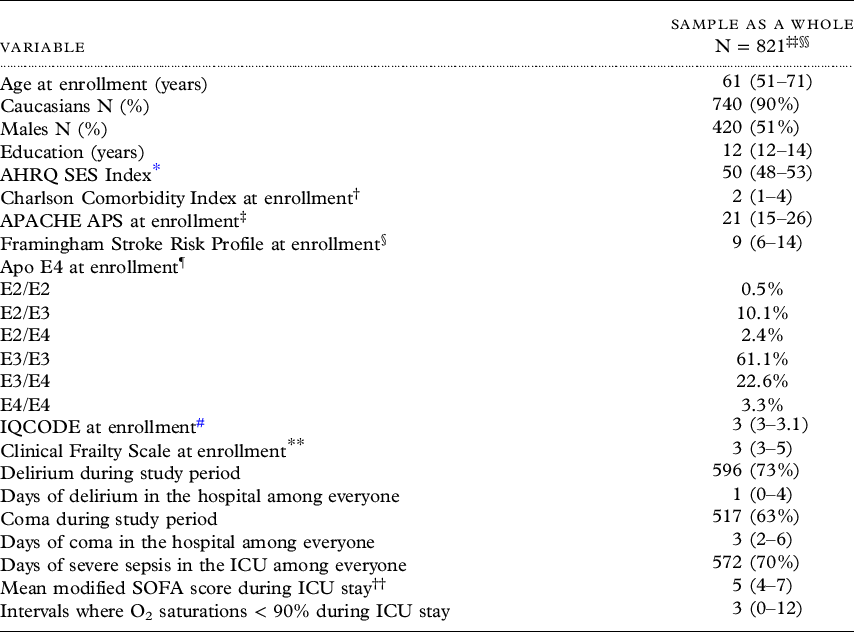
A total of 826 patients were enrolled in BRAIN-ICU between March 2007 and May 2010. Five participants withdrew from all participation. At the 3-month follow-up 252 patients died, and 448 of the 569 surviving patients underwent testing. Another 59 patients of the original cohort died before the 12-month follow-up. Of the 510 surviving patients, 382 were tested 12 months after discharge (flow diagram previously published). The median age at enrollment was 61 years (IQR: 51–71 years); 261 (33%) had a history of depression prior to their critical illness and 51 (6%) had cognitive impairment at baseline (Table 1). In the long-term follow-up, at the 3-month follow-up, 409 patients completed the BDI-II and 375 the RBANS. At 12 months, 347 patients completed the BDI-II and 325 the RBANS. After adjusting for demographic and other relevant confounders, preadmission history of depression, as ascertained by a surrogate questionnaire, was not associated with more DCF days in the ICU (OR 0.78, 95% CI, 0.59–1.03 p = 0.077).
Demographics

* Agency for Healthcare Research and Quality Socioeconomic Status Index.
†The Charlson Comorbidity Index ranges from 0 to 33; for each increasing level of comorbidity there is a 2.3-fold increase in the 10-year risk of mortality.
‡The Acute Physiology and Chronic Health Evaluation (APACHE) rates ICU mortality on a range of 0–71 using a combination of physiological variables and chronic health conditions. The Acute Physiology Score (APS) of the APACHE is a relative value scale applied to 12 physiologic variables used as a severity adjustment to diagnosis-related groups.
§The Framingham Stroke Risk Profile integrates the effect of various vascular risk factors to predict the 10-year probability of incident stroke.
¶Apolipoprotein E genotype.
# The Short Informant Questionnaire on Cognitive Decline in the Elderly (IQCODE) is a scale ranging from 1.0 to 5.0 where 5.0 indicates severe cognitive impairment.
** Clinical Frailty Score ranges from 1 to 9 where 1 indicates very fit and 9 terminally ill.
††The Sequential Organ Failure Assessment (SOFA) ranges from 0 to 24 with higher scores indicating more severe organ dysfunction. The modified SOFA score excludes the Glasgow Coma Scale since coma was included separately in our models.
‡‡History of depression was missing in 38 participants and were not included in this table but included in the analysis using multiple imputation.
§§Continuous variables are described as median values and interquartile range. Categorical variables are described using numbers and percentiles.
We then examined the association of preadmission history of depression with long-term cognitive performance measured at 3 and 12 months after hospital discharge. Cognitive performance was measured using the RBANS global cognitive score. We did not observe an effect of preadmission history of depression on RBANS scores at either 3 or 12 months (3 months beta coefficient −0.04, 95% CI, −2.70–2.62 p = 0.97; 12 months 1.5, 95% CI, −1.26–4.26 p = 0.28; Table 2).
Association between history of depression and postdischarge global cognitive performance measured by RBANS and depression severity measured with the BDI-II

* Data presented for RBANS as beta coefficient.
†Data presented for BDI-II as odds ratio.
Finally, we examined whether a preadmission history of depression was associated with depressive symptom severity as measured by BDI-II at 3 and 12 months postdischarge. Patients with a prior history of depression were more likely to have higher BDI-II scores at 3 and 12 months (3 months OR 2.15, 95% CI, 1.42–3.24 p = 0.001; 12 months OR 1.89, 95% CI, 1.24–2.87 p = 0.003).
Discussion
Our primary finding is that patients with a history of depression prior to ICU stay exhibit a greater severity of depressive symptoms in the following year. A past history of depression was not associated with differences in the number of DCF days in the ICU. Moreover, past history of depression was not associated with worse cognitive performance over the following year.
Depression is common following ICU stay. Nearly a third of ICU survivors have depression up to 24 months follow-up (Bienvenu et al., Reference Bienvenu2015; Wang et al., Reference Wang2017). We now report that a premorbid history of depression increases this risk for greater post-ICU depressive symptoms over the next year. Although the mean BDI-II scores observed in this cohort at 3 and 12 months follow-up are in the minimal to mild depression severity range, there is a tendency for patients with a prior history of depression to experience more symptoms in the year following an ICU stay. This relationship may not be unexpected, as life stressors are commonly associated with the development of depression. The events leading to the ICU stay and the ICU stay itself are typically quite stressful. Moreover, any associated disability or recovery period may increase life stress after discharge, potentially through emotional responses to disability, financial, or employment stress. We propose that a preexisting vulnerability to depression, characterized by having had previous episodes, increases the likelihood that such stressors may precipitate the development or worsening of depressive symptoms. In some individuals, this may progress to a full depressive episode.
Premorbid depression was not associated with DCF days during hospitalization or cognitive outcomes following ICU stay. This finding is consistent with the Oldham et al. (Reference Oldham2019) study reporting that preoperative depression, but not lifetime depression was associated with increased risk of delirium. Unfortunately, while we could identify a premorbid history of depression, we could not determine whether clinically significant depressive symptoms existing immediately prior to ICU admission affected course.
We also did not observe an effect of prior depression on cognition, measured by RBANS scores at 3 and 12 months. Future studies should explore if the severity of depressive symptoms does associate to worse cognitive performance in this population. Prior studies report that severity of depression is associated with poorer cognitive performance (Lawrence et al., Reference Lawrence, Roy, Harikrishnan, Yu and Dabbous2013). It has also been reported that cognitive deficits are still present in patients with remitted depression (Albert et al., Reference Albert, Potter, McQuoid and Taylor2018). Thus, while premorbid depression is not associated with post-ICU cognitive performance, post-ICU depression is associated with poorer post-ICU performance. Nordness et al. (Reference Nordness2021) demonstrated that depression at 3 months after hospital discharge was associated with poorer cognition at 3 months and worse executive functioning at 3 and 12 months.
Our study has some strengths, including a large longitudinal sample following subjects up to 1 year after ICU discharge. Limitations include that history of depression was gathered by proxy during the ICU stay and that we did not measure depressive symptoms at the time of enrollment. We also did not capture how far in the past the history of depression was, how many episodes they may have experienced, and whether they were treated with antidepressant medications. Another limitation is that our findings may not generalize to other populations such as those with recurrent ICU admissions, substance use, or preexisting cognitive impairment. These populations may be at higher risk for a range of neurological or psychiatric disturbances in the postcritical care period. Regarding possible biases patients with missing data were different from those with complete outcomes data. We addressed this using model-based imputation.
It is important to identify patients that have a history of depression prior to an ICU stay and to monitor their symptoms after discharge. These individuals are at increased risk of developing depressive symptoms again. Such depressive symptoms may additionally contribute to cognitive dysfunction in ICU survivors. Although identification and treatment of depression is important to improve these patients’ quality of life, it is unclear how well patients with PICS respond to antidepressant management and whether such interventions benefit post-ICU cognitive performance and reduce disability. Future studies should explore possible treatment options for depression and cognitive impairment in the ICU and after discharge.
Author contributions
All authors listed above have contributed substantially to the conception or design of the work; or the acquisition, analysis, or interpretation of data for the work and have participated in drafting the work or revising it critically for important intellectual content. Additionally, each author has given their approval to the final version of the manuscript and has agreed to be accountable for all aspects of the work in ensuring that questions related to the accuracy or integrity of any part of the work are appropriately investigated and resolved.
Disclosures
Dr Ely, Dr Taylor and Dr Wilson would additionally like to acknowledge salary support from the Tennessee Valley Healthcare System Geriatric Research Education and Clinical Center (GRECC). Dr Wilson would like to acknowledge salary support from the Vanderbilt Clinical and Translational Research Scholars program (1KL2TR002245). Dr Wilson and Dr Ely have also received support from NIH grants (JEW, GM120484; EWE, AG058639). Dr Ely will also disclose having received honoraria from Orion and Hospira for CME activity; he does not hold stock or consultant relationships with those companies. The content is solely the responsibility of the authors and does not necessarily represent the official views of the NIH.