I. INTRODUCTION
The templated grain growth (TGG) method has been widely used to fabricate textured ceramics including α-Al2O3, various perovskite ceramics, Aurivillius (bismuth-layer-structure) phases, and tetragonal tungsten bronzes.Reference Messing, Trolier-McKinstry, Sabolsky, Duran, Kwon, Brahmaroutu, Park, Yilmaz, Rehrig, Eitel, Suvaci, Seabaugh and Oh1–Reference Pavlacka and Messing4 In almost all cases, templates are aligned mechanically using shear forces (tape casting) or compression (uniaxial pressing).Reference Messing, Trolier-McKinstry, Sabolsky, Duran, Kwon, Brahmaroutu, Park, Yilmaz, Rehrig, Eitel, Suvaci, Seabaugh and Oh1 Texture qualities in these ceramics can be well represented by the texture fraction f and the orientation parameter r in the March–Dollase (MD) equationReference Dollase5:
 $$P(\,f,r,{\rm{\theta }}) = (1 - f) + f{\left( {{r^2}\cos {{\rm{\theta }}^2} + {1 \over r}\sin {{\rm{\theta }}^2}} \right)^{ - 3/2}}\quad .$$
As applied here, the f parameter represents the volume fraction of grains that grow epitaxially from the aligned template particles (or the volume fraction of aligned grains). This parameter is affected by the initial template loading and thermal processing parameters needed to induce sintering and subsequent TGG. The r parameter characterizes the width of the orientation distribution within the aligned grain fraction, and is determined by how well the templates were aligned during green forming. This parameter ranges from 0 to 1, where 0 represents perfect texture and 1 represents random grain orientation.
A majority of the work on TGG has focused on increasing texture quality by controlling template loading and thermal processing (by increasing f or the Lotgering factor F 001).Reference Messing, Trolier-McKinstry, Sabolsky, Duran, Kwon, Brahmaroutu, Park, Yilmaz, Rehrig, Eitel, Suvaci, Seabaugh and Oh1,Reference Seabaugh, Messing and Vaudin6 This work has been largely successful, with high quality textured ceramics showing f values between 0.9 and 0.99. However, relatively little attention has been paid to improving the r parameter, and in many cases, the width of the grain orientation distribution is not characterized. To date, the best r values obtained by TGG (r = 0.13–0.17) were measured in α-Al2O3.Reference Pavlacka and Messing4 These values correspond to a full width at half maximum (FWHM) of the grain orientation distribution of 4.6–7.7°. In textured piezoelectric perovskites such as Pb(Mg1/3Nb2/3)O3–PbTiO3 (PMN–PT), higher r values of 0.2–0.25 are typically obtained, corresponding to FWHM = 7–12°.Reference Brosnan, Messing, Meyer and Vaudin7–Reference Poterala, Trolier-McKinstry, Meyer and Messing9 Although these values indicate a narrow grain orientation distribution, recent simulations of textured PMN–PT indicate that piezoelectric properties are very sensitive to grain misalignment in well textured samples.Reference Aleshin, Raevskiĭ and Sitalo10 Thus, substantial performance benefits may be obtained by further reducing the width of grain orientation distributions in these materials.
During tape casting, the MD r parameter and the related orientation distribution FWHM are determined by the interaction between template particles, applied shear forces, and particle randomization by Brownian motion. In the transient state, particle alignment is governed by Jeffery's equations for motion of ellipsoids in shear flows and has been further discussed by Wu and Messing, and Snel et al.Reference Jeffery11–Reference Snel, van Hoolst, de Wilde, Mertens, Snijkers and Luyten13 Steady state grain orientation distributions for shear alignment of ellipsoidal particles were calculated by Leal and HinchReference Leal and Hinch14 under the condition of weak thermal (Brownian) motion, in which the time for orientation to relax thermally is much longer than the orbital period of motion defined by Jeffery. The equilibrium particle orientation distribution for plate-like particles is given asReference Leal and Hinch14:
 $$\!P({r_e},{\rm{\alpha ,\beta }}) \approx 4{\left( {{{{{\cos }^2}{\rm{\alpha }}} \over {{r_e}^{2/3}}} + 4{{\sin }^2}{\rm{\alpha }}\left( {{r_e}^{4/3}{{\cos }^2}{\rm{\beta }} + {{{{\sin }^2}{\rm{\beta }}} \over {{r_e}^{2/3}}}} \right)} \!\!\right)^{ \!\!\!- 3/2}}\,{\rm{for }}\;{r_e}\,{\rm{ \lt \lt \,1}}\quad {\rm{,}}$$
where r e is the particle aspect ratio (thickness/diameter) and the angles α and β define the particle orientation. Thus, in the best case (steady state) scenario, the grain orientation distribution resulting from shear depends only on the template aspect ratio, and high aspect ratio templates are necessary for obtaining a narrow orientation distribution in all directions. For example, an aspect ratio of 1:35 (r e ≈ 0.03) is predicted to yield a FWHM of 5° in both the tape casting and transverse directions.
High aspect ratio templates (1:10 or higher) are typically produced for TGG by hydrothermal or molten salt synthesis methods.Reference Feng, Hirasawa and Yanagisawa15,Reference Poterala, Chang, Clark, Meyer and Messing16 Increasing the template aspect ratio to improve alignment is problematic because high aspect ratio templates dispersed in a fine particle matrix increase local stresses during sintering and prevent densification, as described by Sudre et al.Reference Sudre, Bao, Fan, Lange and Evans17 Also, the durability and stability of high aspect ratio templates during powder mixing (milling) and during sintering is problematic. To avoid using high aspect ratio templates, it is necessary to consider nonmechanical alignment approaches. Magnetic alignment (MA) in very high magnetic fields (≥10 T) has been shown to produce strong textures in a wide variety of diamagnetic and paramagnetic ceramic materials.Reference Suzuki, Uchikoshi and Sakka18 Under MA, particles experience an alignment torque based on their intrinsic magnetic anisotropyReference Suzuki, Uchikoshi and Sakka18:
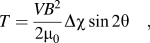 $$T = {{V{B^2}} \over {2{{\rm{\mu }}_0}}}\Delta {\rm{\chi }}\sin 2{\rm{\theta }}\quad {\rm{,}}$$
where B is the applied field, V is the particle volume, μ0 is the permeability of free space, and Δχ is the para- or diamagnetic anisotropy of the aligned material. The alignment torque is opposed by viscous resistance of the surrounding fluid. MA of particles under this method is not dependent on particle morphology, and the factors controlling alignment (field strength, particle size, and viscosity) are easier to experimentally control than particle aspect ratio. As in tape casting, steady state alignment in MA systems is opposed by the randomizing effect of thermal, or Brownian, motion. Under a static magnetic field, the steady-state grain orientation distribution is given asReference Fujiwara, Fukui and Tanimoto19:
 $$P\left( {B,T,{\rm{\theta }}} \right) = {{\exp \left( { - U(B,{\rm{\theta }})/{k_{\rm{B}}}T} \right)} \over {\int\limits_0^{\rm{\pi }} {\exp \left( { - U(B,{\rm{\theta }})/{k_{\rm{B}}}T} \right)\sin {\rm{\theta d\theta }}} }}\quad ,$$
where k BT is the thermal energy of the system. U is the driving force for MA:
 $$U\left( {B,{\rm{\theta }}} \right) = {{V{B^2}} \over {2{{\rm{\mu }}_0}}}\left( {{{\rm{\chi }}_{\rm{a}}}{{\sin }^2}{\rm{\theta }} + {{\rm{\chi }}_{\rm{c}}}{{\cos }^2}{\rm{\theta }}} \right)\quad ,$$
where χa and χc are the magnetic susceptibilities of the particle perpendicular and parallel to the <001> magnetic axis, respectively. The FWHM in this case is determined by the relative strength of magnetic forces (determined by particle size, magnetic susceptibility, and the field strength) and thermal energy (dependent on temperature). Because the driving force for MA depends directly on particle volume, it is advantageous to combine this process with TGG, in which a small number of particles larger than matrix particle size, referred to as templates, are preferentially aligned by the applied field. In the general case, MA eliminates the requirement for morphology control of the template particles used for TGG.
The use of TGG in conjunction with MA has been demonstrated previously in the Bi4Ti3O12 and ZnO systems.Reference Suzuki, Miwa, Kawada, Kimura, Uchikoshi and Sakka20,Reference Kesinbora, Suzuki, Ozer, Sakka and Suvaci21 In Bi4Ti3O12, anisotropic templates were primarily used to facilitate biaxial (three-dimensional) alignment, in which case one direction was aligned by mechanical forces (slip casting), and a second direction was aligned magnetically.Reference Suzuki, Miwa, Kawada, Kimura, Uchikoshi and Sakka20 In ZnO, MA and TGG were combined primarily to increase texture quality by facilitating improved alignment of the larger template particles.Reference Kesinbora, Suzuki, Ozer, Sakka and Suvaci21 Apart from the ability to obtain biaxial alignment, the grain orientation distributions in these studies are comparable to results from MA or tape casting/TGG. Additionally, the use of high field (12 T) superconducting magnets in MA processing raises concerns regarding scalability of these techniques.
In this work, we use a combined dynamic MA and TGG approach to produce <001>C texture in a PMN–28PT model system using plate-like 0.4(Na1/2Bi1/2)O3–0.6PbTiO3 (0.4NBT–0.6 PT) templates. These templates are aligned using a much lower magnetic field (2.2 T) than is conventionally used in MA processing. For this study, textured ceramics were produced using the same templates, matrix powders, and thermal processing as used during tape casting and TGG of textured PMN–PT.Reference Poterala, Trolier-McKinstry, Meyer and Messing9 These parameters are held constant to facilitate a direct comparison between tape casting and MA, in that differences between the resulting textured ceramics can be attributed directly to template alignment. Although the 0.4NBT–0.6 PT templates were not intentionally optimized for MA, the observed magnetic anisotropy of these templates is related to the relatively high structural anisotropy (c/a ratio) of this phase and to preferred domain structure within the template particles (see supplemental information, published online).
Heteroepitaxial templates (e.g., 0.4NBT–0.6 PT) are used for TGG of PMN–PT due to an inability to fabricate suitable templates having the matrix composition.Reference Poterala, Trolier-McKinstry, Meyer and Messing9 Heteroepitaxial templates are also required for MA/TGG of PMN–28PT to obtain the desired alignment direction. Specifically, the PMN–25PT matrix used is rhombohedral in symmetry and does not possess a unique magnetic axis along the <001>C direction.Reference Noheda, Cox, Shirane, Gao and Ye22 As a result, MA of PMN–28PT particles cannot yield the desired <001>C texture. In contrast, the 0.4NBT–0.6PT phase is tetragonal and should have a unique magnetic axis along <001>.Reference Poterala, Meyer and Messing23 Plate-like 0.4NBT–0.6 PT templates were confirmed experimentally to have anisotropic magnetic susceptibility, the origin of which is discussed in the supplemental information. Because the unique magnetic axis (normal to the template surface) aligns perpendicular to the applied magnetic field, a rotating magnetic field was used to obtain <001> alignment during slip casting.
MA of 0.4NBT–0.6PT templates within a PMN–PT matrix is facilitated by slip casting of samples in a relatively modest horizontal magnetic field of 2.2 T. The use of lower magnetic field levels permits MA within a permanent magnet array or commercial magnetic resonance imaging systems, as opposed to high-field superconducting magnets. Grain alignment in sintered and annealed samples is investigated as a function of solid loading, casting viscosity, and casting time to determine the optimum conditions for MA within a rotating-field system. Experimental results are also correlated with models of dynamic MA derived by Yamaguchi et al.Reference Yamaguchi, Ozawa and Yamamoto24
II. EXPERIMENTAL PROCEDURES
<001>C textured PMN–PT ceramics were fabricated using 93 vol% 0.75Pb(Mg1/3Nb2/3)O3–0.25PbTiO3 matrix powder and 7 vol% 0.4(Na1/2Bi1/2)O3–0.6PbTiO3 (0.4NBT–0.6PT) template particles. Template particles of ∼8 μm in diameter and ∼1 μm in thickness were produced via topochemical conversion of PbBi4Ti4O15.Reference Poterala, Meyer and Messing23 The template concentration used (7 vol%) was chosen to facilitate comparison with prior work and reflects a compromise between template alignment considerations and suppression of matrix coarsening during the TGG process. Matrix powders were synthesized by solid-state reaction of Pb3(CO3)2(OH)2 (Sigma–Aldrich, St. Louis, MO), fumed TiO2 (Evonik Aeroxide P25, Addison, IL), and MgNb2O6 (H.C. Starck, Newton, MA). Powders were vibratory milled in water for 36 h using 3-mm diameter stabilized ZrO2 media, dried at 130 °C, and then calcined at 700 °C for 1 h. Calcined matrix powders were 200–300 nm in size and predominantly perovskite phase.
To align template particles within these samples, samples were unidirectionally slip cast in conjunction with dynamic MA. Nonaqueous slip casting slurries were chosen to avoid aqueous leaching of Pb2+ from the PMN–PT powder and consisted of PMN–25PT powder (20–40 vol%) dispersed in xylenes with blown menhaden fish oil (12 vol% on a dry powder basis). Additional binders and organics were avoided as they were found to dramatically increase the slurry viscosity and thus reduce the slip casting rate. Slurries were ball milled for 24 h, and then mixed with the template particles for an additional 15 min before slip casting. For slip casting, ∼3 mL of casting slurry was poured into a vertically oriented cylindrical sample holder against a 1.25-cm diameter by 5-cm long plaster plug. This sample holder was rotated about the vertical axis at 3 rpm within a constant horizontal magnetic field of 2.2 T. A slow rotation rate was used to avoid flow in the casting slip due to inertial effects (e.g., centripetal force). Viscosities of slip casting slurries were measured at shear rates of 0.02–100 s−1 at the time of casting using a variable shear rate rheometer (Low Shear 30, Oerlikon Contraves, Export, PA). Slip casting was constrained to the vertical direction by the sample holder design and followed t 1/2 kinetics. Casting rates were directly measured on control samples cast outside of the field. Samples in the magnet were allowed to cast for 24 h, removed from the field, and then dried for 12 h. Samples were heated at 600 °C for 1 h to remove the fish oil dispersant before sintering. Samples were sintered at 1150 °C for 1 h in closed Al2O3 crucibles containing 5.0 g of stoichiometric PMN–28PT embedding powder. After sintering, samples were cut perpendicular to the casting direction (i.e., within the plane of magnetic field rotation) to produce slices 1.5–2 mm in thickness. These slices were annealed in a PbO-rich atmosphere (10.0 g of 7 wt% PbO–93 wt% PMN–28PT embedding powder in a closed Al2O3 crucible) at 1150 °C for 10 h to induce TGG. Sample densities were measured before and after sintering by direct measurement of dimensions and mass and were measured after annealing by Archimedes' method.
Texture quality in <001>C oriented PMN–PT slices was evaluated by x-ray diffraction (X2, Scintag Inc., Cupertino, CA) by measurement of θ–2θ scans and {002} rocking curves on each sample surface. Rocking curves were fit to the MD equation and to a texture model derived for the dynamic MA process. Rocking curves were corrected for defocusing effects prior to fitting by dividing measured data by equivalent data measured on a randomly oriented sample with the same shape and diameter. The randomly oriented sample was produced by isostatic pressing and sintering (1150 °C, 3 h) of equiaxed PMN–28PT powder. Sample surfaces were ground flat using 600-grit silicon carbide paper and annealed at 350 °C prior to XRD analysis. Each surface was correlated with a unique casting time by measurement of the slip casting kinetics and the height of the surface with respect to the plaster mold. Surface positions were determined by careful tracking of sintering shrinkage as well as the amount of material removed by sawing and grinding operations. Texture quality could then be correlated with solids loading, viscosity, and casting time over the entire sample series.
III. RESULTS AND DISCUSSION
A. Dynamic MA of 0.4NBT–0.6PT templates
To determine the feasibility of dynamic MA of perovskite 0.4NBT–0.6PT template particles, a sample of these platelets was dispersed in a polyester resin in a horizontal magnetic field of B = 7 T. The sample of suspended platelets was rotated at 5 rpm about a vertical axis, and the resin was allowed to cure for ∼15 min. An XRD pattern on a horizontal section through the sample is shown in Fig. 1. For reference, an XRD pattern of the as-synthesized template powder with minimal preferred orientation is also shown. XRD results show that the 0.4NBT–0.6PT platelets align very strongly with <001> perpendicular to the sample surface and perpendicular to the rotating magnetic field. Although both the <100> and <001> peaks are enhanced in the aligned template sample, the <001>/<100> peak intensity ratio is dramatically increased. Because the <001> direction is oriented perpendicular to the rotating magnetic field, the 0.4NBT–0.6PT phase is shown to have easy-plane magnetic character (χc < χa). In addition, the <110> and <111> peaks are almost nonexistent in the aligned sample, indicating that very high quality <001> orientation is obtained. The strong <001> alignment of 0.4NBT–0.6PT templates indicates that each template possesses a preferred crystallographic orientation rather than an equal mixture of the 6 ferroelectric domain variants possible for this phase. The template domain structure and its role in MA were investigated and are presented as supplemental information (published online).
XRD patterns of 0.4NBT–0.6PT platelet powder (control) and the same platelets after dispersion in polyester resin and MA in a horizontal magnetic field (B = 7 T) rotated at 5 rpm. The sample normal direction was perpendicular to the rotating field. Note that tops of the <001> and <002> peaks in the aligned sample are truncated due to saturation of the XRD detector.

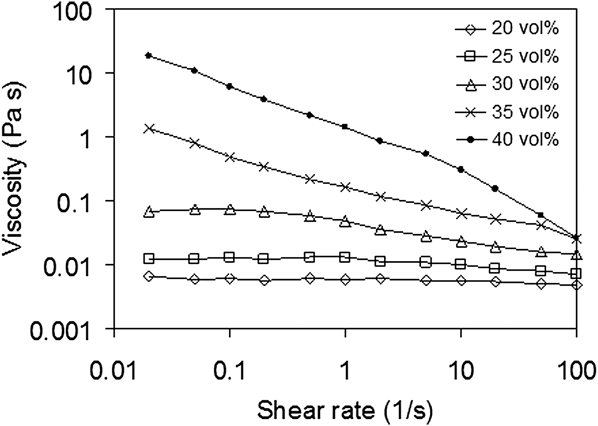
The viscosities of the nonaqueous PMN–PT slips (20–40 vol% solids) are shown in Fig. 2. Nonaqueous casting slips with 35–40 vol% PMN–PT were strongly shear thinning, whereas slips with lower solid loading were nearly Newtonian in nature. At low shear rates (∼0.02 1/s), the slip viscosity increases about one order of magnitude for each 5 vol% increase in solids loading above 25 vol%.
Viscosity of nonaqueous PMN–PT slips shown as a function of the shear rate and volume percent solid loading.
PMN–PT samples were unidirectionally slip cast within the rotating magnetic field using a cylindrical sample chamber partially filled with casting plaster as shown schematically in Fig. 3. The sample holder in Fig. 3 was 1.25 cm in diameter and was charged with ∼3 mL of PMN–PT casting slip (containing 7 vol% 0.4NBT–0.6 PT templates on a powder basis). The slip was allowed to cast for at least 24 h and was removed from the sample holder. Samples produced in this way were ∼12 mm in diameter and 5–15 mm in height and could be air dried and sintered without cracking.
Cut-away schematic of the sample setup used for dynamic MA of PMN–PT slurries containing 0.4NBT–0.6PT templates. Samples were cast unidirectionally in a cylindrical sample holder, which was rotated about the vertical axis within a 2.2-T permanent magnet array.
During casting, dynamic MA samples were rotated at 3 rpm (ω = 0.05) in a horizontal magnetic field of 2.2 T. Control samples were cast using the same parameters, but without rotation or application of a magnetic field. Sample casting rates were fit to a parabolic rate law:
 $$h = K{t^{1/2}}\quad ,$$
where h is the height of the cast layer, t is the casting time, and K is a rate constant. The validity of this equation was confirmed by multiple slip casting experiments. Vertical position in the sintered samples was correlated with casting time using Eq. (6), after correcting for the linear z-dimension shrinkage during sintering. Both the linear shrinkage and the casting constant K were correlated with the slurry solids loading, as shown in Fig. 4. These values, along with Eq. (6), were used to relate casting time and thickness within the slip cast samples. Linear shrinkage in the casting direction decreases from ∼17% at a solid loading of 20 vol% to ∼15% at a solid loading of 42 vol%, corresponding to an increase in green density from ∼54% to ∼61%. Sintering was nearly isotropic in all cases, although low viscosity slips (<0.1 Pa s at low shear rates, corresponding to 20–30 vol%) showed slightly more shrinkage in the casting direction. The casting rate is approximately doubled as slip viscosity increases to ∼10 Pa s at 0.1 s−1. At the highest values of K (15 × 105 m/s1/2 for 40 vol% solids), slip casting of a 1-cm-thick sintered sample required 106 min. In all cases, sintered samples consisted of a single perovskite phase within the resolution limits of x-ray diffraction. Previous work has found that 0.4NBT–0.6PT templates are chemically soluble in PMN–PT, resulting in textured ceramics with homogeneous composition.Reference Poterala, Trolier-McKinstry, Meyer and Messing9
Variation in the linear shrinkage during sintering and in the slip casting constant K as a function of solid loading for nonaqueous PMN–PT slips.
B. Models for texture in dynamic MA/TGG samples
The MD texture model [Eq. (1)] has been shown to apply to MA ceramics (with f = 1) in the transient alignment regime and has been used in some cases to characterize these materials.Reference Terada, Suzuki, Suzuki, Kitazawa, Sakka, Kaneko and Metoki25 However, the equilibrium orientation distribution function (ODF) predicted for MA is substantially different and is rewritten from Eq. (5) to giveReference Fujiwara, Fukui and Tanimoto19,24−26:
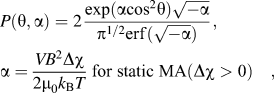 $$P({\rm{\theta ,\alpha }}) = 2{{\exp \left( {{\rm{\alpha }}{{\cos }^2}{\rm{\theta }}} \right)\sqrt { - {\rm{\alpha }}} } \over {{{\rm{\pi }}^{1/2}}{\rm{erf}}\left( {\sqrt { - {\rm{\alpha }}} } \right)}},\,{\rm{\alpha }} = {{V{B^2}\Delta {\rm{\chi }}} \over {2{{\rm{\mu }}_0}{k_{\rm{B}}}T}}\,{\rm{for \;static \;MA (}}\Delta {\rm{\chi > 0)}}\quad ,$$
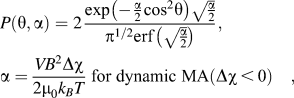 $$P({\rm{\theta ,\alpha }}) = 2{{\exp \left( { - {{\rm{\alpha }} \over 2}{{\cos }^2}{\rm{\theta }}} \right)\sqrt {{{\rm{\alpha }} \over 2}} } \over {{{\rm{\pi }}^{1/2}}{\rm{erf}}\left( {\sqrt {{{\rm{\alpha }} \over 2}} } \right)}},\,{\rm{\alpha }} = {{V{B^2}\Delta \chi } \over {2{{\rm{\mu }}_0}{k_B}T}}\,{\rm{ for \;dynamic \;MA (}}\Delta \chi {\rm{ \,\lt\, 0)}}\quad {\rm{,}}$$
where V is the particle volume, B is the applied field, and Δχ is the magnetic anisotropy χc − χa. The dimensionless field parameter α is related to the quality of particle alignment and is therefore analogous to the MD parameter r. As in the MD model, the ODF for dynamic MA may be modified to include a texture fraction f that reflects the degree of template growth during TGG, assuming only the templates are aligned by the magnetic field. This model must also be modified in the PMN–PT system to account for multiplicity of the <001>C peak in the pseudocubic perovskite structure:
 $$P({\rm{\theta ,\alpha ,}}f) = \left( {1 - f} \right) + \left( {{f \over 3}} \right)2{{\exp \left( { - {{\rm{\alpha }} \over 2}{{\cos }^2}{\rm{\theta }}} \right)\sqrt {{{\rm{\alpha }} \over 2}} } \over {{{\rm{\pi }}^{1/2}}{\rm{erf}}\left( {\sqrt {{{\rm{\alpha }} \over 2}} } \right)}}\quad .$$
The similarly modified MD model is given as:
 $$P(f,r,{\rm{\theta }}) = (1 - f) + \left( {{f \over 3}} \right){\left( {{r^2}\cos {{\rm{\theta }}^2} + {1 \over r}\sin {{\rm{\theta }}^2}} \right)^{ - 3/2}}\quad .$$
It should be noted that Eqs. (8) and (9) assume that rotation of the magnetic field is fast with respect to randomization of particle orientation due to k BT. In well aligned samples, the FWHM of Eq. (9) depends almost entirely on α and is approximated by:
 $$\sin {\left( {{{{\mathop{\rm FWHM}\nolimits} } \over 2}} \right)^2} \approx {{2\ln 2} \over { - {\rm{\alpha }}}}\,{\rm{or}}\,{\mathop{\rm FWHM}\nolimits} \approx {{2\sqrt {2\ln 2} } \over {\sqrt { - {\rm{\alpha }}} }}\quad .$$
This approximation is valid for values of f > 0.5 and α > 10 that are encountered in this work. The saturation FWHM can also be related to the order parameter  $m_{\rm{3}}^{{\rm{SAT}}}$ defined by Yamaguchi et al.Reference Yamaguchi, Ozawa and Yamamoto24 This order parameter, defined for static MA, is given as:
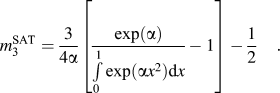 $$m_{\rm{3}}^{{\rm{SAT}}} = {3 \over {4{\rm{\alpha }}}}\left[ {{{\exp \left( {\rm{\alpha }} \right)} \over {\int\limits_0^1 {\exp \left( {{\rm{\alpha }}{x^2}} \right){\rm{d}}x} }} - 1} \right] - {1 \over 2}\quad .$$
An equivalent order parameter may be calculated for dynamic MA, such that equal values of  $m_{\rm{3}}^{{\rm{SAT}}}$ correspond to equivalent grain orientation distributions:
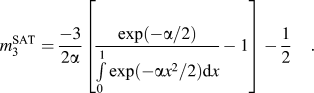 $$m_{\rm{3}}^{{\rm{SAT}}} = {{ - 3} \over {2{\rm{\alpha }}}}\left[ {{{\exp \left( { - {\rm{\alpha }}/2} \right)} \over {\int\limits_0^1 {\exp \left( { - {\rm{\alpha }}{x^2}/2} \right){\rm{d}}x} }} - 1} \right] - {1 \over 2}\quad .$$
As the parameters α, FWHM, and  $m_{\rm{3}}^{{\rm{SAT}}}$ depend directly on the degree of particle alignment, any of these parameters are suitable for characterization of the dynamic MA process within sintered and annealed TGG samples. The parameter f in Eq. (9) has the same meaning as the MD texture fraction f in Eq. (10), in that it represents the volume fraction of material that is textured according to the selected orientation model.
C. Characterization of grain alignment in MA/TGG samples
Alignment of the 0.4NBT–0.6PT template particles by the rotating magnetic field was determined by analysis of crystallographic texture in sintered and annealed PMN–PT samples. XRD rocking curves measured on the {002} peak show that these samples have a strong <001>C texture perpendicular to the rotating magnetic field. This texture was confirmed to be approximately uniaxial (i.e., fiber texture) by measurement of rocking curves at various sample orientations. The presence of this strong texture confirms that 0.4NBT–0.6PT templates align magnetically within the PMN–28PT matrix powder and that χc < χa for this material. To calculate alignment parameters for each sample, the {002} rocking curves were fit to Eqs. (9) and (10). An example of fitting to these models is shown in Fig. 5. As seen in Fig. 5, measured {002} rocking curves for <001>C textured PMN–PT were found to fit the dynamic MA model [Eq. (9)] with good accuracy and fit less well to the MD model [Eq. (10)]. Similar results were seen for all solid loadings for casting times t between 5 and 30 min. This result suggests that ODFs obtained from dynamic MA represent equilibrium between MA and the randomizing effect of Brownian motion (thermal energy).
Texture evolution during MA/TGG was analyzed by tracking the FWHM of corrected {002} rocking curves as a function of slip casting time and solid loading (Fig. 6). For Newtonian slips (viscosity ≤ 0.1 Pa s at 0.1 s−1 or solid loading ≤ 32 vol%), the orientation distribution FWHM appears to reach a steady value after ∼15–30 min of slip casting, in agreement with earlier evidence that dynamic MA reaches thermal equilibrium. The overall quality of alignment increases with increasing viscosity up to 0.1 Pa s, as the higher viscosity suppresses loss of alignment caused by thermal (Brownian) motion. Stable alignment was not obtained for the shear thinning slips (viscosity of 1–10 Pa s at 0.1 s−1 or solid loading ≥ 35 vol%), although a sample cast at 35 vol% solids initially shows a very strong alignment (FWHM < 7°) but degrades with time. This degradation is correlated with a sharp increase in slurry viscosity and slip casting rate (Figs. 2 and 4), and all of these factors may reflect instability of particle dispersion in slips with higher solids loading.
FWHM of grain ODFs in textured PMN–28PT ceramics, plotted with respect to t 1/2 (t is the slip casting time) and solid loading (vol%) during dynamic MA (B = 2.2 T, 3 rpm).
The onset of alignment does not appear to depend strongly on slip viscosity, although a full kinetic analysis is precluded by a lack of data at t 1/2 < 5 min1/2. One possible explanation is that the transient alignment state is controlled by capillary forces during slip casting and not by viscous resistance toward the MA process. The ODF also becomes more stable (less variation in FWHM or maximum texture intensity between adjacent cross sections) as viscosity increases to ∼0.1 Pa s, beyond which slips become strongly non-Newtonian. This result is attributed to a relatively low rotation rate of the suspended template particles due to viscous drag. A more rapid template rotation rate results in loss of alignment in the plane orthogonal to the magnetic field and allows any unwanted vibration of the sample chamber to interfere with the alignment process. At a slurry viscosity of 0.1 Pa s at 0.1 s−1 (32 vol% solids), loss of alignment is negligible, resulting in a stable alignment of ∼7.9° FWHM through most of the sample thickness. The full time-dependent ODF at this condition (measured after sintering and TGG) was reconstructed from rocking curve measurements on sequential sections and is shown in Fig. 7. The ODF of this sample reached equilibrium after t = 20 min and remained stable for 4 h. However, a slight decrease in the FWHM (an increase in alignment quality) was observed at the end of the casting process, as shown in Figs. 6 and 7. This increase in alignment affects only a thin (∼1 mm) layer at the sample surface. A similar result was seen at 0.08 Pa s (0.1 s−1, 30 vol% solids), shown in Fig. 6. This effect may be related to a slight increase in viscosity caused by evaporation of xylenes from the sample surface.
Time-dependent plot of the grain ODF in MA/TGG samples slip cast at 2.2 T, 3 rpm with a 32 vol% solid loading. Texture intensity in MRD is plotted as a function of misorientation angle θ and t 1/2 (which is proportional to sample thickness).
The grain orientation distribution FWHM in MA/TGG textured PMN–PT was inversely correlated with solid loading and slip viscosity during dynamic MA, as shown in Fig. 6. To explain this effect, we consider the interaction between the reduced rotation frequency [ωr = ω/(α·D R)] and the alignment order parameter m 3.Reference Yamaguchi, Ozawa and Yamamoto24 The order parameter m 3 was calculated as a function of solid loading using averaged values of FWHM for each sample series. The rotational diffusion coefficient D R and the reduced frequency ωr were estimated using viscosity values measured at a shear rate of 1 s−1. For this calculation, templates were modeled as discs of 8-μm diameter. The order parameter  $m_{\rm{3}}^{{\rm{SAT}}}$ and FWHM values are plotted as a function of estimated ωr in Fig. 8. As seen in Fig. 8, increasing ωr results in an increase in m 3 and a decrease in FWHM. This trend follows closely with the predictions of Yamaguchi et al.Reference Yamaguchi, Ozawa and Yamamoto24 The estimated values of ωr obtained for slips with 25 and 30 vol% solid loading are ∼2 and 7, respectively, and are low enough that m 3 may be noticeably reduced below
 $m_{\rm{3}}^{{\rm{SAT}}}$. In contrast, the 35 vol% slip shows ωr ≈ 23, and thus, the order parameter for this sample (m 3 = 0.992) is likely close to the true
 $m_{\rm{3}}^{{\rm{SAT}}}$ for the field conditions used. This
 $m_{\rm{3}}^{{\rm{SAT}}}$ value corresponds to a dimensionless field parameter of α ≈ −360. Although m 3 is predicted to approach
 $m_{\rm{3}}^{{\rm{SAT}}}$ relatively quickly (m 3 > 0.95
 $m_{\rm{3}}^{{\rm{SAT}}}$ at ωr = 3), this order parameter is relatively insensitive to ωr compared to the FWHM value. As shown in Eq. (6) through Eq. (12) and in Fig. 8, even a slight increase in m 3 from 0.977 to 0.992 corresponds to a substantial change in the ODF of dynamic MA ceramics.
Variation of the order parameter m 3 and the ODF FWHM as a function of the reduced rotation frequency ωr. ωr was estimated using slip viscosities measured at a shear rate of 1 s−1.
The results in Fig. 8 were also checked by calculating the time required for MA at each viscosity. Nearly complete alignment is achieved at t r > 5, where t r is the reduced time given by t r = D R·α·t. Minimum alignment times (t r = 5) were initially calculated using α ≈ −360 and using viscosities measured at 1 s−1. The times calculated for alignment of 25 vol% and 30 vol% slips are 11 and 24 min, respectively. These times cannot be validated as they are both shorter than the first measurements shown in Fig. 6. However, the calculated time to align a 35 vol% slip (t = 49 min) is substantially longer than the observed alignment time (t < 6 min). In contrast, estimation of α using the observed alignment time and measured slurry viscosity yields a much higher value (α ≈ −3000).
The  $m_{\rm{3}}^{{\rm{SAT}}}$ value of 0.992 and the corresponding value of α ≈ −360 were used to estimate a lower bound for the magnetic anisotropy of 0.4NBT–0.6 PT template particles using volume average template dimensions of ∼8 μm in diameter and ∼1 μm in thickness. The magnetic anisotropy calculated in this way is χc − χa = −1.5 × 10⁻⁸ in SI units or roughly half the value for α-Al2O3 (3.5 × 10⁻⁸ in SI units). This value underestimates the true magnetic anisotropy of the 0.4NBT–0.6PT phase because it does not take into consideration the polycrystalline multidomain microstructure of these particles (see supplemental information). As a result, the FWHM values achieved (∼7°) are likely dictated by grain misalignment within the template particles, or misalignment between the <001>C direction and the template magnetic axis due to the template domain structure. This conclusion is supported by the rapid alignment kinetics in Fig. 8, which suggests a higher magnetic anisotropy than was estimated from an equilibrium alignment of 6–7° FWHM. Using a kinetic approach to estimate the magnetic anisotropy results in a higher value for χc − χa of −1.3 × 10⁻⁷ or about 4 times greater than α-Al2O3. This anisotropy value would be predicted to yield a FWHM of ∼2.5° at thermal equilibrium if the template particles were monocrystalline in nature. In any case, the success of dynamic MA at low field levels (2.2 T) is not attributed to strong magnetic characteristics of the NBT–PT templates. These results are primarily attributed to the use of coarse templates, for which the MA driving force is 3–4 orders of magnitude greater than k BT. In contrast, conventional MA approaches utilize a lower alignment force due to the smaller size of aligned particles, while the thermal energy k BT (the force opposing alignment) remains constant.
Dielectric and piezoelectric properties were measured on well-textured samples (FWHM ∼ 8°) cast from a slip with 32 vol% solid loading. Samples 1, 2, and 3 represent the center slices of the sample depicted in Fig. 7 and correspond to approximately 33, 90, and 182 min after the start of slip casting (distances of 3.5, 5.9, and 8.4 mm from the mold surface). Although a lower FWHM (6–7°) could be achieved at a solid loading of 35 vol%, this texture quality was not stable enough with respect to casting time to produce thick homogeneous samples. The properties of three samples and the texture parameters determined from Eq. (10) are shown in Table I.
Properties of <001>C textured PMN–PT samples made by a combined MA/TGG process.
All three samples show similar texture parameters (FWHM, α, and f). The texture fraction f is almost identical to values measured in textured PMN-PT made by tape casting with the same template particles. These samples also have a lower FWHM (∼7.9°) than tape cast samples (∼12°).Reference Poterala, Trolier-McKinstry, Meyer and Messing9 It should be noted that the ODF resulting from MA has lower tails than the MD texture model (Fig. 6), and thus, MA-derived samples contain fewer strongly misaligned grains than tape cast samples with the same FWHM and f parameters.
The relative permittivity of MA/TGG samples (3332) was found to be similar to that of well-textured PMN–PT produced by tape casting and TGG (3490), and both materials show an average dielectric loss tan(δ) of 0.010. However, MA samples have a 20% higher piezoelectric coefficient d 33 (1222 pC/N) than tape cast samples (1016 pC/N), which may be attributed to the narrower FWHM obtained via MA. This value approaches the piezoelectric coefficient of <001> PMN–28PT single crystal (1470 pC/N) and demonstrates that combined MA/TGG methods have promise for producing very high performance textured ceramics.
IV. CONCLUSIONS
<001> oriented 0.4NBT–0.6PT templates were aligned in slip cast PMN–PT matrix powders using the dynamic MA approach and were used to produce <001>C textured PMN–PT ceramics via TGG. Template alignment was observed over the viscosity range of 0.01–1 Pa s at 0.1 s−1 (25–32 vol% solids) for nonaqueous slips. As viscosity increased to 0.1 Pa s, the orientation distribution FWHM decreased from ∼13° to 7° as thermal randomization of template orientation was suppressed. Slip stability decreased substantially at ≥35 vol% solids, resulting in strongly shear-thinning behavior and unstable template alignment with respect to casting time. As a result, optimal texture (FWHM = 7.85°) is obtained at a viscosity of ∼0.1 Pa s (32 vol% solids). This texture is substantially better than was reported for tape casting with the same templates (FWHM = 12°). The resulting textured PMN–28PT ceramics show d 33 = 1222 pC/N (100 Hz), a ∼20% increase compared to tape cast TGG samples. As both tape cast and MA samples show similar volume fractions of texture (91–92%), this increase in performance is attributed entirely to the narrower FWHM resulting from dynamic MA. The FWHM was ultimately limited by instability of casting slips with higher solid loading and by the polycrystalline nature and multidomain structure of the 0.4NBT–0.6PT template particles. A combination of low-field MA and TGG strategies should yield narrower orientation distributions (FWHM < 3°) when applied to systems with monocrystalline templates of similar size (5–10 μm) and magnetic anisotropy (approximately −10−7 in SI units). These results may be useful in guiding future work on improving texture qualities in MA of bulk ceramics and in reducing field strength to avoid the use of superconducting magnet enclosures.
Supplementary Material
Supplementary materials can be viewed in this issue of the Journal of Materials Research by visiting http://journals.cambridge.org/jmr.
ACKNOWLEDGMENT
This work was supported by the Office of Naval Research under Contract No. N00014-07-01-0300.