Introduction
The striped hamster is one of the main rodent pests in northern China farmland and has a high reproductive capacity. It generally reproduces three times a year, and its litter size is four to nine for every parity (Mu et al., Reference Mu, Wang and Ren1999). Intensity of reproductive activity is season dependent, and is higher in the spring (March–April) and autumn (September–October) than in summer (July–August) and winter (December–January) (Luo et al., Reference Luo, Chen and Gao2000). Seasonal differential intensity of the reproductive activity is a major reason leading to significant population fluctuations with the seasons (Xue et al., Reference Xue, Xu, Chen and Xu2014). The population abundance of the striped hamster is significantly higher in the spring and autumn than in summer and winter, which matches the high reproductive activity in spring and autumn (Zhao et al., Reference Zhao, Zhong, Xue, Ding, Wang, Xu, Lei and Xu2014; Xu et al., Reference Xu, Xue, Li, Xu and Chen2017). In general, rodents play an important role in maintaining the ecological balance, however when their numbers increase, they cause considerable damage to agricultural production (Zhang and Wang, Reference Zhang and Wang1998). Therefore, it is very important to study the seasonal fluctuating mechanism of striped hamster populations to reasonably control their abundance.
As a polypeptide hormone, prolactin (PRL) is mainly synthesized and secreted by PRL cells in the anterior pituitary, and can promote breast development, maintain lactation, and regulate animal reproduction (Zhang et al., Reference Zhang, Li, Liu, Wang, Zhao and Zhu2012). Genes encoding PRL, growth hormone, and placental lactogen have evolved from a common ancestral gene by gene duplication (Niall et al., Reference Niall, Hogan, Sauer, Rosenblum and Greenwood1971), therefore PRL belongs to the PRL/growth hormone/placental lactogen family (Boulay and Paul, Reference Boulay and Paul1992; Horseman and Yu-Lee, Reference Horseman and Yu-Lee1994). Most seasonally breeding mammals show a season-dependent secretion pattern in PRL (Curlewis, Reference Curlewis1992). PRL secretion is affected by a large variety of environment and the internal milieu. Photoperiod affects PRL secretion by regulating secretion of the pineal hormone melatonin (Curlewis, Reference Curlewis1992). It is thought that melatonin influences prolactin secretion by acting within the anterior hypothalamus or possibly on another site that projects into this region (Curlewis, Reference Curlewis1992).
The PRL receptor (PRLR) is a specific receptor for PRL, and is a single membrane-bound protein expressed in the hypothalamus, pituitary, breast, ovary, testis, liver and many more mammalian tissues (Bole-Feysot et al., Reference Bole-Feysot, Goffin, Edery, Binart and Kelly1998), and contains extracellular, transmembrane and intracellular domains. Expression levels of PRLR are much higher in the hypothalamus and pituitary gland than in other tissues (Zhou et al., Reference Zhou, Zadworny, Guémené and Kuhnlein1996). PRLR expression in the hypothalamus is increased by PRL in serum (Sugiyama et al., Reference Sugiyama, Minoura, Kawabe, Tanaka and Nakashima1994), so it may be an ideal index for PRL concentration in serum. The transcription of PRLR in the ovaries is regulated in a complex way by developmental stage and hormones (Clarke et al., Reference Clarke, Wathes and Jabbour1997; Telleria et al., Reference Telleria, Parmer, Zhong, Clarke, Albarracin, Duan, Linzer and Gibori1997). Oestrogens can also increase the expression levels of PRLR in the brain (Mustafa et al., Reference Mustafa, Nyberg, Bogdanovic, Islam, Suliman, Lindgren, Roos and Adem1995; Shamgochian et al., Reference Shamgochian, Avakian, Truong, Stone, Tang and Devito1995). PRL was believed to only play a role in infertility and galactorrhoea in men, but evidence gathered over the past decade clearly indicates that PRL plays a role in a diverse spectrum of disorders. Increased PRL levels may not only improve infertility and hypogonadism but also have a positive effect on the metabolic profile of patient and control of glycaemia (Bolyakov and Paduch, Reference Bolyakov and Paduch2011).
PRL binds to PRLR and regulates physiological processes such as reproduction, growth and development, metabolism, immunity, behaviour (Asad et al., Reference Asad, Nicola Candia, Gonzalez, Zuccato, Abt, Orrillo, Lastra, De Simone, Boutillon, Goffin, Seilicovich, Pisera, Ferraris and Candolfi2019). In PRLR knockout mice, luteal function is abnormal and reproductive activity is missed for decreased ovulation rate, aberrant oogenesis, and implantation failure (Bole-Feysot et al., Reference Bole-Feysot, Goffin, Edery, Binart and Kelly1998). Binding of PRL to PRLR can regulate the synthesis of gonadotropin-releasing hormone (GnRH) in the hypothalamus, regulate the secretion of luteinizing hormone (LH), FSH and oestrogen, promote the maturation of cumulus cells, and further affect ovulation (Bole-Feysot et al., Reference Bole-Feysot, Goffin, Edery, Binart and Kelly1998; Clevenger et al., Reference Clevenger, Gadd and Zheng2009). Therefore, PRLR may play an important role in seasonal reproduction of mammals. Expression patterns with the seasons and the effects of PRLR in striped hamsters are less understood.
In this study, the mature female striped hamster in oestrus and the mature males with oestrus behaviour from different seasons were used to study the seasonal differential expression patterns of PRLR in the hypothalamus, ovary and testis using real-time quantitative PCR methods. Correlation of PRLR expression levels with FSH and LH serum concentrations was analyzed to provide a theoretical basis for further understanding the effect and the mechanism of PRLR in the seasonal reproduction of animals, to provide suitable ideas and methods to effectively control rodent pests in the northern China farmland.
Materials and methods
Animals and tissues preparation
The striped hamsters (Cricetulus barabensis) used in this study were captured following a live-trap method with iron cages in the fields in Puwang Village, Yinan County, and Linyi City of Shandong Province, which was established by our research team to study the fluctuating mechanisms of agricultural rodent populations over more than 10 years. The sampling fields are located in the northern plains of China and have typical warm temperate climates. Seasons were divided generally into spring (March, April and May), summer (June, July and August), autumn (September, October and November) and winter (December, January and February). Striped hamsters were captured in the middle month of each season, and capture activities were performed from day 10 to day 20 in April, July, October and January in 2014. The concrete trapping activity has been described in a previous study (Xu et al., Reference Xu, Xue, Li, Xu and Chen2017). Firstly, the trapped striped hamsters were given a unique number and categorized as individuals from spring, summer, autumn or winter, respectively; Secondly, they were sexed, weighed, and appraised to provide information on size, age and reproductive condition. Differences in the individual weights for the same sex in the same season were all within 5% of mean weight. Thirdly, 12 adult male and female individuals were selected in each season and were fed at the animal experiment centre at Qufu Normal University and kept under natural light irradiation and temperature conditions. Then, from 5 p.m. to 6 p.m. on feeding days, the oestrous cycle of female striped hamsters and the oestrous behaviour of male striped hamsters were examined. When the striped hamsters showed oestrous behaviour, they were immediately euthanized by CO2 asphyxiation, and dissected to collect the hypothalamus, ovaries or testes. Organs and tissues were stored at −80°C. Blood samples were collected immediately and stored at 4°C for 30 min, then centrifuged at 1200–2000 g for 15 min at 4°C. All experiments were approved by the Animal Ethics Committee of Qufu Normal University.
Total RNA extraction and reverse transcription polymerase chain reaction
Total RNA from the hypothalamus, ovaries in the females and testes in the males were extracted using an RNA extraction reagent (TaKaRa, Japan). The purity and the concentration of total RNA were assessed by the A260/A280 ratio using an ultraviolet spectrophotometer (Eppendorf, Germany). Total RNA integrity was also examined using agarose gel electrophoresis. Subsequently, 20 μl of high quality RNA from the sampled tissues were reverse transcribed to cDNA using reverse transcriptase XL AMV with an oligo(dT) primer (TaKaRa, Japan). All synthesized cDNA were stored at −20°C.
Real-time fluorescence quantitative polymerase chain reaction
Based on the nucleotide sequences of PRLR from the striped hamsters (EU826030), primers of real-time quantitative polymerase chain reaction (RT-qPCR) for PRLR were designed using Beacon Designer 7.0 software. The primer sequences for PRLR were F1 (5′-TTCTTCACAGAGACACGCGG-3′) and R1 (5′-TTTTGCCGGGGAGAAAAGT-3′). The primer sequences for β-actin (as a reference gene) were F2 (5′-GAGACCTTCAACACCCCAGC-3′) and R2 (5′-ATGTCACGCACGATTTCCC-3′). RT-qPCR was performed using an Agilent Stratagene Mx3000P detector with the Brilliant II SYBR Green qPCR Master Mix (TaKaRa, Japan). Three repeats for each sample were performed during every RT-qPCR analysis. The reaction procedure was 10 min at 94°C for enzyme activation followed by 40 cycles of 1 min at 94°C, 1 min at 56°C, and 1 min at 72°C. The expression levels of PRLR mRNA are shown as 2–ΔΔCT (normalization to β-actin) (Livak and Schmittgen, Reference Livak and Schmittgen2001).
Serum FSH and LH concentration determination
Blood samples were collected immediately after sacrifice and stored at 4°C for 30 min, and then centrifuged at 2400 g for 10 min at 4°C. FSH and LH serum concentrations were measured using enzyme-linked immunosorbent assay (ELISA) Labsystems Multiskan MS 352.
Statistical analysis
Data were expressed as means ± standard error of the mean. Statistical analysis was conducted using the independent sample t-test and single-factor analysis of variance (ANOVA) of SPSS Statistics 17.0 software. Differences were considered to be significant when P < 0.05 and highly significant when P < 0.01. Pearson’s correlations of prolactin receptor (PRLR) relative expression levels in the hypothalamus and gonads of the striped hamster with FSH and LH serum concentrations were analyzed using SPSS 17.0 software (SPSS Inc., Chicago, IL, USA).
Results
Seasonal differential expression levels of PRLR in the hypothalamus and gonads of the striped hamsters
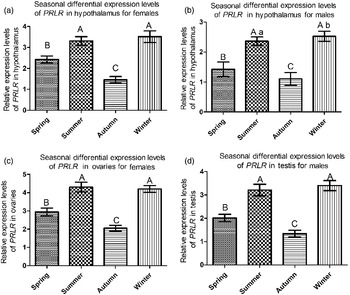
Expression variances of PRLR were demonstrated quantitatively in the hypothalamus and ovaries of the female (Fig. 1a,c) and the hypothalamus and testis of the male (Fig. 1b,d) striped hamsters from different seasons. PRLR mRNA levels in hypothalamus, ovaries and testis were significantly higher in the summer and winter than that in the spring and autumn (P < 0.01) both in females (Fig. 1a,c) and males (Fig. 1b,d). In addition, expression was the lowest in autumn individuals (P < 0.01). Seasonal differential expression models of PRLR in the hypothalamus and goads were consistent between female and males striped hamsters.
Differential expression of PRLR mRNA in the hypothalamus, ovaries and testis of the striped hamsters from four seasons. (a) Seasonal differential expression levels of PRLR in hypothalamus for female striped hamsters. (b) Seasonal differential expression levels of PRLR in hypothalamus for male striped hamsters. (c) Seasonal differential expression levels of PRLR in ovaries for female striped hamsters. (d) Seasonal differential expression levels of PRLR in testis for male striped hamsters.

FSH and LH concentration in serum of the striped hamsters from spring, summer, autumn and winter
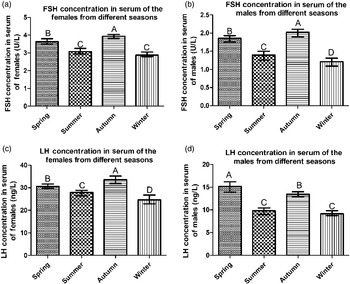
Significantly higher concentrations of FSH and LH in serum were found from spring and autumn striped hamsters than from summer and winter individuals (Fig. 2). Males caught in summer had significantly higher FSH concentrations in serum compared with males from the winter (Fig. 2b). Females caught in the spring had significantly lower LH concentrations in serum than individuals from the autumn (Fig. 2c), whereas males showed the opposite results (Fig. 2d). For females, individuals from the summer had significantly higher LH concentrations in serum than individuals from the winter (Fig. 2c).
Concentration of FSH and LH in serum of the striped hamsters from four seasons. (a) Seasonal differential FSH concentration in serum of female striped hamsters. (b) Seasonal differential FSH concentration in serum of male striped hamsters. (c) Seasonal differential LH concentration in serum of female striped hamsters. (d) Seasonal differential LH concentration in serum of male striped hamsters.

Expression of PRLR in the hypothalamus was negatively correlated with FSH and LH serum concentrations
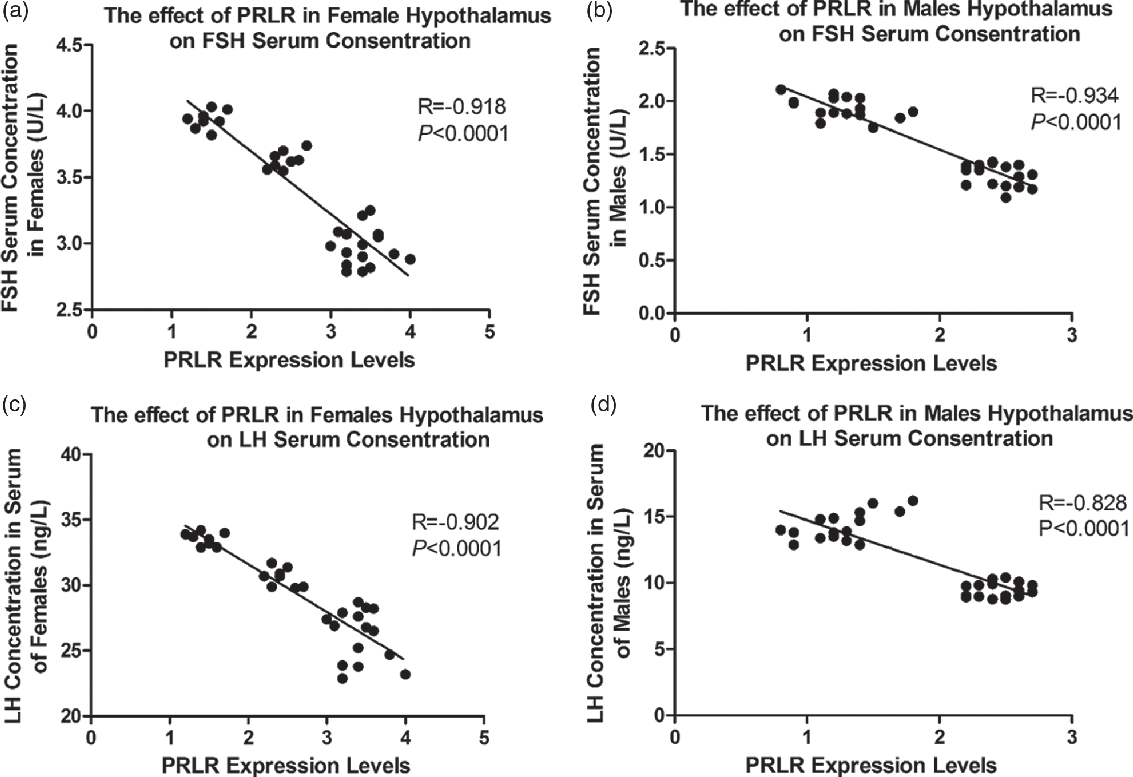
Correlations of the relative expression quantity of PRLR in the hypothalamus with the FSH and LH concentrations of serum of female and male striped hamsters are shown in Fig. 3. When samples from four seasons were analyzed separately, there was no significant correlation between relative expression quantity of PRLR in the hypothalamus and gonads with FSH and LH concentrations in striped hamster serum (P > 0.05). When all samples were analyzed as a whole, including the striped hamsters from spring, summer, autumn and winter, there was a significant negative correlation between the relative expression quantity of PRLR in the hypothalamus and gonads with FSH and LH serum concentrations of the striped hamsters (Figs 3 and 4). For female striped hamsters, correlation coefficients were −0.918 (P = 0.000) (Fig. 3a) and −0.902 (P = 0.000) (Fig. 3c), respectively, between the relative expression quantity of PRLR in the hypothalamus with FSH and LH serum concentrations. In males, significant negative correlations also existed between the relative expression quantity of PRLR in the hypothalamus with the FSH (r = −0.934, P = 0.000, Fig. 3b) and LH (r = −0.828, P = 0.000, Fig. 3d) serum concentrations.
Relationships of the relative expression quantity of PRLR in the hypothalamus with the concentration of FSH and LH in serum of the striped hamsters. (a) Correlations of the relative expression quantity of PRLR in the hypothalamus with the concentration of FSH in serum of the female striped hamsters. (b) Correlations of the relative expression quantity of PRLR in the hypothalamus with the concentration of FSH in serum of the male striped hamsters. (c) Correlations of the relative expression quantity of PRLR in the hypothalamus with the concentration of LH in serum of the female striped hamsters. (d) Correlations of the relative expression quantity of PRLR in the hypothalamus with the concentration of LH in serum of the male striped hamsters.

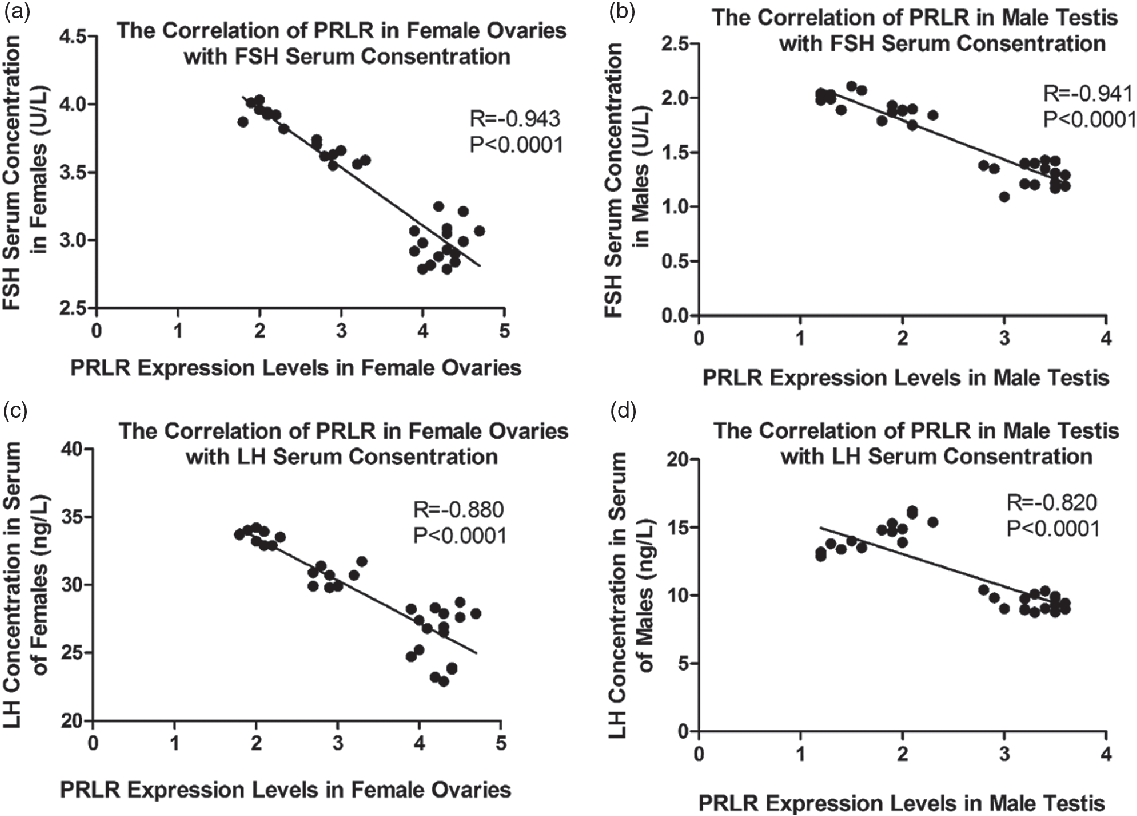
Correlations of the relative expression quantity of PRLR in the gonads with the concentration of FSH and LH in serum of the striped hamsters. (a) Correlations of the relative expression quantity of PRLR in the ovaries with the concentration of FSH in serum of the female striped hamsters. (b) Correlations of the relative expression quantity of PRLR in the testis with the concentration of FSH in serum of the male striped hamsters. (c) Correlations of the relative expression quantity of PRLR in the ovaries with the concentration of LH in serum of the female striped hamsters. (d) Correlations of the relative expression quantity of PRLR in the testis with the concentration of LH in serum of the male striped hamsters.

Expression of PRLR in ovaries and testis was negatively correlated with FSH and LH serum concentrations
Correlations of the relative expression quantity of PRLR in the ovaries of the female and in the testis of the male with FSH and LH concentrations in serum of striped hamsters are shown in Fig. 4. A significant negative relationship existed between the relative expression quantity of PRLR in the ovaries and FSH (r = −0.943, P = 0.000) (Fig. 4a) and LH (r = −0.880, P = 0.000) (Fig. 4c) serum concentrations. Similar results were obtained in male individuals for FSH (r = −0.941, P = 0.000) (Fig. 4b) and LH (r = −0.820, P = 0.000) (Fig. 4d). Therefore, PRLR may play an important role in reproduction in striped hamsters.
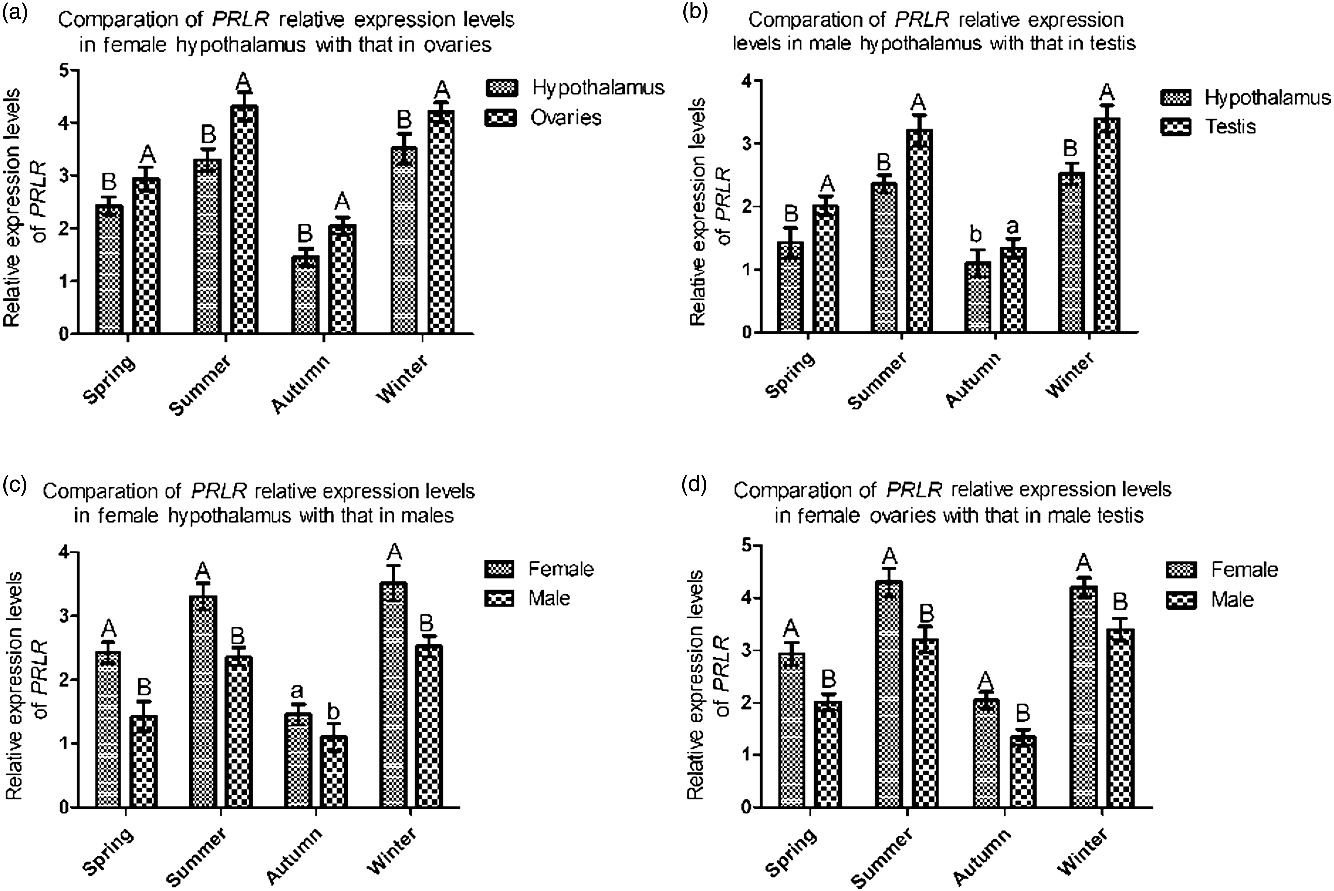
Expression level of the PRLR in striped hamsters is tissue dependent and sex dependent
For female striped hamsters from spring, summer, autumn and winter seasons, significantly higher expression levels of PRLR (P < 0.01) were observed in the ovaries compared with in the hypothalamus (Fig. 5a). Similar results were obtained in male individuals (P < 0.01) (Fig. 5b). In the hypothalamus, female individuals from the four seasons expressed significantly higher levels of PRLR than the males (P < 0.05) (Fig. 5c). Relative expression quantities of PRLR in ovaries of females were significantly higher than that in testis of males from the four seasons (P < 0.01) (Fig. 5d).
Comparison of relative expression levels of PRLR in different tissues and sexes of the striped hamsters from four seasons. (a) Comparison of relative expression levels of PRLR in female hypothalamus with that in ovaries. (b) Comparison of relative expression levels of PRLR in male hypothalamus with that in testis. (c) Comparison of relative expression levels of PRLR in female hypothalamus with that in males. (d) Comparison of relative expression levels of PRLR in female ovaries with that in male testis.

Discussion
Striped hamsters are typically seasonal reproductive rodent pests in northern China farmland, and their seasonal reproductive activity significantly affects population abundance fluctuation. As a polypeptide hormone, PRL can promote breast development, maintain lactation, and regulate animal reproduction through binding to PRLR. This study demonstrated the seasonal differential expression of PRLR in the hypothalamus and gonads of striped hamsters, and its role in the seasonal reproduction of striped hamsters.
PRLR is expressed in the hypothalamus and gonads of rat, and PRL binding to PRLR may feed back at the hypothalamus level to mediate its action in peripheral tissues (Chiu et al., Reference Chiu, Koos and Wise1992). Therefore, expression levels of PRLR in the hypothalamus and gonads of mammals are important for regulation of reproduction. Seasonal conversion of PRLR expression patterns in the hypothalamus and gonads compared with the intensity of reproductive activity of the striped hamsters had an opposite correlation. The striped hamster has higher reproductive activity in the spring and autumn than in the summer and winter (Zhao et al., Reference Zhao, Zhong, Xue, Ding, Wang, Xu, Lei and Xu2014; Xu et al., Reference Xu, Xue, Li, Xu and Chen2017), whereas expression levels of PRLR in the hypothalamus and gonads were significantly lower in the spring and autumn than in the summer and winter, and indicated that PRLR may inhibit the reproductive activity of striped hamsters. This result agrees with results from some former studies that showed PRL binding to PRLR inhibited GnRH release in GnRH neurons (Clayton and Bailey, Reference Clayton and Bailey1982; Sarkar and Yen, Reference Sarkar and Yen1985; Calogero et al., Reference Calogero, Weber and D’Agata1993; Koike et al., Reference Koike, Kadowaki, Hirota, Ohmichi, Ikegami, Sawada, Miyake and Tanizawa1993; Milenković et al., Reference Milenković, D’Angelo, Kelly and Weiner1994), and was related to the decreased levels of plasma gonadotropin in chronic hyperprolactinemia (Clayton and Bailey, Reference Clayton and Bailey1982). The inhibitory effect of PRL on gonadotropic secretion in the hypothalamus is regulated by an inhibitory effect of dopamine on GnRH release (Koike et al., Reference Koike, Kadowaki, Hirota, Ohmichi, Ikegami, Sawada, Miyake and Tanizawa1993).
In seasonally reproductive mammals, such as hamsters and ewes, PRL secretion also varies with day length. For example, in adult male hamsters, exposure to a short photoperiod (5 h of light, 19 h of darkness) for 2 months caused a significant decline in PRL secretion (Badura and Goldman, Reference Badura and Goldman1997). In Magang goose ganders, a long photoperiod stimulated PRL secretion (Shi et al., Reference Shi, Huang, Liu, Liu, Li, Proudman and Yu2007). Light is an important regulator of PRL secretion in photoperiodic mammals, and the PRL secretion rhythm is coincident with the shift in light. However, expression levels of PRLR in the hypothalamus of bantams (Gallus domesticus) were not affected by sex, reproductive state, or photoperiod (Ohkubo et al., Reference Ohkubo, Tanaka, Nakashima and Sharp1998). PRLR is expressed in ovarian tissue of female Typhlonectes compressicauda, and its expression level is oestrous cycle dependent (Exbrayat and Morel, Reference Exbrayat and Morel2003), whereas no significant difference existed in PRLR expression levels between the mares of different reproductive states or seasons (Gregory et al., Reference Gregory, Brooks, McNeilly, Ingleton and Tortonese2000). Therefore the regulative mechanism of PRLR expression is species dependent, and the expression model of PRLR in striped hamsters varies significantly with seasons.
Pituitary gonadotropins FSH and LH are critical signals for ovarian function by stimulating follicle growth and subsequent ovulation. FSH is a stimulator of follicle growth and survival (van Den Hurk et al., Reference van Den Hurk, Dijkstra and De Jong2002), and LH is critical to trigger ovulation and initiate ovarian steroidogenesis (Yong et al., Reference Yong, Baird and Hillier1992). The secretion of reproduction associated hormones, such as FSH, LH, and PRL, varies with season in sheep (Lincoln and Short, Reference Lincoln and Short1980), deer (Bubenik et al., Reference Bubenik, Morris, Schams and Claus1982), and goats (Muduuli et al., Reference Muduuli, Sanford, Palmer and Howland1979). Both FSH and LH concentrations in stallion also change significantly with season and increase during the spring (Harris et al., Reference Harris, Irvine and Evans1983). In our study, FSH and LH concentrations in the serum of striped hamsters matched the intensity of reproductive activity of striped hamsters from different seasons. This result showed that the FSH and LH concentrations in striped hamster serum could be used as an ideal index to represent reproductive activity intensity.
Expression levels of PRLR in the hypothalamus and gonads were significantly negatively correlated with FSH and LH concentrations in striped hamster serum, and indicated that PRLR may play an inhibitory role in the seasonal reproduction of striped hamsters. PRL influences gonadotropin secretion by blocking the release of GnRH from the hypothalamus, and may act through the kinase C pathway (Koike et al., Reference Koike, Kadowaki, Hirota, Ohmichi, Ikegami, Sawada, Miyake and Tanizawa1993). PRL may also inhibit LH release through a central action and can block the action of gonadotropins at the ovarian level, such as in follicle maturation, steroidogenesis and ovulation (Wang et al., Reference Wang, Hsueh and Erickson1980). Reduced gonadotropin secretion and decreased gonadal function were detected in hyperprolactinemia rats and other species (Sarkar and Yen, Reference Sarkar and Yen1985). In the sexually active period for mares, lactotrophs were observed as clusters of cells, but there was an absence of co-localization of PRLRs in LH or FSH cells, which showed that PRL may intermediately mediate gonadotroph function (Gregory et al., Reference Gregory, Brooks, McNeilly, Ingleton and Tortonese2000). Significant differences in the expression levels of PRLR did not exist between mares during different seasons (Gregory et al., Reference Gregory, Brooks, McNeilly, Ingleton and Tortonese2000), and indicated that PRL may have a smaller or no effect on mare seasonal reproduction. PRL explanting in the hypothalamus could increase GnRH secretion (Ciereszko et al., Reference Ciereszko, Opałka, Kamińska, Kamiński and Dusza2002). In adult male rats, PRL enhanced basal LH secretion (Kugu et al., Reference Kugu, Taketani and Mizuno1989). Therefore, the effect of PRL on reproduction is species dependent, and PRL has a negative effect on the reproduction of the striped hamster.
The main limitation of this study was that oestradiol and testosterone levels were not measured. The data presented here show that secretion of PRLR and the regulatory effect of PRLR is species dependent and season dependent. PRLR may have a negative effect on reproductive activity of the striped hamsters.
Acknowledgements
We thank two anonymous reviewers for excellent criticism of the article.
Ethics approval and consent to participate
The study was approved by the Animal Ethics Committee of Qufu Normal University.
Consent for publication
Not applicable.
Availability of data and material
Not applicable.
Funding
This study was approved by the National Science Foundation of China (31570377, 31670385, 31770455, 31800308).
Competing interests
There are no potential conflicts of interest to disclose.
Author’s contribution
HLX was responsible, as the guarantor of integrity for the entire study, for study concepts and design, definition of intellectual content, literature research, experimental studies, data acquisition and analysis, manuscript preparation and editing. JHX was responsible for the literature research, experimental studies, data acquisition, manuscript review. MW was responsible for the experimental studies, data analysis, statistical analysis, manuscript editing and review. LC was responsible for the experimental studies, data analysis, statistical analysis, manuscript preparation. LXX was responsible, as the guarantor of integrity of the entire study, for study concepts and design, definition of intellectual content. All authors read and approved to this manuscript.