The formulary system forms the basis of pharmaceutical management and rational drug use (Reference Tyler, Cole and May1). It includes both the formulary or drug list and the process whereby healthcare practitioners, working through a pharmacy and therapeutics (P&T) committee, appraise, select, and recommend, from among the numerous available drugs, those that are considered most effective for patient care (2). To provide the best patient care, a thorough evaluation of competing drugs is crucial to support informed and evidence-based decision making. Health technology assessment (HTA) uses a systematic process and provides decision makers with quality information about the net patient benefits and cost-effectiveness of health technologies. This helps to guide decisions on the efficient use of healthcare resources. Healthcare systems across the world have seen an explosion of interest in HTA. Incorporating HTA principles in formulary management provides scientific support for decision making.
P&T committees or equivalent bodies exist in almost all hospitals to ensure safe, appropriate and cost-effective use of medicines. Decisions made by such committees will influence the range of medications available and thereby local prescribing practices and patients’ outcomes. The extent to which formularies are managed differs extensively so is the extent of evidence-based use in formulary review and decision making (Reference Mittmann and Knowles3;Reference Puigventos, Santos-Ramos, Ortega and Duran-Garcia4).
Escalating healthcare costs affect many parts of the world including Singapore. Per-capita healthcare expenditure has increased by 1.6 times from USD 580 in 2000 to USD 1,531 in 2009, this translates into 2.4 percent and 4.1 percent gross domestic product (GDP), respectively (5). The rising healthcare costs, partly driven by increasing pharmaceutical expenditures and evolving technologies, justify the need for an effective formulary management system. There is a potential yield to develop and intensify the use of evidence in managing local formularies where it is lacking.
In Singapore, there are eight public hospitals and six national specialty centers (for cancer, eye, and skin, etc.) and eighteen primary healthcare services managed by public healthcare funding (6). In 2012, there were 10,756 hospital beds, giving a ratio of 2.0 beds per 1,000 total populations. Approximately 85 percent of the beds are in the public hospitals and specialty centers while the rest are in the ten private-run hospitals. These public healthcare institutions differ from the private-run hospitals in that they receive an annual government subvention for the provision of subsidized medical services to the citizens (i.e., the nonpaying class patients).
Medication subsidies are restricted to a list of drugs which makes up 90 percent of the total volume of medication prescriptions (7). The list is stipulated, reviewed, and updated on a regular basis by the local health ministry. Even though the public institutions are owned by the government and adhere to its policy guidance, they have their management autonomy. In most healthcare institutions, the access to drugs is overseen by their respective P&T committees which act as gatekeeper to ensure rational drug use. Considering the potential impact of the formulary management system on health outcome and resource allocation, we implemented a formulary management program that applies HTA principles in public healthcare institutions.
METHODS
A multidisciplinary workgroup consisting of clinicians, pharmacists, researchers, and hospital administrators was commissioned in 2010 to review current formulary system in public healthcare institutions. It served to provide recommendations on formulary management using an evidence-based approach. Information on the current practices in formulary management, skills and competencies of pharmacists involved in the formulary review process, existing policies and guidelines were collated from the institutions. This was supplemented by a survey mailed electronically to the institutional P&T committee members. Questions consisted of information on new formulary drug request, decision-making criteria, and formulary decisions dissemination process.
The workgroup's recommendations led to the conceptualization and initiation of a formulary management program (FMP) in 2011. The FMP was participated by five public healthcare institutions and managed by a central coordinating project team that comprised of HTA researchers. The project team worked closely with the institutional P&T committee members and pharmacy department. When new strategies were developed, the project team used a consultative approach to promote greater acceptance to changes.
The FMP focused on the development of tools to support key formulary processes, capability building of formulary pharmacist, and the production of a resource guide. The project team worked with formulary pharmacists and P&T committee members to pilot test the formulary drug submission form, drug evaluation template, and decision-making tool before they were rolled out for all drug applications. As part of capability building, a training plan was developed. Complementary to the training, the project team initiated collaboration with the institutional pharmacists on selected formulary drug reviews to provide support and encourage the pharmacists to apply the skills acquired in systematic review, meta-analysis, and pharmacoeconomic evaluation into practice. A resource guide was published to encourage the adoption of HTA in formulary management.
RESULTS
Uncovering the Unmet Needs in Formulary Management
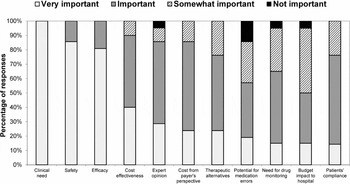
Of the forty-one surveys mailed, twenty-one (51 percent) were returned. On new drug selection, the majority of the respondents (86 percent) believed that pharmacoeconomic assessment should be incorporated as part of a submission dossier by the requestor and reviewed by the formulary pharmacists (Figure 1). The following decision-making criteria were regarded as being the most important when considering formulary inclusion: clinical need, safety, efficacy, and cost-effectiveness of the drug and opinion of clinical experts. The results of the survey also revealed that there were differences in the formulary submission process (e.g., title of the requestor and information submitted), quality of drug review report, and the decision-making process. Only one institution allowed submission by pharmaceutical companies. Nonetheless, all institutions would not reject an application prepared by the manufacturer if the application were endorsed by a practitioner in the institution. Most institutions had implicit criteria to guide decision making. The pharmacists looked forward to more training in systematic literature review and pharmacoeconomic analysis. Another pertinent issue being highlighted was that resource constraint limited the comprehensiveness of the drug evaluation and the ability to conduct regular review of the existing formulary. The approach on reviewing the existing formulary also differed greatly among the institutions.
Results of survey conducted among decision makers within the P&T committees in five public institutions. Of the forty-one questionnaire administered, twenty-one (51 percent) responded. Data from incomplete surveys was considered in the analysis. The results of the survey are expressed as the number of responses.

The workgroup had a total of four meetings. With reference to best practices internationally and results from the survey, the workgroup formulated courses of action to be carried out in phases over the next 3 years. These included the following initiatives: (i) developing tools for effective formulary management and consolidating these tools into a single resource guide for formulary management and decision-making tools; (ii) identifying and building competency in HTA skills relevant to formulary management; (iii) devising a prioritization framework to overcome resource constraints and time pressure; and (iv) conceptualizing and implementing framework to review existing formulary.
Developing Tools for Effective Formulary Management
To facilitate the application of HTA principles in formulary management, guidelines, tools, and templates were developed to optimize current practices. These materials were subsequently consolidated into a resource guide to facilitate the adoption of key HTA techniques, such as systematic review and meta-analysis and diffusion of best practices.
Formulary Drug Request and Review
Based on the information gathered through the survey, a new formulary submission form was developed to improve the comprehensiveness of information provided by requestors. The new form required the requestors to provide information on the place in therapy of the drug and why the drug is needed or preferred over existing treatment alternatives. Another new feature was the submission of pharmacoeconomic evaluation of the drug. Although drug request is routinely initiated by a practitioner, the manufacturer may be involved in supplementing the information. While the information may be perceived as biased, it can be useful to a certain extent and should not preclude a systematic literature review by an independent body.
Decision-Making Tools
Given that some P&T committees did not have explicit criteria to guide their decision making in formulary inclusion, a decision-making tool was developed to ensure transparency and unbiased decision making (Supplementary Table 1). In the light of the evidence review (of the drug), decision makers would also need to consider the existing treatment alternatives. Where possible, a review of the drug class should be undertaken to inform whether the drug would replace any of the existing drugs or add on to the same therapeutic class. Apart from the information gathered through the survey, relevant considerations from the international agencies for HTA (8;9) and professional pharmacy organizations (Reference Tyler, Cole and May1;10) were also incorporated in the tool (Supplementary Table 1). Three P&T committees participated in the pilot testing of the decision-making tool. Generally, the committees indicated that they had favorable experience with the tool, which provided clarity in the overall decision-making process. Its application also appeared to be reasonably broad and may potentially be introduced to other institutions in Singapore.
Training plan for the formulary pharmacists

Resource Guide
A resource guide (Formulary Management – A Practical Guide (Reference Khoo11)) that consolidated the tools developed for formulary drug submission, evidence review, appraisal, and synthesis, and decision making was published to facilitate the adoption of best practices by healthcare institutions. It provided practical information and guided users through steps involved in carrying out a systematic review: formulating a research question, conducting a systematic literature search, performing evidence appraisal with quality assessment tools, evidence synthesis, and reporting. It adapted recommendations of international HTA agencies (8;9;12–16) and professional pharmacy organizations (Reference Tyler, Cole and May1;10) in other aspects of formulary management. Consultation with institutional pharmacists and P&T committee representatives as well as experience from testing selected tools contributed toward the development of its content.
Identifying and Building Competency in HTA Skills Relevant to Formulary Management
Formulary decisions should be informed by good quality drug reviews. We recognized that a more rigorous framework for evaluating drugs was needed. The constitutive barriers to this were the lack of relevant expertise and resource constraints coupled with the pressure of timely formulary review. We facilitated the adoption of the proposed methods for clinical and economic evidence review by providing the relevant competency development and examining the areas for improvement.
Competency Development
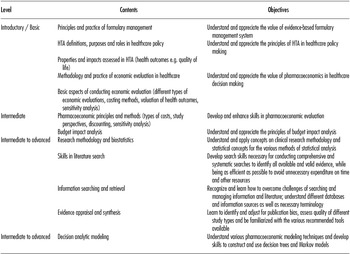
Based on the survey of formulary pharmacists, we gathered that the pharmacists would need further training in systematic, evidence-based drug review methods. A training plan was tailored for pharmacists and decision makers involved in formulary management (Table 1). Six workshops were organized in partnership with the local university and research institution, as well as invited experts from overseas. The formulary pharmacists were trained in areas such as systematic literature search, evidence appraisal and synthesis, as well as pharmacoeconomic evaluation and modeling techniques. The decision makers were provided with an insight on evidence appraisal, interpretation of HTA reports, pharmacoeconomics, and budget impact analysis.
Collaboration with HTA Practitioners
The project team jointly conducted seven drug reviews with the institutional formulary pharmacists. Apart from knowledge sharing, these reviews enabled the institutions to plan for resources required to optimize their formulary management processes.
Devising a Prioritization Framework to Overcome Resource Constraints and Time Pressure
Formulary drug review may be brief or in-depth (Reference Simpson, Hiller and Gutierrez-Ibarluzea17). A brief assessment, comprising essential information about the drug and how it works, its current comparators, safety and efficacy, costs and other concerns, applies to the majority of formulary drug reviews. This takes approximately 1 to 3 weeks. An in-depth assessment is a focused formulary review that involves a structured review strategy in response to a specific question of interest. It involves using transparent approaches for searching the literature, applying explicit criteria for identifying relevant evidence, and assessing the methodological quality of individual studies and the strength of findings based on the full body of relevant evidence. The question of interest usually includes whether a drug is more effective, cost-effective, and/or safer than its comparator. The in-depth assessment takes approximately 8 to 16 weeks, depending on factors such as complexity of the disease and number of comparators. This may extend beyond systematic review of the literature and/or involve economic evaluation (e.g., cost-utility or cost-effectiveness analysis).
We proposed that consideration for an in-depth assessment could be prioritized according to the following factors: (i) impact, that is, the potential of the additional information to influence decision making and the possibility of evidence gaps (clinical and/or economical) that may affect decision making if in-depth assessment were not conducted; (ii) relative importance of the disease, this is expressed by the burden of disease, which determines if the target disease affects a significant proportion of the population in the country or is a local priority (e.g., within a healthcare institution); (iii) potential economic impact of the drug, that is, drugs of relatively high acquisition cost may require cost-effectiveness analysis to allow decision makers to estimate the benefits of the drug in monetary terms and enable them to balance costs and benefits; (iv) feasibility, this is determined by the timeframe and availability of evidence, whether the report can be completed in a timely manner and presented to the decision makers.
Developing a Review Framework for Existing Formulary
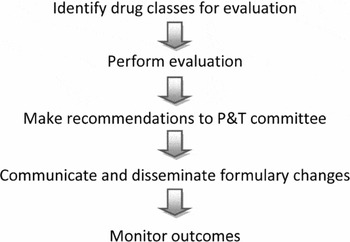
Current practices in the institutions did not cater to the regular review of the existing formulary. Hence, we researched and developed a formulary review framework (Figure 2) based on existing recommendations (18;19). In essence, the processes included identifying and prioritizing drug classes for evaluation, conducting the review, making recommendation to the decision makers, communicating formulary changes, and monitoring its impact. A systematic approach to identify and prioritize drug classes and drugs that require further evaluation was proposed. This involved grouping individual formulary items into drug classes using the World Health Organization Anatomical Therapeutic Chemical classification system. Thereafter, ABC analysis—a method of classifying items according to their annual usage value (unit cost × annual usage)—was used to prioritize the drug classes and develop a schedule for drug reviews. Drug classes commanding high value (driven by high volume of use and/or cost) were considered first, particularly if there are several therapeutic alternatives within the class and/or new safety concerns associated with the class. All the available agents within the drug class, including those not listed in the existing hospital formulary, should be considered in the evaluation. The therapeutic alternatives should be assessed based on factors such as safety, efficacy/effectiveness, cost-effectiveness, and differences in their pharmacological profiles. The impact of the decision made based on the review may be monitored in terms of clinical and economic outcomes.
A review framework for existing formulary. The key processes of formulary review include identifying drugs or drug classes for review using the ABC analysis, performing drug class reviews and recommending subsequent actions based on the findings. These changes are communicated to relevant stakeholders and patients who are affected should be monitored.

The proposed framework was piloted in one of the partner institutions leading to selection of two drug classes for review. Refinement was made before introduction of the formulary review guide in the other institutions.
DISCUSSION
We uncovered differences in the formulary submission, review, and decision-making processes among P&T committees from the five institutions. The common features were that formulary drug reviews were prepared by pharmacists and a systematic literature review was not the normal practice.
Decision making is of utmost importance in maintaining an effective formulary system. However, it is known that the deliberation varies in depth and quality and decision-making criteria are often not explicitly or extensively defined (Reference Tan, Day and Brien20;Reference Schiff, Galanter, Duhig, Koronkowski, Lodolce and Pontikes21). Given a lack of explicit decision-making criteria among the participating institutions, a standardized decision-making tool that clearly listed predefined criteria for assessing clinical need, efficacy/comparative effectiveness, safety, cost-effectiveness, expert opinion, and other factors such as budget impact to the hospital and patient compliance was developed.
Formulary review is an important part of formulary management given the constant changes in drug information and pharmacotherapy practice. New drugs that may offer an advantage over current therapeutic alternatives should be evaluated and considered for formulary inclusion. On the other hand, drugs with safety issues or found to be inferior to other new comparators should also be considered for removal from the formulary. Restrictions may be imposed on new or existing drugs to limit their use for clinical or economic reasons. The objective of conducting formulary review is to ensure that the listed drugs are kept up-to-date with the latest evidence. Regular formulary review will have both therapeutic and economic impact. For example, patient outcomes can be optimized through discontinuation of drugs that are less safe and/or efficacious. The hospital pharmacy budget may be reduced with improved drug inventory management through discontinuation of obsolete or inferior drugs.
Conducting formulary review in accordance with HTA principles is resource-intensive. Due to the limited capacity of trained HTA personnel in Singapore, it is important that the level of input is appropriate for any particular drug review. The general rule is that the resources allocated to a review should be proportionate to the importance of the objectives and impact of the evaluation. It is not practical to subject all new formulary drug requests to such a rigorous evidence review given that the resources required to do so far outweighs the available resources. We put forward a criteria-based prioritization framework to identify drugs requiring intensive reviews and drug classes requiring review (review of existing formulary). However, it may be necessary to modify them to be in line with the institutions polices and requirements.
The global trend has reflected an ongoing movement toward evidence-based decision making in formulary management, with pharmacoeconomic evaluation as part of the evidence base (2). However, given the complex nature and resource limitation, this area was less elaborated in the course of the program. To overcome the lack of economic evidence in formulary drug review, outsourcing such work to independent HTA practitioners may be considered as an interim solution.
The resource constraint may also be overcome if there exists some form of standardization in the review processes that will allow sharing of core information among the public healthcare institutions. This can be achieved by adopting a common guide or practice in the key processes involved in formulary management. In this instance, we assume that formulary drug reviews are carried out within the same decision-making jurisdictions and settings.
CONCLUSION
Through the 3-year formulary management program, we developed a set of tools to facilitate an evidence-based process for formulary submission, review, and decision making. We also devised a framework for systematic review of existing formulary. These tools were consolidated into a resource guide that encompasses the principles and methods on the evaluation of drugs in a systematic, consistent, and transparent manner and optimization of formulary decision making in hospitals. The training and collaborative drug reviews conducted with institutional pharmacists had facilitated the adoption of an evidence-based approach to formulary management.
SUPPLEMENTARY MATERIAL
Supplementary Table 1 http://dx.doi/org/10.1017/S0266462316000040
CONFLICTS OF INTEREST
All authors declare no conflicts of interest.