




No CrossRef data available.
Article contents
Language variation and local elements in family discourse
Published online by Cambridge University Press: 17 March 2004
Abstract
This study focuses on language variation in three families with small children in Antwerp, an officially Dutch-speaking large city in Belgium. Language variation is mainly considered here in terms of whether utterances contain local dialect features or not. Phonetic transcriptions of recorded natural family interaction were coded for language variation on an utterance-by-utterance basis. The following distinctions in usage emerge: “local” utterances containing dialect elements tend to be used when older children and adults in the family address each other. “Neutral” forms, which are common all over Flanders, may also be used, whereas “distal” features, which are imports from a Dutch variety outside Flanders, are to be avoided. However, when older children and adults address the younger members of the family, they increase their use of neutral forms, substantially reduce their use of local forms, and occasionally use distal forms. The younger children use mainly utterances categorized as neutral, dependent on who they are addressing. Implications of this variation across family members for language change are discussed.Financial support for the project reported on in this article comes from the Belgian National Science Foundation (KAN-grant to the author) and the Research Council of the University of Antwerp/UIA. Many thanks to the families, schools, and students who helped at the data collection stage. I also thank Wolfgang Wölck and two anonymous reviewers for their helpful comments.
Information
- Type
- Research Article
- Information
- Copyright
- © 2003 Cambridge University Press
INTRODUCTION
The study presented in this article adds a new dimension to the small but growing body of corpus-based research on linguistic variation in language use within the family by focusing on the extent to which families with small children use utterances containing local dialect features. The data for this study were collected in the city of Antwerp, the most populated city in the officially Dutch-speaking region of Flanders, Belgium. Speakers of Dutch who are residents of Antwerp use a wide range of variation in their speech, depending on educational background, regional allegiance, context of speaking, age, gender, and a multitude of other, less conspicuous factors.
More than twenty years ago, the sociolinguist Kas Deprez wrote that the city of Antwerp is a diglossic community insofar as standard Dutch tended to be spoken in formal and educational settings and in the media, and the local Antwerp dialect in informal situations (Deprez, 1984; for in-depth descriptions of the Antwerp vowel system and the use of subject pronouns, see Nuyts, 1989 and 1995, respectively). What then was and still is commonly seen as the standard (previously, A.B.N. or Algemeen Beschaafd Nederlands ‘general polite Dutch’; nowadays, A.N.) is a fairly new spoken variety in Flanders, which only started to be generally used in Flemish schools between the two World Wars. This oral standard was imposed from above, through the educational system and television and radio, and was and still is generally acknowledged as a necessary instrument for public affairs. Dutch, as written in Flanders, shares the same written standard that is used in the Netherlands.
At this time in history, the situation in the Dutch-speaking community of Antwerp can, however, no longer be described in simple terms of a clear-cut diglossia. It is still true though that in clearly formal settings, such as religious services and public ceremonies, there is hardly any use of elements that are stereotypically seen as belonging exclusively to the dialect. Full-blown dialect use, in which a speaker uses the local Antwerp phonological system, local Antwerp morphosyntax, and typically Antwerpian lexical items to the exclusion of stereotypically standard forms, does appear to be restricted to informal conversation between Antwerp dialect speakers who know each other very well.1
The Antwerp cinematographer, Robbe De Hert, is a very notable exception in that he always speaks full-blown Antwerp dialect in media interviews, certainly when the television or radio station is located in Antwerp. (He was once heard on the Flemish radio, where he did insert a few more standard forms in his speech.)
Much of the variation in the extent to which speakers from Antwerp use Antwerp dialect forms appears to be related to social class differences, although any systematic studies of this are lacking. However, interviews with middle-class speakers from Antwerp carried out in a study related to the analyses presented in this article contain several references to the use of full-blown Antwerp dialect (plat spreken) as indicative of lack of education (Kuppens, 2003; Kuppens & De Houwer, 2003). The Antwerp dialect itself, then, is not a homogeneous variety, because there is considerable variation between speakers in the specific dialect forms they use. There appears to be a continuum here ranging from “heavy” dialect use, which involves frequent use of the full range of dialectal forms, to “light” dialect use, with a restricted selection of dialect forms. Light dialect users may not even consider themselves as dialect users, but will be clearly identified as such by people who are not from Antwerp.
The fact that speakers may refrain from using elements that are clearly dialect elements does not automatically imply that they are speaking in a more normatively standard way. Often what people in Antwerp and the rest of Flanders nowadays regard as the spoken standard is a type of language use that is heard in formal programs in the media, such as newscasts, and that closely follows pronunciation and other norms that are explicitly taught at school (Kuppens, 2003; Van de Velde & Houtermans, 1999). These norms are historically based on standard usage in the Netherlands (Willemyns, 2003), but more and more the standard speaking norms in Flanders are diverging from the standard speaking norms in the Netherlands. People in Antwerp often consider a standard type of language use too “artificial” for informal interpersonal interaction (Kuppens, 2003).
The alternative for adopting a normative standard way of speaking consists of other forms that are not stereotypically dialect forms, but that do not quite follow the explicit norm either (Willemyns, 2003). The use of such forms is regarded more and more as normal in situations where twenty years ago or so the normative standard would have been expected. At the same time, such forms may also be used in local, interpersonal, and informal interaction.
It is clear, then, that in Antwerp there is a whole range of variation in ways of speaking Dutch. Speakers may use speech features which index one end of the continuum (Antwerp dialect) more than the other (standard), or the other way round. They may also find themselves anywhere in or around the middle of the continuum. For informal face-to-face interaction, however, the continuum would appear to be generally restricted to a range going from heavy use of the local dialect to no use of the local dialect. In this kind of linguistic setting, switching between various ways of speaking is common and expected.
As pointed out previously, variation in Dutch oral usage in Antwerp appears to be determined by a multitude of factors. There is a common perception in Antwerp that people who can only speak the local dialect are uneducated and lower class. This is a common phenomenon in dialect-standard situations in which the instrument of written communication is a standard promoted by the education system, and the dialect, by definition, has little if any written support (see also, e.g., Willemyns, 1997). Certainly, the ability to speak in a less local way is a condition for upward mobility. At the same time, the Antwerp dialect holds a great deal of local prestige, and recent live-audience Antwerp television programs with celebrities speaking about Antwerp history drew huge middle-class crowds who applauded loudly when the actors occasionally used strong dialect forms. Older people from Antwerp, including individuals from professional elites, tend to strongly support the dialect (while at the same time recognizing the need for a more standard way of speaking). Young male teenagers use the dialect as a marker of strength and toughness (again a common finding in dialect-standard continuum settings; see, e.g., Lebbe, 1997; Willemyns, 1997). A recent interview study with 30 Dutch adult speakers in Antwerp from various social backgrounds showed a high degree of appreciation for the dialect (Kuppens, 2003; Kuppens & De Houwer, 2003). The few Flemish regional television series that use “real” dialect feature the Antwerp dialect rather than any of the many other Flemish dialects. The prestige of the Antwerp dialect, both within Antwerp and beyond, as well as the generally positive attitudes towards it that can be currently noticed, appear not to have changed much from the positive attitudes evident in the late 1970s and early 1980s, as described in Deprez (1984), Deprez and De Schutter (1981), and Willemyns (1981).
The Antwerp dialect, then, is very much alive. Although it may be used on occasion in various more public settings, and certainly is used a lot between locals who know each other well, it has the most chance of being used in private conversations with people with which one is intimate.
The bond between parents and children would appear to be one of the most intimate bonds there is, and the expectation for family discourse when only family members are present would be that mainly dialect forms are used, especially in lower- and lower-middle-class families. This expectation corresponds with the fact that in educational practice, it is generally assumed that most children, but particularly children from lower- and lower-middle-class backgrounds, need to learn the standard at school because they do not hear it at home. Consequently, at school, much time is spent on teaching children how to use “proper” nondialect ways of speaking, although teachers may use the dialect a lot in nondidactic asides (for earlier observational studies documenting this for Antwerp, see Van de Craen, 1985, and Verbruggen, Stroobants, & Rijmenans, 1985).
In the last few years, however, informal observation in public places, such as supermarkets and restaurants, has repeatedly shown that in conversations between obvious family members, the parents address each other fully in Antwerp dialect, but switch to much less strongly dialect forms when addressing their young children. This switching behavior is surprising within a context in which dialect use is assumed to generally mark informality and intimacy. Is contact between parents and children not to be seen as informal and intimate? Perhaps not when parents address their children in a public place. But this does not explain why parents still have no problem in addressing their partner in the dialect, even when they are in a public place. Clearly, the phenomenon of less dialect usage with young family members warrants further investigation. Is the use of fewer dialect features in speech addressed to young children also a feature of family discourse in the most private of spheres, namely, home interaction? And if so, what are the implications?
This article explores these issues on the basis of several phonetic transcripts of actual family discourse in families with young children in Antwerp.
METHOD
Participants and procedure
The participants for this study were three lower-middle-class two-parent families with at least a four-year-old child. All families resided in the city of Antwerp at the time of data collection. They were recruited through Antwerp nursery schools by university students in the framework of a larger study on children's language development and socialization through language, which was also the goal of the study as stated to parents. All parents and children were born and raised in Antwerp and had not lived anywhere else. In interviews with the student research assistants prior to actual data collection, all mothers confirmed that they were able to speak the local Antwerp dialect and used it on a daily basis with their husbands and other familiar adults (mothers were not asked what they used with children in order not to unduly influence later data collection).
The data for this study consist of audio recordings of naturally occurring family interaction. This interaction was recorded in each family home in the absence of investigators, using an inobtrusive, high-quality cassette tape recorder with multidirectional microphone. The recordings were made at approximately the same time for all families (recordings were made with at most a week's time difference). All parents signed waivers allowing the recorded interactions to be used for scientific analysis.
The recordings involve both multiparty and dyadic home interactions between various parties: the four-year-old target child, the child's mother, the child's father, an older and/or younger sibling, and visitors. In the following, we will refer to each family in terms of the target child: the Dieter family is the boy Dieter's family, the Kim family is the girl Kim's family, and the Katrien family is the girl Katrien's family. For each family, the total duration of recordings was approximately three hours (recorded over three days within the same week).
During the recordings, the four-year-old target child was always present. For the material that will be analyzed in this article, the children's mothers were present almost all the time as well. In both the Dieter and Kim families there was also one preverbal baby sibling present most of the time. For the Katrien and Kim families there was usually an older sibling present as well (Katrien family: five-year-old sister; Kim family: seven-year-old brother). Fathers were occasionally present in the recorded material for the Dieter and Katrien families. Dieter's family had a four-year-old friend visiting for about half the time, and during the recording for Katrien's family, a female adult visitor was briefly present.
Even if, at the beginning of each recording, adult participants might have been somewhat shy or otherwise influenced by the recording equipment, the highly diverse types of interactions recorded, and the fact that young children's needs had to be attended to, can be taken to mean that the recorded interaction is quite close to what actually happens in these families when interactions are not being recorded.
Transcription
All material on the audio recordings was phonetically transcribed using a fairly narrow transcription. The phonetic transcription format used is unibet, as developed by Steven Gillis for Dutch, an ascii adaptation of the IPA format (MacWhinney, 1995). Each utterance also received an orthographic transcript line. Where relevant, comment lines were inserted. The transcription format followed the chat-format as used in childes, the Child Language Data Exchange System (MacWhinney, 1995; MacWhinney & Snow, 1985).
An example of the unibet format is shown in (1), with a ‘translation’ in IPA below it and an English gloss.

For more samples of what the transcriptions look like, see (2), (3), and (4). For clarity's sake, the unibet phonetic transcriptions have been substituted by IPA lines and English glosses. The original orthographic transcription lines and any comment lines appear in bold.

Each recording used for analysis in this article was separately transcribed by two independent transcribers. A third transcriber checked both versions against each other and resolved any transcription differences where possible. The three transcribers were all native speakers of Dutch as spoken in Belgium but came from different dialect backgrounds. Each recording was transcribed by at least one transcriber from the Antwerp area. All transcribers were trained by the author.
Coding
After transcription, a research assistant, who had not assisted in the transcription, coded each utterance in terms of who the speaker was (speaker code), who was being addressed (addressee code), and whether the utterance contained any features that were clearly identifiable as part of the dialect or not (feature code). This was done on the basis of the transcriptions, but, in case of doubt, the original sound recording was again available for added accuracy and reliability. The coding was checked by the author.
Because of the large overlap between a dialect and other varieties of the same reference language, such as the standard, many elements belong to both the dialect and to the other varieties at the same time. Thus, for example, there is a large portion of the lexicon that is shared between the Antwerp dialect and other varieties of Dutch, including the oral standard as presently used in Flanders (e.g., ‘de was doen’ = to do the laundry; ‘schoonheid’ = beauty; ‘binnen’ = inside). Also, for instance, most of the consonant phonemes are the same. Word order within complex noun phrases follows the same pattern, with an article or pronoun followed by one or more adjectives, and then finally the head noun. Many more examples can be found.
Much of what dialect speakers say, then, will not be restricted to just the dialect. Even monodialectal speakers who speak no other variety than the Antwerp dialect will often produce utterances that could have been produced by other Flemish speakers of Dutch who do not speak the Antwerp dialect. Such utterances do not mark the speaker as a person who speaks the Antwerp dialect, nor as a speaker who does not speak the Antwerp dialect. In other words, these utterances are neutral as to the specific variety of Dutch that a speaker could be identified with. At most, these utterances would give away the fact that a speaker is from around Antwerp, because of the use of a regional Antwerp accent (even standard Dutch speakers from Antwerp who do not speak Antwerp dialect may have somewhat of an accent that identifies them as being from around Antwerp).
As described in the beginning of this article, Antwerp dialect speakers may choose to make use of only a portion of the typically Antwerp dialect features. Such speakers will most likely use even more utterances that contain no typically Antwerp dialect features. Again, these utterances are “neutral” in the sense that they do not “betray” people as dialect speakers.
One specifically Antwerp dialect feature in an utterance is enough to identify a speaker as a dialect speaker. Two or three such features per utterance are even more evidence, of course. The number of typically dialect features per utterance and the specific types of dialect features used may identify a speaker as a heavy or light dialect speaker. However, the aim of the present study is not to make comparisons between heavy and light dialect usage in family interaction, but to investigate the variation between any dialect use in an utterance (whatever the extent) and no dialect use. Thus, as explained in more detail later, the basic coding distinction made is one between local utterances and neutral utterances. There are also a few utterances that were coded as distal or combination utterances. These codes were applied on the basis of specific features within each fully transcribed utterance in the corpus (hence the term “feature code”).
An utterance containing at least one feature that is clearly marked as Antwerp dialect is coded as local, regardless of whether the rest of the utterance is neutral, as in example (5). An utterance with more than one dialect feature is also coded local. It was decided to use the term “local” for these utterances rather than “dialect” to specify that, indeed, there may be quite a few neutral features in the utterances as well, while at the same time the dialect feature(s) in it carry a local flavor. In an explanation line underneath the coding line in the transcript, the features are noted which led to the coding decision. Any dialect feature on the allophonic or segmental phonological level, the lexical level, or the morphosyntactic level counted towards the “local” code. The Appendix lists all the features that were present in the corpus that were coded as local.

In principle, each utterance in the corpus that did not contain at least one clearly (Antwerp) dialect feature was coded as neutral. Basically, an utterance coded as neutral could be used anywhere in informal contexts throughout Flanders. An example of such a neutral utterance is example (6).

As coding proceeded, a few features appeared in the corpus that were quite clearly not dialect elements, and that coders did not see as neutral, especially because in each case a neutral informal alternative existed. Typically, the features in question are elements that somewhat older speakers in Flanders would consider to be imports from the Netherlands, and that were extremely rare in informal usage in Flanders until about twenty years ago; see example (7). These features, then, are really departures from local or even neutral usage. The utterances in which such features occurred and in which no dialect features appeared were labelled “distal” utterances to indicate the distance between the imported features and the local dialect base. Although, in principle, allophonic or phonological features could be coded as distal as well (such as the realization of the written form ‘schr’ as [sr], with nonrealization of the fricative between /s/ and /r/), no such usage was present in the corpus under discussion. The Appendix lists all the features that were present in the corpus that were coded as distal.

There are also utterances that contain both a local and a distal feature. These utterances get a separate combination code.
At this time, the coding decisions have been made based on the various coders' personal knowledge of and experience with the varieties involved. Arguably, the list of features now coded as dialect features should in fact be expanded, because in deciding on a particular code a fairly conservative position was taken, where, in case of doubt as to whether a feature should be considered as dialect or not, it was decided not to code it as dialect. Just how generalizable these coding decisions will turn out to be, remains to be seen. What is important, however, is that the coding procedure was consistent for the entire corpus, which means that any variation found within the corpus refers to a real difference in usage.
Material for analysis
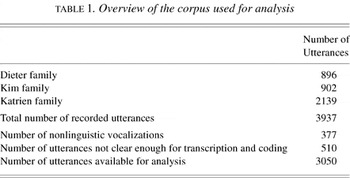
Many more utterances were transcribed than will be discussed in this article. Full utterance-by-utterance feature coding has been completed for about a third of the corpus available for each family. It is this portion of the material that will be analyzed in this article. An overview of the subcorpus can be found in Table 1.
Overview of the corpus used for analysis

As is clear from Table 1, a lot more talk went on in Katrien's family than in the other two families. Rather than opt for an approach in which the same (arbitrary) number of utterances is analyzed for each family, the decision was made to follow as ecologically valid a method as possible, in which the potential differences between the families would not be artificially reduced. Hence, the decision to look at material from all three families that was recorded in the time frame of one hour per family. The balance in the number of recorded utterances for each family is the same for the other portions of the corpus, that is, in Katrien's family there is more than twice as much talk as there is in either Dieter's or Kim's family, and the Dieter and Kim families are about equally verbose. In other words, the subcorpus to be analyzed in this article is representative of the entire corpus as far as its quantitative basis is concerned. In addition, the interactional contexts recorded in the subcorpus are fairly typical for the corpus as a whole, and coincide with information about each target child's usual social interaction at home that was gained through questionnaires filled out by the target children's mothers. Thus, the fact that in Dieter's family a four-year-old friend was present is not unusual for this family. In the Kim and Katrien families, however, friends hardly ever come over to play (and do not feature in the recordings either). Instead, Kim and Katrien usually spend time at home with their respective older siblings. Kim's father is hardly ever at home (he is an international truck driver), whereas in Katrien's and Dieter's family the fathers are regularly at home and see the children every day. In all families, primary care at home is taken on by the mothers, although all the mothers have full-time jobs.
All in all, then, the subcorpus analyzed here is most likely a good representation of the family interactions that typically take place in the three families that are being studied here.
ANALYSES AND RESULTS
Overall characterization of the corpus
The 3,050 utterances available for analysis (see Table 1) are distributed over the three main speaker types as follows: adults (N = 1,085 utterances), four-year-olds (N = 1,231 utterances), and older siblings (N = 734 utterances). (The younger siblings hardly ever produce understandable speech.) There is no question, then, that the children in the families under investigation have plenty of opportunity to talk. In fact, all children together produce nearly twice as much speech on the recordings than do the adults.
The four-year-olds are beyond the age at which limited length of utterance is a stereotypical feature (see, e.g., Brown, 1973; De Houwer & Gillis, 1998). This may explain why the average length in words per utterance by adults, four-year-olds, and older siblings is the same, that is, four. All three speaker groups produce both very short and quite long utterances (for examples of the latter, see examples (8) and (9)). Long utterances coded as local often contain just one dialect feature, and occasionally more than one. All speaker groups carry out a range of speech acts, and no particular speech act is restricted to a specific speaker group. Children, as well as adults, carry out orders, complain, engage in brief narrations, ask information questions, carry out requests, make evaluative statements, and so forth. It is impossible to predict which utterance was produced by what type of speaker on the basis of length characteristics or type of speech act.

When we turn to an analysis of the feature codes, a first major finding is that over two-thirds of the fully transcribed utterances in the corpus are neutral utterances. Only 27% were coded as local, that is, as containing at least one Antwerp dialect feature. This means that, contrary to expectation, at home, Antwerp dialect does not constitute the main way of speaking in the three families under investigation. Even if it is argued that some features now coded as neutral are really more local, and the large number of utterances now coded as neutral (68%) goes down to, say, 58%, it is still not the case that the majority of utterances are in the local dialect. It must be noted, however, that the use of distal features (which are very clearly nonlocal) is quite low (4%). Utterances combining local and distal features account for a meager 1% (33 utterances from a total of 3,050).
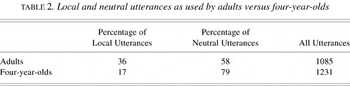
Although, in absolute numbers, adults produce most of the 33 combination utterances, the relative use of combination utterances is virtually the same across the three types of speakers. This also holds for the utterances coded as distal. The overall proportions of use of the local and neutral utterances, which constitute the bulk of the corpus, shows a very different picture however. Proportionately, the adults use nearly twice as many local utterances as do the four-year-olds (36% vs. 17%). These proportions are fairly stable across the three families for the adults (range: 34% to 39%), but somewhat less stable for the four-year-olds (range: 11% to 23%). It follows from these results for the local utterances that the four-year-olds use many more neutral utterances than do the adults (see Table 2). The differences between the four-year-olds and the adults in the usage patterns are statistically significant (chi-square = 116.18; p < .01).
Local and neutral utterances as used by adults versus four-year-olds

For the two older siblings together, the local utterances account for 31% of all their utterances. This would appear to represent somewhat of a middle position between the four-year-olds and the adults were it not that there are huge interindividual differences between the two older siblings, with a percentage of 19% local utterances for the 5-year-old girl in the Katrien family, and a very high 56% for the 7-year-old boy in the Kim family. Certainly, the two older siblings cannot be seen or treated as a group. We return to the 7-year-old boy's language use later on.
As a major finding, we have seen that adults and four-year-olds differ substantially from each other in their relative use of local versus neutral utterances. However, this is not the whole story. There are also differences in language use depending on who is being addressed. We turn to these differences in the next section.
Type of utterance and addressee
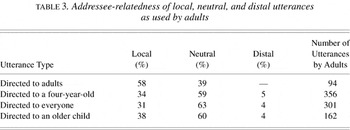
The fact that adults use local utterances in about a third of their utterances does not mean that every third utterance is a local one. In fact, the use of local versus neutral utterances by the adults in the families appears to be quite strongly influenced by who they are addressing. When adults address other adults, they tend to do so using a local utterance rather than a neutral utterance (58% vs. 39%). At the same time, when adults address anyone else at home, they use many more neutral utterances than local utterances. There are statistically highly significant differences between utterance choice with adults, on the one hand, and each of the three other categories of addressees, on the other (p < .01 in all three cases): a four-year-old (chi-square = 14.62), an older child (chi-square = 9.65), or everybody present at once, including the children (chi-square = 19.95). There are no statistical differences between any of the three child addressee categories. The data supporting this are presented in Table 3 (note that the total of the utterances listed here does not add up to 1,085, because only those utterances were considered for which the addressee(s) could be unambiguously determined). Also, in the fairly limited number of adult utterances addressed to a preverbal child (61 in total), there are twice as many neutral utterances as local ones.
Addressee-relatedness of local, neutral, and distal utterances as used by adults

Another difference between adult–adult interaction and interactions involving a child is that any distal utterances used by the adults (41 in total) are addressed exclusively to children, and not to another adult. When four-year-olds use distals, they show no particular distinction in terms of addressee.
However, four-year-olds do make some distinction between adults and children in their use of local versus neutral utterances, although the differences here are far less marked than was the case for adult speech. Four-year-olds always use more neutral utterances than local ones, regardless of who they are addressing (this was not the case for the adults). But in addressing adults, four-year-olds use relatively more neutral utterances than they do when they are addressing other children, and, conversely, they use more local utterances when speaking to same-age or older children than when addressing adults (weakly significant at the p = .05 level; chi-square = 6.32). When four-year-olds are speaking to everyone present, including adults, their relative use of local and neutral utterances, on the whole, resembles how they speak when talking to adults (see Table 4; note that the total of the utterances listed here does not add up to 1,231, because only those utterances were considered for which the addressee(s) could be unambiguously determined).
Addressee-relatedness of local, neutral, and distal utterances as used by four-year-olds

Finally, the use of distals warrants a separate analysis. After all, distals are recently “imported” and thus, from a historical perspective, are very marked elements. There are 110 utterances in the entire corpus that contain a distal feature and no local dialect elements. Most of these distal utterances are either used by a four-year-old (40% of 110) or addressed to a four-year-old (an additional 56% of 110). Adults do use distal utterances as well (37% of all distals), but as noted before, they address them exclusively to children, and mainly to four-year-olds or younger siblings. Sixteen distal utterances are addressed to an adult. Thirteen of these were spoken by a four-year-old. The main context of use for distal utterances, then, is conversation involving four-year-olds, either as speaker, or as addressee.
So far, not much has been said about the two older siblings in the Katrien and Kim families, except that they differ vastly from each other in the relative use of local versus neutral utterances. Arguably, however, the older sibling in the Katrien family is not really to be considered older. She is, after all, only about a year older than her four-year-old sister. She also exhibits a language use pattern that is very similar to that of her sister's. Kim's older sibling, Kenneth, however, is three years older than her and is the only speaker in the corpus who uses more local than neutral utterances (56% as compared to 41%). In the next section we take a closer look at the language use patterns in Kim's family to see how Kenneth's relatively unusual language use fits in.
Language use patterns in the Kim family
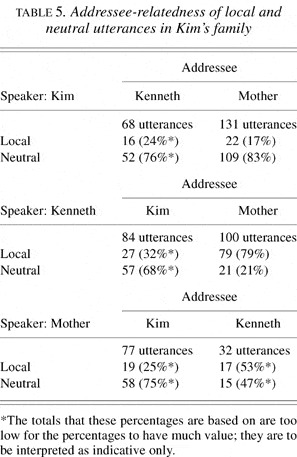
When we look at the interactions specifically addressed to either the four-year-old Kim, her seven-year-old brother Kenneth, and Kim's mother (rather than to everyone present or the baby), we see very clear addressee-influenced patterns for the language used by Kenneth and his mother (see Table 5). They use many more neutral utterances to Kim than they do to each other, and they use far fewer local utterances to Kim than they do to each other. Kenneth also addresses his mother much more often by means of a local utterance than his mother does when she addresses Kenneth, although Kenneth's mother does not say much to Kenneth (32 utterances in total). Kenneth's high proportion of local utterances, then, is not an across-the-board phenomenon, but can be explained as a function of the addressee. Also, his particular choices follow the direction previously identified for the adults in the corpus, who address each other more with a local utterance than with a neutral utterance, and who address children more with a neutral utterance than with a local utterance. Kim herself uses approximately the same proportion of local utterances to either her mother or her brother, although the total number of utterances she directs at her brother (68) is not large enough to make any conclusive statements here.
Addressee-relatedness of local and neutral utterances in Kim's family

The preference for more local forms in conversations between Kenneth and his mother is confirmed by the fact that, in addressing each other, Kenneth and his mother never use a distal utterance. However, they each do use distal utterances when addressing Kim (the mother does this once, Kenneth seven times). Kim uses distal utterances regardless of who she is addressing (eight such utterances with her brother, four with her mother).
On the whole, then, seven-year-old Kenneth resembles the adults more than he does the other children, both in the way he speaks himself, and in the way he is addressed.
SUMMARY AND DISCUSSION
The results from this observational study of home discourse in three Antwerp lower-middle-class families clearly show that there is a lot of variation in the way family members speak. Their utterances may contain local dialect features, or highly marked, “imported” features, and anything in between. Clearly, local elements are far from being in the majority. The generalizability of this finding is, of course, not clear. However, the fact that three lower-middle-class families from different parts of the city, who did not know each other but show the same patterns of use, suggests that the patterns found are not unusual.
This study, then, does not confirm the general perception that, at home, people in Antwerp speak the local dialect. They do so on occasion, but they use more standard, region-neutral features as well, and they do this most of the time, that is, in at least two-thirds of their utterances.
Another clear result from this study is that not all family members speak the same way. The four-year-old children always use more neutral than local utterances, regardless of who they are speaking to, but they use proportionately slightly more neutral utterances when addressing adults than they do when addressing other children. The adults use local dialect elements about twice as often as the children, with the exception of a seven-year-old, who uses proportionately many more dialect elements than any one else. Furthermore, the use of local versus more neutral utterances is dependent on who any one speaker is addressing. This is particularly clear for the adults and the seven-year-old, who use many more local than neutral utterances when addressing adults, and who use many more neutral than local utterances when addressing children. In a recent attitude study, several additional Antwerp parents were interviewed about how they speak to young children (Kuppens, 2003; Kuppens & De Houwer, 2003). They confirmed that they tend to avoid dialect use in speaking to children. When asked about their reasons for this, they indicated that dialect use was not fitting for young children and that children needed to learn to speak in more standard, nondialect ways because this would help them at school. They also feared that dialect use in young children would interfere with their learning of more standard ways of speaking.
Specifically, supraregional elements (the “distal” utterances) are used almost exclusively in adult–child or child–child interaction. Adults do not use these with each other, and the seven-year-old only uses them in addressing his younger sister. Linguistically, then, the seven-year-old behaves much like an adult. Whether this behavior is typical of boys or children his age growing up in similar circumstances cannot be ascertained, but the main point is that through the linguistic choices made by the seven-year-old and the adults in the corpus, preschool-age children are put in different linguistic positions from the rest of the family. This is in accordance with the fact that in supermarkets, restaurants, parks, and other public places parents address each other using many local dialect elements, but switch to more obviously region-neutral forms when talking to small children. Family discourse, then, is not necessarily homogeneous, even in a monolingual settting (see also Hazen, 2002).
In a historical comparison between the Antwerp dialect vowel system in the beginning of the 20th century and the 1980s, Nuyts (1989) noted that the range of phonological variation had changed in the direction of the more standard Dutch vowel system. The linguistic variation that exists in families with young children may be an important link in helping to explain this kind of language change. In Antwerp, the traditional bastion of the dialect, and the place par excellence through which the dialect is transmitted to the next generation (namely, the home), is not just cracking at the seams, but has been largely overtaken by nondialect usage. When parent-couples talk amongst each other, they still align themselves more with the dialect than with other, more region-neutral ways of speaking. However, by introducing more of these region-neutral forms in conversations with young children, these same parents choose to first socialize their young offspring mainly in forms that are not specifically local Antwerp dialect. Thus, the adults are opening the door to more language change. In any event, they are making it appear quite normal not to use much dialect at home.
The observational findings for Antwerp confirm survey findings from other dialect regions in the Dutch-speaking area that have suggested that parents address each other more in the dialect than they do in conversations with their children (see, e.g., Hagen, 1986; see also Willemyns, 1997). Whether this will eventually lead to the disappearance or restructuring of the dialect is another matter, however. Perhaps as children grow older, parents gradually increase the number of local utterances, thereby affecting their children's ways of speaking at home at a time that children start to have to use the standard away from home, namely, at school. This would constitute the best of both worlds, as it were, with the children having some knowledge of region-neutral ways of speaking, which they need for academic achievement and to become full-fledged members of society, while the local dialect, with its high local prestige and high symbolic value as an in-group identity marker, remains in place as a valued alternative mode of communication.
The fact that the oldest child in the sample, seven-year-old Kenneth, was addressed by his mother using relatively more local utterances than she used to her four-year-old suggests that parents may indeed adjust their levels of local-neutral variation in speaking to children as children grow older. The developmental psycholinguistics literature on child-directed speech (CDS) acknowledges that changes over time in how children are addressed by adults are quite common (see, e.g., Gallaway & Richards, 1994). In the field of child language, however, the major changes referred to concern changes in overall intonation patterns, lexical choice (within one variety), morphosyntactic complexity, and the length of utterances, whereby the typical CDS register slowly gives way to an informal register that could also be used with adults. Changes in language variety have so far not featured in the developmental psycholinguistics literature on CDS, but then most work on CDS has been limited to studies of monovarietal families.
Right now, there are insufficient data to determine whether, in fact, parents do adjust their levels of local-neutral variation in speaking to children as children grow older. The less they do so, however, the more they will be contributing to language change, whereby slowly but steadily, children are socialized in ways of speaking that are less and less local and more and more general. If the dialect is not supported at home, where else is that going to happen?
References
REFERENCES
Brown, Roger.
(1973).
A first language: The early stages.
London:
George Allen and Unwin.
De Houwer, Annick, &
Gillis, Steven.
(1998).
Dutch child language: An overview. In
S. Gillis &
A. De Houwer (eds.),
The acquisition of Dutch.
Amsterdam:
Benjamins.
1–100.
De Houwer, Annick, &
Gillis, Steven.
(1982).
Open en verborgen attitudes: Hoe komen we er aan? In
P. Van de Craen &
R. Willemyns (eds.),
Sociolinguïstiek en ideologie.
Brussels:
Vrije Universiteit Brussel.
135–172.
Deprez, Kas.
(1984).
Why do Antwerpians consider Netherlandic language varieties as
‘cultured’, ‘pleasant’,
‘beautiful’, ‘rich”? In
K. Deprez (ed.),
Sociolinguistics in the low countries.
Amsterdam/Philadelphia:
Benjamins.
237–285.
Deprez, Kas, &
De Schutter, Georges.
(1981).
Het Antwerps in Antwerpen. Een attitude-onderzoek. In
M. Dominicy &
C. Peeters (eds.),
Linguistics in Belgium 4. Papers from the fourth December meeting
of the Belgian Linguistics Circle.
Brussels:
Didier Hatier.
17–39.
Gallaway, Clare, &
Richards, Brian (eds.).
(1994).
Input and interaction in language acquisition.
Cambridge:
Cambridge University Press.
Hagen, Antoon.
(1986).
Dialekt und Standardsprache. Zur heutigen Situation im
niederländischen Grenzgebiet.
Rheinisches Vierteljahresblätter
50:287–297.Google Scholar
Hazen, Kirk.
(2002).
The Family. In
J. K. Chambers,
P. Trudgill, &
N. Schilling-Estes (eds.),
The handbook of language variation and change.
Oxford:
Blackwell.
500–525.
Kuppens, An.
(2003).
Liever Standaardnederlands dan Antwerps? Verklaringen voor
taalkeuze in gesprekken met kinderen.
PSW-papers.
Antwerp:
Universitaire Instelling Antwerpen.
Kuppens, An, &
De Houwer, Annick.
(2003).
“Dialect is niet voor kinderen”: Attitudes tegenover
Standaardnederlands en dialect in kindgerichte spraak. In
T. Koole,
J. Nortier, &
B. Tahitu (eds.),
Artikelen van de vierde sociolinguïstische conferentie.
Delft:
Eburon.
268–276.
Lebbe, Dominique.
(1997).
Schoon Vlaams. Een onderzoek naar syntactische en morfosyntactische
aspecten van tussentaal door Ieperlingen gesproken.
Taal en Tongval
49(2):158–175.Google Scholar
MacWhinney, Brian.
(1995).
Computational analysis of interactions. In
P. Fletcher &
B. MacWhinney (eds.),
Handbook of child language.
London:
Blackwell.
152–178.
MacWhinney, Brian, &
Snow, Catherine.
(1985).
The child language data exchange system.
Journal of Child Language
12:271–295.Google Scholar
Nuyts, Jan.
(1989).
Het Antwerps vokaalsysteem: Een synchronische en diachronische
schets.
Taal en Tongval
41(1–2):22–48.Google Scholar
Nuyts, Jan.
(1995).
Subjectspronomina en dubbele pronominale constructies in het
Antwerps.
Taal en Tongval
47(1):43–58.Google Scholar
Van de Craen, Piet.
(1985).
De mislukking van een taalpolitiek: A.B.N. in de klas. In
P. Van de Craen &
R. Willemyns (eds.),
Standaardnederlands en dialect op school, thuis en elders.
Brussels:
Vrije Universiteit Brussel.
45–64.
Van de Velde, Hans, &
Houtermans, Muriel.
(1999).
Vlamingen en Nederlanders over de uitspraak van nieuwslezers. In
E. Huls &
B. Weltens (eds.),
Artikelen van de derde sociolinguïstische conferentie,
Delft:
Eburon.
451–462.
Verbruggen, M.,
Stroobants, F., &
Rijmenans, Rita.
(1985).
Dialect in de klas. Aanzet tot onderzoek in drie basisscholen uit
het Antwerpse. In
P. Van de Craen &
R. Willemyns (eds.),
Standaardnederlands en dialect op school, thuis en elders.
Brussels:
Vrije Universiteit Brussel.
107–128.
Willemyns, Roland.
(1981).
Attitude en gedrag. De soms verhullende rol van cijfers.
Taal en Tongval
33:138–144.Google Scholar
Willemyns, Roland.
(1997).
Dialektverlust im Niederländischen Sprachraum.
Zeitschrift für Dialektologie und Linguistik
64(2):129–154.Google Scholar
Willemyns, Roland.
(2003).
Dutch. In
A. Deumert &
W. Vandenbussche (eds.),
Germanic standardizations. Past to present.
Amsterdam/Philadelphia:
Benjamins.
Overview of the corpus used for analysis
Local and neutral utterances as used by adults versus four-year-olds
Addressee-relatedness of local, neutral, and distal utterances as used by adults

Addressee-relatedness of local, neutral, and distal utterances as used by four-year-olds
Addressee-relatedness of local and neutral utterances in Kim's family
 You have
Access
- 17
- Cited by