Case report
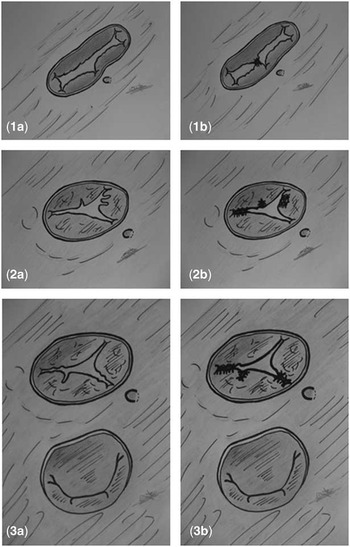
Atrioventricular valve regurgitation in a univentricular heart may be an issue in Fontan physiology. Questions arise in such a setting about how and when to address the atrioventricular valve. Among our last 50 consecutive patients with a univentricular heart, three patients underwent valve repair concomitant with Fontan completion (Table 1). The first patient had an unbalanced atrioventricular septal defect, and closure of the left-side cleft was performed. The second patient had hypoplastic left heart syndrome; the antero-septal commissure was closed, as well as two gaps in the posterior valve. The third patient had a double-outlet right ventricle; both anteroseptal and posteroseptal tricuspid valve commissures were closed. Repair was attempted under a brief period of cardioplegic arrest in patients 1 and 3, whereas fibrillation without cross-clampig and carbon dioxide field flooding was the choice in patient 2 (Fig 1) After the valve repair was completed, the Fontan pathway was completed with an extracardiac 18–20 mm conduit. On echo, trace-to-mild regurgitation was noticed in each case.
( 1a ) Atrioventricular septal defect with regurgitation in the left component. ( 1b ) Closure of the gap between superior and inferior left common valve (cleft). ( 2a ) Tricuspid regurgitation in a hypoplastic left heart syndrome. ( 2b ) Closure of the anterior commissure and several gaps in the posterior leaflet. ( 3a ) Double-outlet right ventricle. Regurgitant tricuspid valve (competent mitral valve). ( 3b ) Closure of anterior and posterior commissures.

Patients and atrioventricular valve repair.

AV=atrioventricular; DORV=double-outlet right ventricle; ECC=extracorporeal circulation (minutes); HLHS=hypoplastic left heart syndrome; VSD=ventricular septal defect
Discussion
Atrioventricular valve dysfunction is not uncommon in children managed with univentricular palliation. Some authors suggest that 25% of patients with single ventricle physiology will develop tricuspid regurgitation, particularly those with hypoplastic left heart syndrome.Reference Elmi, Hickey and Williams 1
Several factors are responsible for atrioventricular valve regurgitation in single-ventricle patients, apart from sub-optimal afterload, such as aortic-arch obstruction and pulmonary hypertension. Chronic volume overload may cause ventricular and annular dilatation leading to “functional” valve insufficiency. Not infrequently, intrinsic abnormal valves with dysplastic or prolapsed leaflets are found, particularly in morphologically tricuspidReference Stamm, Anderson and Ho 2 or common atrioventricular valves. The cumulative effect of re-modelling and ventricular dysfunction after staged surgical procedures may play a role. Regarding hypoplastic left heart syndrome and Norwood stage I, concerns arise either with the diastolic run-off and coronary attrition in the systemic-to-pulmonary shunt or with the ventriculotomy in the Sano modification approach. Irrespective of the aetiology, development of significant atrioventricular valve regurgitation in single-ventricle physiology compromises the natural and surgically modified survival in this subset of patients.
No clear guidelines can be found for the indications and timing of repair. Atrioventricular valve repair can be performed as an isolated procedure or, alternatively, in conjunction with a staged procedure, Glenn or Fontan. Some feel that it is best to separate the valve repair from the Fontan and perform the two procedures as staged operations, and therefore minimise bypass time as well as myocardial ischaemic time during the Fontan. Others feel that it is best to perform the atrioventricular valve repair at the time of Fontan and minimise the number of cumulative operations. No clear data exist to support one approach over the other. Ultimately, the management strategy must be matched to the patient and the surgical team. Both the staged approach of atrioventricular valve repair followed by the Fontan and the combined approach of simultaneous atrioventricular valve repair and Fontan have a role in the management of these complex patients.
Some studiesReference Elmi, Hickey and Williams 1 , Reference Ohye, Gomez and Goldberg 3 , Reference Tsang and Rajab 4 suggest that the atrioventricular valve needs to be repaired when the insufficiency is significant – that is, moderate to severe. There is some evidence that tricuspid regurgitation may improve on decreasing the volume overload at the time of the bi-directional Glenn shunt.Reference Mahle, Cohen and Spray 5 Thus, valvuloplasty could be spared in patients with less than moderate regurgitation. One could speculate the same benefits for the Fontan completion; however, failure to achieve this goal may lead to a new procedure to fix the atrioventricular valve.
Various techniques have been described to repair the atrioventricular valve in the setting of single-ventricle physiology. They share in common its simplicity of not being time-consuming and avoidance of rings or prosthetic material.
-
∙ The De Vega tricuspid annuloplasty is simple and effective in patients with annular dilatation. Durability and annular growth are two major concerns in children. Kanter et alReference Kanter, Forbess and Fyfe 6 reported eight cases of tricuspid repair during Fontan completion with good mid-term results.
-
∙ Partial annuloplasty – bicuspidisation – and commissuroplasty yield good results, as regurgitant jets under echo guidance are precisely addressed. The group of Ann Arbour (Michigan, United States of America) strongly recommends these simple and reproducible techniques.Reference Ohye, Gomez and Goldberg 3
-
∙ Other strategies,Reference Tsang and Rajab 4 borrowed from the mitral repair techniques, are advocated. The edge-to-edge repair between anterior and septal tricuspid leaflets was reported by Ando et alReference Ando and Takahashi 7 in 22 patients, with no stenosis in their follow-up. Cleft closure plus patch augmentation, chordal replacement, chordal transposition – flip-over – and papillary muscle relocation have been reported as well.
In a small group of patients, the atrioventricular valve is not suitable for repair and its replacement should be considered. Occasionally, a previous repair cannot offer a longstanding benefit and one has to consider replacing the valve. Mahle et alReference Mahle, Gaynor and Spray 8 reported in 2001 a series of 17 patients with single ventricle and tricuspid valve replacement. In their paper, seven (44%) children developed complete heart block, with five early and four late deaths. Current results are expected to be better; however, the lessons learnt encourage us to avoid prosthetic atrioventricular valves in single ventricle patients.
Our three patients underwent atrioventricular valve repair along with Fontan completion. Echo guidance was of utmost importance, as regurgitant jets were accurately identified and straightforwardly addressed in the theatre. The morphologically common atrioventricular valve in the first patient had the “cleft” closed, thus mimicking a sort of edge-to-edgeReference Ando and Takahashi 7 repair. Tricuspid valves in the second and third patients had the commissures and gaps closed, as advocated by Ann Arbour’s group.Reference Ohye, Gomez and Goldberg 3 No annuloplasty was deemed necessary in any case. Only patient 2 had hypoplastic left heart syndrome, in whom a beating-heart repair was carried out in order to spare a thorough neo-aorta dissection.
To conclude, atrioventricular valve repair along with Fontan completion is feasible. Echo guidance is a valuable tool for accurate diagnosis of regurgitant jets. Technically speaking, surgery should be simple and reproducible, borrowing hints from mitral and tricuspid repair. Cardioplegic arrest and myocardial ischaemia must be brief so as not to jeopardise the Fontan completion, particularly in patients with hypoplastic left heart syndrome – even beating-heart surgery can be accomplished. Every effort should be attempted to avoid atrioventricular valve replacement
Acknowledgement
None.
Financial Support
This research received no specific grant from any funding agency, commercial or not-for-profit sectors.
Conflicts of Interest
None.