INTRODUCTION
Among the different types of input that L2 learners may encounter, viewing television and movies, listening to songs, and playing video games appear to be the preferred sources of L2 input outside of the classroom for learners (Lindgren & Muñoz, Reference Lindgren and Muñoz2013; Peters, Reference Peters2018). For example, Peters (Reference Peters2018) found that the most commonly encountered types of L2 input that L2 learners in Belgium were exposed to were television and movies, songs, and computer games. She reported that 40% of the learners who were surveyed watched L2 television and movies several times a week in their free time, whereas in contrast, only 1% of these learners read L2 books to the same extent. Moreover, in a survey of young L2 learners from seven European countries, Lindgren and Muñoz (Reference Lindgren and Muñoz2013) found that the amount of time participants were exposed to L2 input through listening to songs and viewing television and movies was more than three times that of reading.
Because exposure to L2 television, movies, and songs might be greater than written input outside of the classroom, we might expect there to be a great deal of research on language learning through these sources of input. However, surprisingly there are almost no intervention studies of L2 learning through viewing L2 television and movies and listening to L2 songs. There are a small number of studies investigating these sources of L2 input that suggest that viewing L2 television and listening to L2 songs also contribute to L2 vocabulary learning (see Pavia, Webb, & Faez, Reference Pavia, Webb and Faez2019, for a study of listening to L2 songs; Peters & Webb, Reference Peters and Webb2018; Rodgers & Webb, Reference Rodgers and Webb2019, for studies of viewing L2 television). There are several reasons why there is little research investigating alternative sources of input apart from written text: historically they have not been as commonly encountered in the classroom, can be difficult to manipulate for research, and are typically perceived as forms of entertainment rather than learning. Another reason why studies investigating alternative sources of L2 input are lacking might be that reading is seen as the most effective form of input for L2 vocabulary learning (Krashen, Reference Krashen1989).
The value of reading for L2 vocabulary acquisition has been well established (e.g., Brown, Waring, & Donkaewbua, Reference Brown, Waring and Donkaewbua2008; Horst, Cobb, & Meara, Reference Horst, Cobb and Meara1998; Pellicer-Sánchez & Schmitt, Reference Pellicer-Sánchez and Schmitt2010; Waring & Takaki, Reference Waring and Takaki2003). The efficacy of other modes of input for L2 vocabulary learning is less clear. In comparison to learning words through reading, there are relatively few studies investigating L2 vocabulary learning through listening (van Zeeland & Schmitt, Reference van Zeeland and Schmitt2013; Vidal, Reference Vidal2003, Reference Vidal2011) and viewing (Neuman & Koskinen, Reference Neuman and Koskinen1992; Peters & Webb, Reference Peters and Webb2018). The extent to which these different modes help to develop vocabulary knowledge in comparison to reading remains to be determined. Research has indicated that reading leads to greater incidental learning of single-word items than listening (Brown et al., Reference Brown, Waring and Donkaewbua2008; Vidal, Reference Vidal2011), but that there is no difference in the amount of learning of multiword items between these two modes (Webb & Chang, Reference Webb and Chang2019). Only one study has compared vocabulary learning through viewing (with and without captions) and reading-while-listening. Interestingly, Neuman and Koskinen (Reference Neuman and Koskinen1992) found that viewing with captions led to greater word learning than reading-while-listening.
There are two main cognitive schemes that suggest that vocabulary learning through viewing may be effective. Multimedia Learning Theory is based on the idea that there are separate channels in working memory to process words and pictures (Mayer, Reference Mayer2009). Dual Coding Theory indicates that human cognition consists of two coding systems, a verbal system that processes objects encoded in verbal modality, and an imagery system that processes objects encoded in nonverbal modality (Sadoski, Reference Sadoski2005; Sadoski & Paivio, Reference Sadoski and Paivio2001). Both theories suggest that presenting information in verbal and pictorial forms together can improve learning, suggesting that learning through viewing might be superior to reading and listening. However, there are no empirical studies comparing the three modes of input in the ways they are encountered most frequently, that is, reading only, listening only, and viewing without captions.
Without any empirical studies comparing the extent to which the different modes of L2 input (reading, listening, and viewing) contribute to language learning, it is impossible to know their relative values for L2 learning. The primary aim of this study is to partially fill this gap in the research literature by investigating the extent that audiovisual, aural, and written L2 input contribute to vocabulary learning. A full-length television documentary presented in the three modes was used as the research materials. L2 television was chosen as the source of L2 input because, in recent years, researchers have begun to advocate extensive viewing of L2 television both inside and outside of the language learning classroom (Peters & Webb, Reference Peters and Webb2018; Rodgers & Webb, Reference Rodgers and Webb2019; Webb, Reference Webb and Paribakht2015; Webb & Nation, Reference Webb and Nation2017). However, if L2 television is to be used regularly as the material for language learning in the classroom, then it is important to determine the extent to which it contributes to learning in relation to other types of input such as spoken and written text. A secondary aim of the study was to examine how frequency of word occurrence and prior vocabulary knowledge influence vocabulary learning in these different modes of input.
LITERATURE REVIEW
INCIDENTAL VOCABULARY LEARNING THROUGH READING
Many researchers have argued that reading is the most important source of L1 vocabulary acquisition (e.g., Jenkins, Stein, & Wysocki, Reference Jenkins, Stein and Wysocki1984; Nagy, Anderson, & Herman, Reference Nagy, Anderson and Herman1987; Nagy, Herman, & Anderson, Reference Nagy, Herman and Anderson1985). Although the vocabulary gains shown in L1 reading studies have been rather small, L1 learners experience a rapid and substantial vocabulary growth during their school years because they receive a large amount of written input (Elley, Reference Elley1989; Nagy et al., Reference Nagy, Anderson and Herman1987). Research has also revealed the value of reading for L2 incidental vocabulary learning (e.g., Horst et al., Reference Horst, Cobb and Meara1998; Hulstijn, Reference Hulstijn, Arnaud and Béjoint1992; Pellicer-Sánchez & Schmitt, Reference Pellicer-Sánchez and Schmitt2010; Waring & Takaki, Reference Waring and Takaki2003). Incidental learning occurs when unknown words are encountered repeatedly in meaning-focused input. During reading, learners may gain knowledge of written form, part of speech, and collocation, and gain some knowledge of the word meaning from the context. Knowledge of encountered words may accumulate as they meet the words in various contexts. Therefore, to increase the potential for incidental vocabulary learning through reading, a large amount of written input is needed. One solution to increase the amount of written input is extensive reading.
Extensive reading is a language learning approach that involves learners reading a large quantity of materials for pleasure. Research has shown that extensive reading is an effective approach for L2 learners to increase their vocabulary knowledge (Horst, Reference Horst2005; Pigada & Schmitt, Reference Pigada and Schmitt2006; Webb & Chang, Reference Webb and Chang2015b). An obvious advantage of extensive reading is the repeated occurrence of words across texts. Empirical studies have confirmed that repeated encounters with unfamiliar words are needed for L2 incidental vocabulary learning to occur through reading (Hu, Reference Hu2013; Pigada & Schmitt, Reference Pigada and Schmitt2006; Waring & Takaki, Reference Waring and Takaki2003). Nation and Wang (Reference Nation and Wang1999) examined the vocabulary load of 42 graded readers, which are commonly used as extensive reading materials for L2 learners, and found that the books at each level had almost 40% of the vocabulary at that level occurring 10 times or more. This indicated the potential value of graded reading material to contribute to vocabulary learning.
Research on L2 incidental vocabulary learning through reading other types of texts has also indicated that more encounters with unfamiliar words is likely to result in greater vocabulary gains (Chen & Truscott, Reference Chen and Truscott2010; Rott, Reference Rott1999; Webb, Reference Webb2007). Various frequency of occurrence thresholds have been suggested for incidental learning to occur. For example, Webb (Reference Webb2007) used sets of short sentences as reading materials to control the frequency of occurrence of target words. His results showed positive correlations between vocabulary knowledge and the frequency of occurrence of target words. He suggested a minimum of 10 encounters to ensure a relatively large increase in vocabulary knowledge to occur through reading. Chen and Truscott (Reference Chen and Truscott2010) used self-composed short stories as reading materials. They found that words that occurred seven times had significantly higher learning rates than the words that only occurred once. However, in a study examining incidental word learning through reading a graded reader, Waring and Takaki (Reference Waring and Takaki2003) concluded that it may take more than 20 encounters with words for vocabulary knowledge to be retained. Taken together, the research suggests that there is not a threshold of frequency of word occurrence that can ensure vocabulary learning because some words are learned after few encounters while others are not learned after many encounters (Saragi, Nation, & Meister, Reference Saragi, Nation and Meister1978; Webb, Reference Webb and Webb2020). However, the more often that words are encountered during reading, the more likely they are to be learned.
INCIDENTAL VOCABULARY LEARNING THROUGH LISTENING
Werner and Kaplan (Reference Werner and Kaplan1950) reported that listening is children’s sole source of learning L1 words before they acquire the ability to read. Research has also indicated that listening to aural input can contribute to L2 incidental vocabulary learning (Brown et al., Reference Brown, Waring and Donkaewbua2008; van Zeeland & Schmitt, Reference van Zeeland and Schmitt2013; Vidal, Reference Vidal2003, Reference Vidal2011). Similar to reading, repeated encounters are needed for learning to take place. For example, through listening learners may gain knowledge of the spoken forms of unknown words, their grammatical functions and collocations, and derive their meanings from the contexts in which they occur (Webb & Nation, Reference Webb and Nation2017). The potential for learning words through listening is also a function of the amount of spoken input encountered; the greater the amount of input, the more likely that words will be encountered enough times for learning to occur. However, the comparison between L2 vocabulary learning gains through reading and listening has revealed an unfavorable position for listening. Brown et al. (Reference Brown, Waring and Donkaewbua2008) compared the vocabulary gains occurring through reading, listening, and reading-while-listening to graded readers. They found that both written and combined written and aural input modes contributed to significantly larger gains in vocabulary knowledge than aural input. Vidal (Reference Vidal2011) compared incidental vocabulary learning through reading and listening to academic texts. The results indicated that incidental vocabulary learning occurred through both input modes, but the reading mode resulted in significantly higher scores than the listening mode in the study. Taken together, these studies indicate that the mode of aural input may be inferior to the mode of written input for incidental vocabulary learning. One reason why written input might contribute to larger gains in vocabulary knowledge than aural input is that listening requires faster processing, and it may therefore be difficult for learners to attend to unknown words in aural input (Goh, Reference Goh2000; Renandya & Farrell, Reference Renandya and Farrell2011; van Zeeland & Schmitt, Reference van Zeeland and Schmitt2013). Vidal (Reference Vidal2011) also argued that written input has the advantage of enabling learners to dwell and reread while listening requires real-time processing.
Research on L2 incidental vocabulary learning also indicates that a higher number of encounters with words is required for learning to take place through listening compared to reading. Brown et al. (Reference Brown, Waring and Donkaewbua2008) found that words that were met 15 to 20 times in aural input only had a 3% chance to be learned, while words that were met 10 to 13 times had a 20% chance to be learned through reading, and a 21% chance to be learned through reading-while-listening. Brown et al. reported that words should be encountered more than 20 times in aural input for incidental learning to occur. They also suggested that 50 or even 100 encounters may not always be enough for incidental vocabulary learning to take place through listening. Van Zeeland and Schmitt (Reference van Zeeland and Schmitt2013) found support for this claim. Their results indicated that even when target words were met 15 times, there was relatively little learning that occurred through listening to aural input. This suggests that L2 learners may need to receive a considerable amount of aural input for listening to be a useful source of incidental vocabulary learning.
INCIDENTAL VOCABULARY LEARNING THROUGH TELEVISION VIEWING
L1 research has revealed that children can incidentally acquire vocabulary knowledge through viewing (Oetting, Rice, & Swank, Reference Oetting, Rice and Swank1995; Rice & Woodsmall, Reference Rice and Woodsmall1988) and that it may have a positive effect on children’s vocabulary growth (Rice, Huston, Truglio, & Wright, Reference Rice, Huston, Truglio and Wright1990). A series of L2 studies have revealed that viewing may also contribute to L2 incidental vocabulary learning (d’Ydewalle, Reference d’Ydewalle2002; d’Ydewalle & Pavakanun, Reference d’Ydewalle, Pavakanun, Winterhoff-Spurk and Van der Voort1997; d’Ydewalle & Poel, Reference d’Ydewalle and Poel1999; Neuman & Koskinen, Reference Neuman and Koskinen1992; Rodgers & Webb, Reference Rodgers and Webb2019).
In fact, viewing television may offer the same potential for L2 vocabulary acquisition as reading. Television shows are popular among L2 learners and are easily accessible. Surveys of EFL learners’ out-of-class exposure to English showed that L2 learners watch L2 television much more than they read books (Lindgren & Muñoz, Reference Lindgren and Muñoz2013; Peters, Reference Peters2018). Moreover, research indicated that television programs provide repeated encounters with both high- and low-frequency words and could thus potentially fuel L2 vocabulary growth with regular viewing (Rodgers & Webb, Reference Rodgers and Webb2011; Webb, Reference Webb2010, Reference Webb and Paribakht2015; Webb & Rodgers, Reference Webb and Rodgers2009). Research on incidental vocabulary learning through viewing television programs provides some support for this. Peters and Webb (Reference Peters and Webb2018) found that L2 learners could learn 14% of the unknown words after watching one full-length television documentary. Rodgers and Webb (Reference Rodgers and Webb2019) investigated incidental vocabulary learning through watching 10 episodes of a television series and found that participants could learn 25% percent of the unknown target words. Together, the research suggests that viewing large amounts of L2 television for pleasure (i.e., extensive viewing) could have a similar potential to extensive reading to contribute to L2 vocabulary growth (Webb, Reference Webb and Paribakht2015). However, as there have yet to be any direct comparisons of learning between the two modes of input, it remains to be determined whether L2 viewing could be as useful for word learning as L2 reading.
Neuman and Koskinen (Reference Neuman and Koskinen1992) conducted the only study that compared incidental vocabulary learning through audiovisual and written input. Nine short segments of a television program about science for children were viewed as part of a science class for bilingual children. In a between-participants design, a control group read science textbooks, and three experimental groups read and listened to the audio input from the videos, watched the videos without captions, and watched the videos with captions. Participants were tested on form recognition, form-meaning connection, and meaning recognition of selected target words after the treatments. The results revealed significantly higher scores for the captioned Viewing Group than those in the reading-while-listening group on all three types of word knowledge test. Neuman and Koskinen’s study provided empirical evidence that viewing might be a useful source of incidental vocabulary learning. However, the extent to which the most common modes of encountering L2 input (reading, listening, and viewing) have yet to be compared.
For viewing to be a valuable mode of L2 incidental vocabulary learning input, words need to be encountered multiple times and this likely requires viewing large quantities of television. While research has suggested that in reading and listening input, the more that words were encountered, the more likely they could be learned (Brown et al., Reference Brown, Waring and Donkaewbua2008; Horst et al., Reference Horst, Cobb and Meara1998; van Zeeland & Schmitt, Reference van Zeeland and Schmitt2013; Waring & Takaki, Reference Waring and Takaki2003; Webb, Reference Webb2007), there are few studies investigating the relationship between frequency of word occurrence and vocabulary learning through audiovisual input. Peters, Heynen, and Puimège (Reference Peters, Heynen and Puimège2016) and Peters and Webb (Reference Peters and Webb2018) both reported positive correlations between frequency of occurrence and language learning through viewing. This suggests that a similar frequency effect may apply to L2 incidental vocabulary acquisition through viewing. The extent to which frequency of occurrence affects vocabulary learning in different modes of L2 input has yet to be investigated. A secondary aim of this study is to help clarify this issue.
There are two reasons why it is useful to investigate the extent to which frequency of occurrence affects vocabulary learning in different modes of input. First, examining the relationship between frequency of occurrence and vocabulary learning allows us to better understand the extent to which different materials may contribute to vocabulary learning. This in turn may help materials creators to design resources that more effectively promote vocabulary learning. Second, this line of research should help to reveal the different amounts of input that are necessary to promote vocabulary learning in different modes. Corpus-driven studies have looked at the extent to which vocabulary learning may occur through encountering different amounts of input. However, the frequency of occurrence that may indicate that learning may occur in these studies tends to vary from study to study (e.g., Cobb, Reference Cobb2007; Nation, Reference Nation2015; Webb, Reference Webb2010).
PRIOR VOCABULARY KNOWLEDGE AND INCIDENTAL VOCABULARY LEARNING
Prior vocabulary knowledge has been found to have a positive impact on L2 incidental vocabulary learning through reading (Horst et al., Reference Horst, Cobb and Meara1998; Tekmen & Daloglu, 2006; Zahar, Cobb, & Spada, Reference Zahar, Cobb and Spada2001) and reading while listening (Webb & Chang, Reference Webb and Chang2015a). The reason why learners with larger vocabulary sizes may learn more words than those with smaller vocabulary sizes could be because greater vocabulary knowledge is likely to yield greater comprehension (Hu & Nation, Reference Hu and Nation2000; Schmitt, Jiang, & Grabe, Reference Schmitt, Jiang and Grabe2011; Webb & Paribakht, Reference Webb and Paribakht2015), making the context more accessible and help learners to successfully infer the meanings of unknown words (Liu & Nation, Reference Liu and Nation1985).
Surprisingly there is no research that has investigated the relationship between vocabulary knowledge and vocabulary learning through listening. However, three studies have examined the relationship between prior vocabulary knowledge and vocabulary learning through viewing. Rodgers (Reference Rodgers2013) investigated vocabulary learning through viewing 10 episodes of a television program with and without captions. He found significant correlations (r = .307 and r = .270 for the two vocabulary knowledge tests used in the study) between prior vocabulary knowledge and vocabulary learning for those who viewed television with captions but not for those who viewed the program without captions. Montero Perez, Peters, Clarebout, and Desmet (2014) also found significant positive relationships (b =.12, b = .16, b = .01, and b = .02 for the four vocabulary knowledge tests used in the study) between vocabulary size and L2 incidental vocabulary gain when the scores of participants who viewed video clips with captions and participants who viewed video clips without captions were examined together. Peters and Webb (Reference Peters and Webb2018) found a significant positive correlation (b = .028) between vocabulary size and vocabulary learning for learners who viewed a full-length documentary television program without captions.
Taken together, the research indicates that the higher learners’ vocabulary level, the more likely they could learn new words through reading and viewing. However, the extent to which prior vocabulary knowledge is related to the amount of vocabulary learning in different modes of L2 input is yet to be examined. The current study aims to fill this gap in the research literature. There are two reasons why it is useful to investigate this question. First, answering this question sheds light on how individual differences in vocabulary size may affect vocabulary learning in the most common forms of L2 input (reading, listening, viewing). This in turn may help teachers to better understand the degree to which their students may learn words through input, as well as which students are likely to need greater support for their learning. Second, answering this question can help guide L2 learners to select appropriate learning materials based on their vocabulary level. This may further increase learners’ motivation and self-efficacy for vocabulary learning.
THE PRESENT STUDY
The aim of this study was to compare vocabulary learning through reading, listening, and viewing. A L2 television program was used as the source of the L2 input. Experimental groups either viewed the television program, listened to the audio of the program, or read a transcript of the language encountered in aural form in the program. Thus, a direct comparison of learning vocabulary in different modes of input was possible by prioritizing control of input; participants encountered the same input in each mode, with the only difference between the conditions being the mode of input. The research should provide some indication of the extent of learning in the different modes of input. This is necessary because if television is to be used in the classroom regularly to promote L2 learning as some researchers have recommended (e.g., Peters & Webb, Reference Peters and Webb2018; Rodgers & Webb, Reference Rodgers and Webb2011, Reference Rodgers and Webb2019; Webb, Reference Webb2011, Reference Webb and Paribakht2015; Webb & Nation, Reference Webb and Nation2017; Webb & Rodgers, Reference Webb and Rodgers2009), research examining its efficacy in relation to reading and listening is clearly needed.
RESEARCH QUESTIONS
This study aims to investigate the effect that input mode has on L2 incidental vocabulary learning. In particular, it aims to explore how written and audio input contribute to incidental vocabulary learning in comparison to audiovisual input using a full-length television documentary. The following research questions were examined:
1. To what extent does incidental vocabulary learning occur through encountering written, aural, and audiovisual input? To what extent is vocabulary gain retained one week after learning?
2. How does vocabulary gain compare across written, aural, and audiovisual input? How does retention compare across different modes of input?
3. In each input mode, what is the relationship between vocabulary learning and the following two factors: vocabulary knowledge and frequency of word occurrence?
METHOD
PARTICIPANTS
The research was a quasi-experimental study in an EFL context with 76 participants ranging in age from 19 to 21. The participants were students majoring in English Translation at a university in China. They were in four classes that were randomly assigned by the university, with 21 second-year students being in one class and 55 third-year students divided into the other three. Twenty-one participants were assigned to a reading group; fifteen participants were assigned to a listening group; twenty-one participants were in a viewing group; and nineteen were assigned to a control group. Data collection took place during their class time and their preassigned classes were used as the experimental and control groups.
The updated Vocabulary Levels Test (VLT; Webb, Sasao, & Ballance, Reference Webb, Sasao and Ballance2017) was administered in a paper-and-pencil format to the participants to measure learners’ prior vocabulary knowledge. The test results indicated that all of the participants had mastered the most frequent 1,000 words, 70 (92.1%) of them had mastered the most frequent 2,000 words or more, and 46 (60.5%) of them had mastered the most frequent 3,000 words or more. The total VLT scores of the participants were used as the indicator of their vocabulary knowledge in this study. Levene’s test revealed that homogeneity of variances was met. One-way ANOVA was used to show the relationship between the treatment group and VLT scores. Results showed that there was no significant difference between the two variables, F (3, 72) = 2.717, p = .051. This result indicated that participants’ vocabulary levels were equivalent among the four groups. Table 1 shows the average scores of each group and the participants as a whole on the VLT.
The average VLT scores of each group and the participants as a whole

MATERIALS
The documentary, Why the Towers Fell (Kennedy & Klein, Reference Kennedy and Klein2002), originally broadcast by the Public Broadcasting Service (PBS), was used as the research materials. The program is about the reasons for the collapse of the World Trade Center in the 9/11 attacks. The video was 54 minutes and 14 seconds long and the script1 contained 6,240 running words. The script and the vocabulary in the video were examined to ensure that there were no differences between the spoken and written language. The script was analyzed using AntWordProfiler (Anthony, Reference Anthony2014) and the BNC/COCA lists (Nation, Reference Nation2012) to determine its lexical profile (the proportion of words that are found in different word-frequency lists). Results of the analysis showed that together with proper nouns, interjections, and transparent compounds (e.g., airplane, firemen), the most frequent 1,000, 2,000, and 3,000 word families provided 81.65%, 90.30%, and 95.80% coverage of the script's total running words, respectively.
Researchers have proposed different lexical coverage targets for comprehension, ranging from 90% to 98%, depending on the type of discourse (Hu & Nation, Reference Hu and Nation2000; Laufer, 1989; Nation, Reference Nation2006; Webb & Rodgers, Reference Webb and Rodgers2009; Van Zeeland & Schmitt, Reference van Zeeland and Schmitt2013) or the benchmark on which the comprehension level was based (Hu & Nation, Reference Hu and Nation2000; Stæhr, Reference Stæhr2008). Schmitt et al. (Reference Schmitt, Jiang and Grabe2011) found a linear relationship between lexical coverage and reading comprehension with reading comprehension tending to increase as coverage increased from 90% to 100%. Van Zeeland and Schmitt (Reference van Zeeland and Schmitt2013) found that coverage levels of 90% and 95% tended to provide adequate listening comprehension to L2 learners. In a study examining how lexical coverage affected comprehension of television programs, Rodgers (Reference Rodgers2013) found a great deal of variation in comprehension among EFL students with different levels of coverage, and that many learners with less than 94% were able to adequately understand episodes of television programs. In his Input Hypothesis, Krashen (Reference Krashen1985) suggested that for vocabulary learning to happen, the input needs to be one level higher than the learner’s current level yet still be comprehensible. It is important to note that because the measure of vocabulary knowledge used in this study (VLT) uses a written format, it might have overestimated the participants’ knowledge of spoken vocabulary. This in turn may have provided further learning chances for the Listening and Viewing groups. Based on these findings, we believed that the lexical coverage of the transcript was at a level that was appropriate for the participants in each group.
TARGET WORDS
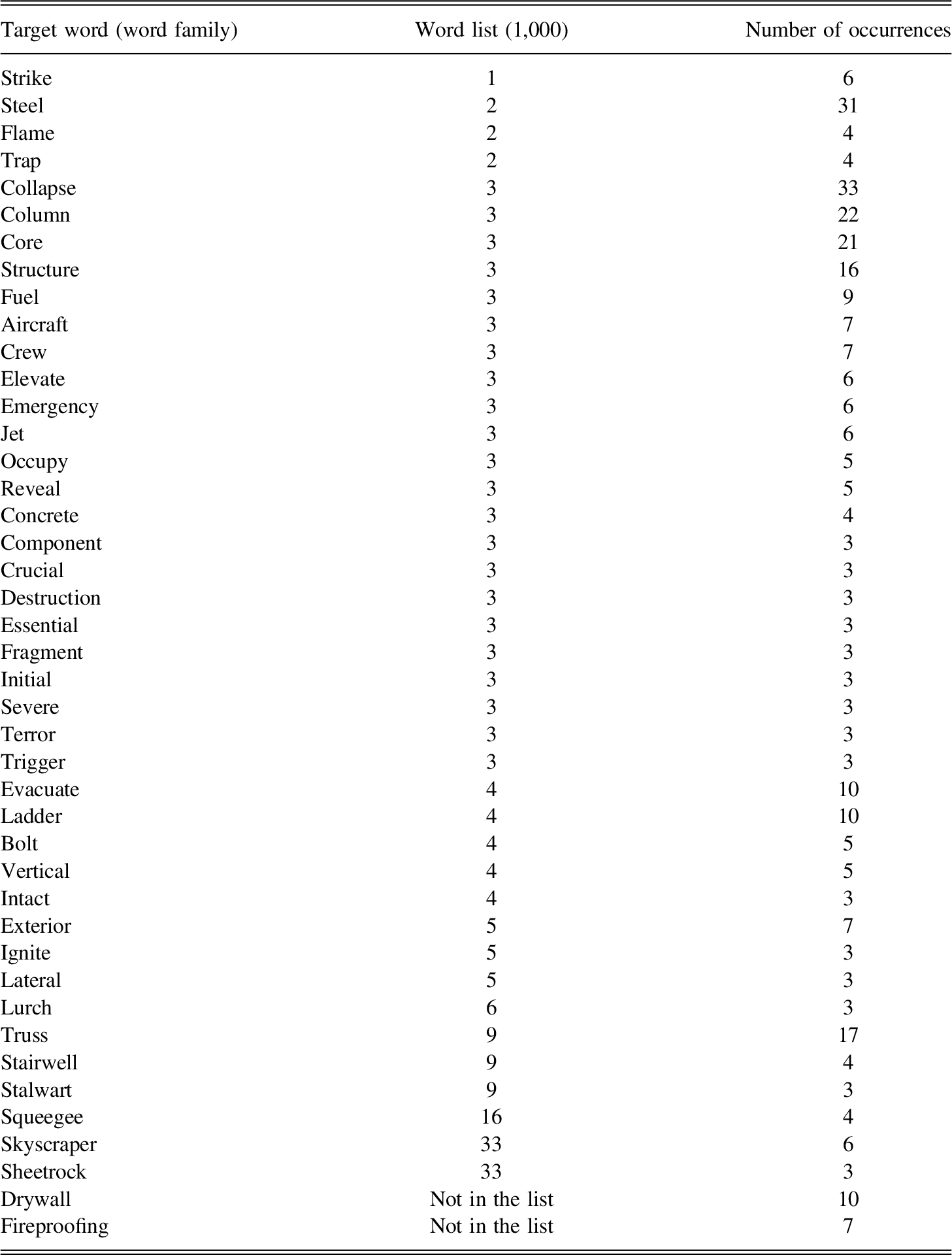
Forty-three words encountered in the transcript of the television documentary were selected as target items. The frequency of the target words in the script ranged from 3 to 33 occurrences. Most of the target items (39/43) were words that were less frequent than the most frequent 2,000 word level in Nation’s (Reference Nation2012) BNC/COCA lists. The target words, their word-frequency levels, and their number of occurrences in the transcript is shown in Table 2.
Target words and their frequency of occurrence in “Why the Towers Fell.”

INSTRUMENTS
The VLT
The VLT (Webb et al., Reference Webb and Nation2017) measures receptive knowledge of form-meaning connection of five word-frequency levels from Nation’s (Reference Nation2012) BNC/COCA word lists: 1,000, 2,000, 3,000, 4,000, and 5,000. Each level of the test contains 30 questions. Schmitt, Schmitt, and Clapham’s (Reference Schmitt, Schmitt and Clapham2001) suggestion of 26/30 correct answers or higher was used as the cutting point for mastery of a level.
Checklist Test
This paper-and-pencil test required participants to respond yes or no to indicate whether they knew the provided words. Adapted from the yes/no EFL vocabulary test designed by Meara (Reference Meara1992), this test consisted of 60 test items: the 43 target words, 10 words that were expected to be known, and 7 nonwords (see Appendix 1 in supplementary material). Including 10 words that were likely to be known should have helped to encourage the participants to complete the test. Analysis of these words was excluded from the results. The seven nonwords were selected from the ARC Nonword Database (Rastle, Harrington, & Coltheart, Reference Rastle, Harrington and Coltheart2002). All the nonwords in the database are based on the phonotactic and orthographic constraints of Australian English and Standard Southern British English monosyllables, therefore they looked and sounded like real English words. Nonwords were included to reduce the limitation caused by test takers overestimating their vocabulary knowledge or not taking the test seriously by ticking the words as they pleased. A “yes” response to a nonword was marked as a “false alarm”; a “yes” to a target word was marked as a “hit.” The proportion of words truly known, p(k), was calculated using the formula from Anderson and Freebody (1983) and Shu, Anderson, & Zhang (Reference Shu, Anderson and Zhang1995):
 $$p(k) = {{p\left( {hit} \right) - p(false\,alarm)} \over {1 - p(false\,alarm)}}$$
A maximum score of 100% could be achieved on the checklist test.
The items were randomized across a pretest, immediate posttest, and delayed posttest. The participants heard the spoken forms of the test items and saw their written forms to ensure that the testing mode was not biased against any of the treatment modes. This should have helped to maintain the reliability of the data (Brown et al., Reference Brown, Waring and Donkaewbua2008). Giving all groups both aural and written forms of test items provided internal consistency of the tests and may have helped to increase the sensitivity of the test to reveal potential learning. The audio version of the test was recorded by a North American English native speaker prior to the study. Each word was read twice with a five-second pause between items.
Multiple-Choice Test
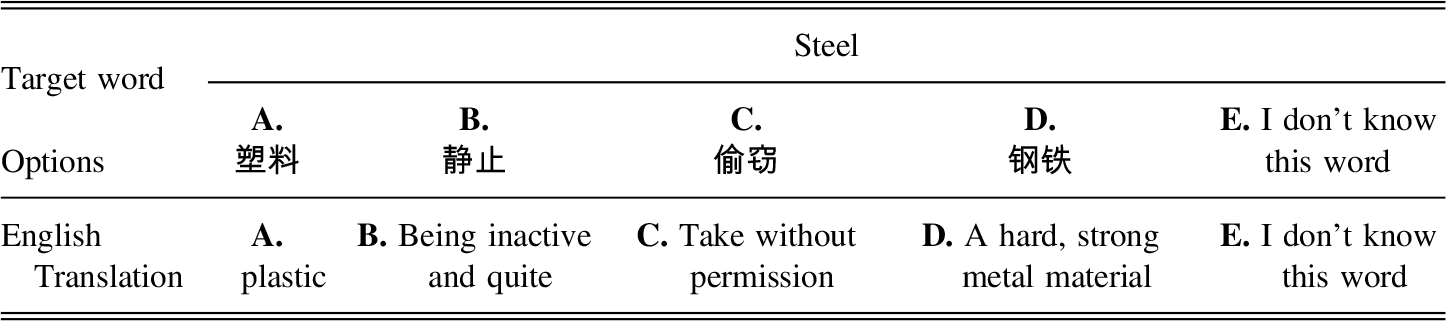
This test was a prompted recognition four-choice test with the key and three distractors in the participants’ L1 (Mandarin, see example in Table 3). An “I don’t know this word” option was presented as a fifth option to reduce the effect of guessing. The test items were randomly ordered across the pretest, immediate, and delayed posttests. The same 10 words that were likely to be known and 7 nonwords from the checklist test were also included to reduce the potential that participants tried to intentionally learn items during the test intervals. The responses for these 17 words were not included in the results.
Example of the multiple-choice test

Note: English translation was not provided in the test.
PROCEDURE
All participants were told that the purpose of this study was to investigate the effect that mode of input could have on comprehension. This was to encourage the participants to focus on the content of the materials rather than paying deliberate attention to any unknown words during the treatment.
In the first week of the study, all participants completed the VLT followed by a pretest consisting of a checklist test and then a multiple-choice test. Participants were given as much time as needed to complete the tests. After seven days, the participants completed the treatment in their assigned groups in separate classrooms. Each classroom was equipped with a multimedia system that included a computer, a projector, and speakers. Participants in the Reading Group were each given individual copies of the transcript to read. The Listening Group listened to the documentary without the support of the video or transcript. The Viewing Group watched the documentary without captions or subtitles. The Reading Group was given as much time as needed to finish the treatment. A posttest consisting of the same checklist and multiple-choice tests was completed by the participants immediately after the treatment. The Control Group took the posttest but did not complete a treatment. Participants were given sufficient time to complete all treatments and tests. After another seven days, all participants took the same checklist and multiple-choice test again as a delayed posttest. The participants were given sufficient time for everyone to finish the tests. This was followed by a 10-minute debriefing session, which was to clarify the real purpose of this study.
RESULTS
PRELIMINARY ANALYSES
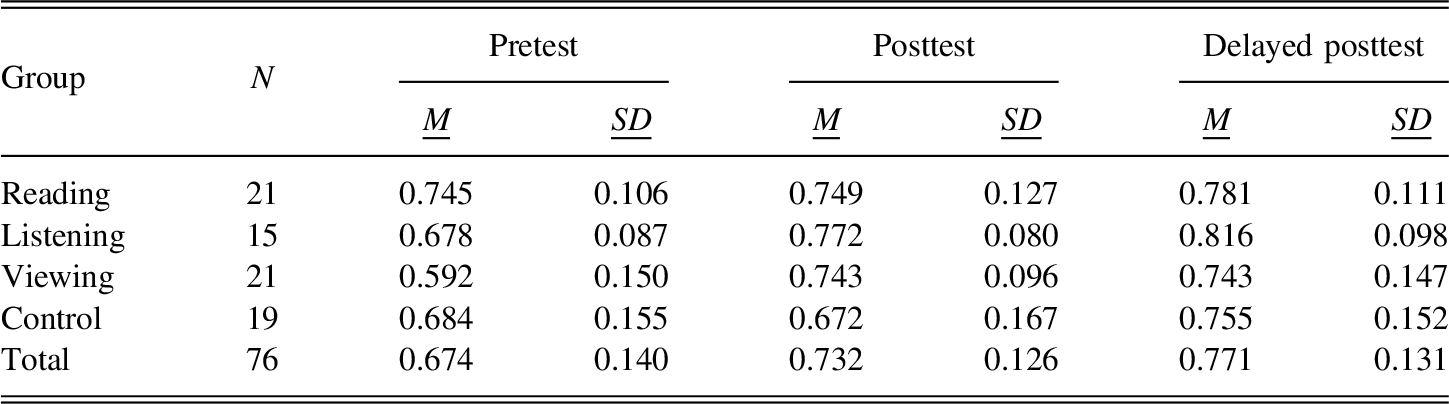
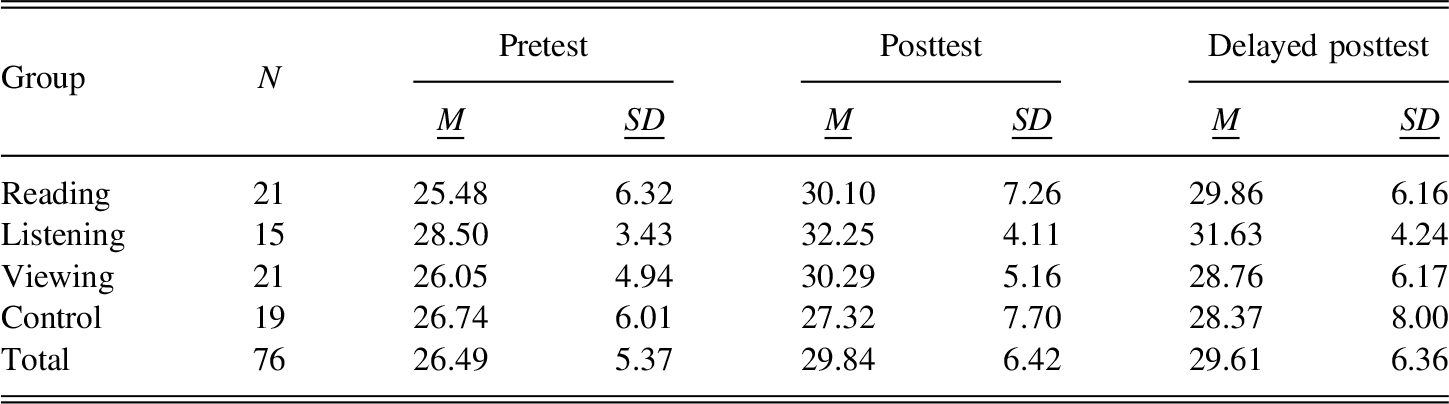
Descriptive statistics of the checklist and multiple-choice tests at three test time points are presented in Table 4 and 5. Cronbach’s alpha showed acceptable reliability for the tests, α = 0.762. From pretest to immediate posttest, all experimental groups showed increased mean scores on the checklist test and the multiple-choice test, while the Control Group showed a decreased mean score on the checklist test and an increased mean score on the multiple-choice test. From pretest to delayed posttest, all four groups showed increased mean scores on both the checklist test and the multiple-choice test. Inferential analyses were then carried out to examine if the observed differences were statistically significant. The assumption of normal distribution was met for all variables using visual inspection of histograms and Q-Q plots. Confidence interval of 95% was used in all the analyses. SPSS (IBM Corp., 2013) was used to conduct all the statistical analyses in this research.
Descriptive statistics of checklist test scores

Note: Maximum score is 1 (100%).
Descriptive statistics of multiple-choice test scores

Note: Maximum score is 43.
RQ 1: TO WHAT EXTENT IS VOCABULARY KNOWLEDGE LEARNED AND RETAINED THROUGH EACH MODE?
To answer the first research question, Repeated Measures ANOVA was conducted to determine whether there was a statistically significant difference in the test scores among the three test time points associated with treatment. Time (pre-, post-, and delayed-post-) was used as the within-group factor and Treatment was the between-group variable in SPSS. A Simple Effects test with Bonferroni correction was followed as the post-hoc analysis.
For the checklist test data, the assumption of sphericity was violated, as assessed by Mauchly’s test of sphericity, χ2(2) = 0.876, p = .009. Therefore, a Greenhouse-Geisser correction was applied (ε = 0.889). The results of Repeated Measures ANOVA revealed a significant Time × Treatment interaction effect on the checklist test scores, F (5.336, 128.068) = 4.888, p < .001, ηp2 = .169. For the multiple-choice test data, the assumption of sphericity was also violated, as assessed by Mauchly’s test of sphericity, χ2(2) = 0.889, p = .016. Therefore, a Greenhouse-Geisser correction was applied (ε = 0.900). The results of Repeated Measures ANOVA revealed a significant Time × Treatment interaction effect on the multiple-choice test scores, F (5.402, 129.654) = 3.455, p < .001, ηp2 = .126.
The results of the Simple Effects test with Bonferroni correction revealed where the differences between Time were in each treatment group. The analysis indicated that for checklist test the immediate posttest scores were significantly higher than the pretest scores for both the Listening Group (p < .01) and the Viewing Group (p < .001), but no significant differences were detected between the pretest and immediate posttest scores for the Reading Group (p = .889) and the Control Group (p = .677). Both the Listening and Viewing groups also scored significantly higher on the delayed posttest than the pretest (p < .001), and no significant differences were detected between the delayed posttest scores and the immediate posttest scores in either of the two groups, indicating that the vocabulary gain was retained a week after the treatment. The delayed posttest scores of the Control Group were significantly higher than their scores on the immediate posttest (p < .05), indicating that some learning took place after the immediate posttest.
In terms of multiple-choice test data, the results of the Simple Effects analysis with Bonferroni correction showed that for Reading, Listening, and Viewing groups, the immediate posttest scores were significantly higher than their pretest scores (p < .001). There were no significant differences between the pretest and the immediate posttest scores for the Control Group (p = .463). Simple effects analysis revealed significantly higher scores on the delayed posttest than the pretest for the Reading Group (p < .001), Listening Group (p < .001), and Viewing Group (p < .005), indicating that the vocabulary knowledge gained by these three groups was retained a week after the treatment. No significant difference was detected for the Control Group (p = .065) from the pretest to the delayed posttest.
RQ2: HOW DOES VOCABULARY ACQUISITION AND RETENTION COMPARE ACROSS DIFFERENT MODES?
To answer the second research question, one-way ANCOVA was conducted separately in the prediction of posttest scores and delayed posttest scores with Treatment as the between-group variable. Pretest scores and VLT were entered in the model as covariates, though VLT had to be excluded because it had a significant correlation with pretest scores (Pearson’s r = .32 for checklist test and Pearson’s r = .648 for multiple-choice test).
Before conducting ANCOVA, the assumption of homogeneity of regression slopes was assessed by the interaction term between Treatment and pretest scores when predicting each dependent variable. The results showed p-values > .05 for Checklist Posttest, Checklist Delayed Posttest, Multiple-Choice Posttest, and Multiple-Choice Delayed Posttest, indicating the assumption of homogeneity of regression slopes was met for each dependent variable.
The results of ANCOVA showed that there was a significant difference between the four groups on the posttest score after controlling for the pretest score both for the checklist test, F (1, 71) = 4.562, p < .01, ηp2 = .162, and the multiple-choice test, F (3,71) = 5.604, p < .005, ηp2 = .191. The pretest score, as the covariate, was significantly related to the posttest score for the checklist test, F (1,71) = 26.323, p < .001, and for the multiple-choice test, F (1, 71) = 173.594, p < .001. There was no significant difference between the four groups on the delayed posttest score on the checklist test (p = .280) and the multiple-choice test (p = .131), indicating that the retention rate of the gained vocabulary knowledge after a week was not significantly different between the groups.
A Bonferroni post-hoc test of the immediate posttest revealed that the Listening Group and the Viewing Group both had significantly higher scores on the checklist posttest than the Control Group, p < .05 and p < .01, respectively. There were no significant differences between the immediate posttest scores of the Reading Group and the Control Group on the checklist test, p = 1.000. For the multiple-choice test, a Bonferroni post-hoc test revealed that the Reading, Listening, and Viewing groups all scored significantly higher than the Control Group on the immediate posttest, p < .005, p < .05, and p < .05, respectively. No significant differences were detected between the three experimental groups, indicating that the learning effect on incidental vocabulary acquisition through written, audio, and audiovisual input was not significantly different. The complete results of the Bonferroni post-hoc test on the immediate posttest scores are displayed in Table 6.
The p values in pairwise comparisons using the Bonferroni post-hoc test

Note: *p < .05. **p < .01. CL = Checklist test. MC = Multiple-choice test.
RQ 3.1 THE RELATIONSHIP BETWEEN PRIOR VOCABULARY KNOWLEDGE AND VOCABULARY LEARNING
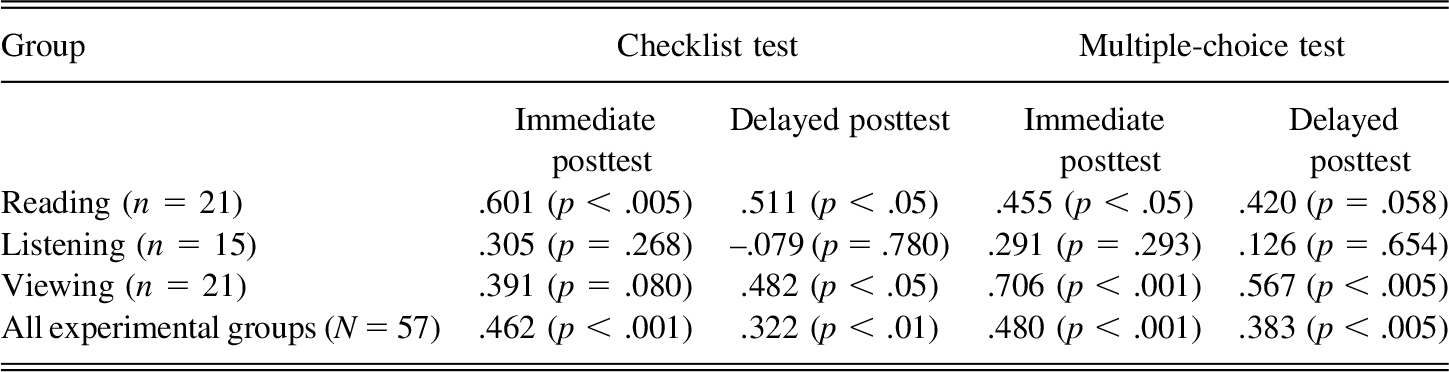
Pearson’s r correlation test was carried out to examine the relationship between the VLT scores in the three experimental groups and their posttest scores. When all three groups were tested as a whole, the results showed that the VLT scores had significant positive correlations with the immediate posttest and delayed posttest scores on both test formats. Significant positive correlations were also found for the Reading and Viewing groups, but not the Listening Group. The results suggested that the more vocabulary the participants in the Reading and Viewing groups knew, the greater their vocabulary learning gains. These findings are presented in Table 7.
Pearson’s correlation r on VLT scores and the test scores

RQ 3.2 THE RELATIONSHIP BETWEEN FREQUENCY OF OCCURRENCE AND VOCABULARY LEARNING
To analyze the relationship between incidental vocabulary learning and frequency of occurrence, the proportion of participants who learned each word (learning rate) was used as the indicator of vocabulary learning. The average frequency of occurrence was 7.44 with SD = 7.196. The assumption of normal distribution was met for all variables by visual inspection of histograms and Q-Q plots. Pearson’s r was used to investigate the correlation between frequency of occurrence and the learning rate of each word. Results did not find any statistically significant correlations between the two variables in any group on either of the tests. Descriptive statistics and the results of the Pearson’s r correlation test are displayed in Tables 8 and 9.
Descriptive statistics for the proportion of participants who learned each word

Note: The numbers of target words varied because there were words that were known by all the participants in the pretest in each group. These words were marked as missing when analysis was carried out in SPSS.
Pearson’s correlation r on frequency of occurrence and the learning rate of each word

Note: The numbers of target words varied because there were words that were known by all the participants in the pretest in each group. These words were marked as missing when analysis was carried out in SPSS.
DISCUSSION
This study fills research gaps in two ways. It is the first study to compare incidental vocabulary learning through written, audio, and audiovisual input. Several studies have compared written and audio input but did not include audiovisual input (e.g., Brown et al., Reference Brown, Waring and Donkaewbua2008; Vidal, Reference Vidal2011; Webb & Chang, 2012). Only one study has compared audiovisual input and reading-while-listening but did not include written-only and audio-only input (Neuman & Koskinen, Reference Neuman and Koskinen1992). This study is also the first to use a full-length television documentary to compare the incidental learning outcome through different modes of input. Earlier studies either used short video segments as viewing material or listening input (Neuman & Koskinen, Reference Neuman and Koskinen1992; Vidal, Reference Vidal2011), or simplified texts such as graded readers as reading input (Brown et al., Reference Brown, Waring and Donkaewbua2008). Therefore, the present study should provide greater evidence to illustrate the extent to which each mode of input could contribute to incidental vocabulary learning.
INCIDENTAL VOCABULARY LEARNING IN EACH MODE OF INPUT
In answer to the first research question, the results showed that significant vocabulary learning could occur through encountering written, audio, and audiovisual input. The results were consistent with the findings of earlier research where vocabulary knowledge was gained incidentally through reading written input (e.g., Nagy et al., Reference Nagy, Herman and Anderson1985; Waring & Takaki, Reference Waring and Takaki2003), listening to audio input (e.g., Elley, Reference Elley1989; van Zeeland & Schmitt, Reference van Zeeland and Schmitt2013; Vidal, Reference Vidal2003) and through viewing audiovisual input (e.g., Montero Perez et al., Reference Montero Perez, Peters, Clarebout and Desmet2014; Neuman & Koskinen, Reference Neuman and Koskinen1992; Peters & Webb, Reference Peters and Webb2018). In terms of retention, the learned vocabulary knowledge was retained one week after the treatment in all three learning conditions. This is consistent with Brown et al.’s (Reference Brown, Waring and Donkaewbua2008) findings for retention of vocabulary knowledge in reading-only and listening-only modes on a one-week delayed posttest.
Apart from supporting the beneficial effects of the more widely researched modes of input (i.e., reading and listening) for incidental vocabulary learning, the results also provided more evidence in support of learning vocabulary through viewing L2 television, a mode of input that learners appear to be highly motivated to learn with (Gieve & Clark, Reference Gieve and Clark2005; Rodgers, Reference Rodgers2013). This is particularly useful because many earlier studies have investigated incidental vocabulary learning through viewing specialized materials such as academic speeches (e.g., Vidal, Reference Vidal2003, Reference Vidal2011), and short segments of videos (e.g., Montero Perez et al., Reference Montero Perez, Peters, Clarebout and Desmet2014; Sydorenko, Reference Sydorenko2010), which might be considered to be less common forms of viewing. The finding in this study showing that viewing L2 television contributes to incidental vocabulary learning is consistent with Peters and Webb’s (Reference Peters and Webb2018) showing that EFL learners in Belgium incidentally learned words through watching a one-hour television documentary.
THE COMPARISON OF VOCABULARY LEARNING ACROSS DIFFERENT MODES OF INPUT
In answer to the second research question, the results indicated that reading, listening, and viewing were equally effective for incidental vocabulary learning. This suggests that second language television programs could contribute to similar amounts of vocabulary learning no matter what kind of input the learners choose to learn from and indicates that viewing L2 television should be considered a useful alternative or supplement to reading. Reading graded readers has been widely advocated as the key resource for L2 vocabulary learning (e.g., Nation, 2013; Pigada & Schmitt, Reference Pigada and Schmitt2006; Webb & Macalister, 2013). Because research suggests that L2 learners tend to watch L2 television more than read L2 text as a recreational activity, the results provide powerful evidence in support of the use of L2 television programs for lexical development.
It might be considered surprising that audiovisual input did not lead to superior vocabulary gain to the other input modes because Multimedia Learning Theory (Mayer, Reference Mayer2009) and Dual-Coding Theory (Sadoski & Paivio, Reference Sadoski and Paivio2001) suggest that multimodal input should result in greater vocabulary learning than unimodal input. One explanation for this contrast is that the participants may not have had as much experience learning in the viewing mode in comparison to learning through reading and listening because L2 television is not commonly used for learning in EFL classrooms in China while the latter two modes are used for learning on a daily basis.
The finding that listening and reading led to similar vocabulary learning gains contrasts earlier studies that compared vocabulary learning through reading and listening. Brown et al. (Reference Brown, Waring and Donkaewbua2008) found that EFL learners learned more words incidentally through reading graded readers than listening to graded readers. Vidal (Reference Vidal2011) found that students in an ESP program made greater vocabulary gain through reading academic texts compared to listening to academic lectures. The difference in findings between the present study and the earlier two studies suggests that more research comparing these two modes of input is warranted.
THE RELATIONSHIP BETWEEN VOCABULARY LEARNING AND FREQUENCY OF OCCURRENCE
In answer to the third research question, the results indicated that frequency of occurrence was not significantly related to incidental vocabulary learning in any of the three modes. This contrasts earlier findings indicating that a word is more likely to be learned if encountered more times in written texts (Brown et al., Reference Brown, Waring and Donkaewbua2008; Waring & Takaki, Reference Waring and Takaki2003), in spoken texts (Brown et al., Reference Brown, Waring and Donkaewbua2008; Vidal, Reference Vidal2011), and in viewing television programs (Peters & Webb, Reference Peters and Webb2018; Rodgers & Webb, Reference Rodgers and Webb2019).
There are several reasons for the inconsistency in findings. First, the material was originally designed to present information with both audio and visual support, making it less ecologically appropriate to serve as reading material alone. The lack of visual support in the reading mode could lead to the material becoming less informative and interesting. Overlap between the occurrence of images in the video and the use of the words in the audio (or written input in the case of captions) would likely increase the potential that the meanings of unknown words are learned (Rodgers, 2018). The lack of visual support may have also caused the participants to become less engaged and pay less attention to the unknown words, thus reducing the impact of frequency of occurrence on learning. As for listening, the results are in line with van Zeeland and Schmitt’s (Reference van Zeeland and Schmitt2013) finding that the relationship between frequency of occurrence and listening was not clear. Perhaps other factors such as salience and relevance were more important than the frequency of word occurrence in the nonreading modes, given how densely the information is provided in a documentary. Ellis (Reference Ellis2006) suggests that words may need more salient cues in the contexts around them to arouse the learners’ attention. For example, Vidal (Reference Vidal2011) argued that when encountering cognates, words that are similar to L1 words, it is easier to notice them in audio input than in written input. As much as repeated encounters are needed, salience may also be necessary for successful guessing from context to happen.
THE RELATIONSHIP BETWEEN VOCABULARY LEARNING AND PRIOR VOCABULARY KNOWLEDGE
The analysis revealed that there were significant relationships between learners’ prior vocabulary knowledge and incidental vocabulary learning for the Reading and Viewing groups, as well as the three groups combined. This is supported by earlier studies that have found positive correlations between prior vocabulary knowledge and vocabulary gain through reading (Horst et al., Reference Horst, Cobb and Meara1998; Tekmen & Daloglu, 2006; Zahar et al., Reference Zahar, Cobb and Spada2001) and viewing (Peters & Webb, Reference Peters and Webb2018). The result for viewing contrasts the Rodgers and Webb (Reference Rodgers and Webb2019) study that found no significant correlation between the two factors for EFL learners who viewed 10 episodes of a television drama. The variation in findings suggests that there may be other influential factors affecting incidental vocabulary learning through viewing that perhaps impacted the results more strongly than prior vocabulary knowledge in the earlier study. Research suggests that learner variables such as L2 proficiency, age (primary, secondary, postsecondary), and treatment conditions such as text type, intended text audience, and lexical coverage may moderate incidental vocabulary learning (Webb, Uchihara, & Yanagisawa, Reference Webb, Uchihara and Yanagisawa2019). For example, Vidal (Reference Vidal2003) suggested that students with higher levels of English proficiency tend to acquire more vocabulary knowledge through listening. In terms of the current study, participants with higher vocabulary levels may not necessarily have higher English proficiency levels because the latter is a superordinate concept of which vocabulary knowledge is just one aspect. It would be useful to investigate which different aspects of language skills other than prior vocabulary knowledge affect incidental vocabulary learning in a follow-up study.
The lack of a significant correlation between prior vocabulary knowledge and word learning for the Listening Group might be explained in two ways. First, it may be that because the VLT measures knowledge of written form-meaning connections, these results do not accurately represent prior vocabulary knowledge of the spoken form-meaning connections of words. Research has revealed that knowledge of spoken form-meaning connections and written form-meaning connections varies (Milton & Hopkins, Reference Milton and Hopkins2006). It may be that variation between prior knowledge of spoken and written form-meaning connections make VLT scores too imprecise to reveal a relationship between prior knowledge and learning for listening. It would be useful to compare the relationships between knowledge of spoken and written form-meaning connections and learning words through listening in a follow-up study.
A second explanation for the lack of significant correlation is that perhaps other factors such as familiarity with L2 spoken input, speech rate, and the amount of connected speech have a greater impact on vocabulary learning through listening than prior vocabulary knowledge. Investigating the extent to which different factors are correlated with vocabulary learning through listening would be a useful follow-up to the present study.
PEDAGOGICAL IMPLICATIONS
Pedagogically, the findings suggest that there is value in learning in all three of the input modes examined in this study. In the classroom, it would be useful for teachers to familiarize their students with a range of modes of input and help to support their reading, listening, and viewing comprehension. This may have the dual effect of revealing to students which mode of input best suits their learning preference, and encourage students to learn with their choice of input outside of the classroom. Relatively few words are likely to be learned incidentally within the classroom because large amounts of input are necessary for many words to be learned through encountering meaning-focused input. However, if students encounter large amounts of input on their own outside of the classroom, there is the potential for meaning-focused input to fuel L2 lexical development (Webb & Nation, Reference Webb and Nation2017). Moreover, in contrast to a great deal of literature claiming that reading is the primary contributor to lexical development (e.g., Krashen Reference Krashen1985; Nagy, Herman, & Anderson, Reference Nagy, Herman and Anderson1985), the findings suggest that vocabulary growth may not depend on extensive reading. The present study provides further empirical evidence to support the positive impact that extensive listening and extensive viewing may have on vocabulary development.
FUTURE DIRECTIONS
One limitation of this study is that while the audiovisual material had ecologically validity (L2 television is commonly viewed by learners), the reading and listening materials were less common forms of spoken and written input. The documentary was designed to come with audio input and imagery support. This could thus have a positive effect on learning in the audiovisual mode, yet the script alone and the audio alone may lack contextual information that may encourage attention or help understanding of unknown words. However, the fact that vocabulary learning still occurred in the reading and listening modes suggests that perhaps any negative effect of the materials may have been minimal. Ecological validity is likely to be an issue in any study that compares different modes of input that include viewing because learners are unlikely to encounter the same language for the same content in audiovisual and written modes. In her comparison of vocabulary learning from reading and listening, Vidal (Reference Vidal2011) tried to deal with this by controlling content, but not language. However, in this case, it cannot be clear whether words are learned because of the mode or the linguistic variables that moderate learning such as the presence of more contextual clues in one mode. More research comparing learning through different modes of input is clearly necessary to have a more precise understanding of how mode influences learning.
It would also be useful for future research to compare incidental vocabulary learning through viewing a full-length television program with and without captions as there are a large number of English television programs with captions available now. It is very common for L2 learners to access these viewing materials through various online platforms, and it could be easy to utilize these materials as extensive viewing input for vocabulary development. Rodgers (Reference Rodgers2013) is the only study to examine vocabulary learning through viewing complete television programs with and without captions. However, that study involved viewing 10 episodes of one program over 13 weeks and so the degree to which learning occurs through viewing an individual episode of a program remains to be determined. Investigating whether captions increase vocabulary learning through viewing full-length television programs would expand on earlier studies of viewing short segments of video with captions (e.g., Montero Perez et al., Reference Montero Perez, Peters, Clarebout and Desmet2014; Sydorenko, Reference Sydorenko2010). Moreover, it would also be useful to look at how learner-related variables play a role in viewing with and without captions to better understand to what extent captions may contribute to learning across L2 learners.
Another limitation of this study is that the only aspect of vocabulary knowledge measured was form-meaning connection. Research indicates that different modes of L2 input may also contribute to incidental gains in other aspects of vocabulary knowledge. For instance, Webb (Reference Webb2007) found that reading contributed to incidental learning of five different aspects of knowledge: orthography, grammatical functions, association, collocation, and form-meaning connection. Hsu (Reference Hsu2014) also found that audiovisual input contributed to improvement in the use of target words in a writing task, whereas, Webb, Newton, and Chang (Reference Webb, Newton and Chang2013) and Pellicer-Sanchez (Reference Pellicer-Sánchez2017) found that participants gained knowledge of collocation incidentally through reading with audio support, and reading, respectively. The results of these studies suggest that the vocabulary gains from different modes of input may also be revealed through tests measuring different aspects of vocabulary knowledge. It would be useful to measure multiple aspects of vocabulary knowledge in future research comparing modes of input.
A final limitation is that only 76 participants learning EFL in China took part in this study. It would be useful to carry out follow-up studies that compared vocabulary learning in different modes of input with participants in different contexts to determine the extent to which the results of this study can be generalized across different learner populations.
CONCLUSION
Overall, this study showed that viewing a full-length television documentary, reading its transcript, and listening to its audio could all contribute to significant incidental vocabulary learning and that there were no statistically significant differences in the amount of vocabulary knowledge gained through the three modes. The results suggest that there is value in learning with all three modes of input within the classroom with perhaps an aim toward enabling students to learn extensively with their preferred mode of input. While there has long been support and programs designed to promote extensive reading, the findings suggest that perhaps there should also be programs developed to encourage extensive listening and extensive viewing.
SUPPLEMENTARY MATERIAL
To view supplementary material for this article, please visit https://doi.org/10.1017/S0272263119000494