1 INTRODUCTION
Weil (Reference Weil1992) observed that many consumers seem to exhibit hand-to-mouth behavior, that is, they simply consume their current income. He also pointed out that this could be because some consumers do not optimize and follow rules of thumb, or because they cannot trade in a particular market due to some ad hoc friction. However, more recent data on consumer finances have highlighted the existence of a sizable amount of consumers with little or no liquid wealth who nonetheless choose to own sizable illiquid assets (real estate, retirement accounts, college funds, and others) as an optimal strategy, and that are important at explaining the behavior of aggregate consumption in recent years. The literature has defined these individuals as wealthy hand-to-mouth consumers.Footnote 1
The reaction of hand-to-mouth consumers to different shocks and events is different depending on the reasons or frictions behind the apparent lack of liquid savings. For example, if hand-to-mouth consumers are poor and credit-constrained, then one would expect these consumers to fully spend tax rebates and any temporary additional income received immediately. If instead, we are in the presence of wealthy hand-to-mouth consumers, the behavior after tax rebates or positive income shocks are more difficult to predict and could depend on the type of illiquid assets in which these consumers have invested their savings in. For example, Kaplan and Violante (Reference Kaplan and Violante2014), Parker et al. (Reference Parker, Souleles, Johnson and McClelland2013), and others measured the consumption responses to the tax rebates handed out in the 2001 and 2008 recessions, finding that on average, households spent 25% of these rebates on nondurable consumption in the same quarter they received them, a response irreconcilable with the behavior of the 10% of truly credit-constrained households found in the data.
This paper focuses on the role of houses as an illiquid asset for two reasons. First, housing has become a prominent asset in household balance sheets -from 48% homeownership rates after World War II, to almost 70% before the Great Recession. Second, it is the most valuable asset in most American household portfolios. For example, in 2016, the Survey of Consumer Finances (SCF) reported that the conditional median value of a family house was $185,000, more than three times the conditional median value of retirement accounts, the most popular financial asset used as a long-term investment, simply underlying the increase in popularity of houses as a vehicle for saving.
Additionally, using the Panel Survey of Income Dynamics (PSID) from 1999 to 2015, Gross (Reference Gross2019) shows that households planning to upgrade or that recently upgraded their housing stock cut nondurable consumption significantly, even exhibiting negative marginal propensities to consume sometimes.This is relevant because Gross’ measure of nondurable consumption is broader than previous studies looking at the same question, such as Martin (Reference Martin2003), and thus makes more difficult to ignore how housing decisions (even in the absence of housing markets shocks) affect the rest of the decisions that we economists generally look in isolation.Footnote 2
To explain his findings, Gross proposes a model where households face idiosyncratic shocks and housing choices. There, when a household chooses to borrow to finance the purchase of housing stock, the opportunity cost of nondurable consumption in the present goes up for two reasons. First, the household faces a higher interest rate, since the borrowing rate is higher than the saving rate. And second, borrowing to pay for housing increases the probability that households will be credit-constrained in the future if they draw a negative idiosyncratic shock. Thus, in order to avoid being credit-constrained in the future and reduce consumption then, households prefer to reduce consumption today, so much as to have negative marginal propensities today.
To my knowledge, there is no evidence or data consistent with this result, and the mechanism explaining the negative marginal propensities to consume in this model seems implausible and complicated.
Instead, in this paper, I propose a tractable and more realistic model that endogenously generates some wealthy hand-to-mouth consumers that invest all their savings in a house and that can help explain some of the heterogeneous consumption observed around housing stock adjustments and tax rebates mentioned above.
More indirectly, this paper contributes to the literature that studies how individual consumption heterogeneity can have important consequences for aggregate consumption as well as for its composition between nondurable and durable consumption, and for the multiplier effects of different fiscal policies.Footnote 3
This paper is organized as follows. Section 2 reviews the related literature. Section 3 discusses the environment and key assumptions of the model. Section 4 explains the basic intuition behind the results of the main numerical exercise in the paper. Sections 5 and 6 look at the model’s implications for the evolution of some key aggregate variables in the presence of income shocks, and the comparative effects on welfare of changing the housing grid. And finally, Section 7 concludes.
2 LITERATURE REVIEW
Most of the literature that generates wealthy hand-to-mouth consumers endogenously relies on assuming that the illiquid asset exhibits a higher after-tax return than the more liquid asset available in their models, in exchange of a long-term commitment.Footnote 4
Others, like Campbell and Hercowitz (Reference Campbell and Hercowitz2019) have also pointed out evidence from the SCF indicating other reasons for widespread saving in anticipation of major expenditures like home purchases, college education, and retirement.
However, the main differences between houses and other illiquid assets are the following. As noted in the introduction, most households in the USA own a house and houses act as collaterals for loans, but fewer own other illiquid assets, and even for those owing other popular illiquid assets such retirement funds, the value of their house is about three times larger than the value of their retirement funds. Thus, when facing with persistent and large negative shocks, such as the loss of a job, the only option many households have to reduce consumption only moderately is to downsize their housing stock and deleverage at the same time. Only this type of wealthy hand-to-mouth consumers can increase savings in the presence of persistent and large negative income shocks, and using PSID data, Krueger et al. (Reference Krueger, Mitman and Perri2016) found that during the Great Recession, a significant amount of households with very little net worth sharply increased their savings as the recession hit.
In the presence of temporary or small income shocks, wealthy hand-to-mouth consumers without housing stock but who have wealth invested in other illiquid assets are better off letting consumption fluctuate widely with income, as smoothing income shocks requires giving up future high returns or incurring transaction costs to access some of these illiquid assets today. These few particular wealthy hand-to-mouth consumers can also slightly reduce their savings by temporarily stopping contributions to college or retirement funds without a penalty, so they have a bit more flexibility adjusting savings and consumption, but for most homeowners without other illiquid assets, stopping or coming up short of mortgage payments generally ends in foreclosures.Footnote 5
Using PSID data on Surveyed Expectations from 1999 to 2015, Gross (Reference Gross2019) finds that 72% of households that report that they definitely expect to move in the following 2 years do so versus only 17% of those that do not expect to move end up moving during the same period, so most house moves are planned. Also, for all the moves captured by Gross, whether planned or not, around 85% of households move into a larger house, and housing upgrades are associated with decreases in nondurable consumption before and immediately after the adjustment.Footnote 6
Moreover, the change in size to a larger or a smaller house is quite significant too, as Kaplan et al. (Reference Kaplan, Mittman and Violante2020) report using PSID data from 1968 to 1996. For example, the average increase in size from a rental to an owner-occupied house is 25%, and the average decrease in size from an owner-occupied to a rental house is close to 30%.
Lastly, the rental and owner-occupied housing markets are also very segmented by size. Using American Household Survey (AHS) data, Kaplan et al. (Reference Kaplan, Mittman and Violante2020) find that on average, only 9% of owners live in the smallest house size, and 79% of renters live in the two smallest house sizes. Thus, renters choose small houses to rent, while homeowners choose larger houses to buy.
Kaplan et al. (Reference Kaplan, Mittman and Violante2020) build a model of the US economy with multiple aggregate shocks to generate fluctuations in house prices that mimic those of the housing boom and bust around the Great Recession. Although their paper is much more ambitious in scope than mine, I am interested in understanding the consumption behavior of agents around planned housing transactions, even in the absence of shocks in the housing market.
Guided by the data findings in Gross (Reference Gross2019) and Kaplan et al. (Reference Kaplan, Mittman and Violante2020), I add few and different housing choices to a standard life cycle model with endogenous credit constraints that depend on housing choices.Footnote 7 The goal is to test whether the key mechanisms of the model can account for some of the heterogeneous consumption behavior we have observed recently in the US economy.
Ngai and Sheedy (Reference Ngai and Sheedy2020) study what is behind housing transactions in the UK housing market, using data on house sales and inventories, and modeling the decision to move house as an investment in match quality.Footnote 8 They convincingly argue that the main driver of housing transactions is changes in how frequently houses come on to the market, and not on how quickly houses are sold. Moreover, using US data, they show that the dominant factor in explaining the number of houses coming on to the market is homeowners’ decisions to move house, and not the total housing stock.Footnote 9
Lastly, and in order to match UK data, Ngai and Sheedy (Reference Ngai and Sheedy2020) model the idiosyncratic values homeowners attach to the house they live in, as a persistent match quality variable, that is subject to occasional but also very persistent idiosyncratic shocks, representing life events, such as changing jobs, marriage, divorce, retirement, or having children, all events that significantly affect income, expenses, or both.
Because the main contribution of my paper is to explain and understand the individual consumption heterogeneity, we observe in the data related to and around housing transactions, and not to match the whole wealth distribution, my paper abstracts from shocks, either temporary or permanent, although temporary shocks seem to be irrelevant to the housing choice as Ngai and Sheedy (Reference Ngai and Sheedy2020) implied by their choice of shocks in their model to mimic the UK data.
Instead of introducing permanent shocks in the model, which would certainly make the model harder to solve computationally and would add very little to economic intuition, we can interpret jumps in the income endowment from A to B as a permanent shock and interpret the decisions of these two different agents as the decisions of an agent whose income has permanently changed from A to B due to a life-changing event.
When we look at permanent increases in income from A to B in the model close to a level of savings that would allow them to put a down payment to adjust their housing stock, or around income levels that prompt housing transactions in the model, at income B agents display lower levels of consumption than at income A, thus exhibiting negative marginal propensities to consume associated with upgrades in the stock of housing.
The explanation for the findings in this paper lies in the discrete nature of the housing choices agents consider, together with the transaction costs and endogenous credit constraints associated with housing adjustments, and the presence of a down payment that requires a significant amount of savings on the consumer side.
If consumers could buy very small amounts of housing and adjust the housing stock without transaction costs, the initial savings required to come up with the down payment of a tiny house would never lead to the decrease in nondurable consumption associated with housing upgrades that we see in the data.
Moreover, my model generates a significant amount of wealthy hand-to-mouth consumers. These are consumers that endogenously decide to put all their savings into the down payment of a house and become credit-constrained for a while, using all their savings toward mortgage payments, holding no liquid assets, and consuming the rest of their income. The reason they do this is because it is optimal for them to do so and they enjoy the flow of services provided by owning a larger house sooner, instead of buying it in the future and smoothing nondurable consumption.
3 MODEL
In this section, I introduce a four-period overlapping generations model with some important features highlighting the very different nature of the asset choices most households face—the choice between a one-period liquid bond without transaction costs and an illiquid house with significant buy-in costs.
Four periods are the minimal number of periods that allow me to introduce a hump-shaped earning profile and a retirement period at the end of life.
In the model, both homeowners and renters are forward-looking and can save in a liquid asset to obtain return r on their savings or borrow some funds against their future labor income at the same return. Homeowners can borrow additional funds at cost r using their house as a collateral.
In every period, agents choose nondurable consumption, how much to save in the liquid asset for the next period or how much to borrow, and whether to rent or buy a house to enjoy housing services this period. They also care about their offspring and leave a bequest to them when they die.
3.1 Environment
Agents live for four periods in the model. In the first three periods of their life, they supply work inelastically and they face a hump-shaped earning profile, so in period 1 they face increasing earnings in period 2. In this period, they know they are at the pinnacle of their career, and they expect period 3 earnings to be a bit lower. Finally, in period 4, they will retire and receive no labor income or social security payments, so they know they will need to save for their retirement.
Survival at ages
 $i=1$
, 2, or 3 in the model is
 $\psi_i=1$
, and 0 at the age of 4, so there is no mortality risk.
3.2 Preferences
To partially account for the consumption and saving heterogeneity that we observed in the USA after retirement and enrich the dynamics of the model at the end of life, I assume imperfect altruism in the form of a simple warm glow function represented by BE().Footnote 10
In all, agents care about consumption and housing services and the bequest they will leave to their offspring when they die.
As is common in the macroeconomic literature, I assume that the utility of consumption and housing services is logarithmic. Thus, the momentary utility of an agent of age i is
 \begin{equation*}U_i(c,h)= \alpha_c \log(c)+\alpha_h\log(h)+\beta (1-\psi_i) BE(\omega').\end{equation*}
The type of house they choose affects their expenses and their access to credit markets. A house of price
 $p \bar{h}$
provides housing services
 $\bar{h}$
, no matter whether the house is rented or bought. This assumption is innocuous, but it makes the rental more appealing at the beginning of life (decreasing the amount of wealthy hand-to-mouth consumers the model delivers), and also at the end of life, where some agents downsize to a rental in order to have more flexibility choosing their optimal bequest, instead of bequeathing a full house.
From now on, the price per squared unit p is normalized to 1 and drops from the problem.
3.3 Endogenous Budget Constraints and Housing Choices
Thus, in the model, the budget constraint that agents face can be written as:
 \begin{equation*}c+\omega'+h+t(h^{-1},h)=y+(1+r)\omega,\end{equation*}
where c is nondurable consumption,
 $\omega$
is financial wealth at the beginning of the period, h is the expenditure in current housing services,
 $t(h^{-1},h)$
is the cost of adjusting housing services from
 $h^{-1}$
in last period to h this period, and y is labor income.
Footnote 11
Nondurable consumption is bounded below by a nonnegativity constraint and above by a borrowing constraint that depends on an agent’s house choice h. Thus:
 \begin{align*}\begin{split}c&\geq 0\\[3pt]c&\le \lambda y'+(1-I_{rent})(1-d)h,\end{split}\end{align*}
where
 $\lambda$
is the portion of future labor income that can be borrowed today, d is the minimum down payment required when buying a house, and
 $I_{rent}$
is an indicator function that takes the value of 1 when an agent chooses to rent in the current period and 0 otherwise.
Following Fella (Reference Fella2014), let us call
 $\bar{m}_c(h)$
the maximum credit available for an agent choosing housing services h this period, so
 \begin{align*}\begin{split}\bar{m}_c(h)&=\lambda y'+(1-I_{rent})(1-d)h.\\\end{split}\end{align*}
Then, we can define a’ as the financial assets still available for this agent, before hitting the credit limit the market offers when an agent’s housing choice is h as follows:
 \begin{align*}\begin{split}a'&=\omega'+\bar{m}_c(h),\\\end{split}\end{align*}
so a’ is bound below:
 \begin{align*}\begin{split}a'&\geq0.\\\end{split}\end{align*}
Therefore, when
 $a'=0$
we know that an agent is credit-constrained, and when
 $a'>0$
, agents have some space to borrow more if they want to.
If the agent is a renter and
 $a'=0$
, then the agent is borrowing the maximum amount of uncollateralized debt possible (the highest fraction of future labor income allowed by markets), and if the agent is a homeowner and
 $a'=0$
, then the agent is borrowing the maximum amount of uncollateralized and collateralized debt possible, putting only the minimum down payment on a house.
If the agent is a renter and
 $a'>0$
, then we know the agent is saving in liquid assets. However, if the agent is a homeowner, the level of a’ only tells us whether the agent is a net borrower or saver, as in the model the agent is indifferent between putting extra savings (beyond the minimal down payment) in the illiquid asset or in the liquid one, as the return on both is the same.
Since credit lines against the equity of a house are very common and provide some liquidity, but are not as liquid as other assets, without much loss of generality, we will assume that when a homeowner is not credit-constrained, some of her funds will be deposited in the liquid asset, and some will go toward the down payment beyond the minimum required.
Now we can rewrite a typical budget constraint in the model as:
 \begin{equation*}c+a'-\bar{m}_c(h)+h+t(h^{-1},h)=y+(1+r)(a-\bar{m}_c(h^{-1})).\end{equation*}
Next, I look at the empirical literature on housing choices to determine the optimal number of housing grid points to use in the model that captures realistic housing decisions and remains simple for intuition purposes. In total, Kaplan et al. (Reference Kaplan, Mittman and Violante2020) use different combinations of seven possible house sizes to match US data, some available exclusively for renting or buying, and some available for both. They vary the grid points overlapping between the two choices and a full segmented market, where the three smallest points in the grid are only available for rent, and the four largest points are only available to buy. The main variation that these different specifications produce in their model is different average homeownership rates, but the differences in average homeownership rates they find are relatively modest, as reported by them.
Moreover, in their basic specification, 40% of homeowners choose the smallest house available to buy in their model (the second grid point), and more than 50% of homeowners choose the third, fourth, or fifth grid points, leaving the largest two house choices almost unpopulated.Footnote 12
However, more telling and relevant for my paper is what the data say. Using AHS data, the authors find that on average, only 9% of owners live in the smallest house size and 79% of renters live in the two smallest house sizes. Moreover, using PSID data from 1968 to 1996, the authors report that the average increase in size from a rental to an owner-occupied house is 25%, and that moves from a rental to another rental do not seem to be motivated by size since the average increase in size in these cases is only 4%.
Therefore, and in line with the data findings shown in Kaplan et al. (Reference Kaplan, Mittman and Violante2020), I will opt to choose a segmented housing grid for my paper, with the smallest size only available to rent and the largest two only available to buy.
In the model, housing services can be enjoyed renting a cheap apartment that delivers the smallest amount of services
 $h_r$
, so
 $h_r=h^s$
, or buying two other more expensive options that deliver a larger flow of services,
 $h^m$
or
 $h^l$
, so
 $h_b=\big\{h^m,h^l\big\}$
, where
 $h^s<h^m<h^l$
.
3.4 Value Functions
If agents enter the period as non-homeowners, they can decide whether to continue renting or to buy a house and start next period as homeowners, as Figure 1 shows.
Choices of nohomeowners at t.

The value function of a non-homeowner of age i with available credit a at the beginning of the period is given by:
 \begin{equation}N_i(a) = \max_{I_{rent}=\{0,1\}} \big\{ I_{rent} R_i(a)+(1-I_{rent}) B_i(a) \big\},\end{equation}
where
 $R_i$
denotes the lifetime utility of a non-homeowner of age i who decides to continue to be a renter this period, and
 $B_i$
denotes the lifetime utility of a non-homeowner of age i who buys a house this period.
The value function of a renter of age i
 $R_i(a)$
is determined as follows:
 \begin{equation}R_i(a) = \max_{c,a'}\ U_i(c, h_r)+\beta (1- \psi_i) N_{i+1}(a')\end{equation}
s.t.
 \begin{align*}\begin{split}c+a'-\bar{m}_c(h_r)+r_r h_r&= (a-\bar{m}_c(h_r))(1+r)+y(e_i)\\[2pt]c&\geq 0\\[2pt]a'&\geq 0\\[2pt]\omega' &=a'-\bar{m}_c(h)\\[2pt]\omega'&\geq 0 \textrm{ if }i=4\\[2pt]r_r&=r+\delta_r,\\\end{split}\end{align*}
where
 $ y(e_i)$
is labor income at age i, and
 $r_r$
is the rental rate per unit of housing. The return on assets or the cost of borrowing r is exogenous, and given by
 $r=\frac{1}{\beta}-1$
.
For all types of agents, I assume that that the bequest they leave to their offspring at the end of their life (in period four) has to be zero or positive.
The value function of a buyer of age i
 $B_i(a)$
is determined as follows:
 \begin{equation}B_i(a) = \max_{c,a',h_b}\ U_i(c, h_b)+\beta (1-\psi_i) H_{i+1}(a')\end{equation}
s.t.
 \begin{align*}\begin{split}c + h_b (1+\theta_b) + a'-\bar{m}_c(h_b)&= (a-\bar{m}_c(h_r))(1+r)+y(e_i)\\[2pt]c&\geq 0\\[2pt]a'&\geq 0\\[2pt]\omega' &=a'-\bar{m}_c(h)\\[2pt]\omega'&\geq 0 \textrm{ if }i=4.\\\end{split}\end{align*}
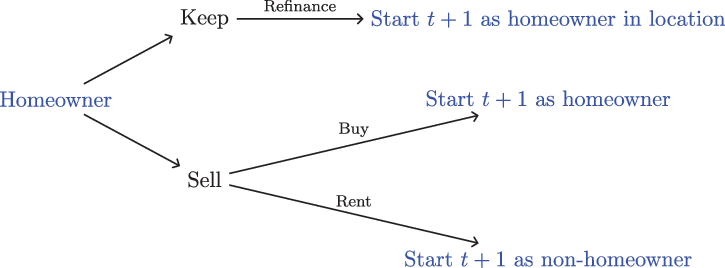
If instead, agents enter the period as homeowners, they can decide whether to refinance their mortgage and stay in the same house, sell their house and buy a different house, or sell their house and rent. Figure 2 shows these options:
Choices of homeowners at t.

Thus, the value function of a homeowner of age i is given by:
 \begin{equation}H_i(a) = \max_{I_{ref}=\{0,1\}} \big\{ I_{ref} RF_i(a)+(1-I_{ref} S_i(a) \big\},\end{equation}
where
 $RF_i(a)$
and
 $S_i(a)$
are the corresponding utilities of refinancing and selling.
In particular,
 \begin{equation}RF_i(a) = \max_{a'}\ U_i(c, h_b)+\beta (1-\psi_i) H_{i+1}(a')\end{equation}
s.t.
 \begin{align*}\begin{split}c + a'-\bar{m}_c(h_b)+\delta_b h_b&= (a-\bar{m}_c(h_b))(1+r)+y(e_i)\\[2pt]c&\geq 0\\[2pt]a'&\geq 0\\[2pt]\omega' &=a'-\bar{m}_c(h)\\[2pt]\omega'&\geq 0 \textrm{ if }i=4.\\\end{split}\end{align*}
A seller can become a renter or buy another house, and the decision is summarized by:
 \begin{equation}S_i(a) = \max_{I_{rent}=\{0,1\}} \big\{ I_{rent} S^R_i(a)+(1-I_{rent}) S^H_i(a) \big\},\end{equation}
where
 $S^R$
denotes the expected lifetime utility of selling a house and becoming a renter, and
 $S^H$
denotes the expected lifetime utility of selling a house and buying another house.
 $S^R$
can be written as follows:
 \begin{equation}S^R_i(a) = \max_{a'}\ U_i(c, h_r)+\beta (1-\psi_i) R_{i+1}(a')\end{equation}
s.t.
 \begin{align*}c + a'-\bar{m}_c(h_r)-r_r h_r&= (a-\bar{m}_c(h^{-1}_b))(1+r)+y(e_i)+(1-\theta_s-\delta_b) h^{-1}_b\\[2pt]c&\geq 0\\[2pt]a'&\geq 0\\[2pt]\omega' &=a'-\bar{m}_c(h)\\[2pt]\omega'&\geq 0 \textrm{ if }i=4,\end{align*}
where
 $\theta_s$
is the transaction cost of selling a house.
And lastly,
 $S^H$
, the expected lifetime utility of selling a house and buying another house, is represented by:
 \begin{equation}S^H_i(a) = \max_{a',h_b}\ U_i(c, h_b)+\beta (1- \psi_i) H_{i+1}(a')\end{equation}
s.t.
 \begin{align*}\begin{split}c + h_b (1+\theta_b) + a'-\bar{m}_c(h_b)&= (a-\bar{m}_c(h^{-1}_b))(1+r)+y(e_i)+(1-\theta_s-\delta_b) h^{-1}_b\\[2pt]c&\geq 0\\[2pt]a'&\geq 0\\[2pt]\omega' &=a'-\bar{m}_c(h)\\[2pt]\omega'&\geq 0 \textrm{ if }i=4.\\\end{split}\end{align*}
3.5 Partial Equilibrium Definition
A partial equilibrium in the model is characterized by (i) a set of value functions
 $N_i$
,
 $R_i$
,
 $B_i$
,
 $H_i$
,
 $S_i$
,
 $S^R_i$
, and
 $S^B_i$
, (ii) a set of rules for non-homeowners and sellers
 $I_{rent}$
, and for homeowners
 $I_{ref}$
and
 $I_{sell}$
, and (iii) a set of choices a’ and sizes of
 $h_b$
, such that taking prices r and w as given, the set of rules and choices solve the value functions represented in equations (2), (3), (4), (5), (6), (7), and (8).
4 NUMERICAL RESULTS AND INTUITION
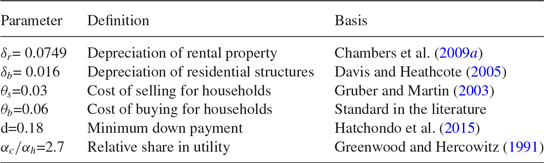
I next assess the ability of the model to generate the responses of consumers that we see in the data, in particular negative marginal propensities to consume associated with housing upgrades and the existence of a considerable amount of wealthy hand-to-mouth consumers. For this purpose, I choose a set of parameters for my model that are standard in the US literature as shown in Table 1. This exercise should be seen as a test of the key mechanisms of the model rather than a quantitative exercise. However, as I will show, its success suggests that the mechanisms presented in this paper can be embedded into a richer model with general equilibrium effects for policy analysis and evaluation.
Parameters for the benchmark case

As stated before, the price of housing per unit is normalized to 1, and the value of services delivered by the median-priced house is fixed to
 $h^m=4$
, so the ratio of the median house value to labor income in the model is 3.6 or 2.7, depending on whether one uses labor income in the first period of the model when agents are young, or in the first two periods using an average of young and middle-aged agents.
Footnote 13
The value of services in the rental house in the model
 $h^s$
is chosen to match average service flows of rental and owner-occupied housing computed in the literature, so that the extra services or premium agents get between the cheapest house available to buy and the rental in the model is 33%, consistent with Attanasio et al. (Reference Attanasio, Bottazzi, Low, Nesheim and Wakefield2012).
Moerover, the values of
 $h^s$
and
 $h^m$
are also consistent with the changes in house size by type of transition computed by Kaplan et al. (Reference Kaplan, Mittman and Violante2020) using PSID data from 1968 to 1996, where they report that the average increase in size from a rental to an owner-occupied house is 25%, and the average decrease in size from an owner-occupied to a rental house is close to 30%.
Lastly, the value of
 $h^l$
is meant to represent a pricey house, and the results of the calibration are not sensitive to the precise value chosen. However, in the benchmark economy
 $h^l=5$
, implying that the services delivered by the pricey house in the model are 66% larger than those of the rental, and also close to the largest house’s size of 5.15 calibrated by Kaplan et al. (Reference Kaplan, Mittman and Violante2020).
Because of the discreetness of the housing set, together with the associated transaction costs and endogeneous credit constraints from adjusting the stock of housing, the choice set is non-convex. To solve this type of problem, I apply the algorithm proposed by Fella (Reference Fella2014), which is more efficient and accurate than standard value function iterations algorithms.
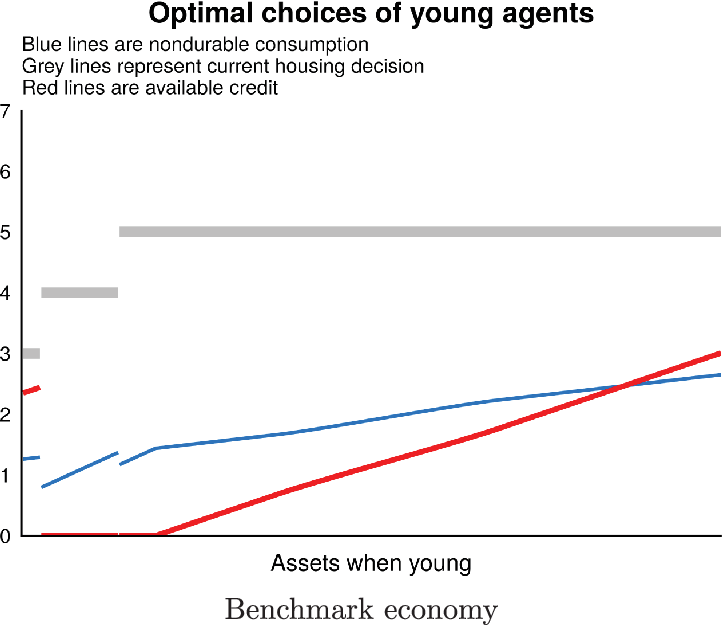
Figure 3 shows optimal choices for young agents as a function of their initial wealth. The gray horizontal lines represent housing choices h. The blue lines represent nondurable consumption choices c, and the red lines show the residual a’, this is, the financial assets still available for an agent. Remember that
 $a'=0$
means that the agent is credit-constrained. If a renter, then
 $a'=0$
indicates that the agent is borrowing the maximum possible amount of uncollateralized debt, and if a homeowner,
 $a'=0$
indicates that the agent is borrowing the maximum possible amount of collateralized and uncollateralized debt, so she/he is only putting the minimum down payment in a house.
Real and financial choices of young agents when
 $h=\big\{3,4,5\big\}$
.

At first sight, it is clear that Figure 3 shows that the discreteness of the housing choice is carried over to nondurable consumption and financial assets, which also presents some discrete jumps and kinks. This is because adjustments in the housing stock are significant and costly, so agent’s choices in the housing market will be occasional and will impact consumption of nondurables significantly.
Moreover, even controlling for age, nondurable consumption is not strictly increasing in wealth, as we see that young agents wealthy enough to buy a medium-sized house consume less nondurable consumption than poorer agents renting the smaller-sized house, and the same is true for a small group of even wealthier agents buying the large-sized house when we compared them with less wealthier agents with medium-sized houses.
Figure 3 delivers four groups of young agents. The first group is composed of poor young agents choosing to rent (
 $h=3$
) and to save (
 $a'>c>0$
).
The second group is composed of slightly wealthier young agents choosing to invest some of their wealth in the minimum down payment of a medium-sized house (
 $h=4$
), to borrow as much as they can (
 $a'=0$
), and to consume the remaining of their initial assets (
 $c>0$
). These are wealthy hand-to-mouth consumers with all their wealth allocated in an illiquid medium sized house.
The third group of agents is another group of wealthier hand-to-mouth consumers with all their wealth allocated in a large-sized house (
 $h=5$
) and also credit-constrained (
 $a'=0$
).
And lastly, the fourth group is composed of traditional wealthy agents, living in a large sized house (
 $h=5$
), but also holding liquid assets, and consuming more than the rest of the young poorer agents in the other three groups shown in Figure 3.
It is also interesting to look at the slope of nondurable consumption of the different groups of agents (blue line) in Figure 3. The slopes of the first and fourth groups, the groups with liquid assets, are flatter than the slopes of the second and third group of agents, those who are credit-constrained.
Because in the model agents are born with some endowment of assets and work inelastically to get some extra labor income in each period, we can interpret small moves in the horizontal axis as a marginal change in income, so the slope of the blue line in Figure 3 can be interpreted as the marginal propensity to consume. Thus, in our benchmark economy, some young renters will be saving in liquid assets preparing to put a down payment in a house and move in the near future and will exhibit low marginal propensities to consume. Meanwhile, all of the young medium-house owners and some young large-house owners exhibit high marginal propensities to consume since they hold no liquid savings.
Wealthy hand-to-mouth consumers (second and third group in our model) are similar to traditional hand-to-mouth consumers in some ways but different in other important ways. Footnote 14 For example, hand-to-mouth consumers react strongly to income shocks, but only through changes in nondurable consumption since their credit constraints are exogenous. Meanwhile, wealthy hand-to-mouth consumers also react strongly to income shocks but have two margins to adjust, through changes in nondurable consumption and through changes in their housing choices. Since credit constraints for homeowners are endogenous, by changing their housing choices, agents could also adjust their savings, albeit in a very abrupt manner.
Furthermore, we can see in Figure 3 that marginal propensities to consume in nondurable goods are negative around income thresholds that prompt adjustments to larger housing stock, confirming the empirical results found in Gross (Reference Gross2019).
A significant and persistent positive income shock of the type used in Ngai and Sheedy (Reference Ngai and Sheedy2020) can trigger a move from renting into buying a medium-priced house, or a move from a medium-priced to a more expensive house, reducing nondurable consumption, and showing the behavior Gross (Reference Gross2019) uncovered. The increase in income provides a chance to become a first-time homeowner or switch to a better house in the current period, but only through an increase in savings high enough to place a minimum down payment on the desired house. In order to come up with this down payment, agents need to cut consumption in nondurables before and immediately after a housing upgrade, therefore exhibiting negative marginal propensities to consume.
5 IMPLICATIONS FOR AGGREGATE VARIABLES
Even though the paper abstract from households’ labor decisions, it is important to look at the possible connections between the micro-heterogeneity the model delivers and some key macroeconomic variables. Footnote 15 To do so, let us try to understand what qualitative implications aggregate income shocks can have on housing and nondurable consumption, and on aggregate consumption and savings.
For transitory or small negative income shocks, most agents manage not to downsize their housing stock. However, with negative shocks larger or more permanent like a job loss, there is evidence that job loss causes default and foreclosure. Footnote 16
In Figure 3, one can think of the effects on individual decisions of a permanent negative income shock like a job dismissal, as a movement to the left in the horizontal axis.
In the model, in the presence of large negative income shocks, some households would downsize their housing stock. Thus, these households, by borrowing less, would be effectively increasing their savings. Therefore, in the aggregate, we would see a reduction in durable or housing consumption, with the sign of nondurable consumption indeterminate.
Interestingly, both model predictions are consistent with the increase in the saving rate and the decrease in nondurable consumption that Krueger et al. (Reference Krueger, Mitman and Perri2016) documented during the Great Recession.
Moreover, taking into account the heterogeneity in marginal propensities to consume is useful to understand the effects of some fiscal policies, and a model like the one presented in this paper also helps explain the consumption responses to recent tax rebates documented by Misra and Surico (Reference Misra and Surico2011).
6 COMPARATIVE STATICS AND WELFARE
Most of the time we can only observe individuals’ housing choices, but not the housing set considered when making those choices. Still, this section tries to understand the effects of changing housing sets for individuals’ decisions and welfare inside the model.
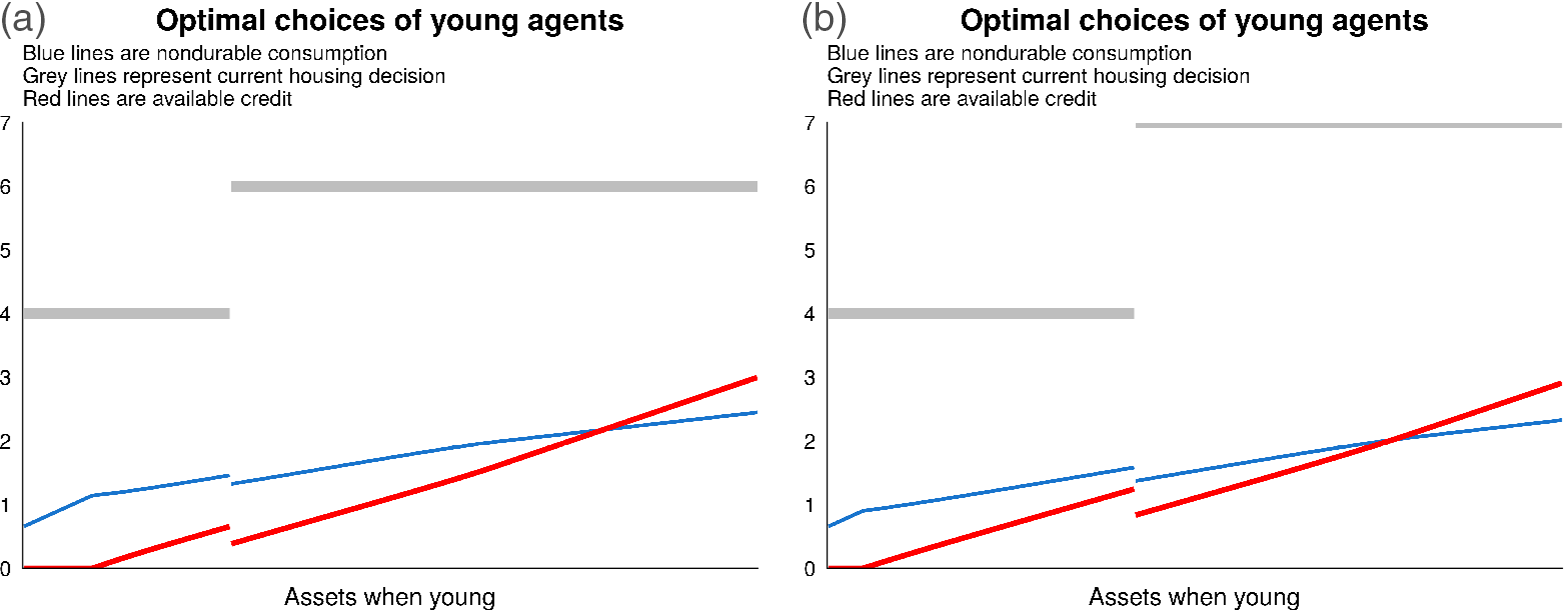
For example, when the houses available for rent are less and less similar to the houses available for ownership, delivering much fewer services as shown in panels (a) and (b) in Figure 4, agents stop renting altogether and jump into ownership as soon as they can.
Effects of changes in the dispersion of the housing grid. (a) Economy with
 $h=\big\{2,4,5\big\}$
. (b) Economy with
 $h=\big\{1,4,7\big\}$
.

At the same time, when differences between median- and expensively priced houses are larger as in panel (b), more agents settle for the median-priced house and optimally decide to move less frequency through their lifetimes.
Interestingly, the set of housing choices also affects welfare in nontrivial ways.
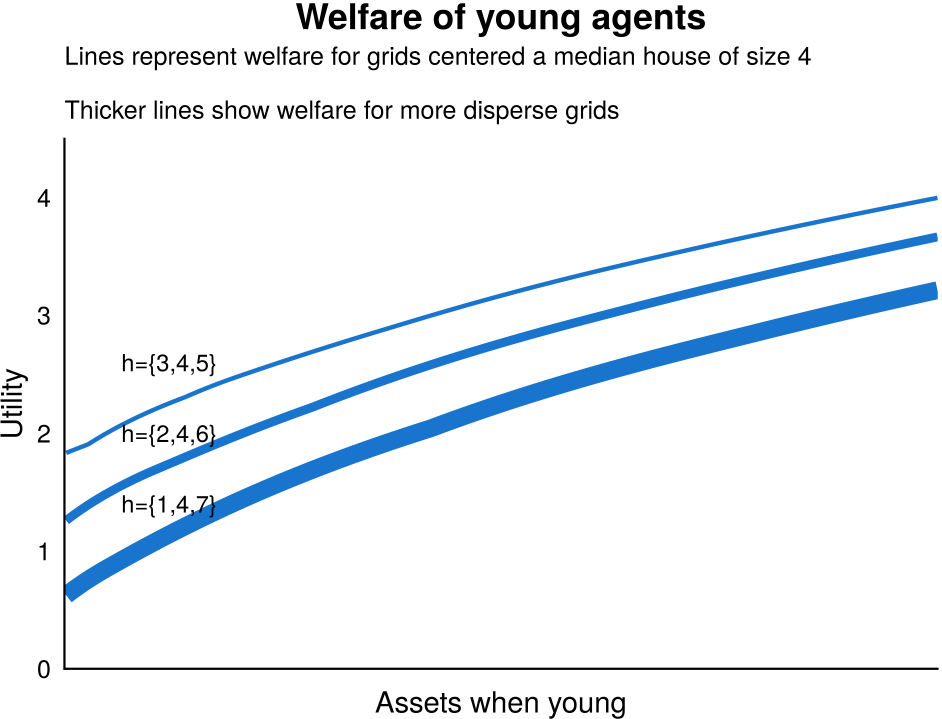
Figure 5 shows lifetime utility of agents with different initial assets for three different economies—the benchmark economy with
 $h=\big\{3,4,5\big\}$
, and then the other two economies shown in Figure 4.
Welfare of young agents under different sets of housing choices.

Surprisingly, in the economy with more homogeneous houses, all agents are better off, independently of their initial assets endowment.
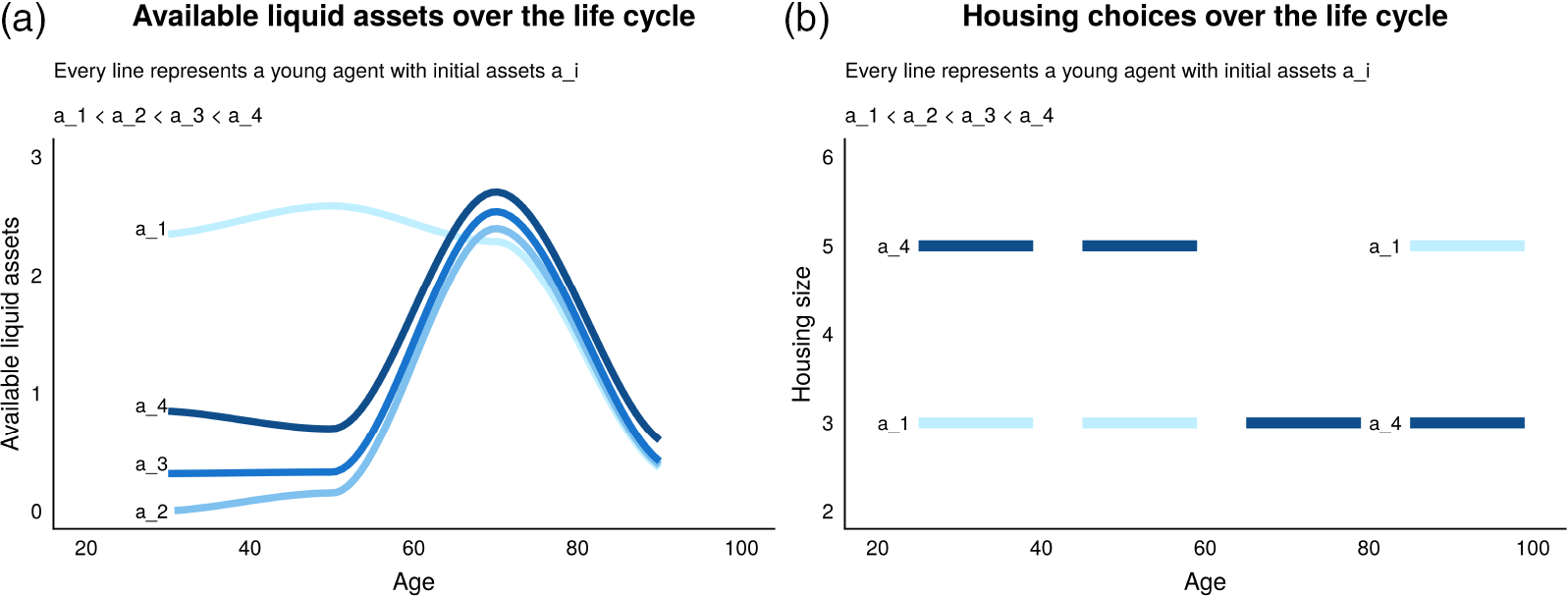
The reason for this finding is in Figure 6. A better rental, even though more expensive than a worse but more affordable one, gives poorer agents higher utility while they wait and save to become homeowners. At the same time, it also allows wealthy agents to sell their houses later in life and downsize to a rental without sacrificing too many housing services, freeing up their illiquid assets for retirement and giving them flexibility to choose the desired amount of bequest to leave to their offspring.
Assets and housing choices over the life cycle when
 $\big\{3,4,5\big\}$
. (a) Liquid assets over the life cycle. (b) Housing choices over the life cycle.

The evolution of nondurable consumption over time (graph not shown) is less interesting, with wealthier agents having higher average and less volatile nondurable consumption throughout their lifetime, and especially early in life, when it is more valued.
7 CONCLUSIONS
This paper has shown how a model with a few realistic housing choices is enough to generate consumers that exhibit negative propensities to consume associated with current or future adjustments in the stock of housing, as well as a significant amount of wealthy hand-to-mouth consumers that put down all their wealth into the down payment of a house.
Moreover, the heterogeneous marginal propensities to consume generated by the model are also consistent with the observed binomial distribution of the rebates recently used by policy makers to stimulate the economy. This heterogeneity in marginal propensities to consume is robust to parameter changes and present under a very general framework, and the reasons why different agents have very different marginal propensities to consume during their life cycles and across the wealth and income distribution appear to be quite fundamental.
Furthermore, because of the differences between houses and other illiquid assets, the type of endogenous wealthy hand-to-mouth consumers generated by this model provides an additional channel to help explain some of the dynamics in the cross-sectional moments found in the data that other models overlook.
Other models with wealthy hand-to-mouth consumers cannot explain why agents would want to increase savings in the presence of persistent negative income shocks since contributions to illiquid assets such 401K’s, college funds, or similar are flexible, and only early withdrawals involved costly transaction costs. However, since mortgage payments are fixed at least in the medium term, wealthy hand-to-mouth consumers may want to increase saving by cutting borrowing and downsizing when houses prices allows them to do so or increase precautionary savings in times of heightened unemployment risk, just to be able to meet mortgage payments in the future.
And lastly, by looking at the qualitative welfare analysis developed in this paper, perhaps public policy should focus on promoting greater availability of better rentals in areas or neighborhoods where the only housing options available are houses to buy.
Acknowledgements
I want to thank Samuel Bailey, who participated in earlier versions of this paper, Joaquin Garcia-Cabo, Benjamin Bridgman, and anonymous referees for useful comments, as well as seminar participants at the International Finance Division Research Seminar series at the Board of Governors of the Federal Reserve System, the Institute for Capacity Development at the International Monetary Fund, Towson University, and the Bureau of Economic Analysis. I would also like to thank Tyler Powell for outstanding research assistance, and the Board of Governors of the Federal Reserve System and the Congressional Budget Office for supporting my work in this paper during my tenure there.
A APPENDIX
A.1 EVIDENCE ON NEGATIVE MARGINAL PROPENSITIES TO CONSUME
Martin (Reference Martin2003) studied a model of consumption of durable and nondurable goods where the durable good was subject to transaction costs. He found that the transaction cost could induce an inaction region in the purchase of the durable good that provoked variation in consumption of the nondurable good over this region. In his model, this variation is a function of the degree of complementarity between durable and nondurable goods in the period utility function, the rate of intertemporal substitution, and a precautionary motive induced by incomplete markets. He then tested the model using PSID data, taking housing as the durable good and food as the nondurable good. He pointed out that data indicate an increase in food consumption before moving to a smaller house and a decrease in food consumption before moving to a larger house.
Adding to Martin’s paper and using a biannual sub-sample PSID data from 1999 to 2015, Gross (Reference Gross2019) created a broader measure of consumption that includes food, utilities, gasoline, car repairs, and other services. Following Kaplan and Violante (Reference Kaplan and Violante2010), Gross cleans the consumption and income data by regressing the log of those variables on year, cohort, and other demographic variables.
After that, and in order to compute marginal propensities to consume, Gross places households into groups following three different strategies. First, he groups households planning to adjust their housing stock in the next two years by their self-reported answer to a related PSID question. Second, he groups households by the likelihood that they will move estimated using a logit model regressing decisions to move on lagged expectations. Third, he groups households by their actual moves in the following two years, and whether they moved to a smaller, same-sized, or bigger house than the one the previously lived in. Finally, he estimates the marginal propensities to consume out of income for each of the three strategies finding negative marginal propensities to consume associated with planned or actual upgrades in the stock of housing.
The three strategies convey two important messages for this paper: first is that most of the upgrades in the housing stock are planned, so positive but temporary income shocks are not key explaining moves to better housing, and second, upgrades in the housing stock are quite sizable, so much that housing upgrades are associated with decreases in nondurable consumption before and immediately after the adjustment.