Introduction
The effect of alcohol consumption on cognitive health is critical, especially in later life, because it is directly related to mental health diseases such as Alzheimer's disease and other dementias (Mukamal et al., Reference Mukamal, Kuller, Fitzpatrick, Longstreth, Mittleman and Siscovick2003; Harwood et al., Reference Harwood2010). At present, it is equivocal in the literature whether its effect on cognitive health is positive or adverse (Panza et al., Reference Panza2012). Some scholars suggest protective role of drinking on cognition of older adults. It is consistent in their studies that light-to-moderate drinking decreases the risk of cognitive decline (Lang et al., Reference Lang, Wallace, Huppert and Melzer2007; McGuire et al., Reference McGuire, Ajani and Ford2007; Chan et al., Reference Chan, Chiu and Chu2010; Kim et al., Reference Kim, Chu, Kim and Moon2011a). In contrast, heavy/problem drinking may be harmful for one's cognition (Kim et al., Reference Kim, Shin, Stewart and Yoon2002; Mukamal et al., Reference Mukamal, Kuller, Fitzpatrick, Longstreth, Mittleman and Siscovick2003; Chan et al., Reference Chan, Chiu and Chu2010; Lyu and Lee, Reference Lyu and Lee2012). On the other hand, Lyu and Lee (Reference Lyu and Lee2012) found no difference between moderate and heavy drinkers on cognition (fluid intelligence) among older adults. It is inconclusive, based on the current literature, whether alcohol consumption has protective or negative role, partly because the definitions and measurements of drinking and the definition of cognition vary from study to study.
Amount of alcohol intake and prevalence of alcohol use disorders are high in South Korea. In 2005, worldwide pure alcohol consumption was equal to 6.13 liters (per person aged 15 years or older), while the average pure alcohol consumption among Koreans, during the same time period, was more than double at 14.8 liters (per person aged 15 years or older). The number of alcohol use disorders (encompasses the harmful use of alcohol and alcohol dependence, and alcohol psychoses) found among Korean men was double the worldwide average. In 2004, worldwide prevalence of alcohol use disorders was found to be 6.25% for men and 1% for women, while it was staggeringly high at 13.10% for Korean men and only 0.41% for Korean women (for 15 years or older; World Health Organization, 2011a; 2011b).
In addition to the gender disparity in the alcohol use disorder figures, a great gender difference among Korean exists for abstainers (persons who did not drink in the past 12 months) compared with the worldwide figures. Only 12% of Korean men were abstainers, while nearly 40% of Korean women were abstainers (World Health Organization, 2011b). High rate of drinking among Korean men may be linked to Korean drinking culture. Social and business drinking is very common, and alcohol-related harmful behaviors (such as drunkenness, excessive drinking, public drinking, and binge drinking) are generously acceptable in South Korea (Kim et al., Reference Kim2011b; Jeong et al., Reference Jeong2012). It does not necessarily mean that Koreans are tolerable in these factors when it comes to health. Jeong et al. (Reference Jeong2012) suggest that problem drinking (heavy and/or combined with binge drinking) is associated with increased all-cause mortality among Korean older adults.
Despite the existence of gender difference (Lyu and Lee, Reference Lyu and Lee2012), past researches on the impact of alcohol consumption on cognition among Korean elderly adults have lacked systematic comparison of gender. It is partly because many of the previous studies focused only on men and, in many cases, small sample sizes make it hard to perform separate analyses between men and women. This study attempts to fill this gap and examines the effect of alcohol consumption on cognition by gender using a nationally representative sample of Korean older adults.
Methods
Study sample
Data for this study came from the 2006 baseline wave of the Korean Longitudinal Study of Ageing (KLoSA), a nationally representative survey conducted and funded by the Korea Labor Institute. The KLoSA includes community-dwelling middle- and old-aged population who are aged 45 years and older living in households selected by multistage stratified probability sampling based on geographical area. The household response rate was 70.7%, and the individual response rate within households was 75.4%. Respondents in individual households were interviewed using computer-assisted personal interviewing (CAPI) methods. The KLoSA survey includes questionnaires on demographics, family, health, employment, income, assets, and subjective expectations and satisfaction (Korea Labor Institute, 2010).
In 2006, a total of 10,254 respondents completed the interview. In this study, the sample was restricted to older adults aged 65 years and older. Among 4,155 respondents who were aged 65 years and older, a pool of 4,128 participants remained eligible for empirical analysis after list-wise deletion of cases with missing values. The sample was subdivided into female and male groups, which consisted of 2,471 and 1,657 participants respectively.
Although the number of missing cases was small after the age restriction, we compared the participants in the analytic sample (N = 4,128) with the participants excluded from the analytic sample (N = 27). Compared with women who were excluded, women in the final sample had less impairment in daily functioning and were more engaged in regular exercise. Compared with men who were excluded, men in the final sample were in better health and were more engaged in regular exercise.
Measures
Cognitive impairment
The measure of cognitive function was derived from a Korean version of the Mini-Mental State Examination (K-MMSE) that had a maximum score of 30 points (Kang et al., Reference Kang, Na and Hahn1997). Based on the K-MMSE score, cognitive impairment was defined as scoring 17 points or less (Lee and Lee, Reference Lee and Lee2011).
Drinking status
Drinking status was categorized into four groups: Non-drinker, past drinker, normal drinker, and heavy drinker. “Non-drinker” was coded as 1 if respondents answered they never had a drink. “Past drinker” was coded as 1 if the respondents answered they used to drink, but quit drinking. “Normal drinker” was coded as 1 if the respondents had normal drinking behavior. “Heavy drinker” was coded as 1 if the respondents had either excessive drinking behavior or were alcoholics.
In the KLoSA, the CAGE questionnaire was used to identify the respondent's drinking behavior (Korea Labor Institute, 2010). The CAGE questions included the following questions: (1) Have you ever felt you needed to cut down on your drinking?, (2) Have people annoyed you by criticizing your drinking?, (3) Have you ever felt guilty about drinking?, and (4) Have you ever felt you needed a drink first thing in the morning to steady your nerves or to get rid of hangover? If the current drinker answered “yes” to one or none of the CAGE questions, the respondent was considered to have normal drinking behavior. If the drinker answered “yes” to two or more of the CAGE questions, the respondent was considered to have excessive drinking behavior (Ewing, Reference Ewing1984).
Covariates
In this study, age (number of years), marital status (others = 0, married = 1), and a set of dichotomous variables of education (elementary school graduate [reference group], middle school graduate, high school graduate, some college, or more) were included as pre-existing socio-demographic factors. Fair/poor health was measured by using dummy variables. If the respondents rated their health as fair or poor, “fair/poor health” was coded as 1. Functional difficulty was measured with Activities of Daily Living (ADL) and Instrumental Activities of Daily Living (IADL) limitations. If respondents reported any difficulty in ADL or IADL items, functional difficulty was coded as 1. Depression was measured by using the short-form (10-item) Center for Epidemiological Studies Depression (CES-D) scale (Andresen et al., Reference Andresen, Malmgren, Carter and Patrick1994). The respondents were asked whether they had depressive symptoms during the past week. “Less than 1 day” was coded as 0, “1–2 days” was coded as 1, “3–4 days” was coded as 2, and “5–7 days” was coded as 3. Two positive items were coded reversely. The total score ranged from 0 to 30. Chronic illnesses (high blood pressure, diabetes, heart disease, and stroke) were measured by using dummy variables. If respondents were diagnosed with the condition, the variable was coded as 1. Health behaviors, such as smoking status and exercise level, were also included as covariates. Smoking status was measured by using dummy variables. If respondents were currently smoking, “current smoker” was coded as 1. Exercise level was measured by using a dummy variable, which was coded as 1 for regular exercise. If the respondents were engaged in exercising for more than once a week, it was regarded as regular exercise.
Statistical analysis
In this study, analyses were conducted separately for females and males. For categorical variables, a joint F-test was conducted to determine the joint significance of a group of explanatory variables. For the descriptive analyses, means (M) and standard deviation (SD) were used to assess the sample characteristics. t-tests and χ 2 tests were conducted to evaluate the gender differences in descriptive statistics. Then the logistic regression was used to investigate the association between alcohol consumption and cognitive impairment while controlling for other covariates. Statistical gender differences in the relationship between drinking status and cognitive impairment were also evaluated. All statistical analyses were based on weighted data and conducted using SPSS version 19.
Results
Descriptive statistics
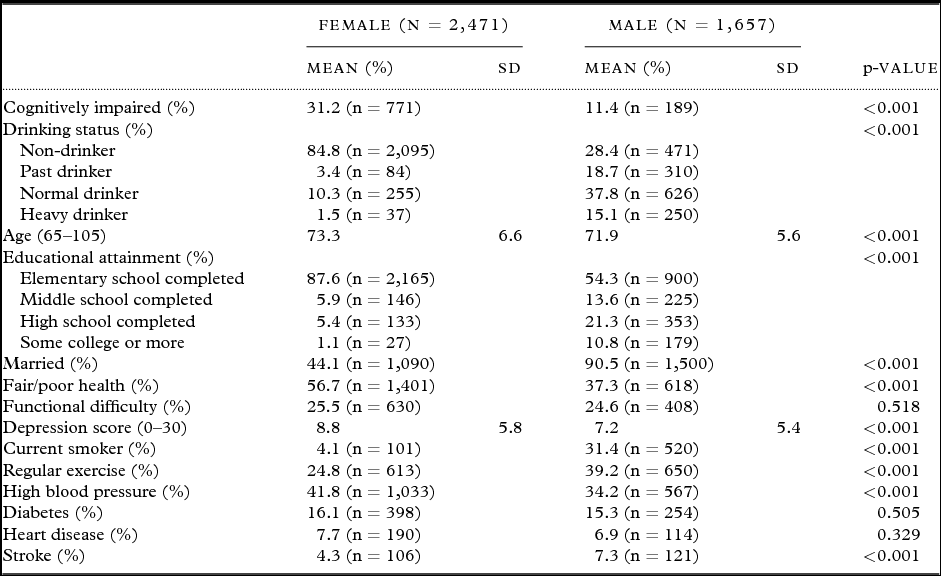
Table 1 contains descriptive statistics for the study sample. Women were cognitively impaired about three times as much as men. Majority of men were classified as normal drinkers, while majority of women were classified as non-drinkers. As for the socio-demographic characteristics, women were slightly older than men. More than four out of five women and more than half of men had less than middle school education. The proportion of married men doubled that of married women.
Sample characteristics by gender

Note: SD = Standard deviation.
Logistic regression results
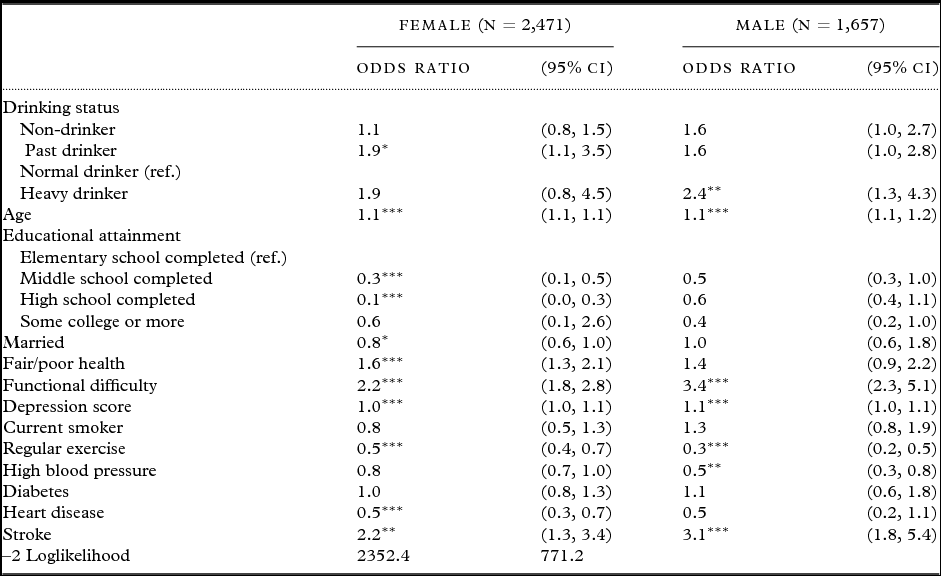
Table 2 contains the empirical results of a logistic regression model that describes cognitive impairment. The odds of being cognitively impaired were 91.8% higher for female past drinkers than female normal drinkers, while there was no significant difference in the odds of being cognitively impaired between male past drinkers and male normal drinkers. Also, the odds of being cognitively impaired were 137.5% higher for male heavy drinkers than male normal drinkers, but no significant difference was found between heavy drinkers and normal drinkers among females. However, the effect of drinking status on cognitive impairment was not significantly different by gender.
Logistic regression results for cognitive impairment
Notes: CI = Confidence interval; ref. = reference group.
*p < 0.05, **p < 0.01, ***p < 0.001.
For both female and male groups, respondents with functional difficulty, depression, and stroke were more likely to be cognitively impaired. In contrast, respondents who exercise regularly were less likely to be cognitively impaired. Married women were less likely to have cognitive impairments, while no significant association was found among men. Women who rated their health status as fair or poor were more likely to be cognitively impaired.
Discussion
This study was designed to examine the relationship between drinking status and cognitive impairment among older adults in South Korea. Corresponding to previous studies, age, functional difficulties, depression, exercise, and stroke were significantly associated with cognitive impairment for both women and men. However, the drinking status had different impact on cognition between women and men. Past drinkers were more likely to be cognitively impaired compared with normal drinkers only among women. In contrast, heavy drinkers were more likely to be cognitively impaired compared with normal drinkers only among men. These results are similar to findings that moderate drinking is protective against cognitive impairment (Nolen-Hoeksema, Reference Nolen-Hoeksema2004; McGuire et al., Reference McGuire, Ajani and Ford2007; Lyu and Lee, Reference Lyu and Lee2012). Although we controlled for many confounders, it should also be noted that there remains a potential for residual confounding that is associated with cognitive impairment.
The results suggesting that past drinking is associated with low cognition only among women is consistent with previous studies (Elias et al., Reference Elias, Elias, D'Agostino, Silbershatz and Wolf1999; McGuire et al., Reference McGuire, Ajani and Ford2007). According to McGuire et al. (Reference McGuire, Ajani and Ford2007), women who abstained from alcohol are less likely to have healthy behaviors than women who drink moderately. In addition, people who abstained from drinking are more likely to be poor, disabled, and less likely to be active both physically and socially (McGuire et al., Reference McGuire, Ajani and Ford2007). Moreover, as the number of abstainers increases with age, abstainers are more likely to be older, and have lower education and occupation levels (Elias et al., Reference Elias, Elias, D'Agostino, Silbershatz and Wolf1999). In contrast, women who drink alcohol at moderate level tend to get mammography regularly to monitor their health (McGuire et al., Reference McGuire, Ajani and Ford2007). Therefore, it is not surprising that female past drinkers had more odds of being cognitively impaired than female moderate drinkers.
The results of this study also suggest that heavy drinking impairs cognitive functioning for men. In South Korea, alcohol dependence is high among men. In addition, social and heavy drinking are encouraged among men in Korean culture, and the amount of alcohol consumption by male heavy drinkers is high. Therefore, men who reported having heavy alcohol might also exhibit the symptoms of neurotoxins such as memory and attention deterioration, hangover, and blackout, which increase the risk of being cognitively impaired.
Although the results did not show the moderating effect of gender, we tested whether the association between alcohol and cognitive impairment was different for males and females. The effect size of alcohol consumption on cognition was not found to be significantly different by gender; however, it is notable that the association between drinking status and cognition was different by gender. Previous studies suggest two explanations for this difference. According to Nolen-Hoeksema (Reference Nolen-Hoeksema2004), women achieve higher blood alcohol levels than men for a given dose of alcohol because women have a higher percentage of body fat and a lower percentage of body water weight than men. In addition, due to gender differences in the interaction between alcohol metabolism and hormonal status, the relationship between alcohol consumption and cognition may be different between men and women (Dufouil et al., Reference Dufouil, Ducimetière, Ducimetière and Alpérovitch1997).
There are some limitations to this study that should be noted. First, cognitive impairment was defined using a screening tool. Although K-MMSE is a validated instrument, it has a ceiling effect which is insensitive for detecting cognitive impairment among those highly educated (Anderson et al., Reference Anderson, Sachdev, Brodaty, Trollor and Andrews2007). However, this study could not adjust for K-MMSE normative data (Mungas et al., Reference Mungas, Marshall, Weldon, Haan and Reed1996) because K-MMSE lacks the standard for normative data. Second, the drinking variable was self-reported. Individuals tend to underreport alcohol use. In addition, those who are assessed to be cognitively impaired may not report their alcohol consumption correctly. This may have made it difficult to accurately differentiate normal drinkers from heavy drinkers. Third, the definition of past drinking is relatively simple and does not capture the degree of excessiveness. Even though people quit drinking, the duration of abstinence or whether people used to be heavy drinkers are still important predictors of cognitive function. Since heavy drinking have a long-term effect, it is hard to differentiate the effect between past drinking and heavy drinking if respondents had stopped drinking recently. Lastly, the current study is cross-sectional. Therefore, it cannot be established that drinking status is causally related to cognitive impairment.
Although we had several limitations to our study, this study makes a number of important contributions. First, this study investigated the relationship between alcohol consumption and cognitive impairment among Korean older adults using a nationally representative sample. Therefore, the findings from this study can be generalized. Second, this study examined the gender differences, which could establish gender-specific strategies for the prevention and treatment of alcohol-related cognitive impairment among older adults. In the future, it would be valuable to do a prospective study of the changes in cognitive function associated with alcohol consumption among elderly Koreans.
Conflict of interest
None.
Declaration of authors’ roles
J. Lyu designed the study, carried out the statistical analysis, analyzed the data, and wrote the paper. S. H. Lee designed the study, analyzed the data, and wrote the paper.