

1. INTRODUCTION
This paper analyses the consequences of urban environmental degradation on the well-being of Spanish miners, based on mortality and height data. It is, therefore, a study of the ‘urban penalty’, a term that was first used to describe how urban mortality tended to exceed rural mortality during the Industrial Revolution.Footnote 1 The term was later adopted by anthropometrists to refer to the lesser height of urban populations compared with rural dwellers during this period.Footnote 2
The first part of the paper proposes new hypotheses regarding the urban penalty. More specifically, we consider the studies in economic theory that analyse how market failures have caused excess urban mortality and explain the reduction in height using the model recently created by Roderick Floud, Robert Fogel, Bernard Harris and Sok Chul Hong for British cities.Footnote 3 The next sections of the paper analyse data from towns in two main mining areas in Spain (Bilbao and the Cartagena-La Unión mountain range) which experienced excess mortality as a result of market failures derived from what we term an ‘anarchic urbanisation’, that is, an unregulated urbanisation. In addition, we report anthropometric figures that reveal a reduction in the average height of miners which, in accordance with the above-mentioned model, we attribute to environmental degradation. The final substantive section provides some speculation as to why sanitary reforms were delayed in the Spanish case. The conclusions of the article coincide with the findings of other studies on the urban penalty, namely, that urban environmental degradation reduced the standard of living of miners. State intervention promoting urban public health reform was a necessary yet insufficient condition to increase well-being. Such sanitary reform was only eventually implemented thanks to the insistence of the hygiene movement and the political forces that supported it.
2. NEW HYPOTHESES FOR THE STUDY OF THE URBAN PENALTY
2.1. Urbanisation, market failures and excess mortality
We will analyse excess urban mortality from the point of view of market failure, an approach that has not been explicitly taken in other studies of the urban penalty.Footnote 4 Four failures are relevant here. The first is the issue of providing public goods. These are goods which private companies have no incentive to provide, since they are non-excludable and non-rival: nobody can be excluded from their free use and use by one individual does not reduce availability to others. The paradigmatic example is a lighthouse. Although a lighthouse is necessary, no private business will construct one because it cannot exclude free riders from using it. A second is that of providing merit goods. Merit goods are those such as housing, healthcare and education, which are considered necessary for a satisfactory standard of living. Unlike public goods, free riders can be excluded, and thus the market may provide such goods, but it tends to do so only slowly or to an insufficient extent. The third type of failure is those derived from imperfect information. An example is food products, as the consumer often cannot know whether they have been adulterated or are in poor condition. Finally, there is the issue of negative externalities, referring to the negative consequences that the action of an economic agent has on the well-being of a third party. An example would be the installation of a chemical company that contaminates a river, thus preventing any fishing activity.
Economists have proposed three ways to avoid market failures. The first is direct state intervention, either to provide public or merit goods, or to protect the consumer against imperfect information and negative externalities. The second, aimed only at decreasing the negative externalities, is the creation of the so-called ‘Pigouvian’ taxes, whereby individuals or firms responsible for generating negative externalities are taxed to pay for the costs of such externalities. A third solution, also designed to reverse the negative externalities, was that proposed in 1960 by Ronald Coase. He claimed that the private sector could avoid these externalities through price negotiation between the agents who cause them and those affected by them. In the case of agreement the externality is ‘internalised’ with no need for state intervention.
We argue in this paper that the urban penalty was the result of an environmental degradation which increased the risk of contracting infectious diseases transmitted through water, food and air, a degradation that in turn was related to market failures derived from an anarchic urbanisation. In general, not just in our case study, market failure can be seen as contributing to environment degradation in the following ways. The first was contaminated water. Basically, this was due to a lack of sewage systems. In the absence of a network connecting dwellings through pipes, waste water was evacuated in buckets into the street gutters and often ended up contaminating rivers and drinking water. For a sewage system to be effective, all dwellings needed to be connected. Private companies, therefore, did not undertake the construction of a sewage system because they could not exclude anyone from its free use. The classic example is London, where the stink from the River Thames became so terrible by 1858 that the municipal authorities were compelled to build a modern sewage system.Footnote 5 The second market failure is the example of imperfect information given above, namely, contaminated food. Incorrect handling, poor hygienic conditions of warehouses and shops and adulteration led to the sale of goods in bad condition that consumers were not always able to recognise. This was likely to be more serious among the working class as the upper and middle classes would have had access to more ‘reputable’ stores which mitigated the imperfect information problem.
A third negative externality was that of air pollution of homes and transmission of infection by inhalation. This negative externality was also more serious in working-class neighbourhoods for two reasons. First, the market was slow in providing a merit good such as housing, and, second, there was a lack of regulation in property development. The literature on building economics shows that the supply of housing is inelastic in the short term.Footnote 6 This market failure was aggravated by a ‘surge’ in the demand for flats in working-class districts due to an avalanche of immigrants and urban growth. Rents increased to a level that obliged families to sublet rooms, thus generating overcrowding. An added factor was the freedom to build narrow streets and high buildings with small flats, all of which prevented adequate ventilation.Footnote 7
Would it have been possible to address these negative externalities with ‘Pigouvian’ taxes or private solutions? This tax reduces the externality but does not eliminate it, hence a high death rate, incompatible with an increase in well-being, would have remained.Footnote 8 It is also hard to imagine how a private negotiation between the agents producing negative externalities (infected or polluted air) and those suffering from them could have been effective.Footnote 9 Therefore, the only efficient means of tackling the above-mentioned market failures was state intervention which also generated huge positive externalities – the construction of a sewage system, for example, increases the well-being of all the residents of a city.
This is evidenced by the success that the measures proposed by the hygienists had in reducing the urban death rate. The hygiene movement sought to combat excess mortality by preventing the airborne spread of miasmas or foul-smelling emissions coming from decomposing organic materials.Footnote 10 Although the miasmatic theory was eventually refuted by germ theory, all the studies in this field show that these measures significantly reduced the risk of contracting infectious diseases.Footnote 11 They were fundamentally similar to those recommended today by health economics: the conveyance of uncontaminated water and sewage; quality control of food; building of low-cost houses to address the problem of overcrowding; and the hygienic regulation of housing construction and development.Footnote 12
2.2. An explanatory model of the urban penalty
The study of mortality during the Industrial Revolution gave rise to a point of controversy that should be addressed before examining the explanatory model recently proposed by Floud, Fogel, Harris and Hong for the British case.Footnote 13 We are referring to the debate between the defenders of the so-called nutrition hypothesis proposed by Thomas McKeown and those supporting the public health argument. McKeown observed that the reduction in deaths between the mid-nineteenth century and the beginning of the twentieth century was due more to a decrease in the incidence of airborne infections (tuberculosis, bronchitis, influenza, pneumonia, whooping cough, measles, scarlet fever, diphtheria and smallpox), than to a reduction in infectious diseases transmitted through water and food (cholera, diarrhoea, dysentery and typhoid). He maintained that sanitary reforms in the towns could not significantly contribute to the fall in mortality because the second group of diseases did not account for the bulk of morbidity and because the effects of the reforms were only evident towards the end of the nineteenth century and the early years of the twentieth century. He claimed that the most important factor in the decline of death rates was improved nutrition, an argument that he extended back to the eighteenth and nineteenth centuries.Footnote 14 McKeown thus supported a nutrition hypothesis which had already been proposed in Malthusian theory and neoclassical thought – Malthus identified scarcity of food as the principal factor preventing population growth and the neoclassical economists believed that an increase in the food supply was sufficient to lower death rates and to increase life expectancy.Footnote 15
Critics of the nutrition hypothesis claim that it provides an inaccurate view of the demographic transition as it ignores the role played by the increased fertility rate and considers the decline in mortality as a seamless process.Footnote 16 Furthermore, the relationship between the nutrition hypothesis and the behaviour of real wages and height is asymmetrical in some periods;Footnote 17 there are aetiological errors;Footnote 18 the urban penalty and the influence of the urban public health reform on the fall in death rates are underestimated;Footnote 19 and the hypothesis does not clearly distinguish between nutrition and nutritional status which rules out factors such as the existing synergy between infections and malnutrition, and the type and amount of work carried out by an individual. Anthropometrists have insisted on this last point, distinguishing the gross nutritional input from the net input. The former corresponds to the energy consumed while the net input, which affects height, is the difference between that energy and the energy consumed through the basal metabolic rate, physical effort, and illness during infancy and adolescence.Footnote 20 A final criticism is that McKeown prioritised nutrition, when the decrease in death rates between the mid-eighteenth century and the beginning of the nineteenth century was due to the interaction of many factors (in summary, we can highlight five, which in turn were the result of others: nutritional status, public health reform, wage levels, educational level and medical progress). It is worth emphasising, in this regard, the pluricausal approach known as health transition or the model recently proposed by Floud, Fogel, Harris and Hong to which we will refer later.Footnote 21
Researchers such as Samuel Preston, Simon Szreter, Graham Mooney and Richard Easterlin suggested an alternative hypothesis to McKeown's proposal, claiming that the improvement in mortality was due to improved public health.Footnote 22 Life expectancy in Great Britain and Wales stagnated between 1810 and 1870 due to a process of ‘anarchic urbanisation’. Szreter theorised that rapid urban development gave rise to the ‘four Ds’ (Disruption, Deprivation, Disease, Death), two of which – disease and death – decreased from the 1870s as a result of a process of sanitary reform that owed its success to scientific and technological progress and the democratisation of parliament and local elections.Footnote 23
The public health hypothesis is now accepted by most, although some of its aspects are still debated today.Footnote 24 However, this is not the sole factor explaining the long-term decline in mortality, for two reasons. The first one is obvious: the hypothesis is confined to the period 1870–1910, so that the increase in life expectancy in Great Britain between 1750 and 1810 was due to other factors.Footnote 25 The second reason, pointed out by Floud, Fogel, Harris and Hong, is that it does not take into account the role played by nutritional status, first in a negative sense and later in a positive sense. These historians have proposed an explanatory model of urban penalty in the working-class districts of British cities which ‘marries’ the public health hypothesis and nutritional status.Footnote 26 The model maintains that real wages and gross nutritional input of working-class families increased slightly between 1810 and the mid-nineteenth century but with no corresponding improvement in net nutritional input or nutritional status. This lack of improvement was due to increased morbidity – largely the result of an ‘anarchic urbanisation’ and also to worsened working conditions.Footnote 27 Mortality only fell from the 1870s, when the risk of contracting infectious diseases decreased due to urban public health reforms and an improvement in nutritional status, this time as a result not only of an increase in real wages, but also of lower morbidity and new working conditions.
3. EXCESS URBAN MORTALITY IN THE SPANISH MINING INDUSTRY
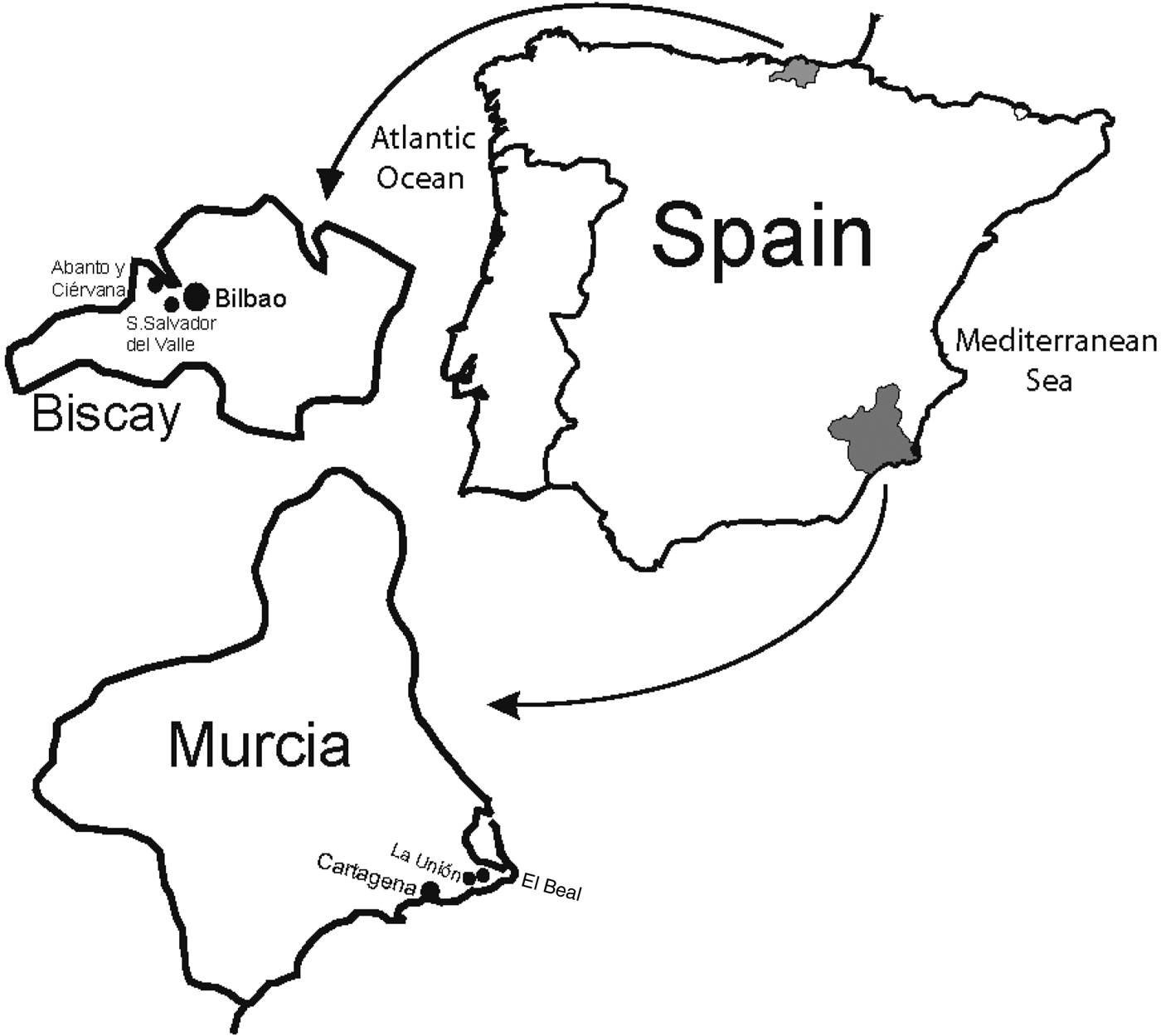
As indicated in the introduction to this paper, this third section will show the relationship between environmental conditions and mortality in Spain's two largest mining areas: the Bilbao basin and the Cartagena-La Unión mountain range (see Figure 1). During the growth cycle of the mining sector (1870–1913), the Bilbao basin produced 65 per cent of Spain's iron ore and employed 12,000 miners. During the 1890s, 63 per cent of Spain's lead ore was extracted from the Cartagena-La Unión mountain range and between 1879 and 1913 this area produced 44 per cent of Spain's production of lead bars, employing 20,000 workers.Footnote 28 The miners in Bilbao lived in towns and villages on the left side of the Nervión estuary where the iron and steel industry, chemical plants and shipyards were located. The workers of the mines in Cartagena-La Unión were concentrated in the town of La Unión and in three nearby villages (Diputación El Beal).
Map of Spain highlighting the Bilbao basin and the area of the Cartagena-La Unión mountain range in Murcia.

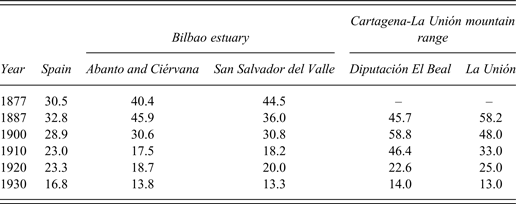
Table 1 shows the crude death rates for Spain as a whole and for the two mining areas between 1877 and 1930. Using these crude rates to make comparisons is not an ideal method as the underlying age structure is unknown and undoubtedly changes over time. However, this does not prevent them from being interesting. As Table 1 shows, mortality in the mining towns exceeded that of the country as a whole between 1877 and 1900. Between 1900 and 1910, this excess mortality disappeared in the mining populations of Bilbao, where the mortality rate stood at 17.5 and 18.2 per 1,000 as opposed to 23 per 1,000 for Spain. By contrast, the towns in the Cartagena-La Unión mountain range in 1910 continued to suffer from a higher crude mortality (rates of 46.4 and 33 per 1,000). By 1920, the crude death rate in El Beal was slightly lower than that for Spain as a whole, while the crude death rate in La Unión remained higher. It was not until 1930 that the crude death rates of both towns were lower than the national rate.
Crude death rates (per 1,000) in Spain and in the mining villages of the Bilbao estuary and the Cartagena-La Unión mountain range, 1877–1930
Sources: Spain: R. Nicolau, ‘Población, salud y actividad’, in A. Carreras and X. Tafunell eds., Estadísticas históricas de España, siglos XIX y XX vol. 1 (Bilbao, 2005), 77–155. Abanto and Ciérvana, and San Salvador: P. M. Pérez Castroviejo, ‘Niveles de bienestar de la población minera vizcaína. Factores que contribuyeron al descenso de la mortalidad, 1876–1936’, Revista de Demografía Histórica 23, 1 (2005), 71–105. El Beal: D. Navarro, A. P. Martínez Soto and M. A. Pérez de Perceval, La vida en la sierra minera de Cartagena. Evolución demográfica de la diputación de El Beal, 1880–1970 (Murcia, 2004). La Unión: A. Gil Olcina, ‘Evolución demográfica del núcleo minero de La Unión’, Saitabi 20 (1970), 202–37.
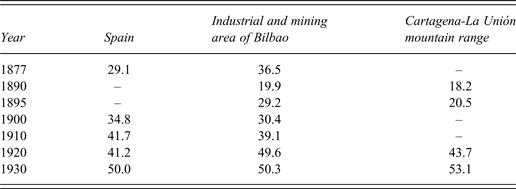
A more rigorous method for comparing the behaviour of death rates is to use life expectancy. In order to do this we have created Table 2, which shows the life expectancy at birth in Spain, in the industrial and mining area of Bilbao, and in the mining villages of El Beal between 1877 and 1930. We can observe that life expectancy in the area of Bilbao was much higher than that of Spain before the mining and industrial boom (36.5 years as opposed to 29.1). However, it fell to 19.9 years in 1890, increased to 29.2 years in 1895, and in 1900 (30.4 years) it had still not exceeded the initial figure of 1877 (36.5 years), standing below the figure for Spain as a whole (34.8 years). A similar pattern can be observed in the case of the mining villages of the Cartagena-La Unión mountain range, where life expectancy was 18.2 years in 1890 and 20.5 years in 1895.
Life expectancy (years) at birth in Spain, the industrial and mining area of Bilbao and the Cartagena-La Unión mountain range, 1877–1930
Sources: Spain: R. Nicolau, ‘Población, salud y actividad’, in A. Carreras and X. Tafunell eds., Estadísticas históricas de España siglos XIX–XX, vol. I (Bilbao, 2005), 77–155. Industrial and mining area of Bilbao: M. E. González Ugarte, ‘Mortalidad e industrialización en el País Vasco. Vizcaya, 1860–1936’, Boletín de la Asociación de Demografía Histórica 12 (1994), 35–53 and M. Arbaiza, ‘Mortalidad y condiciones de vida de los trabajadores de la industria vizcaína del siglo XIX’, Revista de Historia Industrial 8 (1995), 65–98. Cartagena-La Unión mountain range: Á. P. Martínez Soto, D. Navarro Ortiz and M. Á. Pérez de Perceval, La vida en la Sierra minera de Cartagena. Evolución demográfica de la diputación de El Beal, 1880–1970 (Murcia, 2004).
High mortality in urban areas is unsurprising, given contemporary testimony to the existence of unsanitary living conditions that can clearly be ascribed to the kinds of market failure described in the introduction. In 1881, the Spanish Hygiene Society (Sociedad Española de Higiene) was created. Written by one of its members, the following text describes the problems derived from rapid urbanisation:
The working-class neighbourhoods of Spain's main towns are victims of the same problem. The population has grown in number; people crowd together in the few unhygienic and unsanitary rooms that remain available; water distribution and supply systems are either non-existent or faulty; people consume rotten food […] Our society must convince the authorities to implement the necessary means to put an end to all of this […] The towns should be clean, with good sewage networks, abundant drinking water, large rooms with natural daylight, good hospitals, spacious cemeteries, large parks and wide promenades […] Although long and costly, this regeneration should be implemented by the municipal corporations.Footnote 29
Doctors and reformers from Bilbao highlighted the problems caused by the urban development process in their region:
The huge wave of immigration experienced by the villages of Bilbao since the Carlist War has given rise to more expensive rents causing many people to crowd together in the poorer homes […] A sanitary programme should be implemented for supplying drinking water, building sewage systems, town planning and the regulation of housing construction.Footnote 30
Another report into social conditions in the Basque country stated that:
The exploitation of man by man plays a role in endemic infection because the lack of honesty in trade gives rise to criminal falsifications that ultimately cause disease, such as dysentery due to the adulteration of alcoholic beverages, and stomatitis due to the use of limestone in bread making.Footnote 31
Similar concerns were voiced concerning the Cartagena-La Unión mining towns and villages:
Believe me when I tell you that the physicians who practise in this mining area are constantly raising the alarm over the unspeakable state of abandonment of the mining villages in all aspects of hygiene […] Workers who arrive here in huge numbers with no other aspiration than finding work nor other resource than their own strength, find themselves obliged to live in shelters and housing which, due to overcrowding, lack of daylight, air and man-made drainage, are uninhabitable pigsties and a breeding ground for the development of a number of diseases.Footnote 32
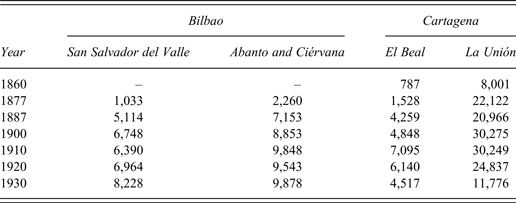
Aside from these first-hand reports, the figures in Table 3 show that in a short period of time the mining towns of Bilbao and Cartagena-La Unión experienced extraordinary demographic growth derived from a sudden influx of immigrants and high natural growth, which transformed them into highly dense and compact urban nuclei. In the 1880s and 1890s, for example, San Salvador had a population density between 600 and 700 habitants per square kilometre, Abanto between 500 and 700 and La Unión between 1,000 and 1,250. In the case of Bilbao, the surge in immigration was the result of a boom in the export of phosphorus-free iron ore for British Bessemer converters from 1876.Footnote 33 In the Cartagena-La Unión mountain range, the immigration process took place earlier due to the increase in lead exports arising from the urban development of the most advanced European countries leading to an increased demand for gas and water pipes.Footnote 34Table 3 shows that in a 10-year period (1877–1887) the populations of San Salvador and Abanto multiplied by five and three, respectively, while in a period of 17 years (1860–1877) the population of El Beal multiplied by two and that of La Unión grew three-fold. The demographic growth of all the towns continued until 1900–1910, but at lower rates.
Populations of the mining towns of Bilbao and the Cartagena-La Unión mountain range, 1860–1930
Sources: San Salvador and Abanto: M. González Portilla, R. García Abad and J. Urrutikoetxea, Las ciudades mineras de la ría de Bilbao durante el boom minero (Bilbao, 2007). El Beal: Á. P. Martínez Soto, D. Navarro Ortiz and M. Á. Pérez de Perceval, La vida en la Sierra minera de Cartagena. Evolución demográfica de la diputación de El Beal, 1880–1970 (Murcia, 2004). La Unión: M. A. López-Morell and M. A. Pérez de Perceval, La Unión. Historia y vida de una ciudad minera (Seville, 2010).
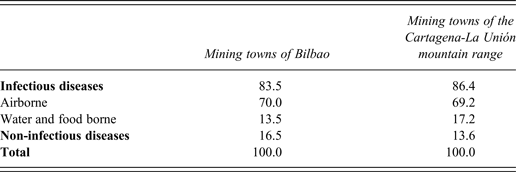
Rapid population increase in areas which experienced an anarchic urbanisation raised the risk of contracting infectious diseases transmitted through the air, water and food. This hypothesis is supported by the data in Table 4, showing the breakdown of mortality according to types of disease. During the years 1877–1900, between 83 per cent and 86 per cent of the mortality of the mining towns of Bilbao and the Cartagena-La Unión mountain range was due to infectious diseases, 70 per cent of which were airborne and 17–13 per cent of which were transmitted through water or contaminated food. It should not surprise us that the proportion of water-borne diseases in these mining areas was higher than that estimated by McKeown for England and Wales, as in Southern Europe there was a higher incidence of these diseases due to the deficiencies in water and sewer infrastructure.Footnote 35 It goes without saying that these diseases affected all population groups, but children under one year of age were particularly vulnerable, which explains why infant mortality reached rates of 250–300 per 1,000 during the 1880s and 1890s, with child mortality even higher.Footnote 36
Incidence (%) of diseases related to mortality in the mining towns of Bilbao and the Cartagena-La Unión mountain range, 1877–1900
Sources: Towns of Bilbao: M. Arbaiza, ‘Urbanización y condiciones de vida en Vizcaya (1877–1930): aproximación a las causas sociales de la mortalidad infantil y juvenil’, Historia Contemporánea 18 (1999), 209–51. Cartagena-La Unión mountain range: Á. P. Martínez Soto, D. Navarro Ortiz and M. Á. Pérez de Perceval, La vida en la Sierra minera de Cartagena. Evolución demográfica de la diputación de El Beal, 1880–1970 (Murcia, 2004). For the disease classification, the authors of these works have followed the criteria proposed by T. McKeown, The modern rise of population (London, 1976).
It is worth considering whether mine accidents and diseases related to mining played a role in such high mortality. Between 1876 and 1900, only 0.15% of the miners of Biscay died in work-related accidents. Although the percentage was higher (6%) in Cartagena-La Unión because the mining was underground, this was still too small a percentage to explain the urban penalty there.Footnote 37 As for occupational diseases, death records of the time have two problems. The first is that characteristic diseases of mining, such as pneumoconiosis and silicosis, were encompassed in the category of chronic bronchitis or broncopneumonias. The second problem is that these records do not specify the occupation of the deceased, so it is impossible to know how many miners died from lung diseases related to their work. However, these diseases cannot explain the urban penalty because the number of miners was low relative to total urban population and because of the very high infant and child mortality rates. In 1900, about 60,000 persons lived in towns and villages on the left bank of the Bilbao estuary, of whom 9,525 were miners (15% of the population).Footnote 38 In the same year the city of La Union, in the Cartagena mountain range, had 30,275 inhabitants of whom 3,580 were miners (11% of the population).Footnote 39 The figures for infant and child mortality point in the same direction. During the 1880s mortality exceeded 300 per 1,000 among those aged 0–5 years in the industrial area of Bilbao, and in 1890 it reached 450 per 1,000.Footnote 40 During the 1890s child mortality in El Beal (in Cartagena-La Unión) exceeded 400 per 1,000.Footnote 41 These huge numbers of deaths of infants and children clearly show that this is a case of an urban penalty, rather than a ‘mining penalty’.
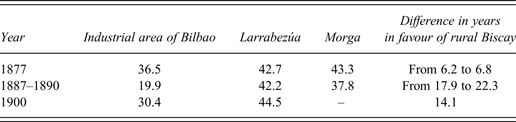
It is worth considering the magnitude of the urban penalty in these mining areas. To do this, we can compare the life expectancy of urban areas with that of rural areas. Table 5 shows the enormous impact of the urban penalty on the industrial and mining area of Bilbao. It compares the life expectancy data of this area with the figures corresponding to two nearby farming villages (Larrabezúa and Morga). At the end of the 1890s the difference was between 17.9 and 22.3 years and in 1900 the gap had fallen to 14.1 years. The figures of 17.9–22.3 years are high but in line with urban penalties elsewhere. Between 1820 and 1870, life expectancy in British cities was 10 to 13.5 years lower than in rural areas.Footnote 42 In the 1840s life expectancy in Manchester and Liverpool was 19 years less than in the countryside.Footnote 43 Also in the 1840s life expectancy in rural France was 11 years higher than in urban areas.Footnote 44 In the United States the life expectancy of rural areas in 1900 was 10 years higher than in cities.Footnote 45
Life expectancy (years) in the industrial and mining area of Bilbao and in rural Biscay, 1877–1900
Sources: Industrial and mining area of Bilbao: M. E. González Ugarte, ‘Mortalidad e industrialización en el País Vasco. Vizcaya, 1860–1936’, Boletín de la Asociación de Demografía Histórica 12 (1994), 35–53; and M. Arbaiza, ‘Mortalidad y condiciones de vida de los trabajadores de la industria vizcaína del siglo XIX’, Revista de Historia Industrial 8 (1995), 65–98. Larrabezúa and Morga: E. M. González Ugarte, ‘Mortalidad e industrialización en el País Vasco. Vizcaya, 1860–1930’, Boletín de la ADEH 12, 1 (1994), 33–54.
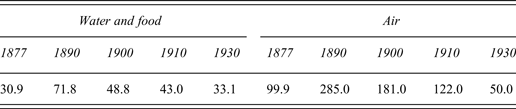
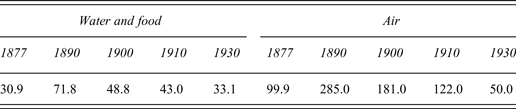
In 1910, the urban penalty had been overcome in the industrial and mining area of Bilbao (Tables 1 and 2). Between the end of the nineteenth century and 1910, the local councils of the left bank of the Bilbao estuary implemented the measures proposed by the hygienists (transportation of uncontaminated water, controls over food quality, paving, waste collection, regulation of housing and street construction, campaigns to promote hygiene and the provision of inexpensive housing).Footnote 46 The mortality data contained in Table 6 suggest that these measures significantly reduced the risk of dying of infectious diseases. Between 1890 and 1910, the death rate corresponding to airborne diseases fell from 285 per 1,000 to 122 (a reduction of 58 per cent) and that corresponding to diseases transmitted through water and contaminated food fell from 71.8 per 1,000 to 43 (a reduction of 40 per cent).
Mortality rates (deaths per 1,000) by disease group in the industrial and mining area of Bilbao, 1877–1930
Source: M. Arbaiza, ‘Urbanización y condiciones de vida en Vizcaya (1877–1930): aproximación a las causas sociales de la mortalidad infantil y juvenil’, Historia Contemporánea 18 (1999), 209–51.
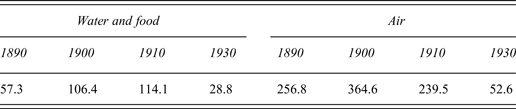
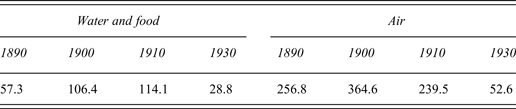
In 1910, El Beal had a crude death rate of 46.4 per 1,000 and La Unión had a rate of 33 per 1,000, while the death rate for Spain as a whole was 23 per 1,000 and that of the mining area of Bilbao was 17–18 per 1,000 (Table 1). The Cartagena-La Unión mountain range continued therefore to suffer from an urban penalty, in all likelihood because the municipal authorities did not undertake any public health reforms, as indicated by the hygienists’ testimony. In 1906, for example, the local council of La Unión answered a question from the Institute of Social Reforms regarding the conditions of working-class homes admitting that: ‘It would be desirable to improve them, equipping them with running water, toilets, drainage, sewage systems, courtyards, light and ventilation, extending and increasing the number of bedrooms as most of them are inhabited by workers with large families who occupy only a single bedroom.’Footnote 47 We should not be surprised, therefore, by the mortality figures in Table 7 which contrast with those in Table 6. While in 1910 the death rate corresponding to airborne diseases was 122 per 1,000 in the area of Bilbao, in the Cartagena-La Unión mountain range it stood at 239.5 and, in the same year, the rates corresponding to water- and food-borne diseases were 43 and 114.1, respectively.
Mortality rates (deaths per 1,000) by disease group in the Cartagena-La Unión mountain range, 1890–1930
Source: Á. P. Martínez Soto, D. Navarro Ortiz and M. Á. Pérez de Perceval, La vida en la Sierra minera de Cartagena. Evolución demográfica de la diputación de El Beal, 1880–1970 (Murcia, 2004), 137.
Things started to change later, as in 1920 the death rate of El Beal was lower than the rate for Spain as a whole and in 1930 the mortality rates of El Beal and La Unión were clearly lower than the Spanish rate (Table 1). The life expectancy figures also confirm that excess mortality disappeared from the Cartagena-La Unión mountain range. In 1920 life expectancy for this area was 43 years as opposed to 41 years for Spain and in 1930 this figure was 53 years compared with 50 years for Spain (Table 2). The disappearance of the urban penalty was not, however, the result of a sanitary reform such as the one carried out in Bilbao and other Spanish towns. Between 1913 and 1930 the local councils of the Cartagena-La Unión mountain range implemented measures, such as creating water piping systems or improving public hygiene, which undoubtedly contributed to lowering the risks of infections but they did not implement an integrated public health reform (conveyance of uncontaminated water and sewage, control of food quality, building of low-cost houses to address the problem of overcrowding, and the hygienic regulation of housing construction and planning).Footnote 48 How can we explain then the disappearance of the urban penalty? In our view, an essential factor was that El Beal and La Unión lost a large part of their populations due to the slump in lead exports after the First World War. The population of these areas combined decreased from 37,344 inhabitants in 1910 to 16,293 in 1930, a reduction of 56 per cent (Table 3). This drastic reduction would have reduced the overcrowding of homes and the risk of contracting the diseases that had most contributed to the urban penalty.
4. THE HEIGHT OF MINERS
Studies of many European countries have shown that excess urban mortality went hand in hand with another type of urban penalty: men in the cities were shorter than those of the countryside. Using height data derived from military sources, in this section we examine whether the mining basins of Bilbao and the Cartagena-La Unión mountain range suffered from this urban penalty, too. As mentioned above, height reflects the nutritional status or the net nutritional input, which is the result of the gross nutritional input (the nutrients consumed) minus the energy spent through the basal metabolic rate, illness and physical activity. It is impossible to differentiate the impact of nutrition, morbidity and physical activity on the height reached at 21 years of age. In what follows, therefore, we take the evolution of the average height of miners to be a reflection of these three variables combined, but offer suggestions based on other evidence as to which may have had a greater weight in different time periods.Footnote 49
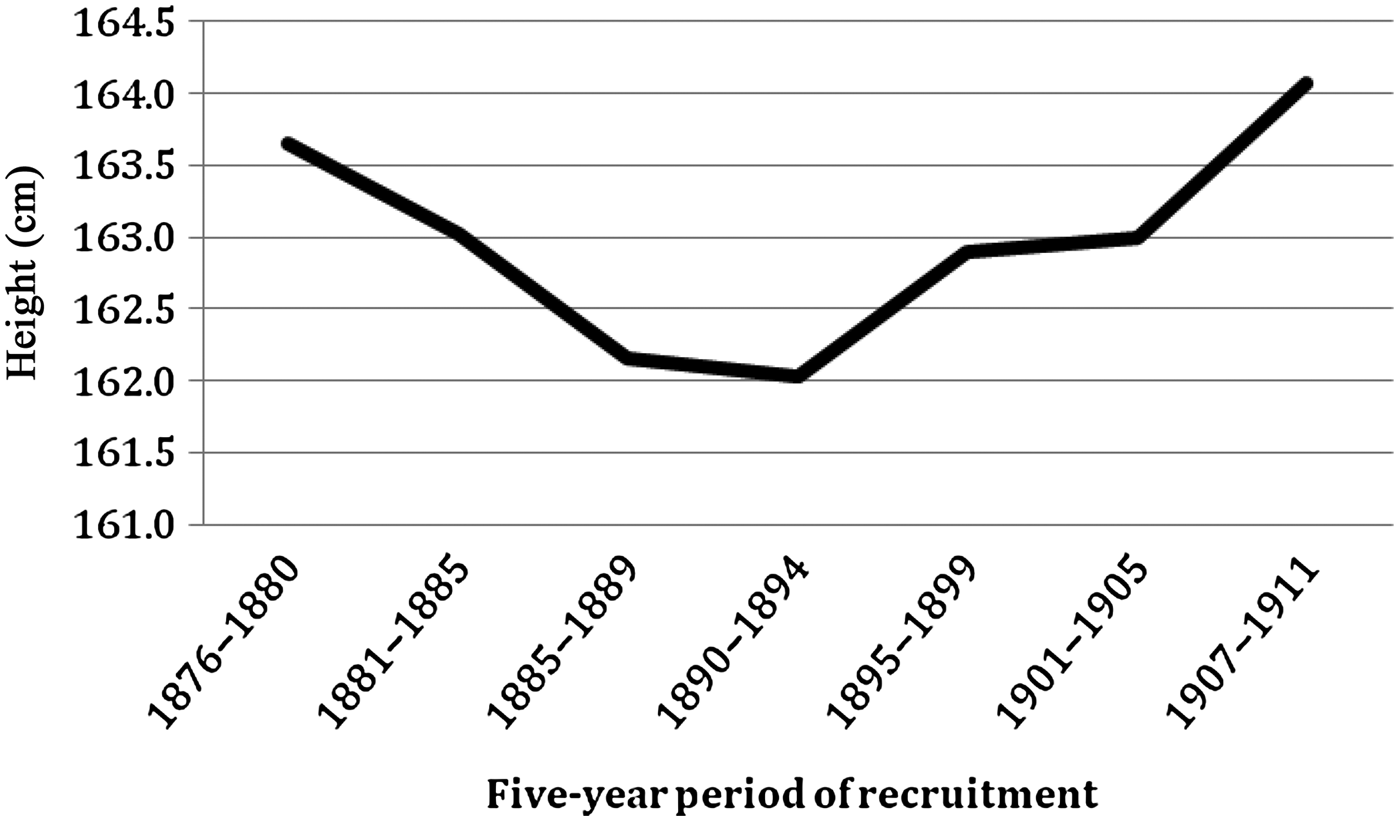
In Figure 2, we can see the evolution of the average height of the miners of Biscay between 1876 and 1911, based on a sample of 3,676 military recruits from the mining area of San Salvador del Valle.Footnote 50 This height series posed a problem. Between 1876 and 1911, half of the recruits measured had been born in the industrial and mining area of Bilbao and the other half had been born outside of Biscay. According to Mercedes Arbaiza, the majority of immigrants were families who had young children.Footnote 51 Therefore, although it is impossible to know the exact proportion of young men born outside of Biscay who spent all or part of their childhood and/or adolescence in the mining basin, it seems logical to assume that it was most of them. We have thus followed Antonio Escudero and Pedro María Pérez Castroviejo in using the average height of all the recruits. In any event, the height of both those born in the industrial and mining area of Bilbao and those born outside of Biscay fell, although in this latter case the reduction was greater.
Average height of the miners in Biscay, 1876–1911, in centimetres. Source: A. Escudero and P. M. Castroviejo, ‘The living standards of miners in Biscay (1876–1936): wages, human development index and height’, Revista de Historia Económica. Journal of Iberian and Latin American Economic History 28, 3 (2010), 503–35.
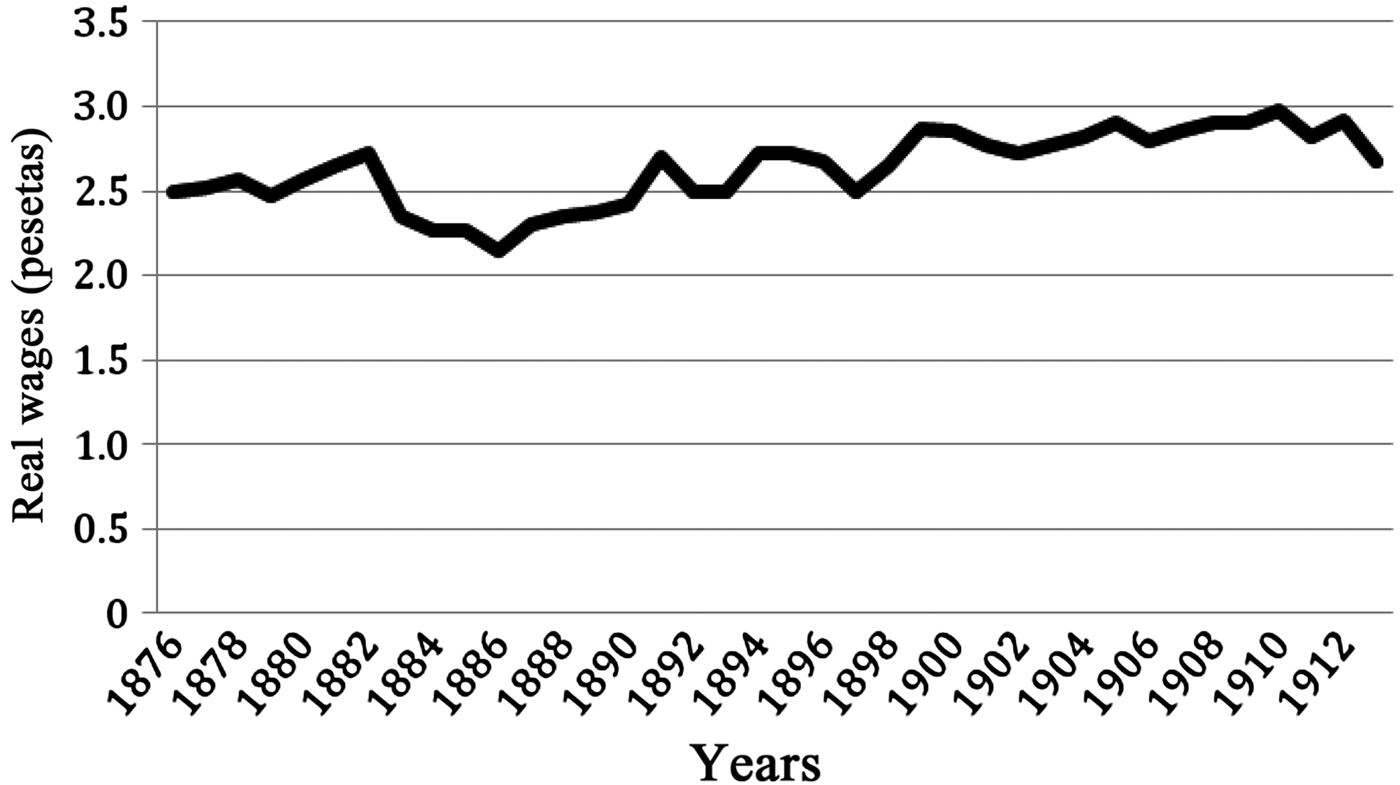
The young men in the first cohort (average height 163.65 centimetres) were measured between 1876 and 1880, which means that they were children and teenagers between 1856 and 1876, when the left bank of the Bilbao estuary was a rural area. The men in the following five cohorts (measured between 1881 and 1905) were shorter in height compared with those in the first cohort. We hypothesise that this decline in height was due to conditions in their childhood and adolescence between 1876 and 1901, specifically, a low-protein diet, based on cereals, potatoes and legumesFootnote 52, a very high morbidity rate (Tables 1, 2 and 4) and long working hours. The working day was 12 hours until 1890, and subsequently 10.5 hours, with 349 working days a year; there were only 16 free days, coinciding with religious festivities. This reduction in height is a clear case of urban penalty because, although the research team headed by Jóse Miguel Martínez-Carrión has yet to publish the height figures corresponding to rural Biscay, we do know that they were much above those of the mining basin. In addition, the height of the Basque miners between 1885 and 1905 was slightly lower than that of rural dwellers, estimated by Gloria Quiroga for Spain as a whole.Footnote 53 Finally, the young men measured between 1907 and 1911 were taller than those of the initial cohort because they spent their childhood in the 1890s and their adolescence between 1902 and 1906, a period characterised by higher real wages (see Figure 3) and a diet richer in protein with a gradually higher consumption of meat, eggs, milk and fishFootnote 54, a lower morbidity rate (Tables 2 and 6) and a working day of nine and a half hours with fewer working days per year as the law making Sunday a rest day had come into force.Footnote 55
Daily real wages of miners in Biscay, 1876–1913, in constant pesetas of 1876. Source: A. Escudero and P. M. Castroviejo, ‘The living standards of miners in Biscay (1876–1936): wages, human development index and height’, Revista de Historia Económica. Journal of Iberian and Latin American Economic History 28, 3 (2010), 503–35.
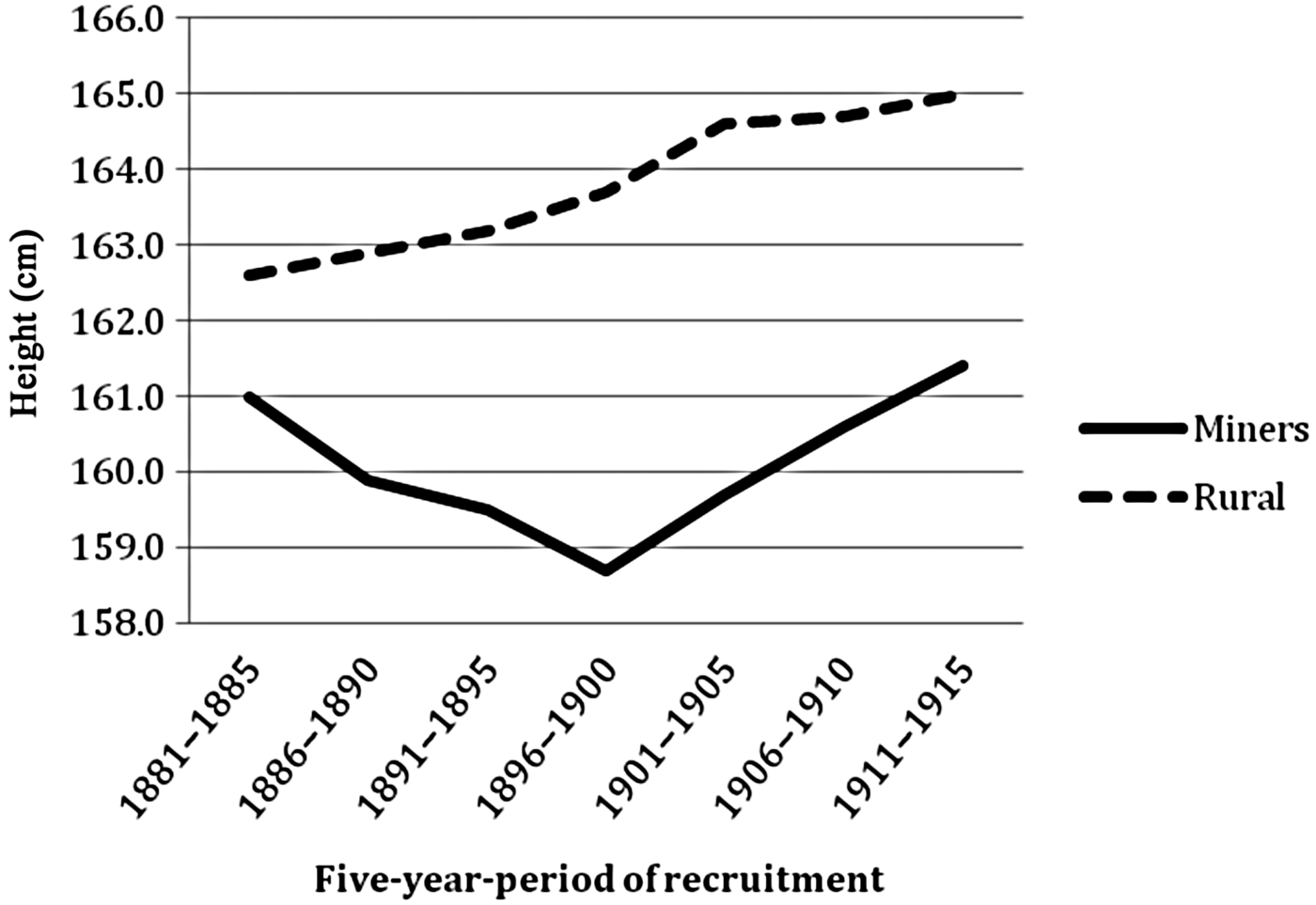
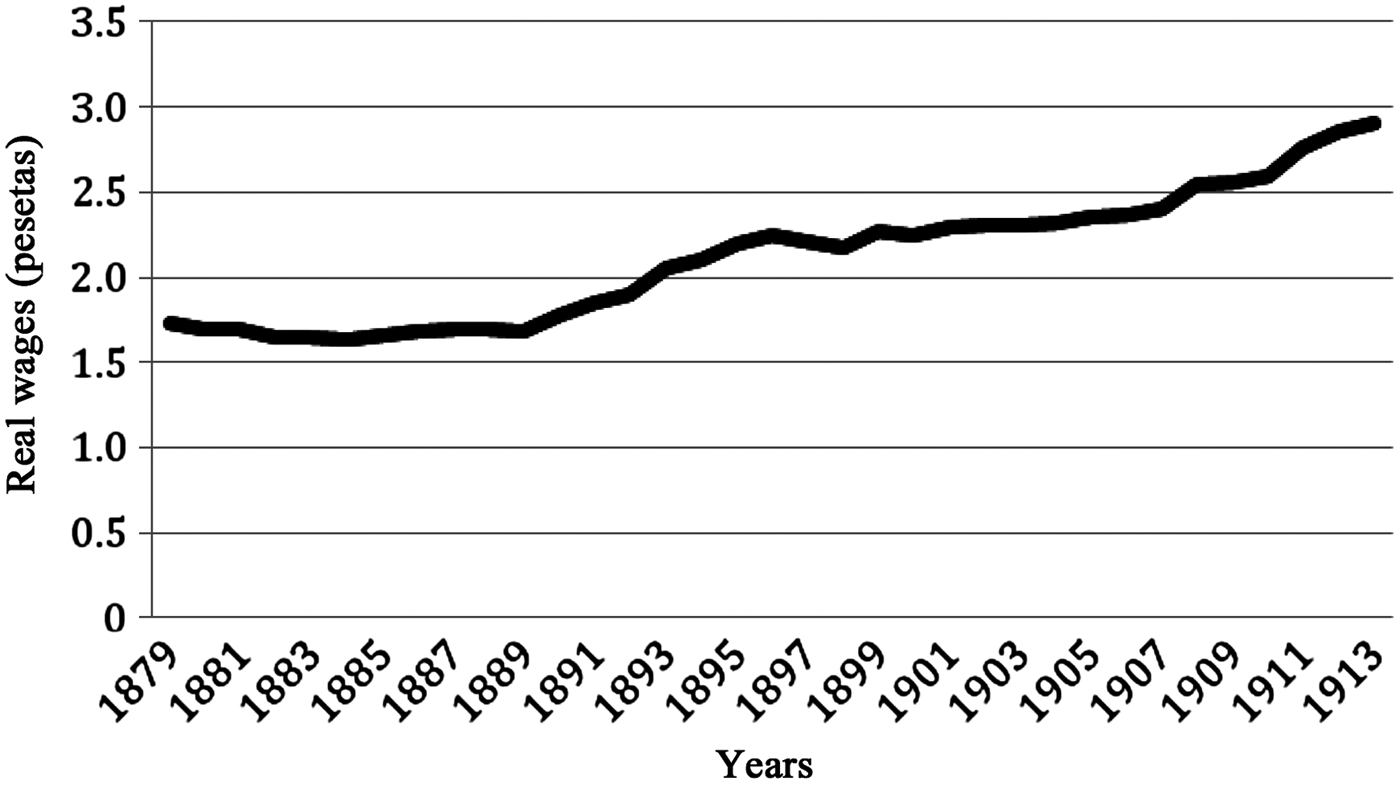
The miners in the Cartagena-La Unión mountain range corresponding to the first cohort (Figure 4) were measured between 1881 and 1885 and had spent their childhood and adolescence between 1861 and 1880, a boom period for the mining sector and one of ‘anarchic urbanisation’. Their short height (161 centimetres) corresponds to a diet poor in proteins,Footnote 56 with a high morbidity rate (Tables 1 and 4) and a very high incidence of child labour, especially compared with the Biscay mines. In the latter area, in the 1870s and 1880s between 5 and 12 per cent of children were employed in the mines, compared with between 34 and 37 per cent of children in the Cartagena-La Unión mountains. In addition, many children here worked underground.Footnote 57 The cohorts measured between 1886 and 1910 – young men who spent their childhood and adolescence between 1866 and 1905 – were shorter than those of the first cohort, even though, as we shall see later, their real wages were higher. It seems reasonable then to attribute this reduction in height to a persistent high morbidity, as no public health reform had been implemented (Tables 1 and 4) and child labour was still very high at between 26 per cent and 30 per cent.Footnote 58 Finally, the cohort measured between 1911 and 1915 was taller because the miners were children and adolescents between 1891 and 1910, a period of higher real wages (Figure 5), a lower morbidity rate (Table 1) and a 22 per cent reduction in child labour. However, the average height of this cohort was practically the same as that of the first one (161 centimetres), and still much shorter than the height of the rural population (Figure 4). The urban penalty was still very evident in the Cartagena mountain range, which is unsurprising given higher mortality rates from infectious disease and the high incidence of child labour.
Average rural height of south-east Spain and of the miners of the Cartagena-La Unión mountain range, standardised at 21 years, 1881–1915, in centimetres. Sources: J. M. Martínez-Carrión, ‘Estatura, salud y nivel de vida en la minería del sudeste española, 1830–1936’, Revista de Demografía Histórica 23, 1 (2005), 177–210; and J. M. Martínez-Carrión and J. J. Pérez-Castejón, ‘Creciendo con desigualdad. Niveles de vida biológicos en la España rural mediterránea desde 1840’, in J. M. Martínez-Carrión ed., El nivel de vida en la España rural, siglos XVIII–XX (Alicante, 2002), 405–60. We have standardised the height with the measurements proposed by J. M. Martínez-Carrión and J. Moreno-Lázaro, ‘Was there an urban height penalty in Spain, 1840–1913?’, Economics and Human Biology 5, 1 (2007), 144–64. The method consists of adding 0.9 centimetres to those measured at the age of 19 years and 0.5 centimetres to those measured at the age of 20 years.
Daily real wages of the miners of the Cartagena-La Unión mountain range, 1879–1913, in constant pesetas of 1879. Source: Series of daily real wages, compiled by Ángel Pascual Martínez Soto and Miguel Ángel Pérez de Perceval (unpublished data).
Figure 3 shows the real wages of the miners of Biscay (based on 80 per cent of workers in the sector) between 1876 and 1913. The real wages of the Cartagena-La Unión mountain range between 1879 and 1913 can be seen in Figure 5 (here an average of the wages of skilled and unskilled miners).Footnote 59 The nominal wages for Biscay have been deflated using a local price index of prices of consumer goods in the industrial and mining area of Bilbao.Footnote 60 We were unable to deflate the nominal wages of the Cartagena-La Unión mountain range with a local index because there is none; hence we have used Jordi Maluquer's national price index for Spain.Footnote 61
The gross nutritional input of the two mining areas deteriorated in the 1880s because the sudden population increase led to a rise in food prices and the subsequent fall of real wages. Later real wages rose modestly and diets also improved. We also know that, from the 1880s, nutrition was better in the towns than in the country.Footnote 62 How then can we explain the fact that the height of the miners in the two basins fell below the already short height of men in rural Spain? We believe that the decrease in net nutritional input was due to the first-comers industrial model adopted by these two areas: a high morbidity arising from market failures derived from an anarchic urbanisation and hard working conditions in childhood and adolescence. That is why we believe that the model proposed by Floud, Fogel, Harris and Hong can explain our case. As we have already said, this model ‘marries’ nutritional status with public health, thus explaining how, in spite of the slight increase in real wages and nutrition, the height of the urban population fell due to the very poor environmental and working conditions. We suggest that the model can also explain the increase in height and the decrease in the death rate of the Bilbao mining basin from the beginning of the twentieth century: improved nutrition due to a larger consumption of meat, fish and dairy products, combined with lower morbidity due to sanitary reform and better working conditions. In the case of the Cartagena-La Unión mountain range, the persistence of excess mortality and a lower height of town dwellers compared with the rural population until 1920 can also be explained by the model: the absence of public health reform and a high level of child labour. Here, however, the model cannot explain the disappearance of the urban penalty in this area, given the absence of public health reform. Instead, we attribute the decline in mortality to the depopulation of La Unión and El Beal arising from the slump in lead exports from the onset of the First World War.
5. THE FAILURE OF SANITARY REFORM
A final interesting question is why sanitary reform was implemented in some areas in Spain at the end of the nineteenth century and not in others. Currently, this is an extremely under-researched question. The history of public health reform in Great Britain, however, suggests various reasons. In Great Britain, reform was similarly slow: the hygiene movement took its first steps in 1830, but the London urban public health reform did not begin until the 1860s and in the rest of British cities until the 1870s.Footnote 63 Five factors have been proposed by historians to explain why reform took more than 40 years to be put into practice. The first factor is a radical liberalism advocating a blind faith in the market, that criticised public expenditure because every pound spent by the state diverted funds away from agriculture, trade and industry. Liberals of this ilk considered the excess mortality of working-class neighbourhoods to be a natural consequence of destitution and the bad habits of the poor. Second, a very restricted suffrage prevailed both in parliamentary and local elections, limiting the ability for those most affected by poor conditions to press for their reform. The third factor was a lack of interest from middle-class voters in voting for sanitary reform as the urban penalty did not affect them; they consumed water from their own water tanks or bought it from water sellers, and they purchased food from reputable stores and did not experience overcrowding in their homes or residential areas. A fourth factor was the existence of a number of pressure groups that opposed reform: conservative politicians, taxpayers, water companies, waste disposal companies, butchers, shopkeepers, water sellers, owners of slaughterhouses, tavern owners and even doctors and pharmacists. Finally, historians also point to the lack of fiscal autonomy suffered by local councils. These five barriers disappeared thanks to the political battle undertaken by the hygiene movement and other political forces in favour of the public health reform, and also thanks to the 1832, 1867, 1872 and 1885 electoral reforms establishing secret and practically universal male suffrage.Footnote 64
The Spanish Municipal laws of 1870, 1876 and 1877 enabled local councils to create taxes to finance sanitary reforms and also to request loans to implement them, although Government approval was also required.Footnote 65 However, urban public health reform did not take place until the end of the nineteenth century in some towns probably for the same reasons proposed for the British case. A similar radical liberalism opposed public expenditure by both Cánovas's Conservative Party and Sagasta's Liberal Party.Footnote 66 Suffrage was similarly restricted for much of the period and even after universal suffrage was introduced, corruption was a significant issue for local politics.Footnote 67 Similarly, we can point to the lack of interest on the part of the middle and upper classes since they were free from the negative externalities described above, the existence of pressure groups opposed to reform and a lack of fiscal autonomy of the local councils. However, in places where there was strong political pressure for a hygienist policy supported by Republicans and Socialists – namely in the large cities, Alcoy and the industrial and mining area of Bilbao – the two major parties of the Spanish Restoration period had to give in and the reform was carried out. José Joaquín García Gómez's recent study of Alcoy illustrates how, after decades of delay, political pressure finally forced through public health reform after 1891.Footnote 68 By contrast, where there was little or no pressure, as in much of the rest of Spain including the Cartagena-La Unión mountain range, the local councils did little or nothing.
6. CONCLUSIONS
From the case studies that we have presented, we can draw the following conclusions. First, the mining areas of Bilbao and the Cartagena-La Unión mountain range experienced excess mortality as a consequence of market failures derived from what we term an ‘anarchic urbanisation’. Second, the height of the miners in both areas fell below that of the rural areas. This can be explained by the model that Floud, Fogel, Harris and Hong have proposed to understand the urban penalty of the working-class districts of British cities during the Industrial Revolution. The environmental degradation reduced the miners’ well-being because it contributed to the lowering of their life expectancy and their biological standard of living. It is worth stressing that this occurred despite the increase in real wages, which once again illustrates that monetary income is not always a good indicator of well-being.
The sanitary reform of the mining area of Bilbao was thus a necessary although insufficient condition to raise the standard of living of the miners as it contributed to increasing their life expectancy and nutritional status. Conversely, the towns of the Cartagena-La Unión mountain region did not implement a public health reform at the end of the nineteenth century, a failure which contributed to the continuation of the urban penalty until the 1920s. Our case studies thus contribute to a wider literature stressing the importance of public health reform in improving urban life expectancy in the late nineteenth century.
ACKNOWLEDGEMENTS
In the writing of this paper, the authors have drawn from the research projects coordinated by the Ministry of Economy and Competitiveness: HAR2010-21941-C03-01, 02 and 03; and HAR2014-56428-C3-1-P, C2-P and C3-P.