Although scholars of American literature and culture have consistently studied male adventure stories, such as James Fenimore Cooper's Leatherstocking tales, adventure stories featuring a female protagonist were virtually absent from these studies until the 1980s, when Catharine Maria Sedgwick's Hope Leslie began to find a place in scholarly discussions and on course syllabi – after the emergence of women's studies programs at universities. A partial explanation for why female adventure stories were ignored by scholars for so long may be found in the fact that these narratives did not easily fit into the prevailing critical paradigm in American studies regarding gender. Females had their category in American literature: the sentimental. Influential scholars of the mid-twentieth century, such as R. W. B. Lewis, Henry Nash Smith, and Leslie A. Fiedler, focussed attention on a mythic American character, the frontiersman who penetrates the wilderness. These critics provided analyses of figures such as Daniel Boone and his fictional counterpart, Natty Bumppo, and discussed the power the romanticized western frontier had over the American imagination. Their observations were certainly accurate, as far as they went. Daniel Boone and his romanticized West did capture Americans' imagination, and Cooper did transform the Boone figure into a most engaging wilderness loner. However, these critics did not acknowledge the many narratives in which a female character conquers the frontier. The assumption seemed to be that the literary female figure belonged in the parlor with a sewing basket and not in the forest with a weapon. Ironically, even within the original Boone story, we find a mini-narrative involving a female hero who, like Boone, conquers the dark forces of the western frontier. Also like the Boone figure, this female protagonist became a kind of cultural archetype, her image appearing again and again in antebellum American letters.
In the 1970s and 1980s feminist critics offered an updated examination of the iconic figure of the male explorer in American letters. For instance, in The Lay of the Land, Annette Kolodny argues that the American pastoral features a feminized landscape that the male explorer perceives as a mother and/or lover; he praises her nurturing properties or is ravished by her beauties, and then transforms the natural, maternal land by establishing settlements or rapes the virgin territories by exploiting her natural treasures.Footnote 1 Similarly, Nina Baym in her seminal article “Melodramas of Beset Manhood” argues that nineteenth-century American narratives identified as canonical are those that present America as a “new land, untrammeled by history and social accident, [where] a person will be able to achieve complete self-definition.” She explains that the protagonist explores the “promising landscape” and fights against “encroaching, constricting, destroying society,” both of which (the landscape and society) are “depicted in unmistakably feminine terms.” Baym argues that this characterization sexualizes the narrative and contains misogynistic overtones.Footnote 2 Like Lewis, Smith, and Fiedler, though, the focus of Kolodny and Baym, albeit more critical, is primarily directed at the figure of the male explorer trekking through the wilderness (or the male scholar who identifies with this explorer). Although in other parts of their scholarly oeuvre these critics discuss the perspectives of American woman writers, these scholars both focus on what could be categorized as stereotypically feminine genres and/or tropes. In Woman's Fiction, Baym describes the pattern of development found in the heroine of the nineteenth-century sentimental–domestic novel.Footnote 3 And in The Land Before Her, Kolodny argues that female pioneers' fantasies about the West typically involved domesticating the wilderness through a “cultivated garden,” and she focusses on the suffering that women passively endured when their husbands decided to move West. In fact, Kolodny asserts in her book that she offers “no recovered myth of a female Daniel Boone.”Footnote 4
In the 1990s, the captivity narrative was the recipient of radical revisionist readings, a number of scholars providing new interpretations of the female figure who often plays a central role in this genre. Previously, critics such as Kolodny and Richard Slotkin had interpreted the female protagonist in the captivity narrative as representing weakness and as being victimized by the wilderness. These critics had commented on the binary in American letters of the virile, active male figure who conquers and/or adapts to the wilderness versus the helpless, desperate female figure who is physically and psychologically terrorized by the wilderness. However, more recently, scholars such as Christopher Castiglia, Kathryn Zabelle Derounian-Stodola and James Arthur Levernier have argued that this female figure blurs the stereotypical male–female binary because the women often exhibit “masculine” strength and endurance, especially when they escape from their captors. In Bound and Determined, Castiglia asserts that the captivity narrative “offers a story of female strength, endurance, and even prosperity,” and because it is set “outside the home” in the wilderness, it allows white women to “demonstrate skills and attitudes of which their home cultures thought them incapable.”Footnote 5 Although the mini-narrative of the female hero found in the Boone tale is not exactly a captivity narrative (Indians attack but the woman is not captured), my argument in this essay is aligned with this second group of critics, in that we focus on how the female protagonist in many antebellum narratives exhibits courage, independence, and bodily strength.
While typically we think of the antebellum image of womanhood as being associated with the domestic, with maternal tenderness and with loving submission to male authority, appearing in tandem with this image of womanhood was a very different one: the tough frontierswoman who expertly wields a weapon and confronts violence with violence. Kolodny remarks that after the Revolutionary War came to a close, “a generation determined to transplant itself westward” found itself in need of a new image of womanhood. Kolodny notes that in a 1773 reprinting of Mary Rowlandson's 1682 captivity narrative, the “original pious title” and “accompanying sermon … were removed, and the title page now carried a woodcut of a woman shooting at four men (presumably Indians).”Footnote 6 If one is familiar with Rowlandson's narrative, this accompanying image of a weapon-wielding woman seems rather an absurd one, since Rowlandson offered no violent resistance to her captors and waited patiently in her captive state to be redeemed (literally with ransom money and spiritually by God). The image would serve as a more appropriate title page for the captivity narrative of Hannah Dustan, who did kill her Indian captors (with a hatchet rather than a gun) and whose tale was first told in Cotton Mather's 1697 Humiliations Followed with Deliverances. Kolodny is correct when she asserts that “what a later generation sought to divine in narratives like Rowlandson's was not the story of patient suffering but a gesture of defiant survival,” which was “no idle theme” for the western-bound emigrants who “crossed the mountains in small family groups.”Footnote 7 Thus it is not surprising that the image of the heroic female in the wilderness found in the Boone narrative became a part of popular culture in antebellum America. She was an updated version of the Dustan figure, and perhaps an improved one because she was never captured.
To understand this female figure's place in the Boone narrative and in American culture, it is important to understand the history of the Boone narrative itself. In 1784 John Filson published The Discovery, Settlement and Present State of Kentucke, to which is appended “The Adventures of Col. Daniel Boon, one of the first Settlers, comprehending every important Occurrence in the political History of that Province.” Though Filson presented this document as if Boone had written it himself, most scholars believe that Filson did the writing, perhaps after encountering Boone in his own explorations of Kentucky. Two years later, in 1786, John Trumbull published a streamlined, pirated version of Filson's Boone narrative, entitled The Adventures of Colonel Daniel Boon, One of the first Settlers at Kentucke Containing the Wars with the Indians on the Ohio, from 1769 to 1783, and the first Establishment and Progress of the Settlement on the River. Written by the Colonel himself, “which was copied and reprinted in popular periodicals, pamphlets, and anthologies for the next fifty years.”Footnote 8 Thus it was Filson who essentially invented the hero that was soon to become one of the biggest myths of the western frontier, but it was Trumbull who produced the text that actually became embedded in the cultural fabric of the United States. As stated earlier, twentieth-century literary critics commented at length on the importance of the Boone figure in American letters, but they, strangely, ignored a female figure found in both these versions of the Boone tale, who also functions as an archetypal image. I am not referring to Boone's wife or daughters, who, as Slotkin and Kolodny both correctly observe, are virtually invisible in the Boone narrative, playing the symbolic role of “the first white women that ever stood on the banks of Kentucke river.”Footnote 9 And although Rebecca Boone clearly was active in contending with the physical forces of the frontier, the reader is given almost no concrete description of her actions. The only direct reference to her accomplishments is found in one of Boone's statements:
during my captivity with the Indians, my wife, who despaired of ever seeing me again, expecting the Indians had put a period to my life, oppressed with the distresses of the country, and bereaved of me, her only happiness, had, before I returned, transported my family and goods, on horses, through the wilderness, amidst a multitude of dangers, to her father's house, in North-Carolina.Footnote 10
Trumbull gives a much less sentimentally rhetorical description of this event, but both Filson and Trumbull indicate that Rebecca transports her family and all their worldly goods through an extremely dangerous and rough country by herself; however, that is all the information the reader is given – end of discussion about Rebecca Boone. No, it is not Rebecca Boone but another (unnamed) female figure in the Boone narrative who leaps out of the pages of this narrative and into so many other stories about the frontier. Using violence, this female figure actively protects her frontier home and her family against Indian invasion.Footnote 11 While this female figure is associated with the domestic, thus aligning with the traditional gender binary often imposed by critical discourse, she is also associated with the wilderness and with forceful, violent action, and thus she demonstrates a kind of gender fluidity that undercuts this binary.
This female figure appears in a very brief (one paragraph) passage in the Boone narrative, but her appearance is striking for a number of reasons. If one reads the complete Boone narrative, one notices the lack of any detailed description of violence, either by the white men or the Indians. Certainly the combatants shoot, kill, sustain great losses, and the like, but the reader is given no close-up views of violence. Boone reports that “we had skirmishes with Indians” or that a “smart fight ensued betwixt us,”Footnote 12 but the reader is presented with no blood and guts in either the Filson or the Trumbull accounts, except when this nameless woman takes her bloody action. The other reason this mini-narrative within the Boone story draws attention to itself is its placement within the story – almost at the end of the narrative. In the Filson version, the passage comes immediately before Boone's four brief concluding paragraphs. In the Trumbull version it is found on the last page, followed by a few concluding sentences. Being the last narrative event related, it takes on increased importance and is likely to be remembered more distinctly by the reader.
The incident is reported thus. A party of Indians attacks Crab Orchard, and one Indian in advance of his companions enters a house in which there are a woman, her children, and a black man. The Indian, “perceiving their defenceless situation, without offering violence to the family,” attempts to capture the man, who proves “an over-match for him,” throwing the Indian to the ground and struggling with him. Meanwhile the woman picks up an ax and cuts the Indian's “head off, while her little daughter shut[s] the door.” When the other Indians appear at the door, she sticks an “old rusty gun-barrel” through a crevice in the door and the Indians flee.Footnote 13 Thus, for the first time in the Boone narrative, the reader gets a close-up view of violence being perpetrated on an Indian, and who is perpetrating this violence? A woman, with some help from a black man. While the Filson account tries to downplay the agency of the woman by concluding that “Providence, by the means of this Negro, saved the whole of the poor family from destruction,”Footnote 14 the Trumbull account leaves the woman's agency front and center by simply reporting the action without any commentary. In either case, the reader is left with the image of a woman cutting off the head of an Indian who has offered no violence towards herself or her children (although the Indian does try to capture the black man whose relationship to the woman is left unspecified). The event itself seems to have virtually nothing to do with the adventures of Boone, so it is significant that both Filson and Trumbull chose to include this mini-narrative and to give it such prominent placement, at the very end of the narrative. Whatever their motivations for including this seemingly tangential tale in their frontier narratives, the female figure that they presented must have struck a chord with the public; similar images of this female hero were subsequently portrayed over and over in later narratives about the frontier, much as the Boone figure appeared again and again in American letters. The fierce woman of Crab Orchard became a cultural archetype.
This narrative of female heroism was so compelling that very similar tales were repeated in countless captivity and western adventure anthologies, almanacs, and the like for the next seventy years. We find evidence of the Crab Orchard narrative pattern in both the setting and the action of these subsequent narratives. The setting is a dark, frightening one, like that found in a fairy tale. The woman is in her own home, but her home is on the frontier. It is not a safe or “civilized” domestic space, but rather a “wild” or “savage” domestic space. The home is permeated by the wilderness. She is vulnerable because of her position on the frontier, but she learns to protect herself and successfully dispatches the evil Other when he attacks. This archetypal female is often associated with males in some way, but the men ultimately are unable to perform the traditional job of protector. For example, in the Crab Orchard narrative we find the man trying to protect himself (and the family) by struggling with the Indian, but the woman needs to step in to ensure that the Indian is dispatched. Also, the woman uses her cunning to trick the other Indians into leaving with the ruse of a non-functional gun barrel. In later versions of this archetypal story, the males demonstrate an even less functional presence: the husband is absent or the men in the home get shot as soon as the Indians arrive, thus leaving the woman to accomplish most of the important action herself. It is also interesting that in the Crab Orchard narrative the daughter (not a son) helps the mother in her battle against the Indians by remaining composed enough to close the door. Thus we have a wife and a daughter valiantly protecting their home against invaders, and the mother uses extreme violence to do so. In later versions of this tale, the woman often receives assistance in closing the door against attackers, although this assistance is not necessarily given by the daughter.
This archetypal narrative seesaws between a feminine–masculine binary. Emphasizing the feminine, the woman is presented as a wife/mother in her home and is surrounded by children/family who serve as a motive for the violent protective measures the woman takes. Enacting the masculine, the woman seldom screams or cries, but takes decisive, aggressive physical action and demonstrates level-headedness, cunning and energy in her designs. Having her home invaded seems to give the woman the freedom to take any action necessary for protection. Like Dustan, this figure functions as a kind of mythic, avenging mother. Symbolically, though, the woman is also protecting her home from (sexualized) violation. Forestalling this violation, the masculinized woman controls phallic objects of power – hatchets, swords, guns – while she protects herself, her family, and her home. In many ways, this figure is reminiscent of a female hero found in the Old Testament Apocrypha, Judith, who single-handedly saves the Israelites from slaughter or surrender by cutting off the head of their enemy, Holofernes, with his own sword.
The pattern of this archetypal narrative becomes even clearer when later versions of this tale are examined. Shortly after the Boone narratives appeared, the Affecting History of the Dreadful Distresses of Frederic Manheim's Family, a collection of sensationalized accounts of Indian captivities, was published in 1793 and was reprinted in various forms and under various titles (either as a whole or in parts) dozens of times through the close of the eighteenth century and throughout the nineteenth.Footnote 15 One account in this collection, involving a woman by the name of Experience Bozarth, follows the Crab Orchard narrative pattern. The account, entitled “Signal Prowess of a Woman, in a Combat with some Indians,” is reported in letter form. The writer takes pains to justify the woman's actions: “you will see how a person of your sex acquitted herself in defence of her own life, and that of her husband and children.” The writer reports that several families have gathered at the Bozarth house for protection. The children run towards the house to inform the adults that Indians are attacking. The two men who are present in the house are the first to grapple with the Indians. One immediately receives “a ball in the side of his breast” while the other throws an Indian on the bed and calls for “a knife to kill him.” The writer then announces, “Now mrs. Bozarth appears the only defence, who not finding a knife at hand, t[akes] up an axe … and with one blow cut[s] out the brains of the Indian.” A second Indian then enters the house and kills the man on the bed. Mrs. Bozarth uses her axe to give him “several large cuts, some of which let his entrails appear.” Thus the Indian successfully kills the man, but is unable to kill the woman. Upon hearing the wounded Indian cry out, several others run through the door to try to assist him, “one of whose heads mrs. Bozarth cl[eaves] in two with her axe.” With the help of the wounded man, she then manages to close and fasten the door.Footnote 16 Thus, following the archetypal pattern, Mrs. Bozarth is presented in a hazardous domestic space. Her maternal position is emphasized by the many children present. Also, we find men in the home, but they are quickly incapacitated. Mrs. Bozarth is the one who must save the day. Although she does not actually decapitate her enemy (like the female figure in the Crab Orchard narrative), she causes significant cranial damage, cutting “out the brains” of one and cleaving the head of another in two. In the middle of the violent mayhem enacted by Mrs. Bozarth, the narrator interjects a reminder of her maternal position. He reports that the second wave of Indians who pass through the door have been “fully employed, killing some children out of doors.”Footnote 17 In this account, it is not the daughter who helps the woman close the door, but rather a wounded man. Like her predecessor in Crab Orchard, Mrs. Bozarth remains calm and focussed during the attack and exhibits amazing physical prowess.
Similarly, in an 1803 narrative appendix to The Connecticut, Rhode-Island, Massachusetts, New-Hampshire & Vermont Farmers Almanac, a Mrs. Watts is shown in her home during an Indian attack – her husband having left on a journey a few days earlier.Footnote 18 She grabs both a tomahawk and an old sword and waits for the Indians to hack a hole in the door. One Indian thrusts his head in, and Mrs. Watts strikes “with so good effect as to beat out his brains.” The Indians then shoot her in her left arm and, hearing her cries, think she will offer no more resistance. Somewhat unaccountably, another Indian puts his head through the same hole in the door and receives “so severe a blow as to be unable [to] draw it out.” In this version of the archetypal tale, Mrs. Watts is unable to keep the Indians at bay. They capture her and her daughters, but she escapes after the Indians have burned her daughters at the stake. This account especially emphasizes the overtones of symbolic sexual violation often present in these narratives: the Indians repeatedly thrust their heads through a hole in her bedroom door, and she beats them back. Historians generally agree that Indians did not rape their captives, and captivity narratives virtually never report actual sexual violation of the female captives. However, these Indians have violated the sanctity of the woman's home and, by extension, the white female body. Some female captives would have become the wives of Indians (no doubt some were more and some were less amenable to this proceeding) or would have been otherwise adopted into the Indian tribe. To many contemporary readers, this potential marriage or adoption would signal a disturbing violation of whiteness, a going over the wall to the dark side. Thus in these narratives the women are validated in fighting and killing to protect their symbolic chastity and the integrity of their whiteness.
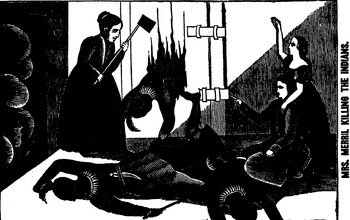
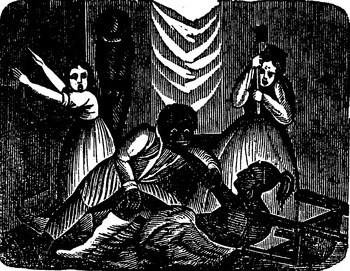
We find similar images of attempted forced entrance in other narratives. An 1808 anthology entitled A Selection of Some of the Most Interesting Narratives of Outrages Committed by the Indians, in Their Wars with the White People gives an account of a Mrs. Porter, whose husband having gone to the mill contends alone with an Indian attack. She grabs a sword and a rifle, sets “the door about half open,” and waits until an Indian enters, splitting “his head with the sword” and doing the same to the next who enters as well.Footnote 19 She shoots the one remaining Indian and then flees to a place of safety. We find similar attempted forced entrances in a tale presented in the anthology Incidents of Border Life (1839). Although the narrative is entitled “Adventures of John Merril,” his wife is the central actor in the story. The husband, although present in the home, is shot at the beginning of the Indian attack, and his arm and leg are broken. Following the archetypal narrative pattern, the Indians hack a hole in the door with their tomahawks, but Mrs. Merril, “a perfect Amazon both in strength and courage,” guards the door “with an axe, and successively kill[s] or badly wound[s] four of the enemy” as they try to enter the door. The remaining Indians then climb onto the roof and attempt to enter the house through the chimney (another symbolically vaginal entryway), but Mrs. Merril has the presence of mind to empty the contents of a feather bed onto the fire, producing a “furious blaze and stifling smoke.” The Indians fall down the chimney and Mrs. Merril dispatches them with the axe. Finally, a last Indian tries to sneak in through the door while she is contending with those at the chimney, but she turns and attacks him, giving him a “gash in the cheek” (see Figures 1 and 2). He flees and later gives a report of “the fierceness, strength and courage of the ‘long knife squaw!’”Footnote 20 This is an image that perfectly joins the male–female binary with the phallic “long knife” in adjectival association with the word “squaw.”
“Mrs. Merril Killing the Indians.” From Indian Atrocities! (Boston, 1846) 22.

“Female Daring.” From Indian Atrocities! (Boston, 1846) 5.

The popularity of the frontier narrative featuring a strong, violent female figure suggests that readers were accepting of the idea of a protectively aggressive woman, at least while she was contending with chaotic forces in the wilderness, with the evil Other. For the contemporary white readers of these tales, the Indian, who is almost always characterized as the aggressor, represented the evil Other. It would seem that the perceived Indian threat mitigated the perceived differences in gender; both male and female were validated in taking aggressive, “masculine” action when fighting to protect “civilization.” The otherness of the Indian was more significant than the otherness of the female.
There are a number of reasons why the Indian represented the frightening Other for European Americans. As Richard Slotkin has pointed out in Regeneration through Violence, early settlers in the New England colonies felt threatened both physically and spiritually by the wild forests and the native inhabitants of these forests, whom the settlers associated with devilish desires and barbaric practices. The Puritans linked their material success and spiritual salvation to well-ordered communities. Thus, quite literally, their worst nightmare was to be dragged into the shadowy woods, but in fact this happened quite regularly when the Indians raided settlements and took captives. Even after the Puritan presence in American society had diminished, this deeply embedded fear of the Indian remained in the psyche of many Americans. During the late eighteenth and early nineteenth centuries the colonies experienced a series of wars, and many Indian tribes joined in the fray. During the French and Indian War (1754–63), the Revolutionary War (1775–83), and the War of 1812, a number of Indian tribes fought on the side of the “enemy” in battle and participated in guerilla-style raids of homes, killing and/or capturing families and setting fire to houses and barns. In addition, as the white population continued to grow, so did the push into the western territories, into the Ohio valley after the Revolutionary War, and continuing ever westward after that. Daniel Walker Howe comments on the “stunning magnitude” of the white migration westward, reporting that the 1800 census recorded only “a third of a million people” living west of the Appalachians while by 1820 “the number was over 2 million.”Footnote 21 Of course, as white families moved into territory already occupied by the native populations, conflicts occurred. These skirmishes, raids, and captivities were well publicized in the newspapers and the magazines of the time, even on the East Coast. Also, a number of full-scale conflicts took place in the first half of the nineteenth century between the native populations and the United States government, for instance the Black Hawk War in the Mid-west and the Seminole Wars in Florida. Thus during the eighteenth and nineteenth centuries the figure of the Indian loomed large as the evil Other in the psyche of many white Americans.
According to Lucy Maddox, by the early nineteenth century public discussion of the “Indian problem” offered two options for the Indians: “to become civilized, or to become extinct.”Footnote 22 Many white Americans argued that Indians were incapable of becoming civilized, which was conceived of as having a respect for private property, converting to Christianity, and adopting the English language.Footnote 23 In addition, the “scientific” ethnological thought at the time was that “the white race [being superior] was genetically destined to inherit the earth.”Footnote 24 Finally, white Americans, who were self-consciously focussed on the “project of nation-building” at this time, saw tribalism, associated with Indians, as antithetical to the “unitarian character of American new-nation ideology.”Footnote 25 Public discussion of the “Indian problem,” punctuated by narrative illustrations of “savage” Indian behavior such those discussed above, and the presidential policy of Andrew Jackson ultimately led to the passage of the Indian Removal Act in 1830, which forced the vast majority of the native populations to move west of the Mississippi River (although this was not the last move they would be forced to make). A notable exception, the Seminoles in Florida refused to be relocated and waged war on the US military into the 1840s.
Thus in the Crab Orchard narrative and subsequent versions of this tale, the “civilized” frontierswoman is pitted against the “uncivilized” Indian. Her violent action not only allows for her survival and the survival of her family members, it also allows for the survival of the nation and the white race. One of the underlying messages in these narratives is that if the Indian refuses to be civilized, he will be extinguished. It should be noted, however, that frontier narratives of these kinds could have simply offered a male protagonist, but this was not the case. As white Americans were moving ever westward, the reading public seemed to be open to the idea of both men and women taking the violent action necessary to conquer the wilderness.
As a practical matter, the realities of the emigrant experience forced the blurring of traditionally gendered codes of behavior. According to John Mack Faragher, who discusses the experiences of men and women on the Overland Trail during the 1840s and the 1850s, women often took their turn driving both the wagons and the stock, activities that they would not have typically undertaken in a more settled domestic environment. Faragher also comments that emergencies, such as “stranded wagons, prairie fires, Indian scares … also called on women to carry out male duties.”Footnote 26 One woman reported in her diary, “I was always timid … I couldn't stand idly by, however, when danger threatened and my services were needed … I put on my husband's hat and overcoat, then grasping our old flintlock between my shaking hands I went forth in the darkness.”Footnote 27 Thus the action the iconic frontierswoman undertakes in antebellum narratives reflects the real-life experiences of many emigrant women.
It is likely that this heroic female figure is allowed to take “manly” violent action because she is on the fringes of civilization – in the liminal space of the wilderness – and because she is faced with extreme circumstances, such as attack and/or captivity. The authors/narrators of these tales try to contain the woman's masculine action with feminized rhetoric, which invokes motherhood, weakness, domesticity, even though these feminized invocations are often incompatible with the events related in the narrative. Still, these female figures – part fantasy and part reality – complicate the traditional gender paradigm (the nurturing passive female versus the active aggressive male) too often imposed by scholars on American letters and culture. While historians and literary critics have emphasized the separate spheres men and women occupied in antebellum America, these adventure narratives seem to suggest that women, both in real life and in American letters, did not remain neatly in their supposed sphere. They penetrated the sphere with performances of violence, physical dexterity, and fortitude.
Scholarly discussions of mid-nineteenth-century American literature and culture have often emphasized the development of an ultra-feminine conception of womanhood during this period. Barbara Welter explains how the emerging “cult of true womanhood” required women to embody “piety, purity, submissiveness and domesticity.”Footnote 28 Mary Ryan identifies this female paradigm as “the cult of domesticity,” where the mother reigned with loving authority in the home.Footnote 29 While it is true that representations of this female ideal are pervasive in mid-century texts, for instance in sentimental–domestic novels and advice manuals, what seems to have been overlooked is that representations of a very different female ideal are commonly found as well. In many texts of the mid- and late century, one discovers the literary progeny of the Crab Orchard protagonist. This female figure is tough and aggressive and takes independent action outside of the domestic setting, often roaming through wilderness areas. As authors such as Cooper and William Gilmore Simms transformed the Boone figure in their works, other authors transformed the figure of the tough frontierswoman in their fiction. Of course, these authors gave the female adventure hero new twists.
An author who presents many versions of this active female protagonist in her novels is Catharine Maria Sedgwick. Sedgwick's work is an interesting case because many critics, for instance Herbert Ross Brown, have focussed exclusively on the sentimental nature of her novels. Certainly, sentimental elements can be found in Sedgwick's novels, but in many instances her heroines are not sweetly passive and a number of them demonstrate the active spirit of their ancestral frontierswomen. For example, Hope Leslie (1827) features Magawisca, an Indian heroine who does not wield a hatchet but does use her own arm to block the blow of a hatchet and save a young man from execution at the hands of Indians, losing her limb in the process. In this scene, the young man, Everell, plays the role of the submissive victim, a more typically feminine role. In contrast, Magawisca takes on the active, heroic role, climbing up a sheer rock face, confronting pain, injury, and the possibility of death to save someone in trouble. Also, in Sedgwick's less well-known Redwood (1824), the heroine Ellen and her friend Deborah, “two errant damsels … in quest of adventure,” plunge through a forest at night to save another young woman, Emily, who is being held captive by an old Indian at the behest of a white man who is trying to force her into marriage.Footnote 30 The two woman release Emily from her captivity and safely convey her back to her family. Thus the scheming males who try to use their physical power to victimize a young woman are vanquished by females.
Similarly, E. D. E. N. Southworth has often been viewed purely as a sentimental novelist. However, Southworth's runaway best seller, The Hidden Hand, first serialized in 1859 and later published as a book, features a heroine who charmingly undertakes “masculine” action and even violence. Capitola, who also calls herself a “damsel-errant in quest of adventures,” rides alone on horseback through the dangerous forests, outwitting the predatory villain, Craven Le Noir. She even challenges and shoots the same Le Noir, who has defamed her character.Footnote 31 Repeatedly, Capitola is identified as the hero of the narrative, at one point declaring, “I will be a hero!”Footnote 32 She performs stereotypically heroic deeds, saving damsels in distress and helping to capture outlaws. The reading public loved this gender-bending heroine, so much so that the novel was dramatized and staged in at least forty versions.
At mid-century, technological and manufacturing advances allowed for books and other reading materials to be produced more cheaply, and this contributed to the emergence of an extremely popular genre, the sensational narrative. While these narratives took many forms, one popular version featured an aggressive heroine who contends with destructive forces in the West. A classic example of this kind of heroine is found in Edward L. Wheeler's dime novel Deadwood Dick on Deck; or, Calamity Jane, the Heroine of Whoop-Up (1878). In this novel, Calamity Jane is presented as a cross between a good ol' boy and a good bad girl. She is considered one of the boys in that she can shoot, gamble, swear, and drink whisky with the best of them. She is a “reckless buchario” who rides a “fiery little Mexican” charger and smokes cigars.Footnote 33 With a revolver at her waist and a rifle on her back, she crisscrosses the desert landscape dressed in buckskin trousers and a velvet jacket. Like Capitola in The Hidden Hand, Calamity Jane really functions as the hero of Deadwood Dick. As she rides across the desert, righting wrongs, she is identified as the “mountain knight.”Footnote 34 She single-handedly fights off packs of outlaws. She rescues the central male character, Sandy, a number of times – first from a ferocious bear and later, “at the peril of her own life,” from a mine that has been booby-trapped and is about to explode.Footnote 35 She saves her old beau, Charley, from a group of bandits. She is a damsel-knight saving gentlemen in distress, and she never needs saving herself.
And late in the nineteenth century, even Mark Twain, whose work has been interpreted by Fiedler and others as associating females with the oppressive confinement of civilization, wrote tales portraying rambunctious, weapon-toting young women. For instance, in “Hellfire Hotchkiss,” a young heroine furiously rides her horse around the country and is brave enough to plunge into a river among the “turmoil of monster ice-cakes” to save a boy who has fallen through the ice, a feat no one else in town is willing to attempt. Described by another character as “the only genuwyne male man in this town,” the young heroine also saves a man struggling against two gun-wielding thugs by beating them with a bat.Footnote 36 It is interesting to note that in “Hellfire Hotchkiss,” as in The Hidden Hand and Deadwood Dick, the “savage” Indians have been replaced by villainous white men as the heroine's antagonists, perhaps an indication that, in the second half of the nineteenth century, the Indian threat was perceived to have diminished, with their almost entire removal west of the Mississippi. It is also noteworthy that these female heroes are “allowed” to take violent physical action against their “own kind” to protect both themselves and others; these heroines do not play the role of passive victims (the typical role the heroine plays in seduction novels, for instance, in relation to the white male villain). In contrast to seduction and sentimental–domestic narratives that typically feature a highly feminized heroine, the frontier adventure tale provides a venue for a more androgynous heroine.
Thus while popular nineteenth-century novels such as Susan Warner's The Wide, Wide World and Maria Susanna Cummins's The Lamplighter present an ideal heroine who demonstrates submissive religiosity in an orderly domestic space, other popular novels such as The Hidden Hand and Deadwood Dick on Deck present a competing ideal heroine who demonstrates active individualism in a chaotic wilderness space. Despite what many critics have suggested, the concept of womanhood in eighteenth- and nineteenth-century America was not monolithic. One reason it was not was that real women continually pushed into the western frontier, and, while doing so, took on “masculine” action. Thus the romanticized narrative of the western frontier was not exclusively a male narrative. The frontier wilderness, as mythologized by the Filson/Trumbull tale of the “discovery” of Kentucky, did give birth to the iconic Boone hero, but it gave birth to an iconic female hero as well. The prevailing critical paradigm regarding antebellum literature has too often served to calcify an artificial male–female binary, which is clearly undercut by androgynous frontier adventure narratives, such as The Adventures of Daniel Boone.