Introduction
The current political instability in Libya poses serious threats to Libya's cultural history in terms of both its sites and monuments, and aspects of its portable heritage. Already during the civil war that followed the Arab Spring, international experts were engaged with compiling ‘no strike’ lists for NATO to try and avert the sort of avoidable damage to key heritage assets that had occurred in the US invasion of Iraq (Kila Reference Kila, Kila and Zeidler2013, 24–27, for a good account; see also Francioni and Godley Reference Francioni and Godley2013). The Association of National Committees of the Blue Shield organised inspection tours of Libya's World Heritage Sites and major museums as soon as conditions permitted, revealing that damage had indeed been minimised (Kila Reference Kila, Kila and Zeidler2013, 26–27). Subsequently, attention has focused on capacity building (Kane, this volume; Nebbia et al. Reference Nebbia, Leone, Bockmann, Hddad, Abdouli, Masoud, Elkendi, Hamoud, Adam and Khatab2016; Wootton et al. Reference Wootton, El Habashi, Stewart and Walda2015) and remote monitoring of threats, as exemplified by the Endangered Archaeology Project (Bewley et al. Reference Bewley, Wilson, Kennedy, Mattingly, Banks, Bishop, Bradbury, Cunliffe, Fradley, Jennings, Mason, Rayne, Sterry, Sheldrick, Zerbini, Campana, Scopigno, Carpentiero and Cirillo2016). However, it also needs to be recognised that the destruction and damage to sites has been accompanied by an upsurge in looting and trafficking of Libya's portable heritage. Since the revolution in Libya in 2011, antiquities have frequently been looted from ancient sites and the number of illicitly sold objects on the international art market has risen sharply. Furthermore, there is a clear and logical linkage between the types of site that have suffered the greatest destruction and the potential availability of particular types of portable antiquities on the market.
The Libyan Antiquities at Risk (LAaR) project was born out of this increase in looting and trafficking of Libyan heritage. The most infamous incident in 2011 was the break-in at a Benghazi bank, targeting the so-called ‘Benghazi treasure’ (Ensoli Reference Ensoli2013). Against a background of growing concern about illicit trafficking of Libyan antiquities, ICOM put together a red list for the country in 2015 (http://icom.museum/resources/red-lists-database/red-list/libya/) to match the emergency red lists for other countries facing similarly severe threats to portable heritage (Syria and Iraq). The red lists are short, sparsely illustrated lists of typical antiquities of different periods; for the Graeco-Roman period they contain many categories of artefacts whose provenances of production may have differed from their final resting places. A problem revealed by the looting of the Benghazi treasure and the red lists is that much of the material that is flooding onto antiquities markets from places like Libya is not readily identifiable as being of Libyan origin, as many items like ancient coins had a pan-Mediterranean distribution. Once caches of looted artefacts found in Libya get outside the national borders, it is much harder to establish their Libyan origin. For this reason, our project took an early decision to focus on categories of artefact that were distinctively, and indeed diagnostically, of a Libyan origin – thus being the ones most likely to lead to prosecution of traffickers and restitution of artefacts.
For us, the wake-up call came in 2013 when an imported statue of a so-called ‘Goddess of Death’ from Cyrene was seized in London. The appearance of a statue from Cyrene destined for the UK antiquities market raised serious concerns for Susan Walker, at that time President of the Society for Libyan Studies. It became evident that a tool was needed to assist customs officers and heritage professionals to identify Libyan antiquities that are illegally removed from Libya and sold under a false provenance.
This article presents the work carried out during the first phase of the LAaR project (September 2015–June 2016; February–May 2017), which was generously funded by the Society for Libyan Studies and the Arts and Humanities Research Council. It also explains the wider context for the workshop held at the British Academy in March 2016, which was the starting point for this themed issue of Libyan Studies. We shall first outline in more detail the nature of the diverse threats to Libya's heritage, before turning to the approach taken by the LAaR project and explaining our chosen focus. The LAaR project has made significant use in its initial stage of materials held in the Society for Libyan Studies Archive at the University of Leicester, but one of the main results of our initial work and the networking and discussion that we have instigated is a vision of how the project can be expanded in future. The final section of the paper presents our current thinking on this, though with the situation in Libya in such a state of flux, there are still many uncertainties. However, two things are clear: Libya's heritage is under attack as never before and the success of any measures to ameliorate the situation ultimately depends on the engagement of the Libyan people in the enterprise. We shall return to this last point in our conclusion.
Preliminary steps: assessing threats to Libyan archaeological heritage
One of the priorities at the start of the LAaR project was to make a careful assessment of the principal threats to Libyan archaeological heritage. This was a necessary step to evaluate priorities for the project and to set up a work agenda. Consultation with Libyan colleagues and experts across the UK, Europe and the US was illuminating to better understand the situation in Libya.
Continued political instability and conflict in the six years since the Arab Spring of 2011 is undoubtedly the most concerning issue. However, it must be acknowledged that threats of various kinds to Libyan heritage occurred even before the revolution (Ensoli Reference Ensoli2012). Natural threats fall within this category; for instance, erosion of the sea frontage has become a matter of increasing alarm. Since the late 1990s, coastal sites like Tocra, Ptolemais and Apollonia have been subject to considerable damage (Bennett and Barker Reference Bennett and Barker2011, 10–12; Bennett et al. Reference Bennett, Wilson, Buzaian and Kattenberg2004; Catani Reference Catani and Rizzo2016, 174–76). Factors related to human activities are even more troubling. These include farming, the construction of houses and infrastructure projects, quarrying, rubbish dumping, land clearance, oil exploration, tourism, and malicious damage. The site of Euesperides, which was excavated under the auspices of the Society for Libyan Studies, has been endangered by rubbish dumping for decades (Marzano Reference Marzano2006). Similar observations apply to the archaeological area of Sirat al-Jamil, which has been swallowed by the city of al-Bayda (Kenrick Reference Kenrick2013, 118). Modern constructions that are being built close to archaeological sites without the consultation of the appropriate authorities have long been a major issue. For instance, construction of a modern harbour and a large hotel complex at Apollonia started without consulting the Libyan Department of Antiquities (Marzano Reference Marzano2006, 93). An ancient settlement featuring amphora kilns and other archaeological remains at Janzur, 6 km east of Tripoli, is now surrounded by new housing which threatens its preservation (Bennett and Barker Reference Bennett and Barker2011, 8). Analogous threats are posed to the site of El Mtaugat in the territory of Cyrene (Petraccia et al. Reference Petraccia, Saad and Abdel Hati2011–12). Sites located in the hinterland of the country, such as those recorded in the pre-desert zone and in Fazzan, are similarly endangered because of housing development and expanding agriculture (Bennett and Barker Reference Bennett and Barker2011, 13–14; Mattingly Reference Mattingly and Ensoli2012, for a review of the multiple threats affecting archaeology in Fazzan).
The outbreak of the revolution in February 2011 made this situation more precarious. Archaeological sites did not suffer much from the conflict, while some museums were broken into during the war and were damaged, such as Bani Walid (Baldoni Reference Baldoni2013–14, 57–59; Musso, this volume, on the important role of the local community in repairing the museum and safeguarding its collections). The principal concerns are represented by the chaos and lawlessness in the aftermath of the Arab Spring. At present, the country is still essentially split into two halves that struggle to negotiate and come to terms with each other; powerful militia groups and local tribal communities are also competing with one another. The Department of Antiquities (DoA) has been divided into two separate (rival) offices with two chairmen based in Tripoli and Benghazi respectively (Bennett and Graham Reference Bennett and Graham2015, 158). This lack of official governance combined with legislation and socio-political instability has further aggravated threats and damage to local archaeological heritage. Land grabbing and new private housing developments are growing on an alarming scale as a reaction to Gaddafi's former restrictive policies (Fitzgerald and Megerisi Reference Fitzgerald and Megerisi2015). Construction on known ancient sites, which was for years controlled or blocked, has been facilitated by the state of abeyance of the cultural heritage laws and continued political anarchy. The recent utter destruction of the village of Artemis at Massa is a significant case in point (Bennett and Graham Reference Bennett and Graham2015, 158–59, figs 1–9).
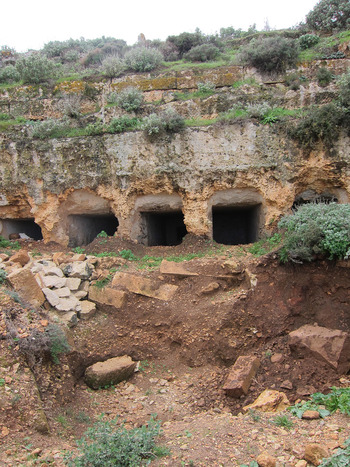
While ancient rural sites are particularly exposed to these activities because of their peripheral location, unregulated housing and agricultural field development are threatening major archaeological sites as well (Rayne et al., this volume). As described in numerous recent reports, the extramural area and cemeteries of the UNESCO World Heritage Site of Cyrene are affected by vandalism, destruction and looting (Abdulkariem Reference Abdulkariem2013, 103; Abdulkariem and Bennett Reference Abdulkariem and Bennett2014; Al Raeid et al. Reference Al Raeid, Di Valerio, Di Antonio, Menozzi, Abdalgader El Mziene and Tamburrino2016, 7–10; Bennett Reference Bennett2016, 183; Hussein Reference Hussein2013; Kane Reference Kane2015, 208–11). The monumental ancient tombs in these sectors are officially protected by law, but their location outside the boundaries of the archaeological area makes them vulnerable. While efforts are being made by local archaeologists and personnel of the DoA to protect these monuments, the task is simply too great and there is also a severe lack of international policy to support them. Tombs are being damaged or destroyed by abusive constructions on a regular basis, and ancient stones are frequently reused in modern buildings. Demolitions in most cases lead to uncovering portable antiquities associated with the monuments, which also encourages a growing presence and activity of looters in the field (Figure 1). Clandestine excavations, looting and illicit exportation of such artefacts from Libya are becoming an increasingly concerning issue (Bennett and Graham Reference Bennett and Graham2015, 159; Kane Reference Kane2015, 211).
Recent looting at one of the rock-cut tombs in the cemeteries of Cyrene. (Photograph: Susan Kane.)

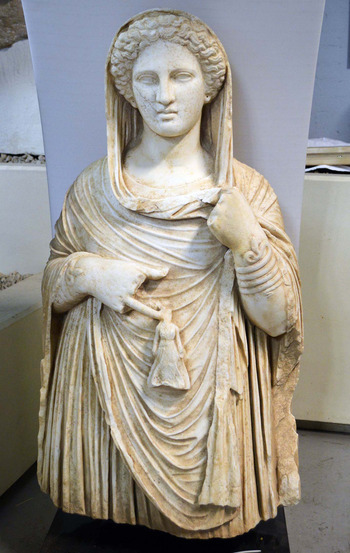
As discussed by Morgan Belzic in this volume, we can draw a direct connection between the destruction of tombs at Cyrene and the recent appearance of large numbers of funerary sculptures on the illegal art market. The most significant case is represented by the Cyrenean ‘Goddesses of Death’, a very distinct local statuary type probably depicting the goddess Persephone emerging from the underworld (Oldjira and Walker Reference Oldjira, Walker, Mugnai, Nikolaus and Ray2016, 193–95). One of these statues was seized by HM Revenue and Customs at London Heathrow in 2013. This marble statue (c. 120 cm high) depicts a female figure wrapped in a mantle, head veiled, with hair in tight locks above the forehead. The left hand is holding on to the garment above the chest, and the right hand is pointing towards a small figurine situated in front of her belly (Figure 2). It transpired that it was illegally exported from Libya in 2011, probably during the chaotic events that followed the outbreak of the Arab Spring. Through forged documentation that attempted to prove a provenance from Lebanon, it made its way to the UK via Dubai to be sold on the illegal art market. The case against the importer was recently won in court and the sculpture declared property of the Libyan State (Bennett Reference Bennett2016, 182). The statue is temporarily in the British Museum's custody; it was hoped that it could be displayed there with a panel informing on the seizure to raise public awareness, but unfortunately this has not been arranged as yet.
‘Goddess of Death’ from Cyrene seized in London in 2013. (Photograph courtesy of the British Museum.)

This example from the UK is not isolated. Many similar illegally imported sculptures have been tracked down elsewhere, which clearly shows how Libyan antiquities are becoming part of a widespread network of illegal trafficking. Funerary monuments are the main source of provision of these objects given their marginal location within archaeological sites, which makes them an easy target for looters. Sculptures, decorations and portable antiquities from tombs in Tripolitania and Cyrenaica can be identified as a category of highly endangered artefacts, on which we decided to focus during the first stage of LAaR. The occurrence of distinct Libyan features on these objects makes them easily recognisable when they turn up on the antiquities market. However, existing publication of these objects is poorly illustrated and not widely accessible. Furthermore, the continued state of conflict in Libya has effectively closed the country to overseas visitors, including archaeological researchers, leading to a growing loss of knowledge of Libya's ancient cultural heritage. Therefore, the establishment of a comprehensive web-based reference collection of types and their particular iconography will provide a tool for combatting illicit trade. For this reason, the LAaR project chose to focus its initial efforts on creating a database built around these sculptural pieces, but always with a view to expanding the scope of the work to encompass other types of portable antiquities that are distinctively ‘Libyan’ and that offer a clear chance of being identifiable as such if intercepted.
LAaR: providing tools to help combat the illicit antiquities trade
The principal aim of LAaR is to develop an illustrated reference website and database that records antiquities that are recognisably Libyan in appearance. The website is currently undergoing final preparation, with a launch date scheduled for later in 2017; there will be a link to it from the Society for Libyan Studies' website. The main user groups of this reference resource are customs officials, international agencies, museum curators, researchers working for professional art dealers, the police and the cultural heritage sector. The objective is to alert them to and help them identify Libyan materials that have started to appear in higher numbers on the art market. From the beginning, it was important for us to establish a network that allows us to communicate effectively with all these different target groups (see below).
During the first stage of the project, our main focus has been on the removable and portable elements of tomb decorations from Cyrenaica and Tripolitania that are in danger of being illegally exported from Libya and sold on the art market. As pointed out above, ancient cemeteries in Libya are particularly vulnerable to destruction and looting due to their marginal position outside the boundaries of archaeological sites. The ‘Goddess of Death’ that was stolen in 2011 is a case in point, as it undoubtedly comes from a funerary context. The online reference collection is designed with its main user group in mind. It is particularly important to keep the entries as concise as possible and to describe the objects in a manner that is easily understandable by non-experts.
The database is divided into three interlinked tables: a site table, a monument table and an object table. The first table holds information about the site itself, its geographical location and a short description. The second table is concerned with the monument or group of monuments from which the decorations come; it features entries such as the type of monument, its measurements and a short description. The third table records the relevant information about the individual artefact, such as the type of decoration, its measurements, dating evidence, type of material, colour and a short description of the principal, more easily identifiable, characteristics. Relevant images can be uploaded to each table. The description for each item is limited to 124 words to keep it as short and precise as possible, and to make it easy and quick to read. The main attributes of each object are described while also distinguishing styles and features, such as particular damages (ancient or modern), that may help to identify the object should it appear on the art market. Where possible, published information about these pieces is added. Descriptive keywords (for example ‘human’; ‘statue’; ‘female’) are attached to each object to make the database searches quick and efficient. This way, users can filter their way down to a particular group of objects that is most relevant for their specific search.
We have designed the structure of the website in a user-friendly manner that enables us to present the data as concisely as possible. The reference collection is searchable on the website via basic categories such as ‘location’, ‘statue’, ‘relief’ and ‘capital’, or through the use of descriptive keywords mentioned above. There is also a free search option. Importantly, an image of each object is provided which will be expandable, and clear copyright rules are stated for each photograph. The most basic information is intended to be open access, such as the object's image, the broad provenance (from Cyrenaica or Tripolitania), the short description, and its measurements. Where possible, multiple images of each object will be provided (front, side and back). However, for security reasons not all information can be open to anyone, especially the exact location, in order to protect vulnerable objects that are still in situ. To obtain this information higher-level users will have to register and clearly state their identity and intent; only then will the password be issued.
The Society for Libyan Studies Archive
Photographs and information for the LAaR reference collection largely come from the Society for Libyan Studies Archive (Leitch and Nikolaus Reference Leitch and Nikolaus2015). Since access to Libya for fieldwork is currently almost impossible, it is very important that we make use of the rich and diverse archival resources available, and that this material becomes accessible online as soon as possible. Indeed, the value of archival materials from conflict countries in the MENA region for research and documentation is increasingly being recognised (see, for instance, Baird Reference Baird2011; Baird and McFadyen Reference Baird and McFadyen2014). The Society for Libyan Studies Archive was established in 1988 and holds a wide variety of resources such as drawings, photographs, maps and written documentation.
Straight after World War II, Libya became the focus of study for a number of prominent British archaeologists. The impressive heritage of this country was then still severely under-studied, and scholars and researchers started the monumental task to record, identify and study sites and antiquities all across the region. This included expeditions as far south as the desert of Fazzan by Charles Daniels, explorations of the pre-desert areas by Richard Goodchild, Olwen Brogan and David Smith, as well as more detailed studies on large urban centres such as Sabratha, Lepcis Magna and Cyrene by John Bryan Ward-Perkins, Barri Jones, Martyn Webb, Alan Rowe, John Dore and James Copland Thorn among others. Between 1979 and 1989, the UNESCO Libyan Valleys Archaeological Survey (ULVS) recorded over 2,000 sites in the pre-desert area of Tripolitania. The meticulous work of these researchers resulted in a rich collection of photographs and notes, the majority of which is now housed in the Society for Libyan Studies Archive. For a project like LAaR, these images are extremely valuable at a time when Libya is inaccessible. For Tripolitania, the Brogan archive, Ward-Perkins' and Smith's collections, as well as the ULVS, are materials of particular value, since they hold numerous images and records of mausolea and their decorative elements. In the case of Cyrene and Cyrenaica, the Thorn archive holds a large number of images of funerary statues, architectural elements and other antiquities that are extremely relevant to the project.
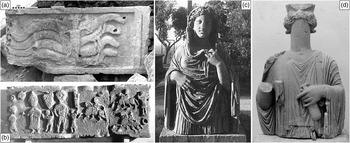
The photographs and records collected over the last century not only provide us with a crucial visual aid to exemplify stylistically distinct architectural elements and sculpture, but they also highlight the existence of pieces that have disappeared since they were recorded. For instance, the Roman-period mausoleum at Chormet el-Busaila in the Tripolitanian jebel was first recorded and photographed by Brogan in 1969, and again by Brogan and Kenrick in 1971 during their expedition to the Jebel Nefusa (Brogan Reference Brogan1970–71). This mausoleum was richly decorated with relief sculpture and statues, which can be divided into three sets of imagery: ocean deities, wild animals and portrait statues (Figure 3a). This monument with its decorations has long since disappeared, but photographs show that the sculpted pieces bear the iconic traces of Roman-period Tripolitanian funerary sculpture: disproportionate figures with large almond-shaped eyes, large heads and smaller bodies (Nikolaus Reference Nikolaus2017). Furthermore, it is conceivable that pieces that have long since been lost are now likely to reappear on the black art market. Stone-carved reliefs and statues similar to those of Chormet el-Busaila decorated mausolea across Tripolitania and are very distinctive to that region in terms of style and subject (Figure 3b).
a) Sculpted relief with ocean deity from Chormet el-Busaila; b) Sculpted relief with human figures from Ghirza; c) ‘Goddess of Death’ with facial features from Cyrene; d) Aniconic ‘Goddess of Death’ from Cyrene. (Photographs: Society for Libyan Studies Archive.)

For information and photographs about funerary sculpture from Cyrene, the Thorn archive is invaluable. Thorn collected not only his personal photographs and records in his archive, but also a variety of materials previously recorded by Rowe, Buttle, Cassels and Jowett (Leitch and Nikolaus Reference Leitch and Nikolaus2015, 155). The numerous images of statues with facial features similar to the ‘Goddess of Death’ seized in London in 2013 (Figure 3c), as well as the aniconic variant of this same type (Figure 3d), will aid in the identification of pieces of similar appearance that are smuggled out of Libya under false provenance. In addition to these archival materials, more recent photographs of relevant sculptures, decorations and architectural elements represent a further set of information to describe the current state of these objects. Such images are principally sourced from publications and from private photographic collections that Libyan and other colleagues are kindly making available for the LAaR project. In many cases these latter include images of newly discovered pieces that will further enhance our digital reference collection.
Networking, collaboration and public engagement
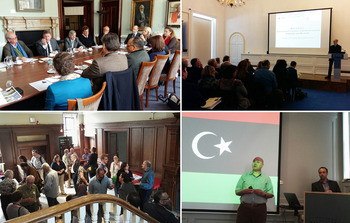
One of LAaR's principal achievements has been the continuous engagement with scholars, cultural heritage operators, experts and the general public through attendance and organisation of dedicated events (Figure 4). The one-day workshop on ‘Libyan Antiquities at Risk’ that we organised at the British Academy, London, in March 2016 was a key event, which featured a round-table discussion in the morning and in the afternoon a series of public presentations by English, French, German, Italian and Libyan researchers currently working on the cultural heritage of Libya and the MENA zone. The workshop had the merit of bringing together individuals who do not normally have many opportunities to speak to each other and exchange information: a range of academics, cultural heritage professionals from UNESCO, ICOM and the Art Loss Register, law experts, curators of the British Museum, officers of the Art and Antiques Unit of the Metropolitan Police, and professional antiquities dealers. The papers included in this special issue of Libyan Studies have mostly been developed from the presentations at the workshop.
Above: Round table and workshop at the British Academy, London, March 2016. Below: Event at the New Walk Museum and Art Gallery, Leicester, May 2016. (Photographs: Niccolò Mugnai and Julia Nikolaus.)

A second event organised as part of the LAaR project, entitled ‘Antiquities at Risk: North Africa and the Middle East’, took place at the New Walk Museum and Art Gallery in Leicester in May 2016. It was targeted at the general public, more specifically the Libyan community of Leicester and groups of migrants and refugees from other countries of the Middle East. The principal focus of the debate was the relationship between cultural heritage and local communities.
The LAaR team also attended events organised by other institutions to further strengthen networks and international partnerships: the ‘Illicit Trafficking of Antiquities' workshop run by the FBI, the US Department of State and Oberlin College at the British School at Rome and American Academy in Rome in February 2016 (Kane, this volume); the ‘Art Theft and Vandalism’ colloquium organised by the AHRC-funded ‘Art, Crime and Criminals: Painting Fresh Pictures of Art Theft, Fraud and Plunder’ project at Queen Mary University of London in June 2016. Finally, the LAaR team gave two lectures illustrating the project's progress at the University of Leicester (July 2016) and for the Society for Libyan Studies at University College London (February 2017).
Discussion with colleagues and experts on these occasions proved to be particularly informative and helped us to recognise a series of issues that must be taken into serious account. With regard to illicit trafficking of antiquities, we must acknowledge that this is constantly growing and becoming a large-scale phenomenon (Brodie Reference Brodie2015). Newly established free ports, such as Bangkok in Thailand, serve as a base for a worldwide redistribution of these objects in addition to ‘usual suspect’ locations like Switzerland and some countries of Eastern Europe (Kane, pers. comm.). The legal background of illicit trade of art and antiquities is not as straightforward as one may assume (Ulph and Smith Reference Ulph and Smith2012, 1–77) and any projects dealing with cultural heritage protection need to work in close contact with law experts (see also Francioni and Godley Reference Francioni and Godley2013). Furthermore, UK-based police have limited resources and personnel, especially when compared with international police units such as the Comando Carabinieri per la Tutela del Patrimonio Culturale and Interpol. For this reason, we need to provide efficient and easily accessible tools to support the Metropolitan Police in this task. It is essential that we improve communication and exchange of information among academics, police, cultural heritage operators and professional dealers about antiquities that are, or may be, missing and that are likely to appear on the illegal market at some point. The involvement of professional art and antiquities dealers in this dialogue is of crucial importance, as they can provide first-hand information about the circulation of objects of suspicious provenance. It is evident that illicit trafficking has negative impacts on the legal trade as well.
Feedback and comments we received from Libyan colleagues and the general public have helped us to plan the project's future directions, as they offered a direct insight into what the main problems and needs of the Libyan people are. One of the most common issues in countries such as Libya, but also elsewhere in North Africa and the Middle East, is the fact that most local people do not know, or are misinformed, about the importance of their own cultural heritage. Monuments and antiquities of the pre-Islamic period, whether Punic, Greek, Roman or Byzantine, are not perceived as part of the Libyan cultural identity and are regarded as ‘other’ than Libyan. Even elements of the Islamic heritage are subject to indifference or targeted destruction, because of religious differences within Islam between orthodox views and regional traditions such as the Sufi and Ibadi persuasions. Much of the worst deliberate destruction of monuments since 2011 has involved extremist Salafist groups targeting mosques and marabout tombs. The potential impacts on the associated Islamic artefacts including decorated tilework, mosque lamps and others need urgent evaluation.
The lack of engagement with pre-Islamic cultures among the populations of the Maghrebian countries can be traced to the events of the modern colonial period. There is a prevailing view that the archaeological heritage of the Graeco-Roman era is nothing but a predecessor of twentieth-century colonialism (Mattingly Reference Mattingly2011, 43–72, for a detailed discussion). This line of thought is, of course, a direct outcome of Gaddafi's regime, a legacy that is still deeply rooted in the country despite the events of the Arab Spring (Kane Reference Kane2015, 210; Kenrick Reference Kenrick and Ensoli2012, 145). The key to improved protection for Libya's endangered archaeological sites and portable heritage lies in education and programmes aimed at creating a clearer sense of the modern relevance and social value of this heritage.
Some archaeologists from local universities and the DoA are currently involved in the organisation of lectures, visits of archaeological sites (especially Cyrene) and other related events for school children and adults in an attempt to raise public awareness among the Libyan community of the importance of its rich heritage (Abdulkariem Reference Abdulkariem2013; Abdulkariem and Bennett Reference Abdulkariem and Bennett2014, 160). Providing training programmes to foster these locally based activities is surely a way to improve a more direct engagement of the Libyan people. Improvement of local education, starting from primary school, is a long-term solution to teach the next generations of Libyans to appreciate and protect their cultural heritage.
In the short term, the most pressing concern is the need to prevent or at least significantly reduce the looting of ancient monuments and smuggling of antiquities out of Libya. Our Libyan colleagues and friends have unanimously recommended that a tool like the LAaR database and website should be effectively translated into Arabic, so that they can be accessed by a much larger number of users. This is precisely the direction we envisage the project will take in the next stage, as the ultimate success of the project will depend on its uptake and development in Libya, by and for Libyans.
Conclusion
The first phase of LAaR has identified some initial categories of portable artefacts that are potentially vulnerable to trafficking to the antiquities market. We have initially focused on funerary sculptures from East and West Libya as these are distinctive categories of artefact whose Libyan provenance can be established on stylistic and typological grounds. Moreover, we have firm evidence that smugglers linked to the illicit antiquities trade are already targeting the funerary statues from Cyrenaica. We have created a database structure and a baseline of relevant records that can be expanded as the project progresses in coming years. We have also initiated discussions between a range of stakeholders and agencies with an interest in helping to combat this trade. We are currently submitting funding applications to allow us to enter the second stage of the project, for which we have developed a number of key aims:
-
1) Expanding the scope and scale of the categories of artefact included in the database. As before, we see the prime criterion for inclusion of an artefact is that it should be something that is distinctively of a Libyan provenance. Some possible artefact types include figural elements of mosaics, wall paintings and rock art that could be cut out from larger fields; stone cinerary urns, inscriptions in Libyan, Latin, Greek, Punic and Arabic script that may contextually indicate a Libyan origin, other types of sculpture, Islamic tilework and so on.
-
2) Creating a fully functional Arabic edition of the database and website. This will provide a more effective platform for the participation of Libyans to work with us on populating the database, checking materials on the ground and, ultimately, adapting such tools to their needs, including the use of the materials in educational initiatives to promote greater public awareness and engagement with the heritage.
-
3) Developing the website further. This will enable it to serve not only as a portal to the database, but also as a place where Libyans, foreign missions and others can post information about damage to sites, theft of artefacts and other threats to the heritage.
-
4) Training and capacity building. We envisage several levels of this, with a first objective to ensure that the DoA and the Libyan universities dealing with cultural heritage are able to use and develop the database in their national context. We hope to promote the use of the database for didactic use and as an educational tool in the universities and schools in particular. Finally, training needs to be provided for police and customs officials so that they are more aware of the nature of material likely to be illegally exported.
-
5) Building on the international contacts and networks. Our experience to date shows the importance of having a coordinated and interconnected response to the illicit antiquities trade and a free flow of information between agencies and stakeholders. This initiative includes not only those who attended our outreach events in 2016, but also members of other projects engaged in similar work across the MENA region, with the aim of maximising the effectiveness and the reach of such projects in and beyond Libya.
-
6) Researching and applying the use of new technologies (e.g. facial recognition) to facilitate use of the website by police and customs officials. An image of the potentially stolen piece can be run through our database, where the image recognition software can match it up to other, very similar, artefacts.
-
7) Raising public awareness about the importance of Libyan artefacts to local history to prevent their sale on the art market in the future. To achieve this, we intend to work together with schoolteachers, developing didactic material and games by using images from our website to engage Libyan children in their cultural heritage.
Acknowledgements
While Susan Walker and David Mattingly are the principal investigators (PIs) on the project, the two project research associates, Niccolò Mugnai and Julia Nikolaus, have from the beginning played a leading role in developing and delivering this project. Although drawing on the expertise and experience of the PIs, this is very much their project. Funding for the initial phase of the work has come from the Society for Libyan Studies and the Arts and Humanities Research Council, through its Cultural Engagement Fellowship scheme. Support in kind has also come from the University of Leicester, where the project has been based, alongside the Archive of the Society for Libyan Studies.