The limitations of conventional paper charts for capturing, storing, and sharing medical information are significant and contribute to errors in medical care.Reference Gearing, Olney, Davis, Lozano, Smith and Friedman1 Patient and family access to medical records is limited by the cost, time, and inconvenience of copyingReference Fioriglio and Szolovits2 and carrying bulky paper-based records. Patients are reluctant to ask for access to their paper records during hospitalisations, and their motives for doing so are often misinterpreted by caregivers.Reference Altman, Reich, Kelly and Rogers3 Electronic Health Records and Personal Health Records have been developed to address these deficiencies, leveraging the power of automated data capture, legibility, and on-demand availability.Reference Shekelle, Morton and Keeler4, Reference Halamka, Mandl and Tang5 Patient’s access to electronic health records became a federal mandate in 2004,Reference Bush6 and early reports of patients with chronic disease have shown benefit from effective medical information systems.Reference Dorr, Bonner and Cohen7 Complex congenital cardiac disease uniquely exposes the limitations of conventional medical information exchange. Patients with congenital cardiac disease generate large volumes of complex imaging data and reports; they may travel great distances to specialised centres for procedures and often require multiple-staged operations over their lifetimes.
Personal health records have been designed for paediatric patients, enabling them to access and manage their own medical information;Reference Wang, Pizziferri and Volk8 however, barriers to adoption are significant.Reference Britto and Wimberg9 The complexity of importing multimedia hospital data, configuring, and maintaining the record system is significant. We hypothesised that a web-based patient-accessible electronic health record could be created by a medical team as a subset of their clinical electronic health record. This system would be free to patients, and they could be taught to use the system while in hospital. The study hospitals would retain control of the Electronic Health Record while creating a unique link between their patients and physicians. We tested the hypothesis that a web-based patient-accessible electronic health record would be used by patients with congenital cardiac disease and their families. We examined the utility of including operative images and daily bedside pictures of each patient in the patient-accessible electronic health record. We studied the patterns of utilisation to test our assumptions about frequency of use over time, in-hospital versus out-of-hospital use, and the types of information patients and families would find most useful. We documented the security and reliability of the system.
Materials and methods
Security and privacy
The study was granted institutional review board exemption by the Western Institutional Review Board on 26 February, 2008. All patients routinely signed consent to have patient information stored in an electronic health record, which would include operative images and daily bedside images. For patients undergoing elective surgery, on their pre-operative day, each adult patient or minor patient’s family was given a user name and password. They were then instructed in the login procedure by the cardiac surgery nurse practitioner performing the pre-operative teaching protocol. For patients undergoing urgent or emergent surgery, patients were instructed on system use before discharge. At the age of 18 years, the system automatically alerted users that the patient now had legal control of the record and prompted them to enter a new password. The system was designed with 128-bit encryption to meet or exceed current hospital Health Insurance Portability and Accountability Act (HIPAA)10 requirements for electronic health records. Security events were monitored continuously during the study period.
System design
The cardiac surgical team used a web-based electronic health record (I-Rounds© Clinical by Teges, LLC, Dallas, Texas, United States of America) to capture and store information on all patients admitted for cardiac care to Miami Children’s Hospital. In 2006, members of the cardiac team met with several families to discuss the potential usefulness of a web-based health record, which could be accessible to the patients and their families during and after discharge from the hospital. The clinical team then conducted a series of meetings with the hospital medical records department, legal team, cardiac intensive care unit nursing team, and HIPAA compliance officer to discuss what would become the patient-accessible version of the clinical electronic health record. On the basis of these meetings, the software development team chose four pages from the comprehensive clinical electronic health record for initial inclusion in the patient-accessible electronic health record, and determined when each page would be activated for patient use. The cardiac team decided on the chosen pages that they felt were most likely to be useful to a patient or family during hospitalisation and after discharge. It was understood that elements could be added, removed, or modified at any time, and the timing of activation could be changed based on feedback from the clinical team and the patient users.
The pages included two sources of text data and two sources of imaging data:
Text Data
• History and physical report: The history and physical report page was chosen as a concise compilation of all daily progress notes, which could be used by parents when communicating with physicians, school health personnel, insurance companies, or when researching their child’s condition on the Internet. Daily progress notes were not made available as the development team felt that this might inhibit the medical team from completely describing complications and problems. The attending physician in the cardiac intensive care unit wrote the discharge summary on the day of discharge. The summary included all diagnoses, operations, and procedures, and recorded any pertinent complications, persistent problems, residual lesions, and plans for further care. These notes were generated as part of the routine cardiac intensive care unit and ward rounds and were automatically uploaded to the electronic health record in real time by the cardiac intensive care unit staff. This page was activated in the patient-accessible electronic health record on the day of discharge.
• Patient care instructions: The patient’s discharge instructions were included as a web-based back-up to the written sheet of discharge instructions, routinely given to the family by the nurse practitioners during discharge planning. Instructions were written by the cardiac nurse practitioners after attending rounds on the ward, based on instructions from the attending cardiologist and automatically uploaded to the patient-accessible electronic health record. The instructions included a list of medications and dosage instructions. This page was activated on the day of discharge.
Imaging data
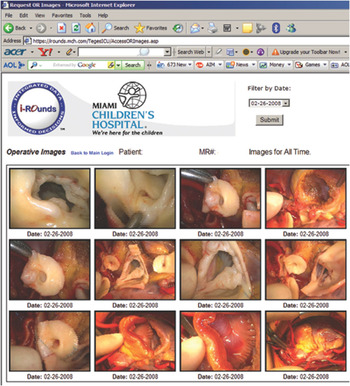
• Operative Images: Intra-operative images of each patient’s congenital cardiac lesion were routinely captured in the operating room by the surgeonsReference Burke, Michielon and Wernovsky11 (Fig 1). These images were automatically uploaded to the electronic health record and the patient-accessible electronic health record in the operating room by the nursing staff. The surgeons routinely used printouts of these images in meetings with families immediately after surgery to describe each lesion and explain the repair techniques. These images were intended to provide patients and families with an accurate representation of their congenital cardiac defects and confirmation of the surgical repair. This page was activated in the patient-accessible electronic health record on the day of surgery.
Figure 1Operative imaging page from the patient-accessible electronic health record showed lesions before and after repair.

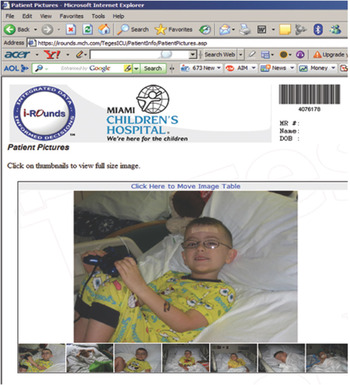
• Daily bedside images: Bedside images of each patient were captured by the cardiac nurse practitioners with digital cameras every morning and were immediately uploaded by the nurse to the electronic health record and the Patient-accessible electronic health record (Fig 2). The images were taken with the intent of showing each patient’s current condition. The images were arranged in sequence to create a time-lapse montage of the patient’s hospital course. This page was activated in the patient-accessible electronic health record on the day of admission.
Figure 2Daily bedside image page from the patient-accessible electronic health record showed the daily post-operative images sequentially by date. The pre-discharge image is enlarged.


The patient-accessible electronic health record system was designed to automatically record each patient or family login by date and time and measured the frequency of views for each page, allowing the clinical team to measure those parts of the patient-accessible electronic health record that were being utilised, and at what time during or after each patient’s hospitalisation. The study institution published a patient bill of rights, clearly stating the patient’s right to view their medical records and the medical record department routinely documented all such requests. These requests were reviewed for all patients admitted to the congenital cardiac service during the study period.
Statistical analysis
Data were expressed as means or medians with ranges, as appropriate. Median values were compared for non-normal distributions with the Mann–Whitney rank-sum test. All analyses were performed with SigmaStat® statistical software (version 3.1, Systat Software Inc., Point Richmond, California, United States of America). All p-values of less than 0.05 were considered statistically significant.
Results
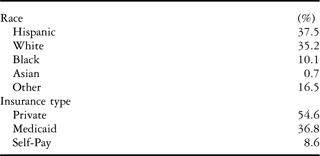
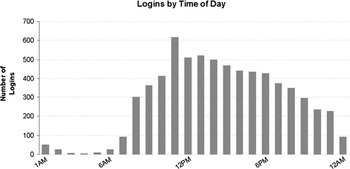
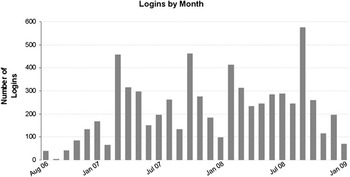
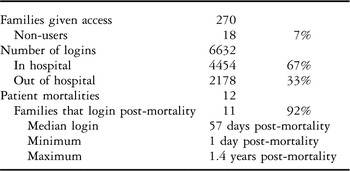
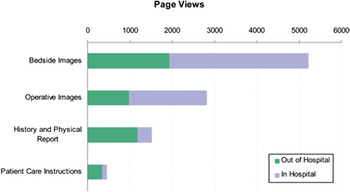
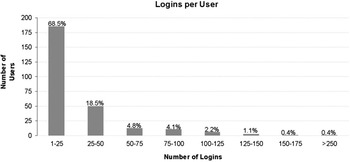
Of the first 270 patients offered access to the system, 252 became users (93% adoption rate). Study group demographics (race and insurance type) are listed in Table 1. There were no Internet security events (defined as unauthorised access of a patient’s record) during the study period. The system uptime for the web-based patient-accessible electronic health record was 99.9%. Patients accessed the system at every hour of the day, with peak utilisation at 11 am (Fig 3). The frequency of all system logins by month is shown in Figure 4. Utilisation patterns showed that users accessed their patient-accessible electronic health records significantly more often while the patients were in hospital (median of 6 logins) than after discharge (median of 4 logins, p ⩽ 0.001; Table 2). There were significantly more views of imaging data (median of 8 page views) than of textual data (median of 5 views, p ⩽ 0.001; Fig 5). The maximum number of logins by a family was 440 and the minimum was 1. The average number of logins per family was 25. Thirty-five families (13%) logged in over 50 times and 11 families (4%) logged in over 100 times (Fig 6). Twelve patients with access to their patient-accessible electronic health record died during the study period, and 11 of their families continued to access their records after the patient had died. Two families continued to access their patient-accessible electronic health records more than a year after their child’s death (Table 2). No patients or families requested to view their paper charts during the study period.
Patient race and insurance information.

Patient-accessible electronic health record logins by time of day.

Patient-accessible electronic health record logins by month.

Utilisation patterns of families given access to the patient-accessible electronic health record.

Non-users are defined as families that did not login after the initial teaching login
Frequency of page views, in hospital and out of hospital, by patients and families using the patient-accessible electronic health record.

Distribution of users by frequency of patient-accessible electronic health record logins.

Discussion
Families caring for a child with chronic disease have an acute and ongoing need for a legible, understandable, transportable, and accessible record of their child’s illness and medical treatment. The optimal interaction of patients, hospitals, physicians, traditional electronic health record companies, and emerging personal health record vendors to provide useful health records for patients is unknown. This study showed the feasibility of developing a patient-accessible web-based electronic health record, which was a subset of the patient’s clinical record. The system was designed with input from the study hospital’s legal, medical record, physician, nursing, and HIPAA compliance teams. Patients and families were able to access the system at any time of day, from any location, with any web-enabled device. There were no reported issues of browser incompatibility, no security events, and no reported violations of HIPAA regulations. The study hospital retained flexible control of the medical information and was able to modify in real time the elements of the electronic health record that they made accessible to the patient and family, for example, labs, notes, summaries, images etc., and the timing of that access, during or after the hospitalisation.
The patient-accessible electronic health record adoption rate was 93%. We did not specifically measure factors enhancing system adoption; however, we believe that the high rate could be attributed to the following factors:
• The system was provided to the patient, without charge, by the hospital.
• The system was made accessible during and after hospitalisation. Having caregivers train families to access the system created a shared experience with the clinical team and ensured that the teaching process was successful before discharge. This also allowed the family to monitor the patient in real time during hospitalisation and to share their child’s progress with remote friends, family, and consultants on demand.
• The system did not require the patient or family to upload and configure medical data. Widely available personal health record systems like Google Health (Google Inc., Mountain View, California, United States of America), WebMD Health Manager (WebMD, LLC, New York, New York, United States of America), and HealthVault (Microsoft Corporation, Redmond, Washington, United States of America)Reference Weitzman, Kaci and Mandl12 often require the patient to actively enter their data or pay a company to import and configure data for them.
• The study system did not rely on advertising as a revenue model, so that patients were not exposed to advertisements while accessing the interface.
• The system was simple and intuitive to use.
• Historically, patients have rarely viewed their medical charts, and those who did were often characterised by the medical staff as being litigious, having psychological problems, or seeking secondary gain.Reference Altman, Reich, Kelly and Rogers13 Accessing the patient electronic health record was not confrontational – patients were empowered to view their record anonymously, on demand.
We are aware of the potential socio-economic barriers to access the InternetReference Mandl, Feit, Pena and Kohane14 and the potential for personal bias in offering the system to patients and families. We did not determine whether this web-based patient-accessible electronic health record could be used by all patients, regardless of socio-economic, educational, or racial backgrounds, and realise that there may be patients who lack access to the Internet, and yet would benefit from a web-based health record.Reference Kind, Huang, Farr and Pomerantz15 We intend to persist in our investigations and explore these questions. We found anecdotally that families without home computers or Internet accounts would gain access to the Internet through relatives, friends, neighbours, and their local libraries to access their patient-accessible electronic health record.
Imaging data seem to create a strong incentive to use the system. Images were incorporated to take full advantage of what Edward Tufte called “The Picture Superiority Effect”Reference Tufte16 – the power of images to convey complex information. Awareness of this effect has been leveraged in social networking sites like CarePages (CarePages Inc., New York, United States of America), Facebook (Facebook Inc., Palo Alto, California, United States of America), and MySpace (Fox Interactive Media Beverly Hills, California, United States of America), where online communities have evolved around shared medical conditions and images are routinely uploaded and shared.Reference Randeree17 We relied on this concept to enhance system use, but we did not specifically measure whether the presence or absence of images in the system influenced our adoption rate. We intend to use the high frequency of logins to the imaging pages as a guide for future system design. We would hypothesise that satisfaction surveys and outcomes research questionnaires would be best embedded in an imaging page to increase user response rate.
We showed unexpected utilisation patterns of the electronic health record. Families used the patient-accessible electronic health record most frequently while the patient was hospitalised, in contrast to our rare observations of families accessing paper charts during hospitalisations. Current patient-accessible electronic health record development has focused on enabling patients to access information when they are out of the hospital; however, our findings suggest that family access to the electronic health record may be just as useful to them while they are hospitalised, even though they theoretically have direct access to information through their caregivers. Families had on-demand access to the operative and daily bedside images and could share these in real time, eliciting observations and concerns from remote observers. Families were empowered to discuss these observations with the medical team. These potential interactions would not be possible with paper charts or with commercially available patient-controlled health records, which are not synchronised in real time with the hospital electronic health record. We also heard anecdotal reports of patients using their patient-accessible electronic health record after discharge to inform their paediatricians and cardiologists about their child’s surgery, including a family who presented to an emergency room after surgery and used their patient-accessible electronic health record to inform the emergency room physicians about their child’s operation and discharge medications.
Families continued to access the patient-accessible electronic health record after the patients had died. No clear patterns of frequency or duration of logins after death emerged. Evidence suggests that photographic images provide a powerful emotional support for parents and siblings as they endure the stages of grieving.Reference Fanos, Little and Edwards18, Reference Capitulo19 We did not measure the impact of the patient-accessible electronic health record on the parental grieving process; however, our awareness of this post mortem utilisation will guide us in development. We understand that many of these families continue to be part of our virtual community, for an unpredictable period of time, after their child has died. End-of-life decision making remains emotionally challenging for paediatric medical teams.Reference Garros, Rosychuk and Cox20 Images may become a useful support for parents facing end-of-life decisions for a critically ill child. Daily sequential bedside images over time showing severe clinical deterioration could be used to show the arc of a patient’s deterioration in a visual way, for families, caregivers, and ethics committee members considering an allow natural death decision.
The complexity of constructing, maintaining, and understanding a health record constitutes an opportunity for caregivers to strengthen their relationship with the patient and family by creating a free and intuitive electronic health record interface and by ensuring its accessibility before discharge. It is important to provide patients and family members with this information during hospitalisation when it may stimulate and enable critical communication with the medical team. This initial experience with a web-based patient-accessible electronic health record for patients with congenital cardiac disease and their families creates a platform for future investigation and innovation. There are clear opportunities for hospitals to maintain communication with patients as long-term clients, for caregivers and researchers to connect with their patients and families, and for patients and families to network with others facing similar medical challenges.