Introduction
A core feature of schizophrenia is a widespread cognitive impairment encompassing several domains (Kahn & Keefe, Reference Kahn and Keefe2013). Among these, social cognition represents the interface between emotional and cognitive processing, while neurocognition involves general information acquiring and processing functions. Both social cognition and neurocognition were found to be predictors of functional outcome (Brekke et al. Reference Brekke, Hoe, Long and Green2007; Fett et al. Reference Fett, Viechtbauer, Dominguez, Penn, van Os and Krabbendam2011; Barbato et al. Reference Barbato, Liu, Penn, Keefe, Perkins, Woods and Addington2013), with social cognition mediating the interaction between neurocognition and daily functioning (Brekke et al. Reference Brekke, Kay, Lee and Green2005). The interplay between social cognition and neurocognition is not yet completely clarified. Nevertheless, social cognition seems to represent a more complex domain, which requires intact neurocognition as a ‘necessary but not sufficient’ prerequisite (Penn et al. Reference Penn, Corrigan, Bentall, Racenstein and Newman1997a , Reference Penn, Spaulding, Reed, Sullivan, Mueser and Hope b ; Fanning et al. Reference Fanning, Bell and Fiszdon2012; Mehta et al. Reference Mehta, Thirthalli, Subbakrishna, Gangadhar, Eack and Keshavan2013).
In recent years different integrated interventions have been developed, targeting both cognitive and psychosocial deficits (Bell et al. Reference Bell, Bryson, Greig, Corcoran and Wexler2001; Hogarty et al. Reference Hogarty, Flesher, Ulrich, Carter, Greenwald, Pogue-Geile, Kechavan, Cooley, DiBarry, Garrett, Parepally and Zoretich2004; Galderisi et al. Reference Galderisi, Piegari, Mucci, Acerra, Luciano, Rabasca, Santucci, Valente, Volpe, Mastantuono and Maj2010; Lindenmayer et al. Reference Lindenmayer, McGurk, Khan, Kaushik, Thanju, Hoffman, Valdez, Wance and Herrmann2013; Medalia & Saperstein, Reference Medalia and Saperstein2013). Although still heterogeneous, results mainly show that combined rehabilitation programmes have a greater impact than single interventions on functional outcome, suggesting that social cognitive rehabilitation programmes in schizophrenia should also include neurocognitive interventions. However, the specific role of different factors involved in this synergic interaction has not yet been unravelled and predictors of intervention outcomes are still lacking. A deeper investigation of the mutual relationship between neurocognition, social cognition and their capacity to improve is thus needed, in order to better define which cognitive domains could predict intervention outcomes.
In this view, one of the main features of social cognition classified as a key predictor of interpersonal functioning impairment is represented by Theory of Mind (ToM), defined as the ability to reflect upon one's own and other persons’ mental states including desires, beliefs, knowledge, intentions and feelings (Frith & Frith, Reference Frith and Frith2003). Different studies argued that ToM does not represent a monolithic process, but rather a set of networks including cognitive and affective processing (Brothers & Ring, Reference Brothers and Ring1992; Shamay-Tsoory et al. Reference Shamay-Tsoory, Shur, Harari and Levkovitz2007). This dichotomy is explained by the presence of ‘cold’ and ‘hot’ aspects of ToM, where the cold or cognitive dimension pertains to inferences about knowledge and beliefs, while the hot or affective dimension pertains to inferences about emotions.
As reported by Frith's notion, ToM impairments in schizophrenia are intrinsically diverse and dependent on symptomatology (Frith & Corcoran, Reference Frith and Corcoran1996; Mazza et al. Reference Mazza, DeRisio, Surian, Roncone and Casacchia2001; Pickup & Frith, Reference Pickup and Frith2001; Stewart et al. Reference Stewart, Corcoran and Drake2008; Corcoran et al. Reference Corcoran, Bentall, Rowse, Moore, Cummins, Blackwood, Howard and Shryane2011) and paranoia appears of particular relevance. It has thus been hypothesized that paranoid patients possess basic capabilities to represent mental states; however, they utilize contextual information inappropriately, inducing incorrect social inferences and quantitatively ‘over-generating’ hypotheses or ‘over-attributing’ significance and intents to events, persons and inanimate objects. In this regard, it was also hypothesized the presence of an ‘hyper-ToM’ of paranoid patients (Abu-Akel & Bailey, Reference Abu-Akel and Bailey2000).
The relationship between paranoid symptoms and performance on ToM tasks might also be confounded by cognitive ability, as persecutory deluded patients tend to be less cognitively impaired (Pickup & Frith, Reference Pickup and Frith2001; Abu-Akel & Abushua'leh, Reference Abu-Akel and Abushua'leh2004). However, whereas some studies have demonstrated an association between ToM impairment and paranoid delusions, others have reported inconsistent findings due to several methodological and conceptual inconsistencies across studies (see Corcoran & Kaiser, Reference Corcoran, Kaiser, Freeman, Bentall and Garety2008, for a review). Given these notions, psychopathology represents another element that could mediate outcome variability of metacognitive interventions (Mehta et al. Reference Mehta, Thirthalli, Subbakrishna, Gangadhar, Eack and Keshavan2013). In this view, different authors focused on metacognitive training effect on psychopathology, reporting an inverse association between social cognitive abilities and both negative and positive symptoms.
We recently developed two different social cognitive interventions, with the objective of improving mentalizing abilities in patients with schizophrenia: Social Cognitive Training (SCT), based on the use of videotaped material and addressed to both emotion recognition and ToM skills, and Theory of Mind Intervention (ToMI), focused on the two distinct aspects of ToM (hot and cold) through the use of comic strips. In previous prospective controlled studies, we demonstrated the effectiveness of both programmes in improving ToM performance, compared to usual rehabilitative interventions (Bechi et al. Reference Bechi, Riccaboni, Ali, Fresi, Buonocore, Bosia, Cocchi, Smeraldi and Cavallaro2012, Reference Bechi, Spangaro, Bosia, Zanoletti, Fresi, Buonocore, Cocchi, Guglielmino, Smeraldi and Cavallaro2013).
In this study we aimed at comparing the efficacy of two newly developed social cognitive interventions, respectively based on the use of videotaped material and comic strips, combined with domain-specific Cognitive Remediation Therapy (CRT) on measures of ToM and daily functioning. The secondary objective was to evaluate possible predictors of training outcome, including neurocognitive and psychopathological variables. In detail, we examined the possible effect of both basal neurocognitive performance and the degree of cognitive improvement after CRT on ToM outcome and we specifically investigated the role of paranoid symptoms on both basal ToM performance and ToM improvement after trainings.
Materials and method
Subjects
Seventy-five outpatients were recruited from the Department of Clinical Neurosciences, IRCCS San Raffaele Scientific Institute, Milan. They all met DSM IV-R criteria for schizophrenia, as determined by trained psychiatrists through clinical interview. All patients were clinically stabilized and treated with a stable dose of the same antipsychotic therapy for at least 3 months. Exclusion criteria were: substance dependence or abuse, co-morbid diagnosis on Axis I or II, major neurological illness, perinatal trauma and mental retardation.
All subjects provided informed consent to a protocol approved by the local Ethical Committee, following the principles of the Declaration of Helsinki.
Design
This study was performed as a randomized controlled clinical trial. We compared three groups of patients affected by schizophrenia who were administered with domain-specific CRT and randomly assigned to: (1) an active control group consisting of newspaper discussion (ACG, n = 19); (2) a video-based social cognitive training (SCT, n = 24); and (3) a Theory of Mind Intervention (ToMI, n = 32).
Assessments
All patients were assessed for psychopathology, intellectual level, daily functioning, ToM and neurocognitive domains before starting CRT. Neuropsychological functions were re-evaluated at the end of CRT, while the assessment of daily functioning and ToM abilities was repeated at the end of experimental treatments.
Psychopathology was assessed by means of the Positive and Negative Syndrome Scale (PANSS; Kay et al. Reference Kay, Fiszbein and Opler1987), administered by trained psychiatrists.
Daily functioning was assessed with the Quality of Life Scale (QLS; Heinrichs et al. Reference Heinrichs, Hanlon and Carpenter1984), a semi-structured interview made up of 21 items that evaluates three different areas of social functioning. It is structured in three subscales, respectively evaluating interpersonal relations; work abilities and self-directedness, including intrapsychic foundations; and common objects and activities. The scale was administered by trained rehabilitation therapists who routinely use all of these measures and who had demonstrated adequate reliability at routine reliability checks. The raters were blind to the randomization and neuropsychological assessment.
Intellectual functioning was assessed by means of the Wechsler Adult Intelligence Scale – Revised (WAIS-R; Wechsler, Reference Wechsler2006).
Neurocognitive deficits were evaluated with the Italian A-B versions of the Brief Assessment of Cognition in Schizophrenia (BACS; Keefe et al. Reference Keefe, Goldberg, Harvey, Gold, Poe and Coughenour2004; Anselmetti et al. Reference Anselmetti, Poletti, Ermoli, Bechi, Cappa, Venneri, Smeraldi and Cavallaro2008). It includes the following tasks: word recall (verbal memory), digit sequencing (working memory), token motor task (psychomotor speed and coordination), symbol coding (processing speed), semantic and phonemic fluency (verbal fluency) and Tower of London (ToL) (executive functions - planning). The Wisconsin Card Sorting Test (WCST; Stratta et al. Reference Stratta, Arduini, Daneluzzo, Rinaldi, Di Genova and Rossi2004) was administered to evaluate executive functioning, in the subcomponent of cognitive flexibility.
ToM was assessed using the Theory of Mind Picture Sequencing Task (PST A-B versions; Brüne, Reference Brüne, Brune, Ribbert and Schiefenhovel2003a ), consisting of six cartoon picture stories depicting (1) two scenarios where two characters cooperate, (2) two scenarios where one character deceives a second character and (3) two scenarios with two characters cooperating to deceive a third. In the Sequencing task, measure of non-verbal ToM processing (Brüne, Reference Brüne2003b ), four cards were presented face-down in mixed order, the participants were asked to turn the cards over and to order them in a logical sequence of events, two points were given for the first and last correctly sequenced cards and one point each for correct sequencing of the two middle cards. In addition, a ToM questionnaire with 23 questions was administered to the subjects to test their ability to appreciate the mental states of the characters involved in the cartoon stories, as a measure of cognitive ToM. The questions referred to the mental states of the characters according to different levels of complexity and included first to third false belief questions, questions involving the understanding of cheating detection and two reality questions, basically included to rule out major attention problems. An answer was considered incorrect and scored 0 if involving errors about the facts depicted in the story or inappropriate inference on characters’ mental states, motivations or beliefs (Brüne, Reference Brüne, Brune, Ribbert and Schiefenhovel2003a ). The variables of interest of this study were: Total Sequencing score, Total Questionnaire score and PST Total score as global measure of ToM abilities. As previously reported by our group (Bechi et al. Reference Bechi, Riccaboni, Ali, Fresi, Buonocore, Bosia, Cocchi, Smeraldi and Cavallaro2012), this scale shows a good internal consistency (Cronbach's α coefficient = 0.86). The raters assessing pre- and post-treatments were blind to group assignment of the participants, and they were nt the therapists who completed the interventions.
Interventions
The ToMI was conducted by trained psychotherapists over five modules divided into 18 sessions (1-h session twice a week) on groups of about five members, using comic strips and cartoons depicting human social interactions. The modules were executed in increasing order of complexity, with the first three modules focusing on cognitive ToM and the last two on affective ToM. Assuming that ToM difficulties in schizophrenia are associated with an inability to extract relevant data from the context (Frith & Corcoran, Reference Frith and Corcoran1996; Pickup & Frith, Reference Pickup and Frith2001), we trained patients to recognize the relevant details, to collect every concrete and meaningful piece of information they saw (place, time, characters’ actions and physical features), to read the verbal part of comic strips and to identify literal meaning. Then we asked patients to interpret hidden meanings using all the information collected and to further hypothesize interpretations, based on expressed emotions, relationships between characters, implicit motivations and mental states. Answers were read aloud and then patients had to assign a title to the story. A guided discussion of each hypotheses followed (more details in Bechi et al. Reference Bechi, Spangaro, Bosia, Zanoletti, Fresi, Buonocore, Cocchi, Guglielmino, Smeraldi and Cavallaro2013).
The SCT was conducted by trained psychotherapists over 12 weeks (one 1-h sessions/week) on groups of about five members, using short videos depicting human social interactions, selected from international movies. Scenes lasted between 30 s and 70 s and imply recognition of emotions and ToM abilities in order to be correctly comprehended. In each session, two or three clips were presented and could be viewed several times, according to the requests of the patients. A guided discussion of hypotheses followed (more details in Bechi et al. Reference Bechi, Riccaboni, Ali, Fresi, Buonocore, Bosia, Cocchi, Smeraldi and Cavallaro2012).
In the ACG patients were involved in a newspaper discussion group over 16 weeks (one 1-h session/week). This intervention was conducted by psychotherapists and rehabilitation therapists on groups of about five subjects. Patients read newspaper articles about recent local news and political issues and were then asked to summarize the most important information from articles. Participants were then encouraged to express their opinions on topics. As in Aghotor et al. (Reference Aghotor, Pfueller, Moritz, Weisbrod and Roesch-Ely2010), the main goal was to reduce speech blockage and communication difficulties, and thereby foster social interaction skills.
CRT consisted of two 1-h sessions/week of domain-specific computer-aided exercises (Cogpack Software; http://www.markersoftware.com/) lasting 12 weeks. This programme includes different neurocognitive exercises, such as ‘Solve a labyrinth’, ‘Memory’, and ‘Stroop task’, aimed at training specific cognitive areas among the ones known to be impaired in schizophrenia (verbal memory, verbal fluency, psychomotor speed and coordination, executive function, working memory, attention) Most exercises are adaptive and the computer sets the level of difficulty, based on the patient's performance during the course of the session. Sets of exercises were individually created for each patient, based on baseline neuropsychological performance (Cavallaro et al. Reference Cavallaro, Anselmetti, Poletti, Bechi, Ermoli, Cocchi, Stratta, Vita, Rossi and Smeraldi2009). They all had started CRT in the last 4 months before group interventions and were reassessed when 24 CRT sessions were completed. All patients completed CRT within 3 weeks from the start of the group interventions.
There was no significant differences in degree of participation and compliance among group interventions and CRT (see Supplementary Fig. S1).
Data analysis
Analysis of variance (ANOVA) and χ 2 test (for dichotomic variables) were performed on demographic, clinical, daily functioning, neuropsychological, IQ and ToM variables to evaluate differences between groups. ToM variables were also analysed for gender differences.
Pearson correlation analysis between ToM measures at baseline and BACS subscores were performed, followed by Bonferroni correction.
Pre- to post-treatment changes in ToMI, SCT or ACG groups were analysed with repeated-measures ANOVAs (2 × 3, p < 0.05, two-tailed) entering ToM measures as dependent variable, time as within-subjects factor and treatment group as independent variable. Tukey's honestly significant difference (Tukey HSD) post-hoc test followed.
The magnitude of changes after social cognitive and neurocognitive treatments were then estimated using Cohen's d (Cohen, Reference Cohen1998).
To compare the effects of ToMI and SCT on ToM improvement, a one-way ANOVA was performed with ToM change (pre-treatment score subtracted from post-treatment sccore) as dependent variable and group (ToMI v. SCT) as independent variable.
To evaluate if ToM improvement after combined treatments (ToMI + CRT or SCT + CRT) is related to neurocognitive improvement, Pearson correlations between cognitive and ToM improvements (pre-treatment scores subtracted from post-treatment scores) were performed.
To analyse the influence of IQ, neuropsychological performance at baseline and cognitive changes on ToM improvement, we then included them as covariates in an ANCOVA, with change in ToM scores as dependent variable, and group as independent variable.
Pre- to post-treatment changes in daily functioning of ToMI, SCT or ACG groups were analysed with repeated-measures ANOVAs (2 × 3, p < 0.05, two-tailed) entering QLS scores as dependent variable, time as within-subjects factor and treatment group as independent variable.
We then divided the sample in two subgroups, i.e. paranoid and non-paranoid, based on the presence v. absence of persecutory delusions in patient's clinical history, in order to evaluate possible influences of paranoia dimension on ToM performance and ToM improvement after social cognitive treatments. ANOVAs were performed on neuropsychological and ToM variables to evaluate differences between paranoid and non-paranoid subgroups. Pearson correlations between ToM measures and BACS subscores at baseline were performed and corrected with the Bonferroni test.
Pre- to post-treatment changes in ToM performance, after ToMI and SCT or ACG respectively, were calculated by means of repeated-measures ANOVA (2 × 2, p < 0.05, two-tailed) entering ToM measures as dependent variable, time as within-subjects factor and group (paranoid v. non-paranoid patients) as independent variable. Tukey's HSD post-hoc test followed.
Raw scores of tests were used for the analysis.
Results
Basal descriptive analysis
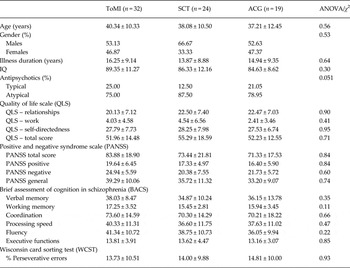
Sample characteristics and neuropsychological performance at baseline are shown in Table 1. No significant differences were observed between groups for demographic and clinical variables. Gender-related differences in basal ToM performance were tested, but no significant differences emerged between males and females.
Demographic and clinical data in the treatment groups

ToMI, Theory of Mind Intervention; SCT, social cognitive training; ACG, active control group.
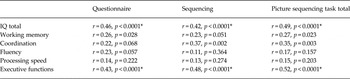
Pearson correlation was performed between neuropsychological measures and ToM performance. After Bonferroni correction, significant correlations were observed between Total IQ and Questionnaire (r = 0.46, p = 0.00), Sequencing (r = 0.42. p = 0.00), PST total score (r = 0.48, p = 0.00) and between ToL and Questionnaire (r = 0.43, p = 0.00), Sequencing (r = 0.48, p = 0.00) and PST Total score (r = 0.52, p = 0.00). Results are presented in Table 2.
Correlations between neuropsychological measures and ToM performances

* Significant correlations Bonferroni corrected.
Treatment effects
The ANOVAs showed significant time (pre- v. post-treatment) × group (ToMI, SCT, ACG) interactions in PST Total score and Questionnaire (Table 3). SCT and ToMI groups improved significantly from pre- to post-test in all ToM measures except Sequencing (which lost significance after multiple comparison correction only in SCT group), whereas ACG did not.
ToM performances at baseline and after treatments (repeated-measures ANOVAs)

ToMI, Theory of Mind Intervention; SCT, social cognitive training; ACG, active control group.
Repeated measures (pre- to post-treatment mean scores) and interaction effects are reported.
* Significant within-group differences indicated; p values refer to Tukey post-hoc.
** Significant group × time interactions indicated.
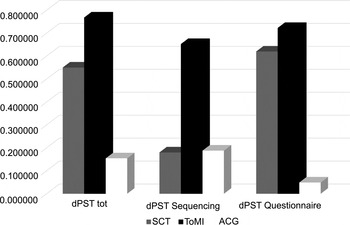
Improvements in ToM measures of Questionnaire, Sequencing and PST Total score after ToMI and SCT corresponded to medium effect sizes, as shown in Fig. 1. The ANOVA showed no significant differences in ToM improvement between ToMI and SCT.
Effect sizes of ToM task improvement after treatments. ToMI, Theory of Mind Intervention; SCT, social cognitive training; ACG, active control group; PST, Picture Sequencing Task.

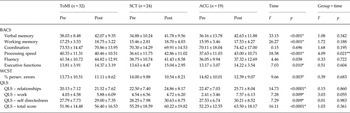
The ANOVAs showed significant improvements in most neurocognitive measures assessed with BACS and WCST (verbal memory, digit sequencing, symbol coding, WCST % of perseverative errors) without any differences between treatment groups, except for Symbol Coding task (Table 4). At post-hoc Tukey test, re-test of Symbol Coding performance was significantly different compared to baseline among patients in the SCT group (p < 0.0001) and ACG (p = 0.03) but not for the ToMI group, probably due to the higher basal mean, even if not statistically different.
Neurocognitive performances and daily functioning at baseline and after treatments (repeated-measures ANOVAs)

ToMI, Theory of Mind Intervention; SCT, social cognitive training; ACG, active control group; BACS, Brief Assessment of Cognition in Schizophrenia; WCST, Wisconsin Card Sorting Test; QLS, Quality of Life Scale.
Repeated measures (pre- to post-treatment mean scores) and interaction effects are reported.
* Significant within-group differences indicated.
** Significant group × time interactions indicated.
The ANOVAs also showed significant improvements in all daily functioning areas assessed with QLS, without any differences between treatment groups (Table 4).
To examine possible influences of IQ, neuropsychological measures and neuropsychological improvement after CRT on changes in ToM measures after treatment, Pearson correlations were performed for each single group, but no significant results were observed.
Since both IQ and ToL performance significantly correlated with basal ToM abilities, we performed ANCOVAs, with effect size of PST Total score as dependent variable, group as independent variable and IQ, ToL and improvement after CRT as covariates. However, we did not observe any significant effects of covariates and still found the group effect. Therefore, results seem to depend on treatment and not to be affected by IQ, ToL, nor improvement after CRT.
Testing ‘paranoia’ effects on ToM performance and improvements
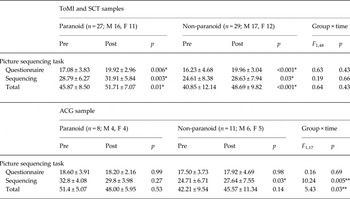
To examine possible influences of the presence of persecutory delusions on ToM performance and improvement after treatments, we divided the sample into two subgroups: paranoid v. non-paranoid. At baseline, there was no significant difference between groups in demographic, clinical, neuropsychological variables and IQ, except for r ToM measures and executive functions. Patients with persecutory delusions showed better performance in PST Total score (F = 6.71, p = 0.012) and ToL score (F = 4.20, p = 0.044).
To test the possible influence of ToL on ToM performance, Pearson correlations were performed in each group. After Bonferroni correction, significant correlations were observed between ToL and PST Total Score (paranoid group: r = 0.36, p = 0.03; non-paranoid group: r = 0.48, p = 0.00), Total Sequencing score (paranoid group: r = 0.42, p = 0.01; non-paranoid group: r = 0.40, p = 0.00) and Questionnaire (r = 0.53, p = 0.00 only in the non-paranoid group).
The ANOVAs showed no significant time (pre- v. post-treatment) × group (paranoid v. non-paranoid patients) interaction on PST variables after ToMI and SCT (Table 5). As revealed by post-hoc Tukey HSD test, both paranoid and non-paranoid groups improved significantly after treatment.
ToM performances at baseline and after treatments in paranoid v. non-paranoid subgroups (repeated-measures ANOVAs)

ToMI, Theory of Mind Intervention; SCT, social cognitive training; ACG, active control group.
Repeated measures (pre- to post- treatment changes) and interaction effects are reported.
* Significant within-group differences marked; p values refer to Tukey post-hoc.
** Significant group × time interactions marked.
After ACG, ANOVAs showed significant time (pre- v. post-treatment) × group (paranoid v. non-paranoid patients) interaction on PST Total score and Sequencing. As shown in Table 5, the absence of persecutory delusions was associated with greater improvement.
Discussion
In this study, we investigated possible influences of neurocognitve rehabilitation and specific factors associated with ToM basal performance on ToM training outcomes, in order to reach a better understanding of complex relationships between cognitive deficits in schizophrenia and their possible role as predictors of treatment efficacy.
Our results confirm the efficacy of ToMI and SCT treatments in increasing social cognitive abilities in patients affected by schizophrenia. Although no statistically significant differences were observed between ToMI and SCT in improving ToM abilities, at a descriptive level, our data suggest a slight superiority of ToMI, especially in the non-verbal component (PST Sequencing score), consistent with previous findings (Galderisi et al. Reference Galderisi, Piegari, Mucci, Acerra, Luciano, Rabasca, Santucci, Valente, Volpe, Mastantuono and Maj2010). We also evaluated daily functioning, observing an overall quality of life improvement, with no differences between treatment groups. The improvement confirms the global efficacy of the rehabilitative interventions on functional outcome of patients. However, it is also possible that putative differences between treatment groups will emerge during follow-up, as it has been previously reported that the benefit of rehabilitation on functioning persist and increase over time (Cavallaro et al. Reference Cavallaro, Anselmetti, Poletti, Bechi, Ermoli, Cocchi, Stratta, Vita, Rossi and Smeraldi2009; Poletti et al. Reference Poletti, Anselmetti, Bechi, Ermoli, Bosia, Smeraldi and Cavallaro2010). We can hypothesize that ToM training may lead to an amelioration in daily abilities only after a certain period of time, during which patients ‘digest and practice’ the strategies learned from the ToM interventions.
Moreover, we reported a correlation between ToM functioning, executive functions and IQ at baseline, but these abilities did not influence final improvements in ToM, as reported in our previous study (Bechi et al. Reference Bechi, Spangaro, Bosia, Zanoletti, Fresi, Buonocore, Cocchi, Guglielmino, Smeraldi and Cavallaro2013).
We then analysed possible interaction effects of CRTs combined with ToM intervention. Unlike some previous findings (Moritz & Woodward, Reference Moritz and Woodward2007; Wölwer & Frommann, Reference Wölwer and Frommann2011; Lindenmayer et al. Reference Lindenmayer, McGurk, Khan, Kaushik, Thanju, Hoffman, Valdez, Wance and Herrmann2013), our results showed an independence between effects of the two treatments. Indeed, we reported no effects on ToM outcome of the CRT neurocognitive improvement, also for the processing speed task that did not show a significant improvement in the ToMI group. This lack of improvement may be due to the fact that mean baseline performance was slightly, although not significantly, higher in this group.
At baseline, the only neurocognitive domain correlated with ToM was represented by executive functions, suggesting that a deficit in this area may contribute to impaired performance in ToM-dependent tasks. However, changes in ToM performance after social cognitive interventions were independent from CRT improvement in executive functions. We can hypothesize that when social cognitive abilities are not sufficient to adequately perform ToM tasks, other abilities, such as IQ and executive functions, may partially compensate for such limitations, acting as a sort of ‘cognitive-metacognitive reserve’. Therefore, if improved with specific training, social cognitive abilities would not need to be supported by such reserve. This hypothesis agrees in principles with the model wherein neurocognition and social cognition are associated to a meaningful degree and could overlap in some related functions (Hoe et al. Reference Hoe, Nakagami, Green and Brekke2012; Ventura et al. Reference Ventura, Wood and Hellemann2013). In the ACG only a small improvement was observed on ToM functioning (PST Total: d = 0.15), supporting the partial independence of neurocognitive and social cognitive networks.
Another goal of this study was the analysis of the role of psychopathology on ToM functioning and improvement. We particularly focused on the presence of persecutory delusions, since relationships between paranoid symptoms and cognitive functions may lead to a misrepresented comprehension of real cognitive abilities, with higher results in ToM tasks compared to everyday life social functioning (Pickup & Frith, Reference Pickup and Frith2001; Chan & Chen, Reference Chan and Chen2011).
In our sample, patients with persecutory delusions showed higher performance at baseline in executive functions and ToM abilities compared to non-paranoid group, consistent with previous findings (Pickup & Frith, Reference Pickup and Frith2001). Interestingly, among patients assigned to the social cognitive treatments, we did not find any significant effects of ‘paranoia’ on ToM measures, as both paranoid and non-paranoid patients significantly improved. In the ACG significant effects were observed for PST Sequencing and Total scores. In particular, significant differences between pre- and post-test scores were observed only in the non-paranoid subgroup, suggesting that CRT and/or groups encouraging social interaction may have a significant, yet slight, effect on ToM abilities in non-paranoid patients. It is possible to speculate that the underlying social cognitive network may operate in different ways between the two subgroups, with paranoid patients carrying diverse specific ToM difficulties. Paranoid patients may possess higher basic capabilities to represent mental states and have greater ‘offline’ ToM abilities; on the other hand, they utilize contextual information inappropriately, inducing incorrect ‘online’ social inference. Indeed, paranoid patients do not have a less impaired ToM, but rather a different alteration of ToM with a propensity to over-mentalize and over-refer significance that may lead to a maladaptive ToM functions, partially independent from basal neurocognitive functioning. Our results suggest that this over-mentalizing shows no compensation from neurocognition, further supporting the ‘hyper-ToM’ theory (Abu-Akel & Bailey, Reference Abu-Akel and Bailey2000). For this reason, a more specific intervention focused on ‘real life’ mentalizing abilities, despite neurocognitive abilities, could be more effective among paranoid patients.
A number of limitations to our research should be taken into account. First, we tested a relatively small sample size in which the effect of possible confounding factors could not be ruled out, particularly regarding the influence of paranoia. Further studies involving a larger sample of patients may help in better understanding the effects of different interventions and their relationships, also taking into account paranoia as a controlled variable in assignment of treatment. Moreover an interesting development of this work could be the analysis of possible influences of ToM intervention on CRT improvements. Second, our study was not performed with a ToM-only control group and it was not possible to verify the objective effect of social cognitive intervention as proposed by Lindenmayer et al. (Reference Lindenmayer, McGurk, Khan, Kaushik, Thanju, Hoffman, Valdez, Wance and Herrmann2013) and the possible higher efficacy of treatments interactions compared to a single rehabilitative treatment.
In conclusion, we presented one of the few head-to-head trials between two social cognitive interventions. In our opinion this could be of great importance in order to evaluate possible differences between therapies. Our study shows that both ToMI and SCT are effective in improving ToM in schizophrenia and that outcomes are not influenced by basal social cognitive and neurocognitive functioning, nor by the cognitive improvement after CRT. Moreover, these interventions are of particular relevance because in the future we anticipate a broader deliverability of the training allowing easy application to all patients with schizophrenia.
In addition, our data suggest that paranoid symptoms may discriminate between different types of ToM impairment in schizophrenia: in patients without persecutory delusion ToM impairment seems more strongly associated with neurocognition, particularly executive functions. These results may lead to future developments in non-pharmacological treatments of schizophrenia, in order to reach a more specific intervention tailored on individual needs of patients affected by such a heterogeneous disease.
Supplementary material
For supplementary material accompanying this paper visit http://dx.doi.org/10.1017/S0033291715001129.