Introduction
The lichen genus Maronina (Lecanoraceae) was originally described for two tropical species known from Australia and South America [M. australiensis Hafellner & Rogers, M. multifera (Nyl.) Hafellner & Rogers] (Hafellner & Rogers Reference Hafellner and Rogers1990). Subsequently, two additional species were described from Australia and Thailand, respectively (Kantvilas & Elix Reference Kantvilas and Elix2007; Kantvilas et al. Reference Kantvilas, Papong and Lumbsch2010). The genus is characterized by a crustose thallus with a trebouxioid photobiont, lecanorine apothecia, polyspored asci, hyaline, non-septate ascospores and bacilliform conidia (Hafellner & Rogers Reference Hafellner and Rogers1990; McCarthy Reference McCarthy, McCarthy and Mallett2004; Kantvilas & Elix Reference Kantvilas and Elix2007; Kantvilas et al. Reference Kantvilas, Papong and Lumbsch2010). The asci of the different Maronina species are variable but are connected through intermediate types and can be regarded as belonging to the ‘Maronina-type’: outer wall intensely amyloid; tholus well-developed, with intensely amyloid flanks and a generally weakly amyloid, fuzzy, masse axiale; ocular chamber poorly developed. A similar ascus type is found in Protoparmelia. The paraphyses of Maronina are likewise variable and range from robust, capitate and mainly simple, to slender, branched and anastomosing (Kantvilas et al. Reference Kantvilas, Papong and Lumbsch2010).
When describing the genus, Hafellner & Rogers (Reference Hafellner and Rogers1990) pointed out the close relationship of Maronina to Protoparmelia and noted that “Maronina may be regarded as a multispored derivative” (p. 102) of the latter genus. Interestingly, Nylander (Reference Nylander, Triana and Planchon1863) had already suggested a placement of M. multifera (as Lecanora multifera Nyl.) in the Lecanora badia group (now Protoparmelia).
The phylogenetic placement of Maronina and its relationships to Protoparmelia were unknown, and previous attempts to obtain DNA sequence data failed. Recently, the first author was able to collect fresh material of both taxa of Maronina present in Thailand and new attempts to obtain DNA sequences were successful. We have, however, not been able to obtain DNA sequence data from the type species of Maronina. We present the results of our phylogenetic analysis based on these sequence data, which, together with the morphological and chemical evidence obtained previously (Kantvilas & Elix Reference Kantvilas and Elix2007; Kantvilas et al. Reference Kantvilas, Papong and Lumbsch2010), have enabled us to evaluate the phylogenetic relationship of this group of lichenized fungi.
Material and Methods
Morphological and chemical examination
The study is based on collections housed in MSUT, and on duplicates and reference specimens in F and HO. Anatomical and morphological observations and chemical studies were performed as described previously (Kantvilas et al. Reference Kantvilas, Papong and Lumbsch2010).
Molecular methods
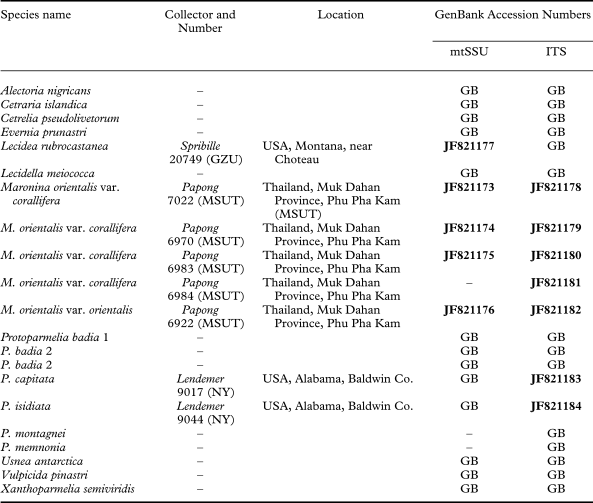
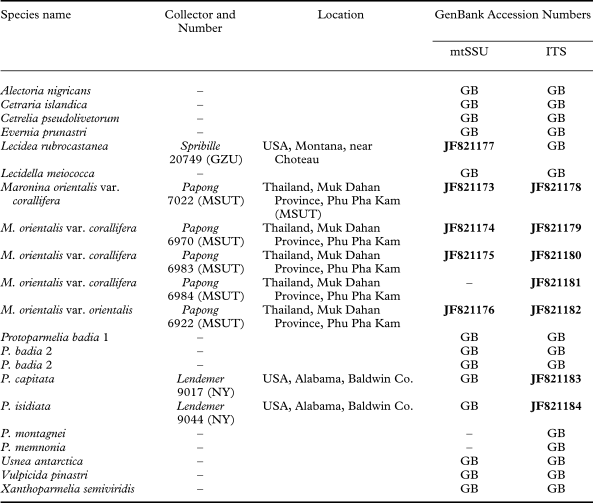
Sequence data of 15 species (with four samples for the two currently accepted varieties of Maronina orientalis) were assembled using sequences of the mitochondrial small subunit and nuclear ITS rDNA (Table 1), with newly obtained sequences from Lecidea rubrocastanea, Maronina orientalis, M. orientalis var. corallifera, Protoparmelia capitata and P. isidiata. Seven species of Parmeliaceae were included in the data set, since this family has been shown previously to be closely related to Protoparmelia and the genus is often classified within this family, albeit with reservations (Arup et al. Reference Arup, Ekman, Grube, Mattsson and Wedin2007; Crespo et al. Reference Crespo, Lumbsch, Mattsson, Blanco, Divakar, Articus, Wiklund, Bawingan and Wedin2007, Reference Crespo, Kauff, Divakar, Amo, Arguello, Blanco, Cubas, del Prado, Elix and Esslinger2010; Lumbsch & Huhndorf Reference Lumbsch and Huhndorf2010). We also included Lecidea rubrocastanea, another taxon that has been proposed to be closely related to Parmeliaceae (Spribille & Printzen Reference Spribille and Printzen2007) in our sampling. Sample preparation, DNA isolation, PCR and direct sequencing were performed as described previously (Mangold et al. Reference Mangold, Martin, Lücking and Lumbsch2008; Wirtz et al. Reference Wirtz, Printzen and Lumbsch2008). Primers for amplification were: mr SSU1 (Zoller et al. Reference Zoller, Scheidegger and Sperisen1999) and MSU 7 (Zhou & Stanosz Reference Zhou and Stanosz2001) for mtSSU and ITS1F, and ITS4R (Gardes & Bruns Reference Gardes and Bruns1993) for ITS rDNA. Sequence fragments obtained were assembled with SeqMan 4.03 (DNASTAR) and manually adjusted.
Species and specimens used in the present study, with location, reference collection details and GenBank accession numbers. Newly obtained sequences are in bold
Sequence alignments and phylogenetic analysis
Alignments were done using Clustal W (Thompson et al. Reference Thompson, Higgins and Gibson1994). Ambiguously aligned regions were removed manually. The alignments were analyzed by maximum likelihood (ML) and a Bayesian approach (B/MCMC). Maximum likelihood analyses were performed using the program GARLI (Zwickl Reference Zwickl2006), employing the general time reversible model of nucleotide substitution (Rodriguez et al. Reference Rodriguez, Oliver, Marin and Medina1990), including estimation of invariant sites, and assuming a discrete gamma distribution with six rate categories. Bootstrapping (Felsenstein Reference Felsenstein1985) was performed based on 2000 replicates. The B/MCMC analysis was conducted using the MrBayes 3.1.2 program (Huelsenbeck & Ronquist Reference Huelsenbeck and Ronquist2001), using the same substitution model as in the ML analysis. A run with 20 000 000 generations, starting with a random tree and employing 4 simultaneous chains, was executed. Every 100th tree was saved into a file. The first 500 000 generations (i.e. the first 5000 trees) were deleted as the ‘burn in’ of the chain. We used AWTY (Nylander et al. Reference Nylander, Wilgenbusch, Warren and Swofford2007) to compare splits frequencies in the different runs and to plot cumulative split frequencies to ensure that equilibrium was reached. Of the remaining 390 000 trees (1925 000 from each of the parallel runs) a majority rule consensus tree with average branch lengths was calculated using the sumt option of MrBayes. Posterior probabilities were obtained for each clade. Only clades that received bootstrap support equal or above 70% under ML, and posterior probabilities ≥ 0·95 were considered as strongly supported. Phylogenetic trees were visualized using the program Treeview (Page Reference Page1996).
We employed alternative hypothesis testing to evaluate whether our data are sufficient to reject Maronina as an independent clade separate from Protoparmelia. Two different methods were used for the hypothesis testing: 1) Shimodaira-Hasegawa (SH) test (Shimodaira & Hasegawa Reference Shimodaira and Hasegawa1999) and 2) expected likelihood weight (ELW) test following Strimmer & Rambaut (Strimmer & Rambaut Reference Strimmer and Rambaut2002). The SH and ELW tests were performed using Tree-PUZZLE 5.2 (Schmidt et al. Reference Schmidt, Strimmer, Vingron and von Haeseler2002) with the combined data set on a sample of 200 unique trees, the best trees agreeing with the null hypotheses, and the unconstrained ML tree. These trees were inferred in Tree-PUZZLE employing the GTR+I+G nucleotide substitution model. We also estimated genetic distances between the two varieties of Maronina orientalis on the ITS data set using Tree-PUZZLE under the GTR+I+G nucleotide substitution model.
Results and Discussion
Phenotypical evidence and phylogenetic analyses
The extent of overlap in many phenotypic characters of Protoparmelia and Maronina is startling. The similarity of ascus characters is discussed above and by Kantvilas et al. (Reference Kantvilas, Papong and Lumbsch2010). The anatomy of the cupulate excipulum as displayed by the species of Maronina and the type of Protoparmelia, P. badia, is identical and features a ± continuous layer of algal cells extending beneath the hypothecium (see also Henssen Reference Henssen, Daniels, Schutlz and Peine1995). Also similar are the relatively narrow ascospores, the brownish thallus and the common occurrence of depsidones, such as alectoronic acid. Whereas no single character is unique to both genera, their occurrence in combination supports their close relationship. Indeed the only character that unequivocally separates the genera is that of 8-spored versus polyspored asci, a feature seen within several other genera of lichenized fungi such as Candelariella and Scoliciosporum.
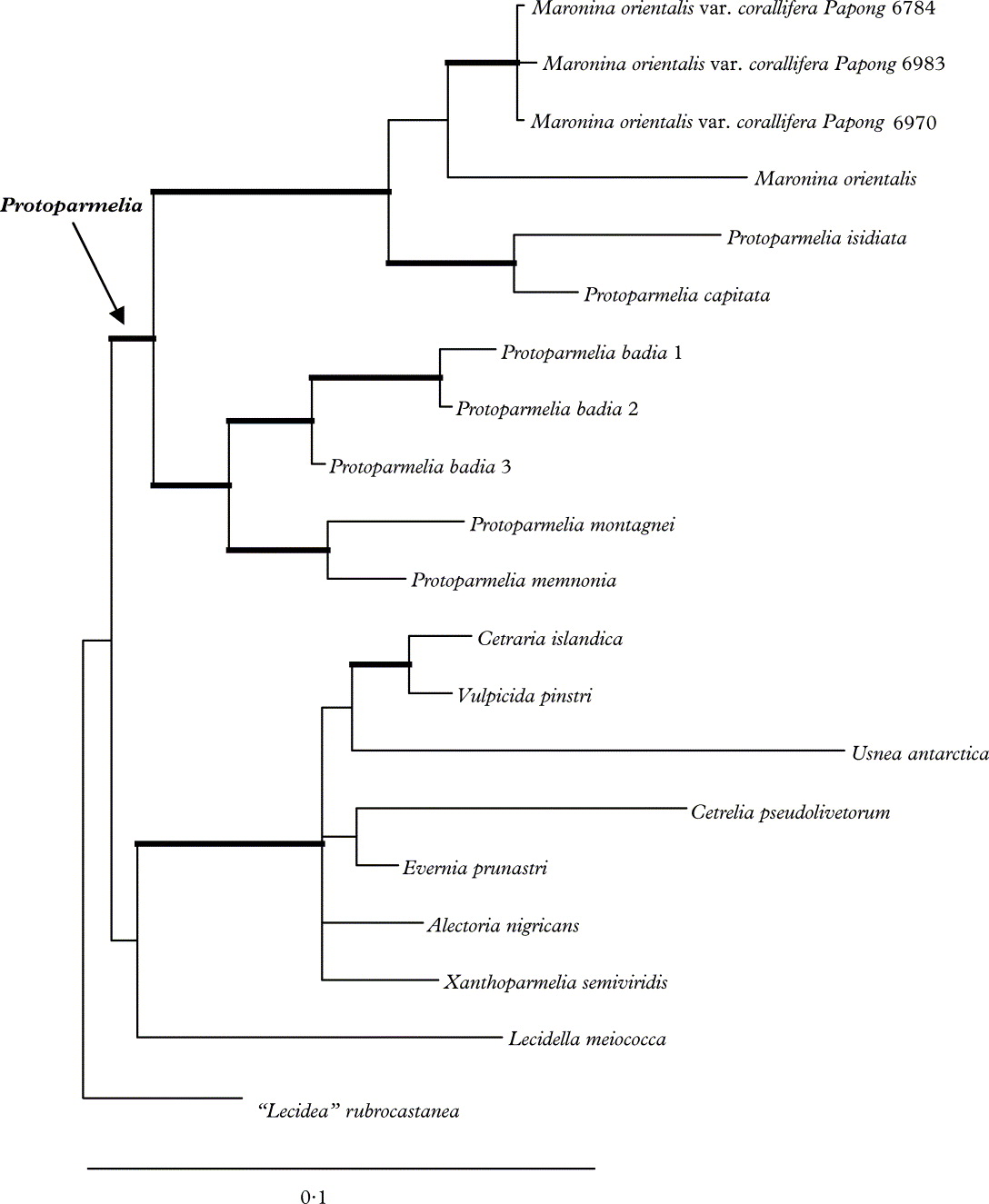
For the molecular analysis, the new sequences of Maronina orientalis and Lecidea rubrocastanea, Protoparmelia capitata and P. isidiata were aligned with sequences obtained from GenBank as listed in Table 1. A matrix of 938 unambiguously aligned nucleotide position characters was produced; 722 characters in the alignment were constant. ML analysis yielded a maximum likelihood tree that did not contradict the Bayesian tree topology. In the B/MCMC analysis of the combined data set, the likelihood parameters in the sample had the following mean (Variance): LnL = −3527·015 (0·31), while the likelihood of the ML tree was –3524·758.
Since the topologies of the ML and B/MCMC analyses did not show any strongly supported conflicts, only the tree from the ML analysis is shown (Fig. 1). The clustering of Maronina orientalis within Protoparmelia is strongly supported (ML-bootstrap support 99%, B/MCMC posterior probability 1·0); the two Maronina orientalis varieties form a strongly supported sister-group with a clade consisting of two corticolous tropical Protoparmelia species (P. capitata, P. isidiata). The clade with Maronina and the two corticolous Protoparmelia species itself forms a strongly supported sister-group relationship with a clade that includes three saxicolous, extratropical Protoparmelia species (P. badia, P. montagnei, P. memnonia); these three species also form a strongly supported monophyletic group. The Parmeliaceae excluding Protoparmelia forms a strongly supported monophyletic group. The poor taxon sampling from this group, however, does not allow any further conclusions for the phylogeny within this group and hence these relationships are not discussed further here. A potentially related genus is Gypsoplaca that was found by Arup et al. (Reference Arup, Ekman, Grube, Mattsson and Wedin2007) to be as closely related to Parmeliaceae s. str. as Protoparmelia. However, the genus was not included in this study since no DNA sequence of ITS and mtSSU rDNA is available in Genbank. We aligned the nuLSU rDNA sequences of Gypsoplaca and Protoparmelia (four sequences: DQ787365, DQ787366, DQ899296, DQ899298) and found them to be quite distinct (data not shown), supporting phenotypical evidence that the two genera are not closely related (Timdal Reference Timdal1990; Poelt & Gärtner Reference Poelt and Gärtner1992).
Optimal tree under maximum likelihood analysis from a concatenated alignment of mtSSU, and ITS DNA sequences showing phylogenetic placement of Maronina. Branches in bold received likelihood bootstrap support values above 70%, and posterior probabilities equal or above 0·95. The enlarged genus Protoparmelia (including Maronina) is marked with an arrow.
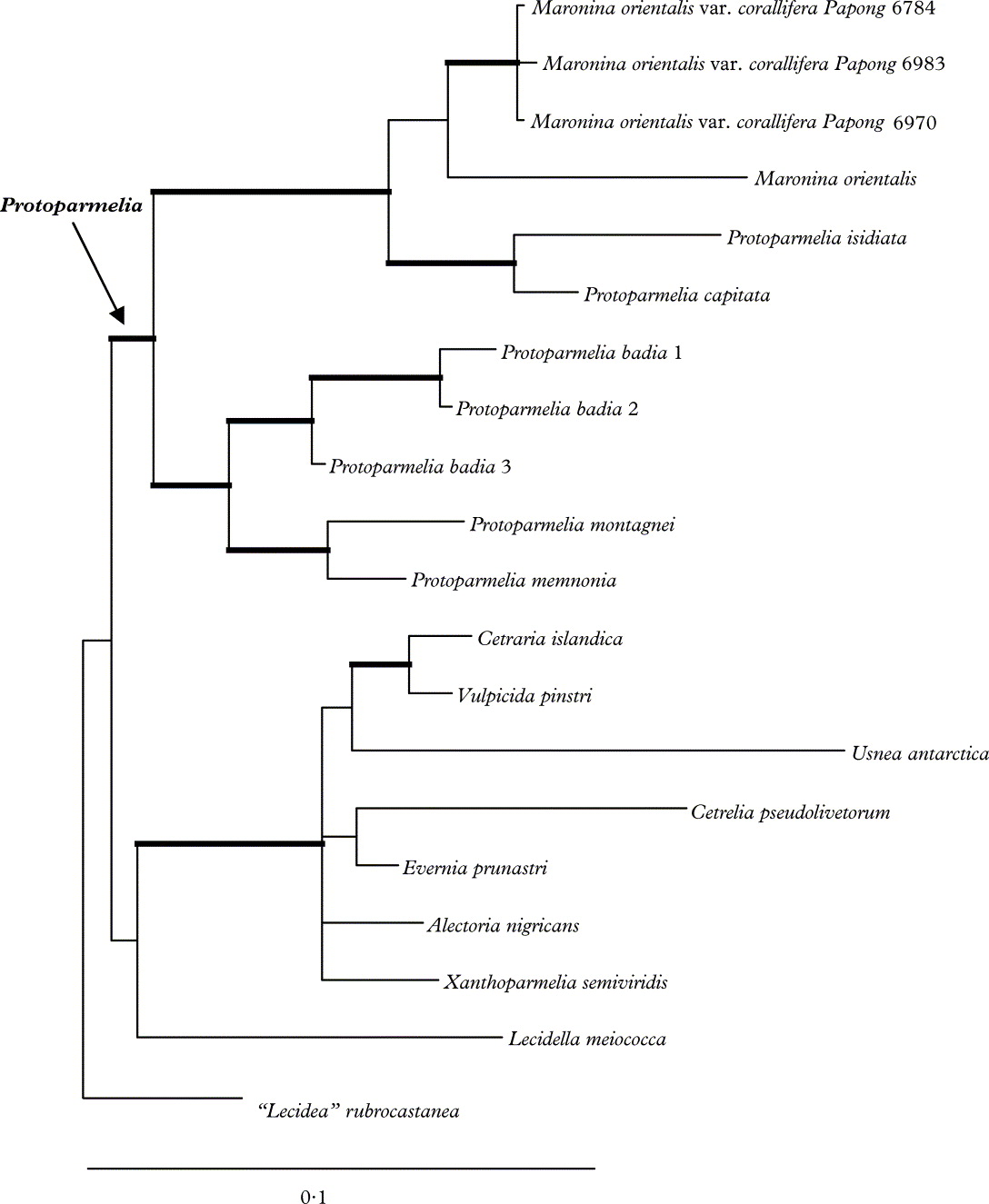
The alternative hypothesis testing significantly rejects a monophyly of Protoparmelia separate from Maronina (P ≤0·001 in SH and ELW tests).
Since the three samples of Maronina orientalis var. corallifera showed very low genetic variability, but were quite distinct from the sample of M. orientalis s. str. included in the combined analysis, we compared the genetic distances within and between Maronina varieties using the ITS data set with four samples for each taxon included (Table 1). The genetic variability within each variety was low (var. corallifera: 0·0092 [SD ±0·0041]; var. orientalis: 0·0059 [SD ±0·0023]) in comparison with the genetic distance between the two varieties (0·2872 [SD ±0·0087]). The latter is comparable to the distances to P. capitata (0·2891) and P. isidiata (0·2979). These results indicate that the morphologically different varieties are better distinguished at the species rank.
Within the genus Protoparmelia, the genetic distances found were high compared with those of taxa included in Parmeliaceae s. str. This may be caused by a younger age of the Parmeliaceae s. str. clade or an accelerated evolutionary rate in the Protoparmelia clade. With the data at hand we cannot address this issue any further.
Consequently, we propose here to enlarge the circumscription of Protoparmelia to include species with polyspored asci that were previously classified in the genus Maronina. Although we have not been able to obtain sequences of the type species of Maronina, we feel confident, based on phenotypical evidence, that Maronina is congeneric with Protoparmelia. Given the genetic distances and the morphological differences, we raise Maronina orientalis var. corallifera to the species level.
The revised classification
Protoparmelia M. Choisy
Bull. Soc. bot. Fr. 76: 523 (1929); type species: Protoparmelia badia (Hoffm.) Hafellner, Beih. Nova Hedwigia 79: 292 (1984).—Verrucaria badia Hoffm., Deutschl. Fl., Zweiter Theil (Erlangen) (1796). =Maronina Hafellner & R.W. Rogers, Bibl. Lichenol. 38: 100 (1990); type species: M. australiensis Hafellner & R.W. Rogers, Bibl. Lichenol. 38: 102 (1990).
Protoparmelia australiensis (Hafellner & R. W. Rogers) Kantvilas, Papong & Lumbsch comb. nov
MycoBank No.: MB561080
Bas.: Maronina australiensis Hafellner & R.W. Rogers, Bibl. Lichenol. 38: 102 (1990).
Protoparmelia corallifera (Kantvilas & Papong) Kantvilas, Papong & Lumbsch comb. et stat. nov
MycoBank No.: MB561083
Bas.: Maronina orientalis var. corallifera Kantvilas & Papong, Lichenologist 42: 559 (2010).
Protoparmelia hesperia (Kantvilas & Elix) Kantvilas, Papong & Lumbsch comb. nov
MycoBank No.: MB561084
Bas.: Maronina hesperia Kantvilas & Elix, Bibl. Lichenol. 96: 138 (2007).
Protoparmelia multifera (Nyl.) Kantvilas, Papong & Lumbsch comb. nov
MycoBank No.: MB561085
Bas.: Lecanora multifera Nyl., Acta Soc. Sci. Fenn. 7: 445 (1863). —Maronina multifera (Nyl.) Hafellner & R.W. Rogers, Bibl. Lichenol. 38: 106 (1990).
Protoparmelia orientalis (Kantvilas & Papong) Kantvilas, Papong & Lumbsch comb. nov
MycoBank No.: MB561086
Bas.: Maronina orientalis Kantvilas & Papong, Lichenologist 42: 557 (2010).
This study was financially supported by the Thailand Research Fund and the Research Division at Mahasarakham University, together with a Scholarship from the Field Museum to KP. We wish to thank James Lendemer (New York) and Toby Spribille (Graz) for allowing us to obtain sequences from material they collected.